
t8t95+:=t9
190 t7
−
2t7
+:=t7tsat
∆T67
K
+:=
CP
272.0 230.2−
10
kJ
kg K⋅
⋅:=β 1
Vliq
1.023 1.012−
20
⎛
⎜
⎝
⎞
⎠
⋅cm3
gm K⋅
⋅:=
We apply Eq. (7.25) for the calculation of the temperature change from point 6
to point 7. For this we need values of the heat capacity and volume expansivity
of water at about 60 degC. They can be estimated from data in Table F.1:
[Eq. (7.24)]
Wpump
V6P2P6
−
()
⋅
η
:=
P620 kPa⋅:=V6Vliq
:=H6Hliq
:=
Tsat tsat 273.15+
()
K⋅:=tsat 60.09:=
If we find t7, then t8 is the mid-temperature between t7 and t1(190 degC), and
that fixes the pressure of stream 4 so that its saturation temperature is 5 degC
higher. At point 6, we have saturated liquid at 20 kPa, and its properties from
Table F.2 are:
Svap 7.9094 kJ
kg K⋅
⋅:=Sliq 0.8321 kJ
kg K⋅
⋅:=
Vliq 1.017 cm3
gm
⋅:=Hvap 2609.9 kJ
kg
⋅:=Hliq 251.453 kJ
kg
⋅:=
At the exhaust conditions of 20 kPa, the properties of sat. liq. and sat.
vap. are:
Similar calculations are required for feedwater heater II.
282

∆V91.075 1.056−()
cm3
gm
⋅:= ∆V11.156 1.128−()
cm3
gm
⋅:=
∆T20K⋅:= β9
1
Vsat.9
∆V9
∆T
⋅:= β1
1
Vsat.1
∆V1
∆T
⋅:=
β98.92 10 4−
×1
K
= β11.226 10 3−
×1
K
=
Now we can make an energy balance on feedwater heater I to find the
mass of steam condensed:
At points 9 and 1, the streams are compressed liquid (P=6500 kPa), and we
find the effect of pressure on the liquid by Eq. (7.25). Values by
interpolation in Table F.1 at saturation temperatures t9 and t1:
Hsat.9 526.6 kJ
kg
⋅:= Vsat.9 1.065 cm3
gm
⋅:= Psat.9 234.9 kPa⋅:=
Hsat.1 807.5 kJ
kg
⋅:= Vsat.1 1.142 cm3
gm
⋅:= Psat.1 1255.1 kPa⋅:=
283

Wturbine WI1⋅kg⋅1kg⋅mI
−
()
H4H3
−
()
⋅+
1kg⋅mI
−mII
−
()
H5H4
−
()
⋅+
…:=
The work of the turbine is:
H52609.4 kJ
kg
=H5H2ηH’5H2
−
()
⋅+:=
Then
H’52.349 103
×kJ
kg
=x’50.889=
H’5Hliq x’5Hvap Hliq
−
()
⋅+:=x’5
S2Sliq
−
Svap Sliq
−
:=
The final stage of expansion in the turbine is to 20 kPa, where the exhaust is wet.
For isentropic expansion,
We can now make an energy balance on feedwater heater II to find the mass of
steam condensed:
H42.941 103
×kJ
kg
=
H4H2ηH’4H2
−
()
⋅+:=
Then
H’42763.2 kJ
kg
⋅:=
Isentropic expansion of steam from the initial conditions to this pressure results in
a slightly superheated vapor, for which by double interpolation in Table F.2:
The temperature at point 8, t8 = 130.38 (see above) is the saturation temperture in
feedwater heater II. The saturation pressure by interpolation in Table F.1 is
273.28 kPa.
284
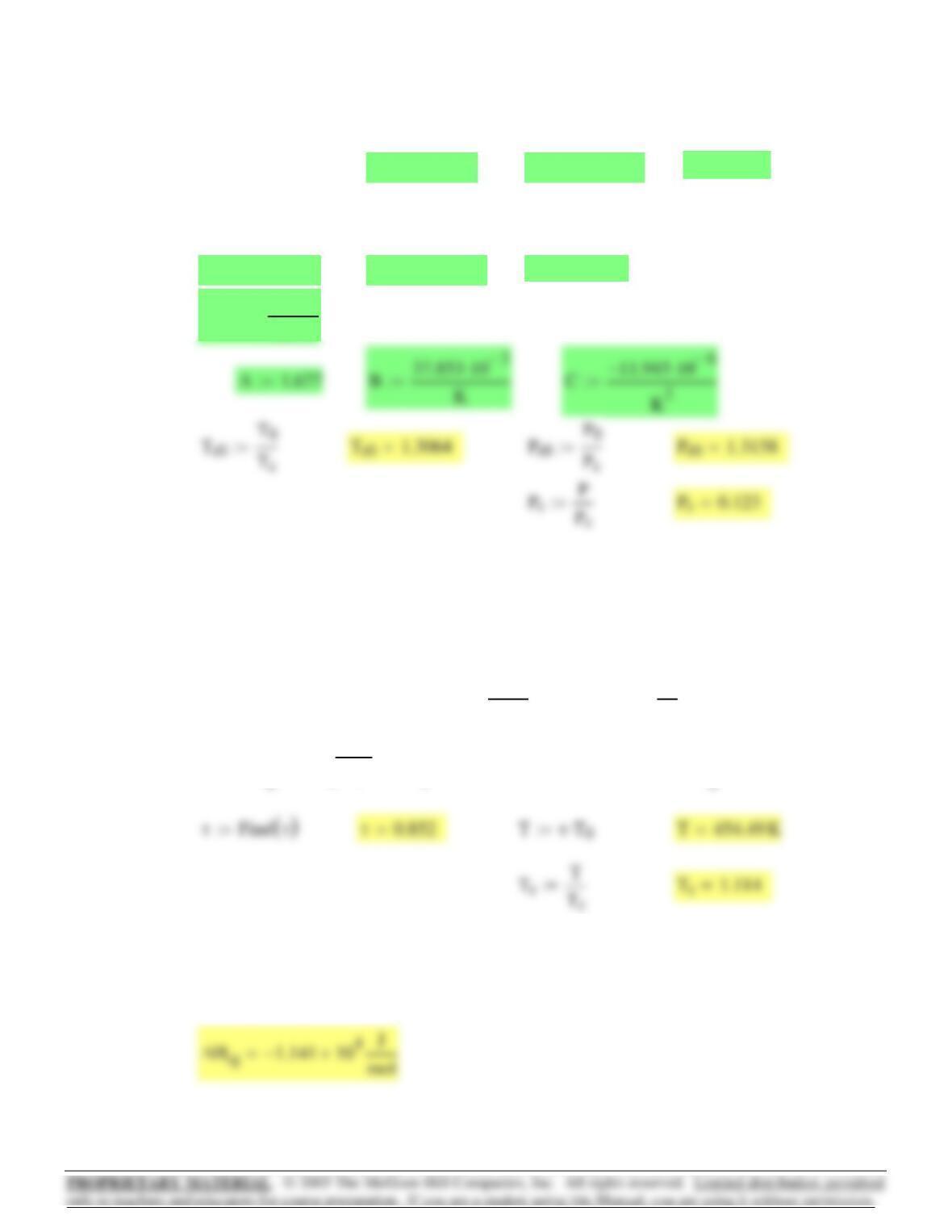
Use generalized second-virial correlation:
The entropy change is given by Eq. (6.92) combined with Eq. (5.15) with D = 0:
τ0.8:= (guess)
Given
∆SRAlnτ
()
⋅BT
0
⋅CT
02
⋅τ1+
2
⎛
⎜
⎝
⎞
⎠
⋅+
⎡
⎢
⎣
⎤
⎥
⎦τ1−
()
⋅+ ln P
P0
⎛
⎜
⎝
⎞
⎠
−
SRB τT0
⋅
Tc
Pr
,ω,
⎛
⎜
⎝
⎞
⎠SRB Tr0 Pr0
,ω,
()
−+
…
⎡
⎢
⎢
⎢
⎢
⎣
⎤
⎥
⎥
⎥
⎥
⎦
⋅=
The enthalpy change for this final temperature is given by Eq. (6.91), with HRB at
the above T:
∆Hig R ICPH T0T,1.677,37.853 10 3−
⋅, 11.945−10 6−
⋅, 0.0,
()
⋅:=
8.10 Isobutane: Tc408.1 K⋅:= Pc36.48 bar⋅:= ω 0.181:=
For isentropic expansion in the turbine, let the initial state be represented by
symbols with subscript zero and the final state by symbols with no subscript.
Then
T0533.15 K⋅:= P04800 kPa⋅:= P 450 kPa⋅:=
∆S0J
mol K⋅
⋅:= For the heat capacity of isobutane:
285
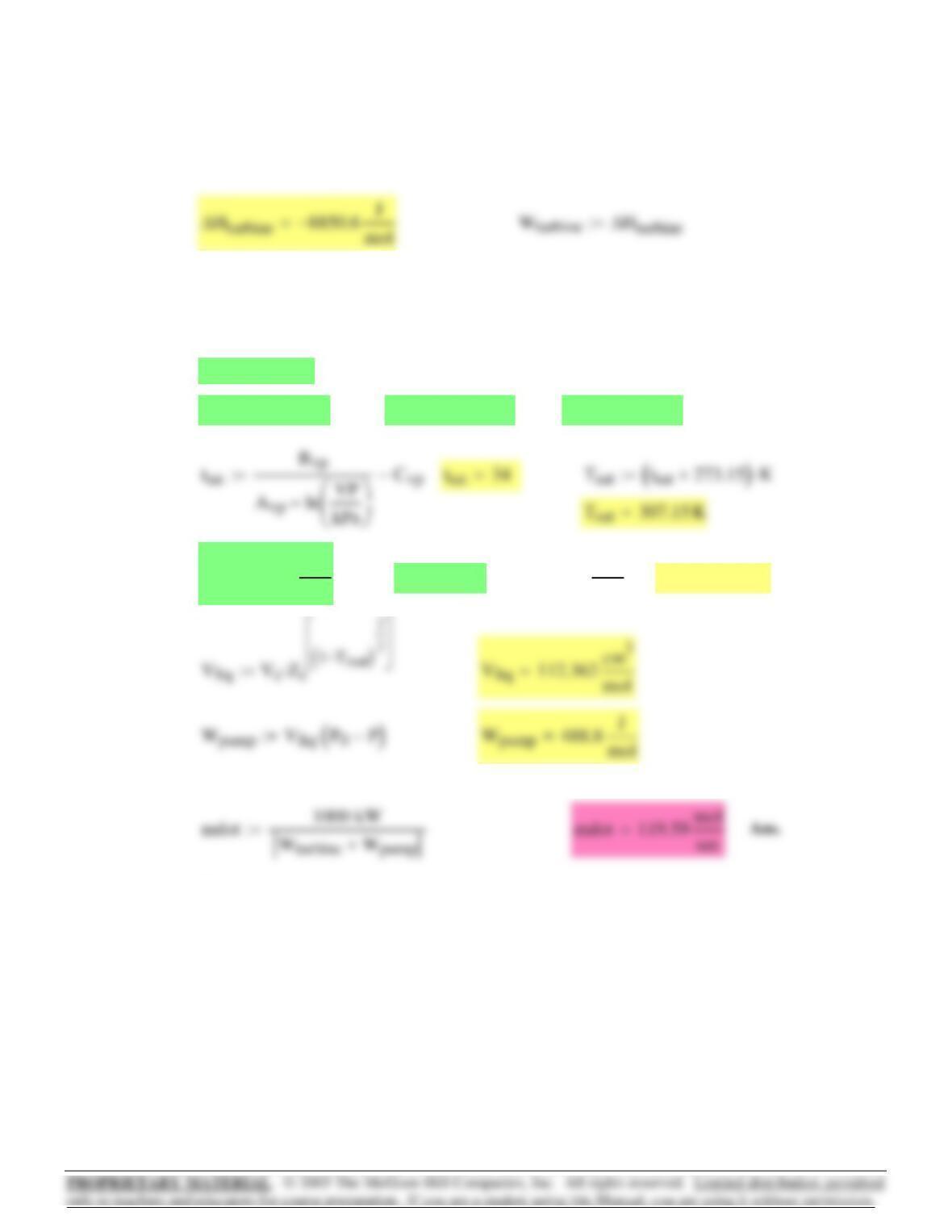
∆Hig R ICPH T Tsat
,1.677,37.853 10 3−
⋅, 11.945−10 6−
⋅, 0.0,
()
⋅:=
Enthalpy change of cooling: HRB at the initial state has already been calculated.
For saturated vapor at 307.15 K:
The enthalpy change of the isobutane in the cooler/condenser is calculated in
two steps:
a. Cooling of the vapor from 454.48 to 307.15 K
b. Condensation of the vapor at 307.15 K
The flow rate of isobutane can now be found:
Trsat 0.753=Trsat
Tsat
Tc
:=Zc0.282:=Vc262.7 cm3
mol
⋅:=
Cvp 274.068:=Bvp 2606.775:=Avp 14.57100:=
VP 450 kPa⋅:=
The work of the pump is given by Eq. (7.24), and for this we need an estimate of
the molar volume of isobutane as a saturated liquid at 450 kPa. This is given by
Eq. (3.72). The saturation temperature at 450 kPa is given by the Antoine
equation solved for t degC:
∆Hturbine ∆Hig RT
c
⋅HRB TrPr
,ω,
()
HRB Tr0 Pr0
,ω,
()
−
()
⋅+:=
286

For isentropic expansion in the turbine, let the initial (inlet) state be
represented by symbols with subscript zero and the final (exit) state by
ω0.181:=Pc36.48 bar⋅:=Tc408.1 K⋅:=
Isobutane:8.11
∆Hn2.118 104
×J
mol
=∆Hn
RT
n
⋅1.092⋅ln Pc
bar
⎛
⎜
⎝
⎞
⎠1.013−
⎛
⎜
⎝
⎞
⎠
⋅
0.930 Trn
−
:=
Trn 0.641=Trn
Tn
Tc
:=Tn261.4 K⋅:=
For the condensation process, we estimate the latent heat by Eqs. (4.12) and (4.13):
∆Ha18082−J
mol
=
∆Ha∆Hig RT
c
⋅HRB Trsat Pr
,ω,
()
HRB TrPr
,ω,
()
−
()
⋅+:=
∆Hig 1.756−104
×J
mol
=
287
∆Hig 9.3−103
×J
mol
=
∆Hig R ICPH T0T,1.677,37.853 10 3−
⋅, 11.945−10 6−
⋅, 0.0,
()
⋅:=
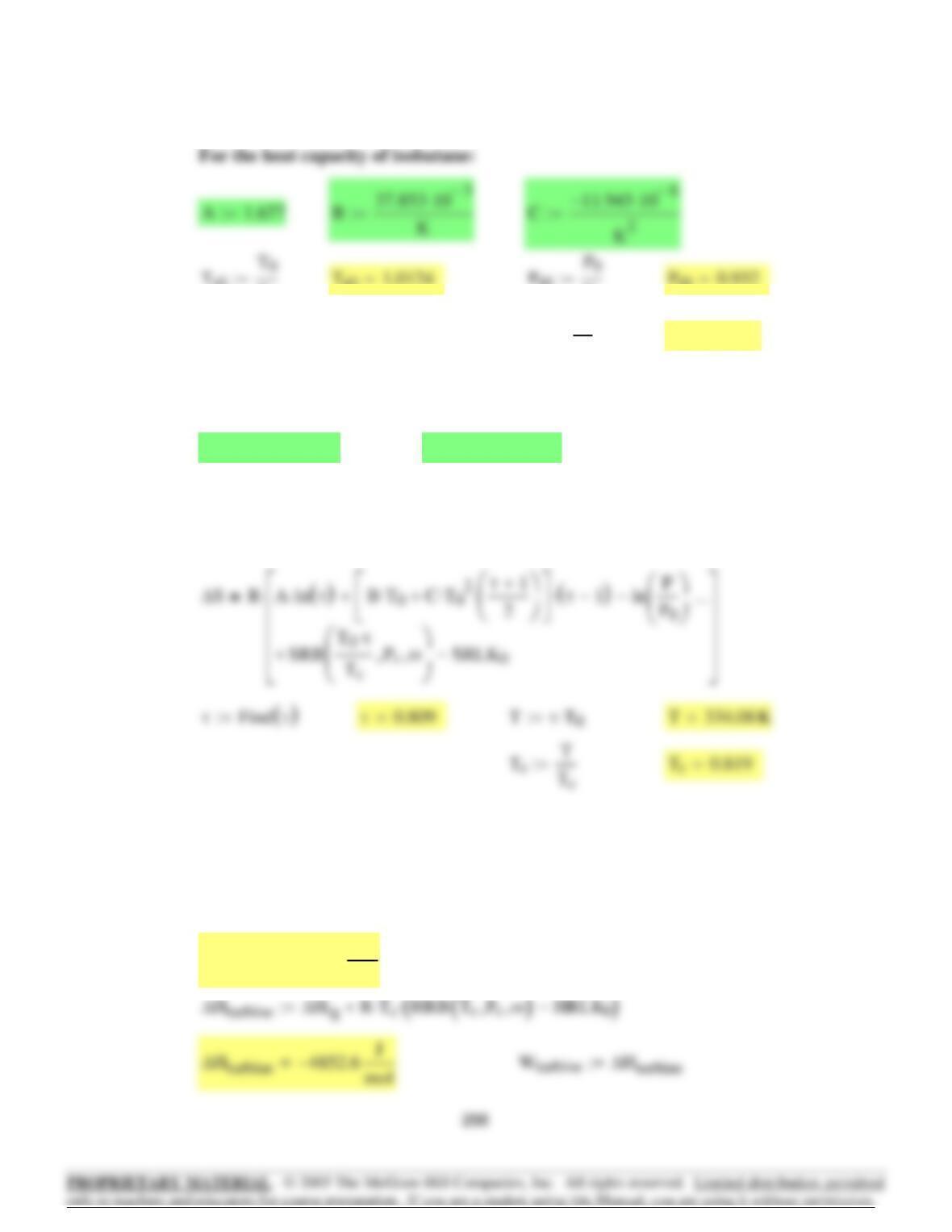
The enthalpy change for this final temperature is given by Eq. (6.91), with
HRB at the above T:
Given
(guess)
τ0.8:=
The entrop
y
chan
g
e is
g
iven b
y
Eq. (6.92) combined with Eq. (5.15) with D = 0
:
SRLK01.160−:=HRLK01.530−:=
Use Lee/Kesler correlation for turbine-inlet state, designating values
by HRLK and SRLK:
Pr0.123=Pr
P
Pc
:=
Pc
Tc

For the condensation process, the enthalpy change was found in Problem
8.10:
∆Ha2975−J
mol
=
∆Ha∆Hig RT
c
⋅HRB Trsat Pr
,ω,
()
HRB TrPr
,ω,
()
−
()
⋅+:=
∆Hig 2.817−kJ
mol
=
∆Hig R ICPH T Tsat
,1.677,37.853 10 3−
⋅, 11.945−10 6−
⋅, 0.0,
()
⋅:=
Trsat 0.753=Trsat
Tsat
Tc
:=Tsat 307.15K:=
Enthalpy change of cooling: HRB at the initial state has already been
calculated. For saturated vapor at 307.15 K it was found in Problem 8.10 as:
Wdot mdot−Wturbine Wpump
+
()
⋅:=mdot 75
molwt
kg
sec
⋅:=
For the cycle the net power OUTPUT is:
Wpump 331.462 J
mol
=Wpump Vliq P0P−
()
⋅:=Vliq 112.36 cm3
mol
⋅:=
The work of the pump is given by Eq. (7.24), and the required value for the
molar volume of saturated-liquid isobutane at 450 kPa (34 degC) is the
value calculated in Problem 8.10:
289

The increase in pump work shows up as a decrease in the heat added in the
heater/boiler. Thus
Qdotout Qdotout Wturbine W’turbine
−
()
mdot⋅+:=
The decrease in the work output of the turbine shows up as an increase in
the heat transferred out of the cooler condenser. Thus
W’pump 414.3 J
mol
=W’pump
Wpump
0.8
:=
The work of the pump is:
W’turbine 3882−J
mol
=W’turbine 0.8 Wturbine
⋅:=
We now recalculate results for a cycle for which the turbine and pump each
have an efficiency of 0.8. The work of the turbine is 80% of the value
calculated above, i.e.,
For the heater/boiler:
290
QDA CPTATD
−
()
⋅=TA
QDA
CP
TD
+:= TA515.845 K=
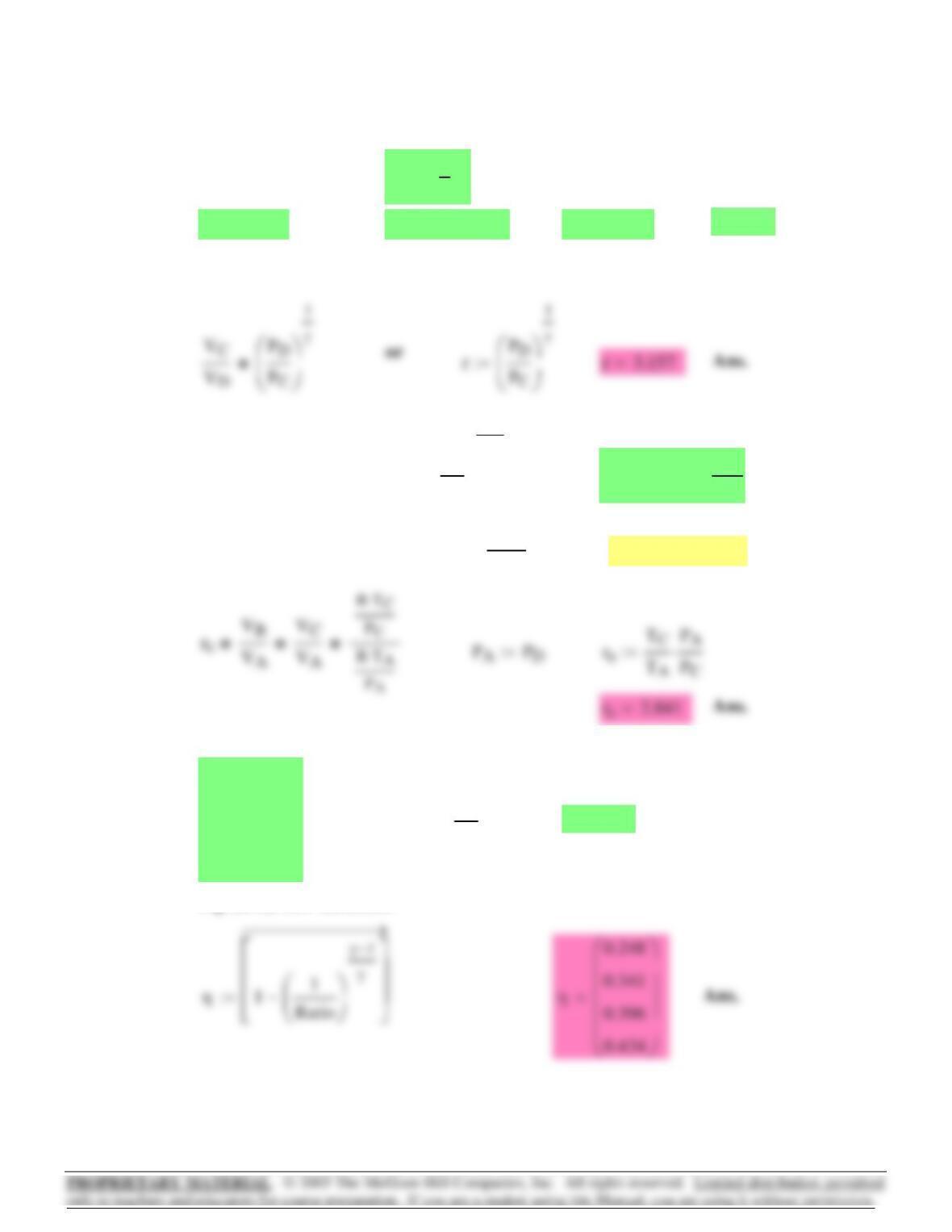
8.14
Ratio
3
5
7
9
⎛
⎜
⎜
⎜
⎜
⎝
⎞
⎟
⎟
⎠
:= Ratio PB
PA
=γ1.35:=
Eq. (8.12) now becomes:
⎢
⎥
⎜
⎜
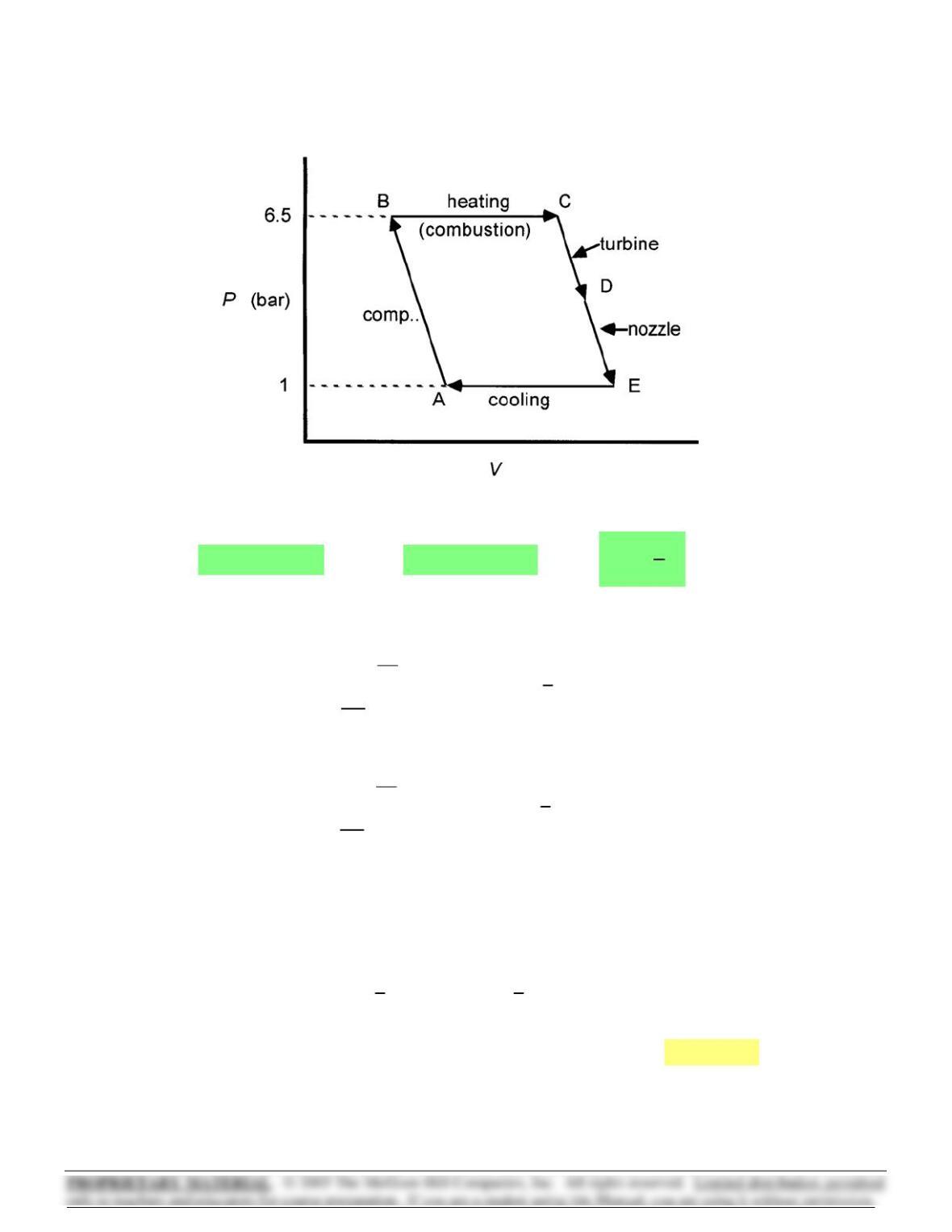
8.13 Refer to Fig. 8.10. CP
7
2R⋅:=
PC1 bar⋅:= TC293.15 K⋅:= PD5 bar⋅:= γ 1.4:=
By Eq. (3.30c): PCVCγ
⋅PDVDγ
⋅=
⎜
⎜
Eq. (3.30b): TDTC
PD
PC
⎛
⎜
⎝
⎞
⎠
γ1−
γ
⋅:= QDA 1500 J
mol
⋅:=
291
er 0.552=
er Find er():=TCer
2
71−
⎛
⎜
⎝
⎞
⎠
⋅TA
−cr
2
71−
⎛
⎜
⎝
⎞
⎠
⋅=
Given
(guess)
er 0.5:=cr 6.5:=
where cr is the compression ratio and er is the expansion ratio. Since the two
work terms are equal but of opposite signs,
WCD CPTC
⋅PD
PC
⎛
⎜
⎝
⎞
⎠
R
CP
1−
⎡
⎢
⎢
⎢
⎣
⎤
⎥
⎥
⎥
⎦
⋅=CPTC
⋅er
2
71−
⎛
⎜
⎝
⎞
⎠
⋅=
WAB CPTA
⋅PB
PA
⎛
⎜
⎝
⎞
⎠
R
CP
1−
⎡
⎢
⎢
⎢
⎣
⎤
⎥
⎥
⎥
⎦
⋅=CPTA
⋅cr
2
71−
⎛
⎜
⎝
⎞
⎠
⋅=
By Eq. (7.22)
CP
7
2R⋅:=TC1373.15 K⋅:=TA303.15 K⋅:=
Figure shows the air-standard turbojet power plant on a PV diagram.
8.16
292
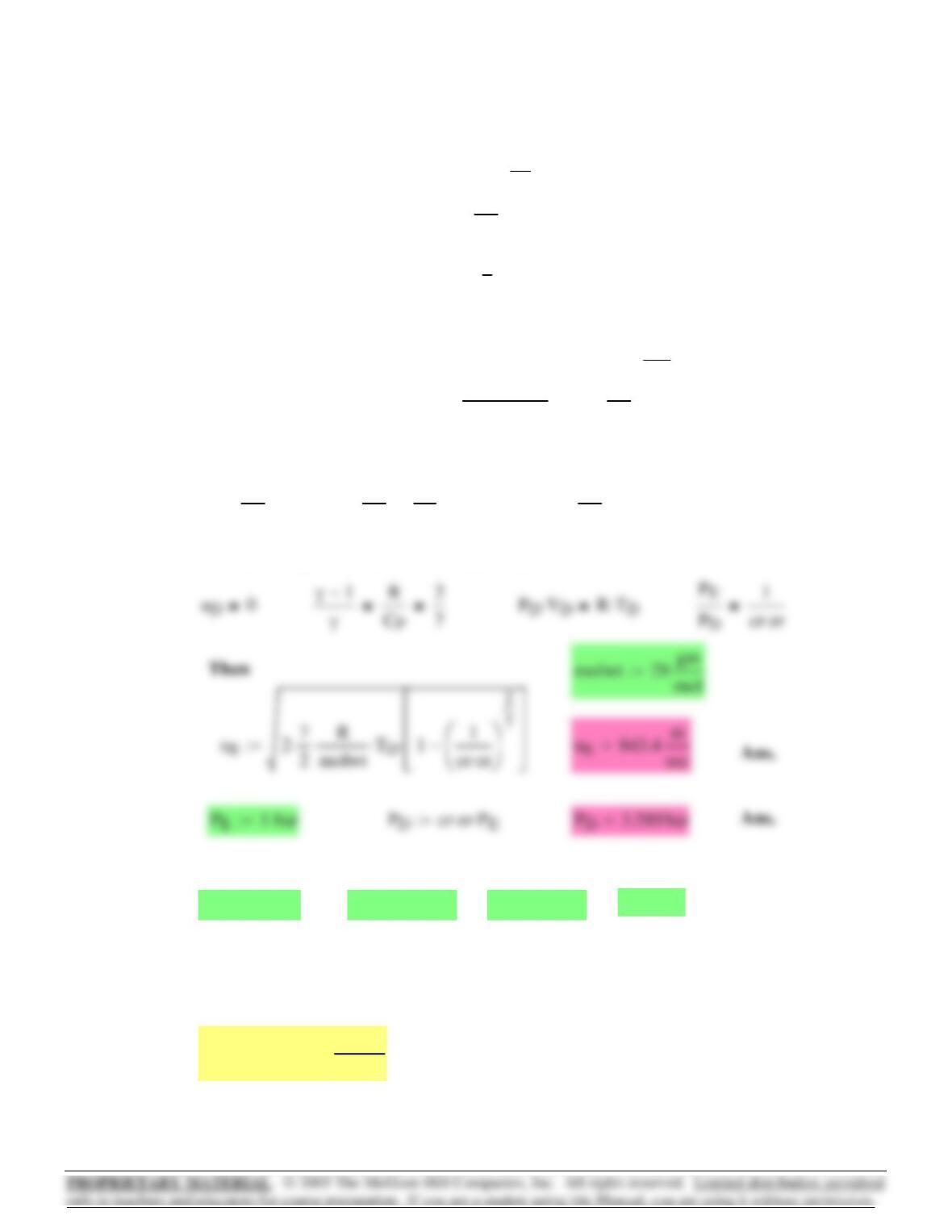
8.17 TA305 K⋅:= PA1.05bar:= PB7.5bar:= η 0.8:=
Assume air to be an ideal gas with mean heat capacity (final temperature by
iteration):
Cpmair MCPH 298.15K 582K,3.355,0.575 10 3−
⋅, 0.0,0.016−105
⋅,
()
R⋅:=
Cpmair 29.921 J
mol K⋅
=
By Eq. (7.18): TDTC
PD
PC
⎛
⎜
⎝
⎞
⎠
R
CP
⋅=
This may be written: TDTCer
2
7
⋅:=
By Eq. (7.11) uE2uD2
−2γ⋅ PD
⋅VD
⋅
γ1−1PE
PD
⎛
⎜
⎝
⎞
⎠
γ1−
γ
−
⎡
⎢
⎢
⎢
⎣
⎤
⎥
⎥
⎥
⎦
⋅=(A)
We note the following:
er PD
PC
=cr PB
PA
=
PC
PE
=cr er⋅PD
PE
=
The following substitutions are made in (A):
293
⎢
⎥

i14..:=
D
1.157−
0.121
0.040
0.227−
⎛
⎜
⎜
⎜
⎜
⎝
⎞
⎟
⎟
⎠
105
⋅:=
B
1.045
1.450
0.593
0.506
⎛
⎜
⎜
⎜
⎜
⎝
⎞
⎟
⎟
⎠
10 3−
⋅:=
A
5.457
3.470
3.280
3.639
⎛
⎜
⎜
⎜
⎜
⎝
⎞
⎟
⎟
⎠
:=
n
1
2
.79 N⋅
.21 N⋅2−
⎛
⎜
⎜
⎜
⎜
⎝
⎞
⎟
⎟
⎠
:=
The product stream contains:
1 mol CO2, 2mol H2O, 0.79N mol N2, and (0.21N-2) mol O2
The solution process requires iteration for N. Assume a value for N until
the above energy balance is satisfied.
For ∆H_R, the mean heat capacities for air and methane are required.
The value for air is given above. For methane the temperature change
is very small; use the value given in Table C.1 for 298 K: 4.217*R.
∆HR∆H298
+∆HP
+0=
Because the combustion is adiabatic, the basic equation is:
Basis: Complete combustion of 1 mol CH4. Reactants are N mol of
air and 1mol CH4.
Combustion: CH4 + 2O2 = CO2 + 2H2O
TB582.126 K=TBTA
Wsair
Cpmair
+:=
Wsair 8.292 103
×J
mol
=Wsair
Cpmair TA
⋅
η
PB
PA
⎛
⎜
⎝
⎞
⎠
R
Cpmair
1−
⎡
⎢
⎢
⎢
⎣
⎤
⎥
⎥
⎥
⎦
⋅:=
Compressor:
294
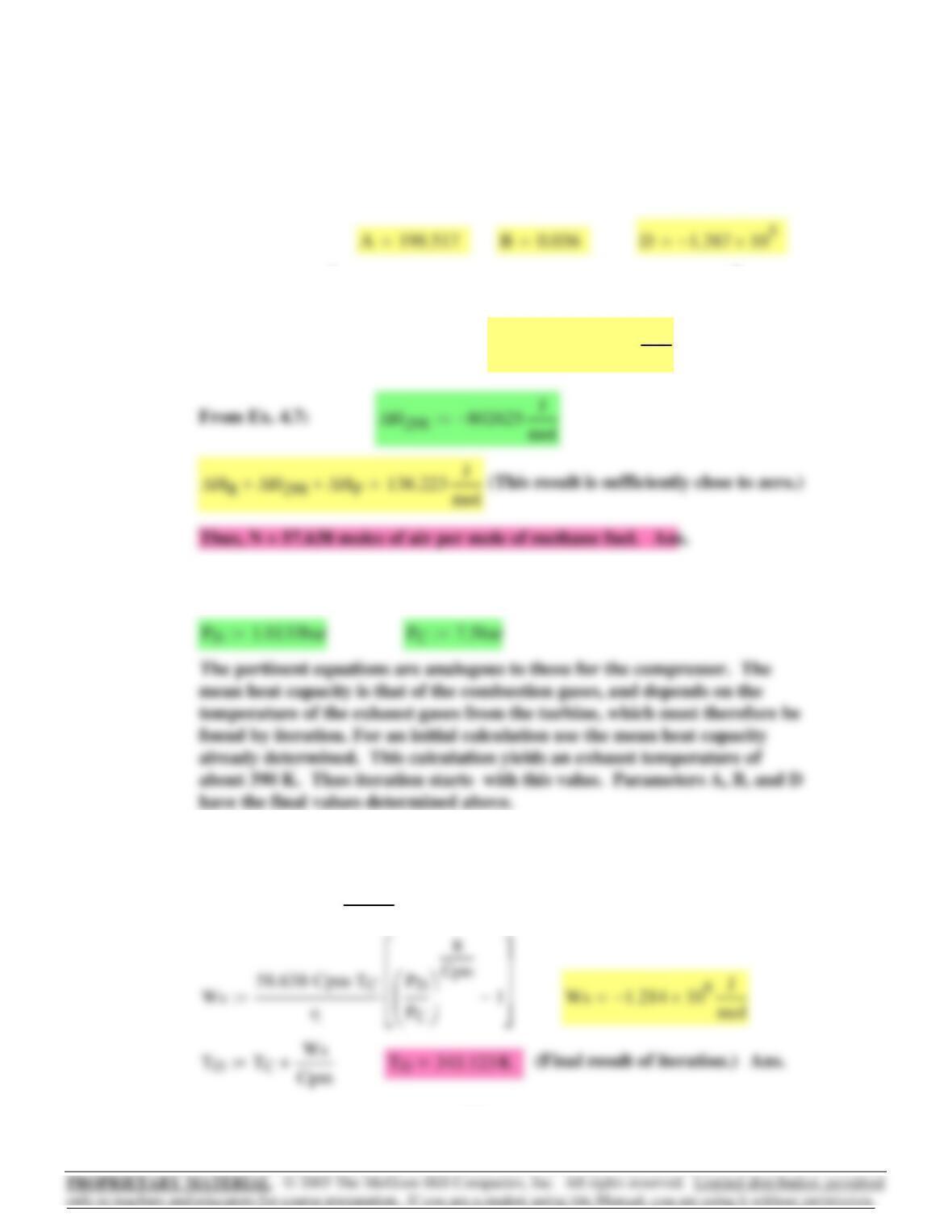
For 58.638 moles of combustion product:
Cpm 1.849 103
×J
mol K⋅
=
Cpm MCPH 1000K 343.12K,198.517,0.0361,0.0,1.3872−105
⋅,
()
R⋅:=
Assume expansion of the combustion products in the turbine is to 1(atm),
i.e., to 1.0133 bar:
∆HP1.292 106
×J
mol
=∆HPCpmPTC298.15K−
()
⋅:=
CpmPMCPH 298.15K 1000.K,198.517,0.0361,0.0,1.3872−105
⋅,
()
R⋅:=
D
i
niDi
⋅
()
∑
:=
B
i
niBi
⋅
()
∑
:=
A
i
niAi
⋅
()
∑
:=
i
ni
∑58.638=
295
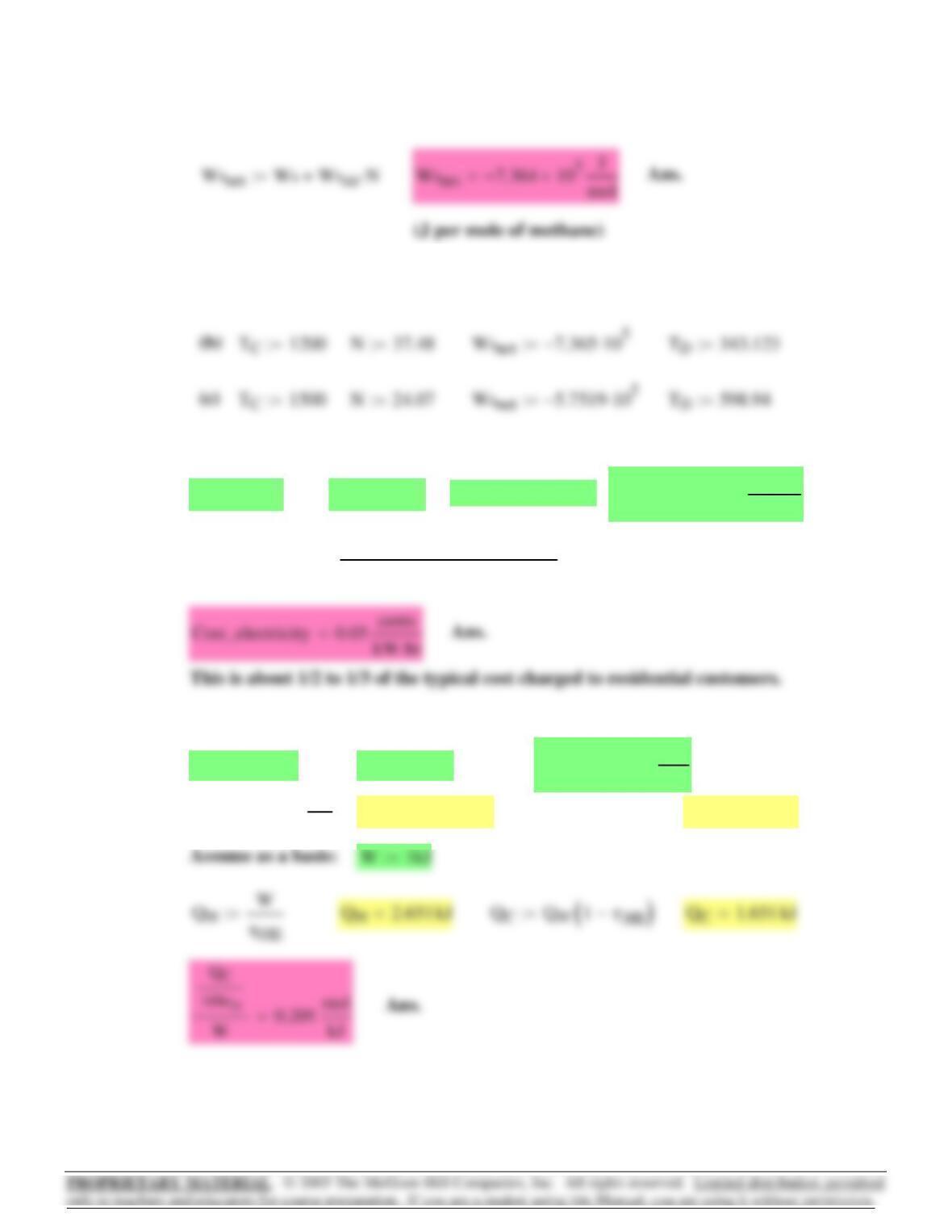
Cost_electricity Cost_fuel
ηtm ηme
⋅1 line_losses−()⋅
⎡
⎣
⎤
⎦
:=
8.19 TC111.4K:= TH300K:= ∆Hnlv 8.206 kJ
mol
:=
ηCarnot 1TC
TH
−:= ηCarnot 0.629= ηHE 0.6 ηCarnot
⋅:= ηHE 0.377=
Parts (b) and (c) are solved in exactly the same way, with the following
results:
8.18 ηtm 0.35:= ηme 0.95:= line_losses 20%:= Cost_fuel 4.00 dollars
GJ
:=
296
8.20 TH27 273.15+()K:= TC6 273.15+()K:=
297