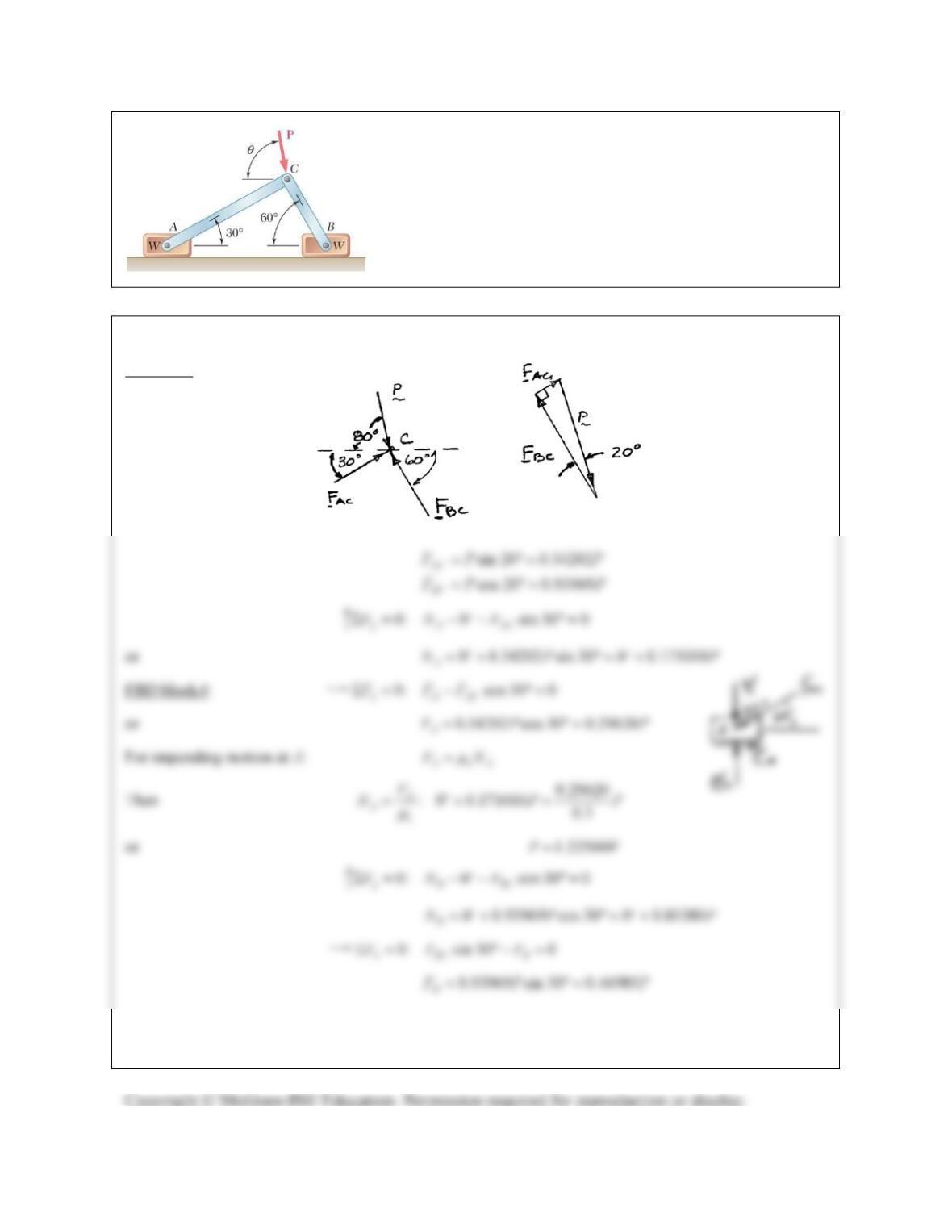
PROBLEM 8.46
Two slender rods of negligible weight are pin-connected at C and
attached to blocks A and B, each of weight W. Knowing that
80
and that the coefficient of static friction between the
blocks and the horizontal surface is 0.30, determine the largest
value of P for which equilibrium is maintained.
SOLUTION
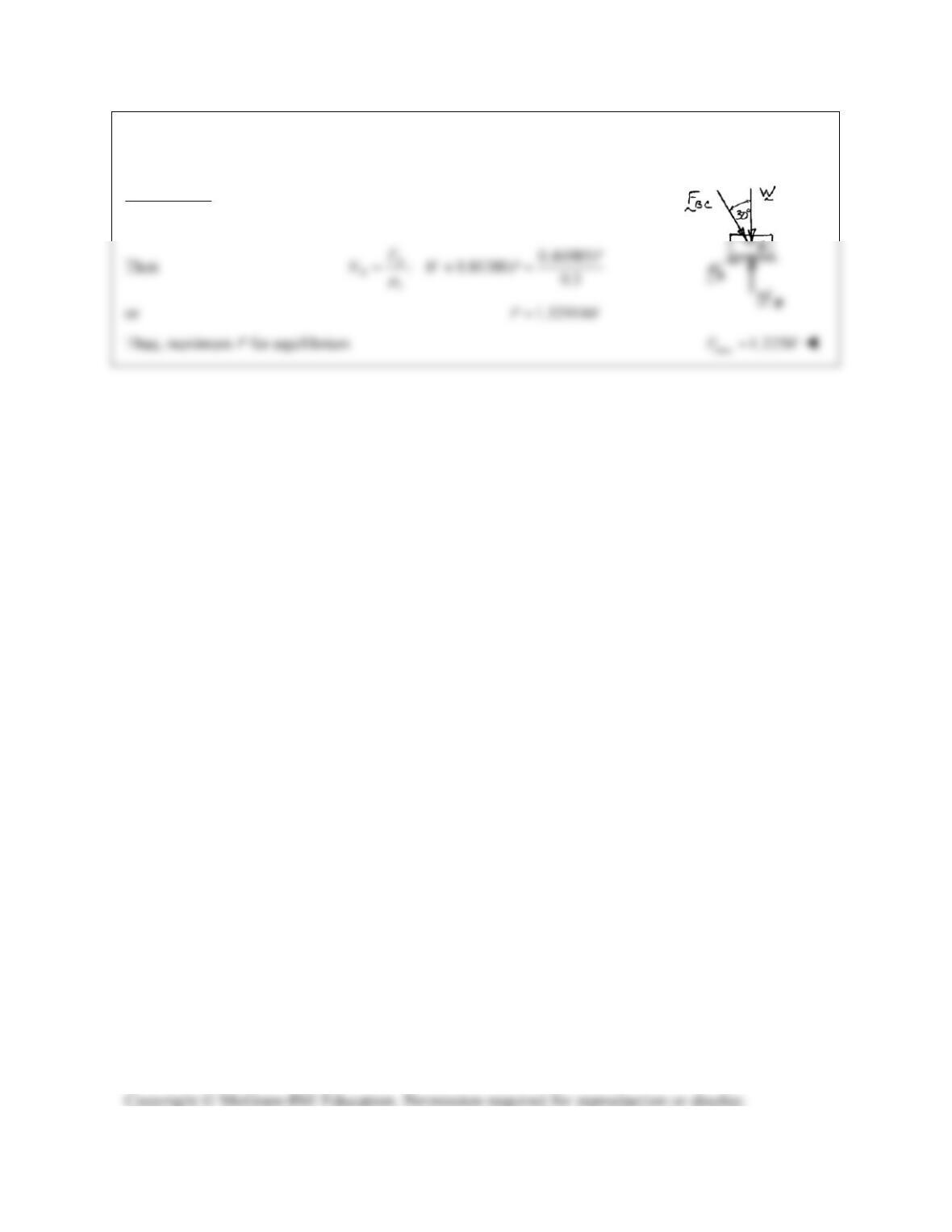
FBD pinC:
PROBLEM 8.46 (Continued)
FBD block
B:
For impending motion at
B:
BsB
FN
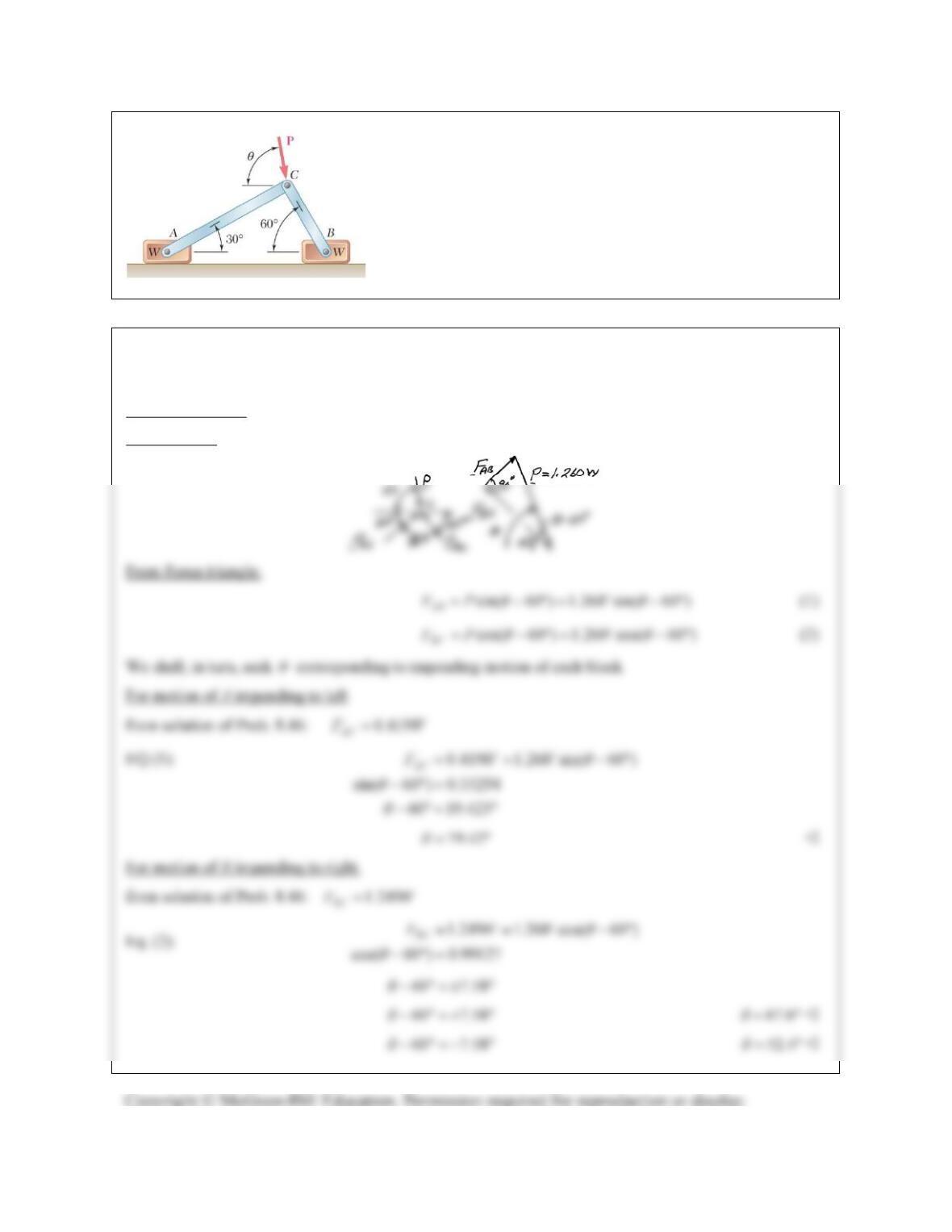
PROBLEM 8.47
Two slender rods of negligible weight are pin-connected at C and
attached to blocks A and B, each of weight W. Knowing that
P 1.260W and that the coefficient of static friction between the
blocks and the horizontal surface is 0.30, determine the range of
values of θ, between 0 and 180°, for which equilibrium is
maintained.
SOLUTION
AC and BC are two-force members
Free body: Joint C
Force triangle:
PROBLEM 8.47 (Continued)
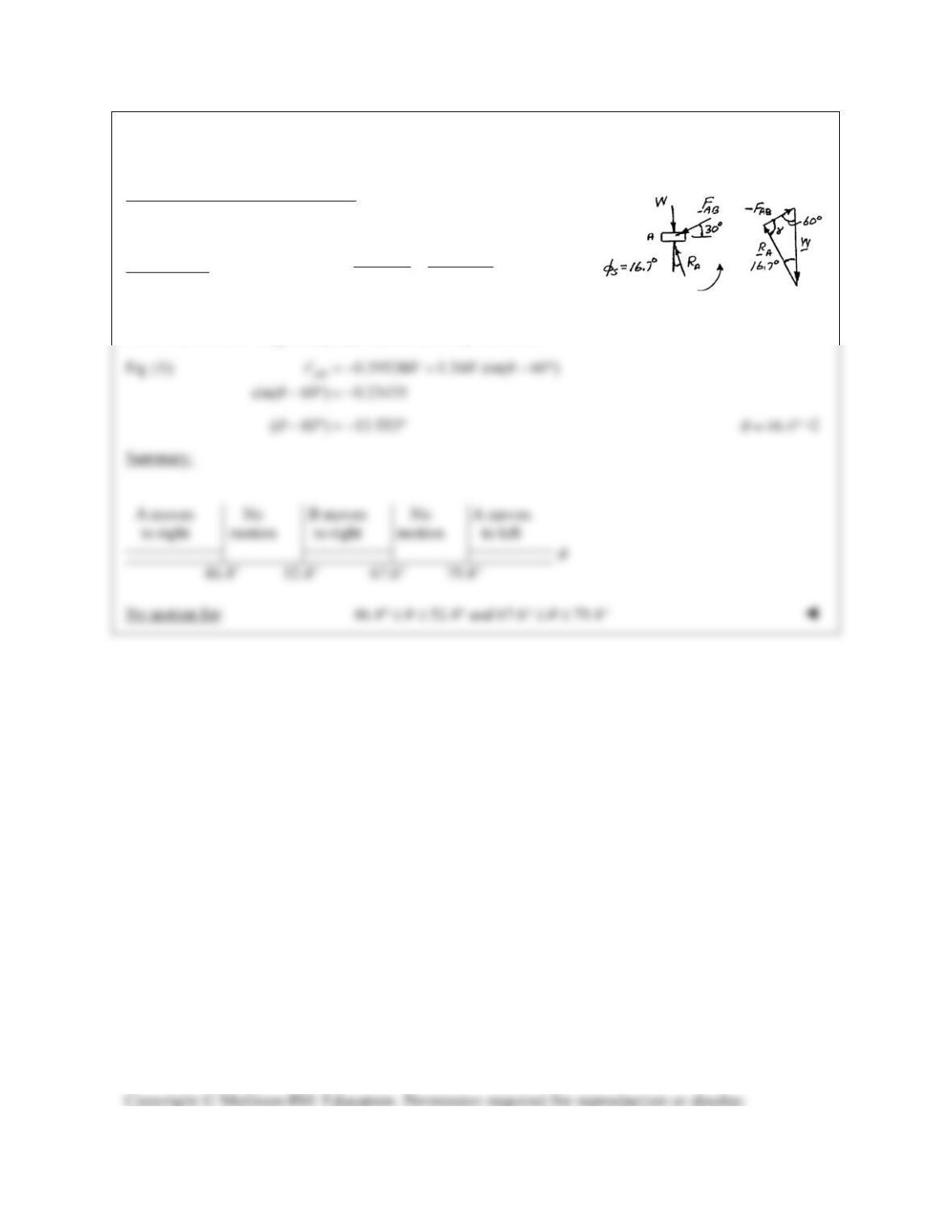
For motion of A impending to right
180 60 16.7 103.3
Law of sines: sin16.7 sin103.3
0.29528
AB
AB
FW
FW
Note: Direction of
A
B
F
is kept same as in free body of Joint C.
PROBLEM 8.48
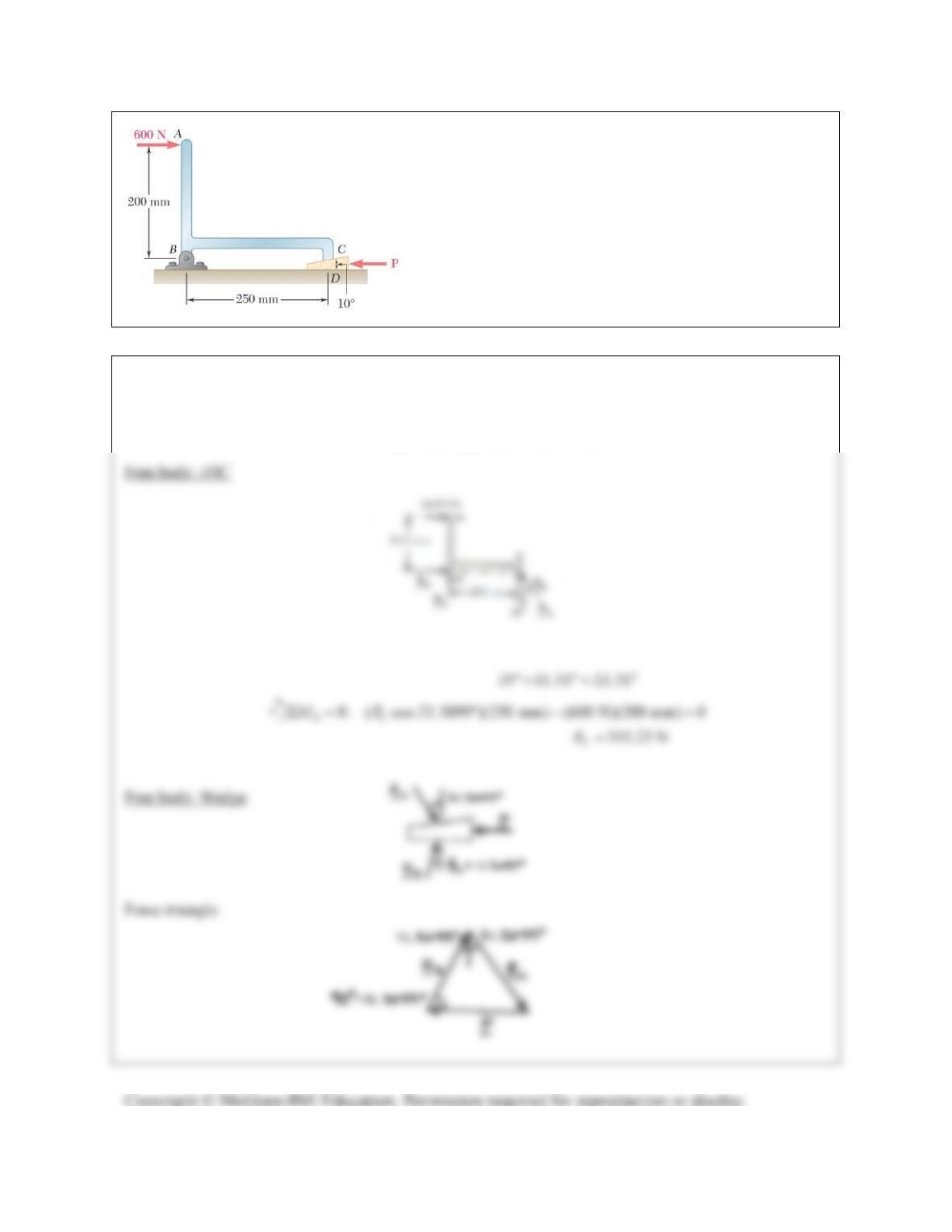
The machine part ABC is supported by a frictionless hinge at
B and a 10 wedge at C. Knowing that the coefficient of
static friction is 0.20 at both surfaces of the wedge,
determine (a) the force P required to move the wedge to the
left, (b) the components of the corresponding reaction at B.
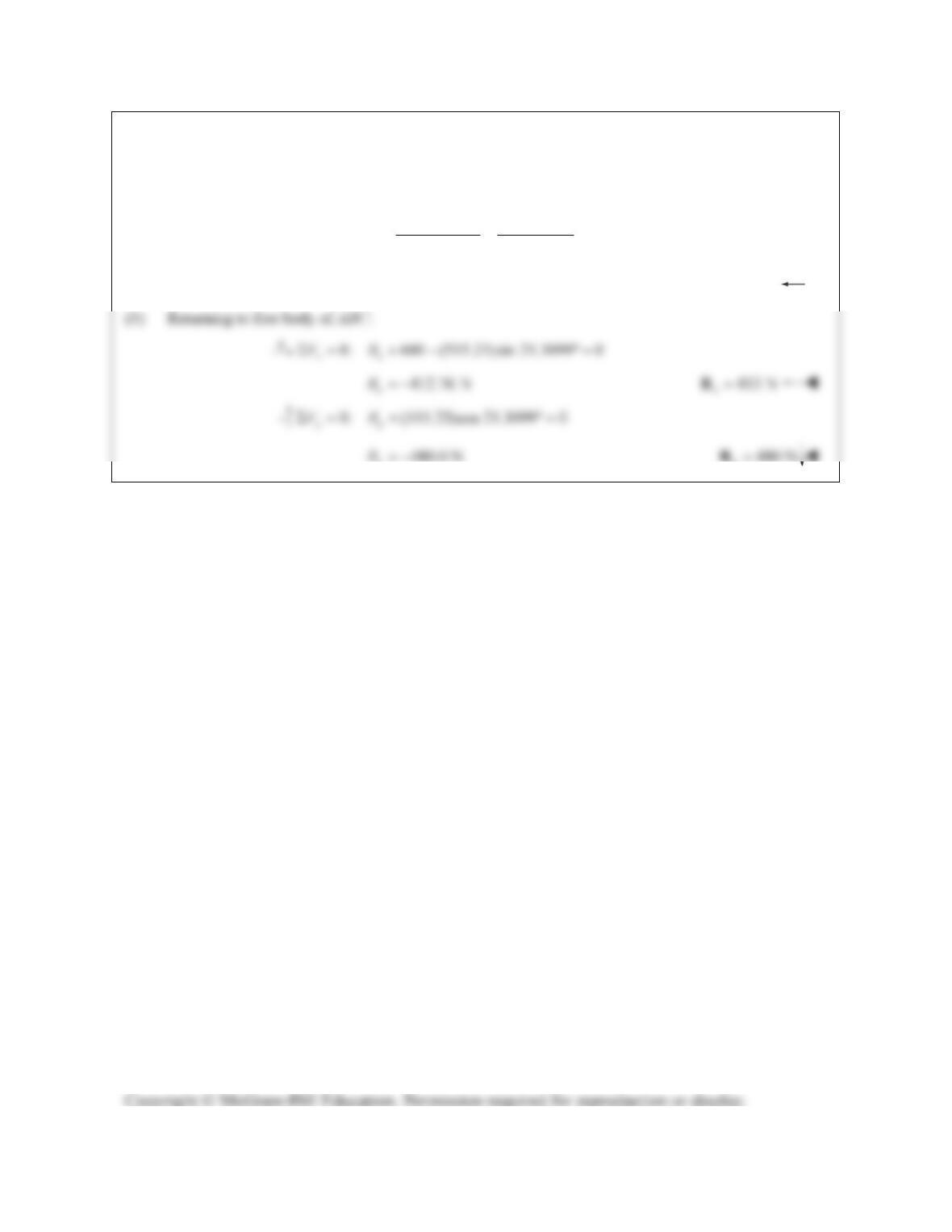
SOLUTION
11
0.20
tan tan 0.20 11.3099
s
ss
PROBLEM 8.48 (Continued)
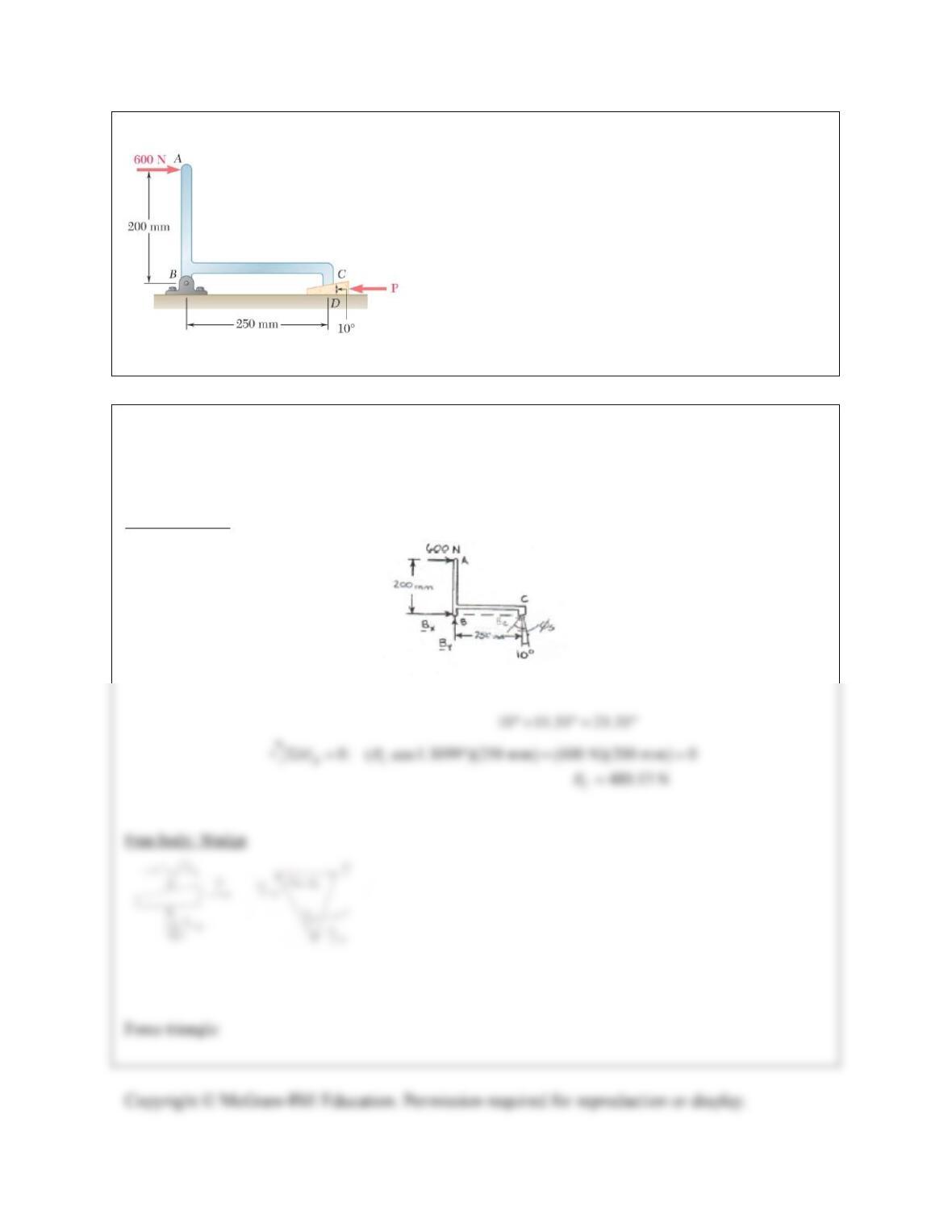
Law of sines:
515.23 N
sin 32.6198 sin 78.690
P
(a)
283 N
P
y
y
PROBLEM 8.49
Solve Prob. 8.48 assuming that the wedge is moved to the
right.
PROBLEM 8.48
The machine part ABC is supported by a frictionless hinge at
B and a 10 wedge at C. Knowing that the coefficient of
static friction is 0.20 at both surfaces of the wedge,
determine (a) the force P required to move the wedge to the
left, (b) the components of the corresponding reaction at B.
SOLUTION
11
0.20
tan tan 0.20 11.3099
s
ss
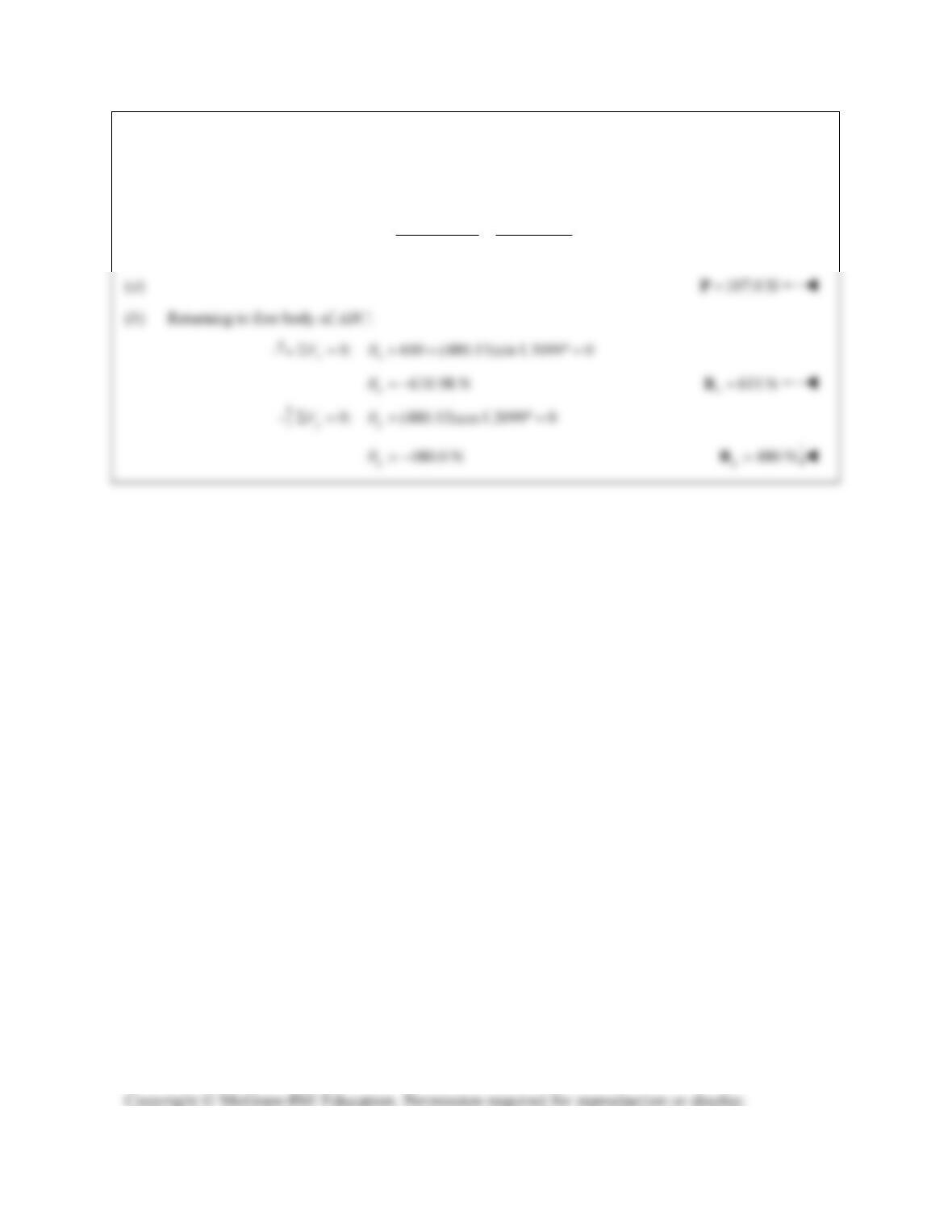
Free body: ABC
PROBLEM 8.49 (Continued)
Law of sines:
480.13 N
sin 12.6198 sin 78.690
P
PROBLEM 8.50
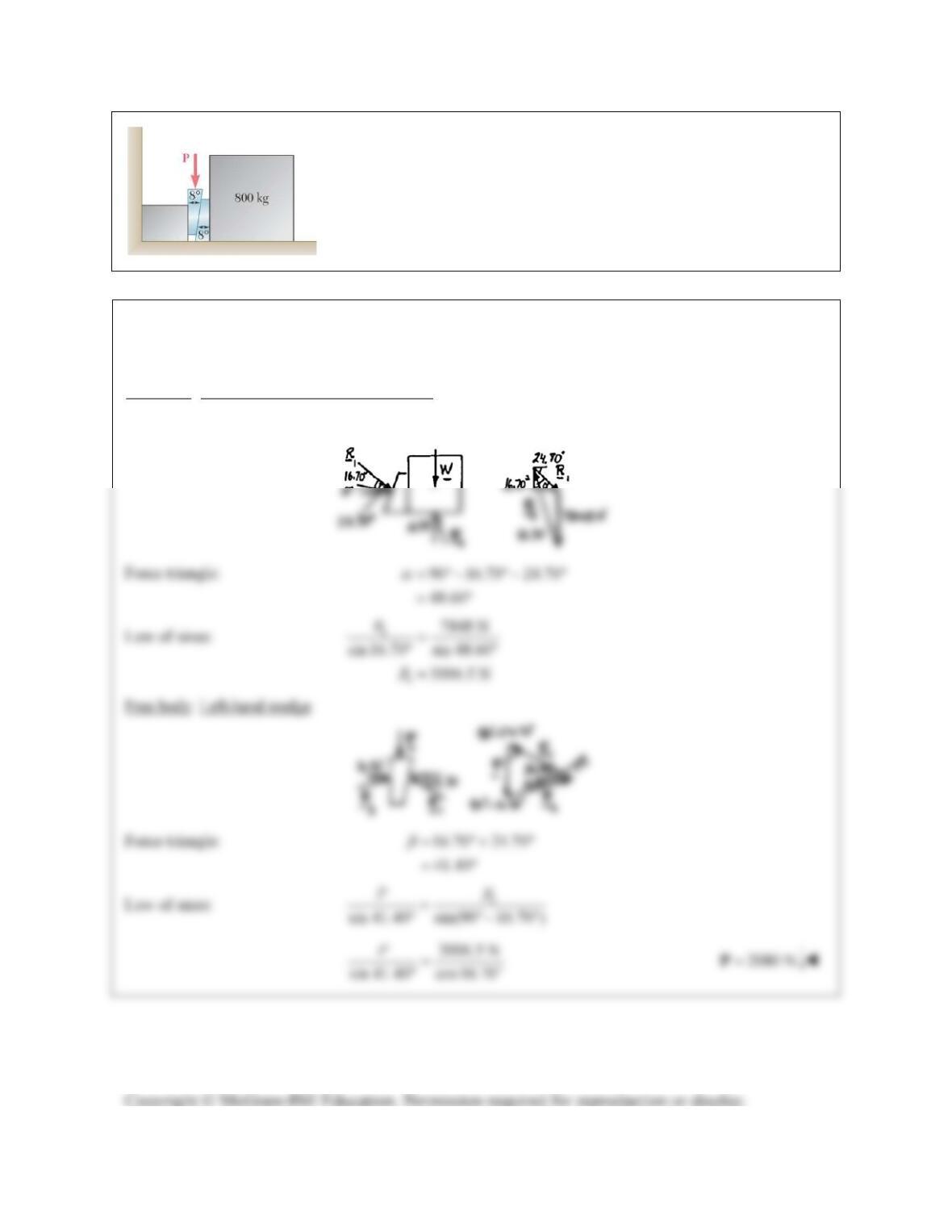
Two 8 wedges of negligible weight are used to move and position the
800-kg block. Knowing that the coefficient of static friction is 0.30 at all
surfaces of contact, determine the smallest force P that should be applied
as shown to one of the wedges.
SOLUTION
1
0.30 tan 0.30 16.70
ss
Free body: 800-kg block and right-hand wedge
2
(800 kg)(9.81 m/s ) 7848 NW
PROBLEM 8.51
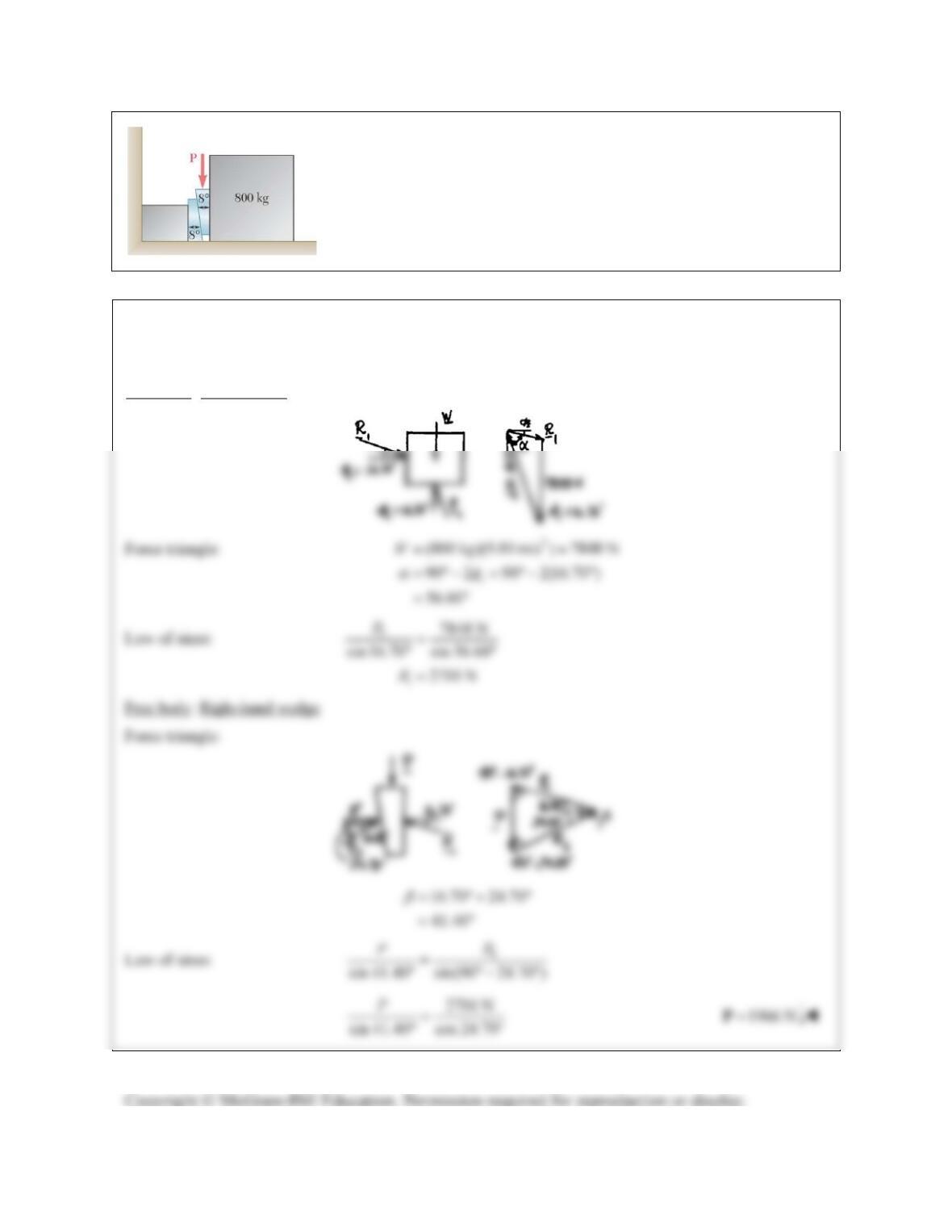
Two 8 wedges of negligible weight are used to move and position the
800-kg block. Knowing that the coefficient of static friction is 0.30 at all
surfaces of contact, determine the smallest force P that should be applied
as shown to one of the wedges.
SOLUTION
1
0.30 tan 0.30 16.70
ss
Free body: 800-kg block
PROBLEM 8.52
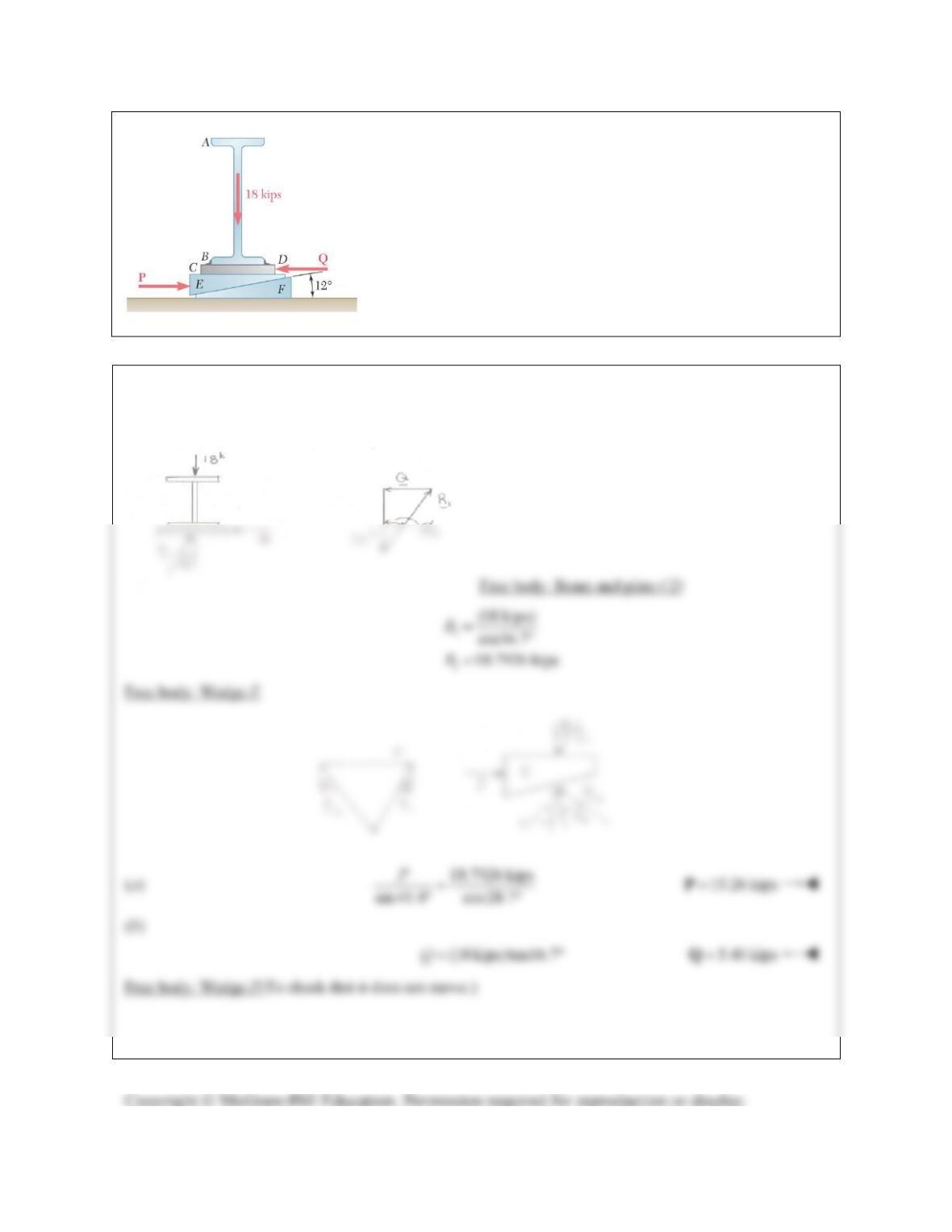
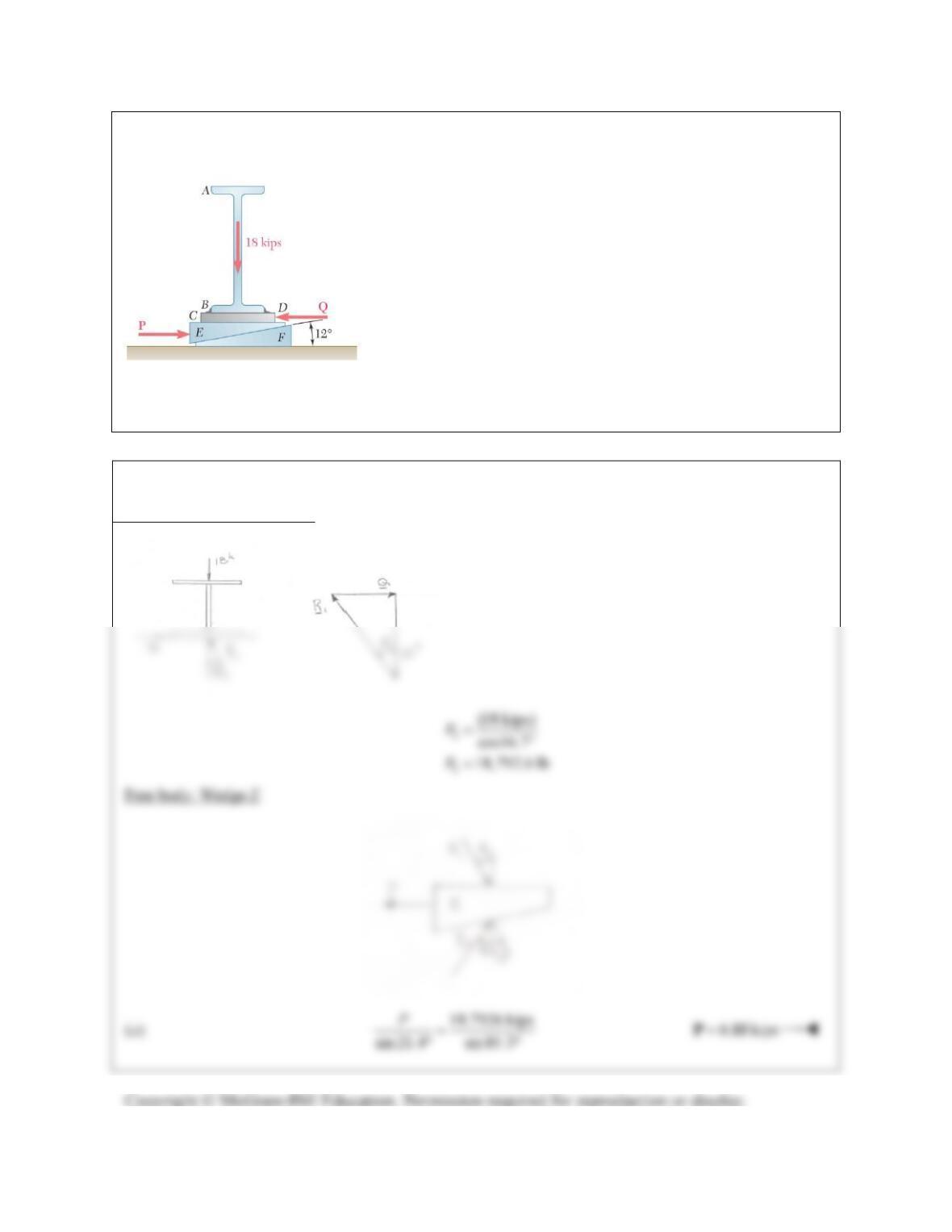
The elevation of the end of the steel beam supported by a concrete
floor is adjusted by means of the steel wedges E and F. The base
plate CD has been welded to the lower flange of the beam, and the
end reaction of the beam is known to be 18 kips. The coefficient of
static friction is 0.30 between two steel surfaces and 0.60 between
steel and concrete. If the horizontal motion of the beam is
prevented by the force Q, determine (a) the force P required to
raise the beam, (b) the corresponding force Q.
SOLUTION
1
0.30 tan 0.30 16.70
ss
PROBLEM 8.52 (Continued)
PROBLEM 8.53
Solve Prob. 8.52 assuming that the end of the beam is to be
lowered.
PROBLEM 8.52
The elevation of the end of the steel beam supported by a concrete
floor is adjusted by means of the steel wedges E and F. The base
plate CD has been welded to the lower flange of the beam, and the
end reaction of the beam is known to be 18 kips. The coefficient of
static friction is 0.30 between two steel surfaces and 0.60 between
steel and concrete. If the horizontal motion of the beam is
prevented by the force Q, determine (a) the force P required to
raise the beam, (b) the corresponding force Q.
SOLUTION
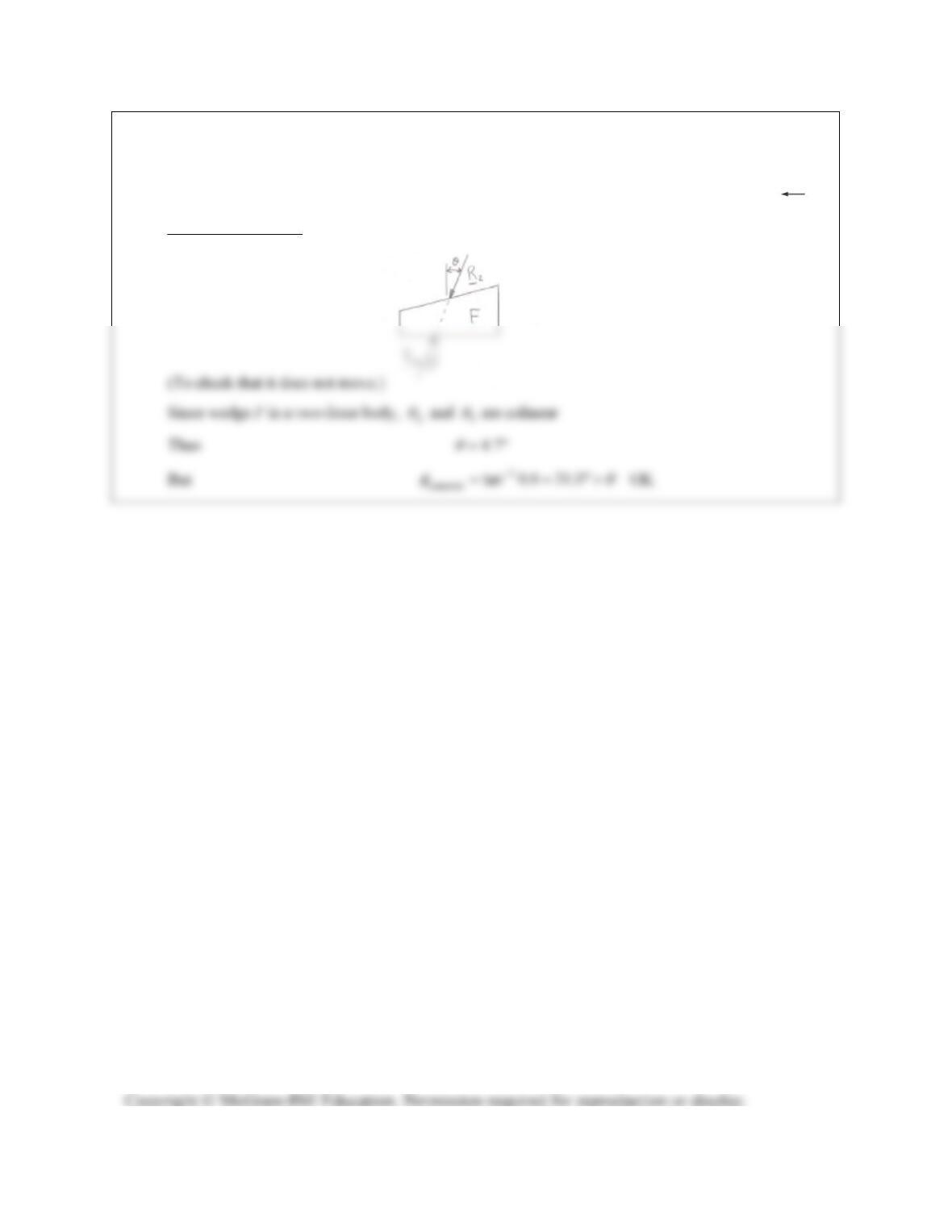
Free body: Beam and plate CD 1
0.30 tan 0.30 16.70
ss
PROBLEM 8.53 (Continued)
(b)
(18 kips) tan16.7Q
5.40 kips
Q
Free body: Wedge
F
PROBLEM 8.54
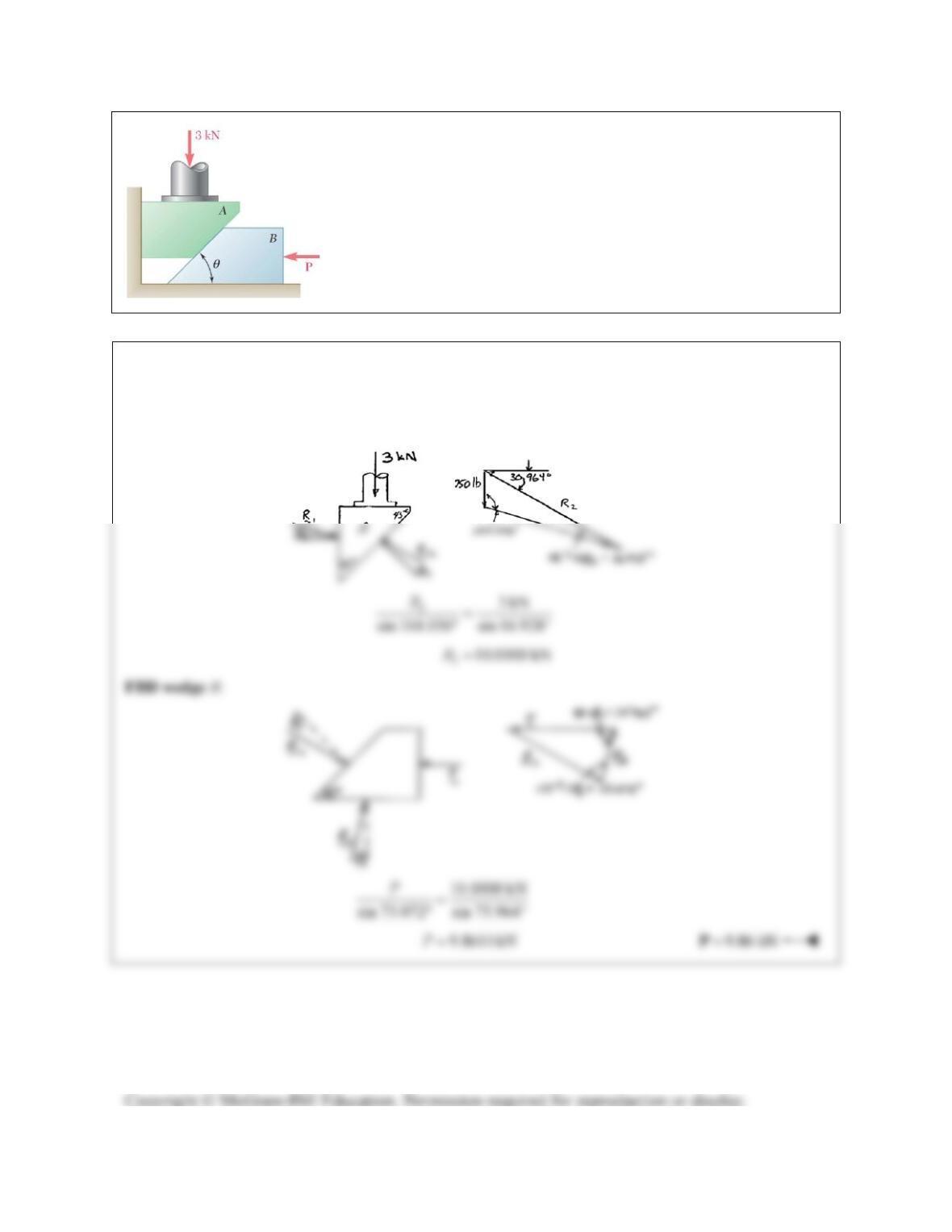
Block A supports a pipe column and rests as shown on wedge B.
Knowing that the coefficient of static friction at all surfaces of contact is
0.25 and that
45 ,
determine the smallest force P required to raise
block A.
SOLUTION
11
tan tan 0.25 14.036
ss
FBD block A:
PROBLEM 8.55
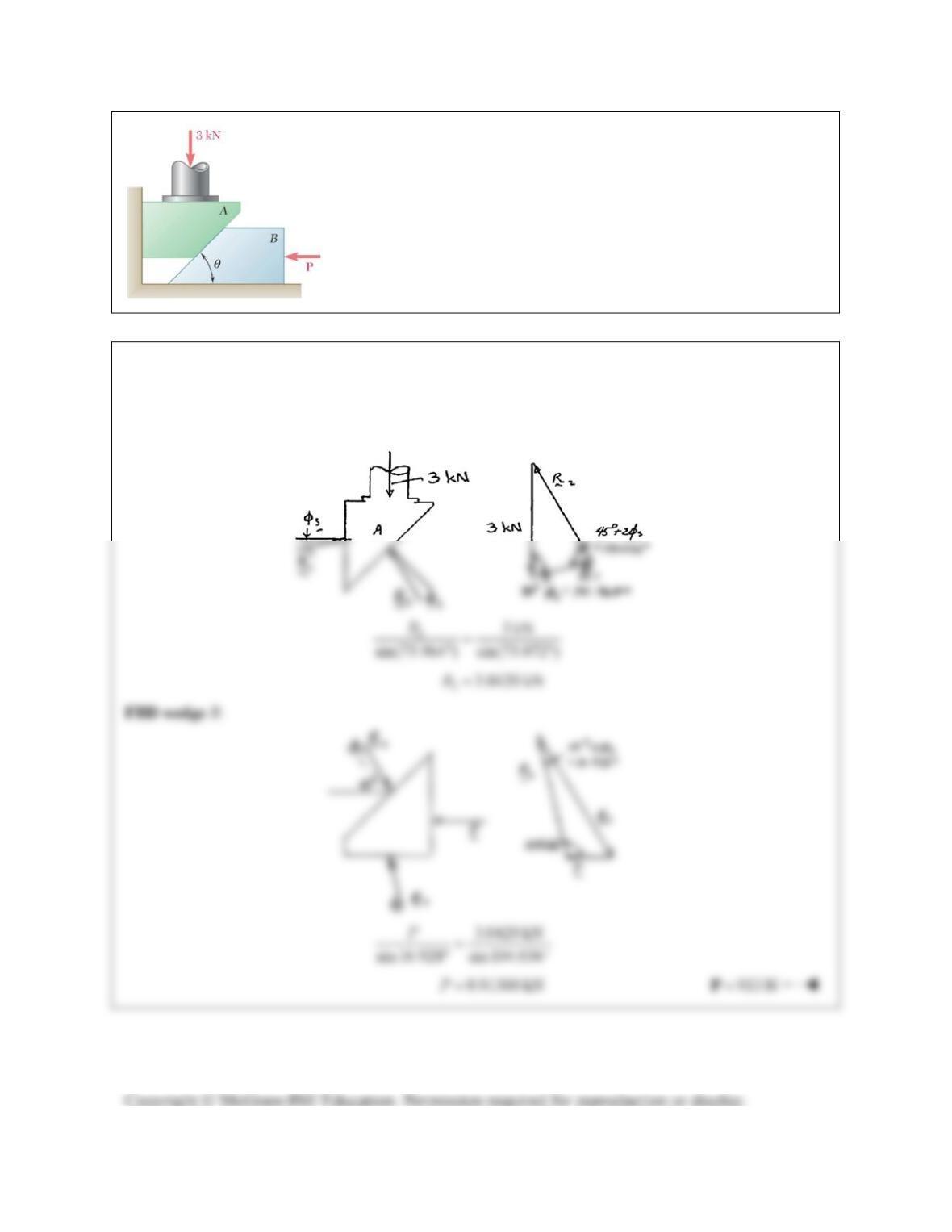
Block A supports a pipe column and rests as shown on wedge B.
Knowing that the coefficient of static friction at all surfaces of contact is
0.25 and that
45 ,
determine the smallest force
P
for which
equilibrium is maintained.
SOLUTION
11
tan tan 0.25 14.036
ss
FBD block
A:
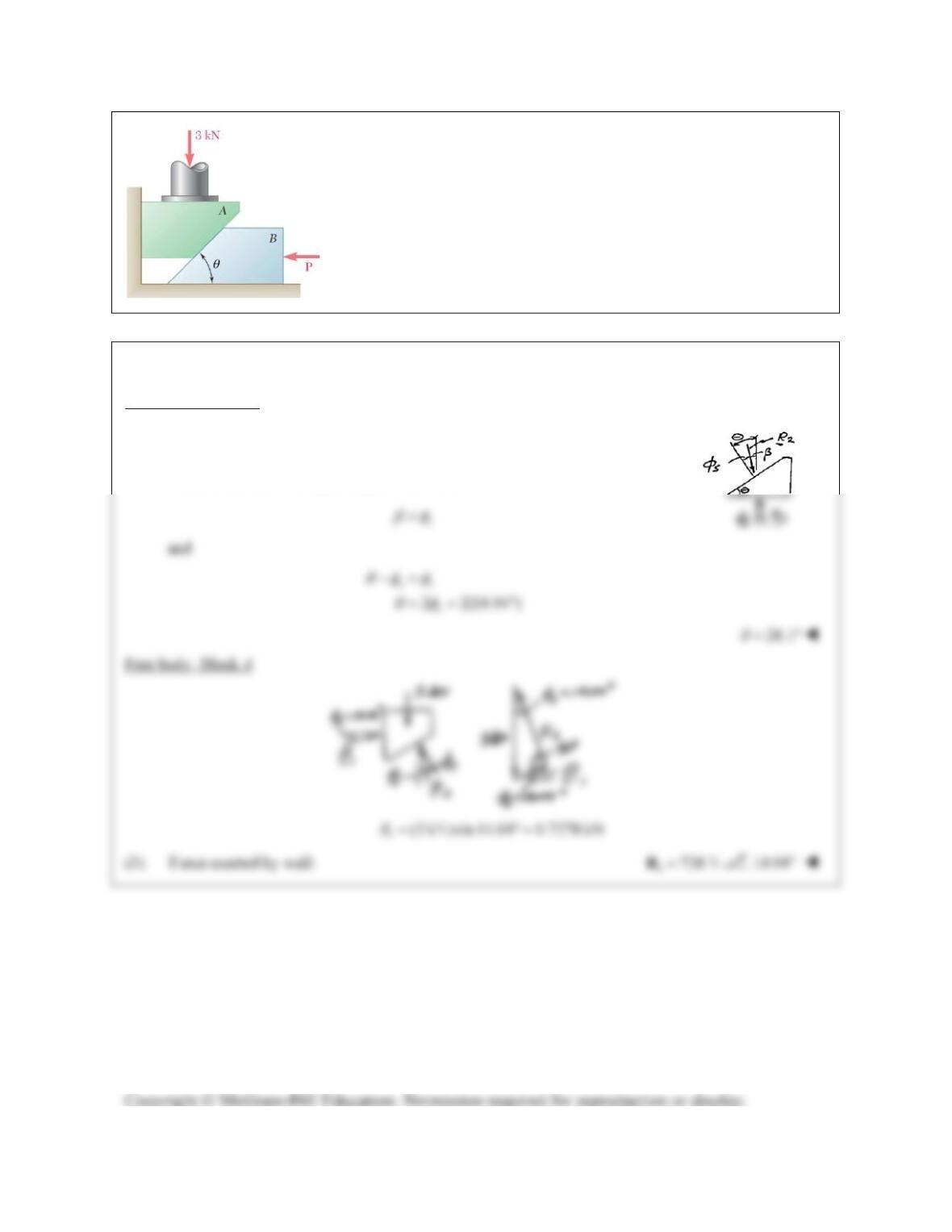
PROBLEM 8.56
Block A supports a pipe column and rests as shown on wedge B. The
coefficient of static friction at all surfaces of contact is 0.25. If
0,
P
determine (a) the angle
for which sliding is impending, (b) the
corresponding force exerted on the block by the vertical wall.
SOLUTION
Free body: Wedge B
1
tan 0.25 14.04
s
(a) Since wedge is a two-force body,
2
R
and
3
R
must be equal and opposite.
Therefore, they form equal angles with vertical
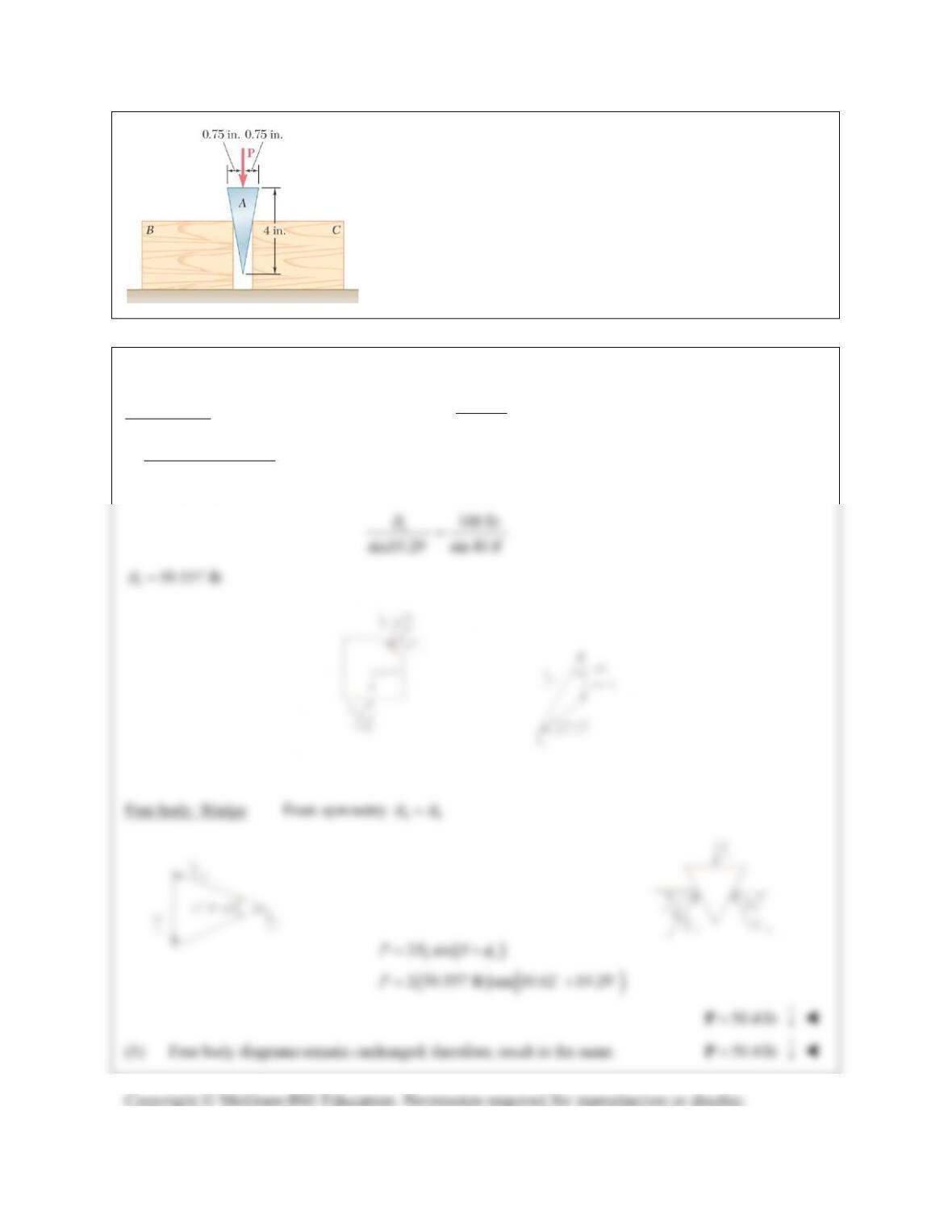
PROBLEM 8.57
A wedge A of negligible weight is to be driven between two 100-lb
blocks B and C resting on a horizontal surface. Knowing that the
coefficient of static friction between all surfaces of contact is 0.35,
determine the smallest force
P
required to start moving the wedge
(a) if the blocks are equally free to move, (b) if block C is securely
bolted to the horizontal surface.
SOLUTION
Wedge angle
1
0.75 in.
tan 10.62
4 in.
(a) Free body: Block B
1
tan 0.35 19.29
s
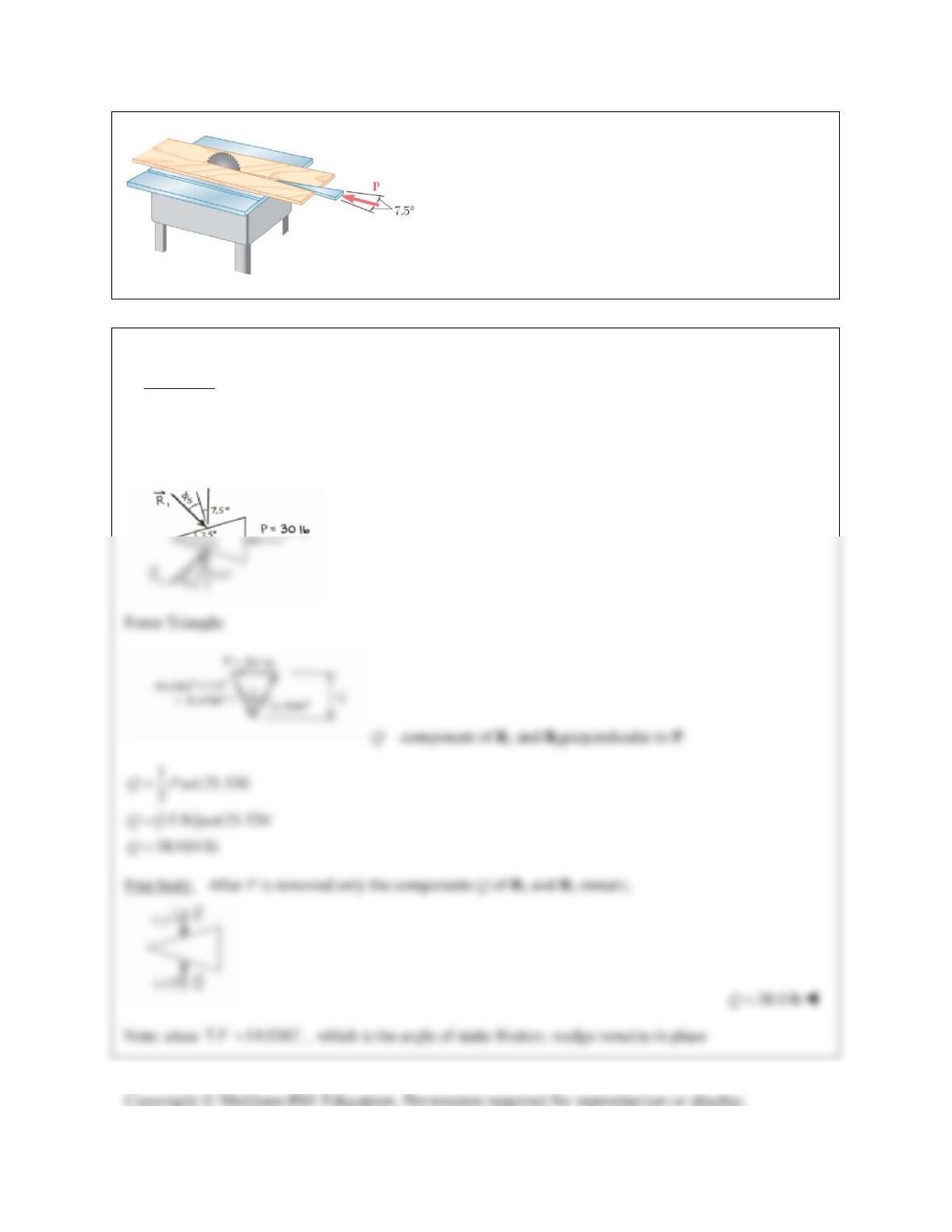
PROBLEM 8.58
A 15 wedge is forced into a saw cut to prevent binding
of the circular saw. The coefficient of static friction
between the wedge and the wood is 0.25. Knowing that a
horizontal force
P
with a magnitude of 30 lb was required
to insert the wedge, determine the magnitude of the forces
exerted on the board by the wedge after insertion.
SOLUTION
(a)Free body: Wedge being inserted,
0.25
s
1
tan 0.25 14.0362
s
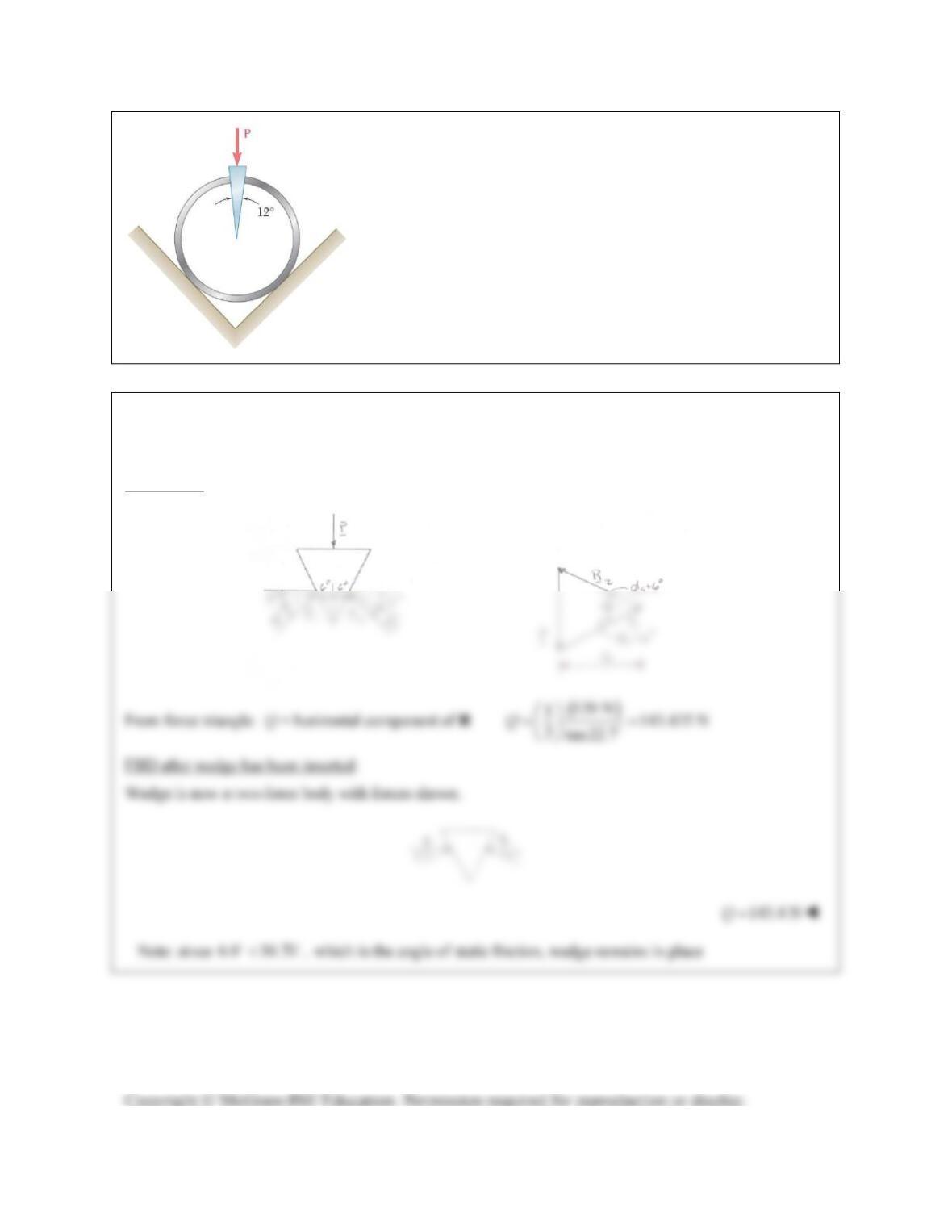
PROBLEM 8.59
A 12 wedge is used to spread a split ring. The coefficient of static
friction between the wedge and the ring is 0.30. Knowing that a
force
P
with a magnitude of 120 N was required to insert the wedge,
determine the magnitude of the forces exerted on the ring by the
wedge after insertion.
SOLUTION
11
tan tan 0.30 16.70
ss
FBD wedge: