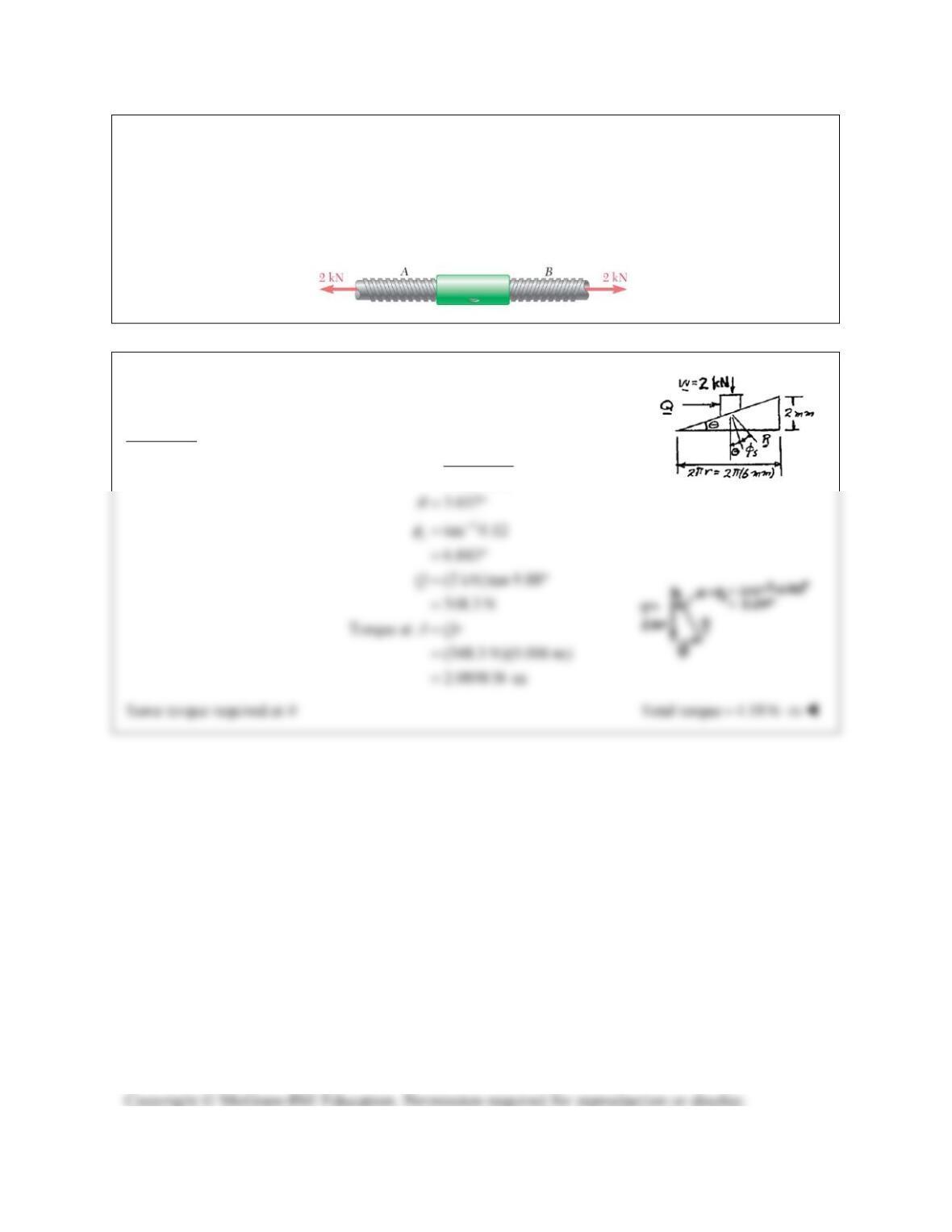
PROBLEM 8.75
The ends of two fixed rods A and B are each made in the form of a single-threaded screw of mean radius
6 mm and pitch 2 mm. Rod A has a right-handed thread and rod B has a left-handed thread. The
coefficient of static friction between the rods and the threaded sleeve is 0.12. Determine the magnitude of
the couple that must be applied to the sleeve in order to draw the rods closer together.
SOLUTION
To draw rods together:
Screw at A
2mm
tan 2 (6 mm)
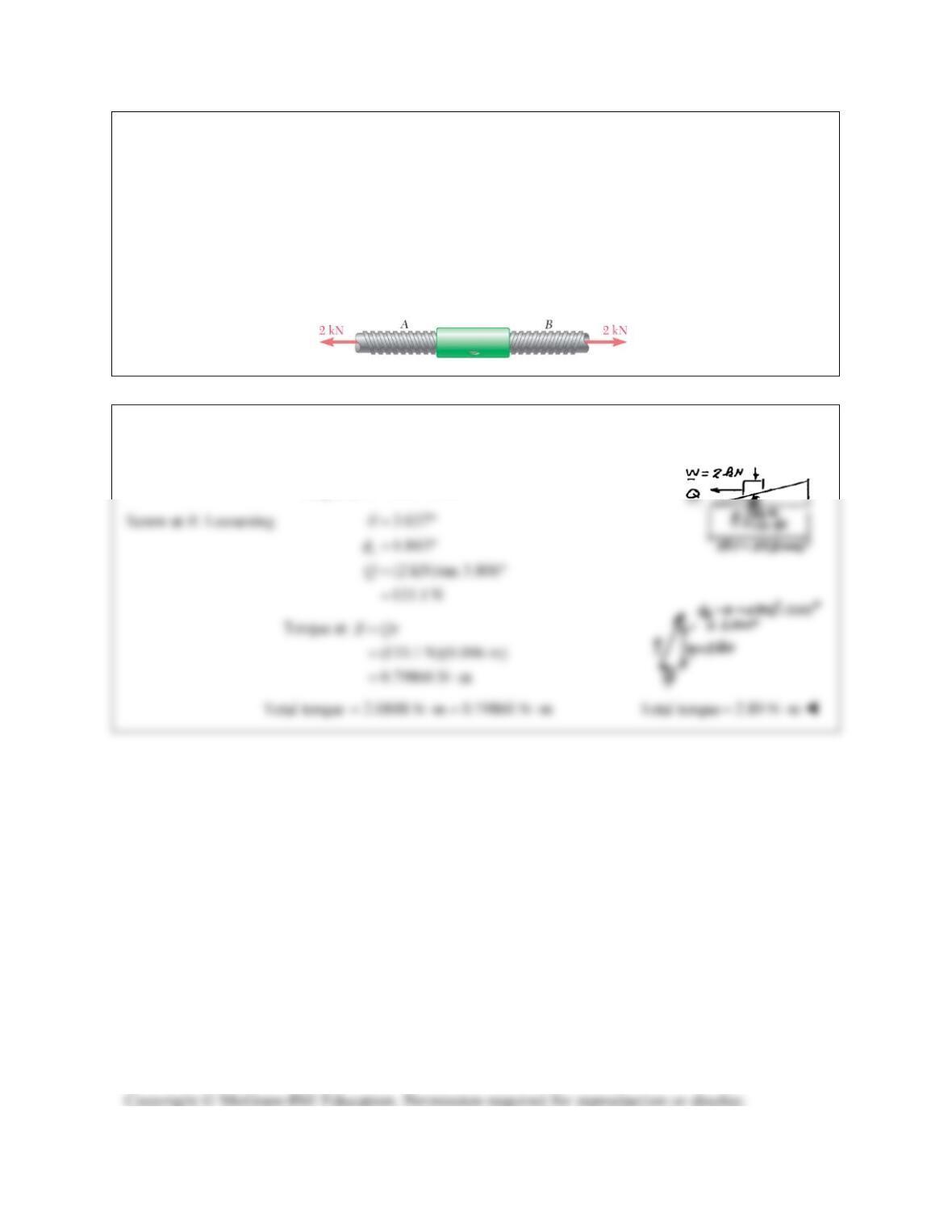
PROBLEM 8.76
Assuming that in Problem 8.75 a right-handed thread is used on both rods A and B, determine the
magnitude of the couple that must be applied to the sleeve in order to rotate it.
PROBLEM 8.75
The ends of two fixed rods A and B are each made in the form of a single-threaded
screw of mean radius 6 mm and pitch 2 mm. Rod A has a right-handed thread and rod B has a left-handed
thread. The coefficient of static friction between the rods and the threaded sleeve is 0.12. Determine the
magnitude of the couple that must be applied to the sleeve in order to draw the rods closer together.
SOLUTION
From the solution to Problem 8.70,
Torque at
2.09 N mA
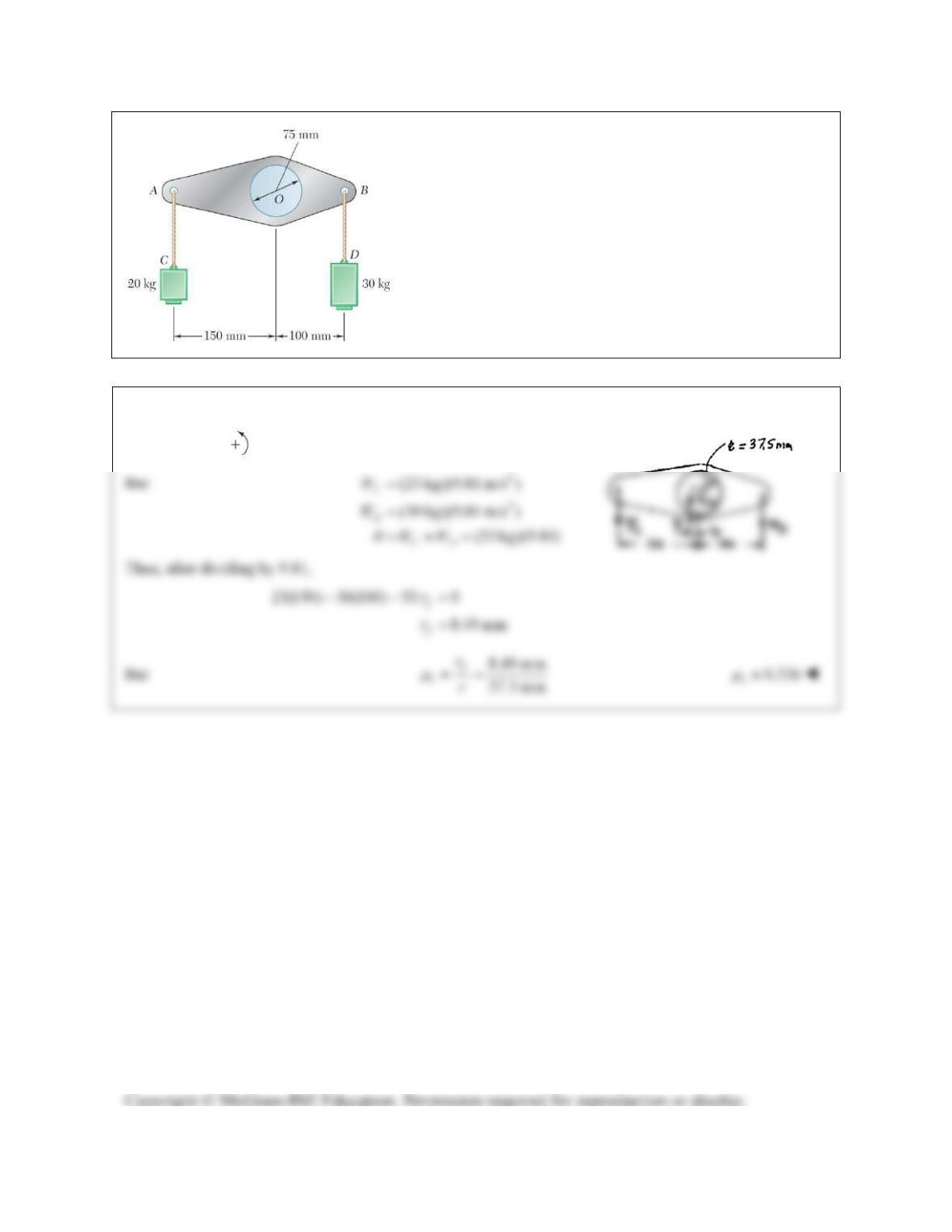
PROBLEM 8.77
A lever of negligible weight is loosely fitted onto a 75-mm-
diameter fixed shaft. It is observed that the lever will just start
rotating if a 3-kg mass is added at C. Determine the
coefficient of static friction between the shaft and the lever.
SOLUTION
0: (150) (100) 0
OC D f
MW W Rr
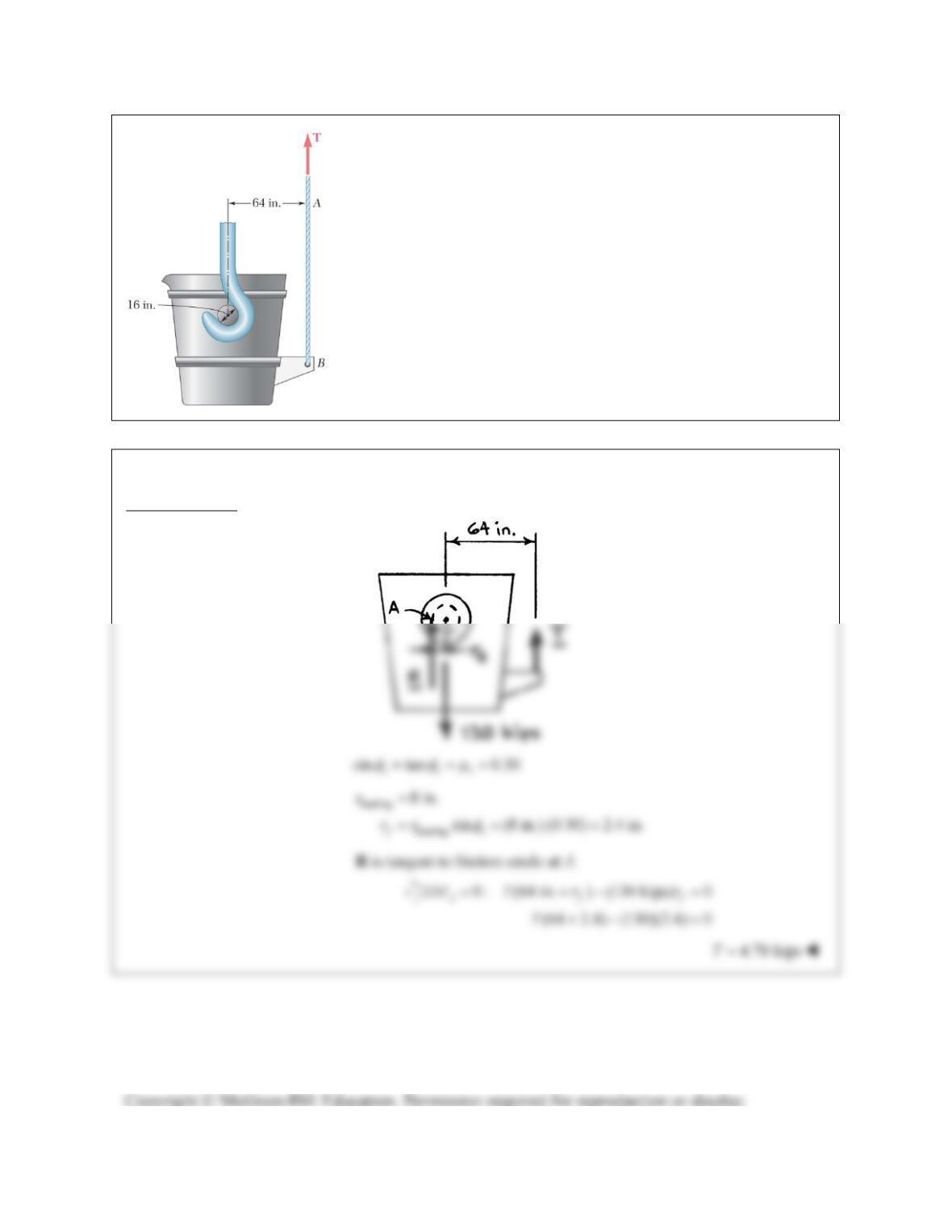
PROBLEM 8.78
A hot-metal ladle and its contents weigh 130 kips. Knowing that the
coefficient of static friction between the hooks and the pinion is 0.30,
determine the tension in cable AB required to start tipping the ladle.
SOLUTION
Free body: Ladle
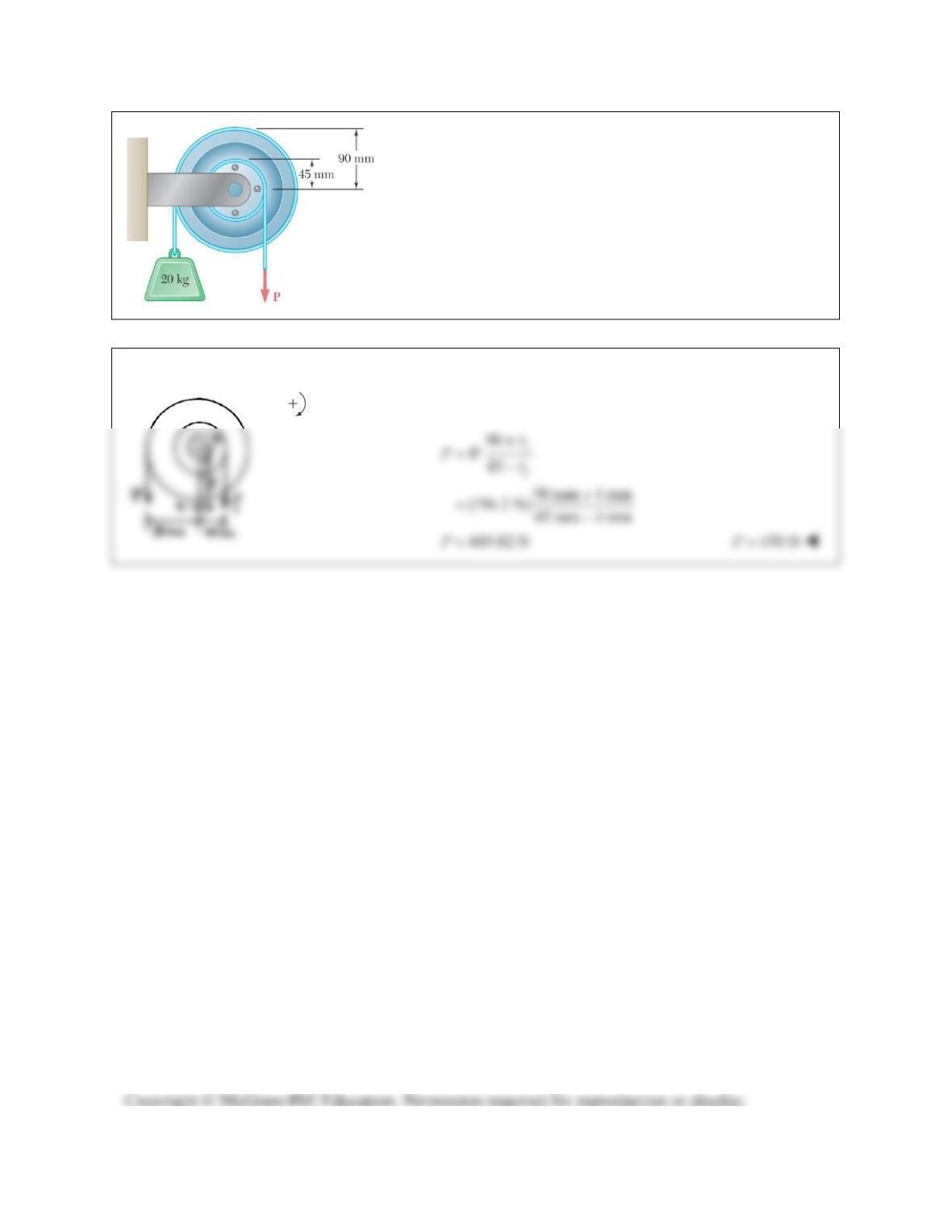
PROBLEM 8.79
The double pulley shown is attached to a 10-mm-radius shaft
that fits loosely in a fixed bearing. Knowing that the coefficient
of static friction between the shaft and the poorly lubricated
bearing is 0.40, determine the magnitude of the force
P
required
to start raising the load.
SOLUTION
0: (45 ) (90 ) 0
Dff
MPrWr
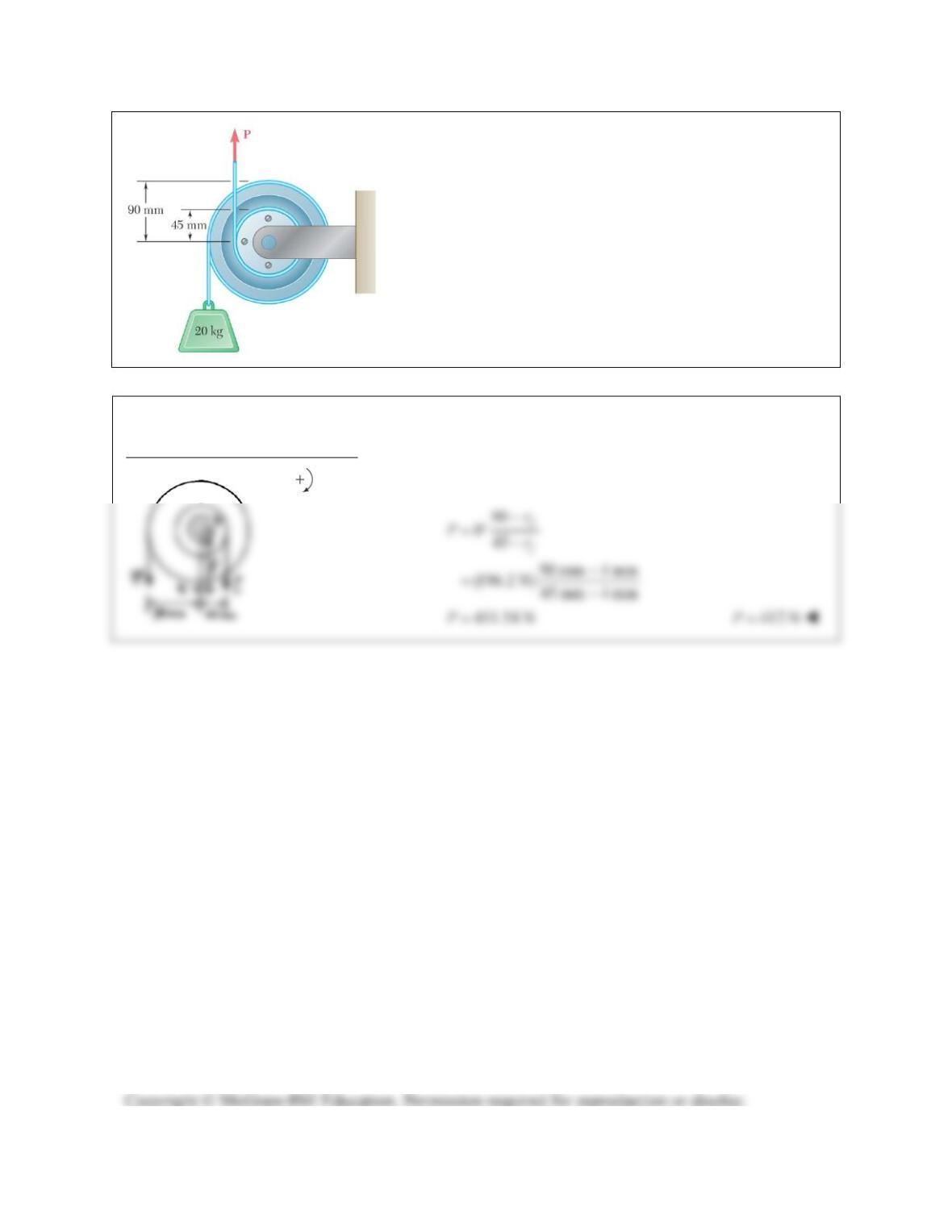
PROBLEM 8.80
The double pulley shown is attached to a 10-mm-radius shaft
that fits loosely in a fixed bearing. Knowing that the coefficient
of static friction between the shaft and the poorly lubricated
bearing is 0.40, determine the magnitude of the force
P
required
to start raising the load.
SOLUTION
Find
P
required to start raising load
0: (45 ) (90 ) 0
Dff
MPrWr
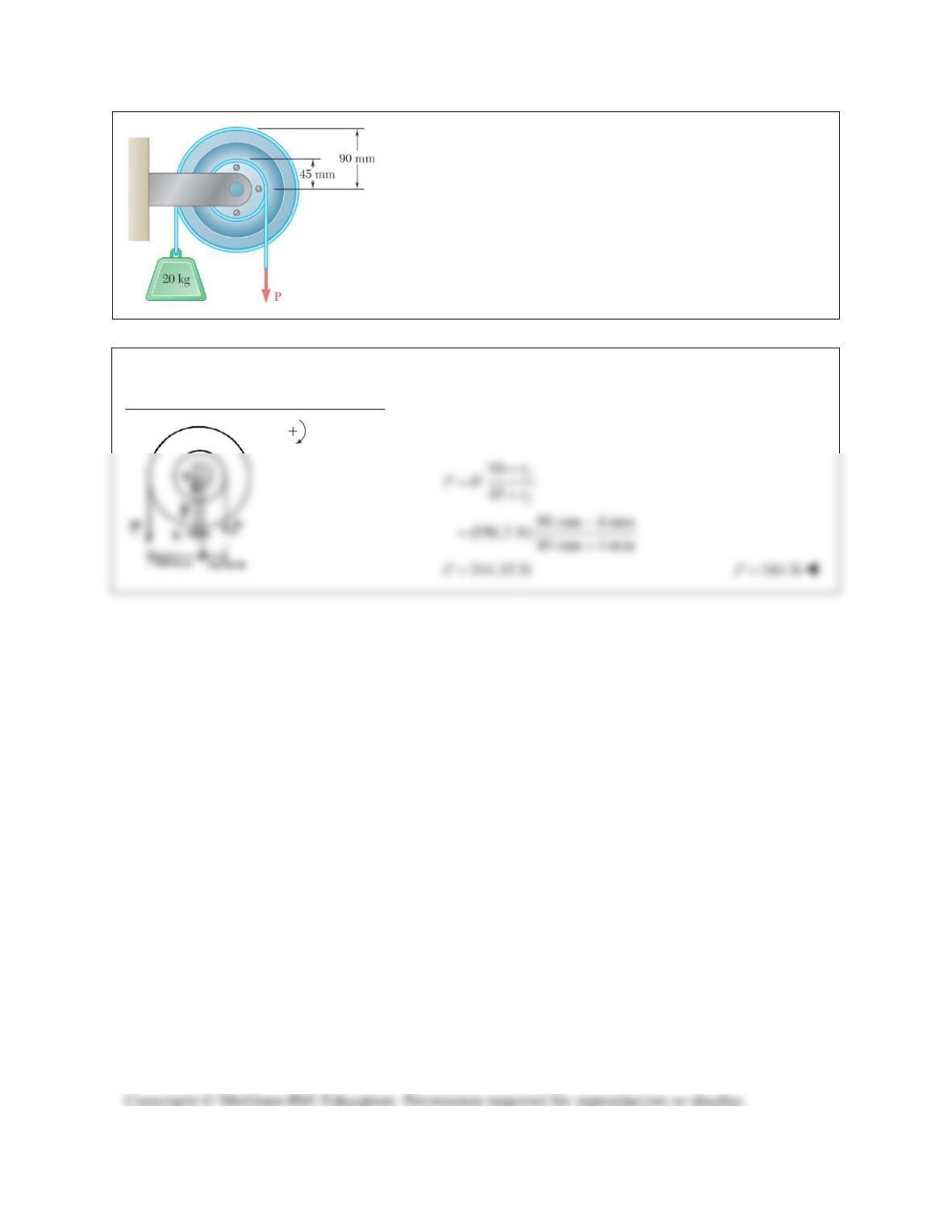
PROBLEM 8.81
The double pulley shown is attached to a 10-mm-radius shaft
that fits loosely in a fixed bearing. Knowing that the coefficient
of static friction between the shaft and the poorly lubricated
bearing is 0.40, determine the magnitude of the smallest force
P
required to maintain equilibrium.
SOLUTION
Find smallest
P
to maintain equilibrium
0: (45 ) (90 ) 0
Dff
MPrWr
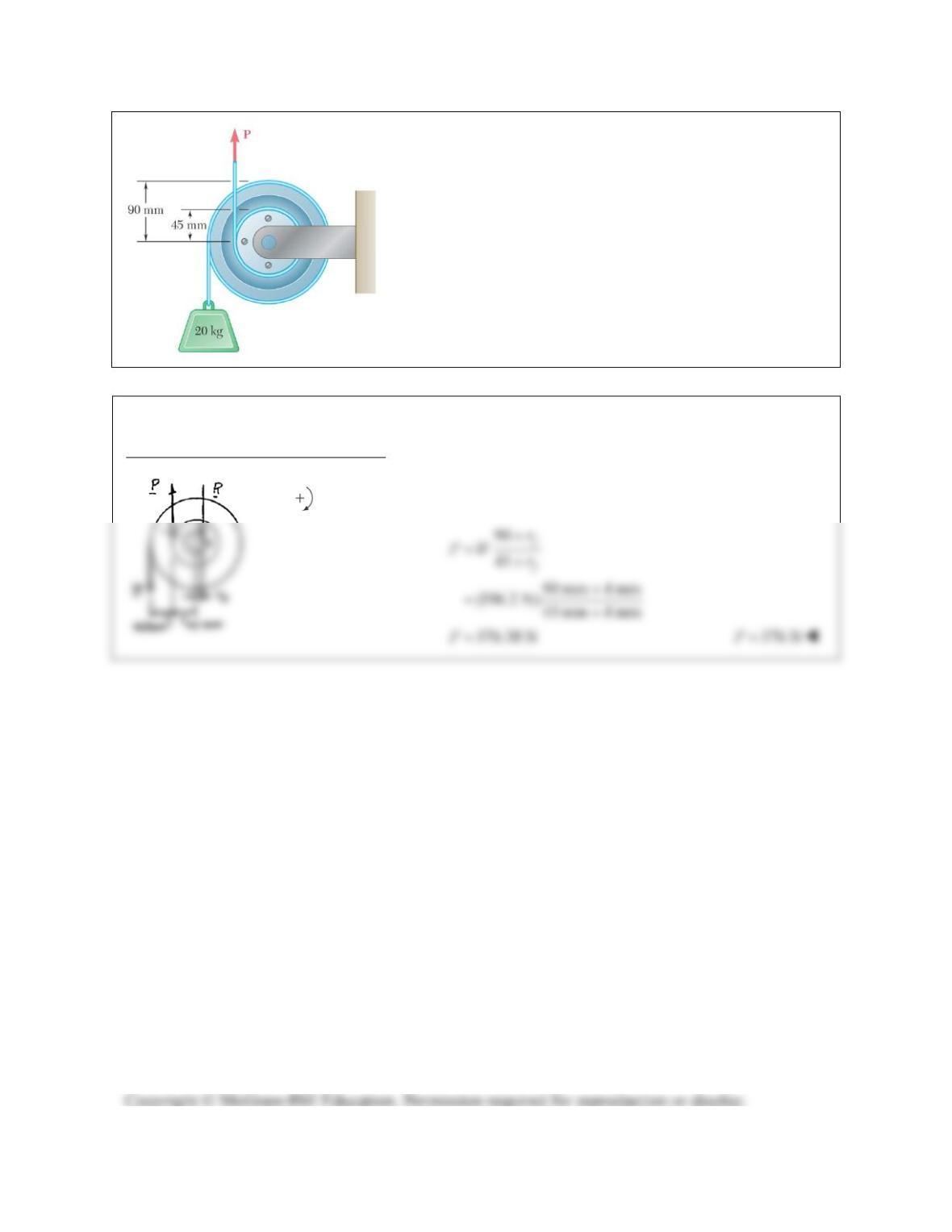
PROBLEM 8.82
The double pulley shown is attached to a 10-mm-radius shaft
that fits loosely in a fixed bearing. Knowing that the coefficient
of static friction between the shaft and the poorly lubricated
bearing is 0.40, determine the magnitude of the smallest force
P
required to maintain equilibrium.
SOLUTION
Find smallest
P
to maintain equilibrium
0: (45 ) (90 ) 0
Dff
MPrWr
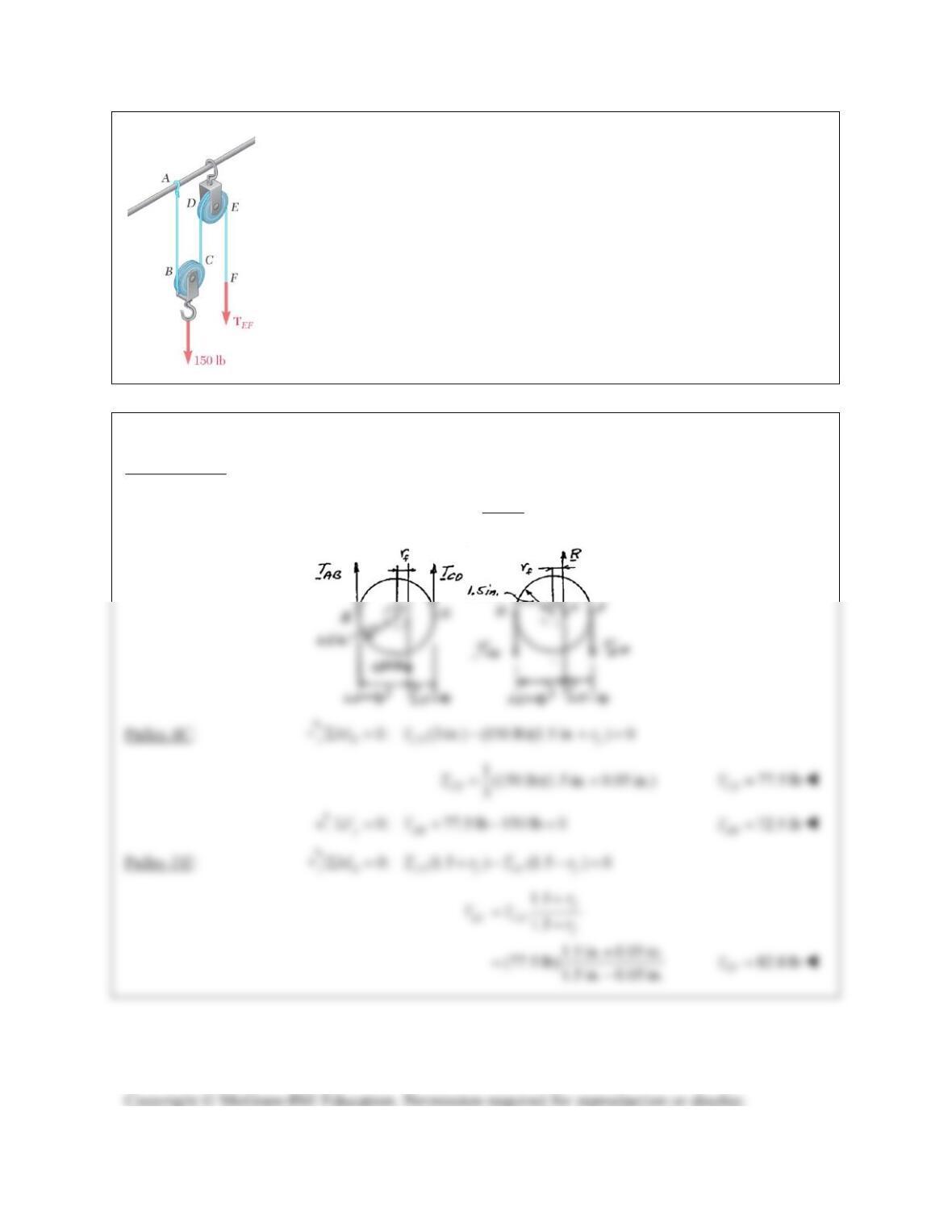
PROBLEM 8.83
The block and tackle shown are used to raise a 150-lb load. Each of the 3-in.-
diameter pulleys rotates on a 0.5-in.-diameter axle. Knowing that the coefficient
of static friction is 0.20, determine the tension in each portion of the rope as the
load is slowly raised.
SOLUTION
For each pulley: Axle diameter
0.5 in.
0.5 in.
sin 0.20 0.05 in.
2
fss
rr r
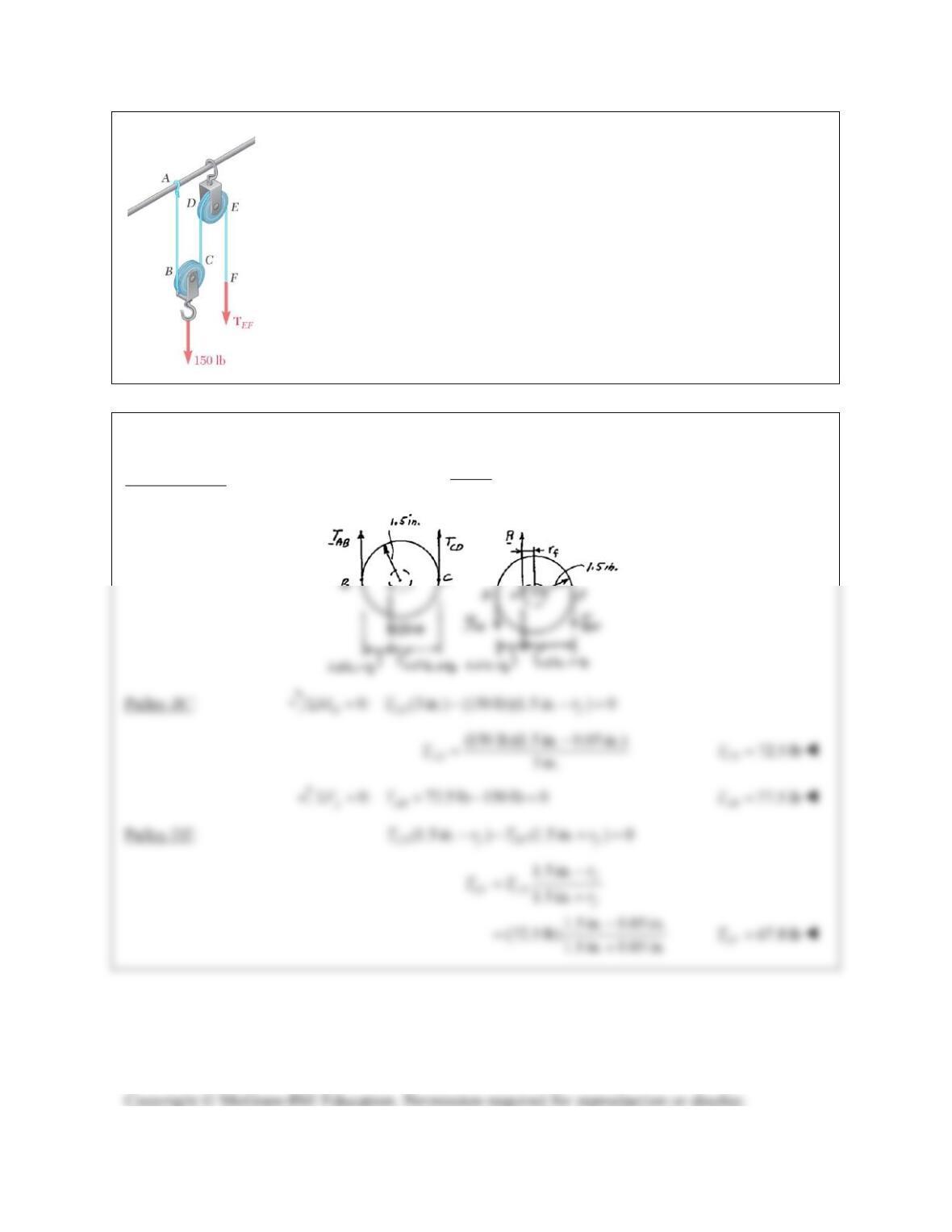
PROBLEM 8.84
The block and tackle shown are used to lower a 150-lb load. Each of the 3-in.-
diameter pulleys rotates on a 0.5-in.-diameter axle. Knowing that the coefficient
of static friction is 0.20, determine the tension in each portion of the rope as the
load is slowly lowered.
SOLUTION
For each pulley:
0.5 in. 0.2 0.05 in.
2
fs
rr
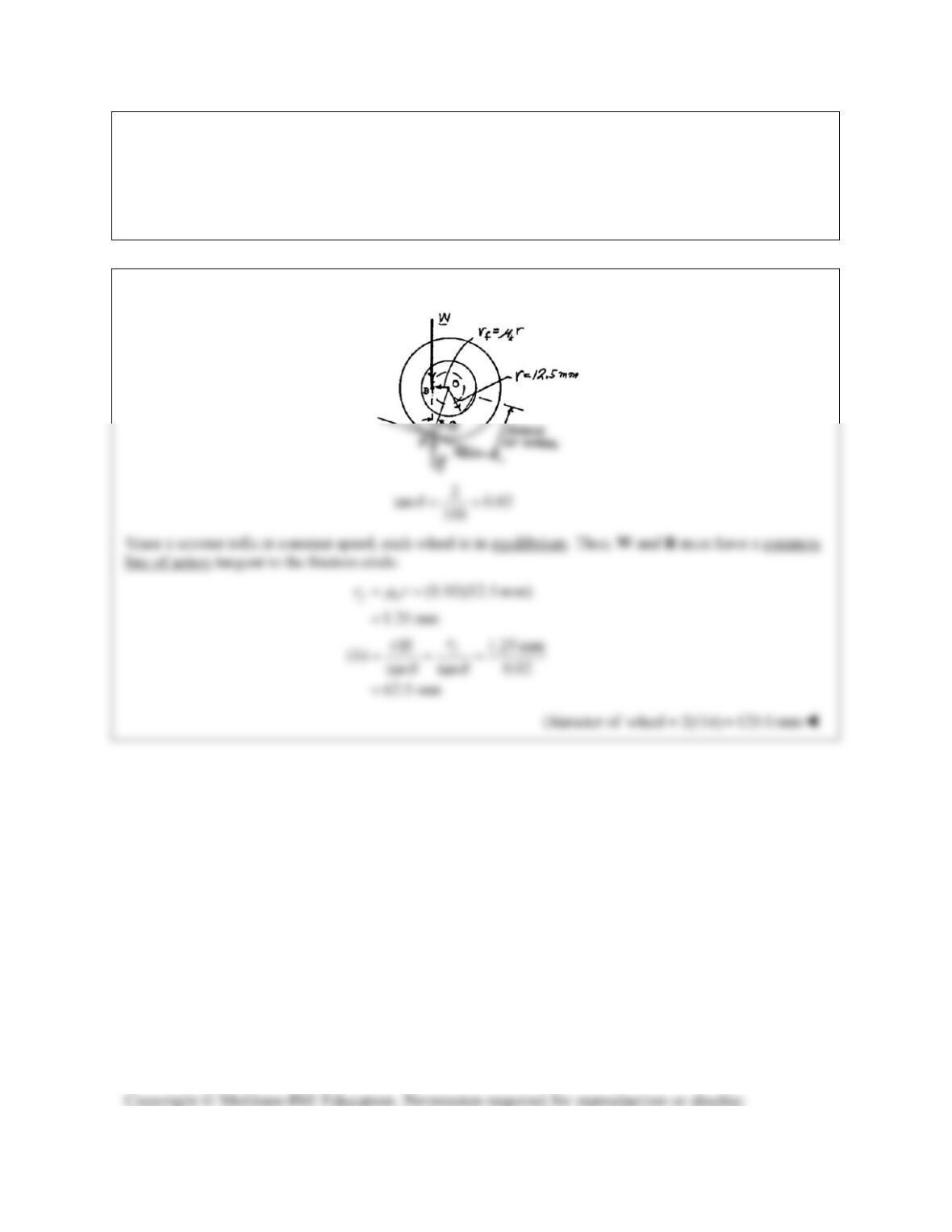
PROBLEM 8.85
A scooter is to be designed to roll down a 2 percent slope at a constant speed. Assuming that the
coefficient of kinetic friction between the 25-mm-diameter axles and the bearings is 0.10, determine the
required diameter of the wheels. Neglect the rolling resistance between the wheels and the ground.
SOLUTION
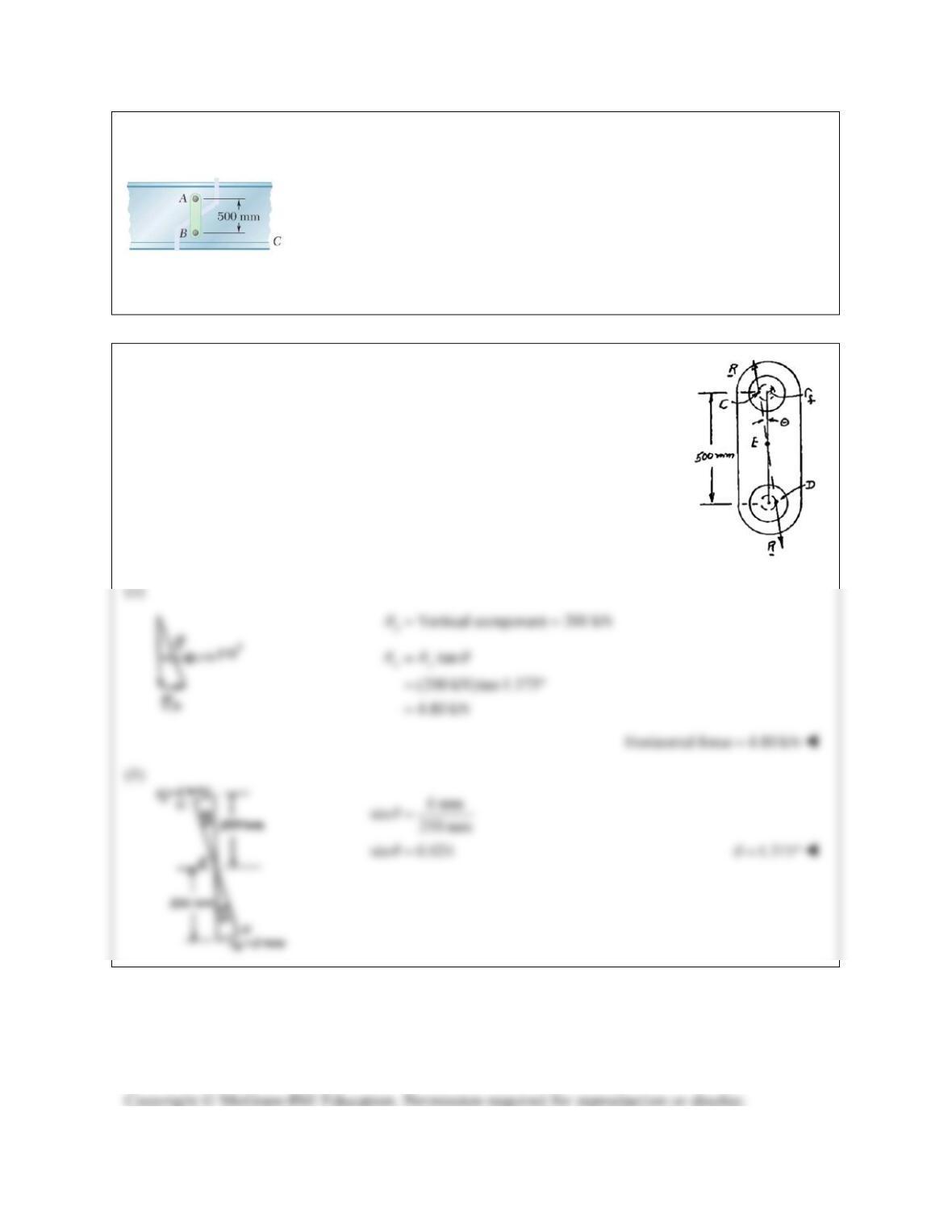
PROBLEM 8.86
The link arrangement shown is frequently used in highway bridge
construction to allow for expansion due to changes in temperature. At each of
the 60-mm-diameter pins A and B the coefficient of static friction is 0.20.
Knowing that the vertical component of the force exerted by BC on the link is
200 kN, determine (a) the horizontal force that should be exerted on beam BC
to just move the link, (b) the angle that the resulting force exerted by beam
BC on the link will form with the vertical.
SOLUTION
Bearing:
30 mm
0.20(30 mm)
6mm
fs
r
rr
Resultant forces
R
must be tangent to friction circles at Points C and D.
PROBLEM 8.87
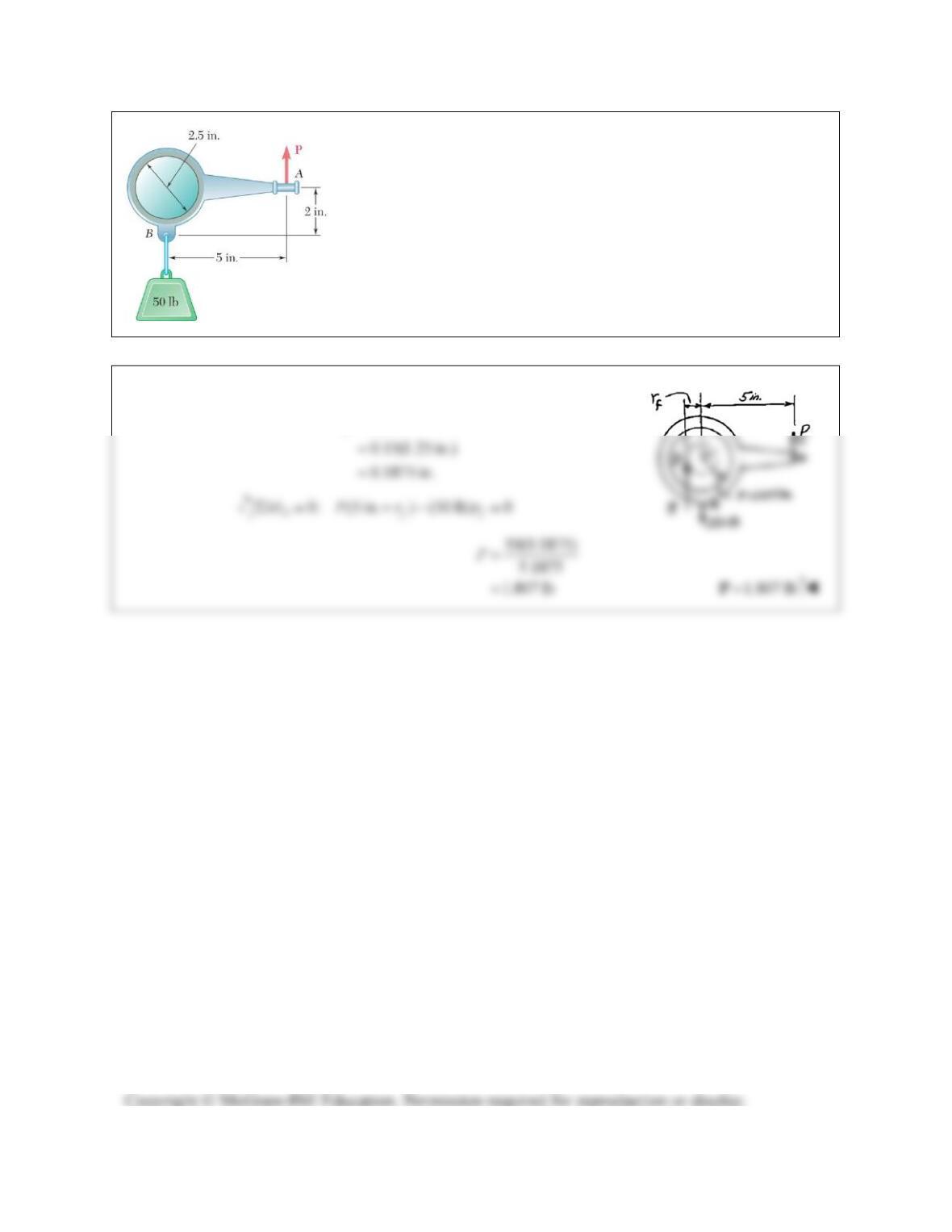
A lever AB of negligible weight is loosely fitted onto a 2.5-in.-diameter
fixed shaft. Knowing that the coefficient of static friction between the
fixed shaft and the lever is 0.15, determine the force
P
required to start
the lever rotating counterclockwise.
SOLUTION
fs
rr
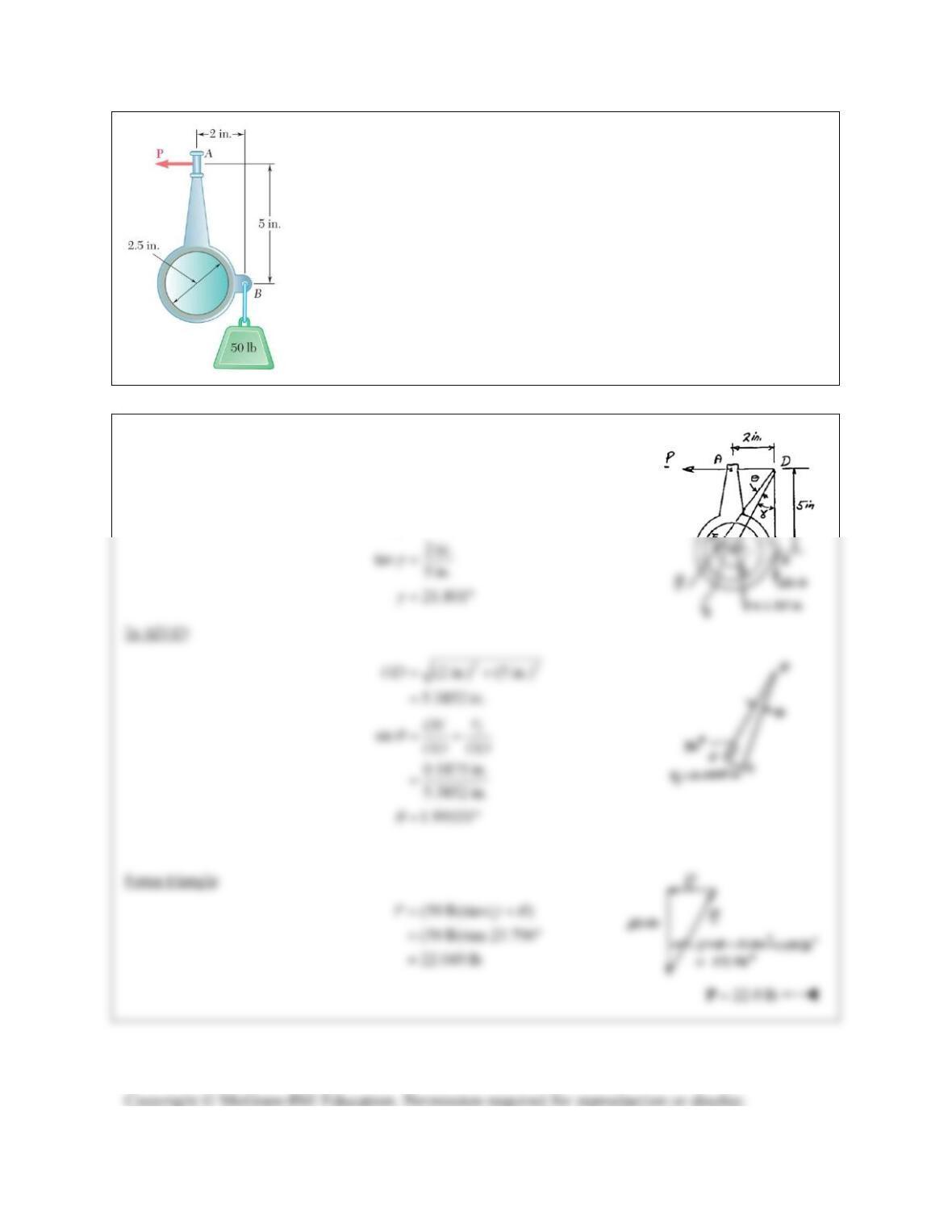
PROBLEM 8.88
A lever AB of negligible weight is loosely fitted onto a 2.5-in.-diameter fixed
shaft. Knowing that the coefficient of static friction between the fixed shaft
and the lever is 0.15, determine the force
P
required to start the lever rotating
counterclockwise.
SOLUTION
0.15(1.25 in.)
0.1875 in.
fs
f
rr
r
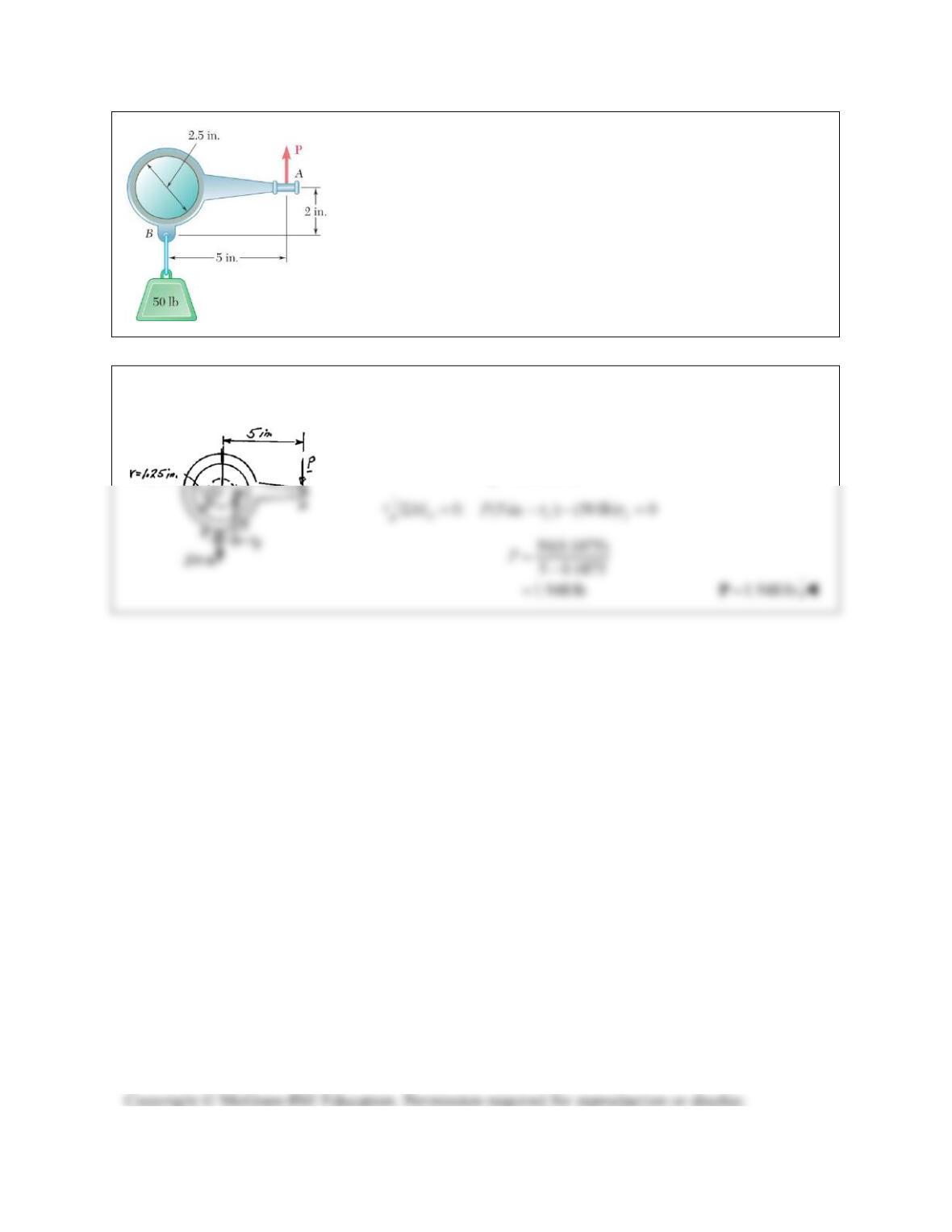
PROBLEM 8.89
A lever AB of negligible weight is loosely fitted onto a 2.5-in.-diameter
fixed shaft. Knowing that the coefficient of static friction between the
fixed shaft and the lever is 0.15, determine the force
P
required to start
the lever rotating clockwise.
SOLUTION
0.15(1.25 in.)
0.1875 in.
fs
f
rr
r
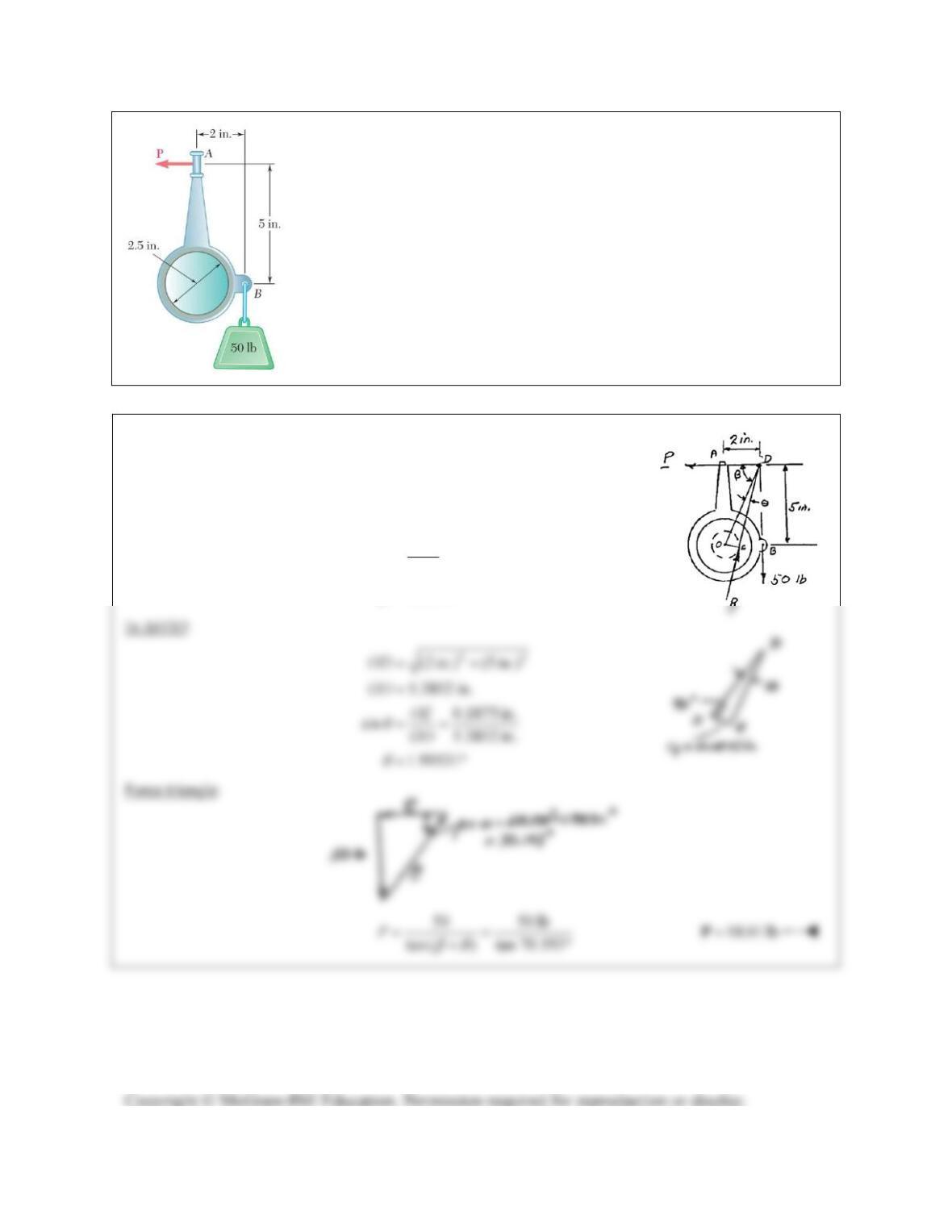
PROBLEM 8.90
A lever AB of negligible weight is loosely fitted onto a 2.5-in.-diameter fixed
shaft. Knowing that the coefficient of static friction between the fixed shaft
and the lever is 0.15, determine the force
P
required to start the lever rotating
clockwise.
SOLUTION
0.15(1.25 in.)
0.1875 in.
5in.
tan 2in.
68.198
fs
rr
PROBLEM 8.91
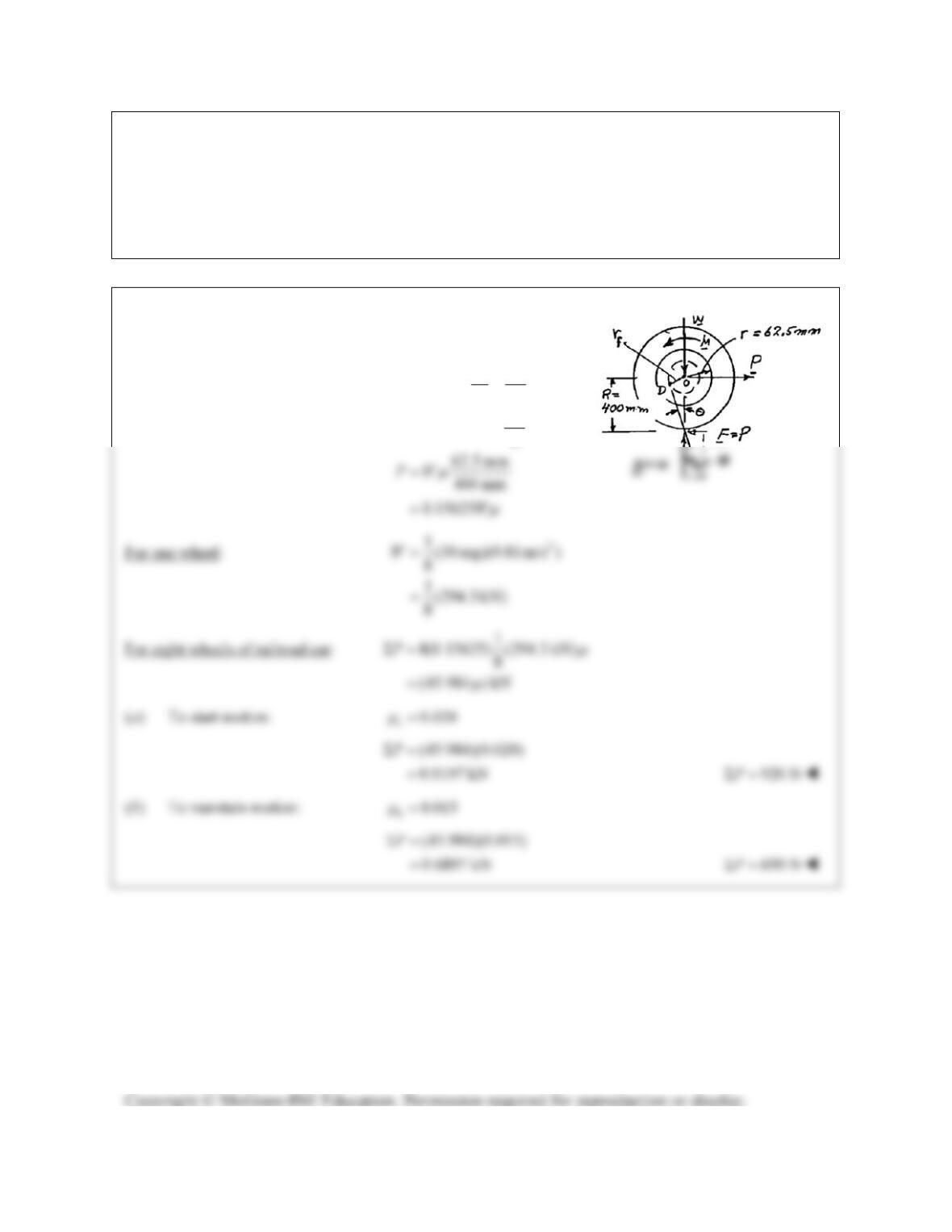
A loaded railroad car has a mass of 30 Mg and is supported by eight 800-mm-diameter wheels with 125-
mm–diameter axles. Knowing that the coefficients of friction are
0.020
s
and
0.015,
k
determine the
horizontal force required (a) to start the car moving, (b) to keep the car moving at a constant speed.
Neglect rolling resistance between the wheels and the track.
SOLUTION
; 400 mm
sin tan
tan
f
f
rrR
rr
RR
r
PW W
R
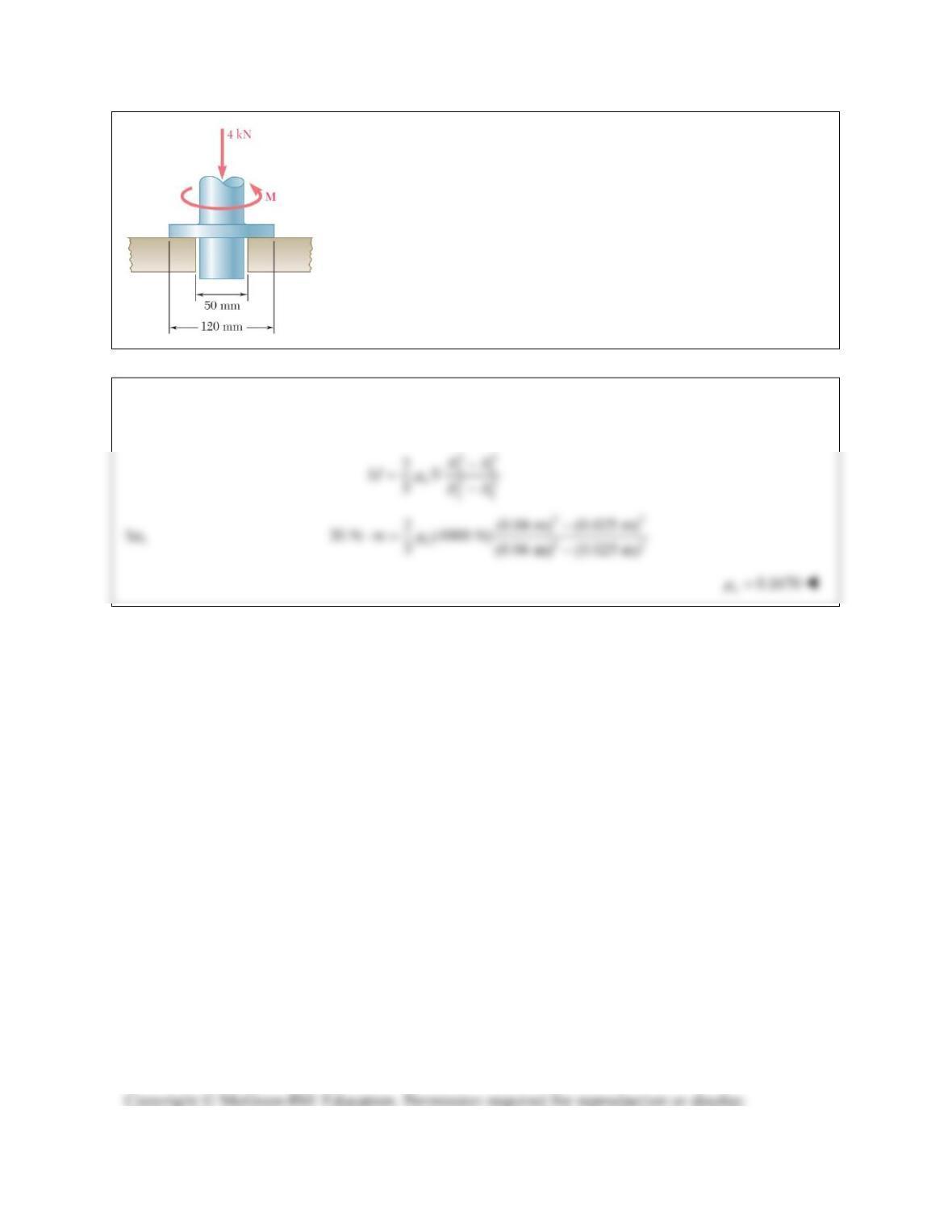
PROBLEM 8.92
Knowing that a couple of magnitude 30 N m
is required to start the
vertical shaft rotating, determine the coefficient of static friction between
the annular surfaces of contact.
SOLUTION
For annular contact regions, use Equation 8.8 with impending slipping:
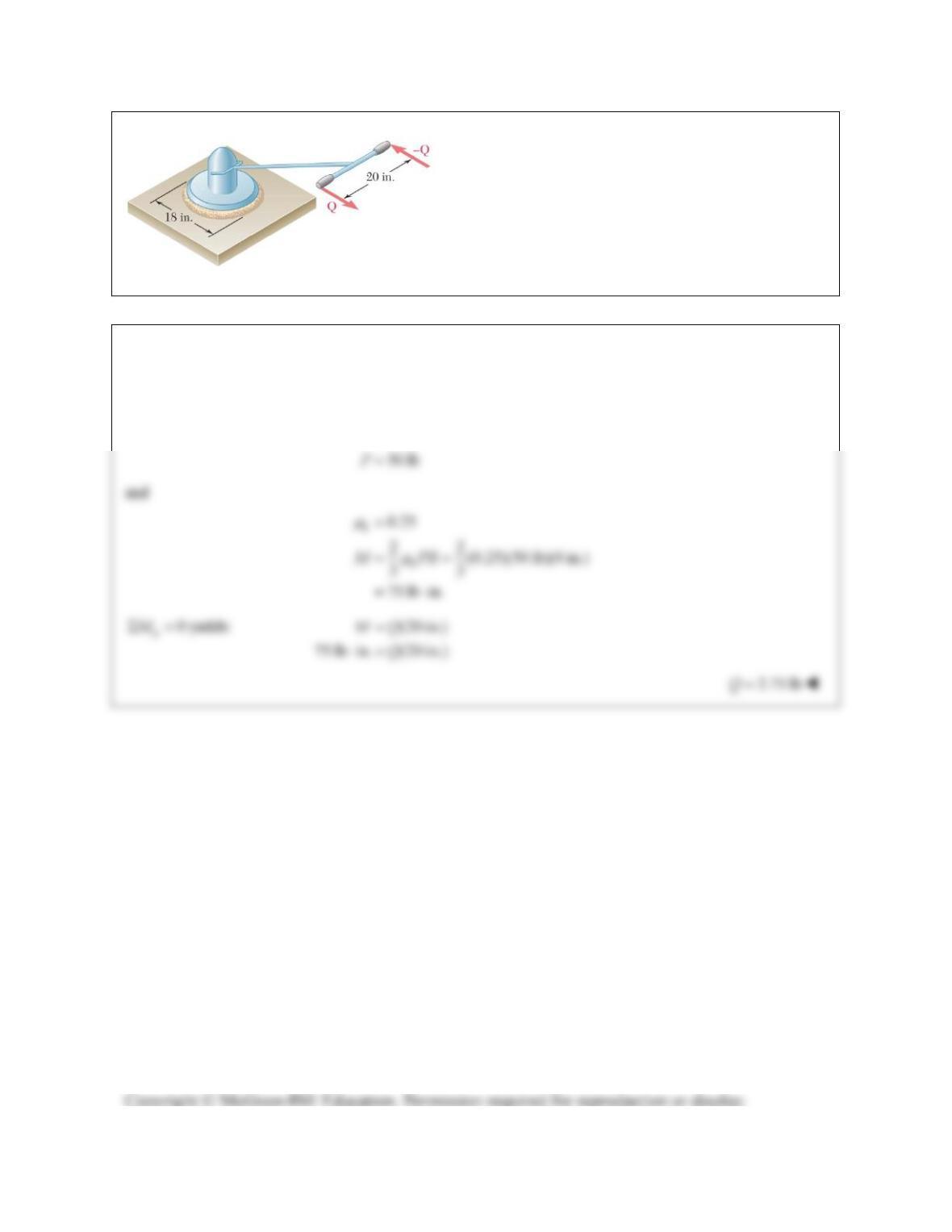
PROBLEM 8.93
A 50-lb electric floor polisher is operated on a surface
for which the coefficient of kinetic friction is 0.25.
Assuming that the normal force per unit area between
the disk and the floor is uniformly distributed, determine
the magnitude Q of the horizontal forces required to
prevent motion of the machine.
SOLUTION
See Figure 8.12 and Eq. (8.9).
Using:
9in.
R
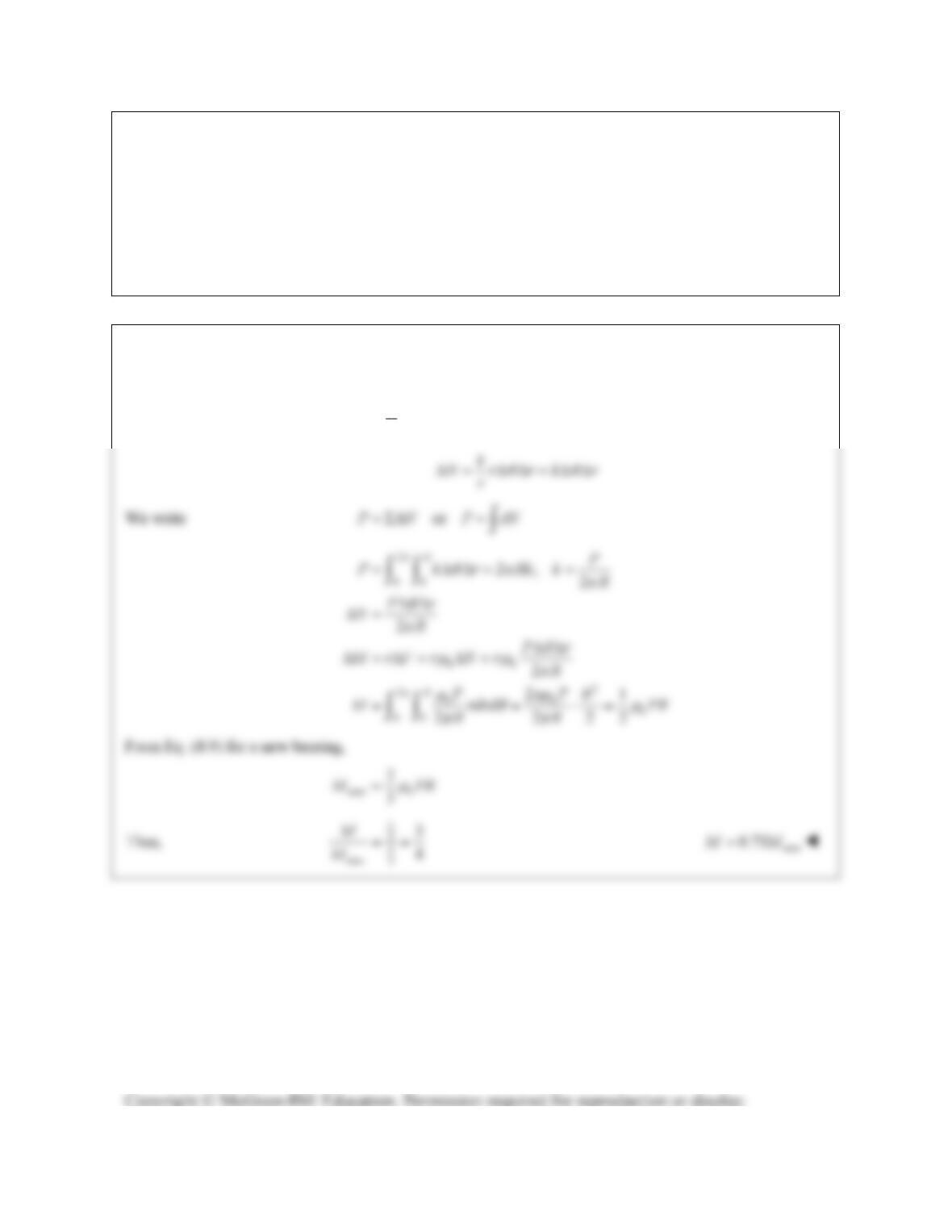
PROBLEM 8.94*
The frictional resistance of a thrust bearing decreases as the shaft and bearing surfaces wear out. It is
generally assumed that the wear is directly proportional to the distance traveled by any given point of the
shaft and thus to the distance r from the point to the axis of the shaft. Assuming, then, that the normal
force per unit area is inversely proportional to r, show that the magnitude M of the couple required to
overcome the frictional resistance of a worn-out end bearing (with contact over the full circular area) is
equal to 75 percent of the value given by Eq. (8.9) for a new bearing.
SOLUTION
Using Figure 8.12, we assume
:
k
NAArr
r