8-1
CHAPTER 8
Valuation of Inventories: A Cost-Basis Approach
ASSIGNMENT CLASSIFICATION TABLE (BY TOPIC)
Topics
Questions
Brief
Exercises
Exercises
Problems
Concepts
for Analysis
1.
Inventory accounts;
determining quantities,
costs, and items to be
included in inventory;
the inventory equation;
balance sheet disclosure.
1, 2, 3, 4,
5, 6, 8, 9
1, 3
1, 2, 3,
4, 5, 6
1, 2, 3
1, 2, 3, 5
5.
Flow assumptions.
12, 13, 16,
18, 20
5, 6, 7
9, 13, 14,
15, 16, 17,
18, 19, 20,
21, 22
1, 4, 5,
6, 7
5, 6, 7, 8, 11
8-2
ASSIGNMENT CLASSIFICATION TABLE (BY LEARNING OBJECTIVE)
Learning Objectives
Brief
Exercises
Exercises
Problems
1. Identify major classifications of inventory.
1
4. Understand the items to include as inventory cost.
3
1, 2, 3, 4,
5, 6, 7, 8
1, 2, 3
5. Describe and compare the cost flow assumptions
used to account for inventories.
5, 6, 7
9, 13, 14, 15,
16, 17, 18,
19, 20, 22
1, 4, 5, 6, 7
6. Explain the significance and use of a LIFO reserve.
21
7. Understand the effect of LIFO liquidations.
8. Explain the dollar-value LIFO method.
8, 9
22, 23, 24,
25, 26
1, 8, 9,
10, 11
9. Identify the major advantages and disadvantages
2. Distinguish between perpetual and periodic
2
4, 9, 13,
17, 20
4, 5, 6
3. Identify the effects of inventory errors
4
5, 10, 11, 12
2
8-3
ASSIGNMENT CHARACTERISTICS TABLE
Item
Description
Level of
Difficulty
Time
(minutes)
E8-1
Inventoriable costs.
Moderate
15–20
E8-2
Inventoriable costs.
Moderate
10–15
E8–10
Inventory errors, periodic.
Simple
10–15
E8–11
Inventory errors.
Simple
10–15
E8–12
Inventory errors.
Moderate
15–20
E8–13
FIFO and LIFO—periodic and perpetual.
Moderate
15–20
E8–14
FIFO, LIFO and average cost determination.
Moderate
20–25
E8–15
FIFO, LIFO, average cost inventory.
Moderate
15–20
E8–16
Compute FIFO, LIFO, average cost—periodic.
Moderate
15–20
E8–17
FIFO and LIFO—periodic and perpetual.
Simple
10–15
E8–18
FIFO and LIFO; income statement presentation.
Simple
15–20
E8–19
FIFO and LIFO effects.
Moderate
15–20
E8–20
FIFO and LIFO—periodic.
Simple
10–15
E8–21
LIFO effect.
Moderate
10–15
E8–22
Alternate inventory methods—comprehensive.
Moderate
25–30
E8–23
Dollar-value LIFO.
Simple
E8–24
Dollar-value LIFO.
Simple
15–20
E8–25
Moderate
20–25
E8–26
Dollar-value LIFO.
Moderate
15–20
P8-1
Various inventory issues.
Moderate
30–40
P8-2
Inventory adjustments.
Moderate
25–35
P8-3
Purchases recorded gross and net.
Simple
20–25
P8-4
Compute FIFO, LIFO, and average cost.
Complex
40–55
P8-5
Compute FIFO, LIFO, and average cost.
Complex
40–55
and perpetual.
P8-7
Financial statement effects of FIFO and LIFO.
Moderate
30–40
P8-8
Dollar-value LIFO.
Moderate
30–40
P8-9
Internal indexes—dollar-value LIFO.
Moderate
25–35
P8–10
Internal indexes—dollar-value LIFO.
Complex
30–35
P8–11
Dollar-value LIFO.
Moderate
40–50
E8-3
Inventoriable costs.
Simple
10–15
E8-4
Inventoriable costs—perpetual.
Simple
10–15
E8-5
Inventoriable costs—error adjustments.
Moderate
15–20
E8-6
Determining merchandise amounts—periodic.
Simple
10–20
E8-7
Purchases recorded net.
Simple
10–15
E8-8
Purchases recorded, gross method.
Simple
20–25
E8-9
Periodic versus perpetual entries.
Moderate
10–15
ASSIGNMENT CHARACTERISTICS TABLE (Continued)
Item
Description
Level of
Difficulty
Time
(minutes)
CA8-1
Inventoriable costs.
Moderate
15–20
CA8-2
Inventoriable costs.
Moderate
15–25
CA8-3
Inventoriable costs.
Moderate
25–35
CA8-4
Accounting treatment of purchase discounts.
15–25
CA8-5
General inventory issues.
Moderate
20–25
CA8-6
LIFO inventory advantages.
15–20
CA8-7
Average cost, FIFO, and LIFO.
15–20
CA8-8
LIFO application and advantages.
Moderate
25–30
CA8-9
Dollar-value LIFO issues.
Moderate
25–30
CA8–10
FIFO and LIFO.
Moderate
30–35
CA8–11
LIFO Choices—Ethical Issues.
Moderate
20–25
SOLUTIONS TO CODIFICATION EXERCISES
CE8-1
(a) Inventory is the aggregate of those items of tangible personal property that have any of the
following characteristics:
a. Held for sale in the ordinary of business.
b. To process of production for such sale.
does not require separate classification. By trade practice, operating materials and supplies of
certain types of entities such as oil producers are usually treated as inventory.
(b) A customer is a reseller or a consumer, either an individual or a business that purchases a
vendor’s products or services for end use rather than for resale. This definition is consistent with
paragraph 280-10–50-42, which states that a group of entities known to a reporting entity to be
CE8-2
According FASB ASC 605-45–45-19 through 21 [Shipping and Handling Fees and Costs]:
45–19 Many sellers charge customers for shipping and handling in amounts in amounts that exceed
the related costs incurred. The components of shipping and handling costs, and the
determination of the amounts billed to customers for shipping and handling, may differ from
8-6
CE8-2 (Continued)
45–20 For those entities that determine under the indicators listed in paragraphs 605–45–45-4 through
CE8-3
FASB ASC 330-10–35-1 and 15 with respect to adjustments to Lower of Cost or Market:
35-1 A departure from the cost basis of pricing the inventory is required when the utility of the goods
is no longer as great as their cost. Where there is evidence that the utility of goods, in their
35–15 Only in exceptional cases may inventories properly be stated above cost. For example,
precious metals having a fixed monetary value with no substantial cost of marketing may be
CE8-4
FASB ASC 330-10-S99–3 (SAB Topic 11.F, LIFO Liquidations) The following is the text of SAB
Topic 11.F, LIFO Liquidations.
Facts: Registrant on LIFO basis of accounting liquidates a substantial portion of its LIFO inventory and
as a result includes a material amount of income in its income statement which would not have been
recorded had the inventory liquidation not taken place.
Question: Is disclosure required of the amount of income realized as a result of the inventory liquidation?
ANSWERS TO QUESTIONS
1. In a retailing concern, inventory normally consists of only one category that is the product awaiting
2. (a) Inventories are unexpired costs and represent future benefits to the owner. A statement of
financial position includes a listing of all unexpired costs (assets) at a specific point in time.
Because inventories are assets owned at the specific point in time for which a statement of
3. In a perpetual inventory system, data are available at any time on the quantity and dollar amount
of each item of material or type of merchandise on hand. A physical inventory means that
4. No, Mishima, Inc. should not report this amount on its balance sheet. As consignee, it does not
own this merchandise and therefore it is inappropriate for it to recognize this merchandise as part
of its inventory.
5. Product financing arrangements are essentially off-balance-sheet financing devices. These arrange-
6. (a) Inventory.
(b) Not shown, possibly in a note to the financial statements if material.
7. This omission would have no effect upon the net income for the year, since the purchases and the
ending inventory are understated in the same amount. With respect to financial position, both the
8. Cost, which has been defined generally as the price paid or consideration given to acquire an
asset, is the primary basis for accounting for inventories. As applied to inventories, cost means the
8-8
Questions Chapter 8 (Continued)
9. By their nature, product costs “attach” to the inventory and are recorded in the inventory account.
These costs are directly connected with the bringing of goods to the place of business of the buyer
and converting such goods to a salable condition. Such charges would include freight charges on
goods purchased, other direct costs of acquisition, and labor and other production costs incurred
10. Cash discounts (purchase discounts) should not be accounted for as financial income when pay-
ments are made. Income should be recognized when the earning process is complete (when the
company sells the inventory). Furthermore, a company does not earn revenue from purchasing
goods. Cash discounts should be considered as a reduction in the cost of the items purchased.
11. $60.00, $63.00, $61.80. (Transportation-In not included for discount.)
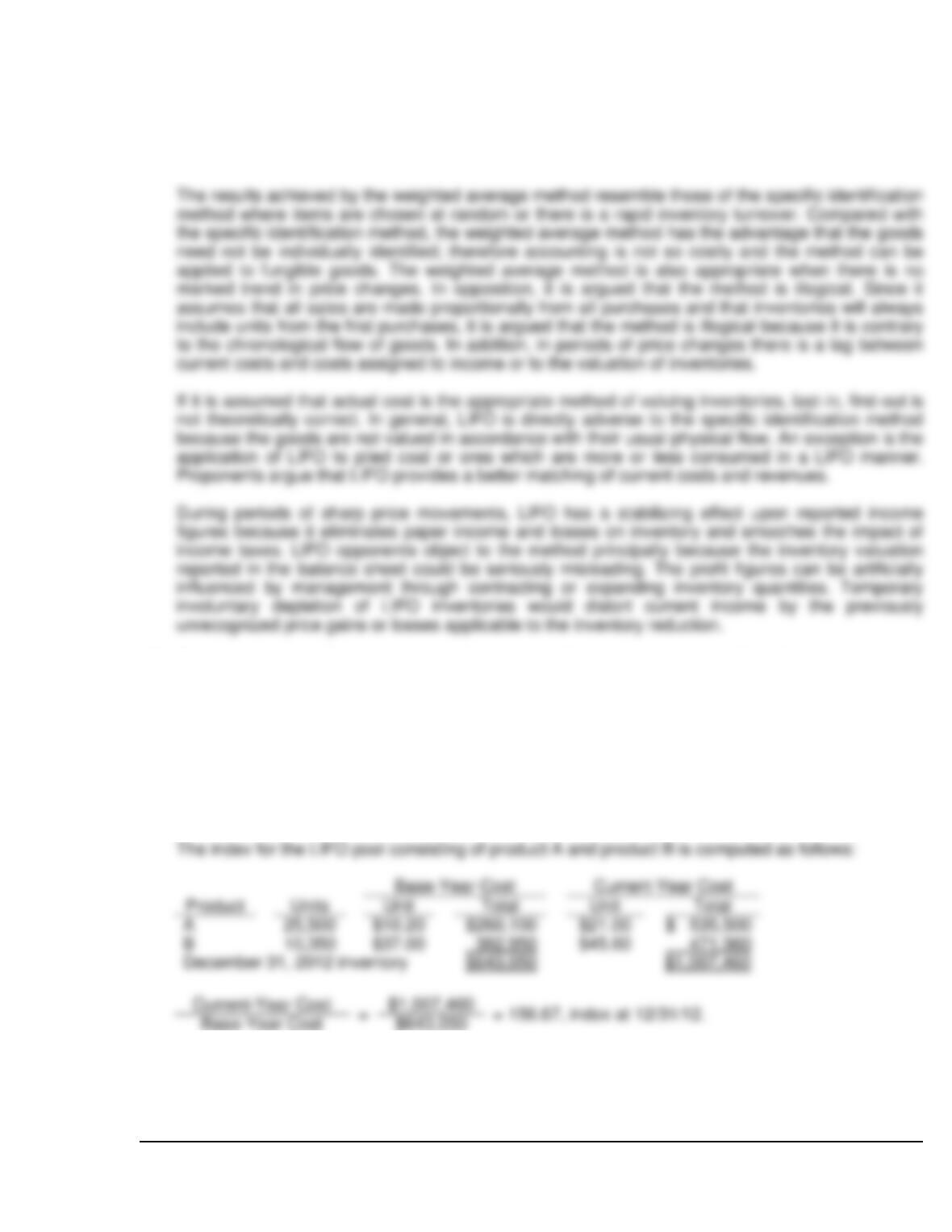
13. The first-in, first-out method approximates the specific identification method when the physical flow
of goods is on a FIFO basis. When the goods are subject to spoilage or deterioration, FIFO is
particularly appropriate. In comparison to the specific identification method, an attractive aspect of
FIFO is the elimination of the danger of artificial determination of income by the selection of
advantageously priced items to be sold. The basic assumption is that costs should be charged in
8-9
Questions Chapter 8 (Continued)
probably least similar to current replacement costs. On the other hand, this method produces a
balance sheet value for the asset close to current replacement costs. It is claimed that FIFO is
deceptive when used in a period of rising prices because the reported income is not fully available
since a part of it must be used to replace inventory at higher cost.
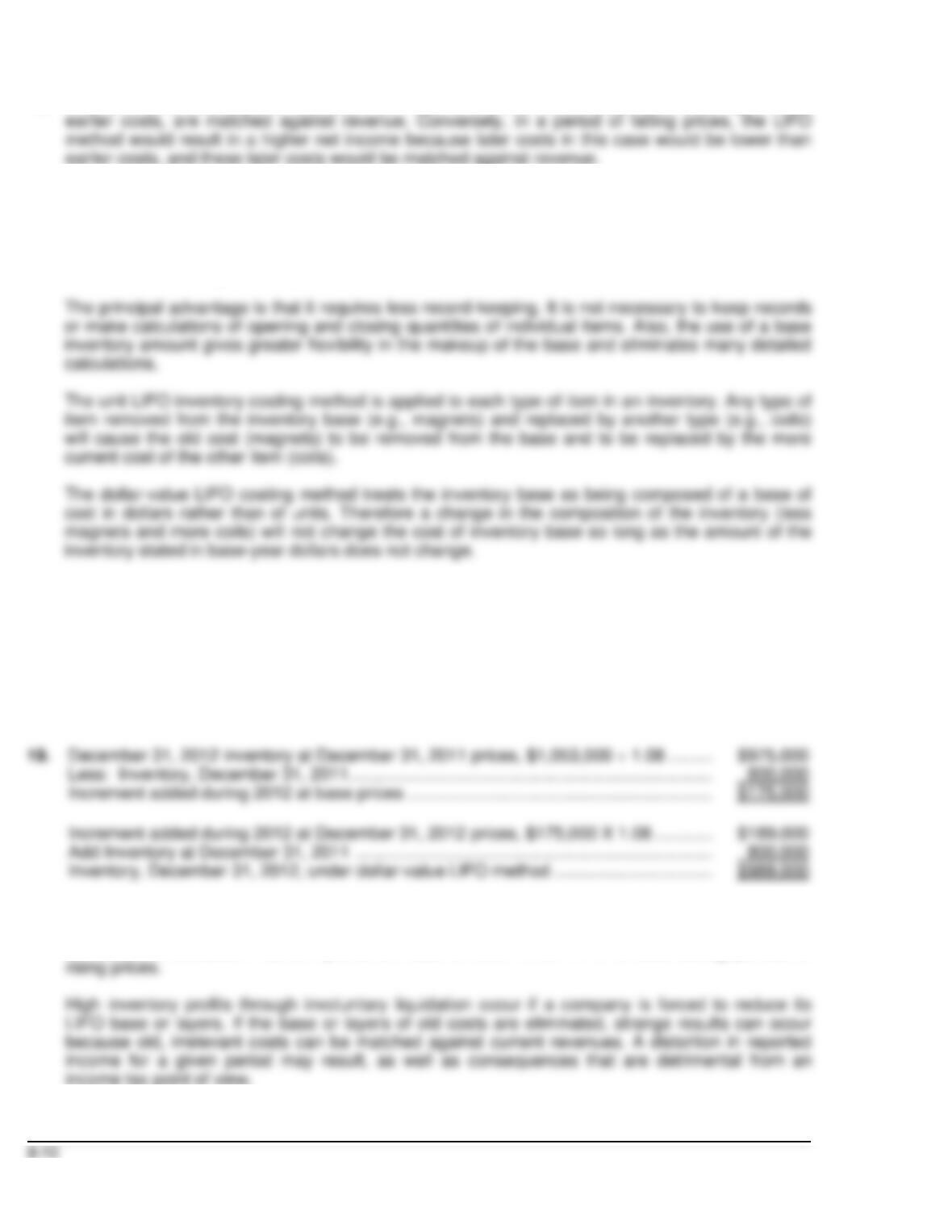
14. A company may obtain a price index from an outside source (external index)—the government, a
trade association, an exchange—or by computing its own index (internal index) using the double
extension method. Under the double extension method the ending inventory is priced at both
base-year costs and at current-year costs, with the total current cost divided by the total base cost
to obtain the current year index.
15. Under the double extension method, LIFO inventory is priced at both base-year costs and current-
year costs. The total current-year cost of the inventory is divided by the total base-year cost to
obtain the current-year index.
Questions Chapter 8 (Continued)
16. The LIFO method results in a smaller net income because later costs, which are higher than
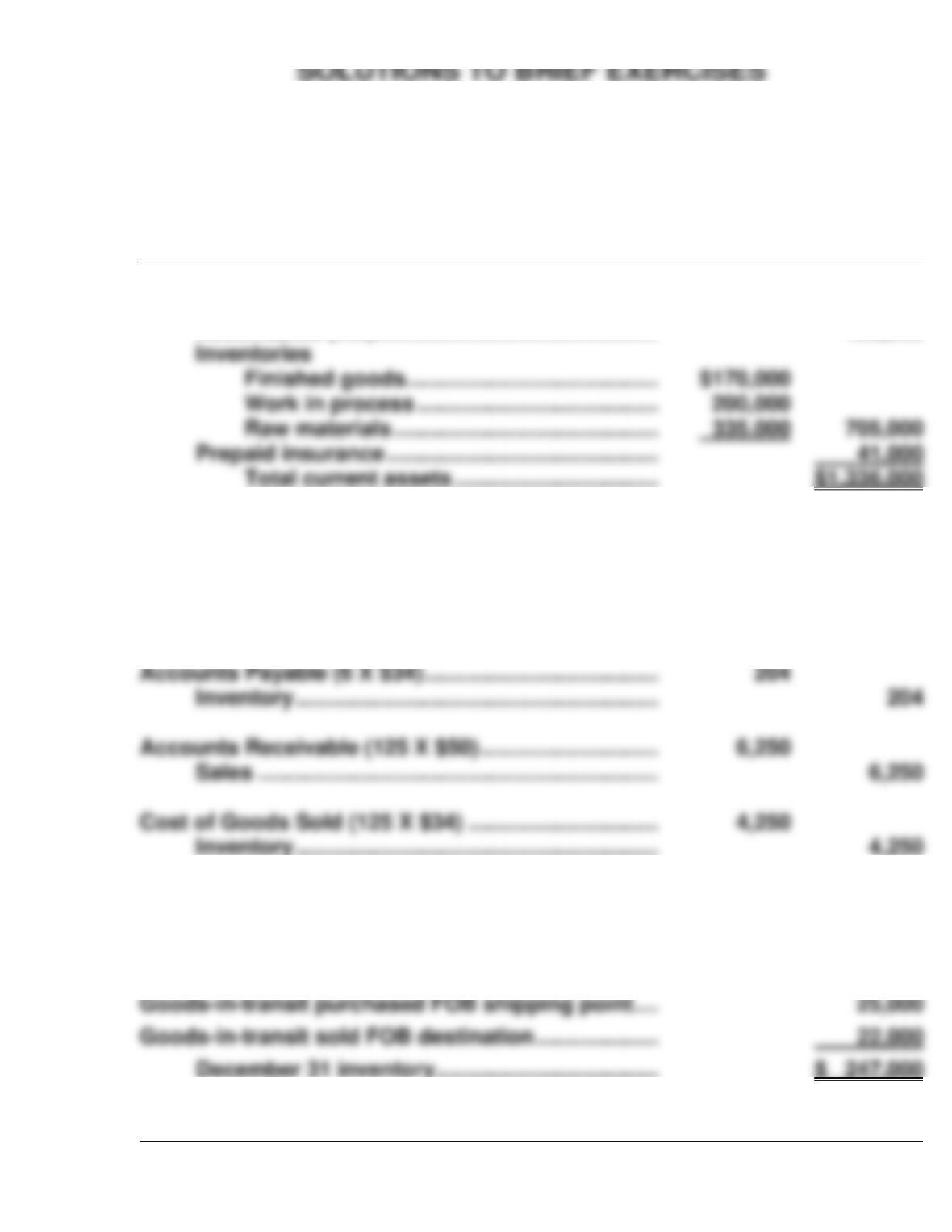
17. The dollar-value method uses dollars instead of units to measure increments, or reductions in a
LIFO inventory. After converting the closing inventory to the same price level as the opening
inventory, the increases in inventories, priced at base-year costs, is converted to the current price
level and added to the opening inventory. Any decrease is subtracted at base-year costs to
determine the ending inventory.
18. (a) LIFO layer—a LIFO layer (increment) is formed when the ending inventory at base-year prices
exceeds the beginning inventory at base-year prices.
(b) LIFO reserve—the difference between the inventory method used for internal purposes
and LIFO.
(c) LIFO effect—the change in the LIFO reserve (Allowance to Reduce Inventory to LIFO) from
one period to the next.
20. Phantom inventory profits occur when the inventory costs matched against sales are less than the
replacement cost of the inventory. The cost of goods sold therefore is understated and profit is
considered overstated. Phantom profits are said to occur when FIFO is used during periods of
8-11
BRIEF EXERCISE 8-1
RIVERA COMPANY
Balance Sheet (Partial)
December 31
Current assets
Cash …………………………………………………………..
$ 190,000
Receivables (net) …………………………………………
400,000
Work in process …………………………………..
200,000
Prepaid insurance ……………………………………….
41,000
BRIEF EXERCISE 8-2
Inventory (150 X $34) ………………………………………………
5,100
Accounts Payable …………………………………………..
5,100
Accounts Payable (6 X $34) ……………………………………..
Inventory ……………………………………………………….
Accounts Receivable (125 X $50) …………………………..
6,250
Sales ……………………………………………………………..
6,250
Cost of Goods Sold (125 X $34) …………………………..
4,250
Inventory ……………………………………………………….
4,250
BRIEF EXERCISE 8-3
December 31 inventory per physical count ………………………
$ 200,000
22,000
BRIEF EXERCISE 8-4
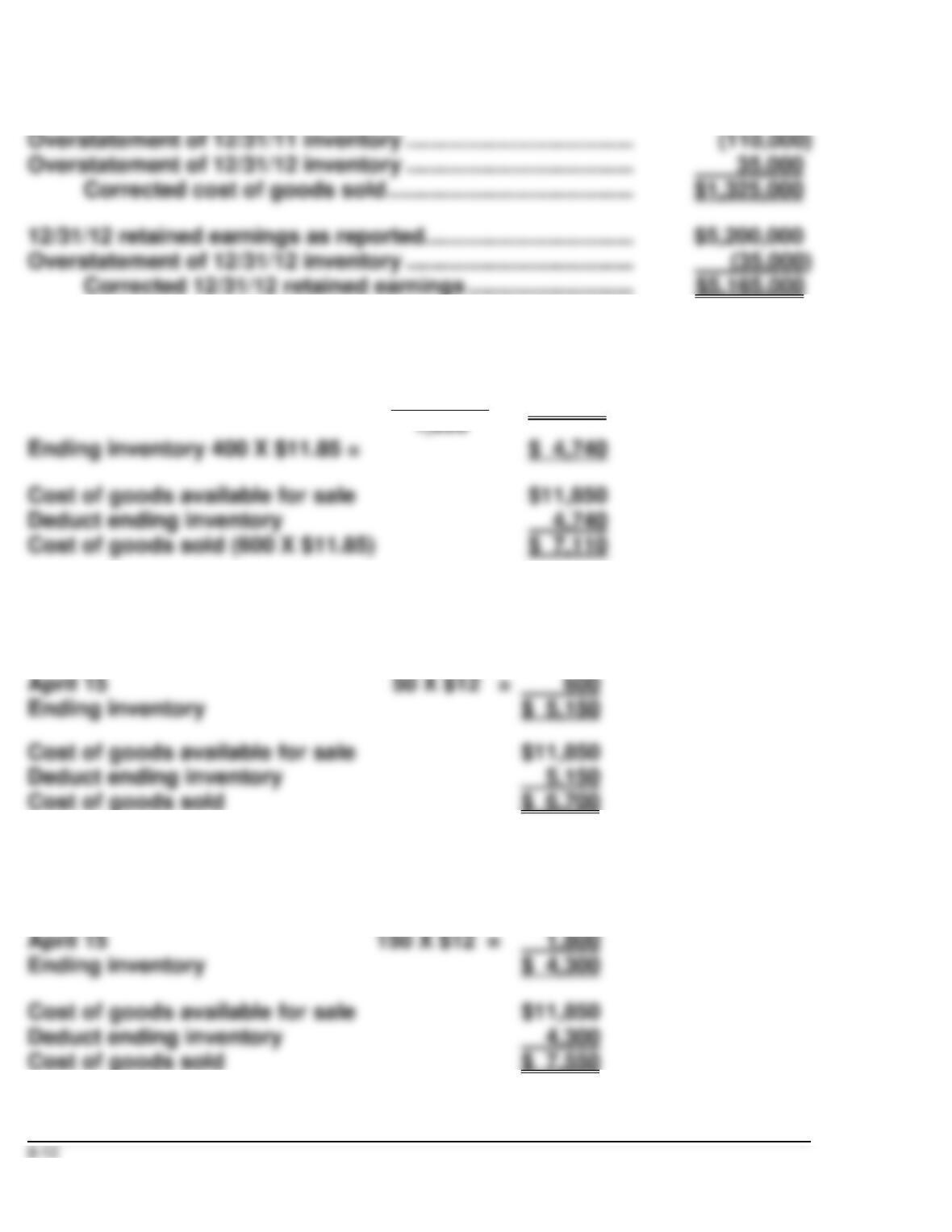
Cost of goods sold as reported ……………………………………….
$1,400,000
Overstatement of 12/31/12 inventory ……………………………….
12/31/12 retained earnings as reported…………………………….
BRIEF EXERCISE 8-5
Weighted average cost per unit
$11,850
=
$ 11.85
Cost of goods available for sale
$11,850
Deduct ending inventory
4,740
BRIEF EXERCISE 8-6
April 23
350 X $13
=
$ 4,550
April 15
=
600
Cost of goods available for sale
$11,850
Deduct ending inventory
5,150
BRIEF EXERCISE 8-7
April 1 250 X $10 =
$ 2,500
April 15 150 X $12 =
1,800
Deduct ending inventory
4,300
8-13
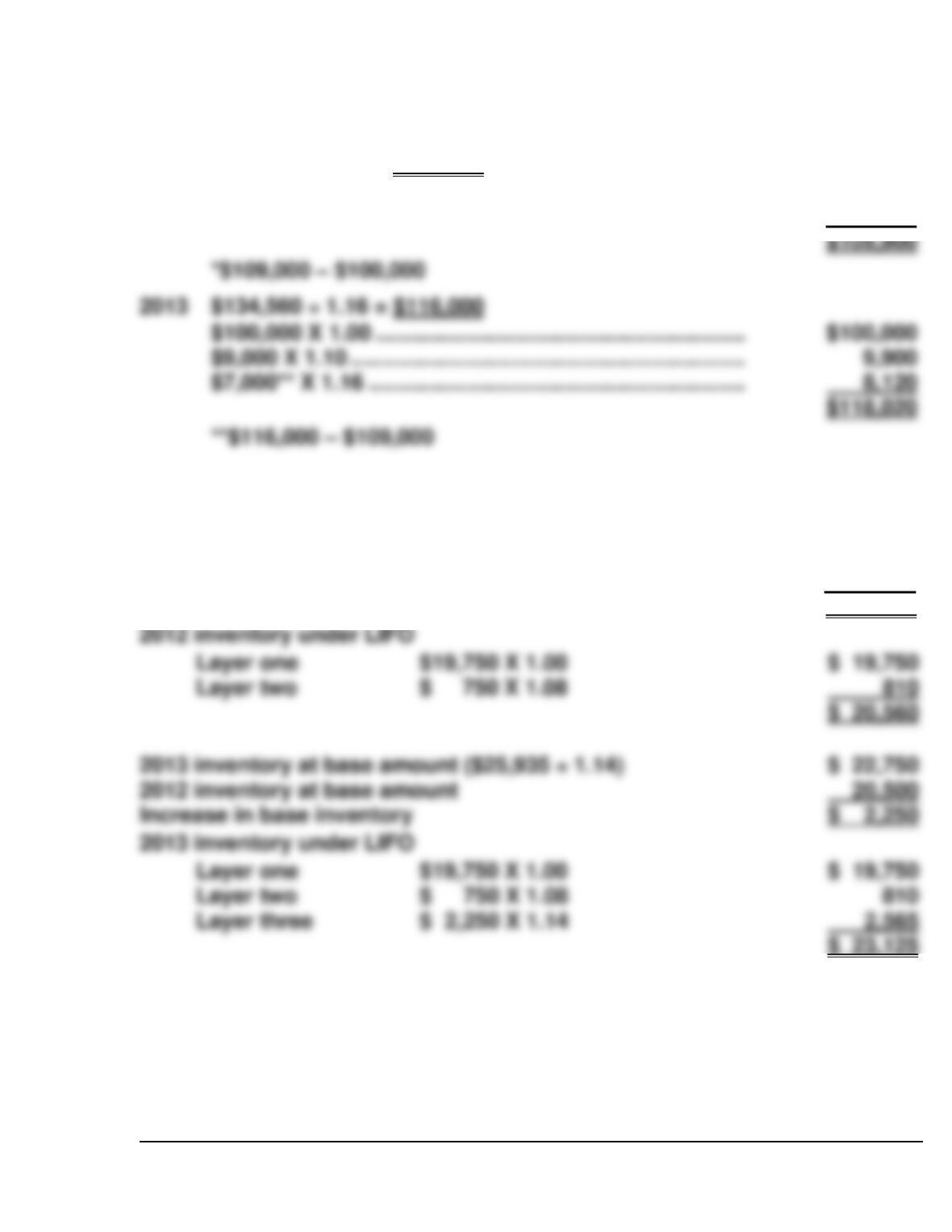
BRIEF EXERCISE 8-8
2011
$100,000
2012
$119,900 ÷ 1.10 = $109,000
$100,000 X 1.00 ……………………………………………………
$100,000
$9,000* X 1.10 ………………………………………………………
9,900
BRIEF EXERCISE 8-9
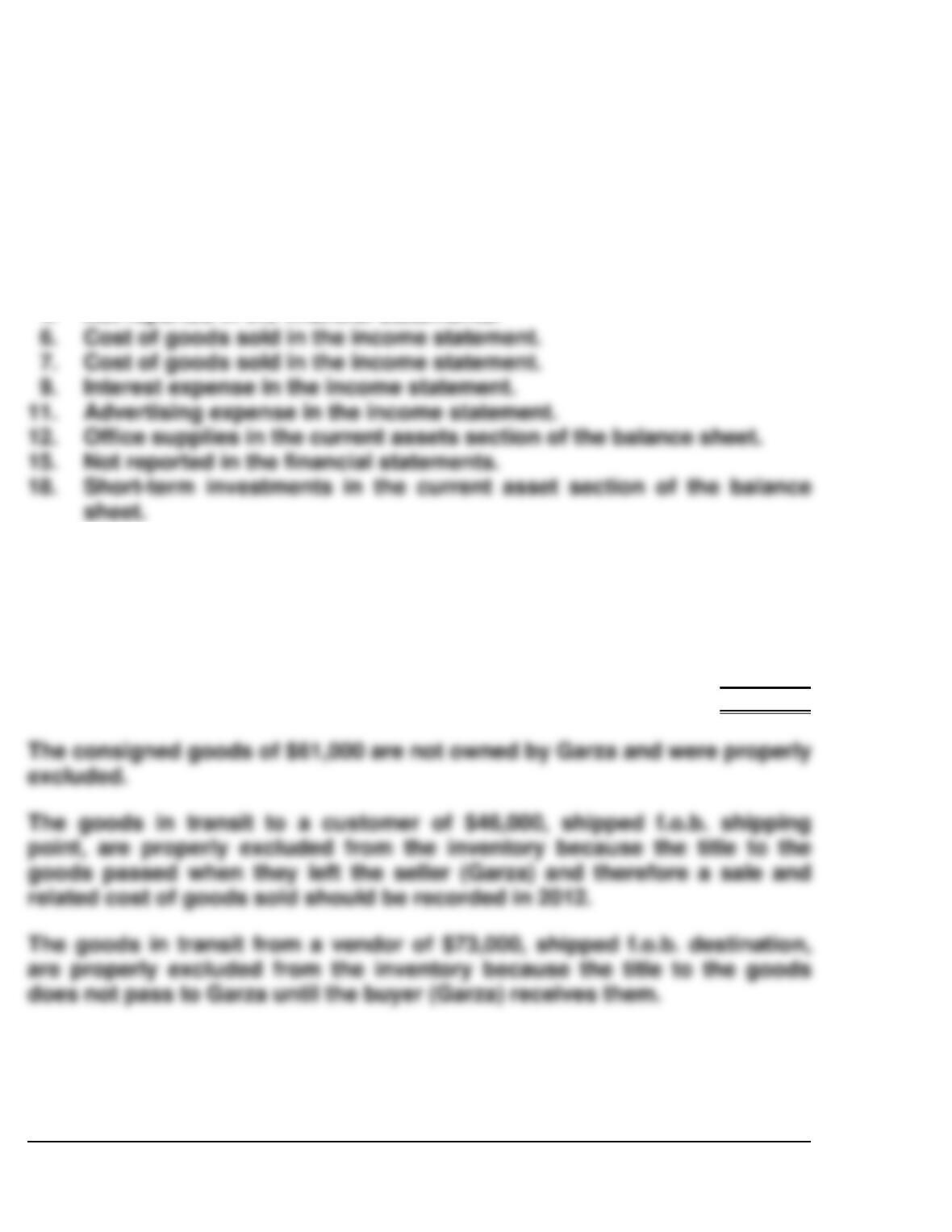
2012 inventory at base amount ($22,140 ÷ 1.08)
$ 20,500
2011 inventory at base amount
(19,750)
Increase in base inventory
$ 750
2012 inventory under LIFO
Layer one $19,750 X 1.00
Layer two $ 750 X 1.08
$ 20,560
2013 inventory at base amount ($25,935 ÷ 1.14)
2012 inventory at base amount
Increase in base inventory
$ 2,250
2013 inventory under LIFO
Layer one $19,750 X 1.00
Layer two $ 750 X 1.08
Layer three $ 2,250 X 1.14
$ 23,125
$100,000 X 1.00 ……………………………………………………
$100,000
$9,000 X 1.10 ……………………………………………………….
9,900
8-14
SOLUTIONS TO EXERCISES
EXERCISE 8-1 (15–20 minutes)
Items 2, 3, 5, 8, 10, 13, 14, 16, and 17 would be reported as inventory in the
financial statements.
The following items would not be reported as inventory:
1. Cost of goods sold in the income statement.
4. Not reported in the financial statements.
EXERCISE 8-2 (10–15 minutes)
Inventory per physical count …………………………………………..
$441,000
Goods in transit to customer, f.o.b. destination ……………….
+ 33,000
Goods in transit from vendor, f.o.b. shipping point…………..
+ 51,000
Inventory to be reported on balance sheet ……………………….
$525,000
8-15
EXERCISE 8-3 (10–15 minutes)
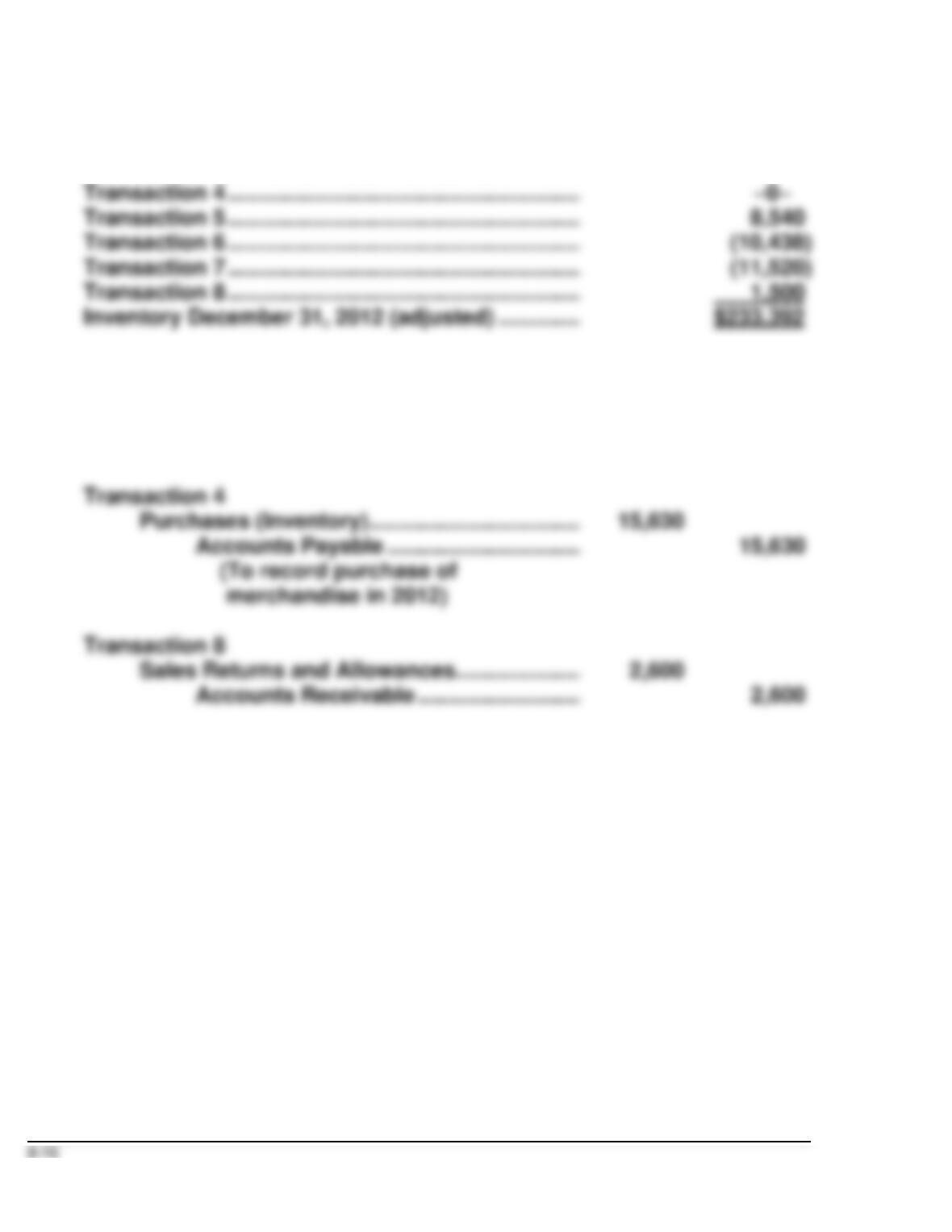
1. Include. Merchandise passes to customer only when it is shipped.
2. Do not include. Title did not pass until January 3.
EXERCISE 8-4 (10–15 minutes)
1.
Inventory …………………………………………………..
8,100
Accounts Payable ……………………………..
8,100
2.
No adjustment necessary.
Inventory …………………………………………………..
Accounts Payable ……………………………..
Accounts Payable ……………………………………..
Inventory …………………………………………..
Inventory …………………………………………………..
Accounts Payable ……………………………..
EXERCISE 8-5 (15–20 minutes)
(a)
Inventory December 31, 2012 (unadjusted) ……………..
$234,890
Transaction 2 ……………………………………………………….
10,420
Transaction 3 ……………………………………………………….
–0–
Transaction 4 ……………………………………………………….
Transaction 5 ……………………………………………………….
Transaction 6 ……………………………………………………….
(10,438)
Transaction 7 ……………………………………………………….
Transaction 8 ……………………………………………………….
(b)
Transaction 3
Sales Revenue ………………………………………..
12,800
Accounts Receivable …………………………..
12,800
(To reverse sale entry in 2012)
Purchases (Inventory) ……………………………..
Accounts Payable …………………………..
Transaction 8
Sales Returns and Allowances…………………
Accounts Receivable ………………………
8-17
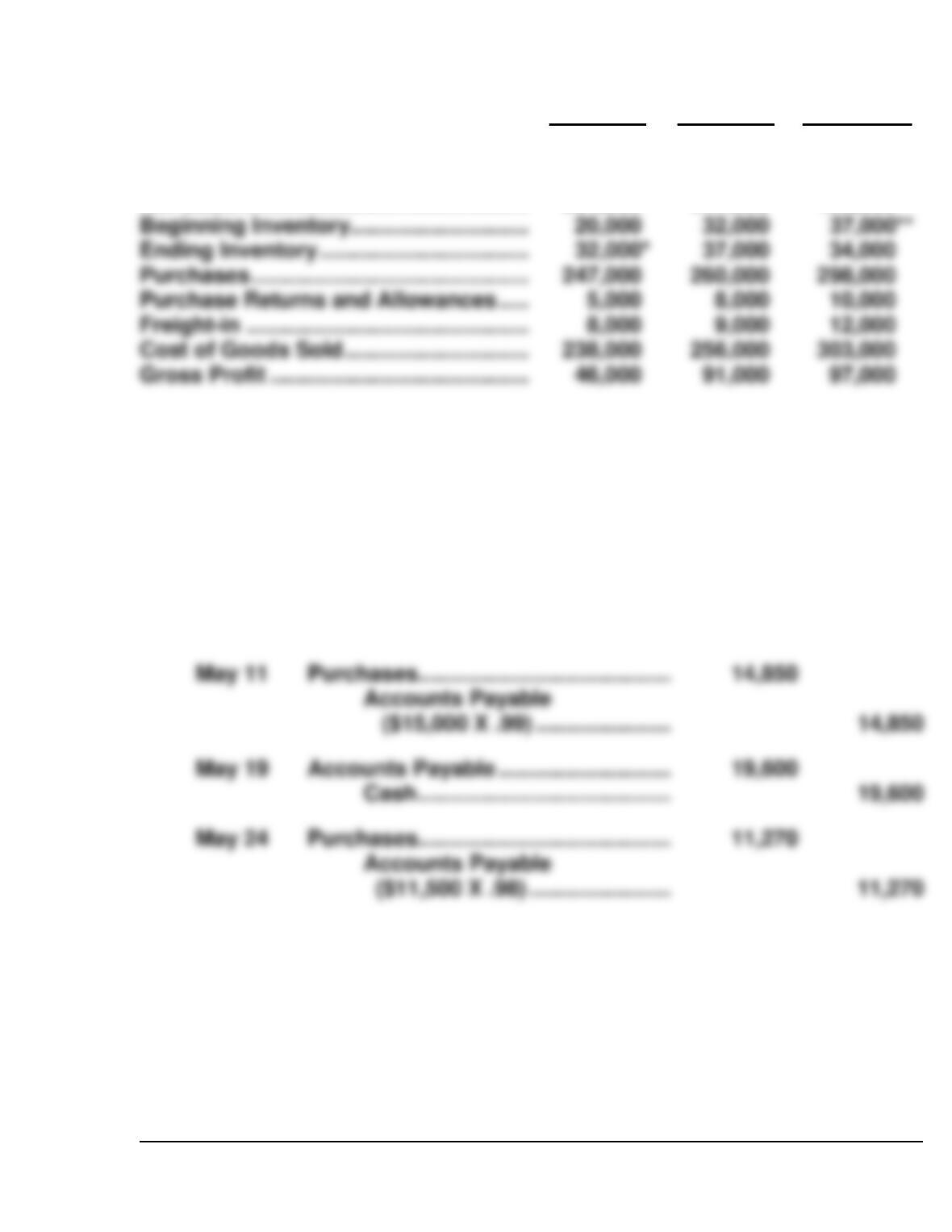
EXERCISE 8-6 (10–20 minutes)
2011
2012
2013
Sales Revenue ………………………………..
$290,000
$360,000
$410,000
Sales Returns and Allowances…………
6,000
13,000
10,000
Net Sales ………………………………………..
284,000
347,000
400,000
*This was given as the beginning inventory for 2012.
**This was calculated as the ending inventory for 2012.
EXERCISE 8-7 (10–15 minutes)
(a)
May 10
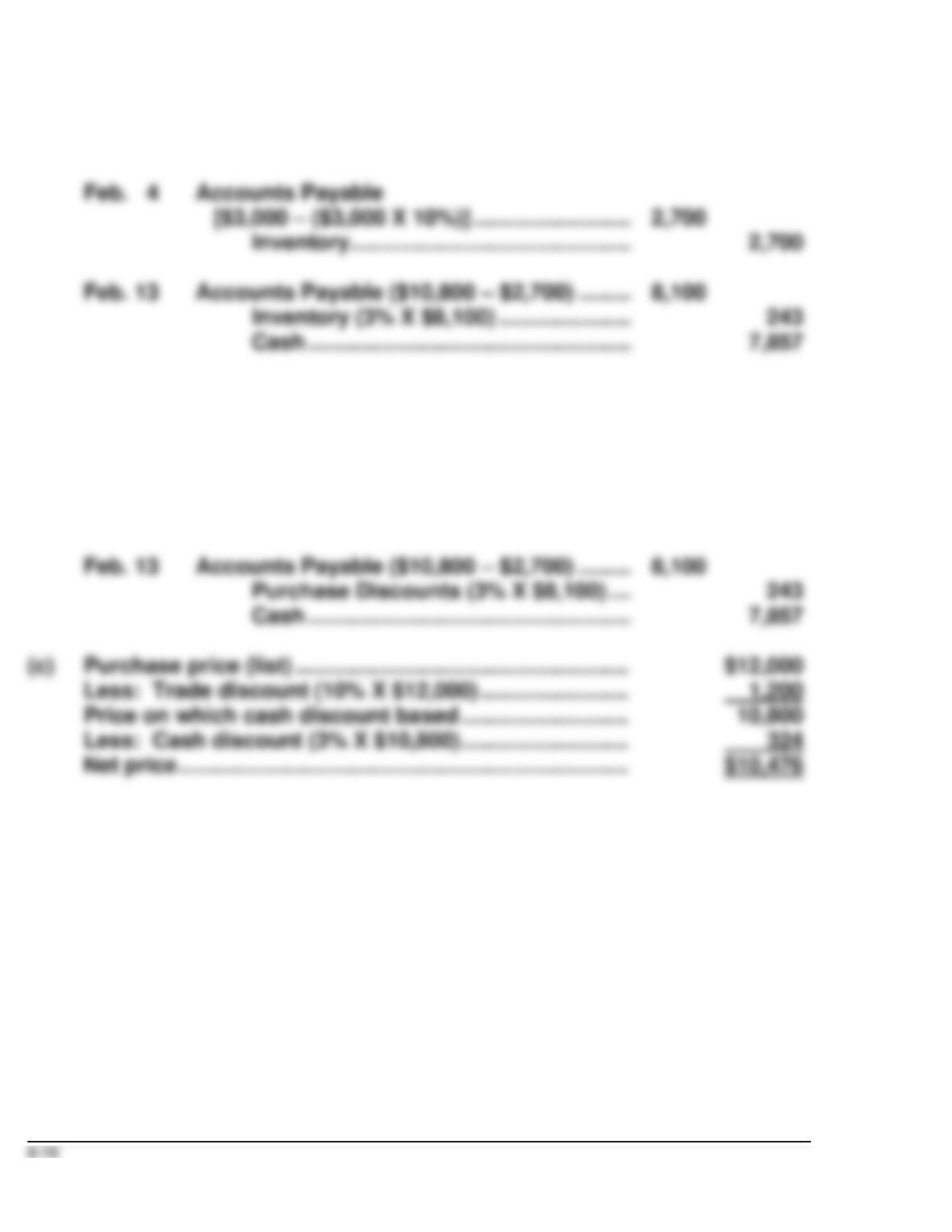
Purchases ……………………………………………………….
19,600
Accounts Payable
($20,000 X .98) …………………………..
19,600
May 11
Purchases ……………………………………………………….
14,850
Accounts Payable
($15,000 X .99) …………………………..
14,850
May 19
Accounts Payable …………………………..
19,600
Cash ……………………………………………………….
19,600
May 24
Purchases ……………………………………………………….
11,270
Accounts Payable
11,270
(b)
May 31
Purchase Discounts Lost …………………………..
150
Accounts Payable
($15,000 X .01) …………………………..
150
(Discount lost on
purchase of May 11,
$15,000, terms 1/15, n/30)
Beginning Inventory ………………………..
Ending Inventory …………………………….
34,000
Purchases ………………………………………
247,000
260,000
298,000
Purchase Returns and Allowances …..
8,000
12,000
Cost of Goods Sold …………………………
238,000
256,000
303,000
Gross Profit ……………………………………
EXERCISE 8-8 (10–15 minutes)
(a)
Feb. 1
Inventory [$12,000 – ($12,000 X 10%)] ………………………
10,800
Accounts Payable …………………………..
10,800
Inventory ……………………………………………………….
Feb. 13
Accounts Payable ($10,800 – $2,700) ……………………….
Inventory (3% X $8,100) …………………………..
Cash ……………………………………………………….
7,857
(b)
Feb. 1
Purchases [$12,000 – ($12,000 X 10%)] …………………….
10,800
Accounts Payable …………………………..
10,800
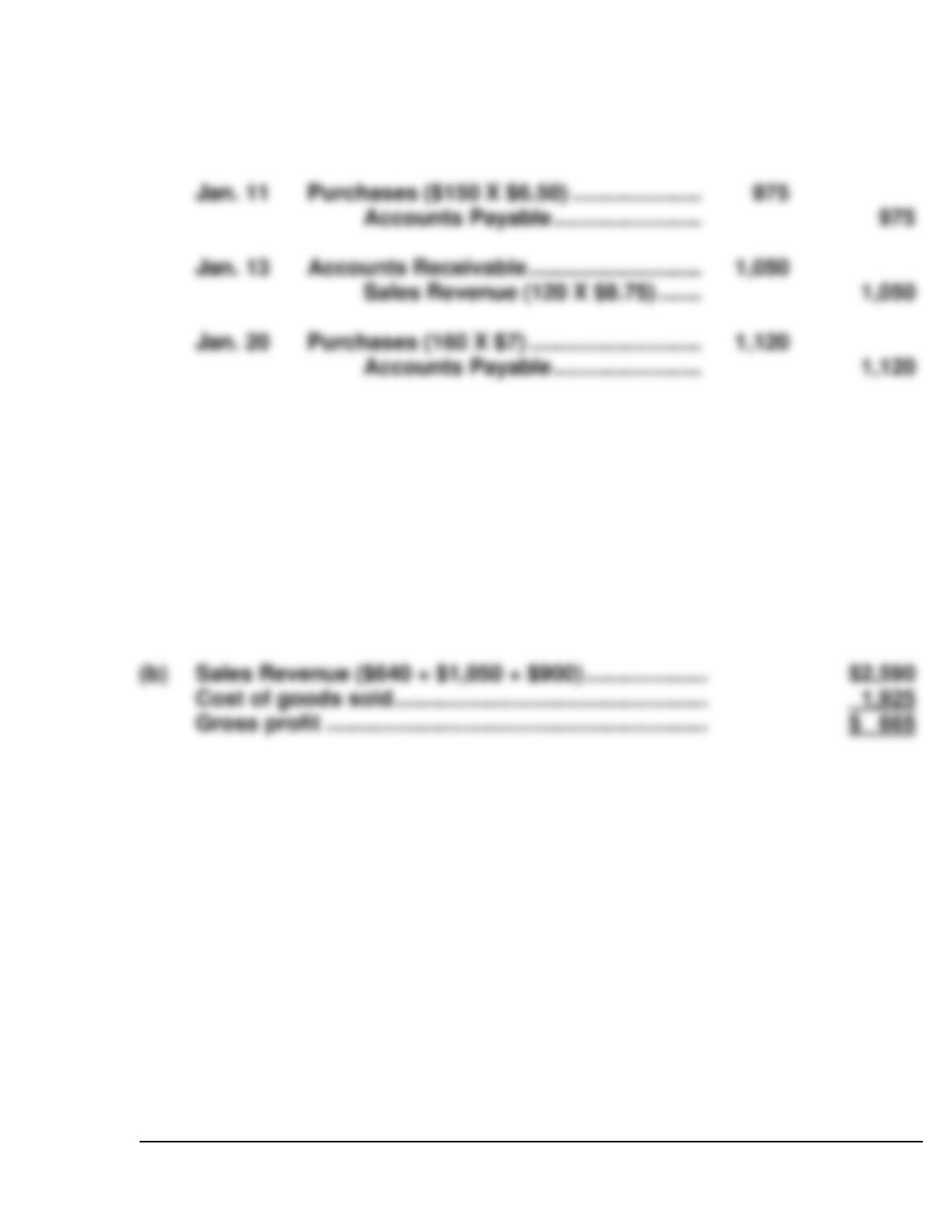
Feb. 4
Accounts Payable
[$3,000 – ($3,000 X 10%)] …………………………..
2,700
Purchase Returns and Allowances …………………..
2,700
Feb. 13
Accounts Payable ($10,800 – $2,700) ……………………….
Purchase Discounts (3% X $8,100) …………………..
Cash ……………………………………………………….
(c)
Purchase price (list) ………………………………………………
Less: Trade discount (10% X $12,000) ……………………
Price on which cash discount based ………………………
10,800
Less: Cash discount (3% X $10,800) ………………………
8-19
EXERCISE 8-9 (15–25 minutes)
(a)
Jan. 4
Accounts Receivable ……………………….
640
Sales Revenue (80 X $8) …………..
640
Jan. 27
Accounts Receivable ……………………….
900
Sales Revenue (100 X $9) …………
900
Jan. 31
Inventory ($7 X 110) …………………………
770
Cost of Goods Sold………………………….
1,925*
Purchases ($975 + $1,120) ……….
2,095
Inventory (100 X $6) …………………
600
*($600 + $2,095 – $770)
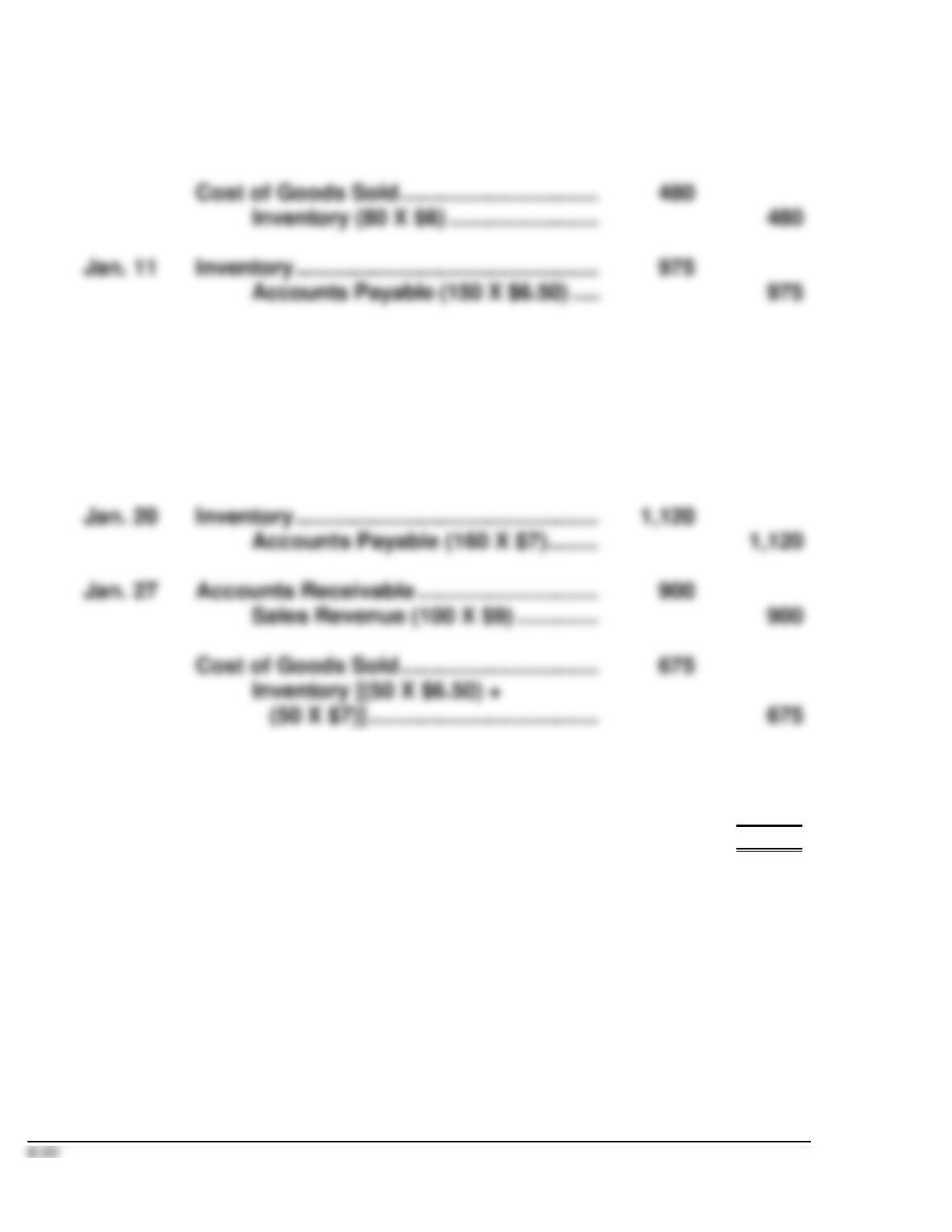
(b)
Sales Revenue ($640 + $1,050 + $900) ………………..
Cost of goods sold ……………………………………………
Jan. 11
Purchases ($150 X $6.50) …………………
975
Accounts Payable ……………………
975
Jan. 13
Accounts Receivable ……………………….
1,050
Sales Revenue (120 X $8.75) …….
Jan. 20
Purchases (160 X $7) ……………………….
1,120
Accounts Payable ……………………
EXERCISE 8-9 (Continued)
(c)
Jan. 4
Accounts Receivable …………………………..
640
Sales Revenue (80 X $8) …………………………..
640
480
Inventory (80 X $6) …………………………..
480
Jan. 11
Inventory ……………………………………………………….
975
Accounts Payable (150 X $6.50) ………………………….
975
Jan. 13
Accounts Receivable …………………………..
1,050
Sales Revenue (120 X $8.75) …………………………..
1,050
Cost of Goods Sold …………………………………………………
770
Inventory ([(20 X $6) +
(100 X $6.50)] …………………………..
770
Jan. 20
Inventory ……………………………………………………….
1,120
Accounts Payable (160 X $7) …………………………..
Jan. 27
Accounts Receivable …………………………..
900
Sales Revenue (100 X $9) …………………………..
Cost of Goods Sold …………………………………………………
675
Inventory [(50 X $6.50) +
(d)
Sales revenue …………………………………………………..
$2,590
Cost of goods sold
($480 + $770 +$675) ………………………………………..
1,925
Gross profit ………………………………………………………
$ 665