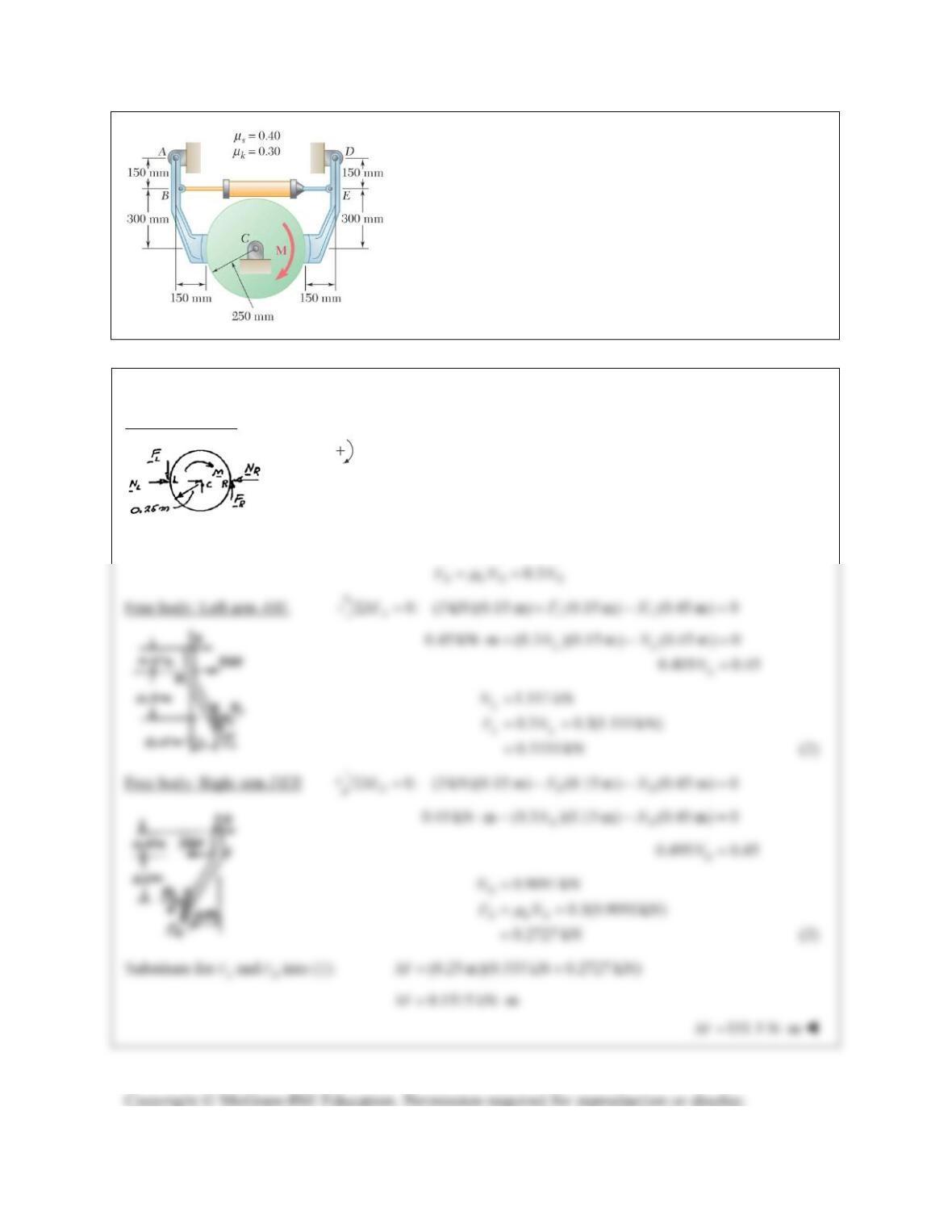
PROBLEM 8.138
The hydraulic cylinder shown exerts a force of 3 kN directed
to the right on Point B and to the left on Point E. Determine
the magnitude of the couple M required to rotate the drum
clockwise at a constant speed.
SOLUTION
Free body: Drum
0: (0.25 m)( ) 0
CLR
MM FF
(0.25 m)( )
LR
MFF
(1)
Since drum is rotating
0.3
LkL L
FN N
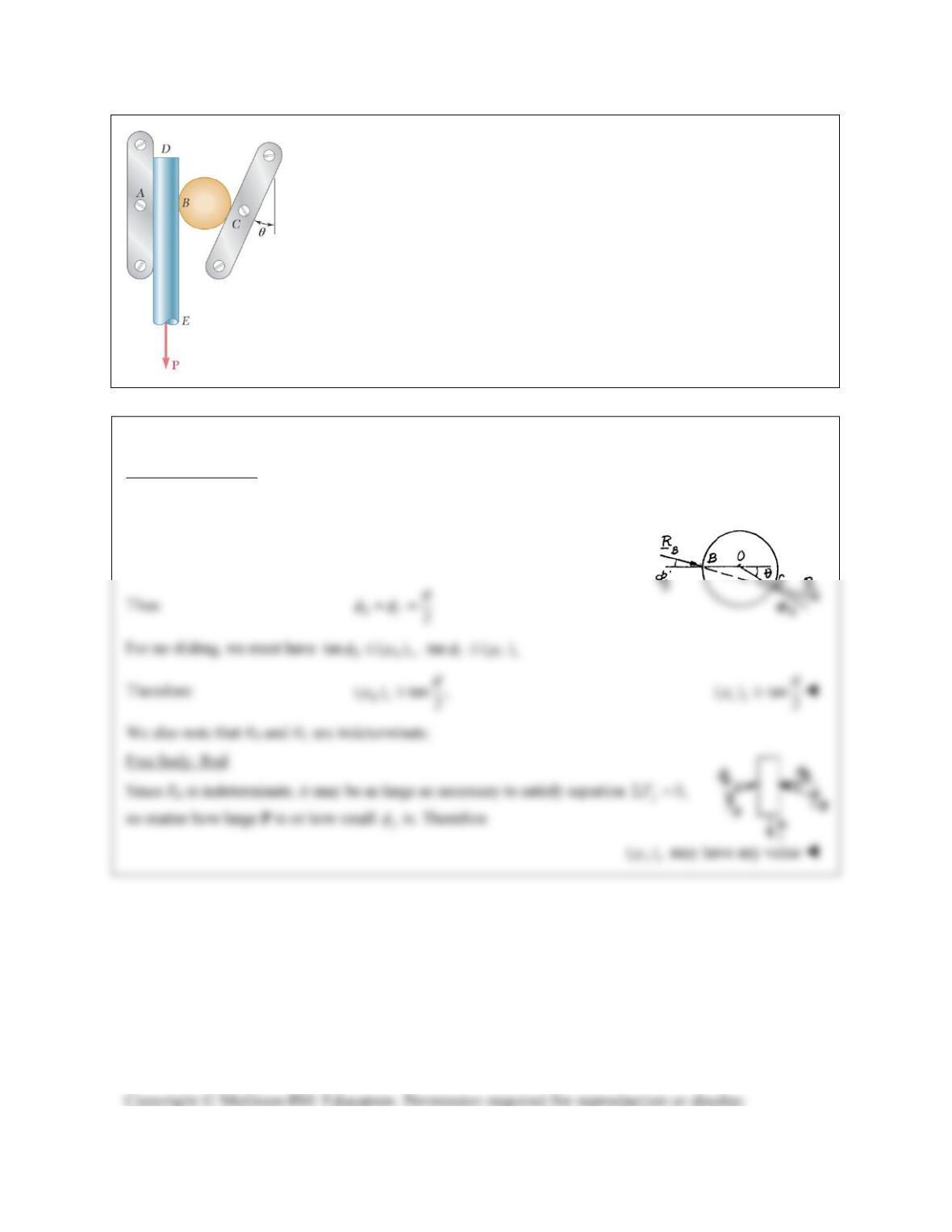
PROBLEM 8.139
A rod DE and a small cylinder are placed between two guides as shown. The
rod is not to slip downward, however large the force P may be; i.e., the
arrangement is said to be self-locking. Neglecting the weight of the cylinder,
determine the minimum allowable coefficients of static friction at A, B, and C.
SOLUTION
Free body: Cylinder
Since cylinder is a two-force body, B
Rand C
R have the same line of action. Thus :
BC
From triangle OBC:
BC
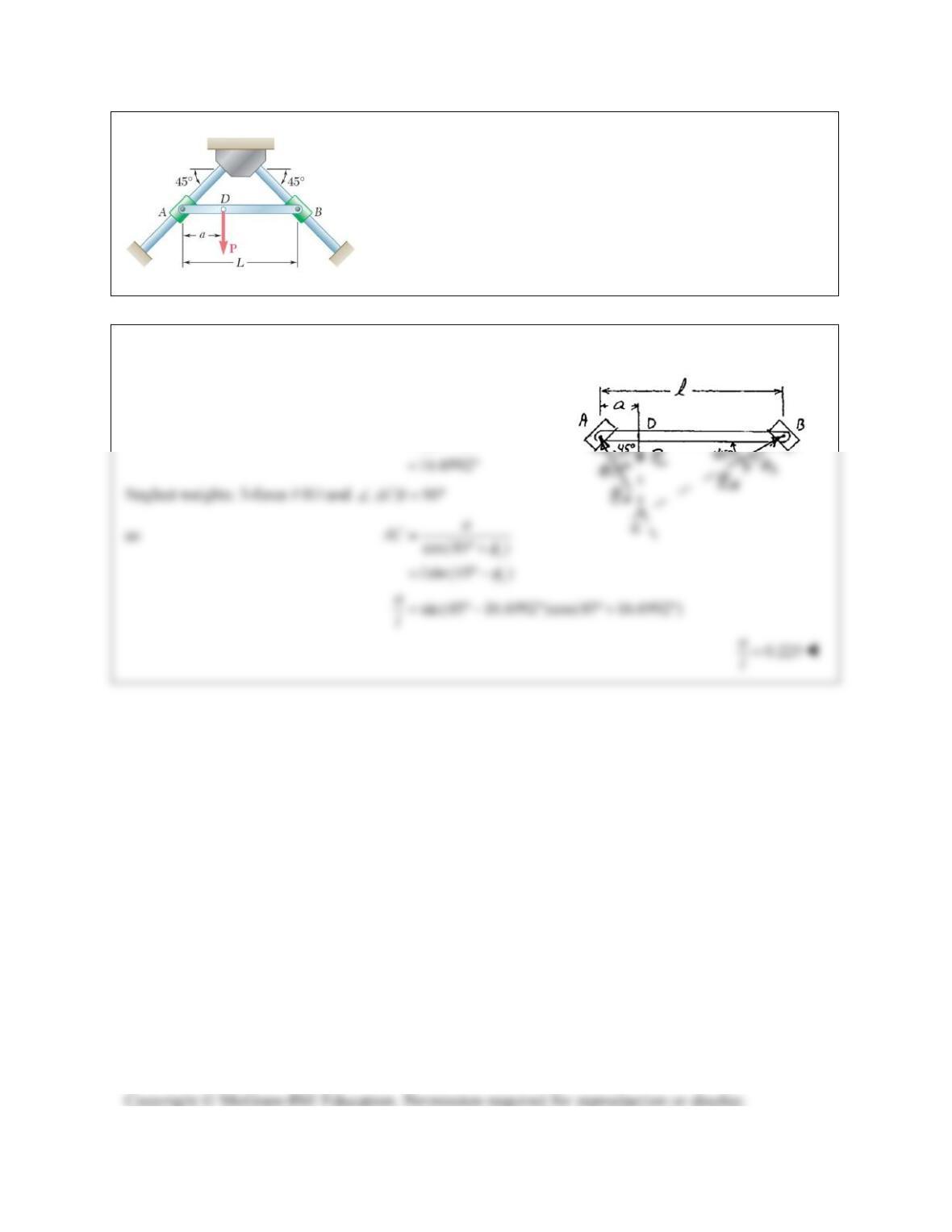
PROBLEM 8.140
Bar AB is attached to collars that can slide on the inclined rods
shown. A force P is applied at Point D located at a distance a from
end A. Knowing that the coefficient of static friction
s
between
each collar and the rod upon which it slides is 0.30 and neglecting
the weights of the bar and of the collars, determine the smallest
value of the ratio a/L for which equilibrium is maintained.
SOLUTION
FBD bar and collars:
Impending motion:
1
1
tan
tan 0.3
ss
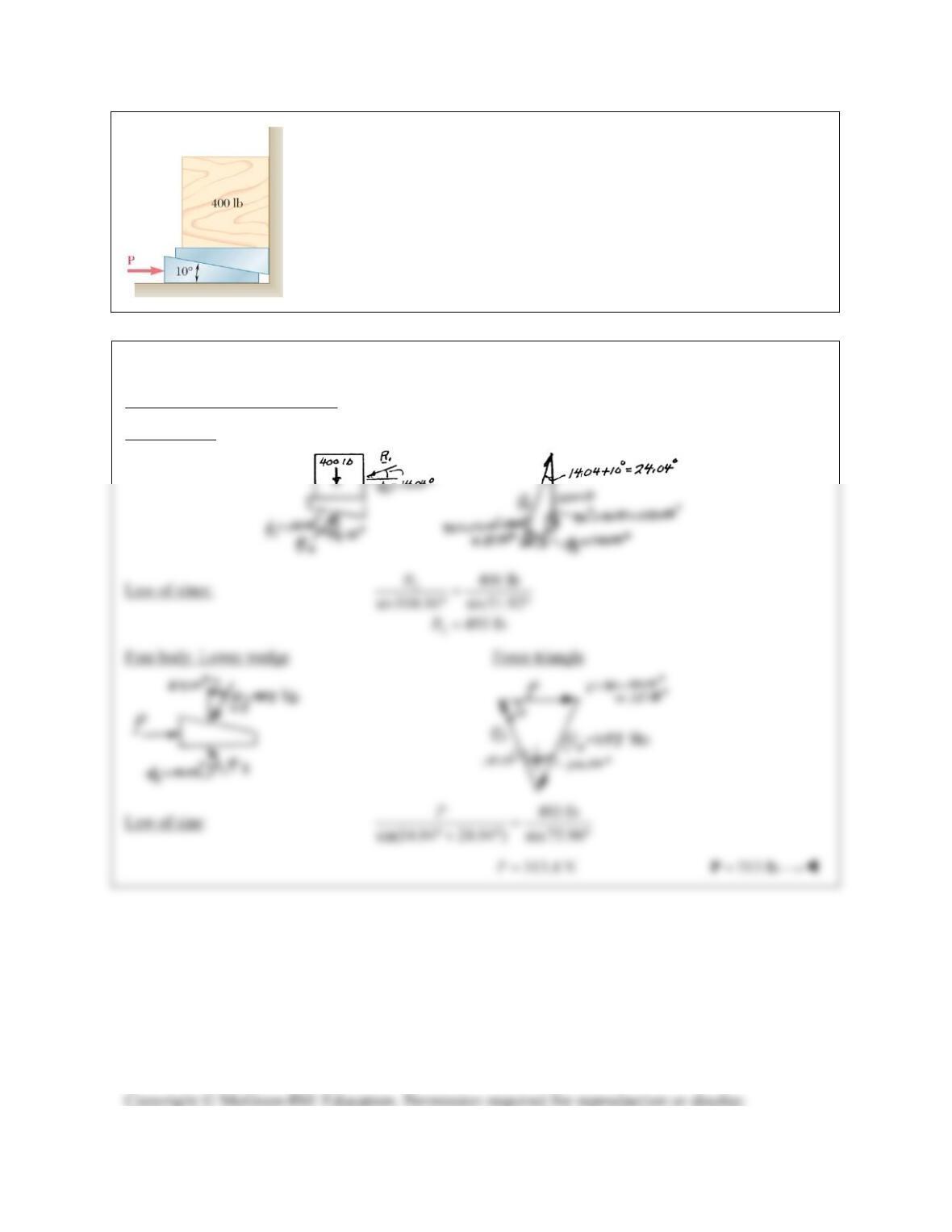
PROBLEM 8.141
Two 10 wedges of negligible weight are used to move and position the 400-
lb block. Knowing that the coefficient of static friction is 0.25 at all surfaces
of contact, determine the smallest force P that should be applied as shown to
one of the wedges.
SOLUTION
Free body: Block and top wedge 1
tan 0.25 14.04
s
Force triangle
PROBLEM 8.142
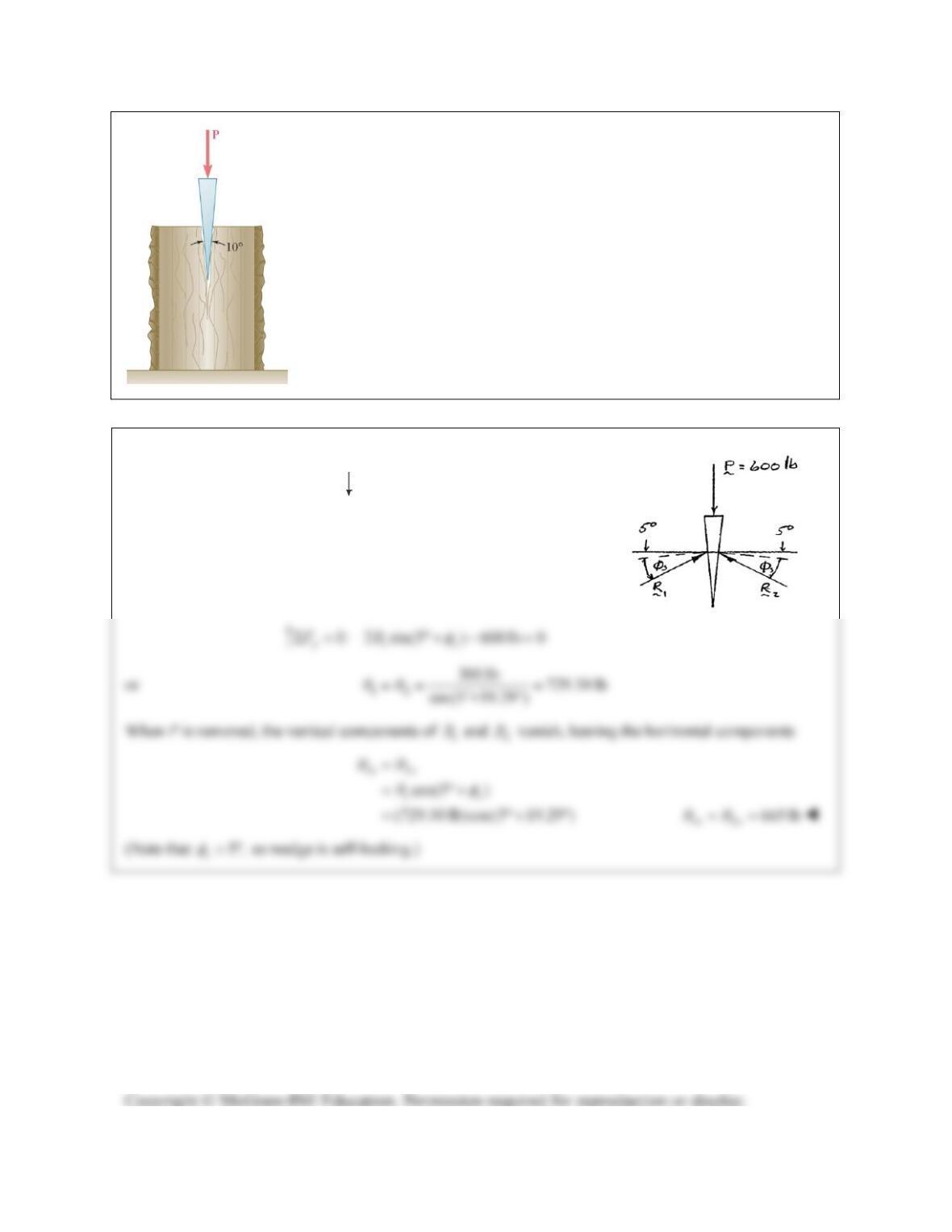
A 10 wedge is used to split a section of a log. The coefficient of static
friction between the wedge and the log is 0.35. Knowing that a force P of
magnitude 600 lb was required to insert the wedge, determine the magnitude
of the forces exerted on the wood by the wedge after insertion.
SOLUTION
FBD wedge (impending motion ):
1
1
tan
tan 0.35
19.29
ss
By symmetry:
12
RR
PROBLEM 8.143
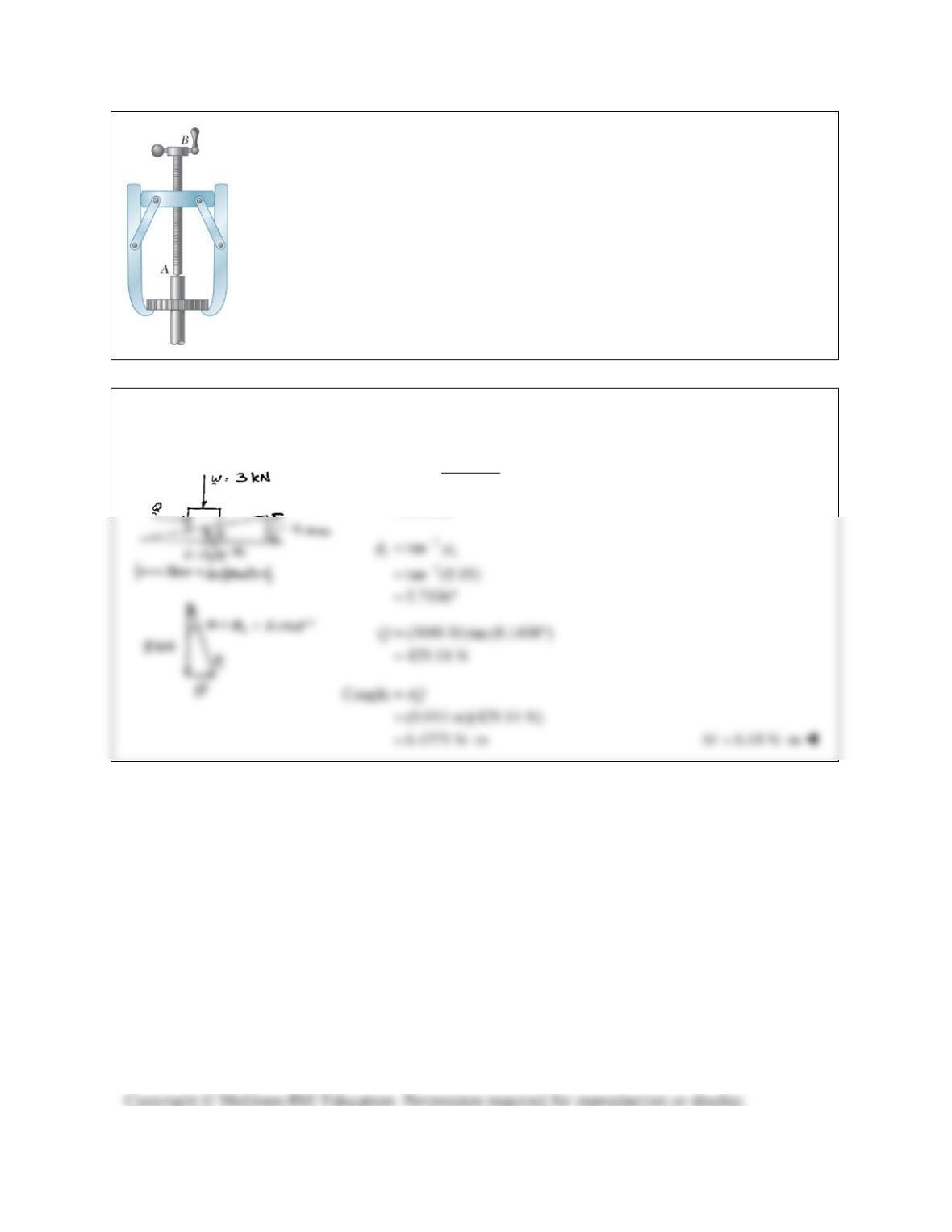
In the gear-pulling assembly shown the square-threaded screw AB has a mean radius
of 15 mm and a lead of 4 mm. Knowing that the coefficient of static friction is 0.10,
determine the couple that must be applied to the screw in order to produce a force of
3 kN on the gear. Neglect friction at end A of the screw.
SOLUTION
Block/Incline:
1
4mm
tan 30 mm
2.4302
PROBLEM 8.144
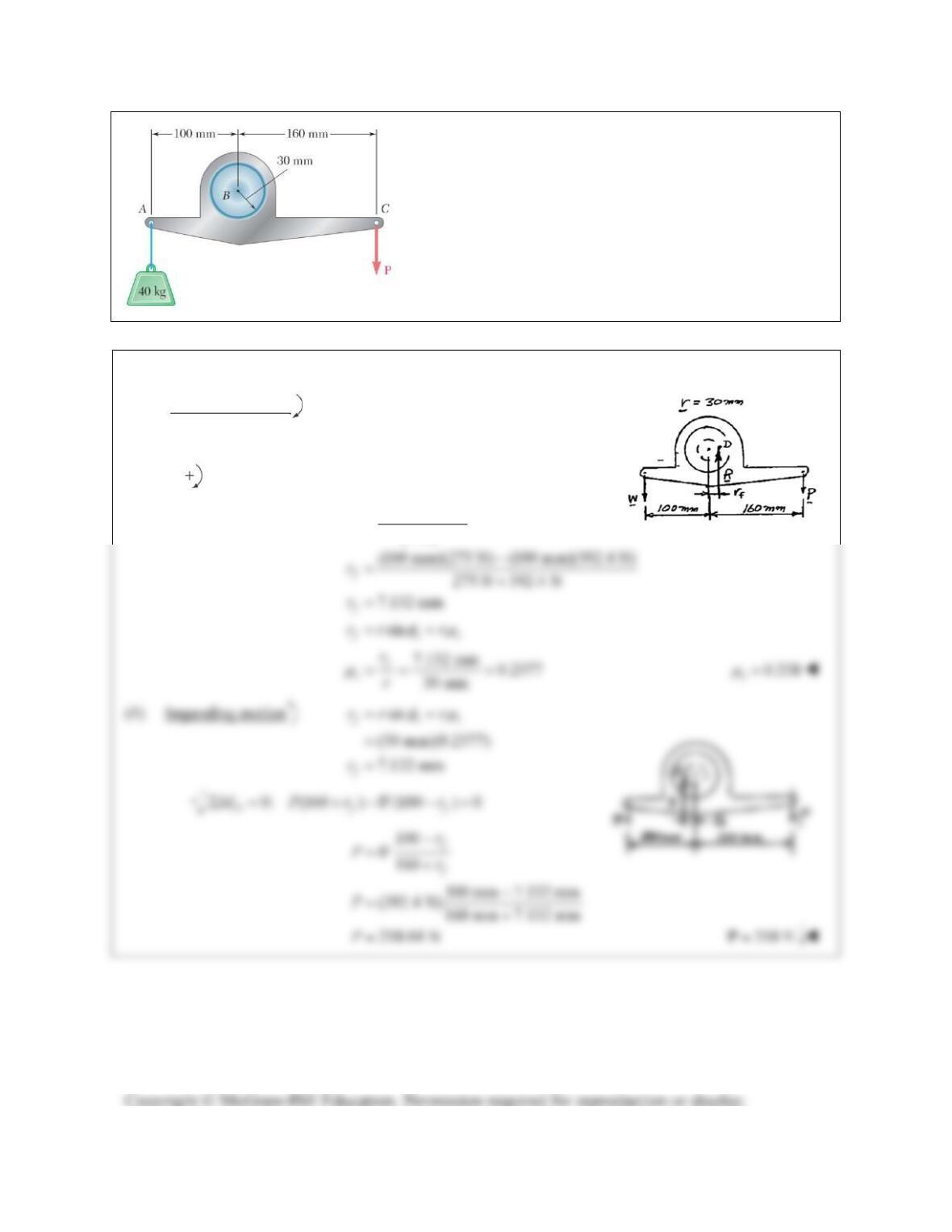
A lever of negligible weight is loosely fitted onto a 30-mm-
radius fixed shaft as shown. Knowing that a force P of
magnitude 275 N will just start the lever rotating clockwise,
determine (a) the coefficient of static friction between the
shaft and the lever, (b) the smallest force P for which the
lever does not start rotating counterclockwise.
SOLUTION
(a) Impending motion
2
(40 kg)(9.81 m/s ) 392.4 NW
0: (160 ) (100 ) 0
Dff
MPrWr
160 100
f
PW
rPW
PROBLEM 8.145
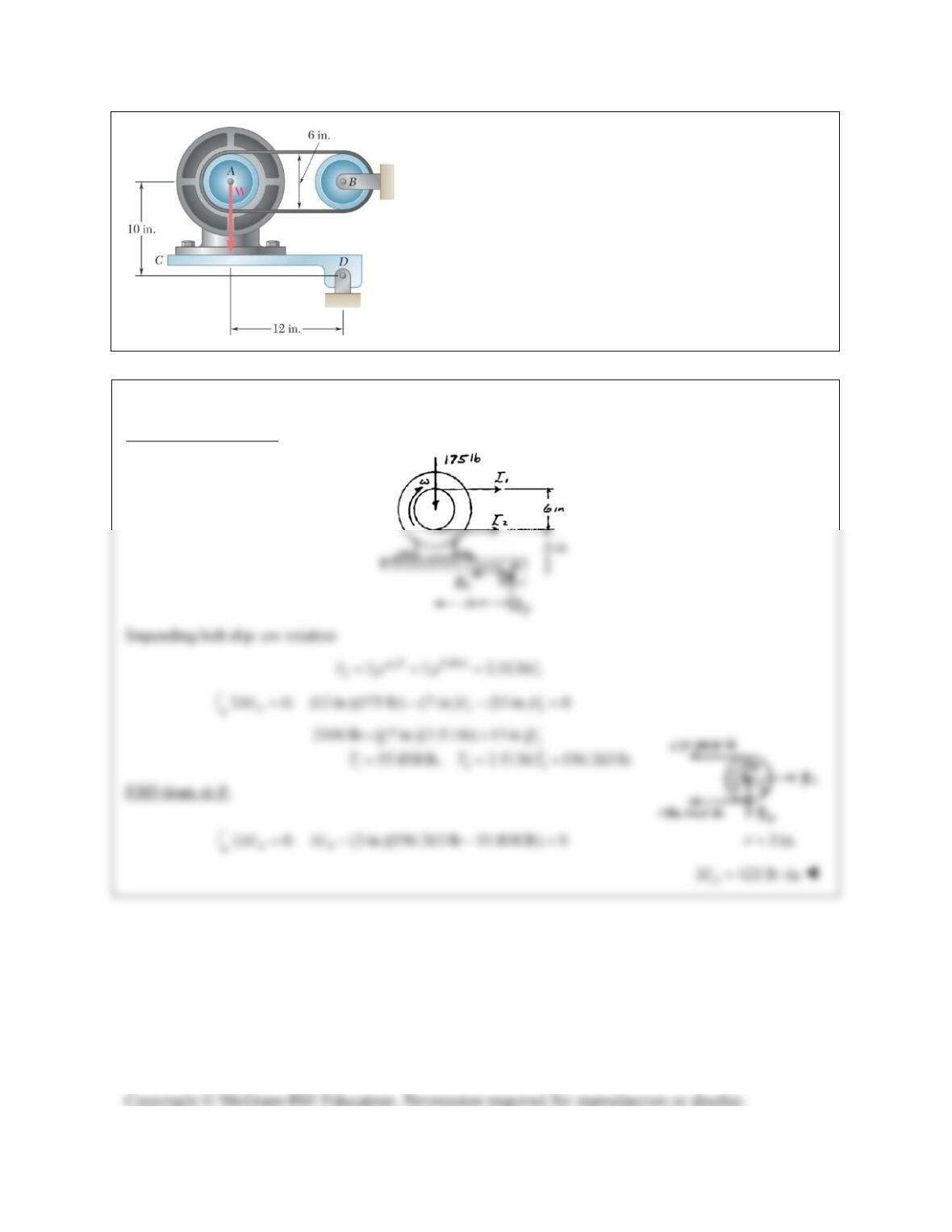
In the pivoted motor mount shown the weight W of the 175-
lb motor is used to maintain tension in the drive belt.
Knowing that the coefficient of static friction between the
flat belt and drums A and B is 0.40, and neglecting the
weight of platform CD, determine the largest couple that can
be transmitted to drum B when the drive drum A is rotating
clockwise.
SOLUTION
FBD motor and mount:
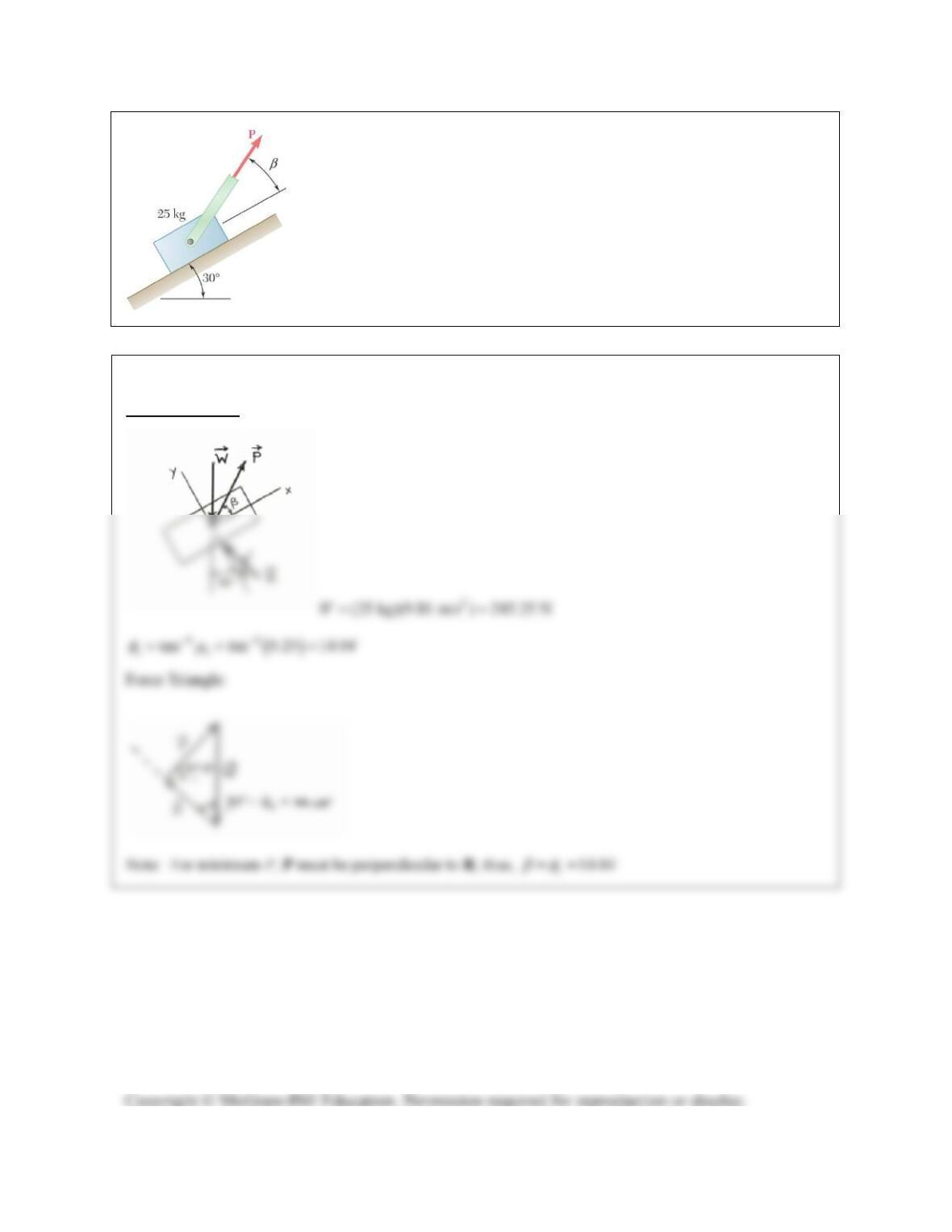
PROBLEM 8.F1
Knowing that the coefficient of friction between the 25-kg block and the
incline is
s = 0.25, draw the free-body diagram needed to determine both the
smallest value of P required to start the block moving up the incline and the
corresponding value of
.
SOLUTION
Free body: Block
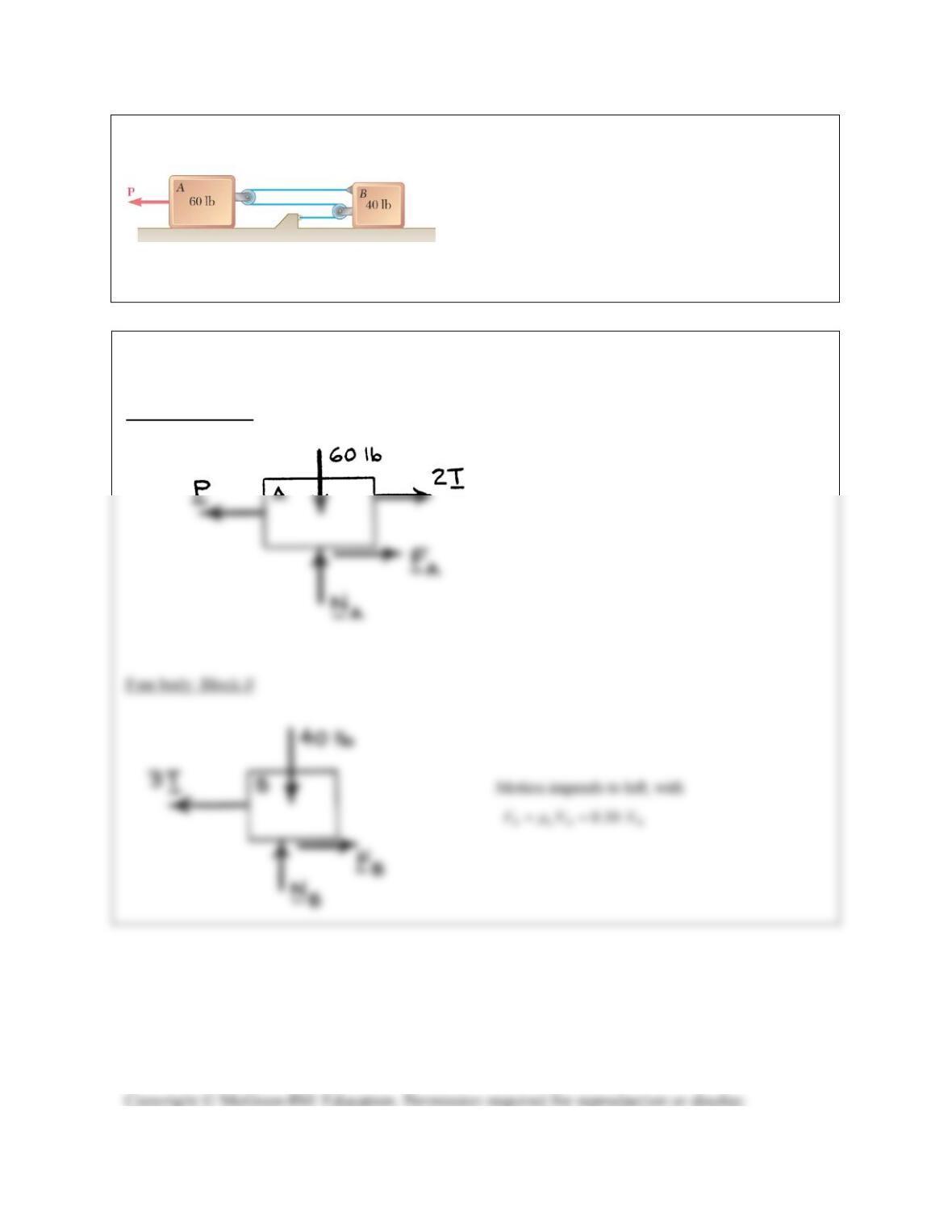
PROBLEM 8.F2
Two blocks A and B are connected by a cable as
shown. Knowing that the coefficient of static friction
at all surfaces of contact is 0.30 and neglecting the
friction of the pulleys, draw the free-body diagrams
needed to determine the smallest force P required to
move the blocks.
SOLUTION
Free body: Block A
Motion impends to left, with
0.30
A
SA A
F
NN
F
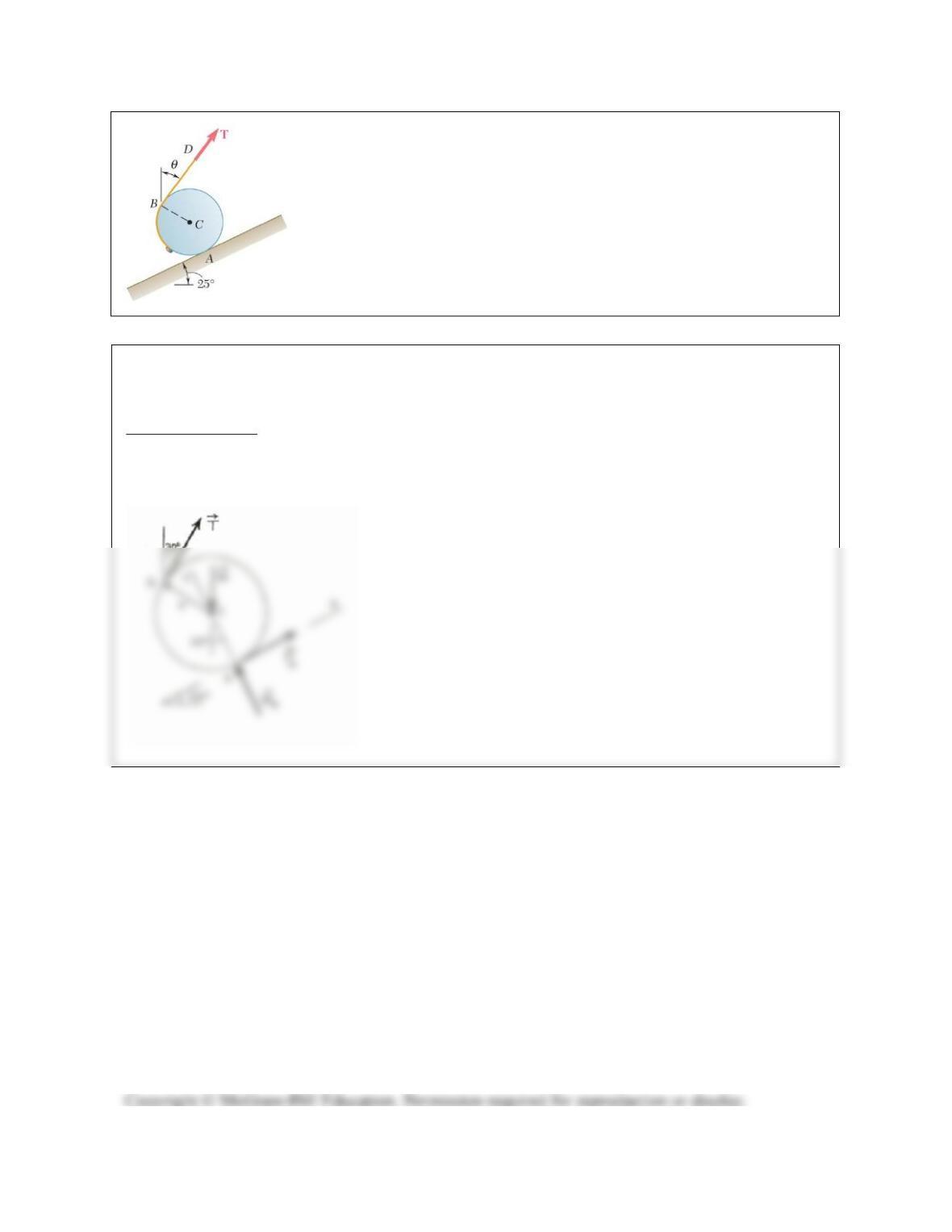
PROBLEM 8.F3
A cord is attached to and partially wound around a cylinder with a weightof
W and radius r that rests on an incline as shown. Knowing that θ = 30°, draw
the free-body diagram needed to determine both the tension in the cord and
the smallest allowable value of the coefficient of static friction between the
cylinder and the incline for which equilibrium is maintained.
SOLUTION
Free body: Cylinder
For minimum
s
, motion impends at A with
AsA
FN
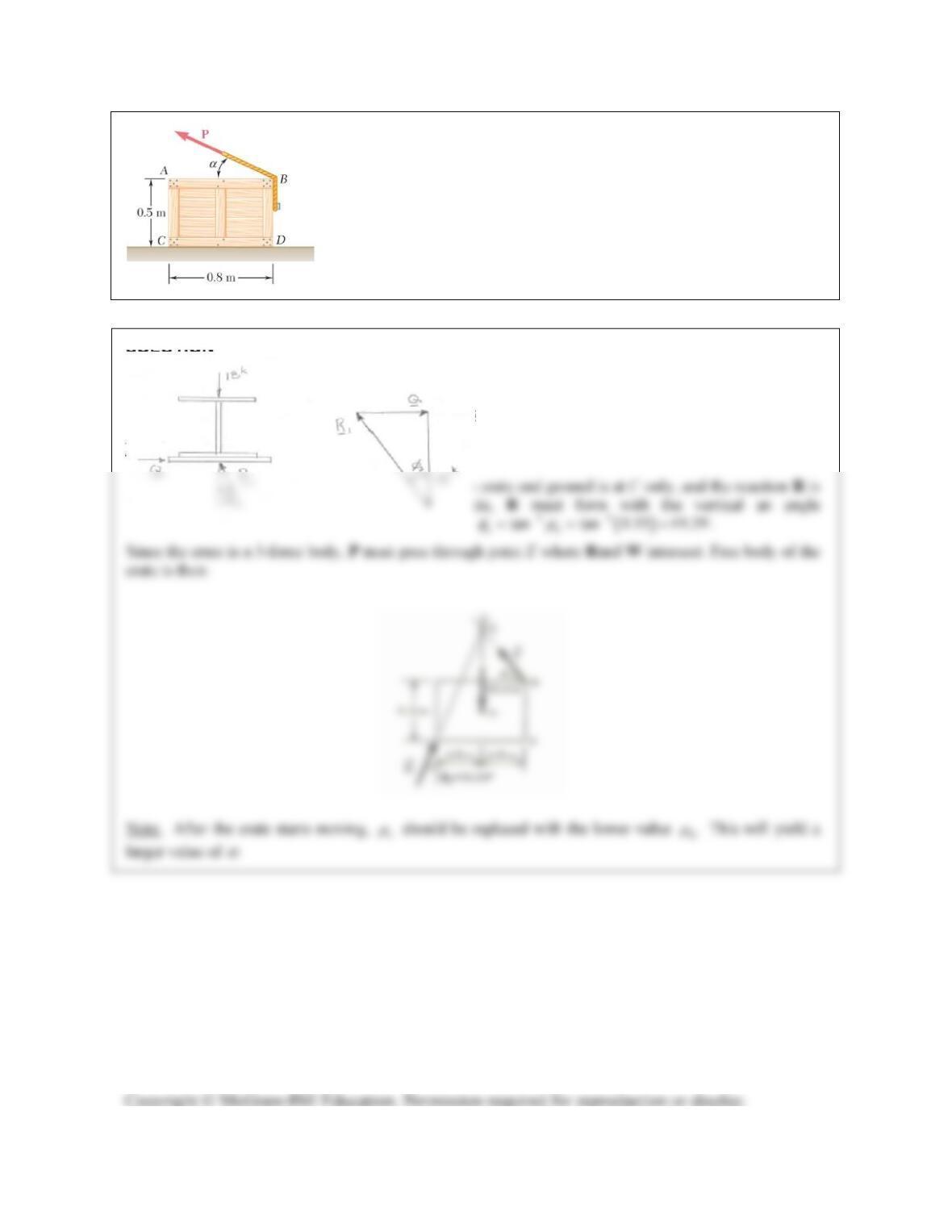
PROBLEM 8.F4
A 40-kg packing crate must be moved to the left along the floor without
tipping. Knowing that the coefficient of static friction between the crate
and the floor is 0.35, draw the free-body diagram needed to determine
both the largest allowable value of α and the corresponding magnitude of
the force P.
SOLUTION
2
(40 kg) (9.81 m/s ) 392.4 NWmg
Free body diagram: