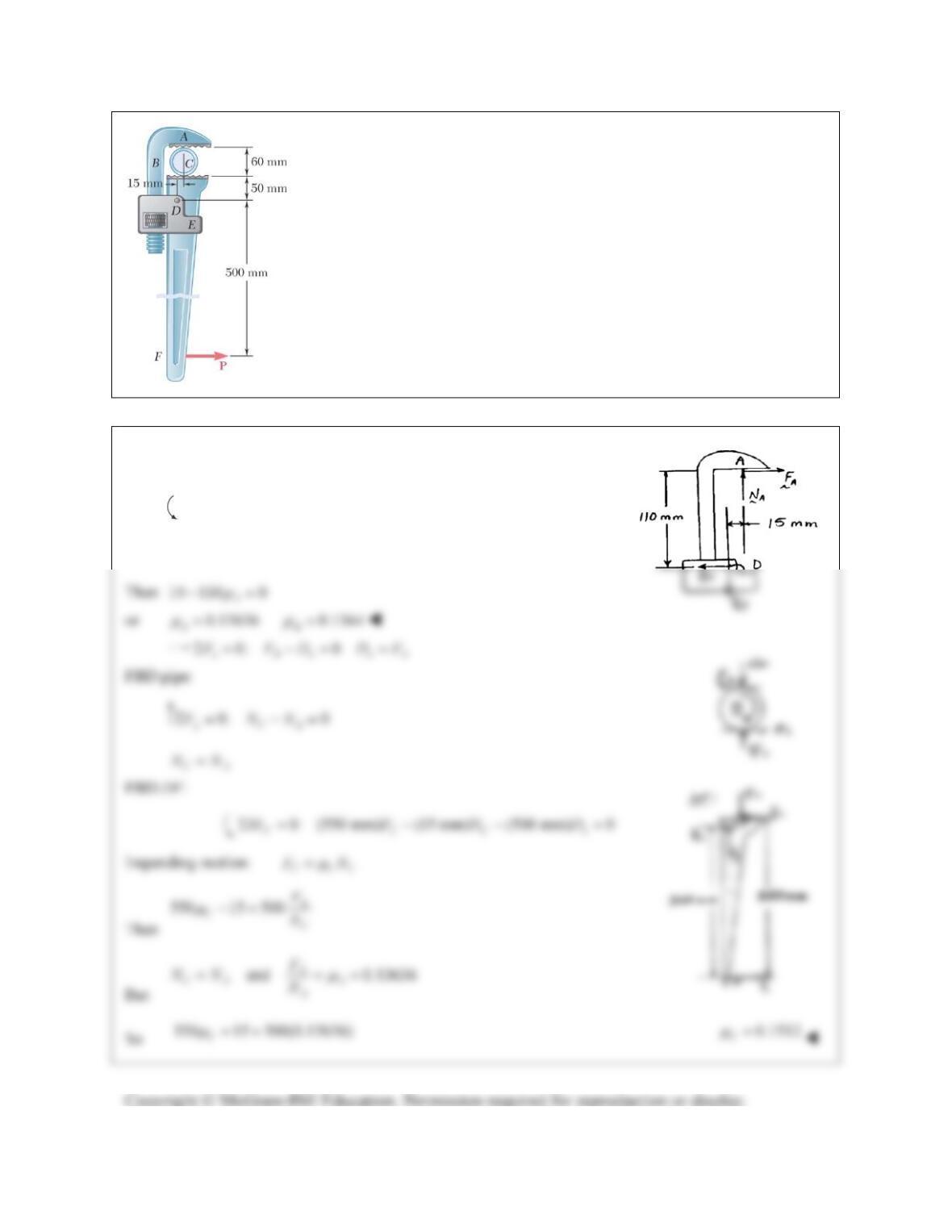
PROBLEM 8.33
A pipe of diameter 60 mm is gripped by the stillson wrench shown. Portions
AB and DE of the wrench are rigidly attached to each other, and portion CF is
connected by a pin at D. If the wrench is to grip the pipe and be self-locking,
determine the required minimum coefficients of friction at A and C.
SOLUTION
FBD ABD:
0: (15 mm) (110 mm) 0
DAA
MNF
Impending motion:
AAA
FN
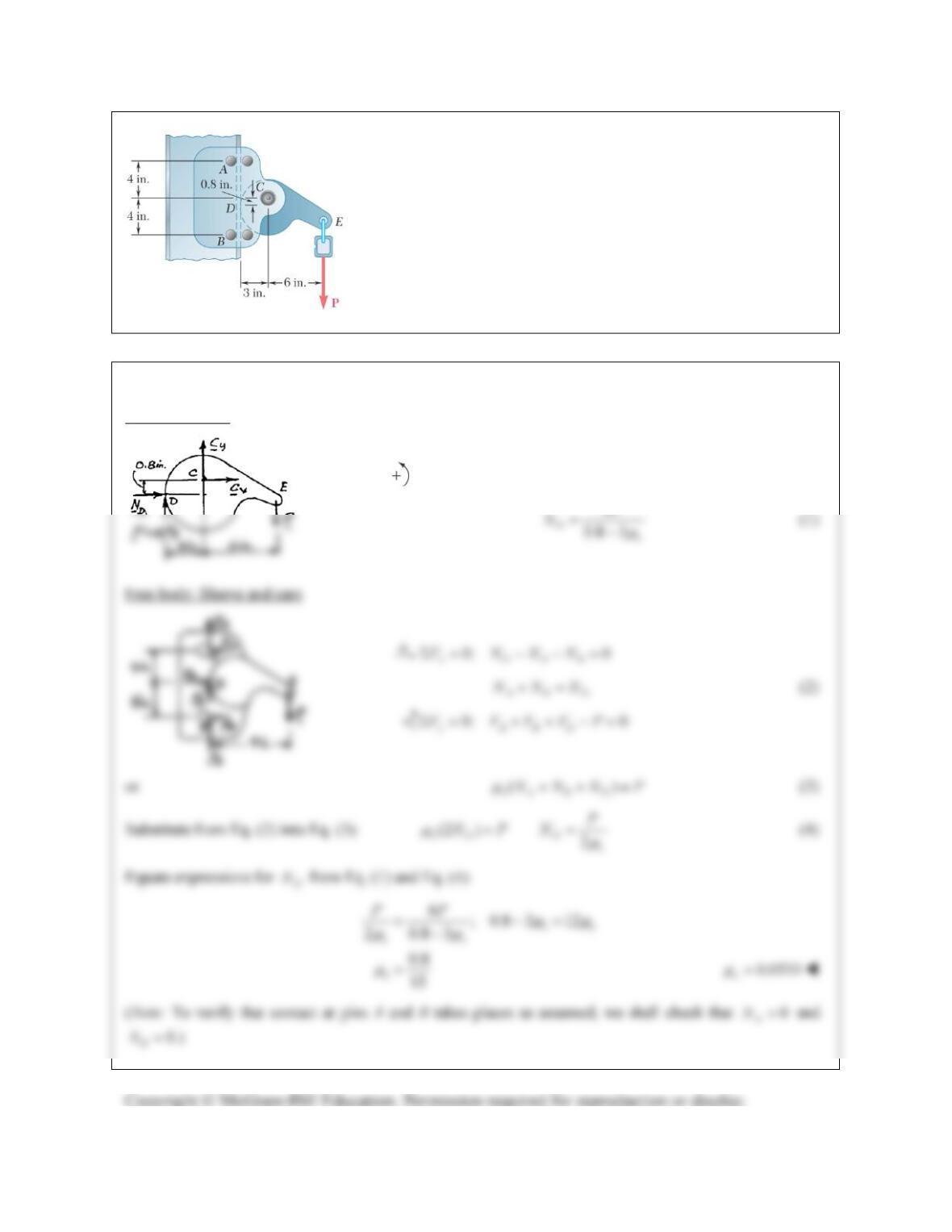
PROBLEM 8.34
A safety device used by workers climbing ladders fixed to high
structures consists of a rail attached to the ladder and a sleeve that can
slide on the flange of the rail. A chain connects the worker’s belt to
the end of an eccentric cam that can be rotated about an axle attached
to the sleeve at C. Determine the smallest allowable common value of
the coefficient of static friction between the flange of the rail, the pins
at A and B, and the eccentric cam if the sleeve is not to slide down
when the chain is pulled vertically downward.
SOLUTION
Free body: Cam
0: (0.8 in.) (3in.) (6 in.) 0
CD sD
MN N P
6
P
PROBLEM 8.34 (Continued)
From Eq. (4): 9.375
2 2(0.0533)
D
s
PP
NP
From free body of cam and sleeve:
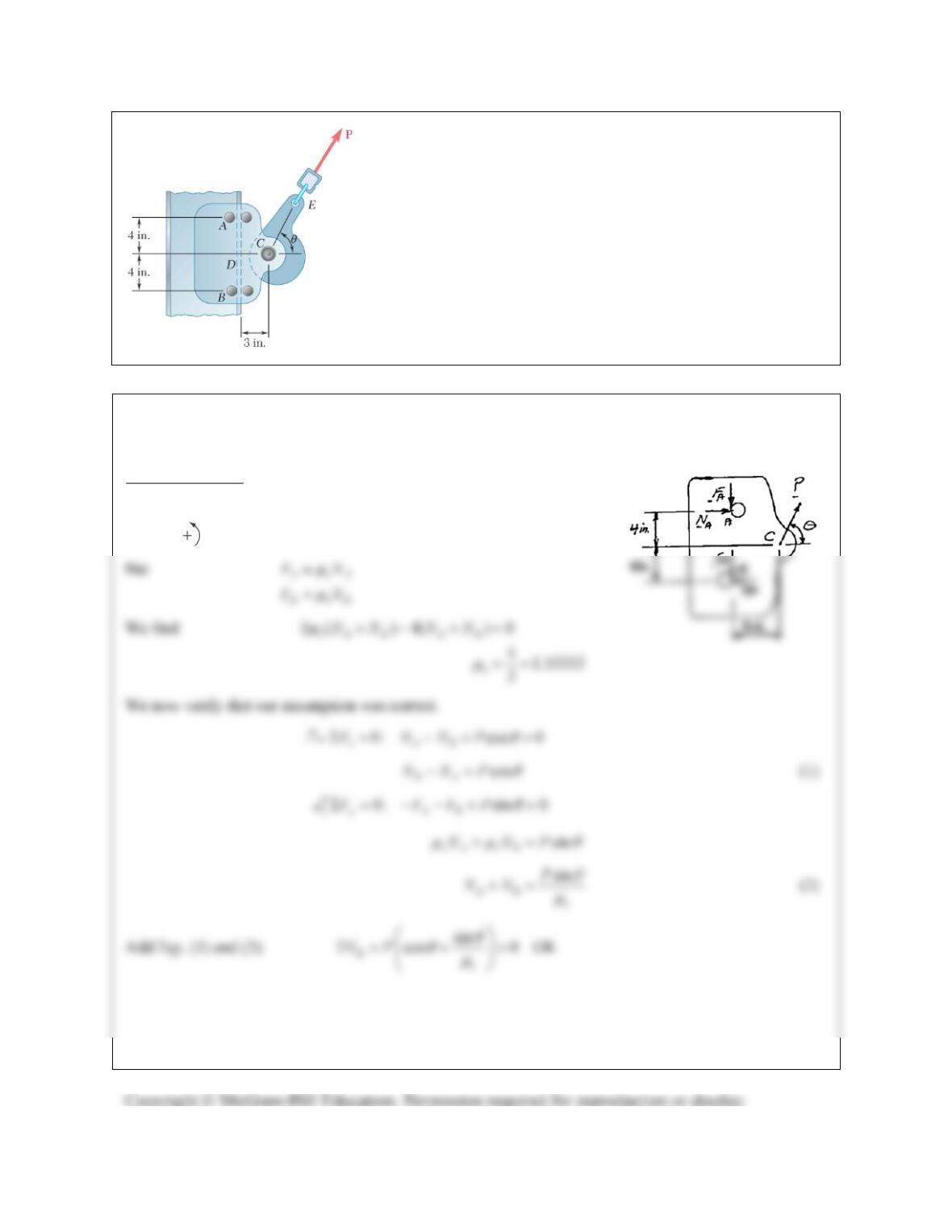
PROBLEM 8.35
To be of practical use, the safety sleeve described in Problem 8.34
must be free to slide along the rail when pulled upward. Determine
the largest allowable value of the coefficient of static friction
between the flange of the rail and the pins at A and B if the sleeve is
to be free to slide when pulled as shown in the figure, assuming
(a)
60 ,
(b)
50 ,
(c)
40 .
SOLUTION
Note the cam is a two-force member.
Free body: Sleeve
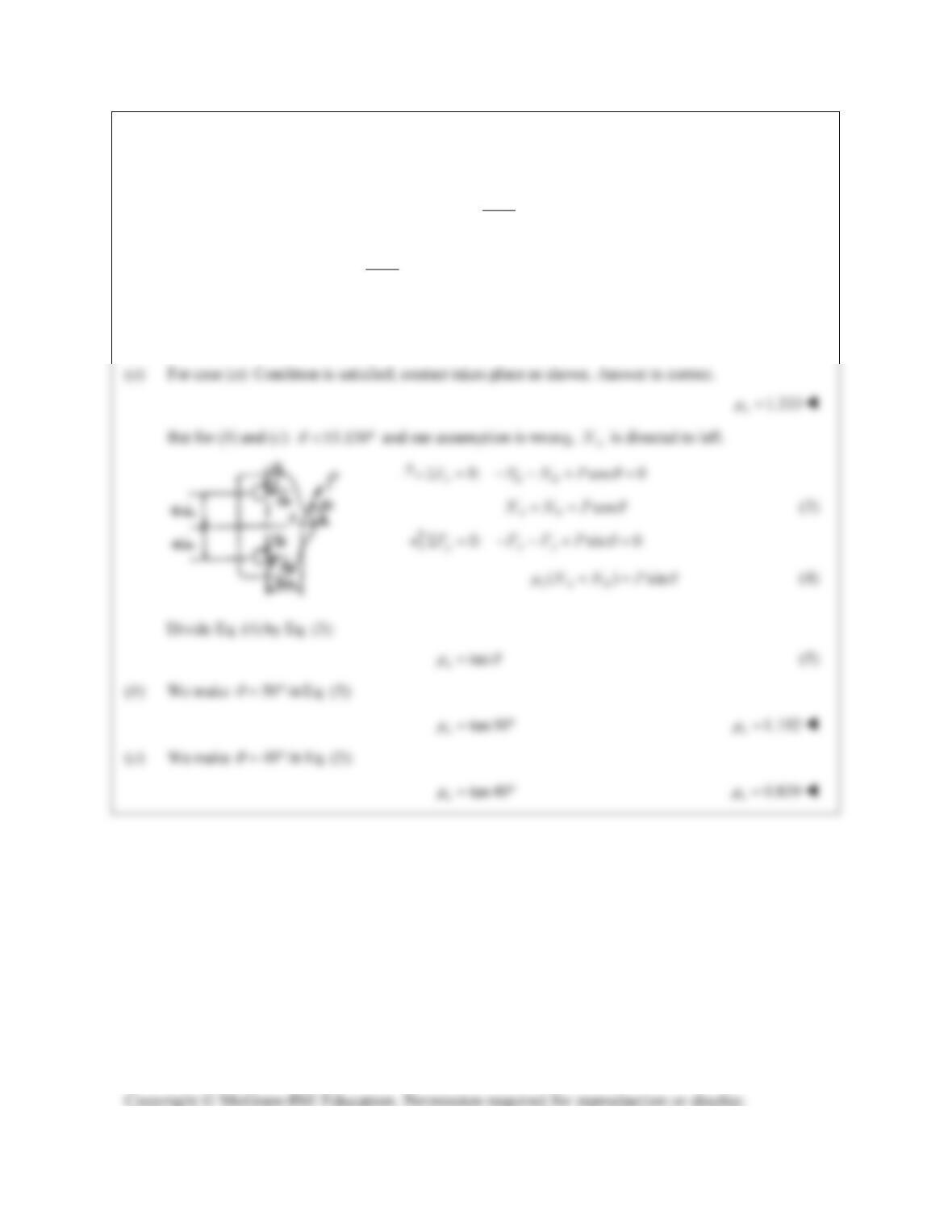
We assume contact between rail and pins as shown.
0: (3 in.) (3 in.) (4 in.) (4 in.) 0
CA B A B
MF F N N
PROBLEM 8.35 (Continued)
Subtract Eq. (1) from Eq. (2):
sin
2cos
A
s
NP
0
A
N
only if
sin cos 0
s
tan 1.33333
53.130
s
PROBLEM 8.36
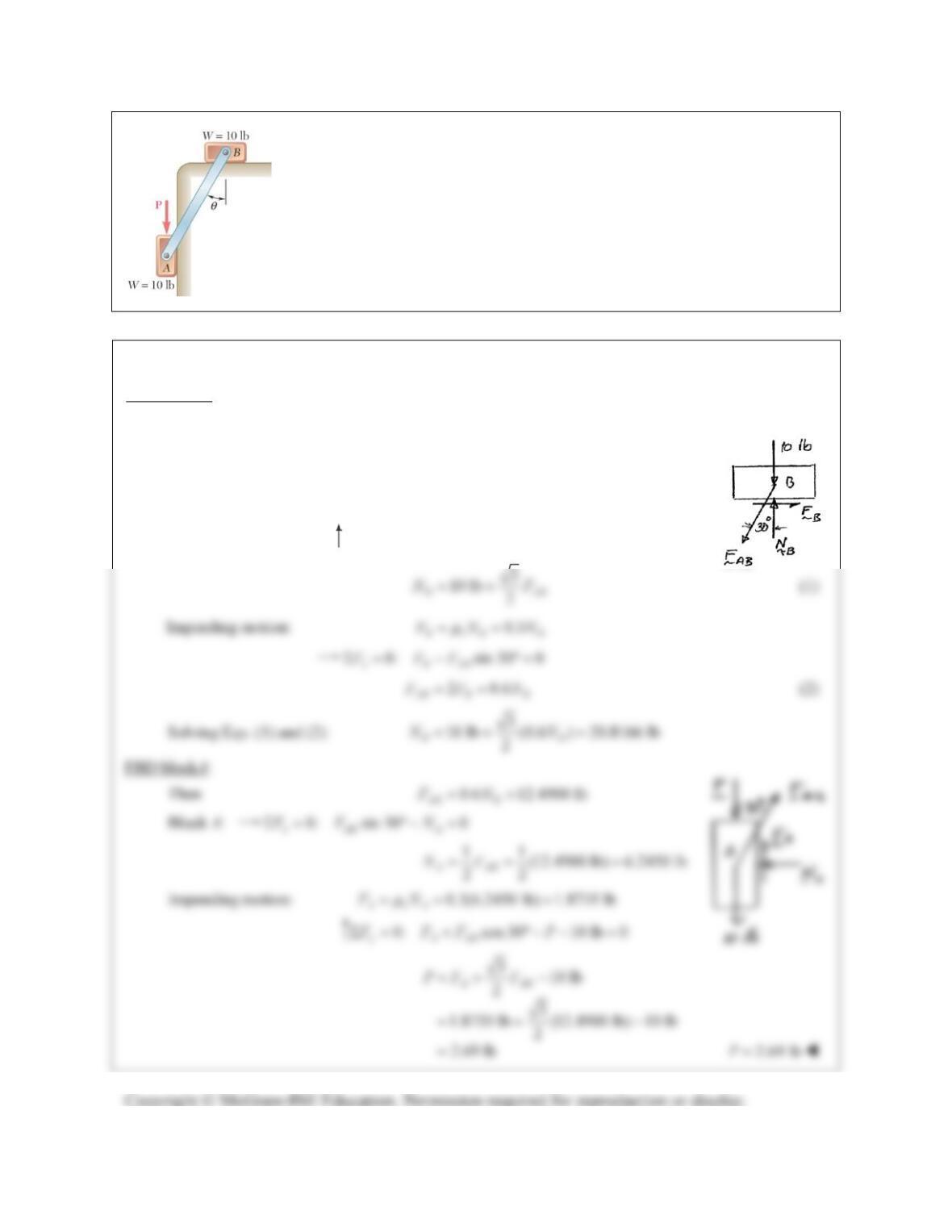
Two 10-lb blocks A and B are connected by a slender rod of negligible weight. The
coefficient of static friction is 0.30 between all surfaces of contact, and the rod
forms an angle
30 .
with the vertical. (a) Show that the system is in
equilibrium when
0.P
(b) Determine the largest value of P for which
equilibrium is maintained.
SOLUTION
FBD blockB:
(a) Since
2.69 lbP
to initiate motion, equilibrium exists with
0P
(b) For
max
,P
motion impends at both surfaces:
Block B:
0: 10lb cos 30 0
yB AB
FN F
PROBLEM 8.37
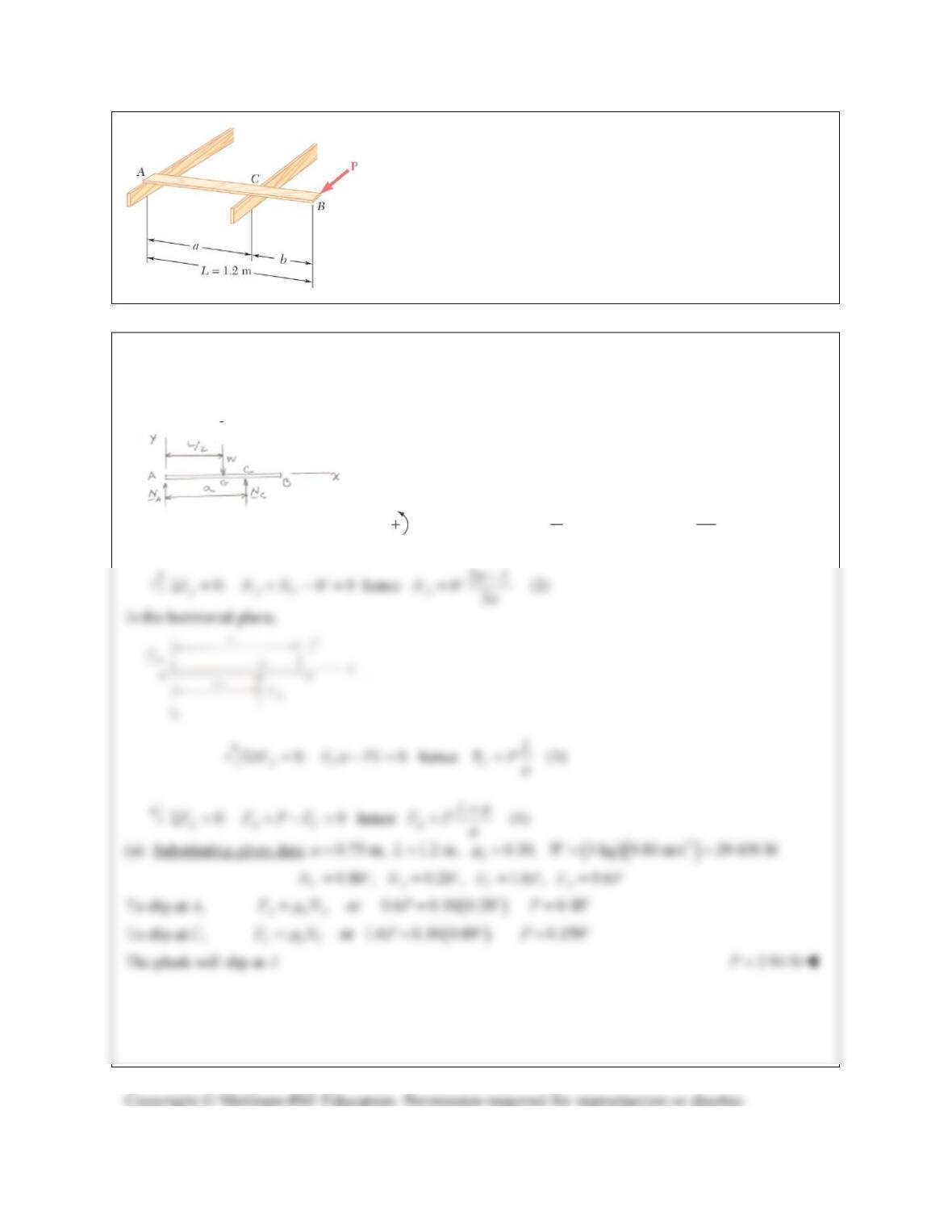
A 1.2-m plank with a mass of 3 kg rests on two joists. Knowing
that the coefficient of static friction between the plank and the
joists is 0.30, determine the magnitude of the horizontal force
required to move the plank when (a) a = 750 mm, (b) a = 900 mm.
SOLUTION
Free body member AB:
In the vertical plane,
0: 0 hence (1)
22
AC C
LL
MNaW NW
a
PROBLEM 8.37 (Continued)
(b) Substituting given data:
2
0.9 m, 1.2 m, 0.30, 3 kg 9.81 m/s 29.430 N
s
aL W
2141
, , ,
3333
CACA
NWNWFPFP
PROBLEM 8.38
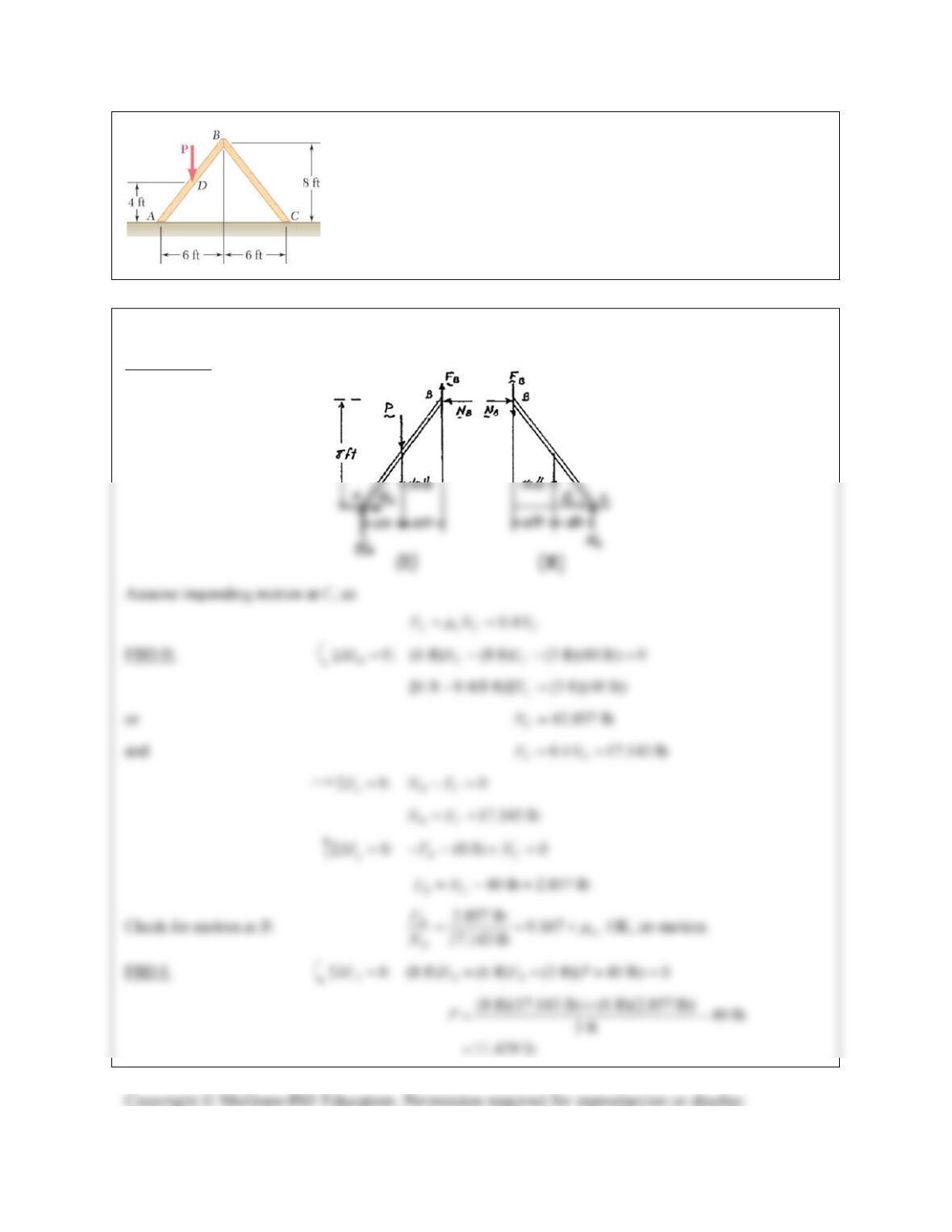
Two identical uniform boards, each of weight 40 lb, are temporarily
leaned against each other as shown. Knowing that the coefficient of
static friction between all surfaces is 0.40, determine (a) the largest
magnitude of the force
P
for which equilibrium will be maintained,
(b) the surface at which motion will impend.
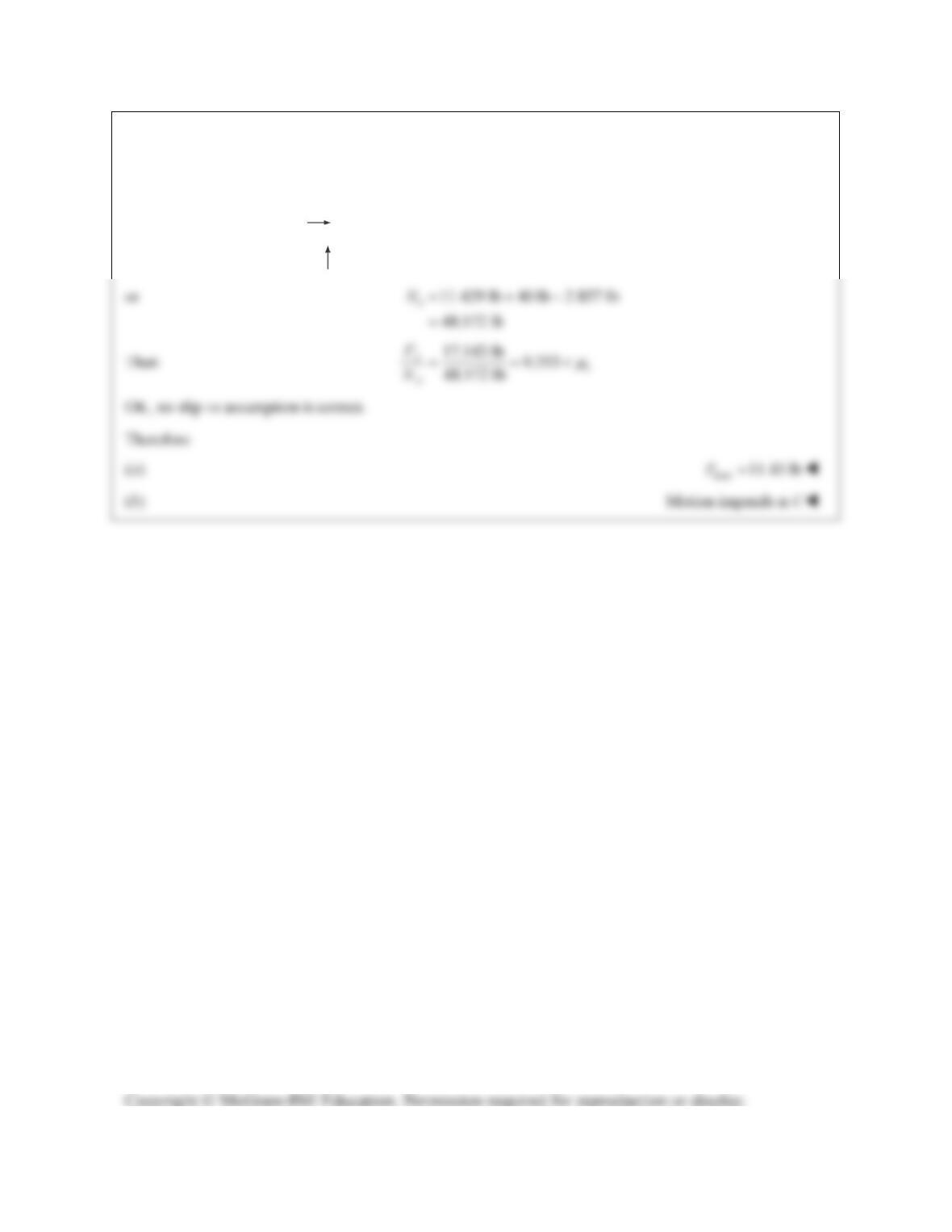
SOLUTION
Board FBDs:
PROBLEM 8.38 (Continued)
Check for slip at A (unlikely because of P):
0: 0 or 17.143 lb
xAB AB
FFN FN
0: 40 lb 0
yA B
FNP F
PROBLEM 8.39
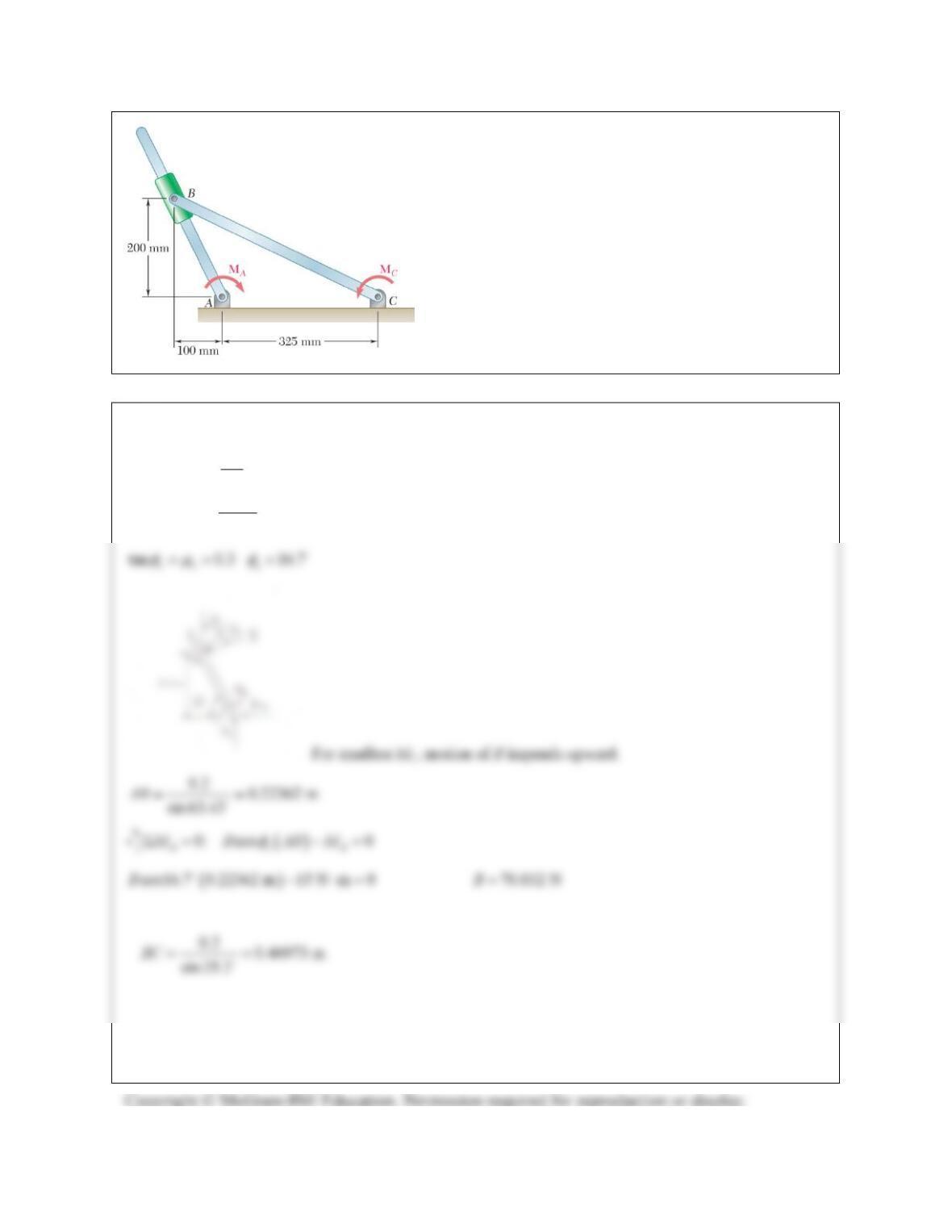
Two rods are connected by a collar at B. A couple
M
A
with a
magnitude of 15 N·m is applied to rod AB. Knowing that the
coefficient of static friction between the collar and the rod is
0.30, determine the largest couple
M
C
for which equilibrium
will be maintained.
SOLUTION
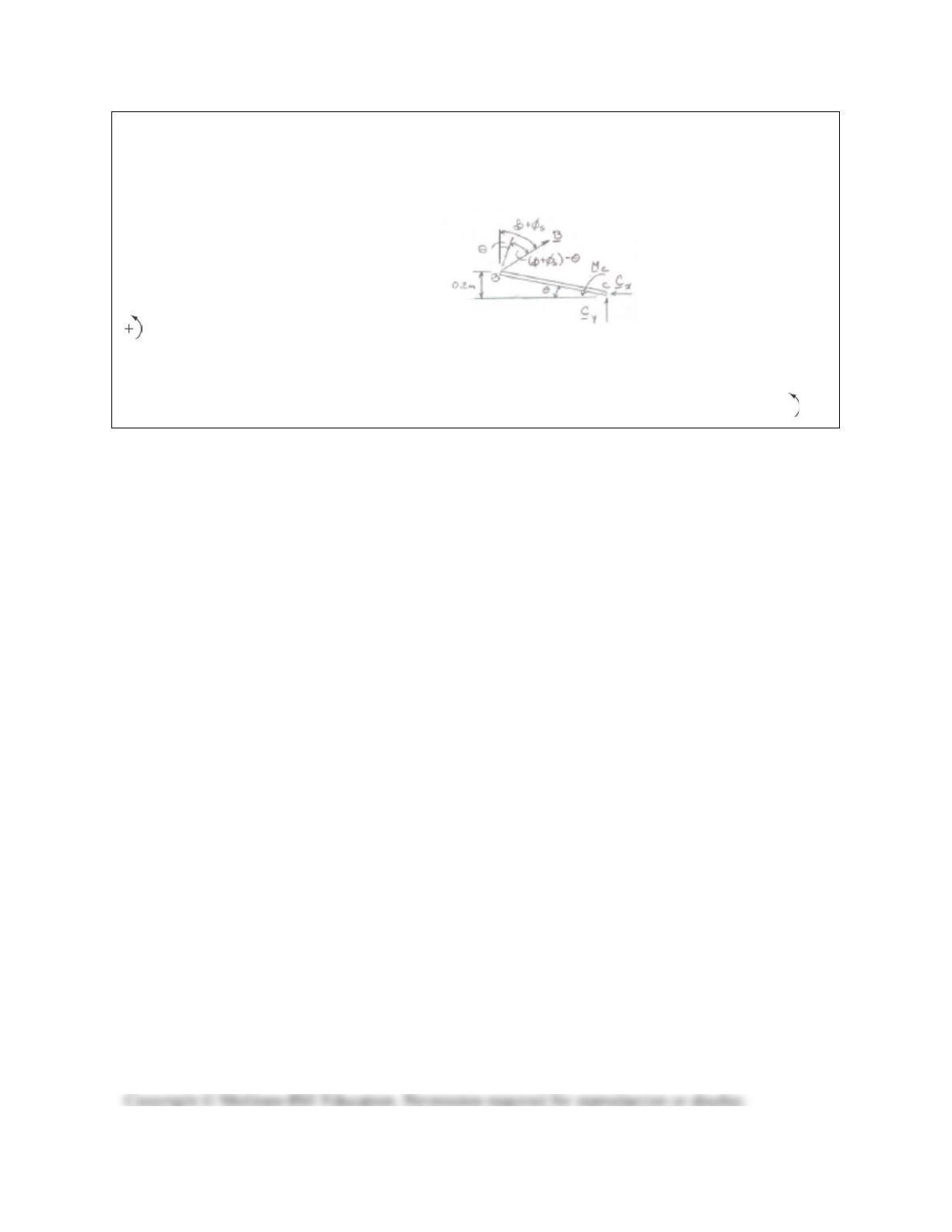
0.2
tan =63.43
0.1
PROBLEM 8.40
In Prob. 8.39, determine the smallest couple
M
C
for
which equilibrium will be maintained.
PROBLEM 8.39
Two rods are connected by a collar at
B
. A couple
M
A
with a magnitude of 15 N·m is applied to rod
AB
.
Knowing that the coefficient of static friction between the
collar and the rod is 0.30, determine the largest couple
M
C
for which equilibrium will be maintained.
SOLUTION
0.2
tan =63.43
0.1
0.2
tan 25.2
0.425
PROBLEM 8.40 (Continued)
0: cos( ) 0
CC s
MMB BC
(70.032 N)cos 63.43 16.7 25.2 0.46973 m
C
M
18.90 N m
C
M
PROBLEM 8.41
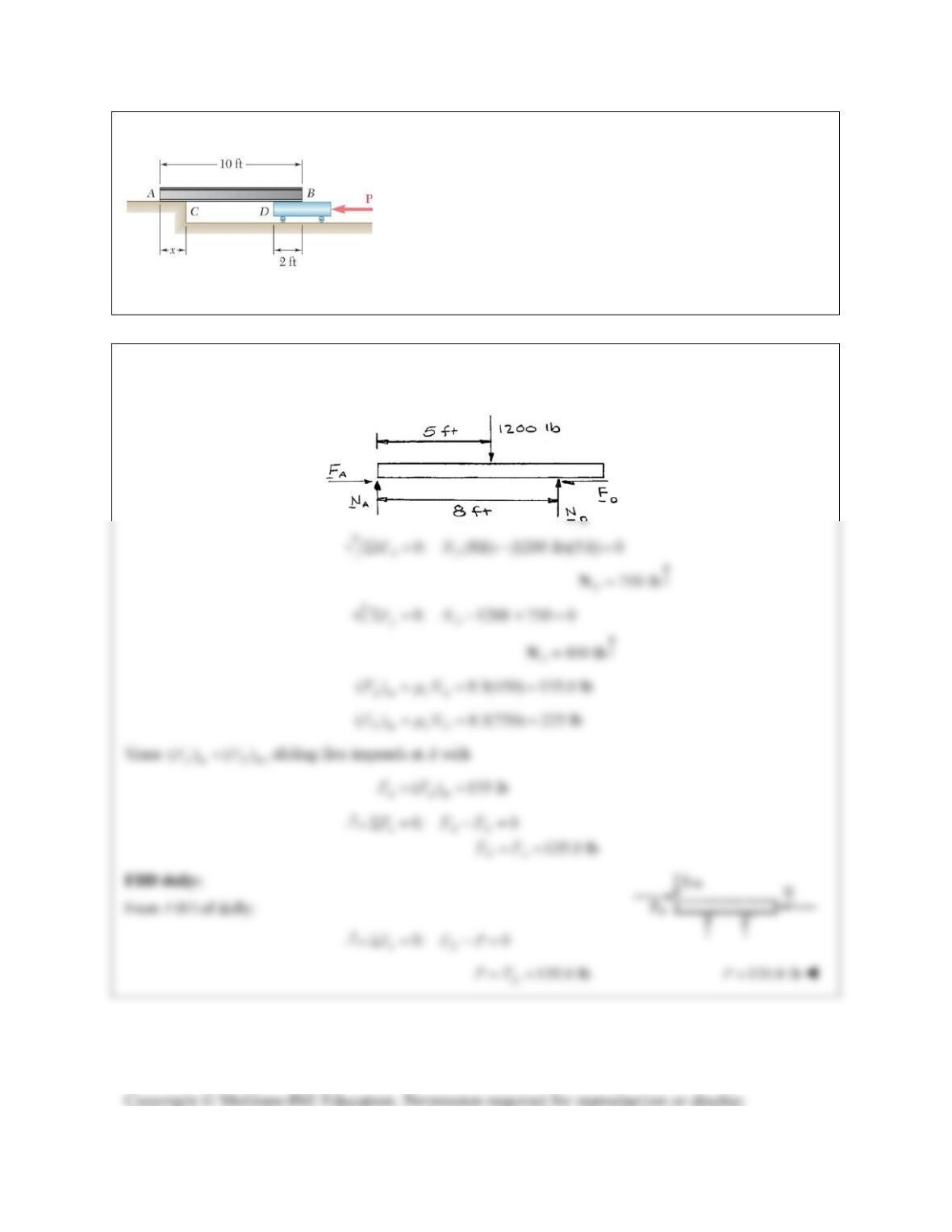
A 10-ft beam, weighing 1200 lb, is to be moved to the left onto
the platform. A horizontal force
P
is applied to the dolly, which
is mounted on frictionless wheels. The coefficients of friction
between all surfaces are
0.30
s
and
0.25,
k
and initially
2 ft.x
Knowing that the top surface of the dolly is slightly
higher than the platform, determine the force
P
required to start
moving the beam. (
Hint:
The beam is supported at
A
and
D
.)
SOLUTION
FBD beam:
PROBLEM 8.42
(
a
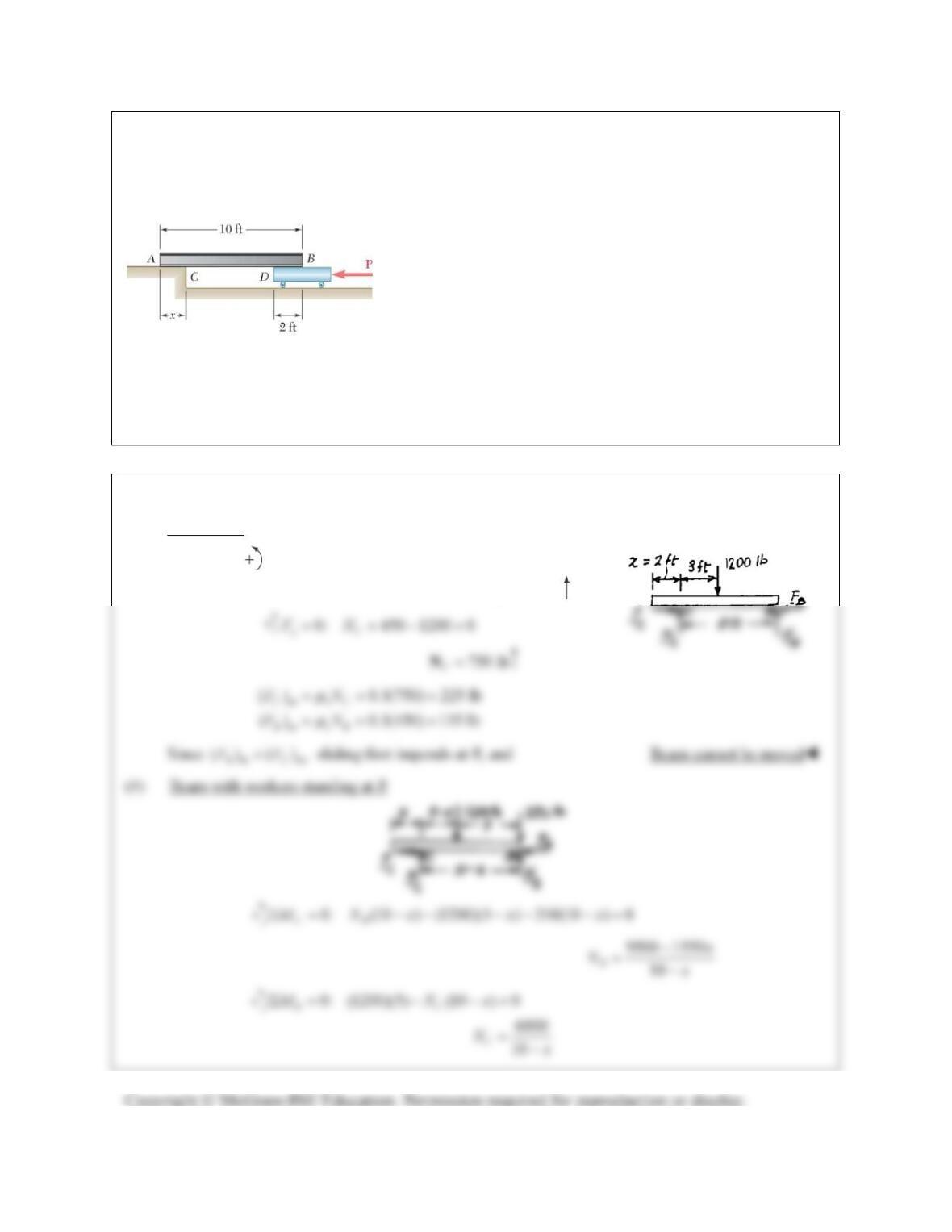
) Show that the beam of Problem 8.41
cannot
be moved if the
top surface of the dolly is slightly
lower
than the platform.
(
b
) Show that the beam
can
be moved if two 175-lb workers
stand on the beam at
B
and determine how far to the left the beam
can be moved.
PROBLEM 8.41
A 10-ft beam, weighing 1200 lb, is to be
moved to the left onto the platform. A horizontal force
P
is
applied to the dolly, which is mounted on frictionless wheels.
The coefficients of friction between all surfaces are
0.30
s
and
0.25,
k
and initially
2 ft.x
Knowing that the top
surface of the dolly is slightly higher than the platform,
determine the force
P
required to start moving the beam. (
Hint:
The beam is supported at
A
and
D
.)
SOLUTION
(
a
) Beam alone
0: (8 ft) (1200 lb)(3 ft) 0
CB
MN
450 lb
B
N
PROBLEM 8.42 (Continued)
Check that beam starts moving for x 2 ft:
For x 2 ft: 9500 1550(2) 800 lb
10 2
6000 750 lb
10 2
( ) 0.3(750) 225 lb
( ) 0.3(800) 240 lb
B
C
Cm s C
Bm s B
N
N
FN
FN
PROBLEM 8.43
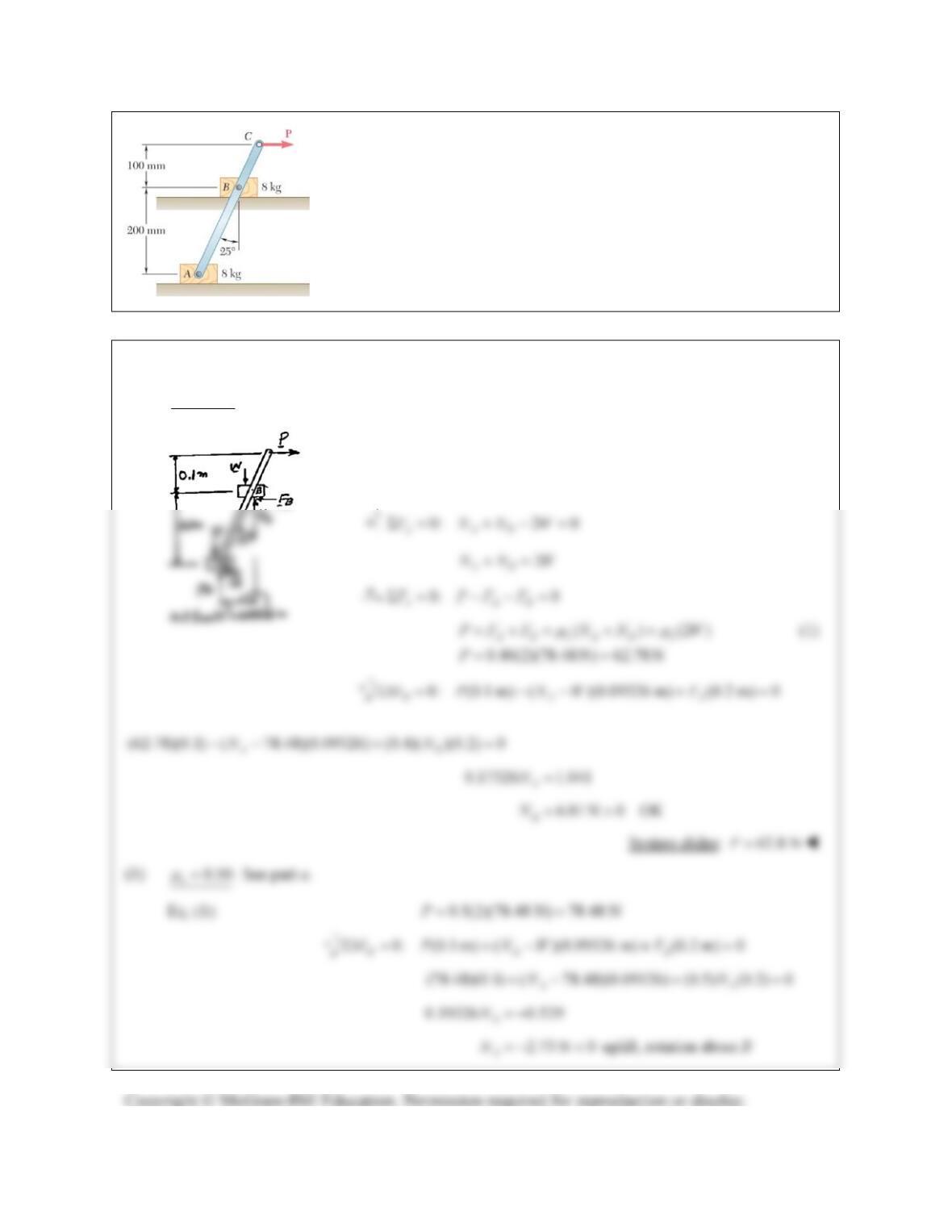
Two 8-kg blocks
A
and
B
resting on shelves are connected by a rod of
negligible mass. Knowing that the magnitude of a horizontal force
P
applied at
C
is slowly increased from zero, determine the value of
P
for
which motion occurs, and what that motion is, when the coefficient of
static friction between all surfaces is (
a
)
0.40,
s
(
b
)
0.50.
s
SOLUTION
(
a
)
0.40:
s
Assume blocks slide to right.
2
(8 kg)(9.81 m/s ) 78.48 N
AsA
BsB
Wmg
FN
FN
PROBLEM 8.43 (Continued)
For
0:
A
N
0: (0.1 m) (0.09326 m) 0
B
MP W
(78.48 N)(0.09326m)/(0.1) 73.19P
System rotates about
B
:
73.2 NP
PROBLEM 8.44
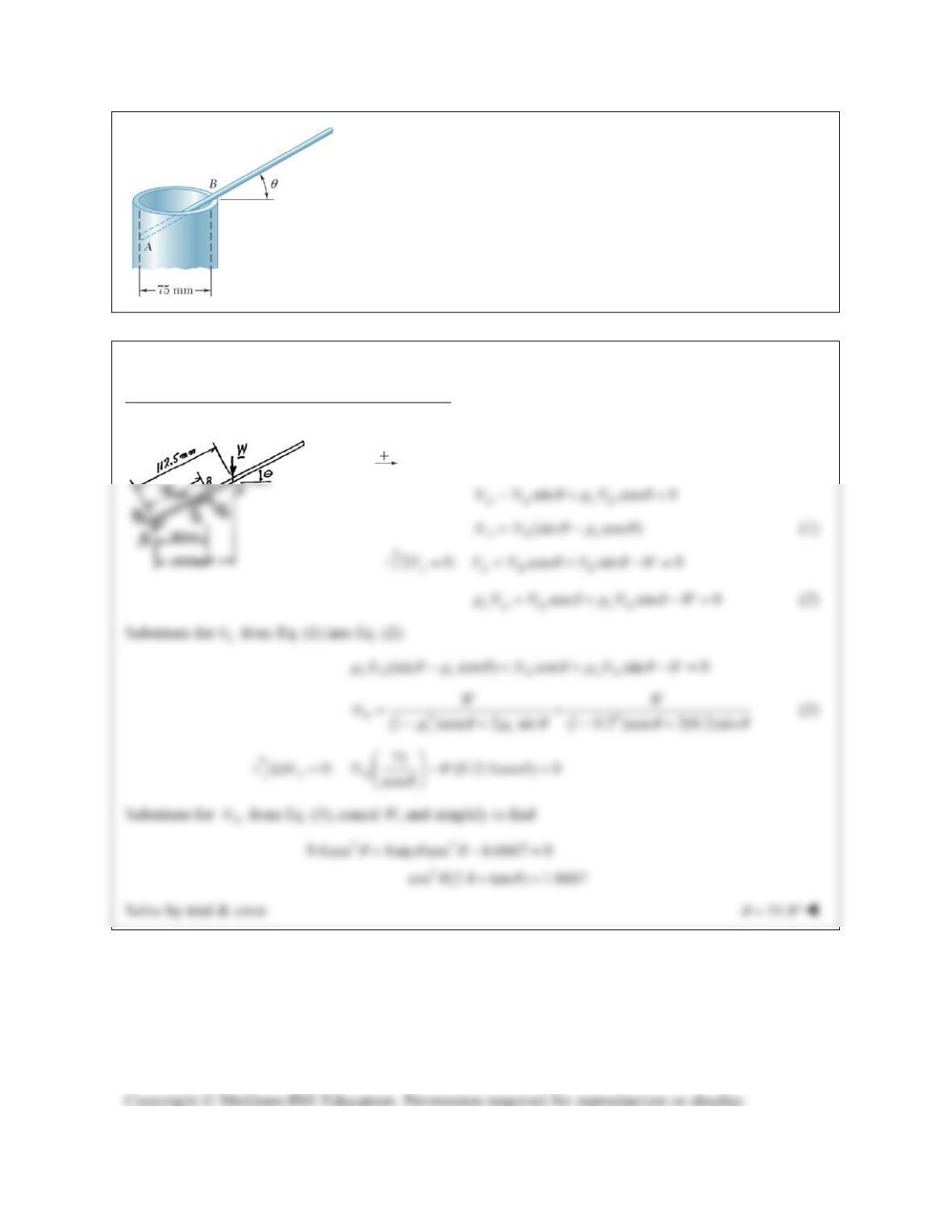
A slender steel rod of length 225 mm is placed inside a pipe as
shown. Knowing that the coefficient of static friction between the rod
and the pipe is 0.20, determine the largest value of
for which the
rod will not fall into the pipe.
SOLUTION
Motion of rod impends down at
A
and to left at
B
.
AsABsB
FNFN
0: sin cos 0
xABB
FNN F
PROBLEM 8.45
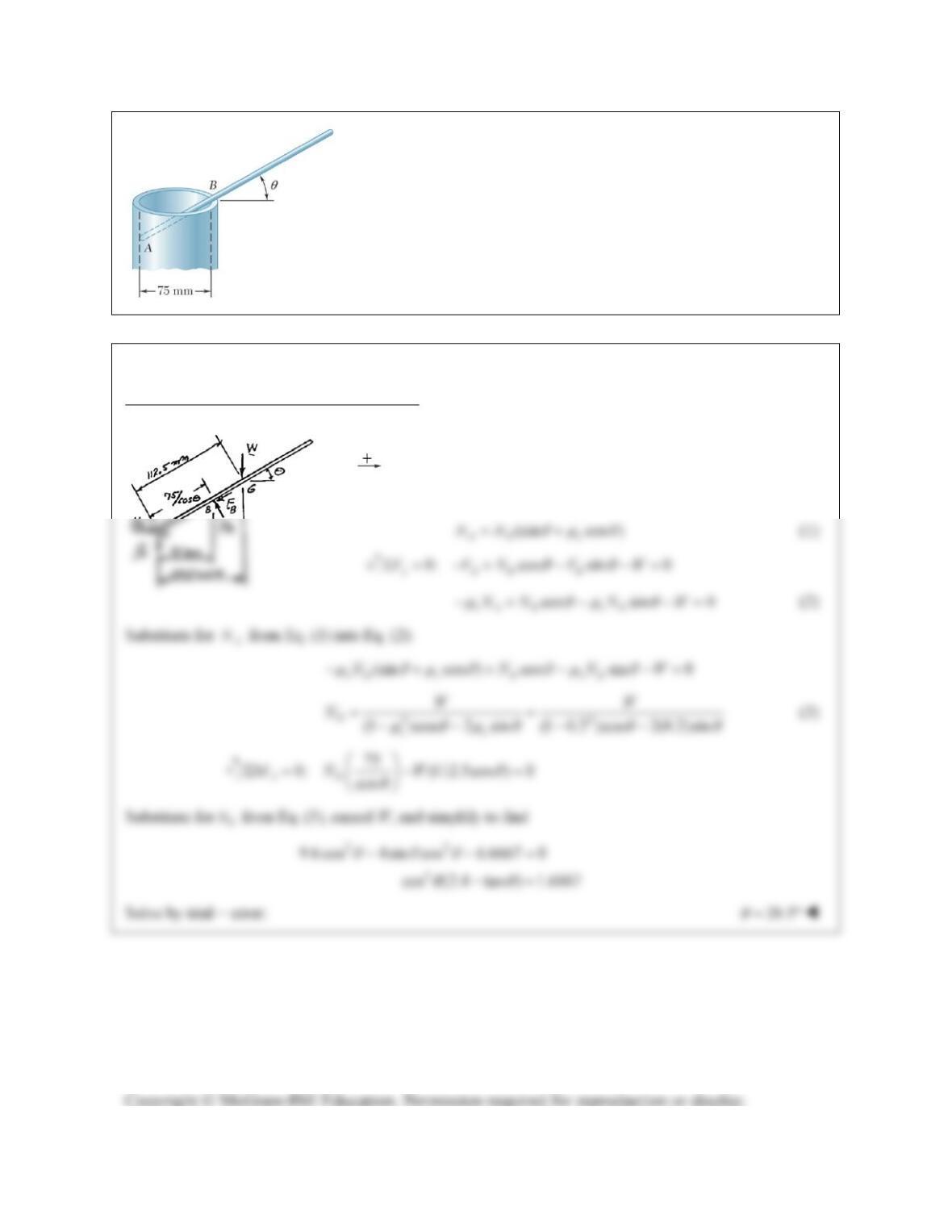
In Problem 8.44, determine the smallest value of
for which the rod
will not fall out the pipe.
PROBLEM 8.44 A slender steel rod of length 225 mm is placed
inside a pipe as shown. Knowing that the coefficient of static friction
between the rod and the pipe is 0.20, determine the largest value of
for which the rod will not fall into the pipe.
SOLUTION
Motion of rod impends up at A and right at B.
AsABsB
FNFN
0: sin cos 0
xABB
FNN F
sin cos 0
AB sB
NN N