Chapter 8 Solutions Revenue and Cash Collection Processes
Page 8-1
Turner/Accounting Information Systems, 2e
Solutions Manual
Chapter 8
Concept Check
1. a
2. c
3. a
4. c
5. d
6. a
7. c
8. d
Discussion Questions
17. (SO 2) Why is it important to establish and monitor credit limits for customers? Allow
customers to order an excess over what they are able to pay poses a large risk for
being paid for goods or services purchased by customers.
18. (SO 2) Distinguish between a pick list and a packing slip. Although the information
on these two documents is essentially the same, they are used for two different
19. (SO 2) How can an effective system of internal controls lead to increased sales
revenue? When an effective systems of internal controls is in place, managers may
be able to spend less time overseeing operations and can therefore, spend more
Chapter 8 Solutions Revenue and Cash Collection Processes
20. (SO 2) Why should the person responsible for shipping goods to customers not also
have responsibility for maintaining records of customer accounts? Custody of
21. (SO 3) What is the purpose of a credit memorandum? The credit memorandum
documents the fact hat a customer has returned goods. The credit memorandum is
also used to reduce the customer’s receivable account balance based upon the
return of goods.
22. (SO 3) How are sales invoices used (in a manual system) in the preparation of credit
23. (SO 2) How can a security guard in a warehouse be considered an important
component of a company’s accounting system? Internal controls over asses should
include physical controls to prevent theft or misuse. For example, cash should be
locked in a safe to prevent the theft of cash. Likewise, a security guard can help
prevent theft or misuse of assets. This internal control would not prevent all theft,
but would help reduce any theft.
24. (SO 3) How could fraud be perpetrated through the sales returns process? In the
absence of good internal controls, there are several types of fraud that could occur
employee.
25. (SO 6,7,8) Identify and distinguish between the three types of IT systems used in the
sales process. The three types of IT systems described are EDI, Internet EDI, and
point of sale systems. EDI and Internet EDI are used in company to company sales
of goods and services. In EDI systems, the buyer and seller computer systems are
26. (SO 6) Distinguish between B2B sales and B2C sales. Other than those presented
in this chapter, name a company from your personal experience that uses B2C
Chapter 8 Solutions Revenue and Cash Collection Processes
B2C.
27. (SO 6) List the advantages of e-commerce systems. The advantages are reduced
costs, shorter sales cycles, increased accuracy and reliability of sales data, and an
increase in the potential market.
28. (SO 6) Identify two of the biggest risks to companies who use e-commerce, along
with controls to prevent these risks. Two of the business risks of e-commerce would
29. (SO 6,7) What controls should a company implement to ensure consistency of sales
information between the front end and back end of its systems? Reconciliations and
30. (SO 6) Why is a redundant server system needed in an e-commerce environment?
Availability is extremely important in e-commerce systems. Any failure of the system
represents lost sales because the system is not available for customer use. A large
e-commerce company could lose thousands of dollars in sales from a two or three
hour downtime.
31. (SO 6) Why should a company continuously monitor the capacity of its e-commerce
system?
32. (SO 7) What are the three components of an EDI system? The three component
33. (SO 7) What are the three standard parts of an EDI data transmission? Header and
trailer data, labeling interchanges, and data segments. Header data is data about
the file or transmission being sent. The header identifies the beginning and end of a
segments include the actual data within the invoices, such as quantities and prices.
34. (SO 7) How could it be possible for two companies to conduct EDI if they are not
directly connected with each other? Two companies could use a value added
network (VAN) as a third party to serve as the provider of electronic inboxes for EDI
exchanges.
35. (SO 7) List the advantages of an EDI system. The advantages are elimination of
keying, keying errors, and the time needed for keying, the elimination of mailing time
Chapter 8 Solutions Revenue and Cash Collection Processes
Page 8-4
36. (SO 6,7,8) What is the purpose of maintaining transaction logs? Why are they
especially important in IT systems? Transaction logs serve as the audit trail of
transactions processed by the computer. Review of these logs can ensure that
transactions are lost or unaccounted for. The logs also help ensure a company can
avoid repudiation of sales.
37. (SO 8) List some advantages of a POS system. Advantages are: ease of use by
38. (SO 8) Why are backup systems one of the most important controls for POS
systems? A system failure in a POS system would interrupt or halt sales. Such lost
sales can be a large dollar amount and there could be future lost sales if customers
Brief Exercises
40. (SO 2, SO 4) Describe what is likely to occur if company personnel erroneously
recorded a sales transaction for the wrong customer? What if a cash receipt was
applied to the wrong customer? Identify internal controls that would detect or
prevent this from occurring. If the sale is attached to the wrong customer, the wrong
customer would be billed and it may cause both the wrong customer and the correct
41. (SO 4) Debate the logic used in the following statement: “The person responsible
for handling cash receipts should also prepare the bank reconciliation because he is
most familiar with the deposits that have been made to the bank account.” It is true
that if a person could be absolutely trusted to do both duties, it may be more
Chapter 8 Solutions Revenue and Cash Collection Processes
42. (SO 7) Revenue systems are crucial in the healthcare industry, where hundreds of
billions of dollars are spent annually reconciling revenues and billing data from the
perspectives of providers (doctors and clinics, etc.) and payers (insurance
43. (SO 2, SO 3, SO 4) Use the process maps in this chapter to answer the following
questions:
a. What would a credit manager do if a sales order received caused a customer
to exceed its credit limit? The sale should be disapproved (rejected).
b. What happens after the shipping department verifies that the quantities and
descriptions of goods prepared for shipment are consistent with the sales
order? The goods are shipped, an invoice is prepared and mailed; the
44. (SO 2) Describe how the matching of key information on supporting documents can
help a company determine that its revenue transactions have not been duplicated.
45. (SO 2,3) Describe how the use of pre-numbered forms for receiving reports and
credit memos can help a company determine that sales return transactions have not
been omitted from the accounting records. When pre-numbered forms are used, it is
Chapter 8 Solutions Revenue and Cash Collection Processes
46. (SO 8) Describe how a POS system could be useful to a company’s marketing
managers. How could it be useful to production managers? A POS system can
provide immediate feedback about product sales and inventory levels. Therefore, a
marketing manager can get immediate feedback about which products sell well,
47. (SO 8) Briefly describe an example from your personal experience where you
purchased something from a company that uses a POS system. How might your
experience have been different if the POS system did not exist in the experience you
described? There are many possible experiences students could describe. Each
Problems
48. (SO 6) In 1956, Nicolai Rizzoli opened a pizza restaurant that he named Rizzoli’s in
St. Louis, Missouri. Over the years, he opened both company and franchise
locations and grew the business to include over 40 restaurants that serve the three
states around the St. Louis area. In 1993, Rizzoli introduced a centralized phone
ordering system with one phone number for customers to use. This meant that the
Chapter 8 Solutions Revenue and Cash Collection Processes
Page 8-7
describe the advantages of Rizzoli’s system, and any risks that it reduces.
Advantages: The Web ordering system provides the advantages of: cost savings
through lower marketing, employee, and paperwork costs; shorter sales cycles due
49. (SO 8) You are the recent heir of $40,000 cash, with which you are considering
opening a sushi bar in the university community. You would accept cash and credit
card payments, which would be handled primarily by your servers. You also plan to
offer introductory specials to attract customers during the initial months of business.
Identify some advantages and disadvantages of investing in a POS system as part
of this new business venture. What internal controls should be implemented to
reduce the risk of theft or error related to the handling of cash, credit card payments,
and coupons?
The advantages of investing in a POS system as part of a new business venture
include the following:
• Ease of use and ease of training servers. This is expected to lead to fewer errors
and more accurate sales and inventory data.
• Time savings related to the elimination of manual input processes. This includes
increased efficiency and reduced fraud related to processing of credit card
payments from customers.
Chapter 8 Solutions Revenue and Cash Collection Processes
Page 8-8
50. (SO 2,4,6) Chris Hargrove is the owner of AP’s Instant Replay, a consignment shop
for used sporting goods. Chris accepts consigned goods and offers them for sale to
the general public. Chris rents business space, including a retail store where the
consigned goods are displayed and sold, with adjoining office space where an
Internet site is maintained and other administrative functions are performed. The
Internet site includes photos and descriptions of items available for sale worldwide.
If the goods sell, Chris’s consignment fee is 40% of the sale price, and 60% is
remitted to the consignor. Shipping costs on electronic orders are paid by the
customers.
Identify internal control considerations for the following:
a. the e-commerce portion of the business. Internal control considerations
associated with e-commerce should address the risks of security and
confidentiality, processing integrity, and availability. Regarding security and
confidentiality, Chris should ensure that customers accessing the website and
b. the retail portion of the business, assuming that the accounting systems are
mostly manual and handled by Chris and his wife. The five internal control
activities should be considered with respect to the retail business and manual
accounting systems involving sales and cash collections. Even though
segregation of duties will be difficult considering that only Chris and his wife are
51. (SO 2,3,4) Identify an internal control procedure that would reduce each of the
risks that follow in a manual system. Also describe how (or if) an IT system could
reduce these risks: Student responses may vary, as more that one control may
Chapter 8 Solutions Revenue and Cash Collection Processes
Page 8-9
apply to risk reduction in these circumstances. However, following are some
likely answers:
a. Revenues may be recorded before the related shipment occurs. Shipping
documentation should be matched with sales order data and presented to the
b. Employees responsible for shipping and accounts receivable may collude to
steal goods and cover up the theft by recording fictitious sales. To prevent
this type of problem, sales orders should be reviewed for proper customer
and authorized by an independent member of management prior to shipment.
The IT system can include validity checks or other controls that require a valid
type of fraud.
c. Credit memos may be issued at full price, when the goods were originally sold
at a discount. Original sales documentation, including key information such as
original sales price, must be required as a basis for preparing credit memos.
An IT system could automatically match credit memo authorizations with the
original sales data so that the credit would be issued at amounts that are
consistent with the original sale pricing.
d. Sales invoices may contain mathematical errors. Independent checks of sales
invoices should occur before the customer is billed. This includes verification
of mathematical accuracy. If an automated system is in place, the IT system
can perform mathematical computations at a great time savings.
e. Amounts collected on accounts receivable may be applied to the wrong
customer. Customer account statements should be sent on a regular basis so
receipt is applied properly.
f. Duplicate credit memos may be issued for a single sales return. A
comparison of the receiving log with the credit memo listing would indicate if
duplicate credit memos have been issued for a single sales return. An IT
system could also prevent this risk by requiring that credit memos be
Chapter 8 Solutions Revenue and Cash Collection Processes
Page 8-10
an invoice was prepared for each item shipped. An IT system may enhance
this process by matching shipping document numbers with invoices, and
preparing a warning report for any instances of unmatched shipping
documents.
h. Shipments may contain the wrong goods. Companies should require the
matching of key information on related documents prior to shipment. This
i. All sales transactions may not be included in the general ledger. A regular
reconciliation should be performed to compare the sales journal with the
amounts recorded in the general ledger. An IT system may perform a periodic
automatic post of the sales journal to the general ledger, thereby eliminating
the potential for missing sales transactions.
52. (SO 3,4,5) The following list presents various internal control strengths (S) or risks
(R) that may be found in a company’s revenues and cash collection processes.
__S__ Credit is authorized by the credit manager.
_N/A_ Checks paid in excess of $5,000 require the signatures of two authorized
members of management. (Although this is viewed as an internal control
strength, it is not applicable to the revenues processes.)
__S___ A bank reconciliation is prepared on a monthly basis by the Treasurer’s
department.
Chapter 8 Solutions Revenue and Cash Collection Processes
Page 8-11
_N/A_ Payments to vendors are made promptly upon receipt of goods or
services. (Vendor payments relate to the expenditures processes rather
than the revenues processes.)
__R__ Cash collections are deposited in the bank account on a weekly basis. (If
cash receipts occur daily, they should be deposited promptly – preferably
on a daily basis.)
53. See the completed spreadsheet “Problem 8–53.xls” on the instructor website. That
spreadsheet has two tabs. The first tab is a simple spreadsheet in which numbers
for invoice and amount are typed into the appropriate column. This spreadsheet is
probably similar to what most students would complete. If students have a higher
formulas and the AND function to place amounts in the correct aged column
54. See the completed spreadsheet “Problem 8-54.xls” on the instructor website. There
is no single correct answer to this problem. However, as a student attempts to
design a spreadsheet, it will cause the student to ponder several important issues.
For example, the student must consider how to handle data that appears once,
Chapter 8 Solutions Revenue and Cash Collection Processes
Page 8-12
55. (SO 2,4) Following are ten internal control failures related to the revenues and cash
collection processes.
__d__ A customer ordered 12 boxes of your product (total of 144 items) for express
shipment. Your data entry clerk inadvertently entered 12 individual items.
__q__ You enter sales and accounts receivable data in batches at the end of each
week. Several problems have resulted recently as a result of recording
invoices to the wrong customer account.
__p__ Several shipping reports have been misplaced en route to the billing
department from the shipping department.
__h__ Several sales transactions were not invoiced within the same month as the
related shipment.
__n__ Customer orders were lost in the mail en route from the sales office to the
accounting department (located at the company’s headquarters).
Required:
Select one internal control from the following list that would be most effective in the
prevention of the failure. Indicate the letter of the control next to each failure above.
Letters should not be used more than once and some letters may not be used at all.
a. Pre-formatted data entry screens
b. Pre-numbered documents
Chapter 8 Solutions Revenue and Cash Collection Processes
Page 8-13
f. 100% check for matching of sales orders and invoices
g. 100% check for matching of deposit slip and customer check.
h. Prompt data entry immediately upon receipt of customer order
i. Customer verification
56. (SO 2,3,4) Brathert Company is a small company with four people working in the
revenue processes. One of the four employees supervises the other three. Some
tasks that must be accomplished within the revenue processes are the following:
a. Accounts receivable record keeping
b. Approving credit of customers
c. Authorizing customer returns
d. Authorizing new customers
Required:
For each of the four employees (supervisor, employee 1, employee 2, and employee
3), consider the duties you would assign to each employee. In assigning duties, no
employee should have more than three tasks and there should be a proper
separation of duties to achieve appropriate internal control. List the four people, the
duties you assigned to each employee, and a description of why those assignments
achieve proper separation of duties.
Supervisor: b., c., and d. (all Authorization functions)
Chapter 8 Solutions Revenue and Cash Collection Processes
Page 8-14
57. (SO 6) Refer to the Ethical Dilemma: Mail Order Case presented in Chapter 3. What
term introduced in this chapter applies to the type of mail order deceit described in
that case? What could the mail order company do to avoid a loss resulting from an
event, assuming that it uses an e-commerce system? This type of mail order deceit
figures by deliberately sending retailers along its distribution channel more products
that they are able to sell to the public. By channel studding, distributors temporarily
inflate their accounts receivables. However, unable to sell the excess products,
retailers will send the excess items instead of cash back to the distributor, who must
adjust its accounts receivable and ultimately its net income. In other words, channel
stuffing always catches up with the company, because it cannot maintain sales at
the rate it is stuffing. The primary motivation for this fraudulent business practice is
to raise the value of the company’s stock.
59. (SO 6) Using a search engine, search for an article written by Vangie Beal titled
“Top 2012 eCommerce Trend”. Briefly describe the main point of this article. The
main point is that companies must shift their focus away from customers who shop
60. (SO 9) This chapter mentioned alleged fraudulent revenue reporting at Coca Cola
and McAfee. Using a search engine, search the phrase “SEC channel stuffing”.
Give one more example of a company that was investigated, or is being
investigated by the SEC. What are the facts and status of the case? The student’s
Chapter 8 Solutions Revenue and Cash Collection Processes
Page 8-15
Bristol Myers. Schiff and Lane consented to the entry of the final judgments without
admitting or denying the allegations of the Commission’s complaint. The
Commission’s complaint alleged that for the period January 1, 2000 through
December 31, 2001, Schiff and Lane deceived the investing public about the true
performance, profitability and growth trends of Bristol Myers and at their direction,
Bristol Myers engaged in a “channel–stuffing” scheme. The complaint alleged that
Cases
61. Sales processes at Sound Redux Company.
a. The sales process in the store are very similar to any retail store. When a
customer buys a CD or LP record, the product is scanned by a bar code
reader, the customer pays the amount b cash, check, or credit card, and
then takes the products out of the store. In online sales, Redux would have
b. Usually very little, if any, data is collected fro customers during in-store
sales. If the customer pays by cash, he can be completely anonymous.
Even in the case of a credit card payment, customer data is only used to
charge the credit card and that data is usually not kept by the company.
Chapter 8 Solutions Revenue and Cash Collection Processes
Page 8-16
d. In addition to the data mentioned in part c, Redux may store and analzye
the CD titles purchased by individual customers. If Redux had software
62. Sales and collection processes at Kornsen Manufacturing.
a. Refer to the separate Microsoft Excel file “Chapter 8 Solutions Process
Maps.xls”.
b. Weakness: The invoice is prepared without comparison to the packing slip. This
means the company could bill the customer for items or quantities different from
items and quantities shipped. This is especially true if items are out of stock.
Improvement: A copy of the packing slip should be forwarded to accountant 1
and the invoice should be based on items and quantities shipped. Furthermore,
accountant 2 should file the packing slip copy with the matched invoice and
approved sales order.
Weakness: There is no prelisting of checks received with the amounts. Such as
list helps prevent theft or accidentally misplacing a check. Improvement: A
prelisting of checks received should be prepared to be compared to the bank
deposit amount.
Weakness: The collections clerk has custody of the checks and also records the
transactions in the accounts receivable subsidiary ledger. Improvement:
Accountant 1 or 2 should record in the subsidiary ledger upon receiving a list of
checks received. This would improve controls regarding segregation of duties, as
the collections clerk should have custody responsibilities but not the related
Chapter 8 Solutions Revenue and Cash Collection Processes
record keeping responsibilities.
63. Process maps and internal control considerations for Cluxton’s sales, billing, and
collection processes
a. Refer to the separate Microsoft Excel file “Chapter 8 Solutions Process Maps.xls”.
b. Brigston’s sales department personnel are preparing a sales order without an
approval for the transaction and without checking the credit status of the customer.
Before the sales department prepares a sales order, it should determine the relevant
pricing for the items ordered and check the customer’s credit. The sales journal
should not be updated at the time a sales order is prepared; rather, the sales journal
should be updated upon shipment of the items to the customer.
Brigston’s billing department is not preparing a billing record or maintaining records
of amounts billed. It should be preparing an invoice to be sent to the customer,
rather than sending a priced version of the sales order. A copy of the invoice should
be retained in the billing department.
Chapter 8 Solutions Revenue and Cash Collection Processes
Page 8-18
collections received in the mail, and a cash receipts department should be
responsible for preparing the cash receipts journal and bank deposit.
64. Internal control risks at Art’s Artist World
The following memo presents internal control weaknesses or potential risks, as well
as recommendations for strengthening controls:
To : Art Dusing, Owner
Art’s Artist World
Fr: AIS Student
Re: Internal Control Recommendations
• Sales documentation is not being prepared for all sales transactions, but only
for sales on account. This allows for the possibility of fraud or error in the
retail store, as there is no basis for reconciling sales with cash register and
credit receipts for each shift worked by a sales clerk. In addition, inventory
records cannot be updated on a regular basis. If sales clerks prepare a sales
receipt for each sale, then a record exists for the purposes of performing daily
reconciliations of the summaries of cash collections and updating the cash,
Chapter 8 Solutions Revenue and Cash Collection Processes
Page 8-19
• The accounts receivable supervisor is not effectively utilizing the list of past
due accounts. This report should be actively investigated and follow-up
should be performed to maximize the likelihood of cash collection. Past due
customers should be contacted promptly in order to discuss the reasons for
the delay in collections and maximize the likelihood of future collection. Art’s
65. Gorko, LLC.’s internal control checklist.
These checklist questions are expected to achieve the internal control purposes as
presented in the following list:
• Is the sales department separate from the credit office and the IT department?
Separation of duties in important in the revenues and receivables processes, so
the separation of the sales office, where initial sales records are prepared, should
be separated from the authorization duties performed by the credit office and the
systems programming and implementation duties performed by the IT
department.
• Are product quantities monitored regularly? Independent checks of the physical
versus recorded inventory quantities is an important control feature that can
detect errors or fraud in the inventory records. This can also be an effective tool
for preventing the risk of a stock shortage which could impact customer
satisfaction.
Chapter 8 Solutions Revenue and Cash Collection Processes
Page 8-20
should be no reason for computer sharing. Therefore, instances of unauthorized
access should be minimized and each employee’s login information can be
unauthorized members of personnel.
• Will customer orders be received via the Internet? This will provide for prompt
recording of customer orders and reduced errors that could otherwise result if
customer orders had to be manually input by company personnel.
• Does the project budget include line items for an upgraded, uninterrupted power
source and firewall? These controls protect against loss of information, loss of a
computer processing source, or unauthorized access to the system, which can
reduce the risk of data destruction or alteration.
• Will the system be thoroughly tested prior to implementation? System testing
reduces the risk of errors in programming that can cause unreliable financial
reporting.
• Will an off-site data storage exist? Off-site data storage allows for back-up
versions of company information to be maintained in case they are needed or
purposes of emergency business continuity.
• Will intrusion detection systems be incorporated? The company should have this
electronic control to monitor for the possibility of unauthorized access to the
system. This will protect the data and records within the system.
66. Internal controls at Springtown Pediatrics
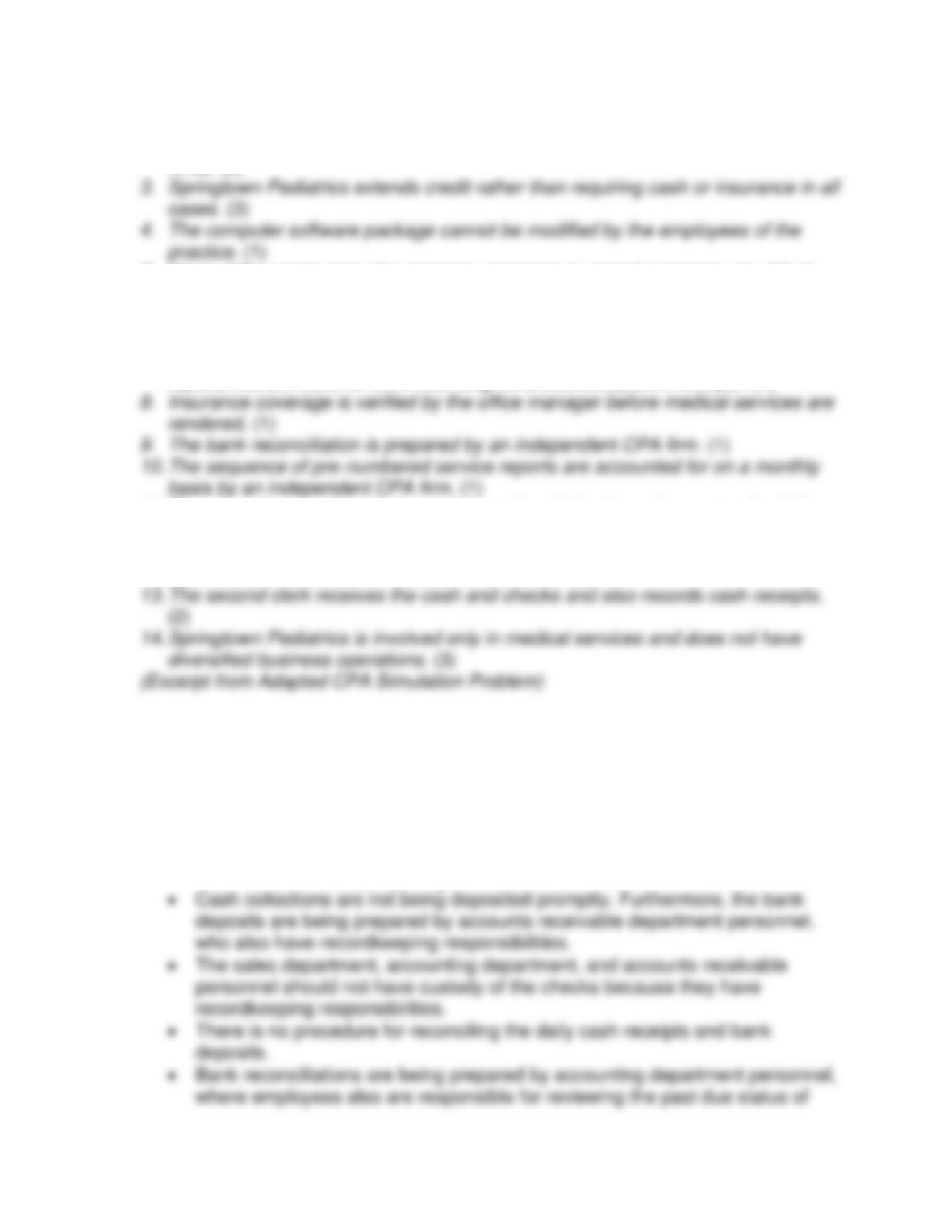
Evaluate the information in each of the following situations as being either an
internal control (1) strength, (2) weakness, or (3) not a strength or weakness.
Chapter 8 Solutions Revenue and Cash Collection Processes
Page 8-21
2. Springtown Pediatrics’ office manager may extend credit based on special
circumstances rather than using a formal credit search and established credit
limits. (2)
5. None of the employees who generate revenues or record revenues are able to
write checks. (1)
6. Computer passwords are known only by the individual employees and the
managing partner, who has no recordkeeping responsibilities. (1)
7. Individual pediatricians document the services they perform on pre-numbered
reports that are used for both recording revenues and patient receipts. (1)
11. The second accounting clerk receives cash and checks and prepares the daily
deposit. (1)
12. The second accounting clerk maintains the accounts receivable records and can
add or delete receivables information on the PC. (1)
67. Internal control weaknesses in cash receipts and sales processes at Gramiko, Inc.
a. Refer to the separate Microsoft Excel file for Chapter 8 Solutions Process Maps.
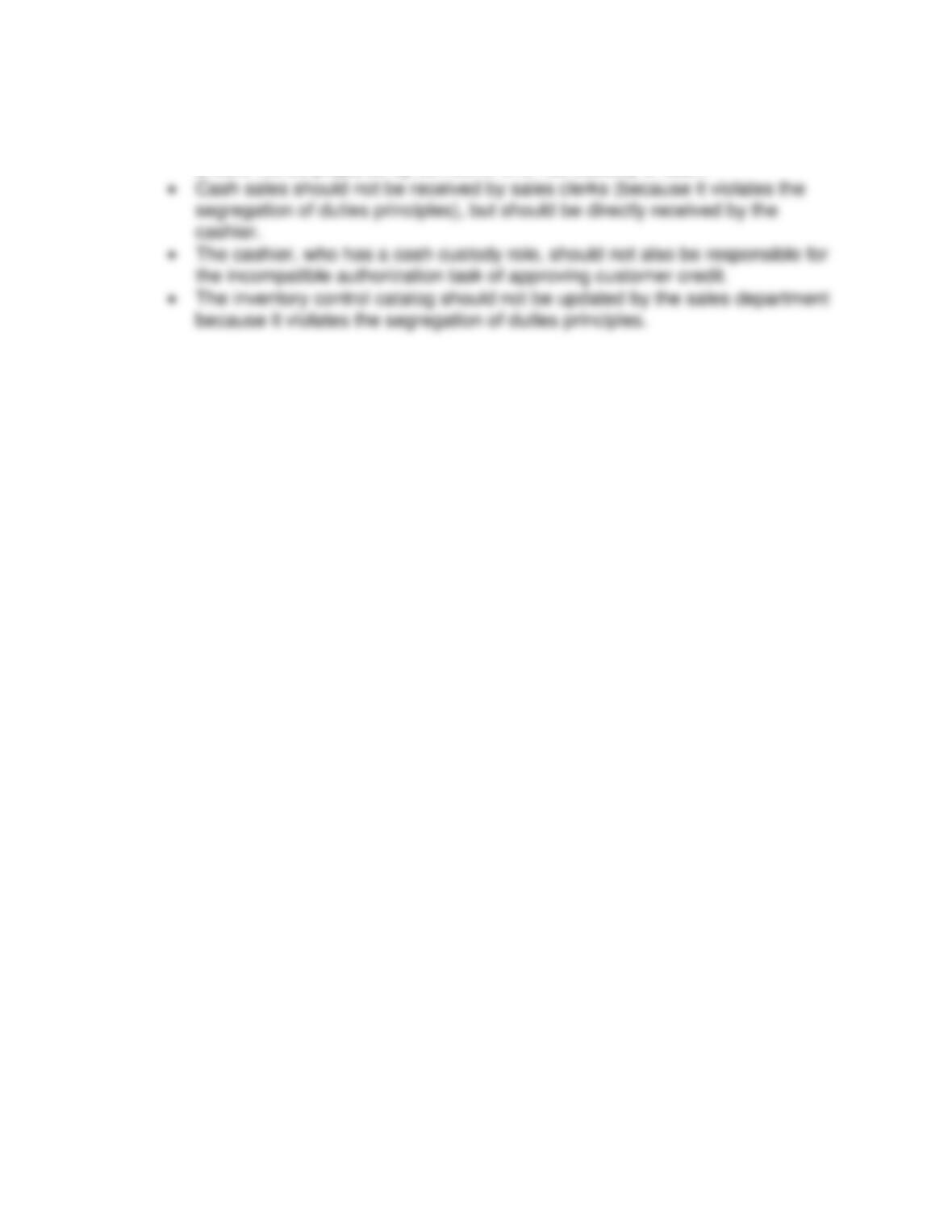
b. Internal control weaknesses:
• The mail clerk should not forward the checks and remittance advices to
departments having recordkeeping responsibilities.
• The mail clerk is not preparing a record of cash received in the mail.
Chapter 8 Solutions Revenue and Cash Collection Processes
Page 8-22
customer accounts. These employees have custody of cash for a limited
period of time, which places them in a custody role. The bank statement
should not be prepared by someone who has custody of cash.