Chapter 8: Students with Special Needs Other Than Disabilities
Chapter-At-A-Glance
Instructor’s Overview and Outline
Chapter 8 is the final chapter that addresses the characteristics and specialized instructional needs of
students with special needs. This chapter is somewhat different from Chapters 6 and 7 in that it describes
students who may or may not be eligible for services through IDEA. The groups of students discussed
include those with attention deficit hyperactivity disorder, those who are gifted and talented, students
from culturally diverse backgrounds, students who are English language learners, and students who are at-
risk, including those who live in poverty, those who have been abused or neglected, and those who live
with substance abuse. Chapter 8 also discusses the protections provided by Section 504 of the
Learning Objectives
Instructor’s Resources
Media Resources
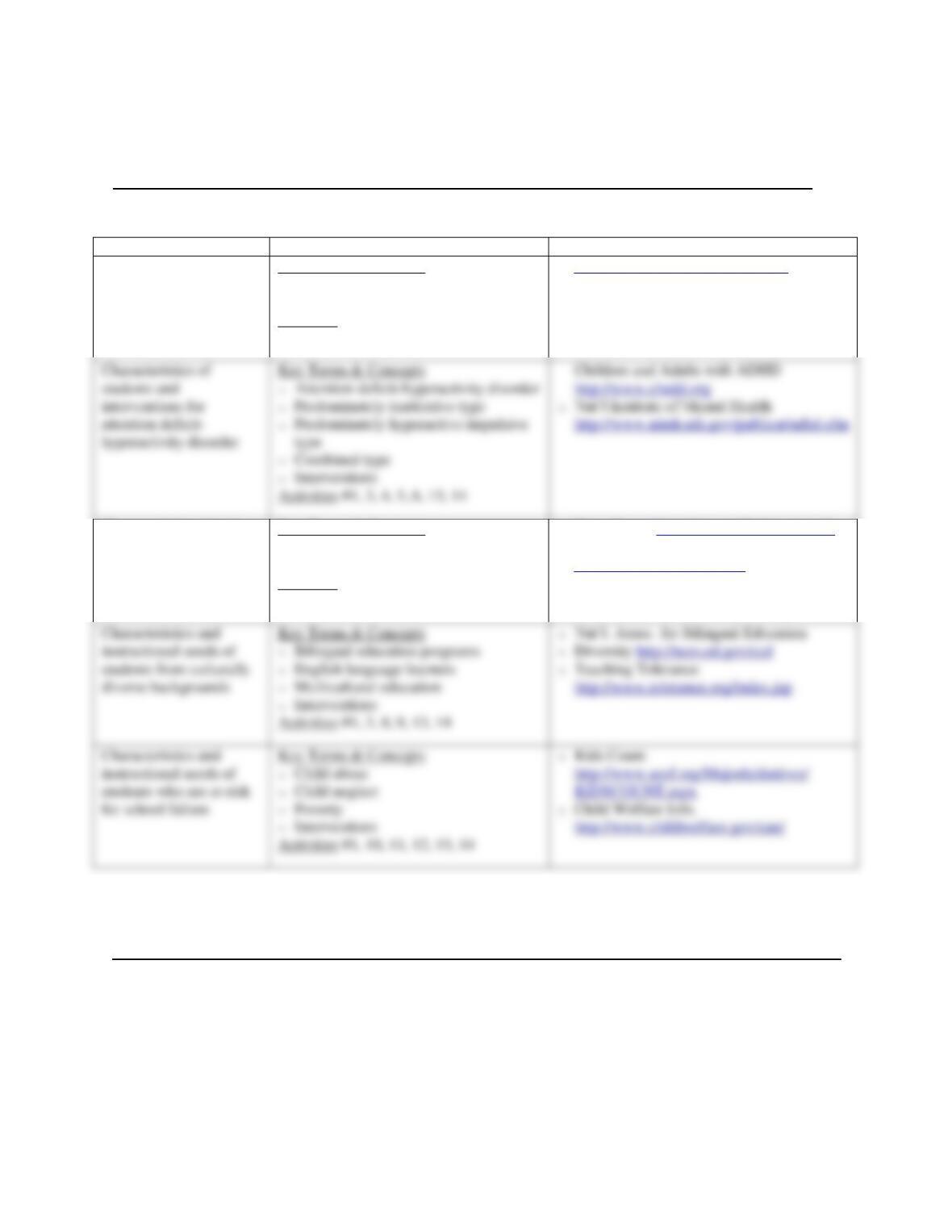
Students protected by
Section 504 and
accommodations by
general education
teachers
Key Terms & Concepts
o Section 504
o Students eligible under 504
Activities #1, 2
o http://www2.ed.gov/about/offices/
list/ocr/504faq.html
Characteristics of and
providing appropriate
instruction for students
who are gifted and
talented
Key Terms & Concepts
o Gifted and talented
o Interventions
Activities #1, 3, 7, 13, 14
o Neag Center http://www.gifted.uconn.edu
o Center for Talented Youth
o http://www.worldgifted.org
instructional needs of
students from culturally
diverse backgrounds
o Bilingual education programs
o English language learners
o Multicultural education
Activities #1, 3, 8, 9, 13, 14
o Diversity http://nces.ed.gov/ccd
o Teaching Tolerance
instructional needs of
students who are at-risk
for school failure
o Child abuse
o Child neglect
o Poverty
Activities #1, 10, 11, 12, 13, 14
o Child Welfare Info.
attention deficit-
hyperactivity disorder
o Predominately hyperactive-impulsive
type
o Combined type
Activities #1, 3, 4, 5, 6, 13, 14
Rehabilitation Act of 1973. The rationale for including these students in the text is to highlight how many
of the instructional strategies for students who are eligible to receive services under IDEA are also
appropriate and effective for students in these groups. Further, the information is intended to extend
students’ understanding of the range of diverse student needs they are likely to find in their own
classrooms.
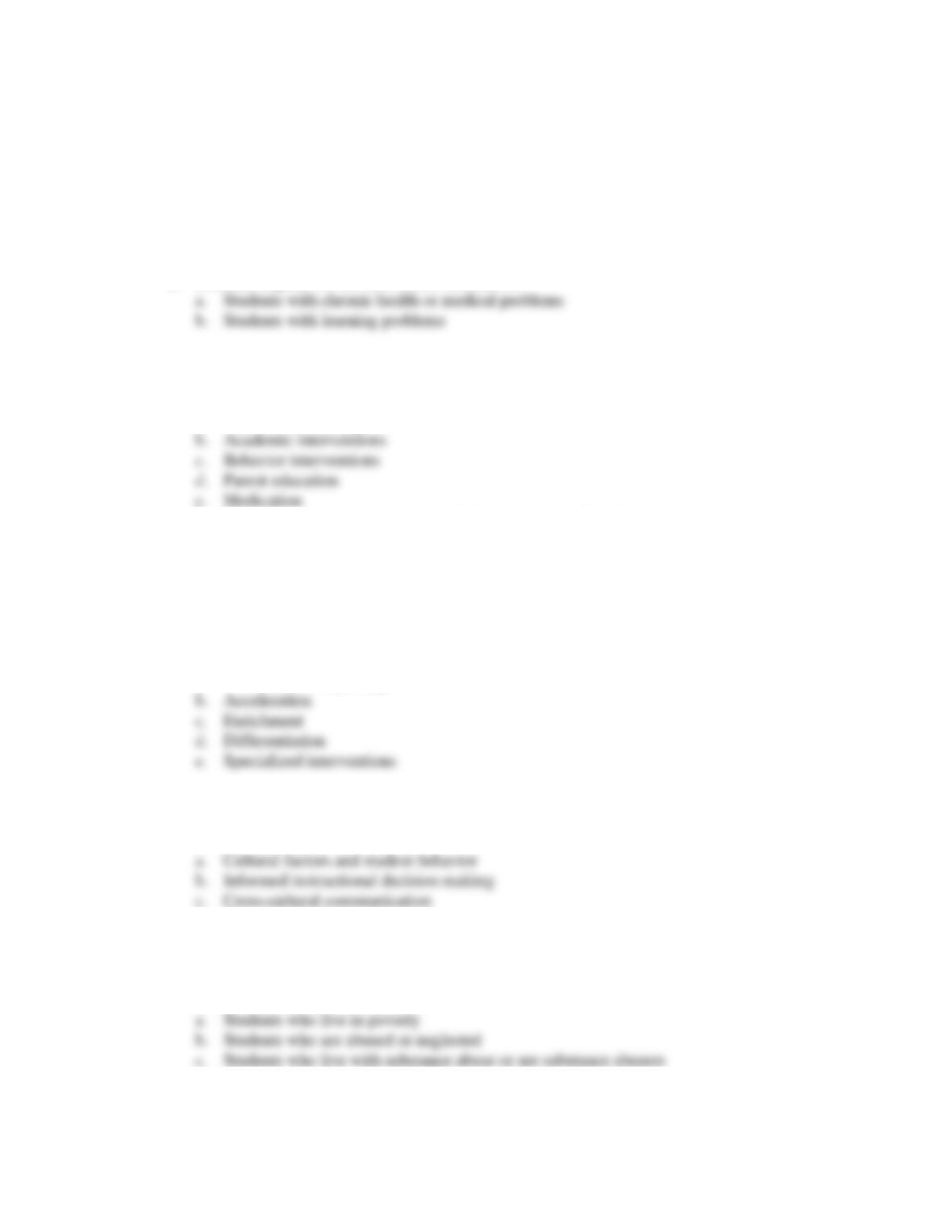
A. What are the characteristics and instructional needs of students protected by Section 504?
1. Understanding Section 504
2. Students eligible for services under Section 504
B. How can you accommodate students with attention deficit-hyperactivity disorder?
1. Characteristics and needs of students with attention deficit-hyperactivity disorder
2. Interventions for students with attention deficit-hyperactivity disorder
a. Environmental supports
3. Families of children with attention deficit-hyperactivity disorder
C. What are characteristics and instructional needs of students who are gifted and talented?
1. Characteristics and needs of students who are gifted and talented
a. Intellectual abilities and academic skills
b. Social and emotional needs
c. Behavior patterns
2. Interventions for students who are gifted and talented
a. Curriculum compacting
D. What are characteristics and instructional needs of students from culturally diverse backgrounds?
1. Diversity and special education
2. Cultural awareness
3. Families and diversity
4. Multicultural and bilingual education
E. What are characteristics and instructional needs of students who are at risk?
1. Characteristics and needs of students at risk
2. Interventions for students at risk
a. Set high but realistic expectations
F. Wrapping it up
2. Summary
Learning Objectives
1. Describe students protected by Section 504 and the accommodations for them.
2. Explain accommodations for students with attention deficit-hyperactivity disorder.
3. Outline adaptations for students who are gifted and talented.
Key Terms and Concepts
Acceleration
At risk
Attention deficit-hyperactivity disorder (ADHD)
Bilingual education programs
Child abuse
Child neglect
Combined type
Curriculum compacting
Differentiation
Activities and Discussion Questions
1. Have students contact the appropriate representative in various school districts to learn about the
2. To help students understand the differences between IDEA and Section 504 of the Rehabilitation
3. Guest speakers:
• If there is a local chapter of the organization Children and Adults with Attention Deficit
Disorder (CHADD), invite a representative and possibly an adolescent or young adult with
4. Pair students to prepare reports that explore differing points of view about issues related to ADHD.
5. The issue of medication and ADHD often raises serious ethical issues for educators. Consider
having a class discussion on these questions: How should a teacher respond if a parent asks whether
the teacher thinks the parent should ask a physician to prescribe medication for a child? What
should a teacher do if he or she believes a child would benefit from assessment for ADHD? What
should a teacher do if a student talks about not wanting to take his/her medication? Alternately,
of.
6. Arrange a class debate on the topic of medication and ADHD.
7. Have students research your state’s regulations about educating students who are gifted or talented.
8. Why is the topic of cultural diversity included in a textbook primarily about special education?
What types of diversity are most common in the schools in your region? What unique concerns and
issues are present in schools related to these diverse groups? What types of discrimination might
students from background different from the predominant local cultural group experience at school?
9. Lynch and Hanson, Developing cross-cultural competence: A guide for working with children and
their families (2011), provide a process for learning about another culture. Invite students to select a
10. Ask students to write a journal entry about their knowledge, experiences, and/or beliefs about
students who live in poverty or who have suffered from abuse or neglect. As they work with
Chapter 8, ask them to revisit their initial written response and identify misconceptions they may
11. Have students visit the KIDS COUNT website to investigate data about the children in your state.
Form small groups and ask students to report about the different data about your state.
12. Now that students have been introduced to a wide range of diversity that might characterize their
students, conclude this chapter with a discussion about inclusion as a concept with applications
13. Technology Notes 8.1 illustrated several Apps to facilitate learning. Ask students to research other
ways personal technology (e.g., podcasts, cell phones, PDAs) can be used to support and facilitate
14. INCLUDE Strategy Activity: At the end of Chapter 8, students should work with Steps 3 and 4 in
the INCLUDE strategy, if they haven’t already done so. Students may want to use the vignettes in
the chapter to practice using the INCLUDE steps for students with other special needs. The Levels
of Language Proficiency (Professional Edge 8.3) can provide useful information to help students
complete Step 2 (Note student’s learning strengths and needs) when using the INCLUDE strategy
to plan for a student who is an English language learner.
Web Links
Instructor Resources
• PowerPoint Presentation slides for this chapter are available on the Instructor Resource Center at
Web Based Content Resources
• Children and Adults with Attention-Deficit/Hyperactivity Disorder (CHADD). This organization is
Additional Readings
Brice, A. E., Miller, K. J., & Brice, R. G. (2006). Language in the English as a second language and
general education classrooms: A tutorial. Communication Disorders Quarterly, 27, 240–247.
Chamberlain, S. P (2005). Recognizing and responding to cultural differences in the education
of culturally and linguistically diverse learners. Intervention in School and Clinic, 40, 195–211.
Hart, K. C., Massetti, G. M., Fabiano, G. A., Pariseau, M. E., & Pelham, W. E. (2011). Impact of group
size on classroom on-task behavior and work productivity in children with ADHD. Journal of Emotional
and Behavioral Disorders, 19, 55–64.
Kropiva, R. J., Emick, J. E., Hipolito-Delgado, C. P., & Cameron, C. A. (2007). Do proper
accommodations make a difference? Examining the impact of improved decision making on
scores for English language learners. Educational Measurement: Issues and Practice, 26(3), 11–
20.
Lynch, E. W, & Hanson, M. J. (2011). Developing cross-cultural competence: A guide for working with
children and their families (4th ed.). Baltimore: Paul H. Brookes Publishing.
Molina, B.S.G, Hinshaw, S., Arnold, L. E., Swanson, J., Pelham, W., Hechtman, L., Hoza, B., Epstein, J.,
Wigal, T., Abikoff, H., Greenhill, L., Jensen, P., Wells, K., Vitiello, B., Gibbons, R., Howard, A.,
Houck, P., Hur, K., Bo Lu, & Marcus, S. (2013). Adolescent Substance Use in the Multimodal
Treatment Study of Attention-Deficit/Hyperactivity Disorder (ADHD) (MTA) as a Function of
Childhood ADHD, Random Assignment to Childhood Treatments, and Subsequent Medication.