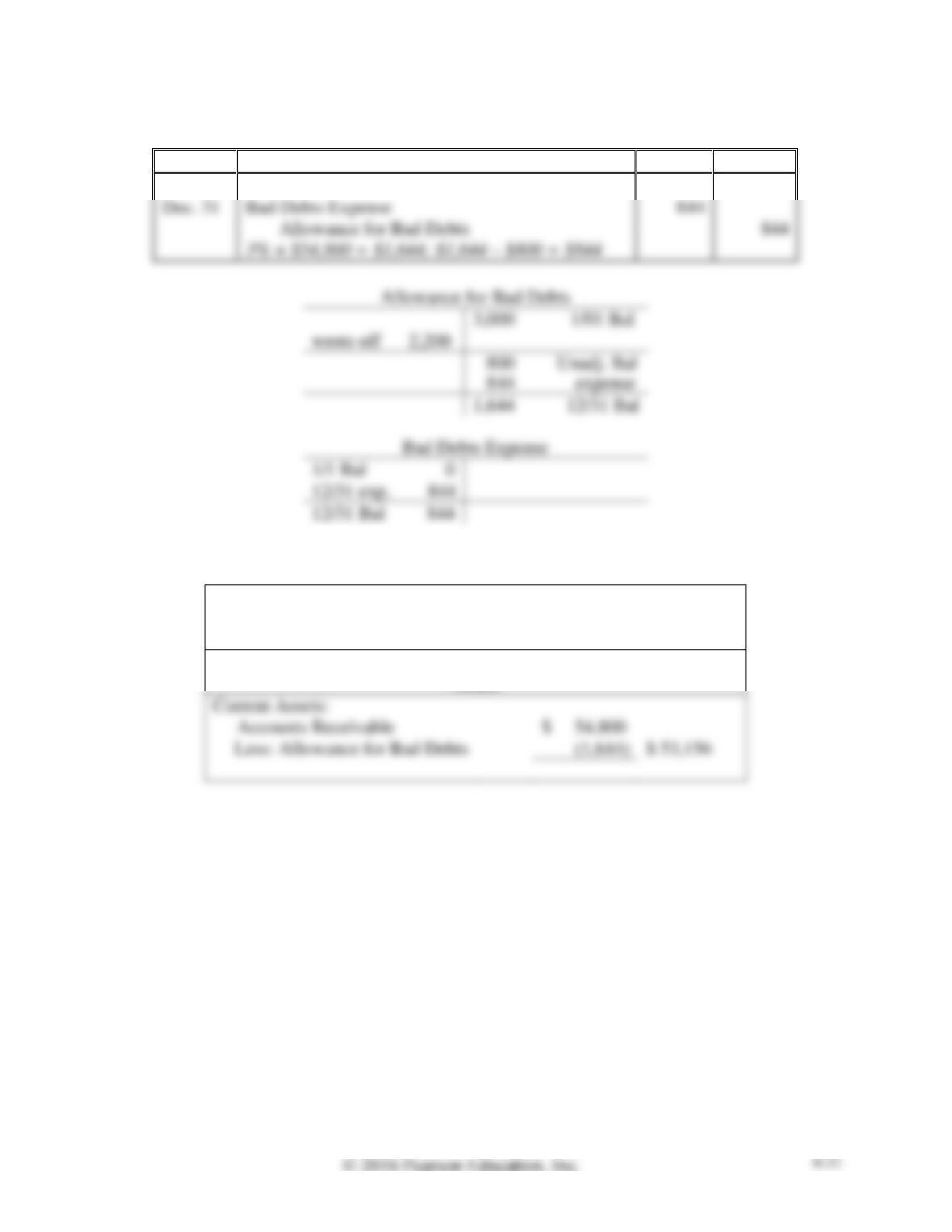
E8-18, cont.
Requirement 3
Date
Accounts and Explanation
Debit
Credit
2016
Dec. 31
Bad Debts Expense
3,000 1/01 Bal
wrote off 2,200
800 Unadj. Bal
1,644 12/31 Bal
1/1 Bal 0
12/31 exp. 844
12/31 Bal 844
Requirement 4
HILLY MOUNTAIN FLAGPOLES
Balance Sheet−Partial
December 31, 2016
Assets
Current Assets:
Accounts Receivable
$ 54,800
$ 53,156
E8-19 Accounting for uncollectible accounts using the allowance method (aging– of-receivables)
and reporting receivables on the balance sheet
Learning Objective 3
2. Allowance CR Bal. $25,100
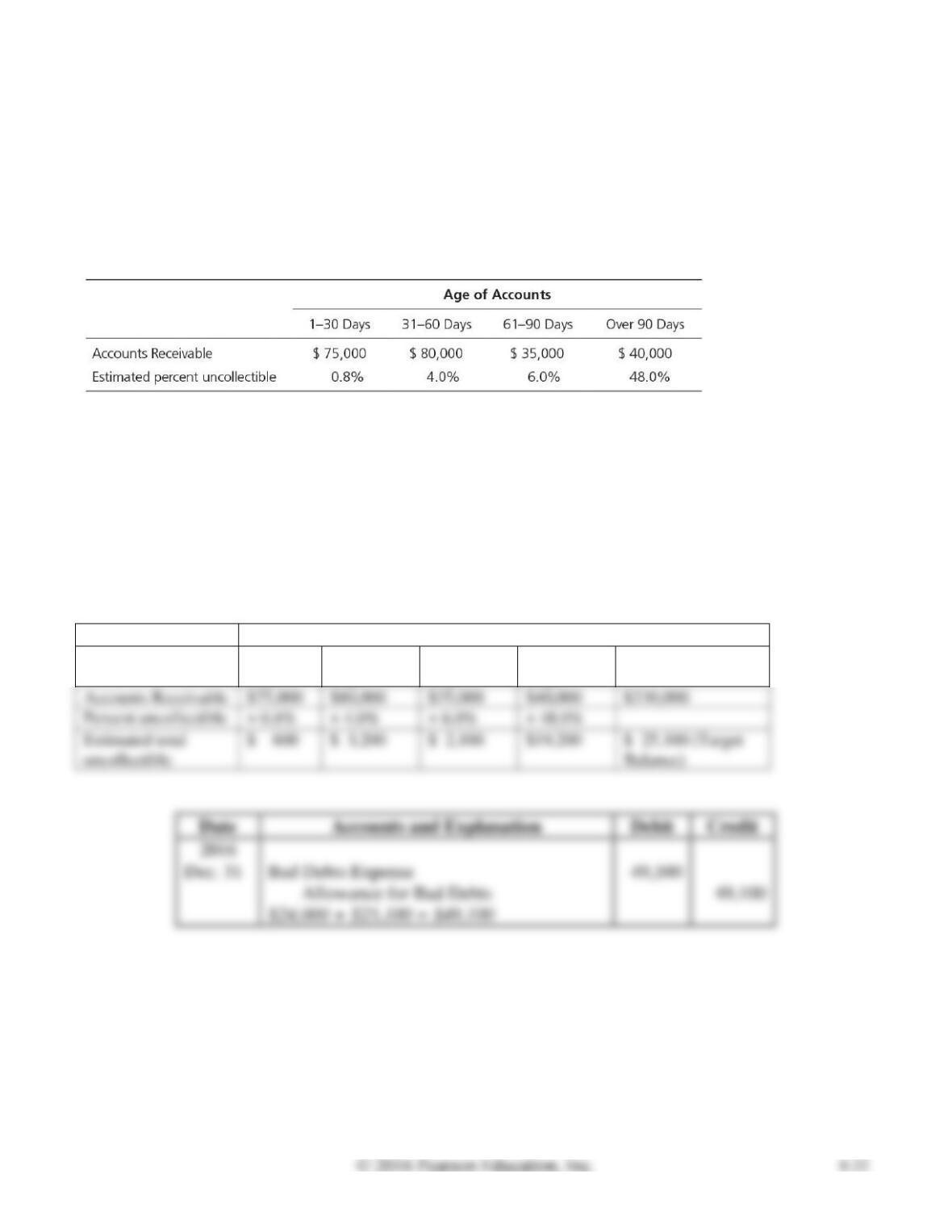
At December 31, 2016, the Accounts Receivable balance of TM Manufacturer is $230,000. The
Allowance for Bad Debts account has a $24,000 debit balance. TM Manufacturer prepares the following
aging schedule for its accounts receivable:
Requirements
1. Journalize the year-end adjusting entry for bad debts on the basis of the aging schedule. Show the T-
account for the Allowance for Bad Debts at December 31, 2016.
2. Show how TM Manufacturer will report its net accounts receivable on its December 31, 2016,
balance sheet.
SOLUTION
Requirement 1
Age of Accounts Receivable
1 – 30
Days
31 – 60
Days
61 – 90
Days
Over 90
Days
Total Receivables
$75,000
$80,000
$35,000
$40,000
$230,000
Dec. 31
Bad Debts Expense
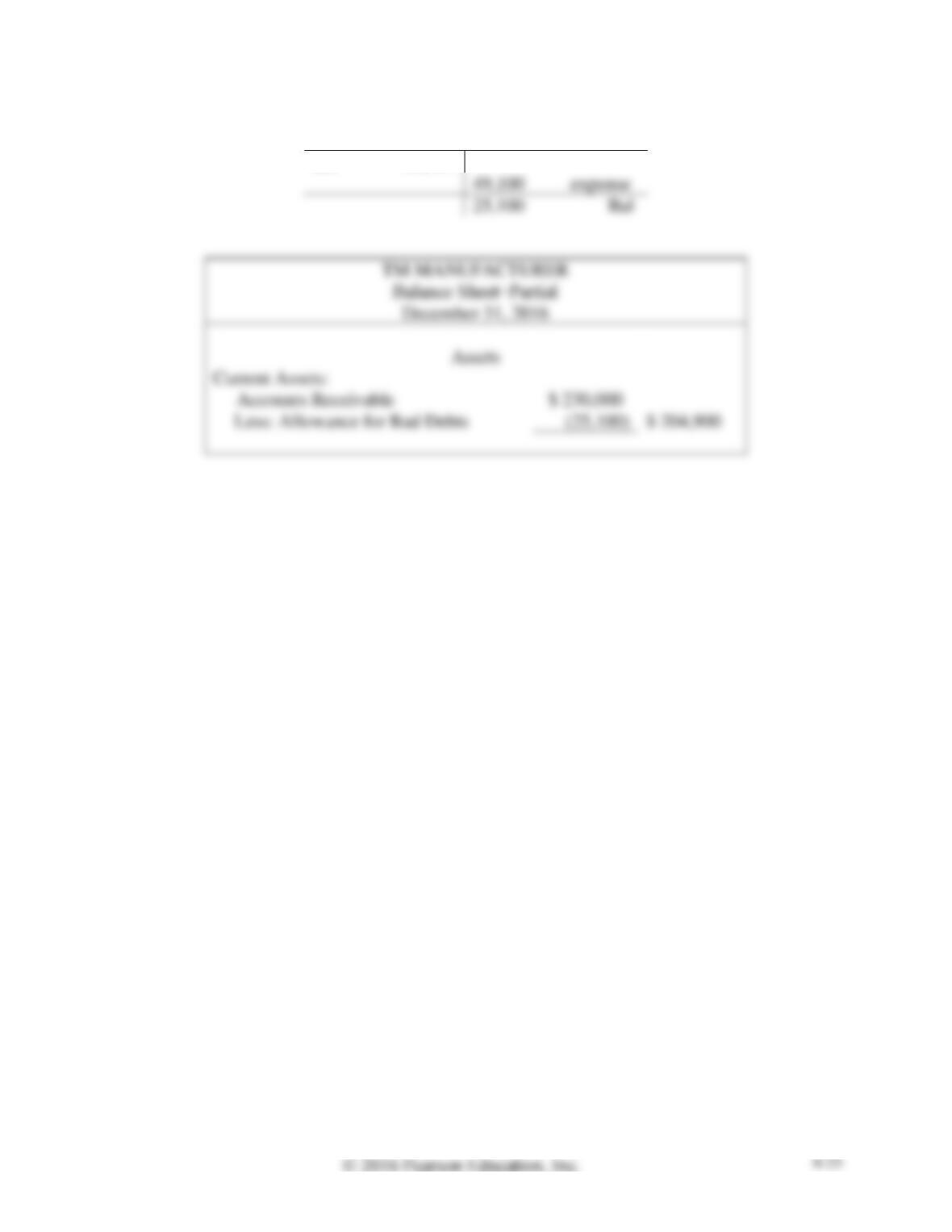
Requirement 2
Current Assets:
Accounts Receivable
$ 204,900
49,100 expense
25,100 Bal
Allowance for Bad Debts
Bal 24,000
E8-20 Journalizing transactions using the direct write-off method versus the allowance method
Learning Objectives 1, 2, 3
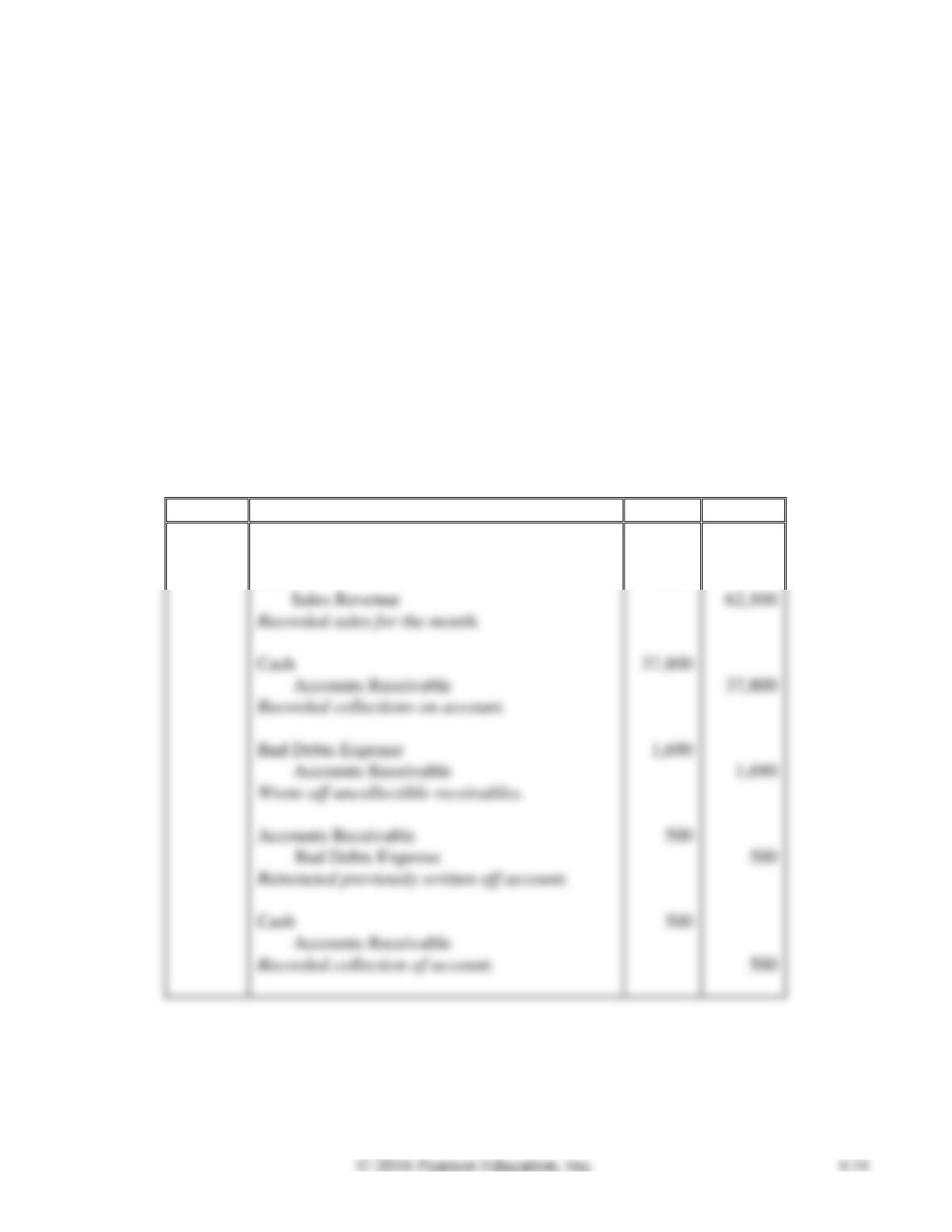
During August 2016, Ritter Company recorded the following:
• Sales of $62,100 ($55,000 on account; $7,100 for cash). Ignore Cost of Goods Sold.
• Collections on account, $37,800.
• Write-offs of uncollectible receivables, $1,690.
• Recovery of receivable previously written off, $500.
Requirements
1. Journalize Ritter’s transactions during August 2016, assuming Ritter uses the direct write-off
method.
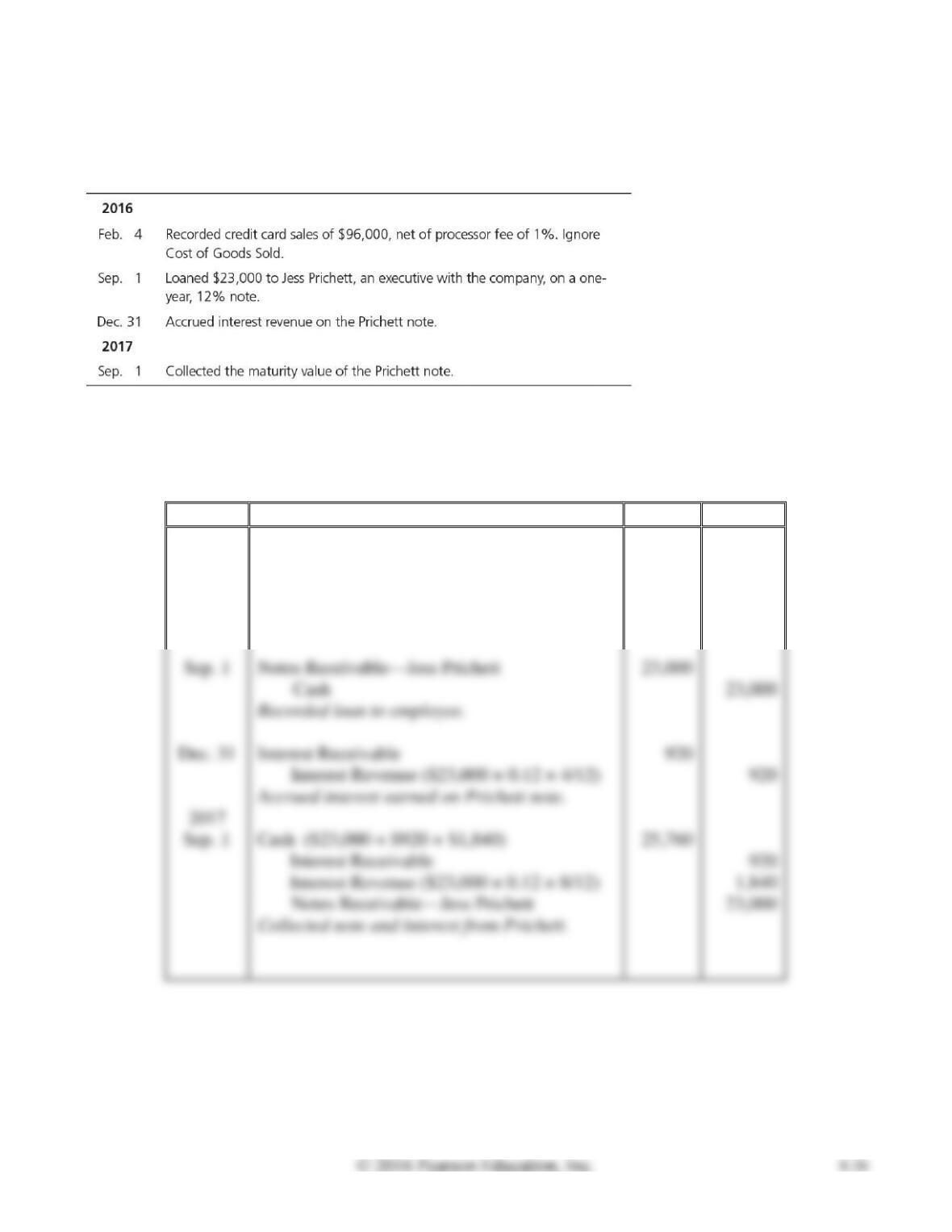
2. Journalize Ritter’s transactions during August 2016, assuming Ritter uses the allowance method.
SOLUTION
Requirement 1
Date
Accounts and Explanation
Debit
Credit
2016
Aug.
Accounts Receivable
55,000
Cash
7,100
Sales Revenue
Cash
37,800
Bad Debts Expense
1,690
Accounts Receivable
Bad Debts Expense
Cash
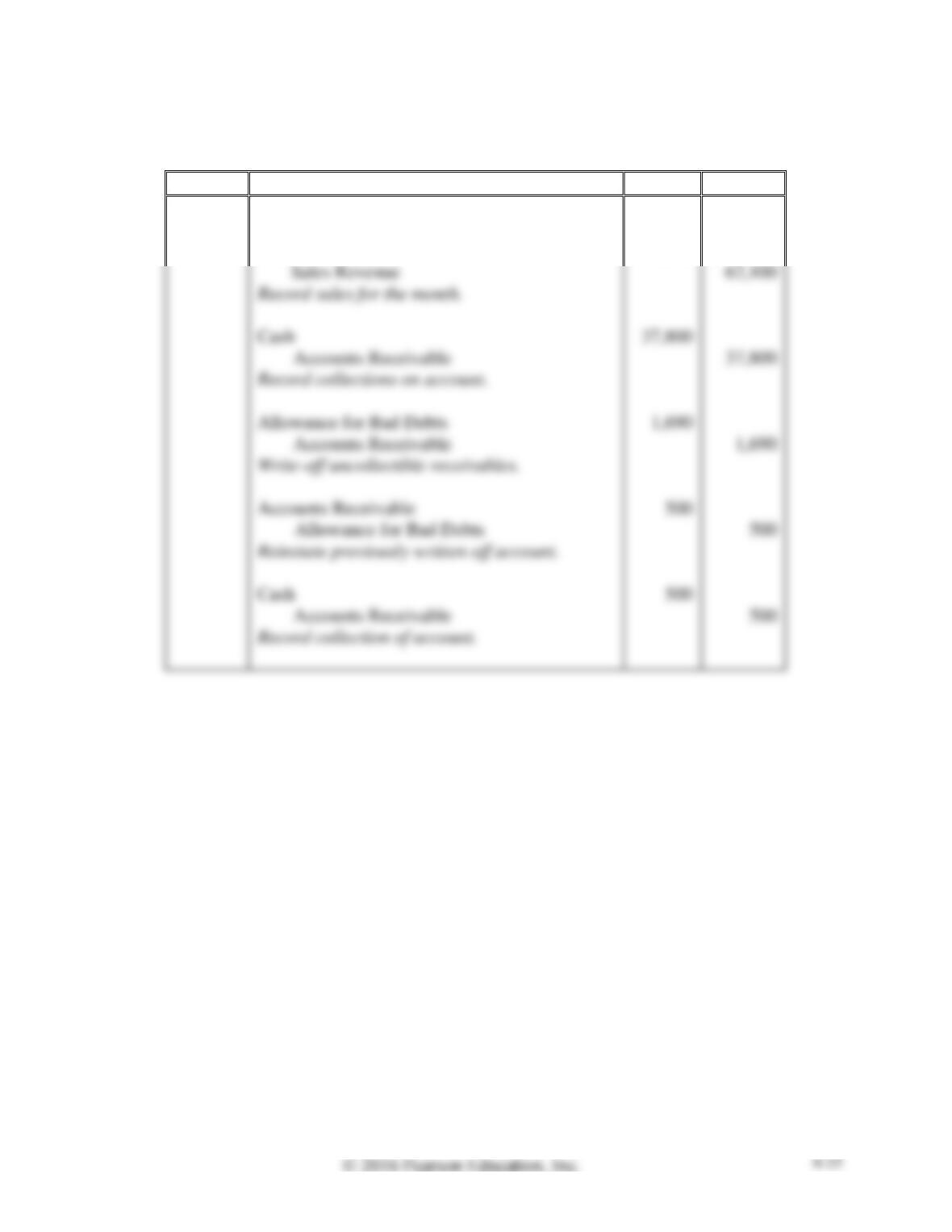
E8-20, cont.
Requirement 2
Date
Accounts and Explanation
Debit
Credit
2016
Aug.
Accounts Receivable
55,000
Cash
7,100
Sales Revenue
Cash
37,800
Allowance for Bad Debts
1,690
Accounts Receivable
Allowance for Bad Debts
Cash
E8-21 Journalizing credit card sales, note receivable transactions, and accruing interest
Learning Objectives 1, 4
Marathon Running Shoes reports the following:
Journalize all entries required for Marathon Running Shoes.
SOLUTION
Date
Accounts and Explanation
Debit
Credit
2016
Feb 4
Cash
95,040
Credit Card Expense ($96,000 × 0.01)
960
Sales Revenue
96,000
Recorded sales for the month.
Sep. 1
Notes Receivable—Jess Prichett
23,000
23,000
Recorded loan to employee.
Interest Receivable
920
Interest Revenue ($23,000 × 0.12 × 4/12)
2017
Sep. 1
Cash ($23,000 + $920 + $1,840)
25,760
Interest Receivable

E8-22 Journalizing note receivable transactions including a dishonored note
Learning Objective 4
On September 30, 2016, Regal Bank loaned $92,000 to Kim Warner on a one-year, 6% note. Regal’s
fiscal year ends on December 31.
Requirements
1. Journalize all entries for Regal Bank related to the note for 2016 and 2017.
2. Which party has a
a. note receivable?
b. note payable?
c. interest revenue?
d. interest expense?
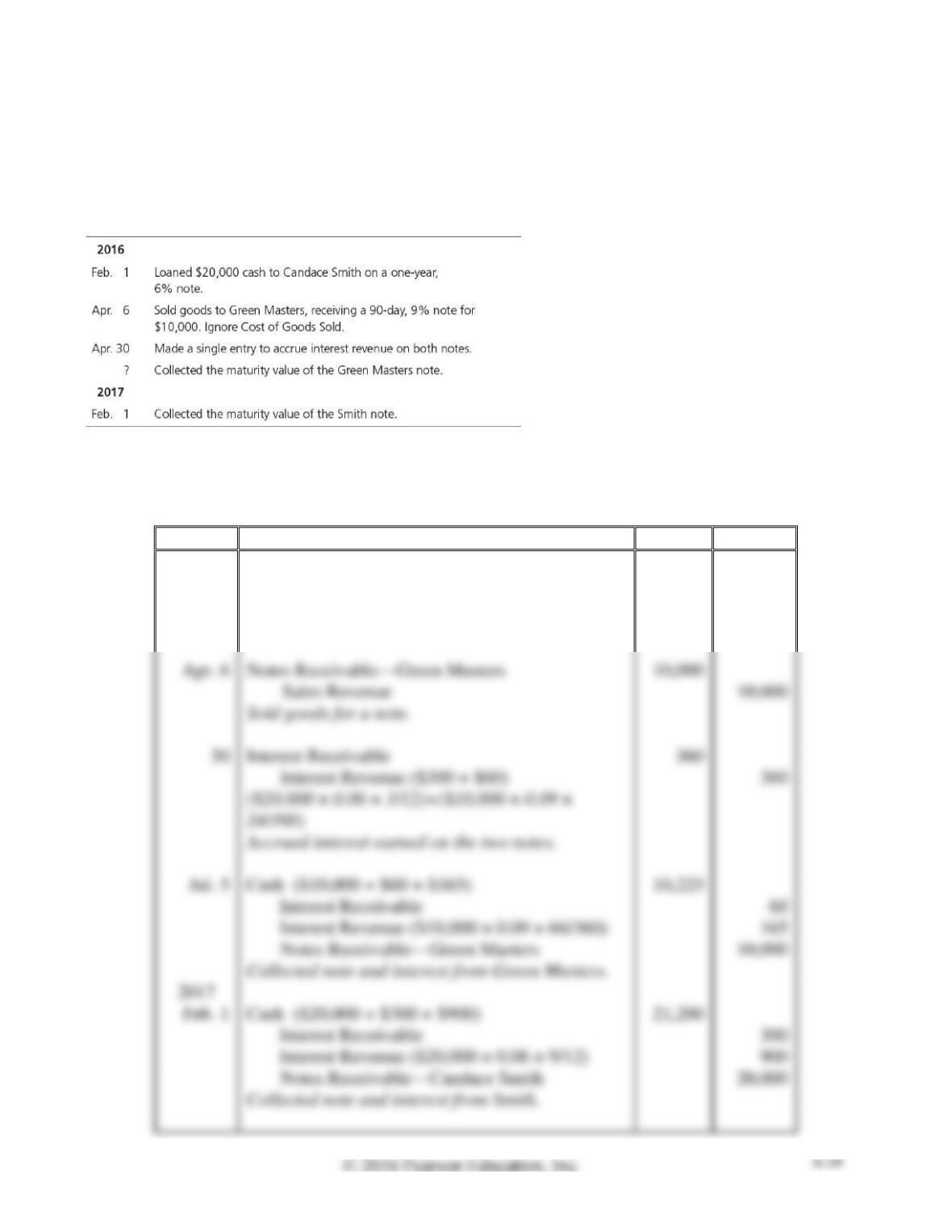
3. Suppose that Kim Warner defaulted on the note. What entry would Regal record for the dishonored
note?
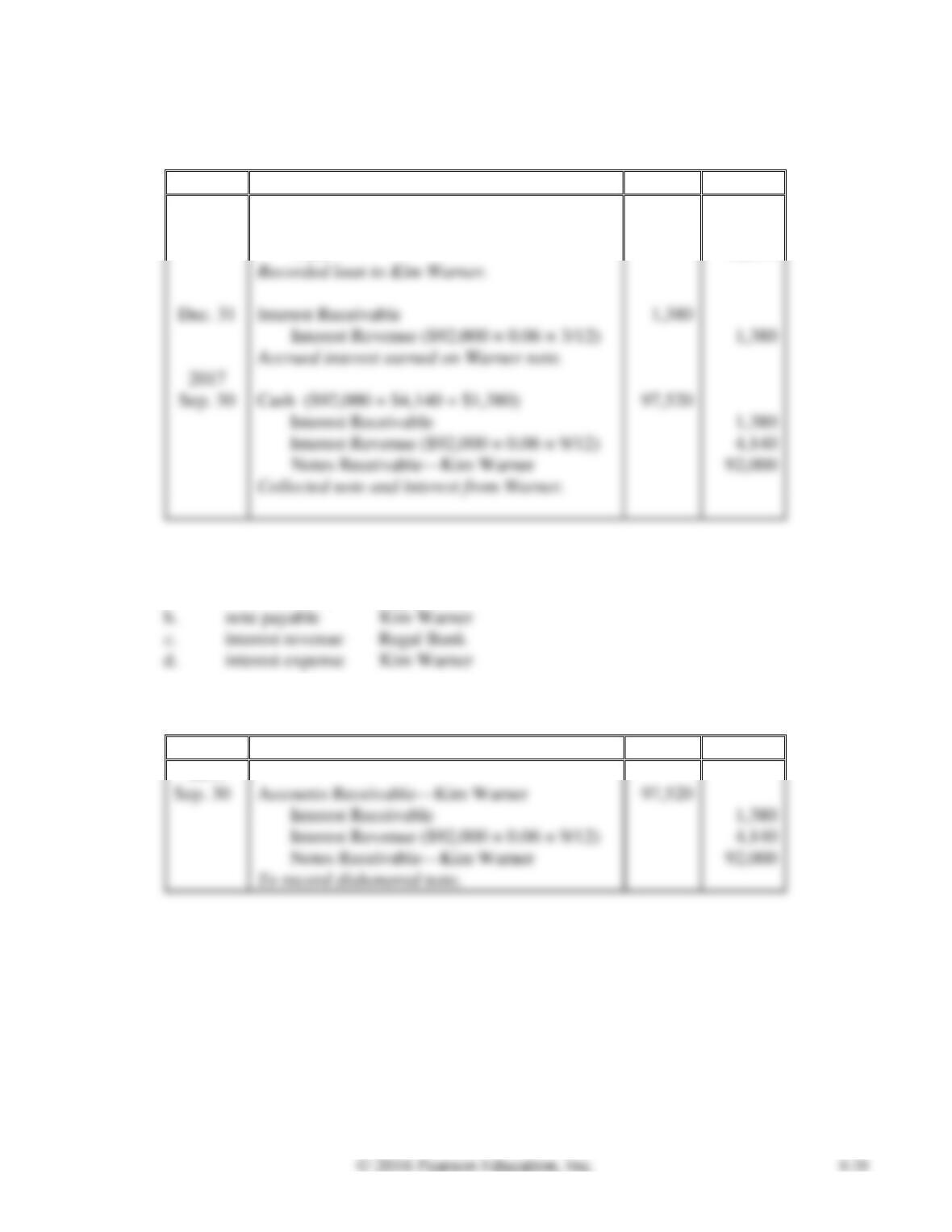
SOLUTION
Requirement 1
Date
Accounts and Explanation
Debit
Credit
2016
Sep. 30
Notes Receivable—Kim Warner
92,000
Cash
92,000
Interest Receivable
Interest Revenue ($92,000 × 0.06 × 3/12)
2017
Sep. 30
Cash ($92,000 + $4,140 + $1,380)
97,520
Interest Receivable
92,000
Requirement 2
a.
note receivable
Regal Bank
note payable
Kim Warner
c.
interest revenue
Regal Bank
interest expense
Requirement 3
Date
Accounts and Explanation
Debit
Credit
2017
Sep. 30
Accounts Receivable—Kim Warner
Interest Receivable
92,000
E8-23 Journalizing note receivable transactions
Learning Objective 4
Feb. 1, 2017 Cash DR $21,200
The following selected transactions occurred during 2016 and 2017 for Mediterranean Importers. The
company ends its accounting year on April 30.
Journalize all required entries. Make sure to determine the missing maturity date.
SOLUTION
Date
Accounts and Explanation
Debit
Credit
2016
Feb. 1
Notes Receivable—Candace Smith
20,000
Cash
20,000
Recorded loan to Candace Smith.
Notes Receivable—Green Masters
10,000
Sales Revenue
10,000
Interest Receivable
Cash ($10,000 + $60 + $165)
10,225
Interest Receivable
10,000
2017
Feb. 1
Cash ($20,000 + $300 + $900)
21,200
Interest Receivable
E8-24 Journalizing note receivable transactions
Learning Objective 4
Oct. 31 Cash DR $24,240
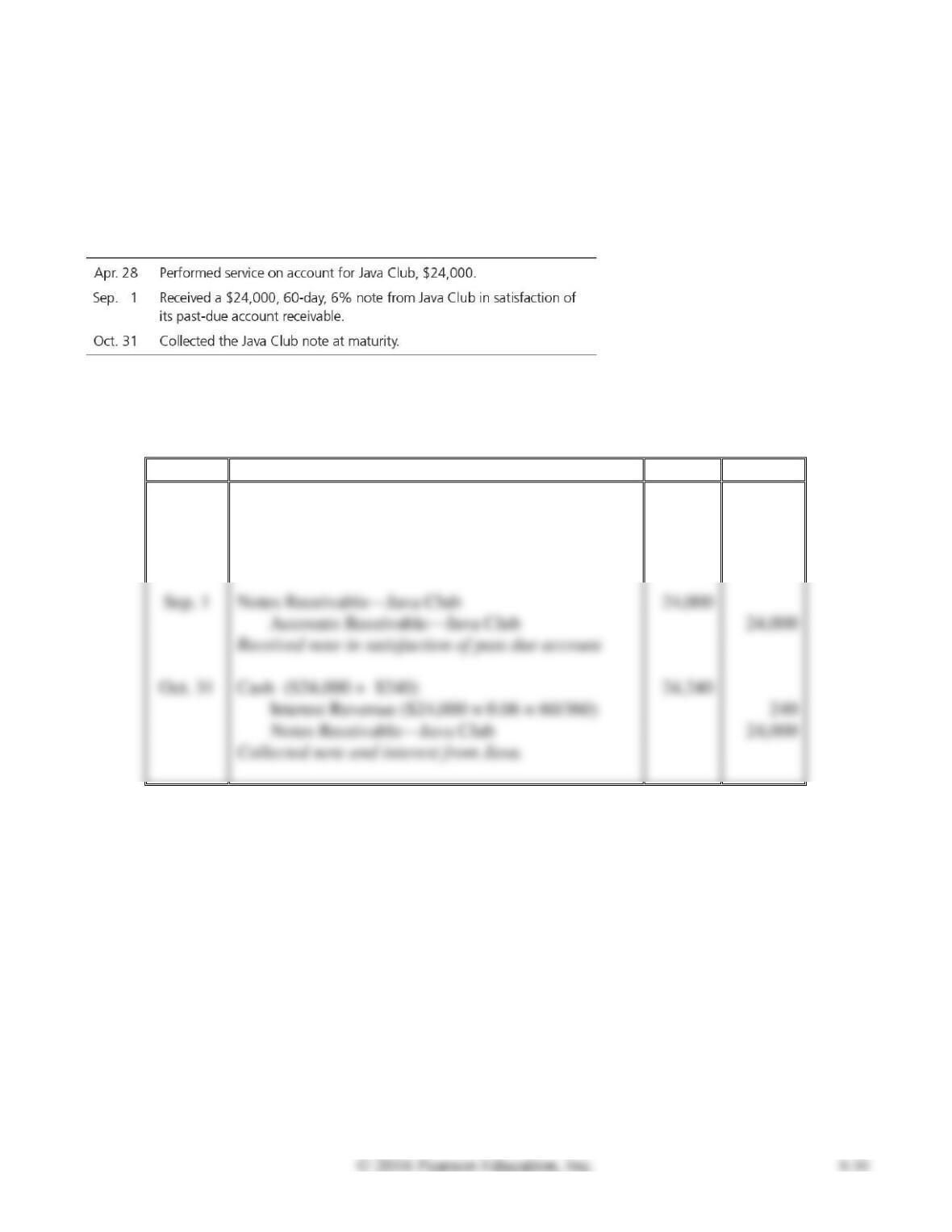
Like New Steam Cleaning performs services on account. When a customer account becomes four
months old, Like New converts the account to a note receivable. During 2016, the company completed
the following transactions:
Record the transactions in Like New’s journal.
SOLUTION
Date
Accounts and Explanation
Debit
Credit
2016
Apr. 28
Accounts Receivable—Java Club
24,000
Service Revenue
24,000
Performed services on account.
Sep. 1
Notes Receivable—Java Club
24,000
Accounts Receivable—Java Club
24,000
Received note in satisfaction of past due account
Cash ($24,000 + $240)
24,240
24,000
Collected note and interest from Java.
E8-25 Evaluating ratio data
Learning Objective 5
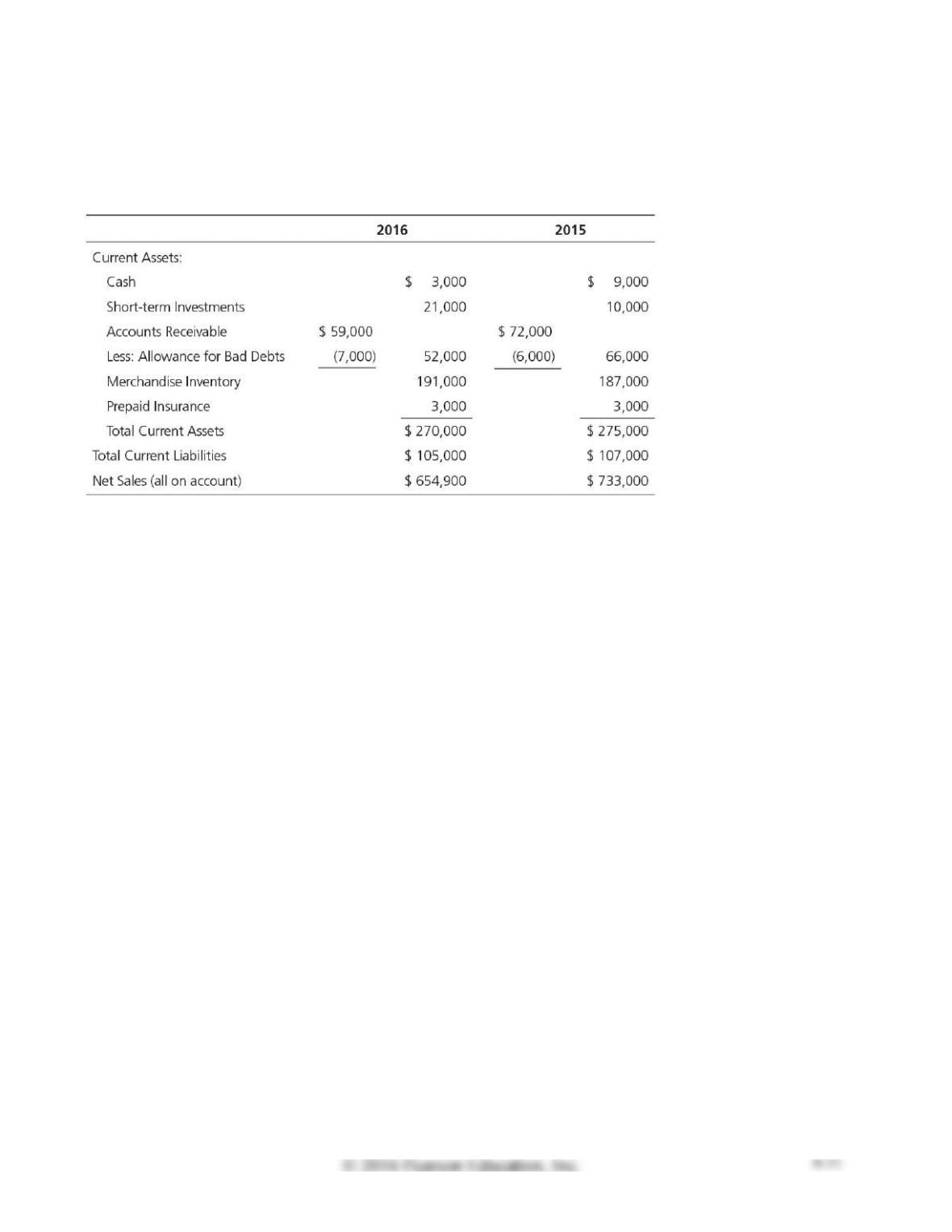
Chippewa Carpets reported the following amounts in its 2016 financial statements. The 2015 figures are
given for comparison.
Requirements
1. Calculate Chippewa’s acid-test ratio for 2016. (Round to two decimals.) Determine whether
Chippewa’s acid–test ratio improved or deteriorated from 2015 to 2016. How does Chippewa’s acid–
test ratio compare with the industry average of 0.80?
2. Calculate Chippewa’s accounts receivable turnover ratio. (Round to two decimals.) How does
Chippewa’s ratio compare to the industry average accounts receivable turnover of 10?
3. Calculate the days’ sales in receivables for 2016. (Round to the nearest day.) How do the results
compare with Chippewa’s credit terms of net 30?
SOLUTION
Requirement 1
Acid-test ratio = (Cash including cash equivalents + Short-term investments + Net current
Requirement 2
Accounts receivable turnover ratio = Net credit sales / Average net accounts receivable
2016
Requirement 3
Days’ sales in receivables = 365 days / Accounts receivable turnover ratio
E8-26 Computing the collection period for receivables
Learning Objective 5
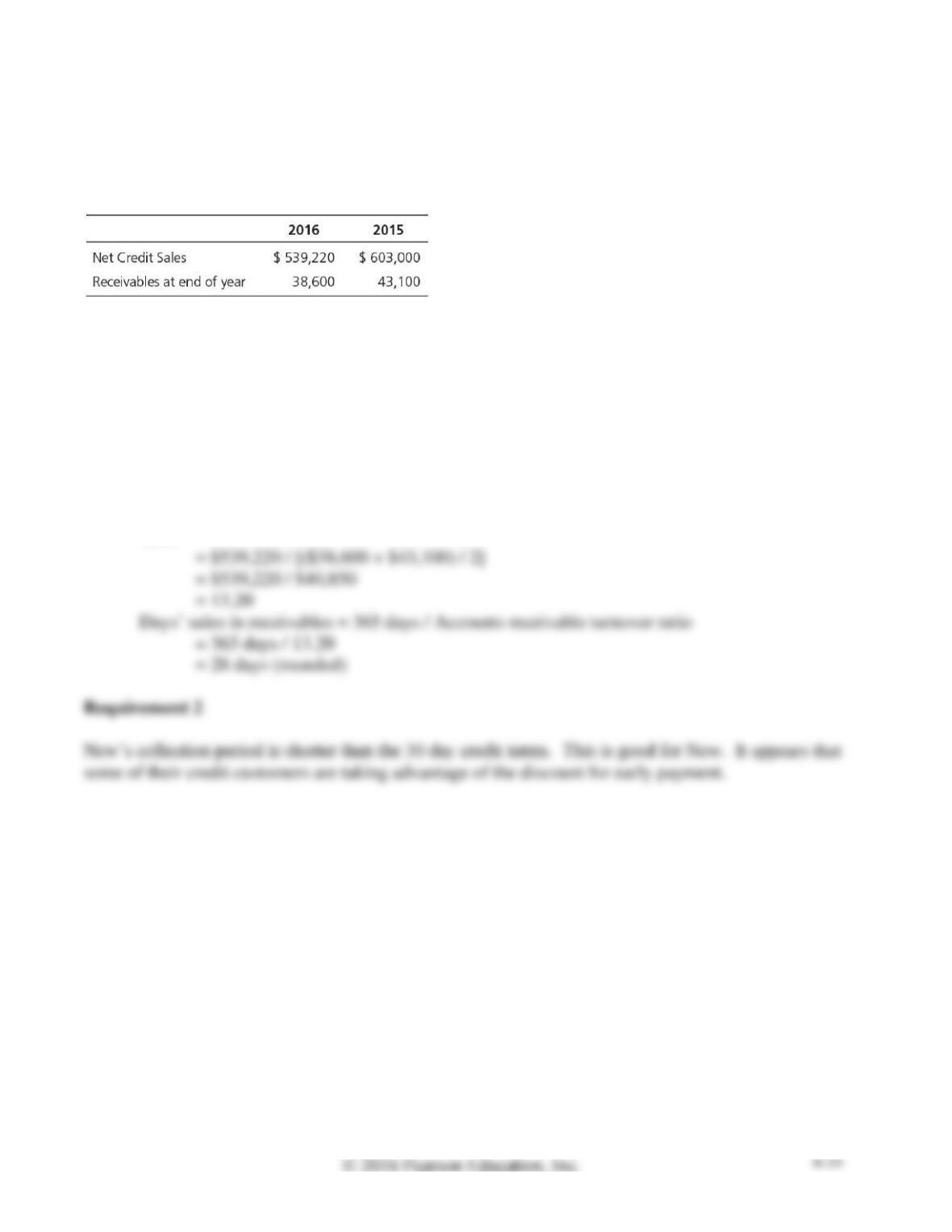
New Media Sign Incorporated sells on account. Recently, New reported the following
figures:
Requirements
1. Compute New’s days’ sales in receivables for 2016. (Round to the nearest day.)
2. Suppose New’s normal credit terms for a sale on account are “2/10, net 30.” How well does New’s
collection period compare to the company’s credit terms? Is this good or bad for New?
SOLUTION
Requirement 1
Accounts receivable turnover ratio = Net credit sales / Average net accounts receivables
2016

Problems (Group A)
P8-27A Accounting for uncollectible accounts using the allowance (percent-of-sales) and direct
write-off methods and reporting receivables on the balance sheet
Learning Objectives 1, 2, 3
1. Bad Debts Expense $5,400
On August 31, 2016, Lily Floral Supply had a $145,000 debit balance in Accounts Receivable and a
$5,800 credit balance in Allowance for Bad Debts. During September, Lily made
• Sales on account, $540,000. Ignore Cost of Goods Sold.
• Collections on account, $581,000.
• Write-offs of uncollectible receivables, $5,000.
Requirements
1. Journalize all September entries using the allowance method. Bad debts expense was estimated at
1% of credit sales. Show all September activity in Accounts Receivable, Allowance for Bad Debts,
and Bad Debts Expense (post to these T-accounts).
2. Using the same facts, assume that Lily used the direct write-off method to account for uncollectible
receivables. Journalize all September entries using the direct write-off method. Post to Accounts
Receivable and Bad Debts Expense, and show their balances at September 30, 2016.
3. What amount of Bad Debts Expense would Lily report on its September income statement under
each of the two methods? Which amount better matches expense with revenue? Give your reason.
4. What amount of net accounts receivable would Lily report on its September 30, 2016, balance sheet
under each of the two methods? Which amount is more realistic? Give your reason.
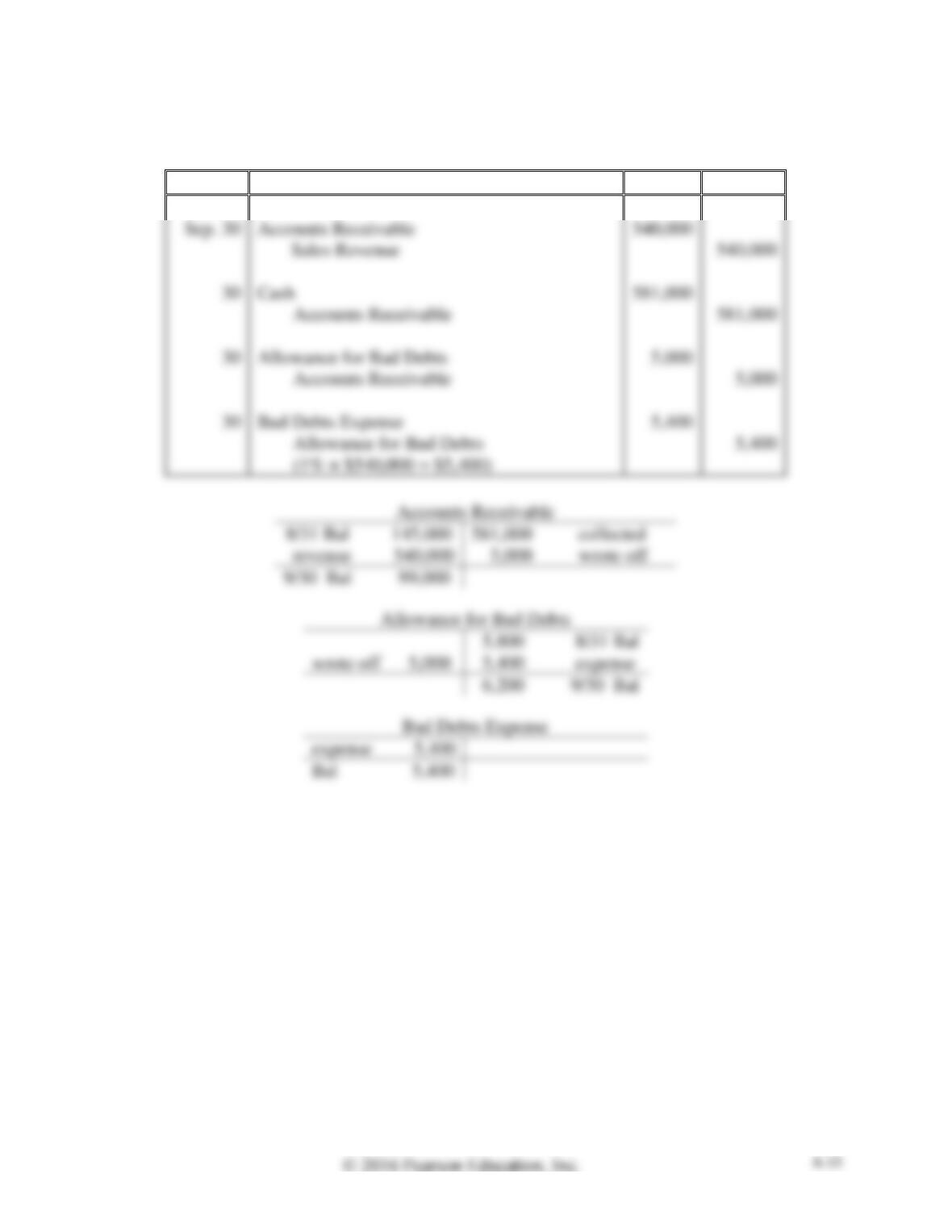
SOLUTION
Requirement 1
Date
Accounts and Explanation
Debit
Credit
2016
Accounts Receivable
540,000
Cash
581,000
Allowance for Bad Debts
Bad Debts Expense
581,000 collected
5,000 wrote off
5,400 expense
6,200 9/30 Bal
P8-27A, cont.
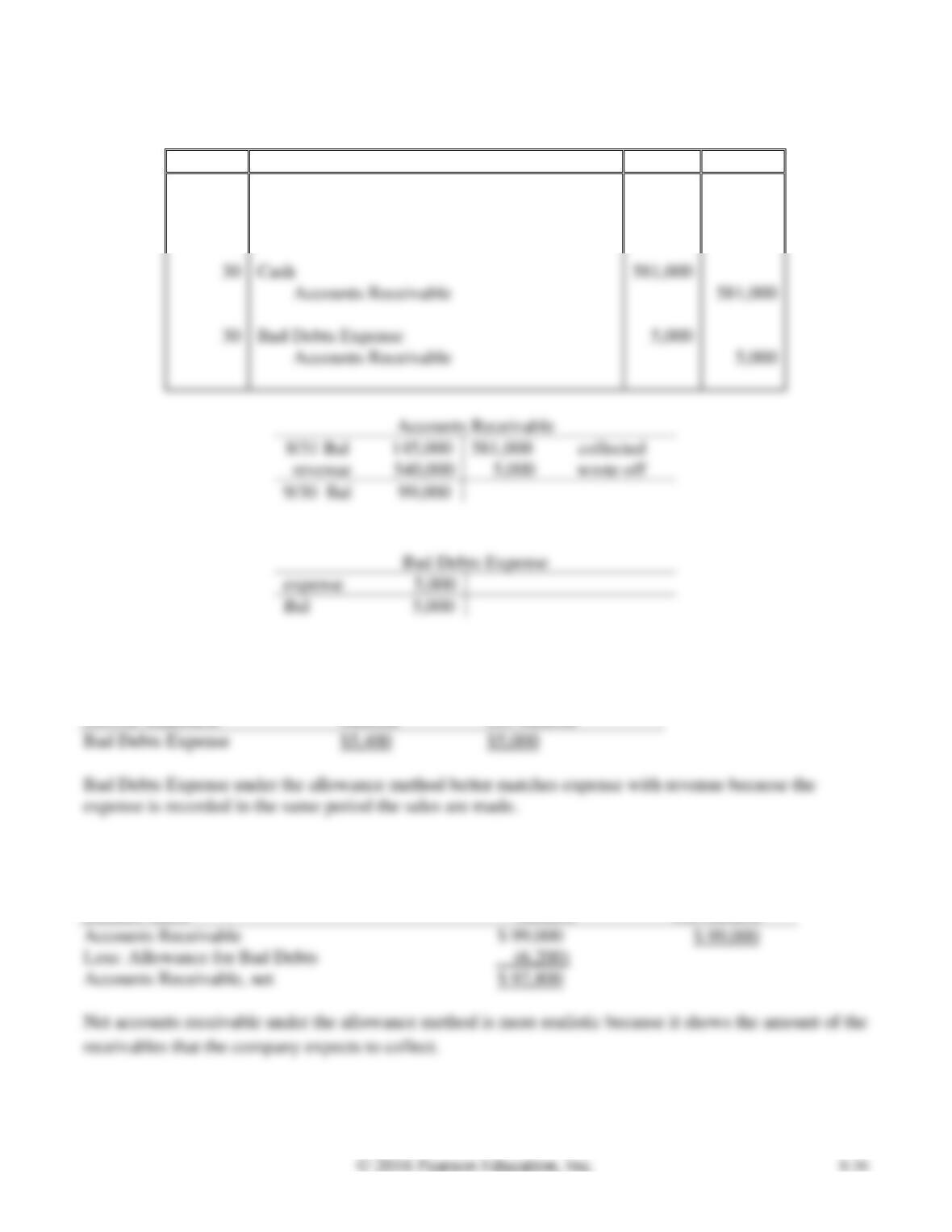
Requirement 2
Date
Accounts and Explanation
Debit
Credit
2016
Sep. 30
Accounts Receivable
540,000
Sales Revenue
540,000
Cash
581,000
581,000
Bad Debts Expense
581,000 collected
Requirement 3
Income Statement
Allowance
Method
Direct Write-
Off Method
Bad Debts Expense
$5,400
$5,000
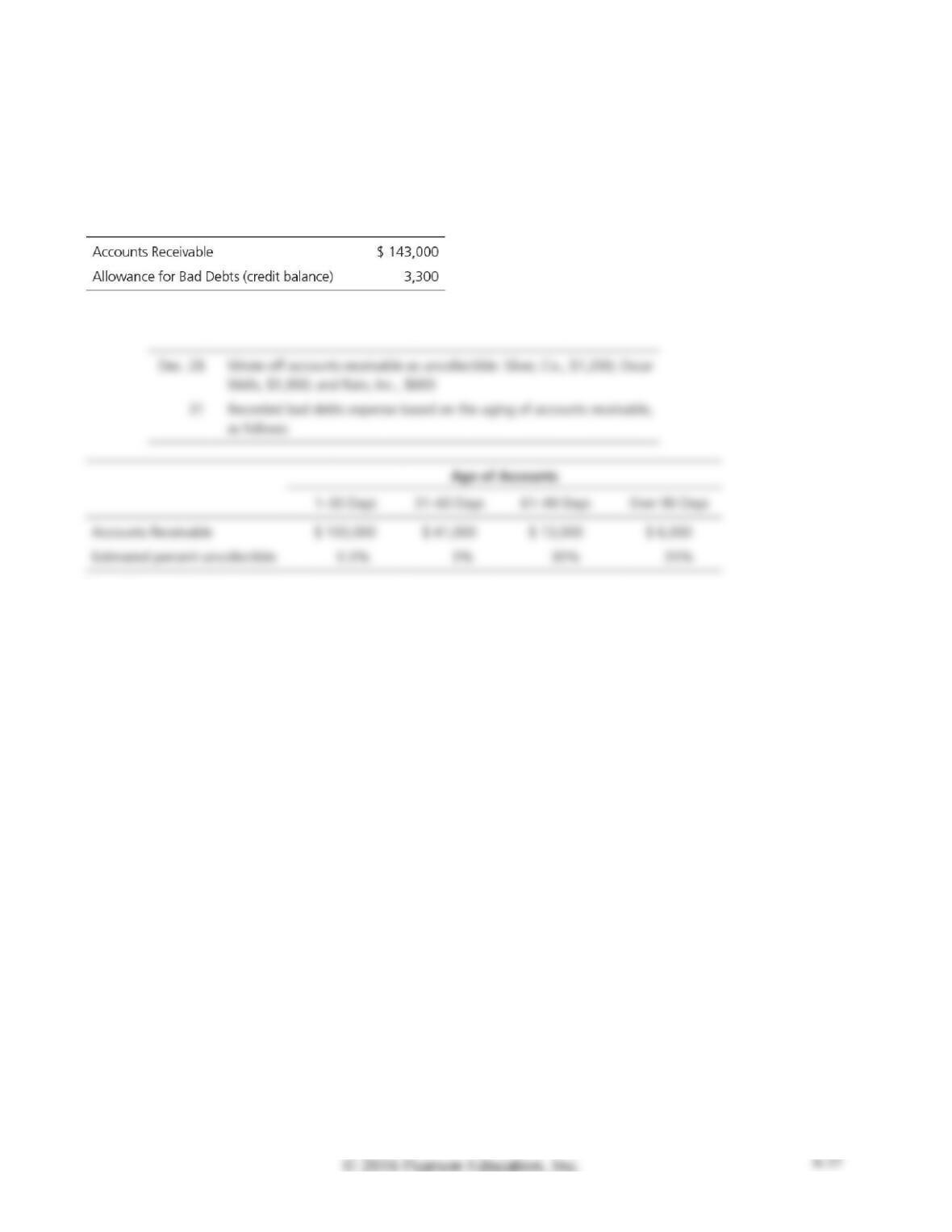
Requirement 4
Balance Sheet
Allowance
Method
Direct Write-
Off Method
Accounts Receivable
Less: Allowance for Bad Debts
(6,200)
Accounts Receivable, net
P8-28A Accounting for uncollectible accounts using the allowance method (aging-of-receivables)
and reporting receivables on the balance sheet
Learning Objective 3
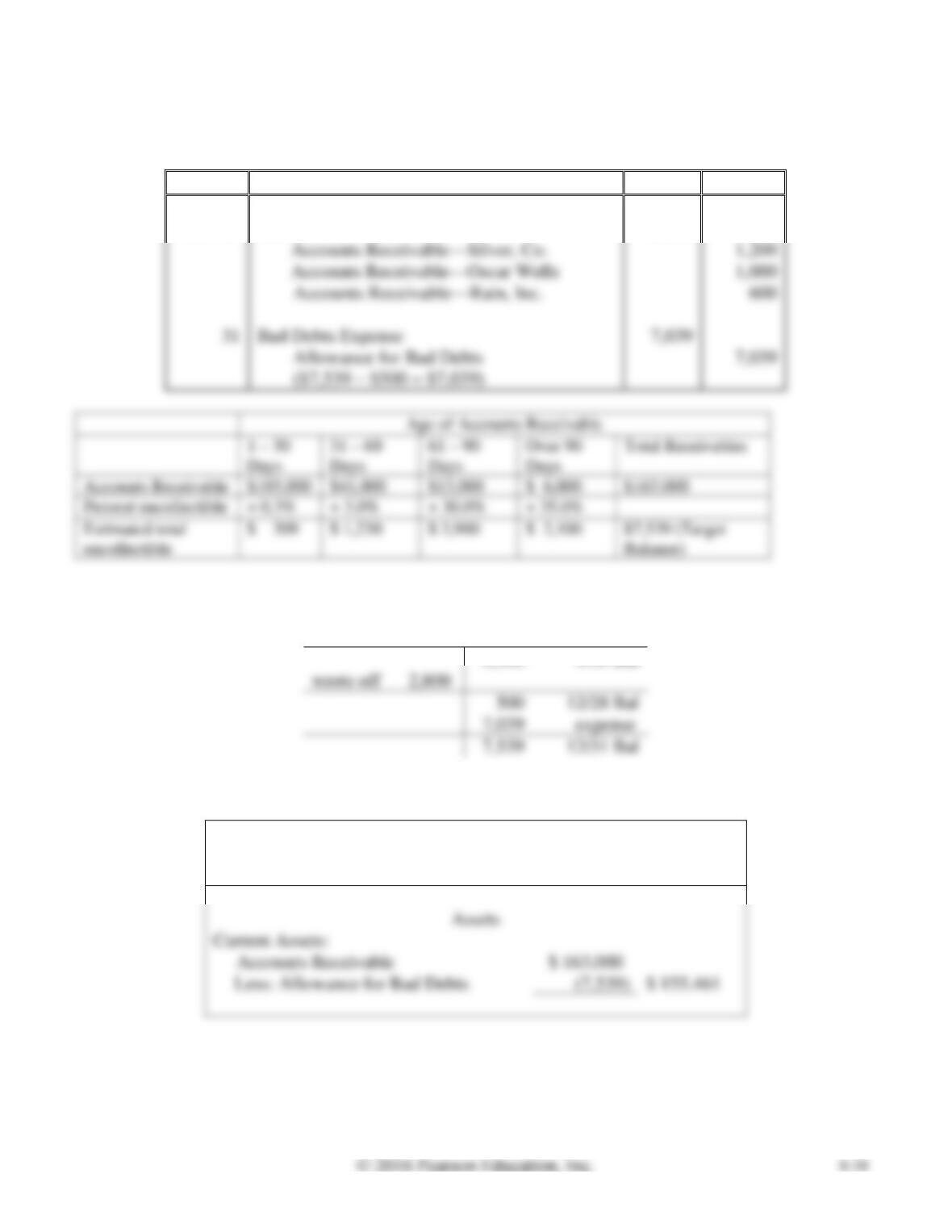
2. Allowance CR Bal. $7,539 at Dec. 31, 2016
At September 30, 2016, the accounts of Park Terrace Medical Center (PTMC) include the following:
During the last quarter of 2016, PTMC completed the following selected transactions:
Requirements
1. Journalize the transactions.
2. Open the Allowance for Bad Debts T-account, and post entries affecting that account. Keep a
running balance.
3. Show how Park Terrace Medical Center should report net accounts receivable on its December 31,
2016, balance sheet.
SOLUTION
Requirement 1
Date
Accounts and Explanation
Debit
Credit
2016
Dec. 28
Allowance for Bad Debts
2,800
Bad Debts Expense
7,039
Requirement 2
3,300 9/30 Bal
wrote off 2,800
500 12/28 Bal
7,039 expense
7,539 12/31 Bal
Requirement 3
PARK TERRACE MEDICAL CENTER
Balance Sheet−Partial
December 31, 2016
Current Assets:
Accounts Receivable
$ 163,000
$ 155,461
Allowance for Bad Debts
P8-29A Accounting for uncollectible accounts using the allowance method (percent–of-sales) and
reporting receivables on the balance sheet
Learning Objectives 1, 3
3. Net AR $107,300
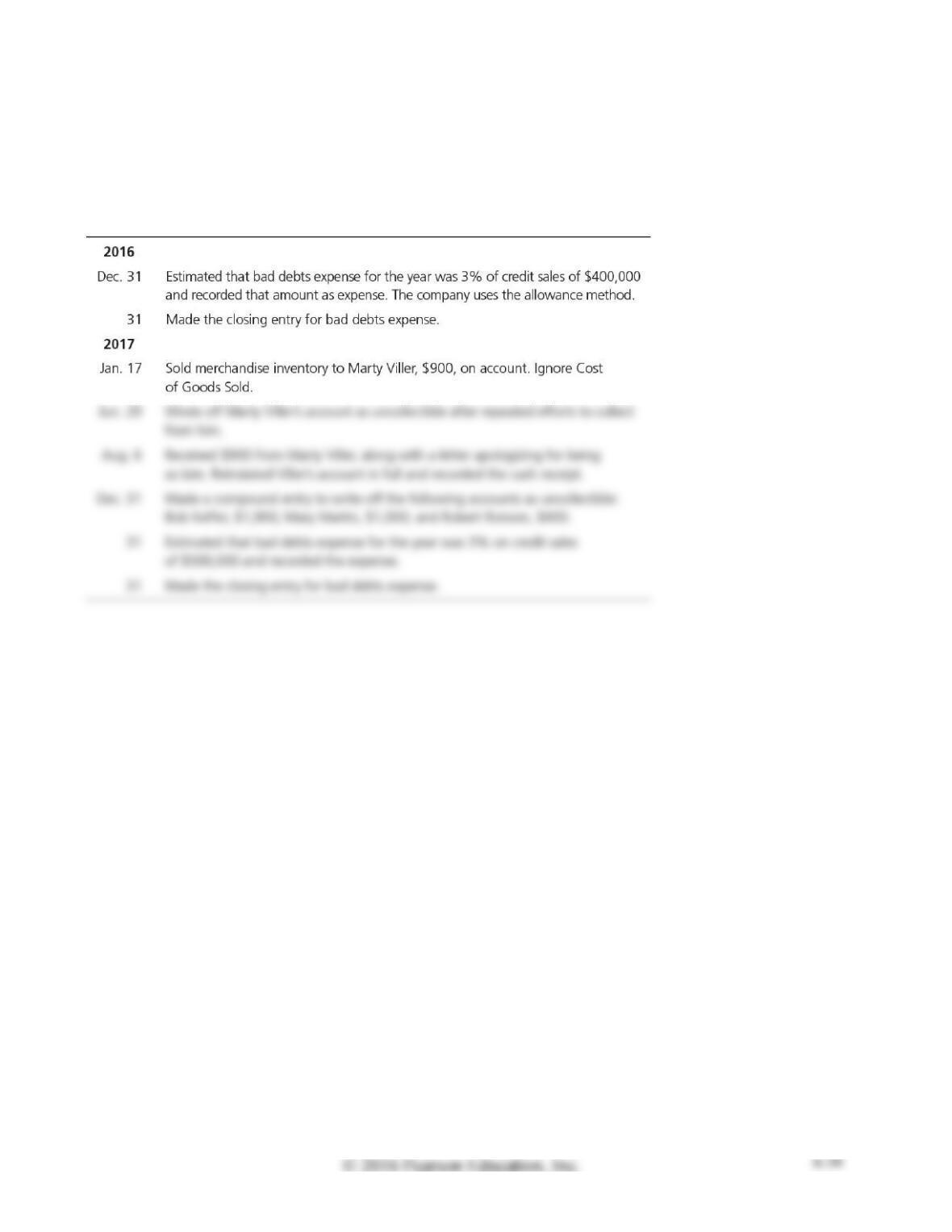
Beta Watches completed the following selected transactions during 2016 and 2017:
Requirements
1. Open T-accounts for Allowance for Bad Debts and Bad Debts Expense. Keep running balances,
assuming all accounts begin with a zero balance.
2. Record the transactions in the general journal, and post to the two T-accounts.
3. Assume the December 31, 2017, balance of Accounts Receivable is $131,000. Show how net
accounts receivable would be reported on the balance sheet at that date.
SOLUTION
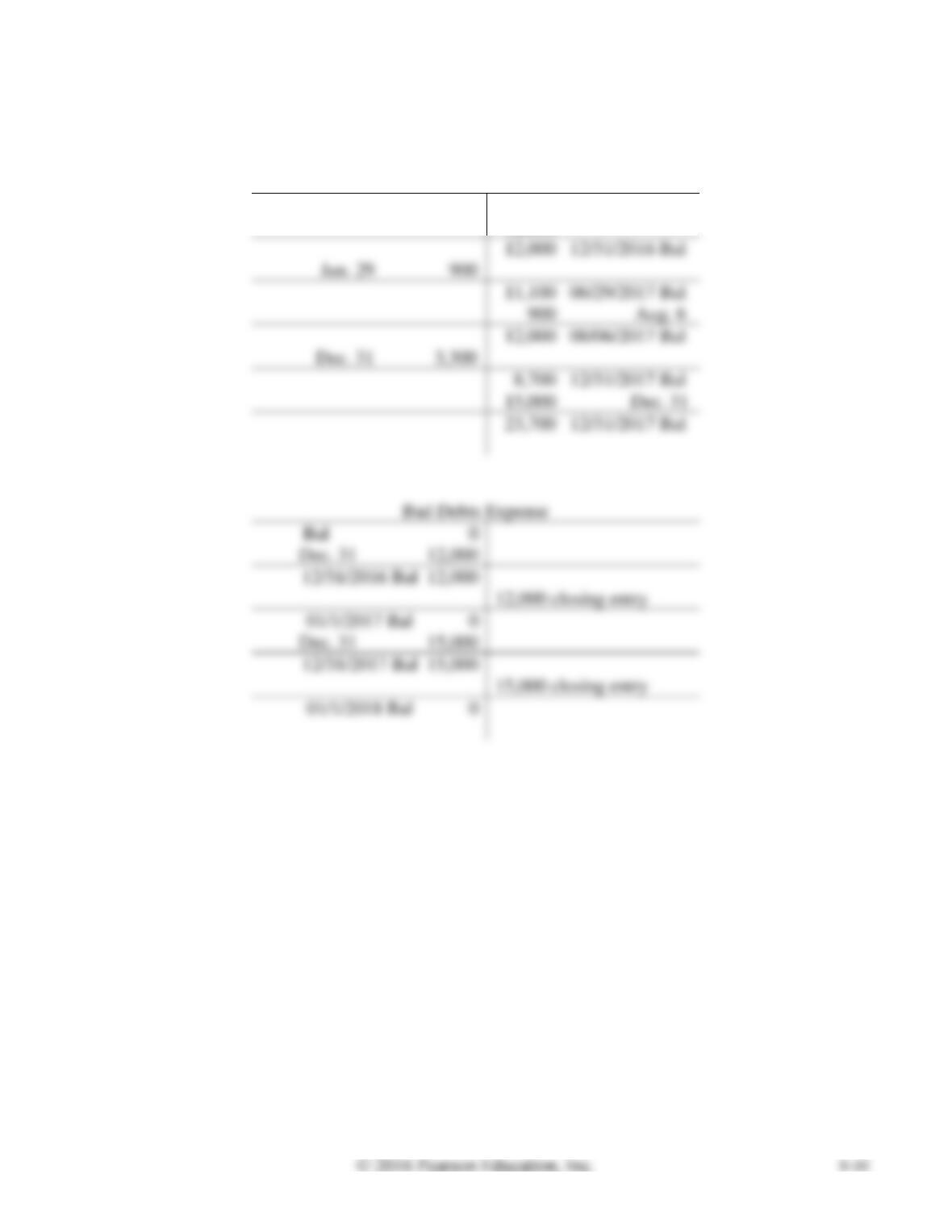
Requirements 1 and 2
12,000 12/31/2016 Bal
Jun. 29 900
11,100 06/29/2017 Bal
900 Aug. 6
12,000 08/06/2017 Bal
Dec. 31 3,300
8,700 12/31/2017 Bal
15,000 Dec. 31
23,700 12/31/2017 Bal
12,000 closing entry
01/1/2017 Bal 0
15,000 closing entry
01/1/2018 Bal 0
Allowance for Bad Debts
0 Bal
12,000