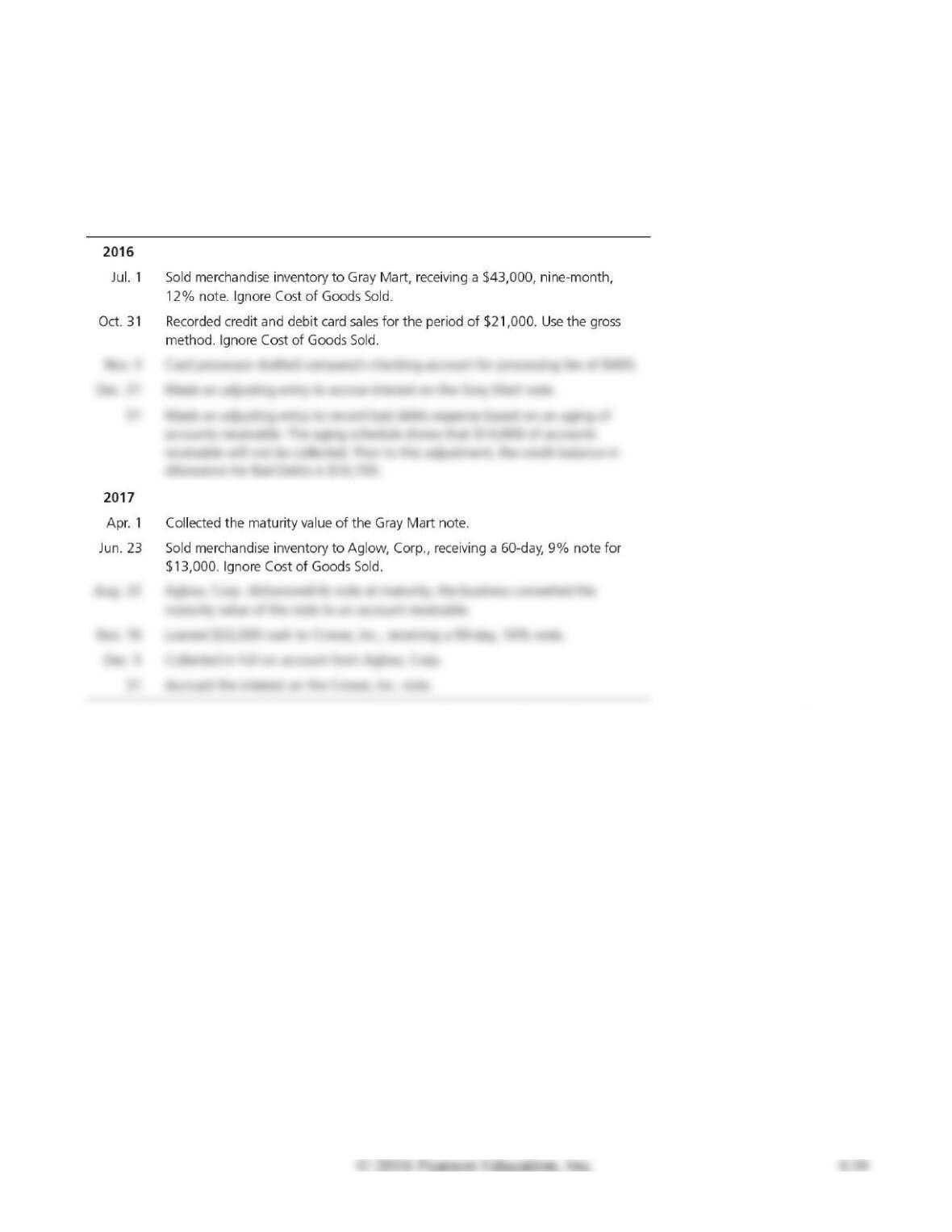
P8-37B Accounting for uncollectible accounts (aging-of-receivables method), credit card sales,
notes receivable, and accrued interest revenue
Learning Objectives 1, 3, 4
Dec. 31, 2016 Bad Debts Expense $3,900
Comfy Recliner Chairs completed the following selected transactions:
Record the transactions in the journal of Comfy Recliner Chairs. Explanations are not required. (For
notes stated in days, use a 360-day year. Round to the nearest dollar.)
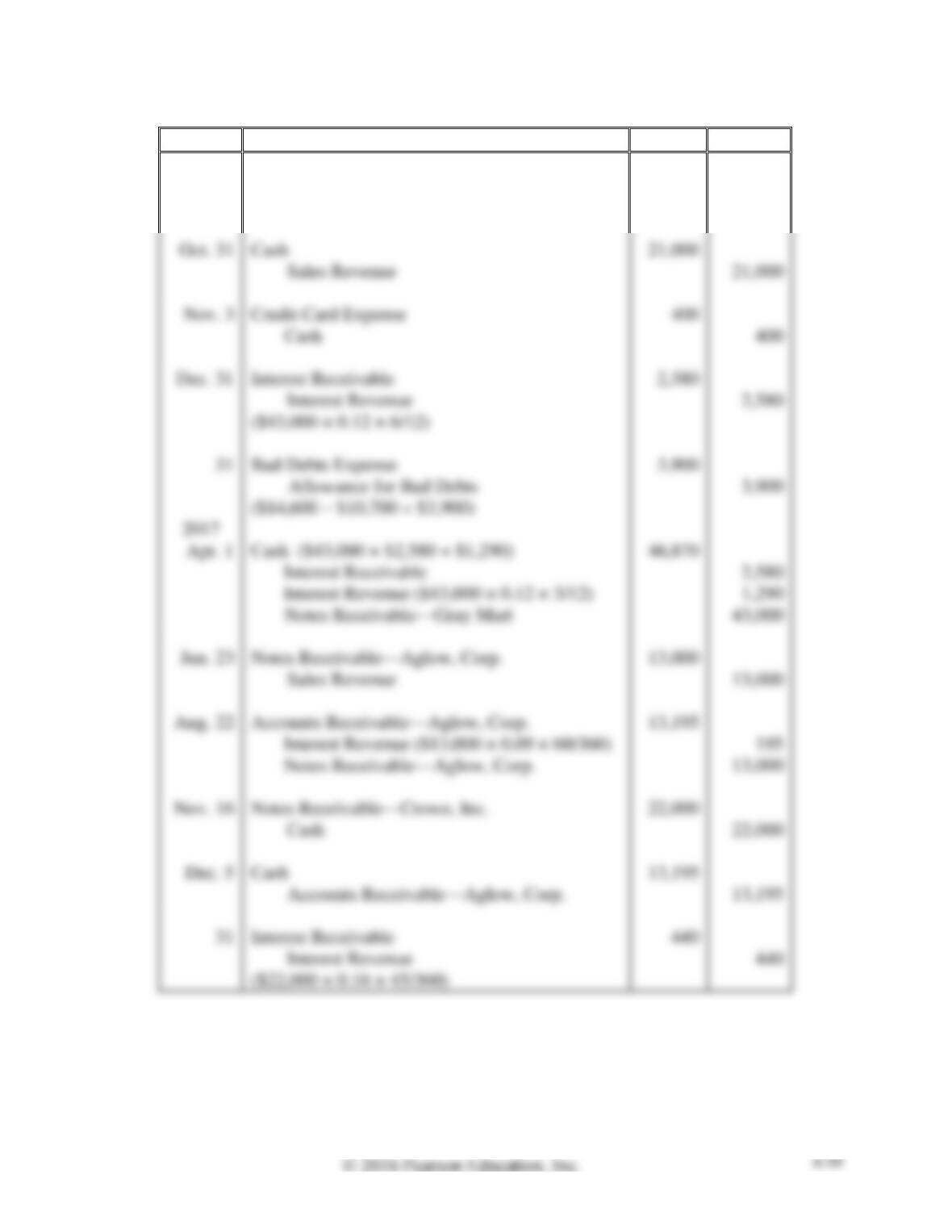
SOLUTION
Date
Accounts and Explanation
Debit
Credit
2016
Jul. 1
Notes Receivable—Gray Mart
43,000
Sales Revenue
43,000
Cash
21,000
Sales Revenue
21,000
Nov. 3
Credit Card Expense
Interest Receivable
Interest Revenue
2,580
Bad Debts Expense
Allowance for Bad Debts
3,900
($14,600 – $10,700 = $3,900)
2017
Cash ($43,000 + $2,580 + $1,290)
46,870
2,580
1,290
43,000
Notes Receivable—Aglow, Corp.
13,000
Sales Revenue
13,000
Accounts Receivable—Aglow, Corp.
13,195
13,000
Notes Receivable—Crowe, Inc.
22,000
Cash
22,000
Cash
13,195
Accounts Receivable—Aglow, Corp.
13,195
Interest Receivable
Interest Revenue
($22,000 × 0.16 × 45/360)
P8-38B Accounting for notes receivable and accruing interest
Learning Objective 4
1. Note 2 Maturity Value $20,300
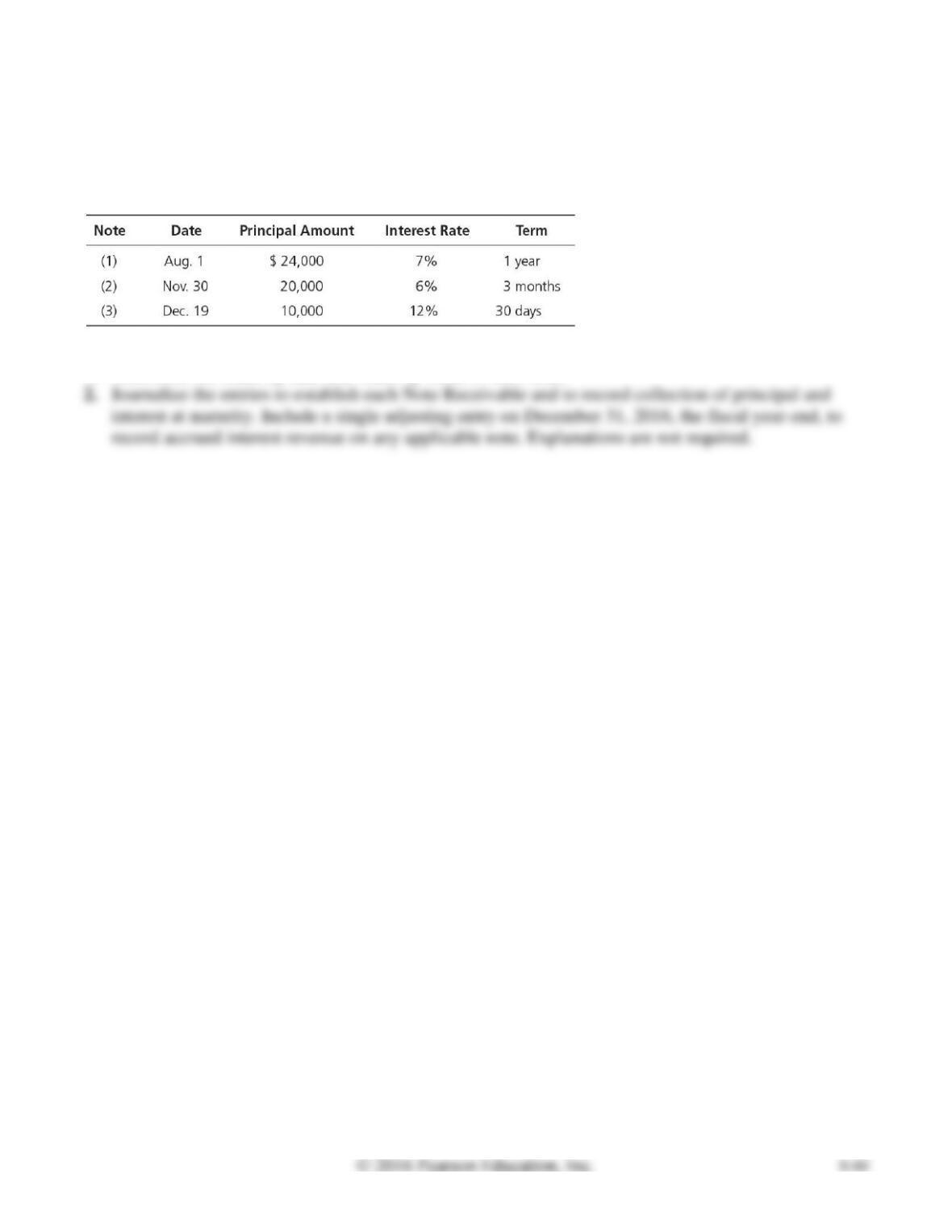
Christie Realty loaned money and received the following notes during 2016.
Requirements
1. Determine the maturity date and maturity value of each note.
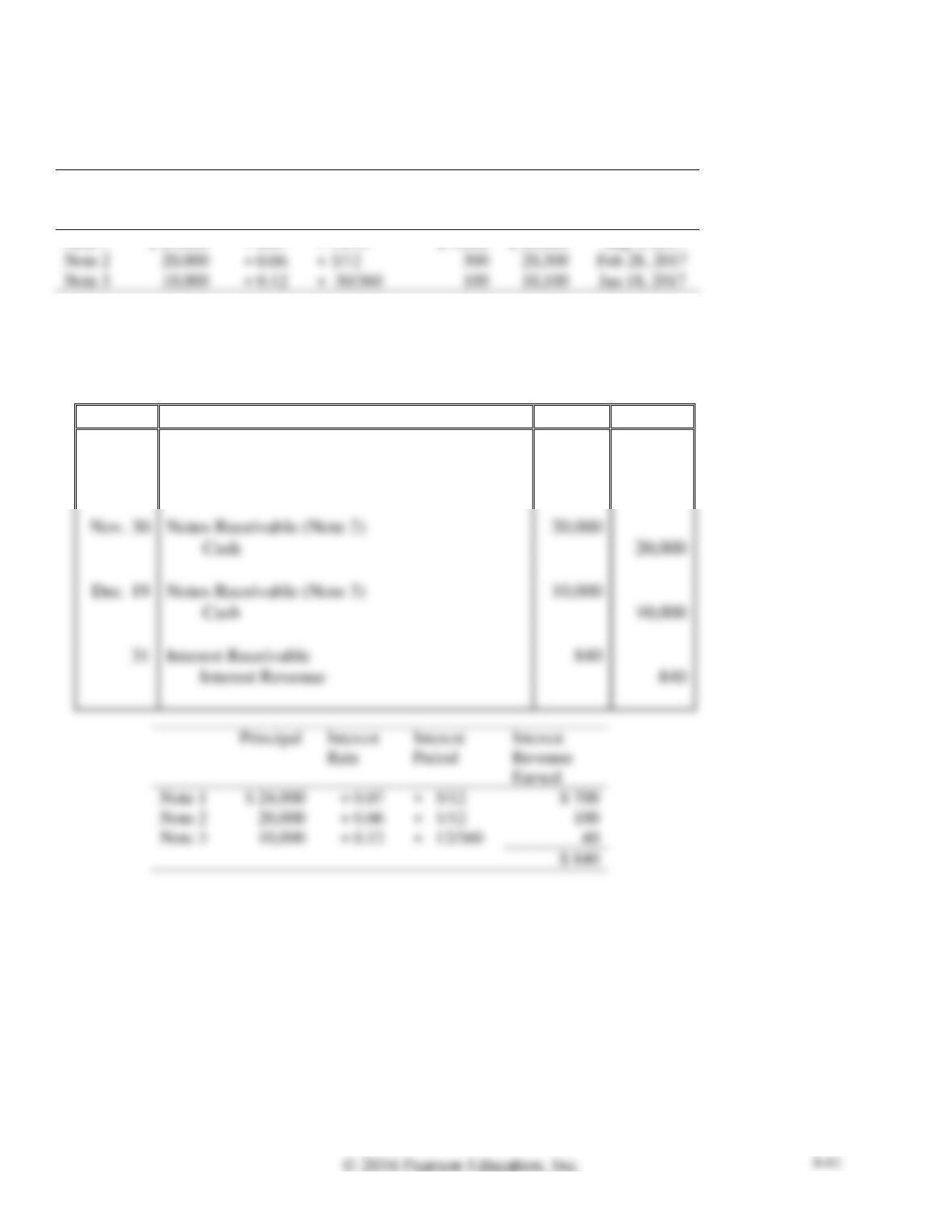
SOLUTION
Requirement 1
Principal
Interest
Rate
Interest
Period
Interest
Revenue
Earned
Maturity
Value
(P + I)
Maturity Date
Note 1
$ 24,000
× 0.07
× 12/12
$ 1,680
$ 25,680
Aug 1, 2017
Note 2
20,000
× 0.06
× 3/12
300
20,300
Feb 28, 2017
Requirement 2
Principal
Interest
Interest
Interest
Earned
Note 2
20,000
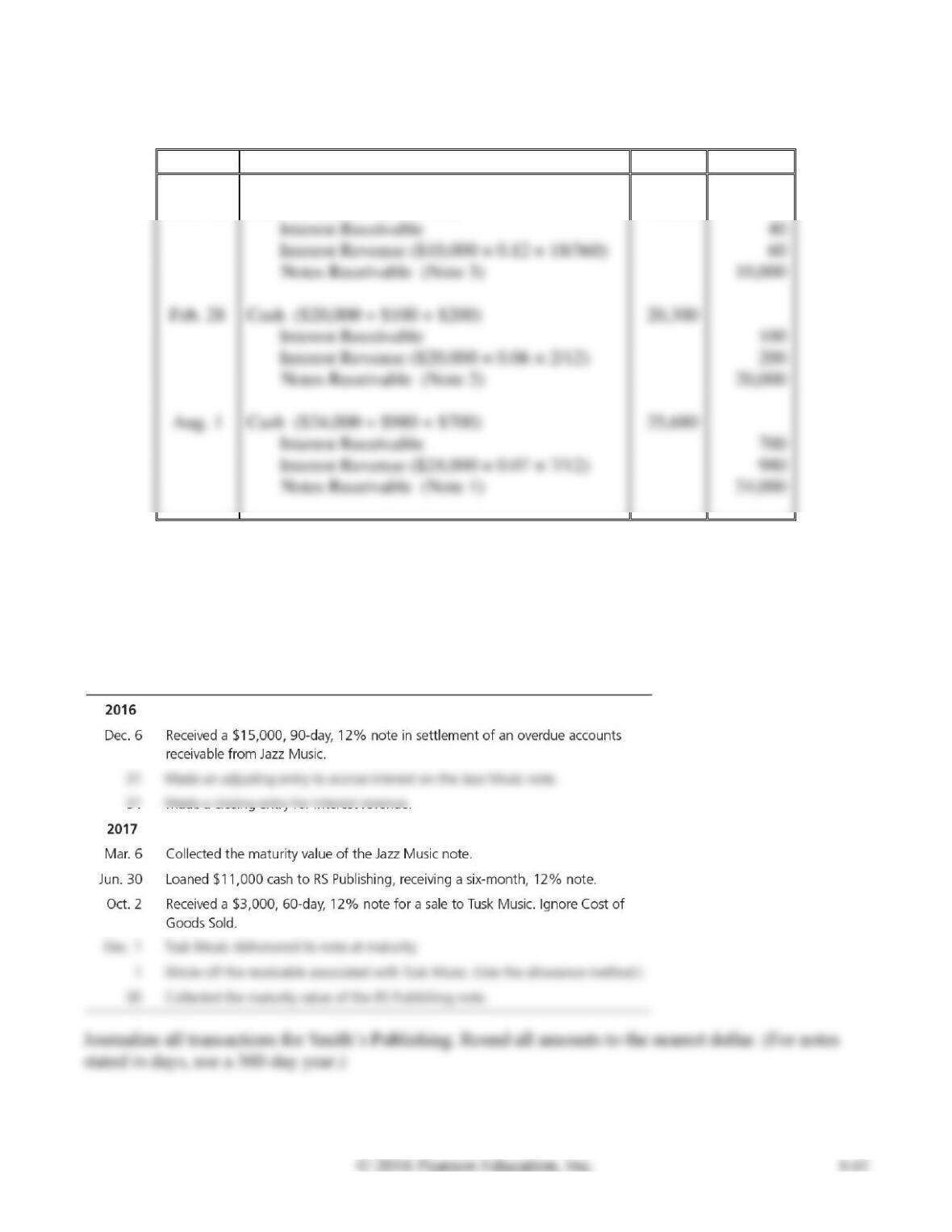
Notes Receivable (Note 2)
20,000
Cash
20,000
Notes Receivable (Note 3)
10,000
Cash
10,000
Interest Receivable
Interest Revenue
Date
Accounts and Explanation
Debit
Credit
2016
Aug. 1
Notes Receivable (Note 1)
24,000
Cash
24,000
P8-38B, cont.
Requirement 2, cont.
Date
Accounts and Explanation
Debit
Credit
2017
Jan. 18
Cash ($10,000 + $40 + $60)
10,100
Interest Receivable
Cash ($20,000 + $100 + $200)
20,300
Interest Receivable
Cash ($24,000 + $980 + $700)
25,680
Interest Receivable
P8-39B Accounting for notes receivable, dishonored notes, and accrued interest revenue
Learning Objective 4
March 6, 2017 Interest Revenue $325
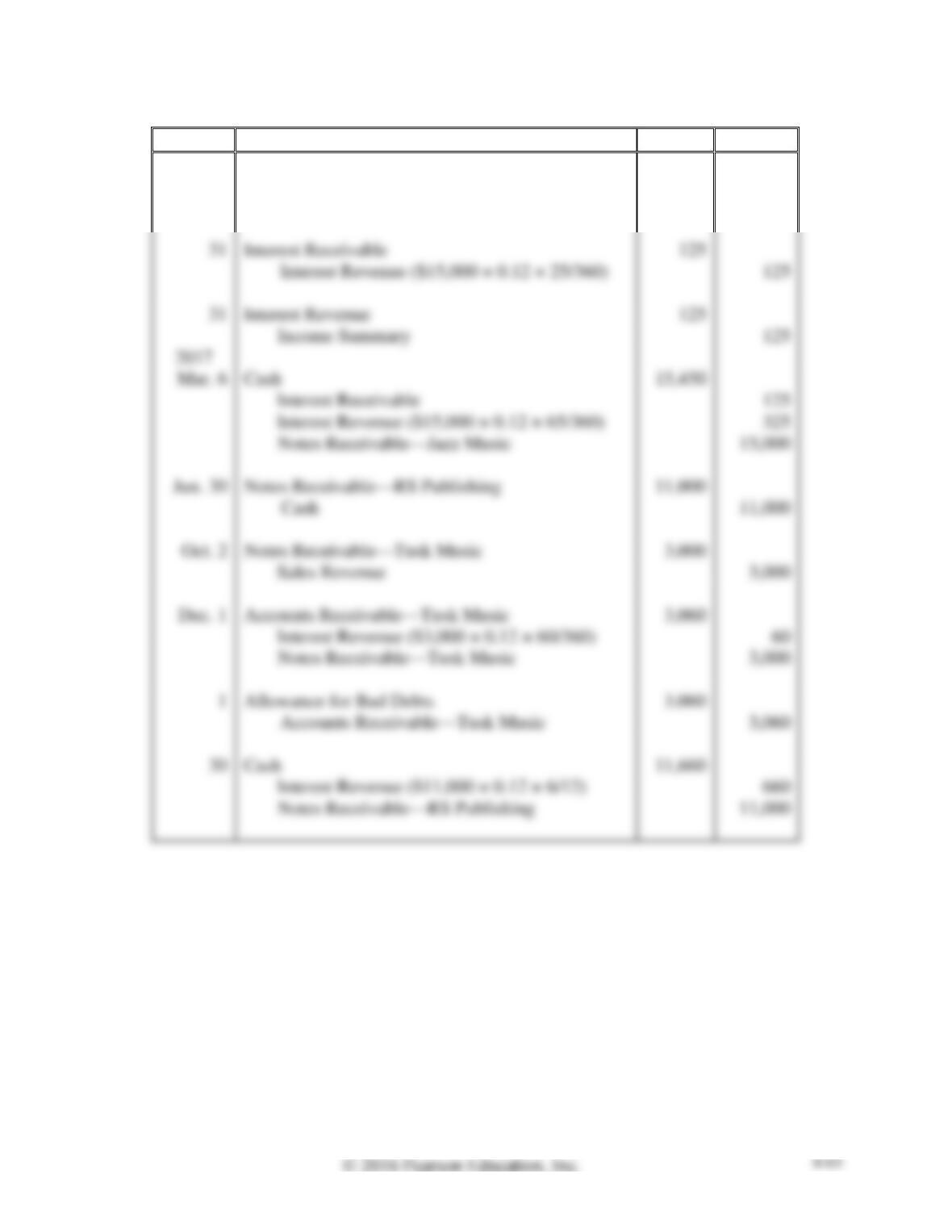
Consider the following transactions for Smith’s Publishing.
SOLUTION
Date
Accounts and Explanation
Debit
Credit
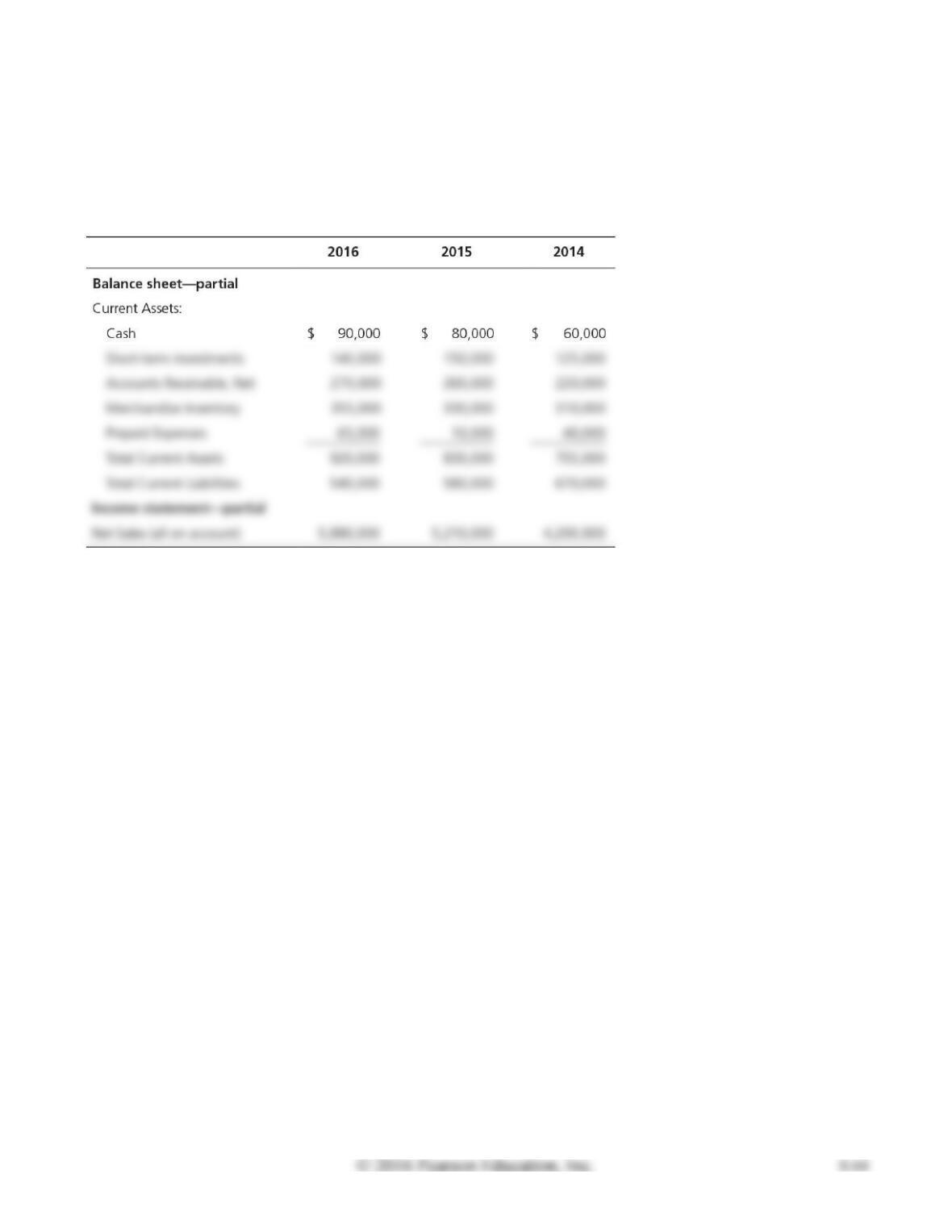
2016
Dec. 6
Notes Receivable—Jazz Music
15,000
Accounts Receivable—Jazz Music
15,000
Interest Receivable
Interest Revenue ($15,000 × 0.12 × 25/360)
Interest Revenue
2017
Cash
15,450
Interest Receivable
15,000
Notes Receivable—RS Publishing
11,000
Cash
11,000
Notes Receivable—Tusk Music
Sales Revenue
Dec. 1
Accounts Receivable—Tusk Music
Allowance for Bad Debts
Accounts Receivable—Tusk Music
Cash
11,660
11,000
P8–40B Using ratio data to evaluate a company’s financial position
Learning Objective 5
1. Days’ sales in receivables (2016) 16 days
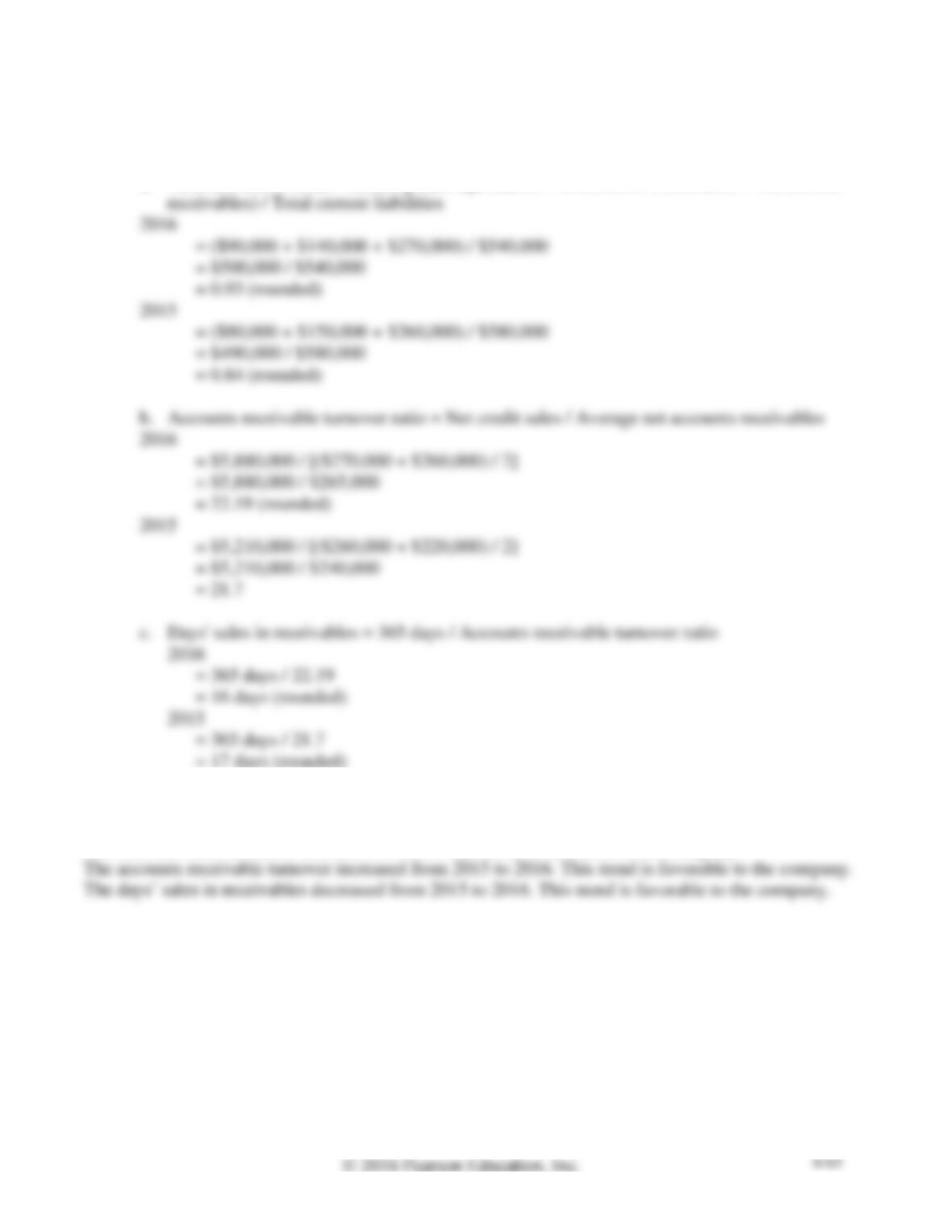
The comparative financial statements of True Beauty Cosmetic Supply for 2016, 2015, and 2014 include
the data shown here:
Requirements
1. Compute these ratios for 2016 and 2015:
a. Acid-test ratio (Round to two decimals.)
b. Accounts receivable turnover (Round to two decimals.)
c. Days’ sales in receivables (Round to the nearest whole day.)
2. Considering each ratio individually, which ratios improved from 2015 to 2016 and which ratios
deteriorated? Is the trend favorable or unfavorable for the company?
SOLUTION
Requirement 1
a. Acid-test ratio = (Cash including cash equivalents + Short-term investments + Net current
Requirement 2
The acid-test ratio increased from 2015 to 2016. This trend is favorable to the company.
Continuing Problem
P8-41 Accounting for uncollectible accounts using the allowance method
This problem continues the Daniels Consulting situation from Problem P7-33 of Chapter 7 and Problem
P6-38 of Chapter 6. Daniels Consulting reviewed the receivables list from the January transactions.
Daniels uses the allowance method for receivables, estimating uncollectibles to be 6% of January sales
revenue of $8,180. Daniels identified on February 15 that a customer was not going to pay his receivable
of $176.
Requirements
1. Journalize the January 31 entry to record and establish the allowance using the percent-of-sales
method for January sales revenue.
2. Journalize the entry to record the write-off of the customer’s bad debt.
SOLUTION
Requirements 1 and 2
Date
Accounts and Explanation
Debit
Credit
Jan. 31
Bad Debts Expense
491
Allowance for Bad Debts
176
Practice Set
This problem continues the Crystal Clear Cleaning problem begun in Chapter 2 and continued through
Chapters 3–7.
P8-42 Accounting for uncollectible accounts using the allowance method and reporting net
accounts receivable on the balance sheet
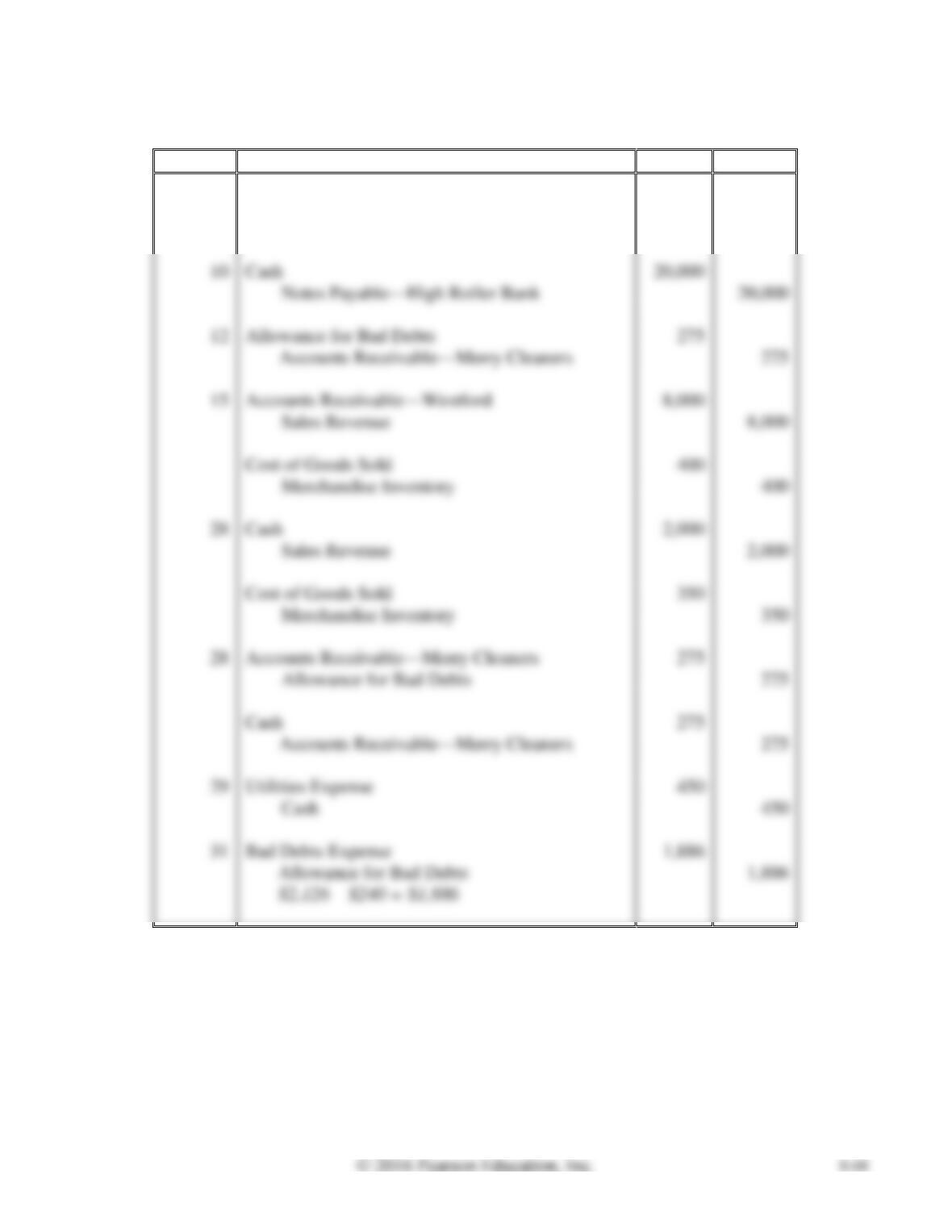
Crystal Clear Cleaning uses the allowance method to estimate bad debts. Consider the following January
transactions for Crystal Clear:
Requirements
1. Prepare all required journal entries for Crystal Clear.
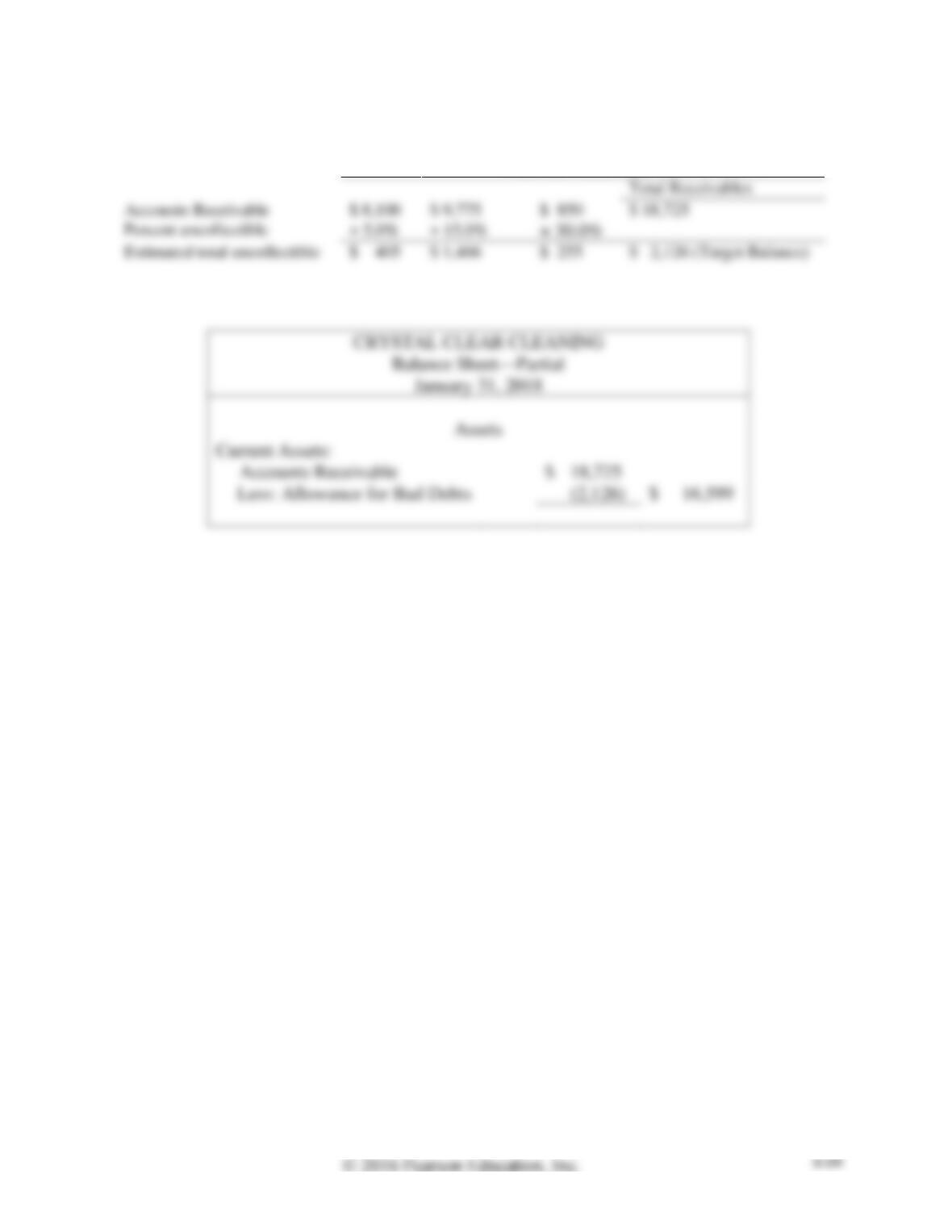
2. Show how net accounts receivable would be reported on the balance sheet as of January 31, 2018.
SOLUTION
Date
Accounts and Explanation
Debit
Credit
2018
Jan. 1
Accounts Receivable—Debbie’s D-list
9,000
Service Revenue
9,000
Cash
Notes Payable—High Roller Bank
Allowance for Bad Debts
Accounts Receivable—Westford
8,000
Sales Revenue
8,000
Cost of Goods Sold
Merchandise Inventory
Cash
2,000
Sales Revenue
2,000
Cost of Goods Sold
Merchandise Inventory
Accounts Receivable—Merry Cleaners
Allowance for Bad Debts
Cash
Utilities Expense
Cash
Bad Debts Expense
1,886
1,886
P8-42, cont.
Accounts Receivable
× 30.0%
$ 16,599
Critical Thinking
Decision Case 8-1
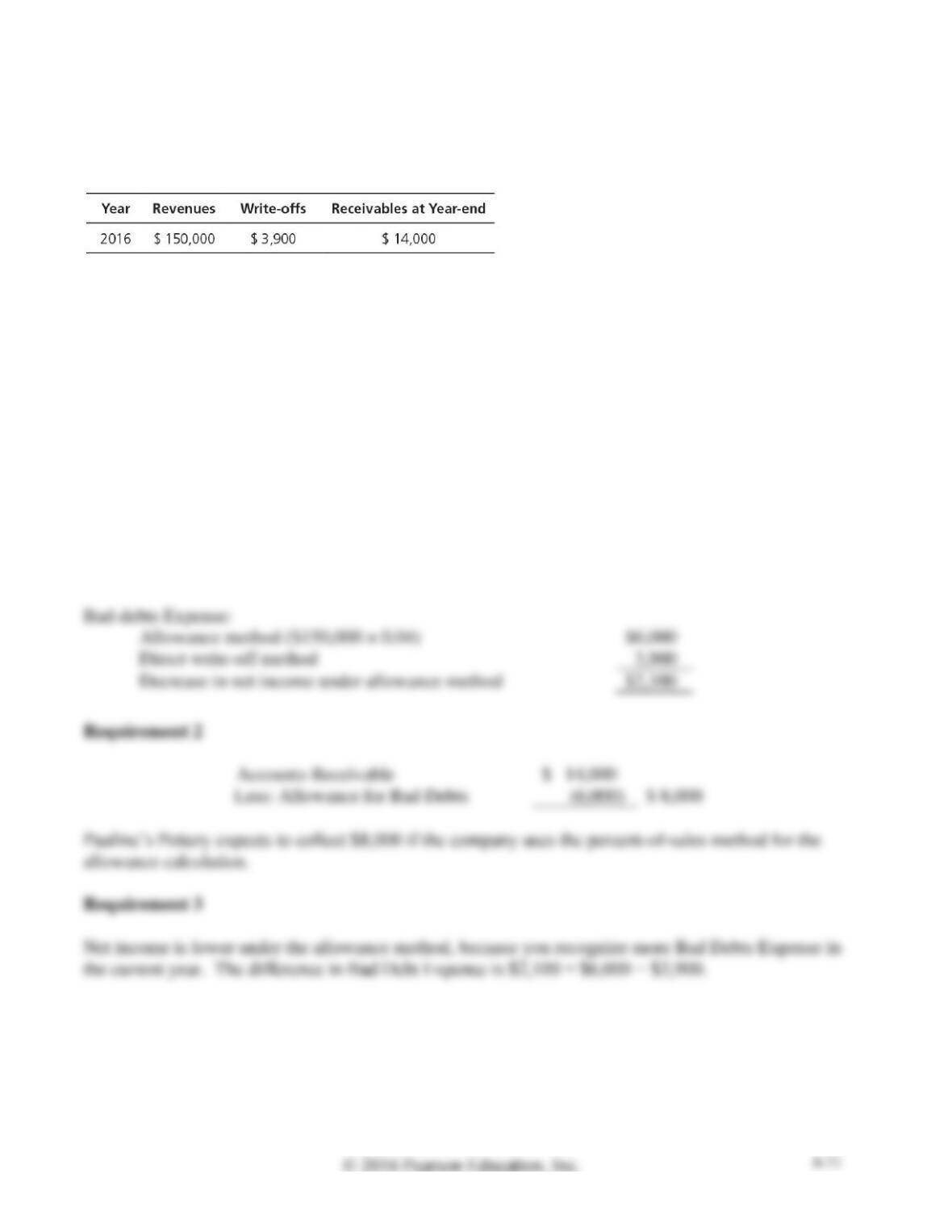
Weddings on Demand sells on account and manages its own receivables. Average experience for the
past three years has been as follows:
Unhappy with the amount of bad debts expense she has been experiencing, Aledia Sanchez, controller,
is considering a major change in the business. Her plan would be to stop selling on account altogether
but accept either cash, credit cards, or debit cards from her customers. Her market research indicates that
if she does so, her sales will increase by 10% (i.e., from $350,000 to $385,000), of which $200,000 will
be credit or debit card sales and the rest will be cash sales. With a 10% increase in sales, there will also
be a 10% increase in Cost of Goods Sold. If she adopts this plan, she will no longer have bad debts
expense, but she will have to pay a fee on debit/credit card transactions of 2% of applicable sales. She
also believes this plan will allow her to save $5,000 per year in other operating expenses.
Should Sanchez start accepting credit cards and debit cards? Show the computations of net income
under her present arrangement and under the plan.
SOLUTION
Actual
New Plan
Expected
Sales Revenue
$ 350,000
× 1.10 =
$ 385,000
Cost of Goods Sold
$ 210,000
× 1.10 =
$ 231,000
Bad Debts Expense
4,000
Credit Card Expense (200,000 × 2%)
4,000
Other Expenses
61,000
56,000
Total Expenses
275,000
291,000
Net Income
$ 75,000
$ 94,000
Decision Case 8-2
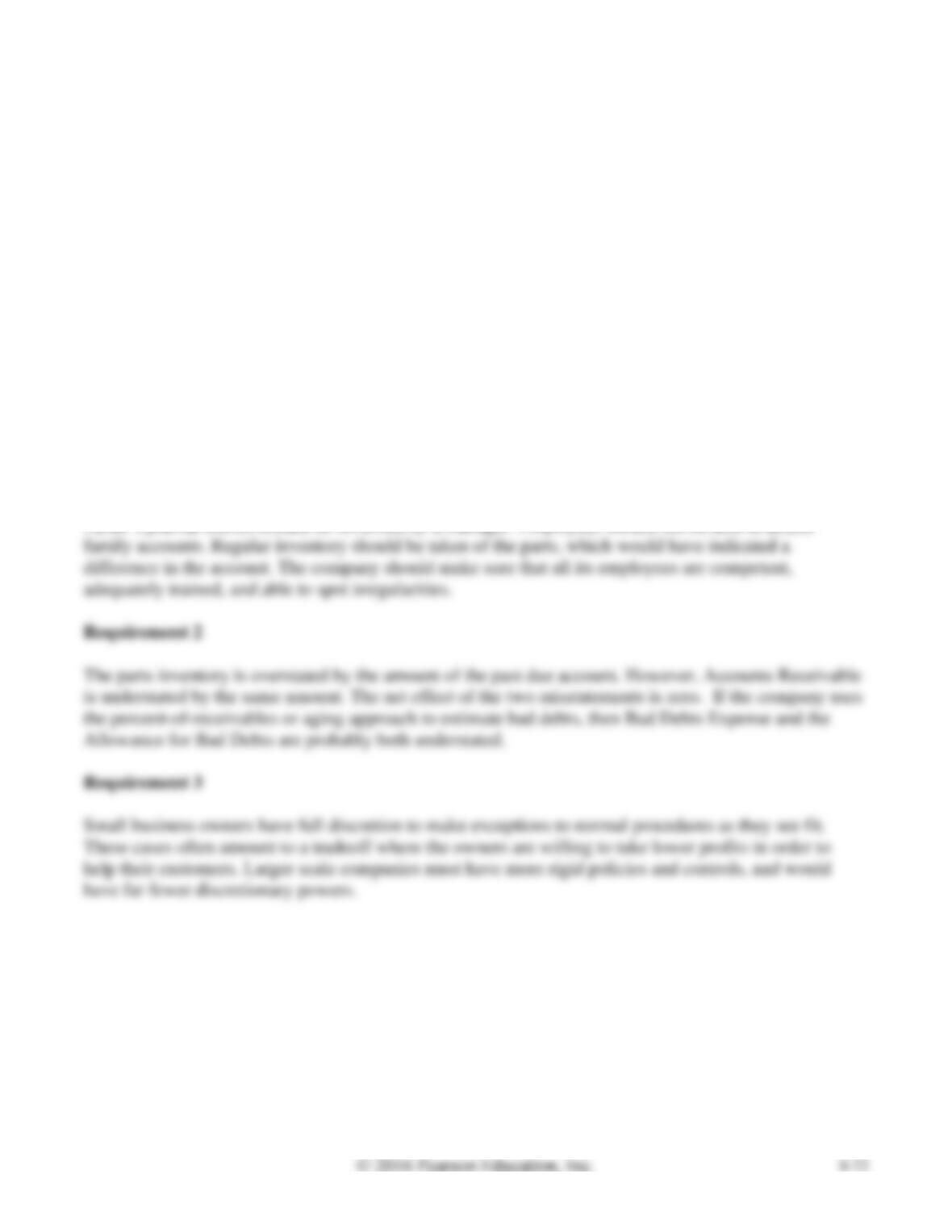
Pauline’s Pottery has always used the direct write-off method to account for uncollectibles. The
company’s revenues, bad debt write-offs, and year-end receivables for the most recent year follow:
The business is applying for a bank loan, and the loan officer requires figures based on the allowance
method of accounting for bad debts. In the past, bad debts have run about 4% of revenues.
Requirements
Pauline must give the banker the following information:
1. How much more or less would net income be for 2016 if Pauline’s Pottery were to use the allowance
method for bad debts? Assume Pauline uses the percent-of-sales method.
2. How much of the receivables balance at the end of 2016 does Pauline’s Pottery actually expect to
collect? (Disregard beginning account balances for the purpose of this question.)
3. Explain why net income is more or less using the allowance method versus the direct write-off
method for uncollectibles.
SOLUTION
Requirement 1
Fraud Case 8-1
Dylan worked for a propane gas distributor as an accounting clerk in a small Midwestern town. Last
winter, his brother Mike lost his job at the machine plant. By January, temperatures were sub-zero, and
Mike had run out of money. Dylan saw that Mike’s account was overdue, and he knew Mike needed
another delivery to heat his home. He decided to credit Mike’s account and debit the balance to the parts
inventory because he knew the parts manager, the owner’s son, was incompetent and would never notice
the extra entry. Months went by, and Dylan repeated the process until an auditor ran across the charges
by chance. When the owner fired Dylan, he said, “If you had only come to me and told me about Mike’s
situation, we could have worked something out.”
Requirements
1. What can a business like this do to prevent employee fraud of this kind?
2. What effect would Dylan’s actions have on the balance sheet? The income statement?
3. How much discretion does a business have with regard to accommodating hard- ship situations?
SOLUTION
Requirement 1
Dylan’s journal entries should be reviewed by a manager. Employees should not be able to access
Financial Statement Case 8-1
Use Starbucks Corporation’s Fiscal 2013 Annual Report and the Note 1 data on “Allowance for
Requirements
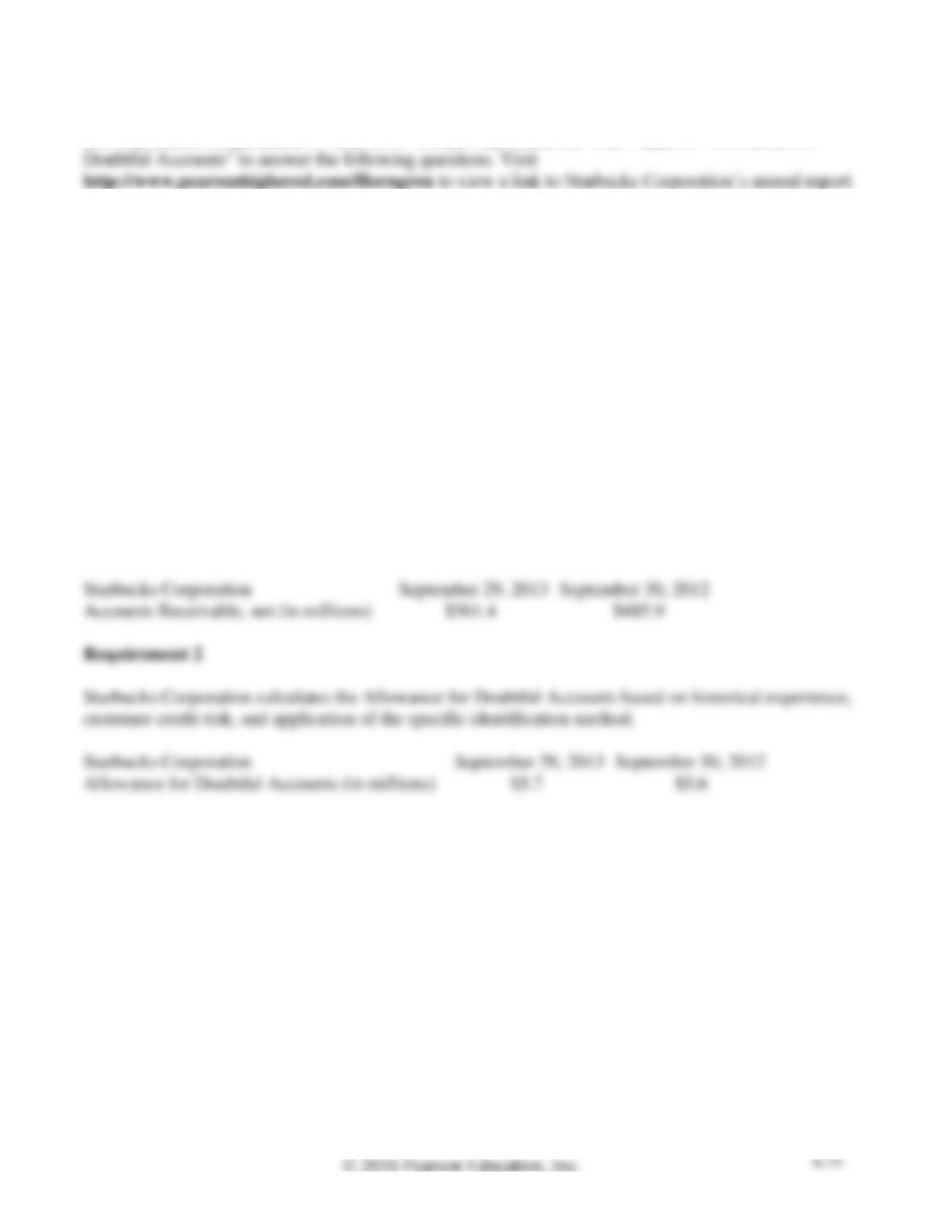
1. How much accounts receivables did Starbucks report as of September 29, 2013? As of September
30, 2012?
2. Refer to Note 1, “Allowance for Doubtful Accounts.” How does Starbucks calculate allowance for
doubtful accounts? What was the amount of the account as of September 29, 2013? As of September
30, 2012?
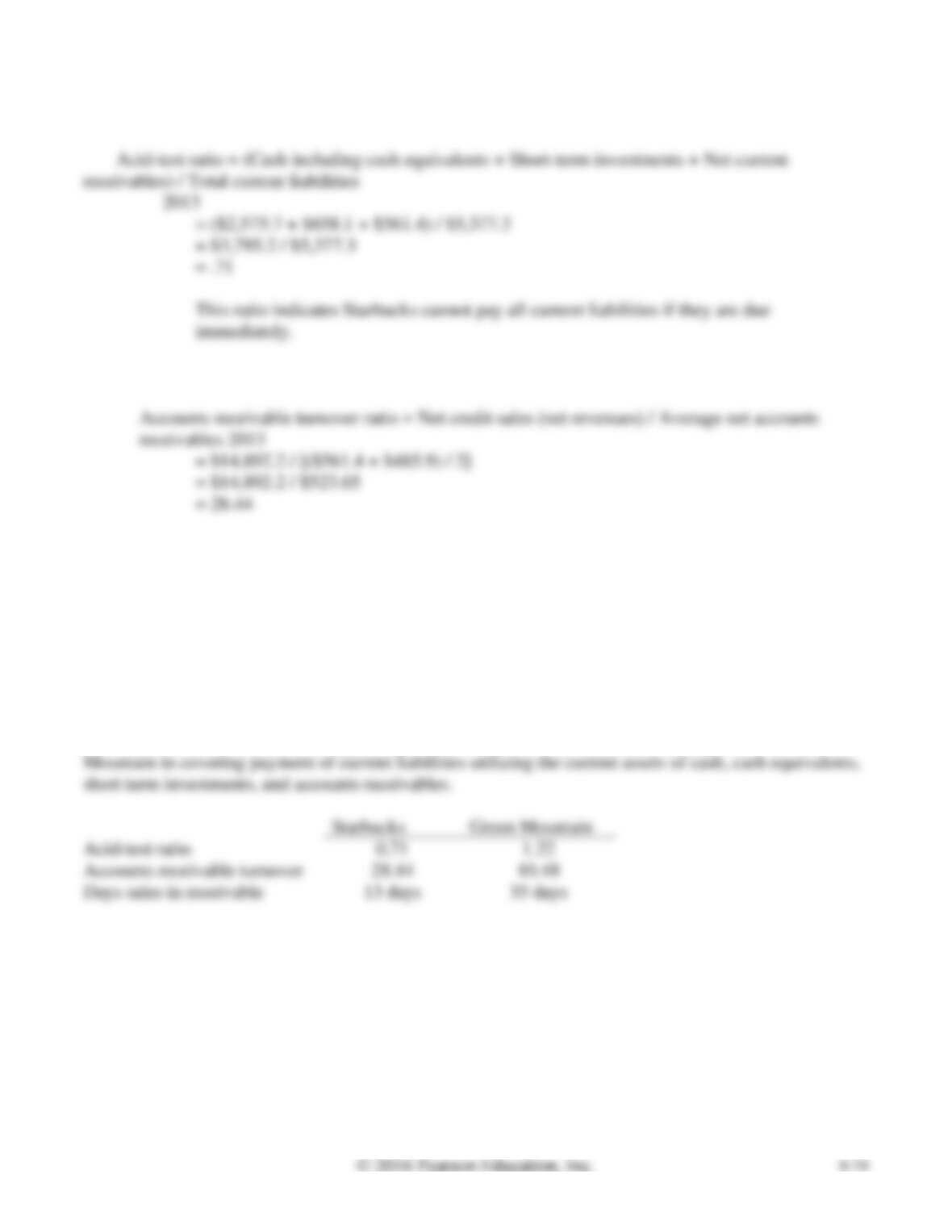
3. Compute Starbucks’s acid-test ratio at the end of 2013. If all the current liabilities came due
immediately, could Starbucks pay them?
4. Compute Starbucks’s accounts receivable turnover at the end of 2013. Use total net revenues.
5. Compute Starbucks’s days’ sales in receivables at the end of 2013.
6. How does Starbucks compare to Green Mountain Coffee Roasters, Inc. on the basis of the acid-
test ratio, accounts receivable turnover, and days’ sales in receivables?
SOLUTION
Requirement 1
Financial Statement Case 8-1, cont.
Requirement 3
Requirement 4
Requirement 5
Days’ sales in receivables = 365 days / Accounts receivable turnover ratio
2011
= 365 days / 28.44
= 13 days (rounded)
Requirement 6
Starbucks has much better ratios regarding collectability of receivables while falling short of Green