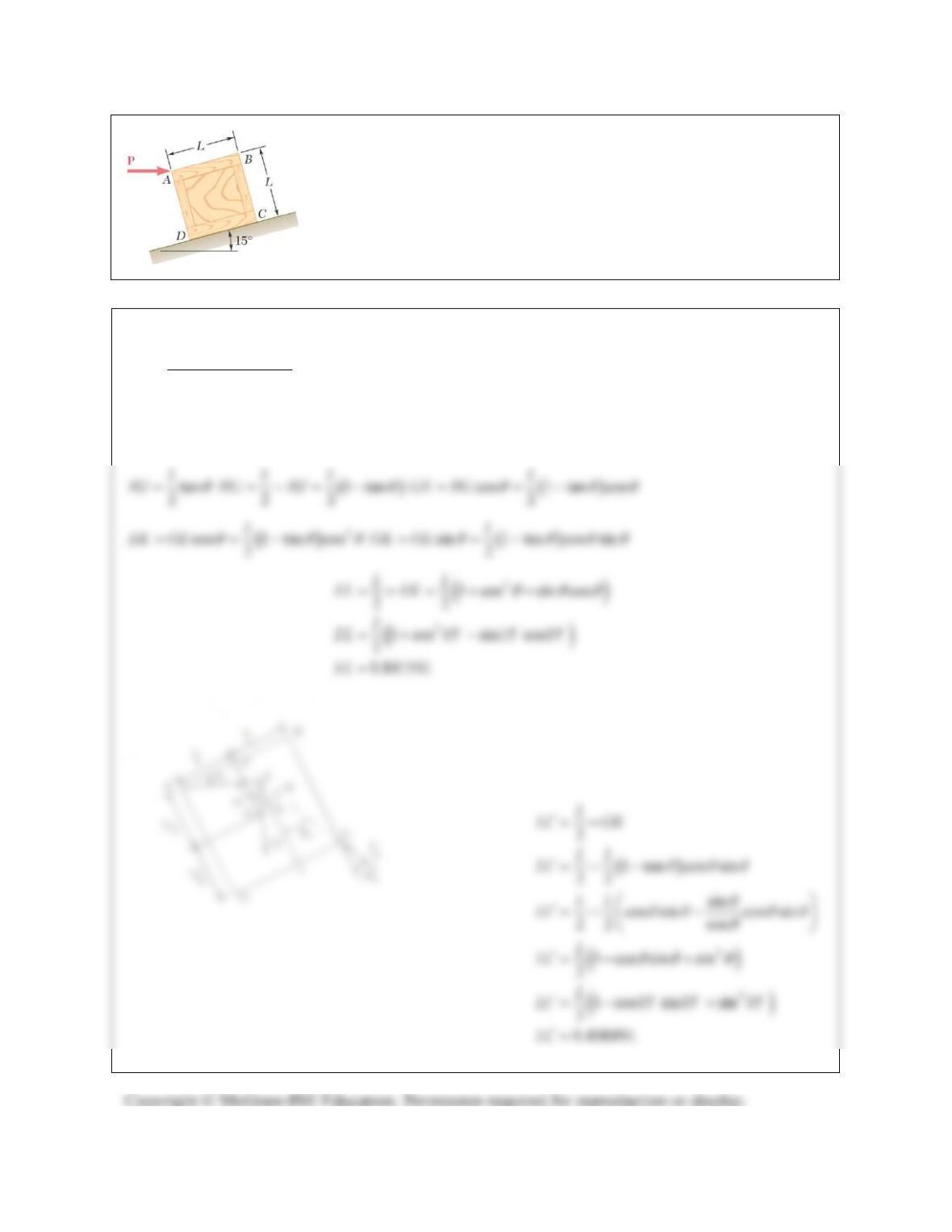
PROBLEM 8.15
A uniform crate with a massof 30 kg must be moved up along the 15°
incline without tipping. Knowing that force
P
is horizontal, determine
(a) the largest allowable coefficient of static friction between the crate and
the incline, (b) the corresponding magnitude of force
P
.
SOLUTION
(a) Free-body diagram
For tipping to be impending, reaction is at C,
Since the crate is a 3-force body.
C
must pass through E where
P
and
W
intersect.
Geometry analysis:
PROBLEM 8.15 (Continued)
0.40849
tan 0.48543, 25.89
0.84151
ss
LC L
EL L
tan
ss
0.485
s
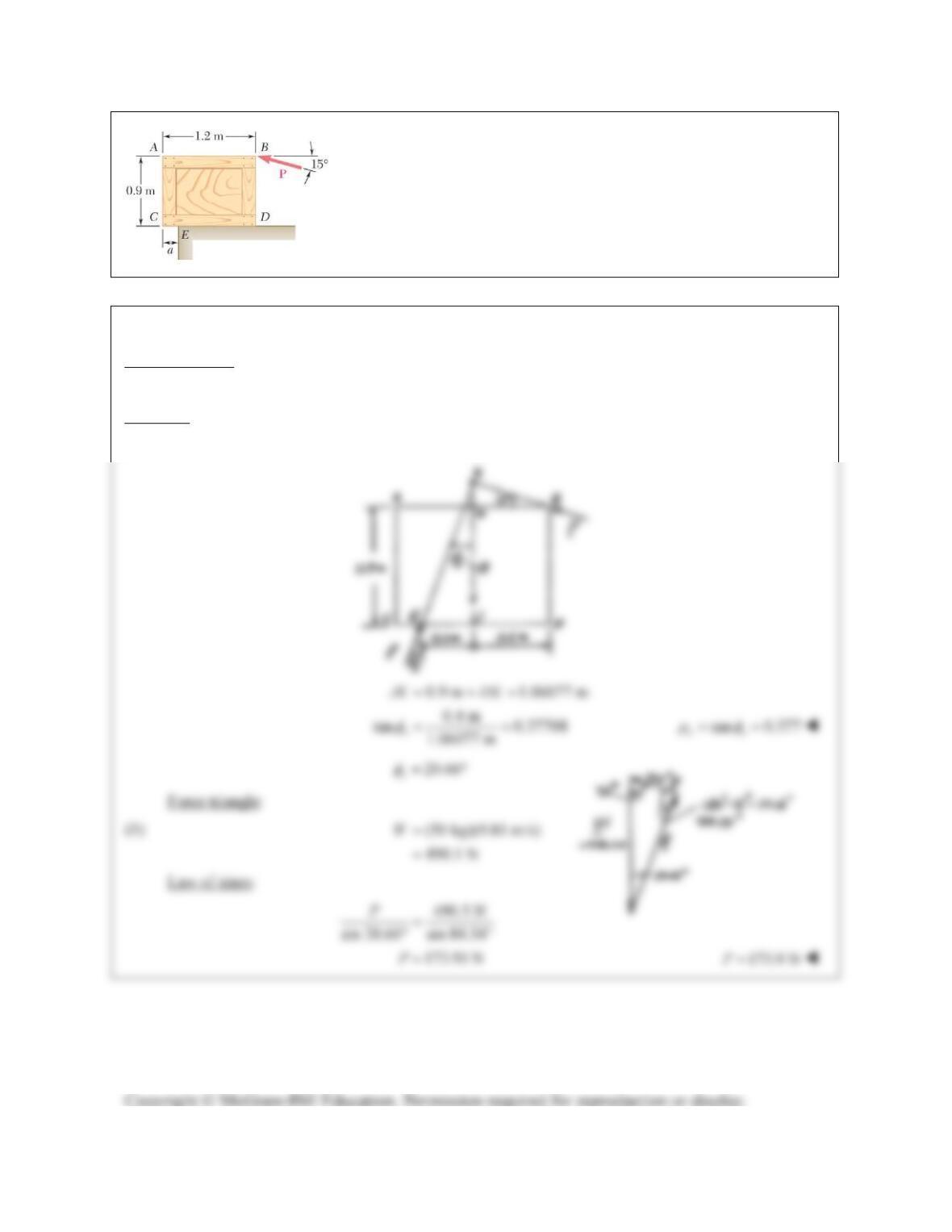
PROBLEM 8.16
A worker slowly moves a 50-kg crate to the left along a loading dock
by applying a force
P
at corner B as shown. Knowing that the crate
starts to tip about the edge E of the loading dock when a 200 mm,
determine (a) the coefficient of kinetic friction between the crate and
the loading dock, (b) the corresponding magnitude P of the force.
SOLUTION
Free body: Crate Three-force body.
Reaction E must pass through K where
P
and
W
intersect.
Geometry:
(a)
(0.6 m) tan15 0.16077 mHK
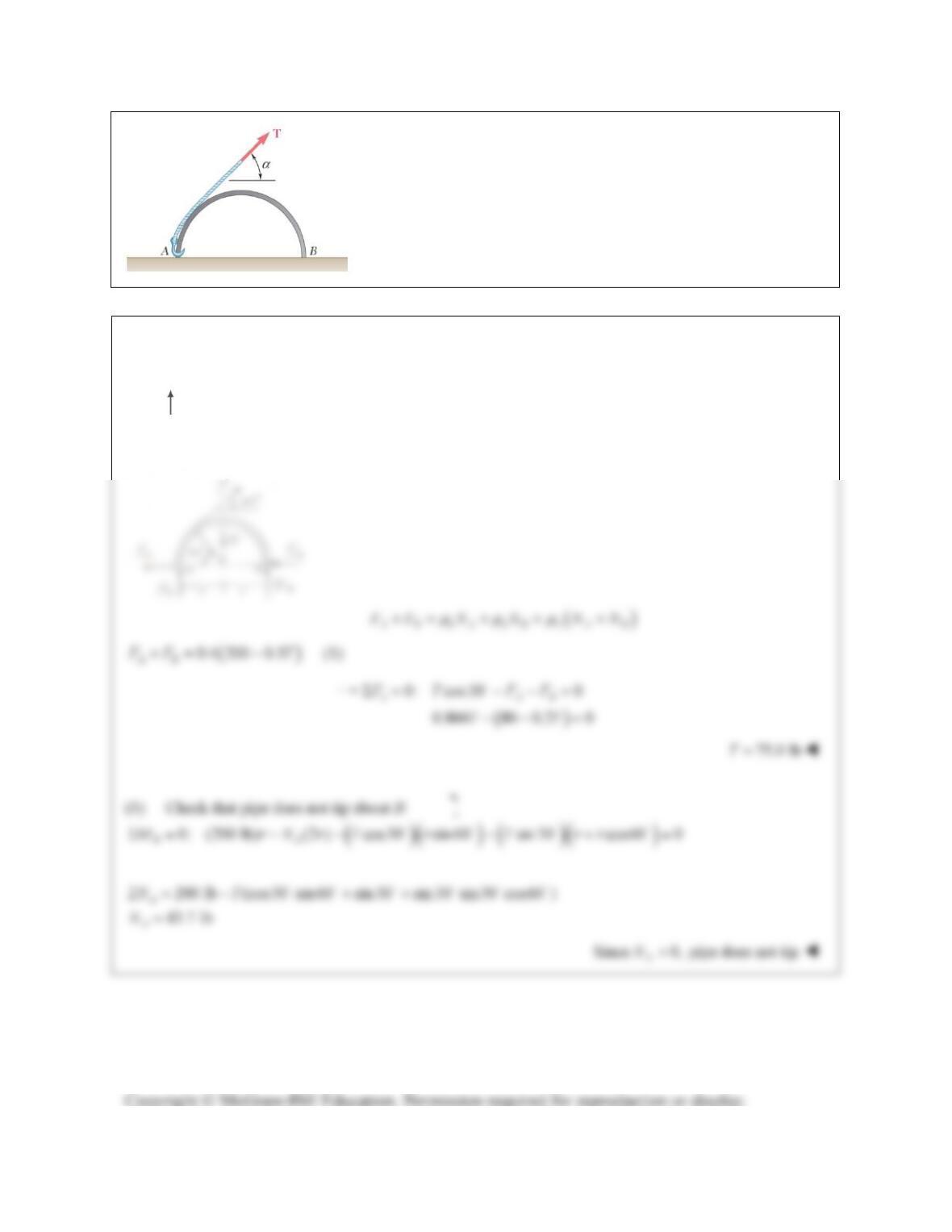
PROBLEM 8.17
A half-section of pipe weighing 200 lb is pulled by a cable as
shown. The coefficient of static friction between the pipe and the
floor is 0.40. If α = 30°, determine (a) the tension T required to
move the pipe, (b) whether the pipe will slide or tip.
SOLUTION
(a)FBD pipe:Note: assume that pipe slides
0; 200 sin 30 0
yAB
FNN T
200 0.5
AB
NN T
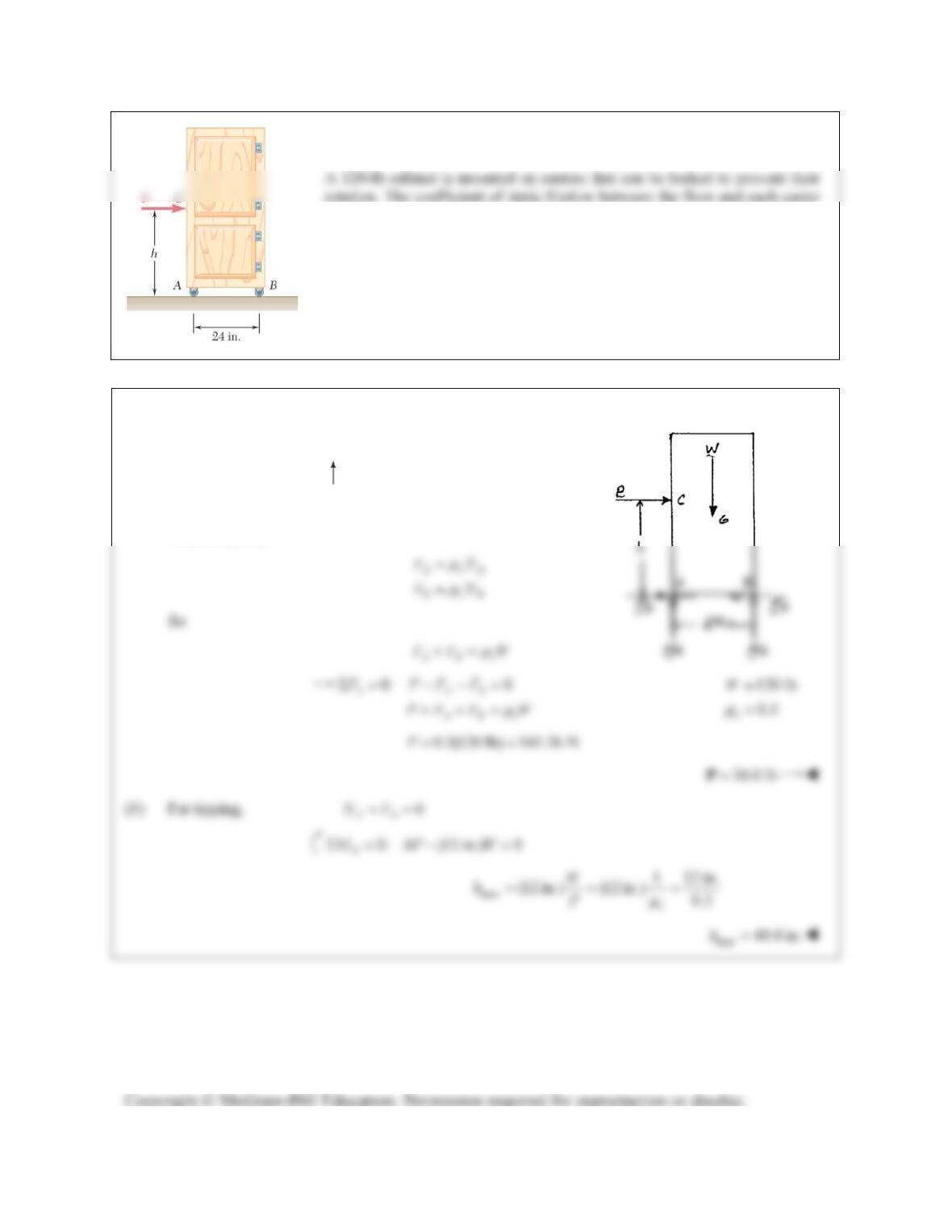
PROBLEM 8.18
is 0.30. Assuming that the casters at both A and B are locked, determine
(a) the force
P
required to move the cabinet to the right, (b) the largest
allowable value of h if the cabinet is not to tip over.
SOLUTION
FBD cabinet:
(a)
0: 0
yAB
AB
FNNW
NNW
Impending slip:
PROBLEM 8.19
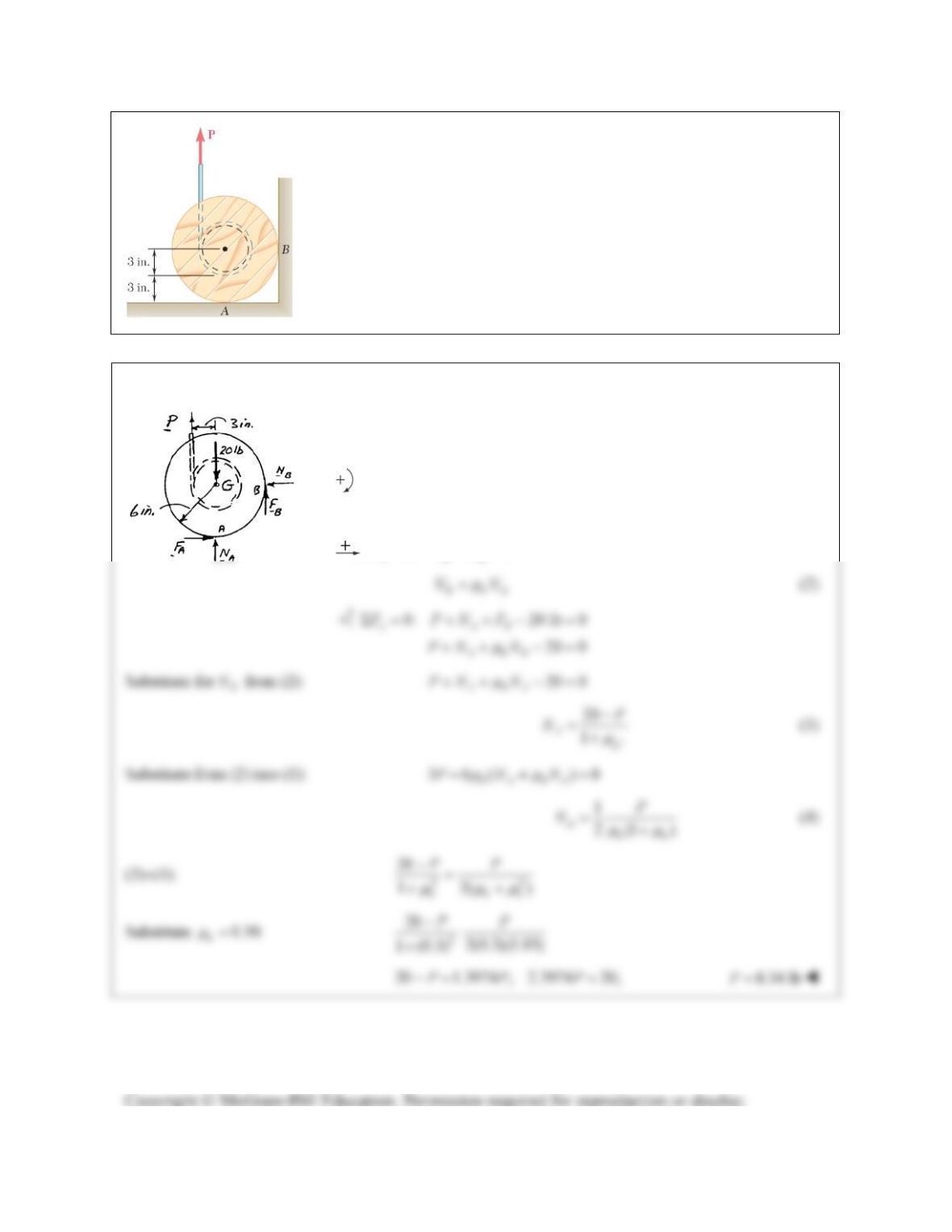
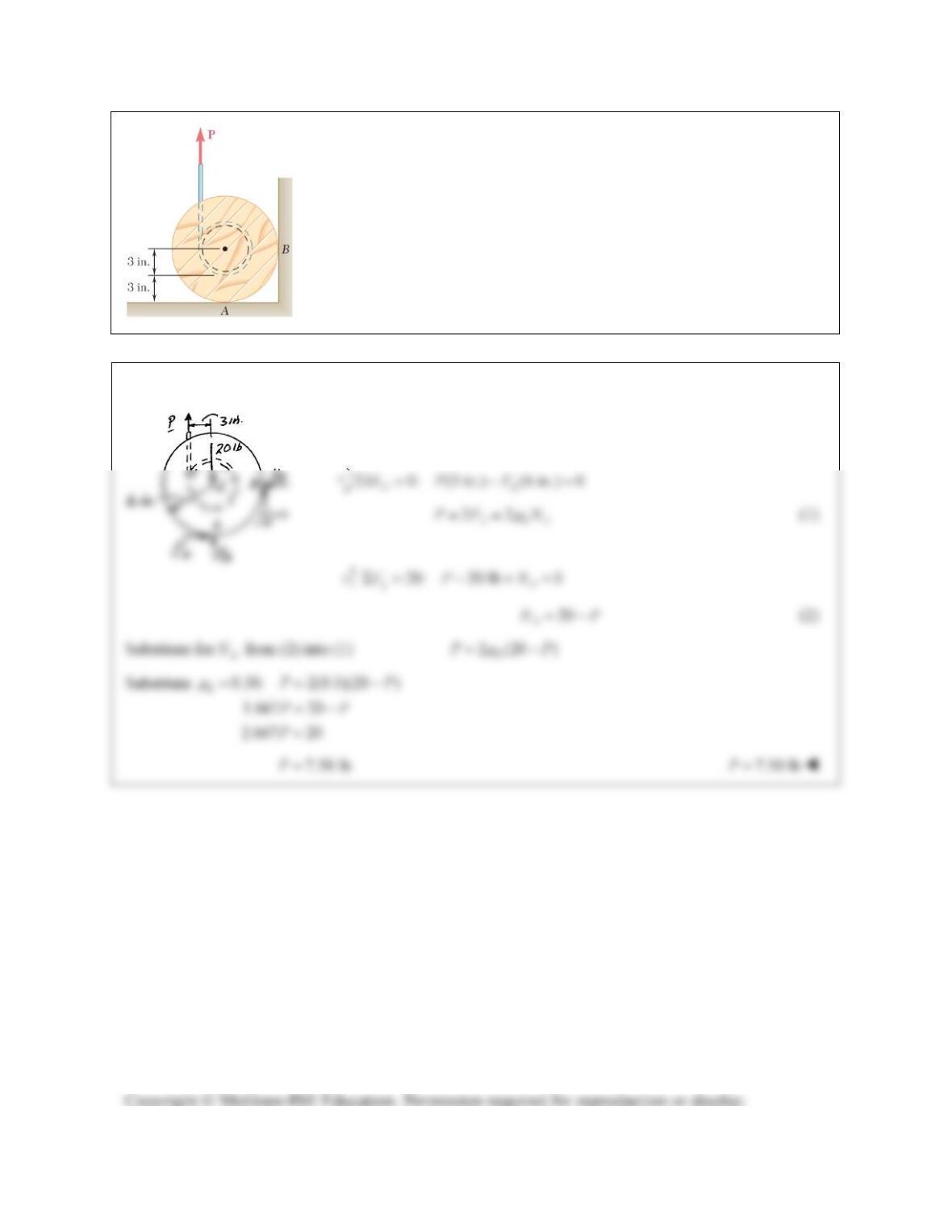
Wire is being drawn at a constant rate from a spool by applying a vertical
force
P
to the wire as shown. The spool and the wire wrapped on the spool
have a combined weight of 20 lb. Knowing that the coefficients of friction at
both A and B are
s
0.40 and
k
0.30, determine the required magnitude
of the force
P
.
SOLUTION
Since spool is rotating
AkA BkB
FNFN
0: (3 in.) (6 in.) (6 in.) 0
GAB
MPF F
36( )0
kA B
PNN
(1)
0: 0
xAB
FFN
PROBLEM 8.20
Solve Problem 8.19 assuming that the coefficients of friction at B are zero.
PROBLEM 8.19
Wire is being drawn at a constant rate from a spool by
applying a vertical force
P
to the wire as shown. The spool and the wire
wrapped on the spool have a combined weight of 20 lb. Knowing that the
coefficients of friction at both A and B are
s
0.40 and
k
0.30, determine
the required magnitude of the force
P
.
SOLUTION
Since spool is rotating
AkA
FN
PROBLEM 8.21
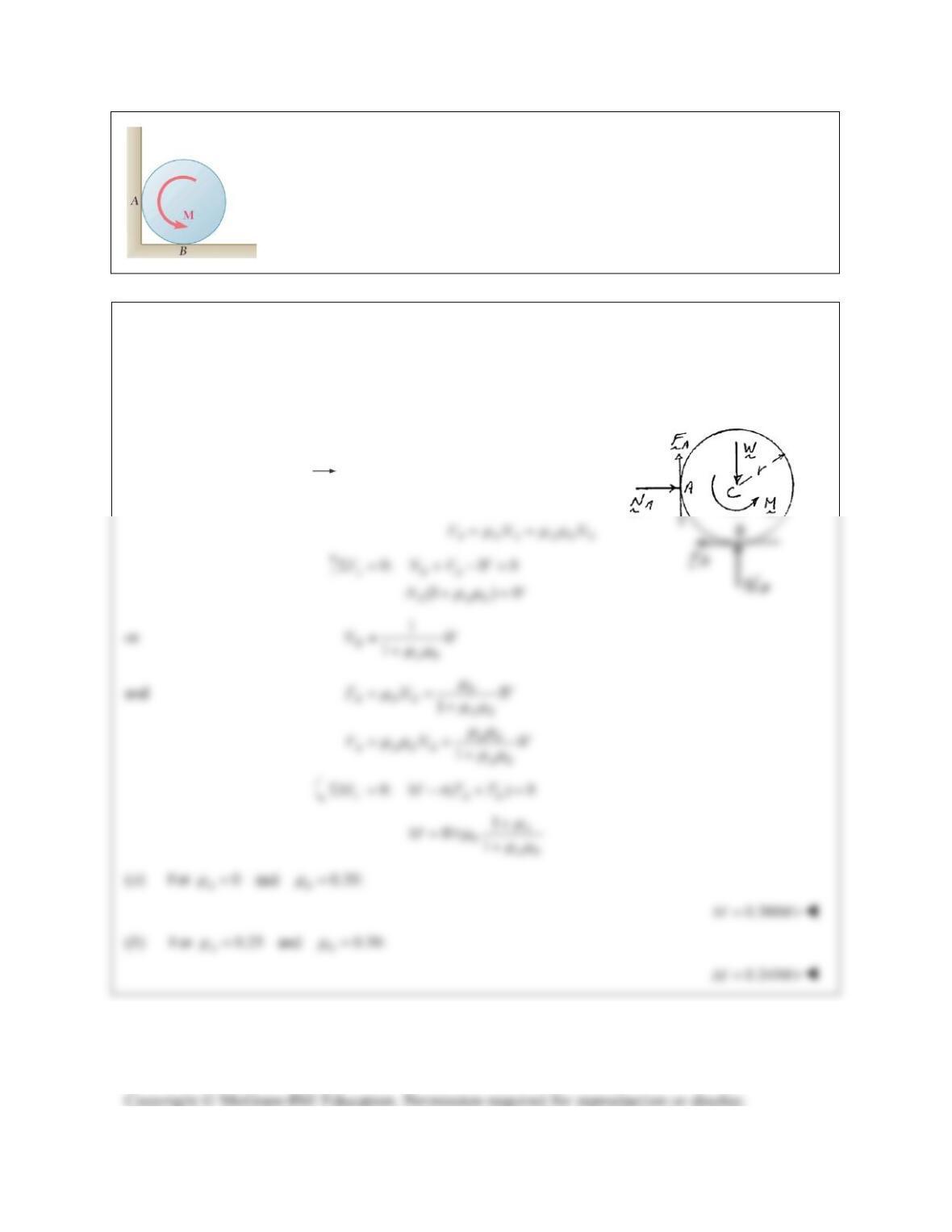
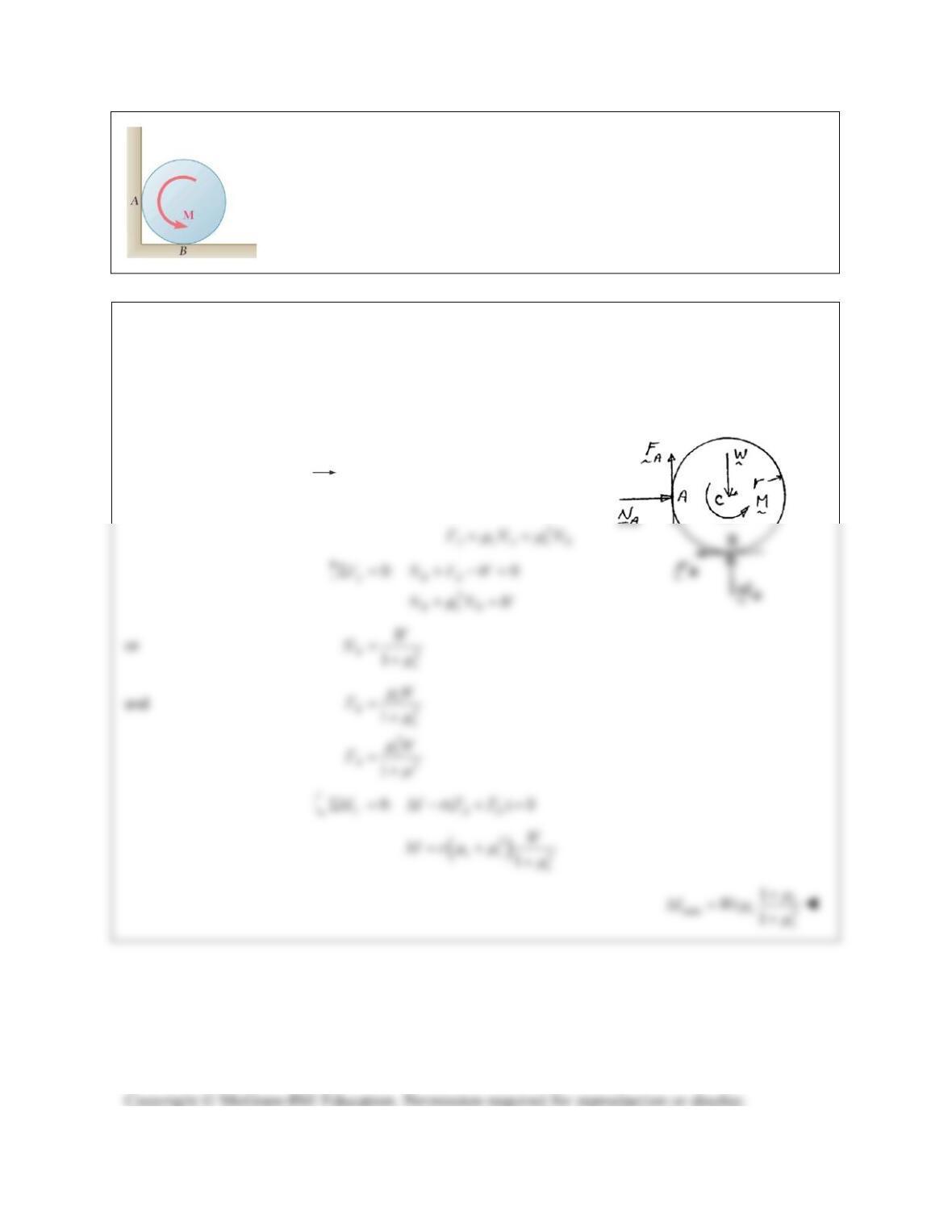
The cylinder shown is of weight W and radius r. Express in terms W and r the
magnitude of the largest couple
M
that can be applied to the cylinder if it is not to
rotate, assuming the coefficient of static friction to be (a) zero at A and 0.30 at B,
(b) 0.25 at A and 0.30 at B.
SOLUTION
FBD cylinder:
For maximum M, motion impends at both A and B
AAA
BBB
FN
FN
0: 0
xAB
AB BB
FNF
NF N
PROBLEM 8.22
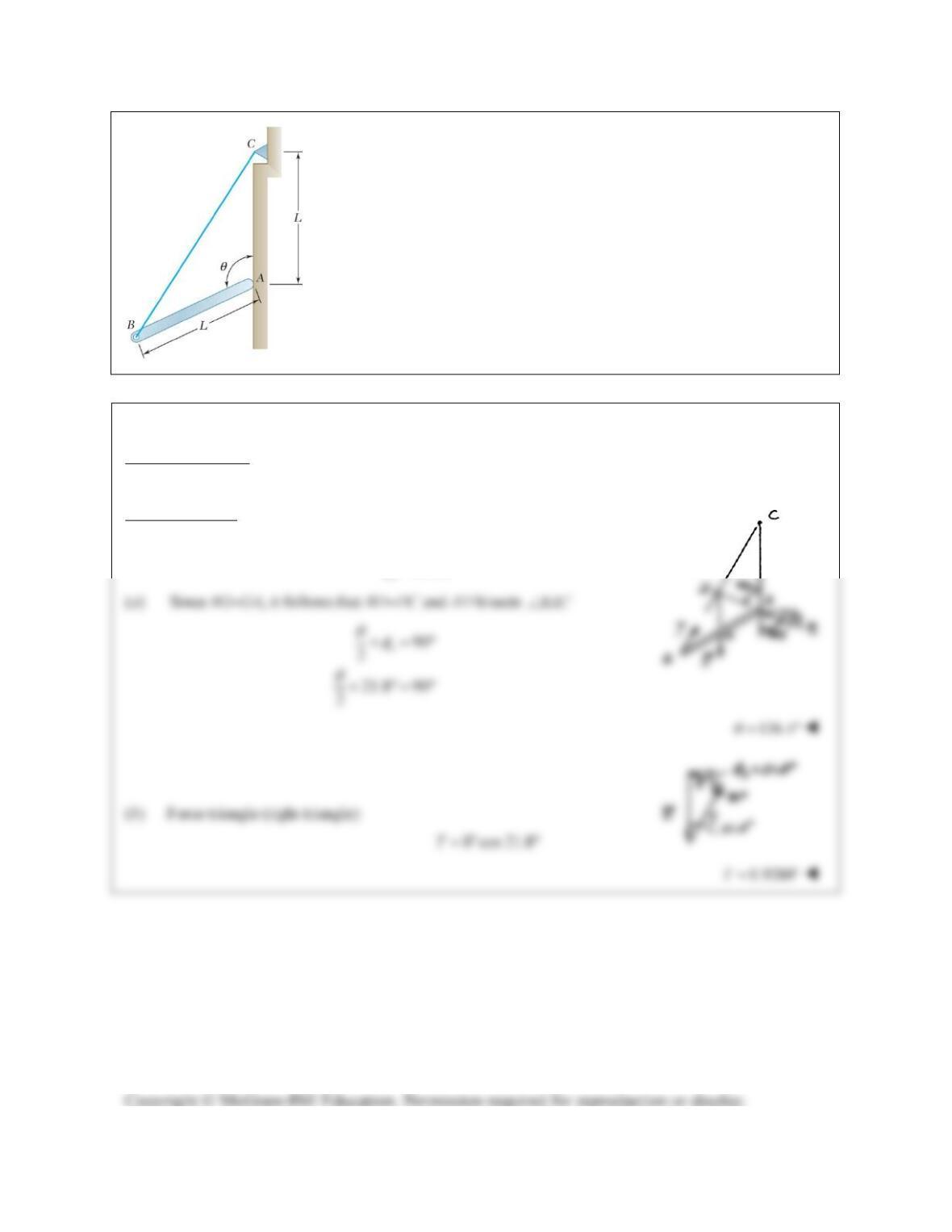
The cylinder shown is of weight W and radius r, and the coefficient of static
friction
s
is the same at A and B. Determine the magnitude of the largest couple
M
that can be applied to the cylinder if it is not to rotate.
SOLUTION
FBD cylinder:
For maximum M, motion impends at both A and B
AsA
BsB
FN
FN
0: 0
xAB
AB sB
FNF
NF N
PROBLEM 8.23
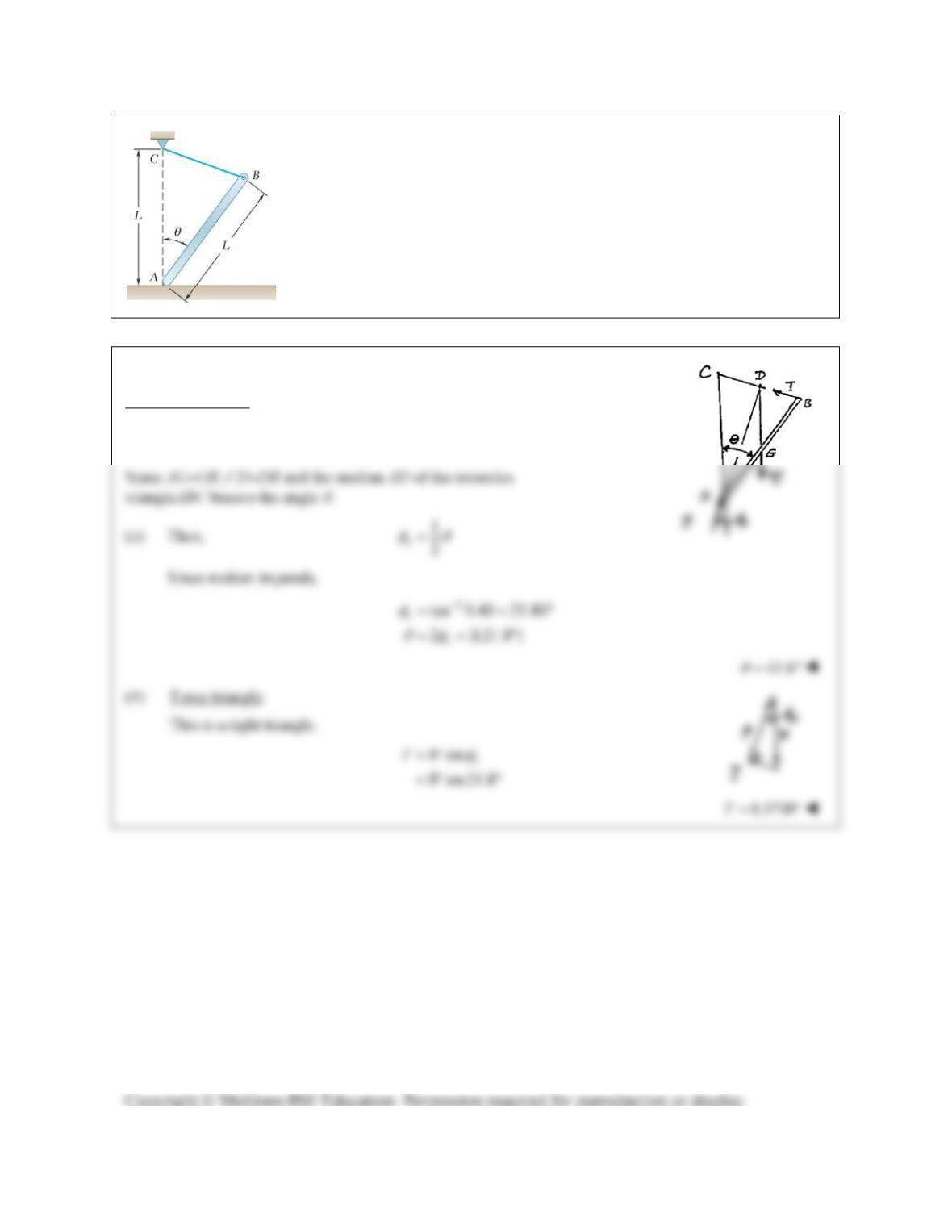
End A of a slender, uniform rod of length L and weight W bears on a
surface as shown, while end B is supported by a cord BC. Knowing that
the coefficients of friction are
0.40
s
and
0.30,
k
determine (a) the
largest value of
for which motion is impending, (b) the corresponding
value of the tension in the cord.
SOLUTION
Free-body diagram
Three-force body. Line of action of
R
must pass through D, where
T
and
R
intersect.
Motion impends:
tan 0.4
21.80
s
PROBLEM 8.24
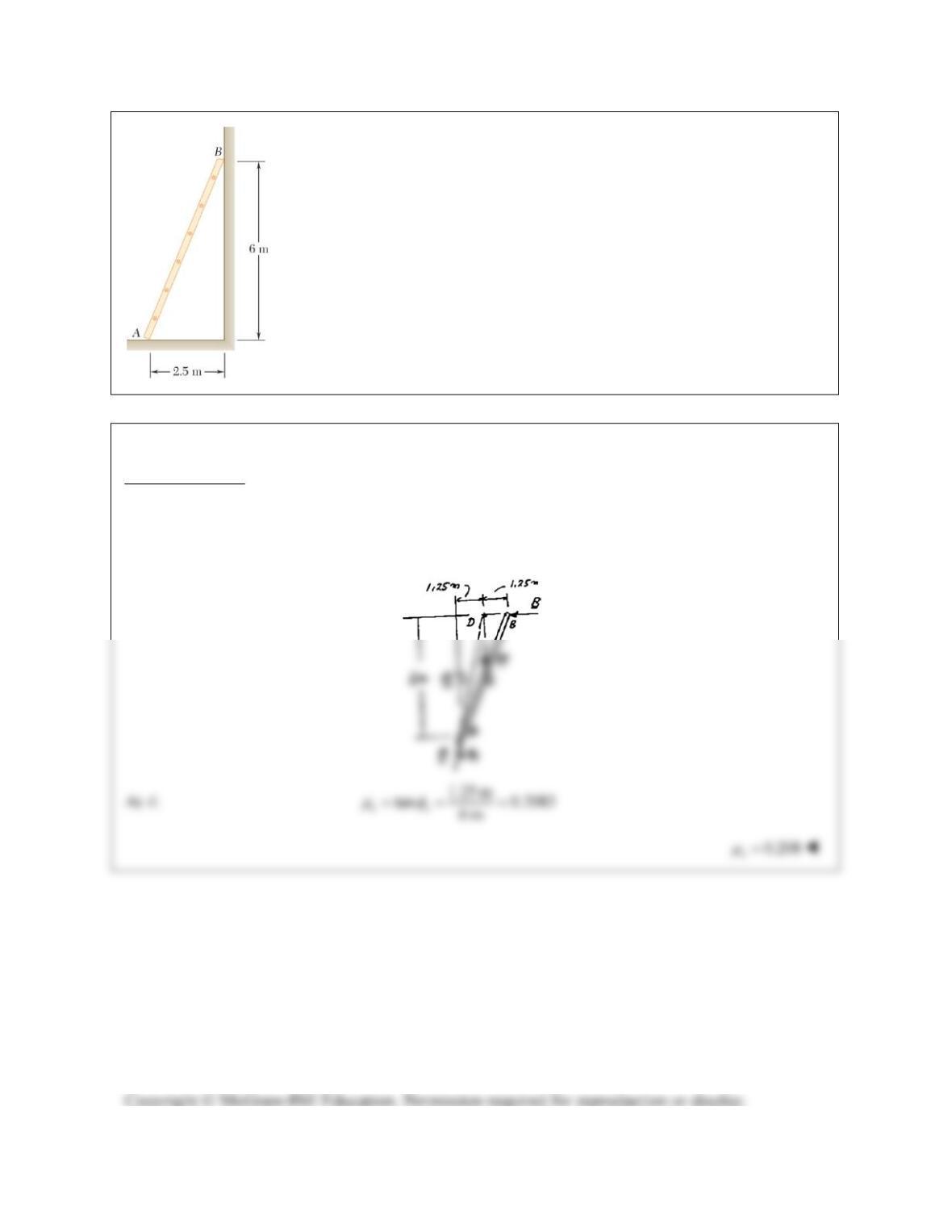
End A of a slender, uniform rod of length L and weight W bears on a surface as
shown, while end B is supported by a cord BC. Knowing that the coefficients
of friction are
0.40
s
and
0.30,
k
determine (a) the largest value of
for which motion is impending, (b) the corresponding value of the tension in the
cord.
SOLUTION
Free-body diagram
Rod AB is a three-force body. Thus, line of action of
R
must pass through D,
where
W
and
T
intersect.
PROBLEM 8.25
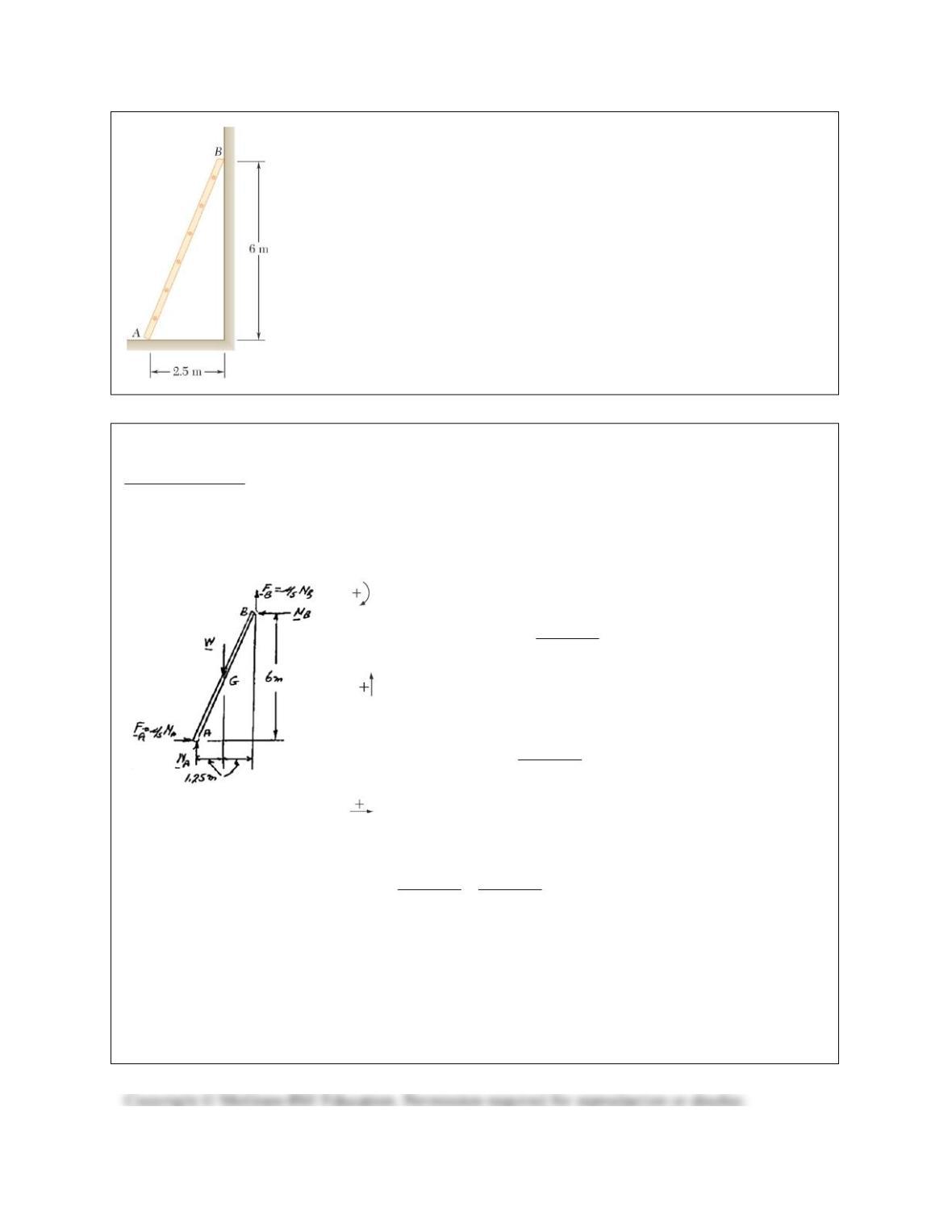
A 6.5-m ladder AB leans against a wall as shown. Assuming that the coefficient
of static friction
s
is zero at B, determine the smallest value of
s
at A for
which equilibrium is maintained.
SOLUTION
Free body: Ladder
Three-force body.
Line of action of
A
must pass through D, where
W
and
B
intersect.
PROBLEM 8.26
A 6.5-m ladder AB leans against a wall as shown. Assuming that the coefficient
of static friction
s
is the same at A and B, determine the smallest value of
s
for which equilibrium is maintained.
SOLUTION
Free body: Ladder
Motion impending:
AsA
BsB
FN
FN
0: (1.25m) (6m) (2.5m) 0
ABsB
MW N N
1.25
62.5
B
s
W
N
(1)
0: 0
yAsB
FNNW
1.25
62.5
AsB
s
A
s
NW N
W
NW
(2)
0: 0
xsAB
FNN
Substitute for
A
N
and
B
N
from Eqs. (1) and (2):
2
22
2
1.25 1.25
62.5 62.5
6 2.5 1.25 1.25
1.25 6 1.25 0
0.2
s
s
ss
ss s
ss
s
WW
W
and
5 (Discard)
s
0.200
s
PROBLEM 8.27
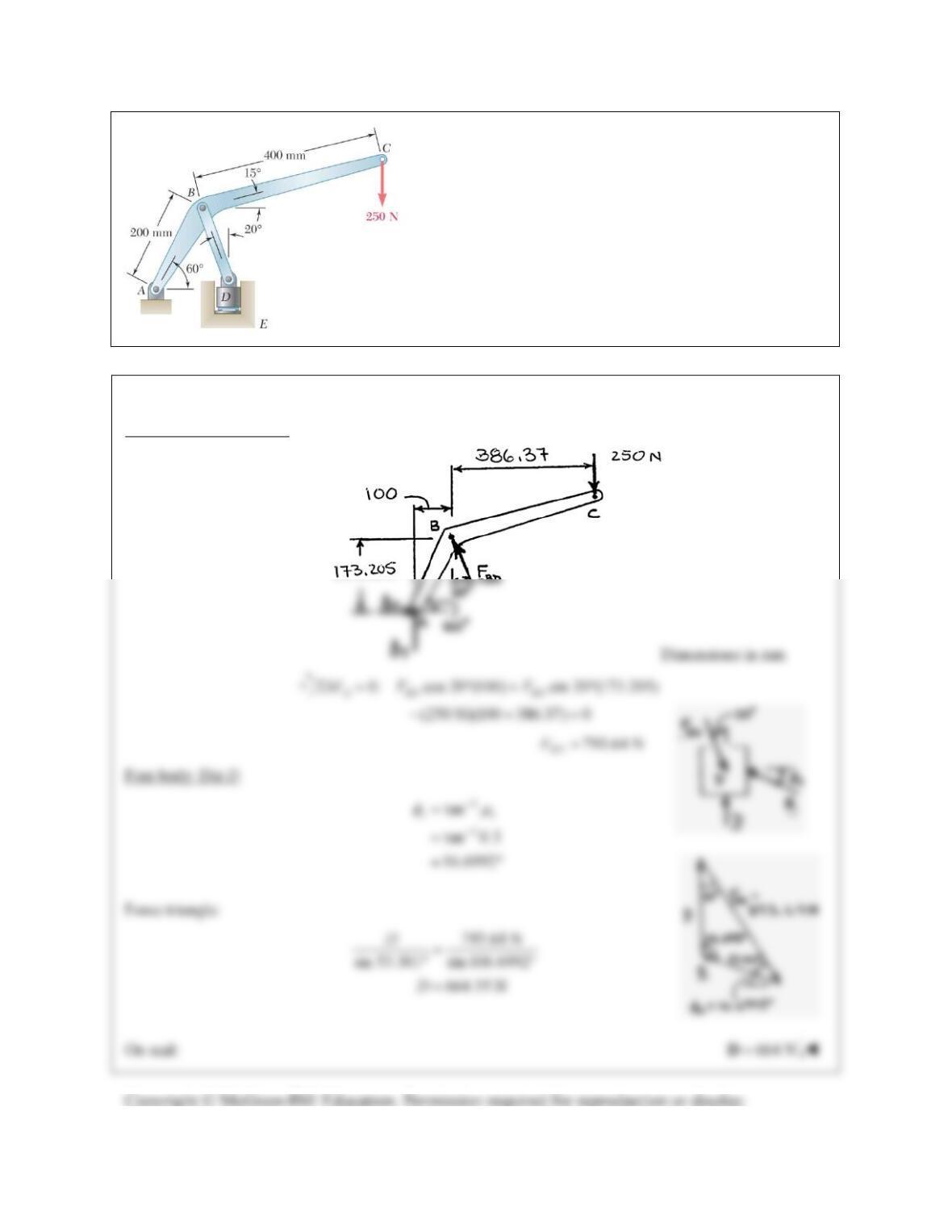
The press shown is used to emboss a small seal at E.
Knowing that the coefficient of static friction between the
vertical guide and the embossing die D is 0.30, determine the
force exerted by the die on the seal.
SOLUTION
Free body: Member ABC
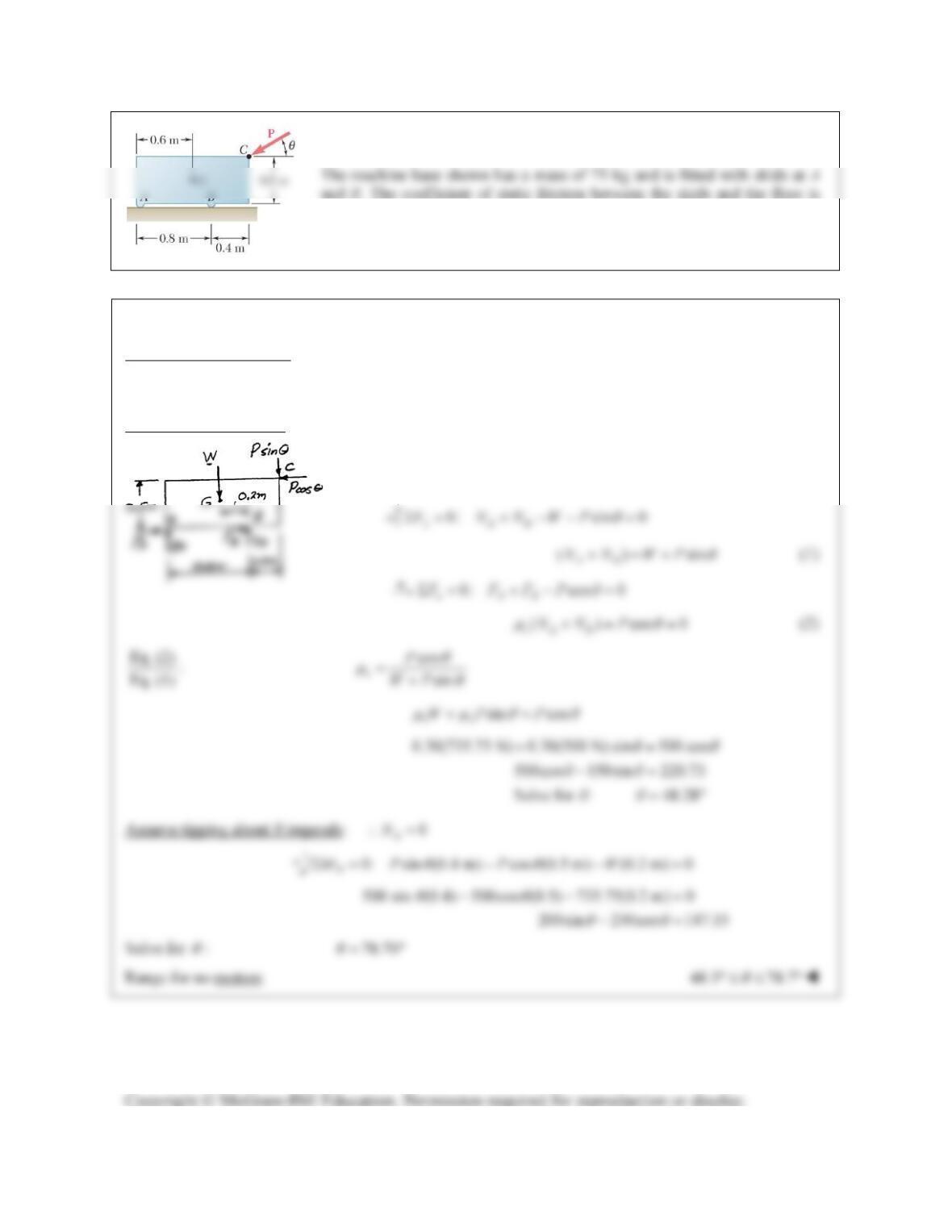
PROBLEM 8.28
0.30. If a force
P
of magnitude 500 N is applied at corner C, determine the
range of values of θ for which the base will not move.
SOLUTION
Free-body: Machine base
2
(75 kg)(9.81 m/s ) 735.75 Nm
Assume sliding impends
AsA BsB
FN FN
PROBLEM 8.29
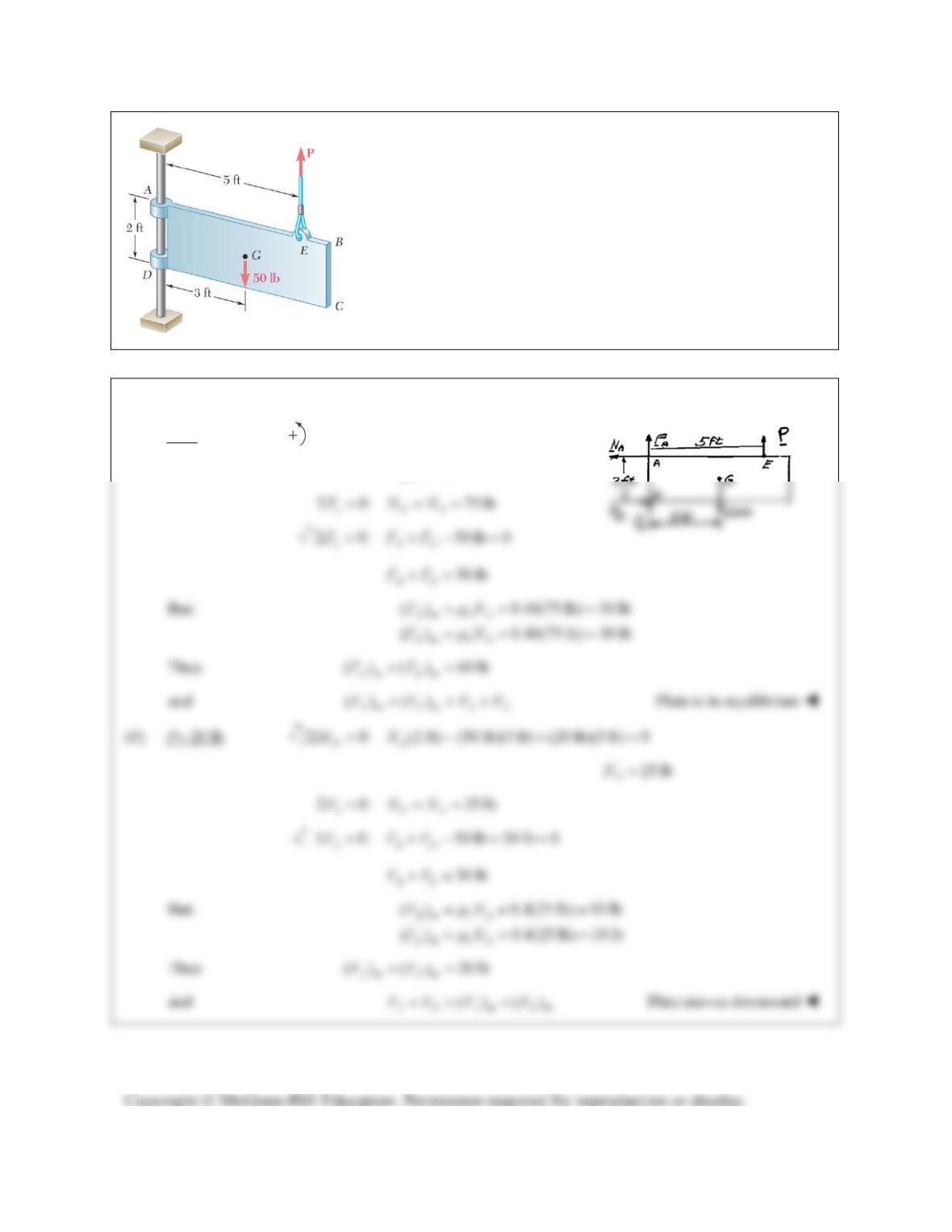
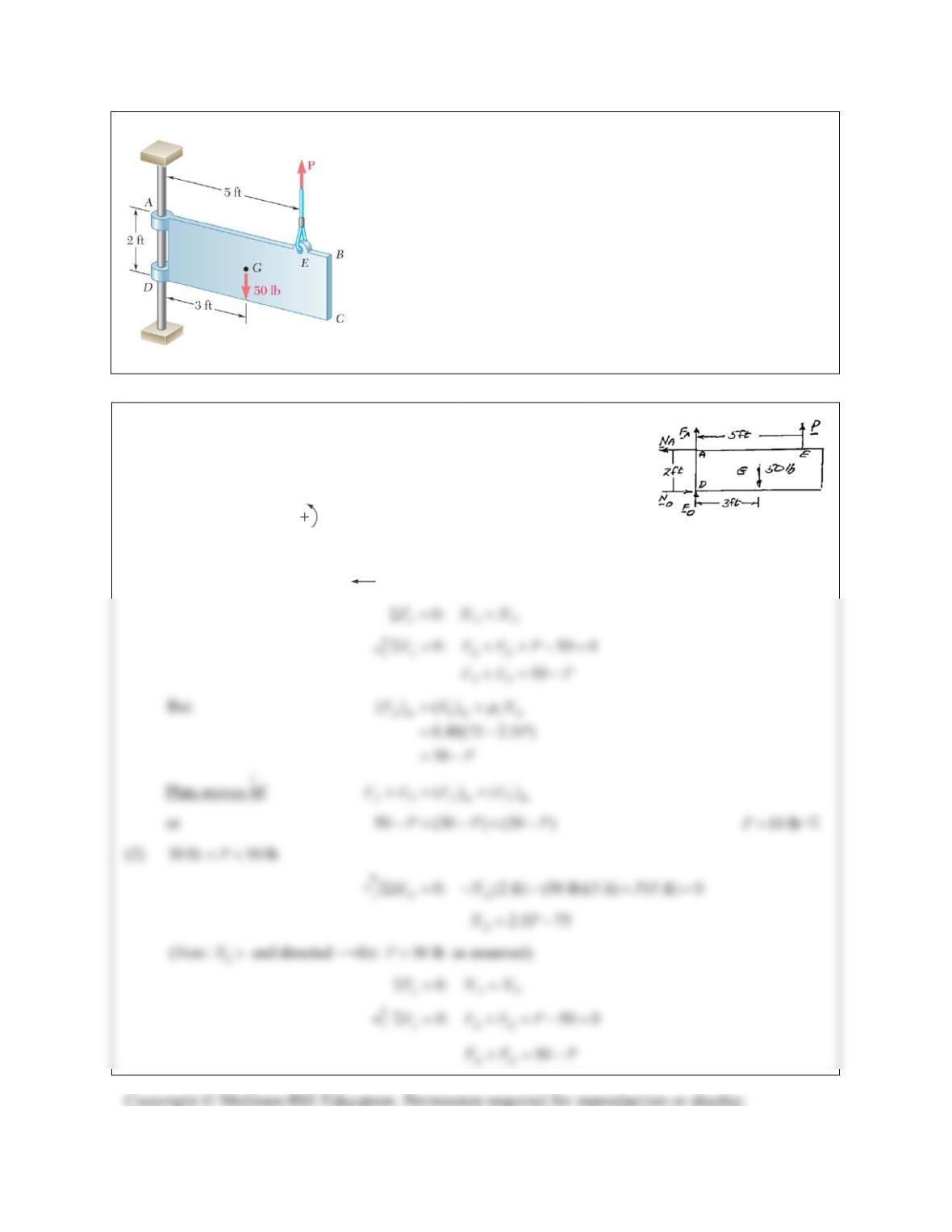
The 50-lb plate ABCD is attached at A and D to collars that can slide
on the vertical rod. Knowing that the coefficient of static friction is
0.40 between both collars and the rod, determine whether the plate is
in equilibrium in the position shown when the magnitude of the
vertical force applied at E is (a)
0,P
(b)
20 lb.P
SOLUTION
(a) P 0
0: (2 ft) (50 lb)(3 ft) 0
DA
MN
75 lb
A
N
PROBLEM 8.30
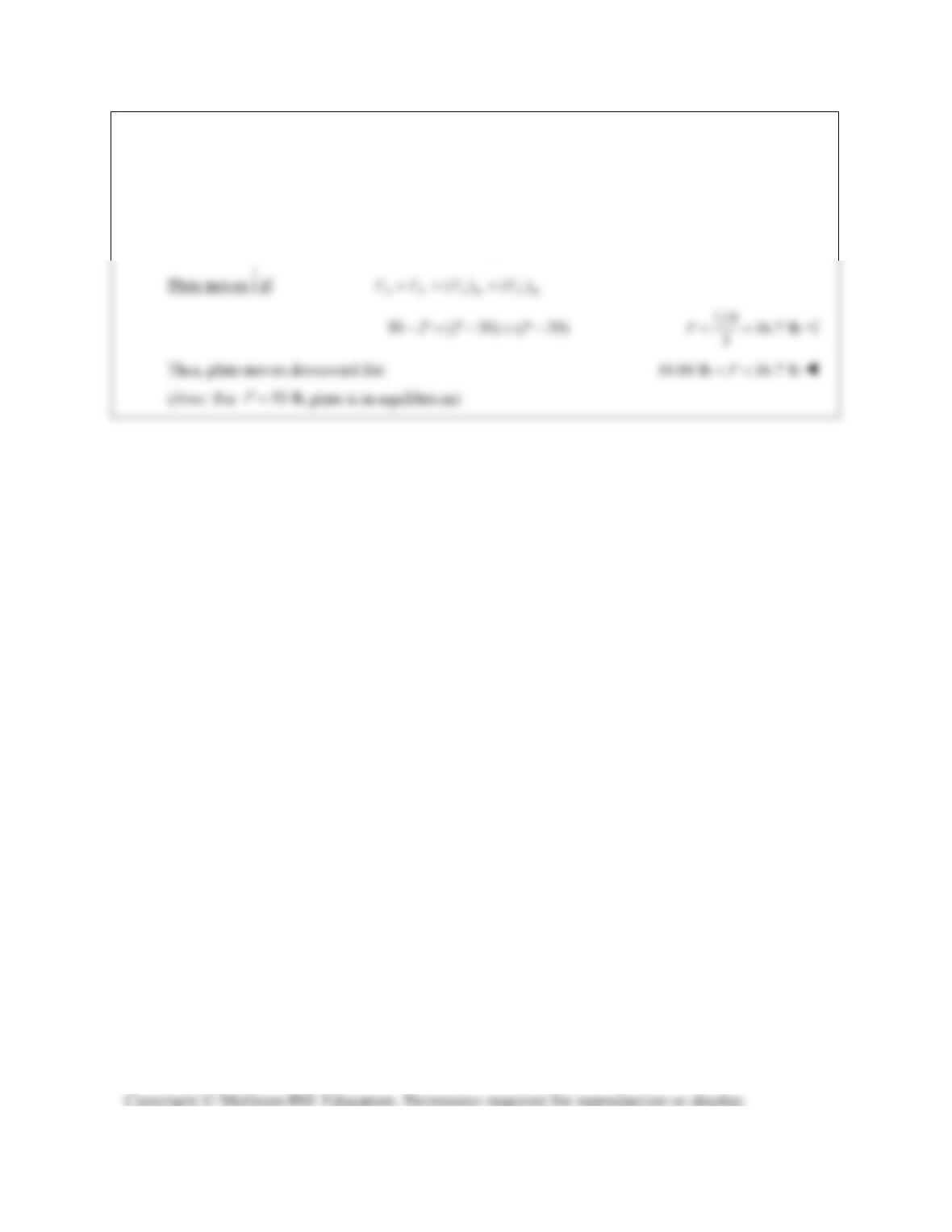
In Problem 8.29, determine the range of values of the magnitude P of
the vertical force applied at E for which the plate will move
downward.
PROBLEM 8.29
The 50-lb plate ABCD is attached at A and D to
collars that can slide on the vertical rod. Knowing that the coefficient
of static friction is 0.40 between both collars and the rod, determine
whether the plate is in equilibrium in the position shown when the
magnitude of the vertical force applied at E is (a)
0,P
(b)
20 lb.P
SOLUTION
We shall consider the following two cases:
(1)
030 lbP
0: (2 ft) (50 lb)(3 ft) (5 ft) 0
DA
MN P
75 lb 2.5
A
NP
(Note:
0
A
N
and directed for
30 lbP
as assumed here)
PROBLEM 8.30 (Continued)
But: () ()
0.40(2.5 75)
30 lb
Am Dm s A
FF N
P
P
PROBLEM 8.31
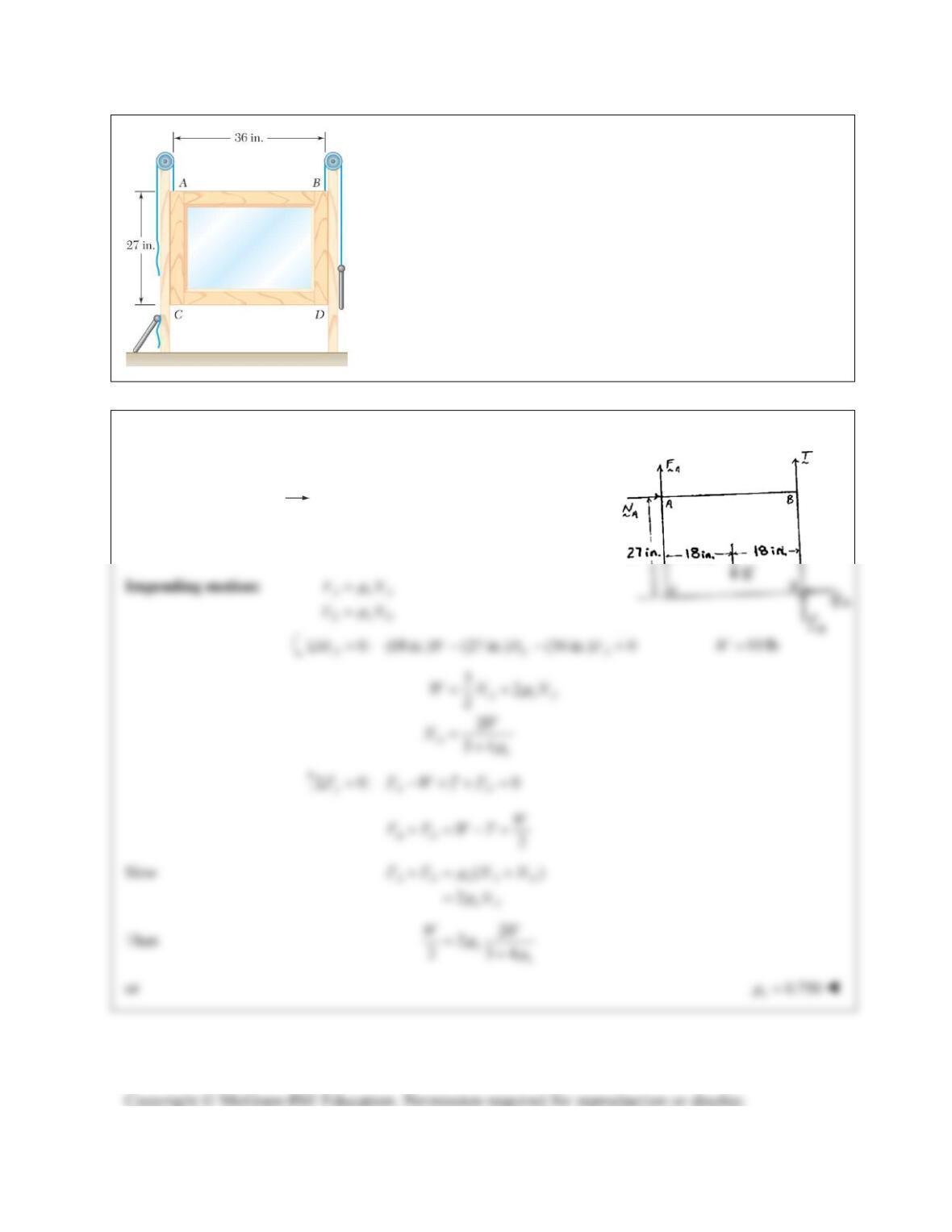
A window sash weighing 10 lb is normally supported by two 5-lb sash
weights. Knowing that the window remains open after one sash cord
has broken, determine the smallest possible value of the coefficient of
static friction. (Assume that the sash is slightly smaller than the frame
and will bind only at Points A and D.)
SOLUTION
FBD window:
5lb
T
0: 0
xAD
AD
FNN
NN
PROBLEM 8.32
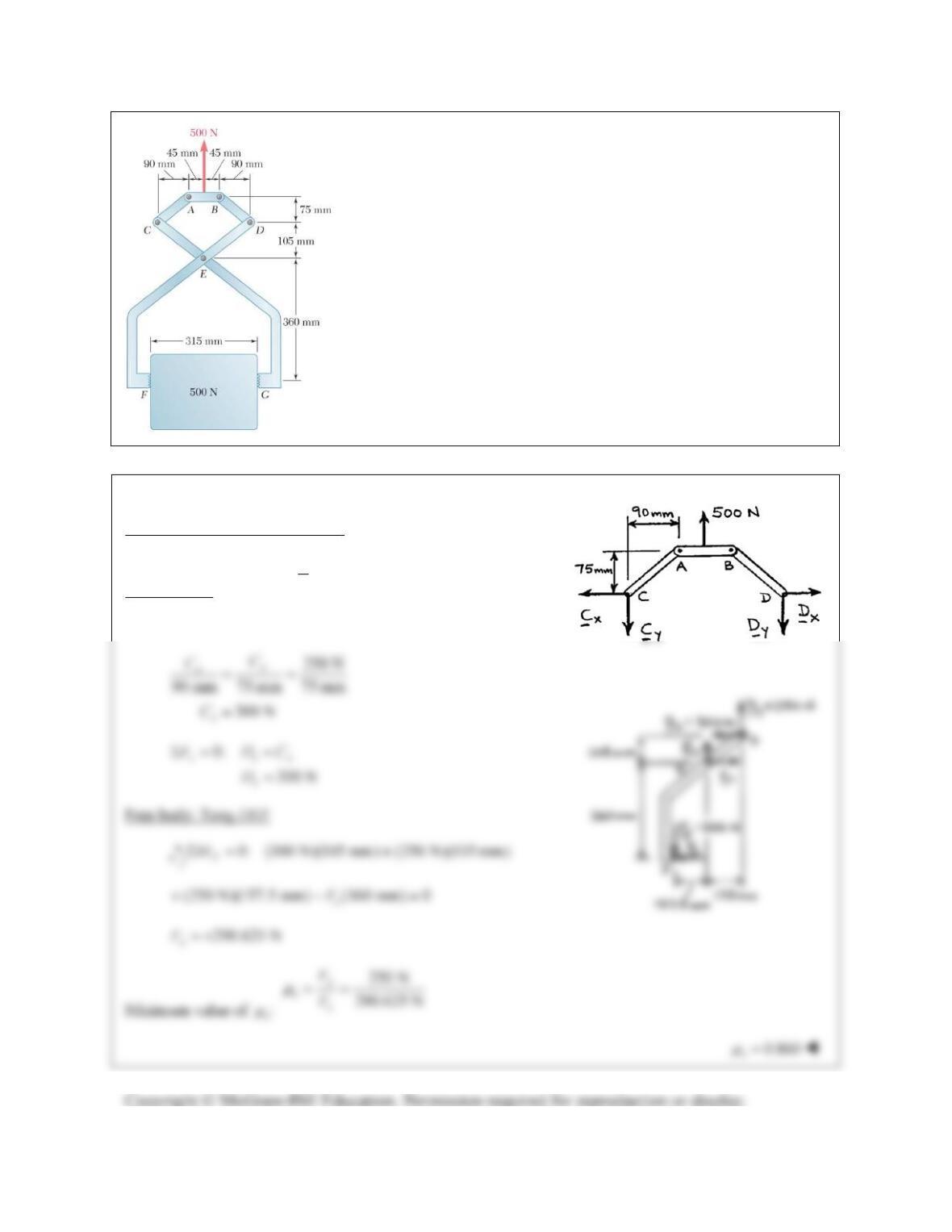
A 500-N concrete block is to be lifted by the pair of tongs shown.
Determine the smallest allowable value of the coefficient of static
friction between the block and the tongs at F and G.
SOLUTION
Free body: Members CA, AB, BD
By symmetry:
1(500) 250 N
2
yy
CD
Since CA is a two-force member,