PROBLEM 8.95*
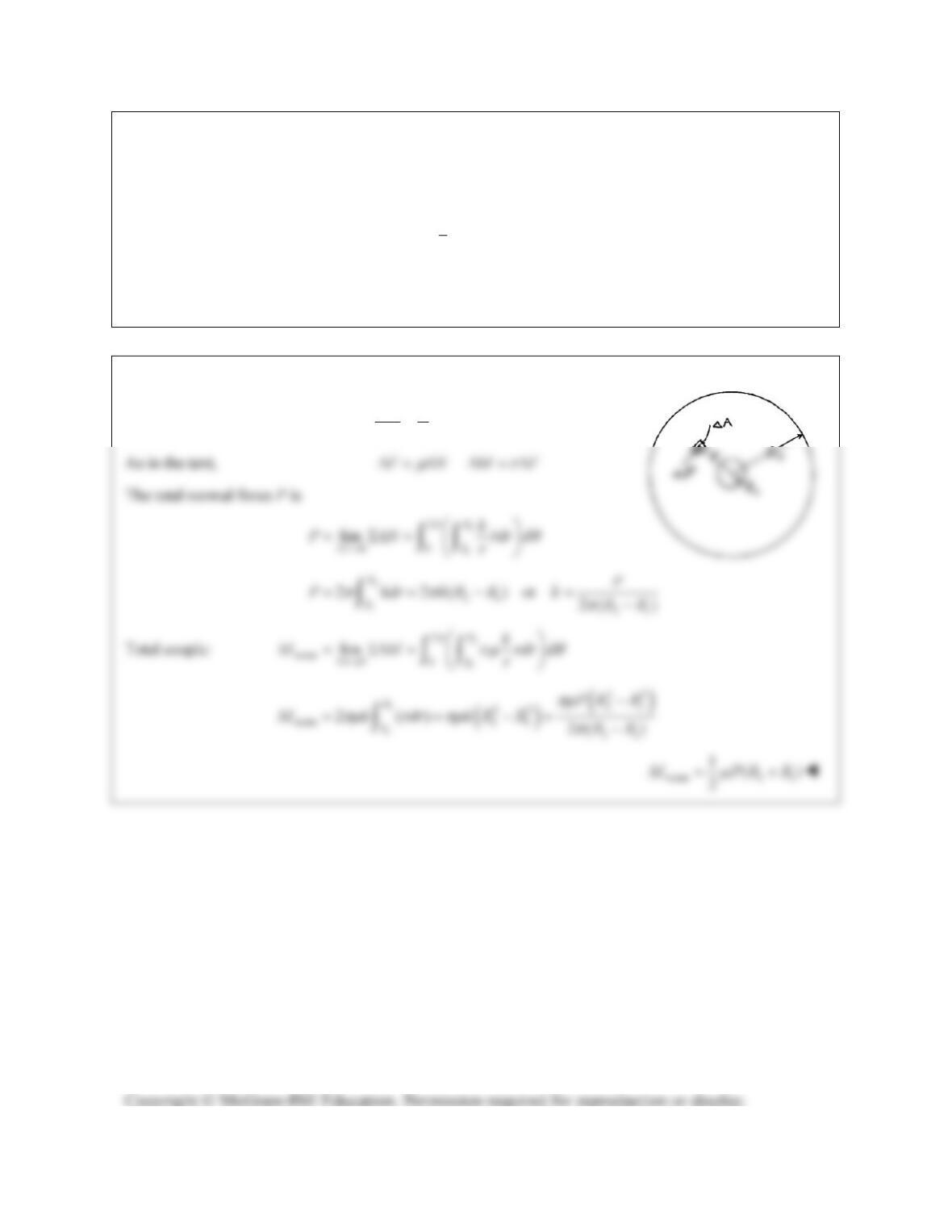
Assuming that bearings wear out as indicated in Problem 8.94, show that the magnitude M of the couple
required to overcome the frictional resistance of a worn-out collar bearing is
1
12
2
()
k
MPRR
where P magnitude of the total axial force
R
1
, R
2
inner and outer radii of collar
SOLUTION
Let normal force on
A
be
,N
and
.
Nk
Ar
PROBLEM 8.96*
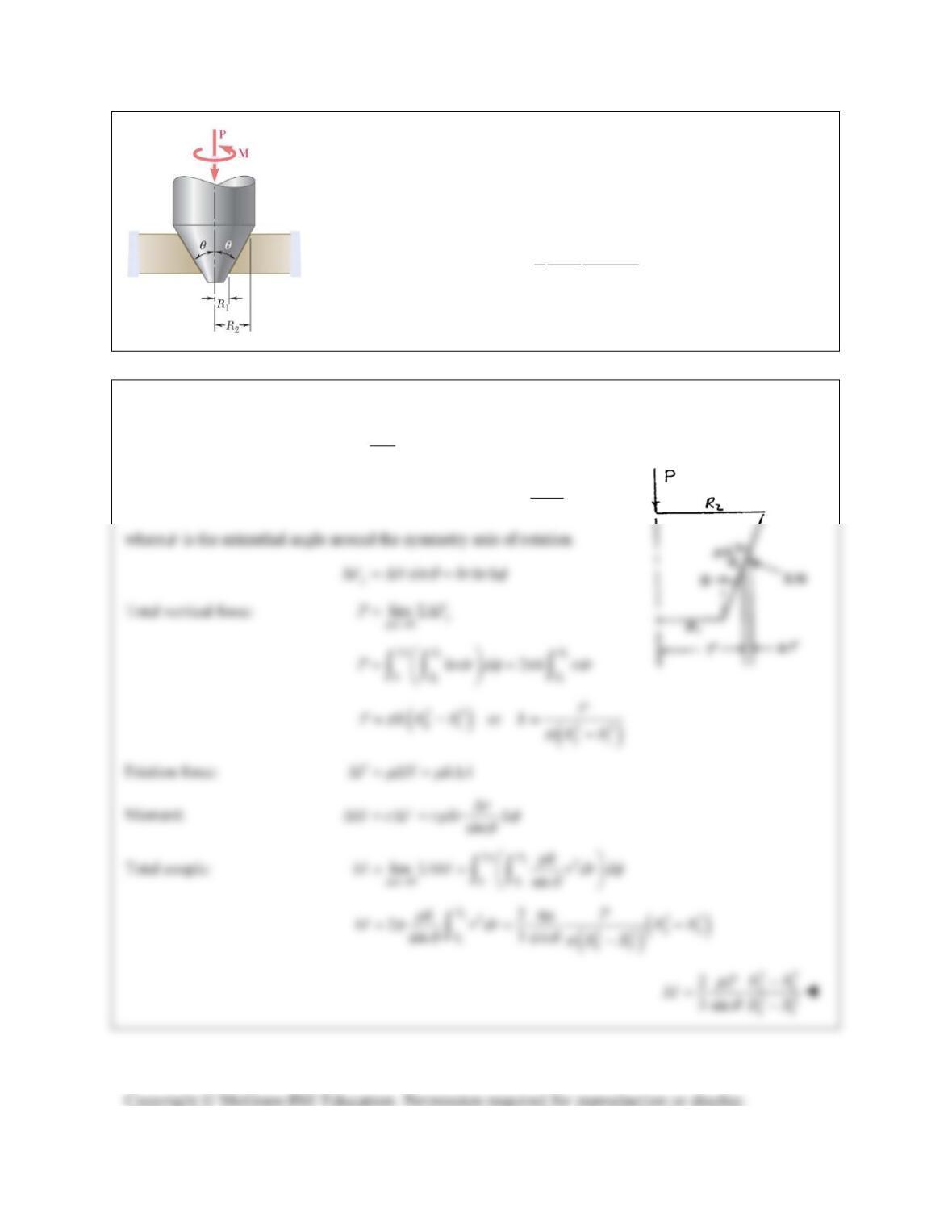
Assuming that the pressure between the surfaces of contact is uniform,
show that the magnitude M of the couple required to overcome frictional
resistance for the conical bearing shown is
33
21
22
21
2
3sin
k
PRR
MRR
SOLUTION
Let normal force on
A
be
N
and
.
Nk
A
So
sin
r
NkA Ars s
PROBLEM 8.97
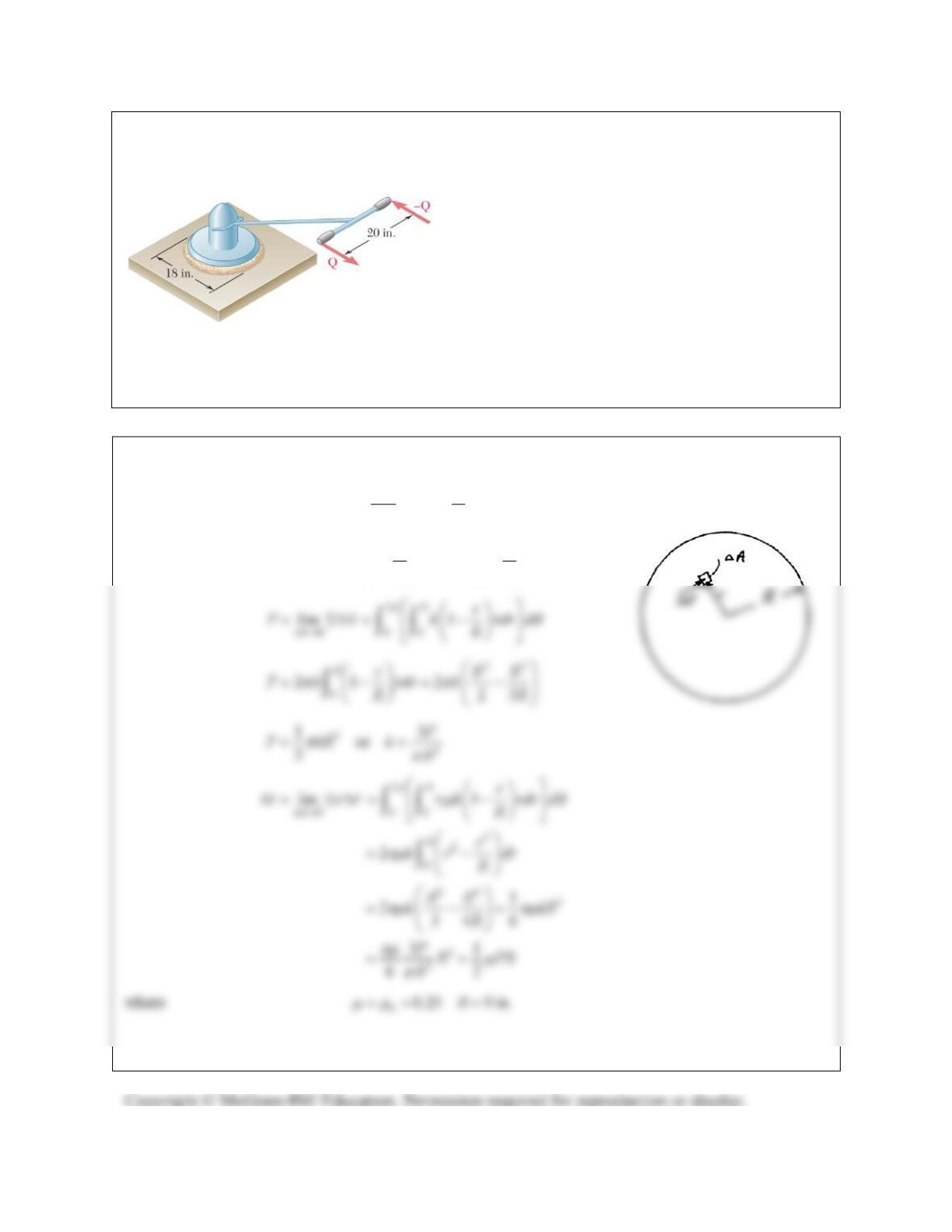
Solve Problem 8.93 assuming that the normal force per
unit area between the disk and the floor varies linearly
from a maximum at the center to zero at the
circumference of the disk.
PROBLEM 8.93 A 50-lb electric floor polisher is
operated on a surface for which the coefficient of
kinetic friction is 0.25. Assuming that the normal force
per unit area between the disk and the floor is
uniformly distributed, determine the magnitude Q of the
horizontal forces required to prevent motion of the
machine.
SOLUTION
Let normal force on
A
be
N
and
1.
Nr
k
AR
11
rr
FNk Ak rr
RR
PROBLEM 8.97 (Continued)
50 lbPW
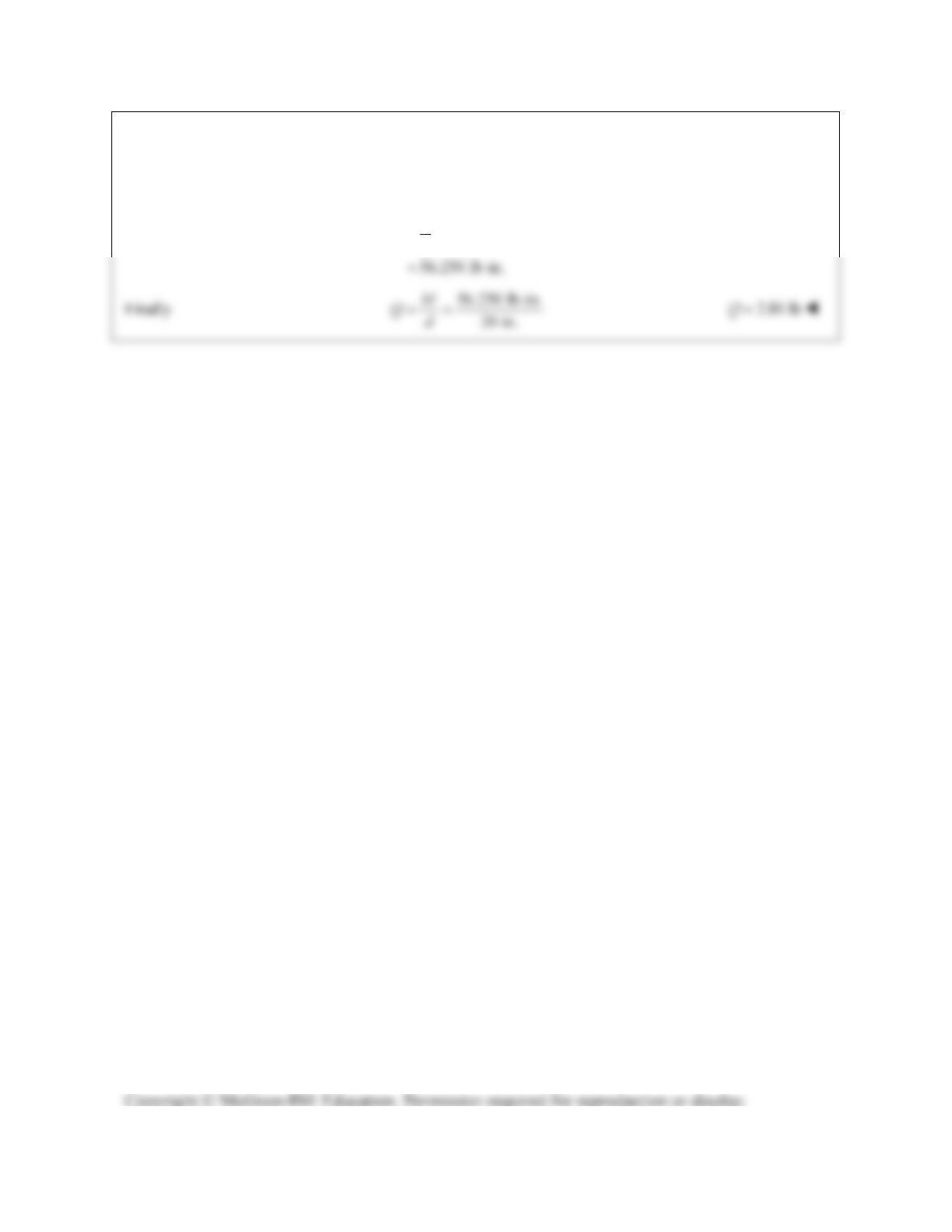
Then 1(0.25)(50 lb)(9 in.)
2
M
PROBLEM 8.98
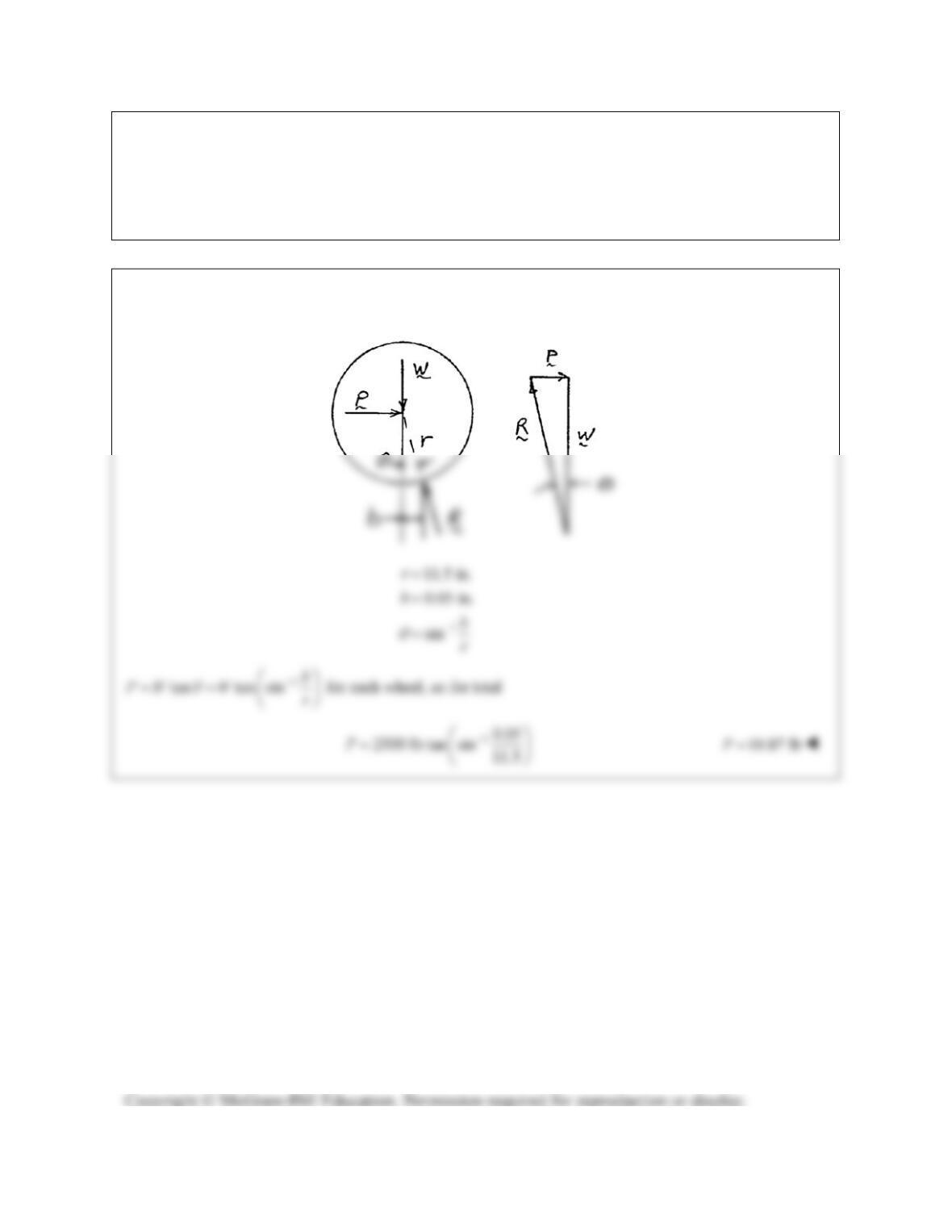
Determine the horizontal force required to move a 2500-lb automobile with 23-in.-diameter tires along a
horizontal road at a constant speed. Neglect all forms of friction except rolling resistance, and assume the
coefficient of rolling resistance to be 0.05 in.
SOLUTION
FBD wheel:
PROBLEM 8.99
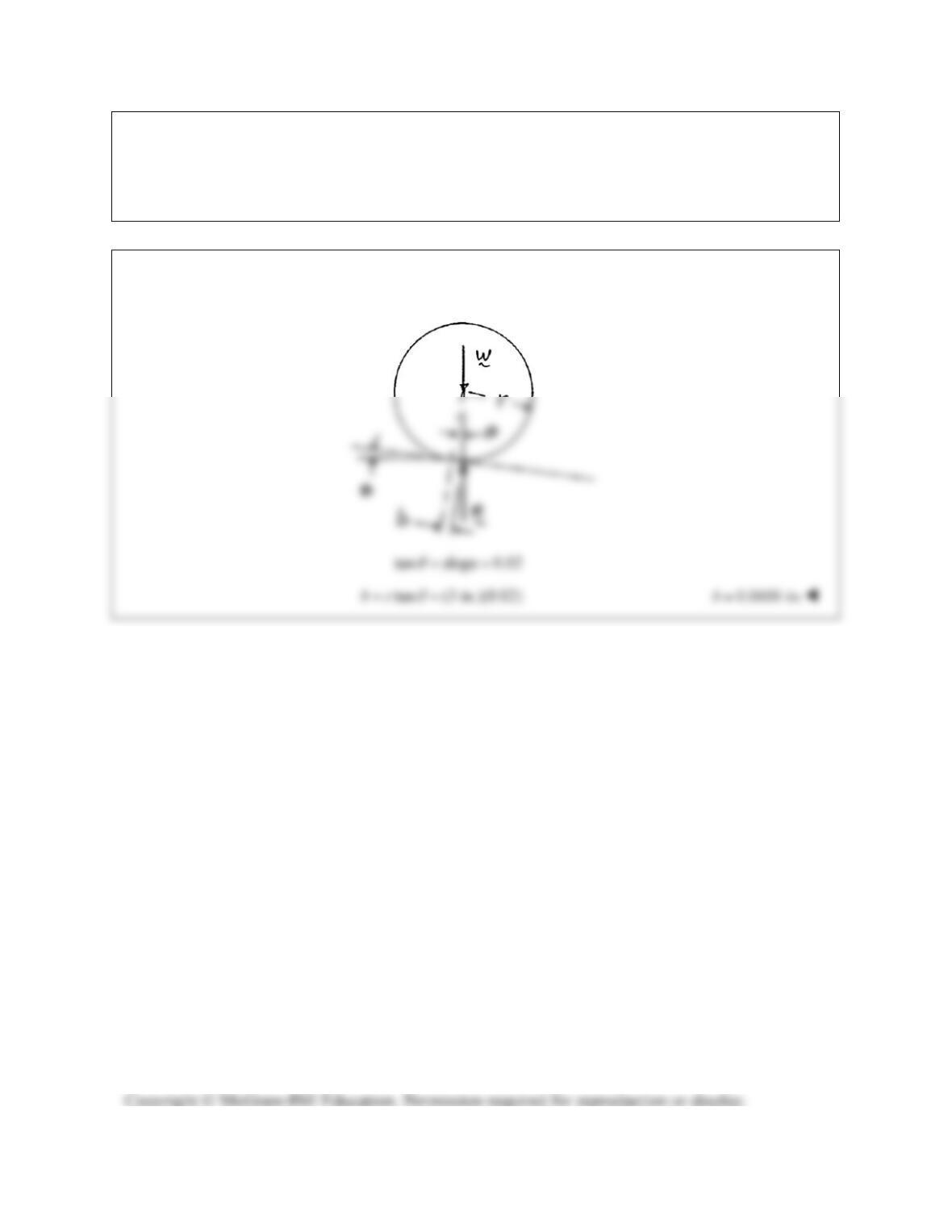
Knowing that a 6-in.-diameter disk rolls at a constant velocity down a 2 percent incline, determine the
coefficient of rolling resistance between the disk and the incline.
SOLUTION
FBD disk:
PROBLEM 8.100
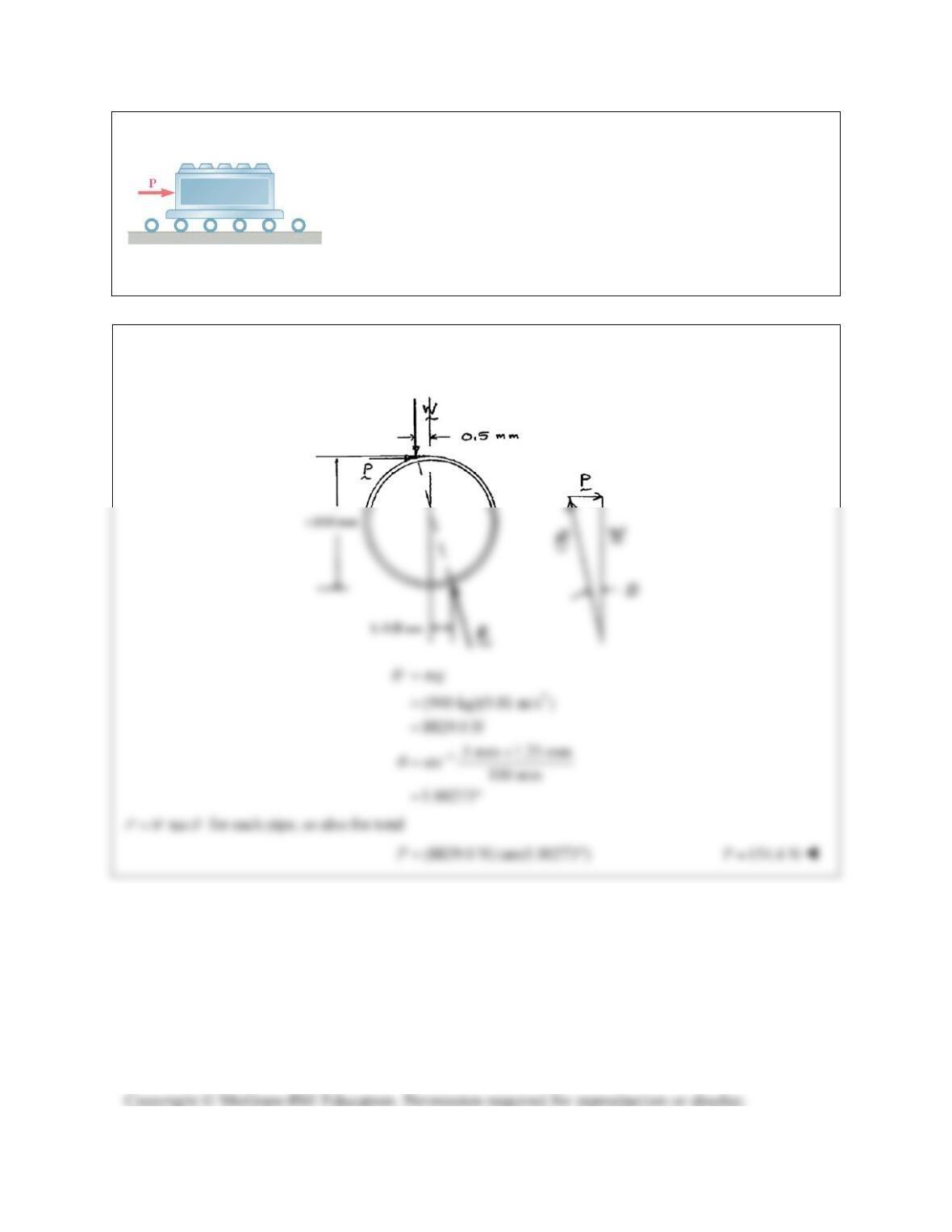
A 900-kg machine base is rolled along a concrete floor using a series of
steel pipes with outside diameters of 100 mm. Knowing that the
coefficient of rolling resistance is 0.5 mm between the pipes and the
base and 1.25 mm between the pipes and the concrete floor, determine
the magnitude of the force
P
required to slowly move the base along the
floor.
SOLUTION
FBD pipe:
PROBLEM 8.101
Solve Problem 8.85 including the effect of a coefficient of rolling resistance of 1.75 mm.
PROBLEM 8.85
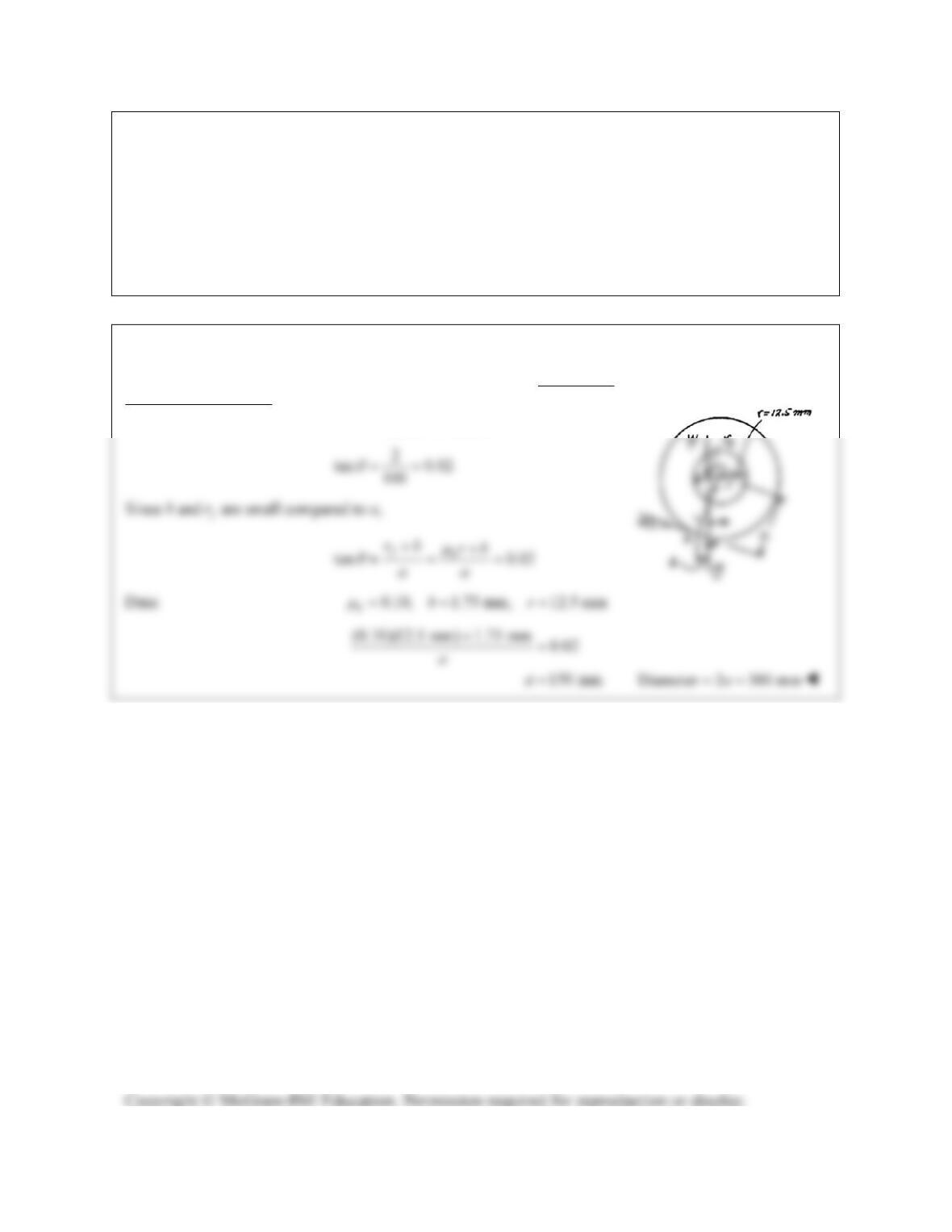
A scooter is to be designed to roll down a 2 percent slope at a constant speed.
Assuming that the coefficient of kinetic friction between the 25-mm-diameter axles and the bearings is
0.10, determine the required diameter of the wheels. Neglect the rolling resistance between the wheels
and the ground.
SOLUTION
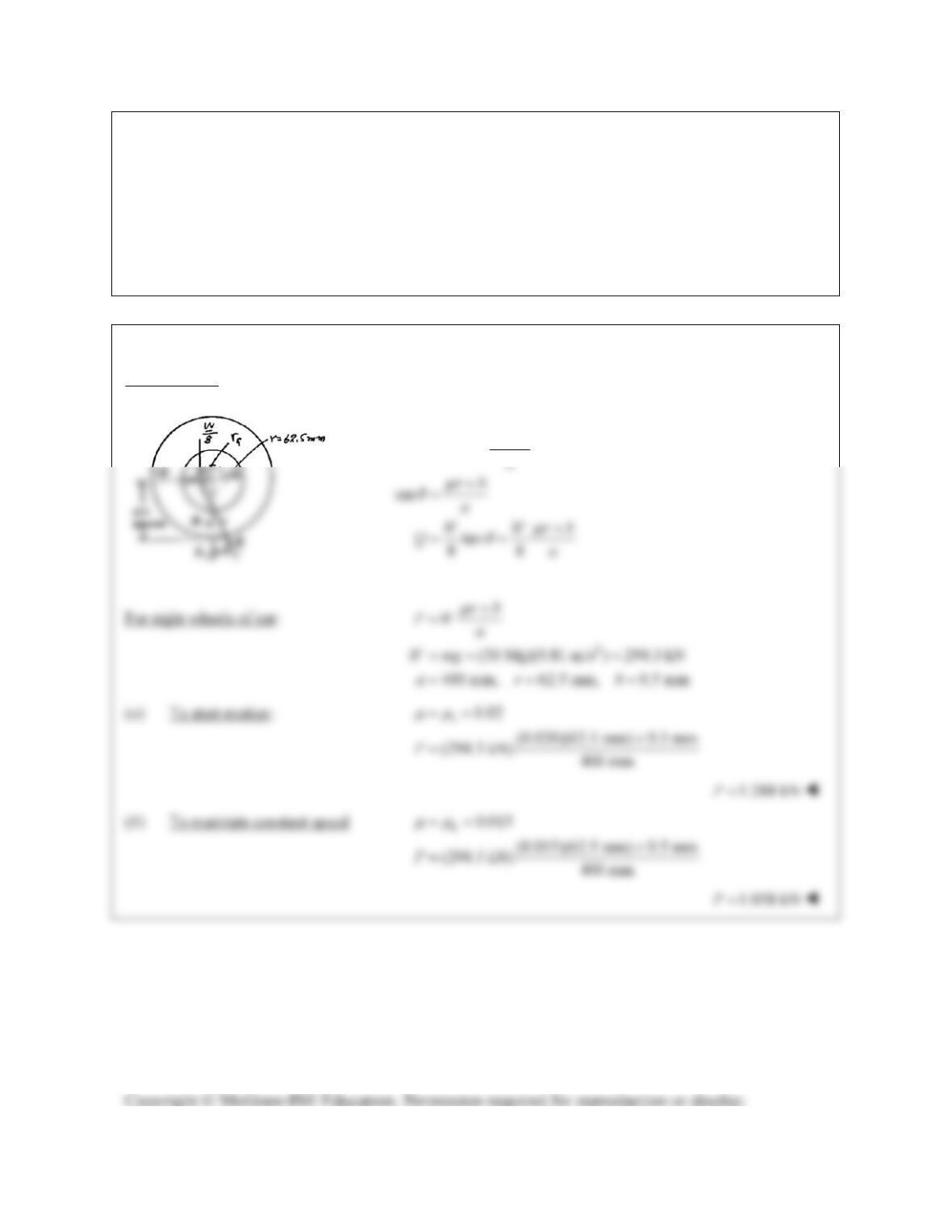
Since the scooter rolls at a constant speed, each wheel is in equilibrium. Thus,
W
and
R
must have a
common line of action tangent to the friction circle.
Radius of wheela
PROBLEM 8.102
Solve Problem 8.91 including the effect of a coefficient of rolling resistance of 0.5 mm.
PROBLEM 8.91
A loaded railroad car has a mass of 30 Mg and is supported by eight 800-mm-diameter
wheels with 125-mm-diameter axles. Knowing that the coefficients of friction are
0.020
s
and
0.015,
k
determine the horizontal force required (a) to start the car moving, (b) to keep the car moving at a constant
speed. Neglect rolling resistance between the wheels and the track.
SOLUTION
For one wheel:
tan sin
f
f
rr
rb
PROBLEM 8.103
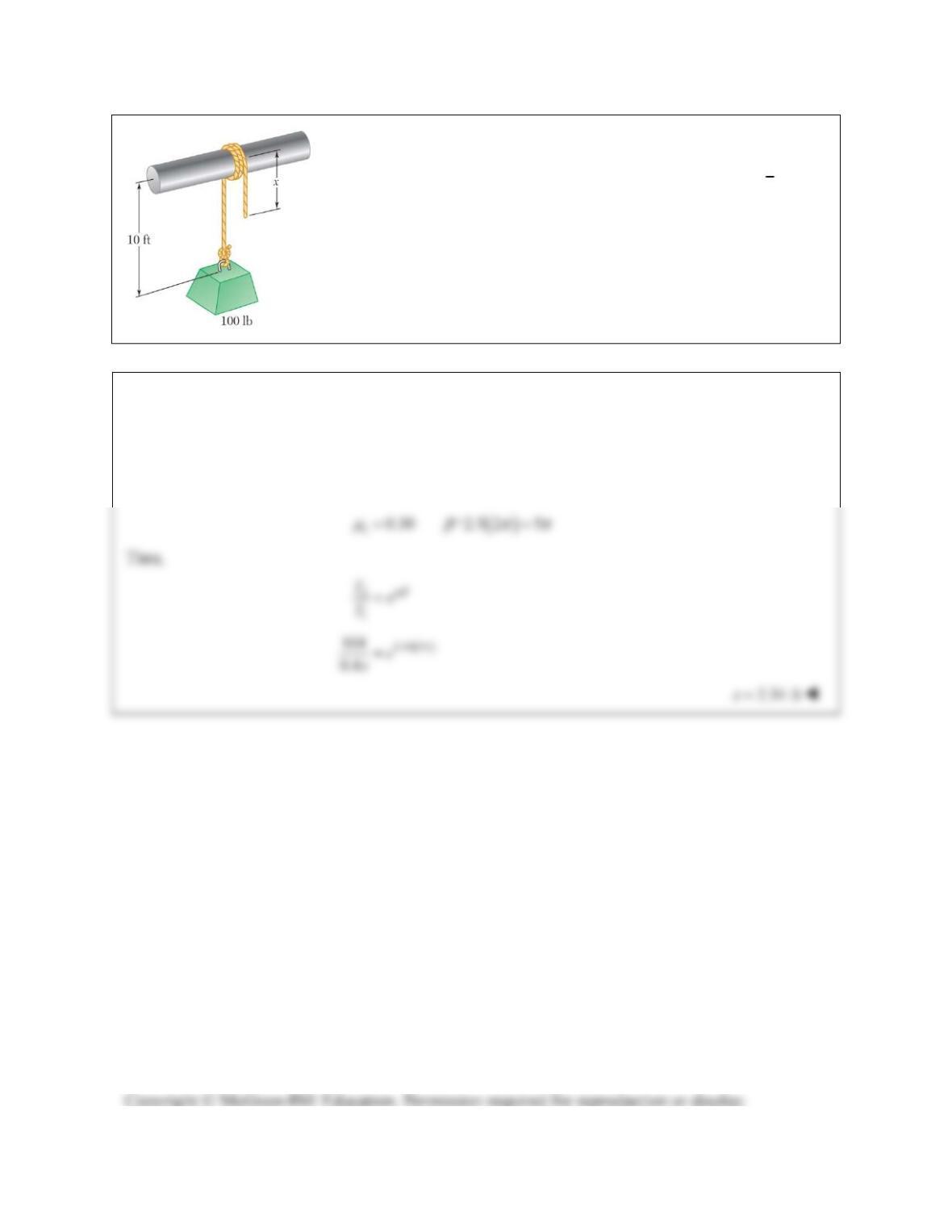
A rope having a weight per unit length of 0.4 lb/ft is wound 2 2
1 times
around a horizontal rod. Knowing that the coefficient of static friction
between the rope and the rod is 0.30, determine the minimum length x of
rope that should be left hanging if a 100-lb load is to be supported.
SOLUTION
Use eq. (8.14) with
1
2
0.4 lb/ft
100 lb 0.4 lb/ft 10 ft 104 lb
Tx
T
PROBLEM 8.104
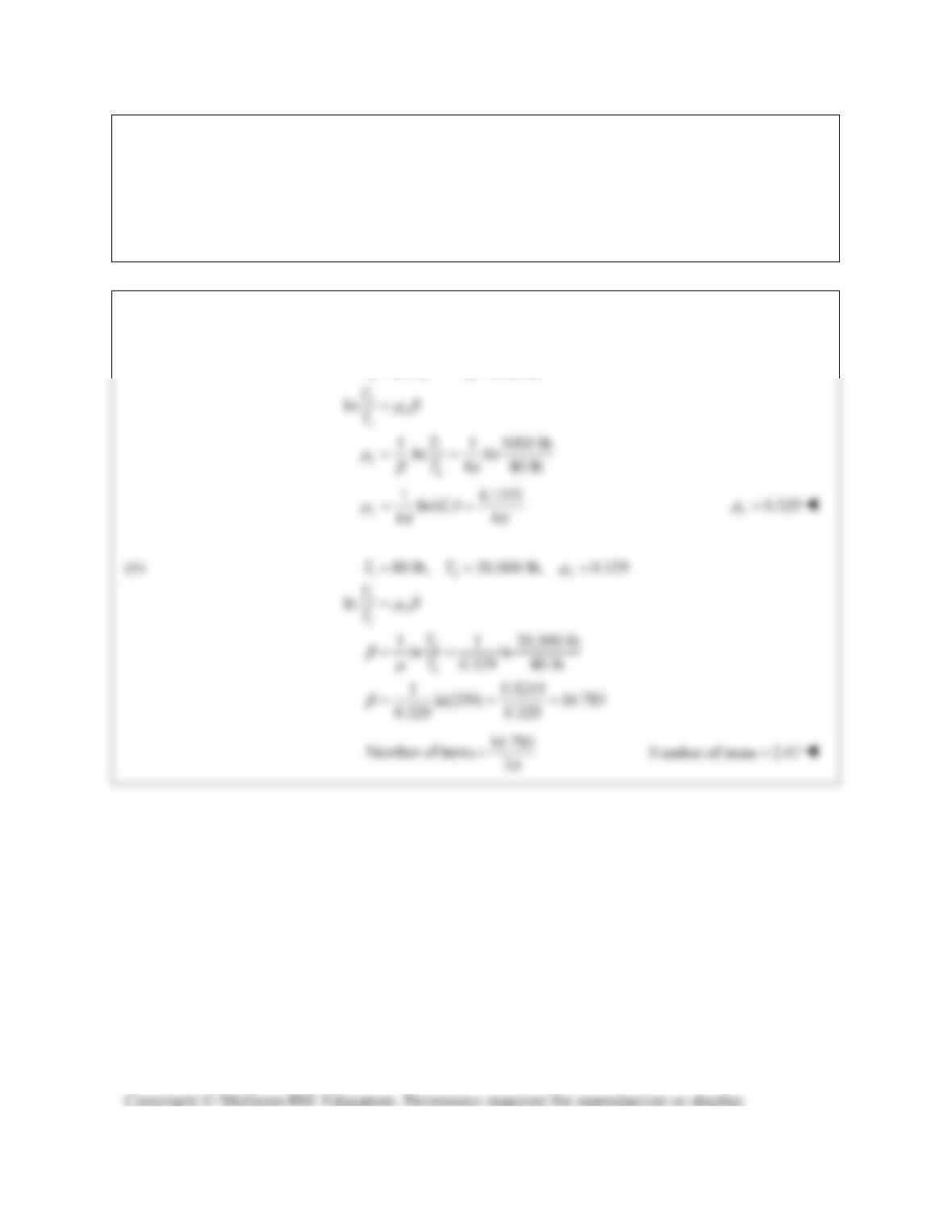
A hawser is wrapped two full turns around a bollard. By exerting an 80-lb force on the free end of the
hawser, a dockworker can resist a force of 5000 lb on the other end of the hawser. Determine (a) the
coefficient of static friction between the hawser and the bollard, (b) the number of times the hawser
should be wrapped around the bollard if a 20,000-lb force is to be resisted by the same 80-lb force.
SOLUTION
(a)
2 turns 2(2 ) 4
80 lb, 5000 lb
TT
PROBLEM 8.105
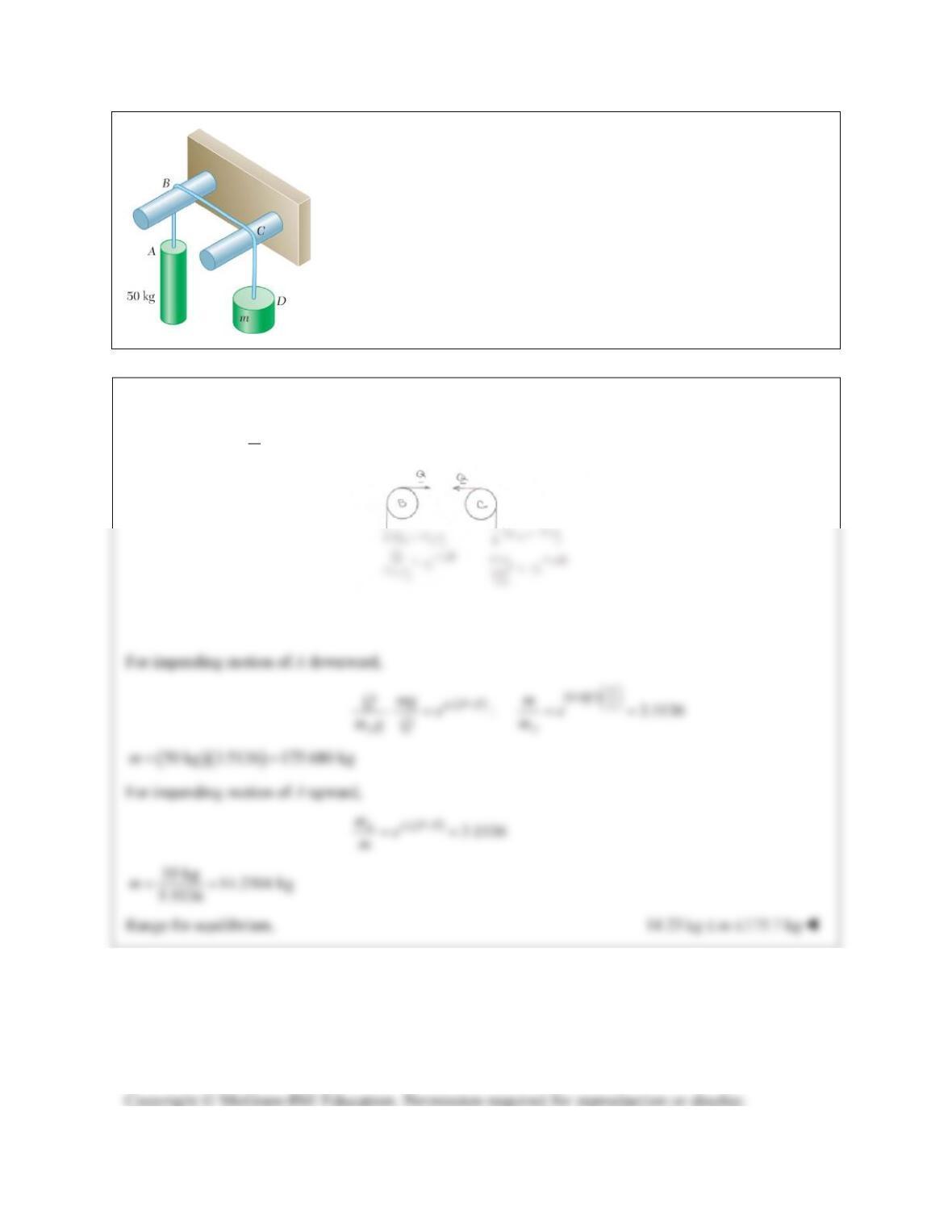
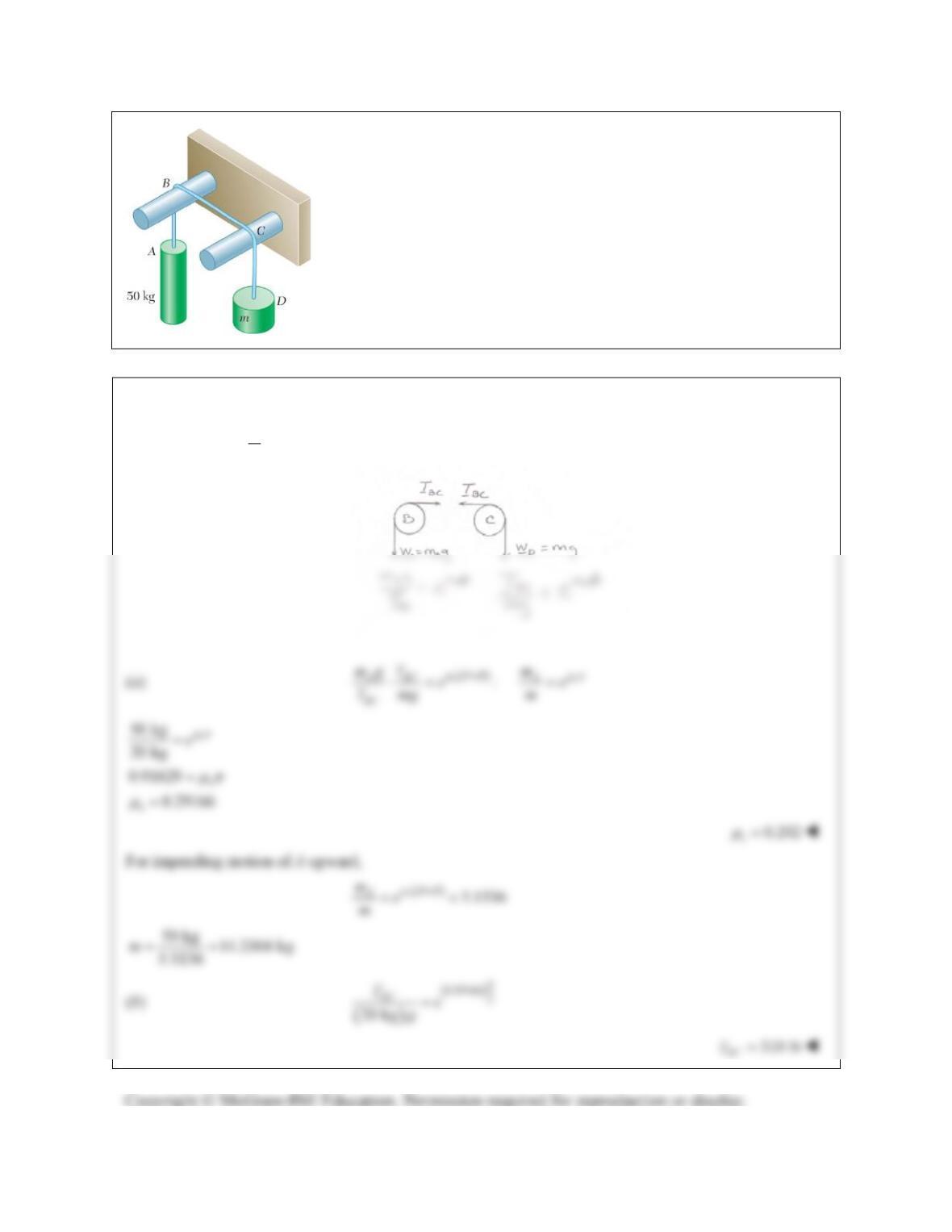
Two cylinders are connected by a rope that passes over two fixed rods as
shown. Knowing that the coefficient of static friction between the rope
and the rods is 0.40, determine the range of the mass m of cylinder D for
which equilibrium is maintained.
SOLUTION
For each rod,
, 0.4
2
s
PROBLEM 8.106
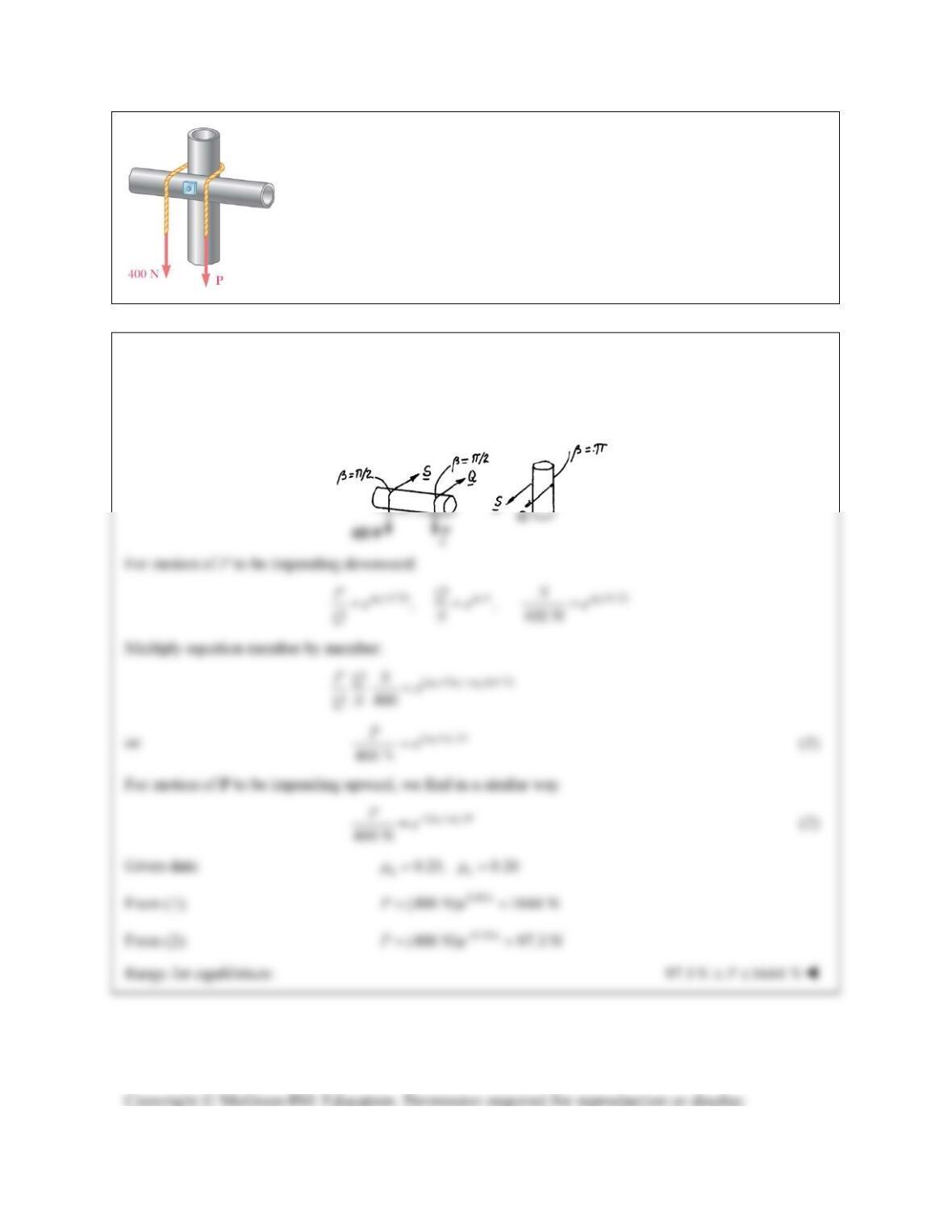
Two cylinders are connected by a rope that passes over two fixed rods as
shown. Knowing that for cylinder D upward motion impends when
m = 20 kg, determine (a) the coefficient of static friction between the rope
and the rods, (b) the corresponding tension in portion BC of the rope.
SOLUTION
For each rod,
2
PROBLEM 8.107
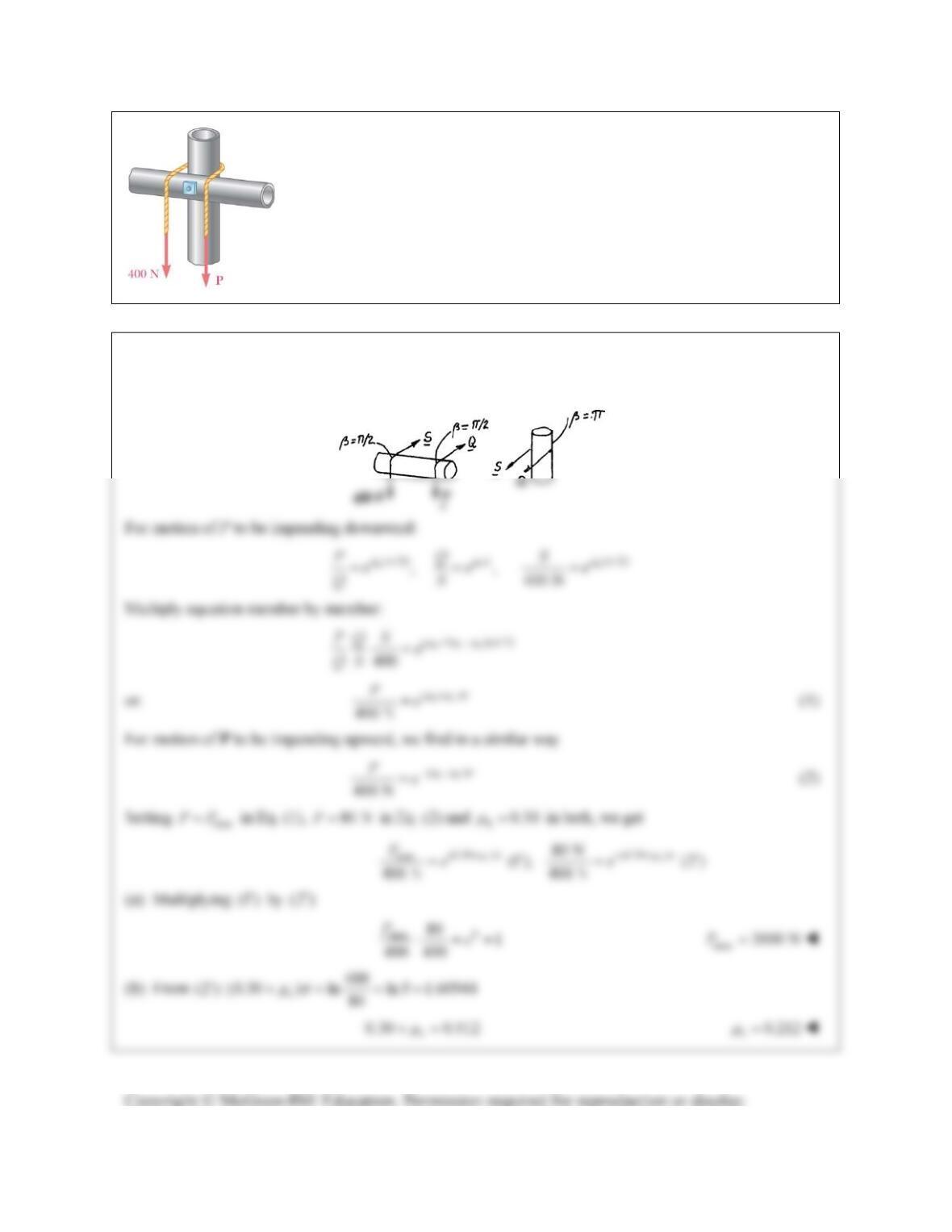
Knowing that the coefficient of static friction is 0.25 between the rope and the
horizontal pipe and 0.20 between the rope and the vertical pipe, determine the
range of values of P for which equilibrium is maintained.
SOLUTION
Horizontal pipe
s
h
Vertical pipe
s
v
PROBLEM 8.108
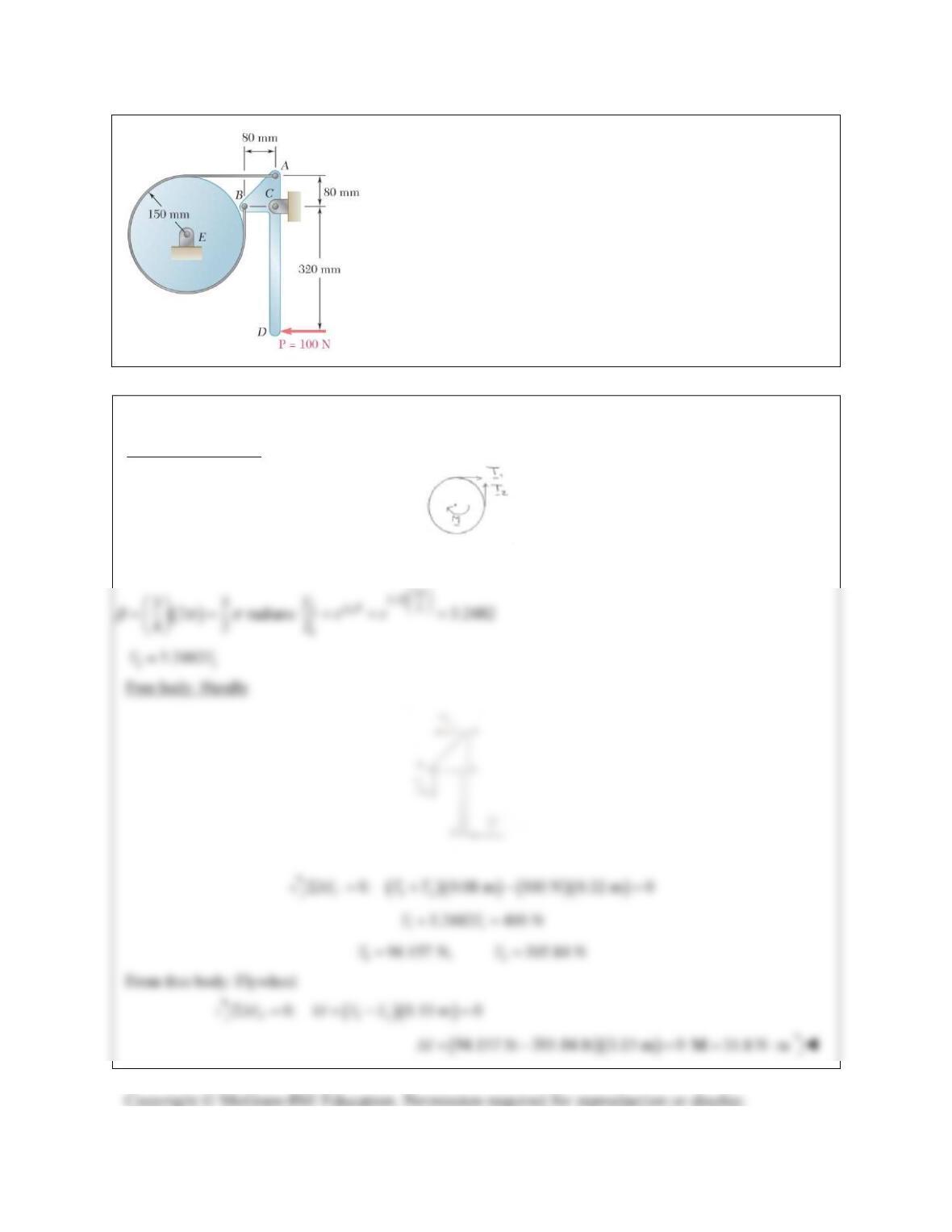
Knowing that the coefficient of static friction is 0.30 between the rope and the
horizontal pipe and that the smallest value of P for which equilibrium is
maintained is 80 N, determine (a) the largest value of P for which equilibrium
is maintained, (b) the coefficient of static friction between the rope and the
vertical pipe.
SOLUTION
Horizontal pipe:
s
h
Vertical pipe:
s
v
PROBLEM 8.109
A band belt is used to control the speed of a flywheel as shown.
Determine the magnitude of the couple being applied to the
flywheel, knowing that the coefficient of kinetic friction between
the belt and the flywheel is 0.25 and that the flywheel is rotating
clockwise at a constant speed. Show that the same result is
obtained if the flywheel rotates counterclockwise.
SOLUTION
Free body: Flywheel
For clockwise rotation of flywheel,
T
1 and
T
2 are located as shown.
PROBLEM 8.110
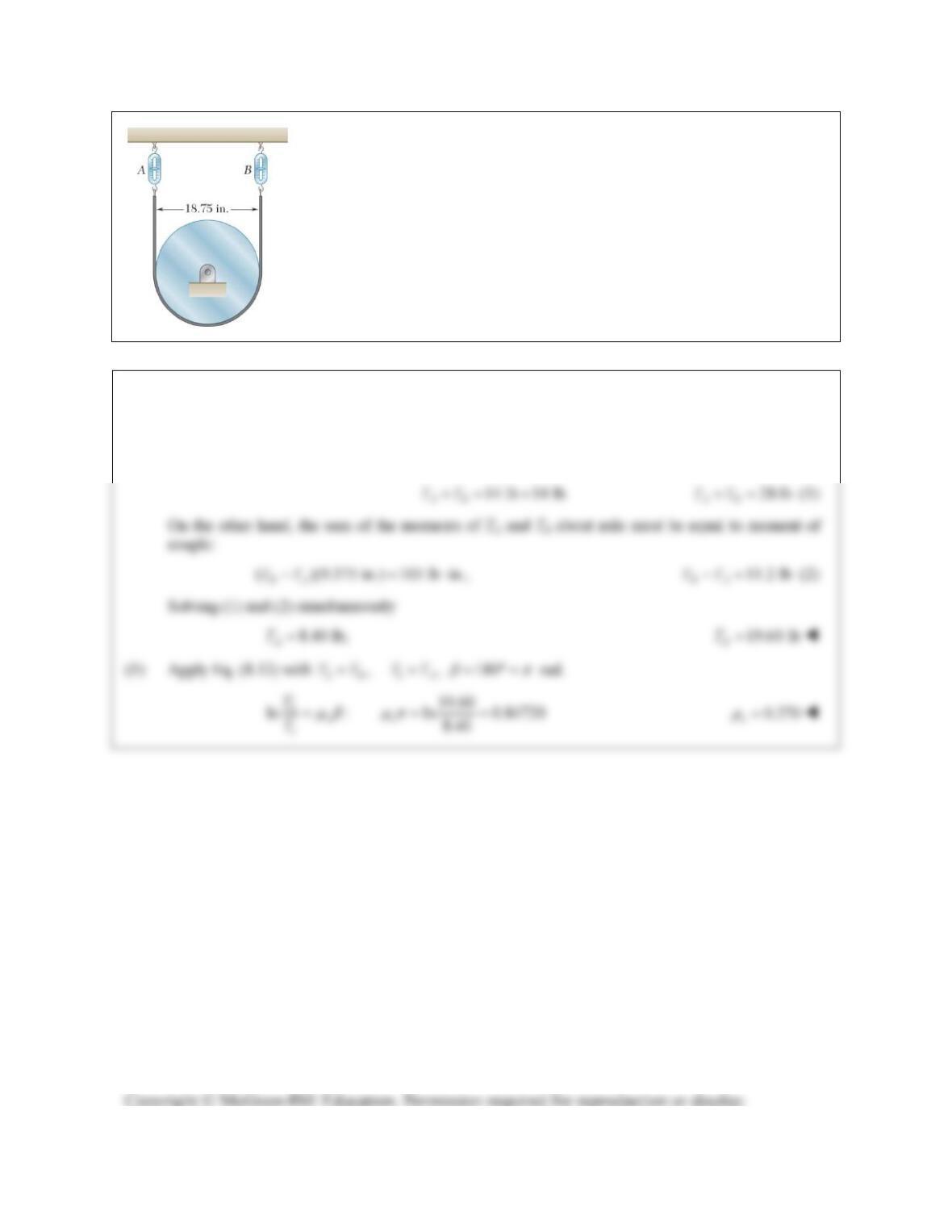
The setup shown is used to measure the output of a small turbine. When the
flywheel is at rest, the reading of each spring scale is 14 lb. If a 105-lb · in.
couple must be applied to the flywheel to keep it rotating clockwise at
a constant speed, determine (a) the reading of each scale at that time, (b) the
coefficient of kinetic friction. Assume that the length of the belt does not
change.
SOLUTION
(a) Since the length of the belt is constant, the spring in scale B will increase in length by
and the
spring in scale A will decrease by the same amount. Thus, the sum of the readings in scales A and B
remains constant:
PROBLEM 8.111
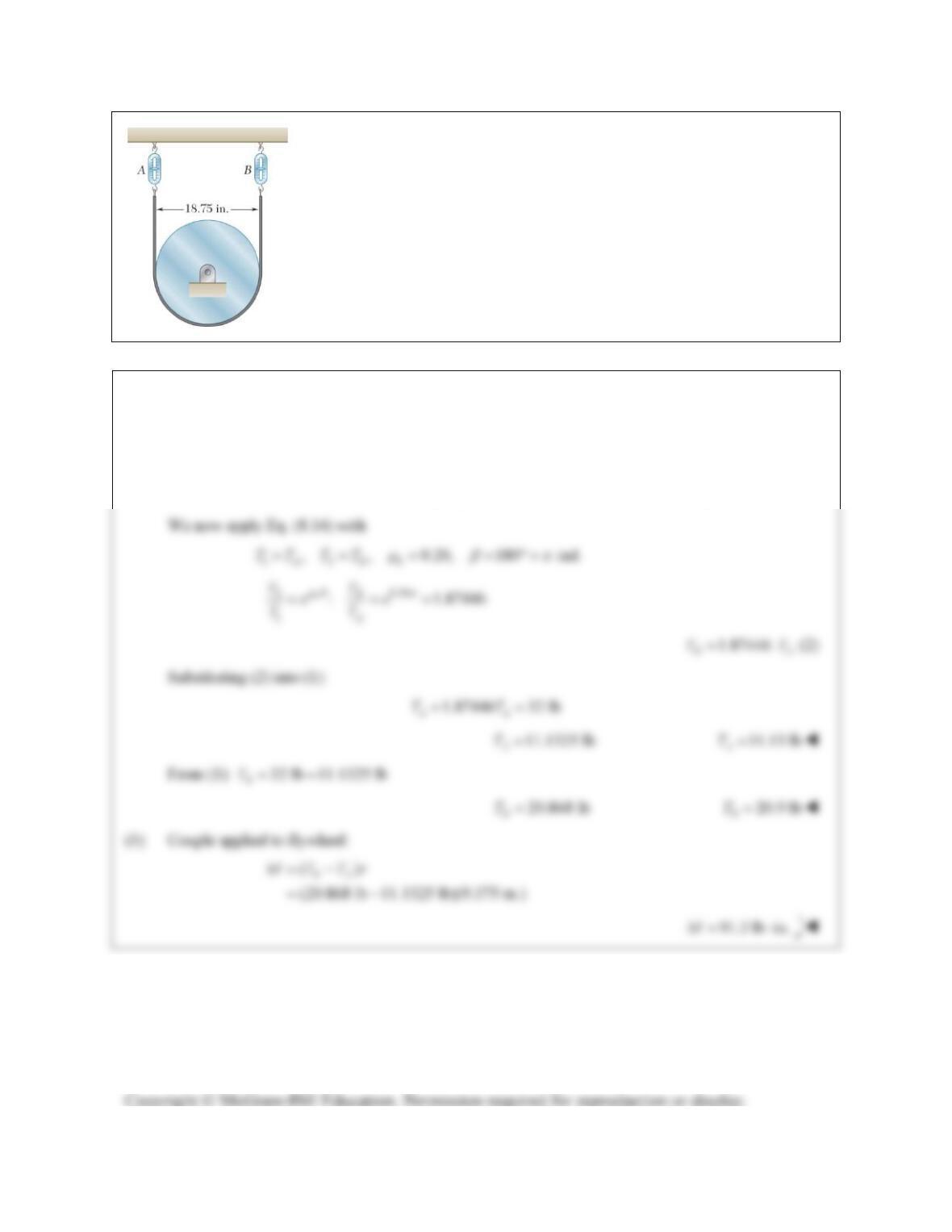
The setup shown is used to measure the output of a small turbine. The
coefficient of kinetic friction is 0.20 and the reading of each spring scale is
16 lb when the flywheel is at rest. Determine (a) the reading of each scale
when the flywheel is rotating clockwise at a constant speed, (b) the couple
that must be applied to the flywheel. Assume that the length of the belt does
not change.
SOLUTION
(a) Since the length of the belt is constant, the spring in scale B will increase in length by
and the
spring in scale A will decrease by the same amount. Thus, the sum of the readings in scales A and B
remains constant:
16 lb 16 lb
AB
TT
32 lb
AB
TT
(1)
PROBLEM 8.112
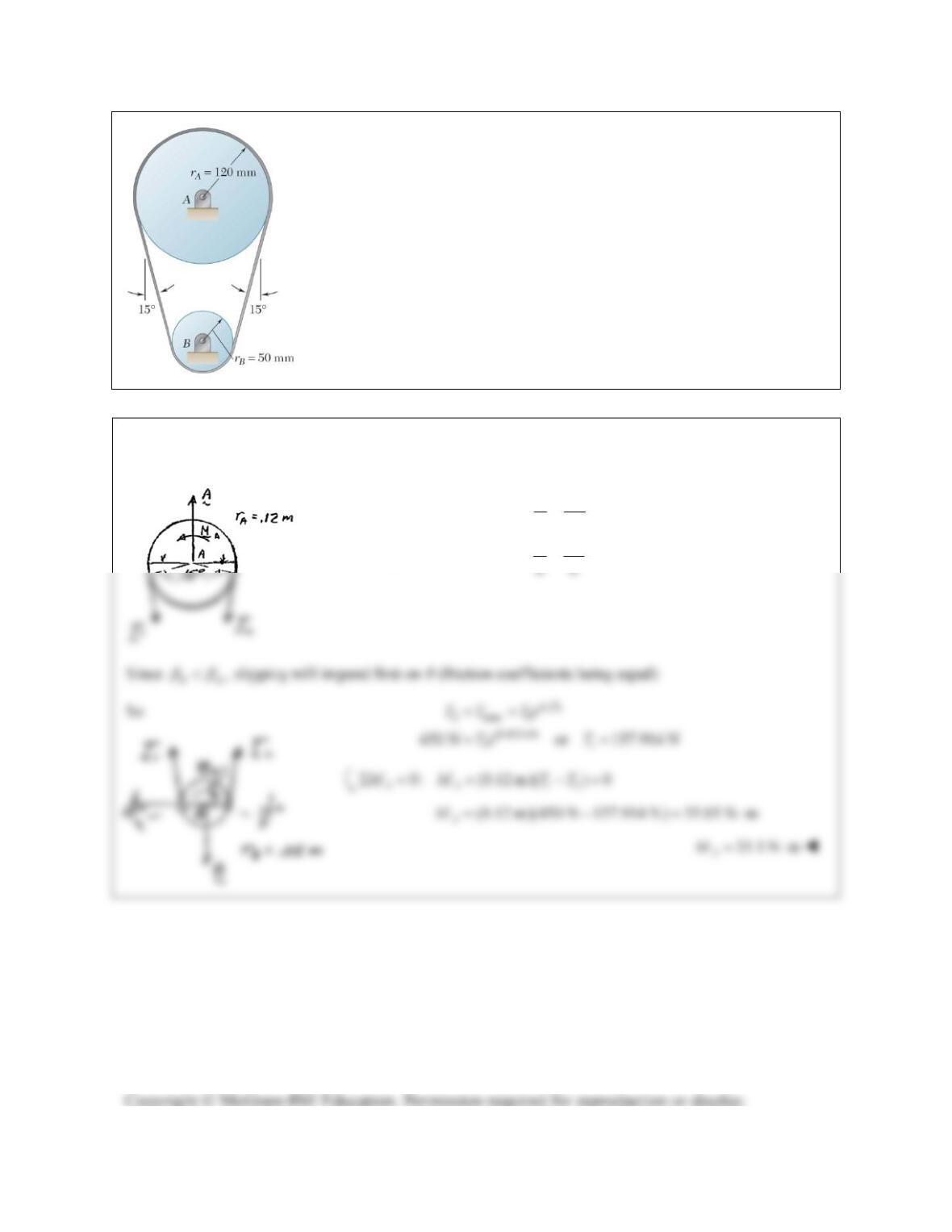
A flat belt is used to transmit a couple from drum B to drum A. Knowing
that the coefficient of static friction is 0.40 and that the allowable belt
tension is 450 N, determine the largest couple that can be exerted on drum A.
SOLUTION
FBD’s drums:
7
180 30 66
5
180 30 66
A
B
PROBLEM 8.113
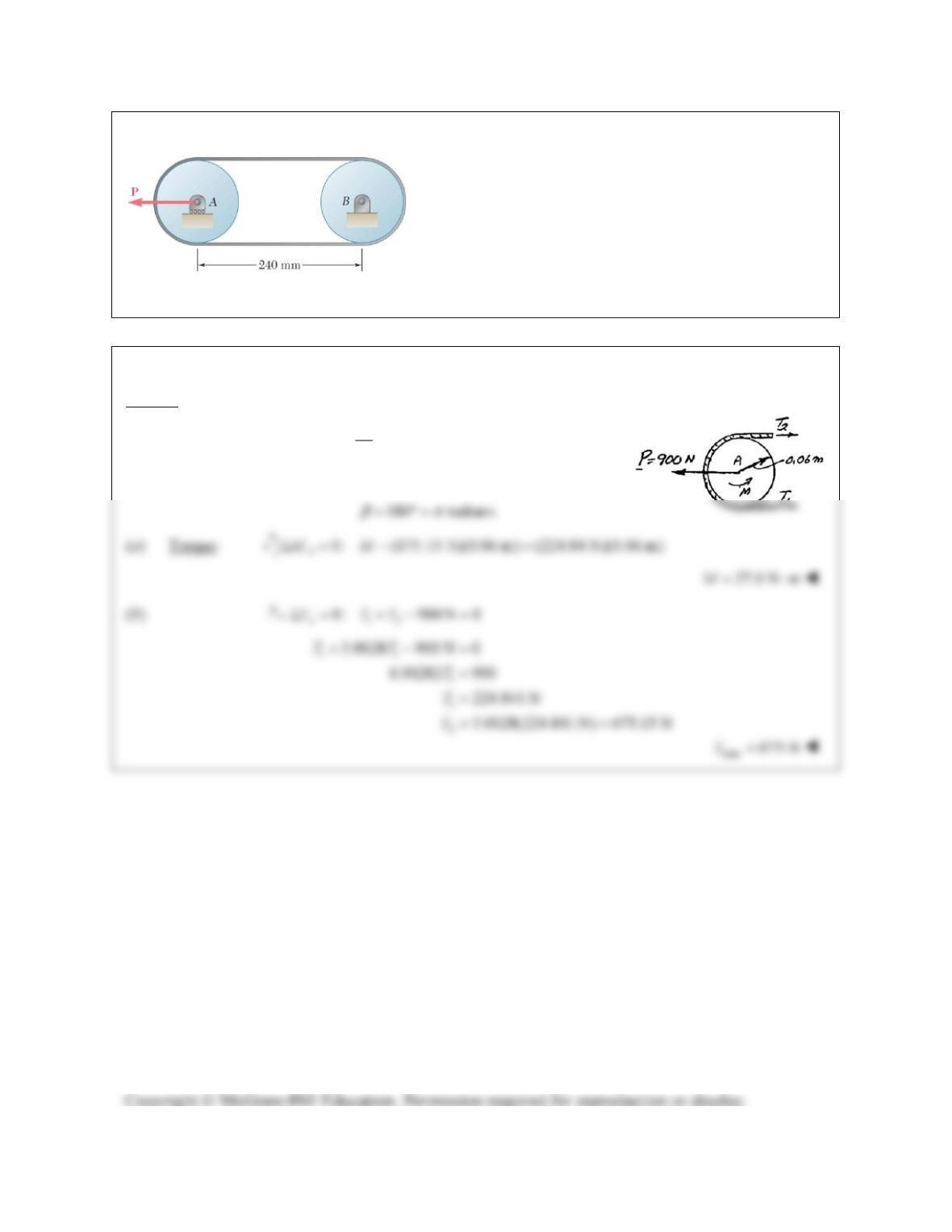
A flat belt is used to transmit a couple from pulley A to
pulley B. The radius of each pulley is 60 mm, and a force
of magnitude P 900 N is applied as shown to the axle of
pulley A. Knowing that the coefficient of static friction is
0.35, determine (a) the largest couple that can be
transmitted, (b) the corresponding maximum value of the
tension in the belt.
SOLUTION
Drum A:
(0.35)
2
1
21
3.0028
s
Tee
T
TT