PROBLEM 8.127 (Continued)
Eq. (3): 17.5056
ln
4.9742 rad 2
1.3225
4.9742
s
PROBLEM 8.128
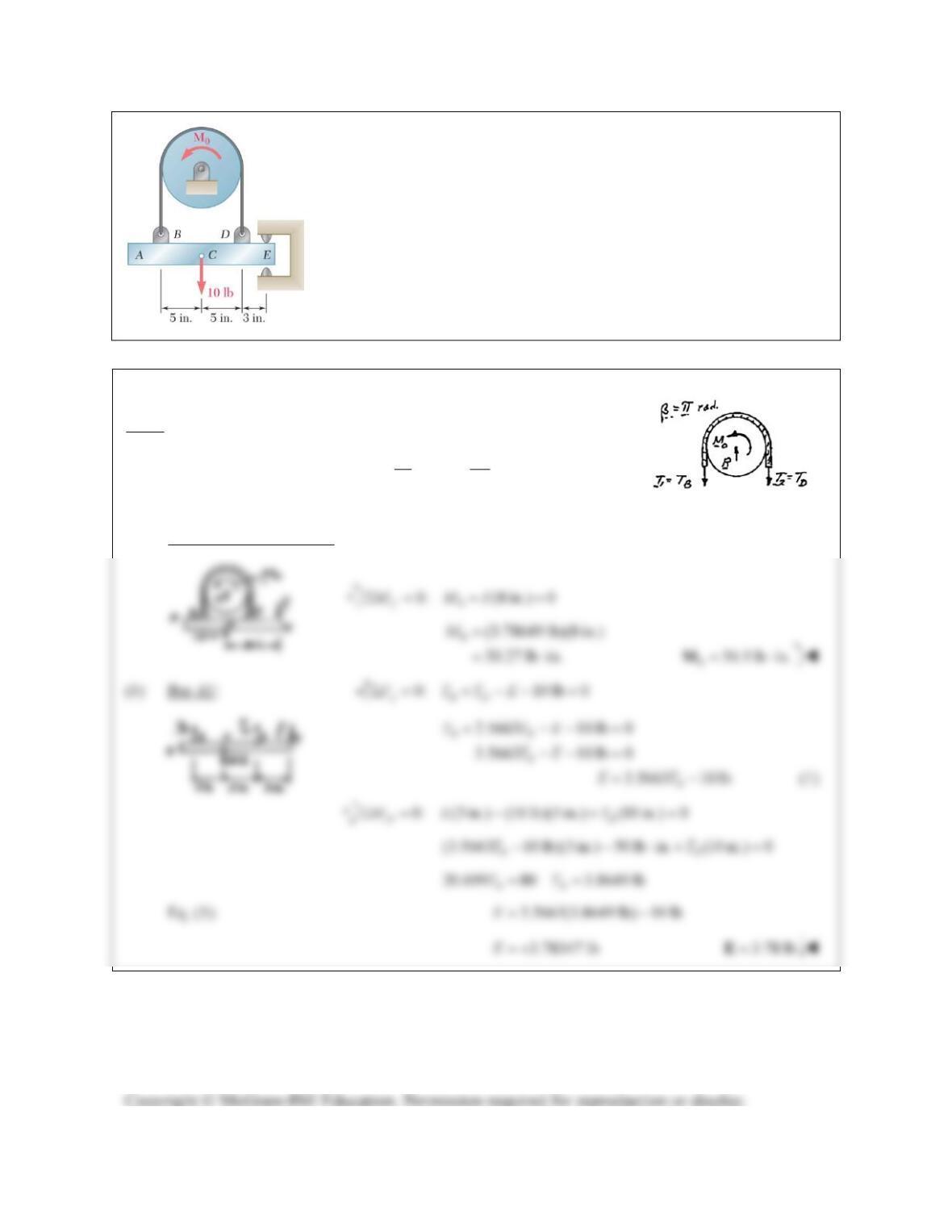
The 10-lb bar AE is suspended by a cable that passes over a 5-in.-radius
drum. Vertical motion of end E of the bar is prevented by the two stops
shown. Knowing that
0.30
s
between the cable and the drum,
determine (a) the largest counterclockwise couple
0
M
that can be applied
to the drum if slipping is not to occur, (b) the corresponding force exerted
on end E of the bar.
SOLUTION
Drum: Slipping impends
0.30
s
0.30
2
1
:2.5663
2.5663
D
B
DB
TT
ee
TT
TT
(a) Free-body: Drum and bar
PROBLEM 8.129
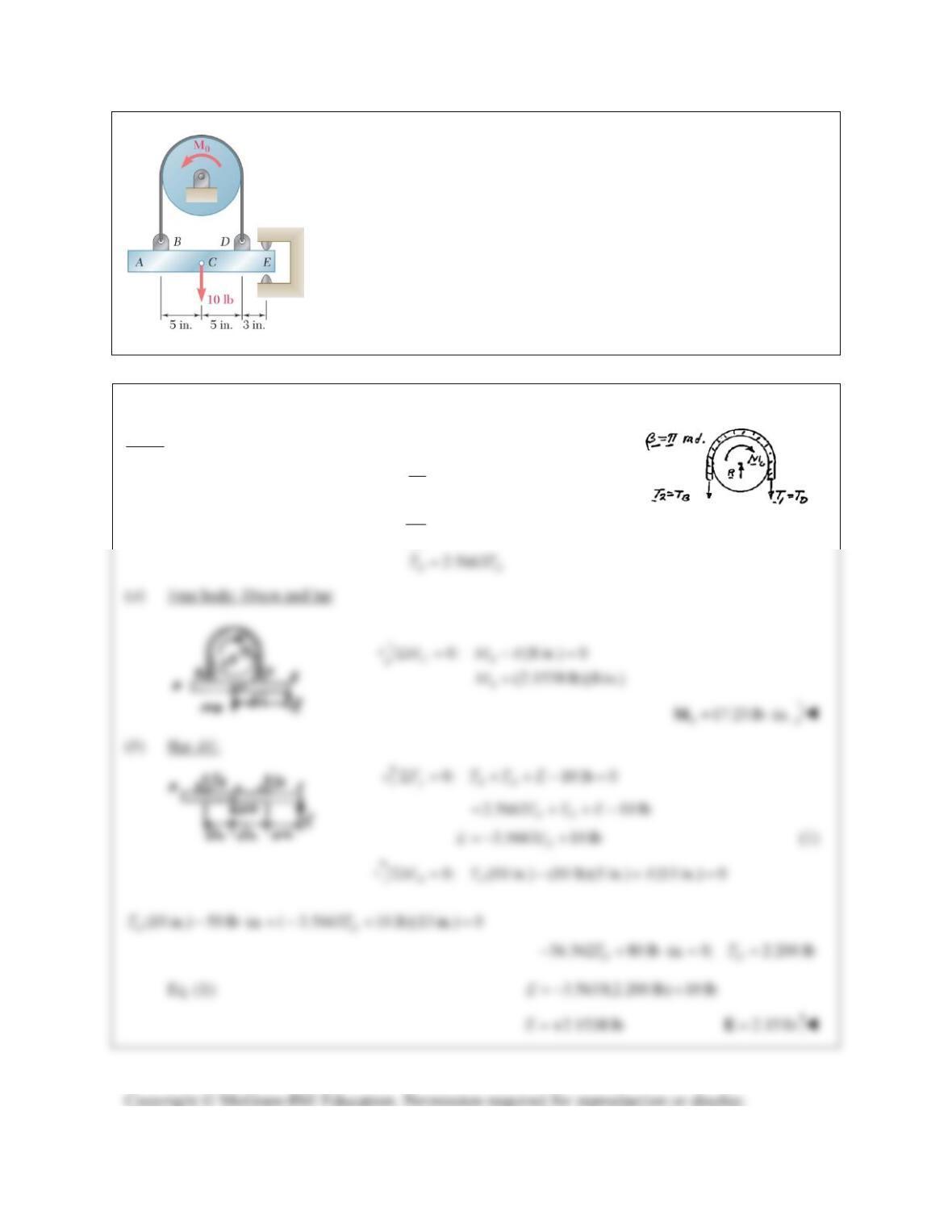
Solve Problem 8.128 assuming that a clockwise couple
0
M
is applied to
the drum.
PROBLEM 8.128 The 10-lb bar AE is suspended by a cable that passes
over a 5-in.-radius drum. Vertical motion of end E of the bar is prevented
by the two stops shown. Knowing that
0.30
s
between the cable and the
drum, determine (a) the largest counterclockwise couple
0
M
that can be
applied to the drum if slipping is not to occur, (b) the corresponding force
exerted on end E of the bar.
SOLUTION
Drum: Slipping impends
2
1
0.30
0.30
2.5663
s
B
D
Te
T
Te
T
PROBLEM 8.130
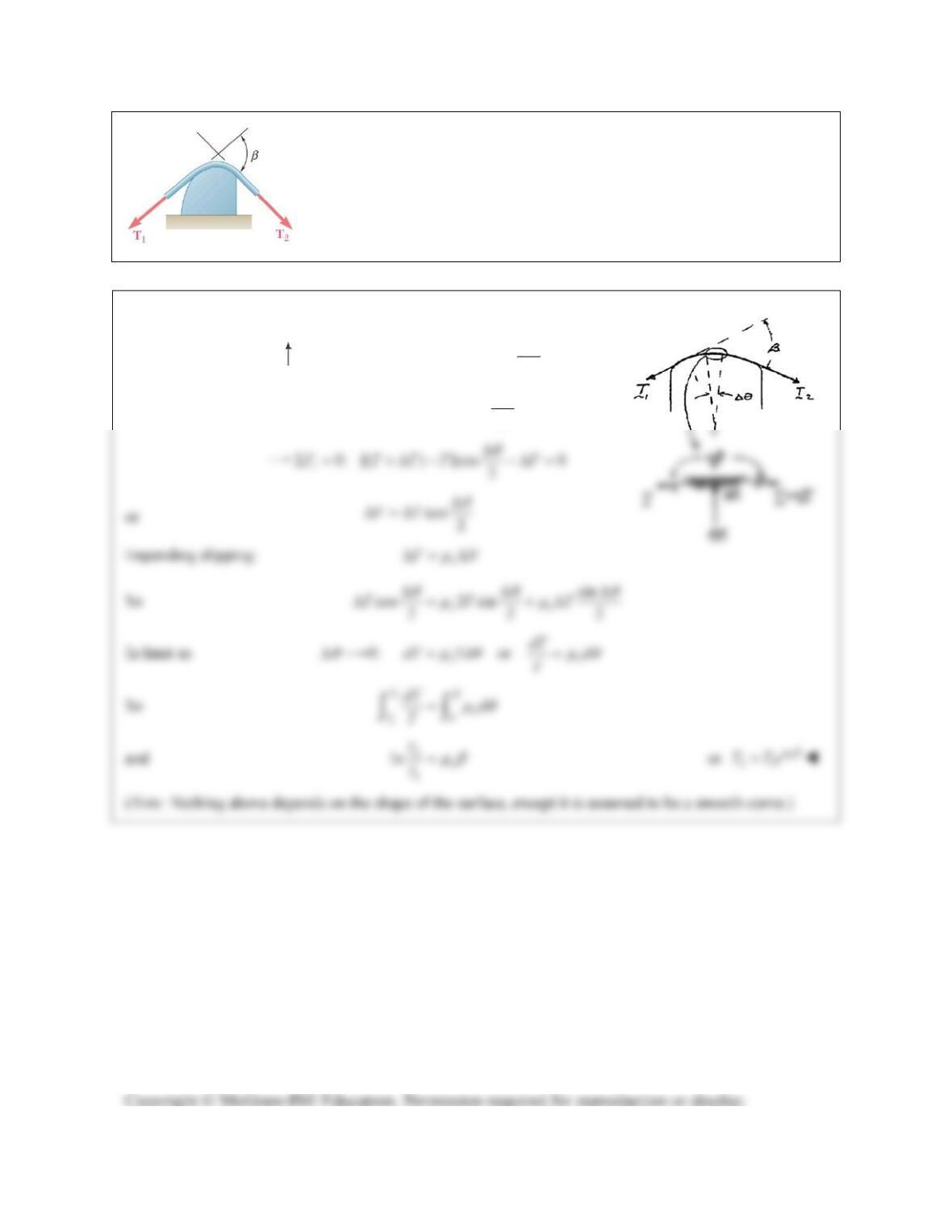
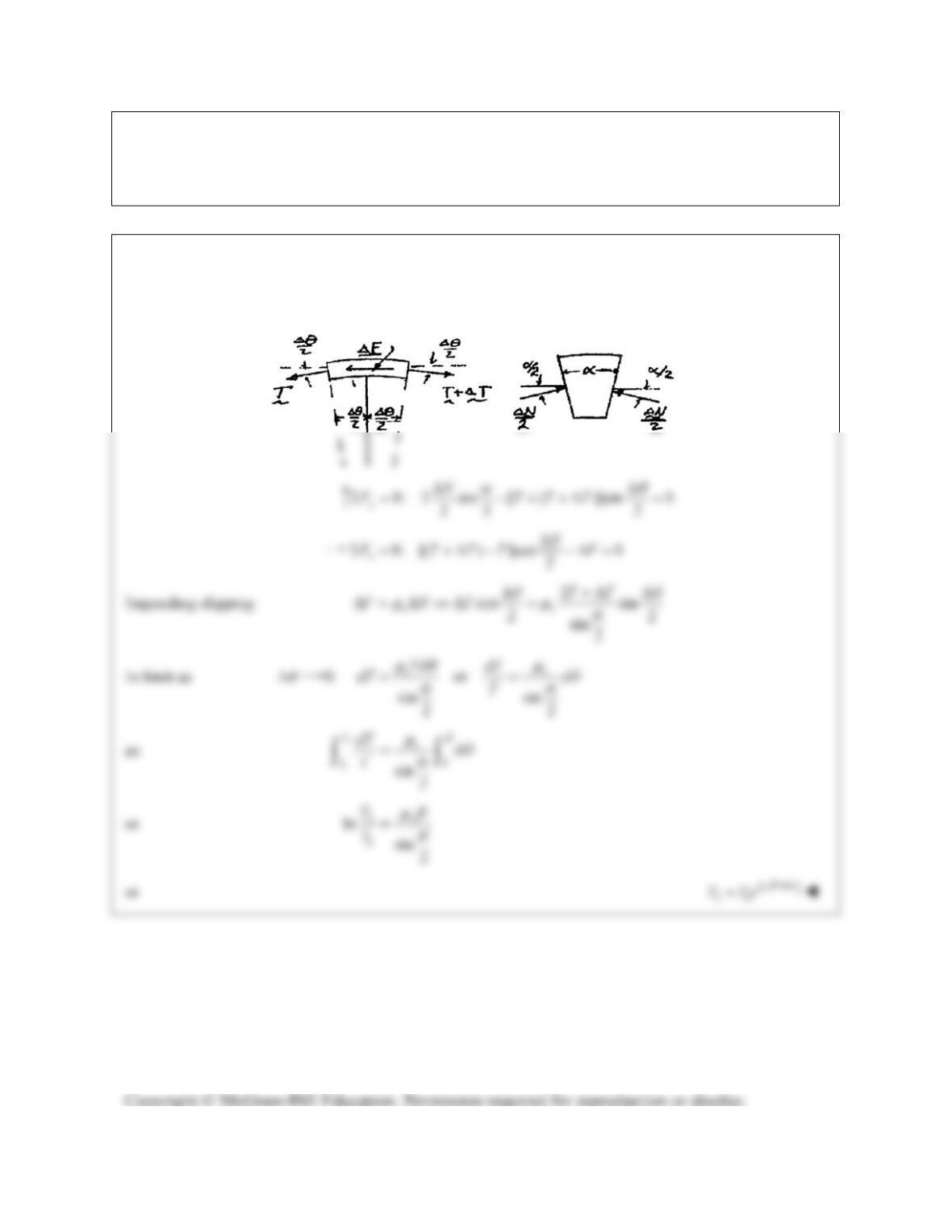
Prove that Eqs. (8.13) and (8.14) are valid for any shape of surface provided
that the coefficient of friction is the same at all points of contact.
SOLUTION
0: [ ( )]sin 0
2
n
FNTTT
or
(2 )sin 2
NTT
PROBLEM 8.131
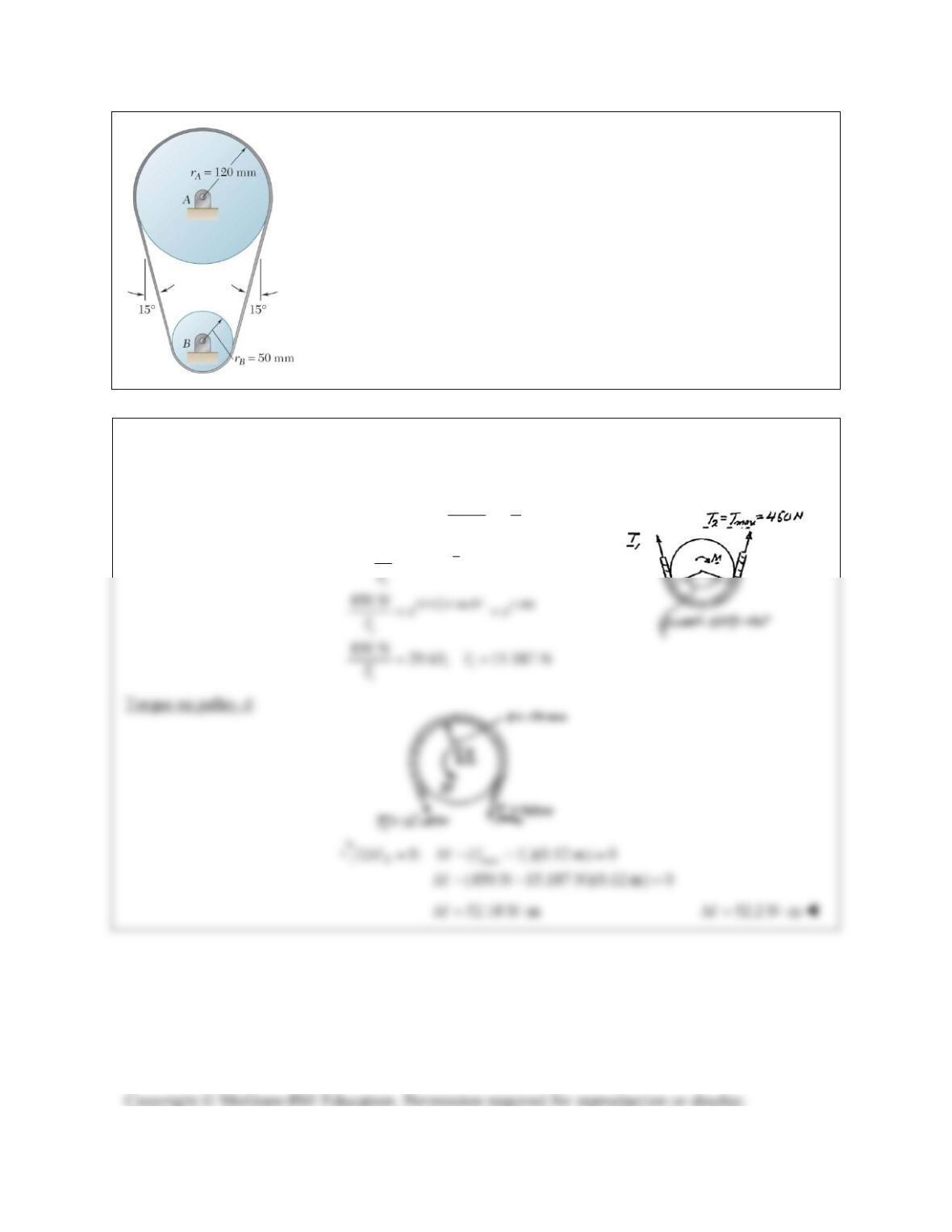
Complete the derivation of Eq. (8.15), which relates the tension in both parts of a V belt.
SOLUTION
Small belt section:
Side view: End view:
PROBLEM 8.132
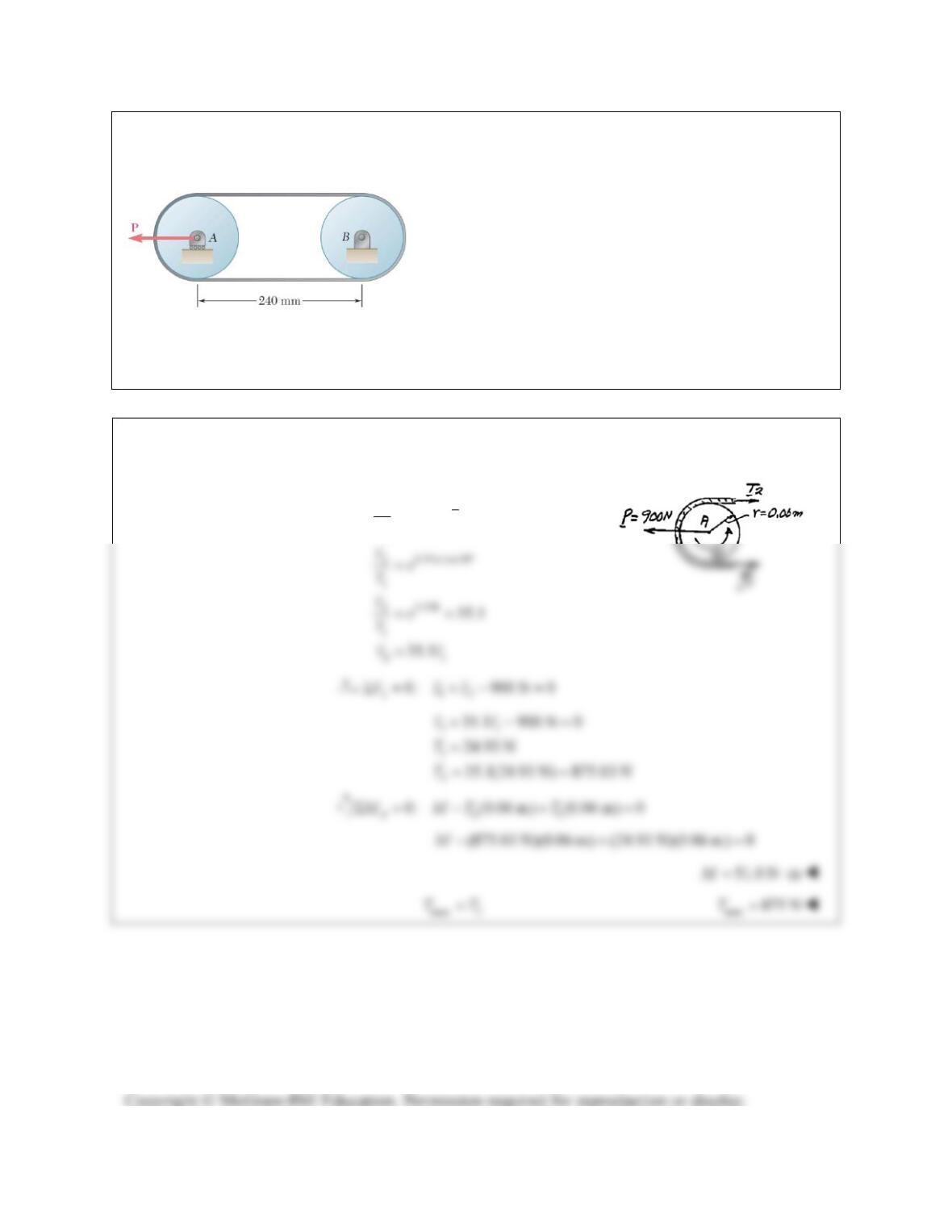
Solve Problem 8.112 assuming that the flat belt and drums are replaced by a
V belt and V pulleys with
36 .
(The angle
is as shown in Figure 8.15a.)
PROBLEM 8.112 A flat belt is used to transmit a couple from drum B to
drum A. Knowing that the coefficient of static friction is 0.40 and that the
allowable belt tension is 450 N, determine the largest couple that can be
exerted on drum A.
SOLUTION
Since
is smaller for pulley B. The belt will slip first at B.
2
/sin
2
rad 5
150 rad
180° 6
s
Te
PROBLEM 8.133
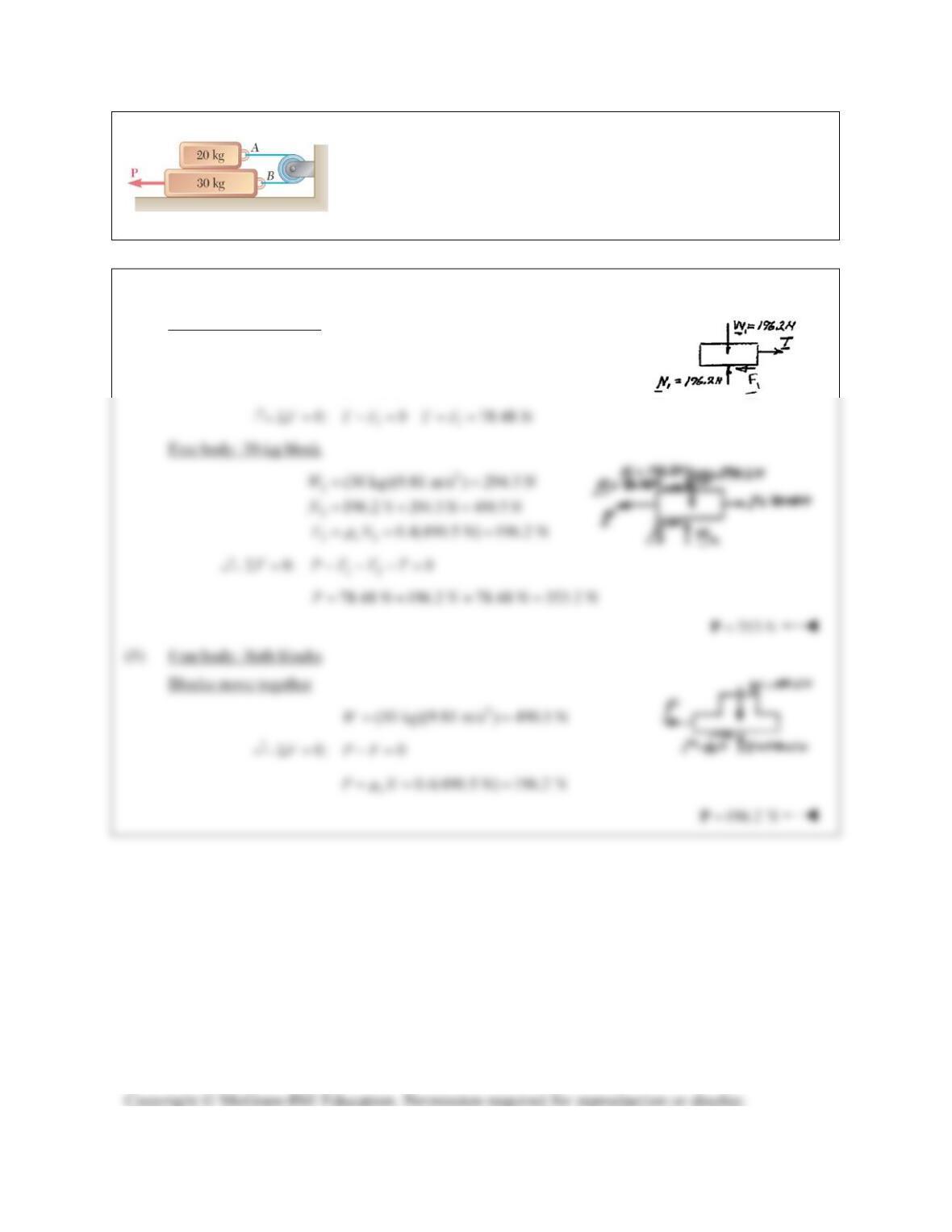
Solve Problem 8.113 assuming that the flat belt and pulleys
are replaced by a V belt and V pulleys with
36 .
(The
angle
is as shown in Figure 8.15a.)
PROBLEM 8.113 A flat belt is used to transmit a couple
from pulley A to pulley B. The radius of each pulley is 60
mm, and a force of magnitude
900 N
P
is applied as
shown to the axle of pulley A. Knowing that the coefficient
of static friction is 0.35, determine (a) the largest couple
that can be transmitted, (b) the corresponding maximum
value of the tension in the belt.
SOLUTION
Pulley A:
rad
2
/sin
2
1
s
Te
T
PROBLEM 8.134
The coefficients of friction are
0.40
s
and
0.30
k
between all
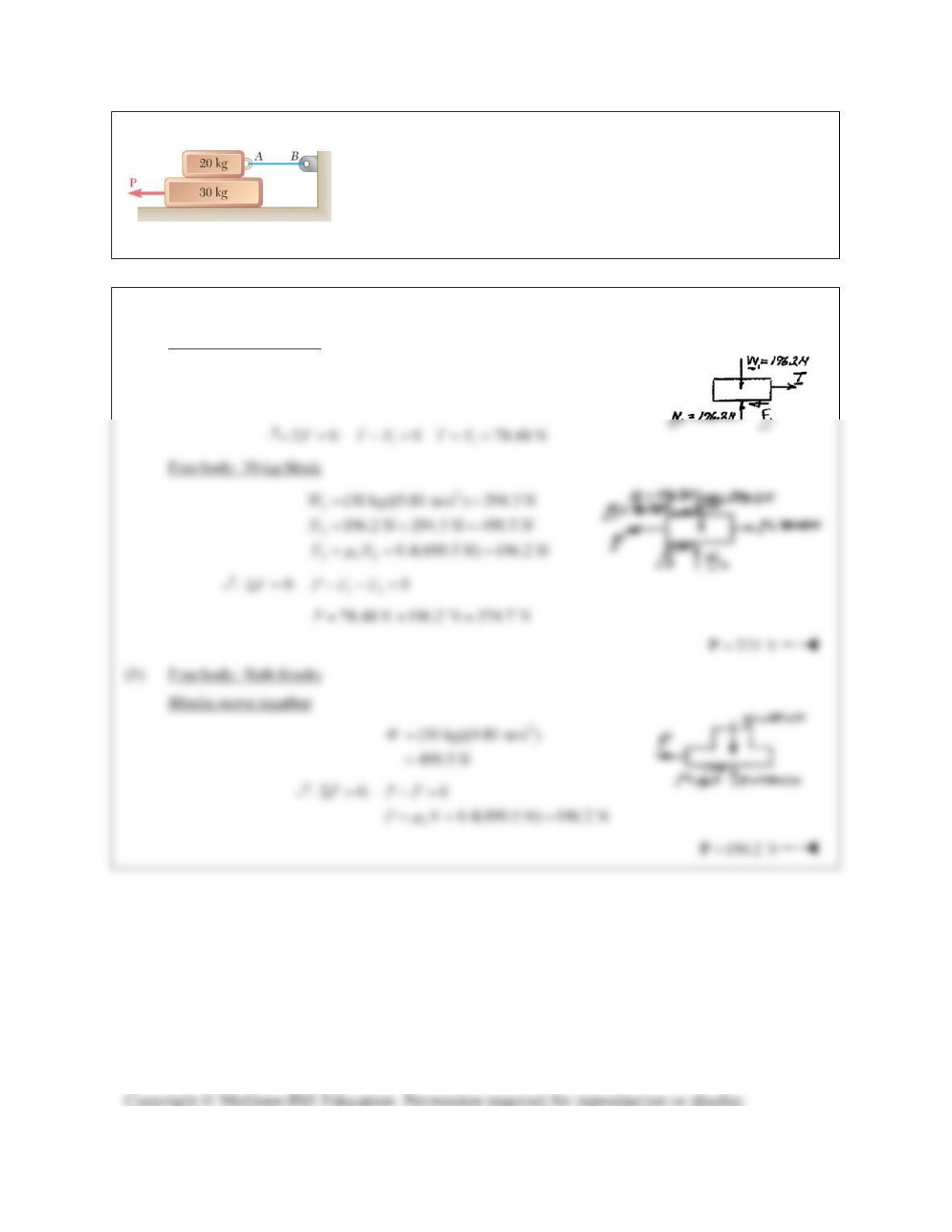
surfaces of contact. Determine the smallest force P required to start the
30-kg block moving if cable AB (a) is attached as shown, (b) is removed.
SOLUTION
(a) Free body: 20-kg block
2
1
11
(20 kg)(9.81 m/s ) 196.2 N
0.4(196.2 N) 78.48 N
s
W
FN
PROBLEM 8.135
The coefficients of friction are
0.40
s
and
0.30
k
between all
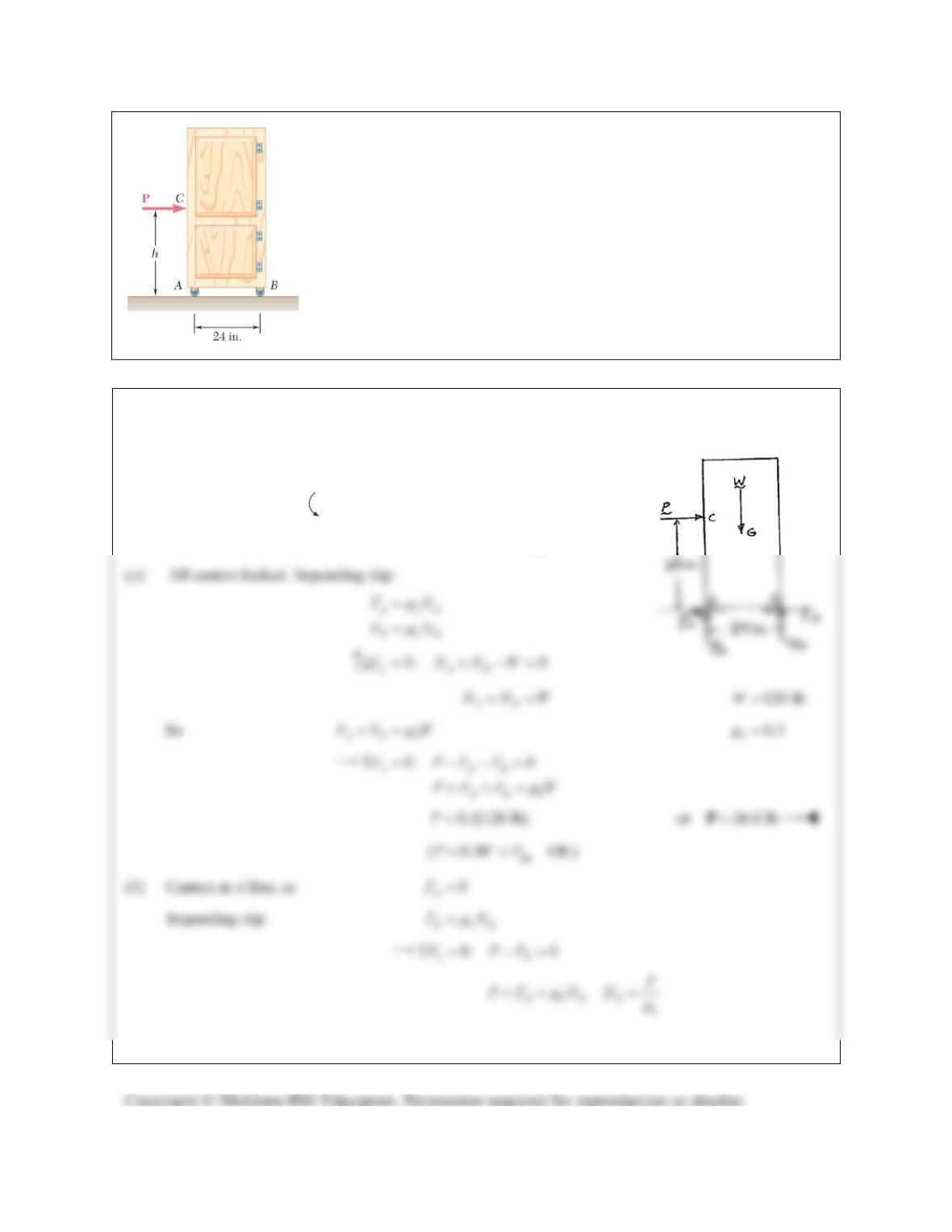
surfaces of contact. Determine the smallest force P required to start
the 30-kg block moving if cable AB (a) is attached as shown, (b) is
removed.
SOLUTION
(a) Free body: 20-kg block
2
1
11
(20 kg)(9.81 m/s ) 196.2 N
0.4(196.2 N) 78.48 N
s
W
FN
PROBLEM 8.136
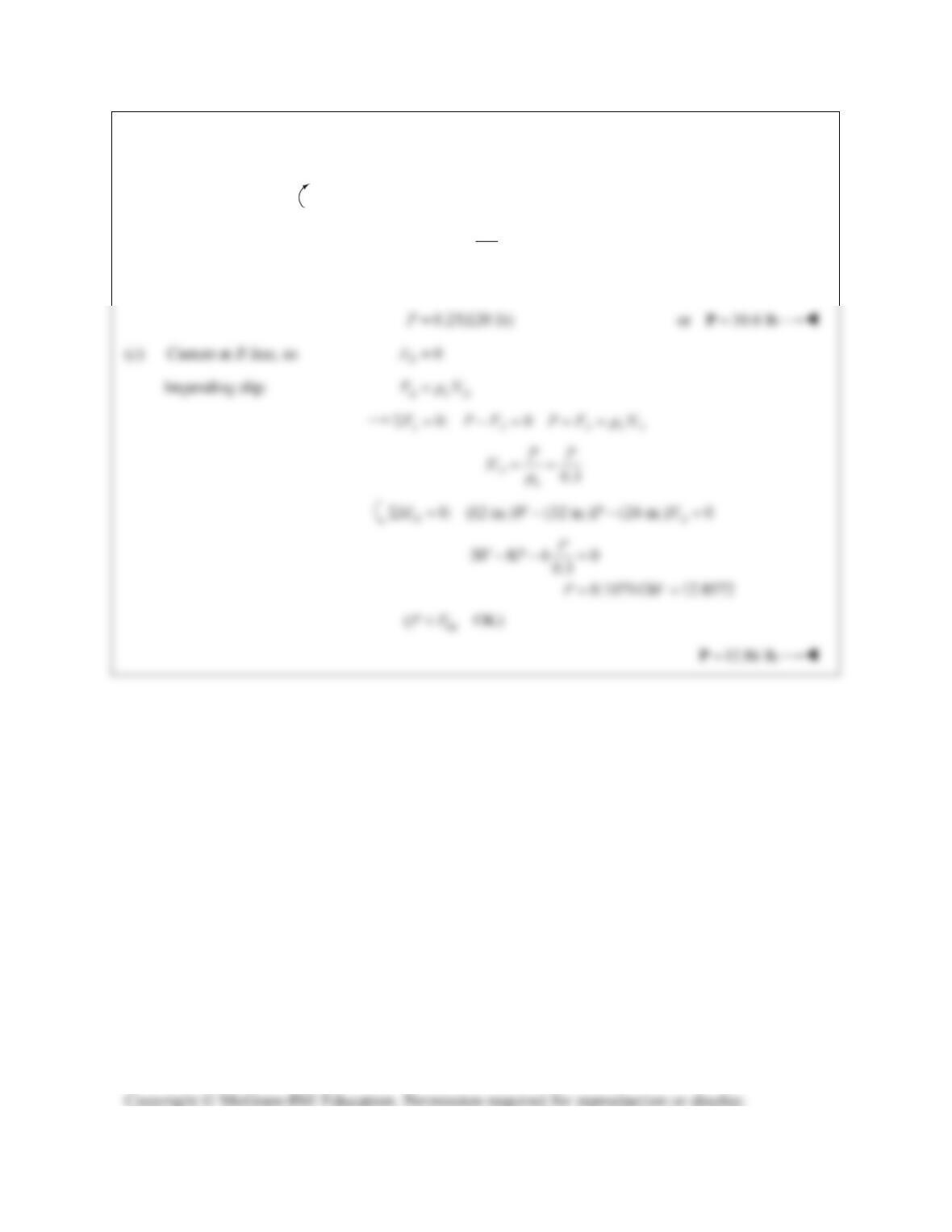
A 120-lb cabinet is mounted on casters that can be locked to prevent their
rotation. The coefficient of static friction between the floor and each caster
is 0.30. If
32 in.,h
determine the magnitude of the force P required to
move the cabinet to the right (a) if all casters are locked, (b) if the casters at
B are locked and the casters at A are free to rotate, (c) if the casters at A are
locked and the casters at B are free to rotate.
SOLUTION
FBD cabinet:Note: for tipping,
0
AA
NF
tip
0: (12 in.) (32 in.) 0
B
MWP
tip
2.66667P
PROBLEM 8.136 (Continued)
0: (32 in.) (12 in.) (24 in.) 0
AB
MPWN
8 3 6 0 0.25
0.3
P
PW P W
tip
( 0.25 OK)PWP
PROBLEM 8.137
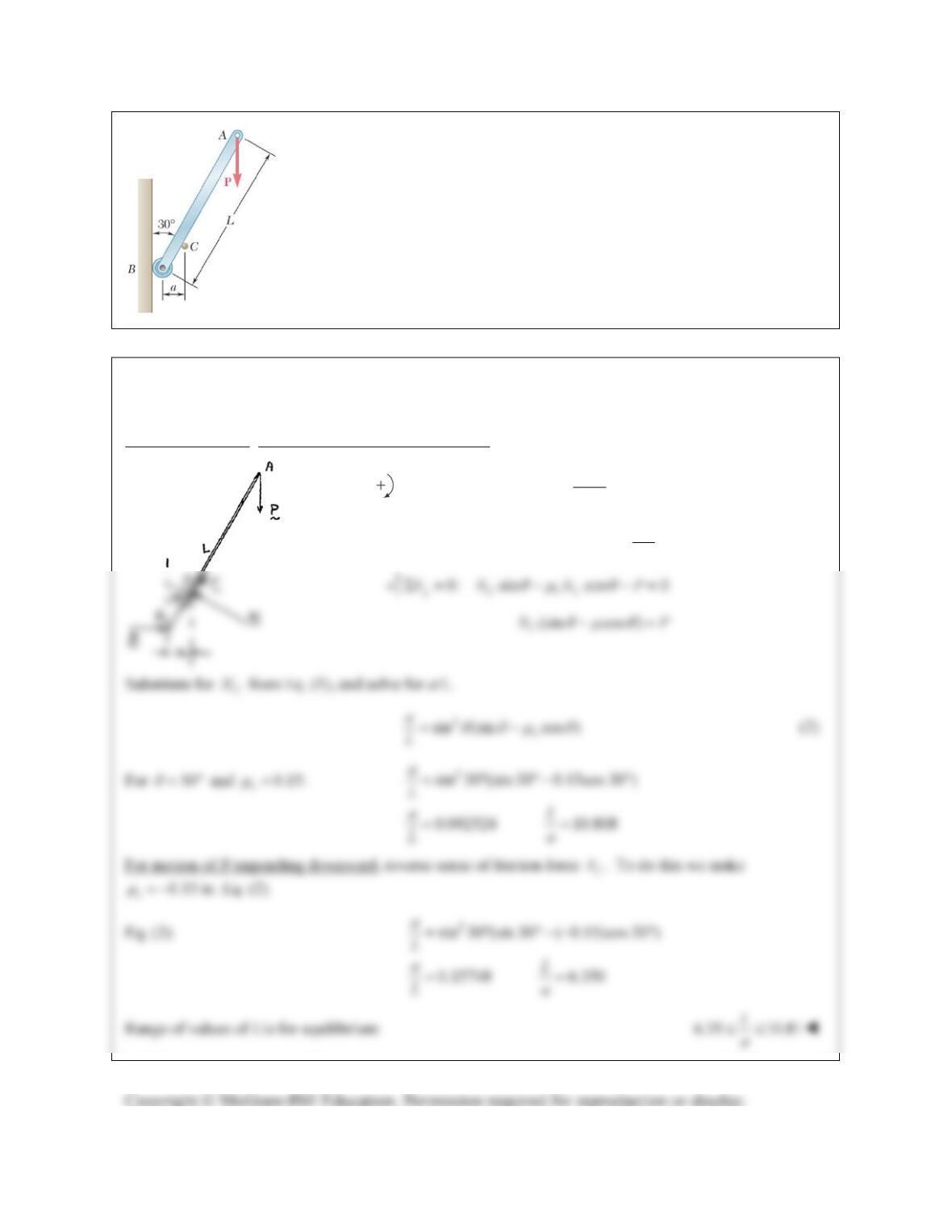
A slender rod of length L is lodged between peg C and the vertical wall and
supports a load P at end A. Knowing that the coefficient of static friction
between the peg and the rod is 0.15 and neglecting friction at the roller,
determine the range of values of the ratio L/a for which equilibrium is
maintained.
SOLUTION
FBD rod:
Free-body diagram: For motion of B impending upward:
0: sin 0
sin
BC
a
MPLN
2
sin
C
PL
Na
(1)