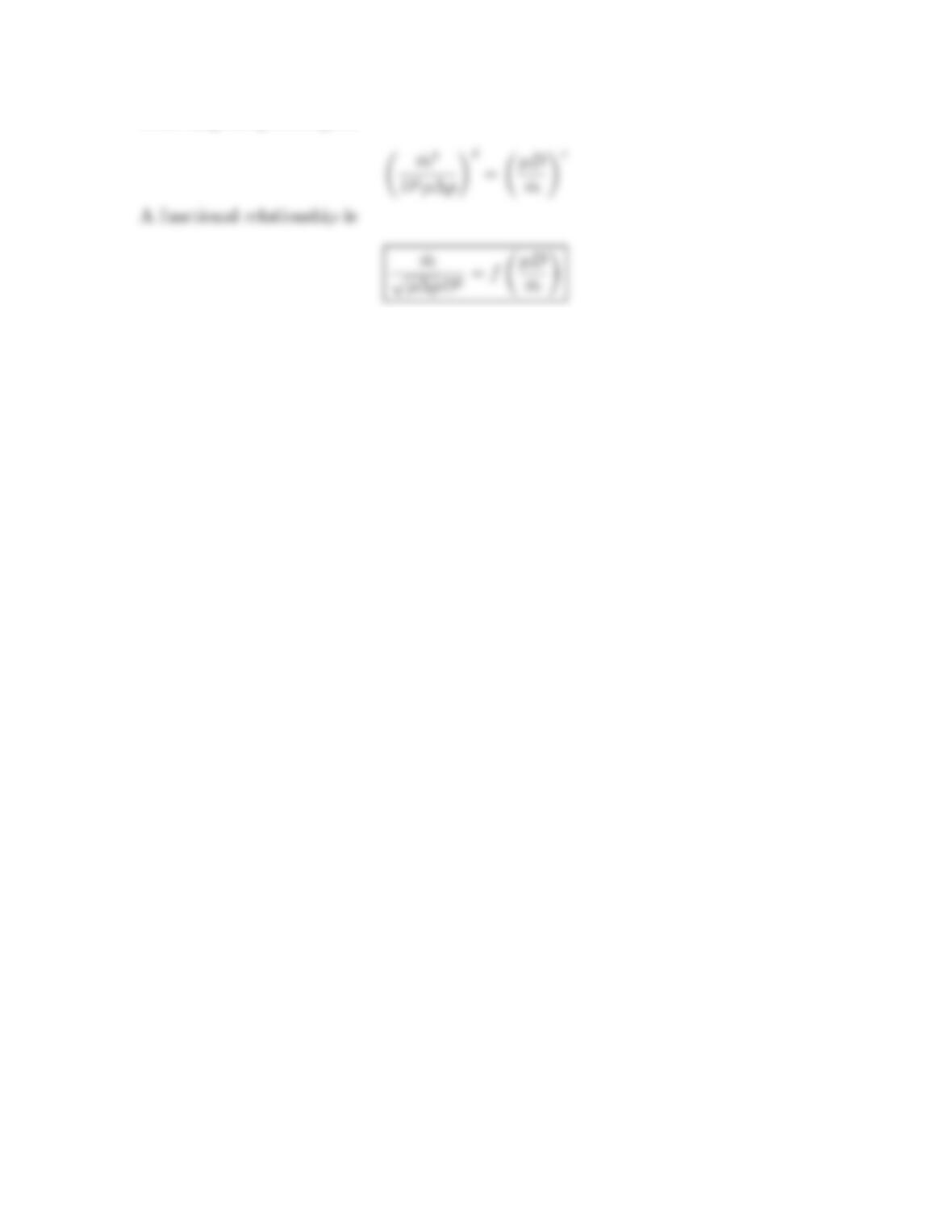
Collecting like powers gives
21
8.19: PROBLEM DEFINITION
Situation:
A torpedo-like device travels just below the water surface.
Find:
Identify which π−groups are significant.
Justify the answer.
SOLUTION
•Viscous stresses influence drag. Thus, Reynolds number is significant.
22
8.20: PROBLEM DEFINITION
Situation:
Drag forces on an oscillating fin is being tested in a wind tunnel.
FD=f(ρ, V, S, ω)
Find:
The π−groups in the form FD
ρV 2D2=f(π)
PLAN
Since there are 5 dimensional variables, there are only 2 π-groups. Use the exponent
method.
SOLUTION
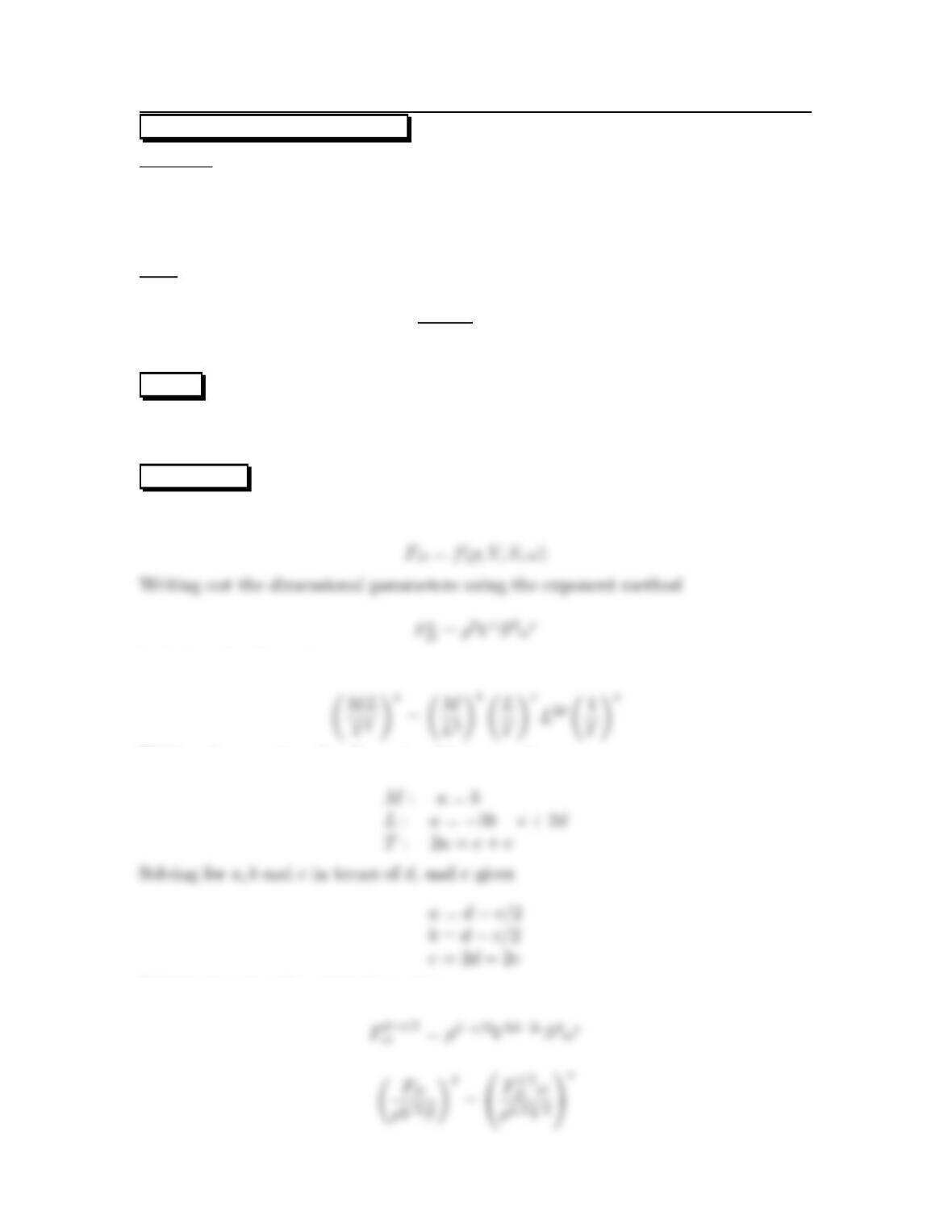
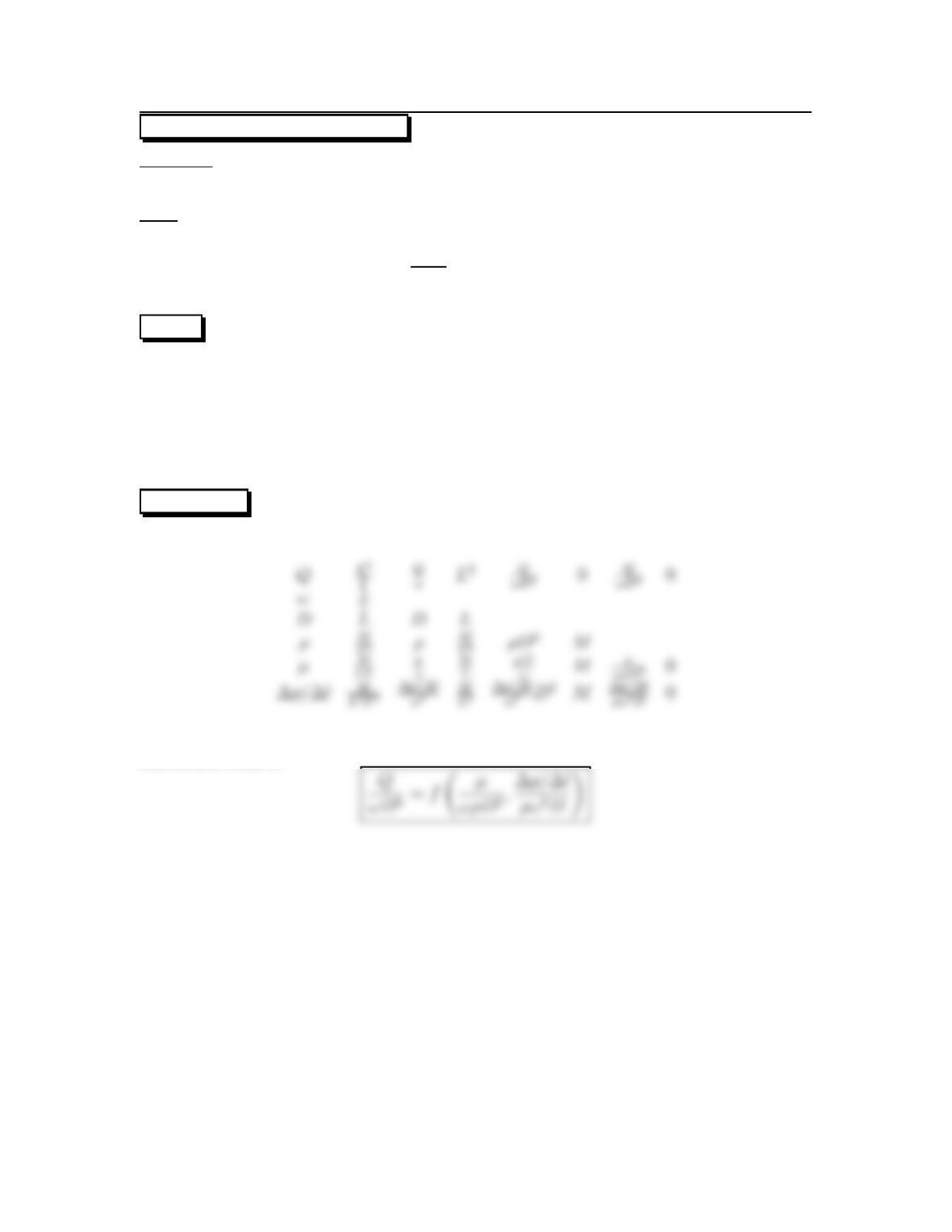
The functional relationship is
Including the dimensions
Writing the equations for dimensional homogeneity,
Substituting into the original equation
23
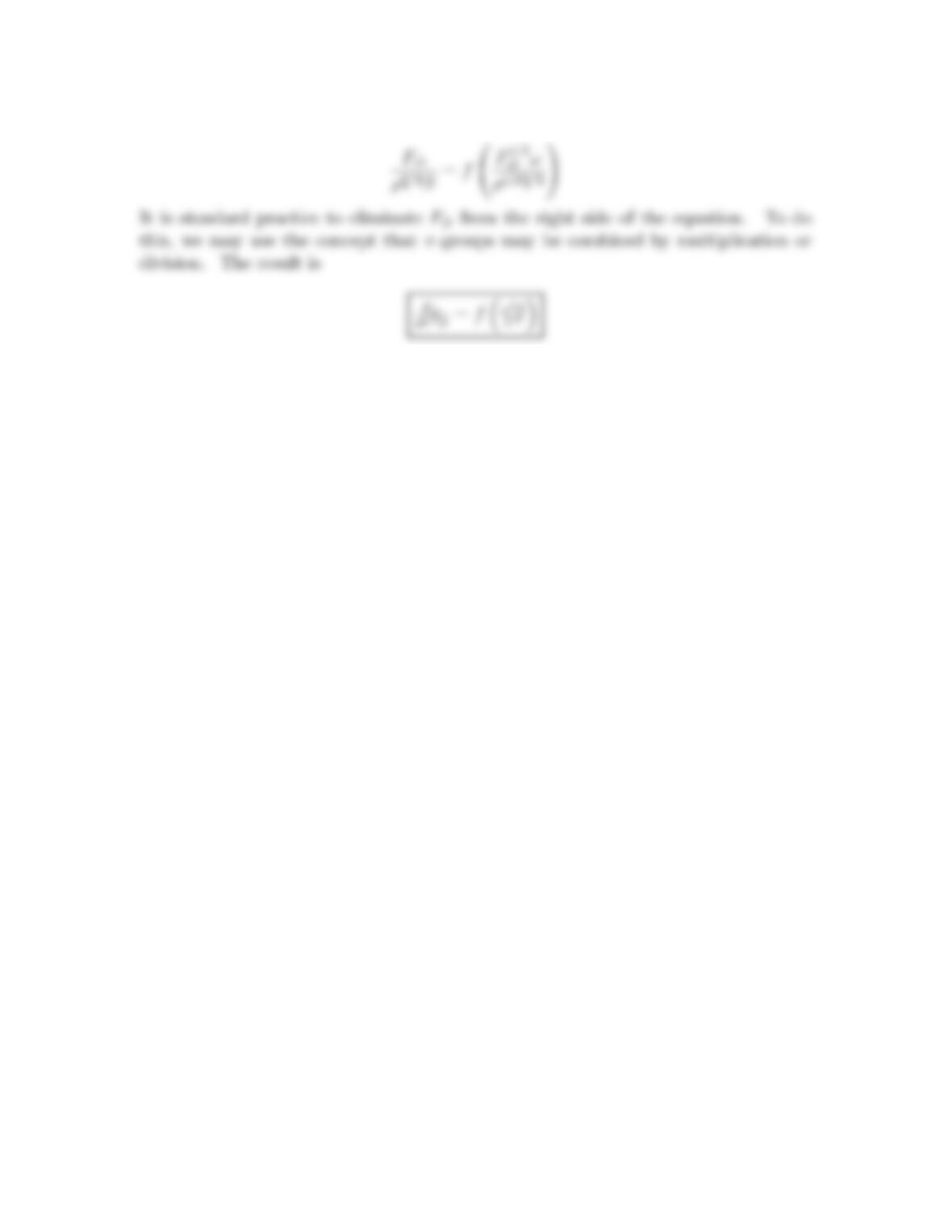
so
24
8.21: PROBLEM DEFINITION
Situation:
Biofluid mechanics involves flow through tubes that change in size over time.
Find:
The π-groups in the form Q
ωD3=f(π1,π
2)
PLAN
The dimensional functional form is
Q=f(ω, D, ρ, μ, ∆p/∆l)
Since there are 6 dimensional variables, there are 3 π-groups. Use the step-by-step
method..
SOLUTION
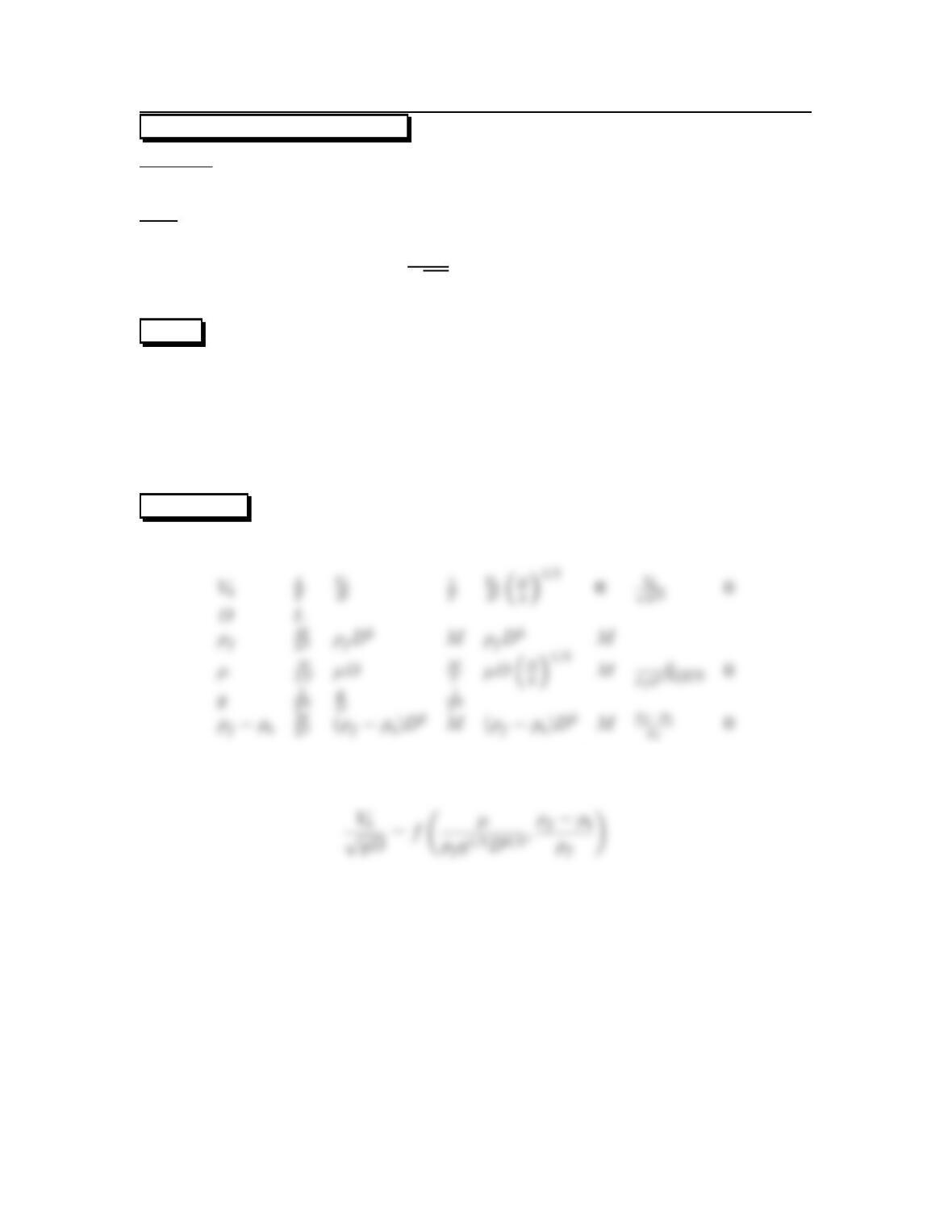
Set up the table
The time was eliminated with ω, the length with Dand the mass with ρD3.The final
functional form is
25
8.22: PROBLEM DEFINITION
Situation:
A bubble rises in a fluid.
Find:
The π-groups in the form Vb
√gD =f(π1,π
2)
PLAN
The dimensional form of the equation is
Vb=f(D, ρf,μ,g,ρ
l−ρb)
There are 6 dimensional variables so there are 3 π-groups. Use the step-by-step
method.
SOLUTION
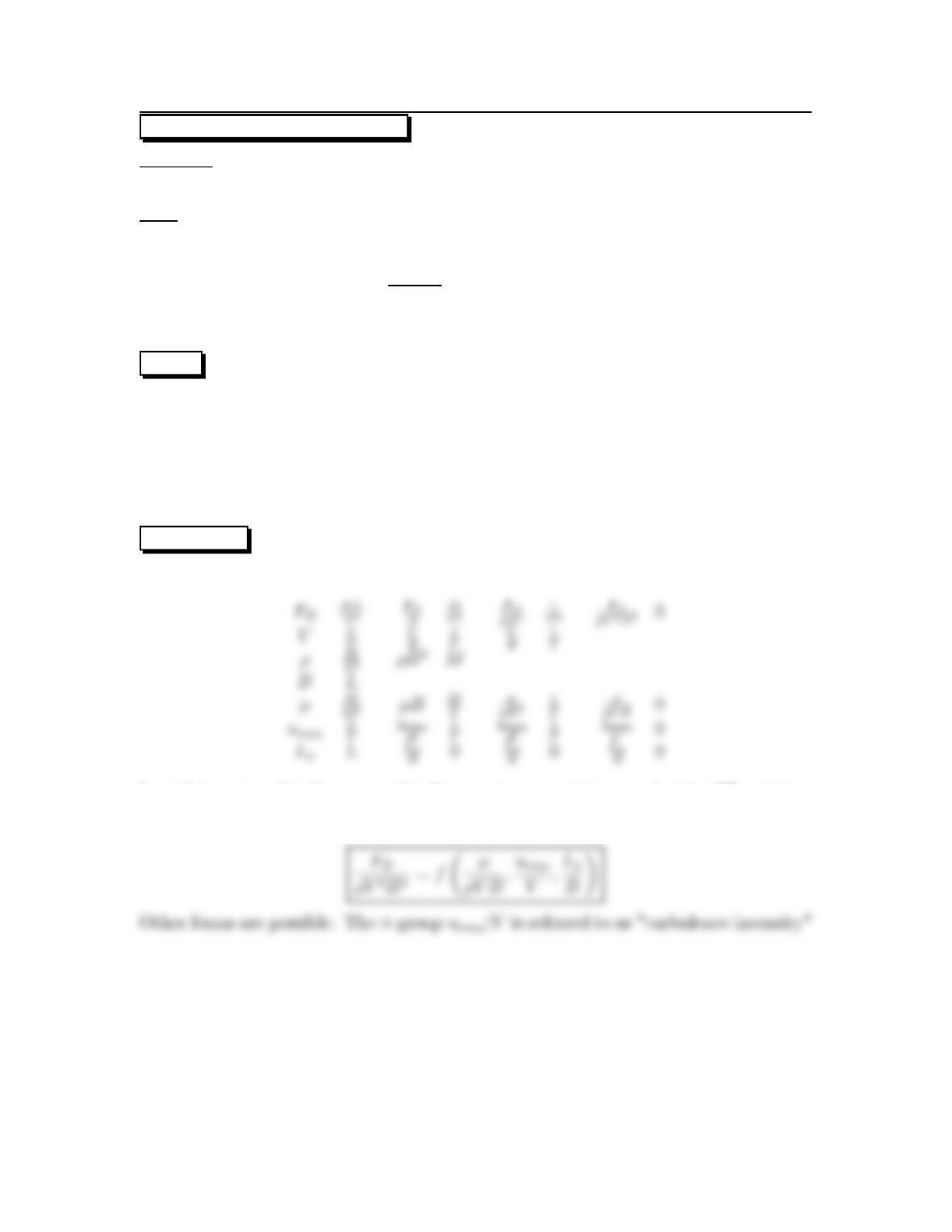
Setting up the table.
The length was eliminated with D, thetimewith(D/g)1/2and the mass with ρfD3.The
dimensionless form isππ
26

8.23: PROBLEM DEFINITION
Situation:
Discharge through a centrifugal pump.
The dimensional functional form:
Q=f(N,D,hp,μ,ρ,g)
Find:
The π-groups in the π−groups in the form
Q
ND3=f(π1,π
2,π
3)
.
PLAN
There are 7 dimensional groups so there should be 4 π-groups. Use the step-by-step
The functional relationship is
Q
ND3=f³hp
D,μ
ρND2,g
N2D´
Some dimensionless variables can be combined to yield a different form
27
8.24: PROBLEM DEFINITION
Situation:
Drag of a square plate placed normal to a free stream velocity.
Find:
The π−groups in the form
FD
ρV 2B2=f(π1,π
2,π
3)
.
PLAN
The functional form of the dimensional equation is
FD=f(ρ, V, B, μ, urms,L
x)
There are 7 dimensional parameters so there are 4 π-groups Use the step-by-step
method.
SOLUTION
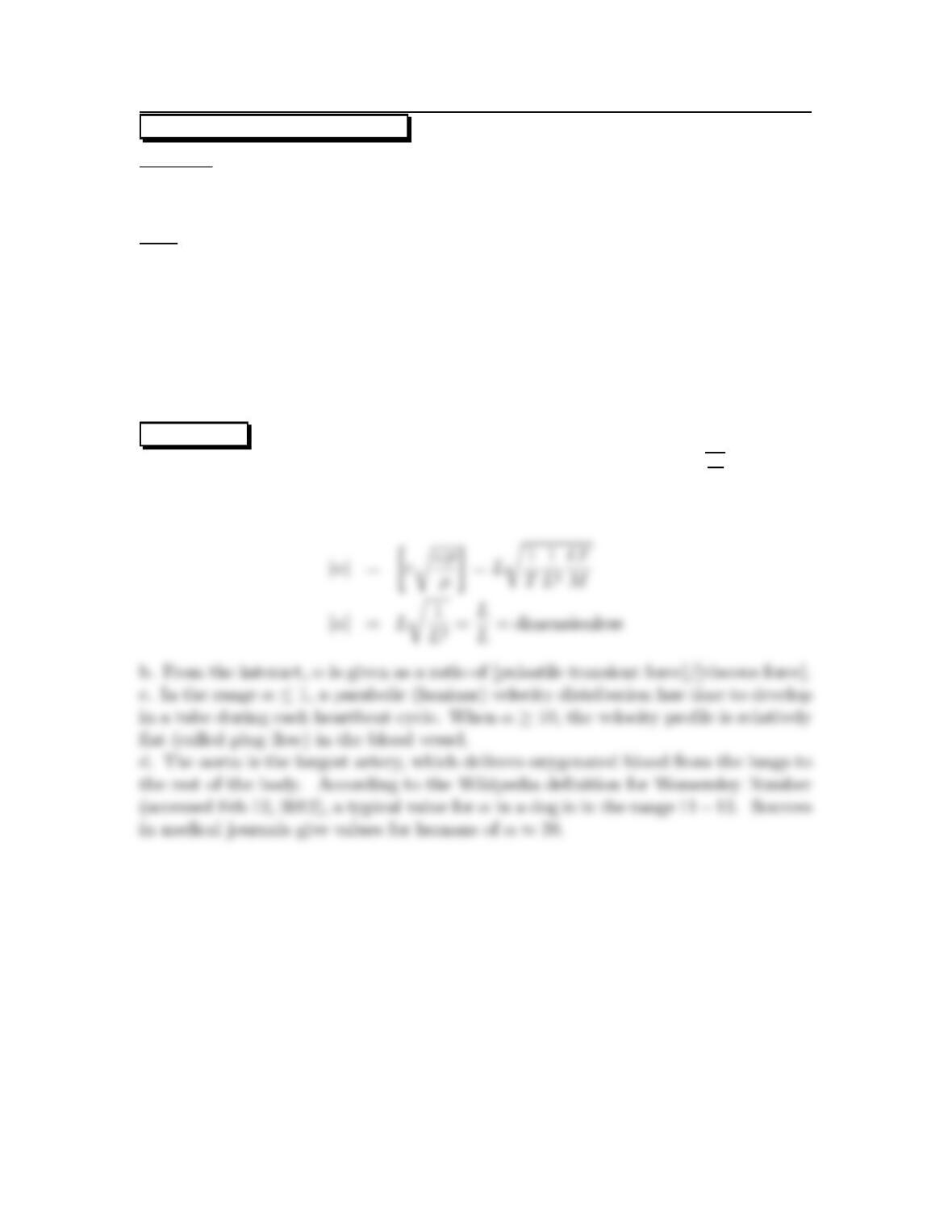
Setting up the table,
Length is removed in first step with B, massisremovedinsecondwithρB3and time
isremovedinthethirdwithV/B. The function form is
28
8.25: PROBLEM DEFINITION
Situation:
Using Wikipedia, read about the Womersley Number (α) and answer the following
questions.
Find:
a. Is αdimensionless? How do you know? Show that all the terms in fact cancel
out.
b. Like other independent π-groups, αis the ratio of two forces. Of what two forces
is it the ratio?
c. What does the velocity profile in a blood vessel look like for α≤1?Forα≥10?
d. What is the aorta and where in the human body is it located? What is a typical
value for αin the aorta? What might you conclude about the velocity profile there?
SOLUTION
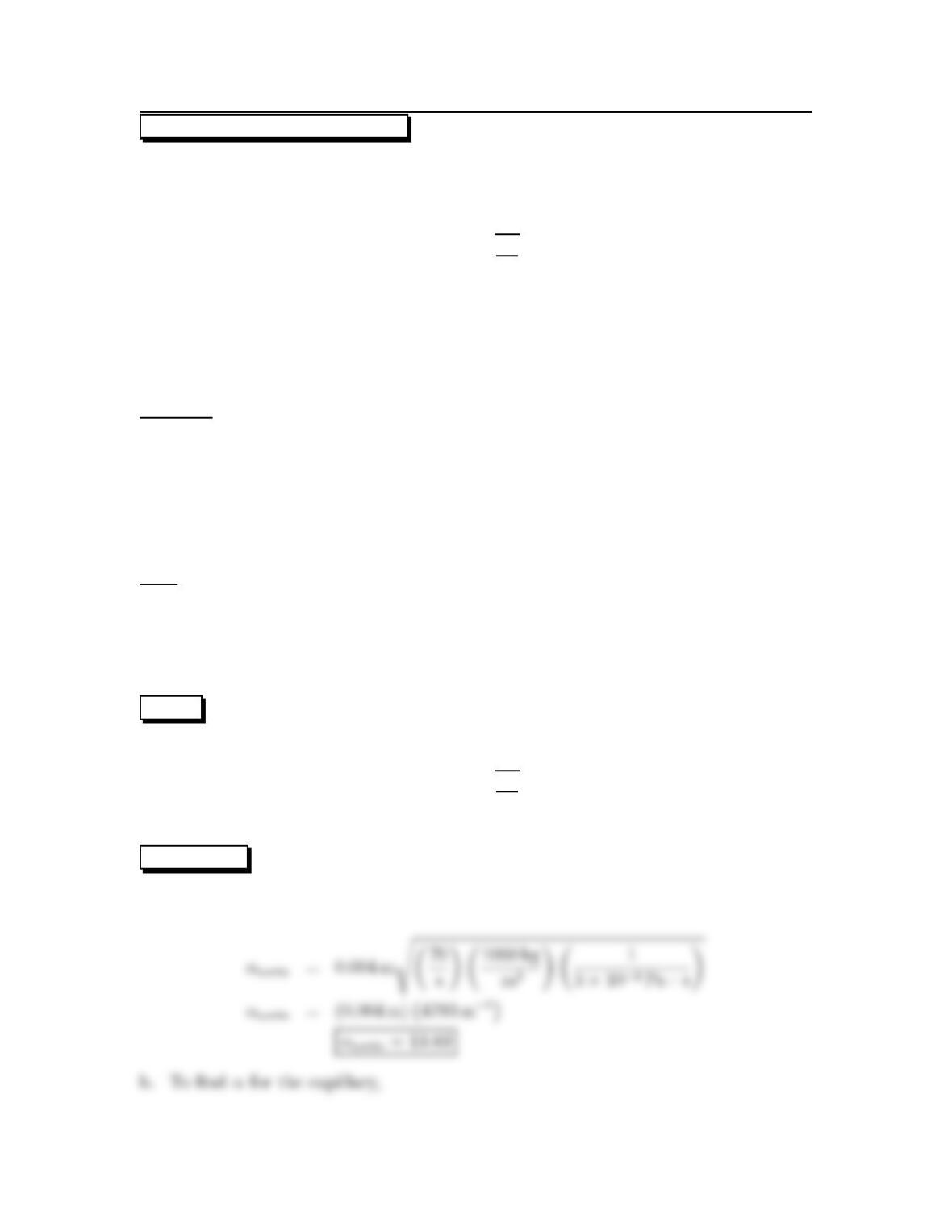
a. To check whether αis dimensionless, use the relationship α=rqωρ
μ,and insert
the dimensions of these variables.
29
8.26: PROBLEM DEFINITION
The Womersley Number (α)isaπ-group given by the ratio of [pulsatile transient
force]/[viscous force]. Biomedical engineers have applied this to characterize flow in
blood vessels. The Womersley Number is given by:
α=rrωρ
μ
where r = blood vessel radius, and ω= frequency, typically the heart rate. Like Re, α
has different practical implications in critical ranges. In the range α≤1, a parabolic
(laminar) velocity distribution has time to develop in a tube during each heartbeat
cycle. When α≥10,thevelocityprofile is relatively flat (called plug flow) in the
blood vessel.
Situation:
Assume a human subject with the following features:
ω=70 beats/s, or 70 s−1
radiusaorta =4mm
ρ=1060kg/m
3
radiuscapillary =7μm
μ=3×10⁻³Pa ·s
Find:
a. Find αfor the aorta of this subject.
b. Find αfor the capillary of this subject.
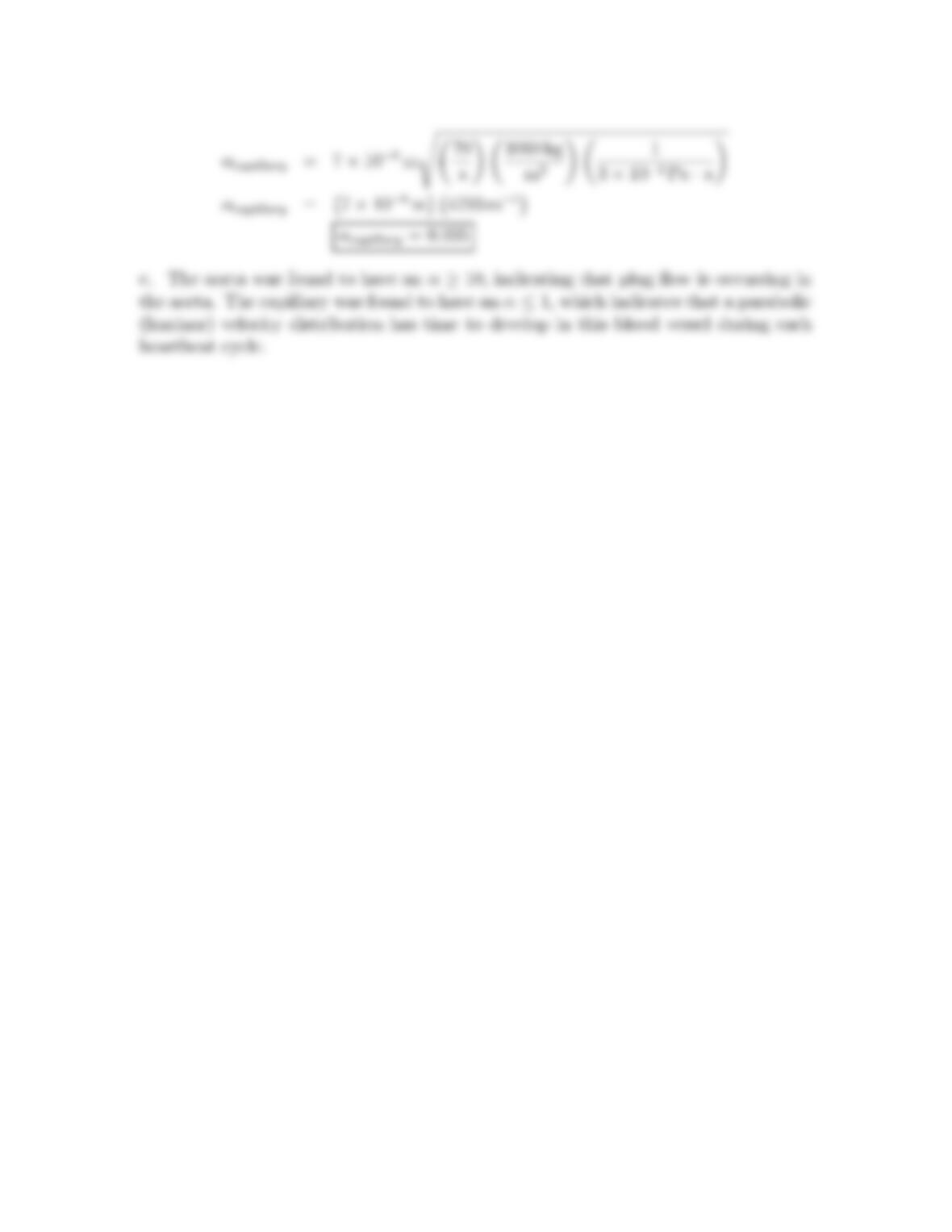
c. Does either the aorta or the capillary have an αthat would predict plug flow?
Does either have an αindicating a parabolic velocity distribution?
PLAN
Use the equation for Womersley Number (α)
α=rrωρ
μ
SOLUTION
a. To find αfor the aorta,
30
31
8.27: PROBLEM DEFINITION
Find:
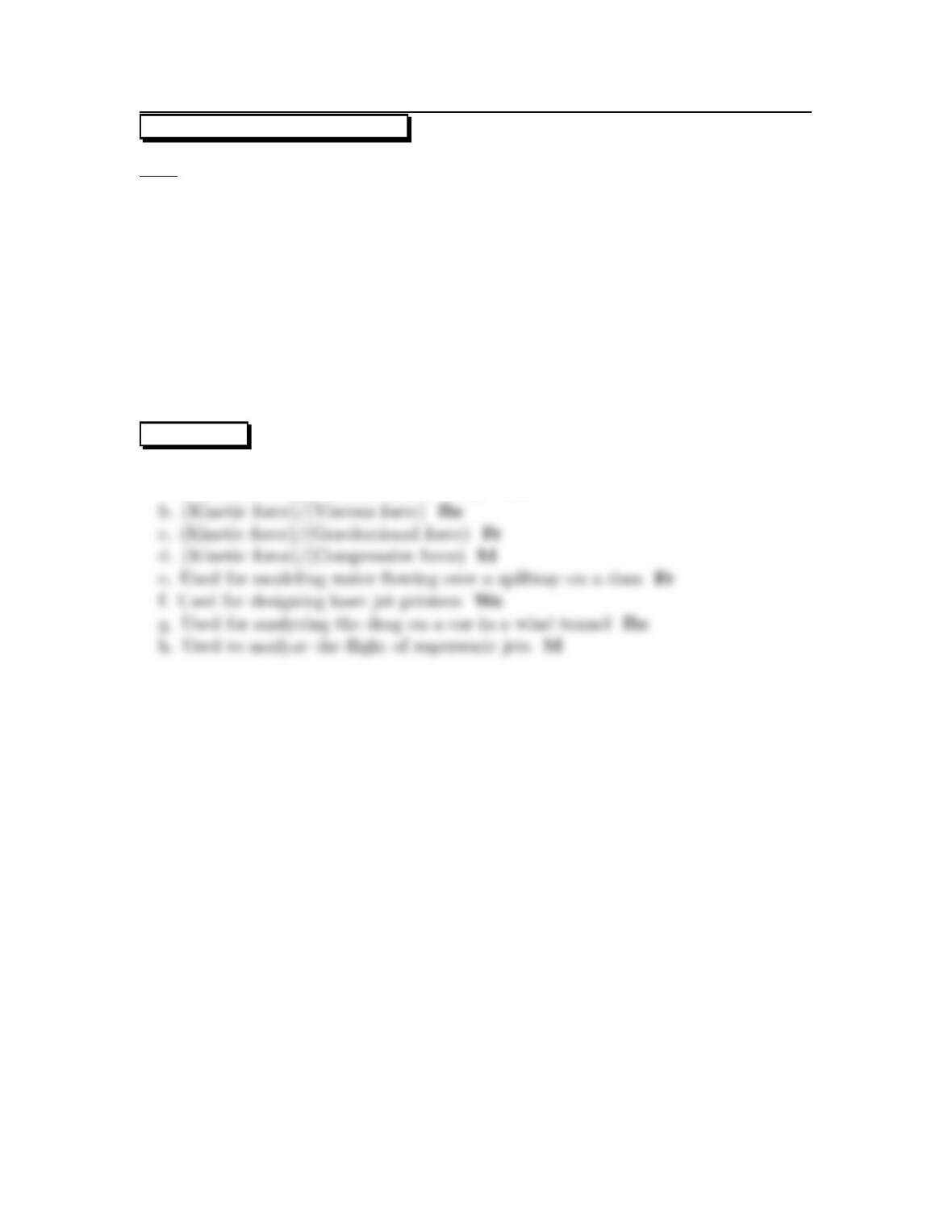
For each item below, which π-group (Re, We, M or Fr) would best match the given
description?
a. (Kinetic force)/(Surface-tension force)
b. (Kinetic force)/(Viscous force)
c. (Kinetic force)/(Gravitational force)
d. (Kinetic force)/(Compressive force)
e. Used for modeling water flowing over a spillway on a dam
f. Used for designing laser jet printers
g. Used for analyzing the drag on a car in a wind tunnel
h. Used to analyze the flight of supersonic jets
SOLUTION
Answers are provided to the right, bolded.
a. (Kinetic force)/(Surface-tension force) We
32
8.28: PROBLEM DEFINITION
Situation:
Geometric similitude.
Find:
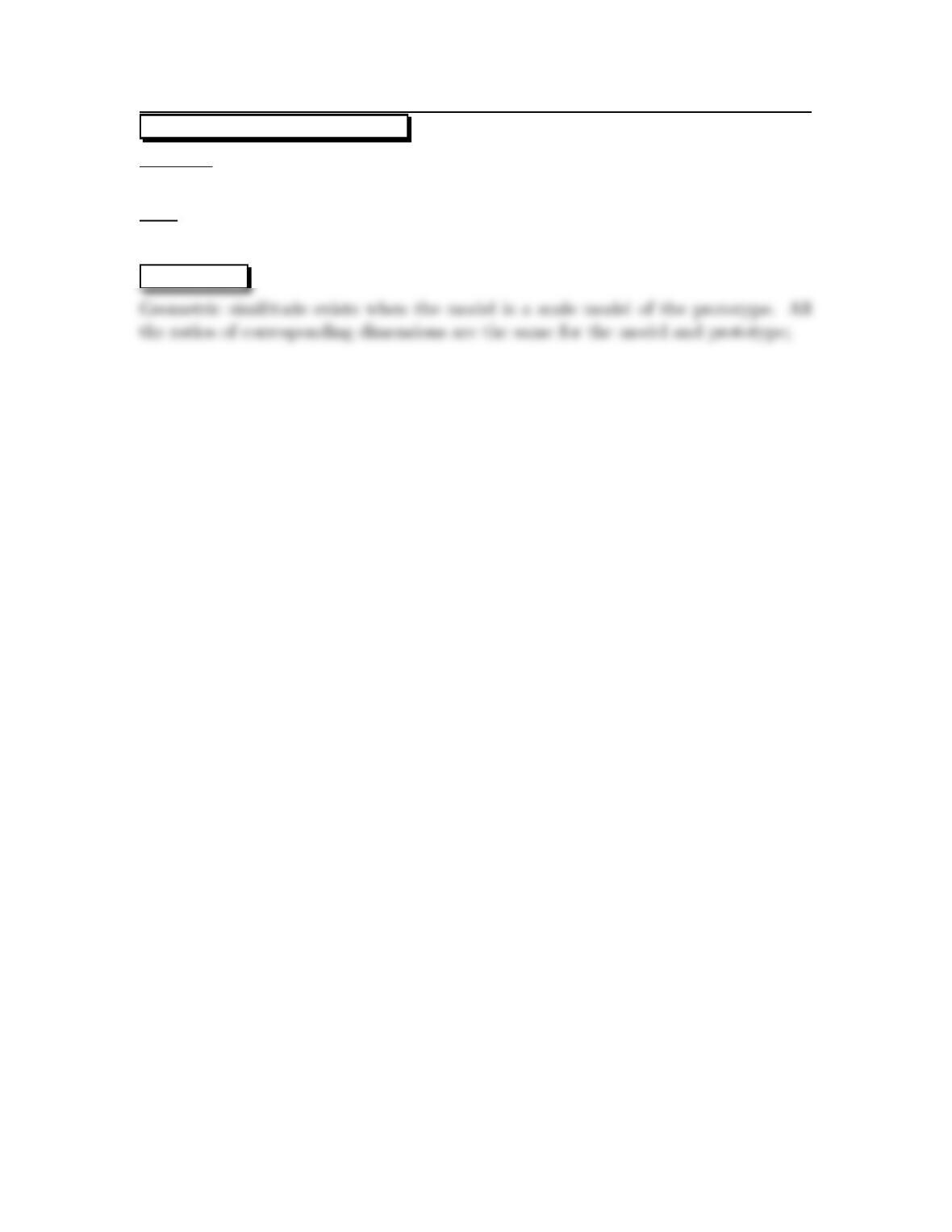
Definition of geometric similitude.
SOLUTION
33

8.29: PROBLEM DEFINITION
Situation:
Gather information on wind tunnel testing of automobiles.
SOLUTION
34
8.30: PROBLEM DEFINITION
Situation:
Testing of an automobile in a wind tunnel.
Find:
Discuss the effect of the ground on the aerodynamic performance of automobiles.
SOLUTION
The effects of the road surface may effect the automobile drag increasing the velocity
35

8.31: PROBLEM DEFINITION
Situation:
Wind tunnel at NASA Facility at Moffat Field, CA
Find:
Summarize information on the facility.
SOLUTION
36

8.32: PROBLEM DEFINITION
Situation:
Hydrodynamics of a sailboat.
Find:
Information on simulations of sailboat performance.
SOLUTION
37
8.33: PROBLEM DEFINITION
Situation:
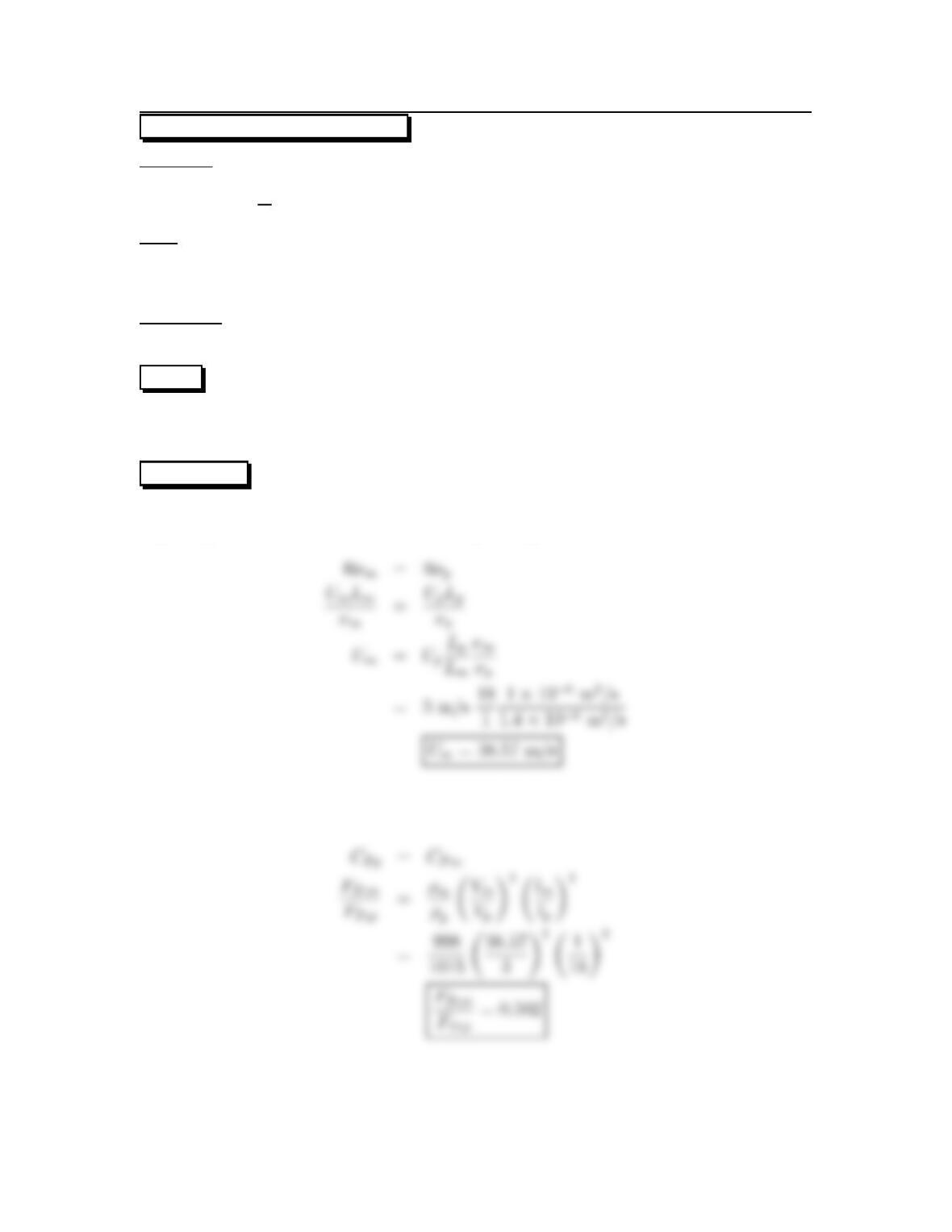
Drag force on a submarine is studied using a scale model in water tunnel.
V=3m/s,1
18 scale model.
Find:
Speed of water in the tunnel for dynamic similitude.
The ratio of drag forces (ratio of drag force on the model to that on the prototype).
Properties:
Sea Water (20 ◦C):ρ=1015kg/m3,ν=1.4×10−6m2/s.
PLAN
Dynamic similarity is achieved when the Reynolds numbers are the same. With
similitude, the force coefficients are the same.
SOLUTION
Match Reynolds number for dynamic similitude.
Equating Reynolds number of model and prototype,
The ratio of the drag force on the model to that on the prototype is
38
8.34: PROBLEM DEFINITION
Situation:
Water flows through a pipe.
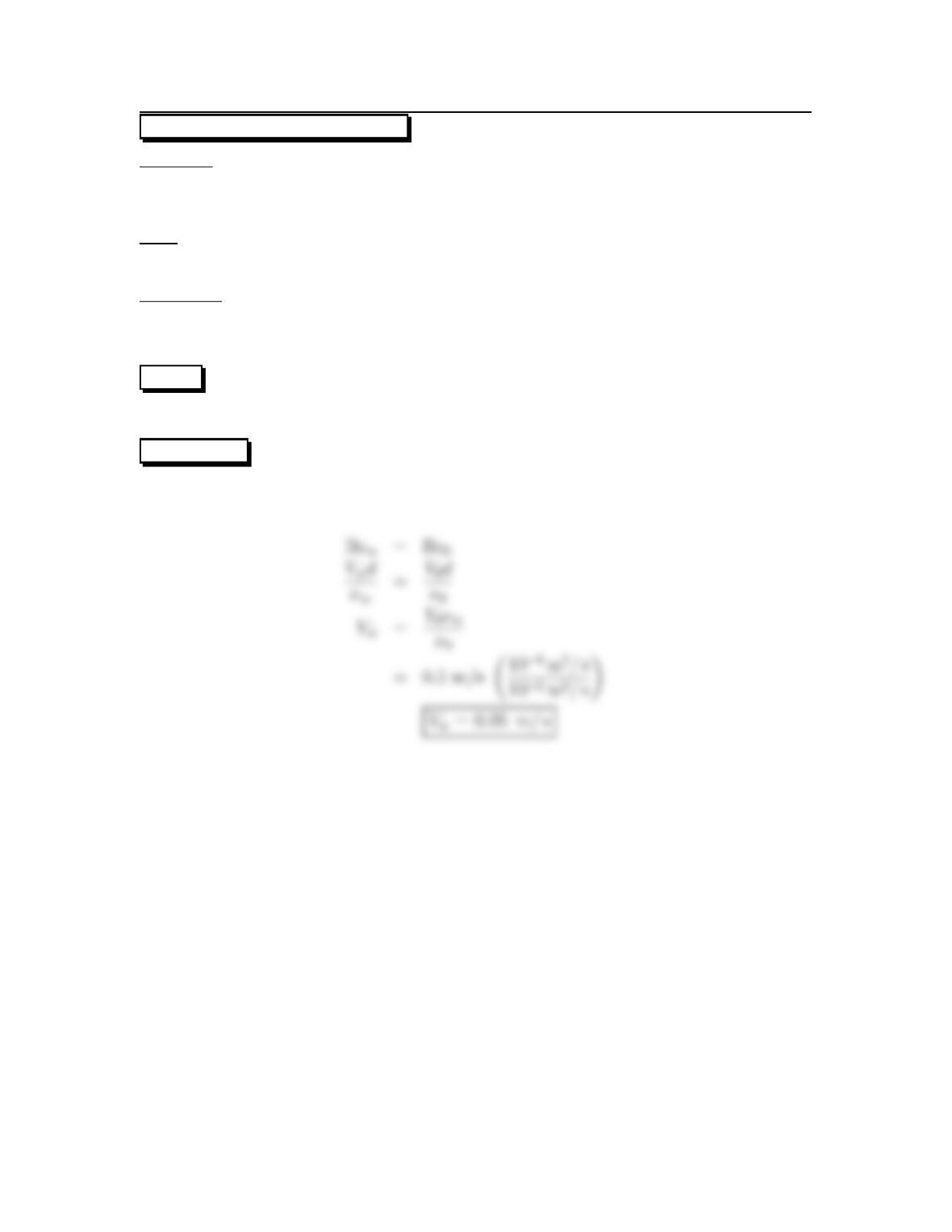
V=0.5m/s,D=4cm.
Find:
Velocity of water for dynamic similarity with oil (ν=10
−5m2/s) at 0.5 m/s.
Properties:
Water: ν=10
−6m2/s.
Oil: ν=10
−5m2/s.
PLAN
Dynamic similarity is achieved when the Reynolds numbers are the same.
SOLUTION
Match Reynolds number
39
8.35: PROBLEM DEFINITION
Situation:
Oil flows through a smooth pipe.
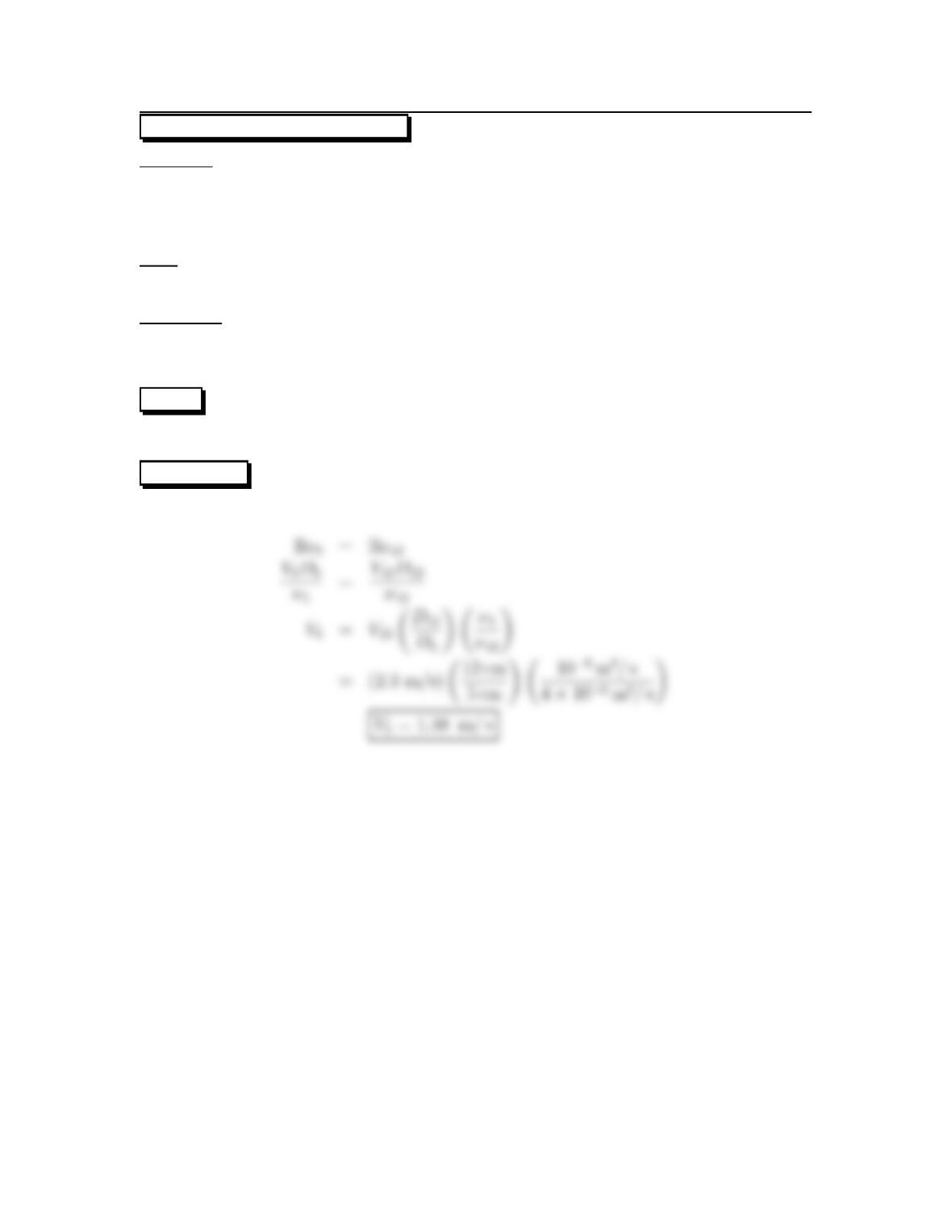
D15 =12cm,V15 =2.3m/s.
D5=5cm.
Find:
Velocityofwaterat5cmpipefordynamicsimilarity.
Properties:
Oil (20 ◦C):ν15 =4×10⁻⁶m2/s.
Water (20 ◦C):ν5=10
−6m2/s.
PLAN
Dynamic similarity is achieved when the Reynolds numbers are the same.
SOLUTION
Match Reynolds number
40