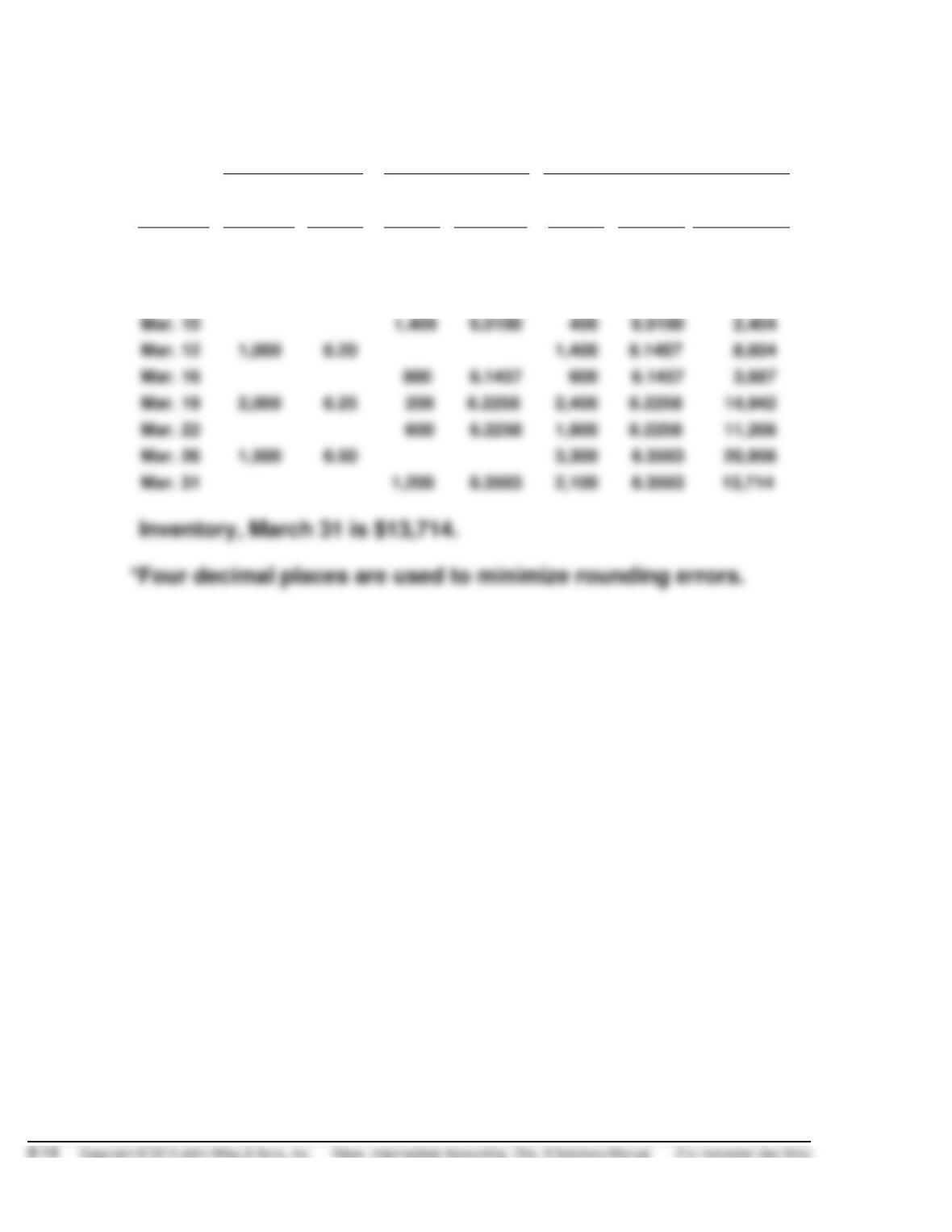
PROBLEM 8-5B (Continued)
3. Average cost.
Received
Issued
Balance
Date
No. of
units
Unit
cost
No. of
units
Unit
cost
No. of
units
Unit
cost*
Amount
Mar. 1
2,000
$6.00
2,000
$6.0000
$12,000
Mar. 6
500
6.05
2,500
6.0100
5,025
Mar. 8
700
$6.0100
1,800
6.0100
10,818
Mar. 10
1,400
400
6.0100
Mar. 12
1,000
6.20
Mar. 16
600
6.1457
Mar. 19
200
2,400
6.2258
Mar. 22
600
1,800
Mar. 26
3,300
6.3503
Mar. 31
2,100
6.3503
13,714
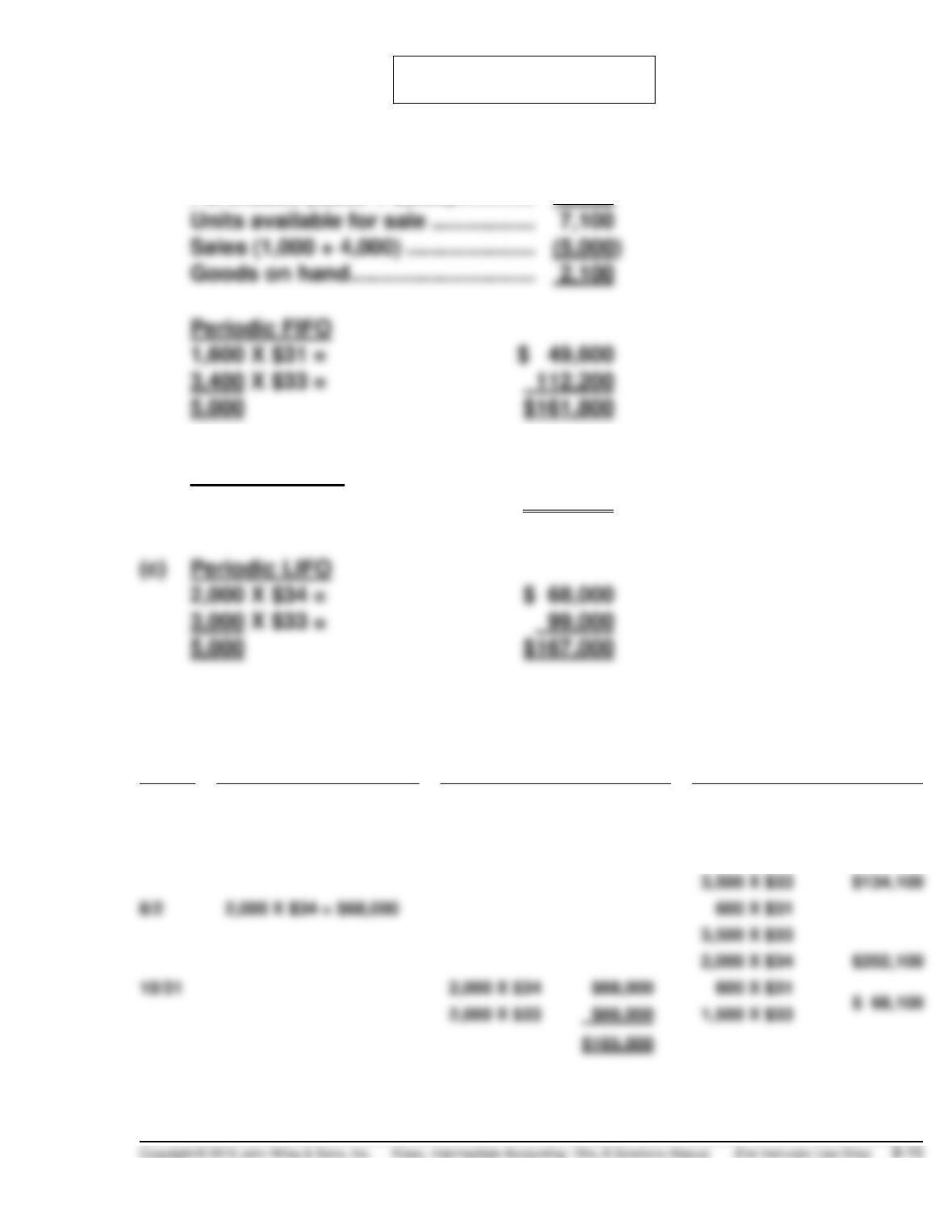
PROBLEM 8-6B
(a)
Beginning inventory …………………
1,600
Purchases (3,500 + 2,000) ………….
5,500
Units available for sale ……………..
Sales (1,000 + 4,000) …………………
Periodic FIFO
$161,800
(b)
Perpetual FIFO
Same as periodic:
$161,800
(c)
Periodic LIFO
2,000 X $34 =
(d)
Perpetual LIFO
Date
Purchased
Sold
Balance
1/1
1,600 X $31
$ 49,600
3/6
1,000 X $31
$31,000
600 X $31
$ 18,600
6/26
3,500 X $33 = $115,500
600 X $31
3,500 X $33
8/2
2,000 X $34 = $68,000
600 X $31
3,500 X $33
2,000 X $34
10/31
2,000 X $34
$68,000
600 X $31
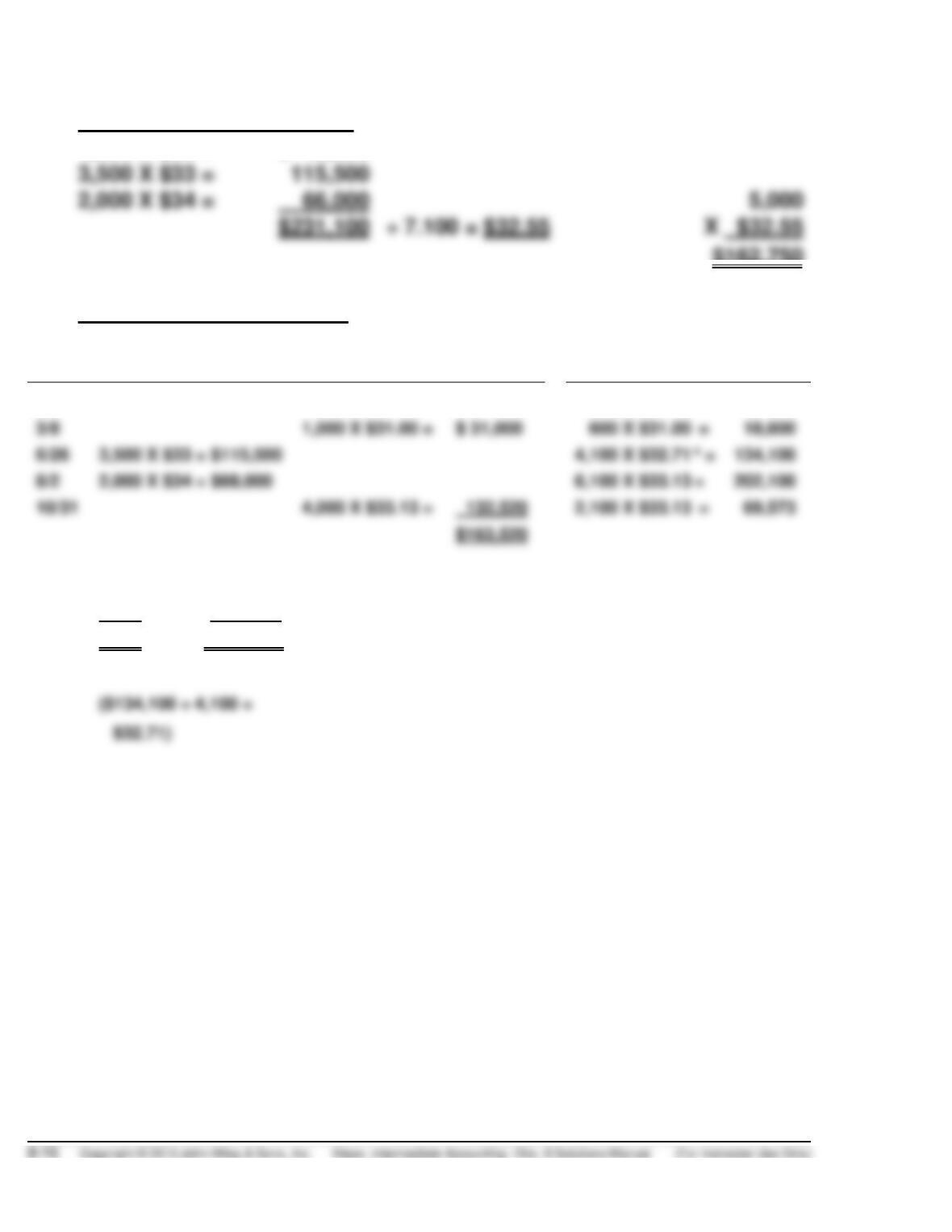
PROBLEM 8-6B (Continued)
(e)
Periodic weighted-average
1,600 X $31 =
$ 49,600
3,500 X $33 =
2,000 X $34 =
66,000
$162,750
(f)
Perpetual moving average
Date
Purchased
Sold
Balance
1/1
1,600 X $31.00 =
$ 49,600
3/8
1,000 X $31.00 =
$ 31,000
18,600
6/26
3,500 X $33 = $115,500
4,100 X $32.71 a =
134,100
8/2
2,000 X $34 = $68,000
6,100 X $33.13 =
202,100
10/31
4,000 X $33.13 =
69,573
$163,520
a
600 X $31 = $ 18,600
3,500 X $33 = 115,100
4,100 $ 134,100
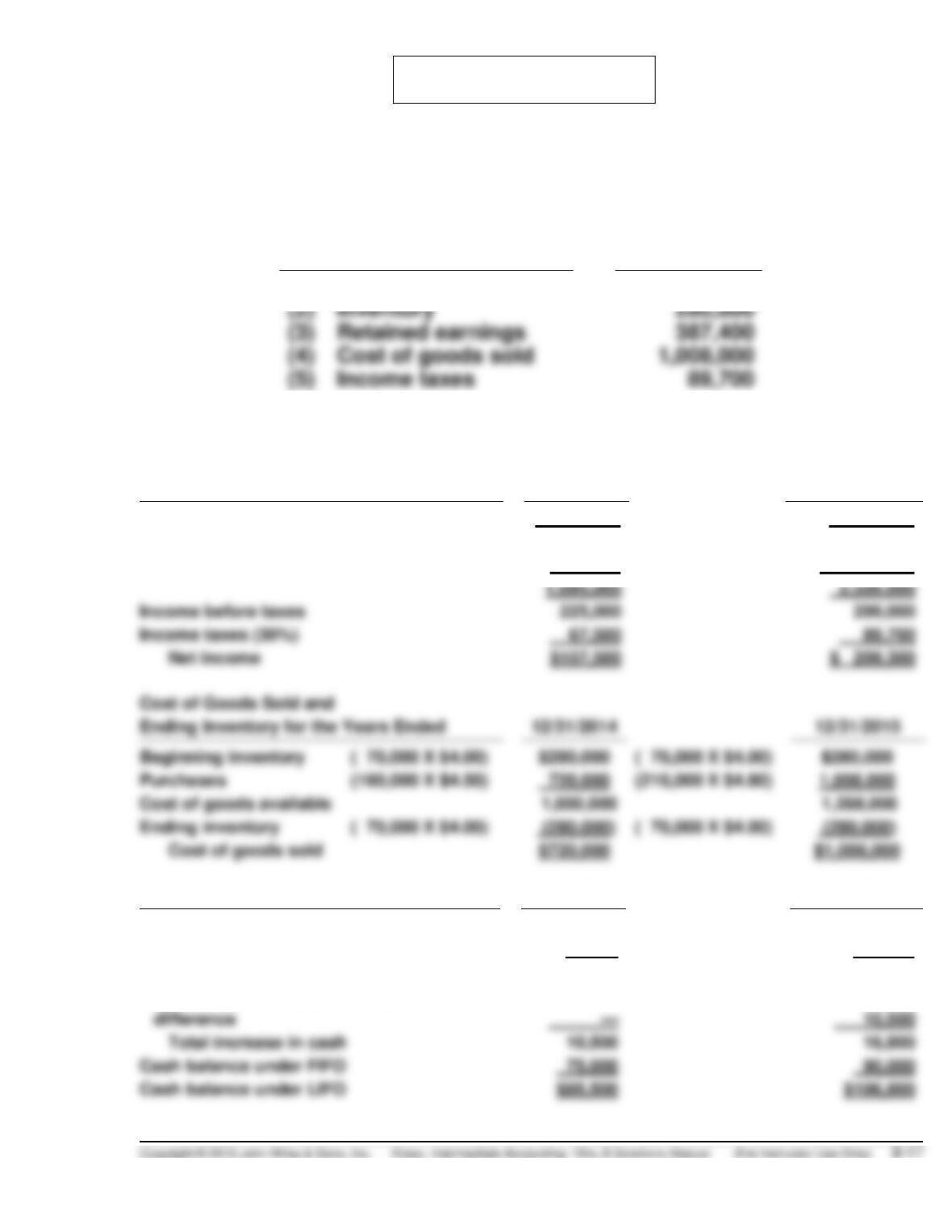
PROBLEM 8-7B
The accounts in the 2015 financial statements which would be affected by
a change to LIFO and the new amount for each of the accounts are as
follows:
Account
New amount
for 2015
(1)
Cash
$106,800
(2)
Inventory
(3)
Retained earnings
(4)
Cost of goods sold
The calculations for both 2014 and 2015 to support the conversion to LIFO
are presented below.
Income for the Years Ended
12/31/2014
12/31/2015
Sales revenue
$1,920,000
$2,625,000
Less: Cost of goods sold
720,000
1,008,000
Other expenses
975,000
1,318,000
Income before taxes
225,000
299,000
Income taxes (30%)
Net income
Ending Inventory for the Years Ended
12/31/2014
12/31/2015
Beginning inventory
( 70,000 X $4.00)
( 70,000 X $4.00)
Purchases
Cost of goods available
Ending inventory
( 70,000 X $4.00)
(280,000)
( 70,000 X $4.00)
Determination of Cash at
12/31/2014
12/31/2015
Income taxes under FIFO
$ 78,000
$96,000
Income taxes as calculated under LIFO
67,500
89,700
Increase in cash
10,500
6,300
difference
10,500
Total increase in cash
10,500
Adjust cash at 12/31/2015 for 2014 tax
PROBLEM 8-7B (Continued)
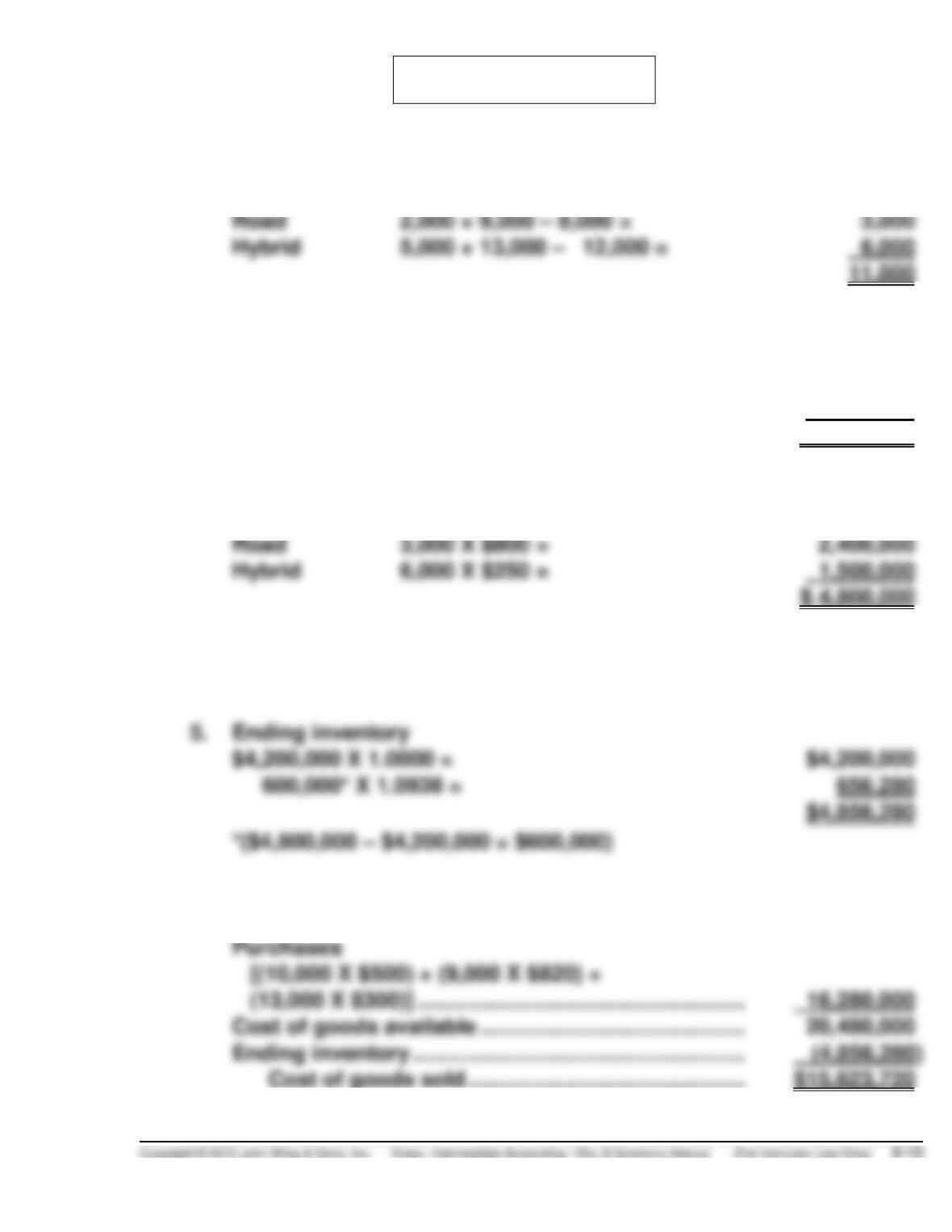
Determination of Retained Earnings at
12/31/2014
12/31/2015
Net income under FIFO
$182,000
$224,000
Net income under LIFO
(157,500)
(209,300)
Reduction in retained earnings
for 2014 reduction
Total reduction in retained earnings
Retained earnings under FIFO
PROBLEM 8-8B
(a)
1.
Ending inventory in units
Mountain
3,000 + 10,000 – 11,000 =
2,000
Road
2,000 + 9,000 – 8,000 =
3,000
Hybrid
5,000 + 13,000 – 12,000 =
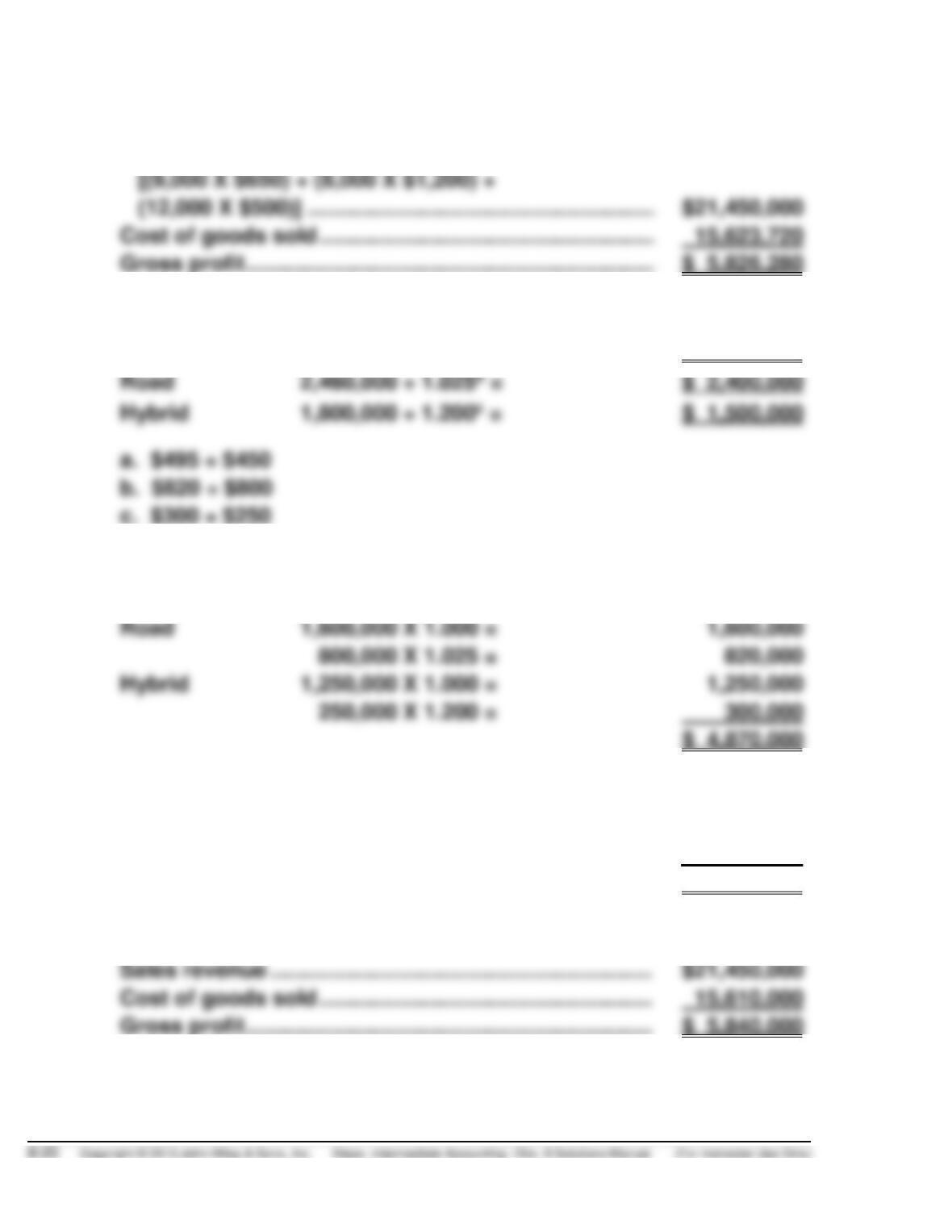
2.
Ending inventory at current cost
Mountain
2,000 X $495 =
$ 990,000
Road
3,000 X $820 =
2,460,000
Hybrid
6,000 X $300 =
1,800,000
$ 5,250,000
3.
Ending inventory at base-year cost
Mountain
2,000 X $450 =
$ 900,000
Road
3,000 X $800 =
Hybrid
6,000 X $250 =
1,500,000
$ 4,800,000
4.
Price index
$5,250,000 ÷ $4,800,000 = 1.0938
5.
Ending inventory
$4,200,000 X 1.0000 =
600,000* X 1.0938 =
*($4,800,000 – $4,200,000 = $600,000)
6.
Cost of goods sold
Beginning inventory ………………………………………….
$ 4,200,000
Purchases
Cost of goods available …………………………………….
Ending inventory ………………………………………………
Cost of goods sold ………………………………………
PROBLEM 8-8B (Continued)
7.
Gross profit
Sales revenue
(12,000 X $500)] …………………………………………………..
$21,450,000
Cost of goods sold …………………………………………………
(b)
1.
Ending inventory at current cost restated to base cost
Mountain
$ 990,000 ÷ 1.100a =
$ 900,000
a. $495 ÷ $450
b. $820 ÷ $800
c. $300 ÷ $250
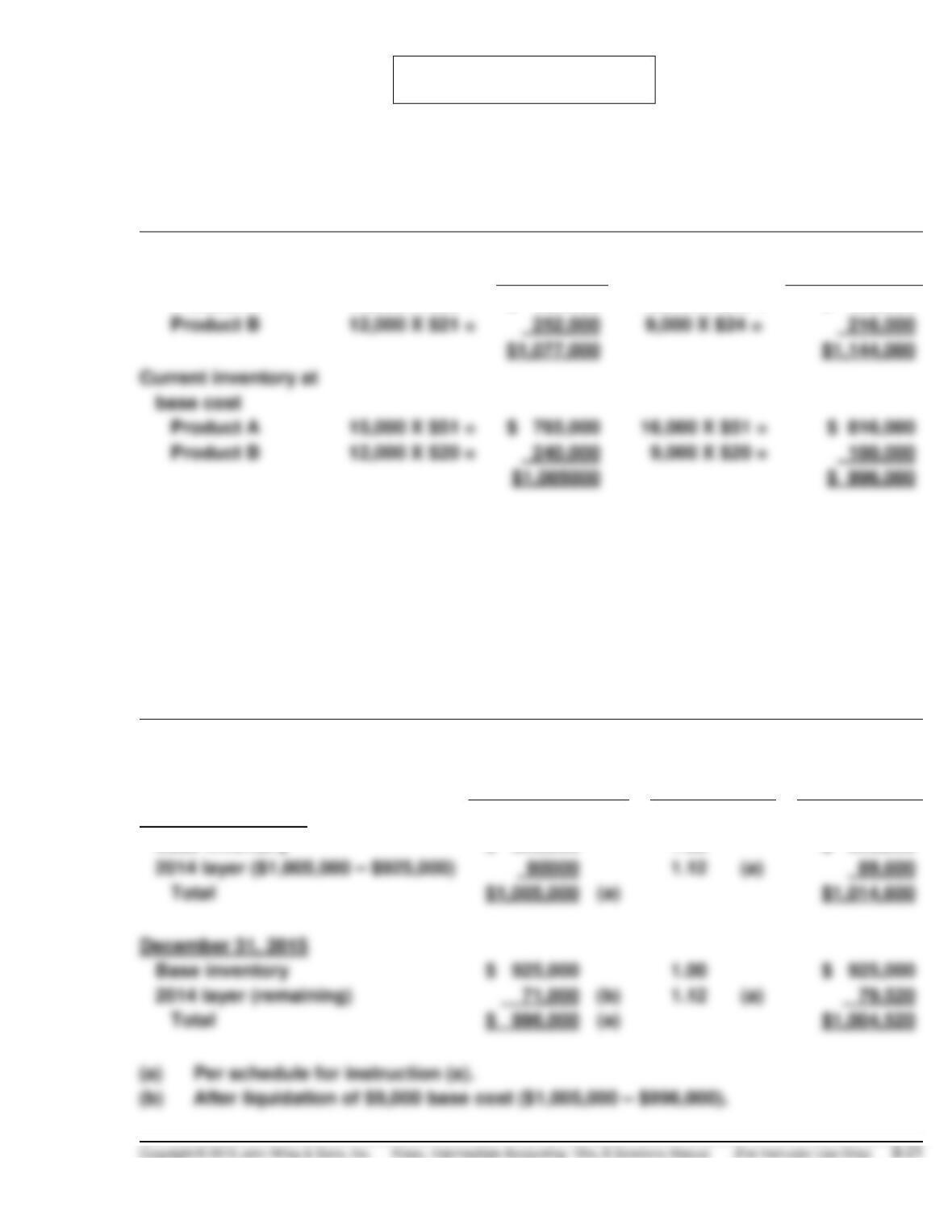
2.
Ending inventory
Mountain
$ 900,000 X 1.000 =
$ 900,000
Road
800,000 X 1.025 =
Hybrid
300,000
3.
Cost of good sold
Cost of good available …………………………………………
$20,480,000
Ending inventory …………………………..…………………….
(4,870,000)
Cost of goods sold …………………………………………
$15,610,000
4.
Gross profit
Sales revenue ……………………………………………………..
$21,450,000
Cost of goods sold ………………………………………………
PROBLEM 8-9B
(a) SQUID FISHTANKS INC.
Computation of Internal Conversion Price Index
for Inventory Pool No. 1 Double Extension Method
Current inventory at
current-year cost
2014
2015
Product A
15,000 X $55 =
$ 825,000
16,000 X $58 =
$ 928,000
Product B
Current inventory at
base cost
Product A
16,000 X $51 =
Product B
12,000 X $20 =
Conversion price index
$1,177,000 ÷ $1,055,000 = 1.12 $1,144,000 ÷ $996,000 = 1.15
(b) SQUID FISHTANKS INC.
Computation of Inventory Amounts
Under Dollar-Value LIFO Method for Inventory Pool No. 1
at December 31, 2014 and 2015
Current
Inventory at
base cost
Conversion
price index
Inventory at
LIFO cost
December 31, 2014
Base inventory
$ 925,000
1.00
$ 925,000
2014 layer ($1,005,000 – $925,000)
December 31, 2015
Base inventory
2014 layer (remaining)
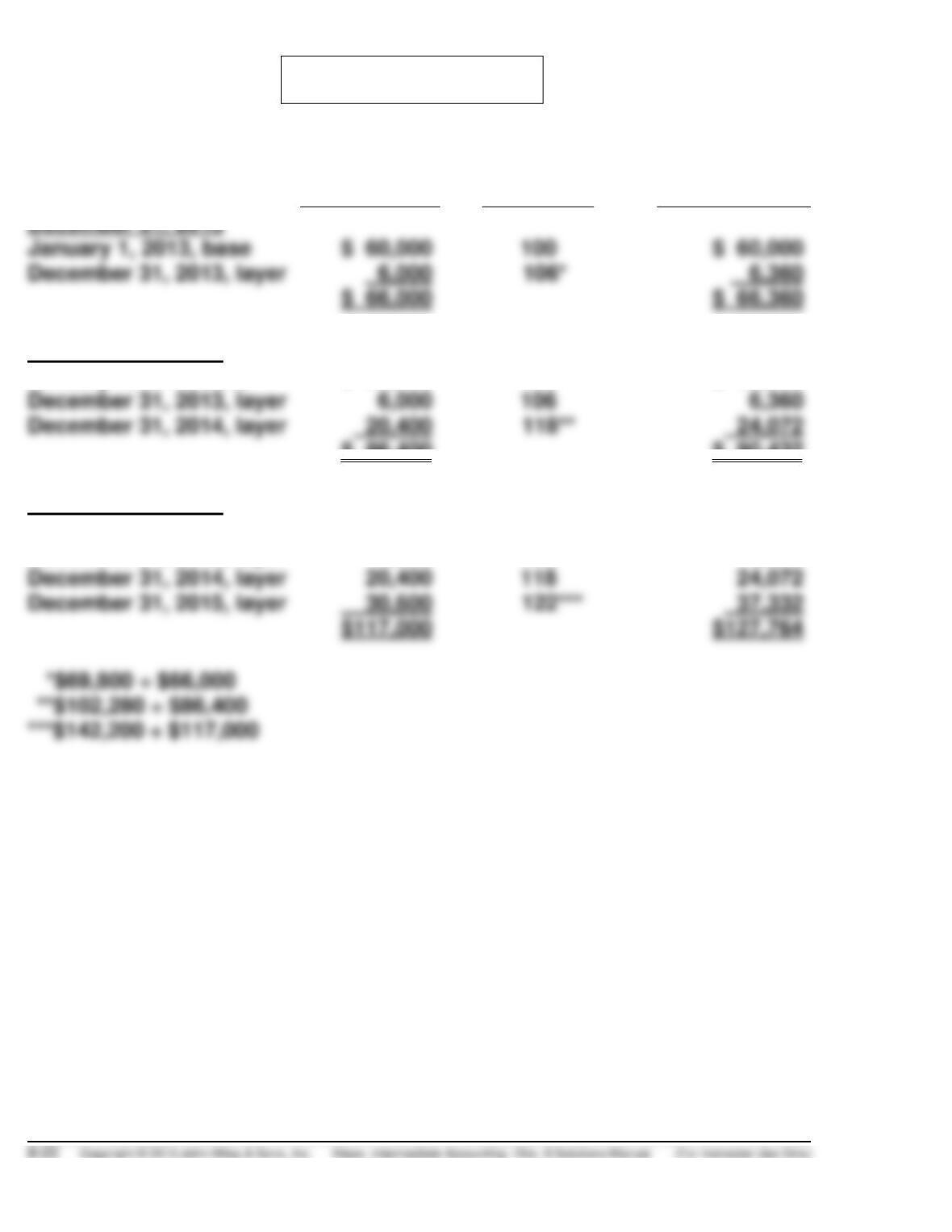
PROBLEM 8-10B
Base-Year
Cost
Index %
Dollar-Value
LIFO
December 31, 2013
January 1, 2013, base
$ 60,000
100
$ 60,000
December 31, 2013, layer
6,000
$ 66,000
$ 66,360
December 31, 2014
January 1, 2013, base
$ 60,000
100
$ 60,000
December 31, 2013, layer
106
December 31, 2014, layer
$ 86,400
$ 90,432
December 31, 2015
January 1, 2013, base
$ 60,000
100
$ 60,000
December 31, 2013, layer
6,000
106
6,360
December 31, 2014, layer
December 31, 2015, layer
$117,000
$127,764
*$69,800 ÷ $66,000
***$142,200 ÷ $117,000
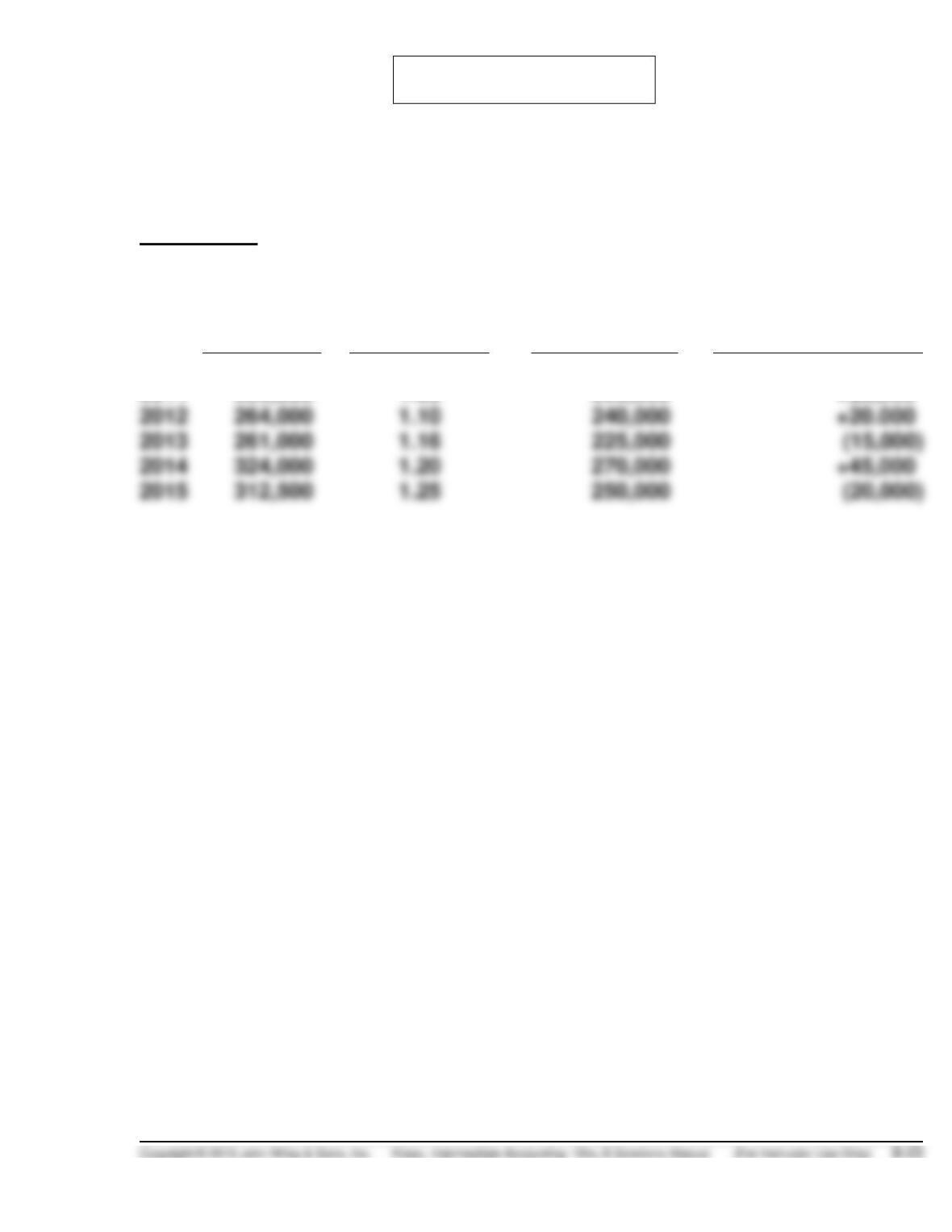
PROBLEM 8-11B
(a)
Schedule A
A
B
C
D
Current $
Price Index
Base-Year $
Change from
Prior Year
2010
$ 212,000
1.00
$ 212,000
—
2011
226,600
1.03
220,000
+$8,000
2012
264,000
1.10
2013
2014
324,000
1.20
270,000
2015
312,500
1.25
250,000
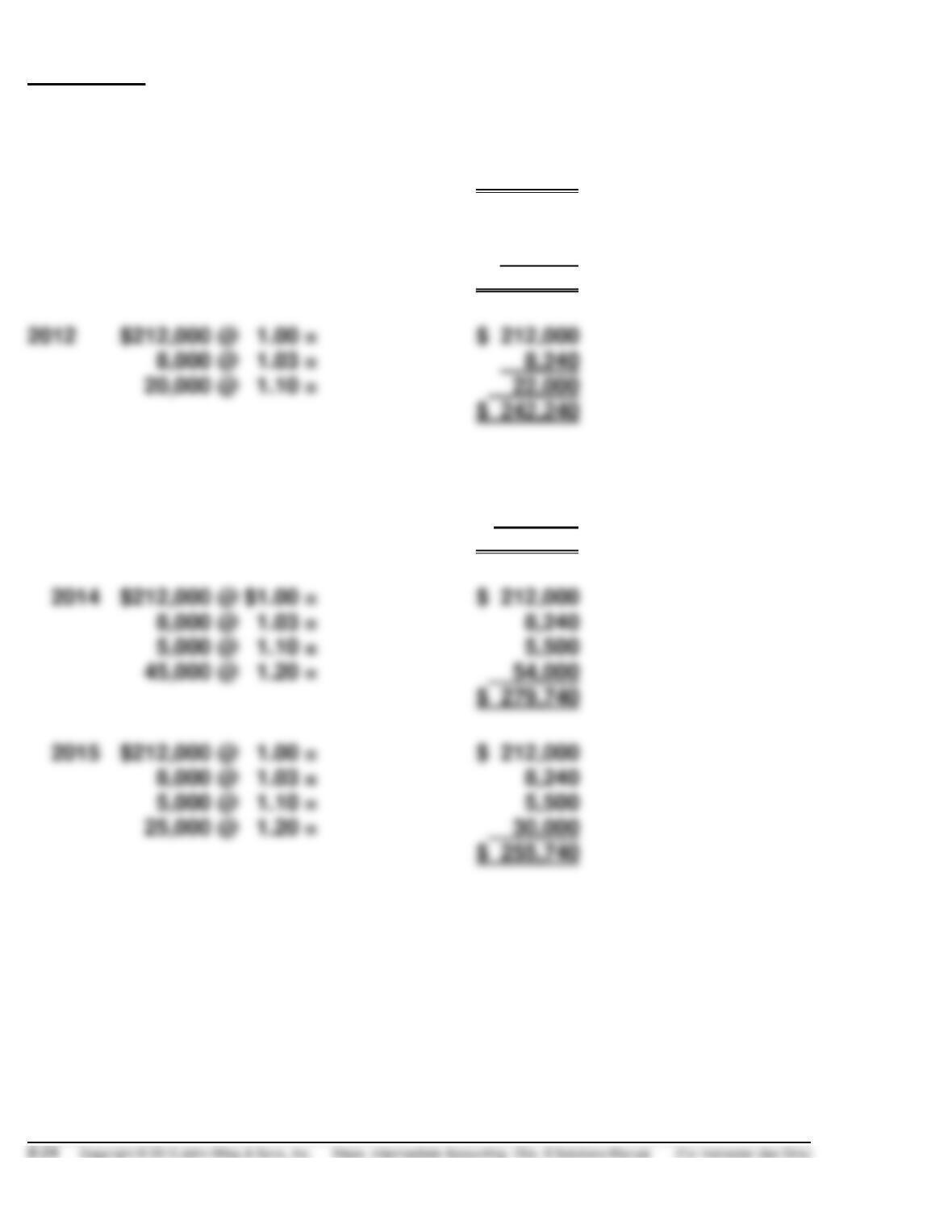
Schedule B
Ending Inventory-Dollar-Value LIFO:
2010
$ 212,000
2011
$212,000 @ $1.00 =
$ 212,000
8,000 @ 1.03 =
8,240
2012
$212,000 @ 1.00 =
$ 212,000
8,000 @ 1.03 =
8,240
20,000 @ 1.10 =
$ 220,240
2013
$212,000 @ 1.00 =
$ 212,000
8,000 @ 1.03 =
8,240
5,000 @ 1.10 =
5,500
$ 225,740
$212,000 @ $1.00 =
$ 212,000
8,000 @ 1.03 =
8,240
5,000 @ 1.10 =
5,500
45,000 @ 1.20 =
$ 279,740
$212,000 @ 1.00 =
8,000 @ 1.03 =
8,240
5,000 @ 1.10 =
PROBLEM 8-11B (Continued)
(b)
To: Landon Company
From: Accounting Student
Subject: Dollar-Value LIFO Pool Accounting
Dollar-value LIFO is an inventory method which values groups or “pools”
of inventory in layers of costs. It assumes that any goods sold during a
Because dollar-value LIFO combines various related costs in groups or
“pools,” no attempt is made to keep track of each individual inventory item.
Instead, each group of annual purchases forms a new cost layer of inventory.
Further, the most recent layer will be the first one carried to cost of goods
sold during this period.
To do this valuation, you need to know both the ending inventory at year-
end prices and the price index used to adjust the current year’s new layer.
The idea is to convert the current ending inventory into base-year costs.
PROBLEM 8-11B (Continued)
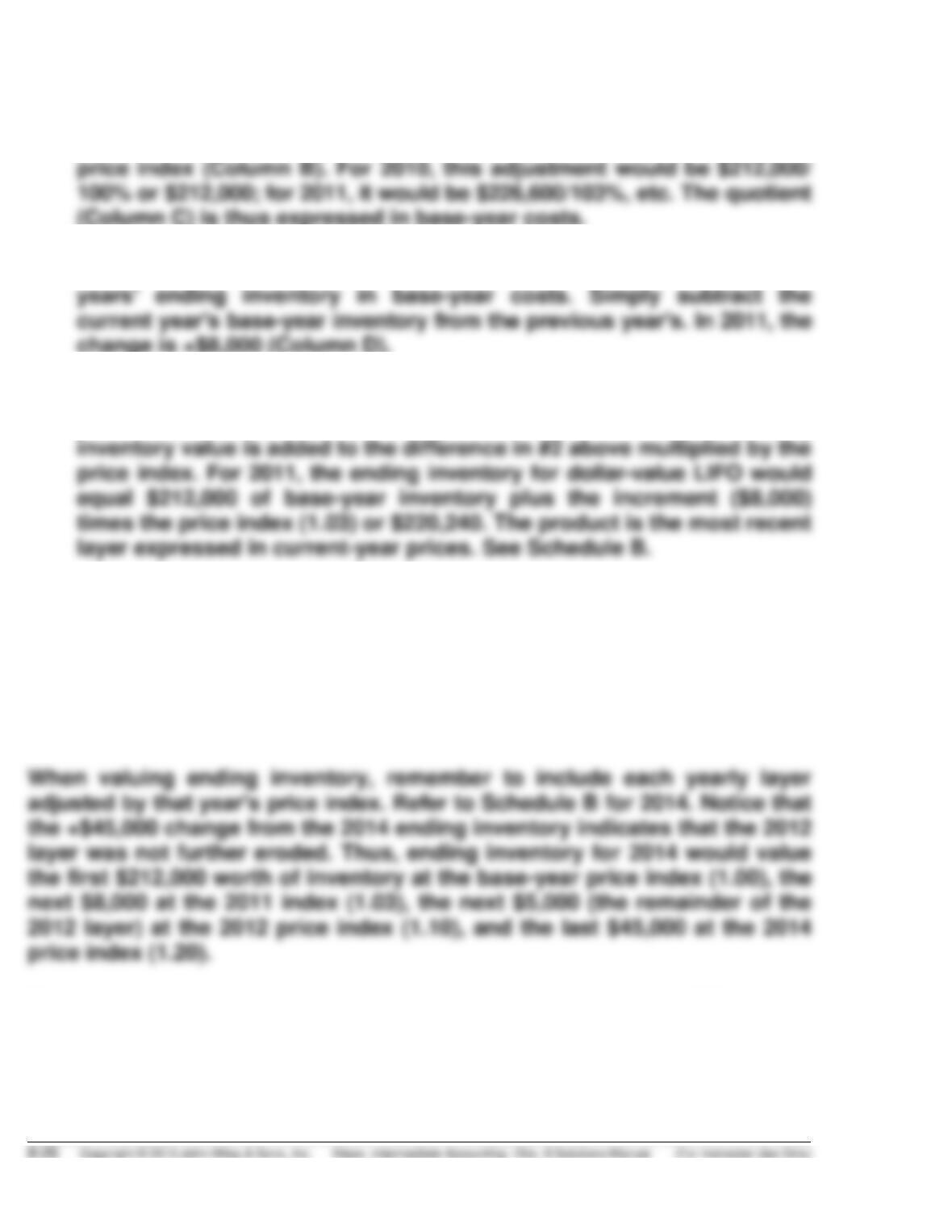
1. Refer to Schedule A. To express each year’s ending inventory (Column A)
in terms of base-year costs, simply divide the ending inventory by the
2. Next, compute the difference between the previous and the current
3. Finally, express this increment in current-year terms. For the second
year, this computation is straightforward: the base-year ending
Be careful with this last step in subsequent years. Notice that, in 2013, the
change from the previous year is –$15,000, which causes the 2012 layer to
be eroded during the period. Thus, the 2013 ending inventory is valued at
the original base-year cost $212,000 plus the 2011 layer of $8,240 plus the
remainder valued at the 2012 price index, $5,000 times 1.10. See 2013
computation on Schedule B.
These instructions should help you implement dollar-value LIFO in your
inventory valuation.