Problem 8.2
Rainwater runoff from a parking lot flows through a 3-ft- diameter pipe, completely filling
it. Whether flow in a pipe is laminar or turbulent depends on the value of the Reynolds
number. Would you expect the flow to be laminar or turbulent? Support your answer with
appropriate calculations
Solution 8.2
ρ
µ
ν
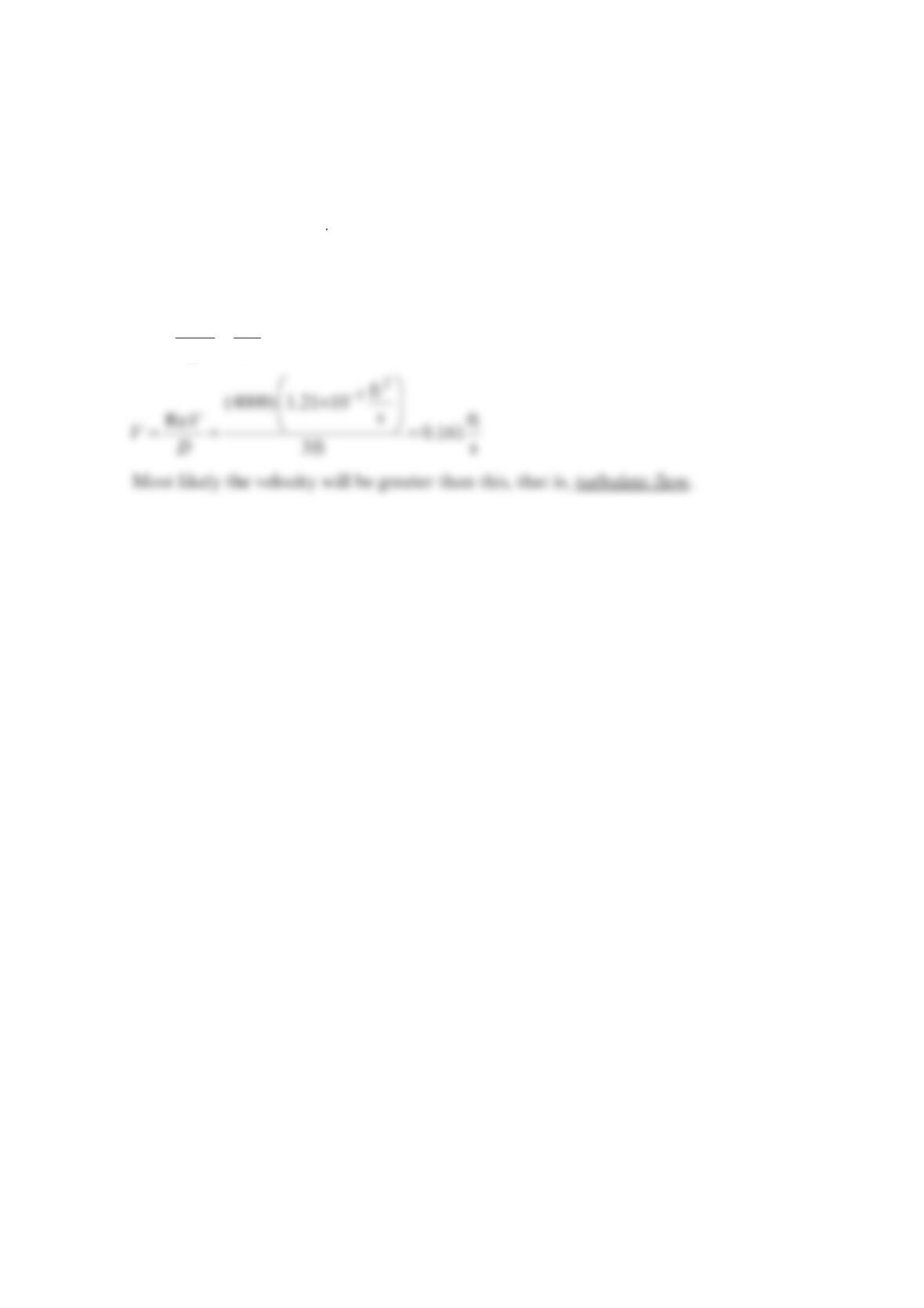
==Re VD VD If Re 4000> the flow is turbulent. The corresponding velocity is
Problem 8.3
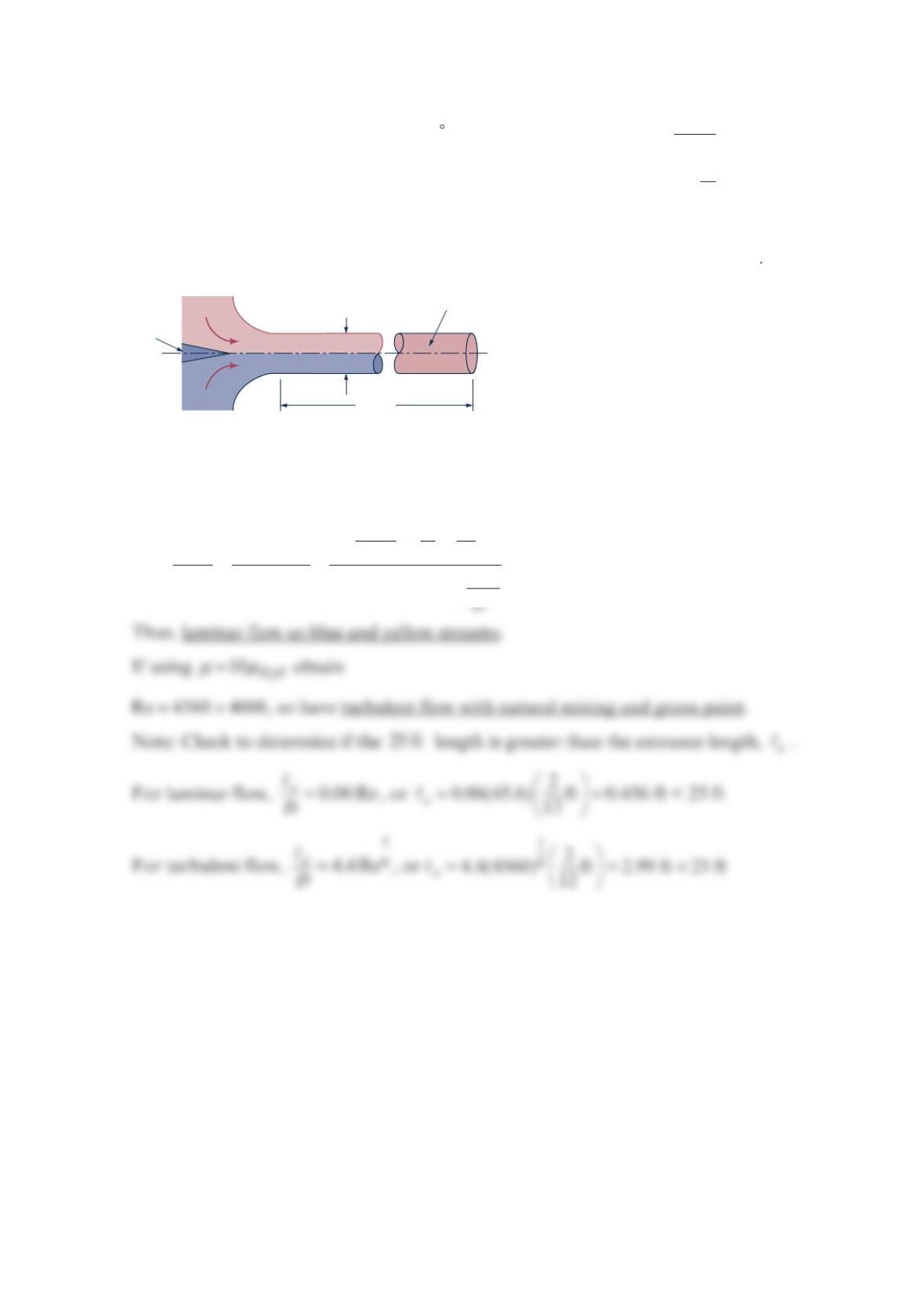
Blue and yellow streams of paint at 60 F (each with a density of 3
slugs
1.6 ft and a viscosity
1
000 times greater than water) enter a pipe with an average velocity of ft
4s as shown in the
figure below. Would you expect the paint to exit the pipe as green paint or separate streams
of blue and yellow paint? Explain. Repeat the problem if the paint were “thinned” so that it
is only 10 times more viscous than water. Assume the density remains the same
Solution 8.3
If the flow is laminar, the paint would exit as separate blue and yellow streams.
()
2
3
5
2
slugs ft 2
1.6 4 ft
s12
ft
Re 45.6 2100
lb s
1000 1000 2.34 10 ft
HO
VD VD
ρρ
µµ
−
== = =<
⋅
×
25 ft
2 in. Green?
Blue
Yellow
Splitter
Problem 8.4
Air at 200 F flows at standard atmospheric pressure in a pipe at a rate of lb
0.08 s .
Determine the minimum diameter allowed if the flow is to be laminar.
Solution 8.4
Maximum
ρ
µ
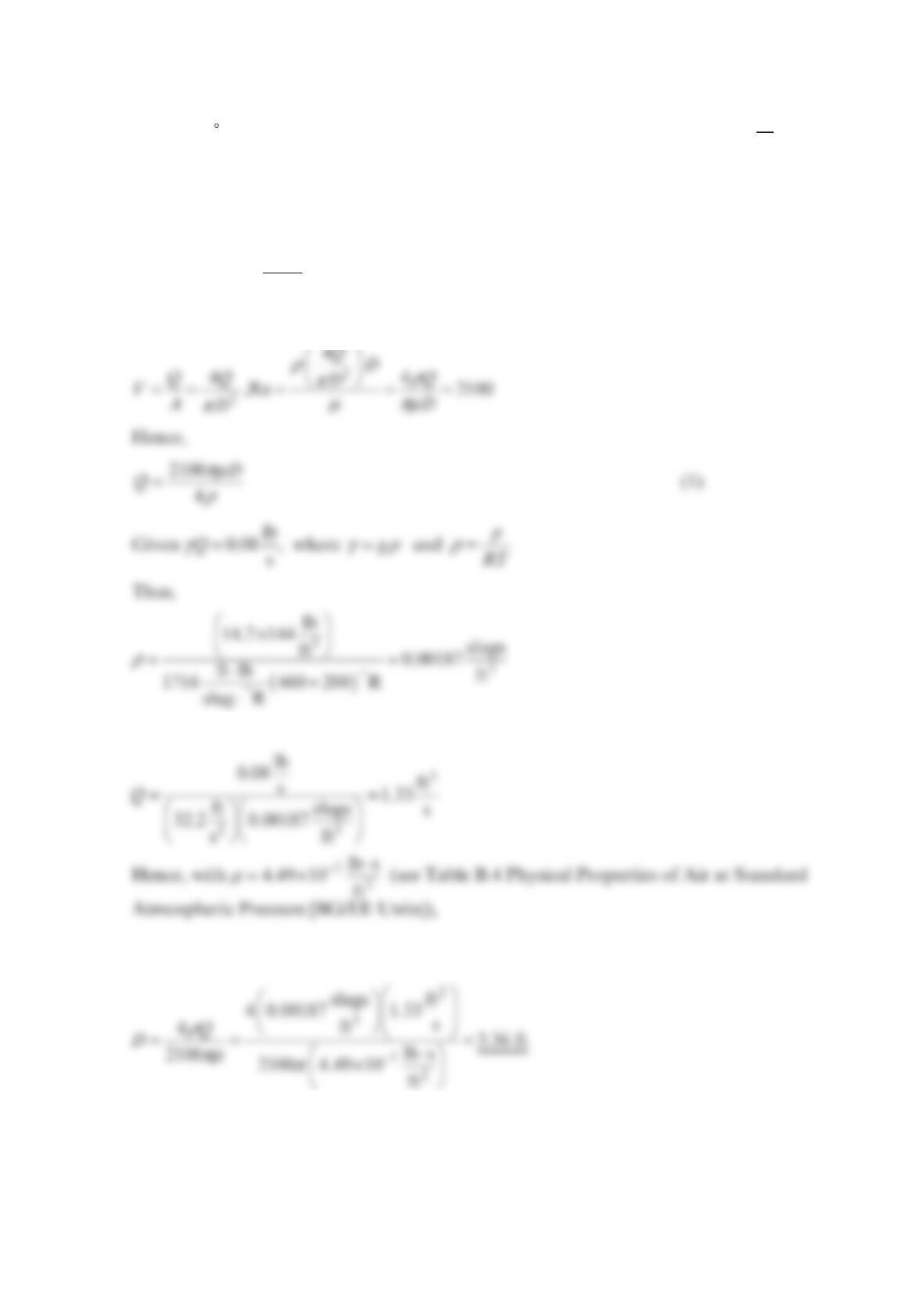
=Re VD for laminar flow is Re 2100=.
or with
so that
Eq. (1) gives
Problem 8.5
To cool a given room, it is necessary to supply
3
ft
4s of air through an 8-in.- diameter pipe.
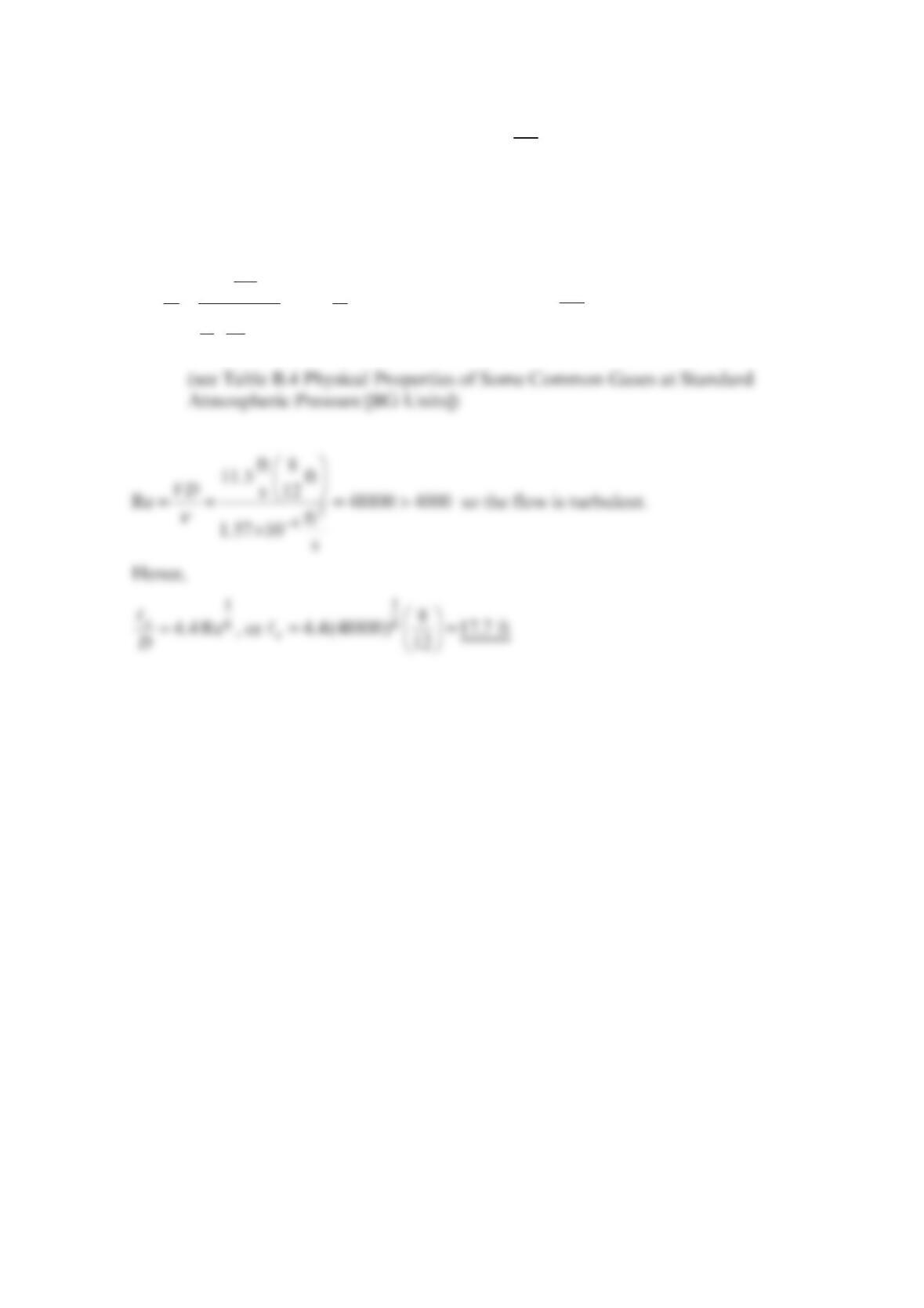
Approximately how long is the entrance length in this pipe?
Solution 8.5
3
2
ft
4ft
s11.5 s
8ft
412
Q
V
A
π
== =
Thus, with
2
4ft
1.57 10 s
ν
−
=×
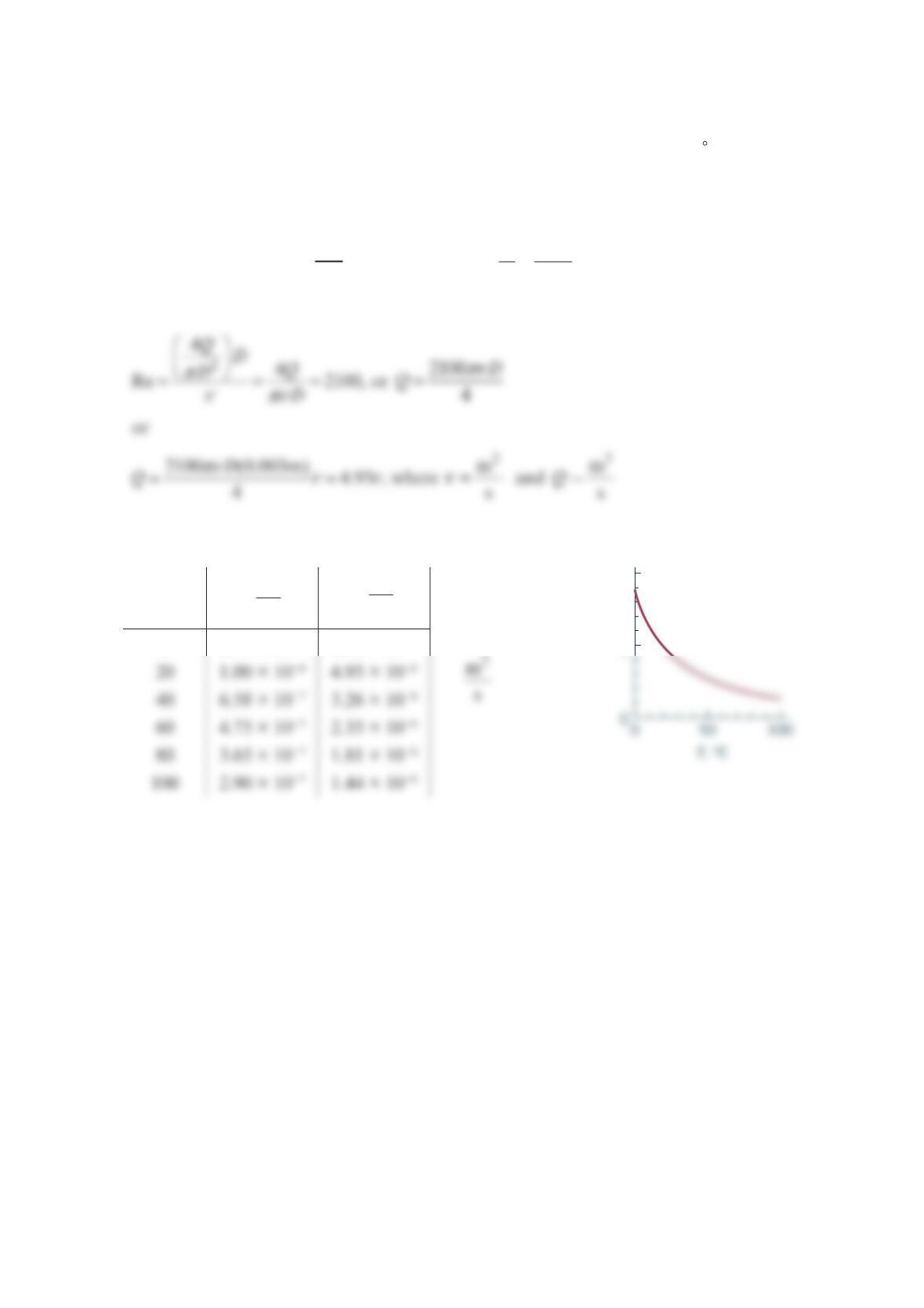
Problem 8.6
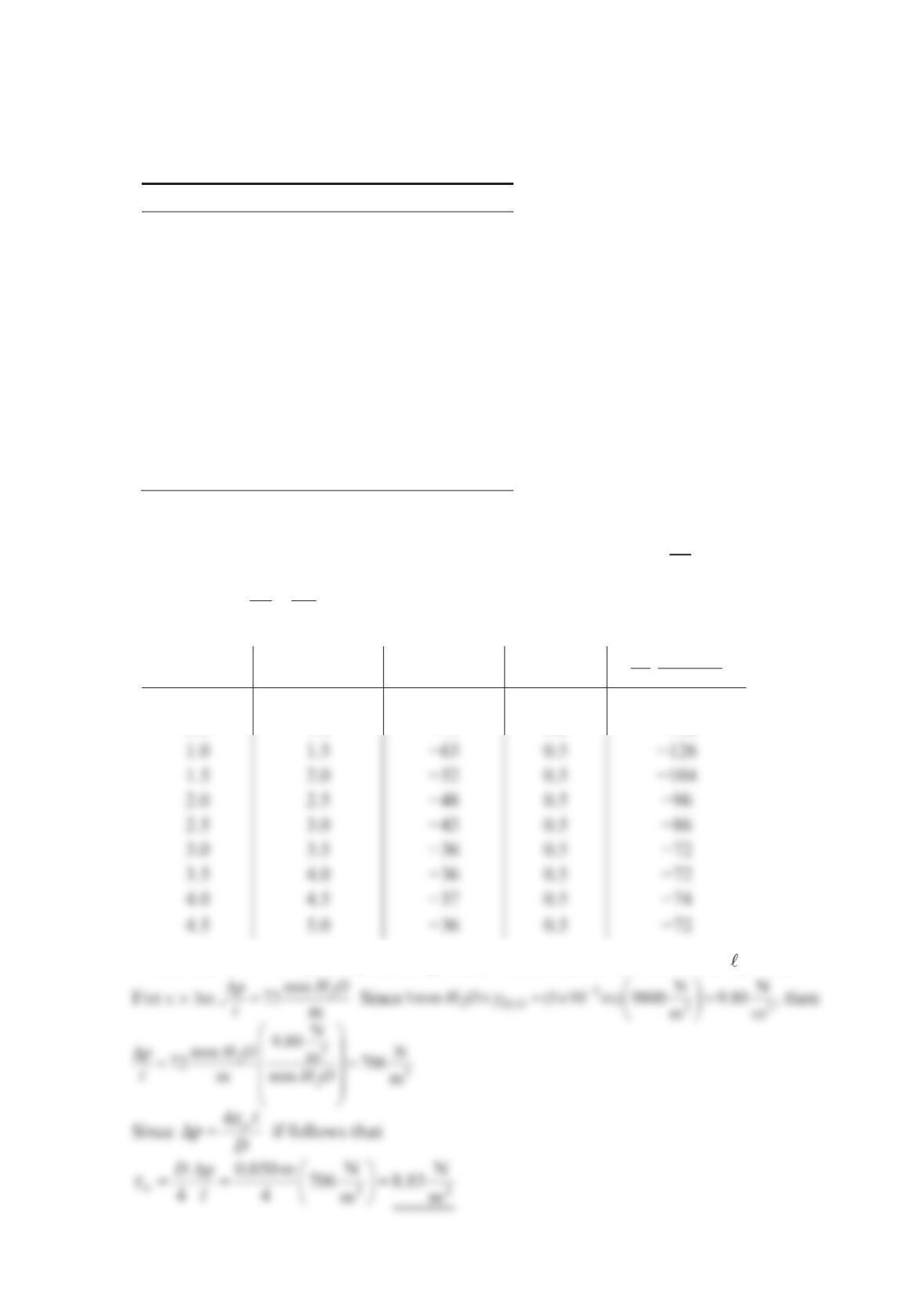
The flow of water in a
3
–mm-diameter pipe is to remain laminar. Plot a graph of the
maximum flowrate allowed as a function of temperature for <<0100C
T.
Solution 8.6
For laminar flow, Re= 2100,
VD
ν
≤ where
π
== 2
4QQ
VAD
Thus, the maximum Q is given by
With values of
ν
from Table B.2 Physical Properties of Water (SI Units), we obtain
5
10
T (°C)
2
m
s
V
3
m
s
Q
6
1
0,
Q
0 1.79 × 10⁻⁶ 8.86 × 10⁻⁶
Problem 8.7
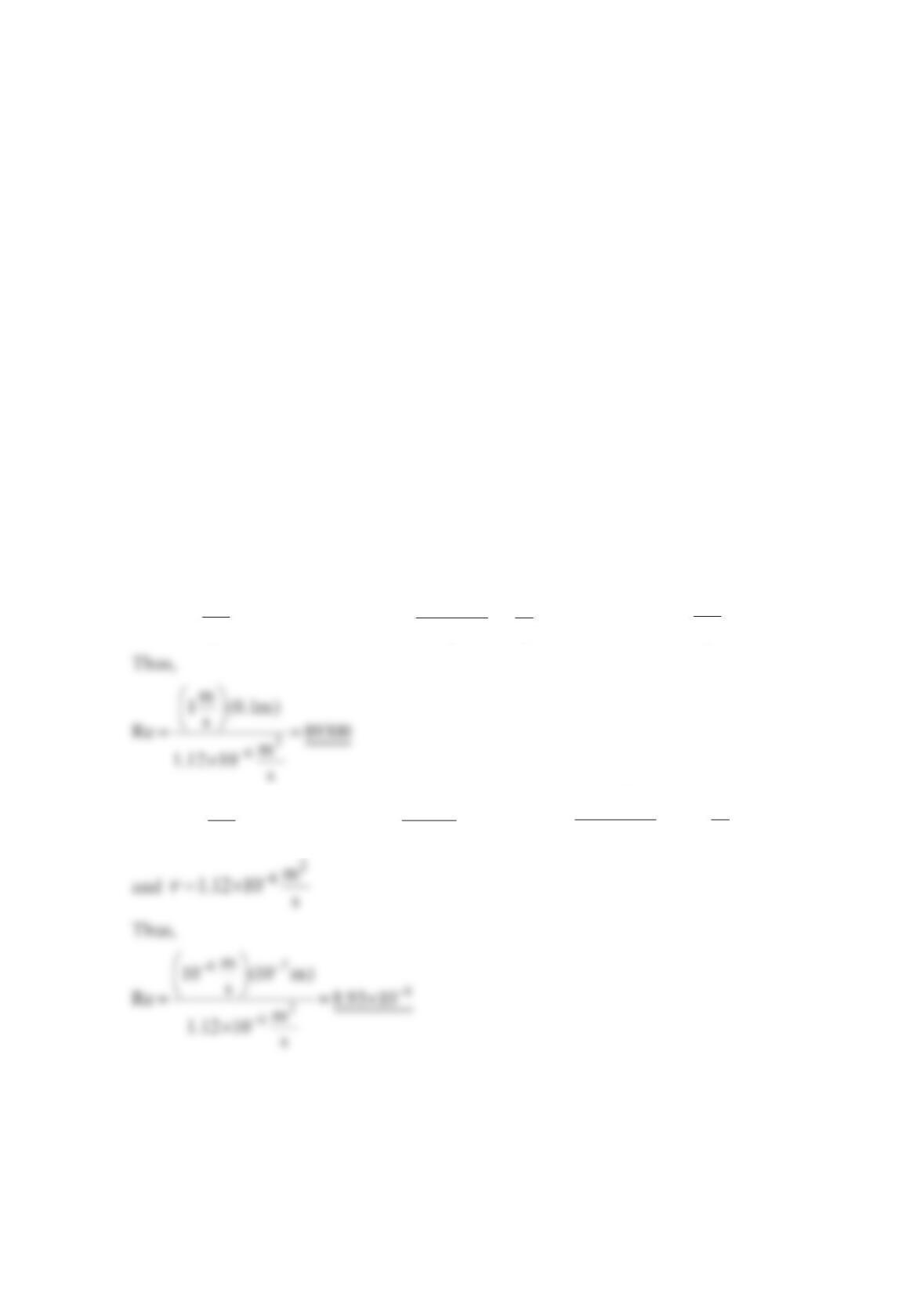
The pressure distribution measured along a straight, horizontal portion of a 50-mm– diameter
pipe attached to a tank is shown in the table below. Approximately how long is the entrance
length? In the fully developed portion of the flow, what is the value of the wall shear stress?
x (m) (±0.01 m) p (mm H2O) (±5 mm)
0 (tank exit) 520
0.5 427
1.0 351
1.5 288
2.0 236
2.5 188
3.0 145
3.5 109
4.0 73
4.5 36
5.0 (pipe exit) 0
Solution 8.7
The entrance length extends to the fully developed portion in which ∂=
∂constant
p
x.
Approximate
δ
δ
∂≈
∂
p
p
xx
to obtain the following:
From x = to x = () m
∂
p, mm H2O
∂
x ∂
∂
2
mmH O
,m
p
x
0 0.5 −93 0.5 −186
0.5 1.0 −76 0.5 −152
Within the error on
δ
,
p
the pressure gradient is constant for ≥3mx. Thus ≈3m
e.
Problem 8.8
Nanoscale flows The term nanoscale generally refers to objects with characteristic lengths
from atomic dimensions up to a few hundred nanometers (nm). (Recall that 1 nm = 10−9
m.) Nanoscale fluid mechanics research has recently uncovered many surprising and useful
phenomena. No doubt many more remain to be discovered. For example, in the future
researchers envision using nanoscale tubes to push tiny amounts of water-soluble drugs to
exactly where they are needed in the human body. Because of the tiny diameters involved,
the Reynolds numbers for such flows are extremely small and the flow is definitely laminar.
In addition, some standard properties of everyday flows (e. g., the fact that a fluid sticks to
a solid boundary) may not be valid for nanoscale flows. In addition, ultratiny mechanical
pumps and valves are difficult to manufacture and may become clogged by tiny particles
such as biological molecules. As a possible solution to such problems, researchers have
investigated the possibility of using a system that does not rely on mechanical parts. It
involves using light-sensitive molecules attached to the surface of the tubes. By shining light
onto the molecules, the light-responsive molecules attract water and cause motion of water
through the tube. (See Problem 8.8.)
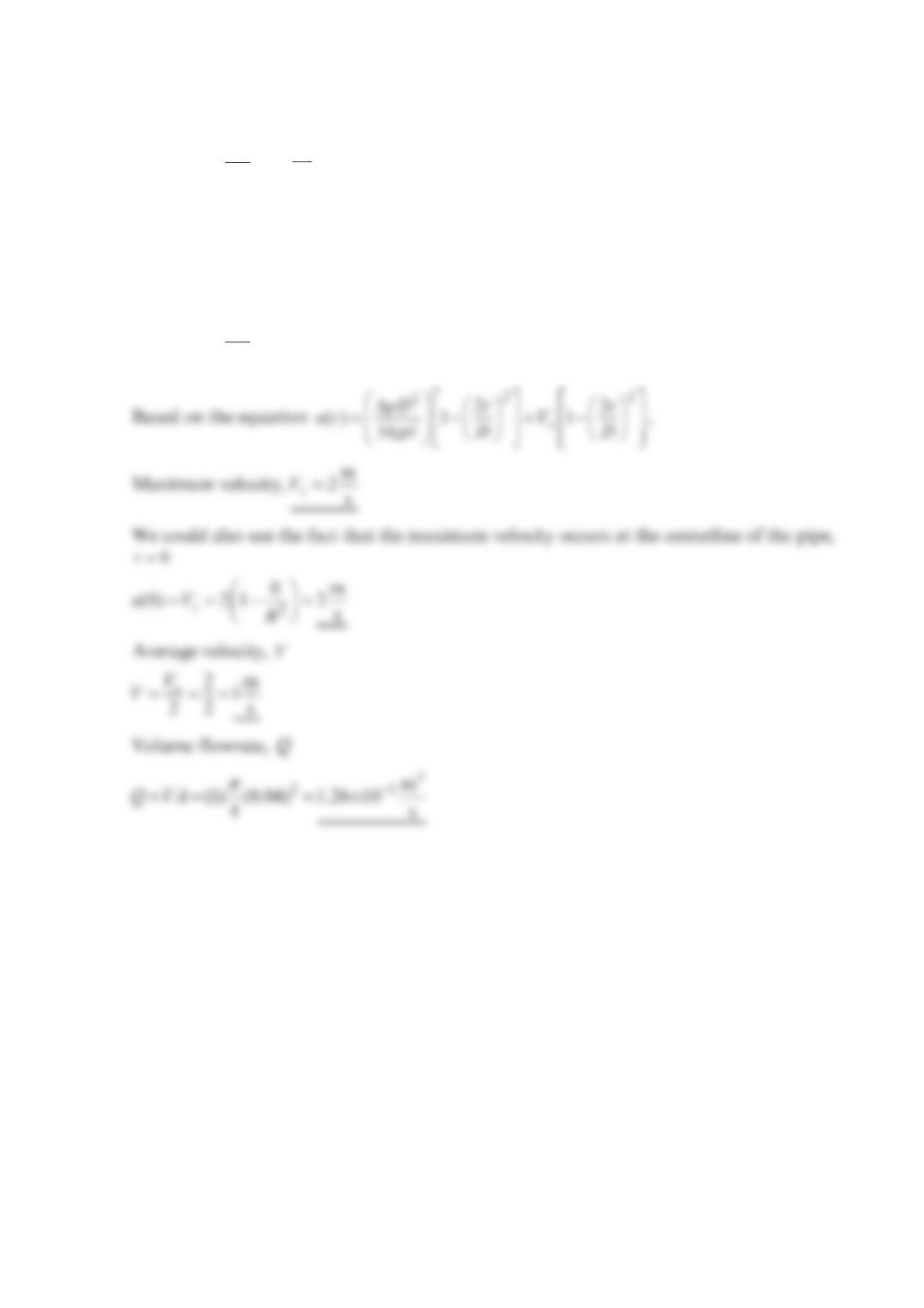
(a) Water flows in a tube that has a diameter of =0.1mD. Determine the Reynolds
number if the average velocity is 10 diameters per second. (b) Repeat the calculations if the
tube is a nanoscale tube with a diameter of =100 nmD.
Solution 8.8
(a)
ν
=Re VD , where =0,1mD, 10(0.1m) m
V
1
ss
==
, and
2
6m
1.12 10 s
ν
−
=×
(b)
ν
=Re VD , where −
==
7
9
1m
100 nm 10 m
10 nm
D,
76
10(10 m) m
10
ss
V
−−
==
,
ν
Problem 8.9
For fully developed laminar pipe flow in a circular pipe, the velocity profile is given by
=−
2
2
() 21 r
ur R in m
s , where R is the inner radius of the pipe. Assuming that the pipe
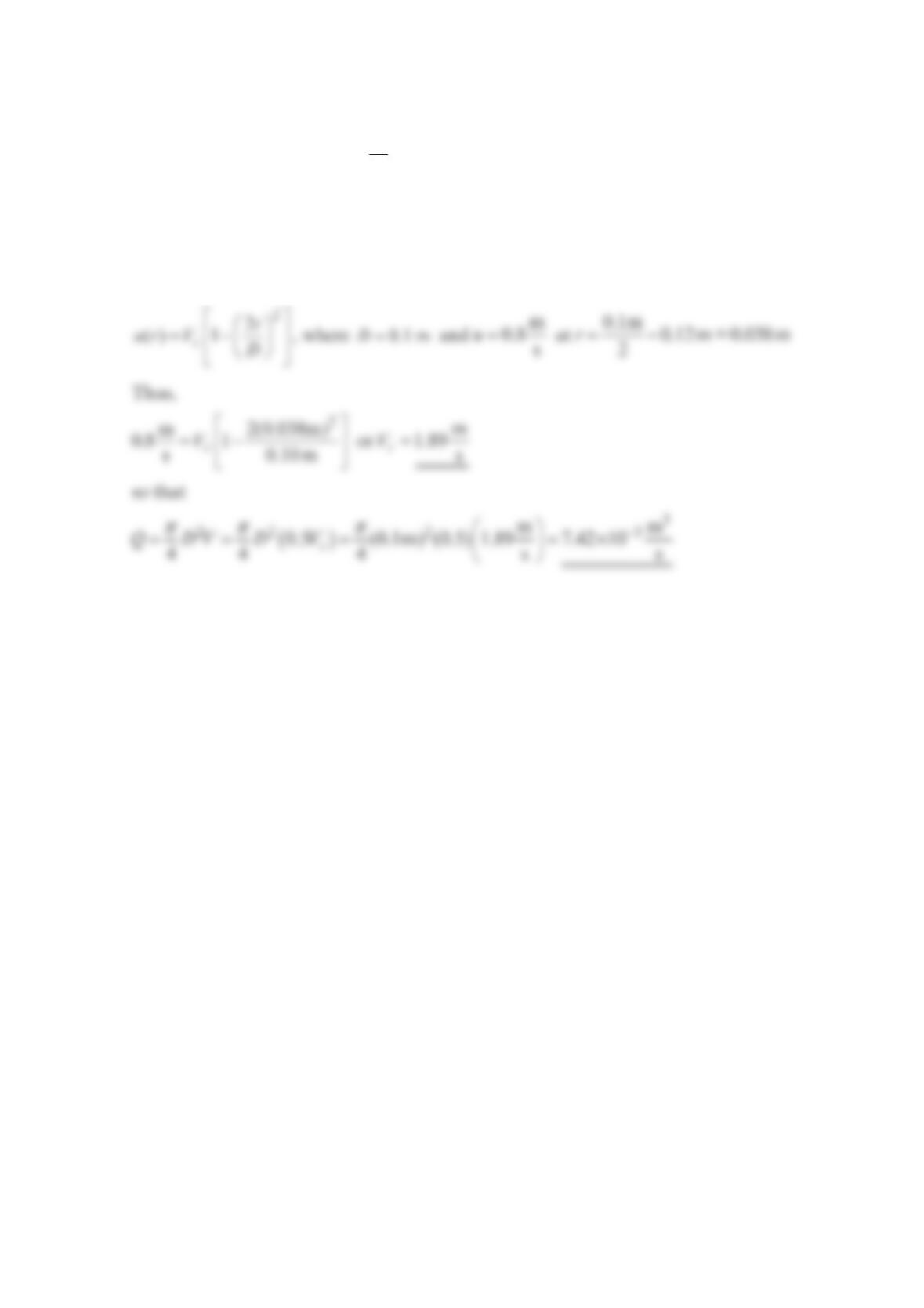
diameter is 4 cm , find the maximum and average velocities in the pipe as well as the
volume flowrate.
Solution 8.9
=−
2
2
() 21 r
ur R
Problem 8.10
A viscous fluid flows in a 0.10-m- diameter pipe such that its velocity measured 0.012 m
away from the pipe wall is m
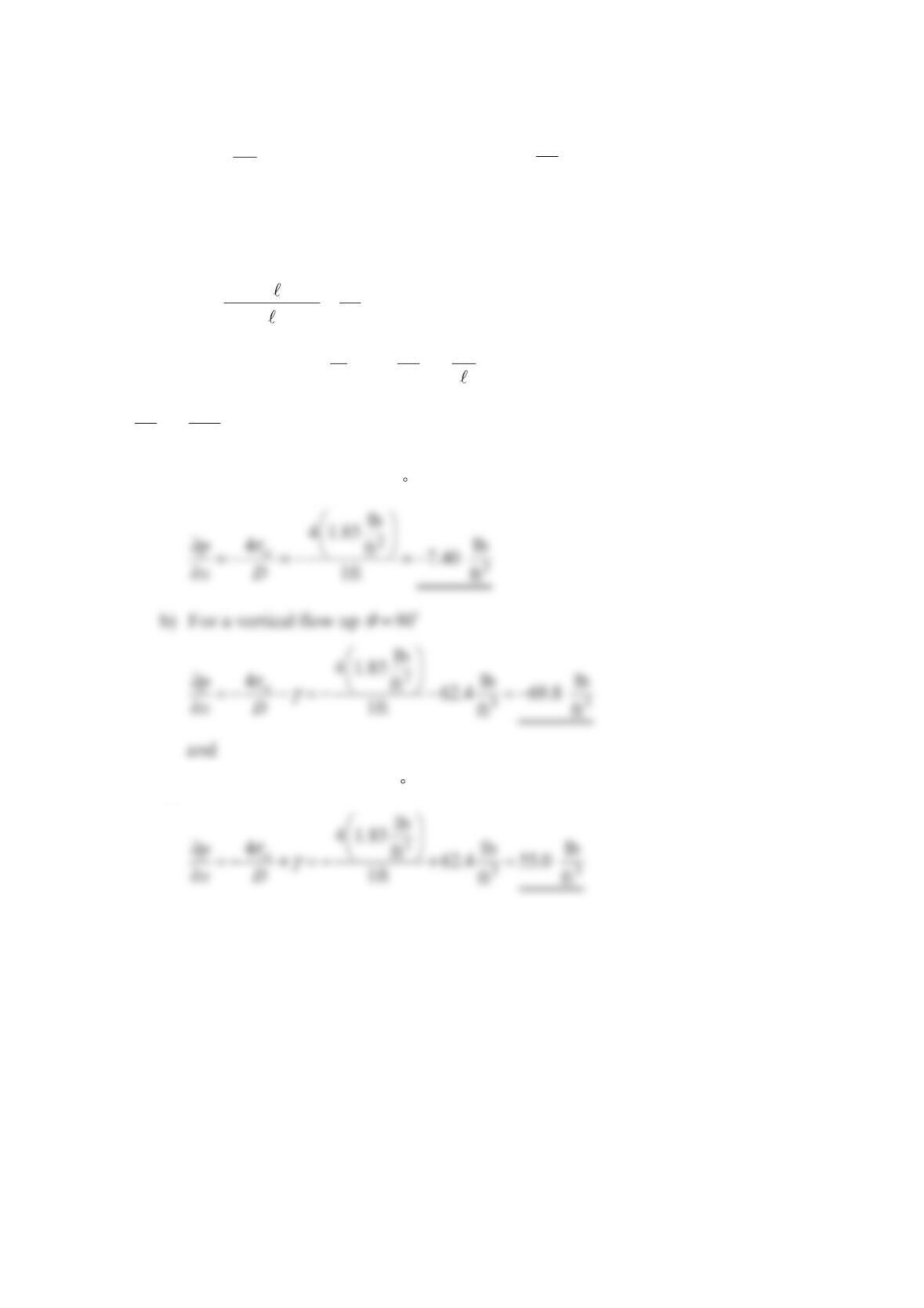
0.8 s . If the flow is laminar, determine the centerline velocity
and the flowrate.
Solution 8.10
For laminar flow in a pipe,
Problem 8.11
The wall shear stress in a fully developed flow portion of a 12-in. -diameter pipe carrying
water is 2
lb
1.85 ft . Determine the pressure gradient, ∂
∂
p
x, where xis in the flow direction, if
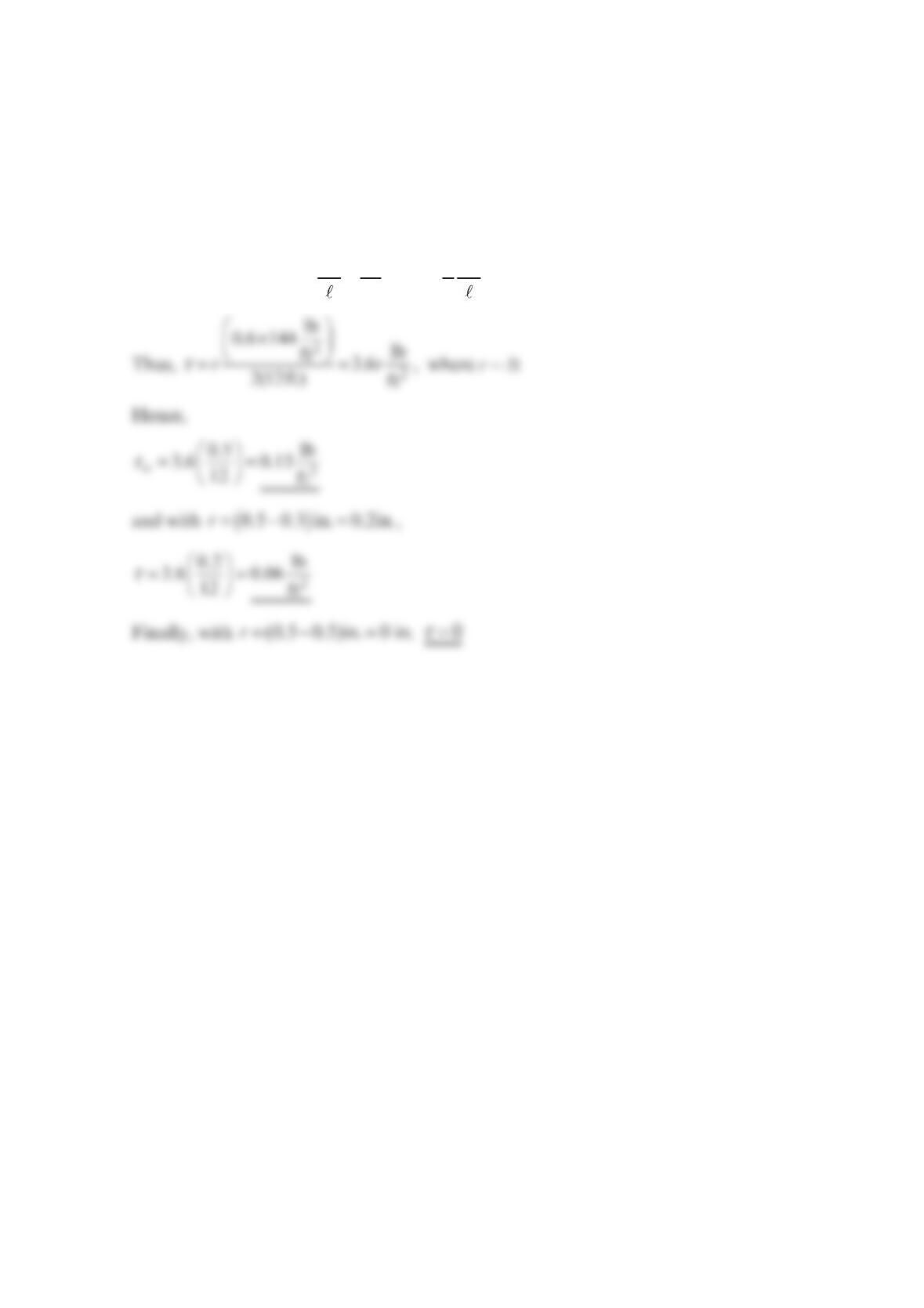
the pipe is (a) horizontal, (b) vertical with flow up, or (c) vertical with flow down.
Solution 8.11
In general,
γ
θτ
Δ− =
sin 2p
r
Thus, with
ττ
≈w at =2
D
r and ∂Δ
=−
∂
p
p
x, this becomes
τ
γ
θ
∂=− −
∂
4sin
w
p
xD
a) For a horizontal pipe =0
θ
c) For a vertical down
θ
=−90
Problem 8.12
The pressure drop needed to force water through a horizontal 1-in. -diameter pipe is
0.60 psi for every 12-ft length of pipe. Determine the shear stress on the pipe wall.
Determine the shear stress at distances 0.3 and 0.5 in. away from the pipe wall.
Solution 8.12
For a horizontal pipe,
τ
Δ=2p
r or
τ
Δ
=2
rp
Problem 8.13
The pressure drop needed to force water through a 1-in. -diameter pipe is 0.60 psi for every
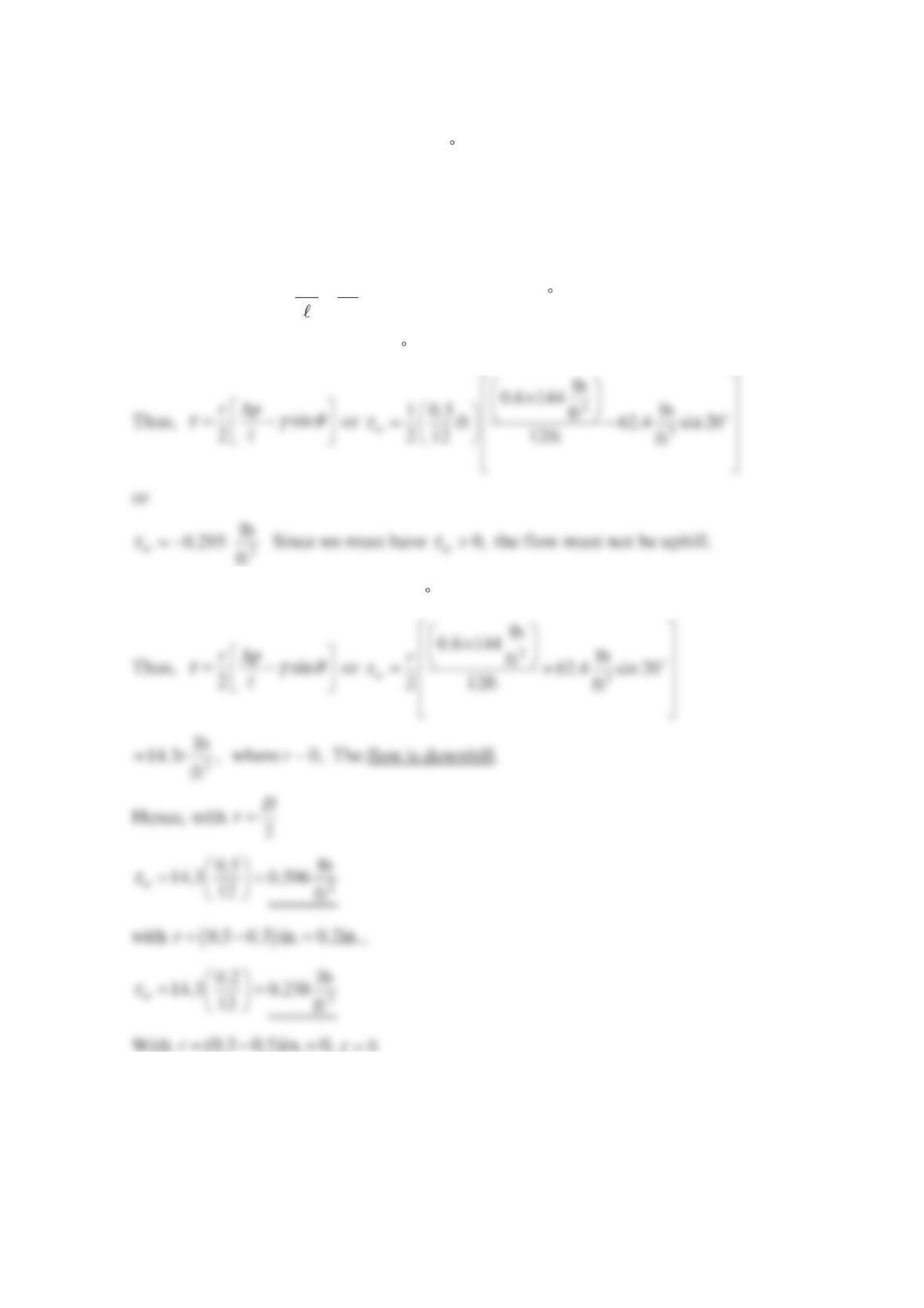
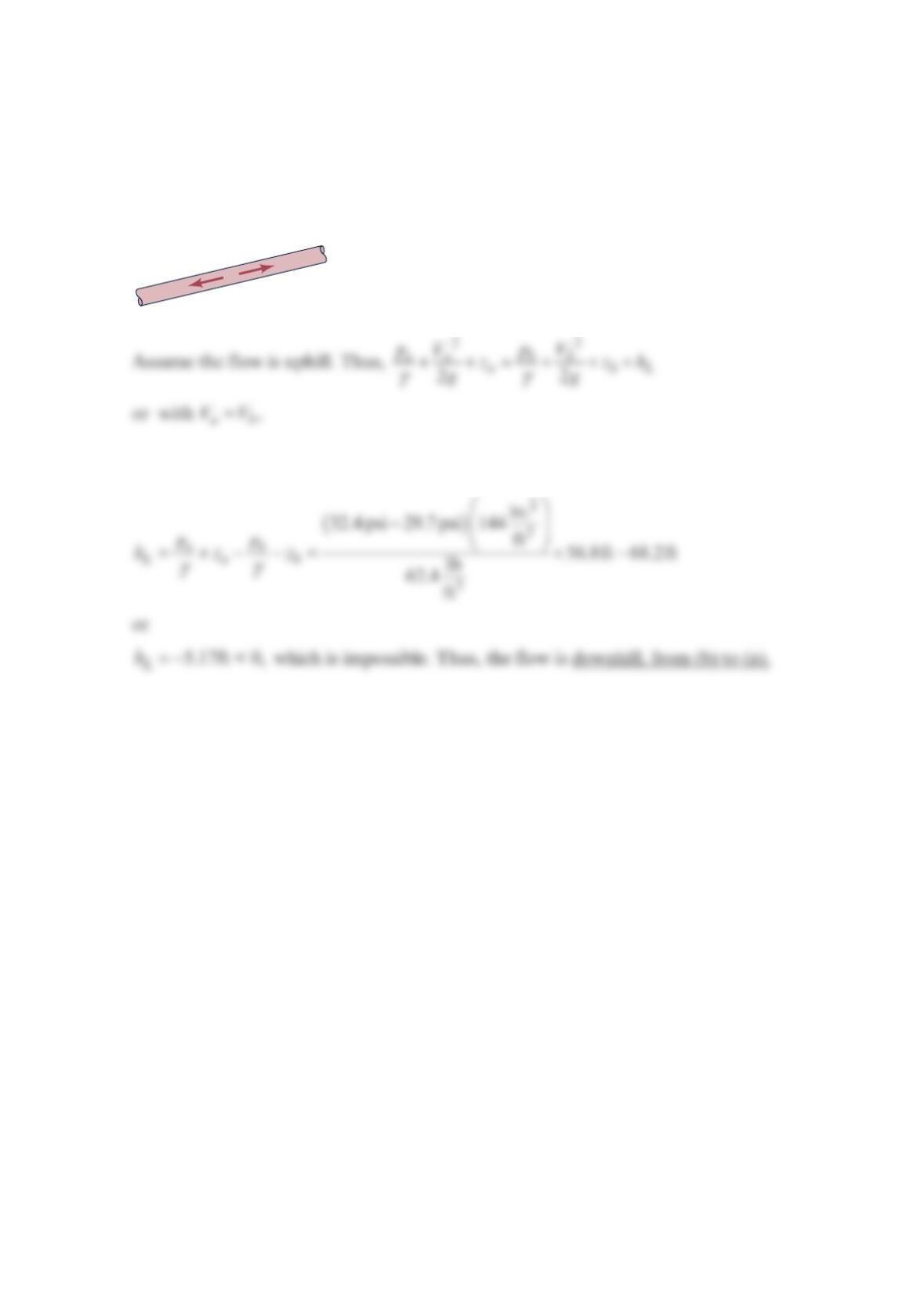
12-ft length of pipe. The pipe is on a 20 hill. Is the flow, up or down the hill? Explain.
Determine the shear stress on the pipe wall. Determine the shear stress at distances 0.3 and
0.5 in. away from the pipe wall.
Solution 8.13
For a pipe on a hill
τ
γ
θ
Δ=+
2sin ,
p
r where
θ
=±20
Assume the flow is uphill:
θ
=+20
Assume the flow is downhill:
θ
=−20
Problem 8.14
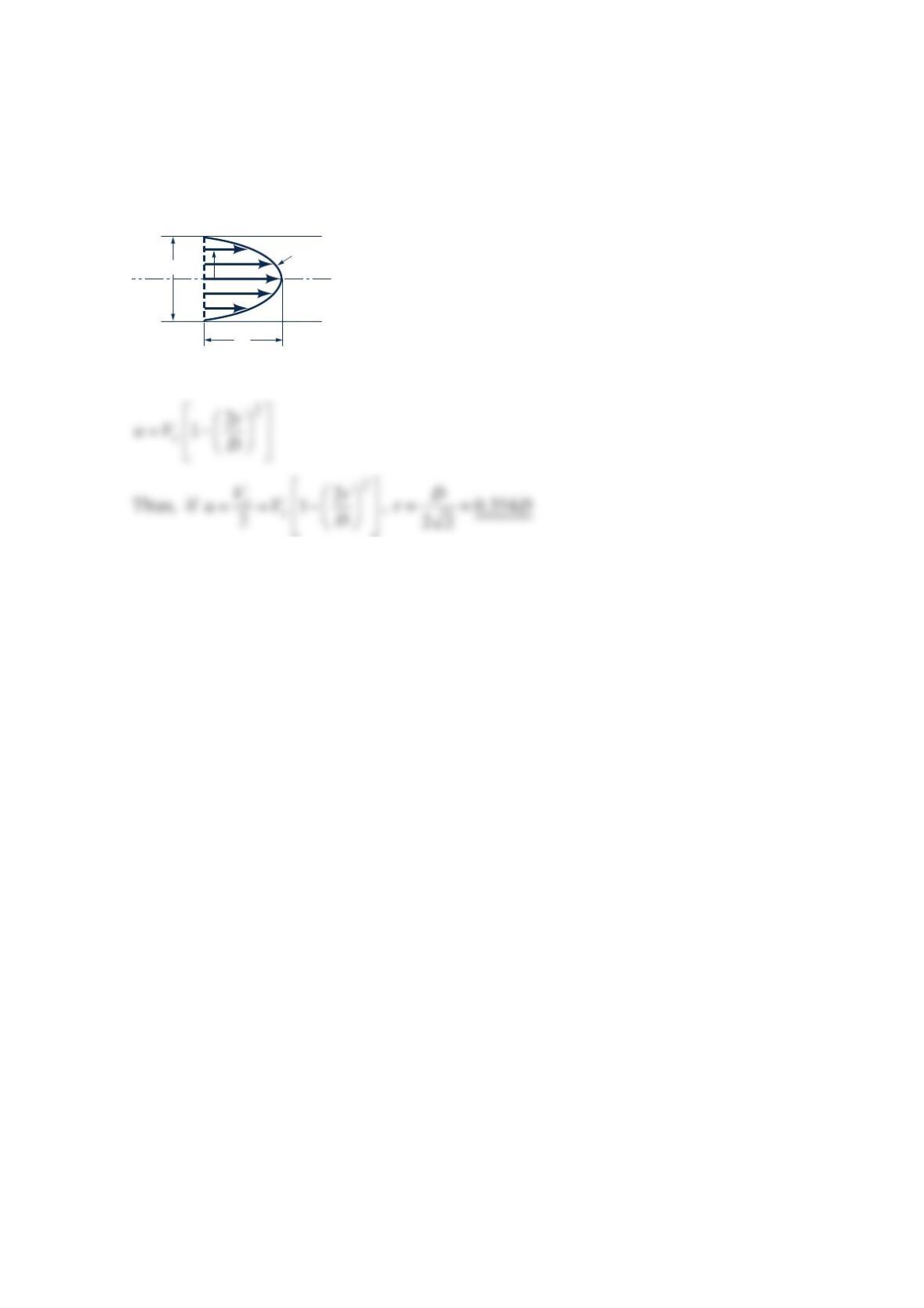
Water flows in a constant-diameter pipe with the following conditions measured: At section
(a) =32.4 psi
a
p and =56.8 ft
a
z; at section (b) =29.7 psi
b
p and =68.2 ft
b
z. Is the flow is
from (a) to (b) or from (b) to (a)? Explain.
Solution 8.14
The head loss is given by
?
(a)
(b)
Problem 8.15
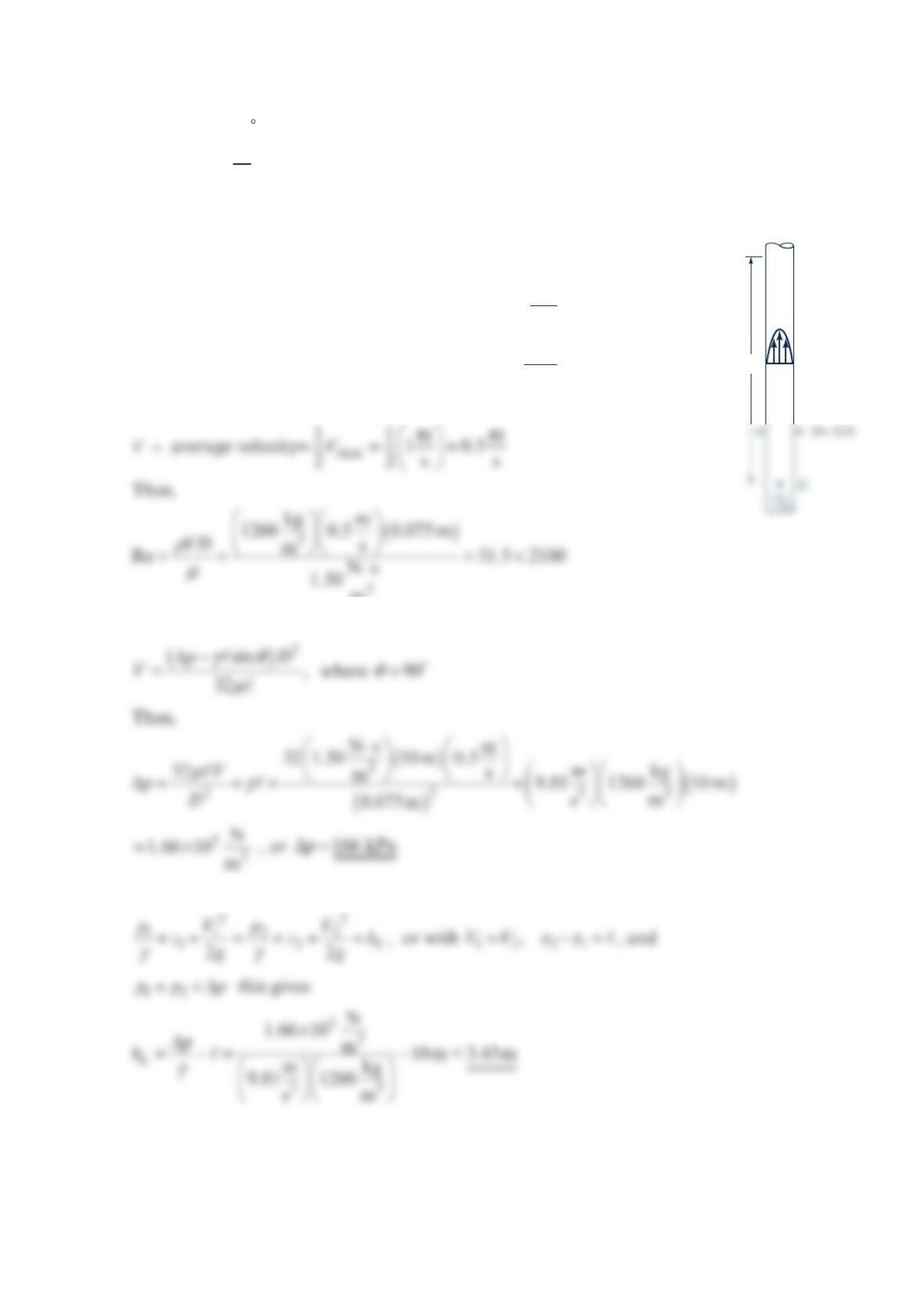
For laminar flow in a round pipe of diameter D, at what distance from the centerline is the
actual velocity equal to the average velocity?
Solution 8.15
For laminar flow,
D
ru
(
r
)
V
c
Problem 8.16
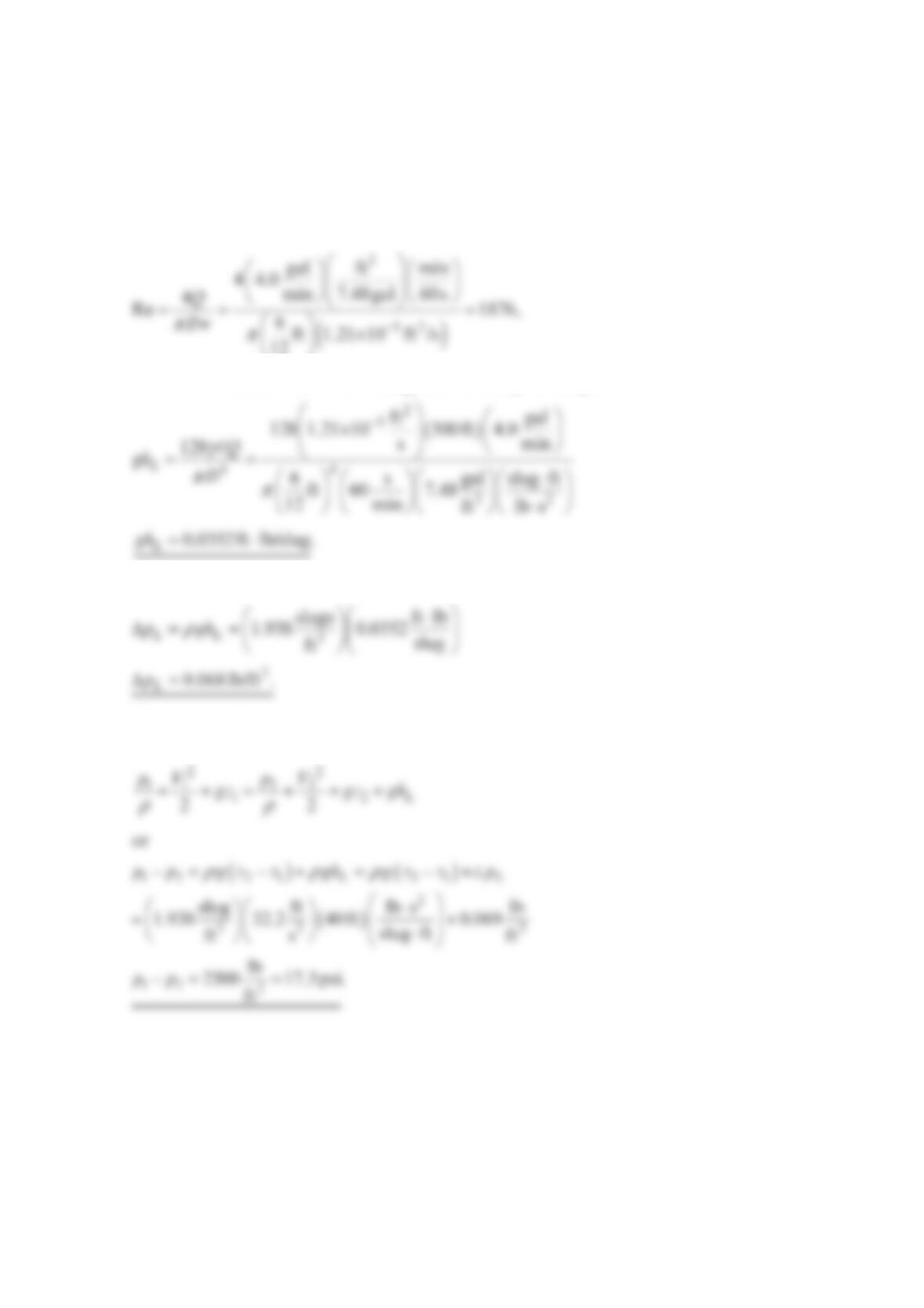
Glycerin at 20 C flows upward in a vertical 75-mm– diameter pipe with a centerline
velocity of m
1
s. Determine the head loss and pressure drop in a 10-m length of the pipe.
Solution 8.16
3
kg
1260 m
ρ
=
2
Ns
1.50 m
µ
⋅
=
For laminar flow in a pipe,
The flow is laminar so that
In addition,
ℓ
= 10 m
•
(2)
Z
2
= Z
1
t
Problem 8.17
Water at °60 F flows at a rate of 4.0 gal /min through a 6-in. I.D. plastic pipe. The pipe is
500 ft long and rises a vertical height of 40 ft over the 500 ft . Find the pressure drop.
Solution 8.17
The Reynolds number is
12
so we have laminar flow. The energy loss for fully developed flow is
The pressure loss is found using the density of water.
The pressure drop is found by writing the mechanical energy equation from the inlet (1) to
the outlet (2).
Problem 8.18
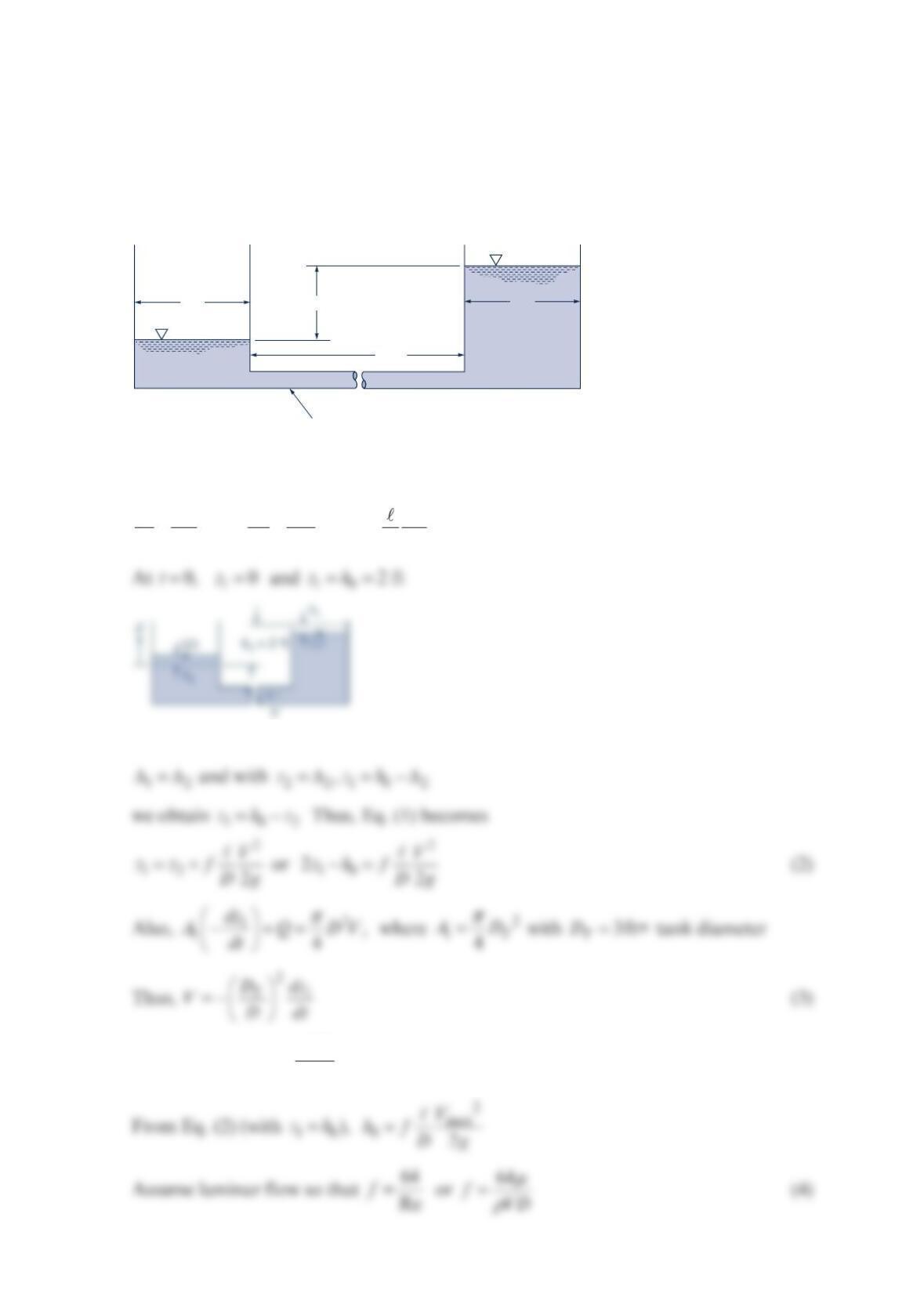
At time =0t, the level of water in tank
A
shown in the figure below is 2ft above that in
tank B. Plot the elevation of the water in tank A as a function of time until the free
surfaces in both tanks are at the same elevation. Assume quasi-steady conditions—that is,
the steady pipe flow equations are assumed valid at any time, even though the flowrate does
change (slowly) in time. Neglect minor losses. Note: Verify and use the fact that the flow is
laminar.
Solution 8.18
γγ
++=+ ++
22
2
11 2 2
12
,
222
pV p V V
zzf
ggDg
where ==
12
0pp and =≈
12
0VV (1)
Because the tanks are the same diameter
The maximum
ρ
µ
=Re VD occurs when the head, −
12
,zz
is greatest.
3 ft 3 ft
25 ft
2 ft at t = 0
0.1-in. diameter, galvanized iron
BA
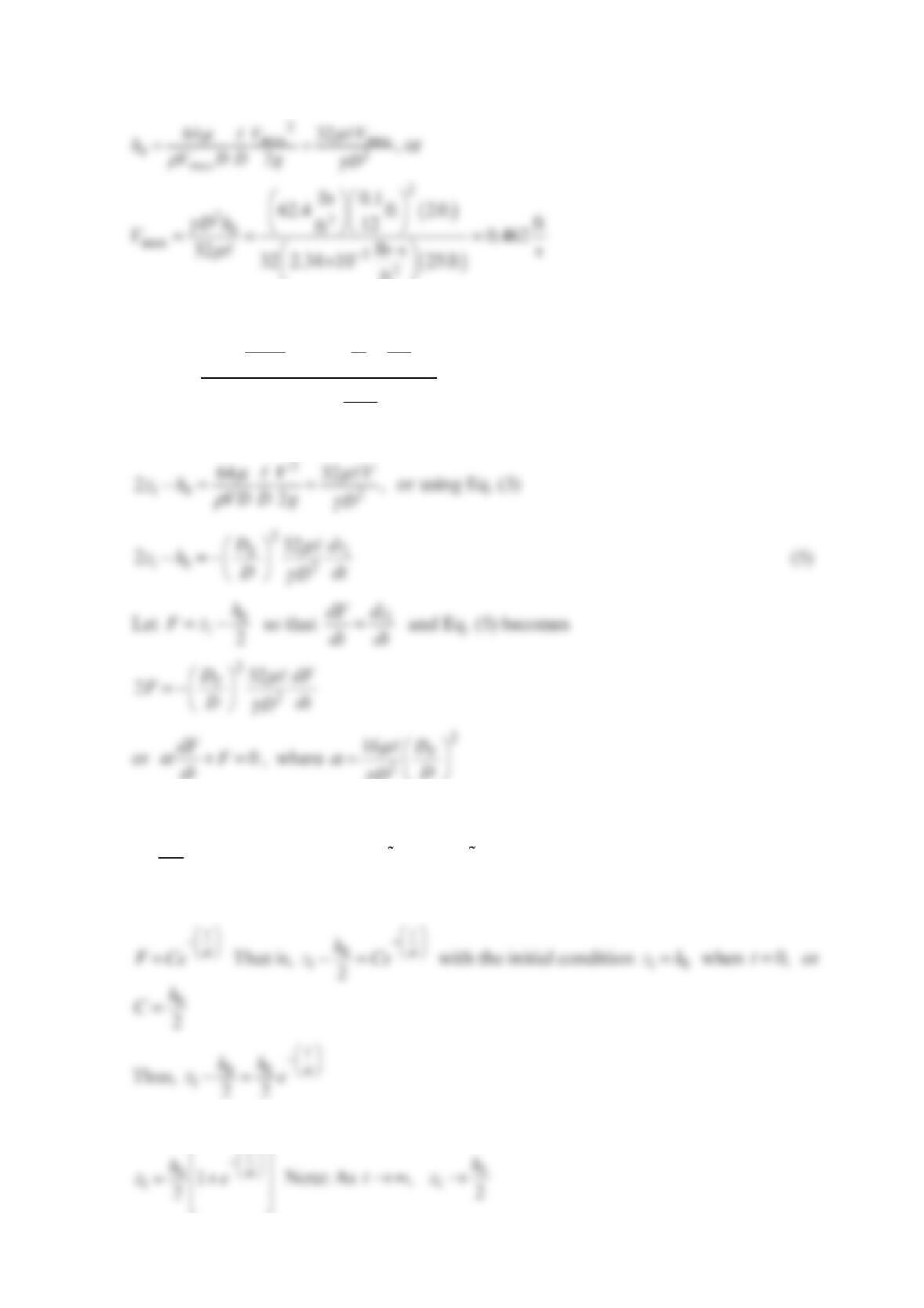
Thus, from Eq. (4)
ft
or
3
max 5
2
slugs ft 0.1
1.94 0.462 ft
s12
ft
Re 319 2100
lb s
2.34 10 ft
−
==<
⋅
×
The flow remains laminar.
Thus, Eqs. (2) and (4) give
D
Thus,
α
=−
dF dt
F or
α
=− +ln FtC
, where =C constant
Hence,
or
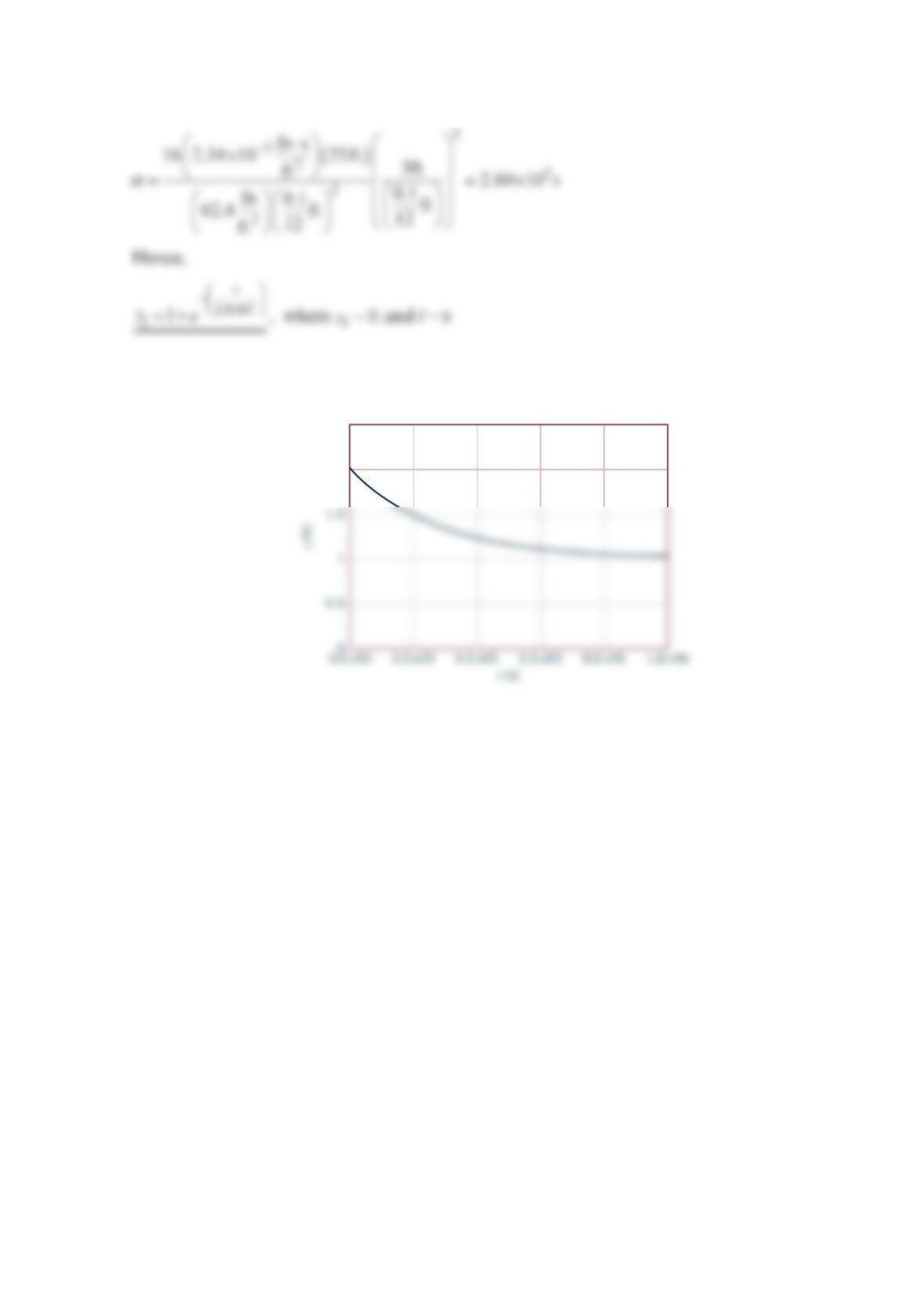
For the conditions given, =
02 fth and
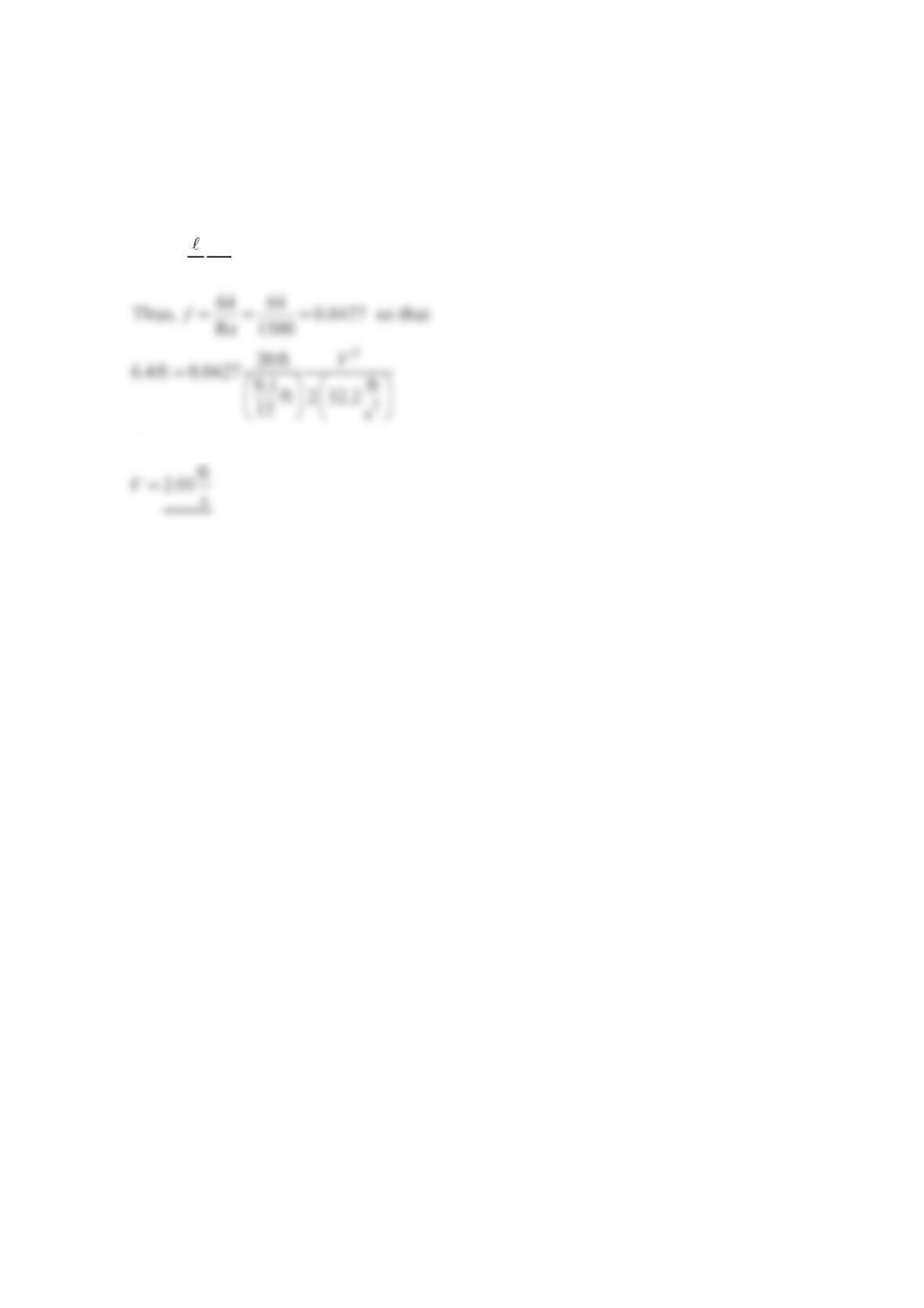
This result is plotted below. (Note: →∞ =
1
lim 1 ft
tz)
2
2.5
Problem 8.19
A fluid flows through a horizontal 01-in.– diameter pipe. When the Reynolds number is
1
500, the head loss over a 20-ft length of the pipe is 6.4 ft . Determine the fluid velocity.
Solution 8.19
=
2
2
L
V
hf
Dg
, where since Re 1500 2100=< the flow is laminar.
or