Problem 8.20
Asphalt at
1
20 F, considered to be a Newtonian fluid with a viscosity
8
0000 times that of
water and a specific gravity of 1.09 , flows through a pipe of diameter 2.0 in. If the pressure
gradient is psi
1.6 ft determine the flowrate assuming the pipe is (a) horizontal; (b) vertical
with flow up.
Solution 8.20
If the flow is laminar, then
()
πγθ
µ
Δ−
=
4
sin
128
pD
Q (1)
a) For horizontal flow,
θ
=0
b) For vertical flow up,
θ
=90
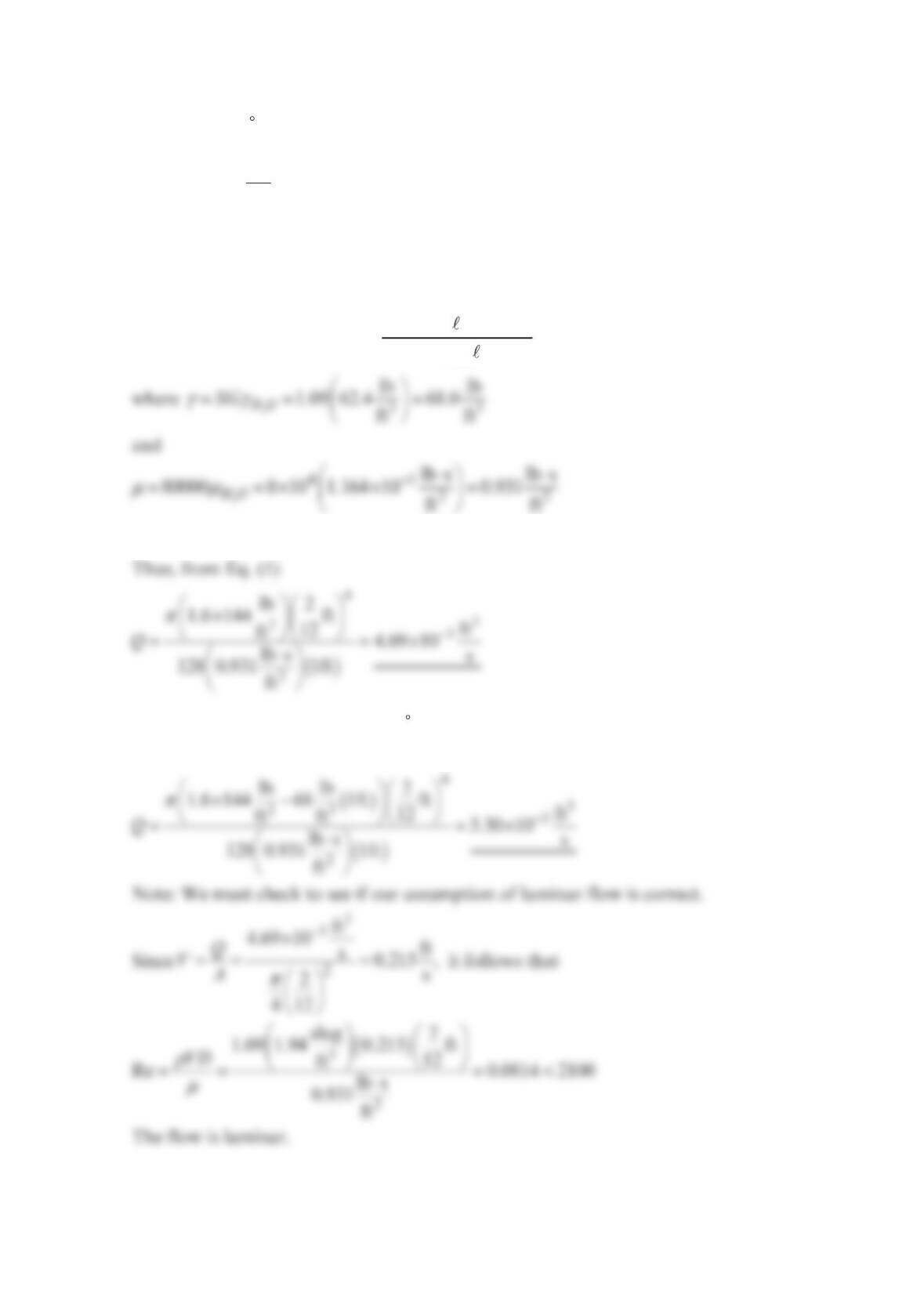
Thus, from Eq. (1)
Problem 8.21
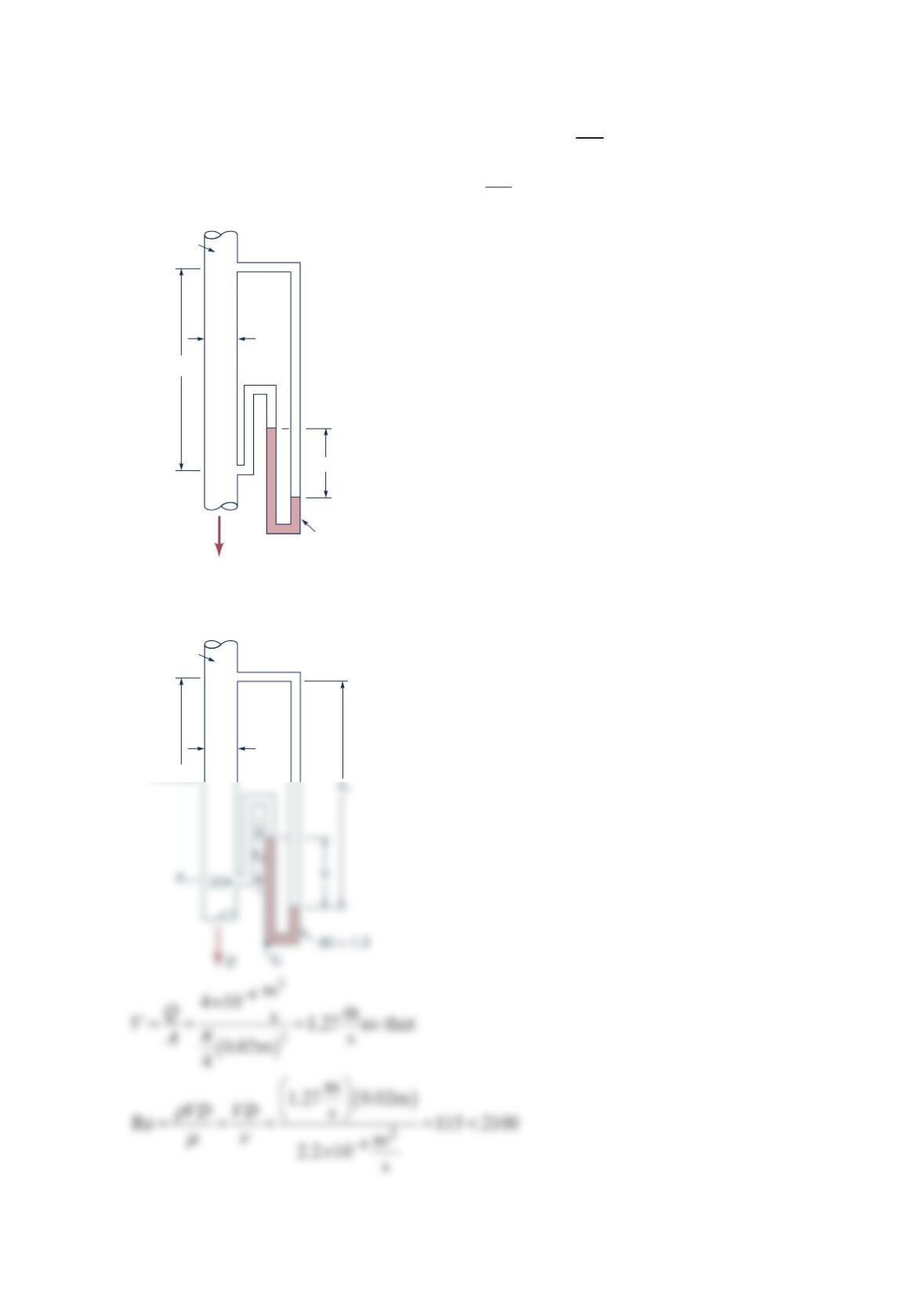
Oil of =0.87SG and a kinematic viscosity
2
4m
2.2 10 s
ν
−
=× flows through the vertical pipe
shown in the figure below at a rate of
3
4m
410 s
−
×. Determine the manometer reading, h.
Solution 8.21
Q
SG = 0.87
4 m
20 mm
h
SG = 1.3
SG
= 0.87
ℓ
= 4 m
20 mm
(1)•
γ
The flow is laminar with
()
πγ
µ
Δ+
=
4
,
128
pD
Q or
µ
γ
π
Δ= − = −
12 4
128 Q
pp p D (1)
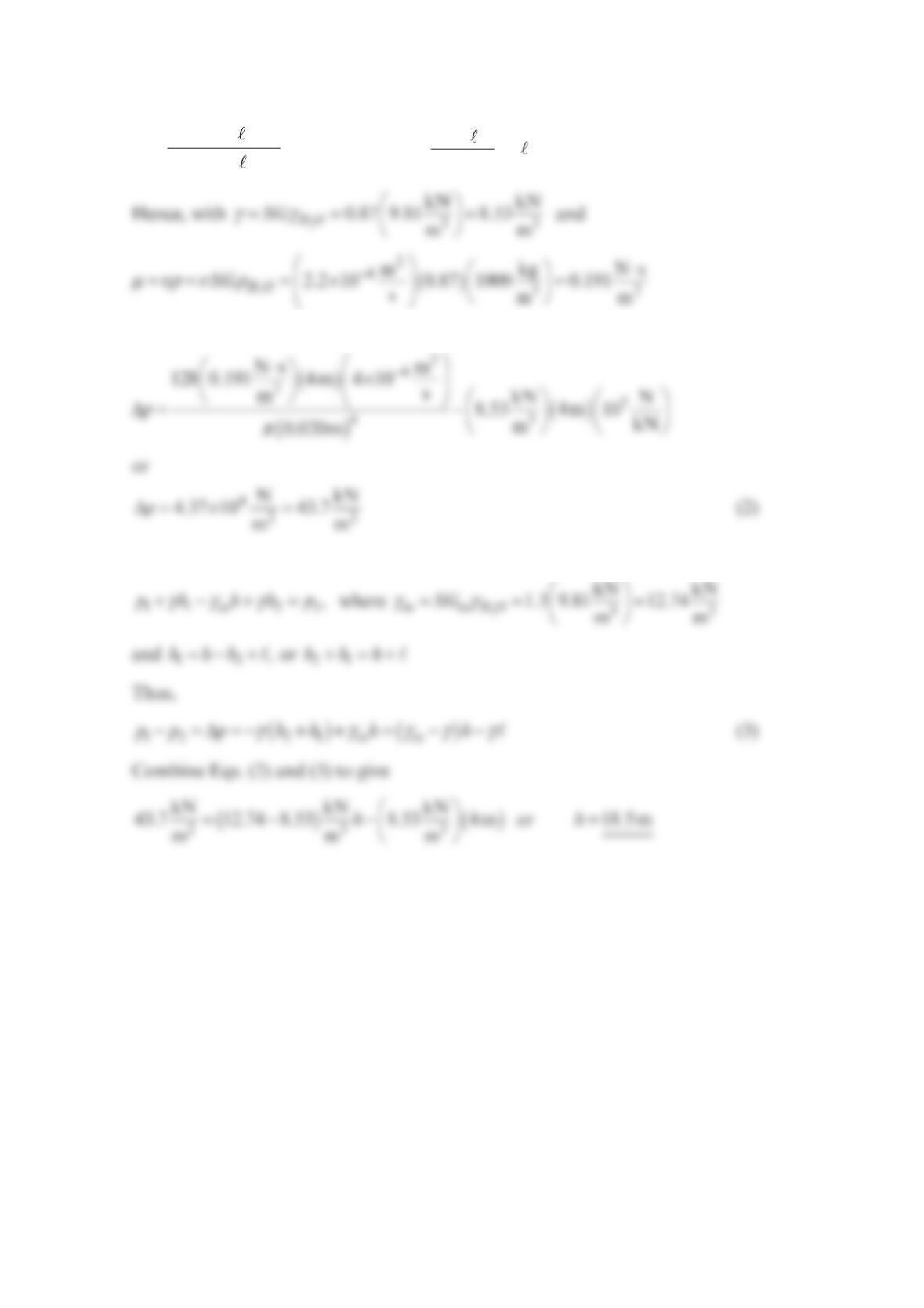
Eq. (1) gives
From manometer considerations,
Problem 8.22
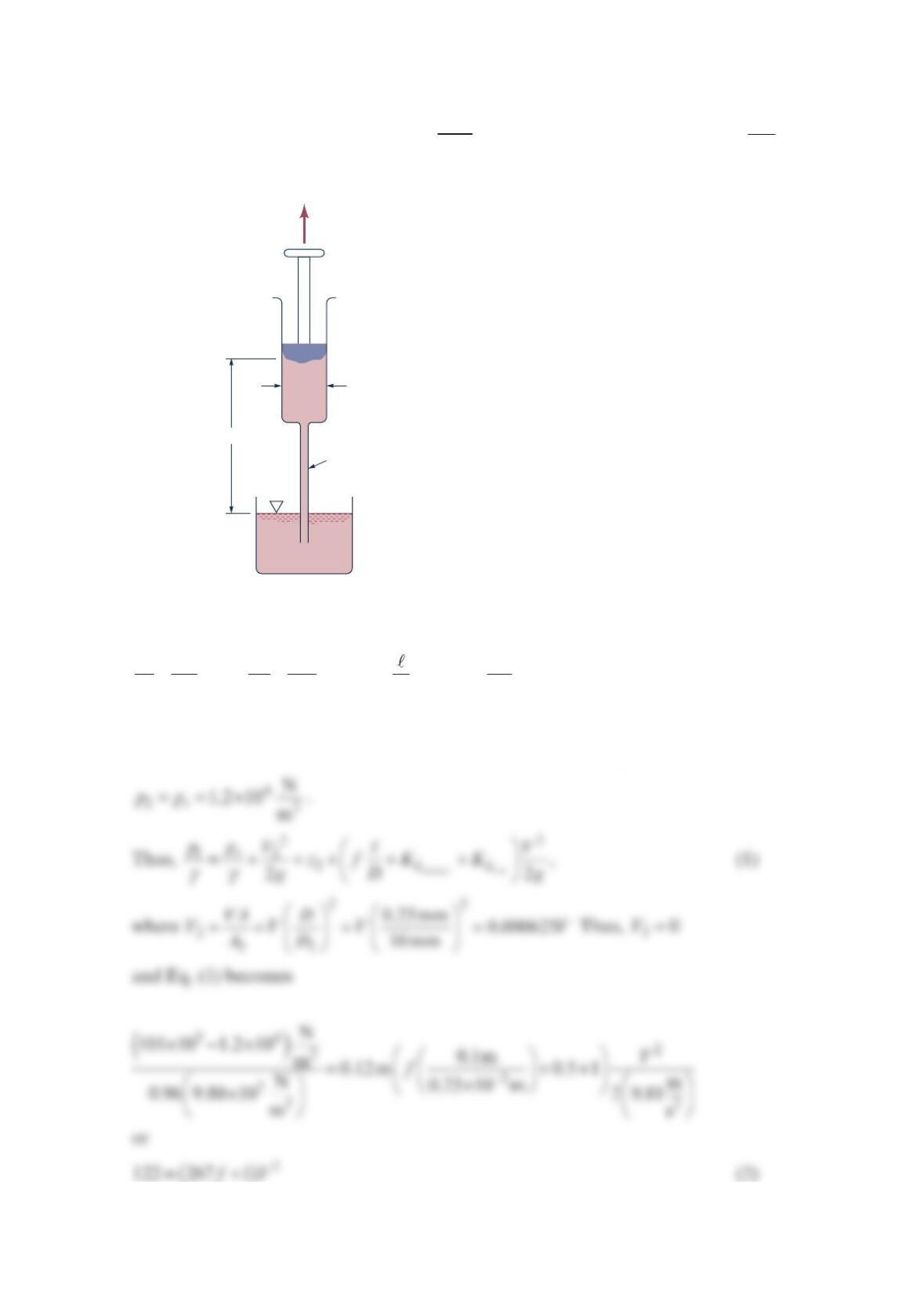
A liquid with =0.96SG , 4
2
Ns
9.2 10 m
µ
−⋅
=× , and vapor pressure =×
4
2
N
1.2 10 (abs)
m
v
p is
drawn into the syringe as is indicated in the figure below. What is the maximum flowrate if
cavitation is not to occur in the syringe?
Solution 8.22
γγ
++=+ ++ +
22 2
11 2 2
12
22 2
L
pV p V V
zzfK
ggDg
, where ==
11
101 kPa, 0pz
=
12
0, z = 0.12 m.
V
The maximum flowrate will occur when 2
p
is the minimum allowed:
10-mm-diameter
0.25-mm-diameter
0.10-m-long needle
0.12 m
p
atm
= 101 kPa (abs)
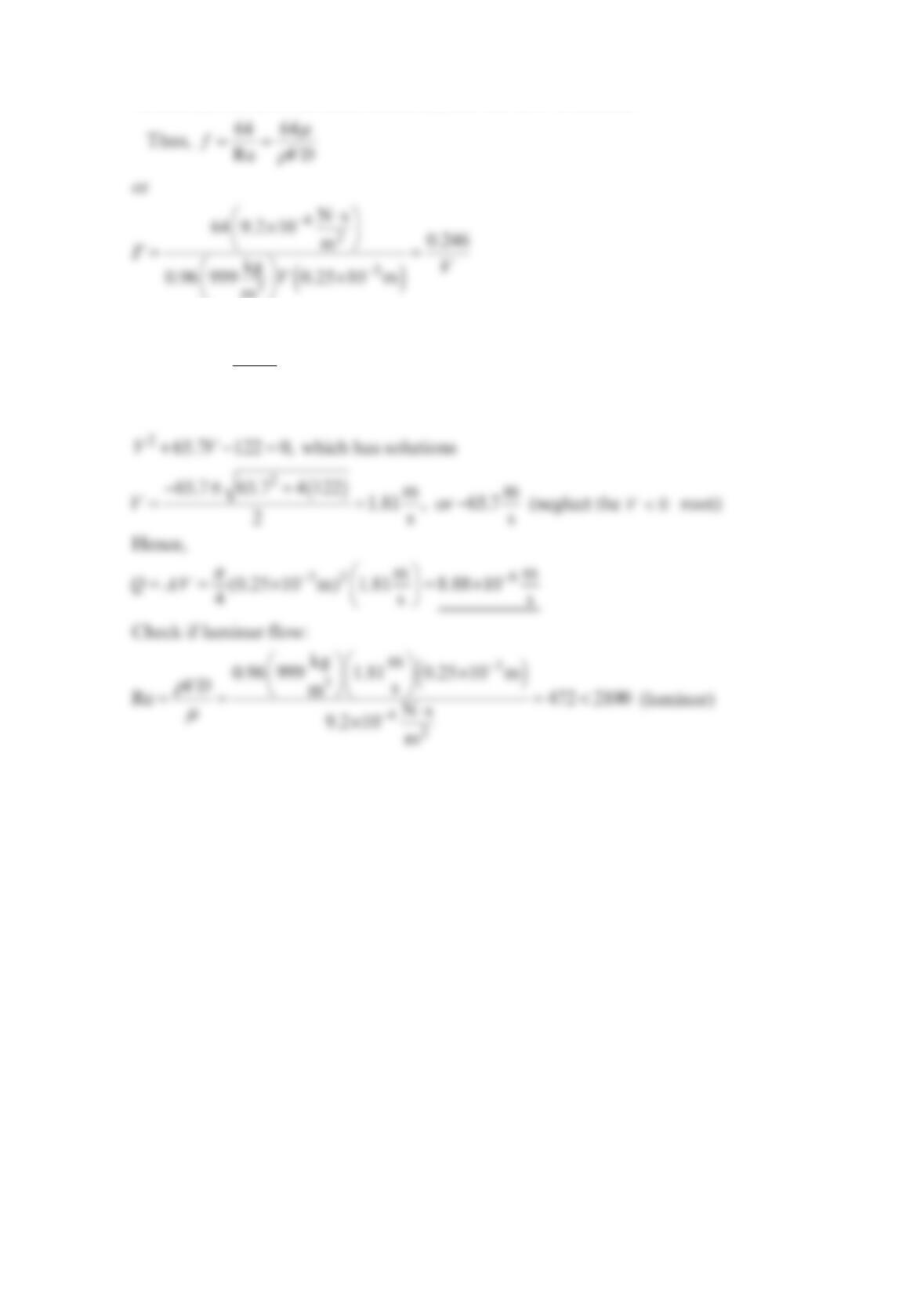
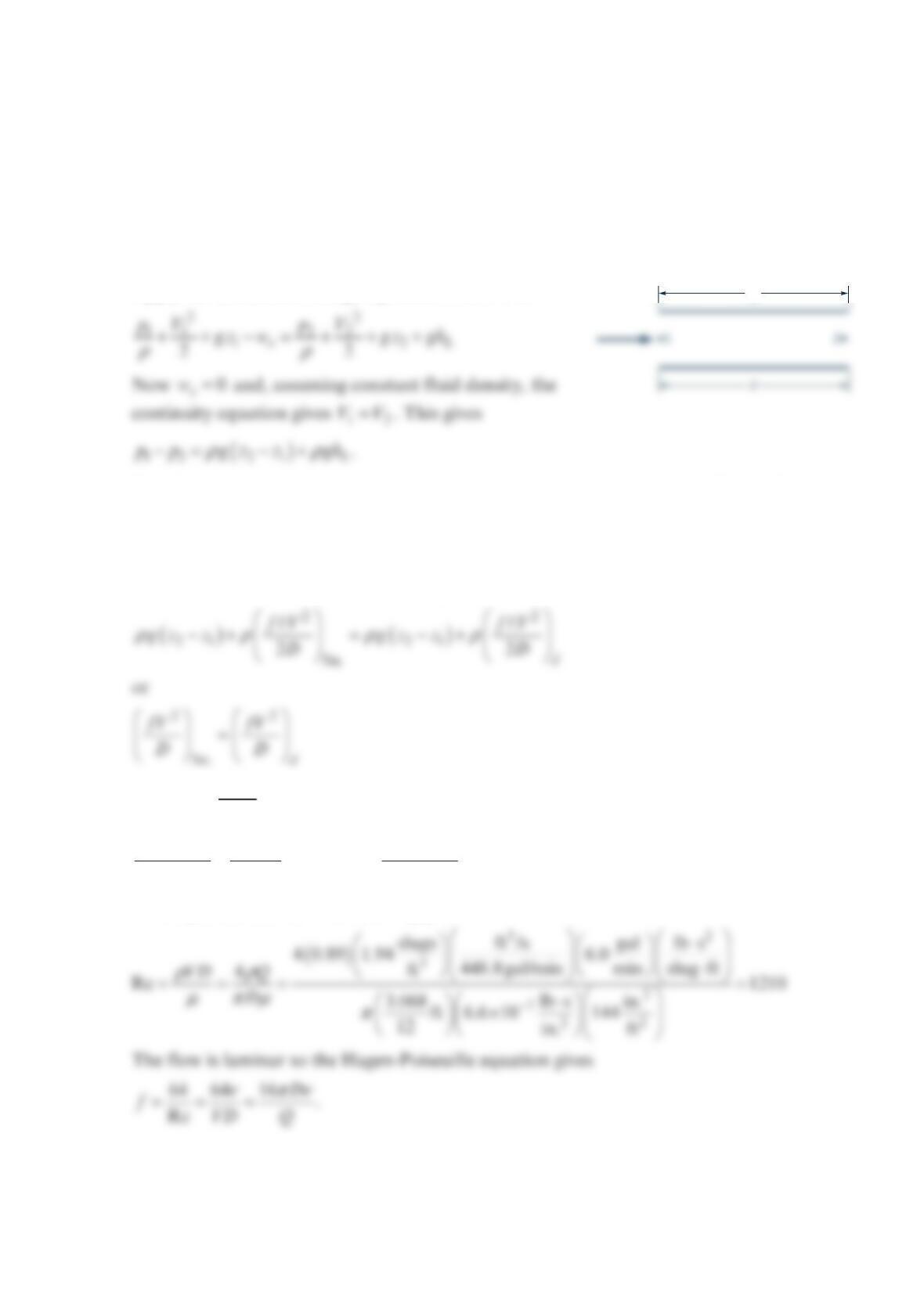
Assume (because of the small diameter) that the flow is laminar.
m
Hence, from Eq. (2),
=+ +
2
0.246
122 267 1 V
V or
()
=+
2
122 65.7VVV
Thus,
Problem 8.23
A 3-in. schedule 40 commercial steel pipe (with an actual inside diameter of 3.068 in. )
carries °210 F SAE 40 crankcase oil at the rate of6.0 gal/min . The oil specific gravity is
0
.89, and the absolute viscosity is 72
6.6 10 lb s / ft
−
×⋅
. For the same pressure drop, what must
the new pipe size be to carry the oil at10.7 gal/min ?
Solution 8.23
Apply the mechanical energy equation from 1 to 2.
Since both the 3-in. pipe and the larger pipe have the same pressure drop
()
−
12
pp
,
we write
()()
−=−
12 12
3in. d
p
ppp
where the dsubscript represents the larger pipe diameter. Then
Using
π
=2
4Q
VD gives
=
22
3in. 3in.
55
3in.
dd
d
f
QfQ
DD
or =
2
55
3in.
2
3in. 3in.
dd
d
fQ
DD
fQ (1)
The Reynolds number for the 3-in. pipe is
Δ
p
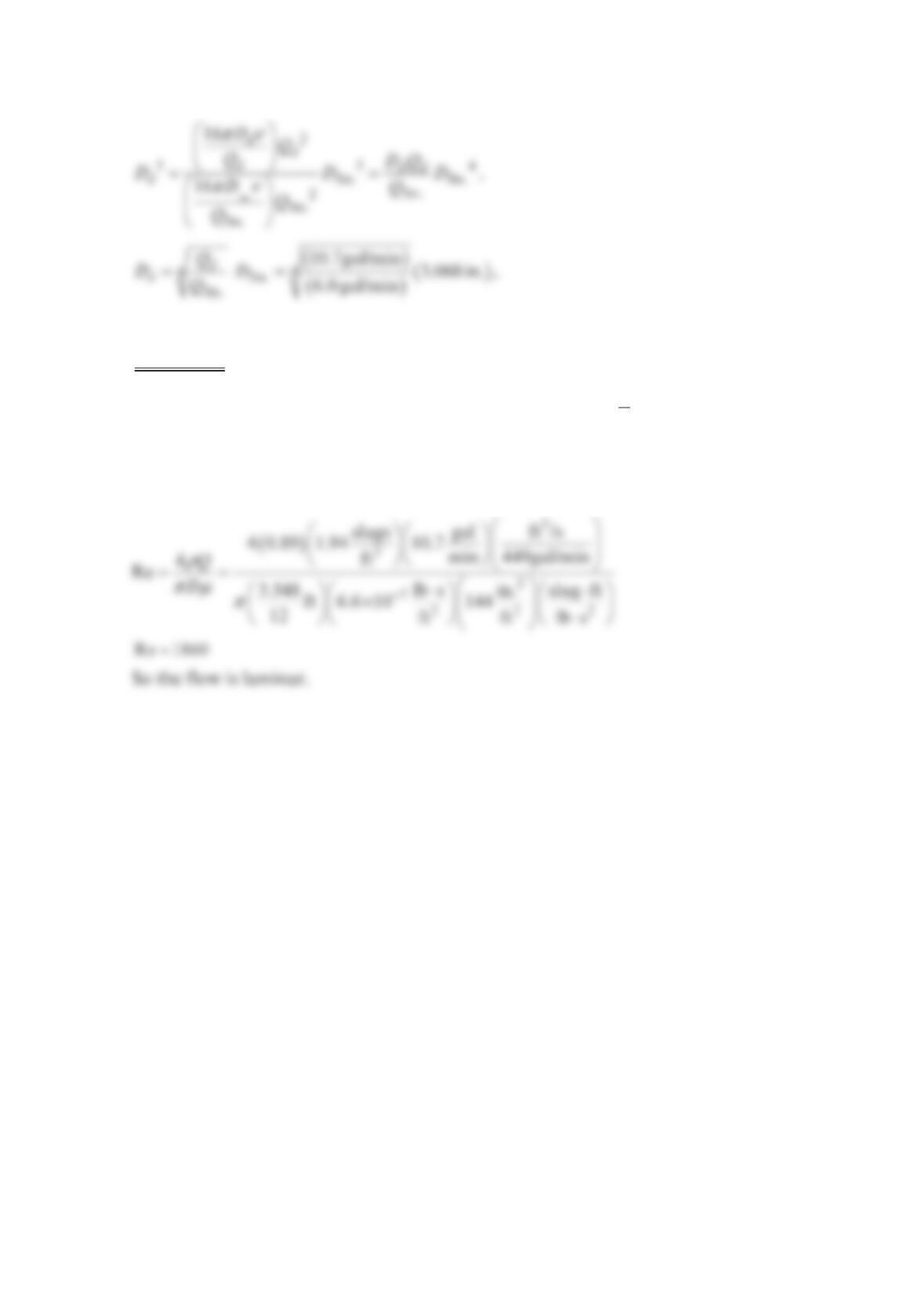
Assuming the flow is laminar for the pipe of diameter d, Eq. (1) gives
or
=3.55in.
d
D
The pipe size when choosing actual available pipe would be 1
3in.
2 schedule 40pipe
(3.548 in. ID)
To verify that the flow is laminar in the pipe of diameter d, we calculate the Reynolds
number
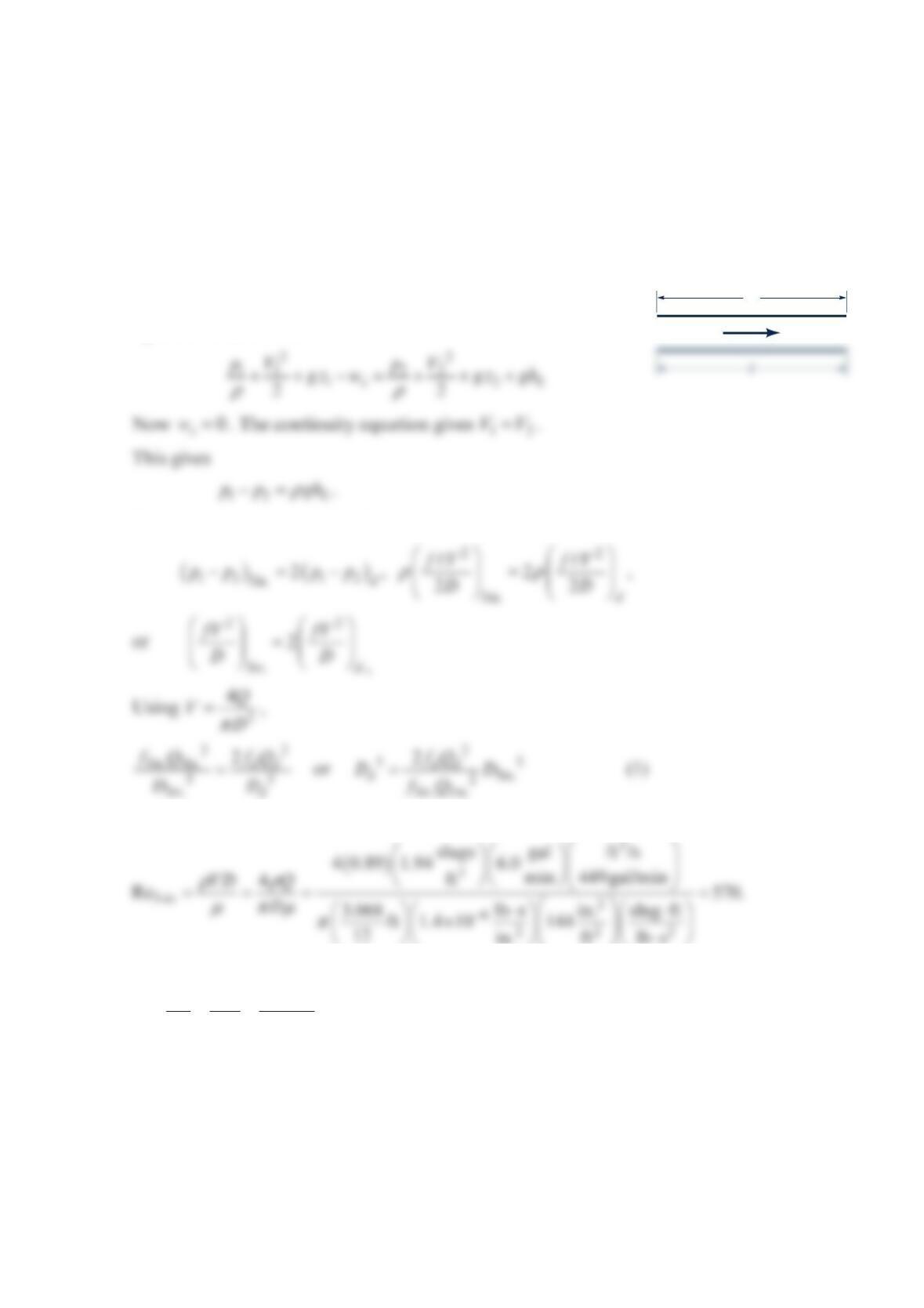
Problem 8.24
A 3-in. schedule 40 commercial steel pipe (with an actual inside diameter of
3
.068 in.) carries
°210 F SAE 40 crankcase oil at the rate of 6.0 gal/min . The oil specific gravity is 0.89 , and
the absolute viscosity is 7
2
6.6 10 1b s/ft
−
×⋅. Calculate the pipe size required to carry the same
flowrate at approximately one-half the pressure drop of the 3-in. pipe. Both pipes are
horizontal.
Solution 8.24
Assume constant fluid density and apply the mechanical energy
equation from 1 to 2.
Denote the new (larger) pipe by the subscript d.
The Reynolds number in the 3-in. pipe is
⋅
The flow is laminar so the Hagen-Poiseuille equation gives
ν
πν
== =
64 64 16 .
Re
D
fVD Q
Δ
p
21
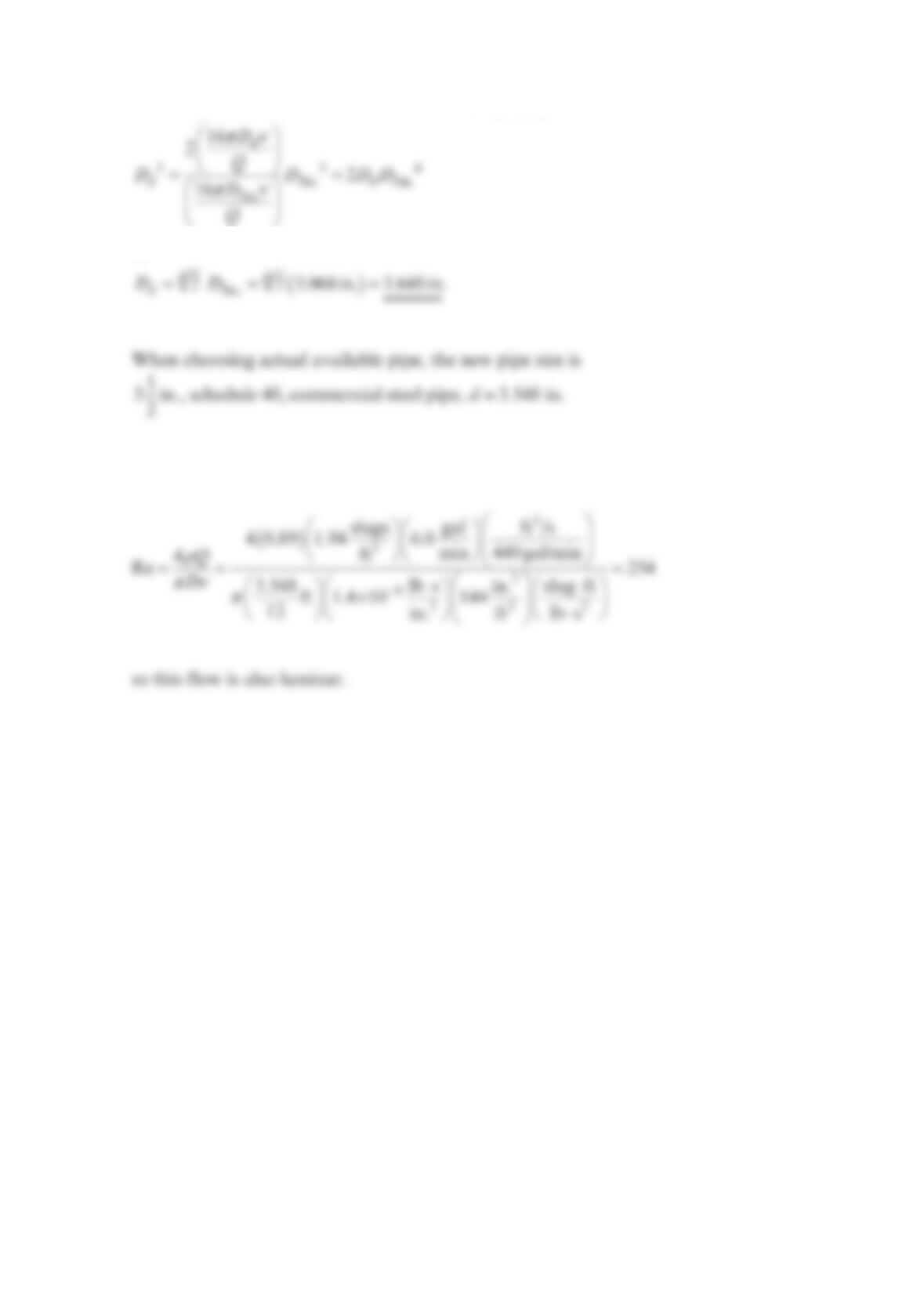
Assuming the flow is laminar in both cases, Eq. (1) gives
or
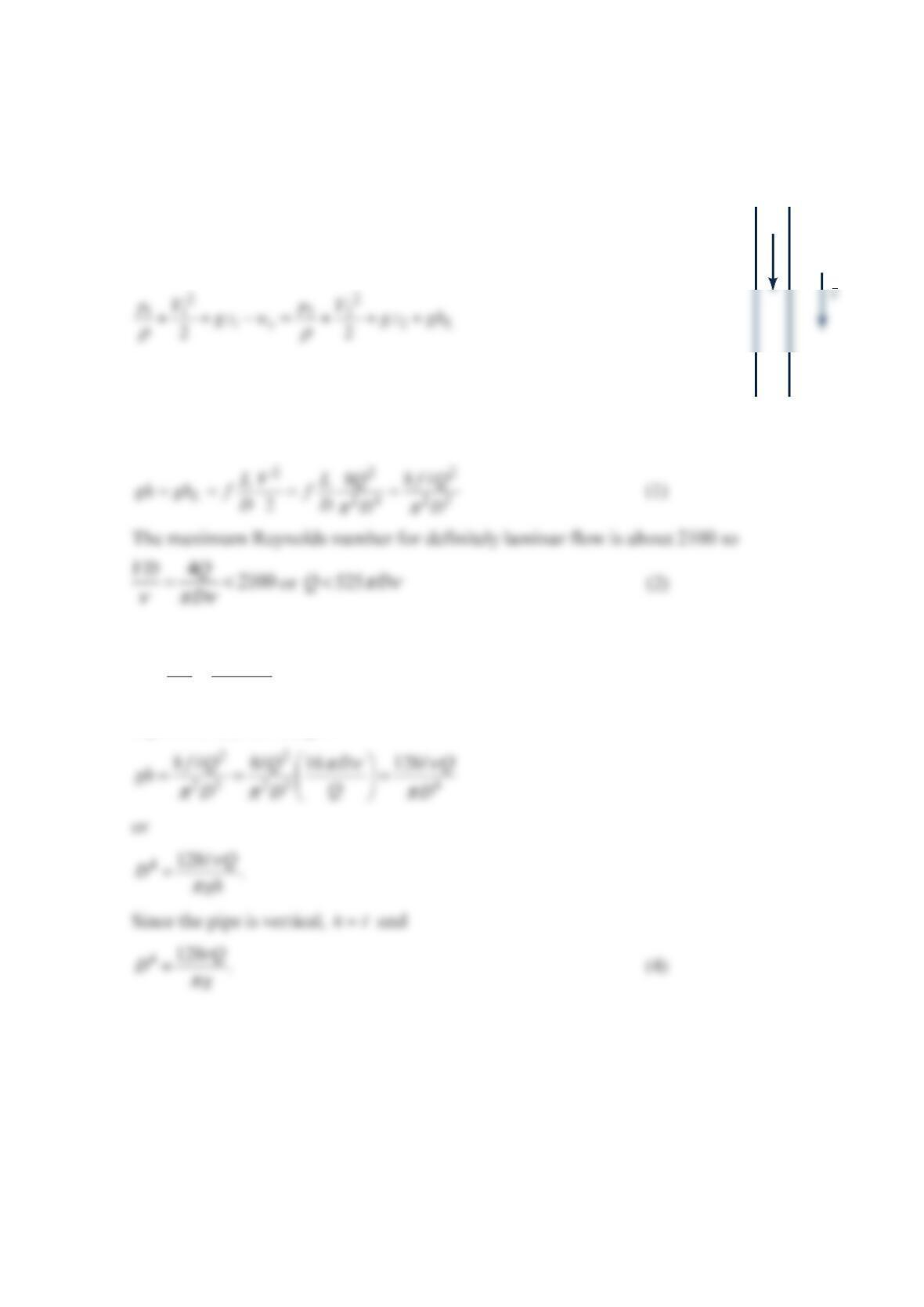
Note that the flow is laminar in the new pipe also since
Problem 8.25
Water at °20 C flows down a vertical pipe with no pressure drop. Find the range of pipe
diameters D (if any) for which the flow is definitely laminar.
Solution 8.25
Apply the mechanical energy equation from point 1 to point 2.
The problem statement gives −
12
p
pand =0
s
w.
Assuming constant water density, the continuity equation gives −
12
VV
. Let
−=
12
zz h
. This gives
and
πν
==
64 16
Re
D
fQ. (3)
Equations (1) and (3) give
•
•
1
2
V
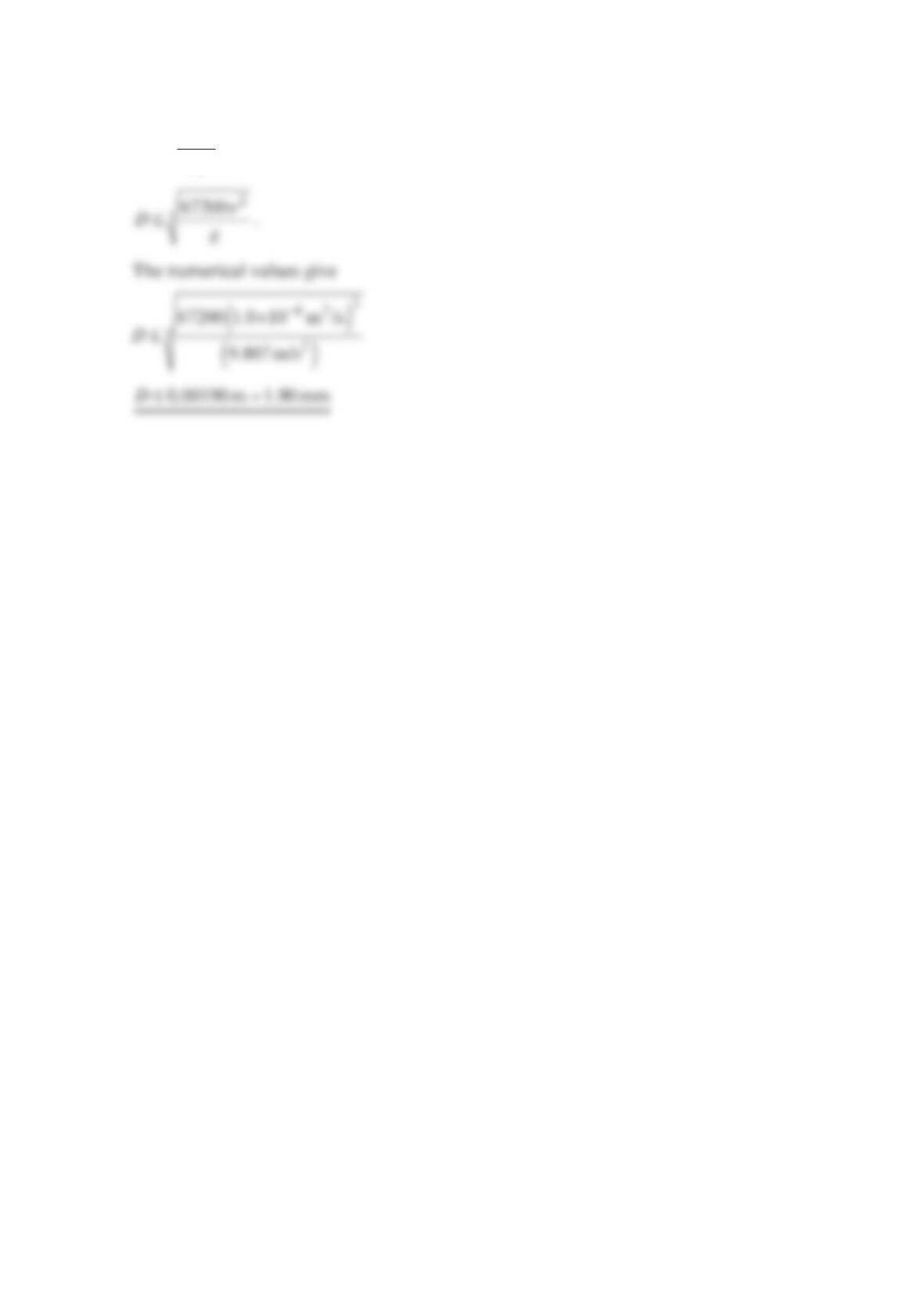
Substituting for Q from Eq. (2) gives
()
ν
πν
π
≤
4128 525DD
g
Problem 8.26
A person is donating blood. The pint bag in which the blood is collected is initially flat and is
at atmospheric pressure. Neglect the initial mass of air in the 1/8-in. I.D., 4 ft– long plastic
tube carrying blood to the bag. The average blood pressure in the vein is 40 mm Hg above
atmospheric pressure. Estimate the time required for the person to donate one pint of blood.
Assume that blood has a specific gravity of 1.0 6 and a viscosity of 42
1
.0 10 1b s/ft
−
×⋅. The
needle’s I.D. is 1/16 in.and the needle length is 2.0 in. The bag is 1. 0 f t below the needle inlet
and the vein’s I.D. is 1/8 in.Optional: Donate a pint of blood and check your answer.
Solution 8.26
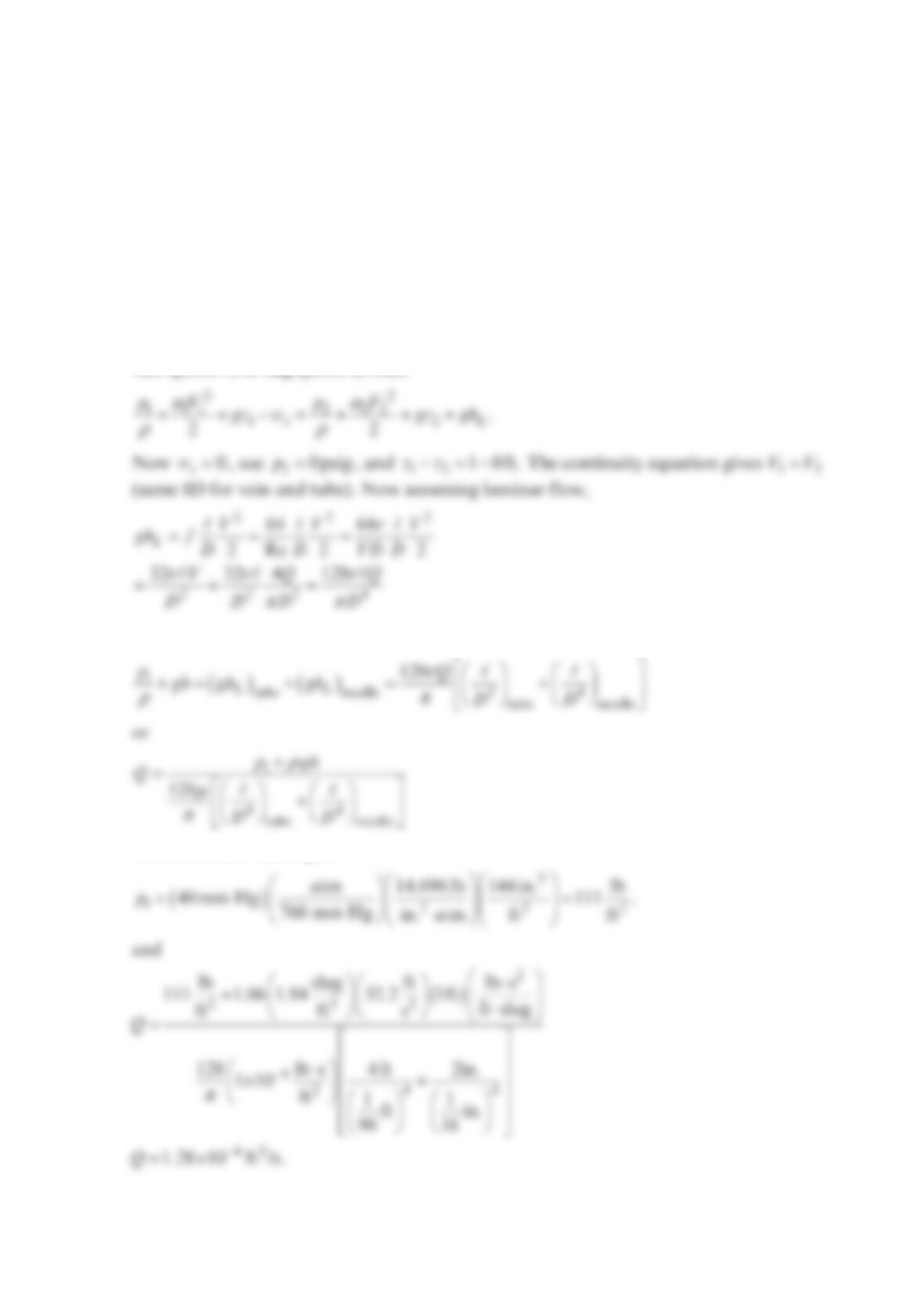
Assume steady flow conditions and apply the mechanical energy equation from
vein (point 1) to bag (point 2) inlet.
The mechanical energy equation is (using =−
12
hz z
)
The numerical values give
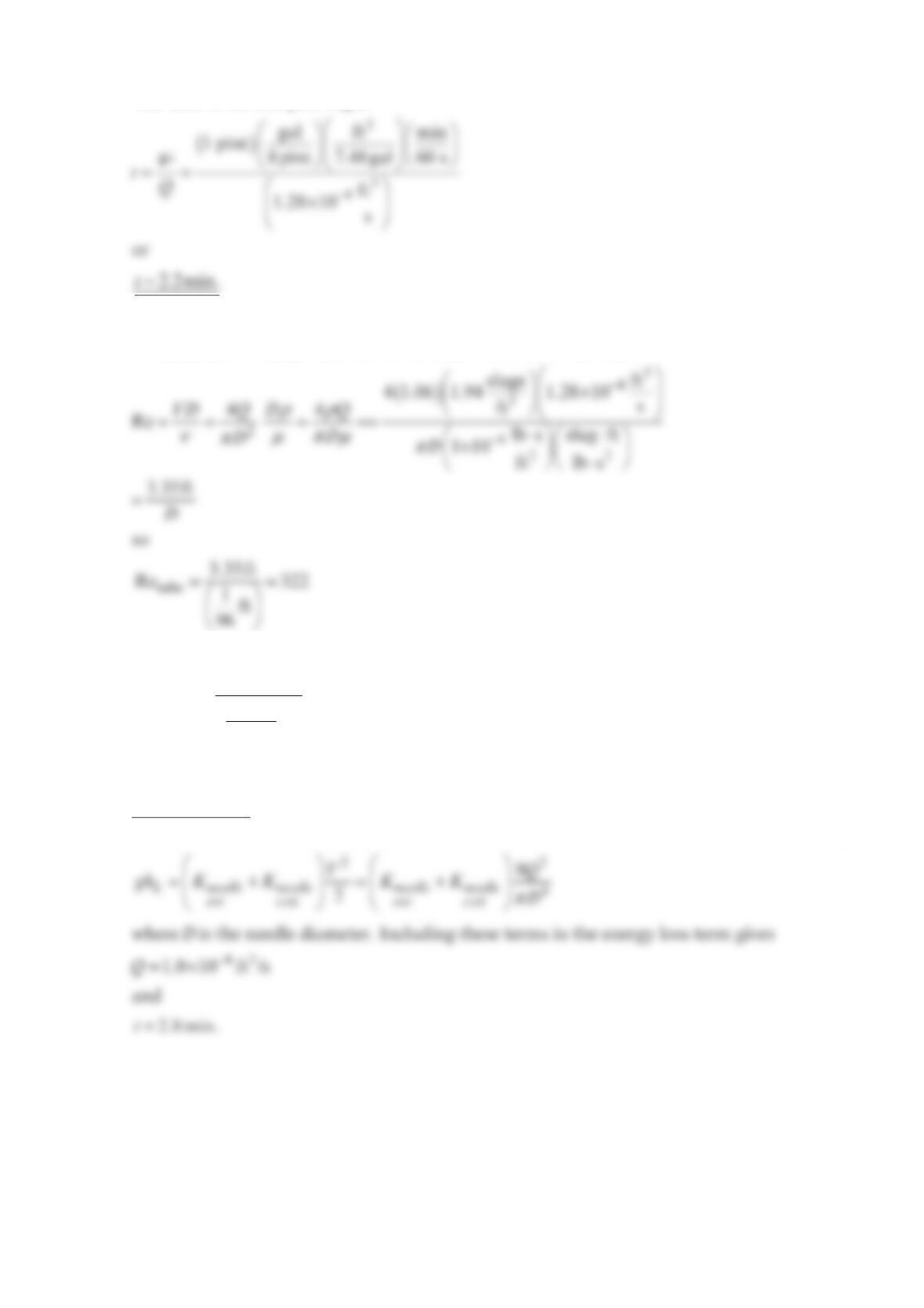
The time to fill one pint bag is
The actual time to donate one pint of blood is 5 to 10 min.
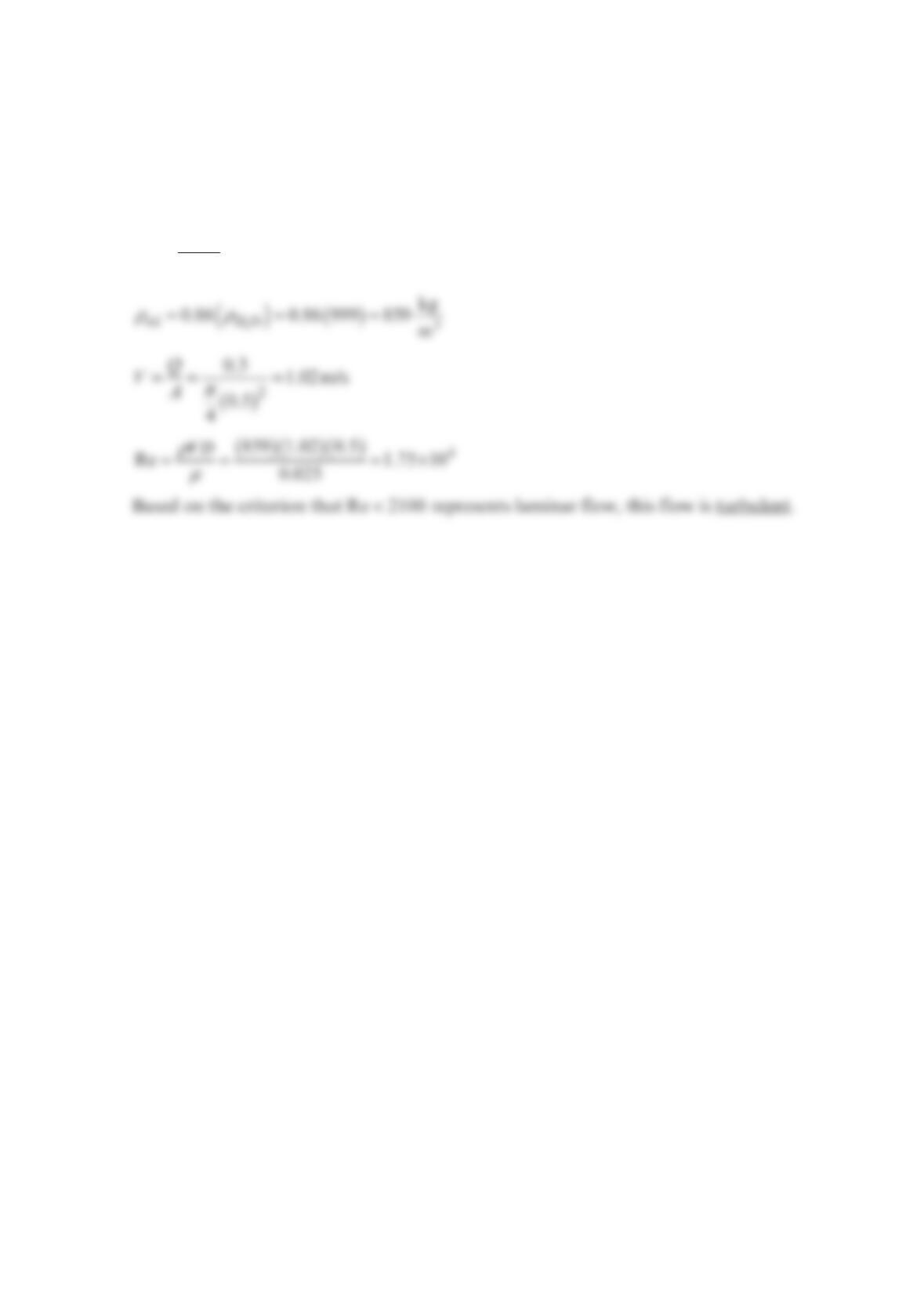
We calculate the Reynolds numbers to see if the flow is laminar.
and
==
×
needle
3.35ft
Re 643
1ft
16 12
so the flows are both laminar.
DISCUSSION We will see in a later section of Chapter 8 that there is a mechanical energy
loss at the needle entrance and at the needle exit (into the tube). These are accounted for by
Problem 8.27
For oil ( = 0.86SG , 2
0.025 Ns/m
µ
=) flow of 3
0.2 m /s through a round pipe with
diameter of 500 mm , determine the Reynolds number. Is the flow laminar or turbulent?
Solution 8.27
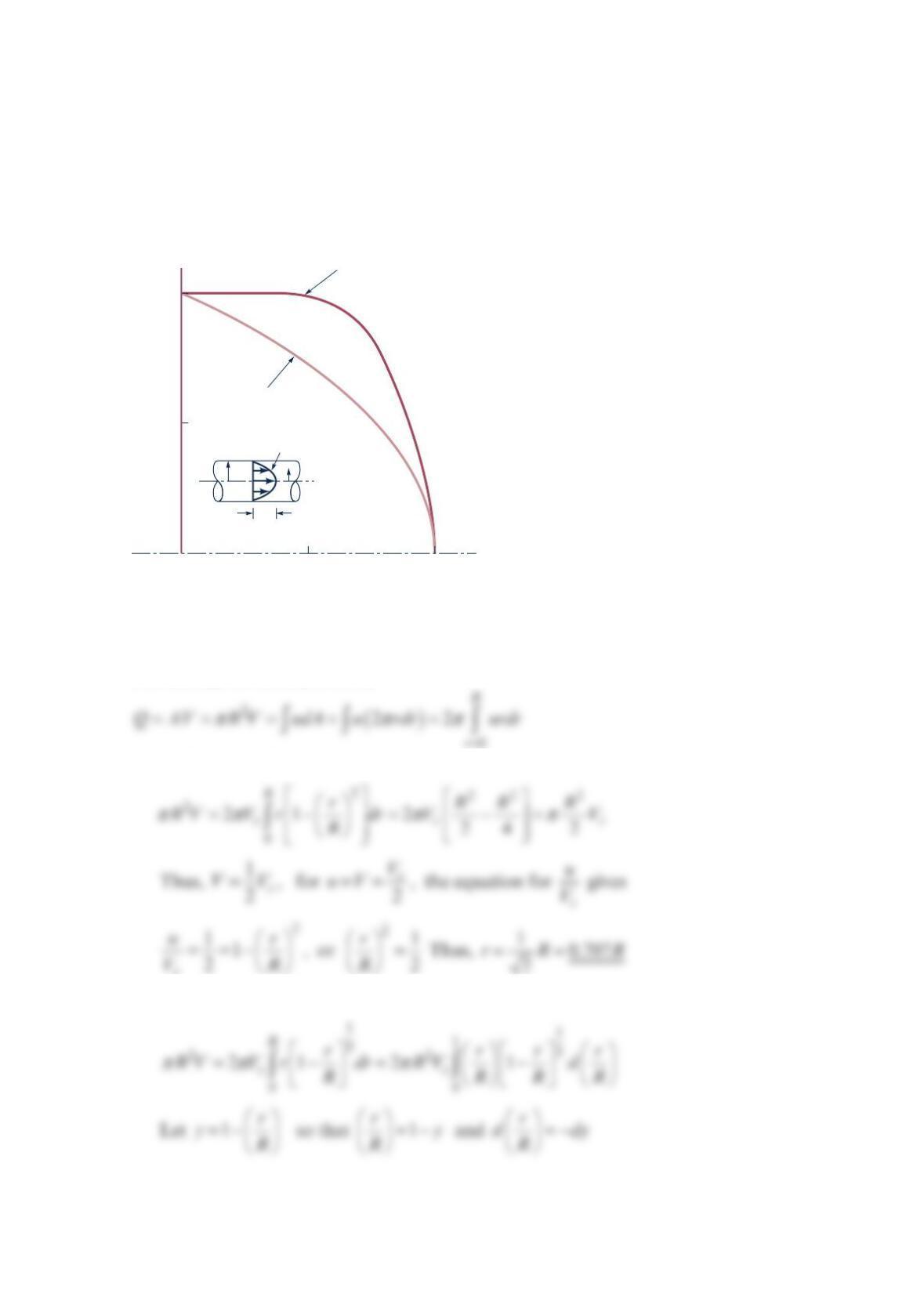
ρ
ρ
==
2
HO
0.86SG
Problem 8.28
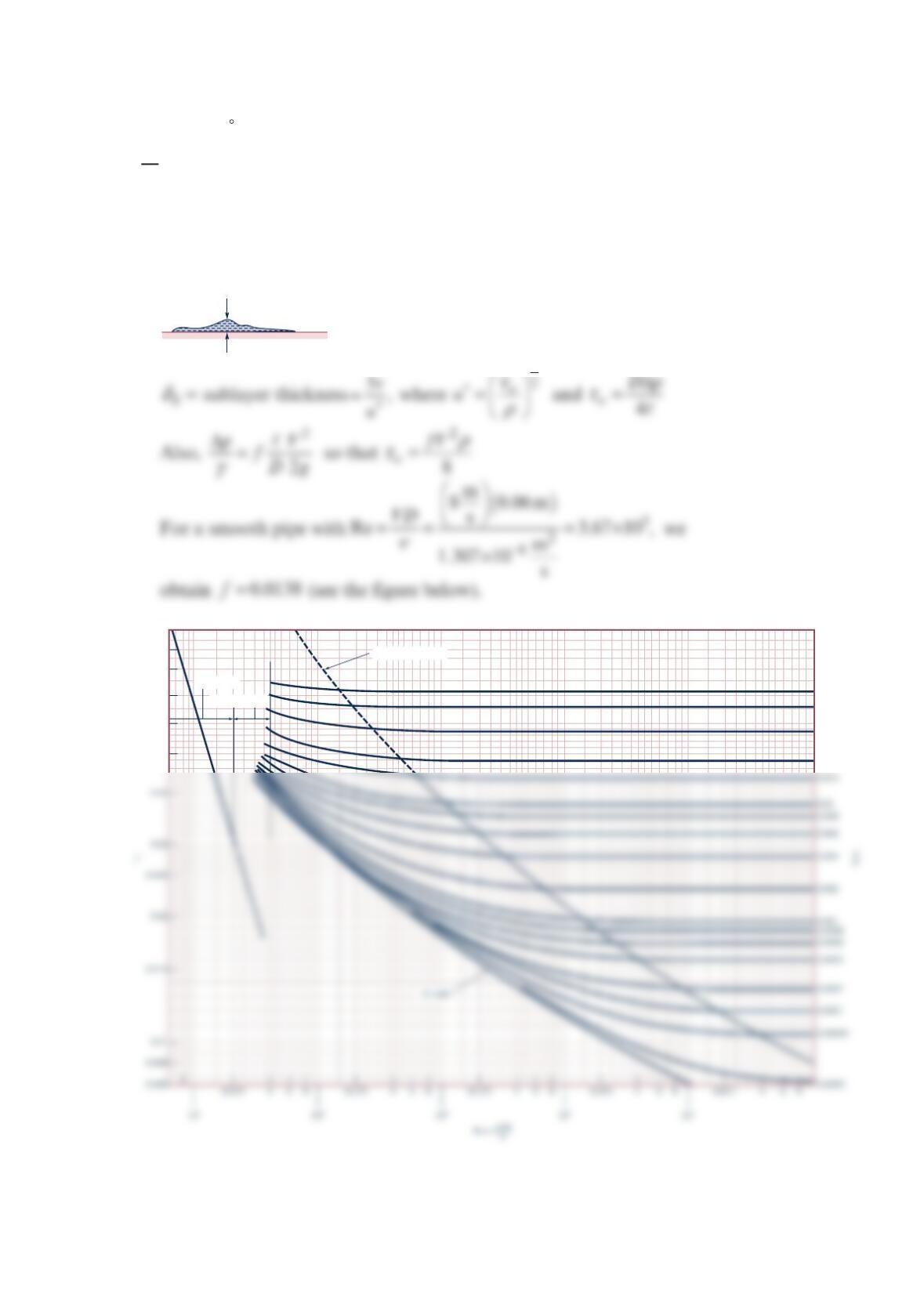
As shown in the figure below, the velocity profile for laminar flow in a pipe is quite
different from that for turbulent flow. With laminar flow, the velocity profile is parabolic;
with turbulent flow at Re 10000=, the velocity profile can be approximated by the power-
law profile shown in the figure. (a) For laminar flow, determine at what radial location you
would place a Pitot tube if it is to measure the average velocity in the pipe. (b) Repeat part
(a) for turbulent flow with Re 10000=.
Solution 8.28
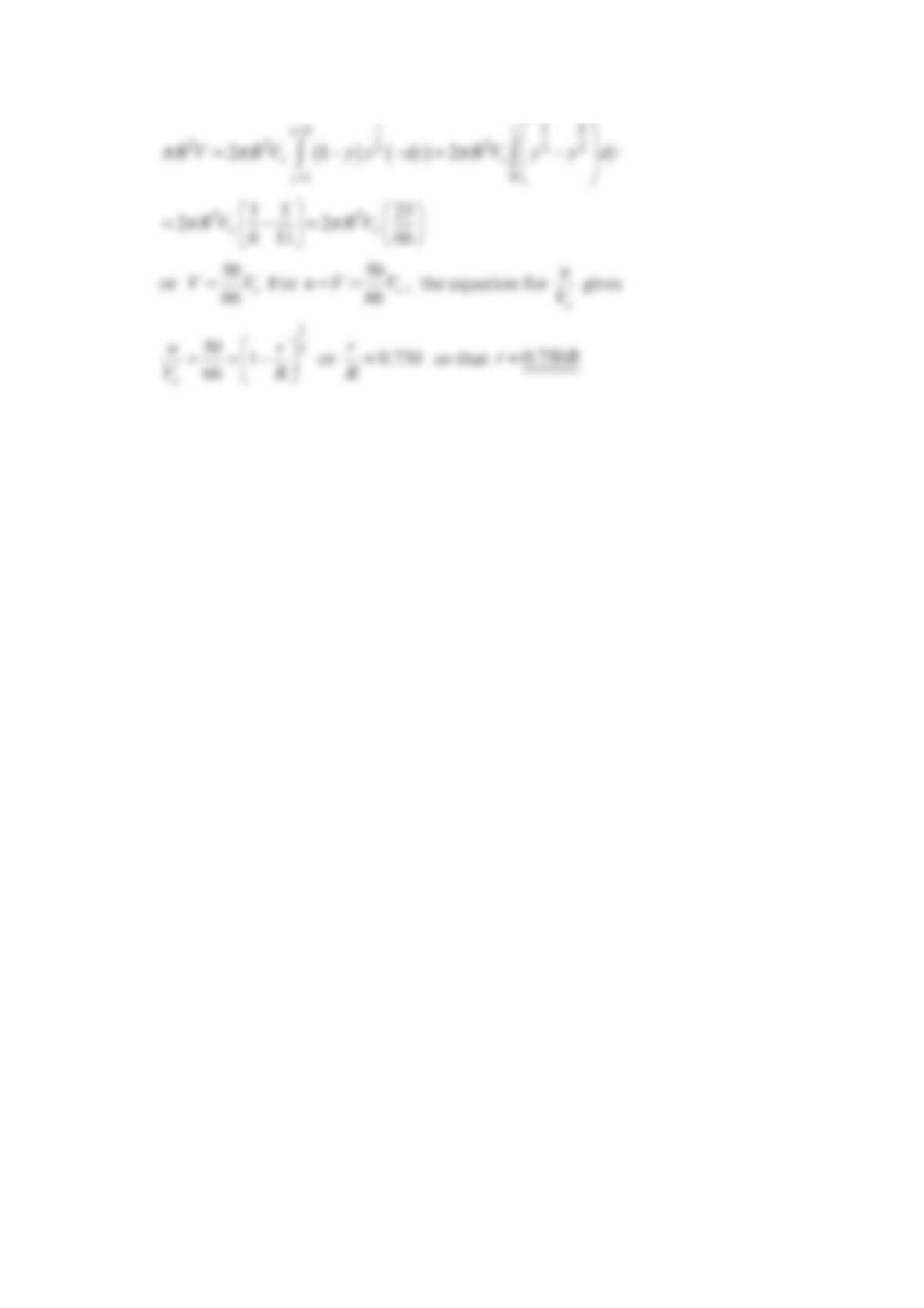
For laminar or turbulent flow,
a) Laminar flow:
c
b) Turbulent flow:
1.0
0.5
0 0.5 1.0
r
__
R
r
__
R
u
__
Vc
u
__
Vc
Laminar with
Re
< 2100
= 1 –
2
()
r
__
R
u
__
Vc
Turbulent with
Re
= 10000
= 1 –
1/5
[]
Rr
u
Vc
Thus,
Problem 8.29
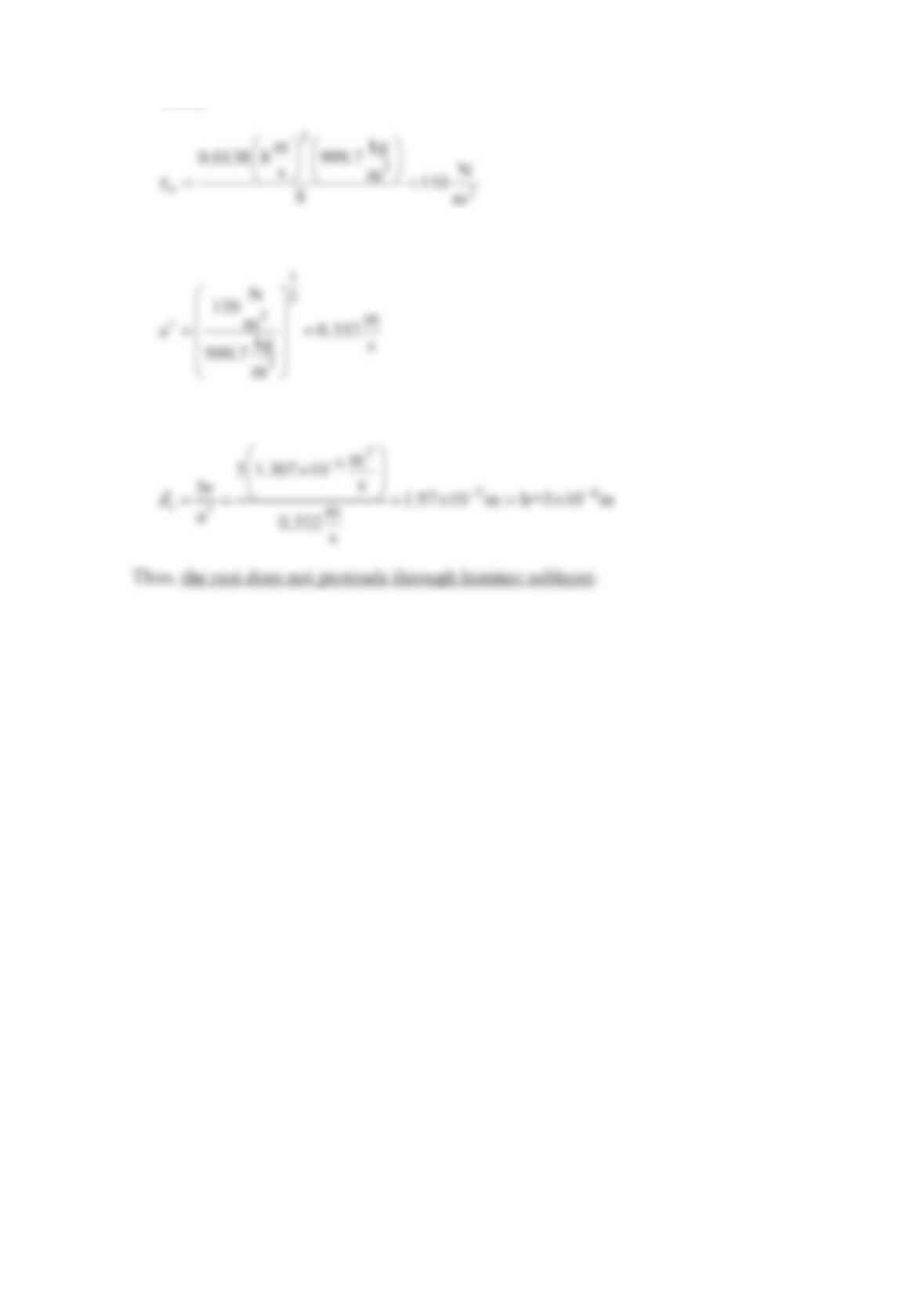
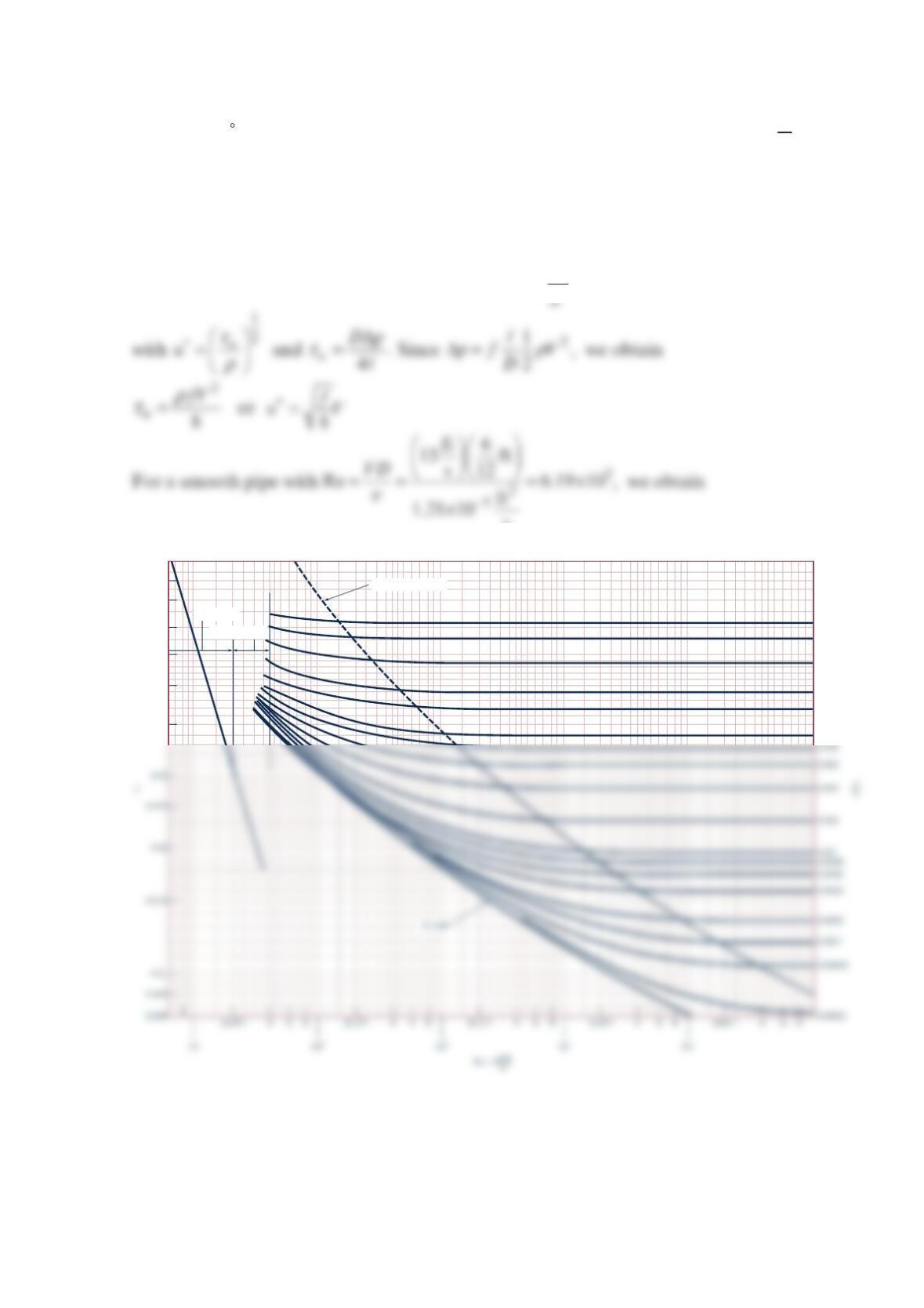
Water at 10 C flows through a smooth 60-mm- diameter pipe with an average velocity of
m
8s. Would a layer of rust of height 0.005 mm on the pipe wall protrude through the
viscous sublayer? Justify your answer with appropriate calculations.
Solution 8.29
1
h = 0.005 mm = 5 × 10⁻⁶ m
Transition range
Laminar flow
Wholly turbulent flow
0.1
0.09
0.08
0.07
0.06
0.05
0.05
0.04
0.03
0.02
Thus,
or
and
Problem 8.31
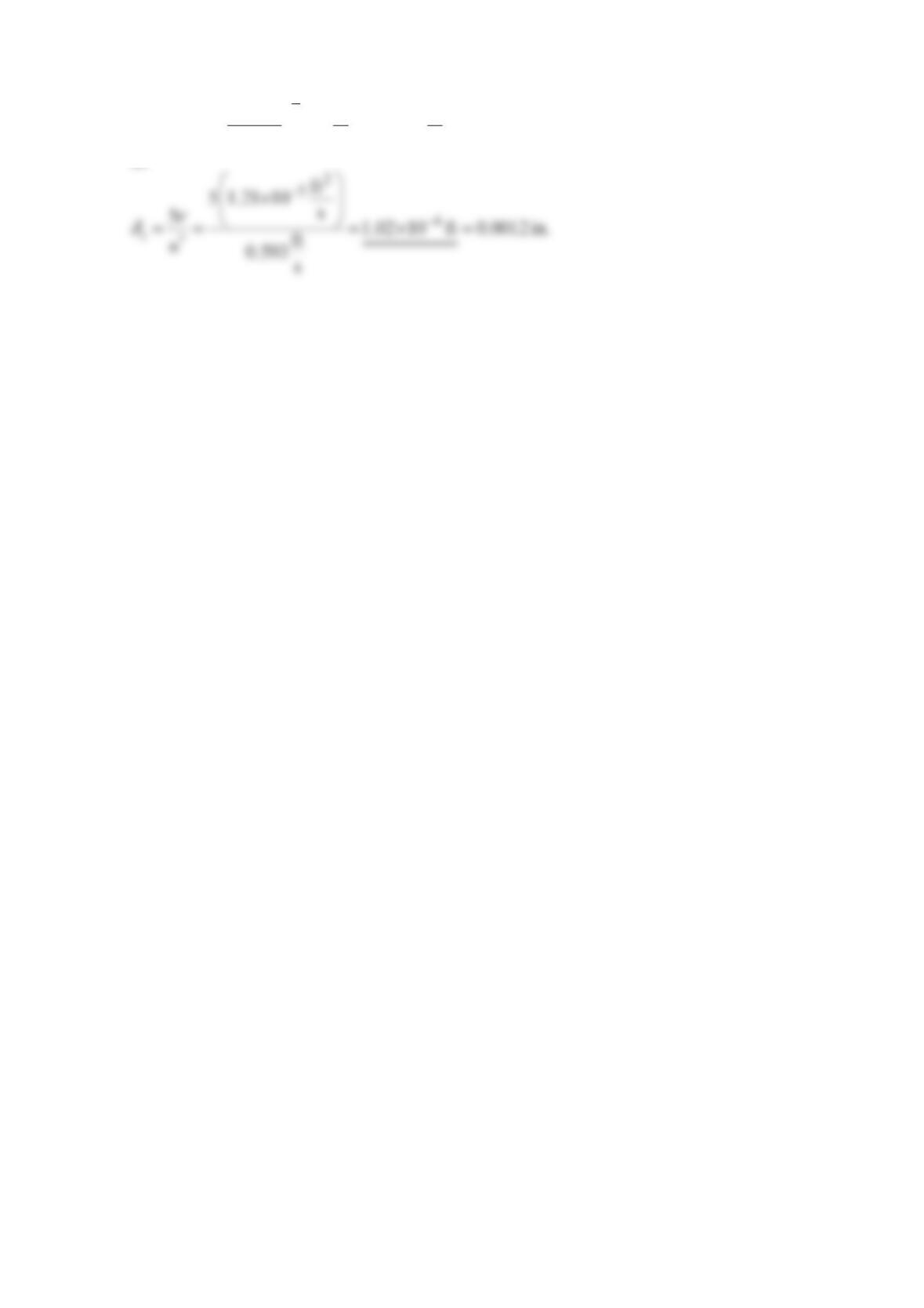
Water at 60 F flows through a 6-in.- diameter pipe with an average velocity of ft
1
5s.
Approximately what is the height of the largest roughness element allowed if this pipe is to
be classified as smooth?
Solution 8.31
Let =h roughness height. Thus,
δ
=,
s
h where
ν
δ
∗
=5
su
from the figure below =0.0125f
Transition range
Laminar flow
Wholly turbulent flow
0.1
0.09
0.08
0.07
0.06
0.05
0.04
0.05
0.04
0.03
0.02
0.015
0.01
Thus,
1
2
0.0125 ft ft
15 0.593
8s s
u∗
==
or