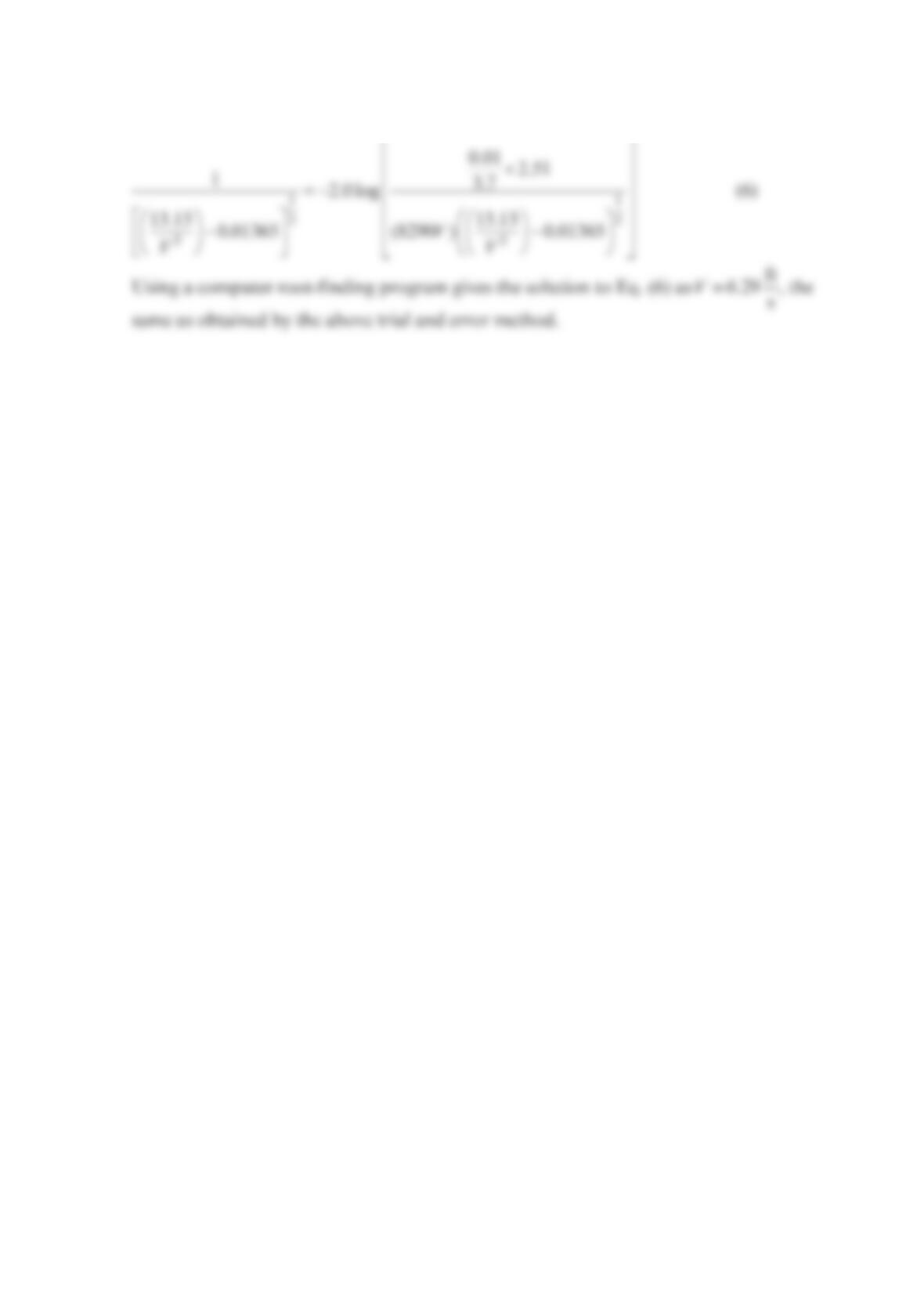
Thus, by combining Eqs. (3), (4), and (5), we obtain the following equation for V:
Problem 8.97
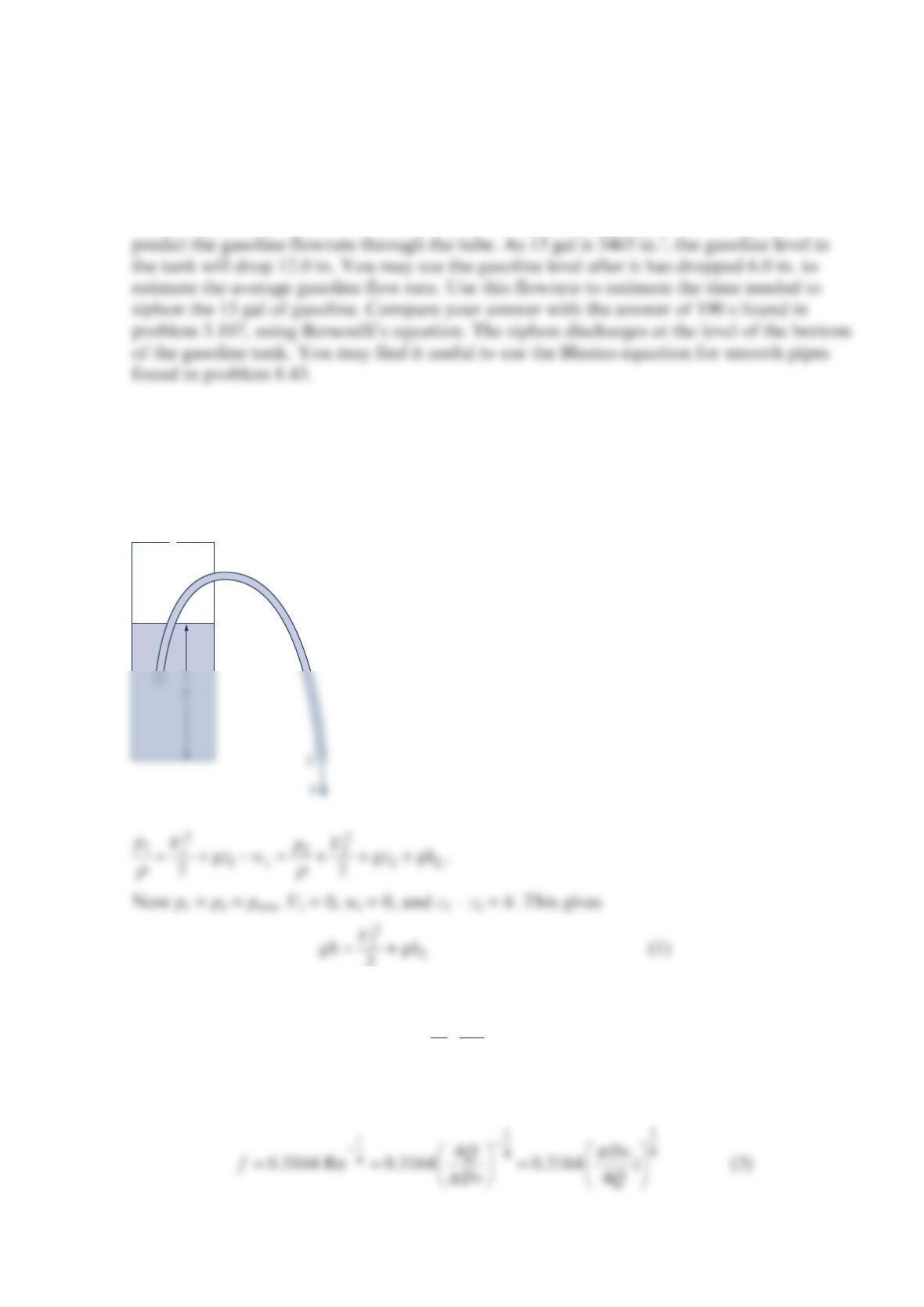
A thief siphoned 15 gal of gasoline from a gas tank in the middle of the night. The gas
tank is 12 in. wide, 24 in. long, and 18 in. high and was full when the thief started. The
siphoning plastic tube has an inside diameter of 0.5 in. and a length of 4.0 ft. Assume
that at any instant of time, the steady-state mechanical energy equation is adequate to
Solution 8.97
Assume constant fluid density and apply the mechanical energy equation from the gasoline
surface (1) to the siphon tube discharge (2).
2L
where
2
2
ent .
2
LL
V
gh K f D
=+
(2)
Figure 8.22 gives KL ent = 0.8. Assuming a smooth pipe (see Table 8.1), the Blasius equation
for smooth pipes and 4000 < Re < 105 gives
1
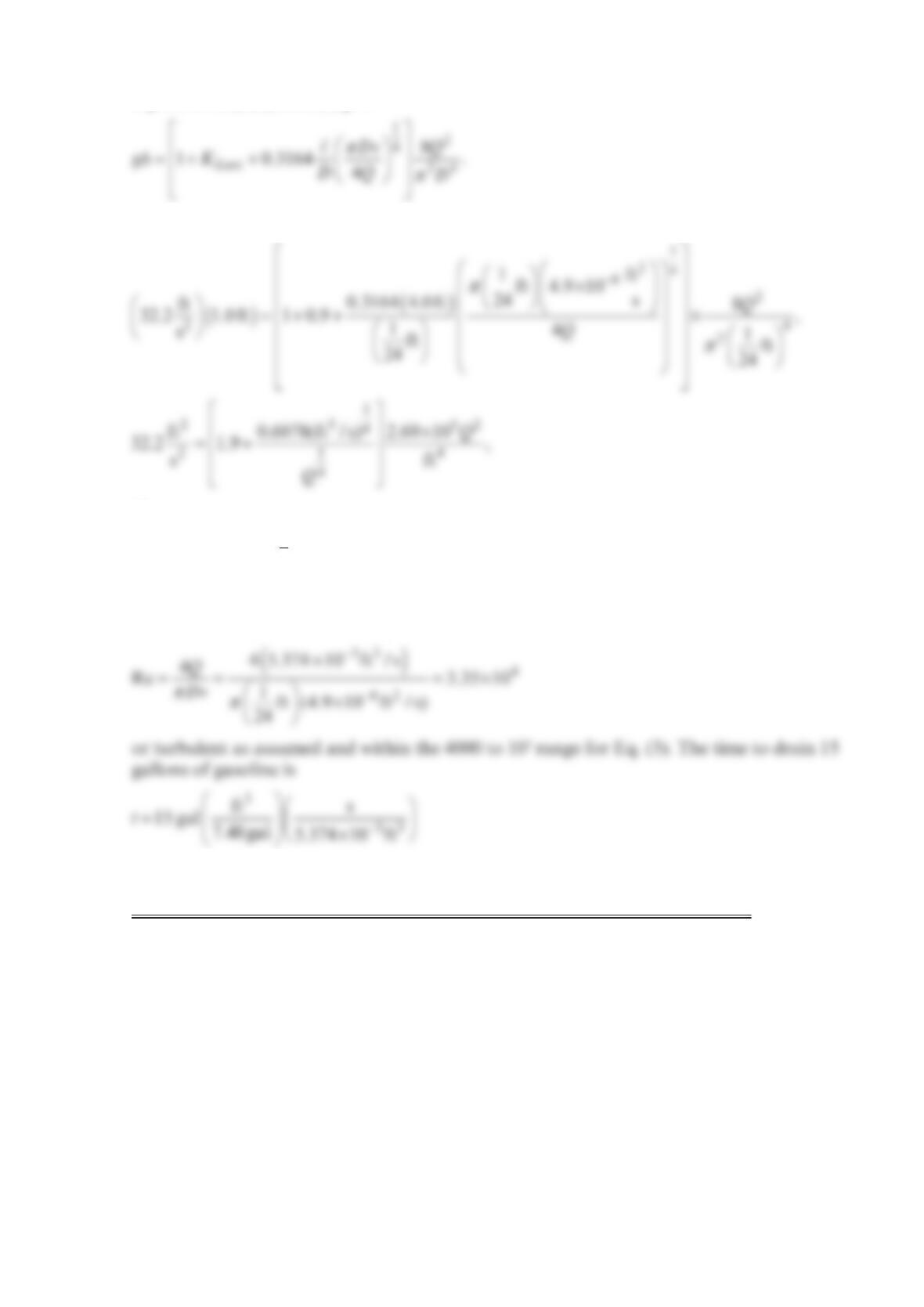
Equations (1), (2), and (3) give
Substituting the known numerical values, and using Table 1.5 gives
or
()
1
2 3 1.75 5 6 2
4
0.3199 ft / s 6.30 10 ft / s 0.QQ
−
+−×=
A trial and error approach produced a single, positive root of Q = 5.374 × 10⁻³ ft3/s. A
check on the Reynolds number gives
or
373s 6 min,13s compared to 190s 3min,10 s using Bernoulli’s equation.tt== ==
Problem 8.98
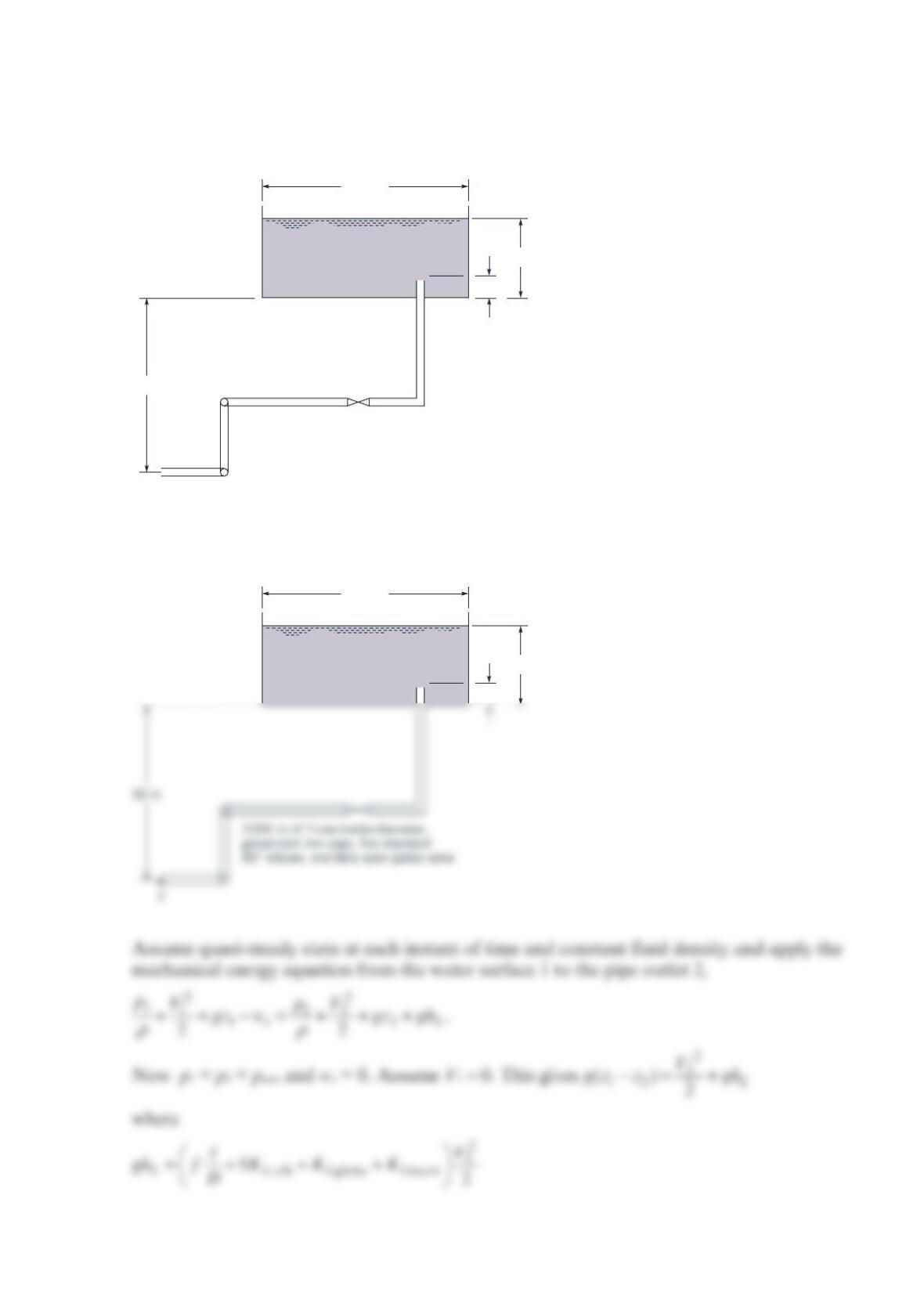
Estimate the time required for the water depth in the reservoir shown in the figure below to
drop from a height of 25 m to 5 m. The connections are threaded.
Solution 8.98
30 m
25 m
5 m
500 m2
1000 m of 7-cm-inside-diameter,
galvanized iron pipe, five regular
90° elbows, one fully open globe valve
T
= 10°C
25 m
5 m
500 m
2
1
•
T
= 10°C
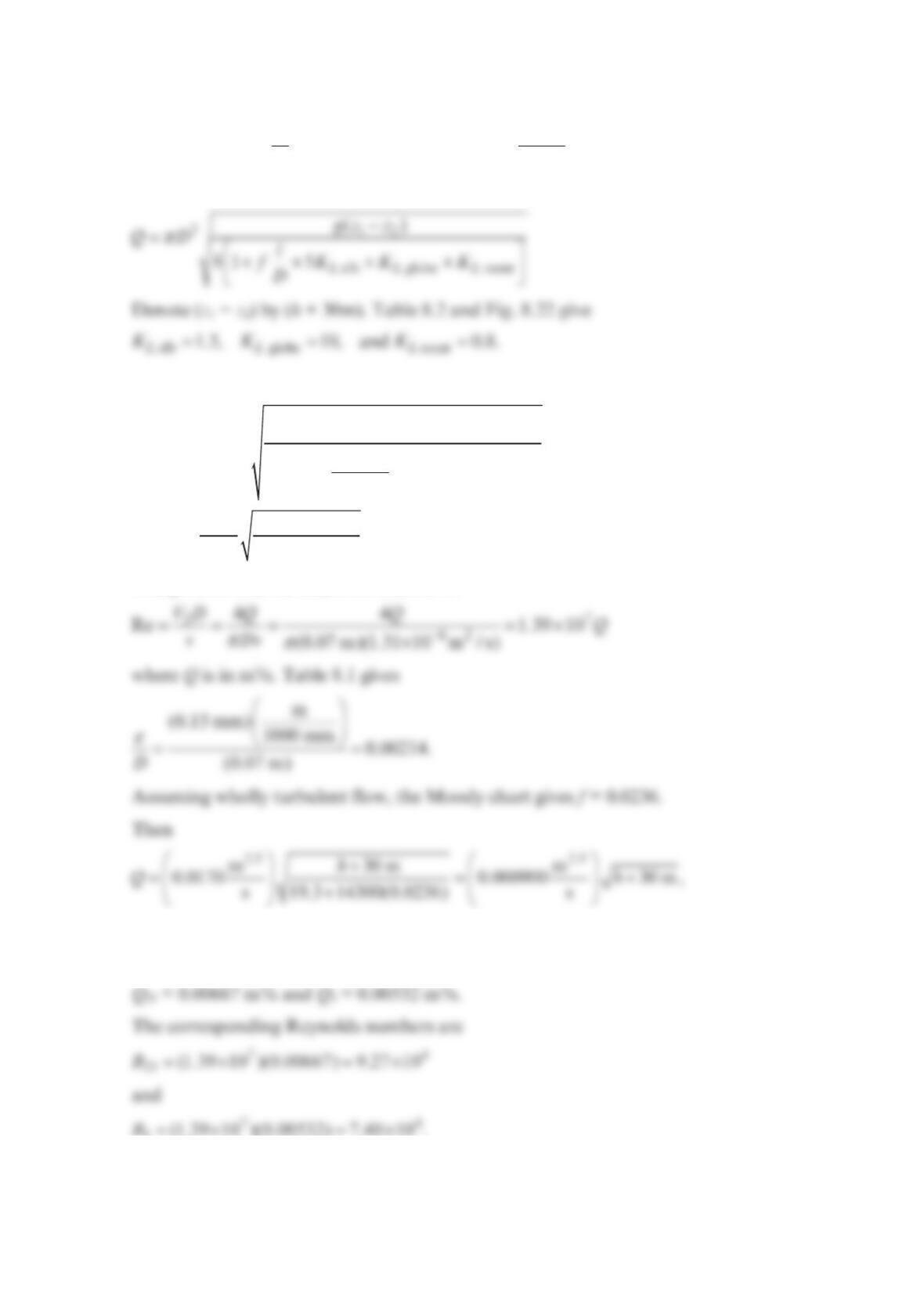
so
2
1 2 elb globe reent 24
8
()1 5
LL L
Q
gz z f K K K
DD
π
−=+ + + +
or
Then
()
2
2
2.5
9.81 m/s ( 30 m)
(0.07 m) 1000 m
8 1 5(1.5) 10 0.8
0.07 m
m30m
0.0170 s 193 14300
h
Q
f
h
f
π
+
=
++++
+
=
+
Using Table B.2, the Reynolds number is
Evaluating Q for h = 25 m and h = 5 m gives
5(1.39 10 )(0.00532) 7.40 10 .
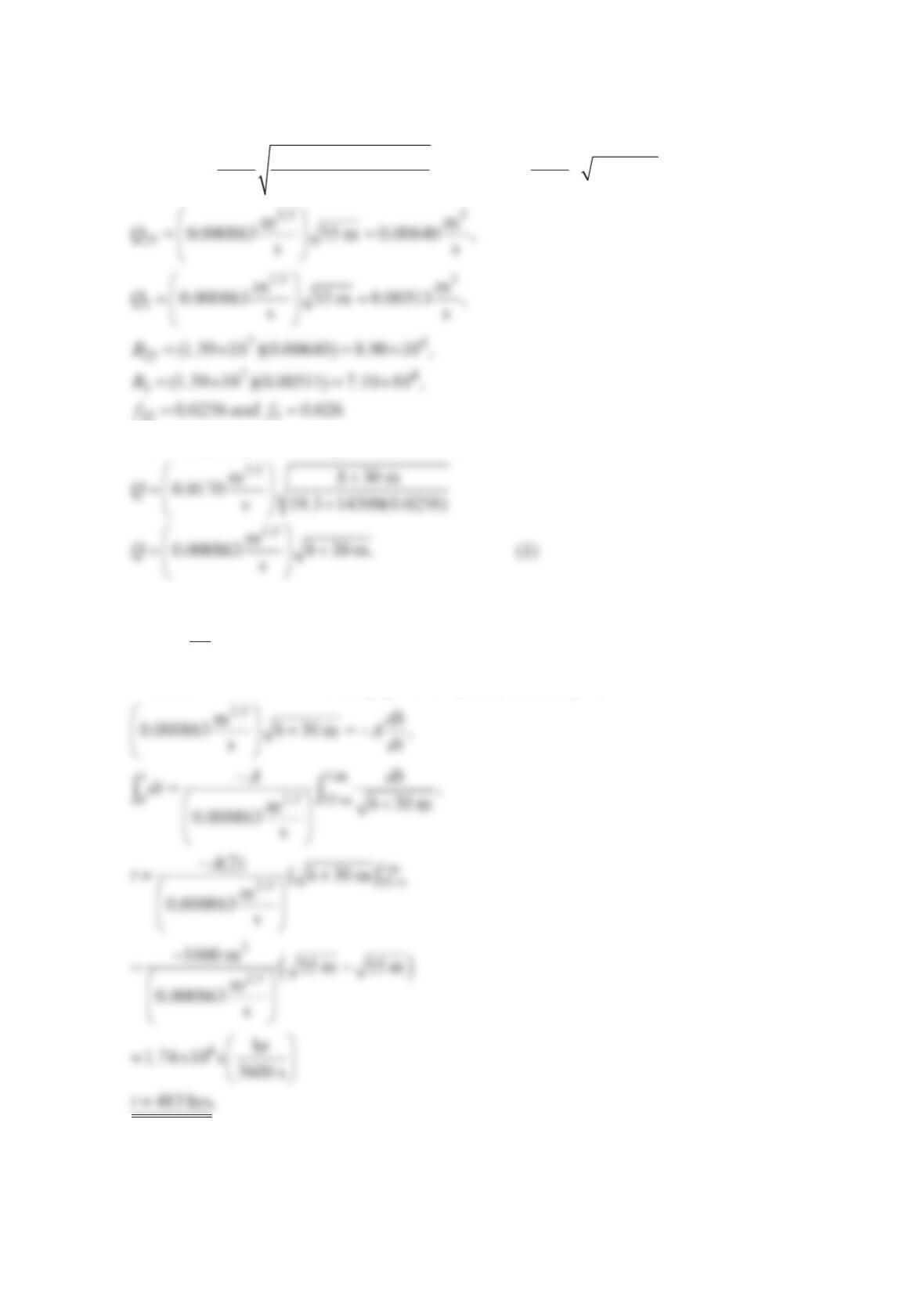
Therefore, the flow is turbulent. The Moody chart gives f25 = 0.0256 and f5 = 0.026.
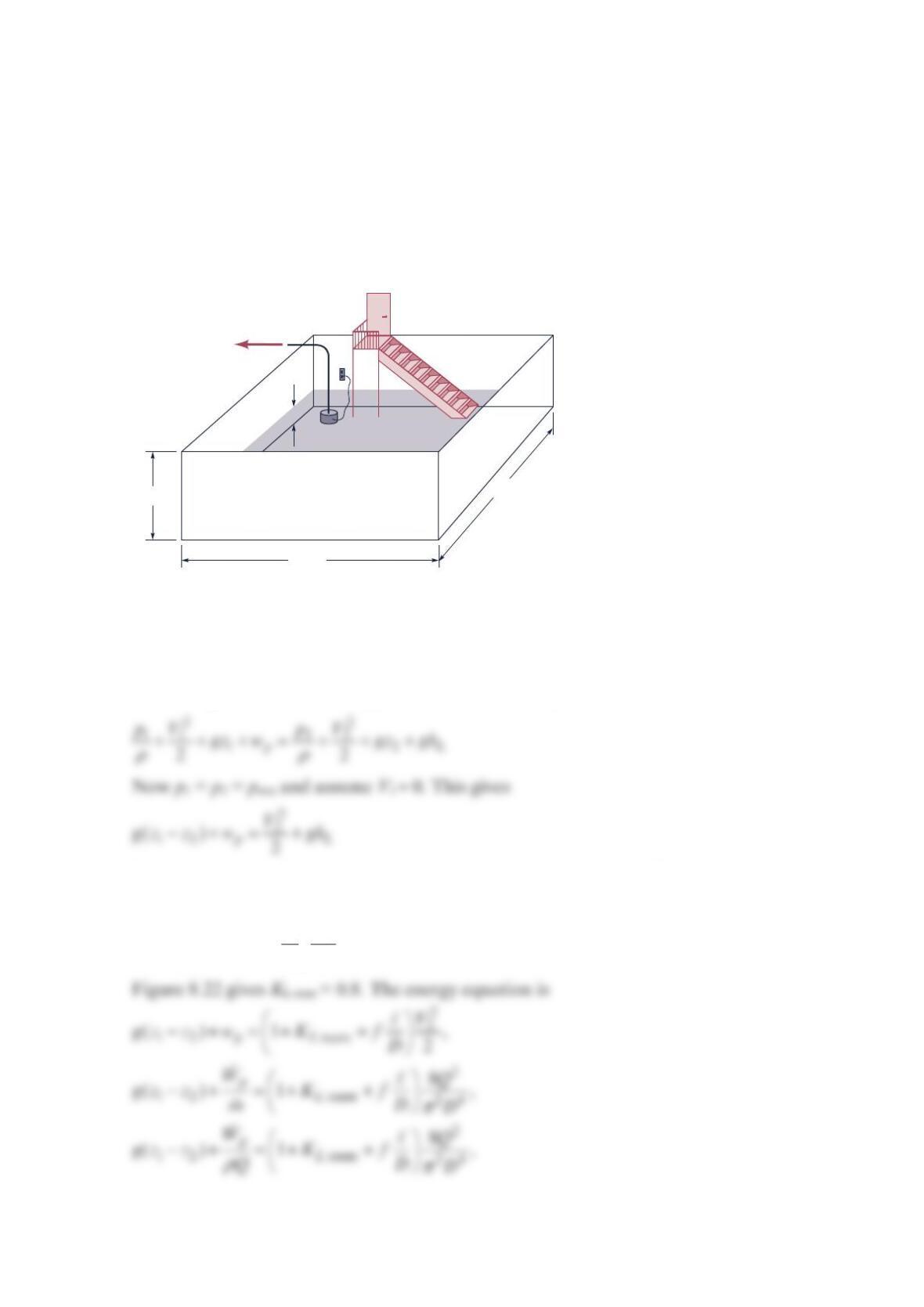
Repeating the calculations for the average f25 = f5 = 0.0258 gives
2.5 2.5
m30m m
0.0170 0.000863 30 m
s 19.3 14300(0.0258) s
h
Qh
+
==+
+
With no perceptible change, use f ≈ 0.0258
Applying the conservation of mass to the tank gives
dh
QA
dt
=− (2)
where A = 500 m2. Eliminating Q from Eqs. (1) and (2) gives
We were fortunate in this problem in that approximately the same friction factor was
appropriate for all water depths. The solution would have been much more difficult if this
were not the case.
Problem 8.99
Sheldon and Leonard come home from a long day of studying to discover that their
basement is flooded with water. They have a submersible pump for such an emergency and
connect the pump discharge to a 12-ft-long garden hose, as shown in the figure below. The
garden hose may be considered a smooth plastic pipe with a 1.0-in. inside diameter. If the
initial water depth is 6.0 in. and the pump has an input power of 0.25 hp and an overall
efficiency of 0.60, how long will it take to pump out the basement? The pump inlet piping
length is negligible, and the garden hose outlet is 7.0 ft above the basement floor.
Solution 8.99
Assume constant water density and apply the mechanical energy equation to a streamline
connecting the water surface (1) and the hose outlet (2).
Now ghL accounts for the mechanical energy loss in the inlet and discharge pipes. Assume a
re-entrant inlet with a 1.0 in. inlet pipe to get
2
2
L reent .
2
L
V
gh K f D
=+
h
= 7 ft
36 ft
24 ft
Q
h
0 = 6 in.
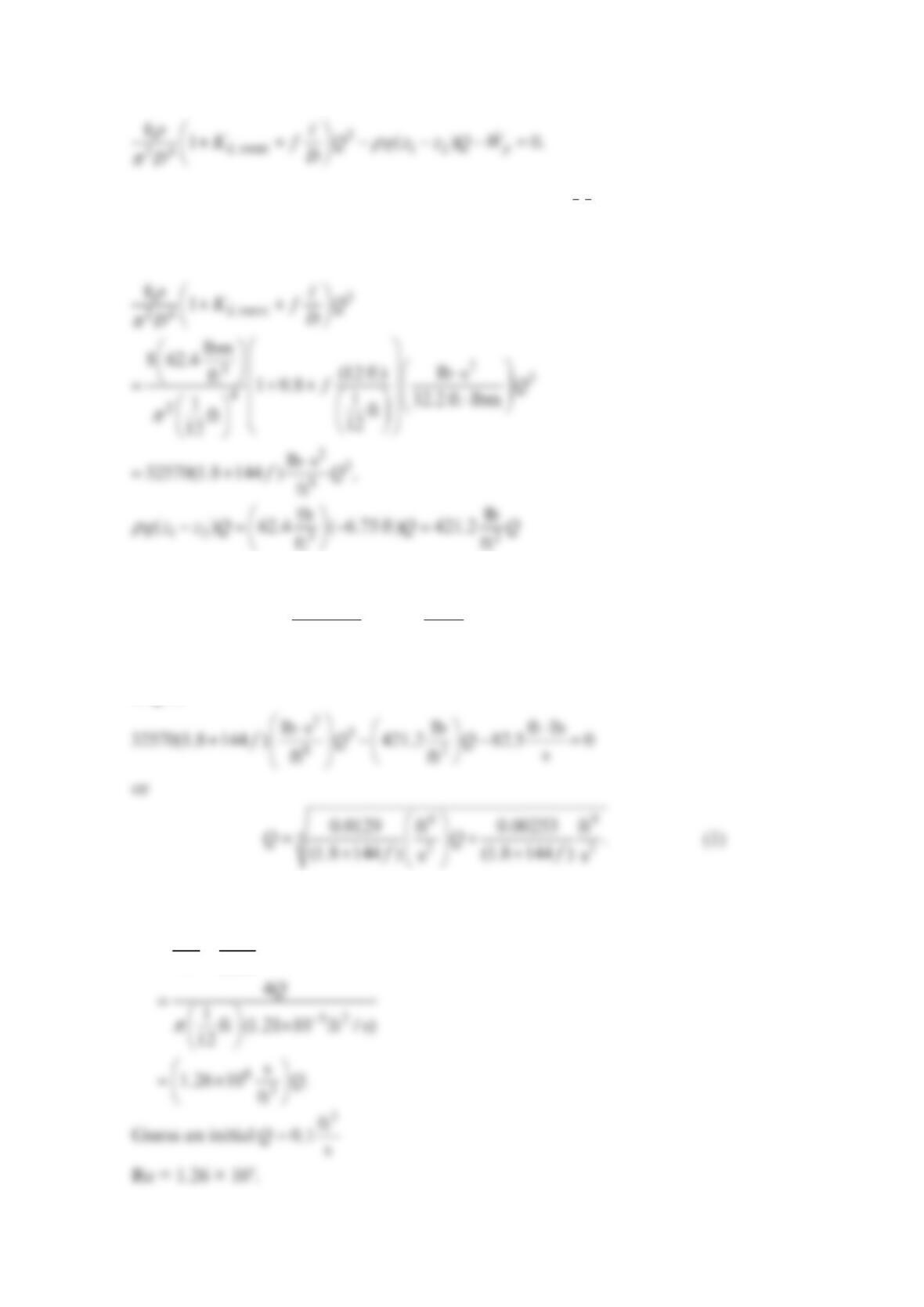
or
We have two ways to solve for Q. We could solve for Q(t) for each water depth in the
basement or we could find Q for the overage water depth. We will choose the second where
z2 − z1 = 6.75 ft. Assuming 60°F water, the numerical values give
and noting that
p
W
represents the (useful) mechanical power transferred to the fluid,
()
550 ft lb ft lb
0.60 0.25 hp 82.5
shp s
p
W
⋅⋅
==
⋅
to give
We now solve for Q by trial and error. However, we first develop an expression for the
Reynolds number using Table B.1.
4
Re
VD Q
vDv
π
==
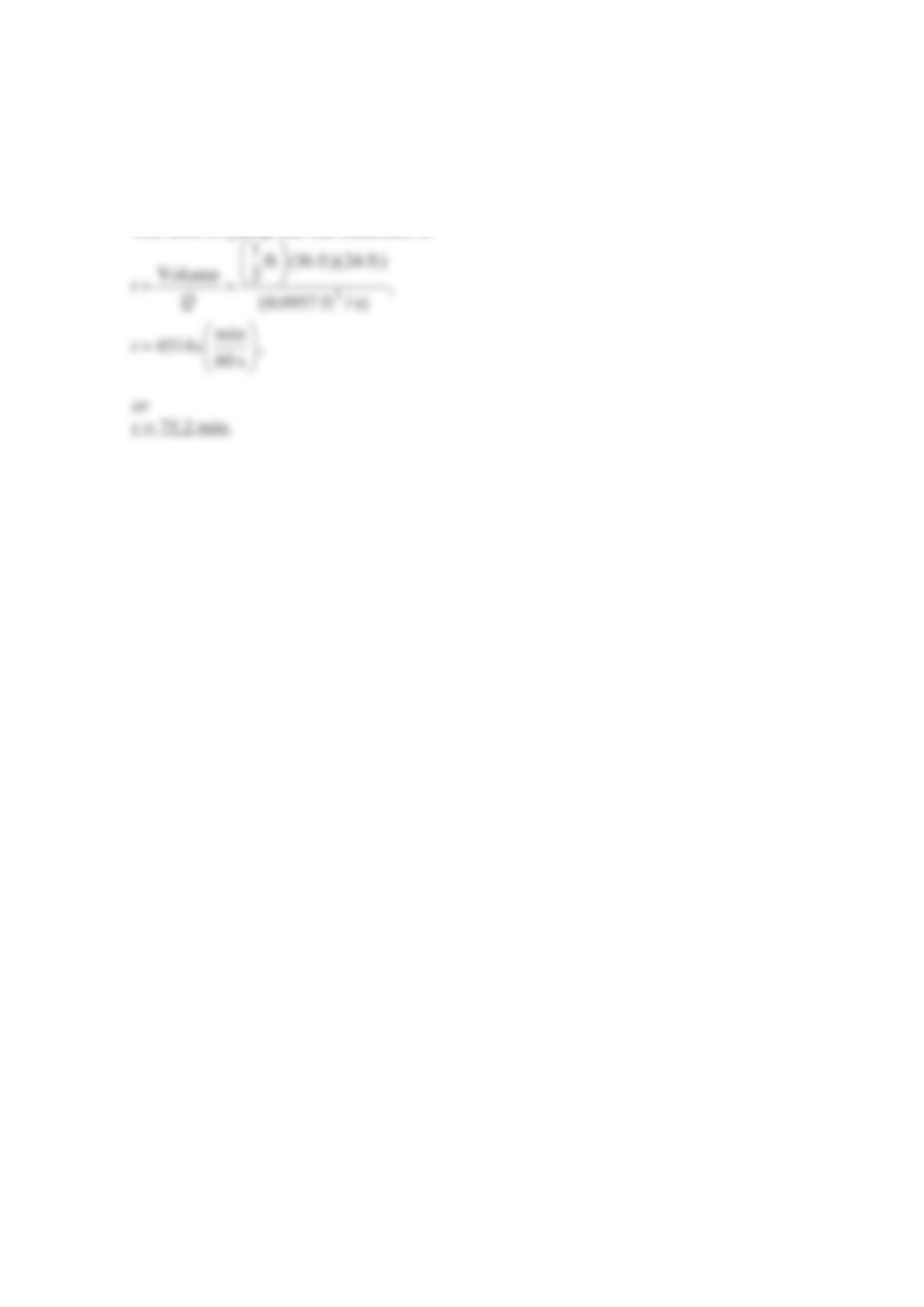
The Moody chart gives f = 0.0172 so Eq. (1) gives Q = 0.0959 ft3/s.
Next guess Q = 0.0959 ft3/s so R = 1.21 × 10⁵.
The Moody chart gives f = 0.0173, so with one more iteration convergence is obtained and
Q = 0.0957 ft3/s.
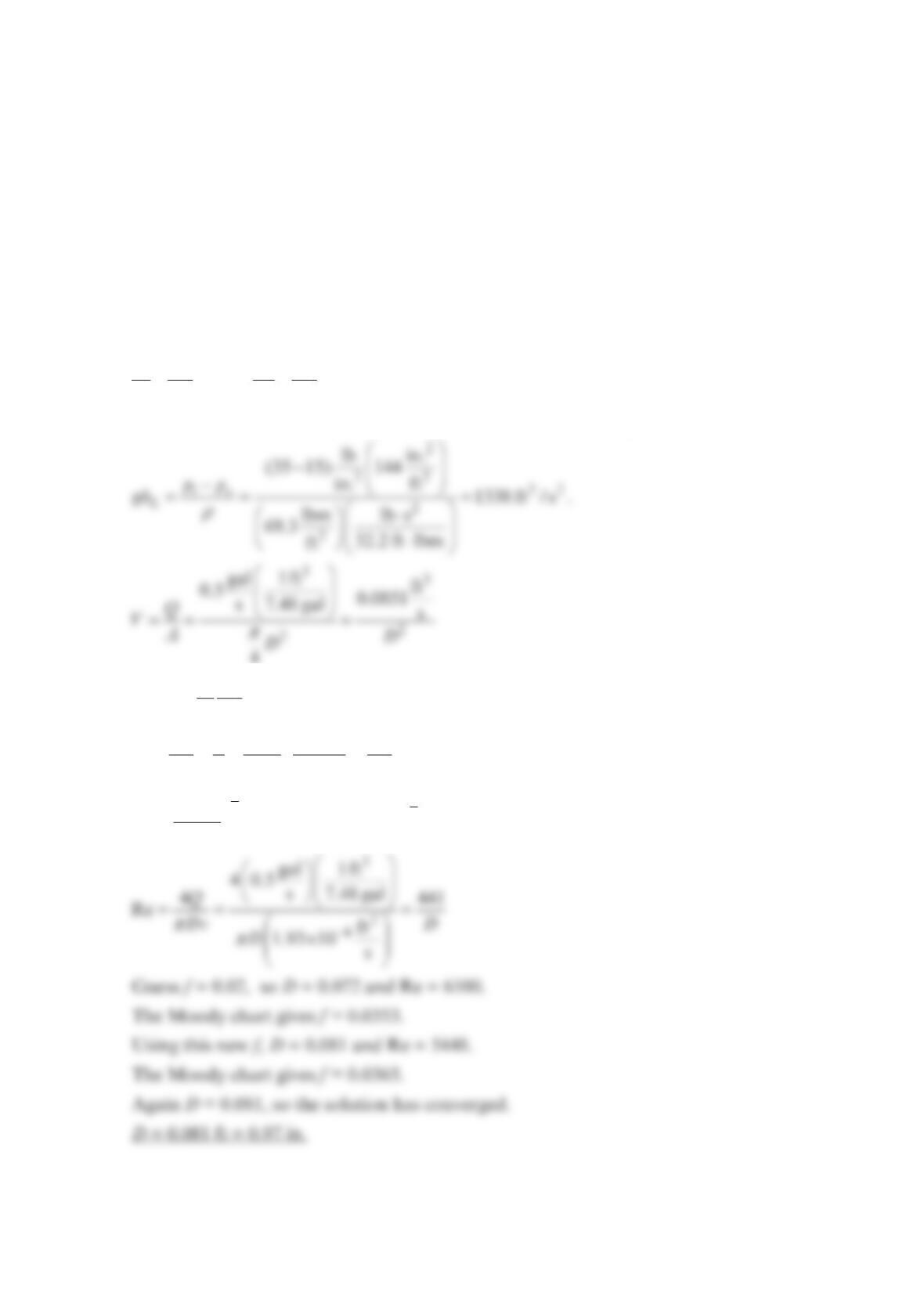
The time to pump out the basement is
Problem 8.100
A company markets ethylene glycol antifreeze in half-gallon bottles. A machine fills and
caps the bottles at a rate of 60 per minute. The 68 °F ethylene glycol (
ρ
= 69.3 lbm /ft3,
v = 1.93 × 10⁻⁴ ft2/s) is pumped to the machine from a tank 36 ft away. The pressure at the
discharge of the pump is 35 psig, and the pressure at the inlet to the filling machine must be
at least 15 psig. Determine the diameter necessary for drawn copper pipe. The pipe has no
elevation change.
Solution 8.100
Assume constant fluid density and apply the mechanical energy equation to the pipeline
from the inlet (i) to the outlet (0) with no work.
22
.
22
i
ii oo oL
pV p V
gz gz gh
ρρ
++=+++
The continuity equation gives Vi = Vo. The problem statement gives zi = zo so
2
2
L
V
gh f D
=
2
22
222
ft 1 36 ft 0.0851 ft
1
338 2
ss
fDD
=
1
5
10264
f
D
=
or
1
5
0.158
D
f=