Problem 7.46
Air at
8
0°F is to flow through a
2
-ft pipe at an average velocity of 6 ft/s. What size pipe
should be used to move water at °60 F and average velocity of
3
ft/s if Reynolds number
similarity is enforced?
Solution 7.46
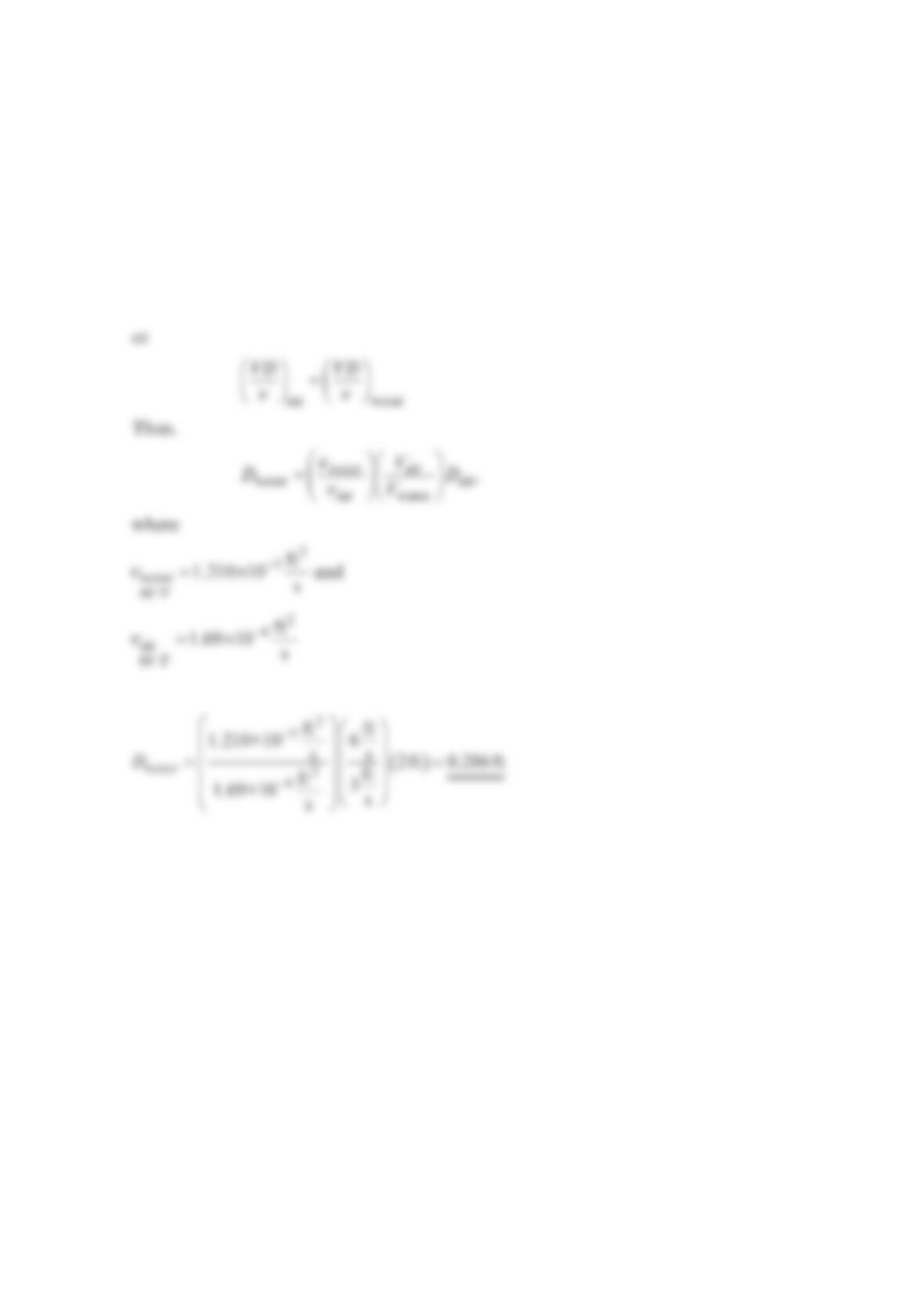
For Reynolds number similarity,
=
air water
Re Re ,
Hence,
Problem 7.47
You are to conduct wind tunnel testing of a new football design that has a smaller lace
height than previous designs. It is known that you will need to maintain Re and
S
t
similarity for the testing. Based on standard college quarterbacks, the prototype parameters
are set at =40 mp
h
V and
ω
=300 rp
m
, where
V
and
ω
are the speed and angular velocity of
the football. The prototype football has a
7
-in
.
diameter. Due to instrumentation required
to measure pressure and shear stress on the surface of the football, the model will require a
length scale of
2
:1 (the model will be larger than the prototype). Determine the required
model free stream velocity and model angular velocity.
Solution 7.47
Let
()
m
and
()
p
denote the model and prototype, respectively.
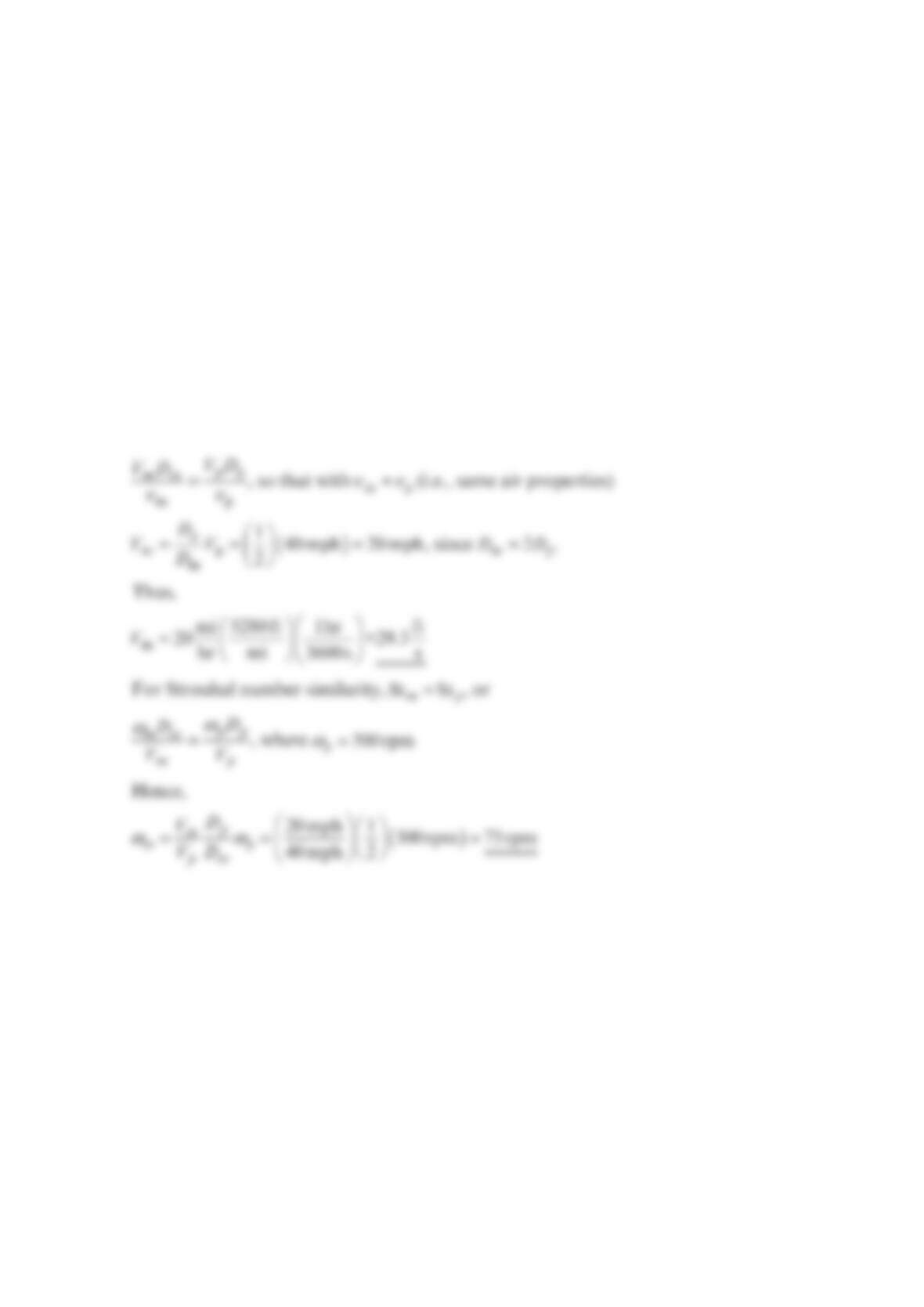
For Reynolds number similarity, =
mp
Re Re , or
Problem 7.48
A model of a submarine,
1
:15 scale, is to be tested at
1
80 ft/s in a wind tunnel with standard
sea-level air, while the prototype will be operated in seawater. Determine the speed of the
prototype to ensure Reynolds number similarity.
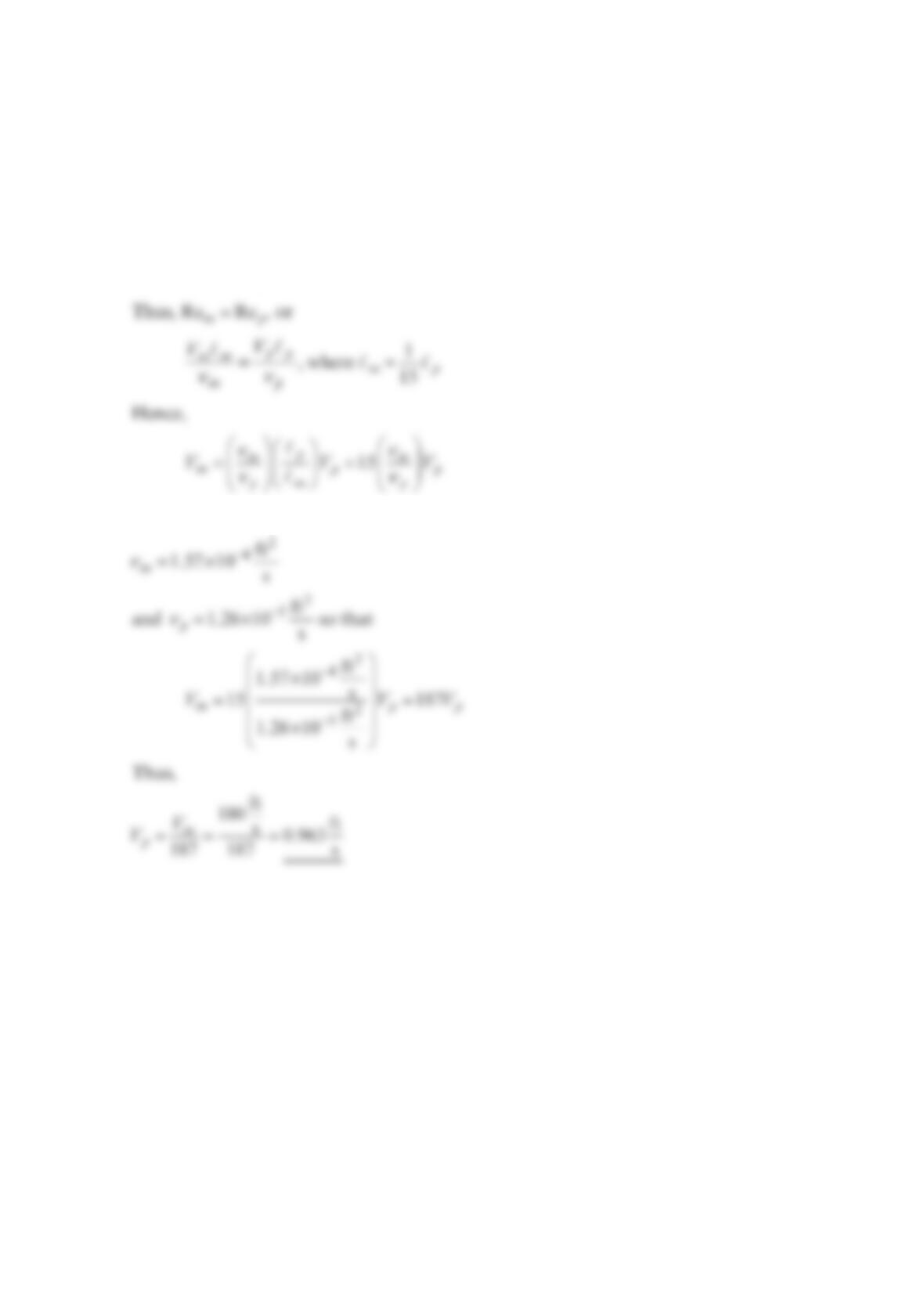
Solution 7.48
Let
()
m and
()
p
denote the model and prototype, respectively.
Also,
Problem 7.49
The drag characteristics of a torpedo are to be studied in a water tunnel using a
1
:5 scale
model. The tunnel operates with fresh water at
2
0C
, whereas the prototype torpedo is to
be used in seawater at
1
5.6 C
. To correctly simulate the behavior of the prototype moving
with a velocity of 30 m/s, what velocity is required in the water tunnel?
Solution 7.49
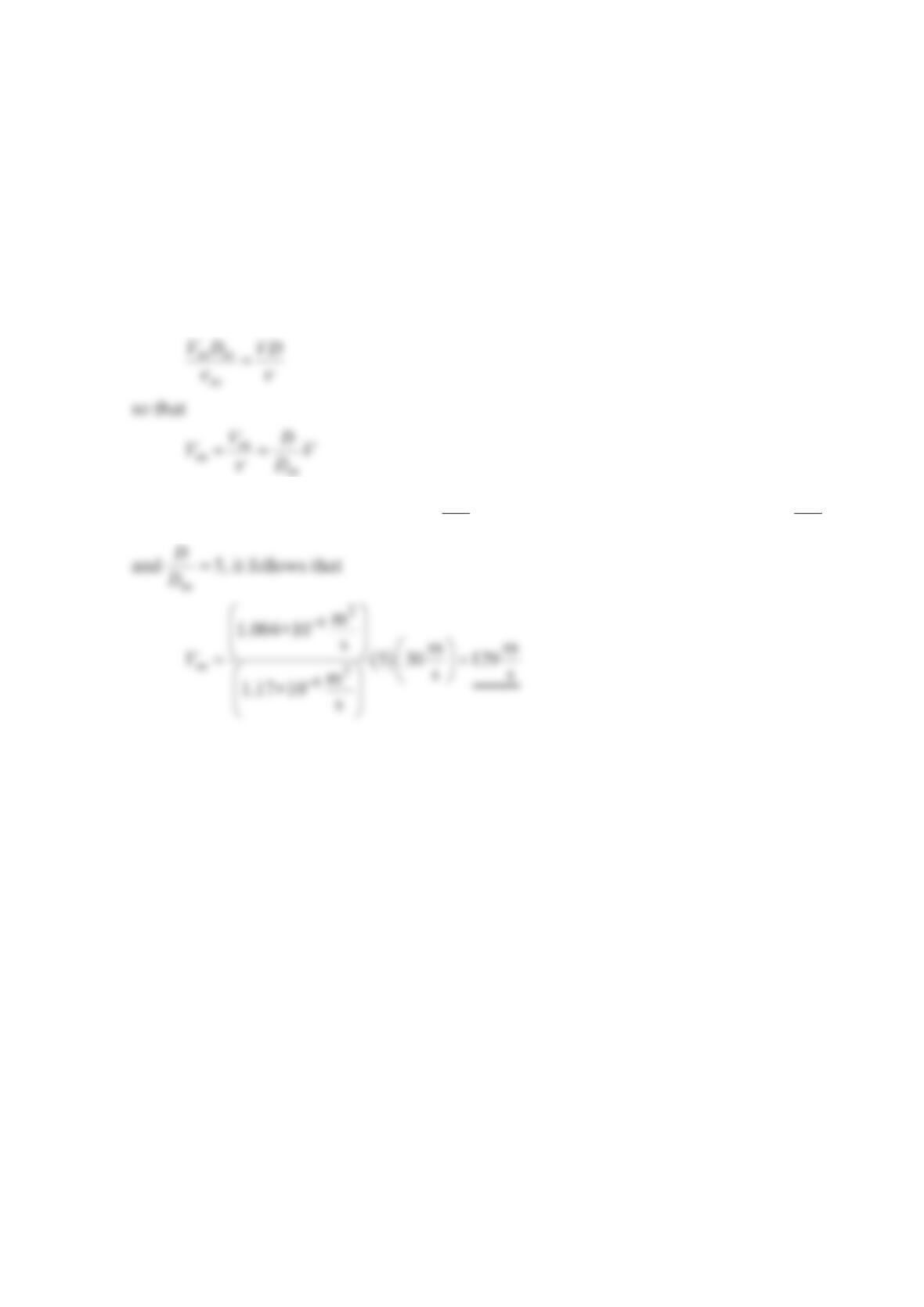
For dynamic similarity, the Reynolds number must be the same for model and prototype.
Thus,
Since,
ν
m (water @
2
0C
) = −
×
2
6m
1
.004 10 s, and
ν
(seawater @
1
5.6 C
) = −
×
2
6m
1
.17 10 s
Problem 7.50
For a certain fluid flow problem, it is known that both the Froude number and the Weber
number are important dimensionless parameters. If the problem is to be studied using a
1
:15 scale model, determine the required surface tension scale if the density scale is equal
to
1
. The model and prototype operate in the same gravitational field.
Solution 7.50
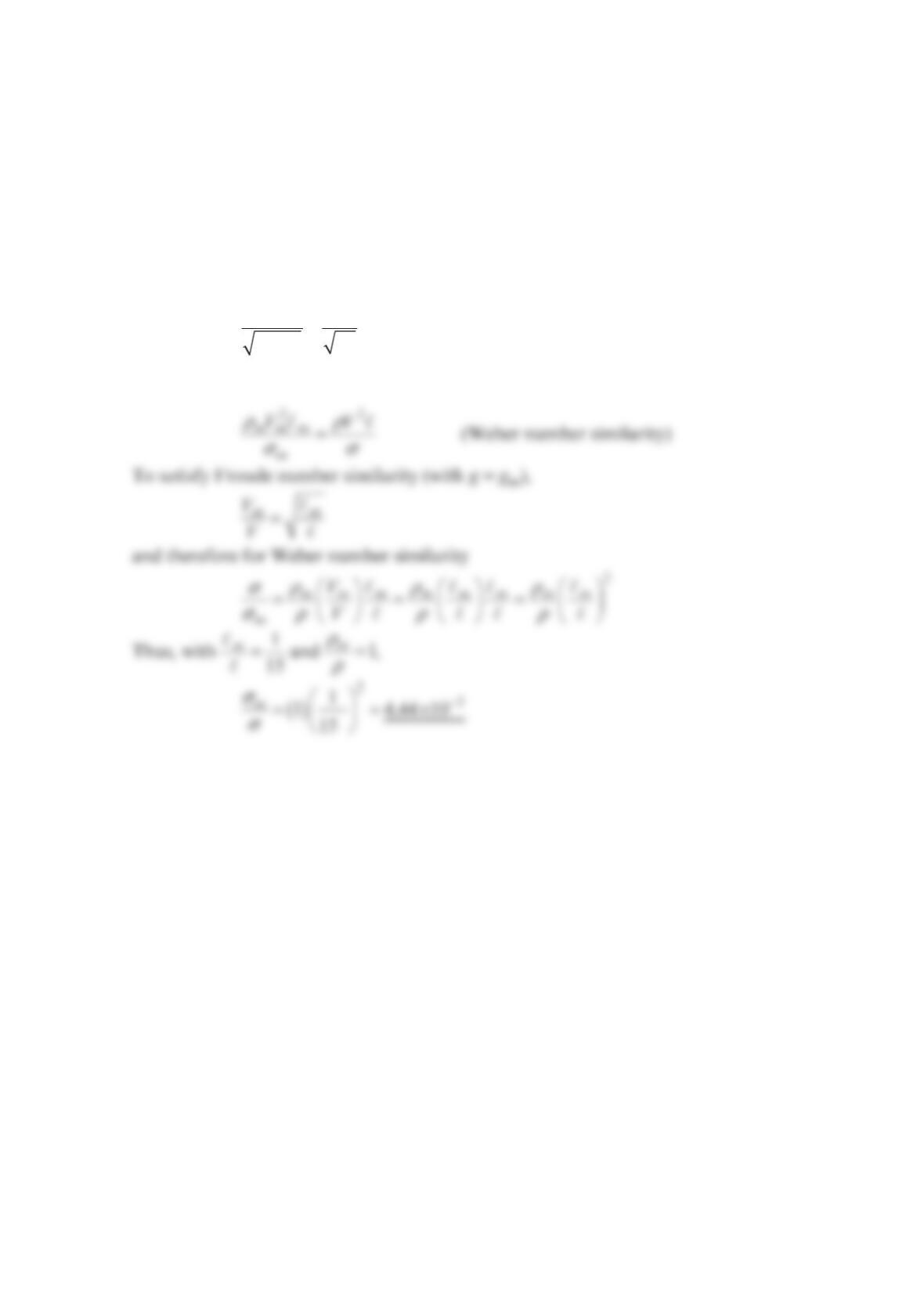
For dynamic similarity,
=
m
mm
VV
gg
(Froude number similarity)
and
Problem 7.51
The fluid dynamic characteristics of an airplane flying
2
40 mph at
1
0,000f
t
are to be
investigated with the aid of a
1
:20 scale model. If the model tests are to be performed in a
wind tunnel using standard air, what is the required air velocity in the wind tunnel? Is this a
realistic velocity?
Solution 7.51
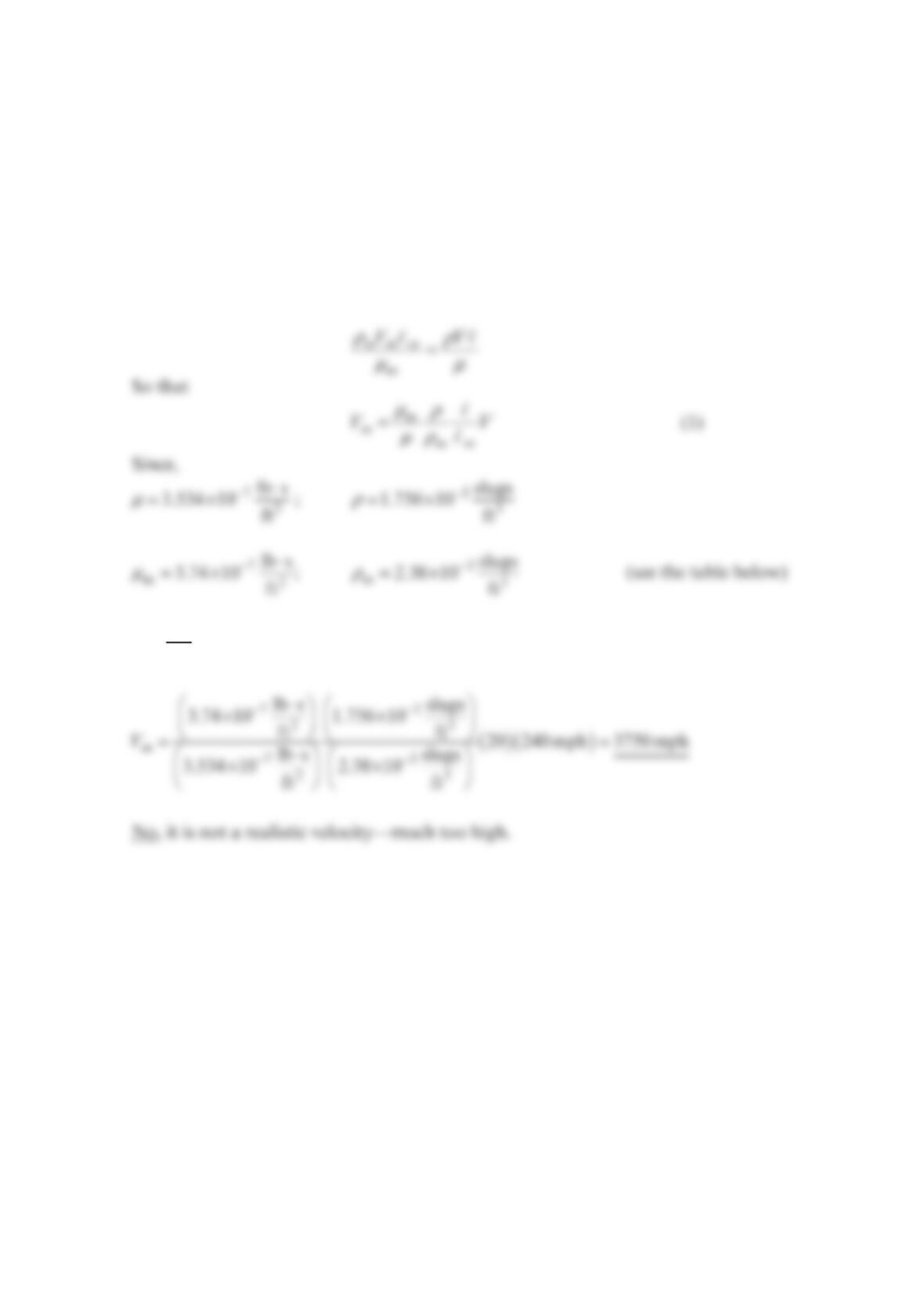
For dynamic similarity, Reynolds number must be the same for model and prototype.
Thus,
and =20
m
it follows from Eq. (1) That
Problem 7.52
If an airplane travels at a speed of
1
120 km/h
r
at an altitude of
1
5km, what is the required
speed at an altitude of
8
km to satisfy Mach number similarity? Assume the air properties
correspond to those for the U.S. standard atmosphere.
Solution 7.52
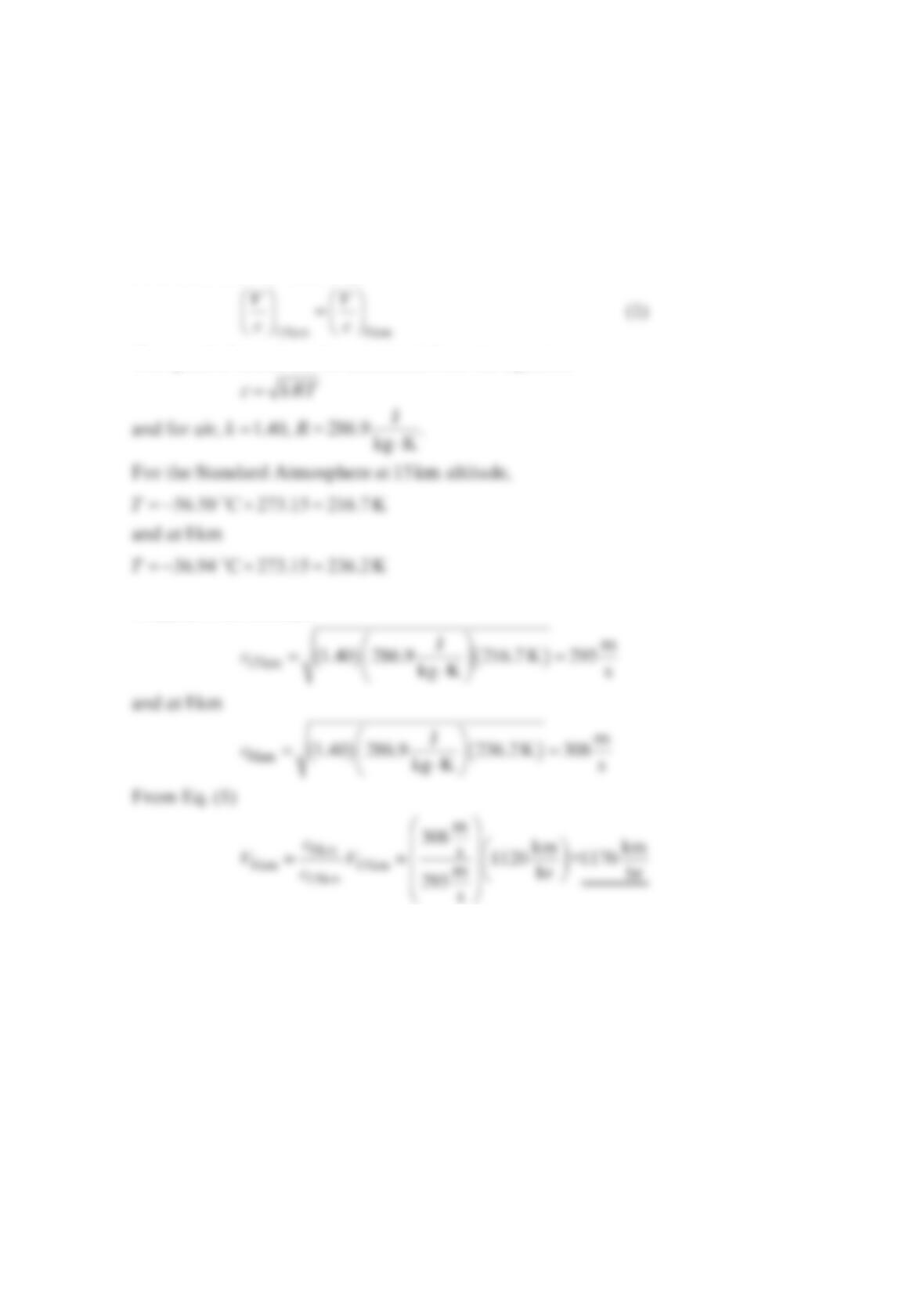
For Mach number similarity,
The speed of sound can be calculated from the equation
1
Thus, at
1
5km altitude
8
Problem 7.53
Modeling parachutes in a water tunnel The first use of a parachute with a free-fall jump from
an aircraft occurred in 1914, although parachute jumps from hot-air balloons had occurred
since the late 1700s. In more modern times, parachutes are commonly used by the military and
for safety and sport. It is not surprising that there remains interest in the design and
characteristics of parachutes, and researchers at the Worcester Polytechnic Institute have been
studying various aspects of the aerodynamics associated with parachutes. An unusual part of
their study is that they are using small-scale parachutes tested in a water tunnel. The model
parachutes are reduced in size by a factor of 30–60 times. Various types of tests can be
performed, ranging from the study of the velocity fields in the wake of the canopy with a
steady free-stream velocity to the study of conditions during rapid deployment of the canopy.
According to the researchers, the advantage of using water as the working fluid, rather than
air, is that the velocities and deployment dynamics are slower than in the atmosphere, thus
providing more time to collect detailed experimental data. (See Problem 7.53.)
Flow characteristics for a
3
0-ft-diameter prototype parachute are to be determined by tests
of a
1
-ft-diameter model parachute in a water tunnel. Some data collected with the model
parachute indicate a drag of
1
7 lb when the water velocity is 4ft/s. Use the model data to
predict the drag on the prototype parachute falling through air at
1
0ft/s
. Assume the drag
to be a function of the velocity,
V
, the fluid density,
ρ
, and the parachute diameter,
D
.
Solution 7.53
()
ρ
=,,fV D
=F
−
=1
VLT
ρ
−
=42
FL T
=
D
L
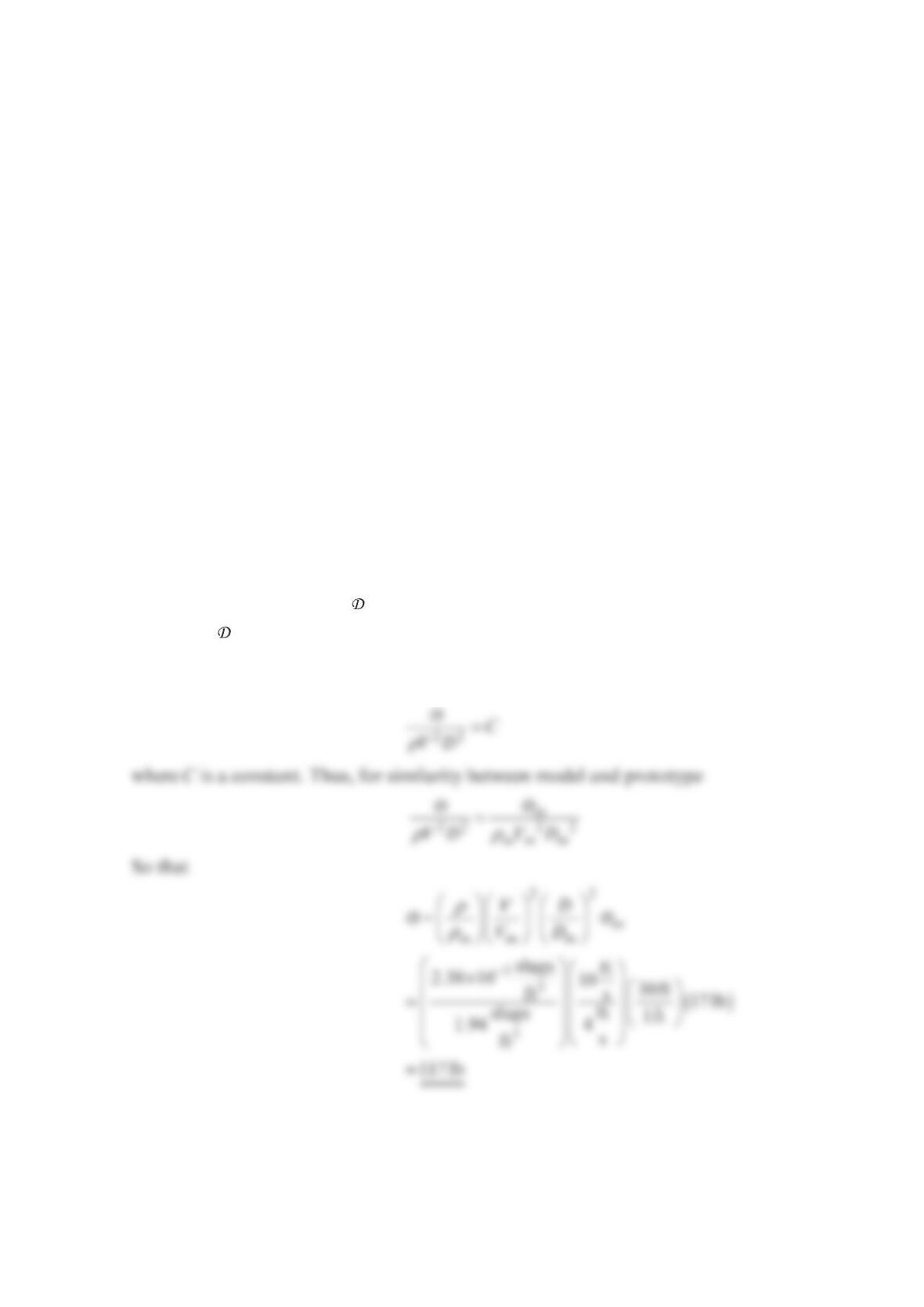
From the pi theorem, −=43
1
pi terms required, and a dimensional analysis yields
Problem 7.54
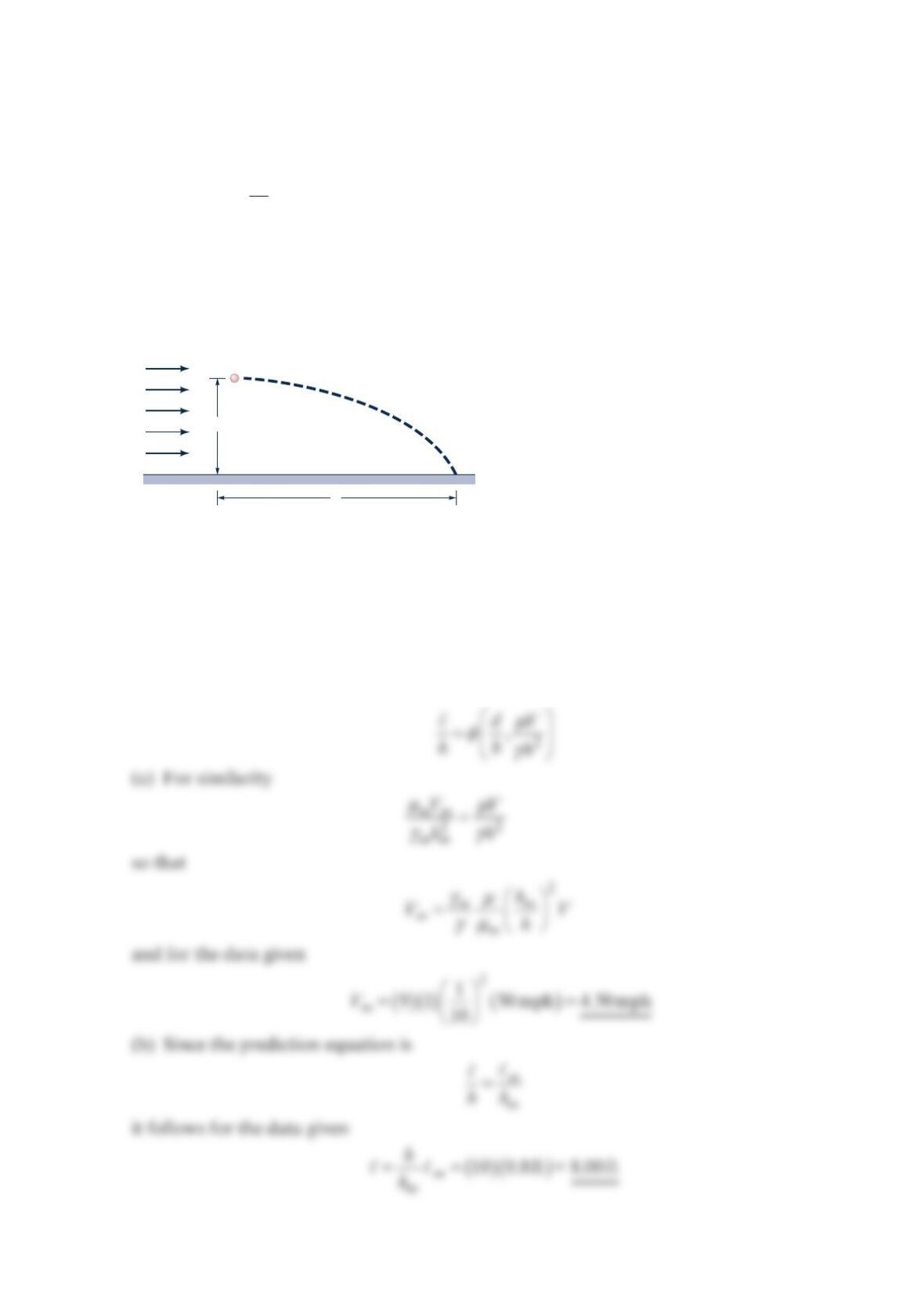
When small particles of diameter
d
are transported by a moving fluid having a velocity
V
,
they settle to the ground at some distance
after starting from a height
h
as shown in the
figure below. The variation in
with various factors is to be studied with a model having a
length scale of 1
10. Assume that
γµ
=,,,,()fhdV
where
γ
is the particle specific weight and
µ
is the fluid viscosity. The same fluid is to be
used in both the model and the prototype, but
()
γγ
=×(protomo tdel 9 ipe). (a) If
=50 mph
V
, at what velocity should the model tests be run? (b) During a certain model test,
it was found that
()
=model 0.8 ft
. What would be the predicted
for this test?
Solution 7.54
γµ
=,,,,()fhdV
=L
=
h
L
=
d
L
−
=1
VLT
γ
−
=3
FL
µ
−
=2
FL T
From the pi theorem, −=633
pi terms required, and a dimensional analysis yields
h
V
Particle
ℓ
Problem 7.55
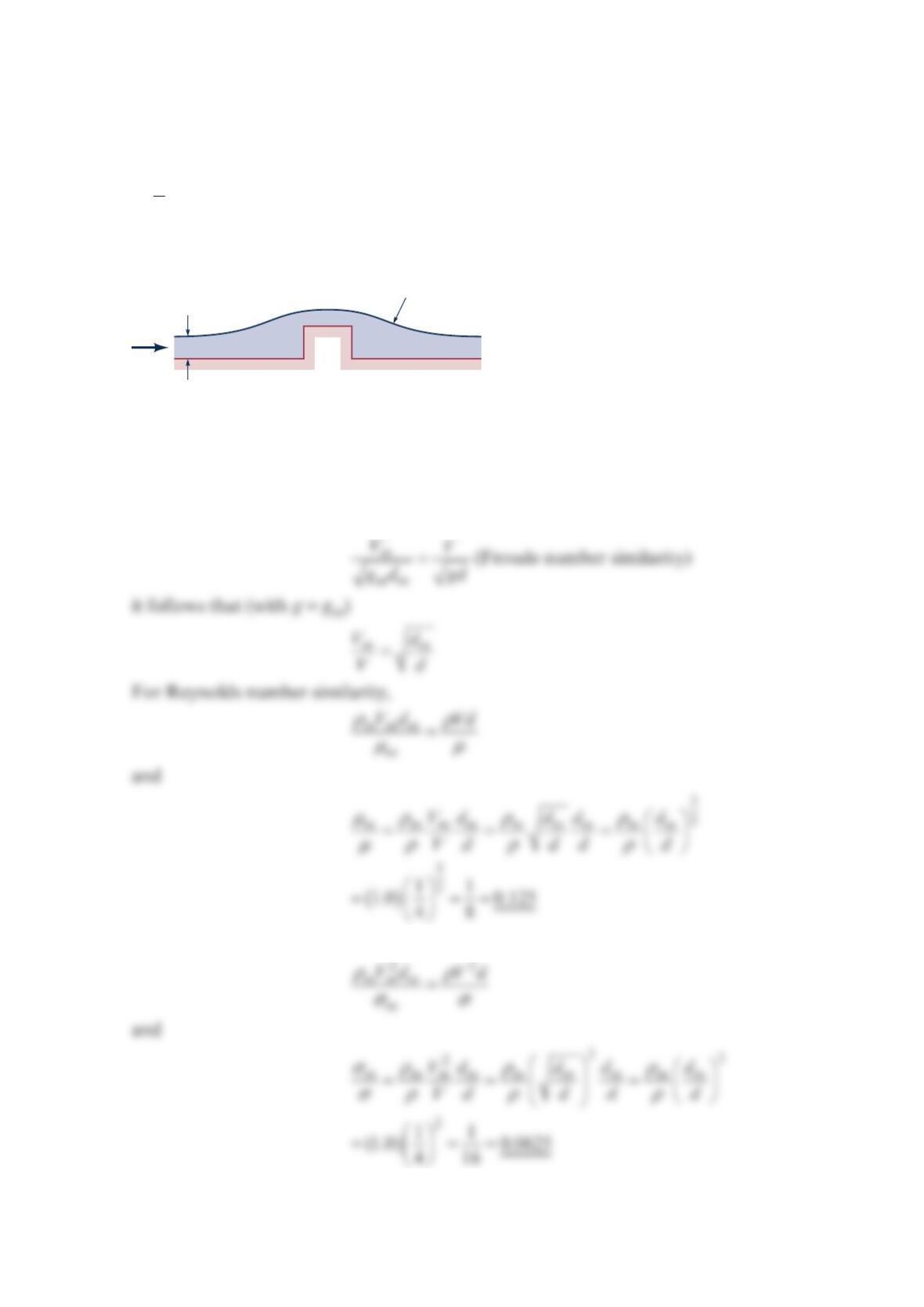
A thin layer of an incompressible fluid flows steadily over a horizontal smooth plate as
shown in the figure below. The fluid surface is open to the atmosphere, and an obstruction
having a square cross section is placed on the plate as shown. A model with a length scale
of 1
4 and a fluid density scale of
1
.0 is to be designed to predict the depth of fluid,
γ
, along
the plate. Assume that inertial, gravitational, surface tension, and viscous effects are all
important. What are the required viscosity and surface tension scales?
Solution 7.55
A fluid dynamics problem for which inertial, gravitational, surface tension, and viscous
effects are all important requires Froude, Reynolds, and Weber number similarity.
Thus, for
For Weber number similarity,
V
y
Free surface
Problem 7.56
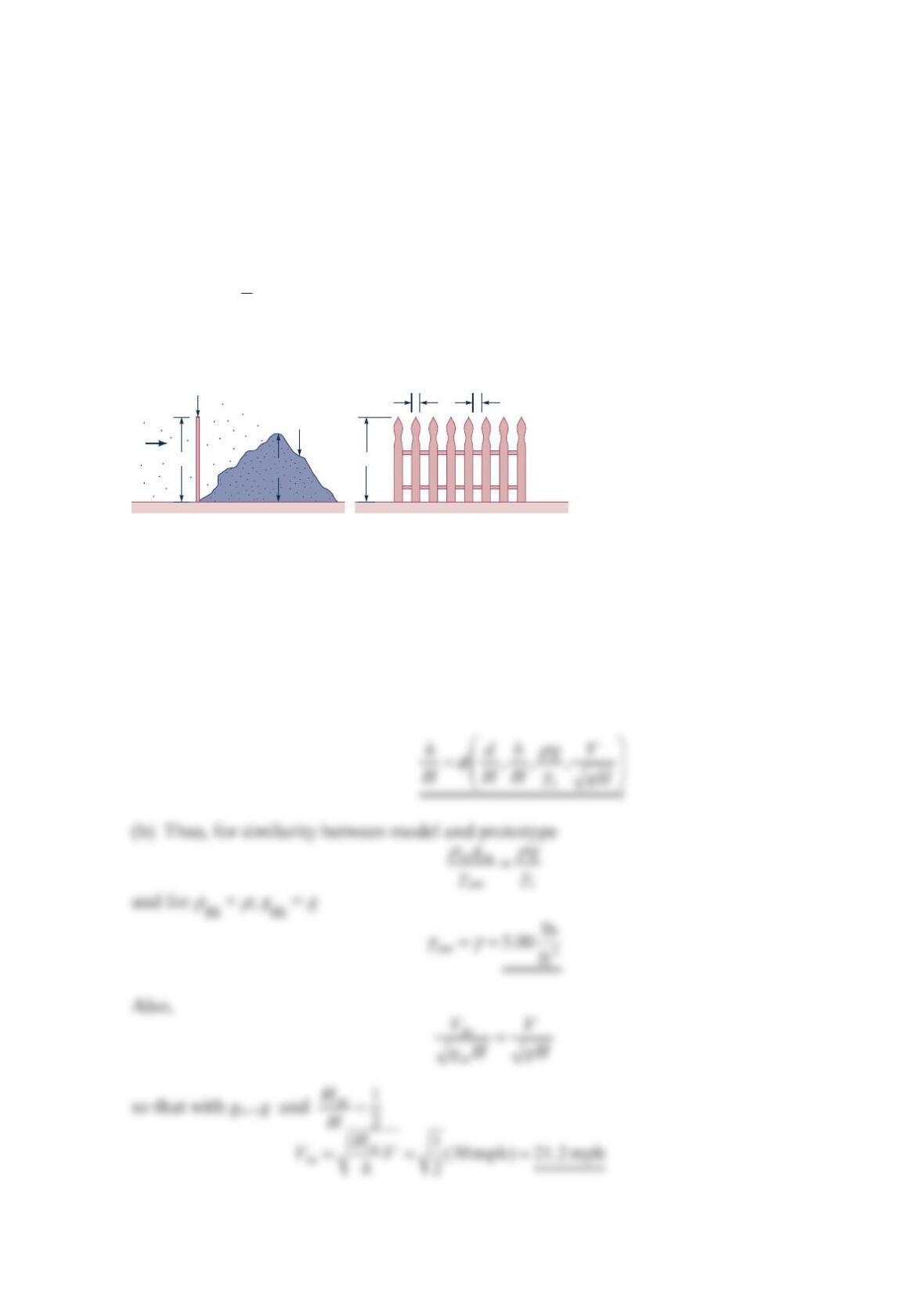
During a storm, a snow drift is formed behind a snow fence as shown in the figure below.
Assume that the height of the drift, h, is a function of the number of inches of snow
deposited by the storm, d; height of the fence, H; width of slats in the fence, b; wind speed,
V; acceleration of gravity, g; air density,
ρ
; and specific weight of snow,
γ
s. (a) If this
problem is to be studied with a model, determine the similarity requirements for the model
and the relationship between the drift depth for model and prototype (prediction equation).
(b) A storm with winds of 30 mph deposits 16 in. of snow having a specific weight of
5.01 lb/ft3. A 1
2-sized scale model is to be used to investigate the effectiveness of a proposed
snow fence. If the air density is the same for the model and the storm, determine the
required specific weight for the model snow and required wind speed for the model.
Solution 7.56
(a)
ργ
=(, ,, ,, , )
s
h
fdHbVg
hL
d
L HL
b
L −1
V
LT−2
gLT
ρ
−42
FL T
γ
−3
sFL
From the pi theorem, 8 – 3 = 5 pi terms required, and a dimensional analysis yields
Drift
Fence
H H
h
b
V
b
Problem 7.57
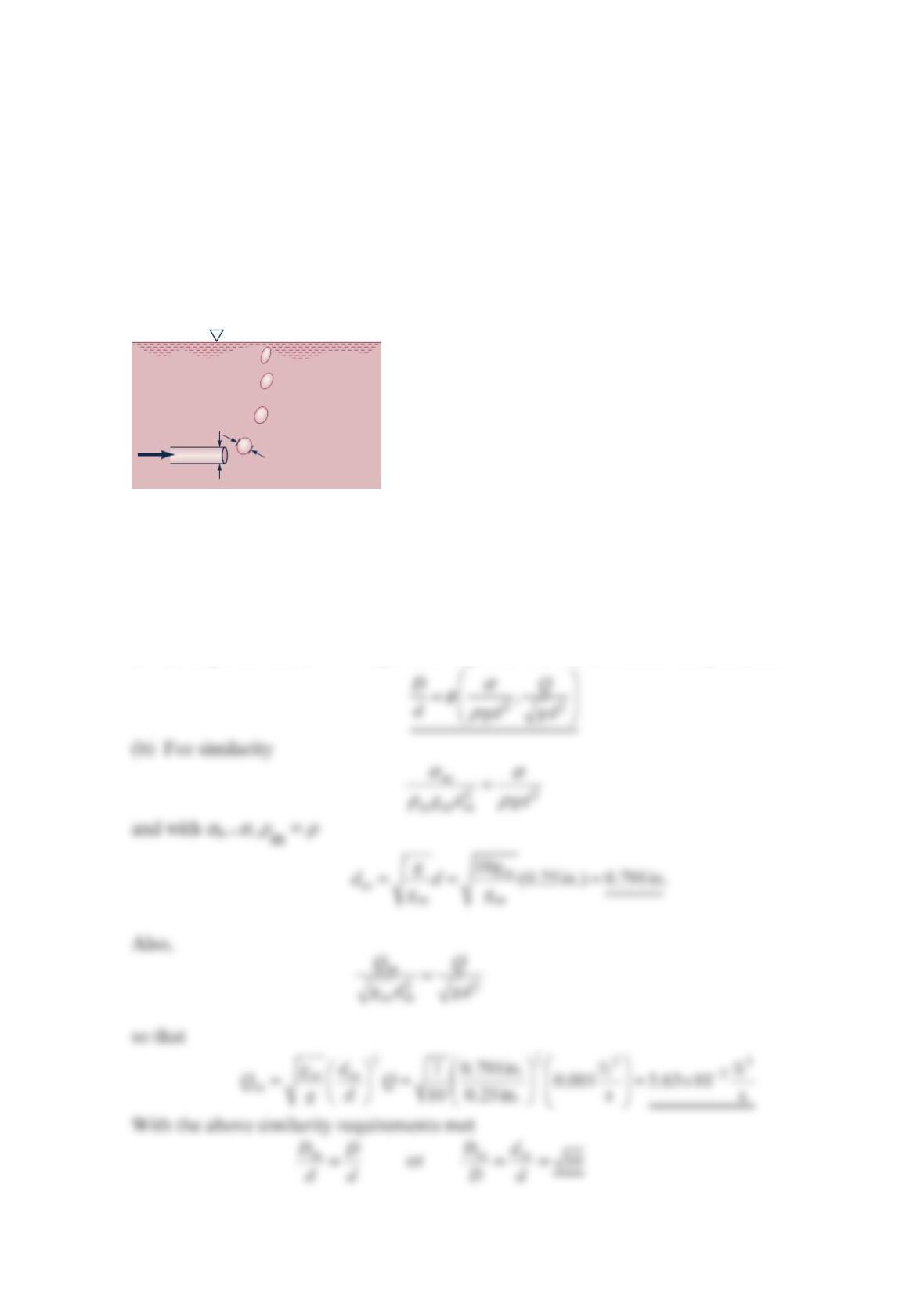
Air bubbles discharge from the end of a submerged tube as shown in the figure below.
The bubble diameter, D, is assumed to be a function of the air flowrate, Q; the tube
diameter, d; the acceleration of gravity, g; the density of the liquid,
ρ
; and the surface
tension of the liquid,
σ
. (a) Determine a suitable set of dimensionless variables for this
problem. (b) Model tests are to be run on the Earth for a prototype that is to be operated
on a planet where the acceleration of gravity is 10 times greater than that on Earth. The
model and prototype are to use the same fluid, and the prototype tube diameter is 0.25 in.
Determine the tube diameter for the model and the required model flowrate if the
prototype flowrate is to be 0.001 ft3/s.
Solution 7.57
(a)
ρ
σ
=(,,,,
)
D
fQdg
D
L −31
QLT
d
L−2
gLT
ρ
−42
FL T
σ
−1
FL
From the pi theorem, 6 – 3 = 3 pi terms required, and a dimensional analysis yields
d
Q
D
Problem 7.58
For a certain model study involving a 1:5 scale model, it is known that Froude number
similarity must be maintained. The possibility of cavitation is also to be investigated, and it
is assumed that the cavitation number must be the same for model and prototype. The
prototype fluid is water at 30 °C, and the model fluid is water at 70 °C. If the prototype
operates at an ambient pressure of 101 kPa (abs), what is the required ambient pressure for
the model system?
Solution 7.58
For Froude number similarity,
=
m
mm
VV
gg
Problem 7.59
A model hydrofoil is to be tested. Is it practical to satisfy both the Reynolds number and
the Froude number for the hydrofoil when it is operating near the water surface? Support
your decision.
Solution 7.59
The Reynolds number requirements is
=pp
mm
mp
V
V
vv
Problem 7.60
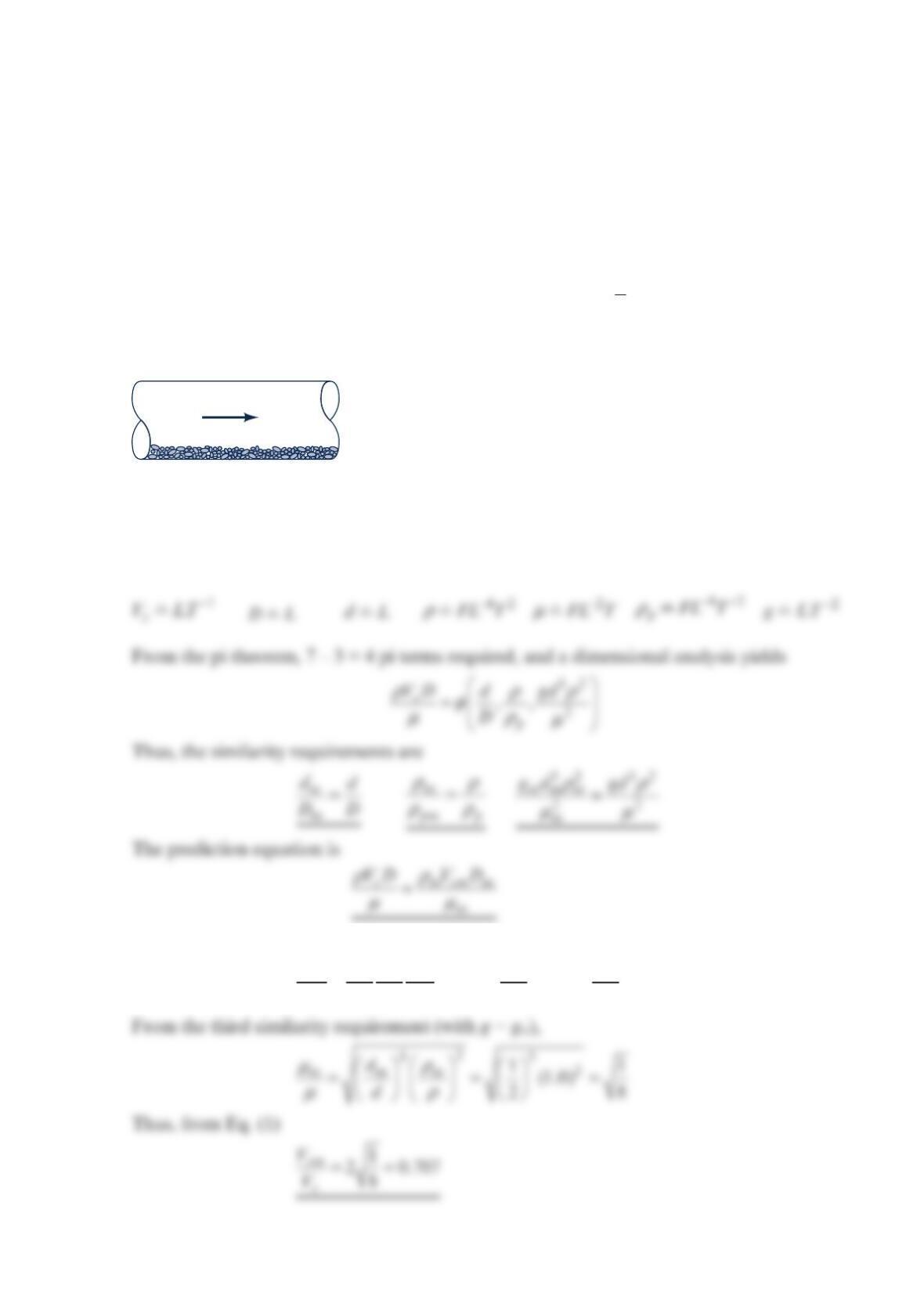
A thin layer of particles rests on the bottom of a horizontal tube as shown in the figure
below. When an incompressible fluid flows through the tube, it is observed that at some
critical velocity, the particles will rise and be transported along the tube. A model is to be
used to determine this critical velocity. Assume the critical velocity, Vc, to be a function of
the pipe diameter, D, particle diameter, d, the fluid density,
ρ
, and viscosity, μ, the density
of the particles,
ρ
p, and the acceleration of gravity, g. (a) Determine the similarity
requirements for the model, and the relationship between the critical velocity for model and
prototype (the prediction equation). (b) For a length scale of 1
2 and a fluid density scale of
1.0, what will be the critical velocity scale (assuming all similarity requirements are
satisfied)?
Solution 7.60
(a)
ρµρ
=p
(,,,, ,)
c
V
fDd g
(b) If all similarity requirements are satisfied, the prediction equation indicates that
µµµ
ρ
ρµ µ µ
== =
(1.0) (2) 2
cm m m m
cm m
VD
VD (1)
Vc
ρ
Problem 7.61
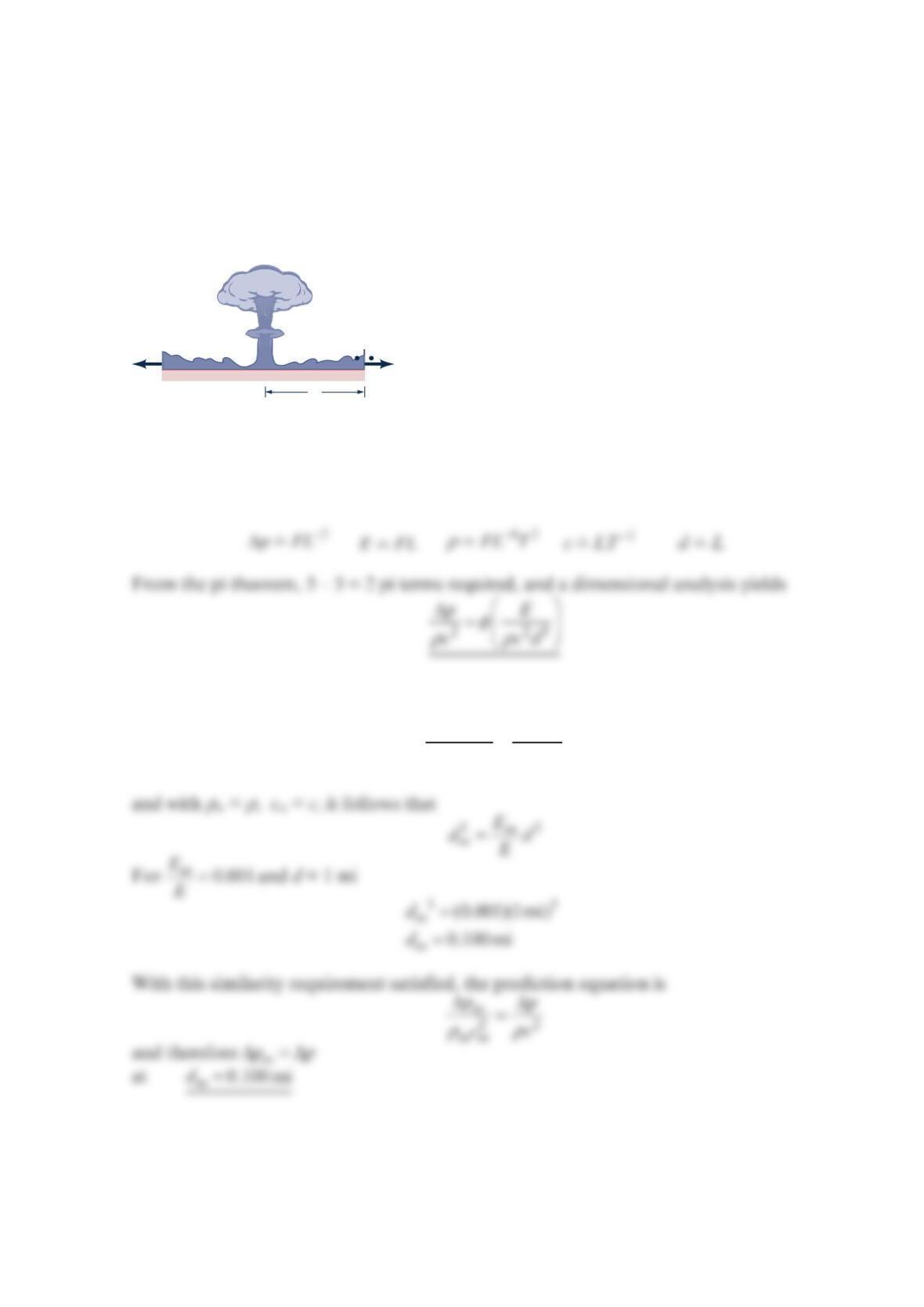
The pressure rise, ∆p, across a blast wave, as shown in the figure below is assumed to be a
function of the amount of energy released in the explosion, E; the air density,
ρ
; the speed
of sound, c; and the distance from the blast, d. (a) Put this relationship in dimensionless
form. (b) Consider two blasts: the prototype blast with energy release E and a model blast
with 1/1000 th the energy release ( =0.001
m
EE
). At what distance from the model blast
will the pressure rise be the same as that at a distance of 1 mile from the prototype blast?
Solution 7.61
(a)
ρ
Δ
=(,,,,)
p
fE cd
(b) For similarity,
ρρ
=
23 23
m
mm m
EE
cd cd
Δ
p
Air ( ,
c
)
ρ
(2)
Δp
=
p2
–
p1
(1)
d
Problem 7.62
An incompressible fluid oscillates harmonically (V = V0 sin(
ω
t), where V is the velocity)
with a frequency of 10 rad/s in a 4-in.-diameter pipe. A 1
4
scale model is to be used to
determine the pressure difference per unit length,
Δ
p
(at any instant) along the pipe.
Assume that
ω
µρ
Δ
=0
(, ,,,,)
p
fDV t
where D is the pipe diameter,
ω
is the frequency, t is the time, μ is the fluid viscosity, and
ρ
is the fluid density. (a) Determine the similarity requirements for the model and the
prediction equation for
Δ
p
. (b) If the same fluid is used in the model and the prototype, at
what frequency should the model operate?
Solution 7.62
−
Δ
3
p
FL
D
L −
1
0
VLT
ω
−1
TtT
µ
−2
FL T
ρ
−42
FL T
(a) Thus, the similarity requirements are
(b) For Reynolds number similarity (the last similarity requirement), with the same fluid in
model and prototype,
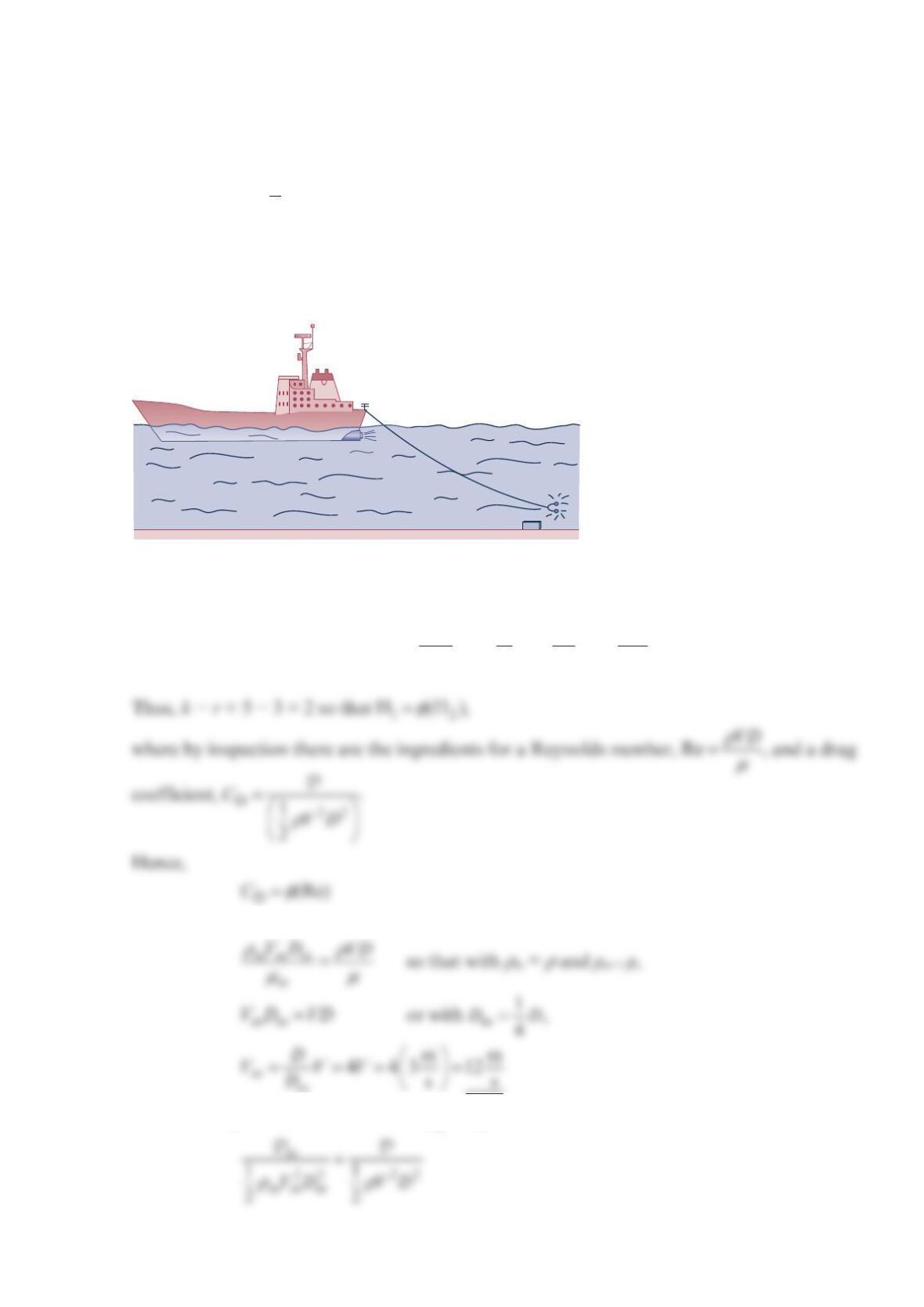
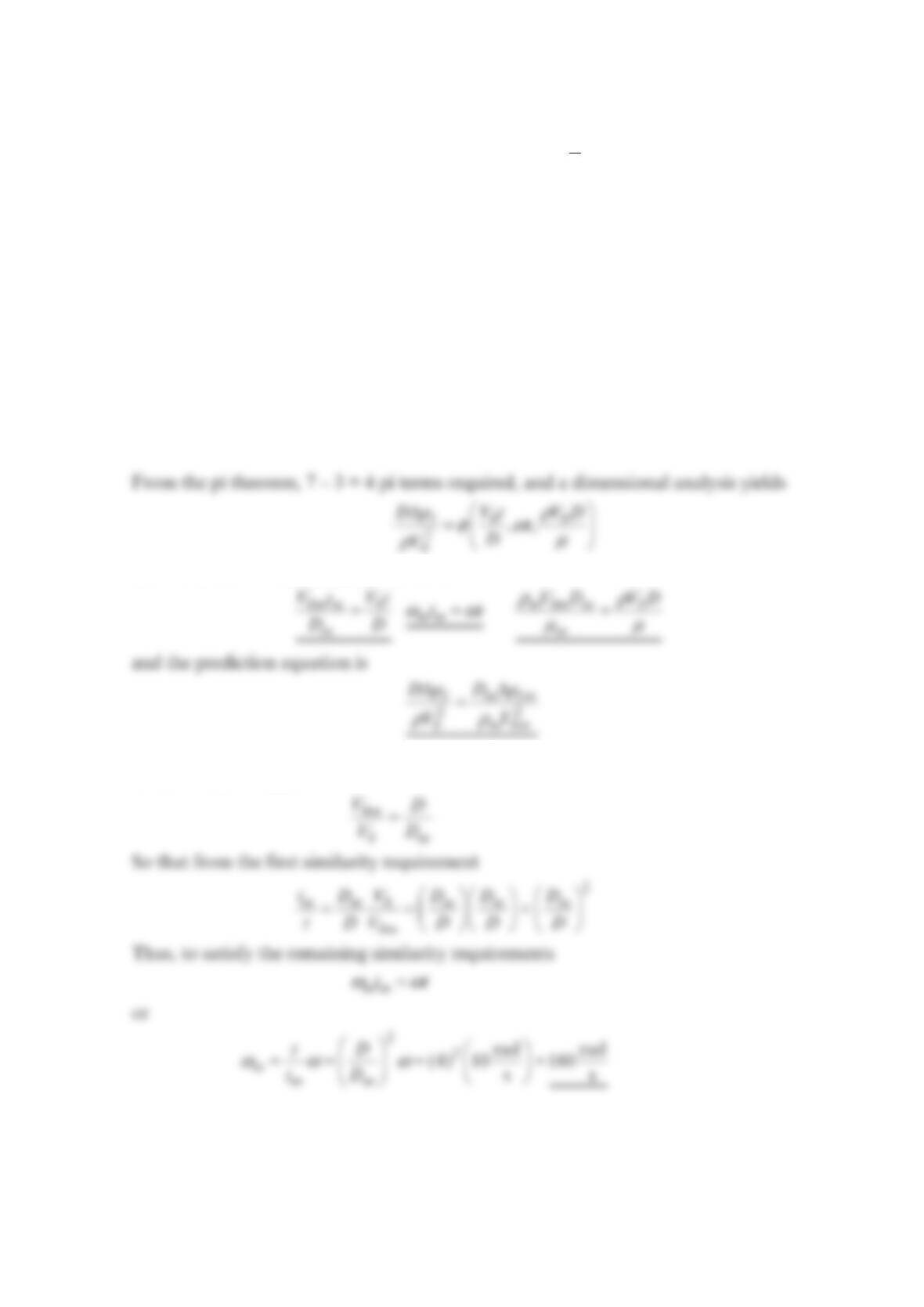
Problem 7.63
As shown in the figure below, a “noisemaker” B is towed behind a minesweeper A to set off
enemy acoustic mines such as at C. The drag force of the noisemaker is to be studied in a
water tunnel at a 1
4 scale model (model 1/4 the size of the prototype). The drag force is
assumed to be a function of the speed of the ship, the density and viscosity of the fluid, and
the diameter of the noisemaker. (a) If the prototype towing speed is 3 m/s, determine the
water velocity in the tunnel for the model tests. (b) If the model tests of part (a) produced a
model drag of 900 N, determine the drag expected on the prototype.
Solution 7.63
(a)
ρµ
=(,,,
)
fV D, where
ρµ
==
23
,, ,
ML L M M
FV
TLT
TL
and
D
L
For similarity, Rem = Re, or
(b) With =Re Re
m, it follows that =
m
DD
C
C, or
C
B
A
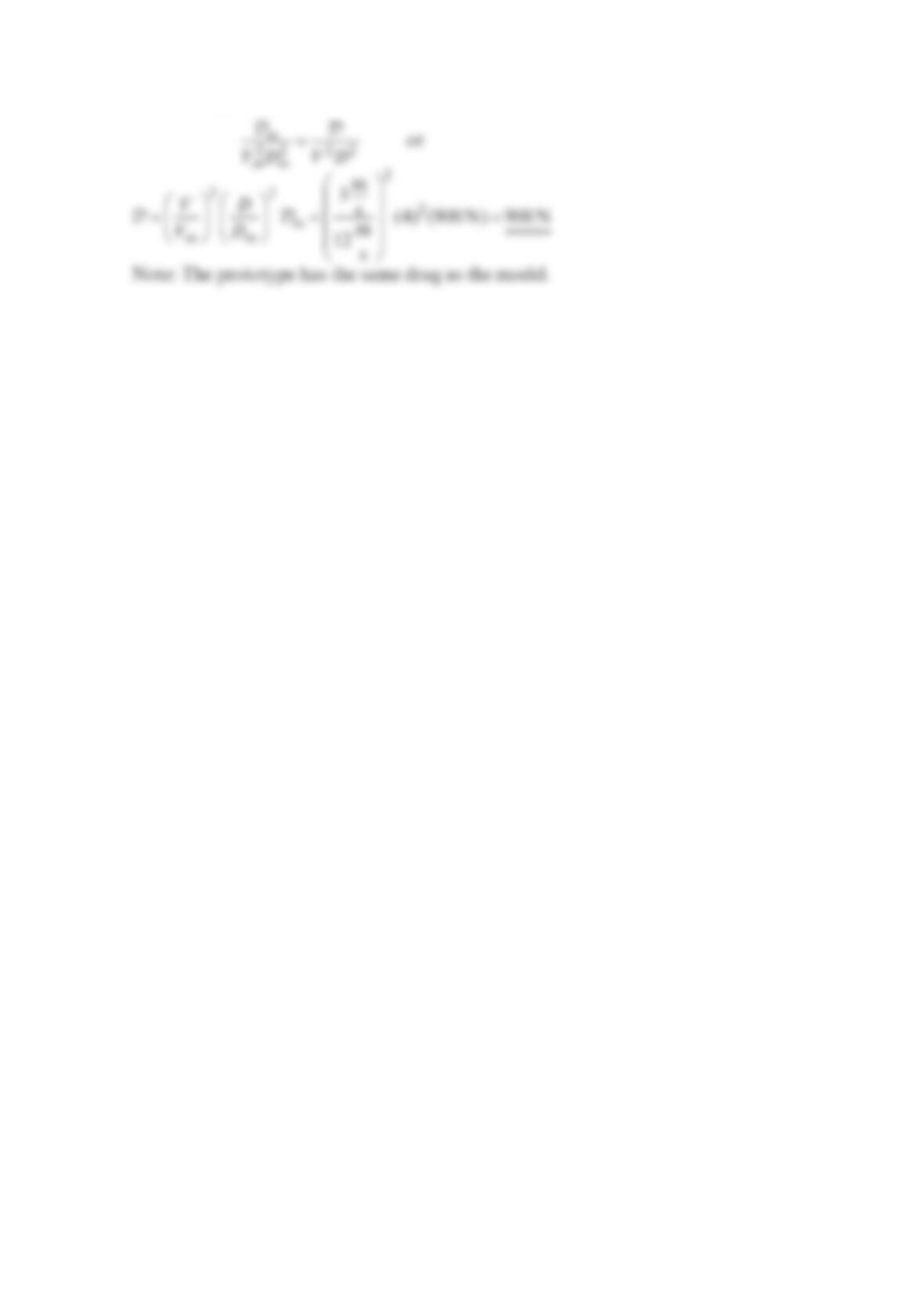
Thus, since
ρ
m =
ρ
,
Problem 7.64
The drag characteristics for a newly designed automobile having a maximum characteristic
length of 20 ft are to be determined through a model study. The characteristics at both low
speed (approximately 20 mph) and high speed (90 mph) are of interest. For a series of
projected model tests, an unpressurized wind tunnel that will accommodate a model with a
maximum characteristic length of 4 ft is to be used. Determine the range of air velocities
that would be required for the wind tunnel if Reynolds number similarity is desired. Are the
velocities suitable? Explain.
Solution 7.64
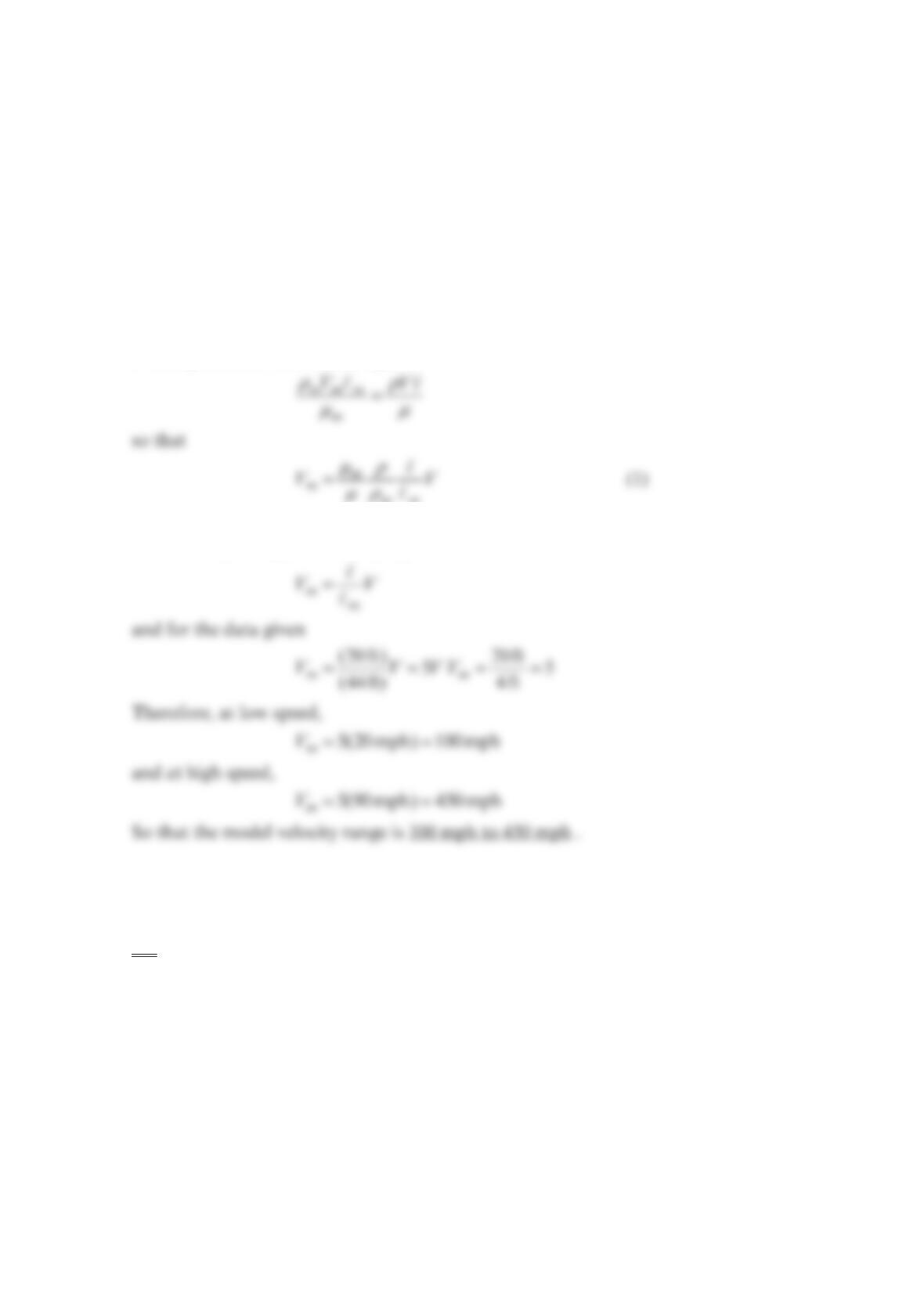
For Reynolds number similarity,
mm
Since the wind tunnel is unpressurized, the air properties will be approximately the same for
model and prototype. Thus, Eq. (1) reduces to
At the high wind tunnel velocity, compressibility of air would start to become an important
factor, whereas compressibility is not important for the prototype. Thus, the higher velocity
required for the model would not be suitable.
No.