PROBLEM 7.90 (Cont.)
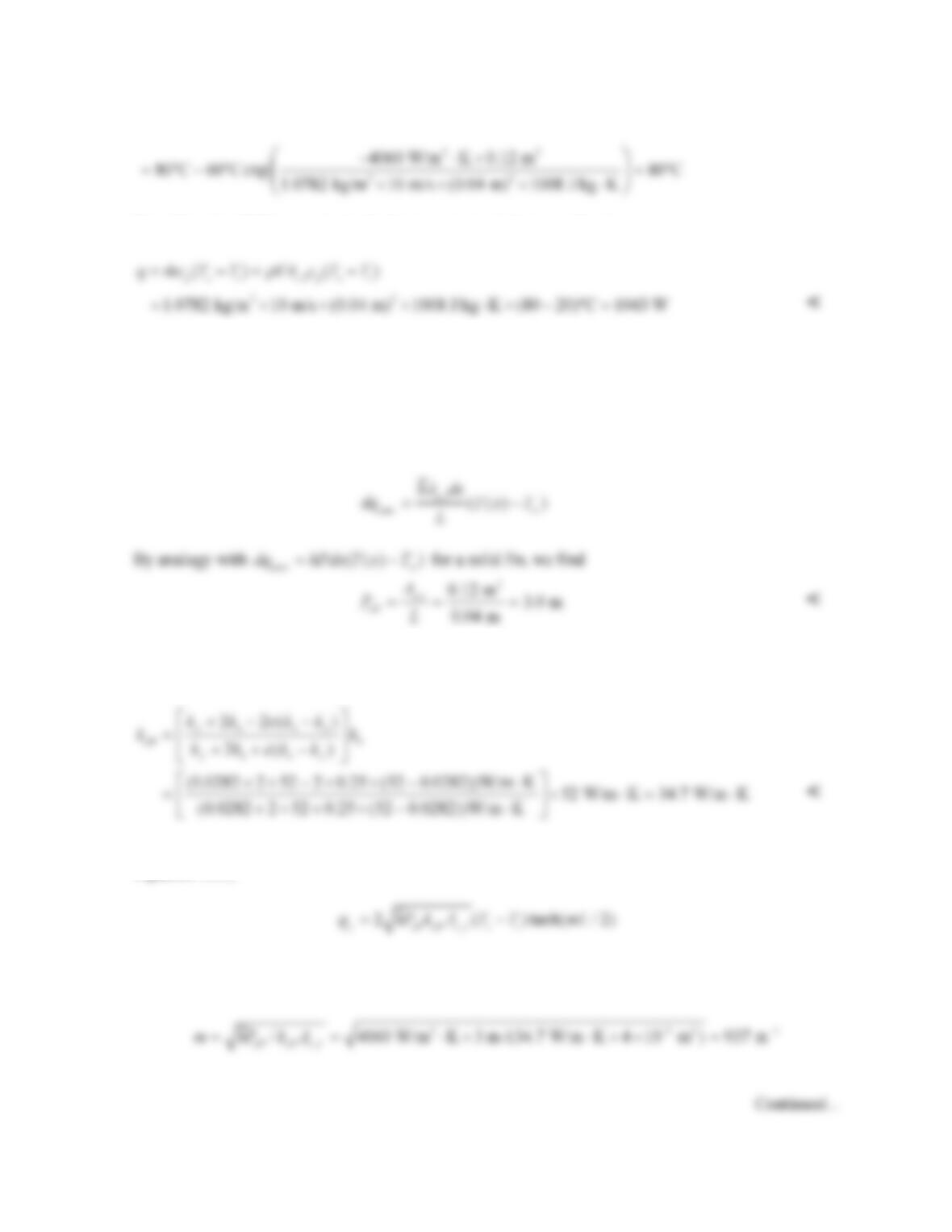
From Equation 7.82, or equivalently from an energy balance on the air,
We would expect the actual convection heat transfer rate to be less because the foam has a conduction
resistance and there are temperature gradients in the foam, primarily in the x–direction. Thus, near the
center of the cross–section, the foam temperature will be reduced and so will the heat transfer rate.
(b) For a slice of the foam of length dx, the surface area of foam in contact with the air is dAs =
Ap,tdx/L. Thus,
From Equation 3.25 with ks = kb,
Due to symmetry, the foam sheet can be treated as a fin of length L/2 with an insulated fin tip. From
Equation 3.81,
where the factor of 2 accounts for both halves of the foam, each of length L/2, Ac,f is the fin cross–
sectional area, Ac,f = Wt = 0.04 m × 0.01 m = 4 × 10⁻⁴ m2, and
PROBLEM 7.90 (Cont.)
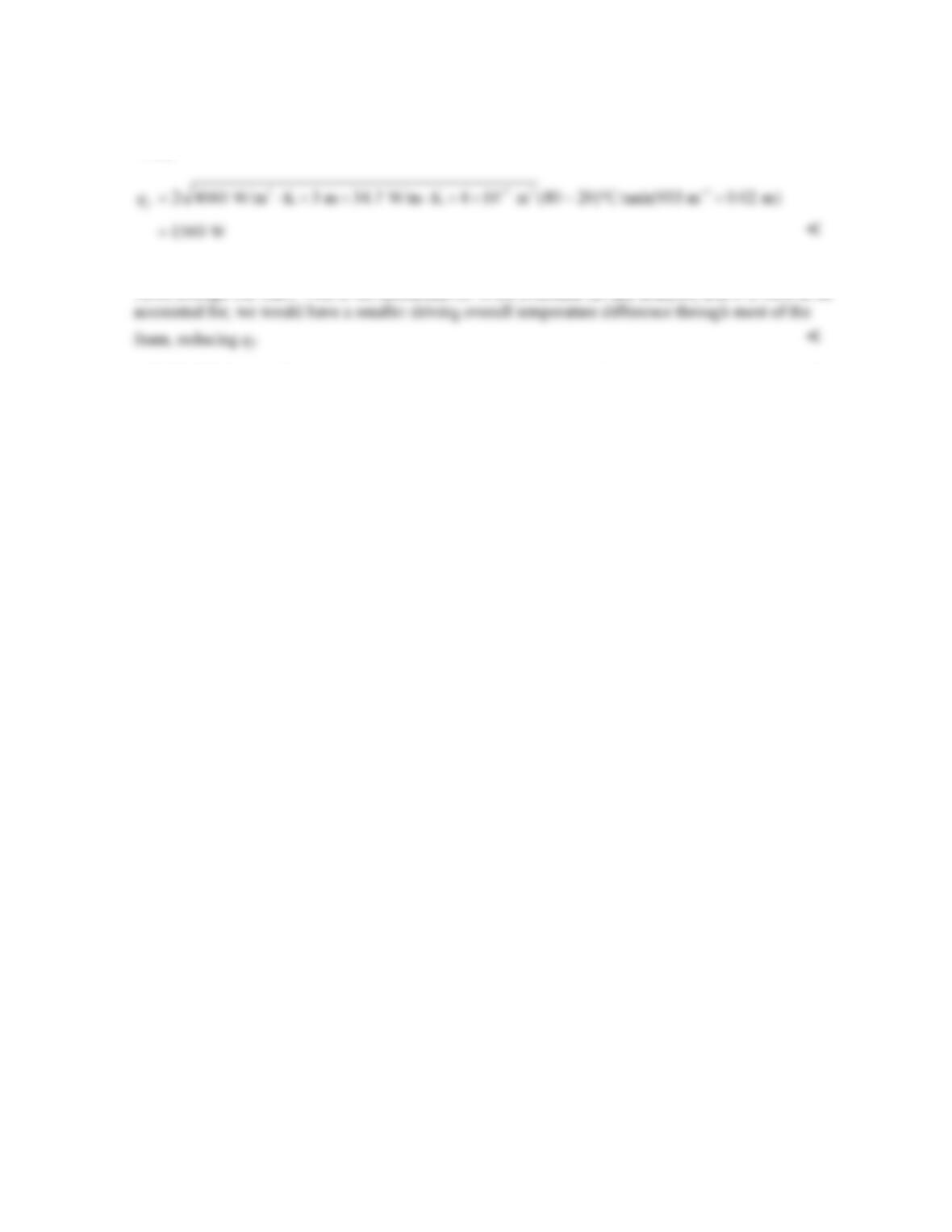
Thus,
We would expect the actual rate of heat transfer to be less because the air temperature increases as it
flows through the foam. This is not accounted for in the extended surface analysis, and if it were to be
COMMENTS: (1) The results suggest that the foam might be an effective heat transfer medium. The
heat transfer rates are quite high. However, the actual heat transfer rate will be lower than calculated
here because of the simultaneous conduction resistance in the foam and increase in the air temperature
as it passes through the foam. (2) In Problem 11.72, this problem is solved accounting for both the
variation of air temperature in the flow direction and the variation of foam temperature in the x–
direction. By accounting for both effects, you will learn that the heat transfer rates calculated here
significantly overestimate the actual heat transfer rate.
PROBLEM 7.91
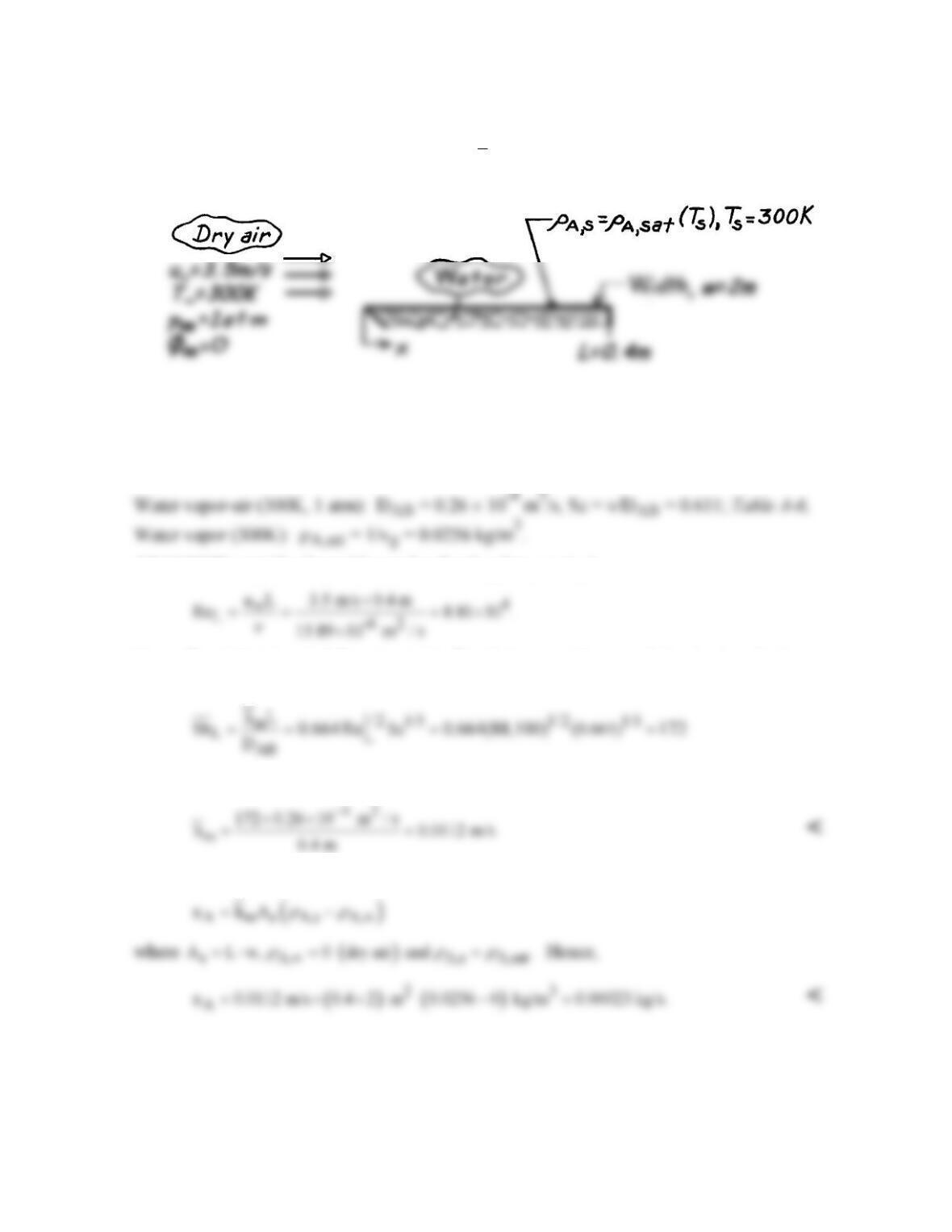
KNOWN: Flow of air over a flat, smooth wet plate.
FIND: (a) Average mass transfer coefficient,
m
h,
(b) Water vapor mass loss rate, nA (kg/s).
SCHEMATIC:
ASSUMPTIONS: (1) Steady-state conditions, (2) Heat-mass transfer analogy applies, (3)
Rex,c = 5 × 10⁵.
PROPERTIES: Table A-4, Air (300K): ν = 15.89 × 10⁻⁶ m2/s, Pr = 0.707; Table A-8,
ANALYSIS: (a) The Reynolds number for the plate, x = L, is
Hence flow is laminar and the appropriate flat plate convection correlation is given by Eq.
7.31,
Therefore,
(b) The evaporative mass loss rate is
PROBLEM 7.92
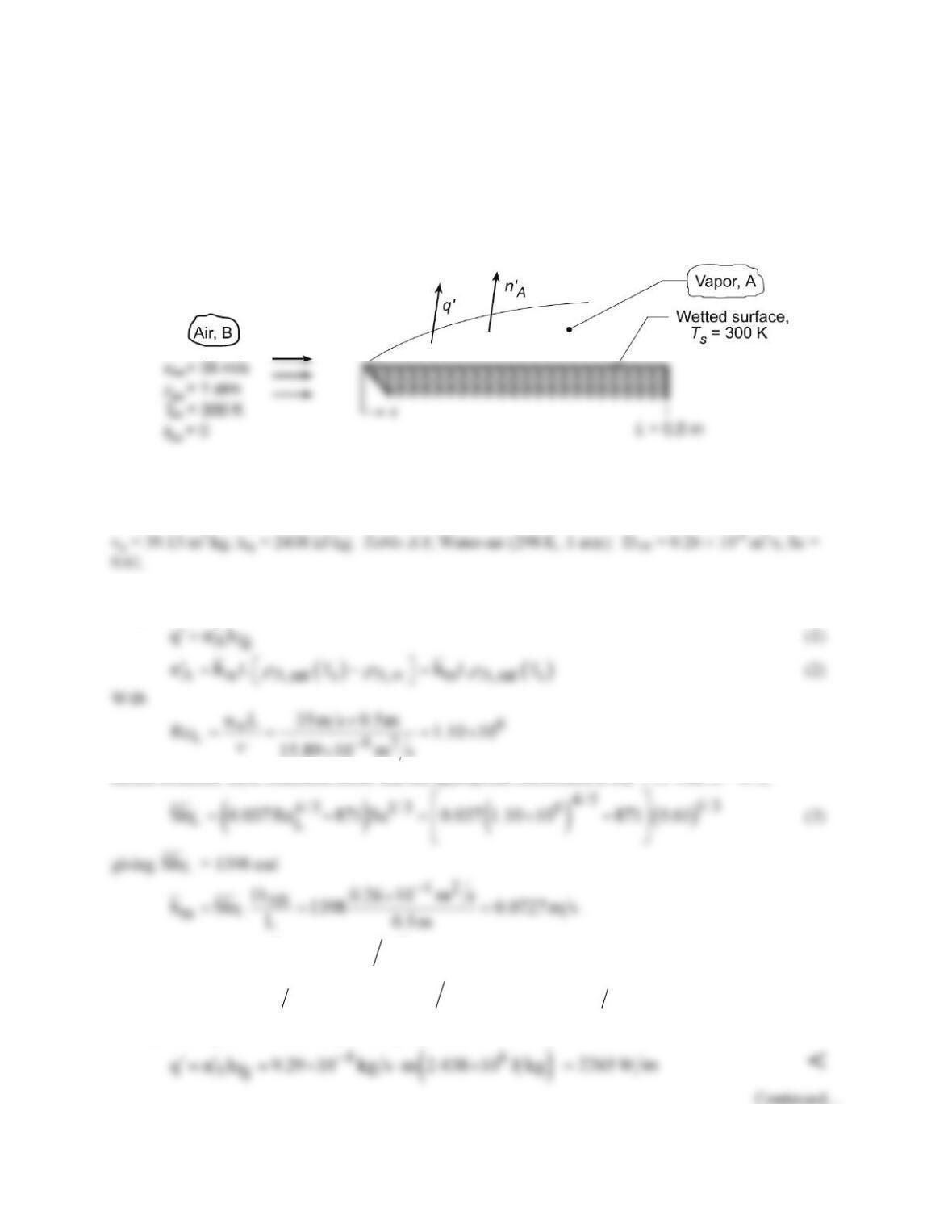
KNOWN: Air flow conditions over a wetted flat plate of known length and temperature.
FIND: (a) Heat loss and evaporation rates, per unit plate width,
q′
and
A
n′
, respectively, (b) Compute
and plot
q′
and
A
n′
for a range of water temperatures 300 ≤ Ts ≤ 350 K with air velocities of 10, 20 and
35 m/s, and (c) Water temperature Ts at which the rate of heat loss will be zero for the air velocities and
temperatures of part (b).
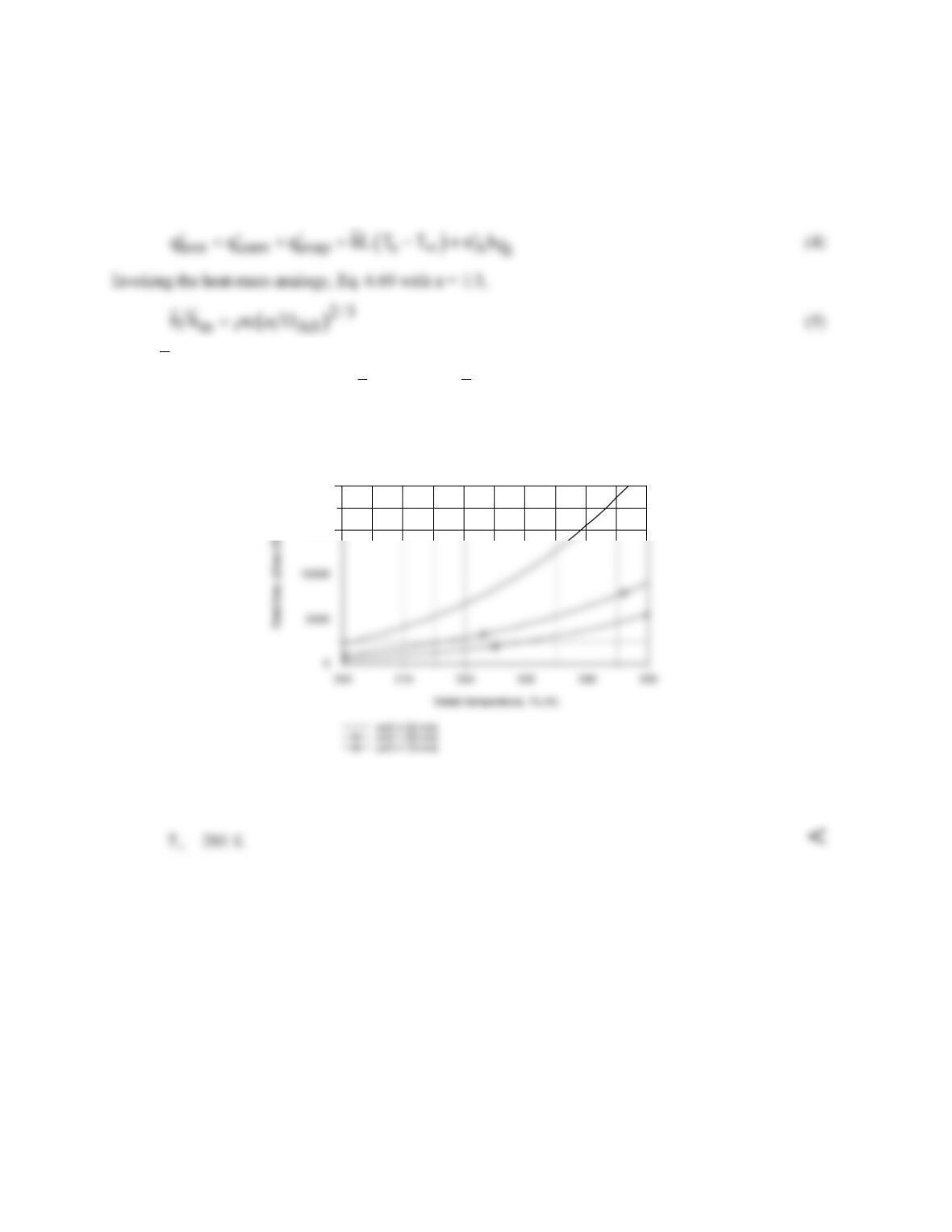
SCHEMATIC:
ASSUMPTIONS: (1) Heat and mass transfer analogy is applicable, (2) Constant properties, (3) Rex,c =
5 × 10⁵.
PROPERTIES: Table A.4, Air (T = 300 K, 1 atm): ν = 15.89 × 10⁻⁶ m2/s; Table A.6, Water (300 K):
ANALYSIS: (a) The heat loss from the plate is due only to the transfer of latent heat. Per unit width of
the plate,
mixed boundary layer condition exists and the appropriate correlation is Eq. 7.41 with A = 871,
with
( )
13
A,sat s g
T v 0.0256 kg m
ρ
−
= =
,
( )
()
34
A
n 0.0727 m s 0.5 m 0.0256 kg m 9.29 10 kg s m
−
′= =×⋅
<
Hence, the evaporative heat loss per unit plate width is
Continued…
PROBLEM 7.92 (Cont.)
Heat would have to be applied to the plate at the rate of 2265 W/m to maintain its temperature at 300 K
with the evaporative heat loss.
(b) When Ts and
T
∞
are different, convection heat transfer will also occur, and the rate of heat loss from
the water surface is
where
m
h
and
A
n′
are evaluated using Eqs. (3) and (2), respectively. Using the foregoing relations in
the IHT Workspace, but evaluating
h
(rather than
m
h
) with the Correlations Tool, External Flow, for
the Average coefficient for Laminar or Mixed Flow,
loss
q′
was evaluated as a function of
u
∞
with
T
∞
= 300 K.
15000
20000
(c) To determine the water temperature Ts at which the rate of heat loss is zero, the foregoing IHT model
was run with
loss
q′
= 0 with the result that, for all velocities,
COMMENTS: Why is the result for part (c) independent of the air velocity?
PROBLEM 7.93
KNOWN: Flow over a heated flat plate coated with a volatile substance.
FIND: Electric power required to maintain surface at Ts = 134°C.
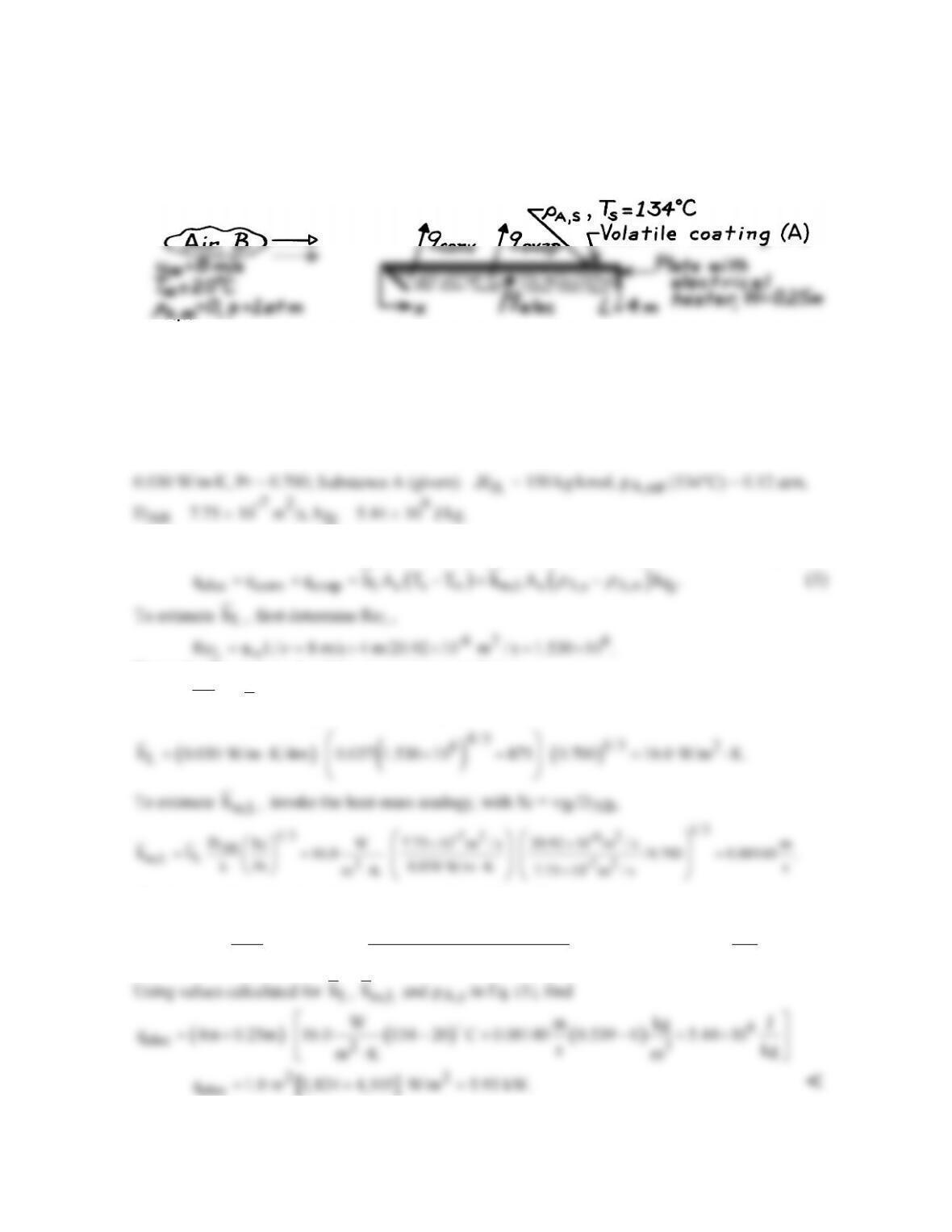
SCHEMATIC:
ASSUMPTIONS: (1) Steady-state conditions, (2) Heat-mass transfer analogy is applicable, (3)
Transition occurs at Rexc = 5 × 10⁵, (4) Perfect gas behavior of vapor A, (5) Upstream air is dry,
ρA,∞ = 0.
PROPERTIES: Table A-4, Air (Tf = (134 + 20)°C/2 = 350 K, 1 atm): ν = 20.92 × 10⁻⁶ m2/s, k =
ANALYSIS: From an overall energy balance on the plate, the power required to maintain Ts is
Hence the flow is mixed and the appropriate correlation:
()
4/5 1/ 3
LLL
Nu h L/k 0.037 Re 871 Pr= = −
The density of species A at the surface, ρA,s(Ts), follows from the perfect gas law,
( )
-2 3
A,s A,s s 3
A
8.205 10 m atm/kmol K kg
p / T 0.12 atm/ 134 273 K 0.539 .
150 kg/kmol m
ℜ ×⋅ ⋅
= = ⋅+ =
M
ρ
COMMENTS: For these conditions, nearly 70% of the heat loss is by evaporation.
PROBLEM 7.94
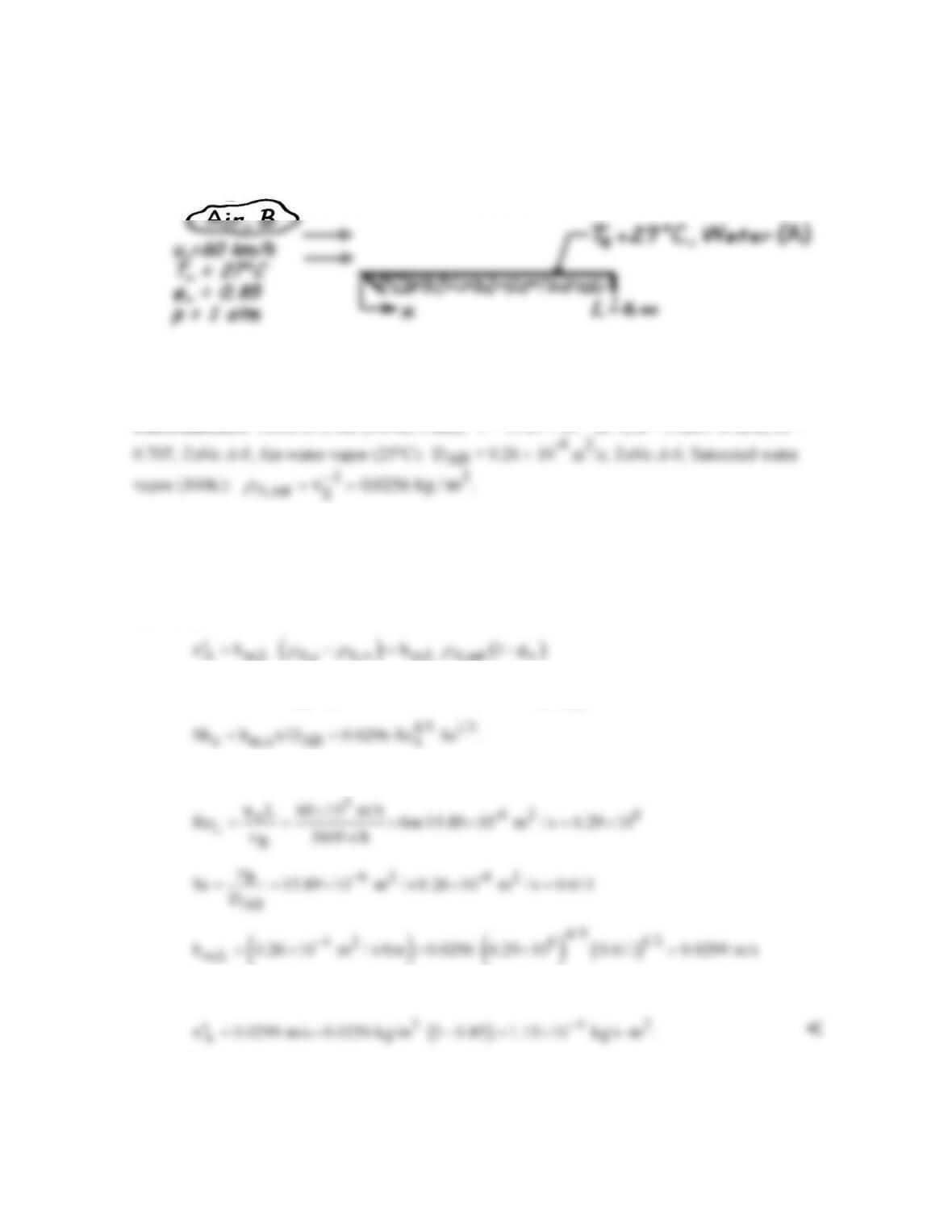
KNOWN: Dry air flows at 300 K over water-filled trays, each 222 mm long, with velocity of 15 m/s
while radiant heaters maintain the surface temperature at 330 K.
FIND: (a) Evaporative flux (kg/s⋅m2) at a distance 1 m from leading edge, (b) Radiant flux at this
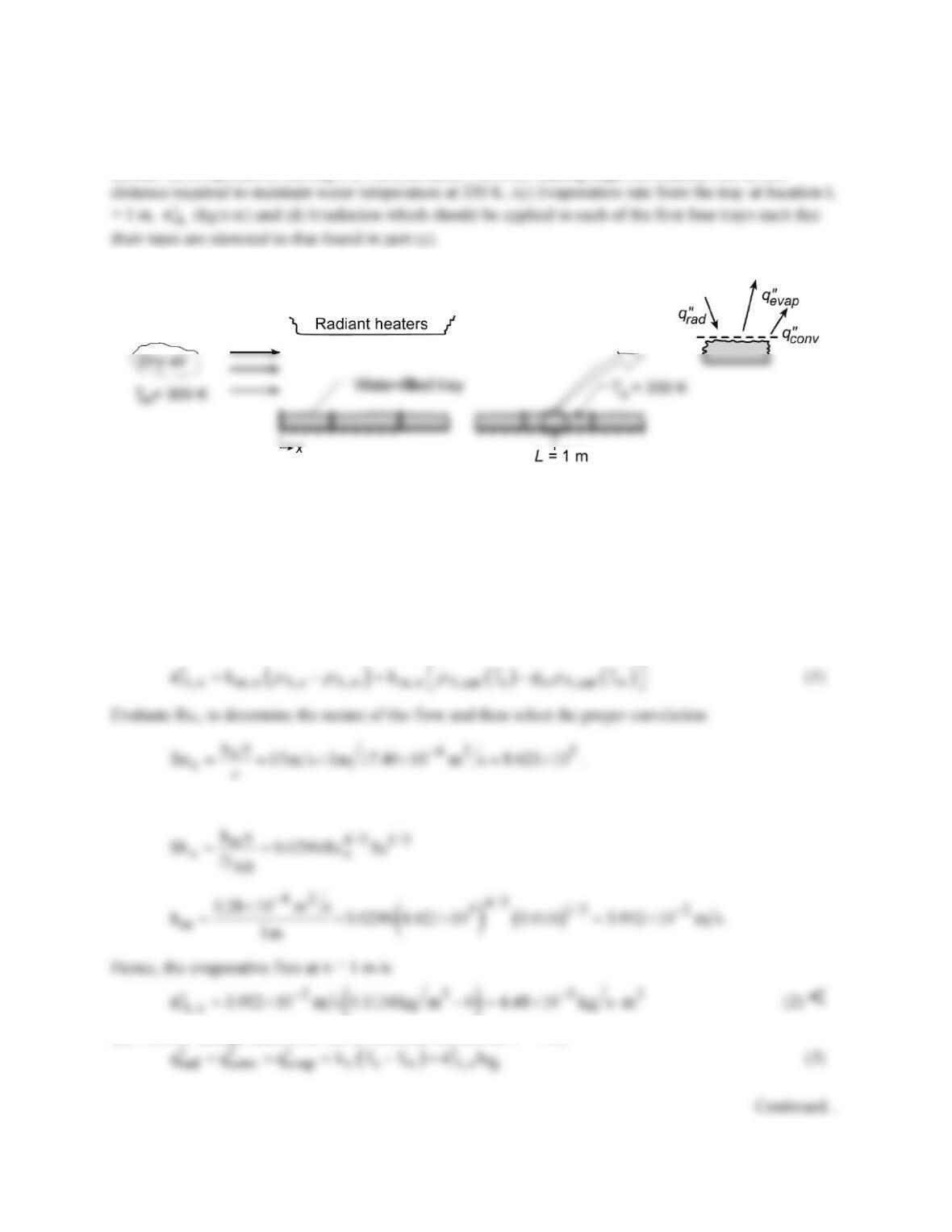
SCHEMATIC:
ASSUMPTIONS: (1) Steady-state conditions, (2) Heat-mass transfer analogy applicable, (3) Water
vapor behaves as perfect gas, (4) All incident radiant power absorbed by water, (5) Critical Reynolds
number is 5 × 10⁵.
PROPERTIES: Table A.4, Air (Tf = 315 K, 1 atm): ν = 17.40 × 10⁻⁶ m2/s, k = 0.0274 W/m⋅K, Pr =
0.705; Table A.8, Water vapor–air (Tf = 315 K): DAB = 0.26 × 10⁻⁴ m2/s (315/298)3/2 = 0.28 × 10⁻⁴ m2/s,
Sc = ν/DAB = 0.616; Table A.6, Saturated water vapor (Ts = 330 K): ρA,sat = 1/vg = 0.1134 kg/m3, hfg =
2366 kJ/kg.
ANALYSIS: (a) The evaporative flux of water vapor (A) at location x is
Hence, the flow is turbulent, and invoking the heat-mass analogy with Eq. 7.37,
(b) From an energy balance on the differential element at x = 1 m,
PROBLEM 7.94 (Cont.)
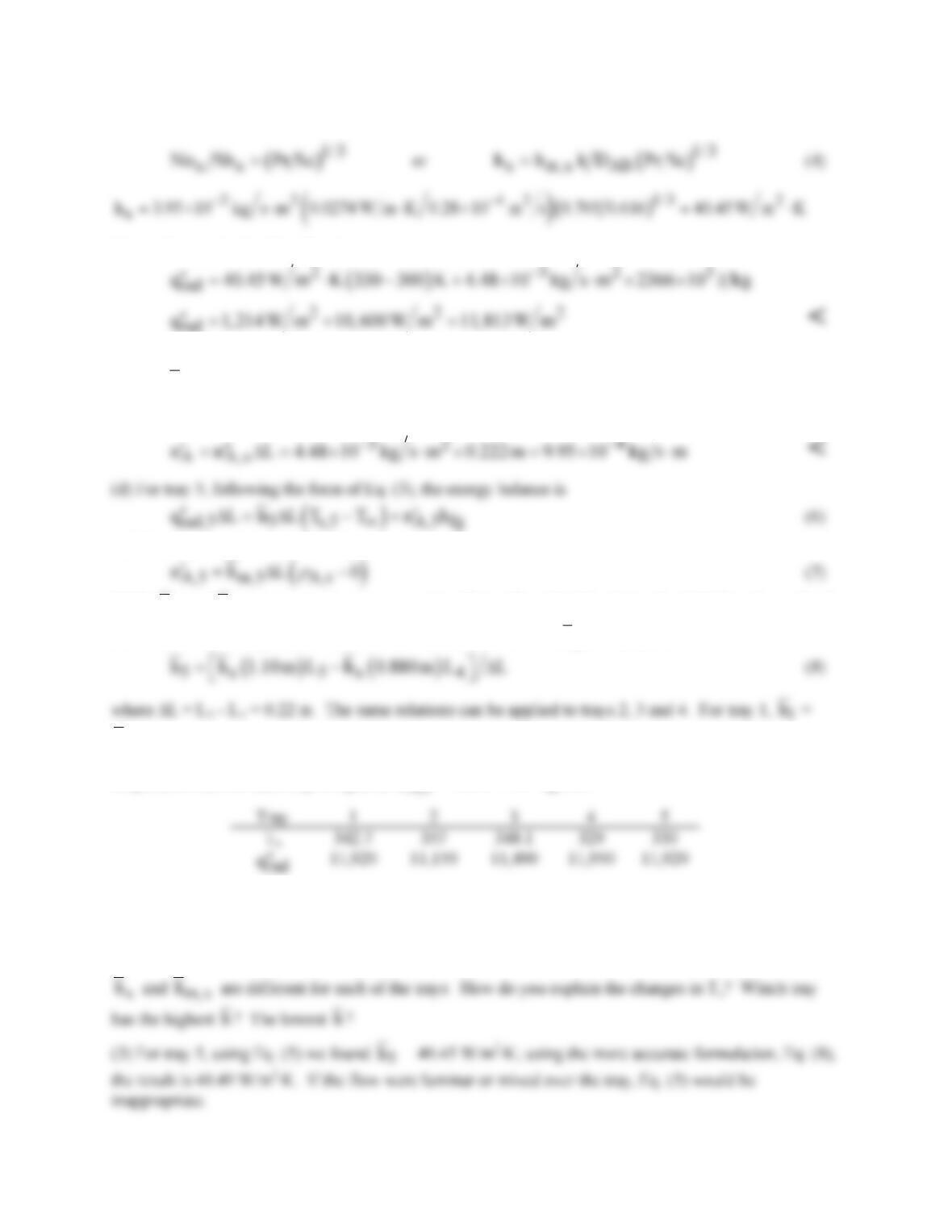
To estimate hx, invoke the heat-mass analogy using the correlation, Eq. 7.37,
Hence, the required radiant flux is
(c) The flow is turbulent over tray 5 having its mid-length at x = 1 m, so that it is reasonable to assume,
( )
5x
h h 1m≈
(5)
so that the evaporation rate can be determined from the evaporative flux as,
and the evaporation rate for the tray is
While
5
h
and
m,5
h
represent tray averages, Eq. (4) is still applicable. Using the IHT Correlation Tool,
External Flow, Average coefficient for Laminar, or Mixed Flow,
5
h
is evaluated as
h
(0.22 m)⋅L1, where L1 = ∆L. With Eqs. (3, 6, 7 and 8) in the IHT Workspace, along with the
Correlations and Properties Tools, the following results were obtained with the requirement that the
evaporation rate for each tray is equal at
n′
= 10.01 × 10⁻⁴ kg/s⋅m.
COMMENTS: (1) Note carefully at which temperatures the thermophysical properties are evaluated.
(2) Recognize that in part (d), if we require equal evaporation rates for each tray,
A,5
n′
, the water
temperature, Ts, and radiant flux,
rad
q′′
, for each tray must be different since the convection coefficients
5
h
PROBLEM 7.95
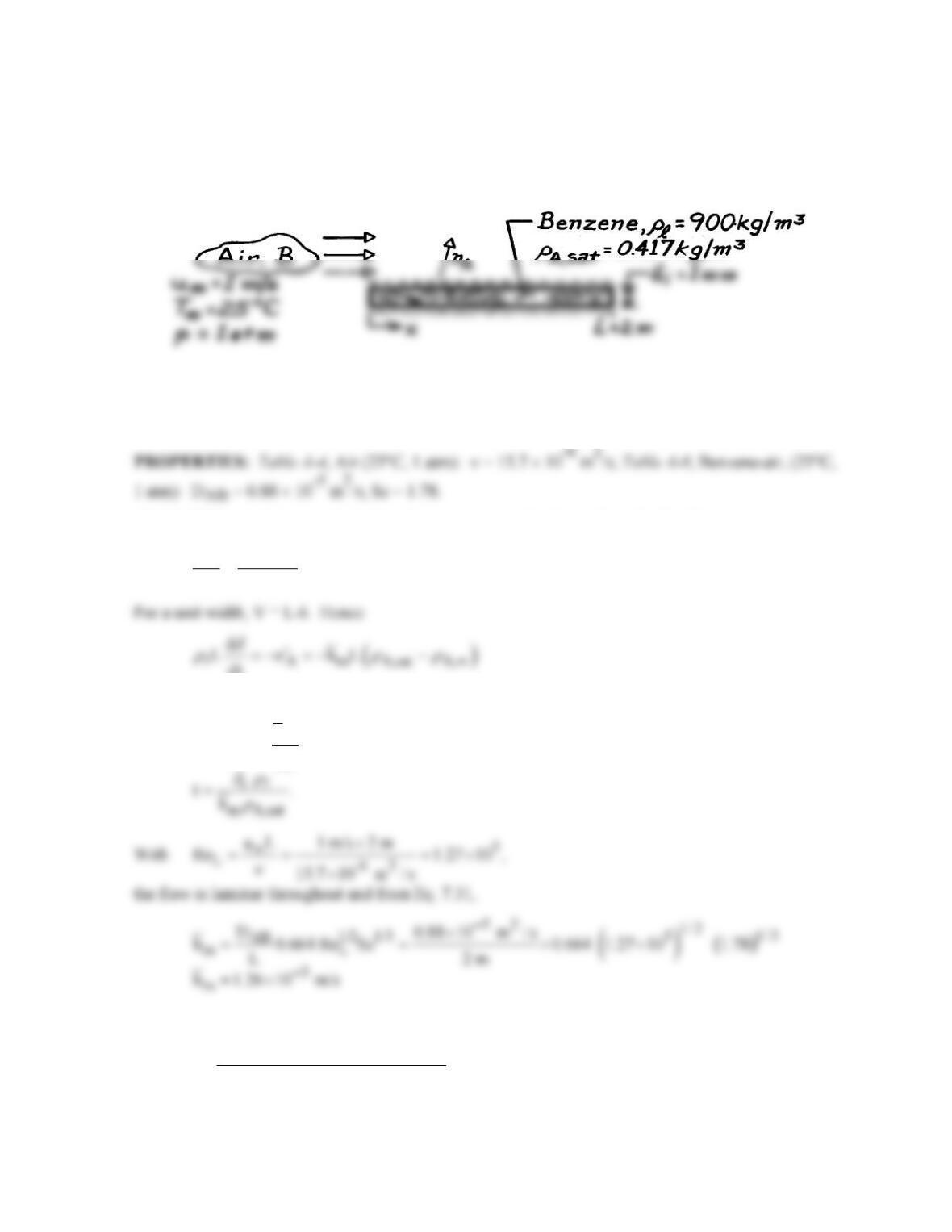
KNOWN: Convection mass transfer with turbulent flow over a flat plate (van roof).
FIND: (a) Location on van that will dry last, (b) Evaporation rate at trailing edge, kg/s⋅m2.
SCHEMATIC:
ASSUMPTIONS: (1) Turbulent flow over entire plate (van top), (2) Heat-mass transfer analogy is
applicable, (3) Ideal gas behavior for water vapor (A).
PROPERTIES: Table A-4, Air (300 K, 1 atm): ν = 15.89 × 10⁻⁶ m2/s, k = 0.0263 W/m⋅K, Pr =
ANALYSIS: (a) The mass transfer coefficient, hm(x), will be largest at x = 0 and smallest at x = L
for turbulent flow conditions. Hence, the trailing edge will dry last. <
(b) The evaporation rate on a per unit area basis, at the trailing edge where x = L, is given by the rate
equation,
For turbulent flow the appropriate correlation for estimating hm,L is of the form
Substituting numerical values,
Hence, the evaporation flux (rate per unit area) is
COMMENTS: Recognize how the heat-mass analogy is utilized and the appropriate correlation
selected from Table 7.7.
PROBLEM 7.96
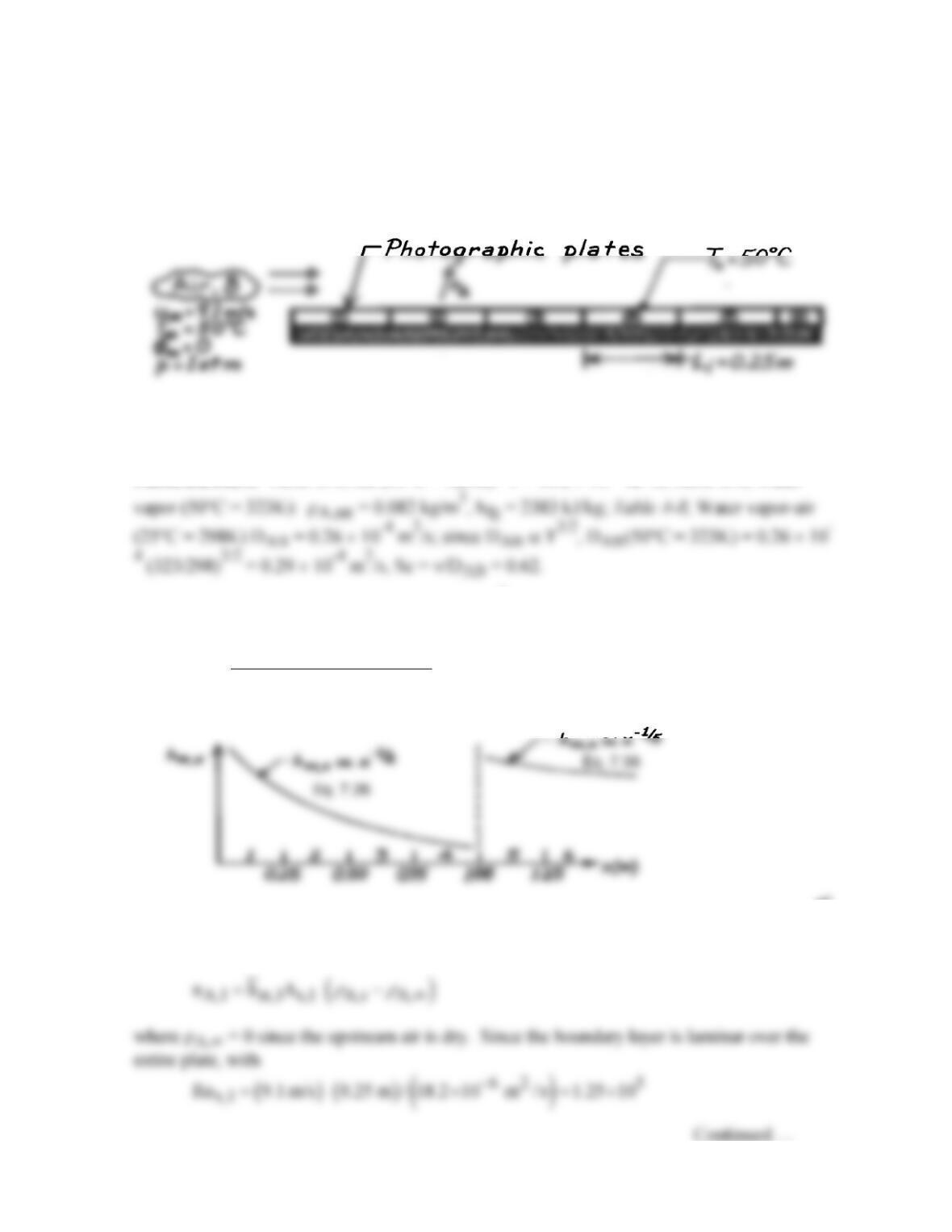
KNOWN: Length and thickness of a layer of benzene. Velocity and temperature of air in parallel
flow over the layer.
FIND: Time required for complete evaporation.
SCHEMATIC:
ASSUMPTIONS: (1) Steady-state conditions, (2) Smooth liquid surface and negligible free–stream
turbulence, (3) Heat and mass transfer analogy is applicable, (4) Negligible benzene vapor
concentration in free-stream air, (5) Isothermal conditions at 25°C.
ANALYSIS: Applying conservation of mass to a control volume about the liquid,
( )
A
dV
dM n.
dt dt
ρ
= = −
dt
and integrating
0t
i0
mA,sat
h
d dt
d
dρ
ρ
∫=− ∫
and
()
()()
3
-3 3
0.001 m 900 kg/m
t 1713 s 28.6 min.
1.26 10 m/s 0.417 kg/m
= = =
×
<
PROBLEM 7.97
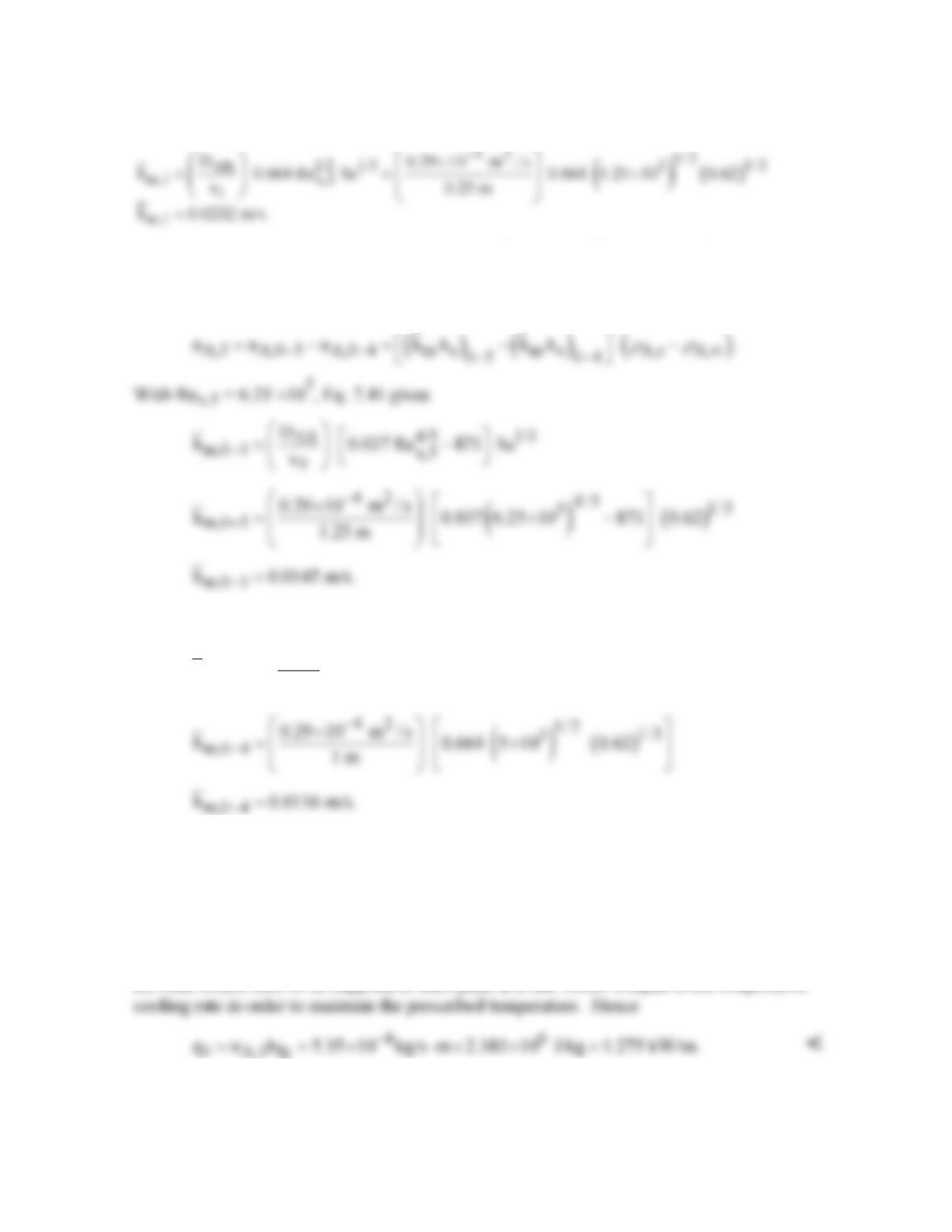
KNOWN: Air and surface conditions for a drying process in which photographic plates are
aligned in the direction of the air flow.
FIND: (a) Variation of local mass transfer convection coefficient, (b) Drying rate for fastest
drying plate, (c) Heat addition needed to maintain the plate temperature.
SCHEMATIC:
ASSUMPTIONS: (1) Heat and mass transfer analogy is applicable, (2) Critical Reynolds
number is Rex.c = 5 × 10⁵, (3) Radiation effects are negligible.
PROPERTIES: Table A-4, Air (50°C = 323K): ν = 18.2 × 10⁻⁶ m2/s; Table A-6, Water
ANALYSIS: (a) With Rex,c = u∞xc/ν = 5 × 10⁵, the point of transition is
()
5 -6 2
c
5 10 18.2 10 m / s
x 1 m
9.1 m/s
××
= =
and the variation of the local mass transfer coefficient is as shown below
<
(b) The largest evaporation will be associated with either the first plate or the fifth plate. For
the first plate,
PROBLEM 7.97 (Cont.)
Eq. 7.31 may be used to obtain
Hence
( )
()
34
A,1
n 0.0232m/s 0.25 m 1 m 0.082kg/m 4.72 10 kg/s m.
−
= × =×⋅
For the fifth plate,
With Rex,4 = 5 × 10⁵, Eq. 7.31 gives
1/4 1/3
AB
m,0 4 x,4
4
D
h 0.664 Re Sc
x
−
=
Hence,
[ ]
()
3
A,5
n 0.0145m/s 1.25 m 1 m 0.0116m/s 1 m 1 m 0.082kg/m= × ×− ××
4
A,5
n 5.35 10 kg/s m.
−
=×⋅
<
Hence the evaporation rate is largest for Plate 5.
(c) Heat would have to be supplied to each plate at a rate which is equal to the evaporative
COMMENTS: The large value of q5 is a consequence of the significant evaporative cooling
effect.
PROBLEM 7.98
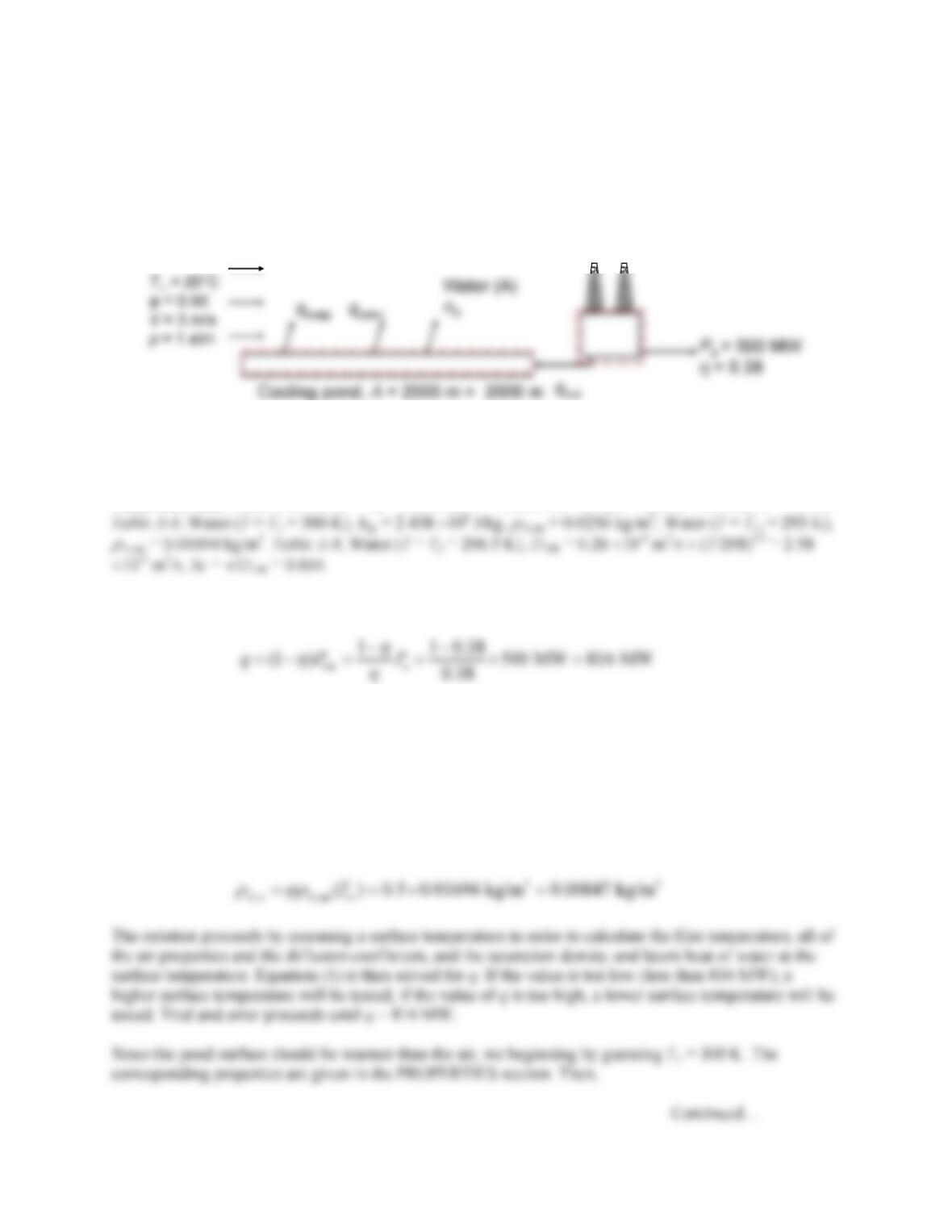
KNOWN: Electric power generation and efficiency of electric power plant. Dimensions of cooling pond.
Temperature, humidity, and velocity of air.
FIND: Pond water temperature and heat loss rates due to convection and evaporation.
SCHEMATIC:
Air (B)
ASSUMPTIONS: (1) Steady–state incompressible flow conditions, (2) Constant properties, (3)
Negligible radiation effects, (4) Turbulent flow, (5) Air flow is parallel to pond surface, (6) Air properties
are same as for dry air, (7) Air is saturated with water at the pond surface.
PROPERTIES: Table A-4, Air (T = Tf = 296.5 K):
ν
= 15.58 ×10⁻⁶ m2/s, k = 0.0260 W/m⋅K, Pr = 0.708.
ANALYSIS: The waste heat from the power plant can be determined from the fact that Pe =
η
Ptot, thus:
Under steady–state conditions, this is the rate at which heat must be removed from the cooling pond by
convection and evaporation (neglecting radiation), thus:
A, A,
() ( )
conv evap s s m s s fg
q q q hA T T h A h
ρρ
∞∞
= + = −+ −
(1)
where species A is water. The heat and mass transfer coefficients can be found for parallel flow over a flat
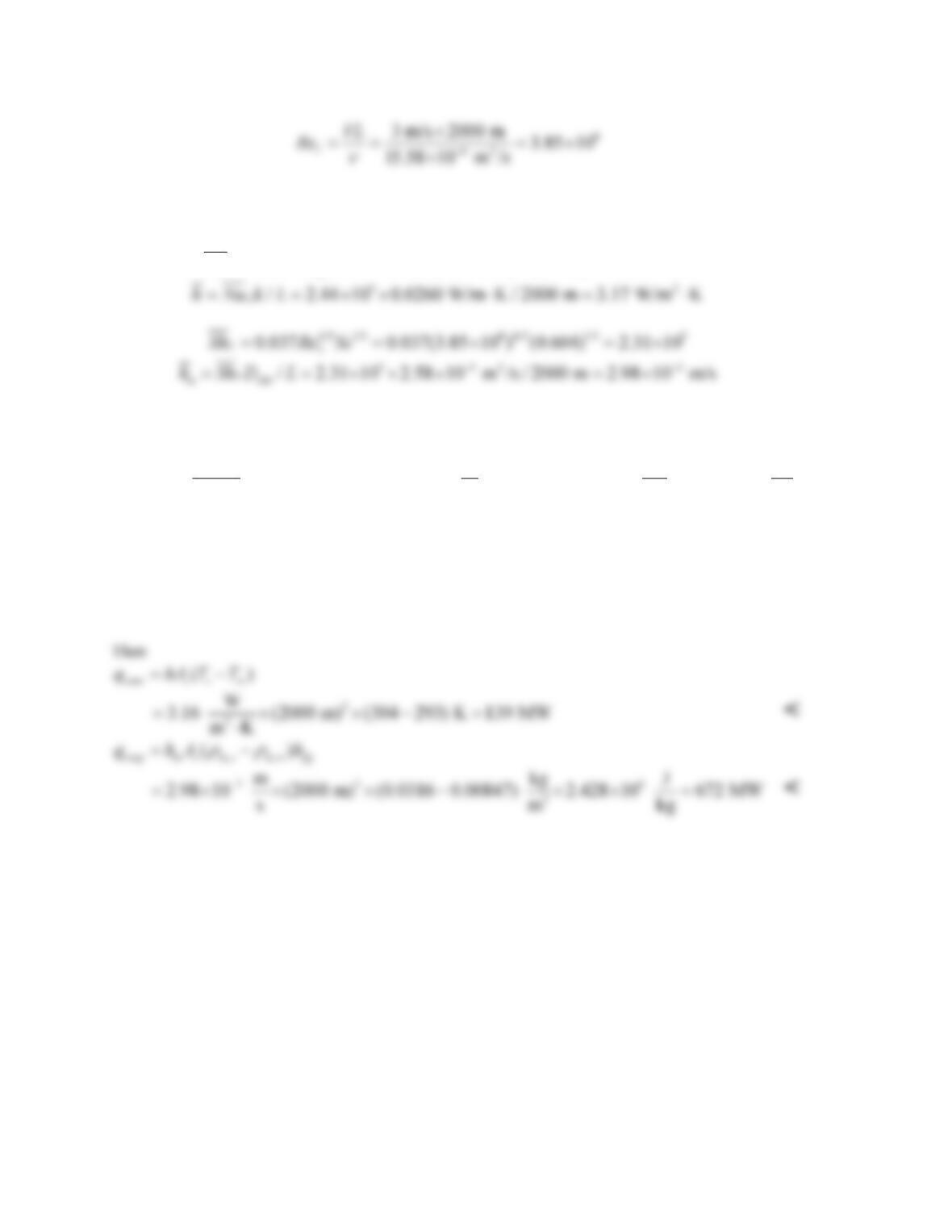
plate. The water density in the freestream is:
PROBLEM 7.98 (Cont.)
The flow is turbulent at the end of the pond. Since ReL >> 5 × 10⁵, the laminar portion of the boundary
layer can be neglected and Equations 7.38 and 7.41 can be used with A = 0.
4/5 1/3 8 4/5 1/3 5
0.037 0.037(3.85 10 ) (0.708) 2.44 10
LL
Nu Re Pr==×=×
From Eq. (1),
3 62
23
W m kg J
3.17 (300 293) K 2.98 10 (0.0256 0.00847) 2.438 10 (2000 m)
m K s m kg
585 MW
q
−
= ×− +× × − × × ×
⋅
=
This value is too small, therefore Ts must be greater than 300 K. Trying Ts = 310 K yields q = 1230 MW.
After trial and error, we find Ts = 304 K yields approximately the correct value for q. Thus,
Ts = 304 K = 31°C <
COMMENTS: (1) The evaporation heat transfer rate is the larger contribution to the cooling rate. (2)
This problem benefits from solution by a program such as IHT that makes it easy to vary the surface
temperature and calculate the properties and convection coefficients.
PROBLEM 7.99
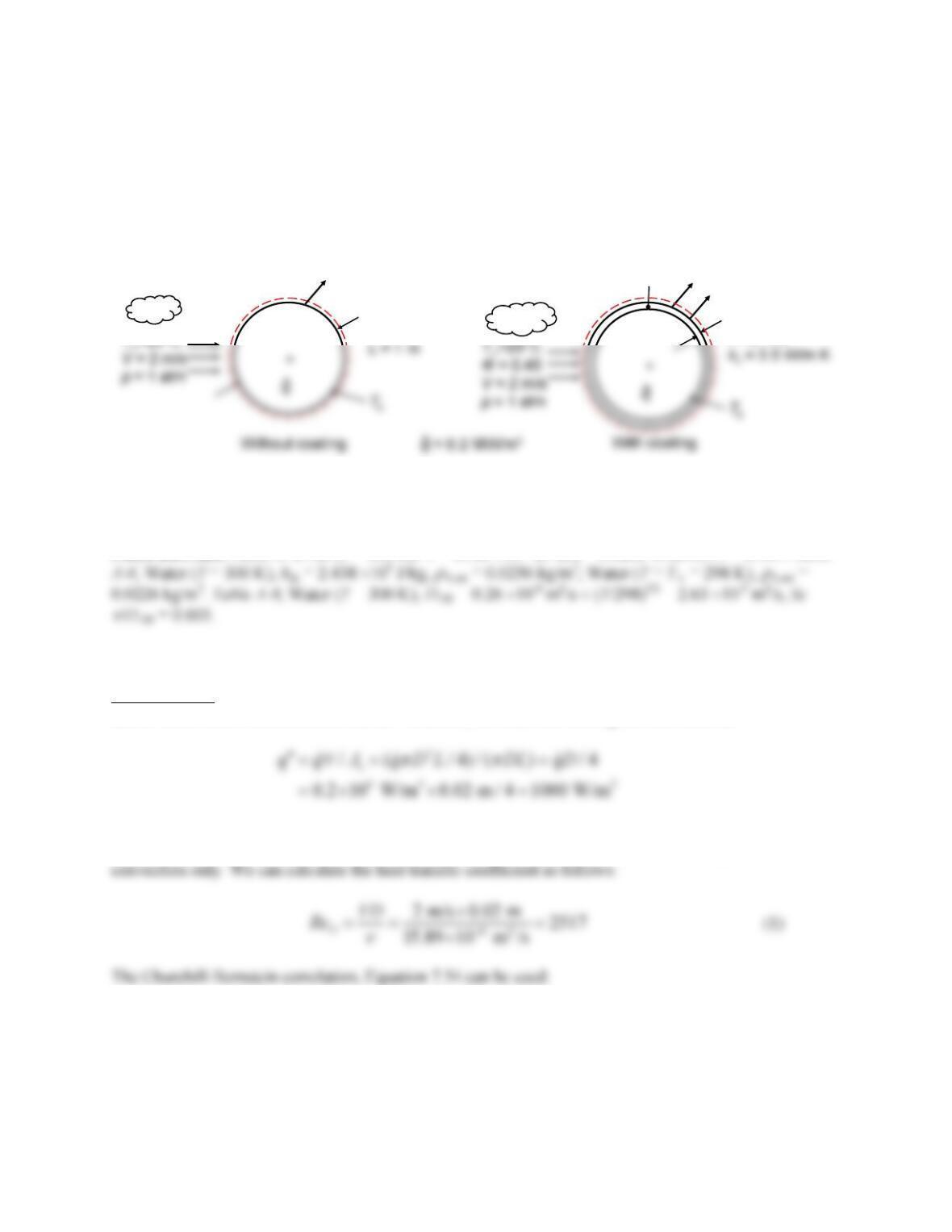
KNOWN: Diameter and length of copper tube. Volumetric thermal energy generation rate within
material inside tube. Temperature, humidity, and velocity of air in cross flow over tube. Thickness and
thermal conductivity of water-saturated porous coating.
FIND: Temperature of tube with and without coating.
SCHEMATIC:
Water (A)
Tube,
D = 20 mm
Air
Coating,
t = 2 mm
Air (B)
q
conv
q
conv
q
evap
ASSUMPTIONS: (1) Steady–state conditions, (2) Incompressible flow, (3) Constant properties, (4)
Negligible radiation effects, (5) Air properties are same as for dry air, (6) Air is saturated with water at
the coating surface.
PROPERTIES: Table A-4, Air (T = 300 K):
ν
= 15.89 ×10⁻⁶ m2/s, k = 0.0263 W/m⋅K, Pr = 0.707. Table
ANALYSIS:
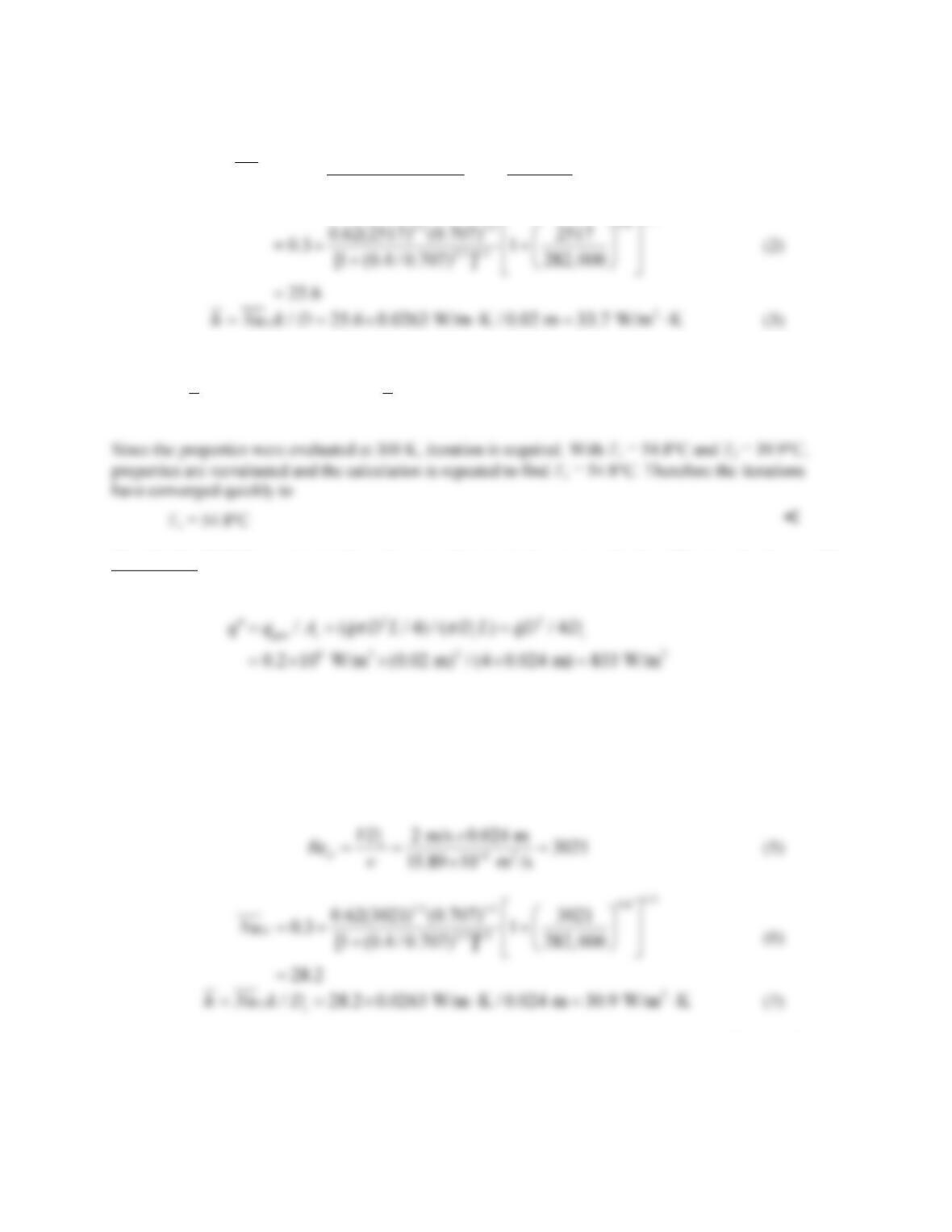
Uncoated tube. Under steady–state conditions, the rate of heat generated inside the tube must equal the
rate at which heat is transferred to the air. Therefore, the heat flux leaving the tube must be:
The surface temperature is unknown at the outset, so we begin by evaluating all air properties at 300 K
(see PROPERTIES). When the tube is uncoated, heat transfer from the tube to the air is by forced
Continued…
PROBLEM 7.99 (Cont.)
4/5
5/8
1/ 2 1/ 3
2/ 3 1/ 4
4/5
0.62
0.3 1
[1 (0.4 / ) ] 282,000
DD
D
Re Pr Re
Nu Pr
=++
+
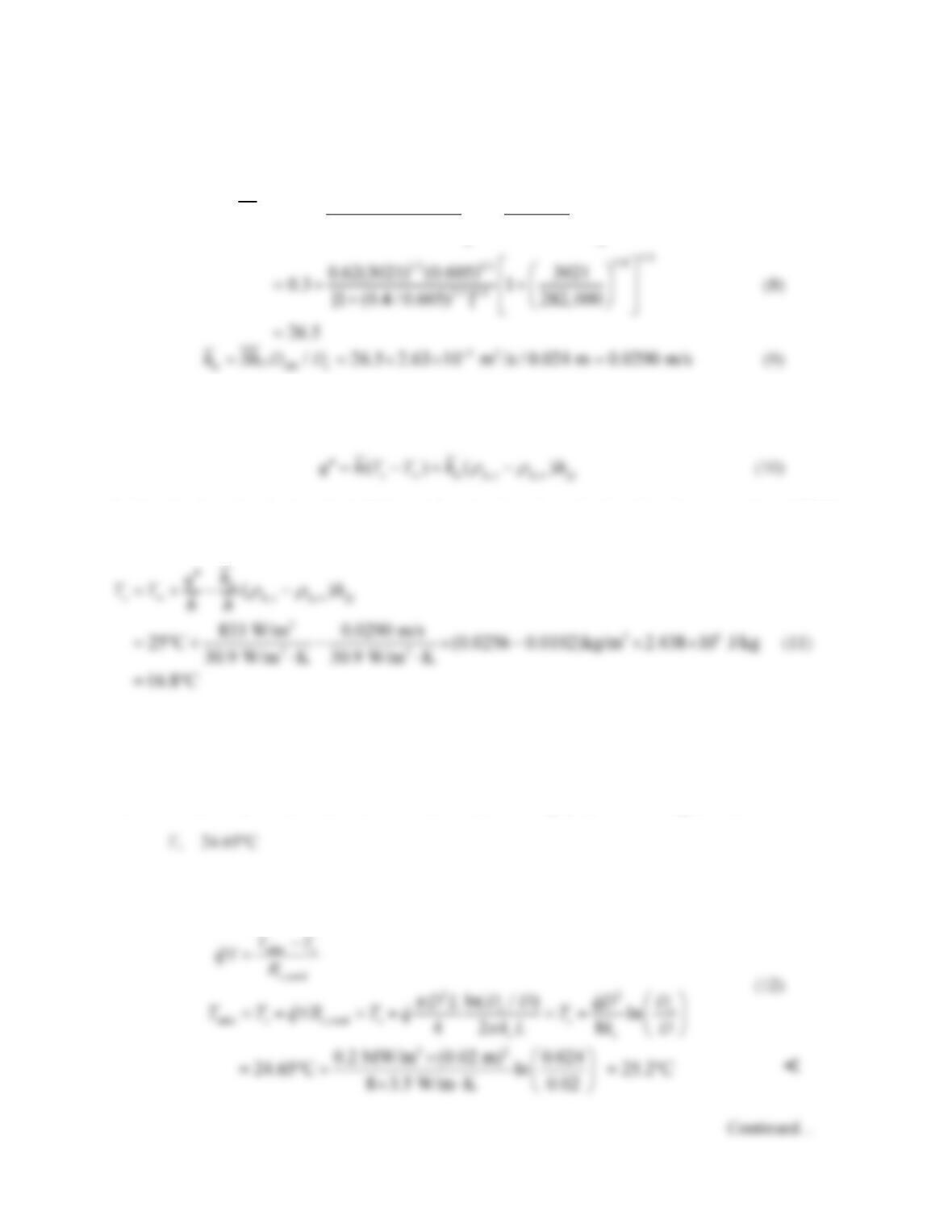
Performing an energy balance at the tube surface, the surface temperature can be determined:
22
( ), / 25 C 1000 W/m / 33.7 W/m K 54.8 C
ss
q hT T T T q h
∞∞
′′ ′′
= − = + = °+ ⋅ = °
(4)
Coated tube. With the coating in place, the outer diameter is larger, namely, Dc = 20 mm + 2 × 2 mm = 24
mm. Therefore, the heat flux leaving the tube must be:
Once again, the surface temperature is unknown at the outset, and we begin by evaluating all air and
water properties at 300 K (see PROPERTIES), except for the freestream saturation density of water which
is evaluated at T∞ = 298 K. Then
3
A, A,sat
( ) 0.45 0.0226 kg/mT
ρ ϕρ
∞∞
= = ×
3
0.0102 kg/m .=
The
Reynolds number and heat transfer coefficient can be calculated as in Eqs. (1-3), accounting for the
change in outer diameter.
Continued…
PROBLEM 7.99 (Cont.)
The mass transfer coefficient can also be calculated from the Churchill-Bernstein correlation (with Pr
replaced by Sc):
4/5
5/8
1/ 2 1/ 3
2/ 3 1/ 4
0.62
0.3 1
[1 (0.4 / ) ] 282,000
DD
D
Re Sc Re
Sh Sc
=++
+
When the tube is coated, the energy balance at the surface must include the heat absorbed due to
evaporation:
Solving for Ts, and evaluating the right-hand side using the estimated values based on properties at 300 K,
we find:
Since the properties were initially evaluated at 300 K (27°C), iteration is required. With Ts = 16.8°C and
Tf = 20.9°C, properties are reevaluated and the calculation is repeated to find Ts = 43°C. The calculation
algorithm is somewhat unstable. Therefore, a trial and error approach is implemented in which different
values of Ts (and corresponding Tf) are used for evaluating properties and the right-hand side of Eq. (11),
until the value of Ts is found that returns the same value from Eq. (11). The converged value is:
This is the temperature at the outer surface of the coating. The outer tube wall temperature can be found
from the known heat generation rate and coating resistance:

PROBLEM 7.99 (Cont.)
COMMENTS: (1) Evaporation from the water-saturated coating has a strong cooling effect. In fact, the
outer surface of the coating is at a slightly lower temperature than the ambient. Even though the coating
PROBLEM 7.100
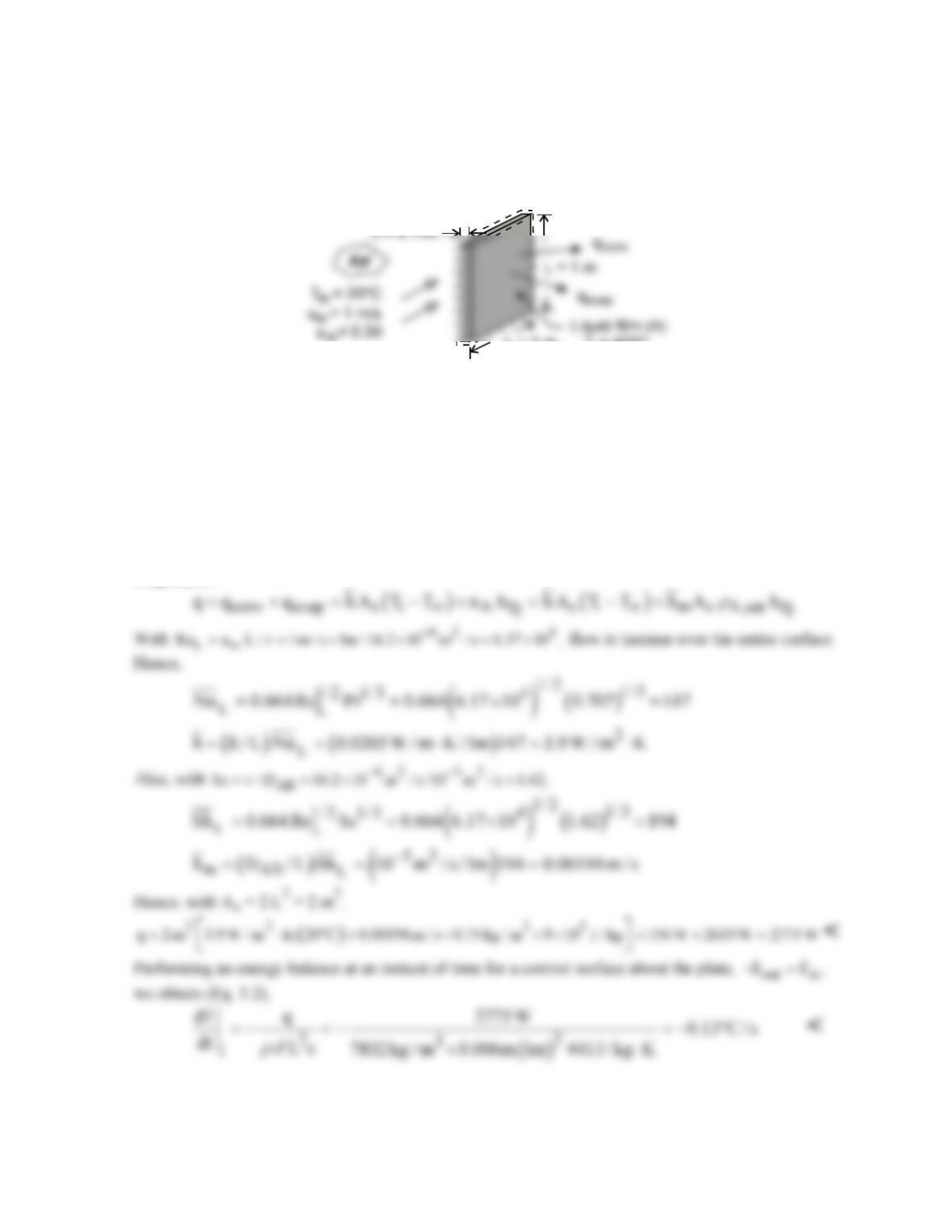
KNOWN: Dimensions and initial temperature of plate covered by liquid film. Properties of liquid.
Velocity and temperature of air flow over the plates.
FIND: Initial rate of heat transfer from plate and rate of change of plate temperature.
SCHEMATIC:
TC
i o
= 40
L = 1 m
ASSUMPTIONS: (1) Negligible effect of conveyor velocity on boundary layer development, (2)
Plates are isothermal and at same temperature as liquid film, (3) Negligible heat transfer from sides of
plate, (4) Smooth air-liquid interface, (5) Applicability of heat/mass transfer analogy, (6) Negligible
solvent vapor in free stream, (7) Rex,c = 5 × 10⁵, (8) Constant properties.
PROPERTIES: Table A-1, AISI 1010 steel (313K): c = 441 J/kg⋅K,
3
7832 kg / m .
ρ
=
Table A-4,
Air (p = 1 atm, Tf = 303K):
62
16.2 10 m / s, k 0.0265 W / m K, Pr 0.707.
ν
−
=× = ⋅=
Prescribed:
Solvent:
3 52 5
A,sat AB fg
0.75 kg / m , D 10 m / s, h 9 10 J / kg.
ρ
−
= = = ×
SOLUTION: The initial rate of heat transfer from the plate is due to both convection and
evaporation.
COMMENTS: (1) Heat transfer by evaporation exceeds that due to convection by more than an
order of magnitude, (2) The total heat rate is small enough to render the lumped capacitance
approximation excellent.
PROBLEM 7.101
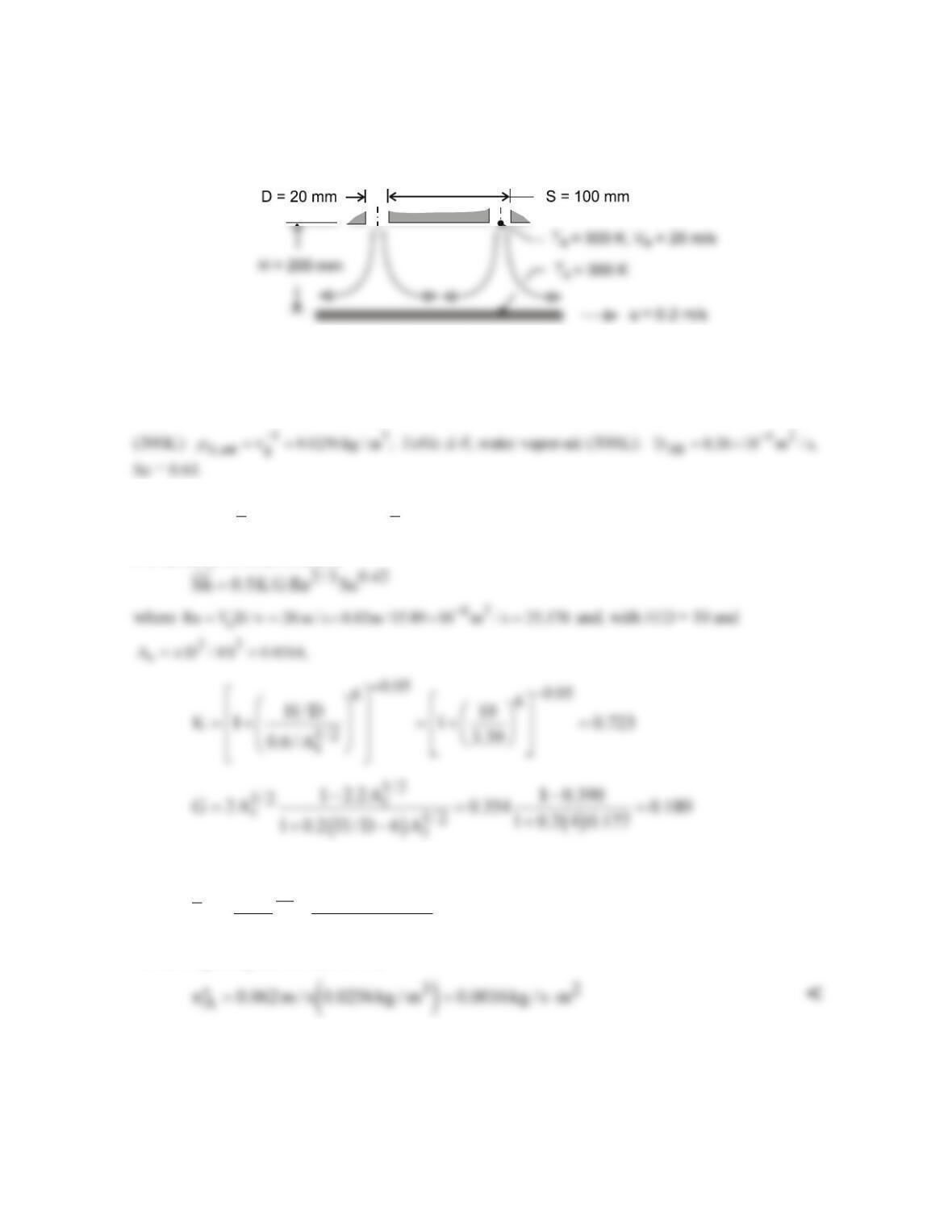
KNOWN: Dimensions of round jet array. Jet exit velocity and temperature. Temperature of paper.
FIND: Drying rate per unit surface area.
SCHEMATIC:
ASSUMPTIONS: (1) Applicability of heat and mass transfer analogy. (2) Paper motion has a
negligible effect on convection (u << Ve), (3) Air is dry.
PROPERTIES: Table A-4, Air (300K, 1 atm):
2
15.89 10 m / s;
6
ν
= × −
Table A-6, Saturated water
ANALYSIS: The average mass evaporation flux is
( )
A m A,s A,e m A,s
nh h
ρρ ρ
′′ = −=
For an array of round nozzles,
Hence,
( ) ( )
42 2 / 3 0.42
AB
m
D 0.26 10 m / s
h Sh 0.5 0.723 0.189 25,170 0.61 0.062 m / s
D 0.02m
−
×
= = ×× =
The average evaporative flux is then
COMMENTS: Note that, for maximum evaporation, the ratio D/H = 0.1 is less than the optimum of
)
op
D / H 0.2,≈
as is S/H = 0.5 less than
)
op
S / H 1.4.≈
If H is reduced by a factor of 2 and S is
increased by 40%, a near optimal condition could be achieved.