*PROBLEM 7-14 (Continued)
(b)
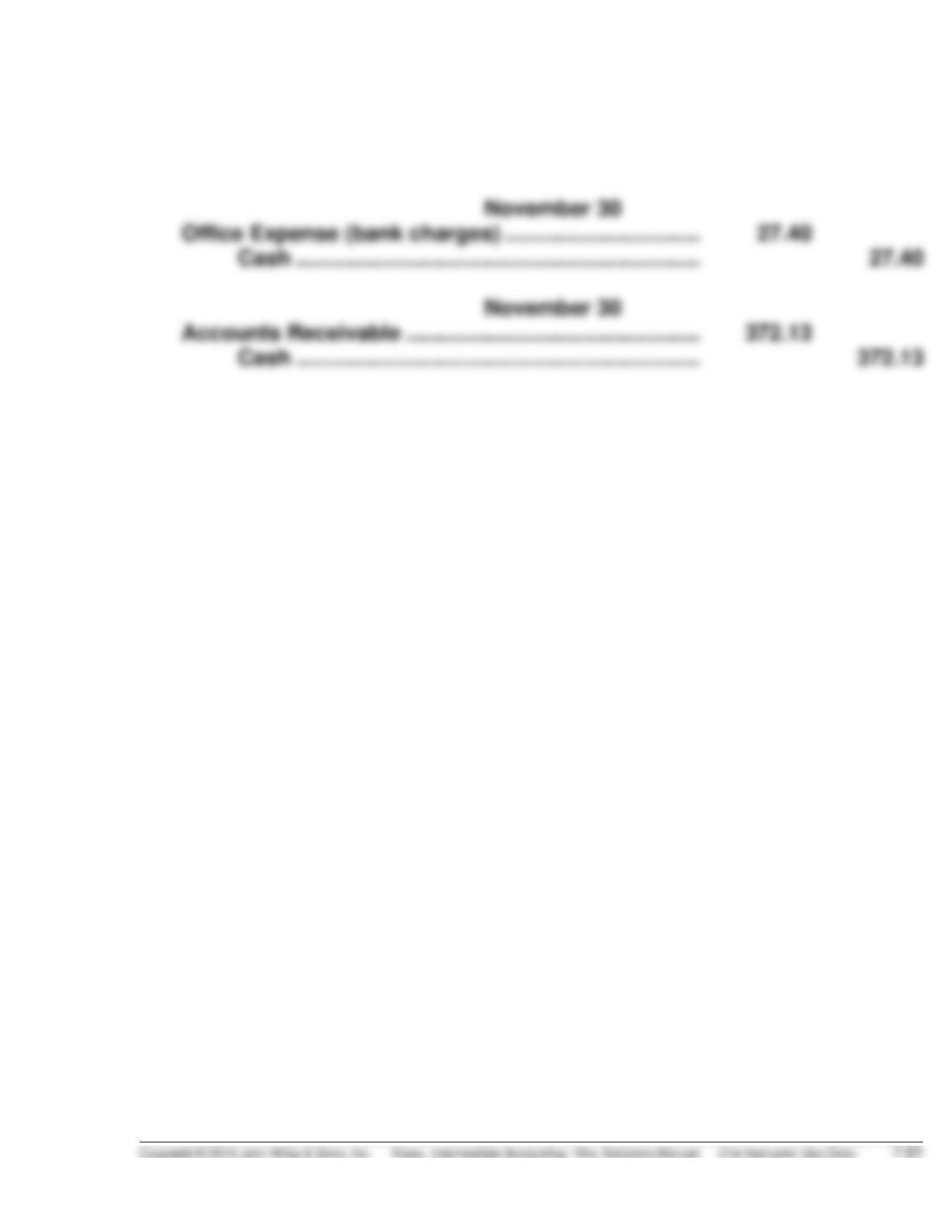
November 30
Cash …………………………………………………………………
1,400.00
Interest Revenue ……………………………………….
1,400.00
Office Expense (bank charges) …………………………..
Cash …………………………………………………………
Accounts Receivable …………………………………………
Cash …………………………………………………………
*PROBLEM 7-15
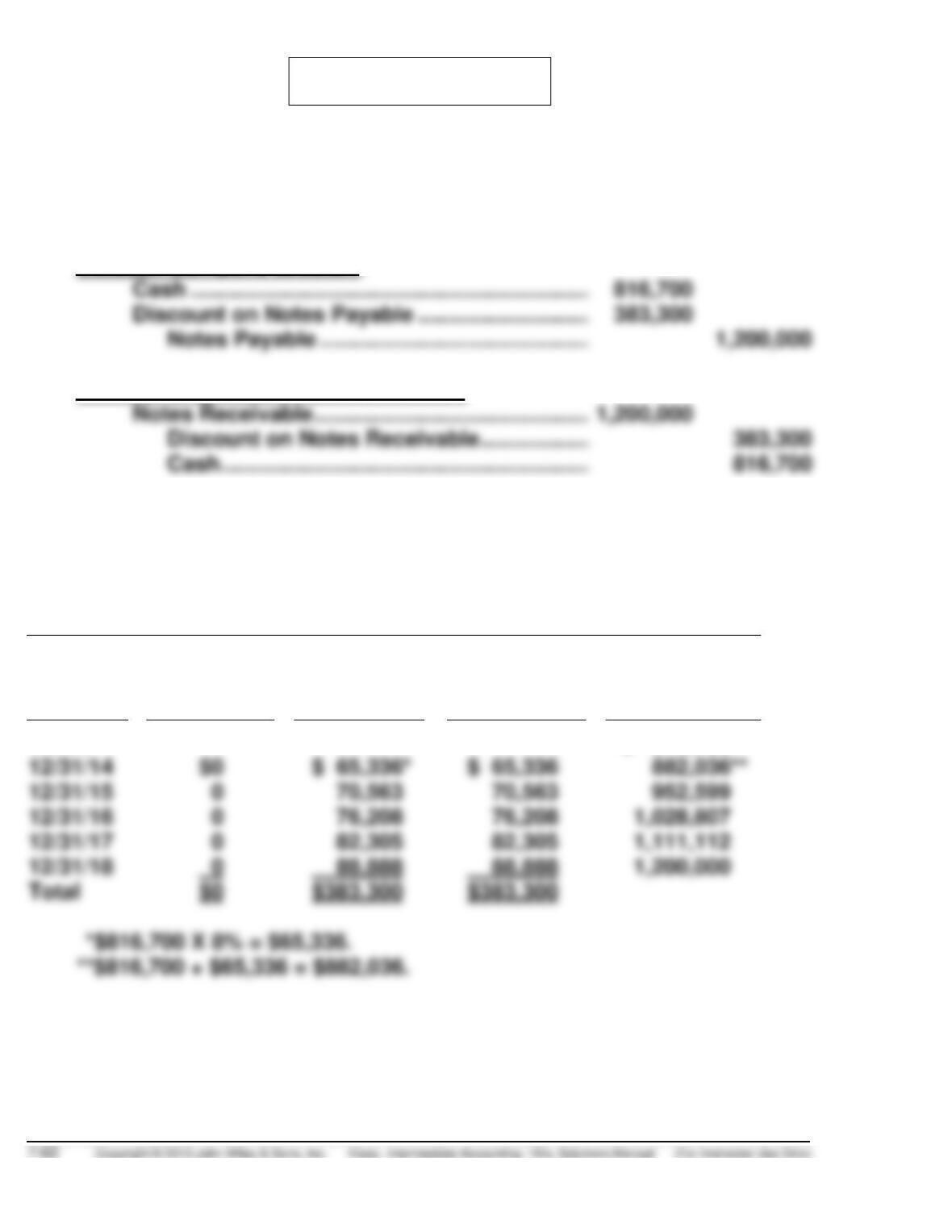
(a) The entries for the issuance of the note on January 1, 2014:
The present value of the note is: $1,200,000 X .68058 = $816,700
(Rounded by $4).
Botosan Company (Debtor):
Cash ………………………………………………………………
Discount on Notes Payable …………………………..
Notes Payable ……………………………………………
National Organization Bank (Creditor):
Notes Receivable …………………………………………….
Discount on Notes Receivable …………………….
Cash ……………………………………………………….
(b) The amortization schedule for this note is:
SCHEDULE FOR INTEREST AND DISCOUNT AMORTIZATION—
EFFECTIVE-INTEREST METHOD
$1,200,000 Note Issued to Yield 8%
Date
Cash
Paid
Interest
Expense
Discount
Amortized
Carrying
Amount of
Note
1/1/14
$ 816,700
0
Total
*PROBLEM 7-15 (Continued)
(c) The note can be considered to be impaired only when it is probable
(d)
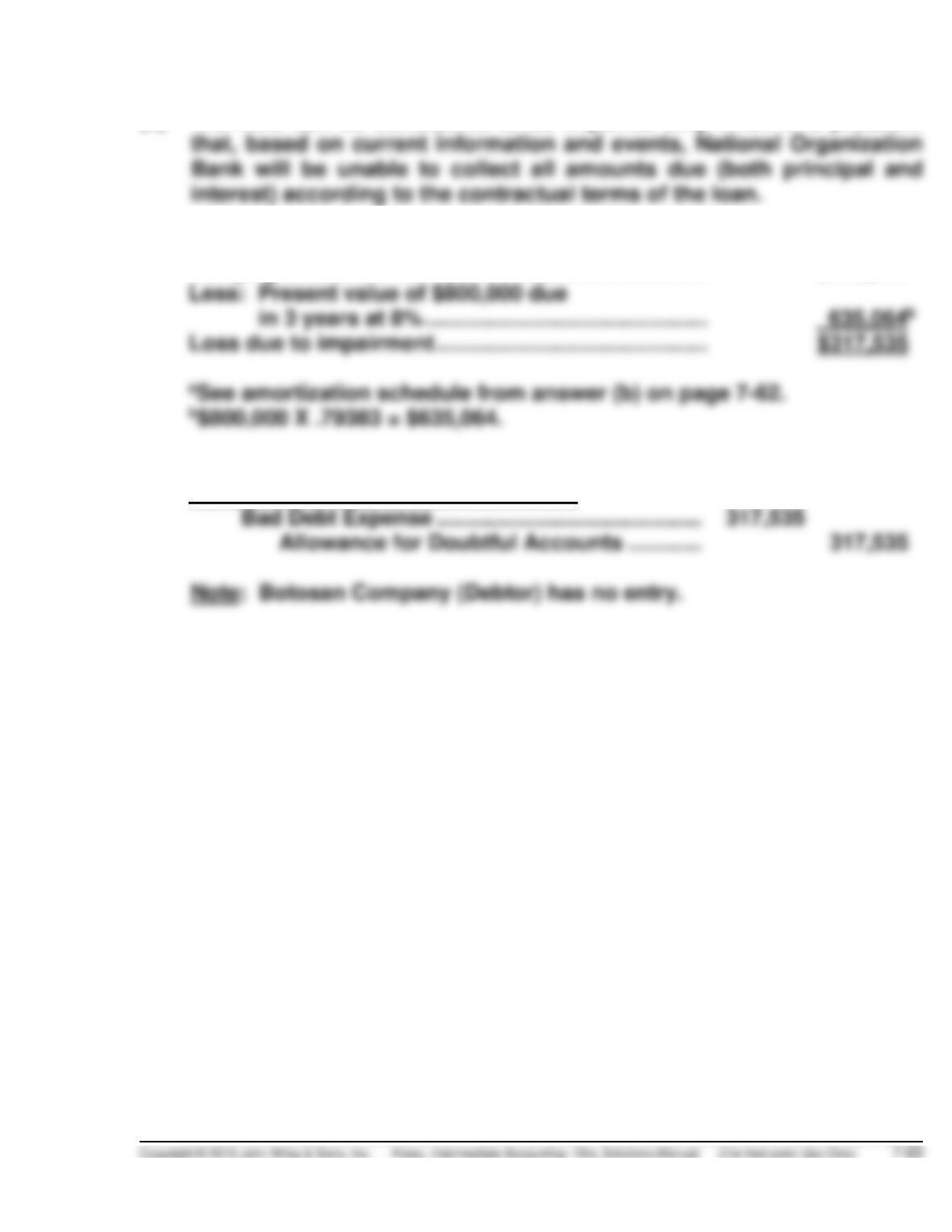
The loss is computed as follows:
Carrying amount of loan (12/31/15) …………………………..
$952,599a
Loss due to impairment …………………………………………..
December 31, 2015
National Organization Bank (Creditor):
Bad Debt Expense …………………………………….
Allowance for Doubtful Accounts …………
TIME AND PURPOSE OF CONCEPTS FOR ANALYSIS
CA 7-1 (Time 10–15 minutes)
CA 7-2 (Time 15–20 minutes)
Purpose—to provide the student with the opportunity to discuss the accounting for cash discounts,
trade discounts, and the factoring of accounts receivable.
CA 7-3 (Time 25–30 minutes)
Purpose—to provide the student with the opportunity to discuss the advantages and disadvantages of
CA 7-4 (Time 25–30 minutes)
Purpose—to provide the student the opportunity to discuss when interest revenue from a note receivable
CA 7-5 (Time 20–25 minutes)
Purpose—to provide the student with a discussion problem related to notes receivable sold without and
with recourse.
CA 7-6 (Time 20–30 minutes)
CA 7-7 (Time 25–30 minutes)
Purpose—to provide the student the opportunity to calculate interest revenue on an interest-bearing
CA 7-8 (Time 25–30 minutes)
Purpose—to provide the student with a case related to the imputation of interest. One company has
CA 7-9 (Time 25–30 minutes)
Purpose—to provide the student with a case to analyze receivables irregularities, including a shortage.
This is a good writing assignment.
CA 7-10 (Time 25–30 minutes)
Purpose—to provide the student with a case to analyze ethical issues inherent in bad debt judgments.
SOLUTIONS TO CONCEPTS FOR ANALYSIS
CA 7-1
(a) The direct write-off method overstates the trade accounts receivable on the balance sheet by
reporting them at more than their net realizable value. Furthermore, because the write-off often
occurs in a period after the revenues were generated, the direct write-off method does not match
bad debts expense with the revenues generated by sales in the same period.
CA 7-2
(a) 1. Kimmel should account for the sales discounts at the date of sale using the net method by
recording accounts receivable and sales revenue at the amount of sales less the sales
discounts available.
2. There is no effect on Kimmel’s sales revenues when customers do not take the sales discounts.
Kimmel’s net income is increased by the amount of interest (discount) earned when customers
do not take the sales discounts.
(d) Kimmel should report the face amount of the interest-bearing notes receivable and the related
interest receivable for the period from October 1 through December 31 on its balance sheet as
noncurrent assets. Both assets are due on September 30, 2016, which is more than one year from
the date of the balance sheet.
CA 7-2 (Continued)
Kimmel should report interest revenue from the notes receivable on its income statement for the
year ended December 31, 2014. Interest revenue is equal to the amount accrued on the notes
CA 7-3
(1) Allowances and charge-offs. Method (a) is recommended. In the case of this company which
has a large number of relatively small sales transactions, it is practicable to give effect currently to
the probable bad debt expense. Whenever practicable, it is advisable to accrue probable bad debt
(2) Collection expenses. Method (a) or (b) is recommended. In the case of this company, one strong
argument for method (a) is that it is advisable to have the Bad Debt Expense account show the full
amount of expense relating to efforts to collect and failure to collect balances receivable. On the
(3) Recoveries. Method (c) is recommended. This method treats the recovery as a correction of a
previous write-off. It produces an allowance account that reflects the net experience with bad
CA 7-4
Part 1
Since Wallace Company is a calendar-year company, six months of interest should be accrued on
12/31/14. The remaining interest revenue should be recognized on 6/30/15 when the note is collected.
CA 7-4 (Continued)
Part 2
(a) The use of the allowance method based on credit sales to estimate bad debts is consistent with the
expense recognition principle because bad debts arise from and are a function of making credit
sales. Therefore, bad debt expense for the current period should be matched with current credit
(b) On Wallace’s balance sheet, the allowance for doubtful accounts is presented as a contra account
to accounts receivable with the resulting difference representing the net accounts receivable (i.e.,
their net realizable value). Bad debt expense would generally be included on Wallace’s income
CA 7-5
(a) The appropriate valuation basis of a note receivable at the date of sale is its discounted present
value of the future amounts receivable for principal and interest using the customer’s market rate
of interest, if known or determinable, at the date of the equipment’s sale.
(b) Corrs should increase the carrying amount of the note receivable by the effective-interest revenue
recognized for the period February 1 to May 1, 2014. Corrs should account for the sale of the note
(c) 1. For notes receivable not sold, Corrs should recognize bad debt expense. The expense equals
the adjustment required to bring the balance of the allowance for doubtful accounts equal to
the estimated uncollectible amounts less the fair values of recoverable equipment.
CA 7-6
(a) 1. It was not possible to determine the machine’s fair value directly, so the sales price of the
machine is reported at the note’s September 30, 2013 fair value. The note’s September 30,
2. Rolen reports 2013 interest revenue determined by multiplying the note’s carrying amount at
(b) To report the sale of the note receivable with recourse, Rolen should decrease notes receivable by
the carrying amount of the note, increase cash by the amount received, record a recourse liability
for possible customer defaults (the recourse liability is reported on the balance sheet at 12/31/14)
and report the difference as a loss or gain as part of income from continuing operations.
(c) Rolen should decrease cash, increase notes (accounts) receivable past due for all payments
CA 7-7
(a) 1. For the interest-bearing note receivable, the interest revenue for 2014 should be determined by
multiplying the principal (face) amount of the note by the note’s rate of interest by one half (July 1,
2014 to December 31, 2014). Interest accrues with the passage of time, and it should be
accounted for as an element of revenue over the life of the note receivable.
2. For the zero-interest-bearing note receivable, the interest revenue for 2014 should be deter-
(b) The interest-bearing note receivable should be reported at December 31, 2014 as a current asset
at its principal (face) amount.
CA 7-7 (Continued)
(d) Because the trade accounts receivable were factored on a without recourse basis, the factor is
CA 7-8
The controller of Engone Company cannot justify the manner in which the company has accounted for
the transaction in terms of sound financial accounting principles.
Central to the transaction is the issue of imputed interest. If we assume that an arm’s-length exchange
has taken place, then the zero-interest-bearing feature masks the question of whether a gain, no gain
or loss, or a loss occurred.
For a gain to occur, the interest imputation must result in an interest rate of about 5% or less. To
illustrate:
Notes Receivable ……………………………………………………………………… 4,000,000
Loss on Disposal of Investment …………………………………………………… 315,968
Equity Investment (Henderson Stock) ……………………………… 3,000,000
Discount on Notes Receivable ……………………………………….. 1,315,968
CA 7-9
To: Mark Price, Branch Manager
From: Accounting Major
Date: October 3, 2014
Subject: Discrepancy in the Accounts Receivable Account
CA 7-9 (Continued)
While performing a routine test on accounts receivable balances today, I discovered a $2,000
discrepancy. I believe that this matter deserves your immediate attention.
I realize that this situation is very sensitive and that we should not accuse any one individual without
further evidence. However, in order to protect the company’s assets, we must begin an immediate
investigation of this disparity.
Note to Instructors: This situation could result from 1) Collins colluding with a customer, or 2) a
lack of segregation of duties where Collins is also involved with collections.
CA 7-10
(a)
(1) Steps to Improve
Accounts Receivable Situation
(2) Risks and Costs Involved
Establish more selective credit–
granting policies, such as more
This policy could result in lost
sales and increased costs of credit
Charge interest on overdue ac-
counts. Insist on cash on deliv–
ery (COD) or cash on order
(COO) for new customers or
poor credit risks.
This policy could result in lost
sales and increased administrative
costs.
CA 7-10 (Continued)
(b) No, the controller should not be concerned with Marvin Company’s growth rate in estimating the
write-off.
(c) Yes, the controller’s interest in disclosing financial information completely and fairly conflicts with
FINANCIAL REPORTING PROBLEM
(a) Under “Cash Equivalents” in its notes to the consolidated financial
statements, P&G indicates:
(b) P&G has $2.768 billion in cash and cash equivalents. As disclosed in
the Consolidated Statement of Cash Flows, P&G indicates that in 2011
(c) As indicated in Note 1, the company’s products are sold primarily
through retail operations including mass merchandisers, grocery
COMPARATIVE ANALYSIS CASE
(a) Cash and cash equivalents: ($ millions):
Coca-Cola, 12/31/11 PepsiCo, 12/11/11
$12,803 $4,067
Coca-Cola classifies cash equivalents as “marketable securities that
(b) Accounts receivable (net):
Coca-Cola, 12/31/11
PepsiCo, 12/31/11
$4,920
$6,912
(c) Accounts Receivable turnover ratio and days outstanding for
receivables:
Coca-Cola
PepsiCo
FINANCIAL STATEMENT ANALYSIS CASE 1
(a) Cash may consist of funds on deposit at the bank, negotiable instru–
ments such as money orders, certified checks, cashier’s checks,
personal checks, bank drafts, and money market funds that provide
checking account privileges.
(b) Cash equivalents are short-term, highly liquid investments that are
(c) A compensating balance is that portion of any cash deposit main–
tained by an enterprise which constitutes support for existing borrow–
ing arrangements with a lending institution.
A compensating balance representing a legally restricted deposit held
(d) Short-term investments are investments held temporarily in place of
cash which can be readily converted to cash when current financing
needs make such conversion desirable. Examples of short-term invest-
ments include stock, Treasury notes, and other short-term securities.