7-1
CHAPTER 7
CASH AND RECEIVABLES
CONTENT ANALYSIS OF EXERCISES AND PROBLEMS
Number
Content
Time Range
(minutes)
E7-1
Cash. (Easy) Determination of items to be included as cash on
the balance sheet.
5-10
E7-6
Returns and Allowances. (Moderate) Record as actual, record
as estimate. Journal entries, financial statement disclosure.
10-15
E7-7
Bad Debts. (Easy) Estimation versus direct write-off. Journal
entries.
10-15
E7-8
Bad Debts. (Moderate) Estimating from receivable balances.
Journal entries. Balance sheet disclosure. Computation of
receivables turnover. IFRS disclosure.
10-20
E7-12
Assigning Accounts Receivable. (Moderate) Sales return,
collections, repayment. Journal entries. Balance sheet
disclosure.
15-20
7-2
Number
Content
Time Range
(minutes)
E7-13
Factoring Accounts Receivable. (Moderate) Sales returns and
allowances on factored accounts. Journal entries.
10-15
E7-18
(Appendix). Petty Cash. (Easy) Journal entries to record
establishment, expenses, and replenishment.
5-10
E7-19
(Appendix). Unknown Cash Balance. (Moderate) Determine
cash balance and adjusted cash balance through use of bank
reconciliation. Journal entries to update cash account
balance.
5-15
P7-1
Cash and Other Items. (Easy) Determination of cash account
balance, balance sheet disclosure of other items.
10-20
P7-2
Bad Debts. (Challenging) Change from direct write-off
method to estimation of bad debts. Percentage of credit
sales, percentage of outstanding accounts receivable.
Analysis.
30-40
7-3
Number
Content
Time Range
(minutes)
P7-6
Cash Discounts. (Moderate) Gross price and net price methods.
Journal entries to record sale, collections, and returns. Reversing
entries.
30-40
P7-10
Assigning Accounts Receivable. (Moderate) Journal entries for
various transactions. Balance sheet disclosure.
20-30
P7-11
Factoring Accounts Receivable. (Moderate) Sales on account,
sales returns and allowances, and sales discounts. Factored and
unfactored accounts receivable. Journal entries.
20-30
P7-12
Factoring and Assigning Accounts Receivable. (Moderate)
Journal entries for various transactions. Financial statement
disclosure.
20-30
P7-16
(AICPA adapted). Correction of Allowance Account.
(Challenging) Prepare schedules to analyze initial and subsequent
balance in allowance account, based on historical data.
30-40
P7-17
Comprehensive Receivable Problem. (Moderate) Sales,
collections, write-off, bad debts, assignment, returns and
50-60
7-4
Number
Content
Time Range
(minutes)
P7-20
(Appendix). Bank Reconciliation. (Challenging) Preparation from
bank statement. Record journal entries to adjust the books.
20-40
ANSWERS TO QUESTIONS
Q7-1 Cash consists of coins, currency, unrestricted funds on deposit with a bank (either
checking accounts or savings accounts), negotiable checks, and bank drafts.
Certificates of deposit, bank overdrafts, postdated checks, travel advances, and
postage stamps may be confused with cash, but these items normally are
Q7-2 Internal control is the process (policies and procedures) a company uses so that its
financial reports are reliable, its operations (including safeguarding its assets) are
Q7-3 The two revenue recognition criteria are that (1) realization must have occurred and
company must defer revenue recognition.
Q7-4 The first method of recording accounts receivable (gross price method) when cash
discounts are involved is to record accounts receivable and sales at the gross price.
In using this method, a company records both accounts at the total invoice price as
Q7-4 (continued)
A second method (net price method) is to record accounts receivable and sales at
Q7-5 A sales return occurs when a customer returns goods to the seller. A sales allowance
occurs when a customer retains defective goods and is allowed a reduction in the
Q7-6 Under the estimation (allowance) methods of recording bad debts, a company
studies the historical data about the actual bad debts it has incurred on credit sales
or credit accounts receivable resulting from a particular credit policy. This
information is then compared with current sales or accounts receivable to determine
relationships to use to estimate its current uncollectible accounts. These relationships
Q7-7 Under the sales or income statement approach, a company estimates bad debts
based on the historical relationship to sales. This approach matches current revenues
and anticipated current expenses. It is income statement oriented because it is
based upon the matching principle and results in recording bad debt expense in the
7-6
Q7-7 (continued)
Under the accounts receivable or balance sheet approach, a company estimates
bad debts based on the historical relationship between actual losses and accounts
Q7-8 The net realizable value of a company’s accounts receivable is the amount it
expects to collect in the future. The company reports the net realizable value of its
Q7-9 The aging of accounts receivable method categorizes individual accounts based on
the length of time they are outstanding. The length of time an account is
Q7-10 If bad debt expense is recorded based on an estimate, an individual account is
written off the accounting records when it is determined to be uncollectible by
Q7-11 When a company pledges its accounts receivable, it is using these only as collateral
for a loan, and the servicing activities generally remain the responsibility of the
borrower. The borrower records the loan in the usual manner and then uses the cash
collected from the receivables to repay the loan plus any interest charges. Upon full
7-7
Q7-12 A company (transferor) records the transfer of accounts receivable to a transferee as
a sale when all of the following conditions are met:
(1) The transferred assets have been isolated from the transferor (i.e., put beyond the
Q7-13 A note receivable is an unconditional written agreement to receive a certain sum of
money on a specific date. Notes receivable have two attributes that accounts
Q7-14 A non-interest-bearing note is a note that does not specify an interest rate. For a
short-term non-interest-bearing note, the maturity value is listed as the face value,
and includes both principal and implicit interest. Therefore, the note is initially
Q7-15 Notes receivable discounted are customer notes receivable that a company has
transferred to a bank in exchange for cash. The customer is notified to pay the bank
Q7-16 When a note receivable is discounted, the cash proceeds are determined by
Q7-17 Under IFRS, most receivables are classified as “loans and receivables.” U.S. GAAP
contains no such classification. In some instances, receivables can be classified as
7-8
Q7-18 In order to recognize a receivable at fair value, IFRS require that certain qualifying
criteria be satisfied. These criteria include:
• The reporting of the receivable at fair value must eliminate an accounting
Q7-20 The actual expenses, rather than the Petty Cash account, are debited when the fund
is replenished because the petty cash fund is always carried in the company’s
Q7-21 A bank reconciliation is a schedule that a company prepares to analyze the
difference between the ending cash balance its accounting records and the ending
Q7-22 After the bank reconciliation is completed, adjusting entries are made to bring the
company records up to date. The adjustments to the company records on the bank
ANSWERS TO MULTIPLE CHOICE
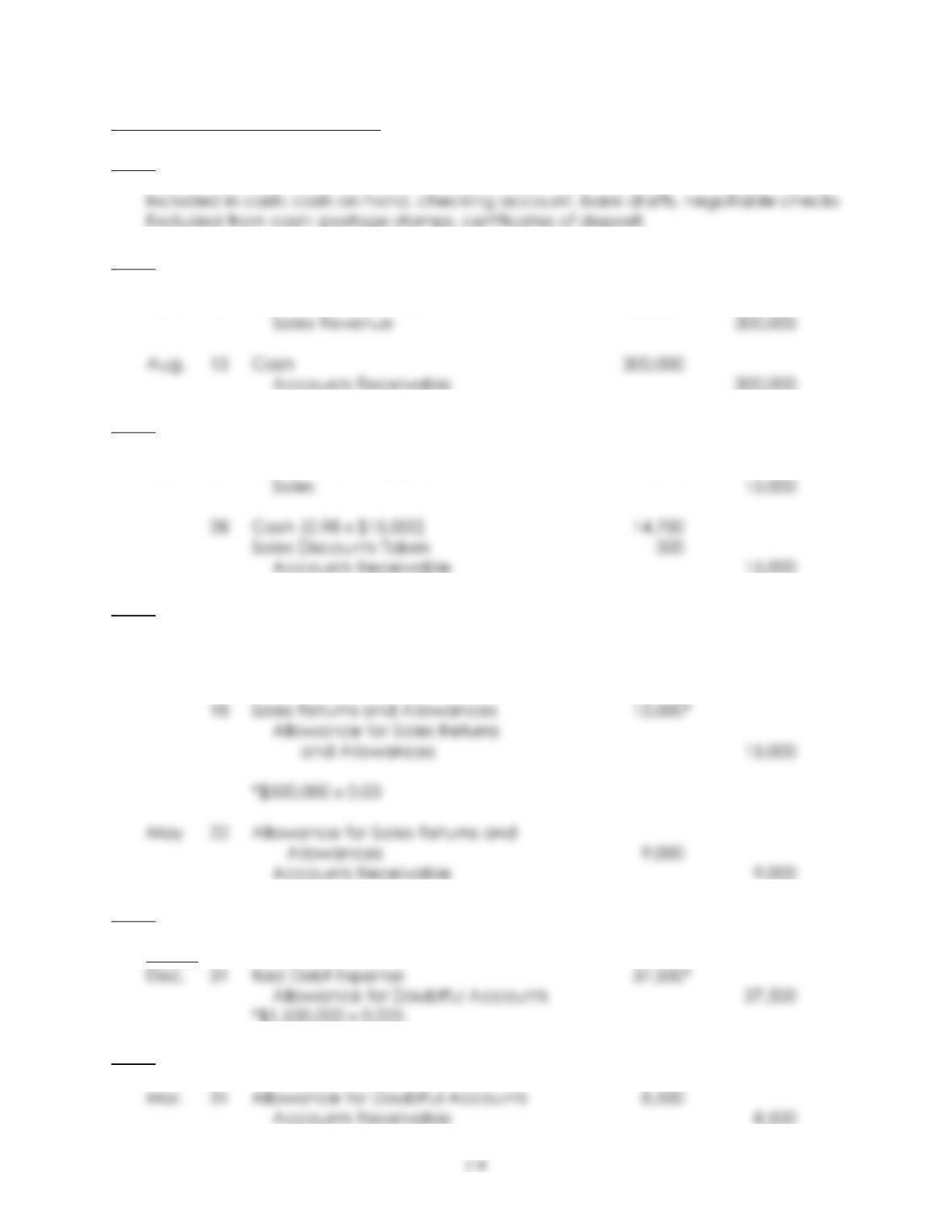
SOLUTIONS TO REVIEW EXERCISES
RE7-1
RE7-2
June 30 Accounts Receivable 300,000
RE7-3
Jan. 20 Accounts Receivable 15,000
RE7-4
Apr. 18 Accounts Receivable 500,000
Sales 500,000
RE7-5
Year 1
RE7-6
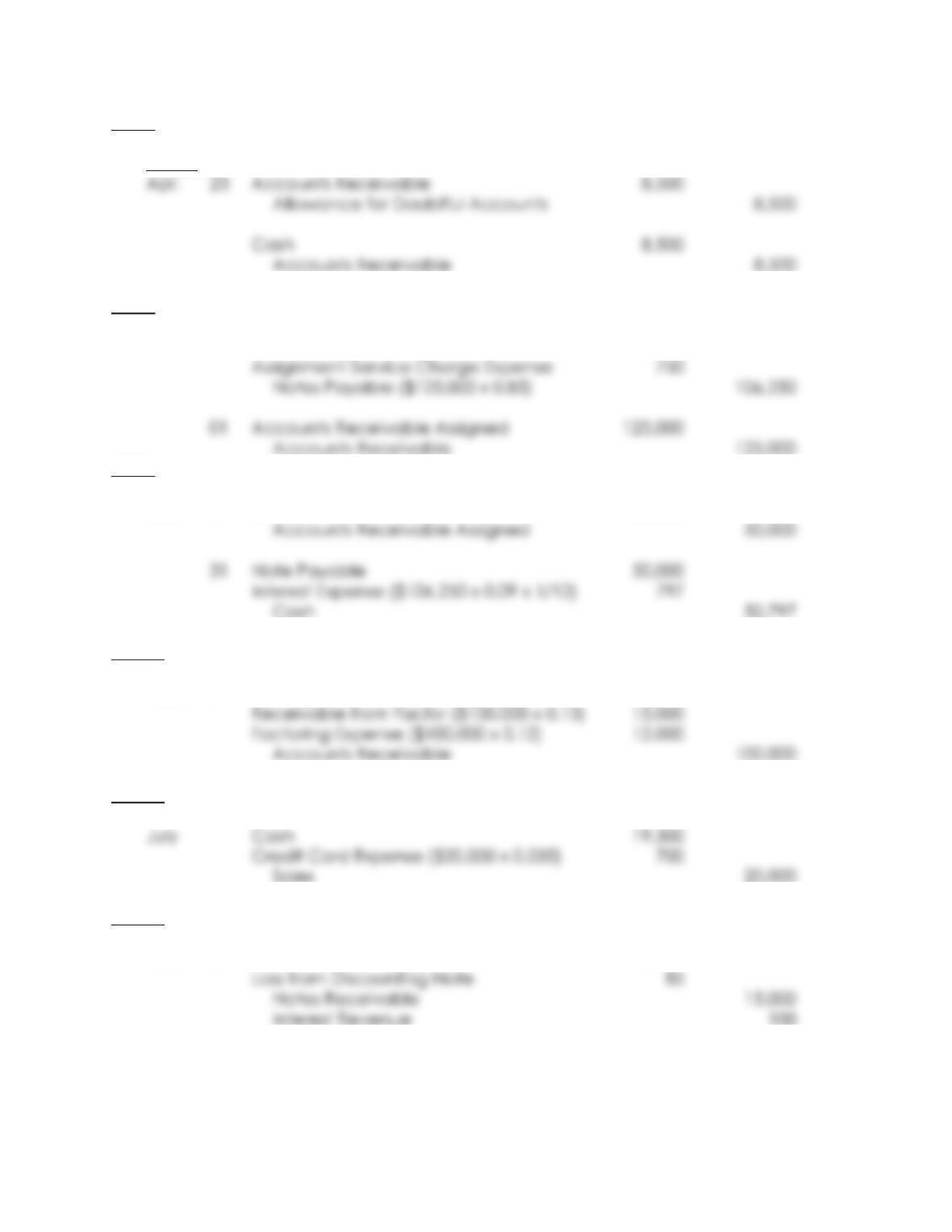
7-10
RE7-7
Year 2
RE7-8
Dec. 01 Cash [($125,000 x 0.85) – $750] 105,500
RE7-9
Dec. 31 Cash 50,000
RE7-10
Dec. 01 Cash [($100,000 x 0.85) – $12,000] 73,000
RE7-11
RE7-12
June 01 Cash ($15,400 – $385) 15,015
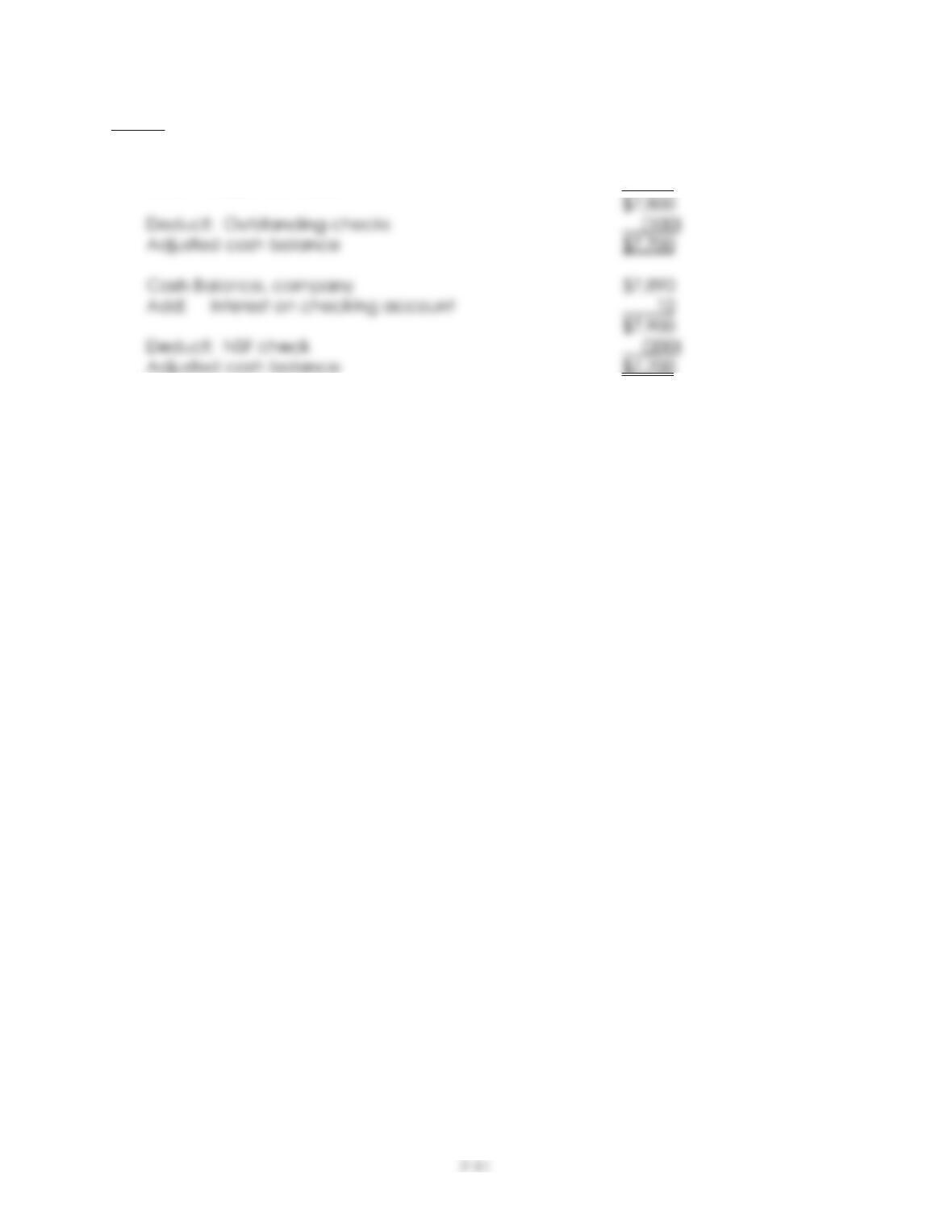
RE7-13
Cash balance, bank $7,200
Add: Deposit in transit 600
7-12
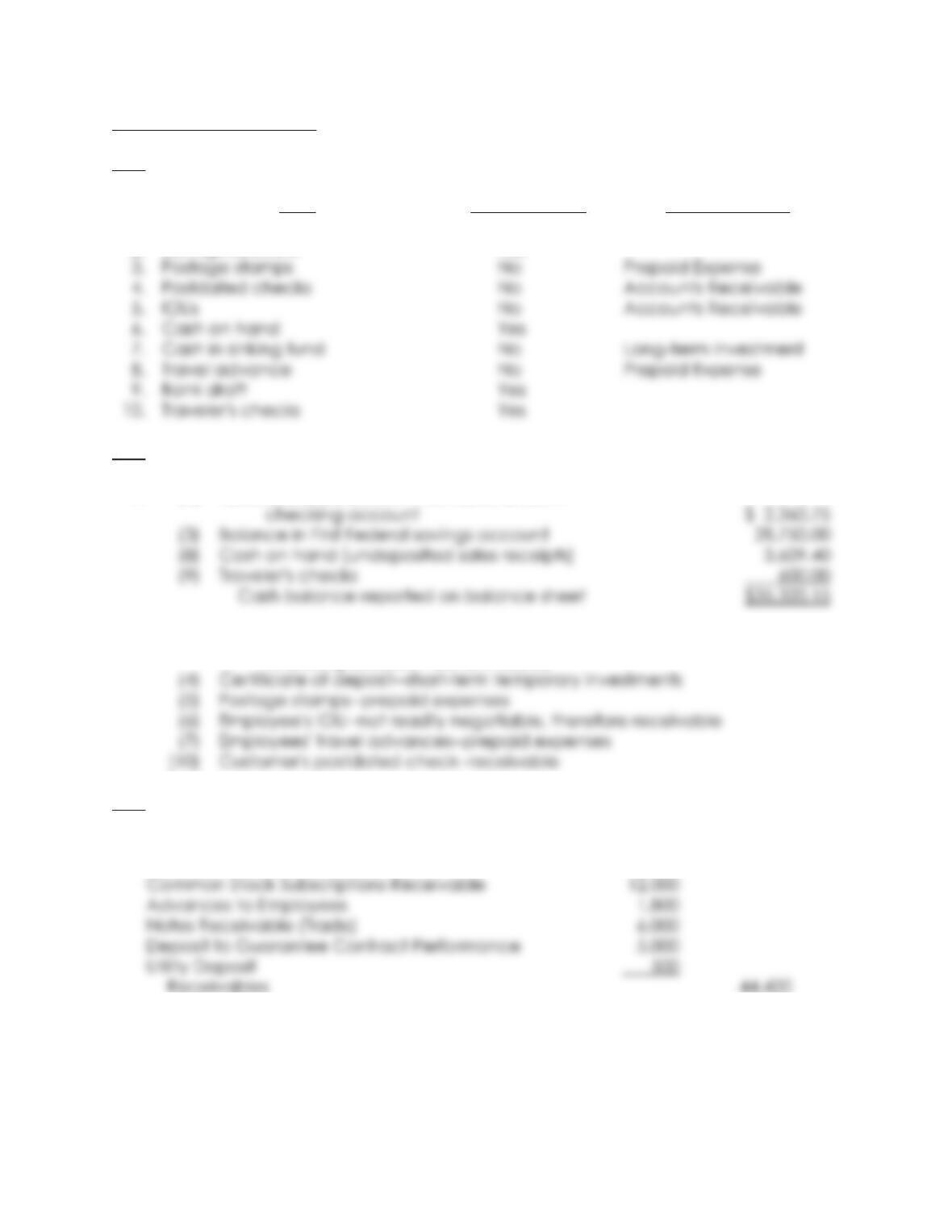
SOLUTIONS TO EXERCISES
E7-1
Item
Include in
Cash Balance
Classification of
Items Excluded
1.
2.
NSF checks
Savings account
No
Yes
Accounts Receivable
E7-2
1. (1)
Reconciled balance in First National Bank
2. (2)
Reconciled negative balance in City National Bank
checking account–current liability
E7-3
1. Accounts Receivable (Trade) 15,500
Accounts Receivable (Officers) 3,600
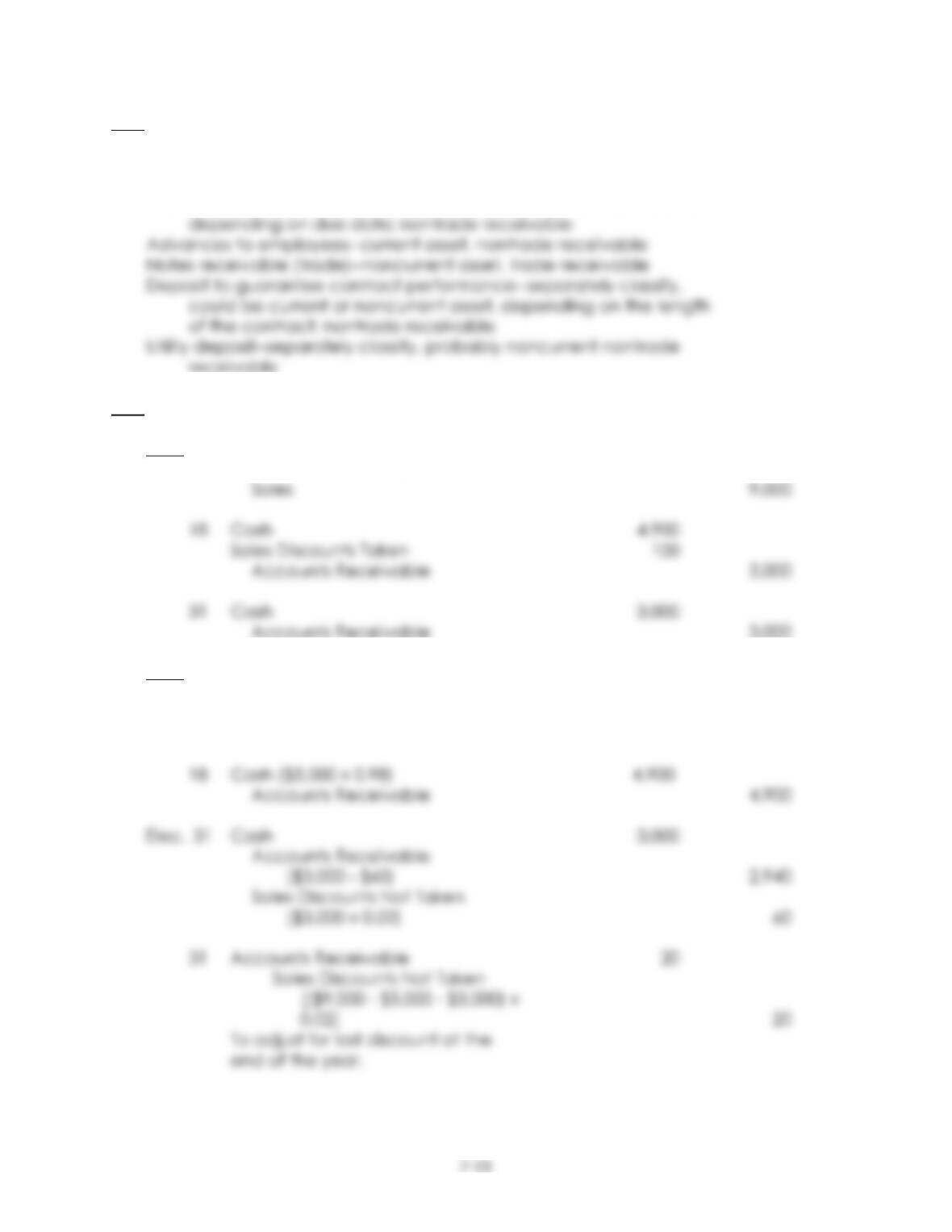
E7-3 (continued)
2. Accounts receivable (trade)–current asset, trade receivable
Accounts receivable (officers)–normally current asset, nontrade receivable
Common stock subscription receivable–current or noncurrent asset,
E7-4
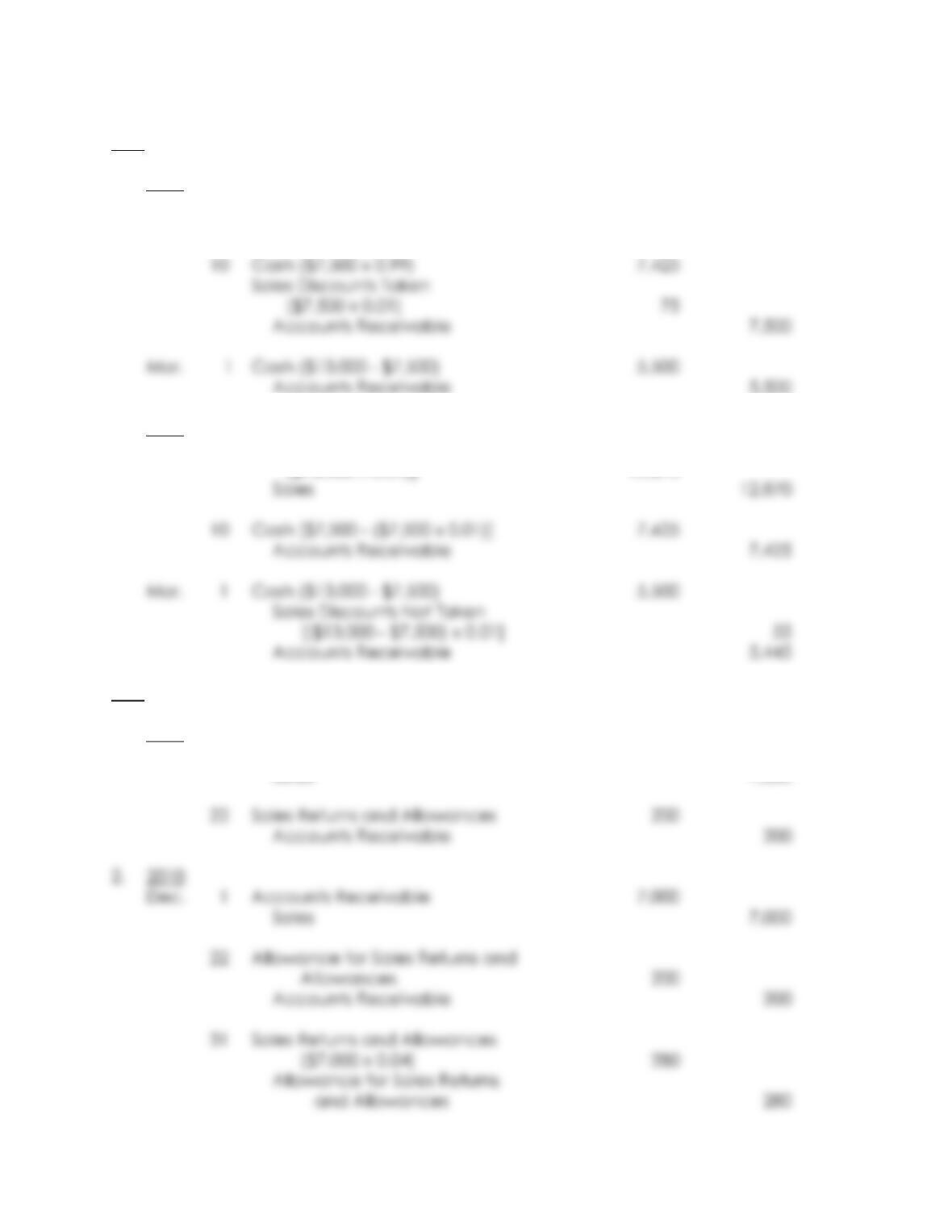
1. 2010
Dec. 8 Accounts Receivable 9,000
2. 2010
Dec. 8 Accounts Receivable
[$9,000 – (0.02 x $9,000)] 8,820
Sales 8,820
7-14
E7-5
1. 2010
Feb. 1 Accounts Receivable 13,000
Sales 13,000
2. 2010
Feb. 1 Accounts Receivable [$13,000 –
($13,000 x 0.01)] 12,870
E7-6
1. 2010
Dec. 1 Accounts Receivable 7,000
Sales 7,000
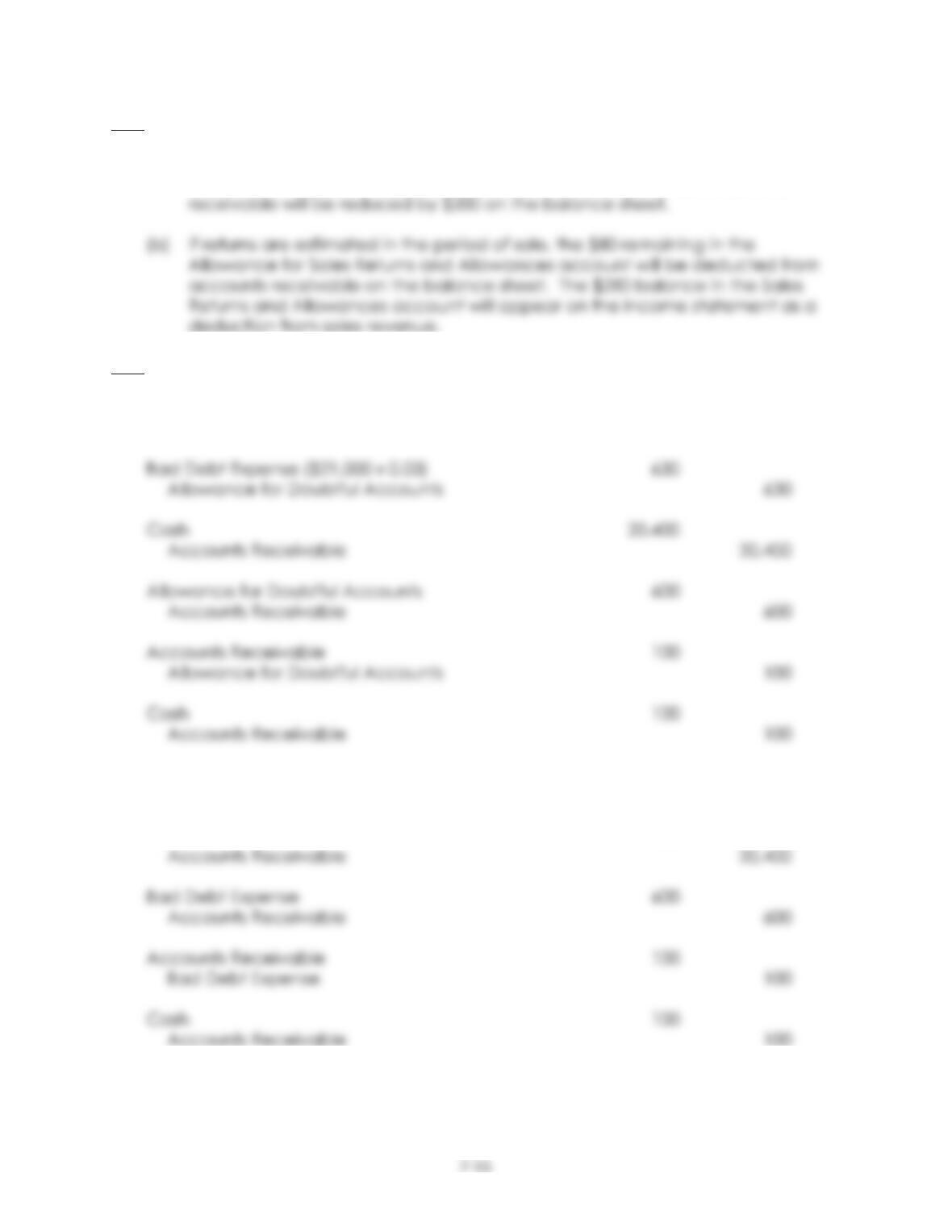
E7-6 (continued)
3. (a) If sales returns and allowances are recorded as they occur, sales returns and
allowances of $200 will appear on the income statement, and accounts
E7-7
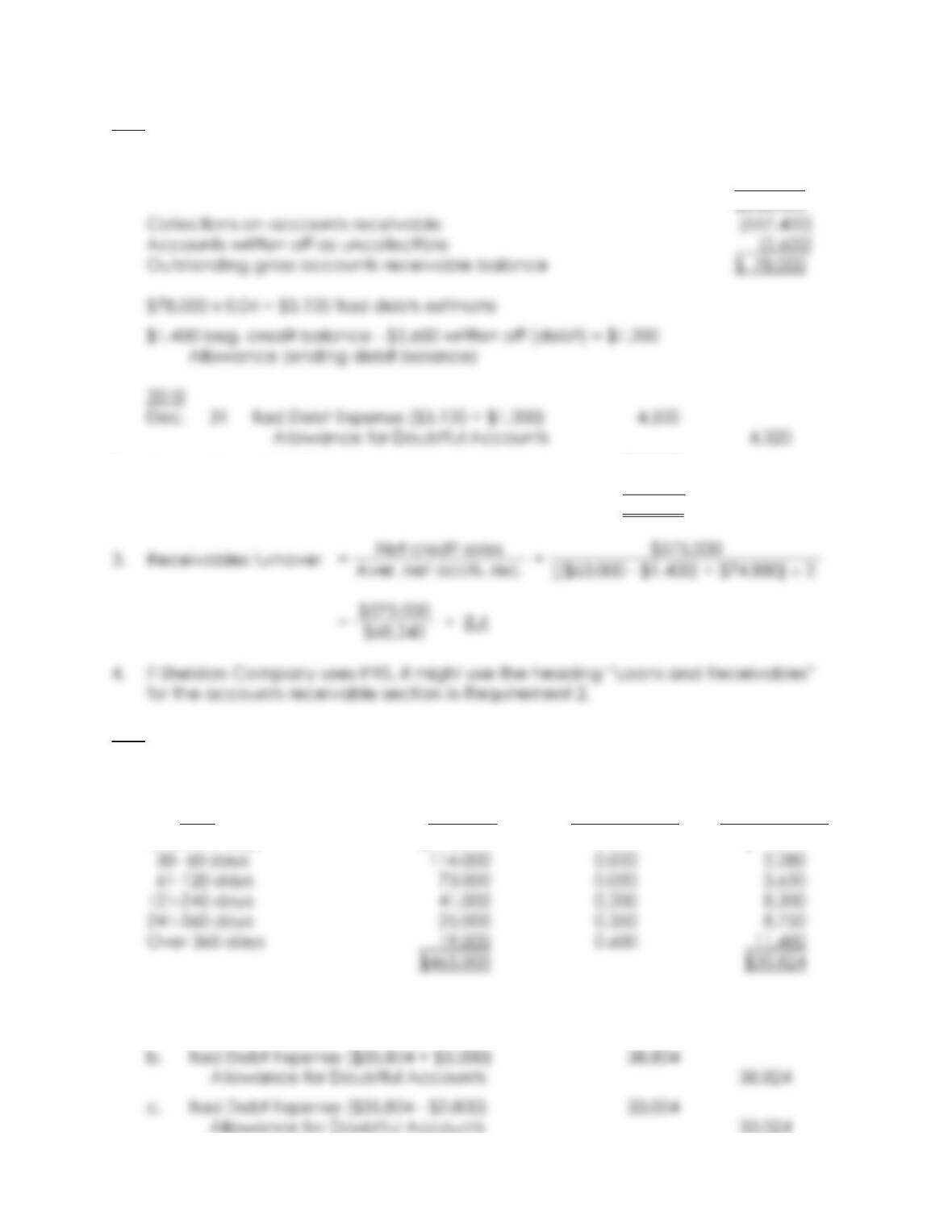
1. Accounts Receivable 21,000
Sales 21,000
2. Accounts Receivable 21,000
Sales 21,000
Cash 20,400
7-16
E7-8
1. Balance in accounts receivable (1/1/10) $ 63,000
Sales on credit 575,000
2. Accounts receivable $78,000
Allowance for doubtful accounts (3,120)
Net accounts receivable $74,880
E7-9
1.
Age
Balance
Estimated
Percentage
Uncollectible
Estimated
Amount
Uncollectible
Under 30 days
$193,000
0.008
$ 1,544
2. a. Bad Debt Expense 35,824
Allowance for Doubtful Accounts 35,824
7-17
E7-10
1. Bad Debt Expense 5,340
Allowance for Doubtful Accounts
($356,000 x 0.015) 5,340
E7-11 (AICPA adapted solution)
MASTER COMPANY
Computation of Allowance
for Doubtful Accounts
December 31, 2010
E7-12
1. 2010
Dec. 1 Cash [($160,000 x 0.80) – $1,280] 126,720
Assignment Service Charge Expense
($160,000 x 0.80 x 0.01) 1,280
7-18
E7-12 (continued)
1. (continued)
2011
Jan. 29 Cash 50,000
Accounts Receivable Assigned 50,000
2. On the December 31, 2010 balance sheet of the White Corporation, the assigned
accounts receivable and the remaining liability would be reported as follows:
E7-13
Cash [($80,000 x 0.90) – $12,800)] 59,200
Loss from Factoring ($80,000 x 0.16)* 12,800
7-19
E7-14 (AICPA adapted solution)
GUIDE COMPANY
Income Statement Effect
For the Year Ended December 31, 2010
Expenses resulting from accounts receivable
E7-15
1. 2010
Dec. 11 Notes Receivable 12,000
Cash 12,000
7-20
E7-15 (continued)
1. (continued)
Feb. 9 Cash 12,240
2. 2010
Dec. 11 Notes Receivable 12,000
2011
Jan. 1 Discount on Notes Receivable 160
E7-16
(1) (2) (3) (4)
Face value of note
Interest to maturity
$8,000
0
$9,000.00
180.00b
$6,000
150d
$10,000
400f