8-1
“Booker Jones”
Teaching Commentary
OVERVIEW
This case has been around for thirty years, and it is still one of my favorites. To me, it is definitely a star in the “oldie,
but goodie” category. For the first twenty years of its life, the case was seen as a vehicle to teach absorption versus
direct costing—a financial reporting issue. In more recent years, we have realized that there are many other excellent
discussion issues in the case. I see it now much more as a comprehensive “business policy” case with financial reporting
as the starting point.
The set of questions in the current version of the case covers all of the following issues:
1. Accounting theory—matching revisited: direct versus absorption costing.
6. What should management do? Expand or not? If yes, how to finance? What else?
It is certainly not possible to cover all these issues carefully in one class period. One strategy is to assign the
case for two class periods. In the first period, cover Questions 1-4 with heavy emphasis on the accounting theory and
8-2
Our approach at Tuck is to use the financial
reporting issues more as a “false issue,” just to get the
discussion started. We cover the case in one class
period (ninety minutes), devoting only about thirty
minutes to Questions 1 through 4. We are fairly direct
ANSWERS TO ASSIGNMENT QUESTIONS
Question 1
A. The cost of barrels in Exhibit 2 increased by
B. This is a little harder because the change is
retroactive. That means that we have to
increase the value of all barrels of whiskey in
inventory by $31.50 as of July 1, 1959. We
1. Revised balance sheet at 6/30/60:
Bulk Cased
Whiskey Whiskey
Value per Exhibit 1 4,506 1,969
172,000 barrels @ $31.50 5,418
5,000 barrels
Value per Exhibit 1 5,030 1,969
192,000 barrels @ $31.50 6,048
5,000 barrels @ $31.50 ______ 158
adjusted inventory value 11,078 2,127
follows:
Before After
Stockholders’ Equity Adjustment Adjustment Change
increase in stockholders’ equity would be the
same at the beginning and end of that fiscal
year. Thus, the profit for 1960 would still be
$752,000 pre-tax and $462,000 after tax—no
change!
balance would have been $2,794.
Before After
Stockholders’ Equity Adjustment Adjustment Change
Beginning balance, 6/30/59 2,794 8,370 5,576
Profit (loss) for 1960 462 462 ——-
Ending balance, 6/30/60 3,256 8,832 5,576
8-3
profit. Depending on the accounting system used, the
balance sheet might be very different (as we see above),
although the individual balance sheet accounts would
also be constant from one period to the next.
Question 2
In one sense, the case serves as an antidote for
shows a precipitous drop, from black to red, at exactly
the worst time—when a bank loan is needed to fund the
production build-up. Direct costing is the culprit. Very
compelling here. Some may argue that Booker Jones is
not even really using direct costing because they
expense even the barrels as a period cost. This view
holds that barrels are a direct production cost and are
thus a product cost even under direct costing. This is
arguable, but one can also reasonably view the barrels
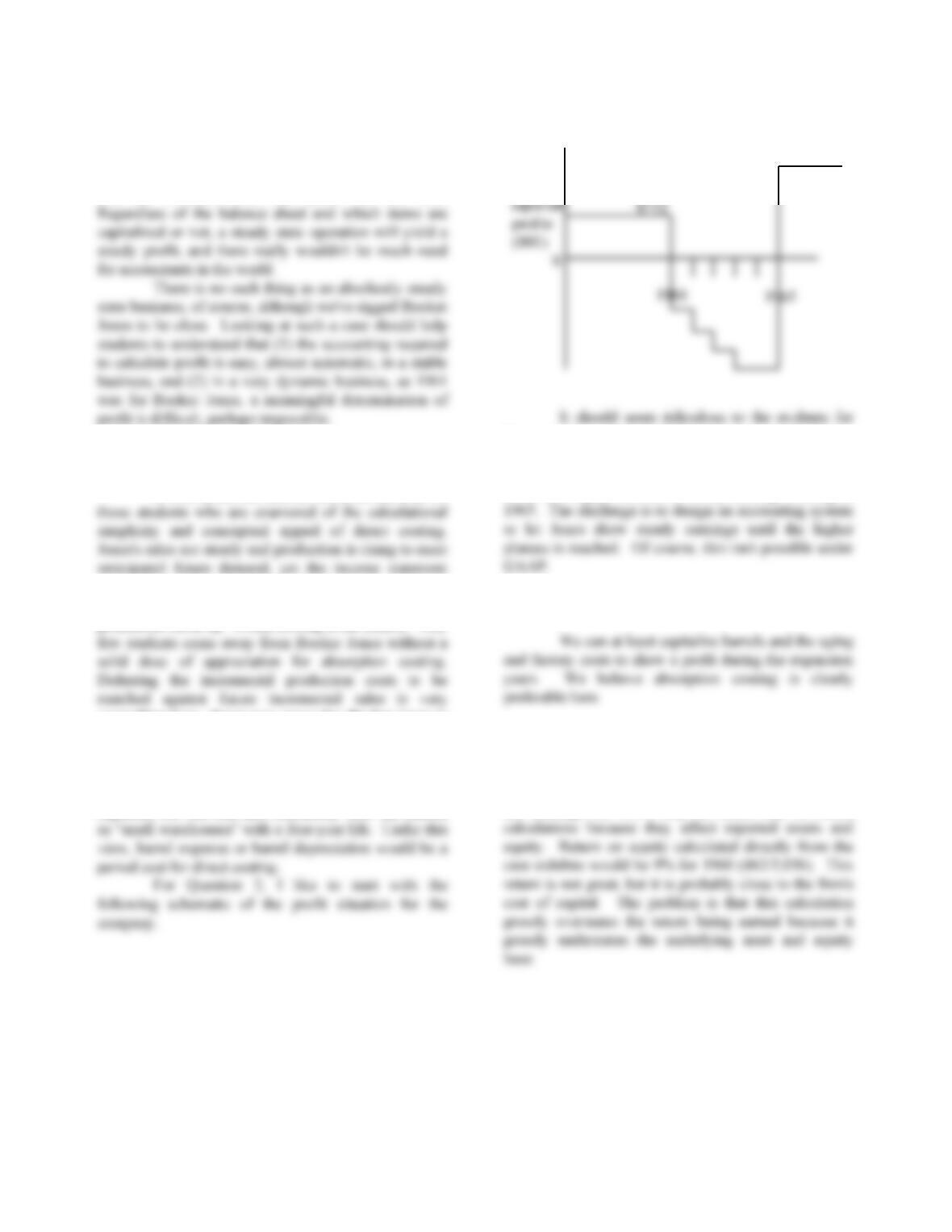
$1379
Level of
Jones to show a loss in 1961 and progressively bigger
losses in 1962, 1963, and 1964 (extra interest cost, at
least) when the additional costs being incurred will all
result in a higher stream of steady earnings starting in
Question 3
Question 4
The idea of this question is to help students see
that even though accounting policy choices don‘t affect
net earnings for 1960, they do affect rate of return
8-4
Adjusted Equity
Paid in Capital $1,800
Per these revisions, the return on equity
changes to 4-% (462/11,762).
What is a common-sense interpretation here?
Conceptually, the return on equity is the earnings
divided by the opportunity value of the equity
investment. Per Exhibit B, the net realizable value of
the asset base probably far exceeds the $11,762
number. The inventory alone may be worth that much.
Question 5
One way of summarizing the cash flows for
1961 is shown here (assuming barrels only are
capitalized and tax reporting does not change):
Operations
capitalized in inventory, the net funds required that year
for inventory investment, net of operations, is
Operations 894 (This ignores any
increase in interest
expense)
Inventory Investment (3,462)
Other Working Capital Changes 0
Property Asset Purchases 0
Net Borrowing Required 2,568
Assumptions
100 days in 1960. It isn’t clear in the case why
the 1960 level was so high.
4. No change in other current asset or current
liabilities.
5. No further investment, beyond 1961, is
8-5
of $9,767 will increase receivables by $856,000. This
cash shortfall will mean a 1965 additional borrowing
need of $373,00 ($856,000 – $483,000).
Question 6
This is a very difficult exercise, because it is
tricky to sort out the incremental investment flows and
to estimate the return from them. One way to
But this is really just a proportionate
expansion of a “poor return” business. Is this really a
reasonable investment project? Of course, it may be
too late to turn back now in 1962 when we are already
in the second year of the venture and have already
committed to a four-year expansion of warehousing
cost.
Question 7
It is certainly debatable whether or not the
As shown in the suggested approach to
Question 8, below, we try to leave open the question of
whether Ridgeview Bank should or would extend the
the case, no one had even seen this idea before. I
believe it is a brilliant insight that gives the case more
of a marketing twist than accounting or finance or
production:
• Booker Jones has lost market share over the
• Our profit margins and ROE are not good—In
fact, they are dismal.
• If we need $1M a year for four years, one way
to get it, instead of borrowing, is to raise
selling prices 5% ($21M x 5% = ~$1M).
• Per the value chain in Exhibit 2 of the case, a
5% increase ($.14 per “fifth”) in the wholesale
price results in a $.25 increase to the consumer
($.14 ÷ .84 ÷ .67). This is still a very
8-6
TEACHING STRATEGY
In moving through the assigned questions, the logical
flow is as follows:
1. Question 4—What ROE did the business earn
in 1960?
statements?
3. How is the business doing? Try to show
clearly that the business is underperforming.
4. What does this imply about the expansion
8. Question 8 then can be used as a wrap-up to
show an alternative solution.
As noted earlier, the case should be assigned
for two days if the instructor wants to allow extended
discussion of the accounting and financial reporting
SUMMARY
This case is great for reinforcing the interplay
of accounting analysis with business decision making.
8-7
EXHIBIT A
Assume: 1. Accounting for tax purposes does not change.
2. All depreciation must be reinvested to maintain the property.
Changes
Current Capitalize Capitalize
Accounting Barrels Barrels & “A&F”
Funds Available from
Operations (per Income Statement) (407) [(407)+630] 223 [223+262] 485
THE FUNDS REQUIREMENT FOR EXPANSION IS NOT AFFECTED BY ACCOUNTING METHODS.
EXHIBIT B
Inventory—As Collateral for the Loan
Cost/Barrel over four Years:
Mash $26.20 26.20
*Net Reliable Value (NRV) of an Aged Barrel of Whiskey
The Inventory—Estimated Wholesale Market Value
43,000 x ~$90
Short-Term Loan— Now $1.5M
+3.0
8-8
EXHIBIT C
1961—A Loan for ~$3M more—Is it “bankable”?
YES – An old and good customer (we already hold a $3.5M mortgage)
– We are already the seasonal credit lender (good business for us)
NO – Finance 100% of four-year expansion with zero equity?
* – Very low returns being earned