Problem 7.16
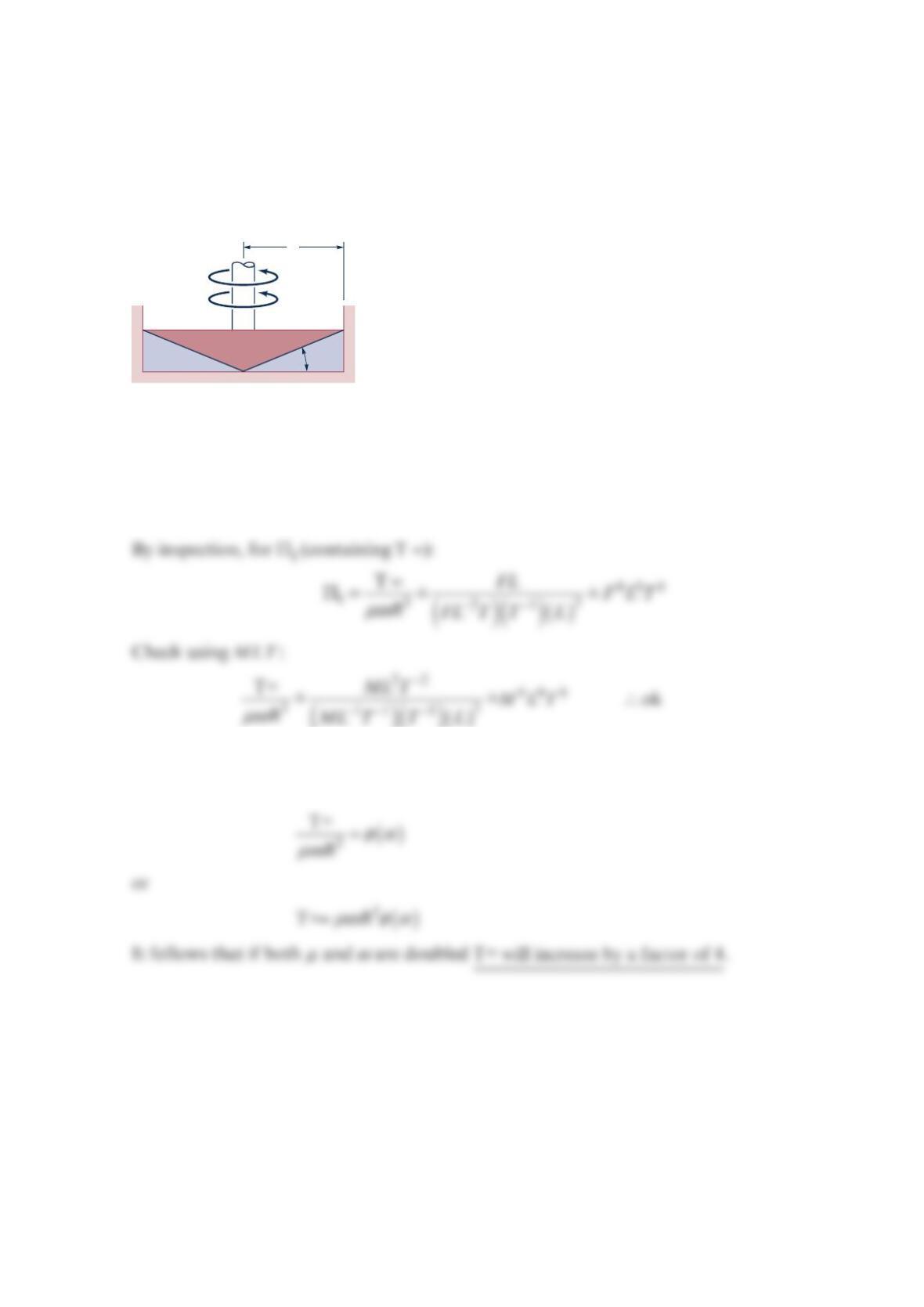
A cone and plate viscometer consists of a cone with a very small angle
α
that rotates above
a flat surface as shown in the figure below. The torque,
T,
required to rotate the cone at an
angular velocity
ω
is a function of the radius,
R
; the cone angle,
α
; and the fluid viscosity,
µ
; in addition to
ω
. With the aid of dimensional analysis, determine how the torque will
change if both the viscosity and angular velocity are doubled.
Solution 7.16
T
=
()
α
µ
ω
=
,,,fR
=
T
=
FL
=
R
L
α
=00 0
FLT
µ
−
=2
FL T
ω
−
=1
T
From the pi theorem, −=53 2
pi terms required.
()()
The angle,
α
, can be used as
Π
2 since it is dimensionless.
Thus,
T
µ
ω
R
𝒯
ω
Fluid
α
Π
T
Π
F
M
M
Problem 7.17
The pressure drop,
Δ
p
, along a straight pipe of diameter
D
has been experimentally studied,
and it is observed that for laminar flow of a given fluid and pipe, the pressure drop varies
directly with the distance,
, between pressure taps. Assume that
Δ
p
is a function of
D
and
,
the velocity,
V
, and the fluid viscosity,
µ
. Use dimensional analysis to deduce how the
pressure drop varies with pipe diameter.
Solution 7.17
()
µ
Δ
=,, ,pfDV
−
Δ
=2
pFL
=
D
L
=L
−
=1
VLT
µ
−
=2
FL T
For
Π
2(containing
):
Π
=
2D
which is obviously dimensionless. Thus,
Δ
K
Π
Δ
p
M
M
Problem 7.18
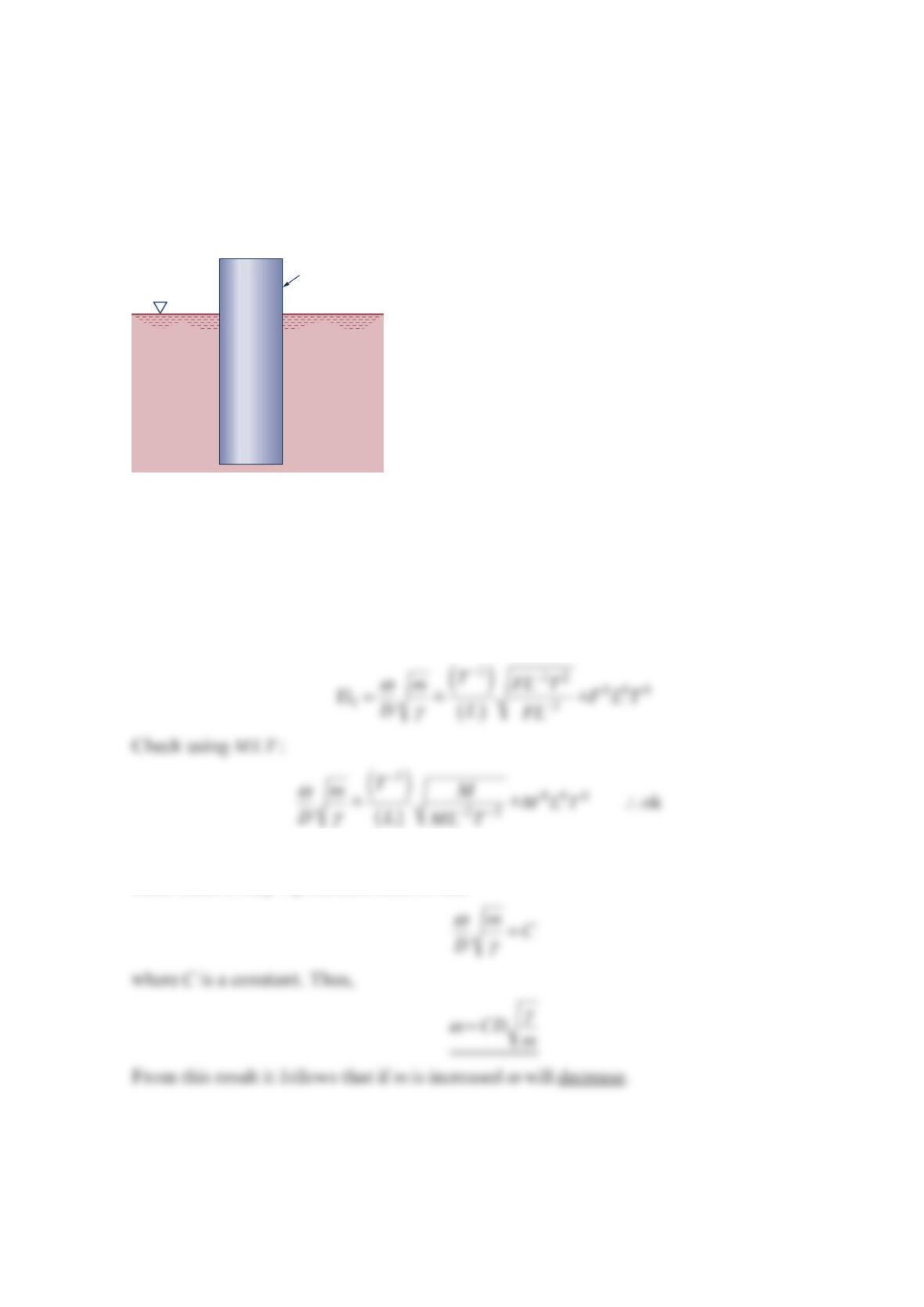
A cylinder with a diameter
D
floats upright in a liquid as shown in the figure below. When
the cylinder is displaced slightly along its vertical axis it will oscillate about its equilibrium
position with a frequency,
ω
. Assume that this frequency is a function of the diameter,
D
;
the mass of the cylinder,
m
; and the specific weight,
γ
, of the liquid. Determine, with the aid
of dimensional analysis, how the frequency is related to these variables. If the mass of the
cylinder were increased, would the frequency increase or decrease?
Solution 7.18
()
ωγ
=,,fDm
ω
−
=1
T
=
D
L
−
=12
mFLT
γ
−3
FL
From the pi theorem, −=43
1
pi terms required.
By inspection:
Since there is only 1 pi term, it follows that
ω
Cylinder
diameter =
D
Liquid
F
M
Problem 7.20
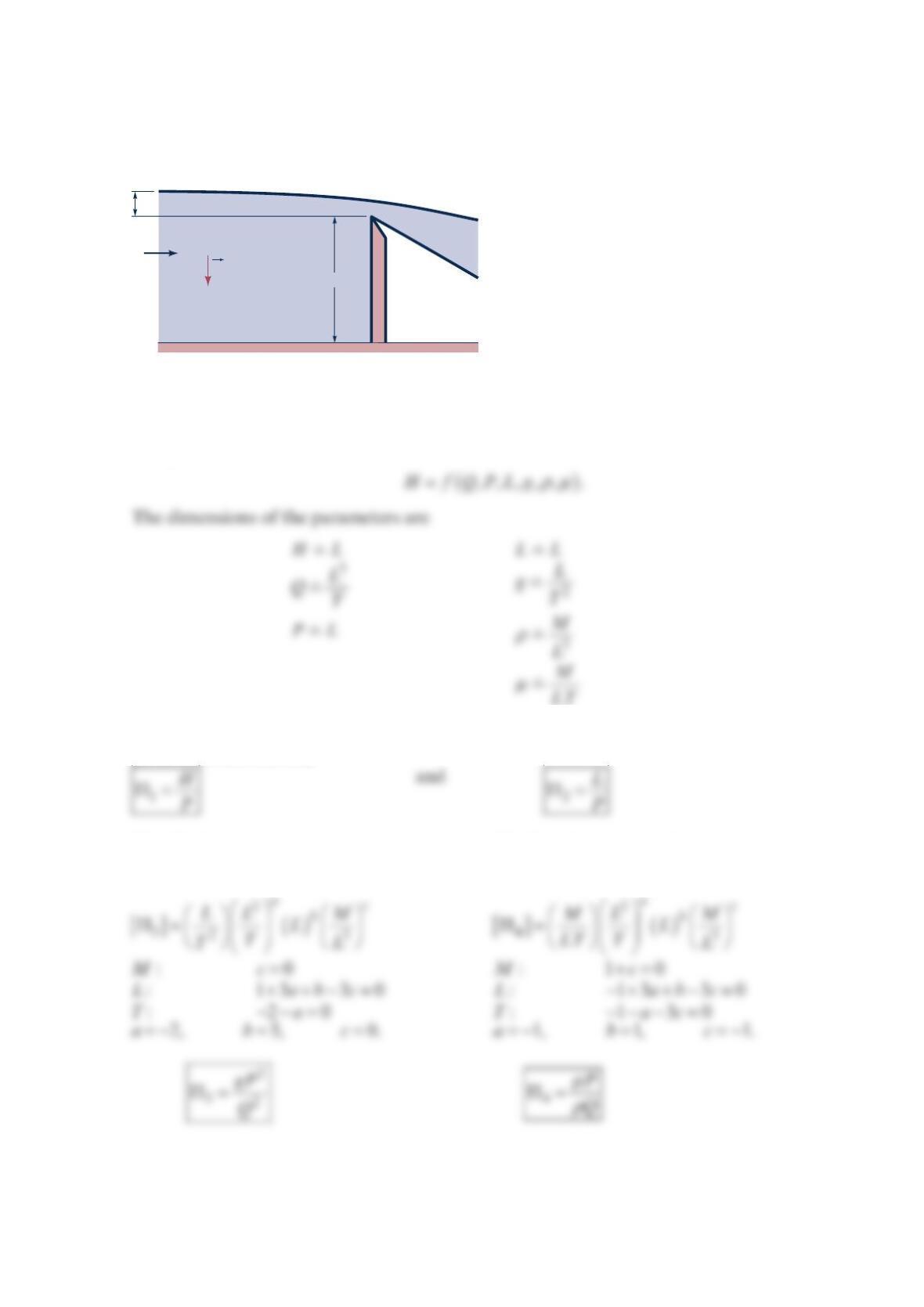
The weir shown in the figure below is used to measure the volume flowrate Q. The height H
is a measure of this flowrate. The weir has length L (perpendicular to the paper). Select and
include relevant fluid properties and find the appropriate dimensionless parameters.
Solution 7.20
Considering head above the weir H as the dependent variable and flowrate Q as an
independent variable.
So =7
n
, =3
k
, and −=4
n
k. Choose ,,QP
and
ρ
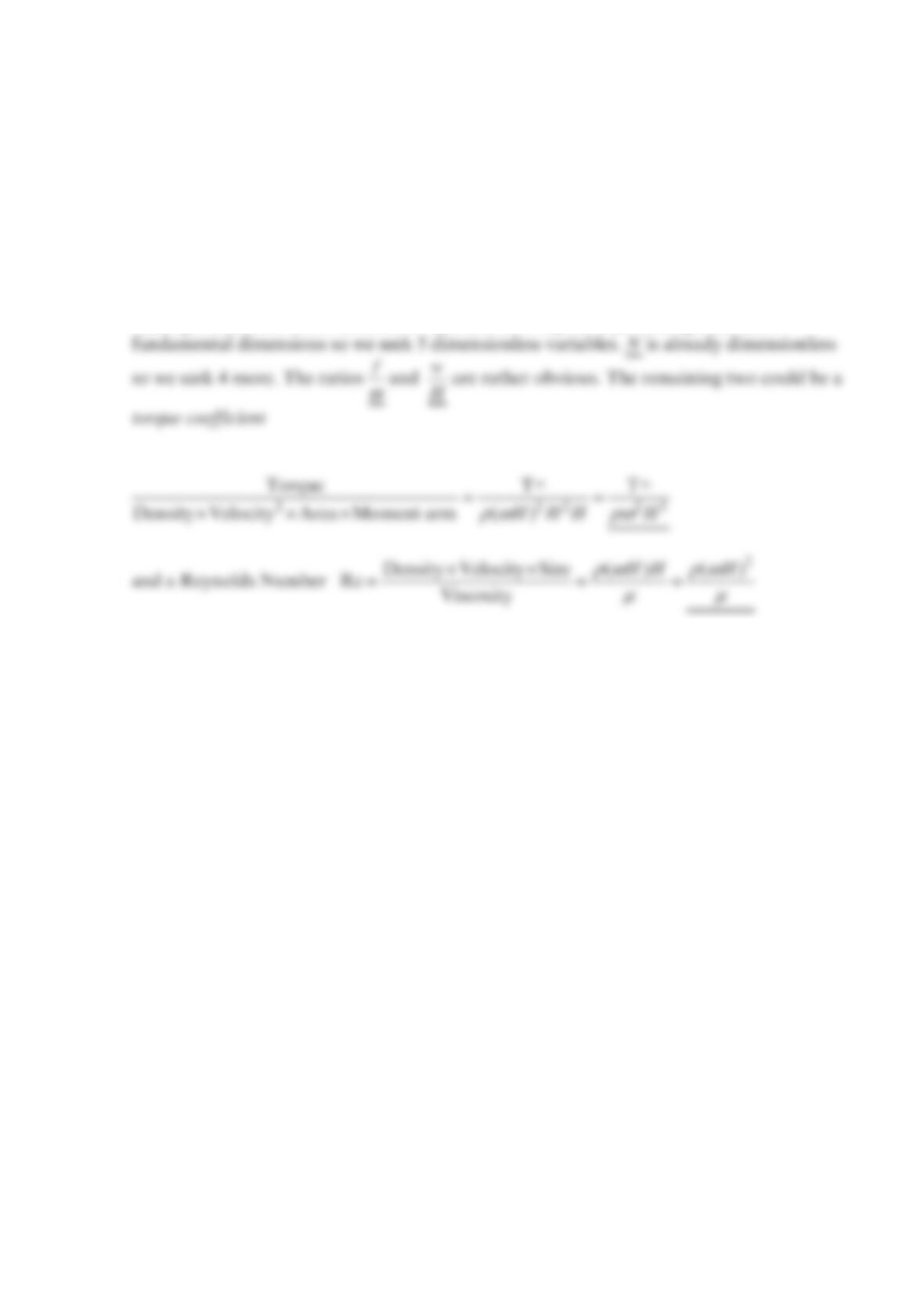
as repeating variables. The first two
parameters are obvious
The third parameter is The fourth parameter is
ρ
Π
=
3
ab
c
gQ P
µρ
Π
=
4
abc
QP
M
M
a
b
a
b
c
P
H
Q
Density =
Absolute viscosity =
g
ρ
μ
Problem 7.21
Experiments are conducted on a washing machine agitator. The relevant dimensional
parameters are the driving torque,
T
=; the oscillation frequency,
f
; the angular velocity,
ω
;
the number of paddles, N; the paddle height, H; and the paddle width, w. Specify the
relevant fluid properties and find the appropriate dimensionless parameters.
Solution 7.21
The relevant fluid properties are density
ρ
and viscosity
µ
.
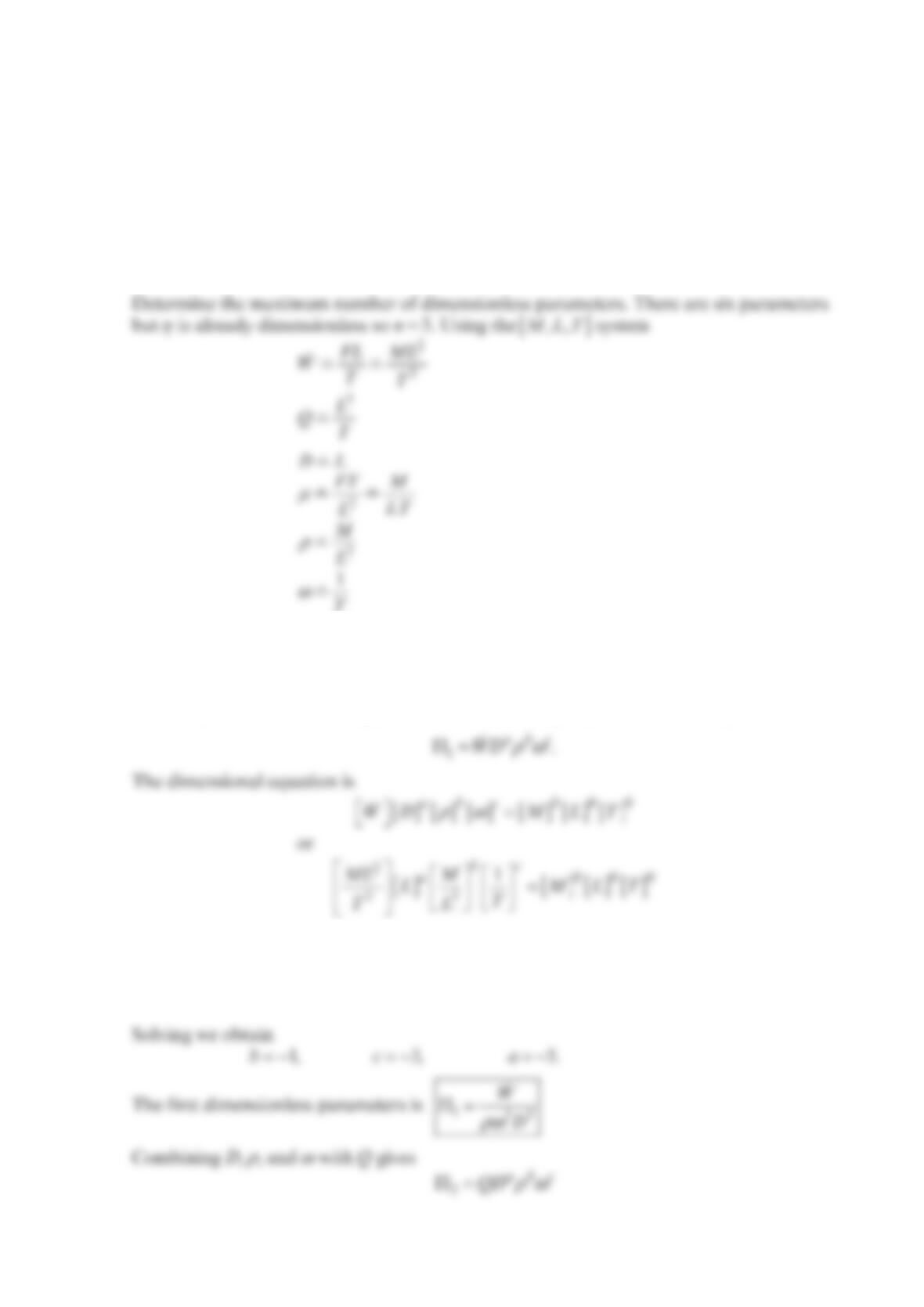
Adding these, there are 8 variables
ω
ρµ
T
=,,, , ,,, and
.
fNHw Among them are 3
Problem 7.22
The input power,
W
, to a large industrial fan depends on the fan impeller diameter
D
, fluid
viscosity
µ
, fluid density
ρ
, volumetric flow Q, and blade rotational speed
ω
. What are the
appropriate dimensionless parameters?
Solution 7.22
Write the dimensional relation considering
W
as the dependent variable
()
µρ
ω
=,,,,
.
W
fQD
T
There are three fundamental dimensions
()
,,MLT so we expect
µ
=3; , ,
k
D and
ρ
cannot
form a dimensions group so =3
k
and the maximum number of dimensionless parameters is
()
−=63 3.
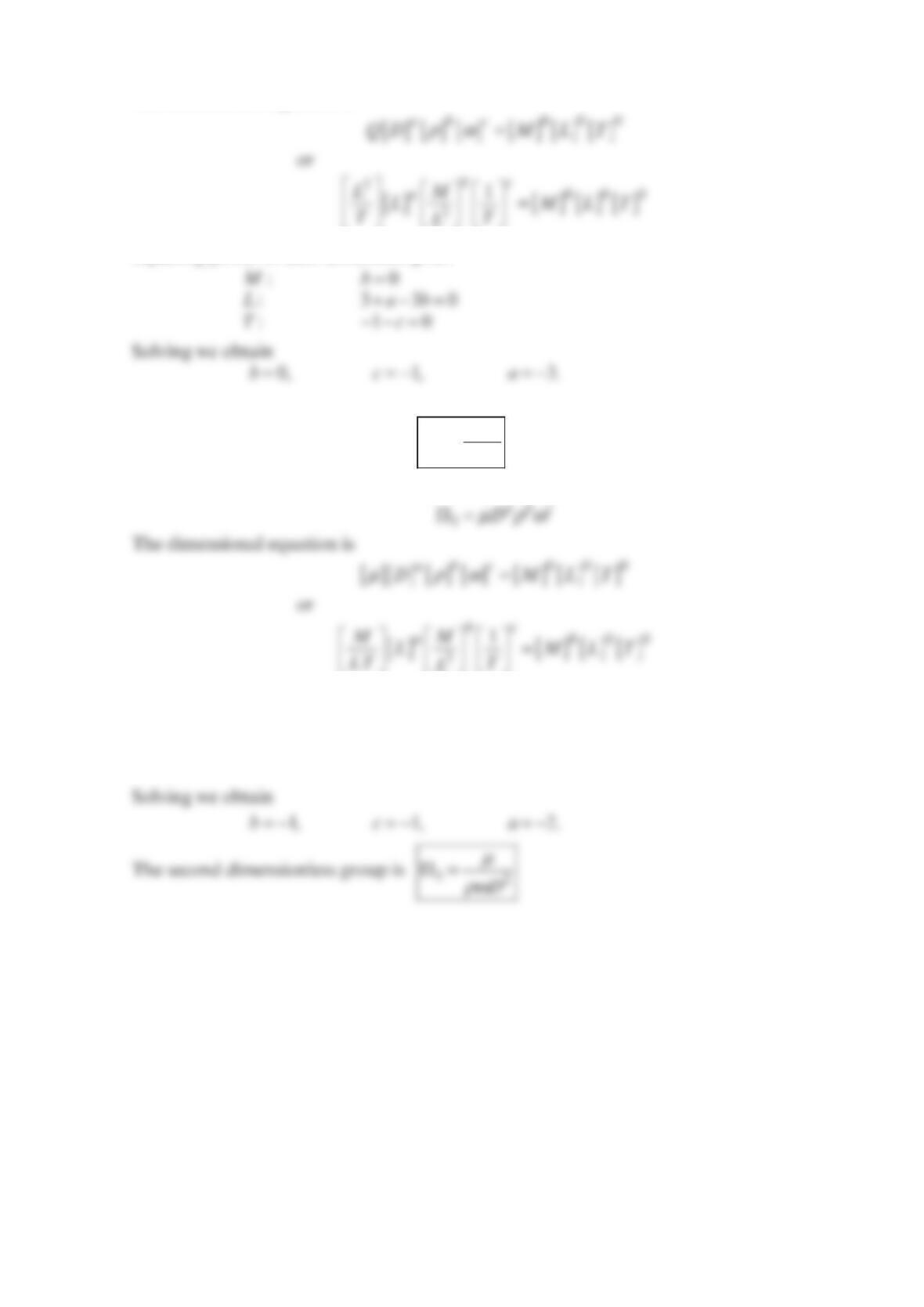
Select
ρ
,,
D
and
ω
as repeating parameters. Combining
ρ
,,
D
and
ω
with
W
gives
Equating power of each dimension gives
:
M
+=
1
0b
:L+− =
2
30ab
:T
−
−=30c
b
c
5
a
n
D
The dimensional equation is
Equating power of each dimension gives
M
b
3
−
b
c
a
The second dimensionless group is
ω
Π=
23
Q
D
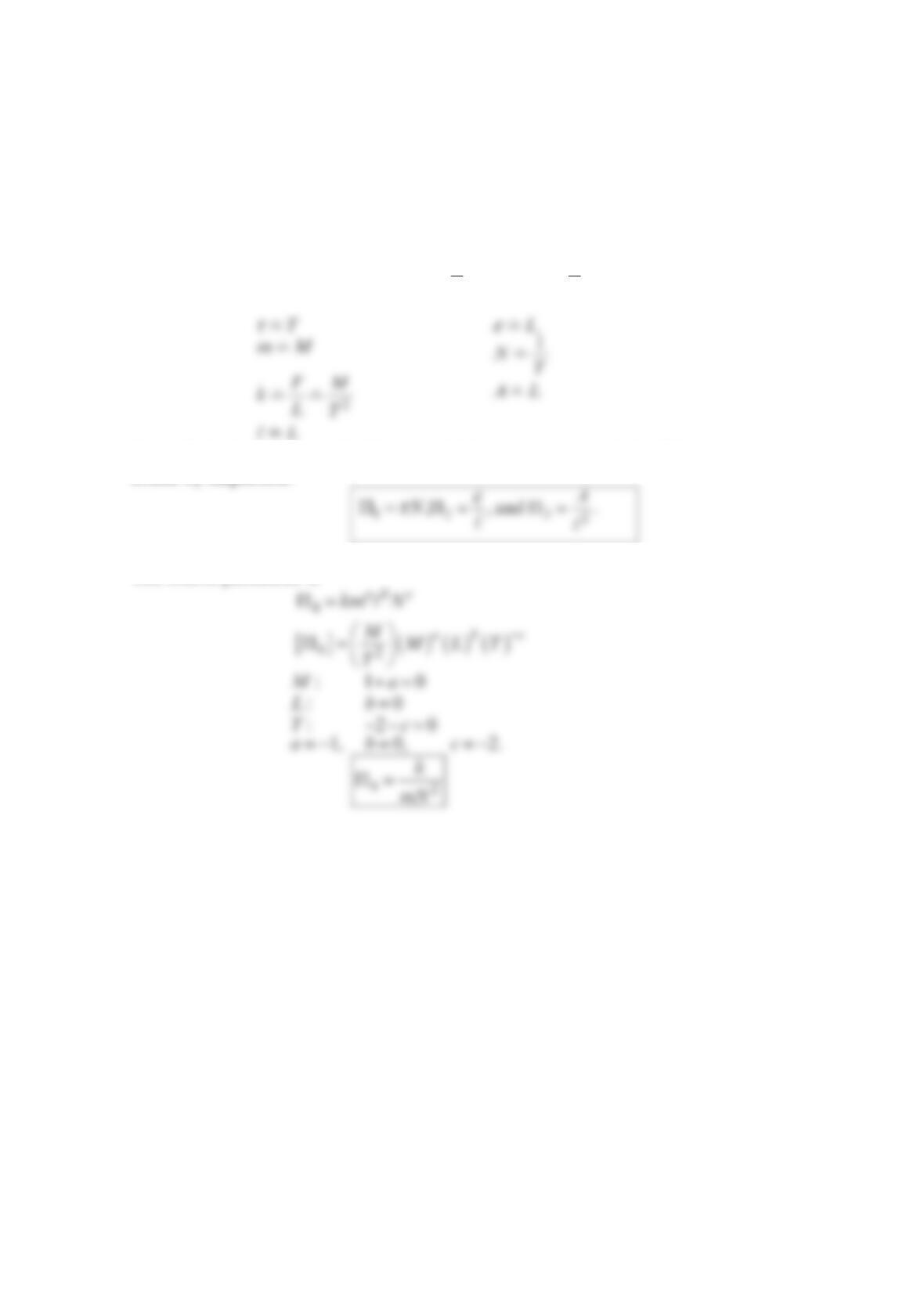
Combining
ρ
,,
D
and
ω
with
µ
gives
Equating power of each dimension gives
:
M
+=
1
0b
:L
−
+− =130ab
:T
−
−=10c
b
c
a
Problem 7.23
Develop the appropriate dimensionless parameters for the period
τ
of transverse vibration
of a turbine rotor of mass
m
connected to a shaft of stiffness =/
k
FL
and length
. Other
relevant dimensional parameters are the eccentricity
ε
=L
of the center of mass of the
rotor, the speed of rotation =1/NT
of the shaft, and the amplitude =
A
L
of the vibration.
The dimensions are Solution 7.23
τ
=(
f
ε
,,,, , )mk NA
So =7
n
, =3
k
, and −=4
n
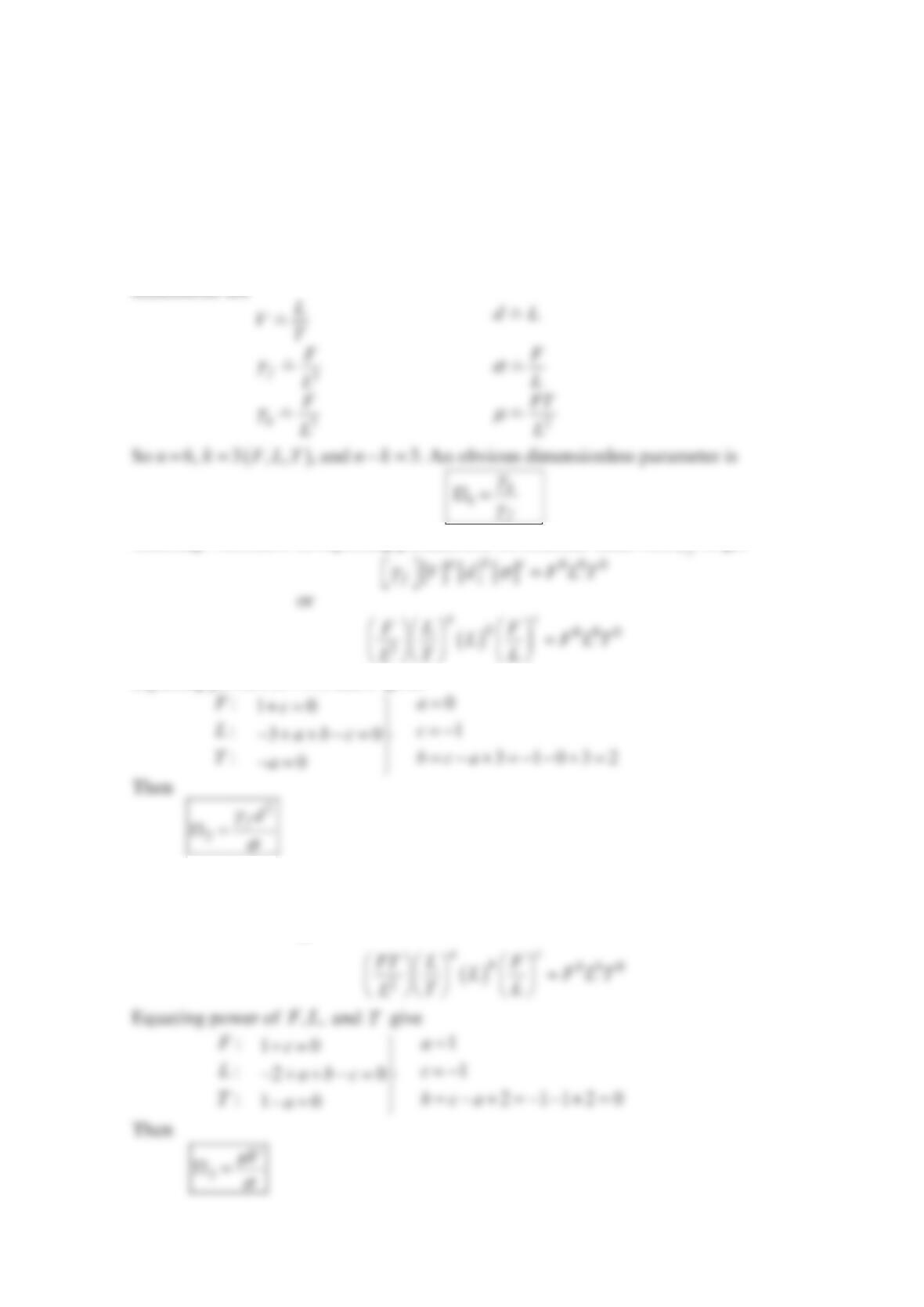
k. Choose ,,mN as repeating variables. Three parameters are
found by inspection.
The fourth parameter is
M
b
a
b
ε
L
A
Problem 7.24
A vapor bubble rises in a liquid. The relevant dimensional parameters are the liquid specific
weight,
γ
f
; the vapor specific weight,
γ
g
; bubble velocity,
V
; bubble diameter,
d
; surface
tension,
σ
; and liquid viscosity,
µ
. Find appropriate dimensionless parameters.
Solution 7.24
()
γγ
σ
µ
=,,
,,
fg
V
fd
dimensions are
Selecting ,,Vd
and
σ
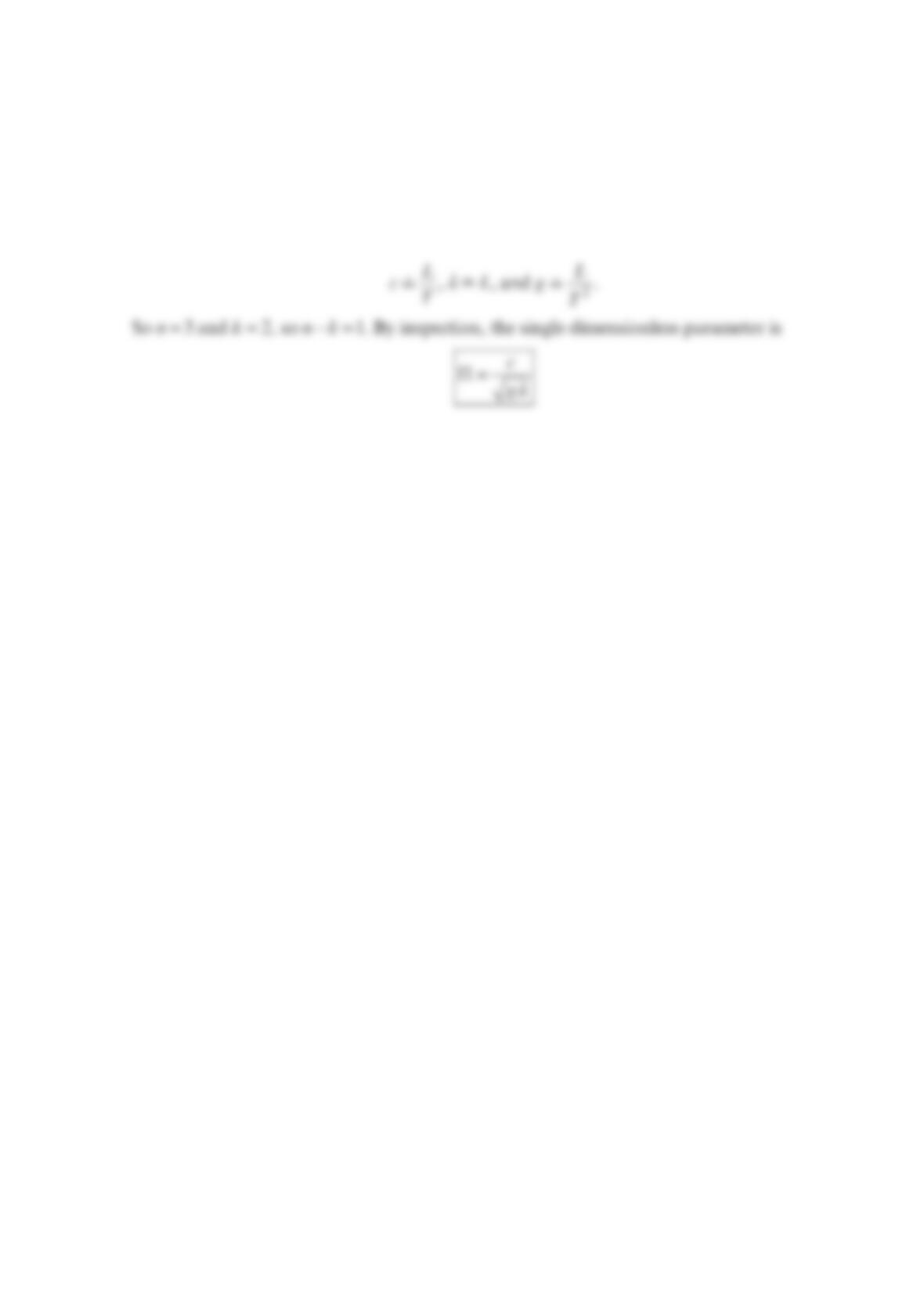
as repeating parameters, we combine them with
γ
to get
Equating powers of ,,
F
L and T gives
Combining ,,Vd and
σ
with
µ
gives
[][][][]
µσ
=00 0
abc
Vd FLT
or
d
γ
n
k
n
Problem 7.25
The speed of deep ocean waves depends on the wave length and gravitational acceleration.
What are the appropriate dimensionless parameters?
Solution 7.25
()
λ
=,cf g
where =
c
wave speed and
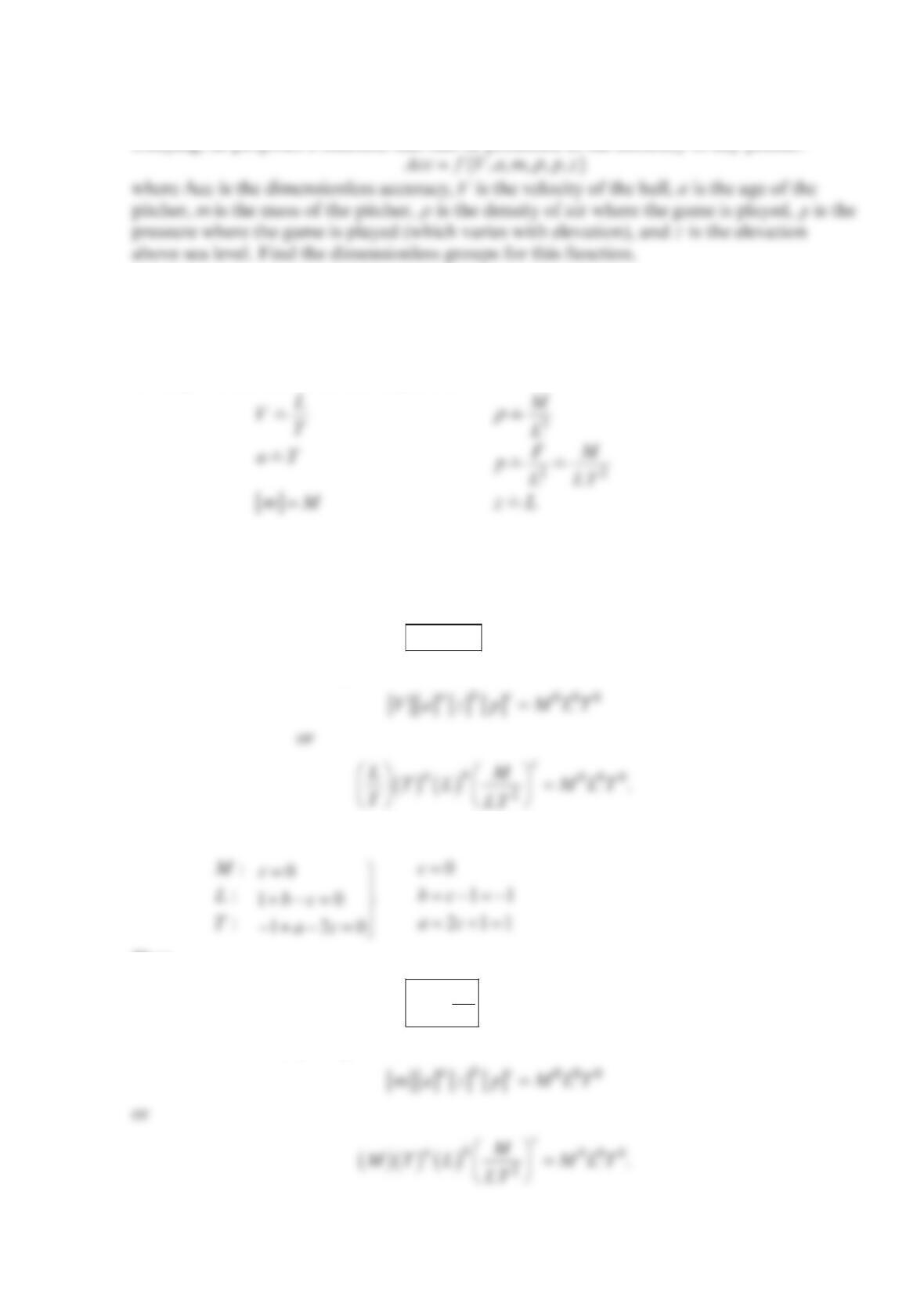
λ
=
wave length. The dimensions are
Problem 7.26
A coach has been trying to evaluate the accuracy of a baseball pitcher. After 2 years of
studying, he proposes a function that can be presented as the accuracy of any pitcher:
Solution 7.26
()
ρ
=,, , ,,
A
cc f V a m p z
Identity the relevant dimensional parameters
Step 2. The number of physical parameters is =7
n
(including the dimensionless
A
cc). The
number of fundamental dimensions is =3
k
(for ,,
M
L and T) and since ,,
a
z and
p
cannot
form a dimensionless groups. This gives −=4
n
k dimensionless groups. One obvious
dimensionless group is
Π=
1Acc
We now combine ,,
a
z and
p
with
V
.
Equating powers of ,,
M
L and T give
Then
Π=
2
Va
z
We now combine ,,
a
z and
p
m
.
ρ
A
V
a
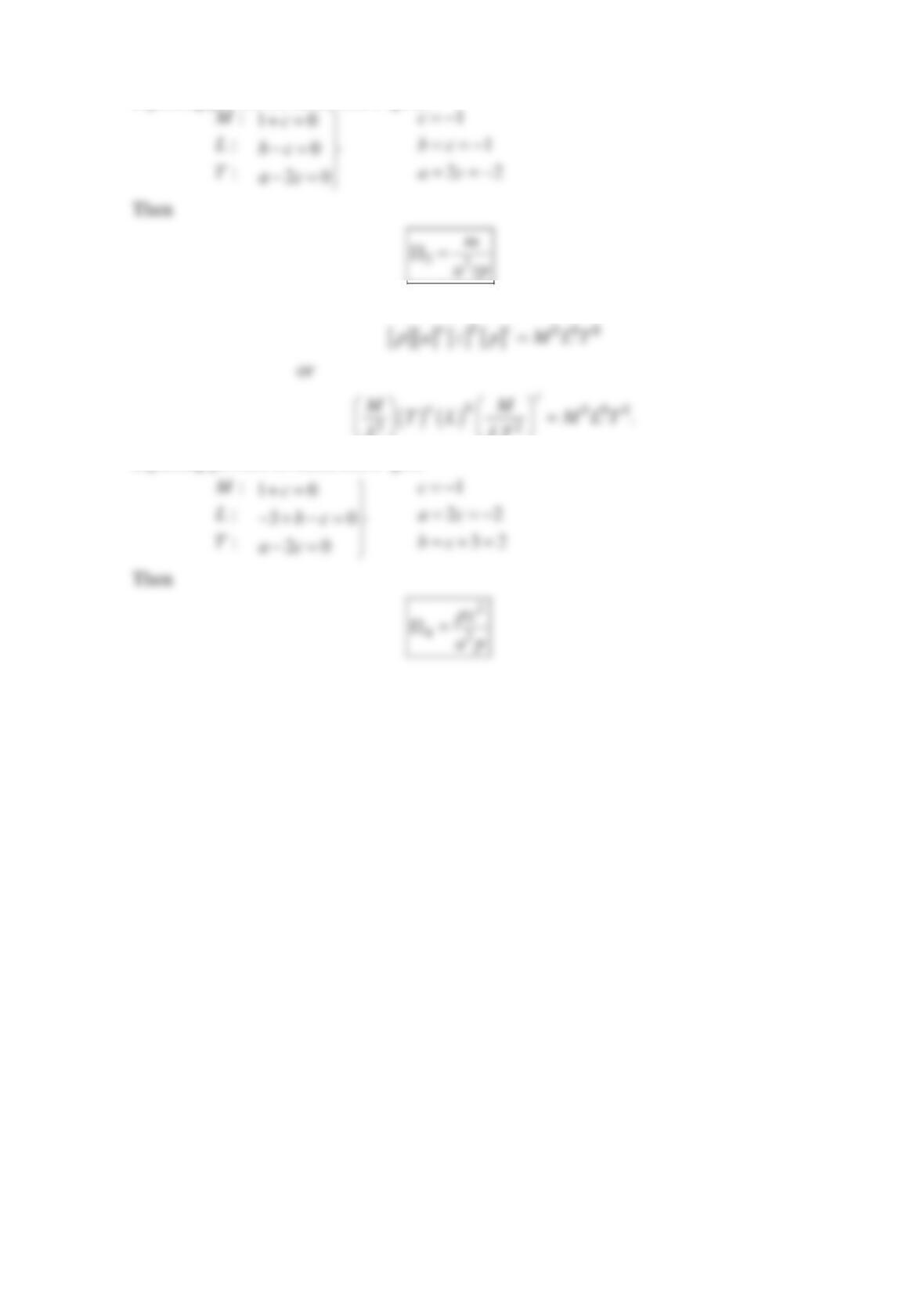
Equating powers of ,,
M
L and T gives
We now combine ,,
a
z and
p
with
ρ
.
LLT .
Equating powers of ,,
M
L and T give
Problem 7.27
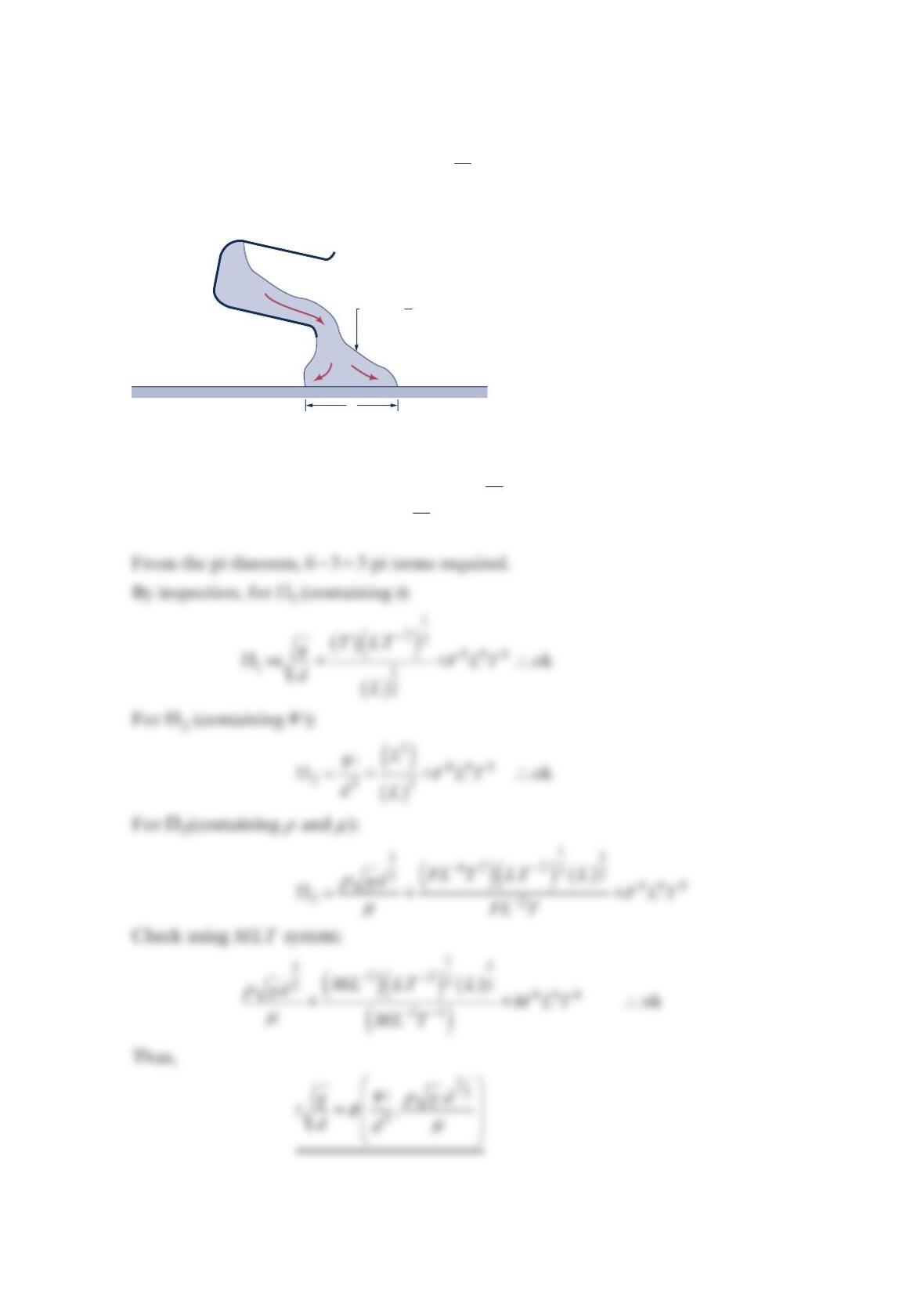
A viscous fluid is poured onto a horizontal plate as shown in the figure below. Assume
that the time,
t
; required for the fluid to flow a certain distance,
d
; along the plate is a
function of the volume of fluid poured, V; acceleration of gravity,g; fluid density,
ρ
; and
fluid viscosity,
µ
. Determine an appropriate set of pi terms to describe this process. Form
the pi terms by inspection.
Solution 7.27
ρµ
=(, ,, ,
)
tfdVg
=t
T
=
d
L
=3
VL
−
=2
gLT
ρ
−
=42
FL T
µ
−
=2
FL T
d
VolumeV
t
ρ
µ
Problem 7.28
The velocity,c, at which pressure pulses travel through arteries (pulse–wave velocity) is a
function of the artery diameter,
D
; wall thickness,
h
; the density of blood,
ρ
; and the
modulus of elasticity,
E
, of the arterial wall. Determine a set of nondimensional parameters
that can be used to study experimentally the relationship between the pulse–wave velocity
and the variables listed. Form the nondimensional parameters by inspection.
Solution 7.28
ρ
=(,,,)cfDh E
−
=1
cLT
=
D
L
=
h
L
ρ
−
=42
FL T
−
=2
E
FL
F
M
M
Problem 7.29
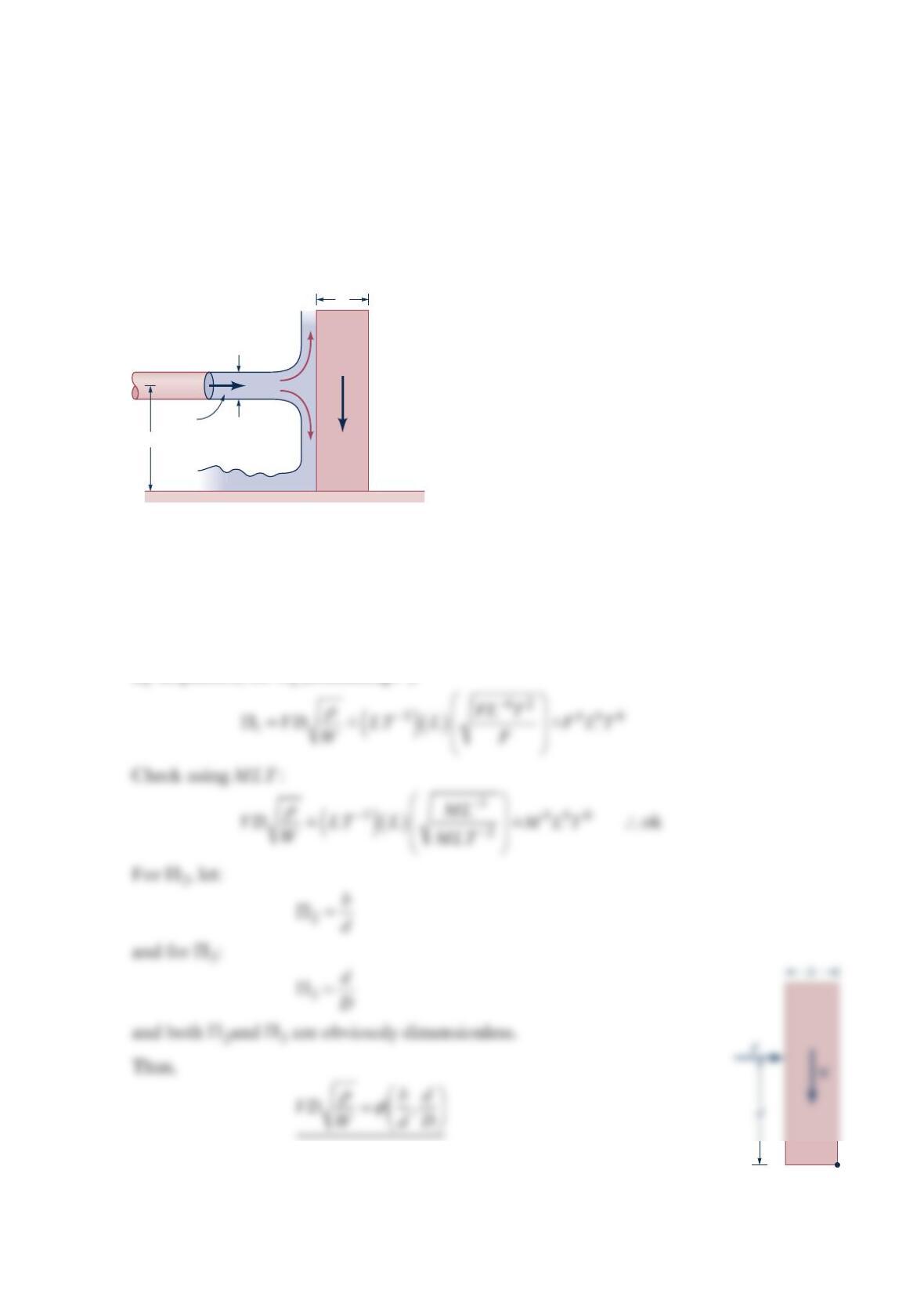
As shown in the figure below, a jet of liquid directed against a block can tip over the block.
Assume that the velocity,
V
, needed to tip over the block is a function of the fluid density,
ρ
,
the diameter of the jet,
D
, the weight of the block, ,
W
the width of the block,
b
, and the
distance,
d
, between the jet and the bottom of the block. (a) Determine a set of
dimensionless parameters for this problem. Form the dimensionless parameters by
inspection. (b) Use the momentum equation to determine an equation for V in terms of the
other variables. (c) Compare the results of parts (a) and (b).
Solution 7.29
(a)
ρ
=(, , ,,)Vf DWbd
−
=1
VLT
ρ
−
=42
FL T
=
D
L
=
W
F
=
b
L
=
dL
From the pi theorem, −=633
pi terms required.
By inspection, for
Π
(containing
V
):
(b) For impending tipping around 0
=
00M
V
D
d
b
ρ
𝒲
0
Π
Π
Π
Π
So that
=
2
b
F
dW (1)
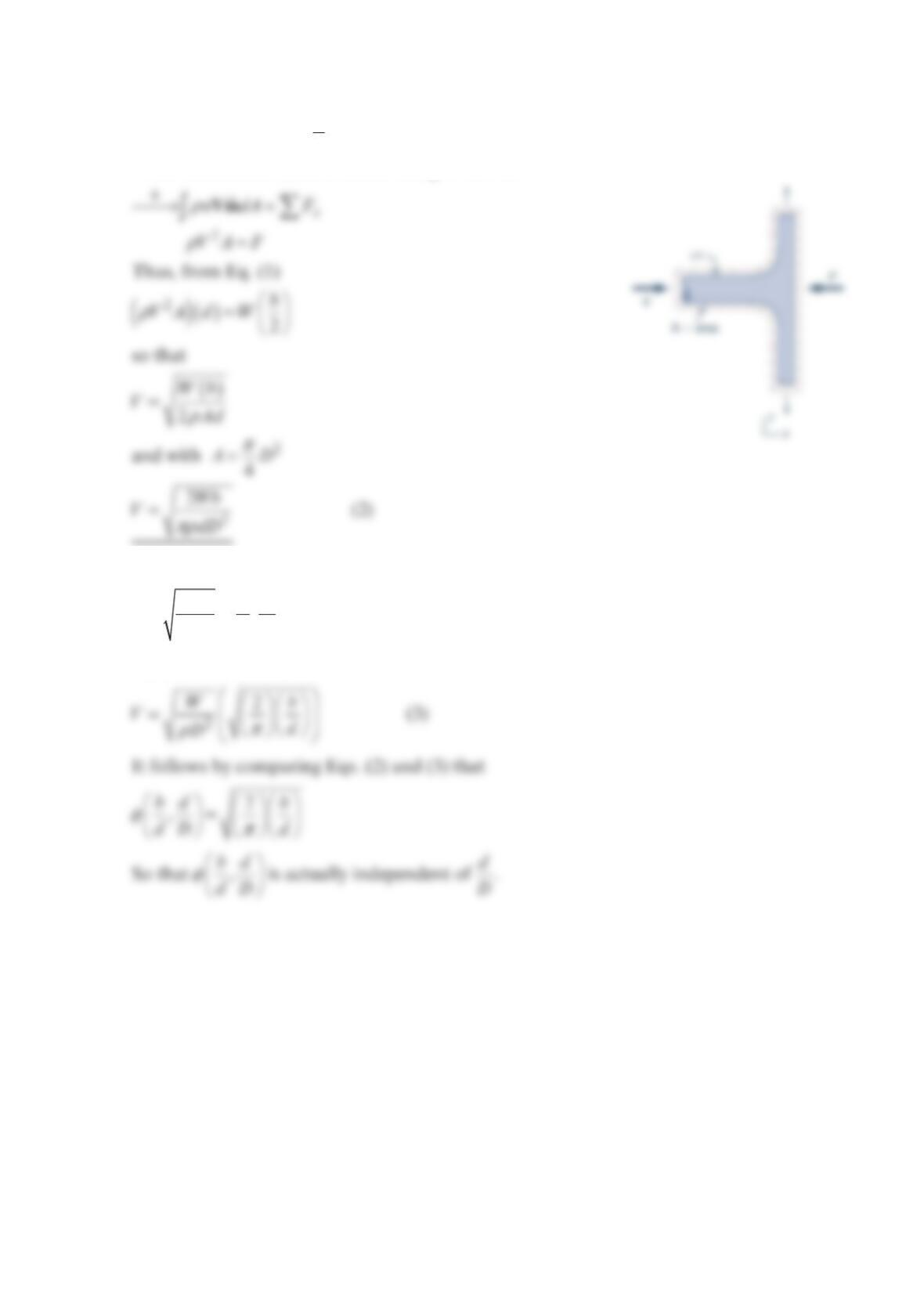
From momentum considerations using
c
v shown
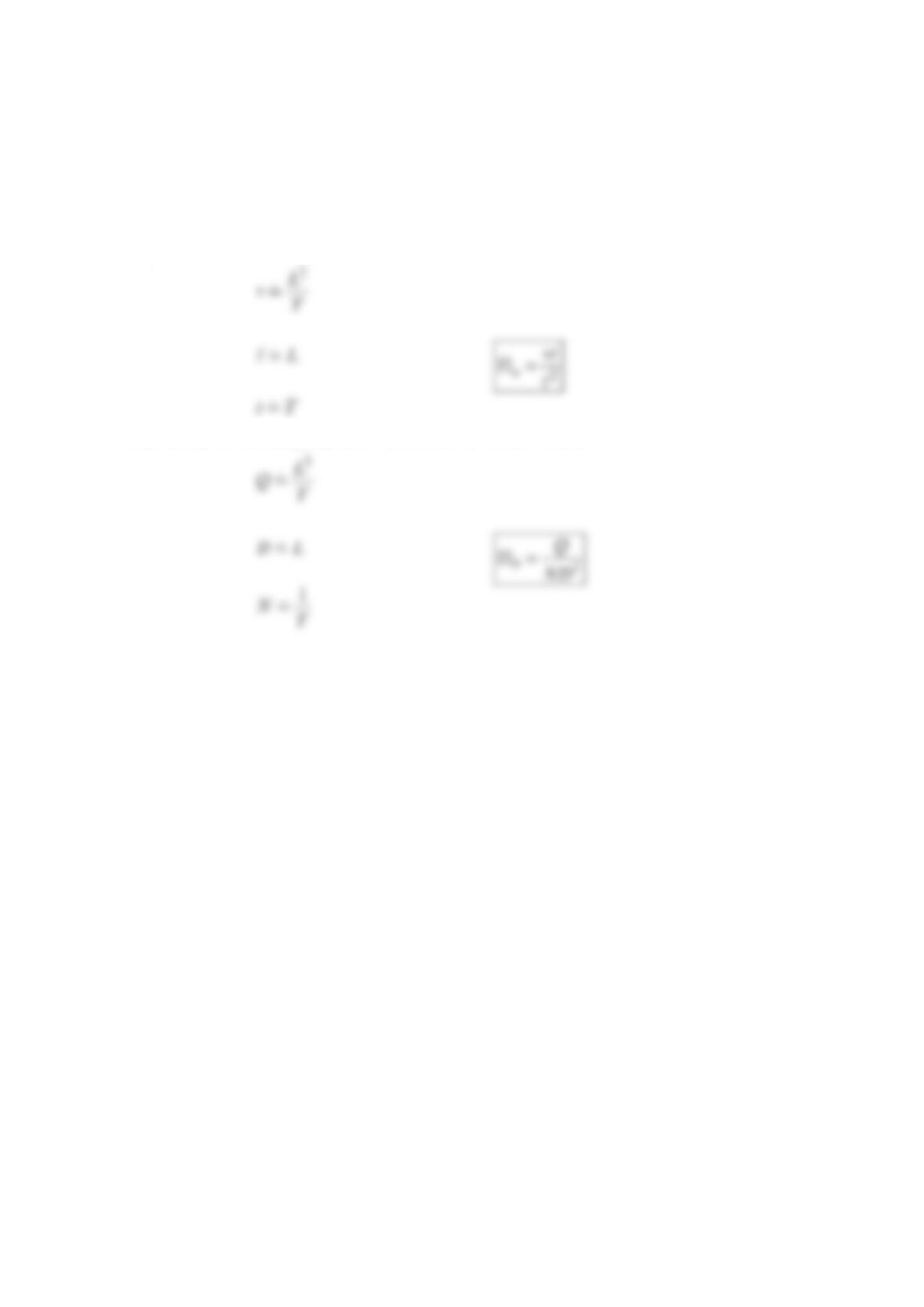
(c) From part (a)
φ
ρ
=
2,
Wbd
V
dD
D
Eq. (2) can be written as
V
Problem 7.30
By inspection, arrange the following dimensional parameters into dimensionless
parameters: (a) kinematic viscosity, v, length,
, and time,
t
; and (b) volume flowrate, ,Q
pump diameter,
D
, and pump impeller rotation speed, N.
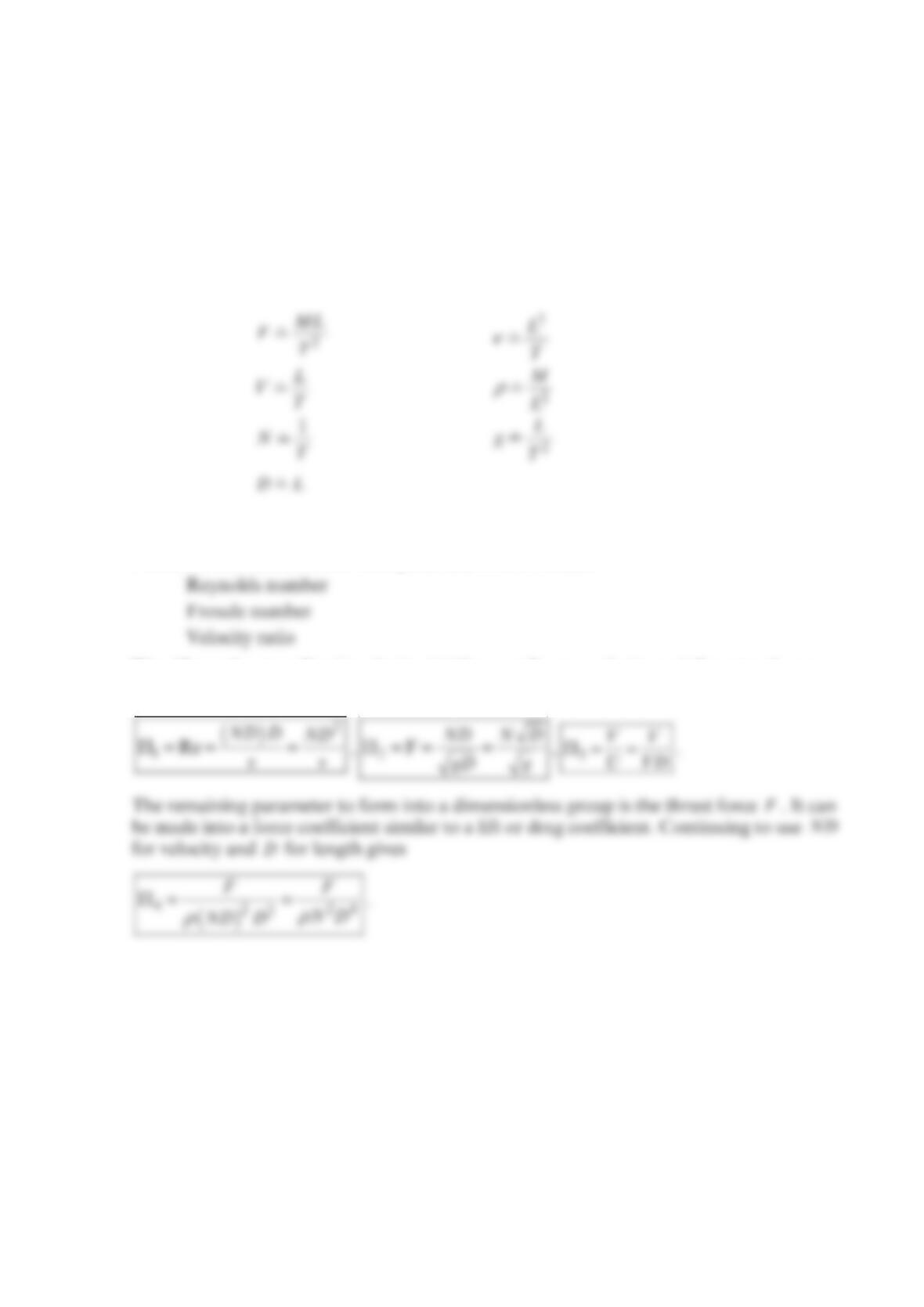
Solution 7.30
(a) The dimensional parameters and their dimensions are:
(b) The dimensional parameters and their dimensions are:
Problem 7.31
A screw propeller has the following relevant dimensional parameters: axial thrust,
F
;
propeller diameter,
D
; fluid kinematic viscosity, v; fluid density,
ρ
; gravitational
acceleration, g; advance velocity,
V
; and rotational speed, N. Find appropriate
dimensionless parameters to present the test data.
Solution 7.31
()
ρ
=,,,,,
F
fVNDv g
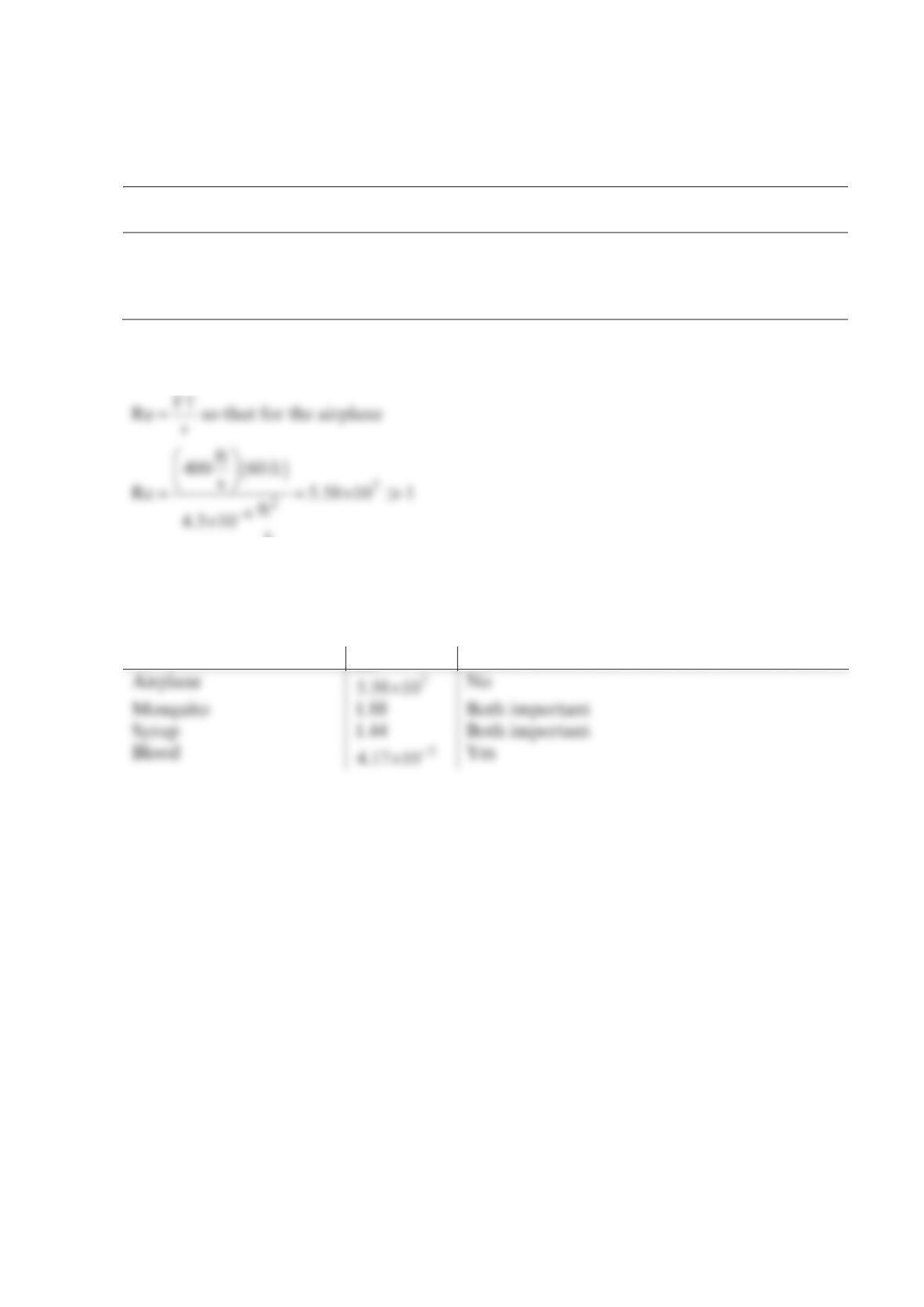
=7,n=3k, and −=4nk . Assuming that the propeller operates near a free surface in
water, the relevant dimensionless parameters must include
We will use the propeller tip velocity
()
ND as a reference velocity and diameter D as a
reference length. Then
D
Problem 7.32
Shown in the following table are several flow situations and the associated characteristic
velocity, size, and fluid kinematic viscosity. Determine the Reynolds number for each of the
flows and indicate for which ones the inertial effects are small relative to viscous effects.
Flow Velocity (ft/s) Size (ft) Kinematic viscosity
(ft2/s)
Airplane 400 60 4.3 × 10⁻⁴
Mosquito 0.02 0.015 1.6 × 10⁻⁴
Syrup on pancake 0.03 0.12 2.5 × 10⁻³
Blood in capillary 0.001 5 × 10⁻⁵ 1.2 × 10⁻⁵
Solution 7.32
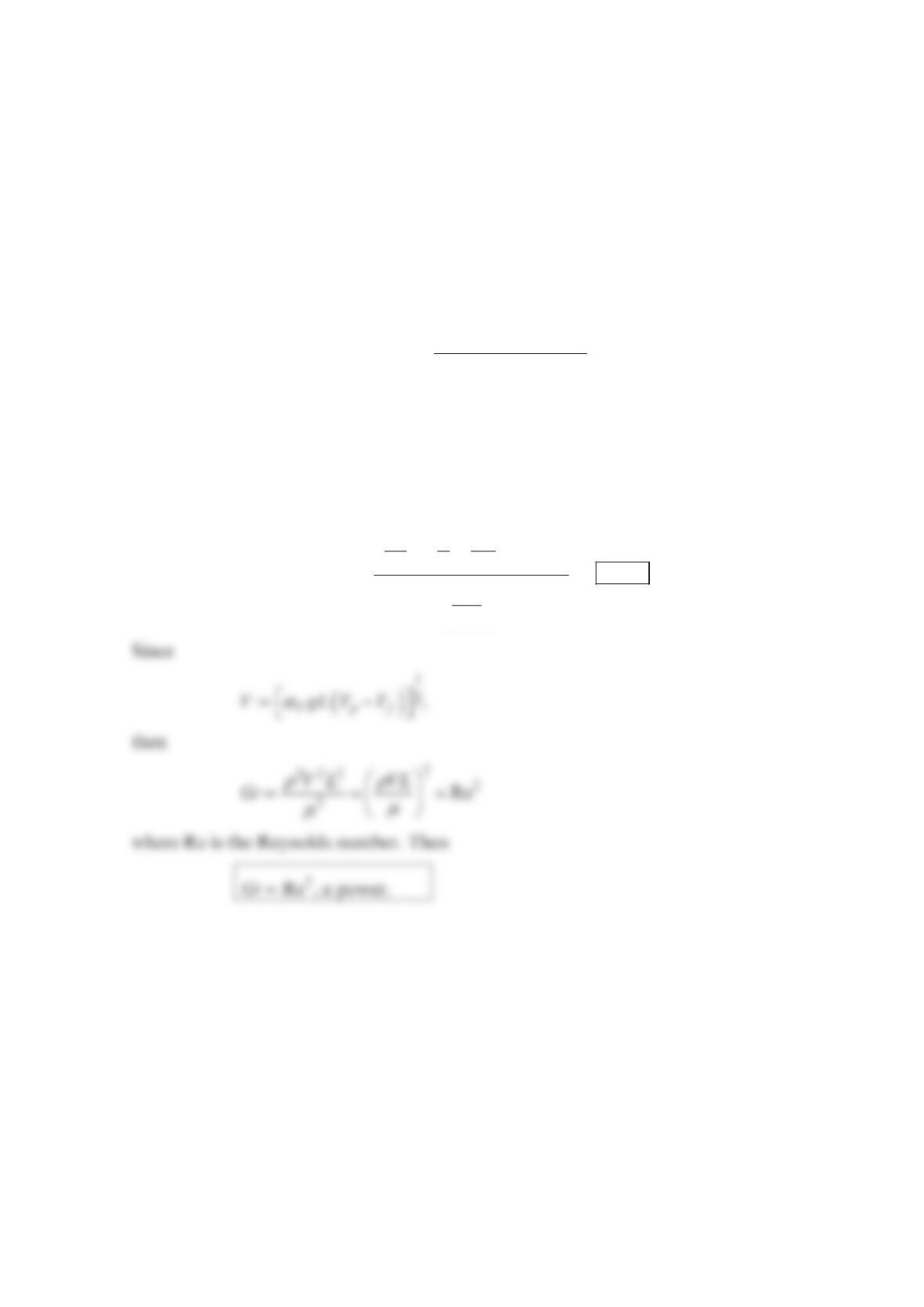
Since Re inertia force/viscous force, it follows that inertial effects are not small relative to
viscous effects for the airplane.
The table below shows the results for all 4 flows.
Re Inertial effects small relative to viscous effects?
Problem 7.33
A large, hot plate hangs vertically in a room. Heat transfer from the plate to the air near it
causes the air density to decrease. This lighter air rises upward with a velocity proportional
to the group
()
α
−
1/2
Tpf
gL T T ,
where
α
T
is the coefficient of thermal expansion [units = −−
°11
(
or )RK
], g is the acceleration
of gravity, L is the plate length, and
p
T and f
T are the temperatures of the plate and fluid,
respectively, in °or RK. The resulting heat transfer process depends on the Grashof
Number, defined by
()
ρα
µ
−
=
23
2
Tpf
gT T L
Gr ,
where
ρ
is density and
µ
is dynamic viscosity. Show that
G
is dimensionless. How is G
related to the common dimensionless parameters of fluid mechanics? Is it equivalent to a
combination, power, or product of one or more of the common dimensionless parameters
Solution 7.33
()
()
θ
θ
2
3
32
2
1
1
ML
L
LT
Gr Gr
M
LT
.