
28
Chapter 7: Consumption, Saving, and
Investment
Chapter Summary:
The theory that explains the relative stability of consumption spending
and the relative volatility of investment spending begins with the assumption
that consumption is an intertemporal choice. The chapter describes an
intertemporal consumption choice constrained by income from assets and labor,
and with the assumption that credit markets are readily available to borrow
against future income or lend current income. In this environment,
The exposition of the multi-period household budget constraint makes
clear that changes in economic variables such as real wages, asset prices, and
interest rates have complex effects on consumption. These are broken down into
of consumption and investment.
Chapter Outline:
I. Introduction: Consumption and Saving
II. Consumption in a 2 Period Model.
A. Present Value and Discount Factors
D. Combined Effects
III. Consumption Over Many Years
29
A. The Multiyear Budget Constraint
IV. Consumption, Saving, and Investment in Equilibrium
A. Aggregate Household Budget Constraint
V. Summary
Teaching Tips:
1. Provide numerical examples early and often until students gain
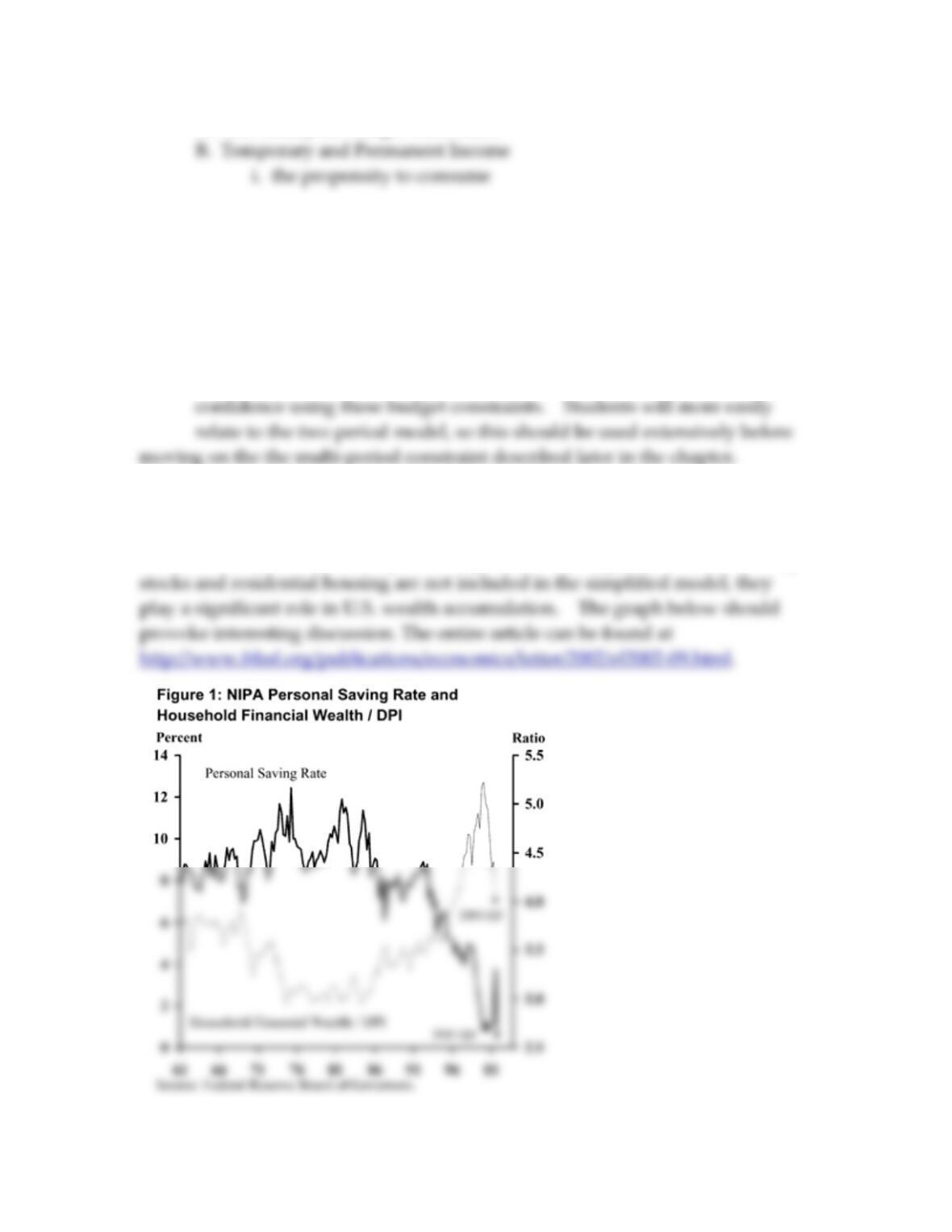
2. Milt Marquis of The Federal Reserve Bank of San Francisco has issued
a brief analysis of the declining U.S. savings rate that can help students
understand the the relationship of saving rates and changes in wealth. Although

3. It is important for students to understand how savings is related to real asset
accumulation over time. A fair amount of time should be spent discussing the
figure 7.2 (again using numerical examples). The way in which wealth is
4. One way for students to keep track of the differences between income and
substitution effects is to note that substitution effects always involve the
5. The assumption that the substitution effect dominates is problematic for an
open economy of net savers. Discuss how a change in the interest rate might
affect the consumption decisions of a retired couple living off of their assets.
Answers to review questions, pg. 169
1. The two year household budget constraint is derived as follows:
Assuming that markets clear( so that real profit =zero) household income is
generated in our model by wages for labor services, rent for capital services, and

2. When we use the present value, we multiply the number by a discount factor
(1/(/(1+ii)) which is less than 1 for any positive rate of interest. A positive rate of
3. Propensity to consume is determined in our model by a rational choice, by
which we mean that consumers seek to maximize their utility across periods.
4. Effect on this year’s consumption:
a. an increase in the interest rate has an ambiguous impact on current
consumption of a household; by the substitution effect, it would reduce it. But if
our consumer is a net saver, it may increase it by the income effect. If the consumer
Answers to Problems for discussion, pg. 169
5. a)In order to keep the notation somewhat manageable, we will make the
simplifying assumption that interest rates are constant.
Then permanent income = (1+i)( (B0/P + K0) +L* t=1(w/P)t/(1+i)t
Where T represents the number of periods of earned income. Permanent income
6.a) If the household has a positive balance of bonds, it is a net saver to begin
with. The real value of the asset is B0/P, so the higher price level P reduces
the real value of the asset. If there is no offsetting increase in w, (the nominal
wage) then permanent labor income will also be reduced. Both of these