PROBLEM 7.109 (Cont.)
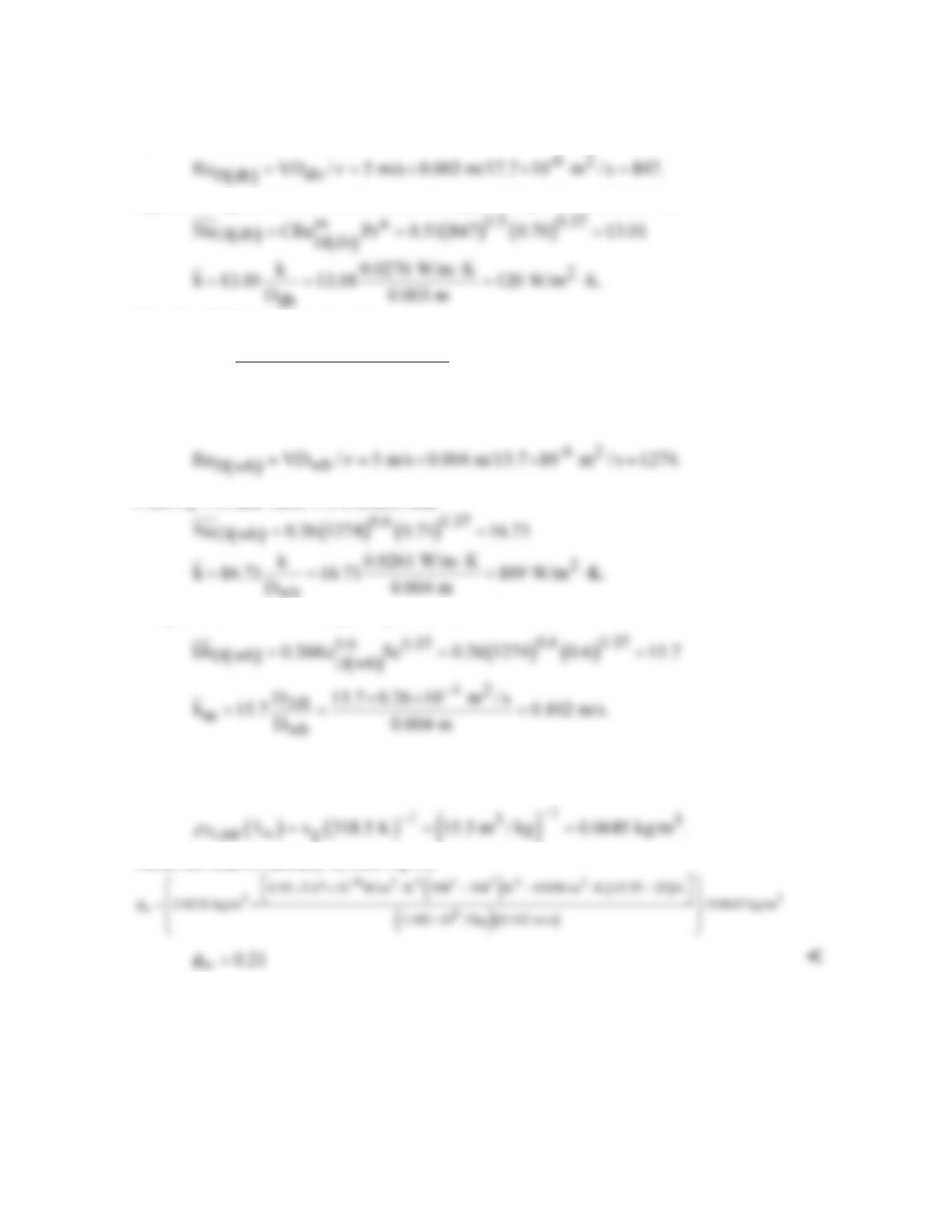
Convection Calculations: For the prescribed conditions, the Reynolds number associated with the
dry-bulb thermometer is
Approximating the Prandtl number ratio as unity, from Eq. 7.53 and Table 7.4,
From Eq. (1) the air temperature is
()
8 24 4 44
2
0.95 5.67 10 W/m K
T 45 C 318 308 K 45 C 0.55 C 45.6 C.
120 W/m K
−
∞×× ⋅
=+ − =+=
⋅
<
The relative humidity may now be obtained from Eq. (2). The Reynolds number associated with the
wet-bulb thermometer is
From Eq. 7.53 and Table 7.4, it follows that
Using the mass transfer analog of Eq. 7.53, it also follows that
Also,
( ) ( )
()
1
133
A,sat wb g
T v 298 K 44.3 m / kg 0.0226 kg/m
ρ
−
−
= = =
Hence the relative humidity is, from Eq. (2)
COMMENTS: (1) The effect of radiation exchange between the duct wall and the thermometers is
small. For this reason T∞ = Tdb. (2) The evaporative heat loss is significant due to the small value
of φ∞, causing Twb to be significantly less than T∞.
PROBLEM 7.110
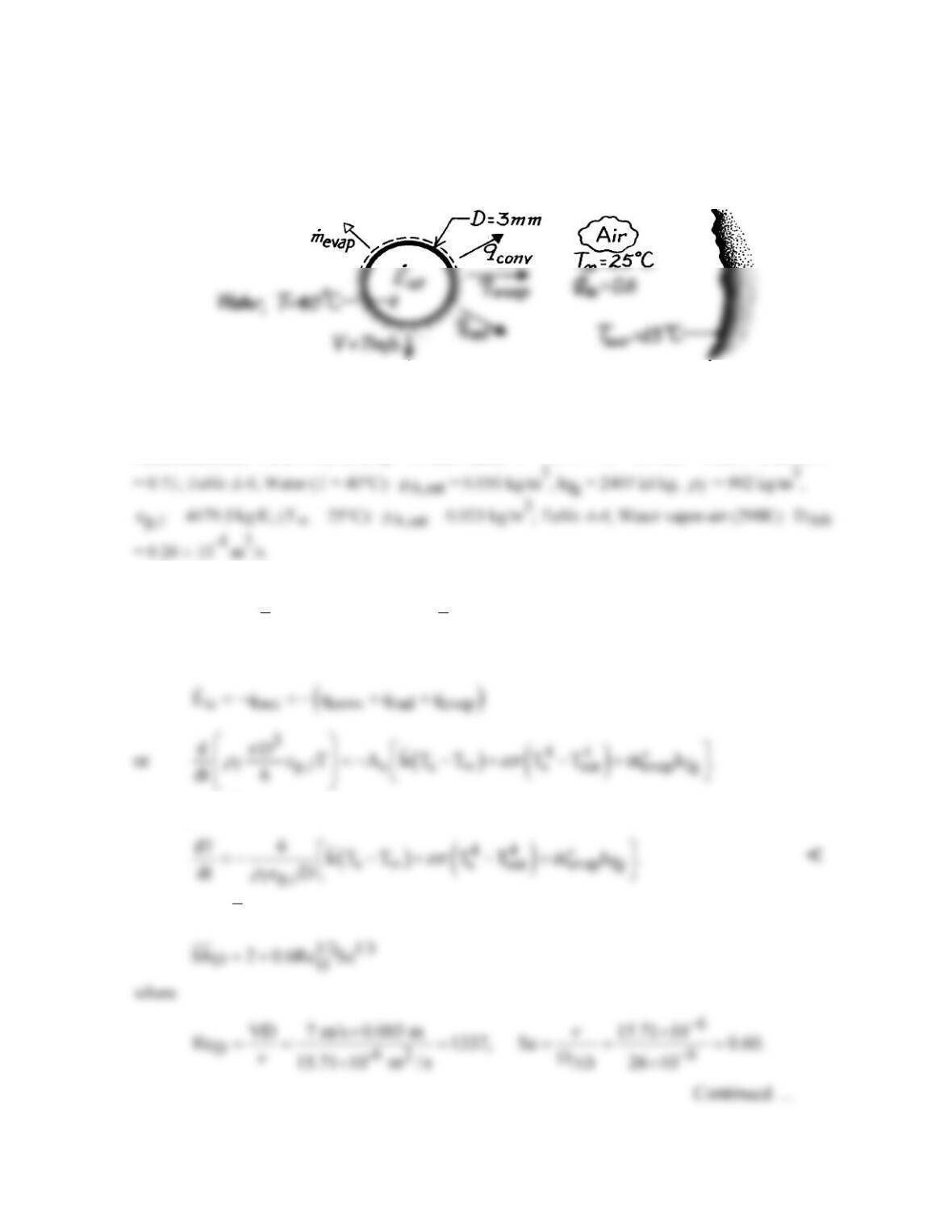
KNOWN: Velocity, diameter and temperature of a spherical droplet. Conditions of surroundings.
FIND: (a) Expressions for droplet evaporation and cooling rates, (b) Evaporation and cooling rates
for prescribed conditions.
SCHEMATIC:
ASSUMPTIONS: (1) Negligible temperature gradients in the drop, (2) Heat and mass transfer
analogy is applicable, (3) Perfect gas behavior for vapor.
PROPERTIES: Table A-4, Air (T∞ = 298K, 1 atm): ν = 15.71 × 10⁻⁶ m2/s, k = 0.0261 W/m⋅K, Pr
ANALYSIS: (a) The evaporation rate is given by
( )
( ) ( )
2
evap m s A,s A, m A,sat A,sat
m hA h D T T .
ρ ρ π ρ φρ
∞ ∞∞
= −= −
<
The cooling rate is obtained from an energy balance performed for a control surface about the droplet,
With As = πD2, it follows that
(b) To obtain
m
h,
the mass transfer analog of the Ranz–Marshall correlation gives
PROBLEM 7.110 (Cont.)
Hence
( ) ( )
1/ 2 1/ 3
D
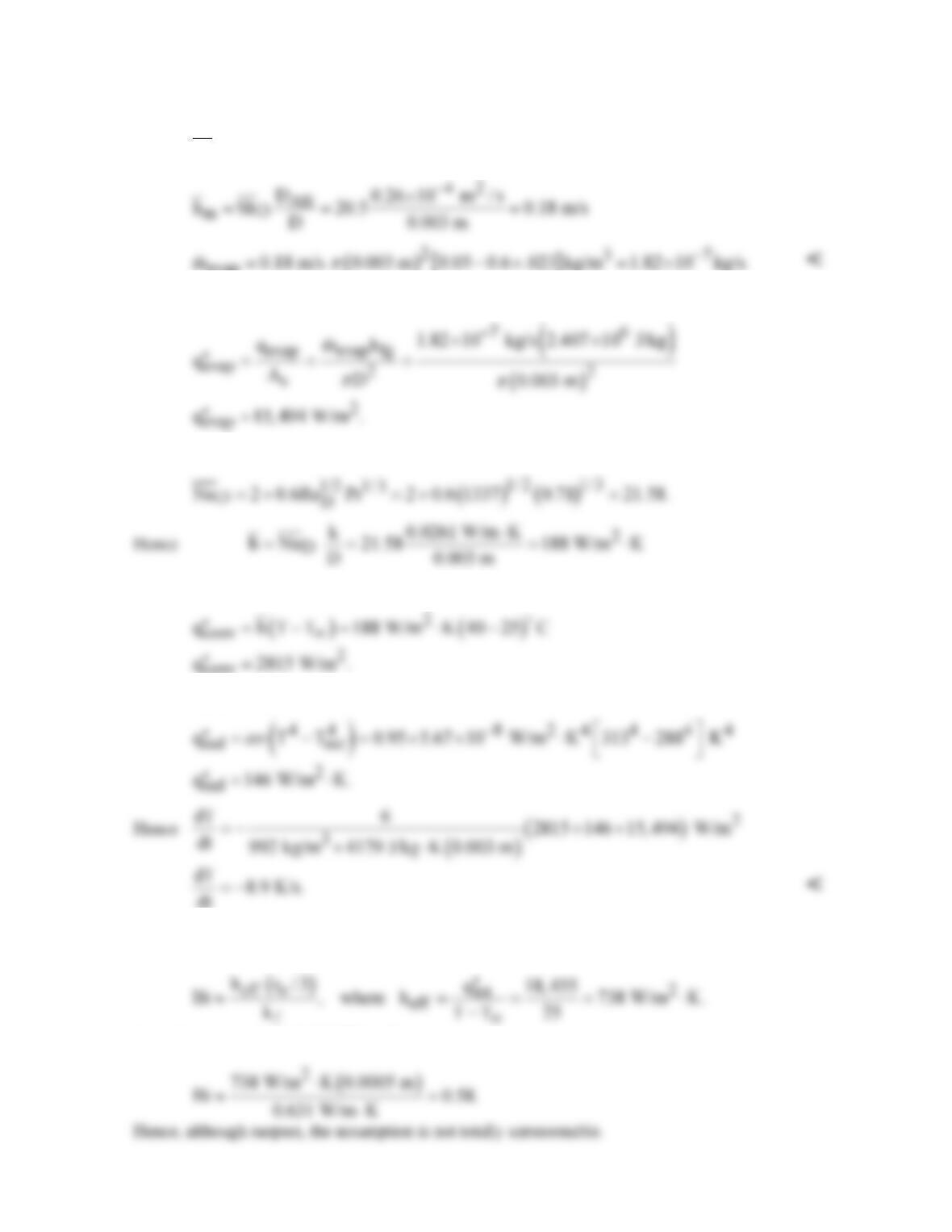
Sh 2 0.6 1337 0.6 20.5=+=
evap
The evaporative heat flux is then
Using the heat transfer correlation, the Nusselt number is
and the sensible heat flux is
conv
The net radiative flux is
COMMENTS: (1) Evaporative cooling provides the dominant heat loss from the drop. (2) To test
the validity of assuming negligible temperature gradients in the drop, calculate
From Table A-6,
k 0.631 W/m K,= ⋅
hence
PROBLEM 7.111
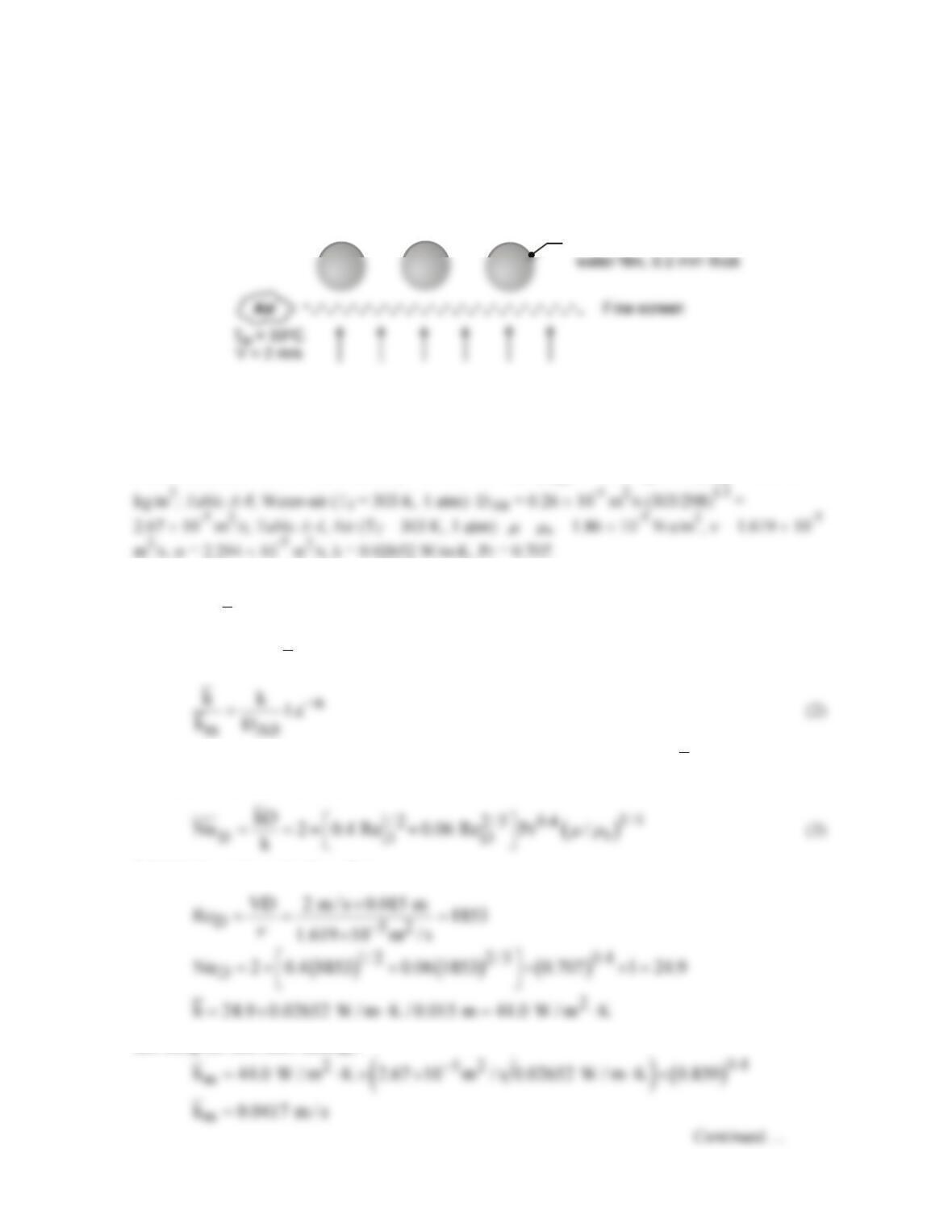
KNOWN: Cranberries with an average diameter of 15 mm rolling over a fine screen. Thickness of
the water film is 0.2 mm.
FIND: Time required to dry the berries exposed to heated air with a velocity of 2 m/s and temperature
of 30°C.
SCHEMATIC:
Berry, D = 15 mm,
ASSUMPTIONS: (1) Steady–state conditions, (2) Air stream is dry, (3) Water film on the berries is
also at 30°C, (4) Convection process is uniform over the exposed surface, and (5) Heat-mass analogy
is applicable.
PROPERTIES: Table A-6, Water (Tf = 30°C = 303 K):
3
A,f 995.8 kg / m ,
ρ
=
ρ
A,g = 0.02985
ANALYSIS: The evaporation rate of water from the berry surface is given by the rate equation,
( )
m s A,s A,
nhA
ρρ
∞
= −
(1)
where As = πD2 and
m
h
is determined using the heat-mass analogy, Eq. 6.60,
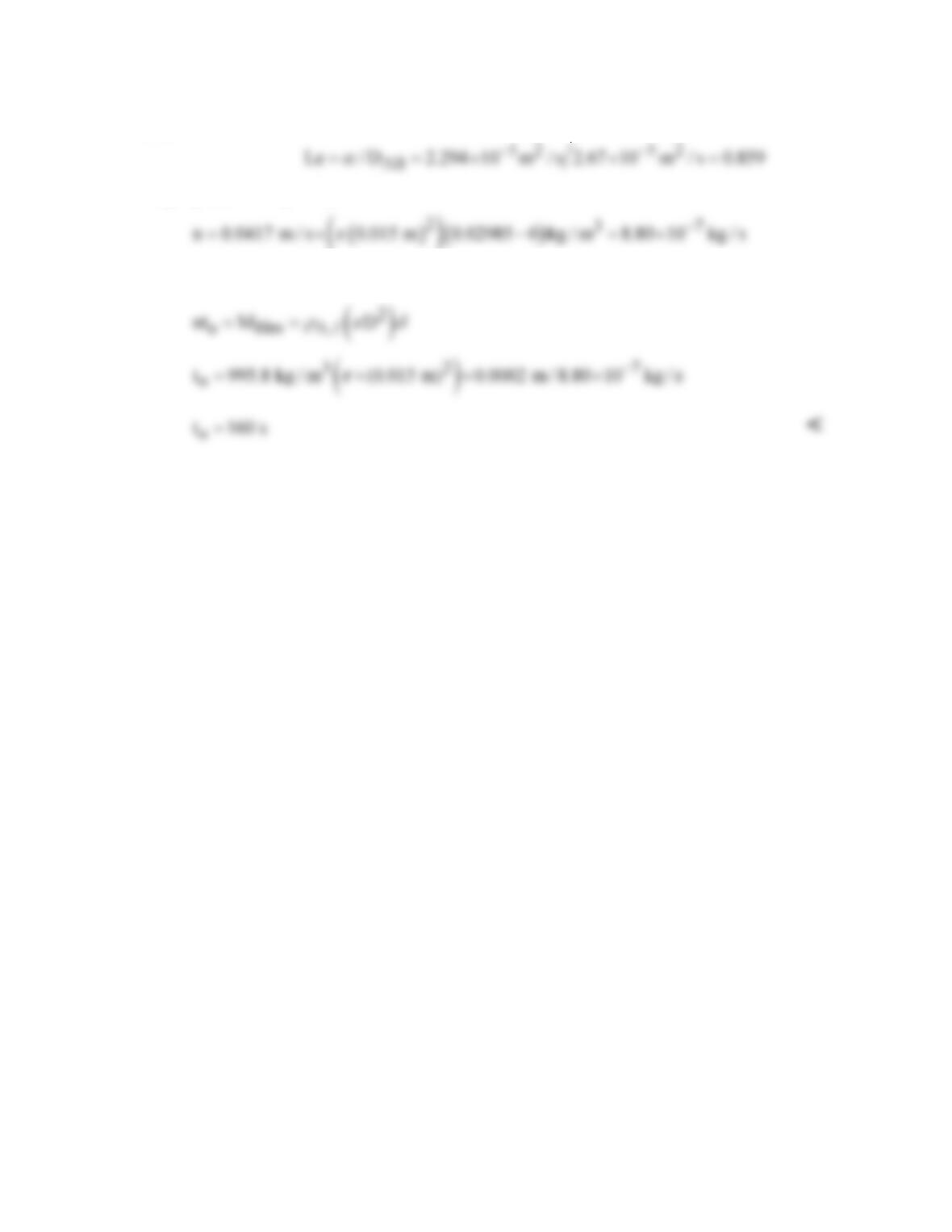
where Le = α/DAB and for this problem, n = 0.4. The heat transfer coefficient
h
is estimated with the
Whitaker correlation, Eq. 7.56,
Substituting numerical values, find
and using the heat-mass analogy,
PROBLEM 7.111 (Cont.)
where
Using Eq. (1), the evaporation rate is
The time, to, required to evaporate the water film of thickness δ = 0.2 mm is
PROBLEM 7.112
KNOWN: Diameter, velocity and surface vapor concentration of alcohol droplet falling in quiescent air.
Latent heat of vaporization and diffusion coefficient. Air temperature.
FIND: Droplet surface temperature
SCHEMATIC:
ASSUMPTIONS: (1) Steady-state conditions, (2) Applicability of heat and mass transfer analogy, (3)
Negligible radiation, (4) Negligible vapor concentration in air (
A,
ρ
∞
= 0).
PROPERTIES: Table A.4, air (
T
∞
= 300 K): ν = 15.89 × 10⁻⁶ m2/s, k = 0.0263 W/m⋅K, Pr = 0.707.
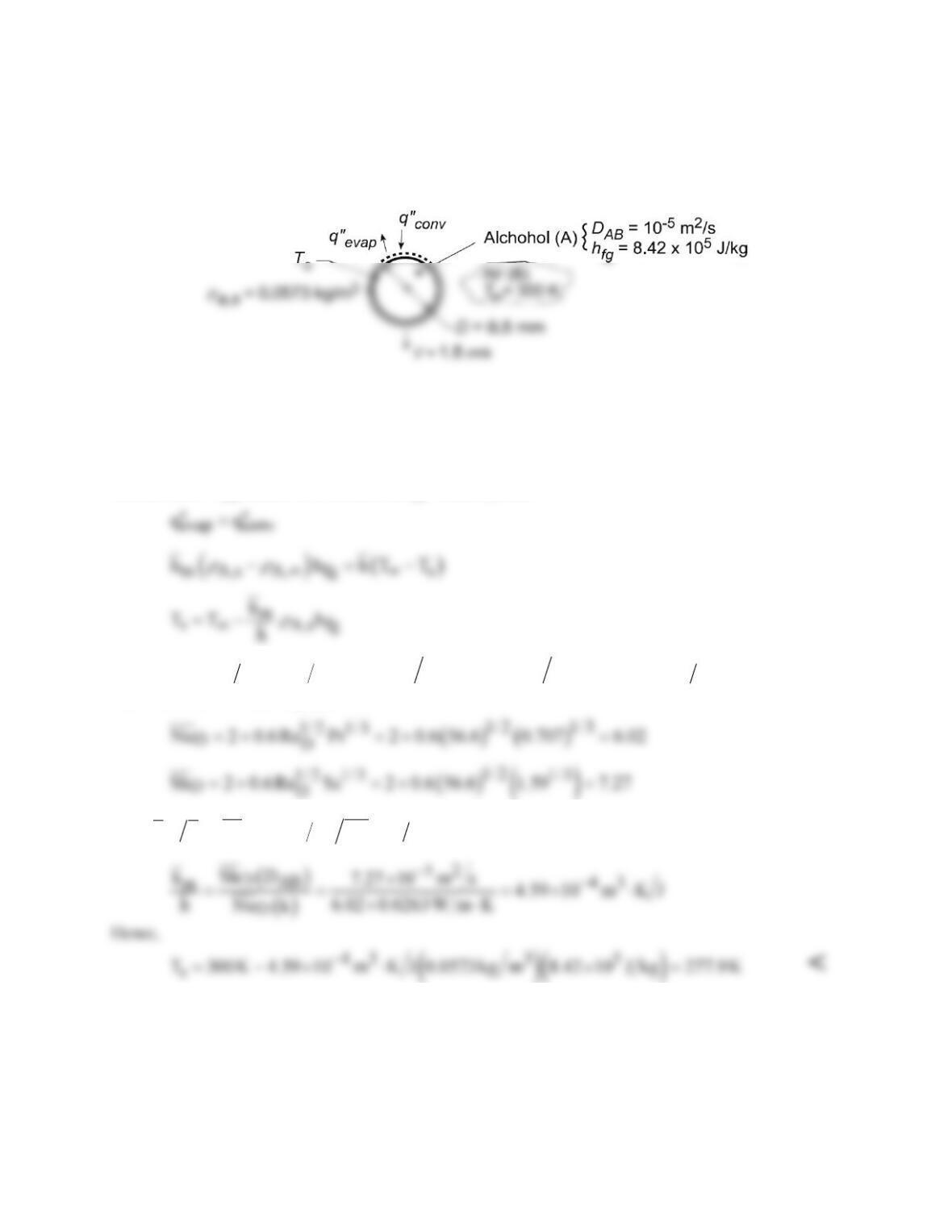
ANALYSIS: Application of a surface energy balance yields
With
4 62
D
Re VD 1.8 m s 5 10 m 15.89 10 m s
ν
−−
= = ×× ×
= 56.6 and Sc =
AB
D
ν
= 1.59, the
Ranz-Marshall correlation yields
With
m
hh
=
( ) ( )
DAB D
ShD DNukD
,
COMMENTS: The large vapor density,
A,s
ρ
, renders the evaporative cooling effect significant.
PROBLEM 7.113
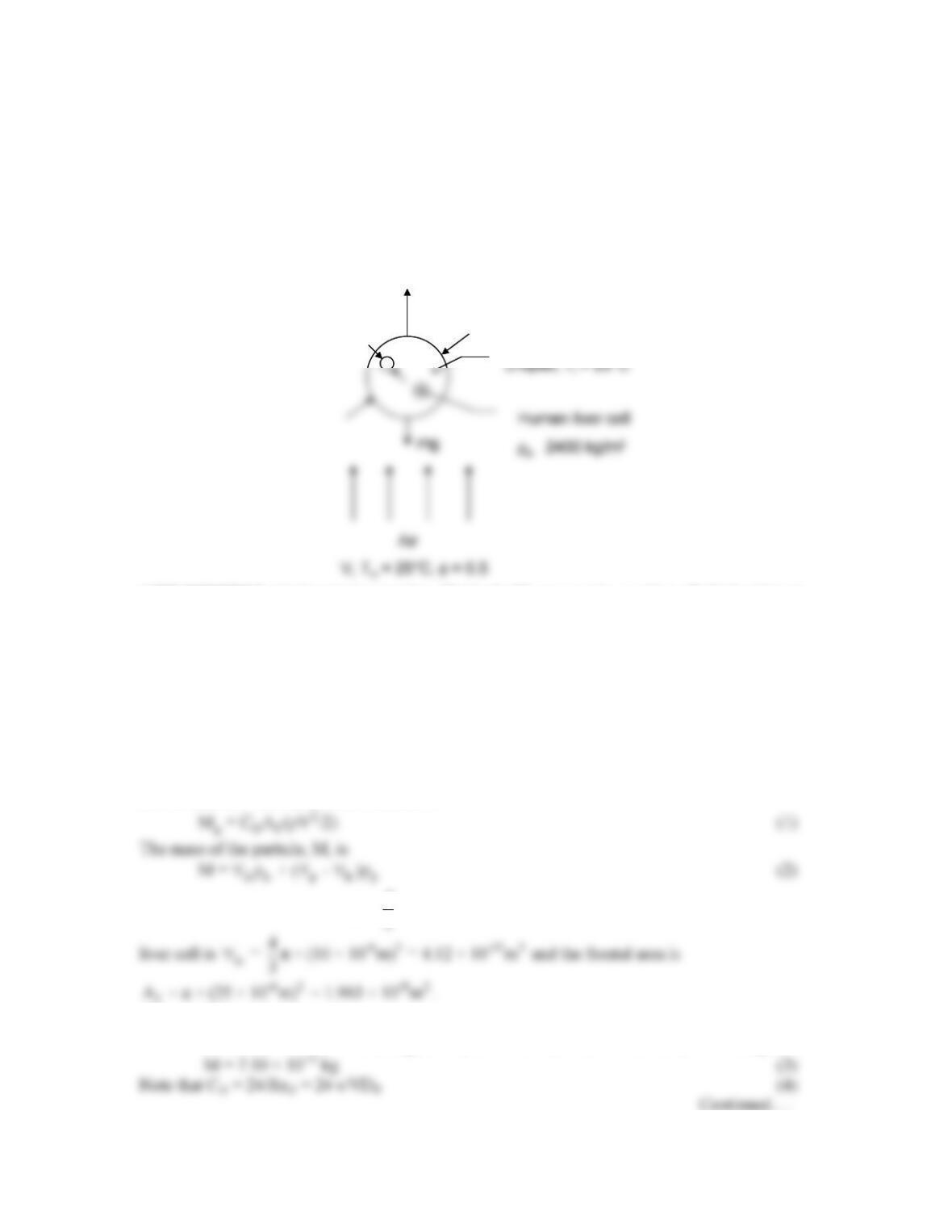
KNOWN: Diameter and density of liver cells, diameter of droplets.
FIND: (a) Terminal velocity of the droplets when each droplet contains one liver cell, (b) Time
of flight of a droplet containing one liver cell if the distance between injector and scaffold is L =
4 mm, (c) Initial evaporation rate from the droplet, (d) Comparison of the mass variation due to
evaporation to variation due to liver cell populations ranging from one to five per droplet.
SCHEMATIC:
ASSUMPTIONS: (1) Constant properties, (2) Negligible evaporative cooling, (3) Stokes’ law is
valid, CD = 24/ReD, (4) Neglect mass of displaced air in force balance, (5) Evaporation rate is
unaffected by change in droplet diameter, (6) Negligible microscale mass transfer effects.
PROPERTIES: Table A.4, air: (T = 25 °C = 298 K): ρ = 1.171 kg/m3, ν = 15.71 × 10⁻⁶ m2/s,
Table A.6, liquid water: (T = 25 °C = 298 K): ρ = 997.4 kg/m3, Table A.6, water vapor: (T = 25
°C = 298 K): vg = 44.25 m3/kg. Table A.8, water vapor in air: (T = 25 °C = 298 K): DAB = 0.26 ×
10-4 m2/s.
ANALYSIS:
(a) At terminal velocity, the face balance is
The volume of the droplet is
-6 3 -14 3
p
4
= π × (25 × 10 m) = 6.54 × 10 m
∀
while the volume of a
The mass is therefore
-15 3 3 -14 3 -15 3 3
M = 4.12 × 10 m × 2400 kg/m + (6.54 × 10 m – 4.12 × 10 m ) × 997.4 kg/m
F
D
D
P
= 50 µm
D
lc
= 20 µm
F
D
D
P
= 50 µm
D
lc
= 20 µm
PROBLEM 7.113 (Cont.)
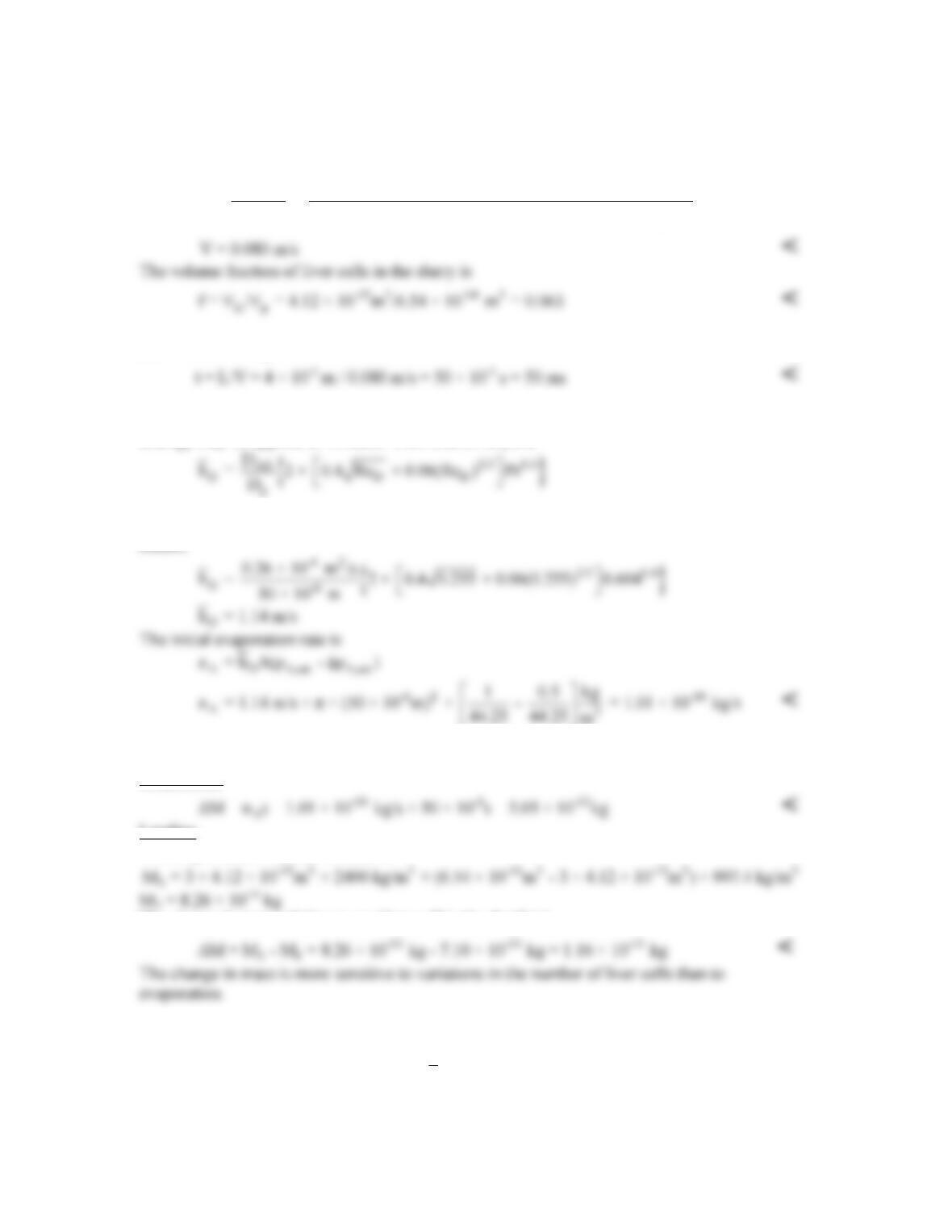
Combining Equations 1, 2 and 3 yields
-11 2 -6
gp
-6 2 -9 2 3
f
MD 7.10 × 10 kg × 9.8 m/s × 50 × 10 m
V = =
12νA ρ 12 × 15.71 × 10 m /s × 1.963 × 10 m × 1.171 kg/m
(b) The time of flight is
(c) With Sc = ν/DAB = 1.571 × 10⁻⁵ m2/s / 0.26 × 10⁻⁴ m2/s = 0.604, the heat and mass transfer
analogy may be applied to Whitaker’s correlation to yield
The Reynolds number is
-6 -6 2
Dp
Re = VD /ν = 0.08 m/s × 50 × 10 m/15.71 × 10 m /s = 0.255.
Hence,
(d) The sensitivity may be estimated by comparing the change in mass due to evaporation to the
difference in mass due to liver cell loading.
Evaporation
Loading
The droplet mass with 3 liver cells is
The change in mass relative to one liver cell in the droplet is
COMMENTS: (1) Inspection of Figure 7.9 shows that Stokes’ law is valid at ReD = 0.255. (2)
The Whitaker correlation is used outside of the Reynolds and Schmidt number ranges for which it
was developed. The Sherwood number is
D p AB
h D /D
= 2.2. Since this is close to the limiting
value of 2.0, it is probably reasonably accurate.
PROBLEM 7.114
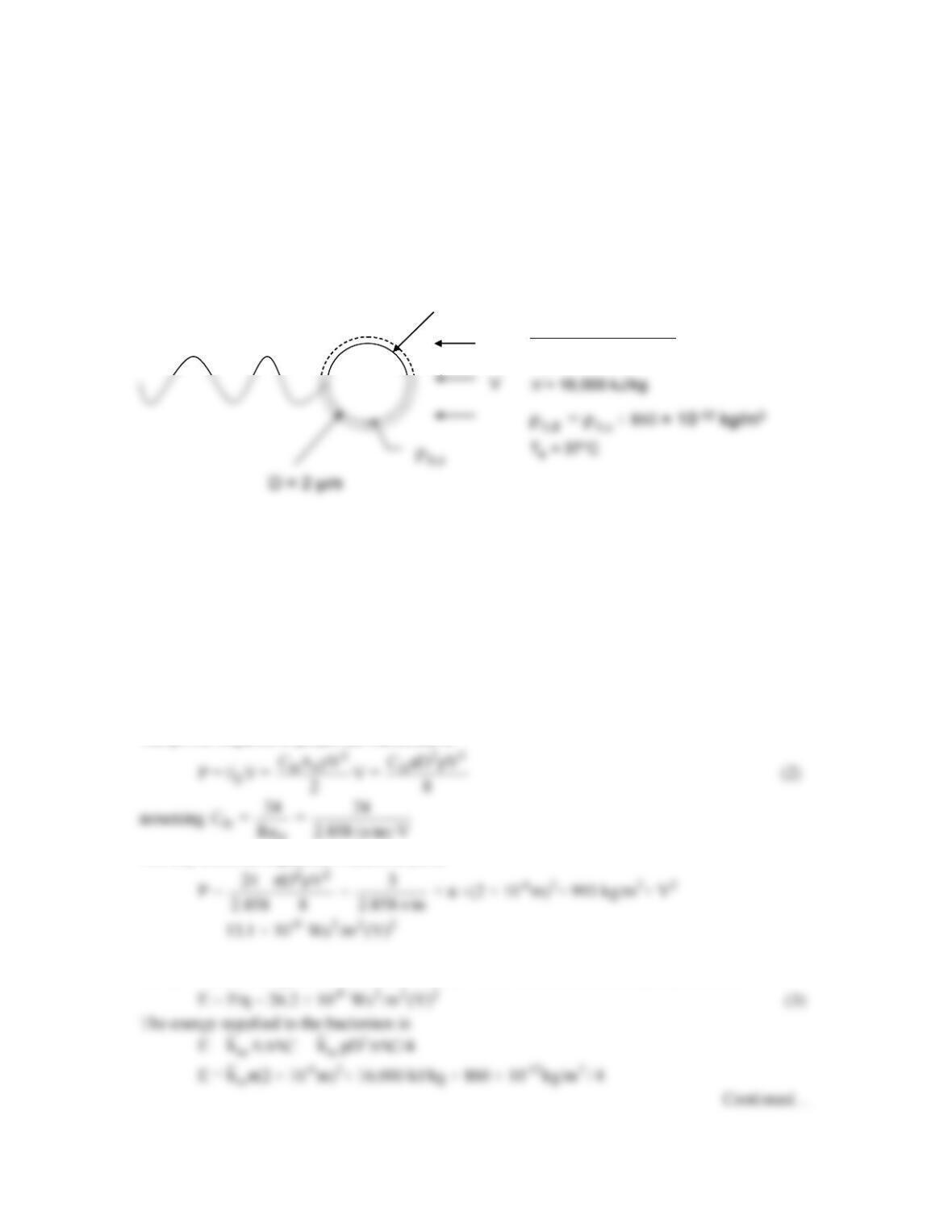
KNOWN: Dimension and approximate shape of E. coli bacterium. Binary diffusivity, nutrient
value, propulsion efficiency and concentration difference from free stream water–based solution
to bacterium shell.
FIND: Estimate the maximum E. coli speed in body diameters per second.
SCHEMATIC:
Water–based solution
D
AB
= 0.7 ×10
-9
m
2
/s
Water–based solution
D
AB
= 0.7 ×10
-9
m
2
/s
ASSUMPTIONS: (1) Negligible capability of bacterium to store energy, (2) Constant properties,
(3) Steady-state, (4) Stokes’ law is valid, that is CD = 24/ReD, (5) Negligible microscale mass
transfer effects.
PROPERTIES: Table A.6, water (T = 37 °C = 310 K): ρ = 993 kg/m3, ν = 6.999 × 10⁻⁷ m2/s, Pr
= 0.701.
ANALYSIS: For the spherical bacterium shell
-6 -7 2
D
Re = VD/ν = (V × 2 × 10 m)/(6.999 × 10 m /s) = 2.858 (s/m) × V
(1)
The power required to propel the bacterium is
D
We may combine Equations 1 and 2 to yield
For η = 0.5, the energy to be delivered from the water-based solution to the bacterium is
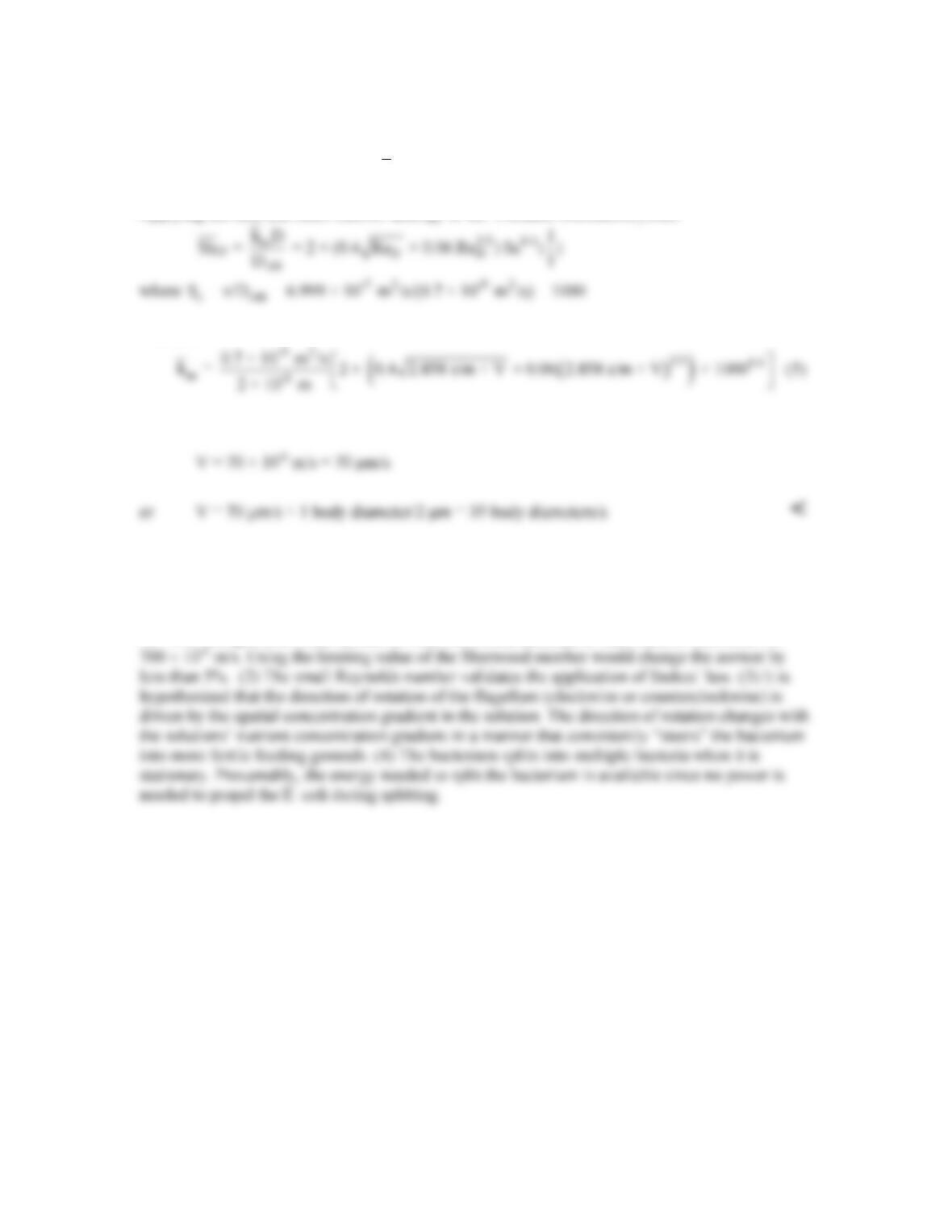
PROBLEM 7.114 (Cont.)
-18
m
E = 43.23 × 10 Ws/m × h
(4)
Applying the heat and mass transfer analogy to the Whitaker correlation yields
Therefore
Combining Equations (3) through (5) and solving for V yields
COMMENTS: (1) The maximum Reynolds number is ReD = VD/ν = 70 × 10-6 m/s × 2 × 10⁻⁶
m/6.999 × 10-7 m2/s = 200 × 10-6. The Whitaker correlation is extrapolated outside of its range of
application and provides a Sherwood number of 2.093 and a mass transfer coefficient of 732 ×
10-6 m/s. Using a Sherwood number of two, one would calculate a mass transfer coefficient of
PROBLEM 7.115
KNOWN: Diameter and temperature of sphere wetted with kerosene. Air flow conditions.
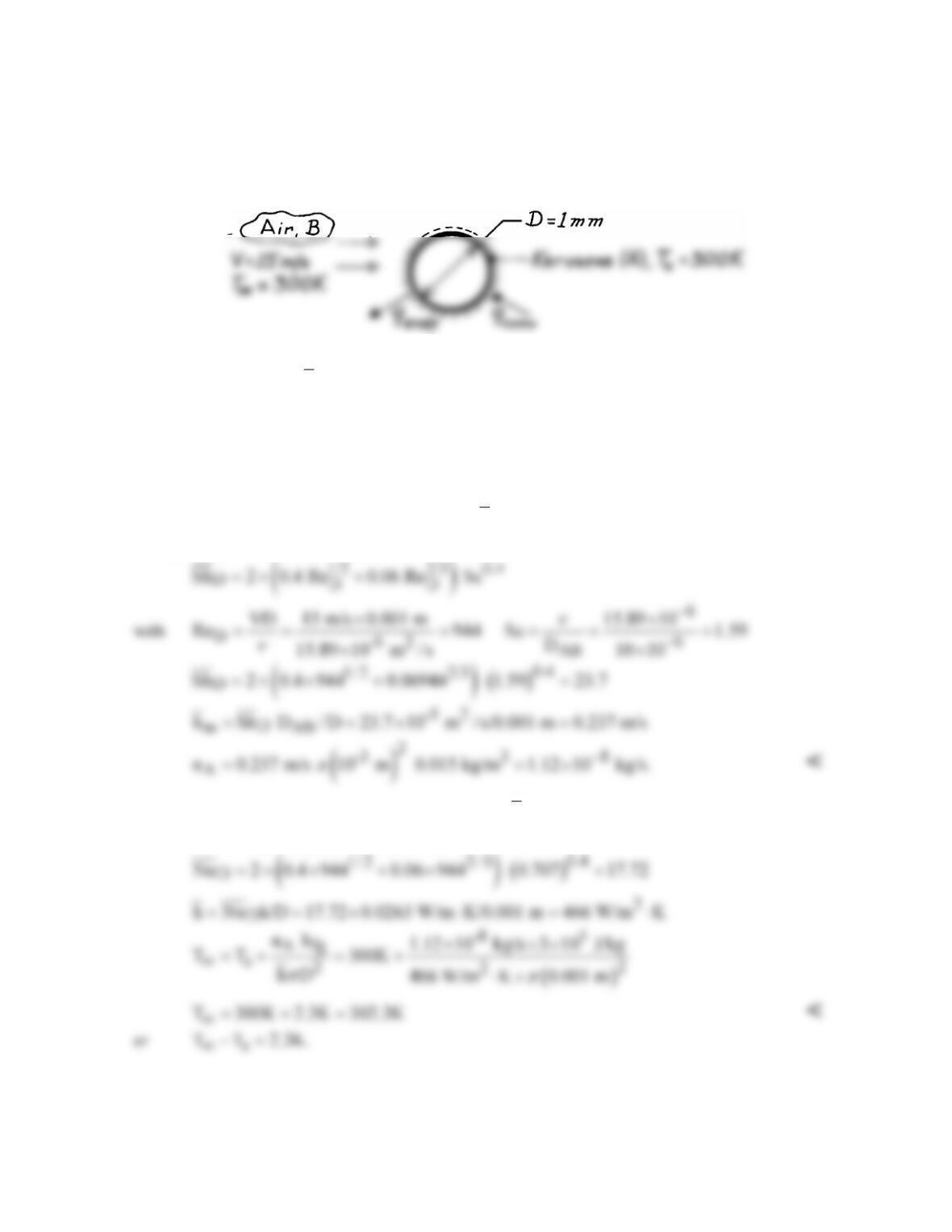
FIND: (a) Minimum kerosene flow rate, (b) Air temperature required to maintain wetted surface at
300K.
SCHEMATIC:
ASSUMPTIONS: (1) Steady-state conditions, (2) Sphere mount has a negligible influence on the
flow field and hence on
h,
(3) Negligible kerosene vapor concentration in free stream.
PROPERTIES: Table A-4, Air (300K): ν = 15.89 × 10⁻⁶ m2/s, k = 0.0263 W/m⋅K, ρ = 1.161
kg/m3, Pr = 0.707; Kerosene (given): ρA,sat = 0.015 kg/m3, hfg = 300 kJ/kg; Kerosene vapor-air
(given): DAB = 10–5 m2/s.
ANALYSIS: (a) The kerosene flowrate is
( )
A m A,sat A,
n hA .
ρρ
∞
= −
Using the mass transfer
analog of Eq. 7.56 and neglecting the viscosity ratio,
(b) An energy balance on the sphere yields
( )
A fg s
n h hA T T .
∞
= −
Using the Whitaker
correlation and neglecting the viscosity ratio,
COMMENTS: The small temperature excess (2.3K) is due to comparatively small values of ρA,sat
and hfg for kerosene.
PROBLEM 7.116
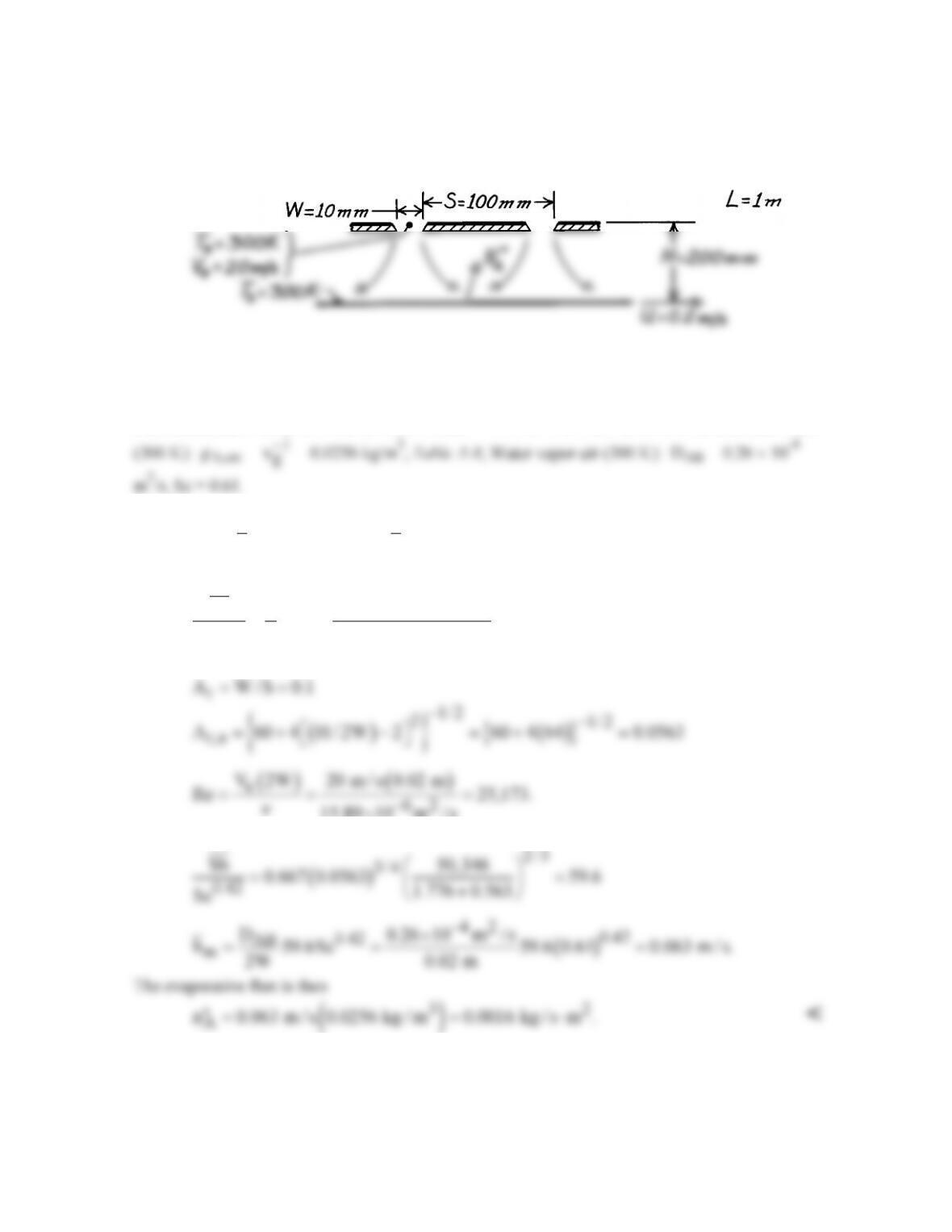
KNOWN: Dimensions of slot jet array. Jet exit velocity and temperature. Temperature of paper.
FIND: Drying rate per unit surface area.
SCHEMATIC:
ASSUMPTIONS: (1) Applicability of heat and mass transfer analogy, (2) Paper motion has
negligible effect on convection (U << Ve).
PROPERTIES: Table A-4, Air (300 K, 1 atm): ν = 15.89 × 10⁻⁶ m2/s; Table A-6, Saturated water
ANALYSIS: The mass evaporation flux is
( )
A m A,s A,e m A,sat
nh h
ρρ ρ
′′ = −=
For an array of slot nozzles,
2/3
3/4
r,o
0.42 r r,o r,o r
Sh 2 2 Re
A
3 A /A A /A
Sc
=
+
where
15.89 10 m / s
×
Hence
COMMENTS: The mass fraction of water vapor to air leaving the sides of the dryer is
( ) ( )
4
A air e
n S L / V W L 7 10 .
ρ
−
′′ × ×=×
Hence, the assumption of dry air throughout the dryer is
reasonable.