Problem 7.1
A mixing basin in a sewage filtration plant is stirred by mechanical agitation (paddlewheel)
with a power input (ft lb/s
)
W⋅
. The degree of mixing of fluid particles is measured by a
“velocity gradient” G given by
W
GV
µ
=
where
µ
is the fluid viscosity in
2
lb s/ft⋅ and V is the basin volume in 3
f
t. Find the units of
the velocity gradient.
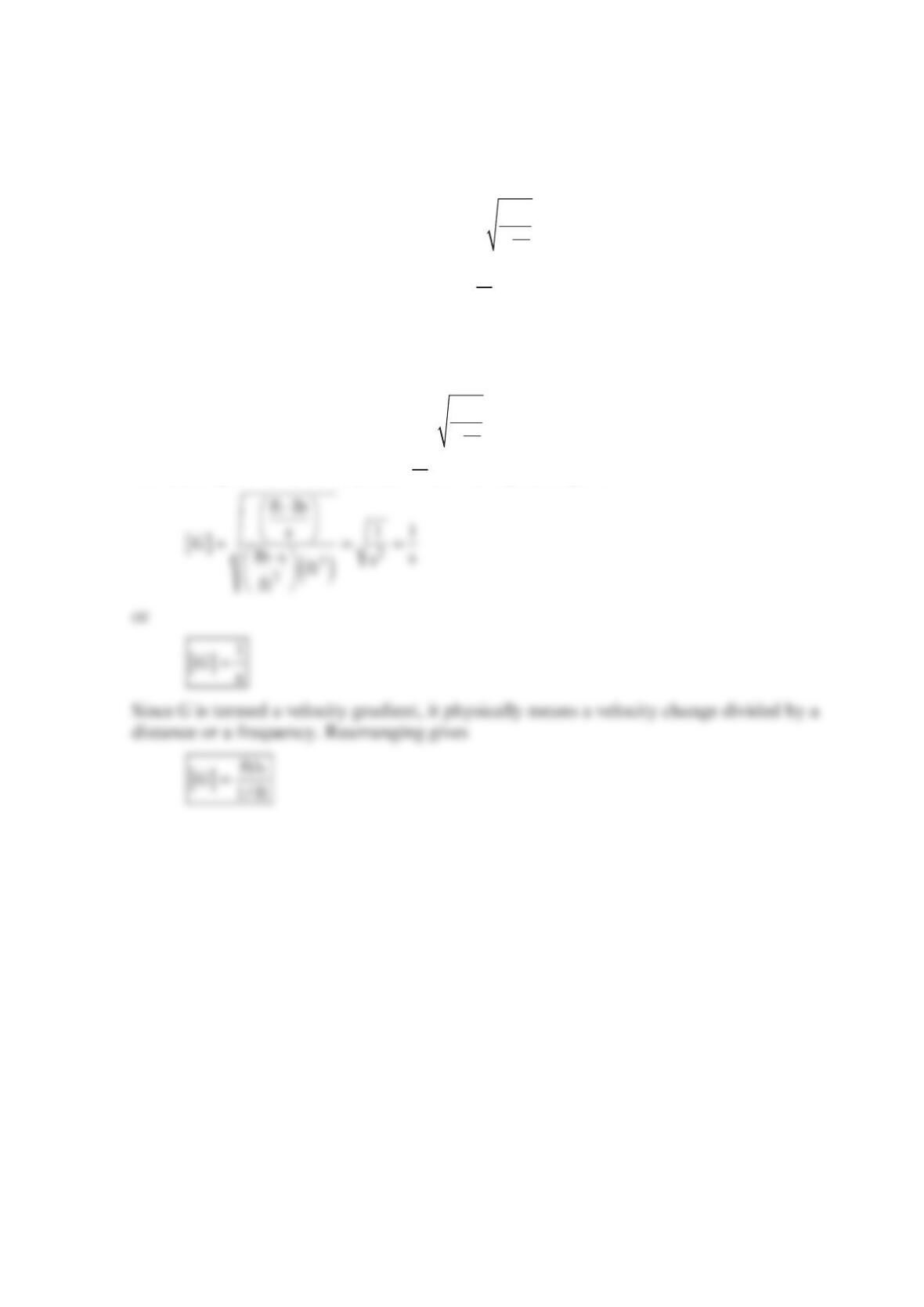
Solution 7.1
W
GV
µ
=
.
Substituting the units of
W
,
µ
, and Vinto the equation gives
Problem 7.2
An equation used to evaluate vacuum filtration is
()
2
f
pA
QVRw AR
α
Δ
=+,
where 3/QL
T
is the filtrate volume flowrate, 2
/
p
FL
Δ
is the vacuum pressure
differential, 2
A
L is the filter area,
α
is the filtrate “viscosity,”
3
VL is the filtrate
volume, /
R
LF is the sludge specific resistance, 3
/
wFL is the weight of dry sludge per
unit volume of filtrate, and f
R
is the specific resistance of the filter medium. What are the
dimensions of f
R
and
α
?
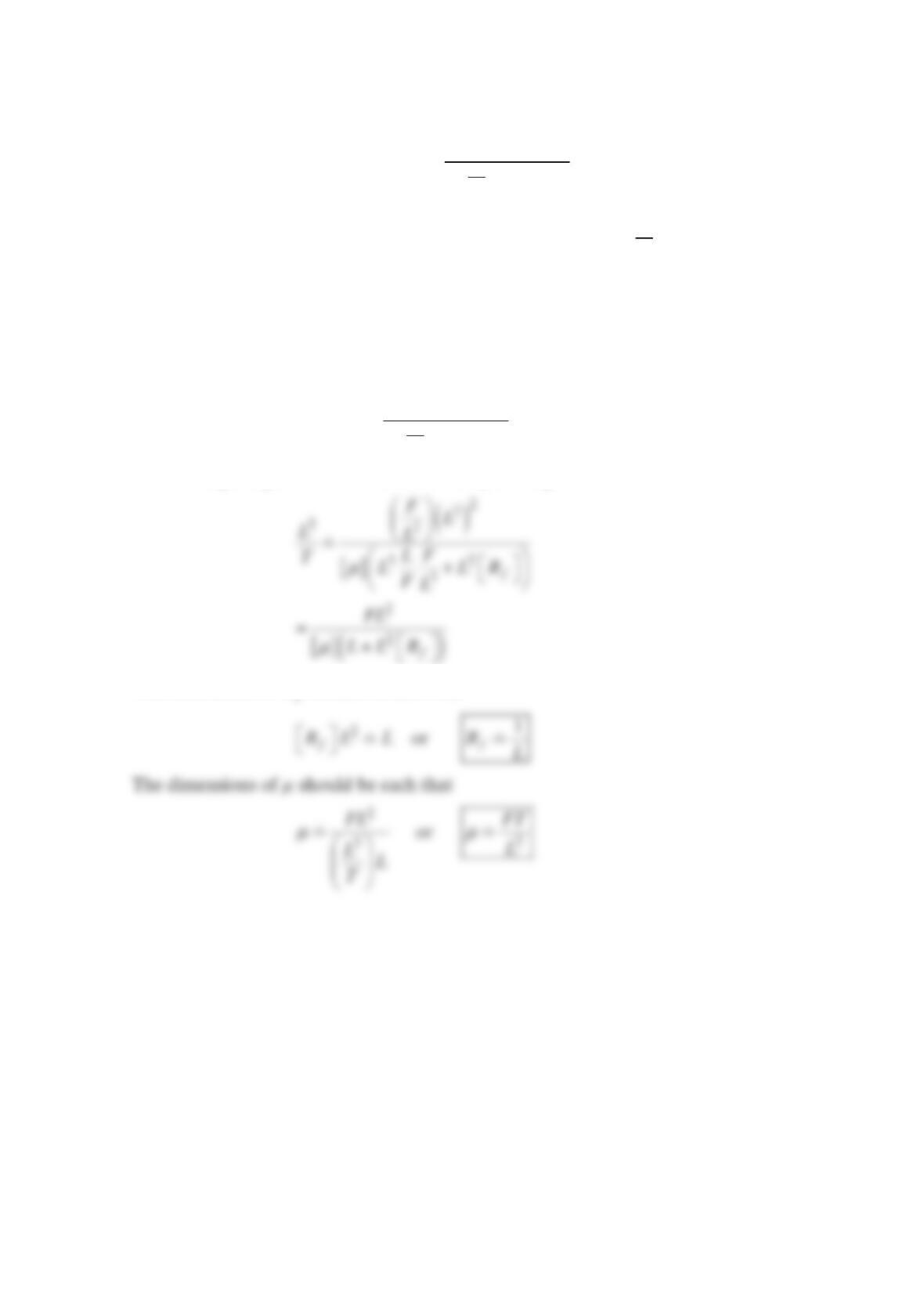
Solution 7.2
()
2
f
pA
QVRw AR
µ
Δ
=+
Substituting the given dimensions into the equation gives
The dimensions of
f
R
should be such that
Problem 7.3
Verify the left-hand side of 2
Dp VD
V
ρ
φ
µ
ρ
Δ=
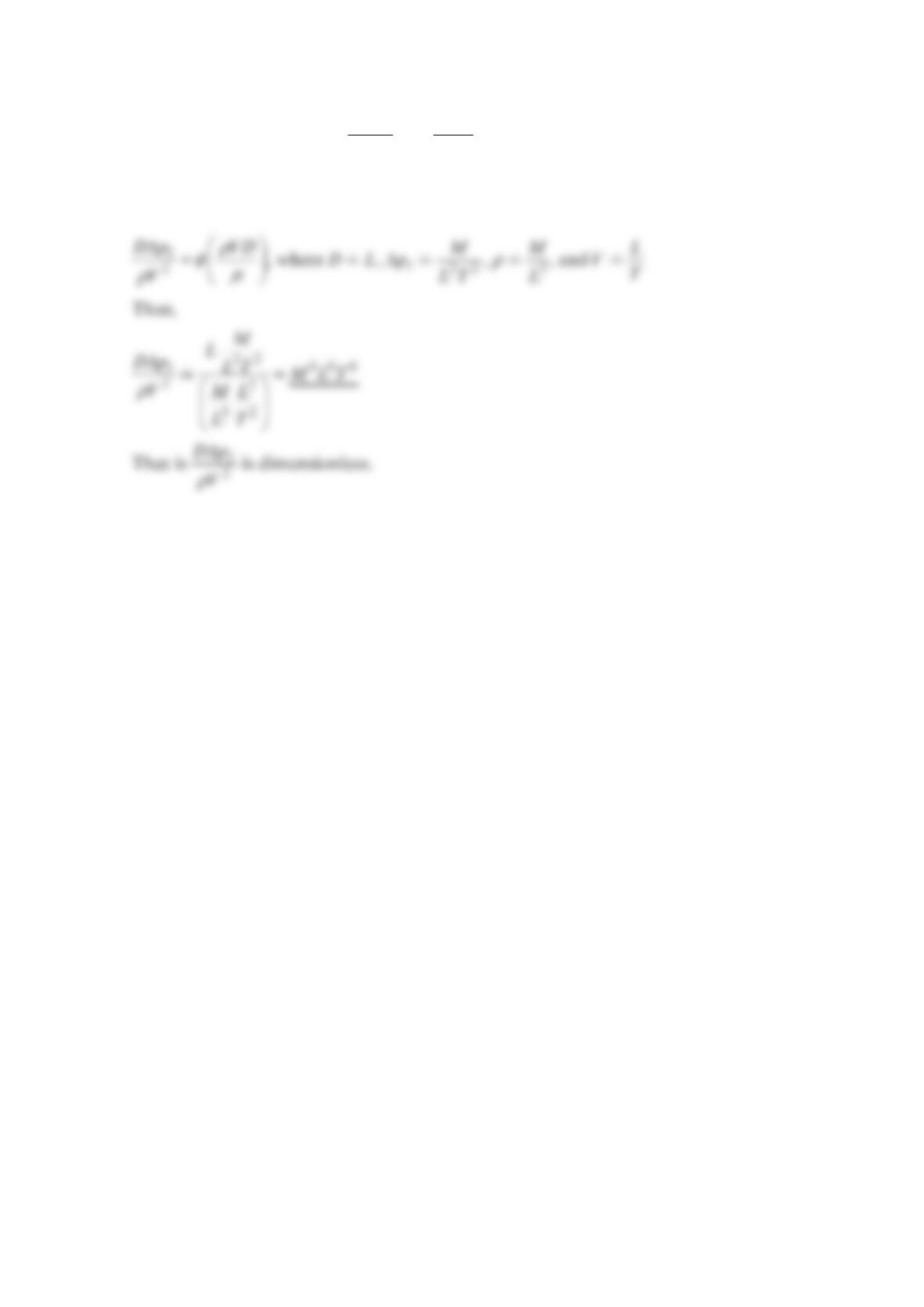
is dimensionless using the
M
LT system.
Solution 7.3
ρ
µ
Problem 7.4
The Reynolds number, /VD
ρµ
, is a very important parameter in fluid mechanics. Verify
that the Reynolds number is dimensionless, using both the
F
LT system and the
M
LT
system for basic dimensions, and determine its value for ethyl alcohol flowing at a velocity
of
3
m/s through a
2
-in.-diameter pipe.
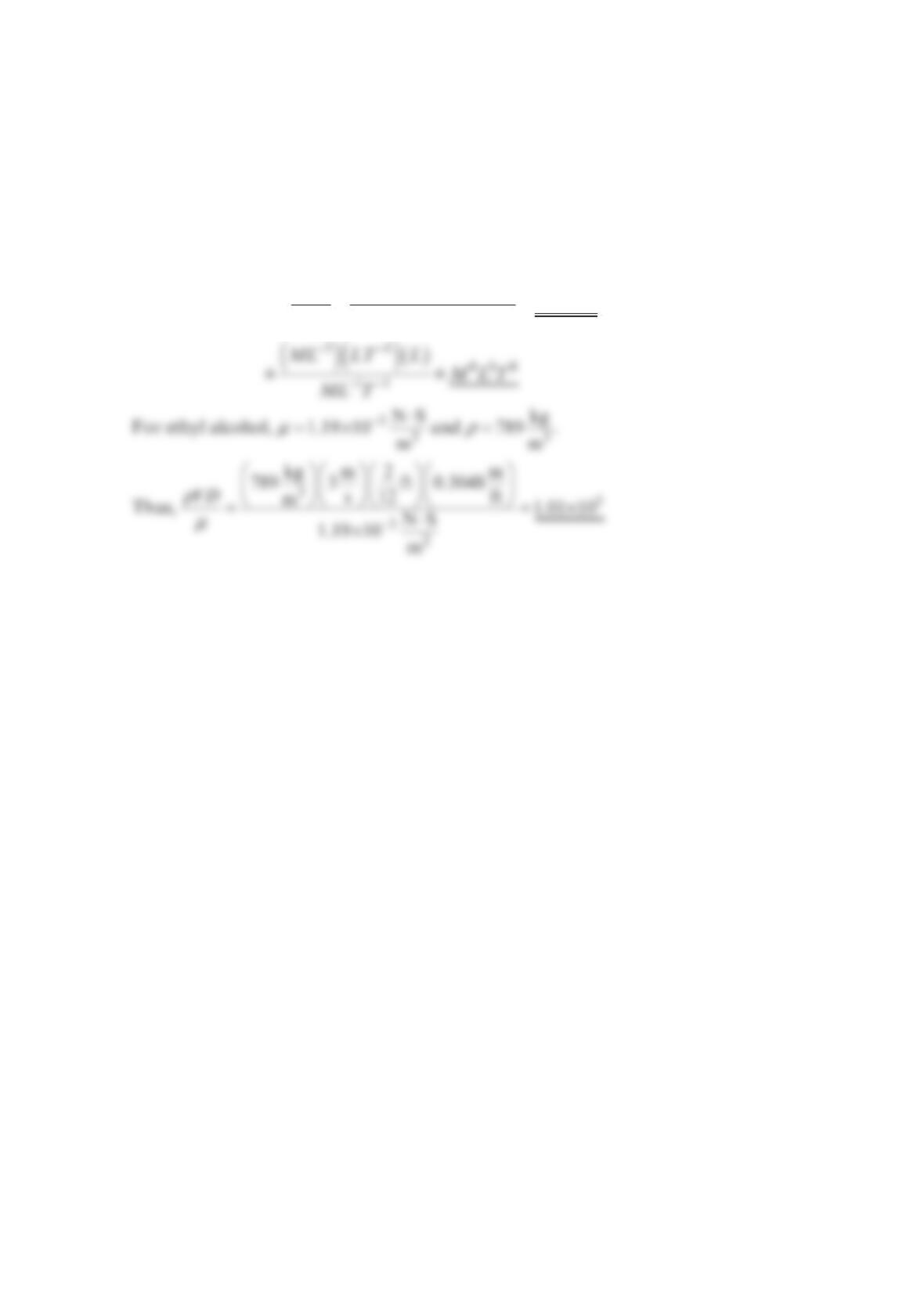
Solution 7.4
Reynolds number
()()
()
42 1
00 0
2
FL T LT L
VD FLT
FL T
ρ
µ
−−
−
=
==
Problem 7.5
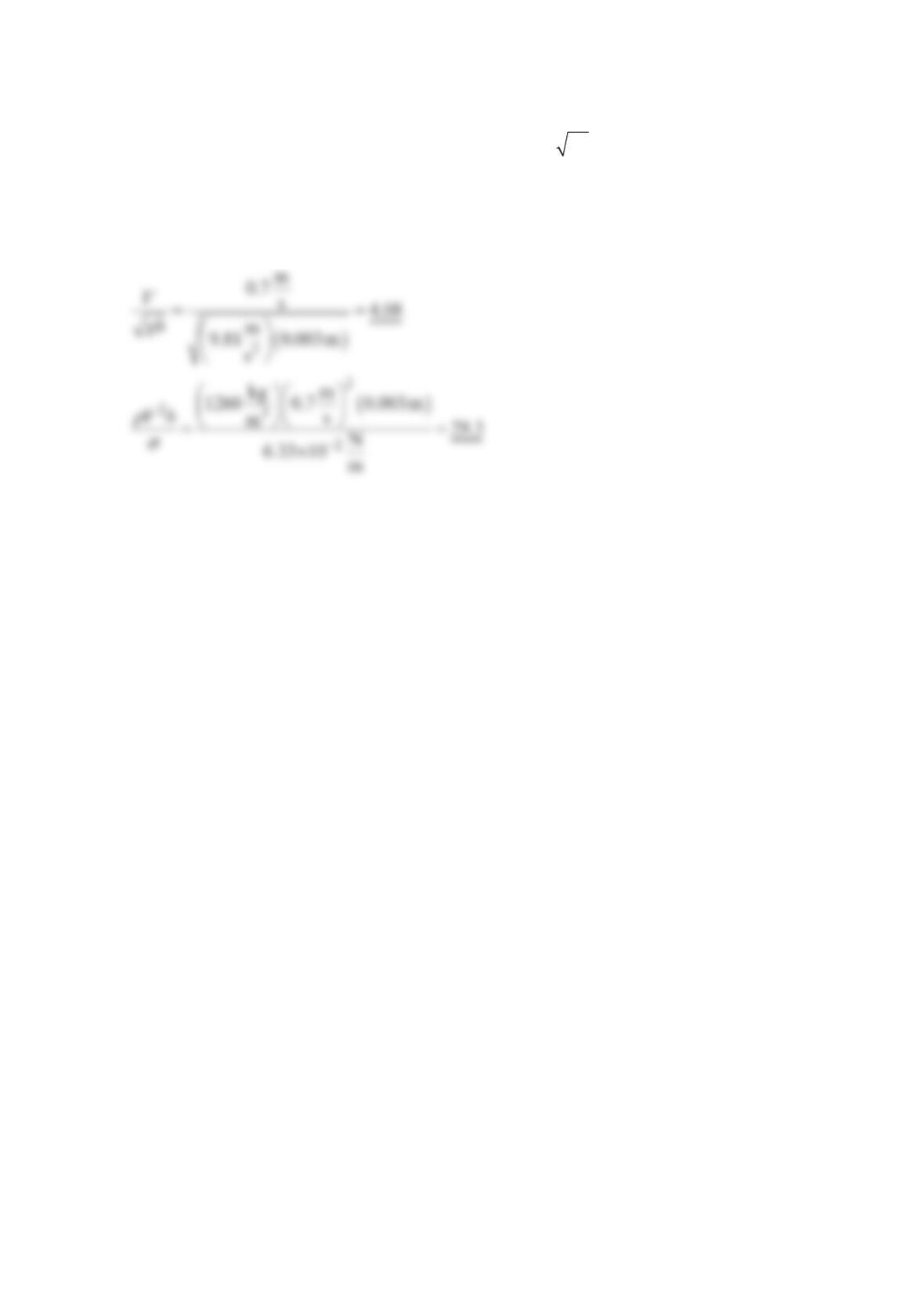
For the flow of a thin film of a liquid with a depth
h
and a free surface, two important
dimensionless parameters are the Froude number, /Vgh
, and the Weber number,
2/Vh
ρσ
. Determine the value of these two parameters for glycerin (at
2
0C
) flowing with a
velocity of 0.7 m/s at a depth of
3
mm.
Solution 7.5
Problem 7.6
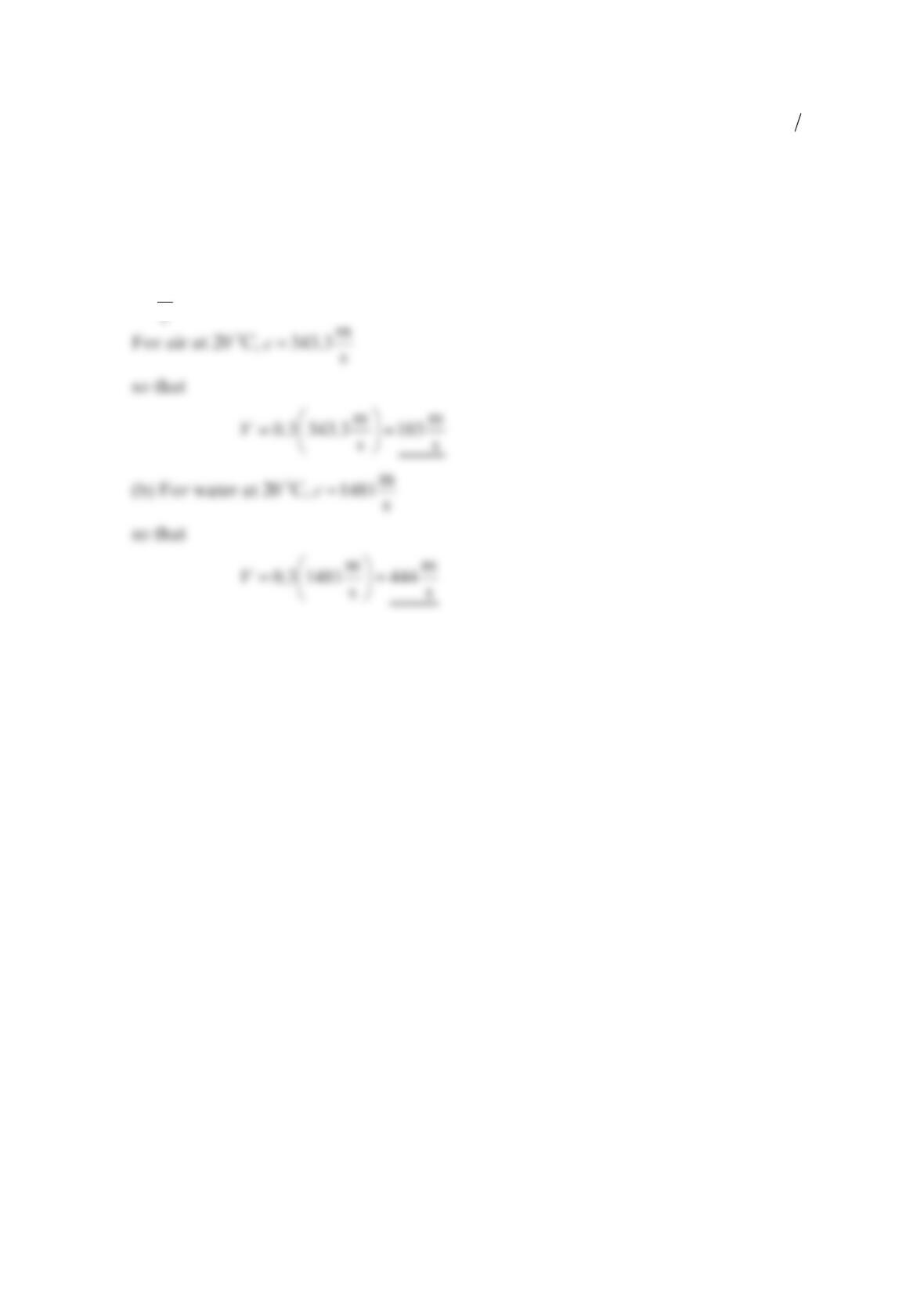
The Mach number for a body moving through a fluid with velocity
V
is defined as
V
c,
where c is the speed of sound in the fluid. This dimensionless parameter is usually
considered to be important in fluid dynamics problems when its value exceeds 0.3. What
would be the velocity of a body at a Mach number of 0.3 if the fluid is (a) air at standard
atmospheric pressure and
2
0C,° and (b) water at the same temperature and pressure?
Solution 7.6
(a) 0.3
V
Problem 7.7
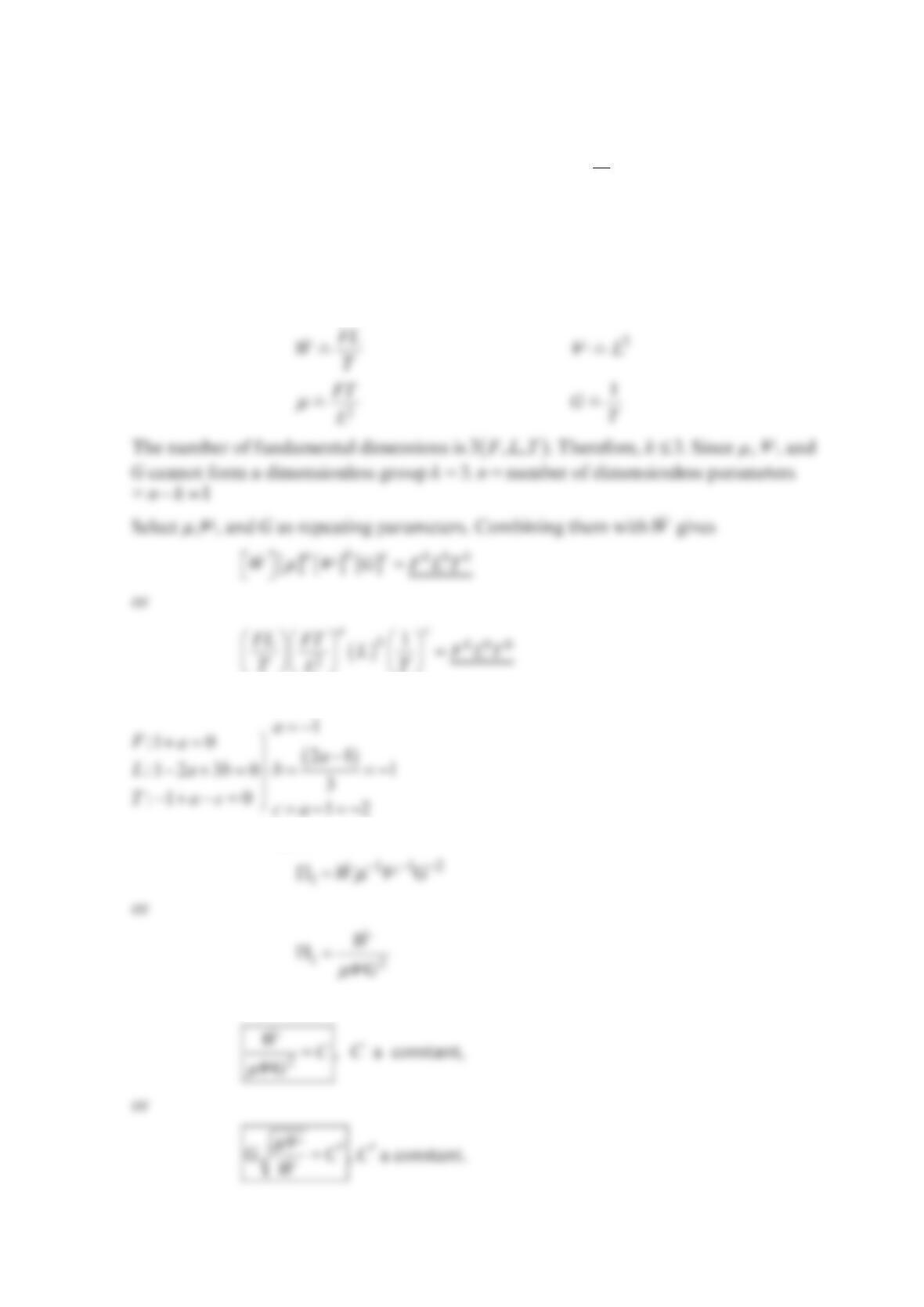
A mixing basin in a sewage filtration plant is stirred by a mechanical agitator with a power
input /
W
FL
T
=⋅
. Other parameters describing the performance of the mixing process are
the fluid absolute viscosity 2
/
FT L
µ
=⋅
, the basin volume 3
VL=
, and the velocity gradient
1/GT=
. Determine the form of the dimensionless relationship.
Solution 7.7
We will use the Pi Theorem to find the dimensionless parameter(s).
The dimensional parameters are:
L
Equating power of like dimensions gives
The dimensionless parameter is
The form of the dimensionless relationship is
W
Problem 7.8
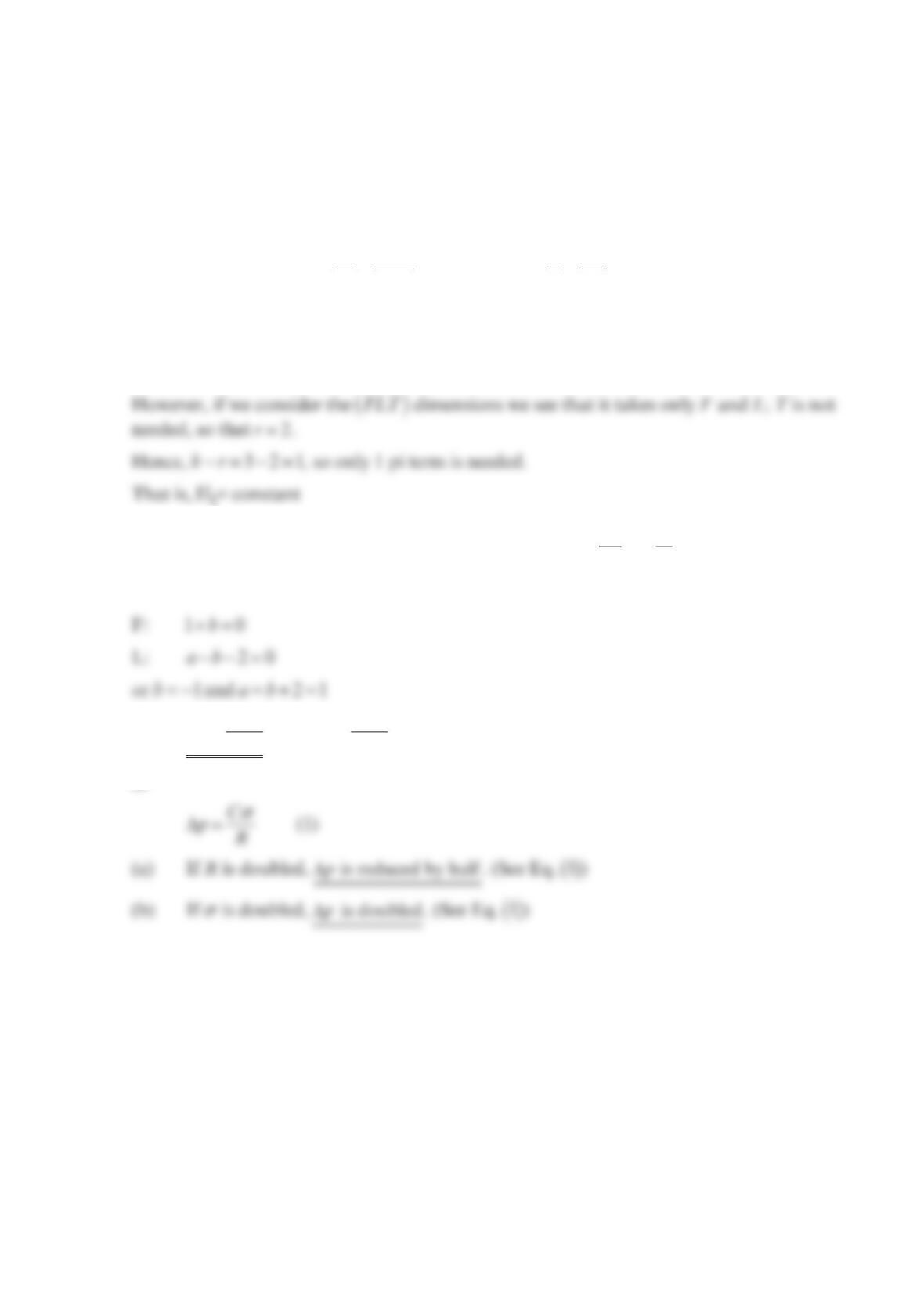
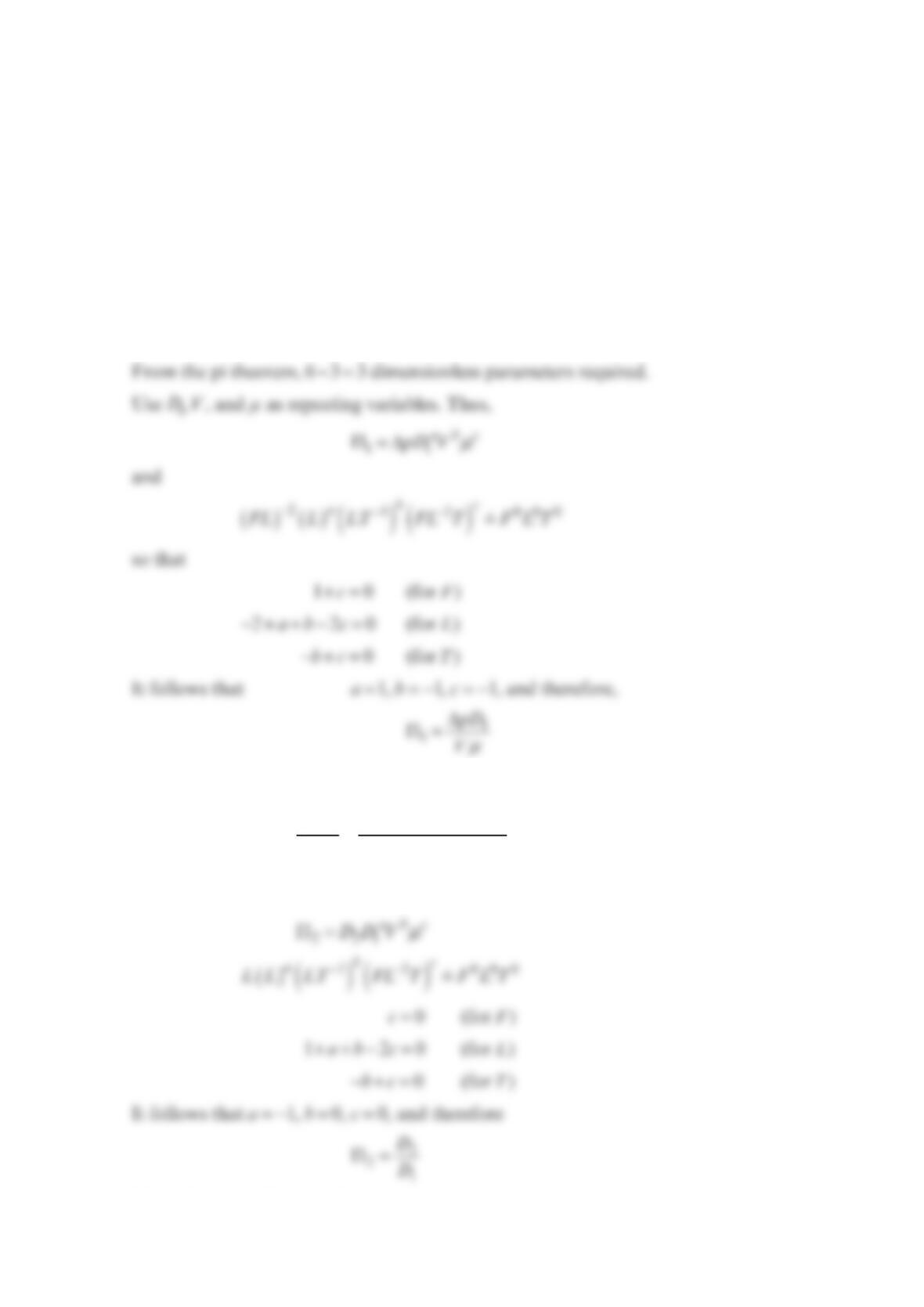
The excess pressure inside a bubble is known to be dependent on bubble radius and surface
tension. After finding the pi terms, determine the variation in excess pressure if we (a)
double the radius and (b) double the surface tension.
Solution 7.8
()
,pfR
σ
Δ
=, where 22
FM
pLLT
Δ
==
,
R
L=
, and 2
FM
LT
σ
==
Consider the
()
MLT dimensions so that 33 0
k
r−=−= since there are 3 variables and
3 dimensions.
According to this, there should be 0
k
r−= pi terms!?
To determine
1
Π
, consider 1
a
b
pR
σ
Π
=Δ or 12
2
b
ab a b ab
FF
pR L F L
L
L
σ
+−+−
Δ
==
Thus:
a
b
a
Hence 1
p
R
σ
Δ
Π
= or
p
RC
σ
Δ=, where
C
= constant.
or
F
k
1
Π
Problem 7.9
At a sudden contraction in a pipe, the diameter changes from
1
D
to 2
D
. The pressure drop,
p
Δ
, which develops across the contraction is a function of
1
D
and 2
D
, as well as the velocity,
V
, in the larger pipe, and the fluid density,
ρ
, and viscosity,
µ
. Use
1
D
,
V
, and
µ
as repeating
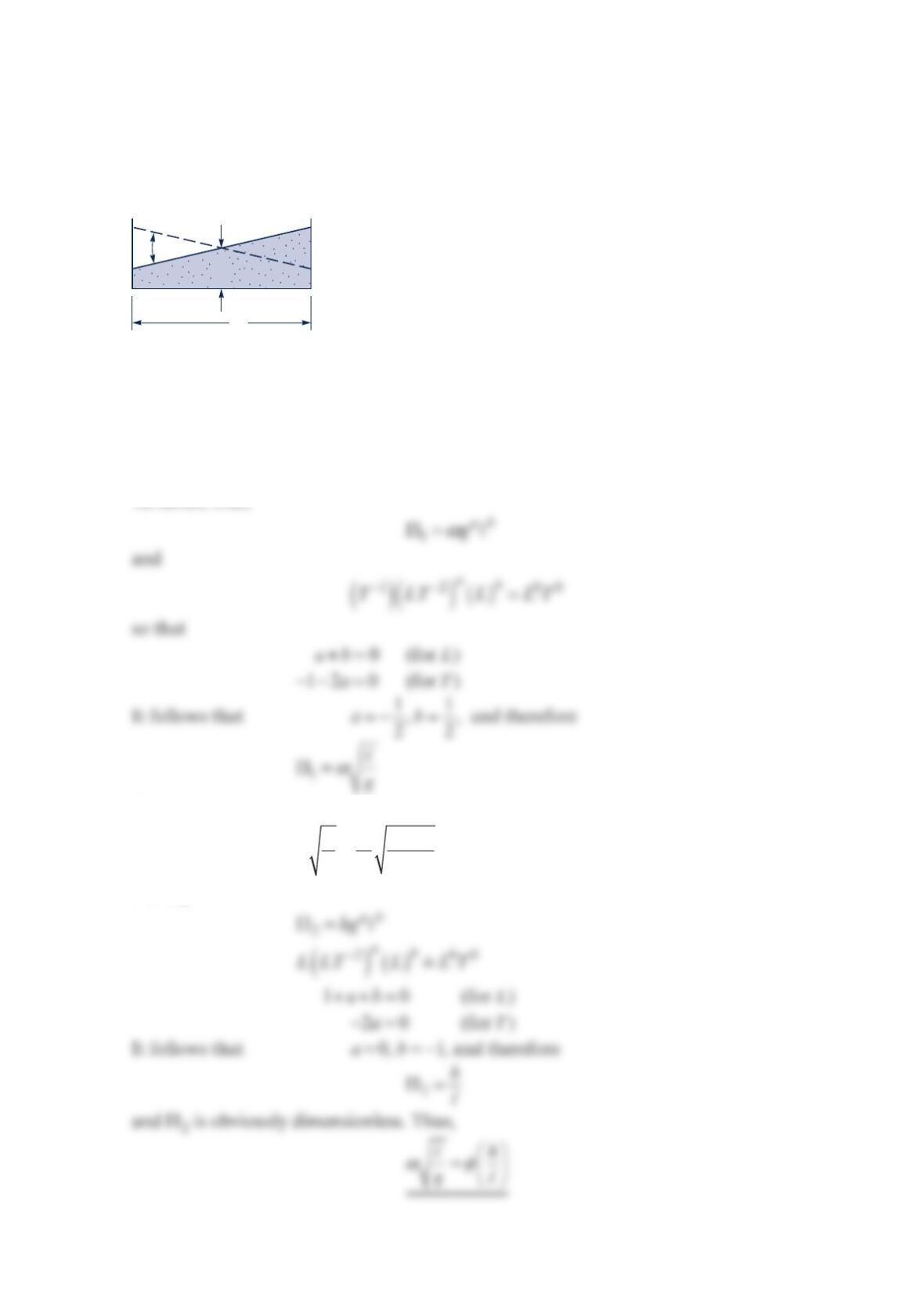
variables to determine a suitable set of dimensionless parameters. Why would it be incorrect
to include the velocity in the smaller pipe as an additional variable?
Solution 7.9
()
12
,,,,pfDDV
ρµ
Δ
=
2
p
FL−
Δ
=
1
D
L=
2
D
L=
1
VLT
−
=
42
FL T
ρ
−
=
2
FL
T
µ
−
=
Check dimensions using
M
LT system:
()
()
()( )
12
00 0
1
111
ML T L
pD MLT
VLT ML T
µ
−−
−−−
Δ==
∴
ok
For 2
Π
:
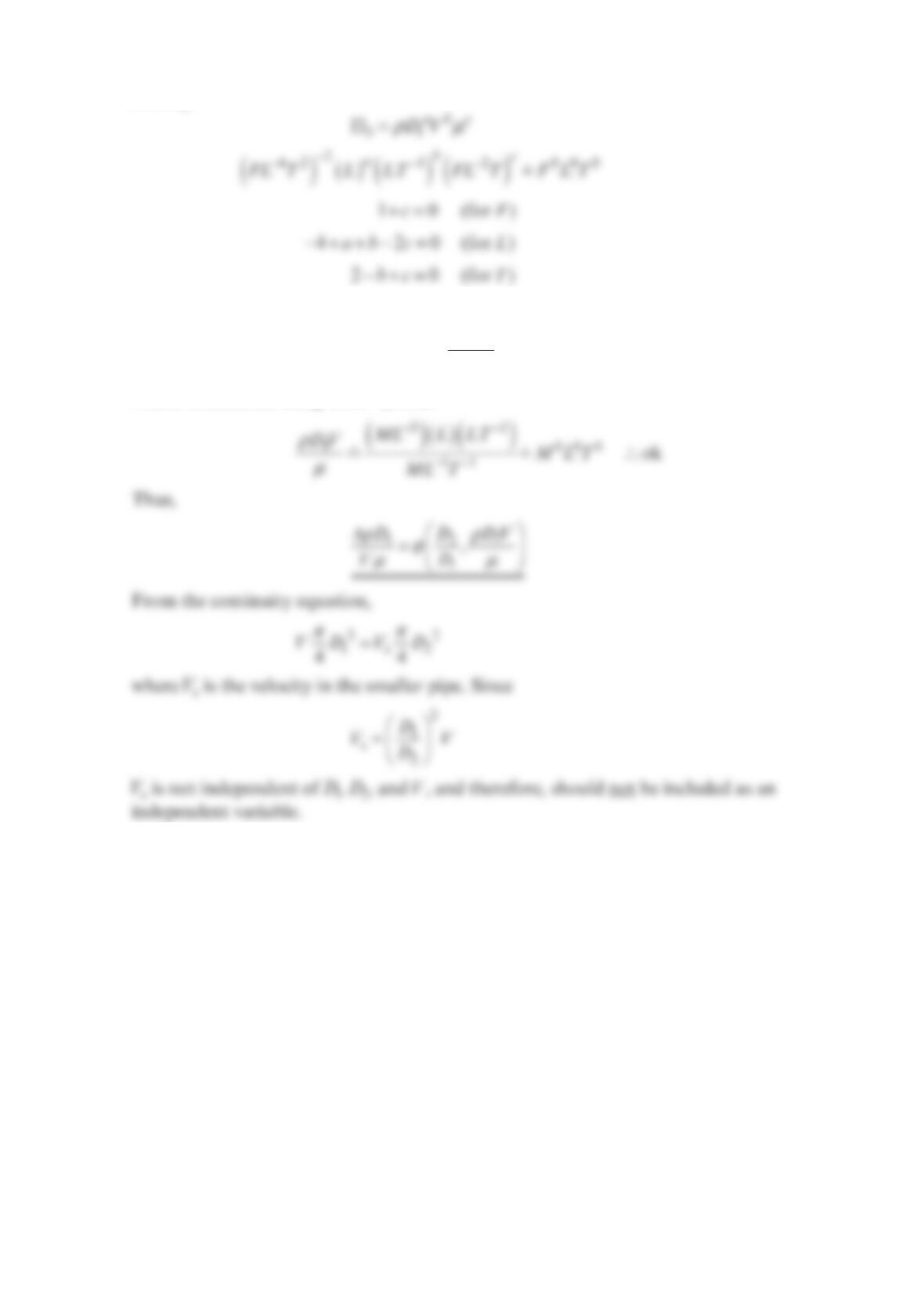
2
Π
is obviously dimensionless.
1
D
V
µ
Π
For 3
Π
:
It follows that 1
a
=,
1
b
=, 1
c
=− , and therefore
1
3
DV
ρ
µ
Π
=
Check dimensions using
M
LT system:
ρ
2
Problem 7.10
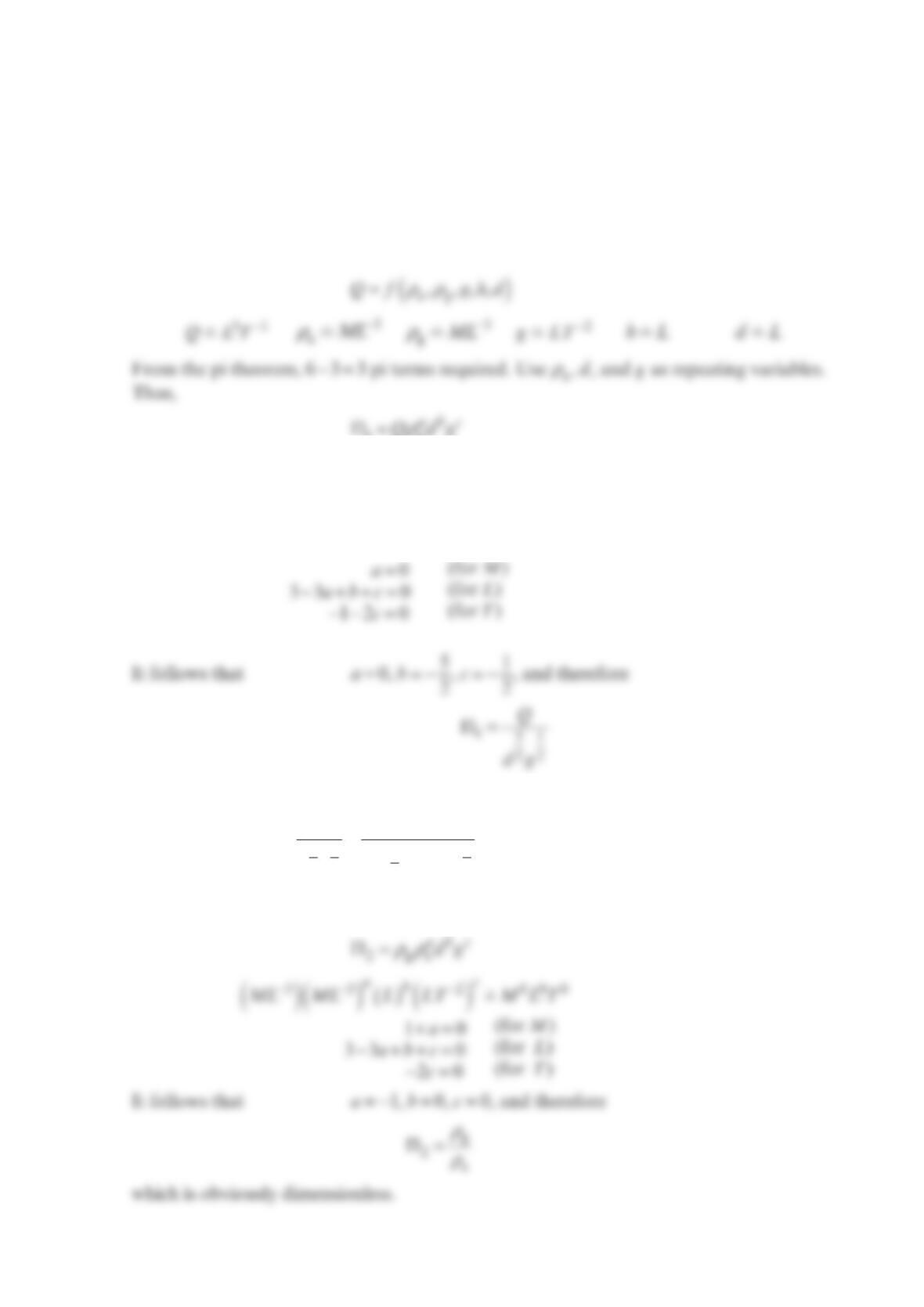
Water sloshes back and forth in a tank as shown in the figure below. The frequency of
sloshing,
ω
, is assumed to be a function of the acceleration of gravity, g, the average depth
of the water,
h
, and the length of the tank,
. Develop a suitable set of dimensionless
parameters for this problem using g and
as repeating variables.
Solution 7.10
()
ω
=,,fgh
ω
−
=1
T
−
=2
gLT
=
h
L
=L
From the pi theorem, −=42 2 dimensionless parameters required. Use g and
as repeating
variables, thus,
Check dimensions:
ω
−
==
00
2
1LLT
gT
LT
∴
ok
For
Π
2:
a
b
Π
h
ℓ
ω
a
Problem 7.11
Assume that the flowrate, Q, of a gas from a smokestack is a function of the density of the
ambient air,
ρ
a, the density of the gas,
ρ
g
, within the stack, the acceleration of gravity, g,
and the height and diameter of the stack,
h
and
d
, respectively. Use
ρ
a,
d
, and g as
repeating variables to develop a set of pi terms that could be used to describe this problem.
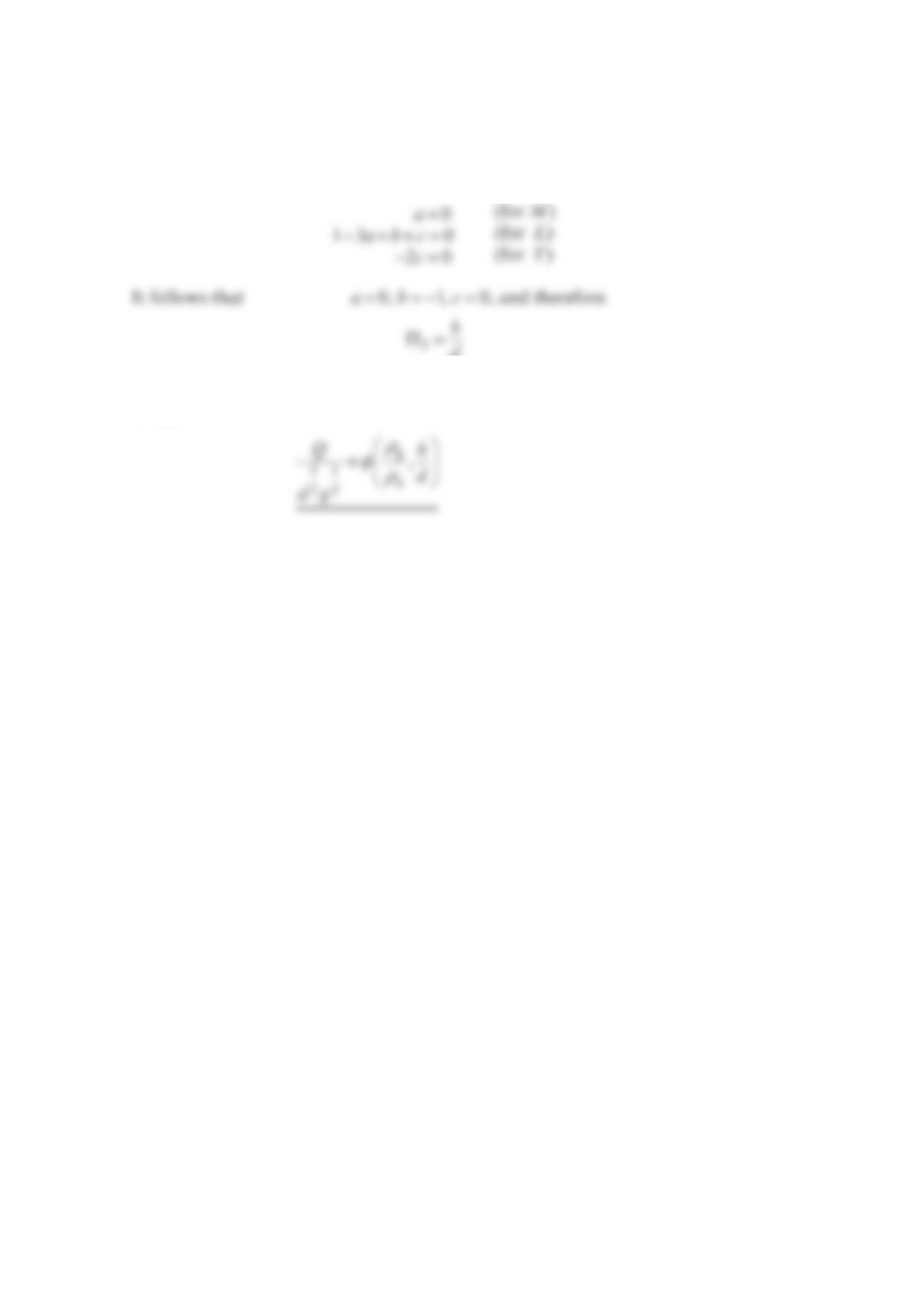
Solution 7.11
1a
and
()()
()
()
−− −
=
31 3 2 000
ac
b
LT ML L LT M LT
so that
Check dimensions using
F
LT system:
()
()
−
−
==
31 00 0
51 1
52
22 2
2
QLTFLT
LLT
dg
∴
ok
For
Π
2:
ρ
For
Π
3:
ρ
Π
=
3a
abc
hdg
()
()
()
()
−−
=
32000
ac
b
LML L LT MLT
d
which is obviously dimensionless.
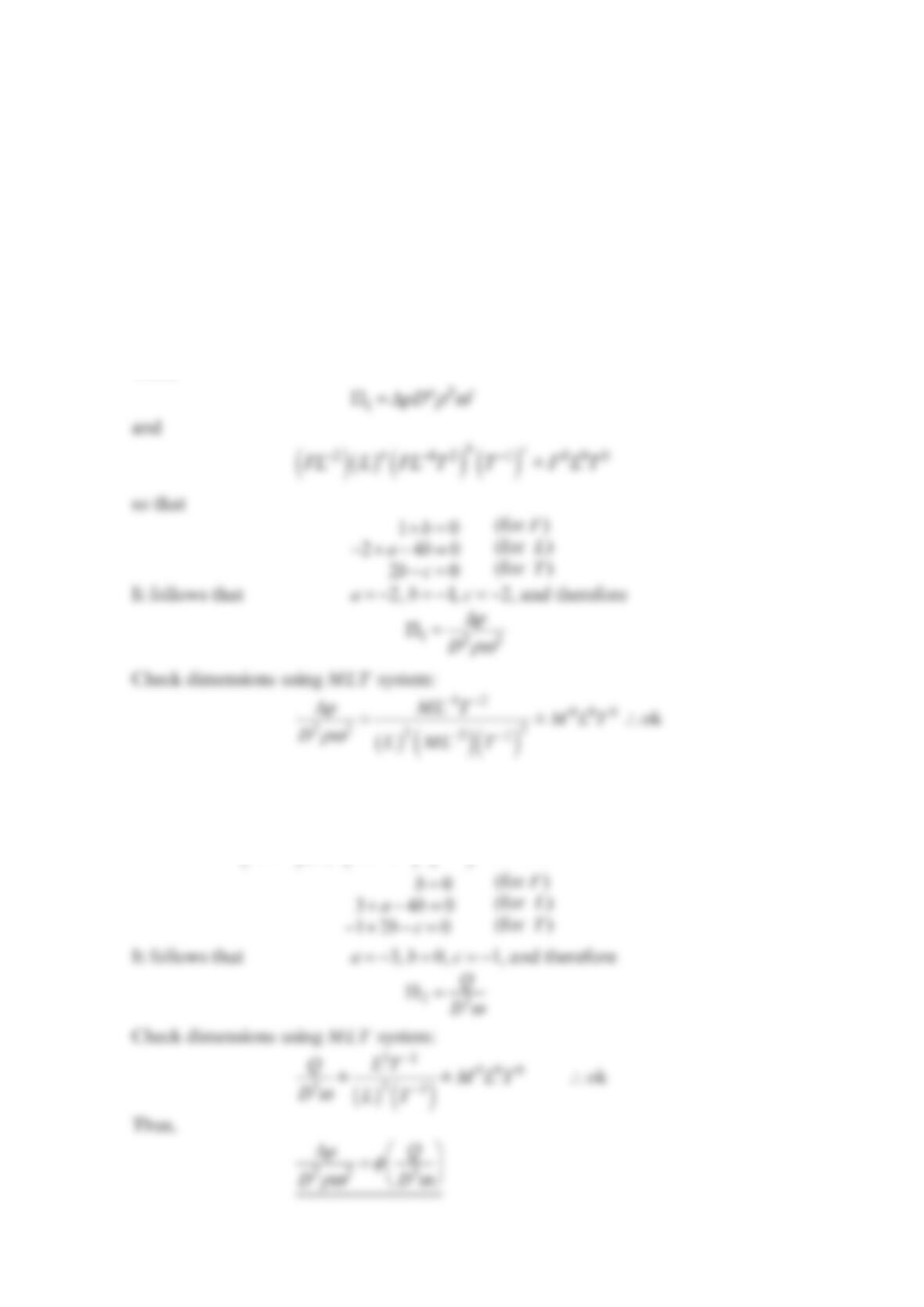
Thus,
Problem 7.12
The pressure rise,
Δ
p
, across a pump can be expressed as
ρ
ω
Δ
=(,,,)pfD Q
where
D
is the impeller diameter,
ρ
is the fluid density,
ω
is the rotational speed, and Q is
the flowrate. Determine a suitable set of dimensionless parameters.
Solution 7.12
−
Δ
=2
pFL
=
D
L
ρ
−
=42
FL T
ω
−1
T −
=31
QLT
From the pi theorem, −=53 2 pi terms required. Use
D
,
ρ
, and
ω
as repeating variables.
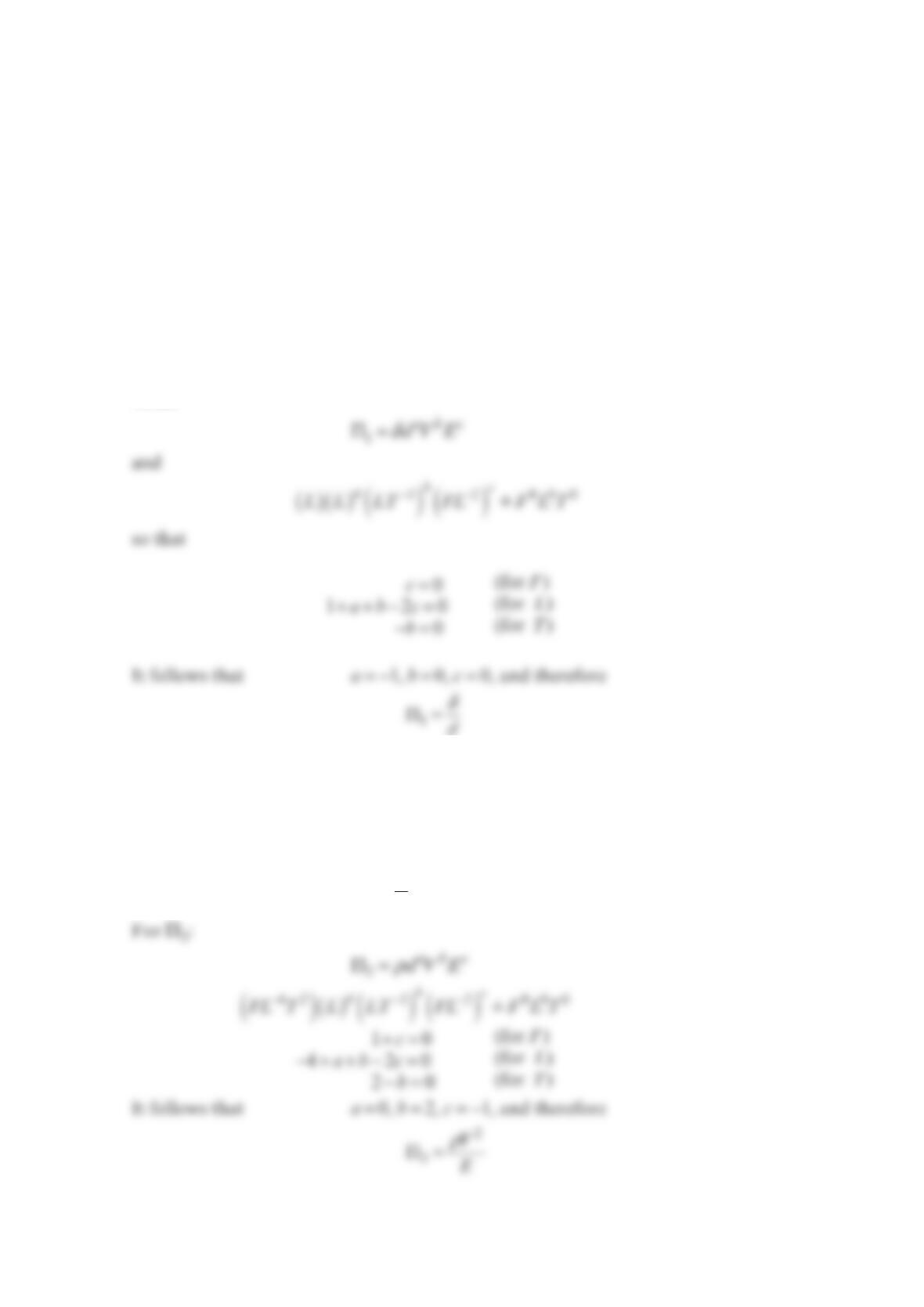
Thus,
For
Π
2:
ρ
ω
Π
=
2
ab
c
QD
()
()
()()
−−−
=
31 42 1 000
bc
a
LT L FL T T F LT
F
ρ
Π
F
Problem 7.13
A thin elastic wire is placed between rigid supports. A fluid flows past the wire, and it is
desired to study the static deflection,
δ
, at the center of the wire due to the fluid drag.
Assume that
δρµ
=(, , , , ,
)
fd VE
where
is the wire length,
d
is the wire diameter,
ρ
is the fluid density,
µ
is the fluid
viscosity,
V
is the fluid velocity, and
E
is the modulus of elasticity of the wire material.
Develop a suitable set of pi terms for this problem.
Solution 7.13
δ
=
L
=L
=
dL
ρ
−
=42
FL T
µ
−
=2
FL T
−
=1
VLT
−
=2
E
FL
From the pi theorem, −=
7
3
4
pi terms required. Use
d
,
V
, and
E
as repeating variables.
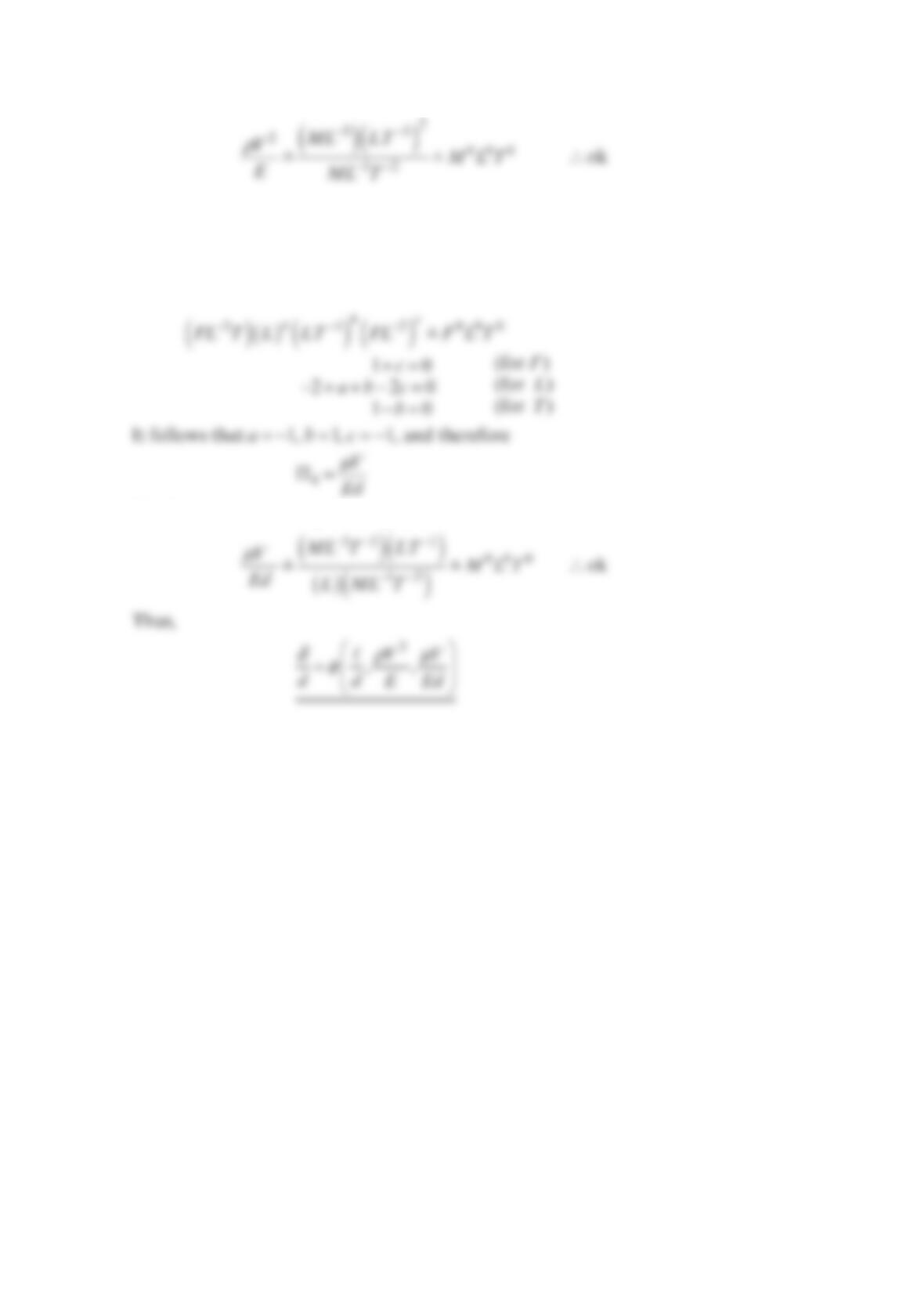
Thus,
which is obviously dimensionless.
For
Π
2:
Π
=
2
ab
c
dV E
and as for
Π
1, =−1
a
, =0
b
, =0c, so that
Π
=
2d
Π
c
F
a
b
Π
c
F
a
b
Check dimensions using
M
LT system:
For
Π
4:
µ
Π
=
4
abc
dV E
Check dimensions using
M
LT system:
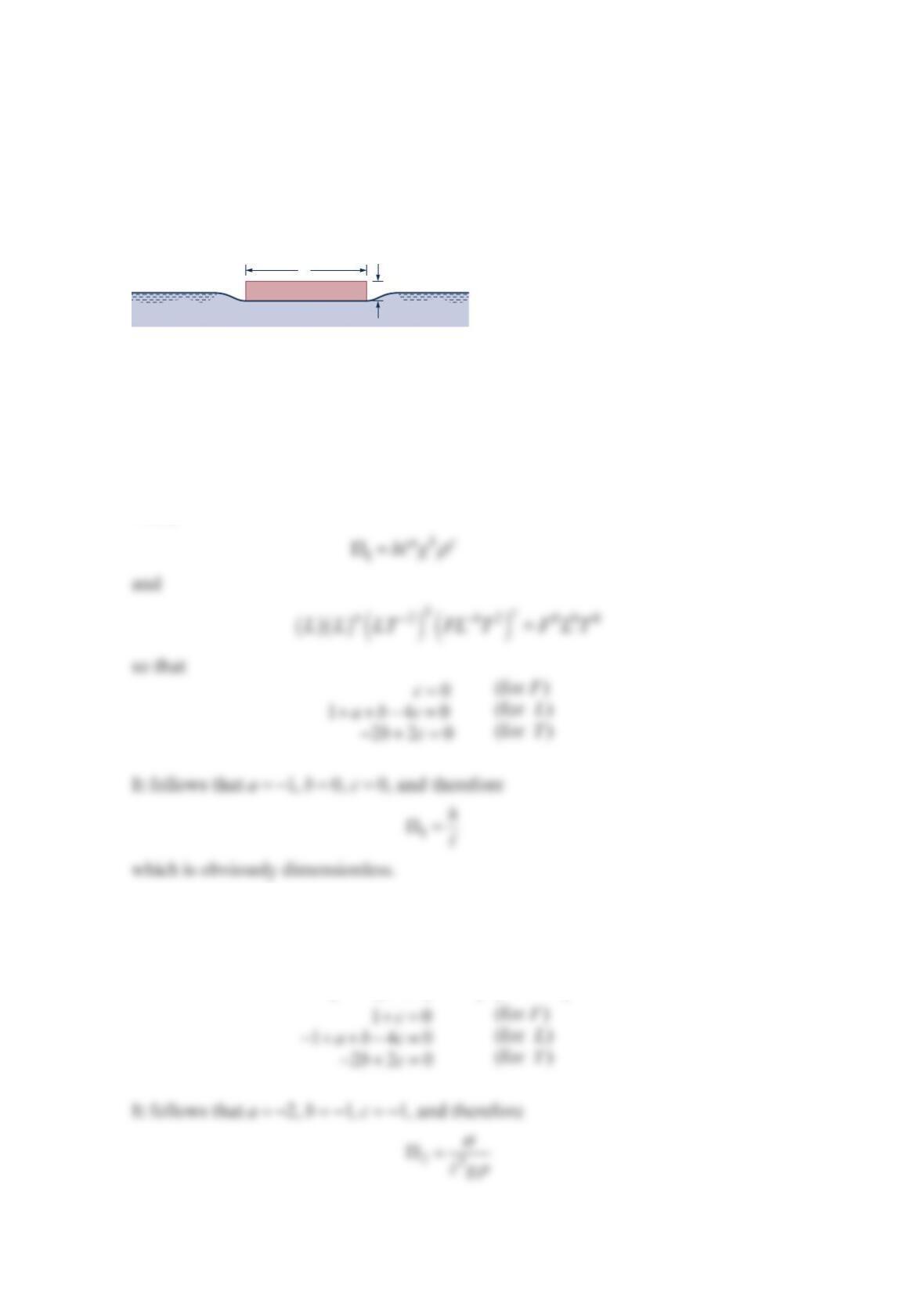
Problem 7.14
Because of surface tension, it is possible, with care, to support an object heavier than water
on the water surface as shown in the figure below. The maximum thickness,
h
, of a square
of material that can be supported is assumed to be a function of the length of the side of the
square,
; the density of the material,
ρ
; the acceleration of gravity, g; and the surface
tension of the liquid,
σ
. Develop a suitable set of dimensionless parameters for this
problem.
Solution 7.14
()
ρ
σ
=,,,
h
fg
=
h
L
=L
ρ
−
=42
FL T
−
=2
gLT
σ
−
=
1
FL
From the pi theorem, −=53 2 pi terms required. Use
, g, and
ρ
as repeating variables.
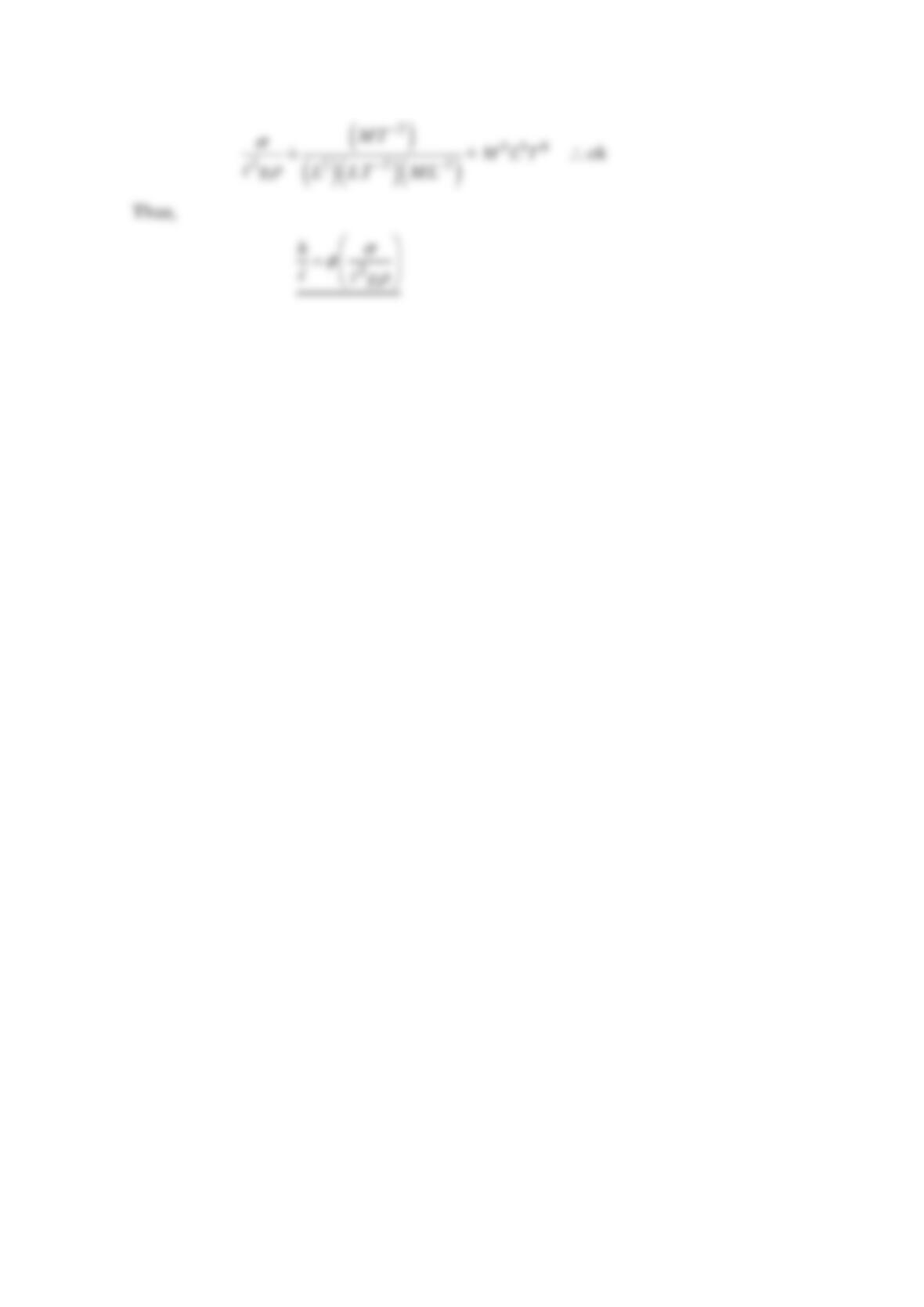
Thus,
For
Π
2:
σ
ρ
Π
=
2
abc
g
()
()
()( )
−−−
=
1242000
bc
a
FL L LT FL T F L T
a
b
ℓ
h
a
b
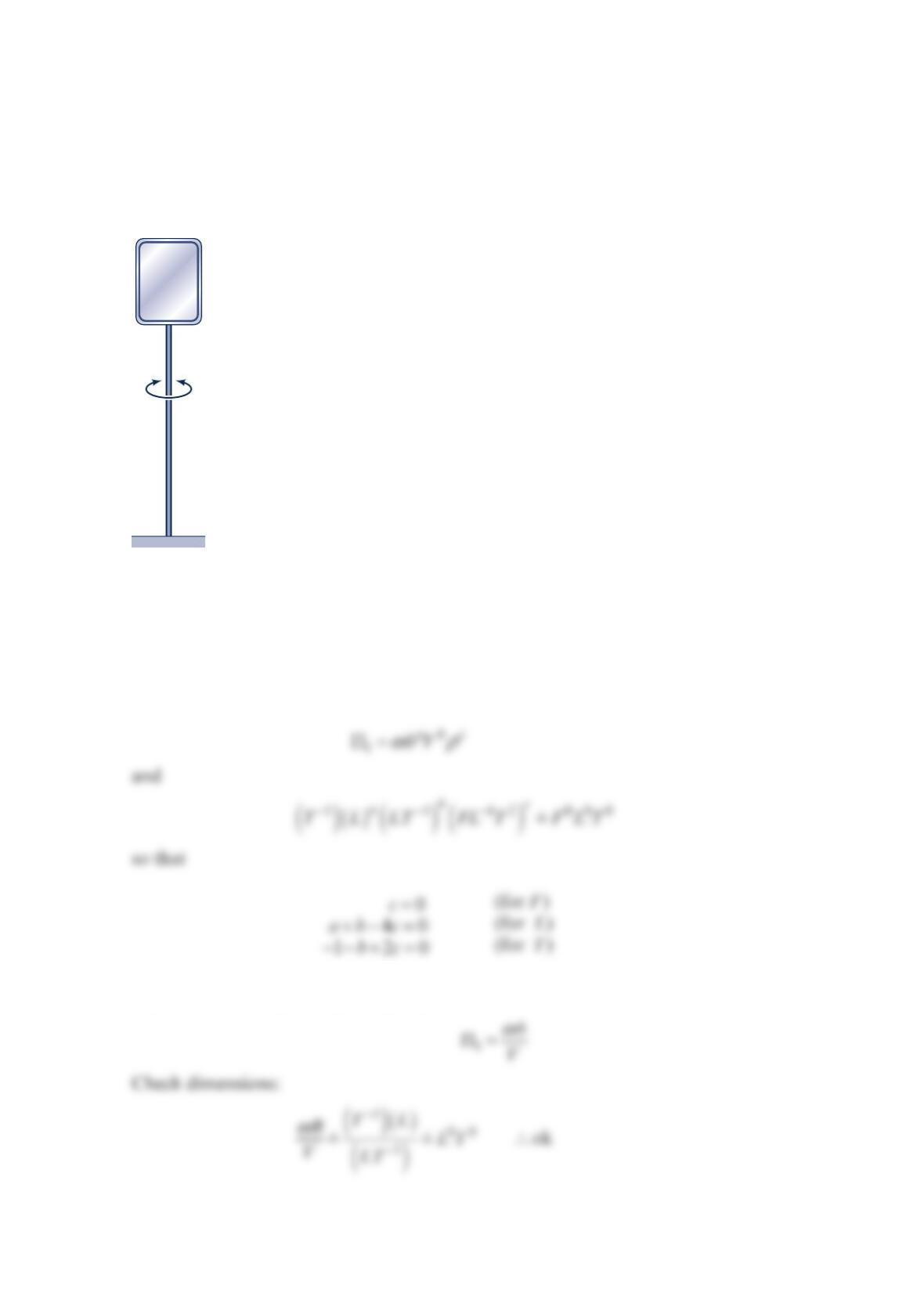
Check dimensions using
M
LT system:
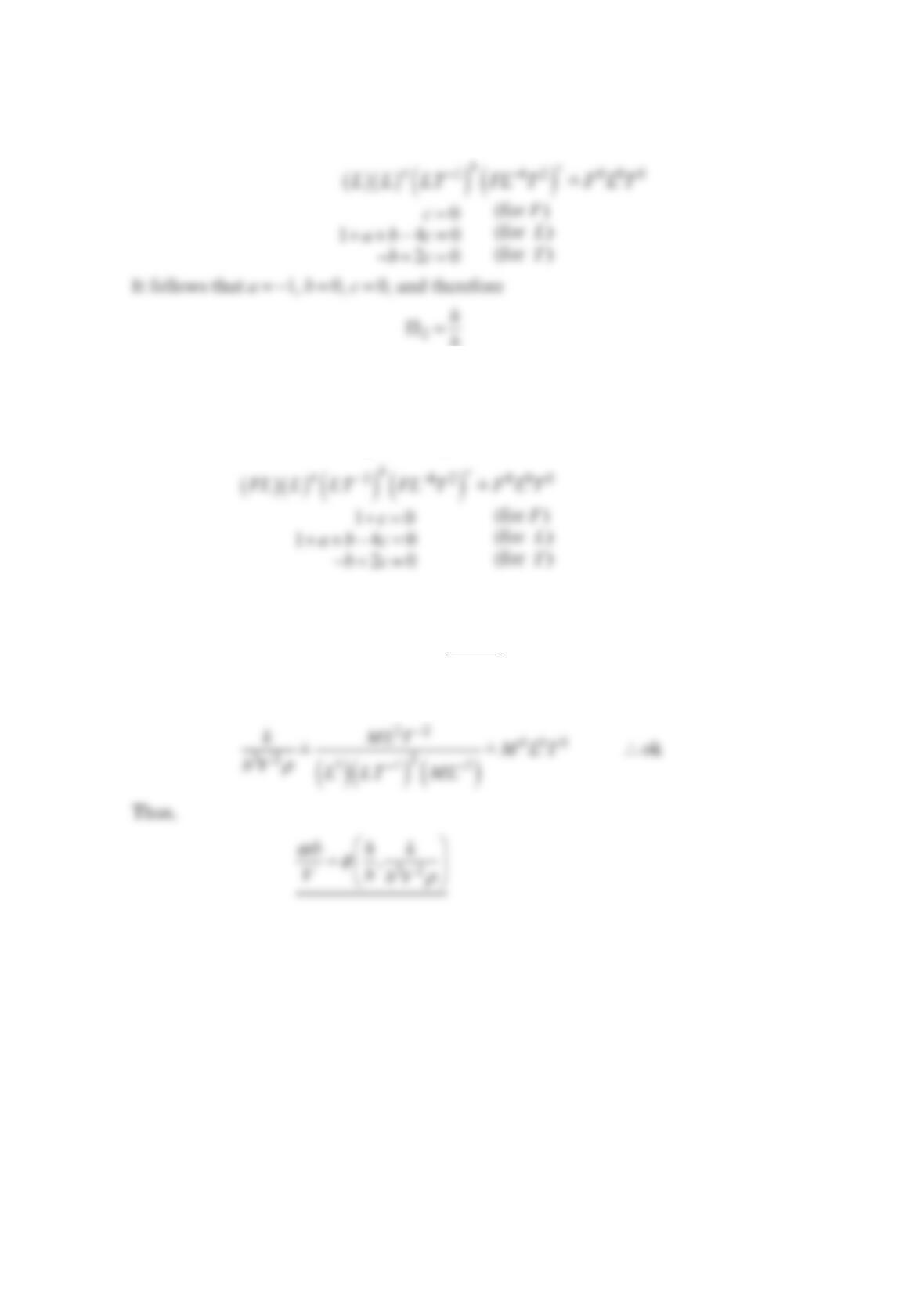
Problem 7.15
Under certain conditions, wind blowing past a rectangular speed limit sign can cause the
sign to oscillate with a frequency
ω
(see the figure below). Assume that
ω
is a function of
the sign width,
b
; sign height,
h
; wind velocity,
V
; air density,
ρ
; and an elastic constant,
k
,
for the supporting pole. The constant,
k
, has dimensions of FL. Develop a suitable set of pi
terms for this problem.
Solution 7.15
()
,, , ,fbhV k
ωρ
=
1
T
ω
−
=
=
b
L
=
h
L
−
=1
VLT
ρ
−
=42
FL T
=
k
FL
From the pi theorem, −=633 pi terms required. Use
b
,
V
, and
ρ
as repeating variables.
Thus,
It follows that =1
a
, =−1
b
, =0c, and therefore
ω
SPEED
LIMIT
40
a
For
Π
2:
ρ
Π
=
2
abc
hb V
b
which is obviously dimensionless.
For
Π
3:
ρ
Π
=
3
abc
kb V
It follows that =−3
a
, =−
2
b
, =−1
c
, and therefore
ρ
Π
=
332
k
bV
Check dimensions using
M
LT system:
a
b