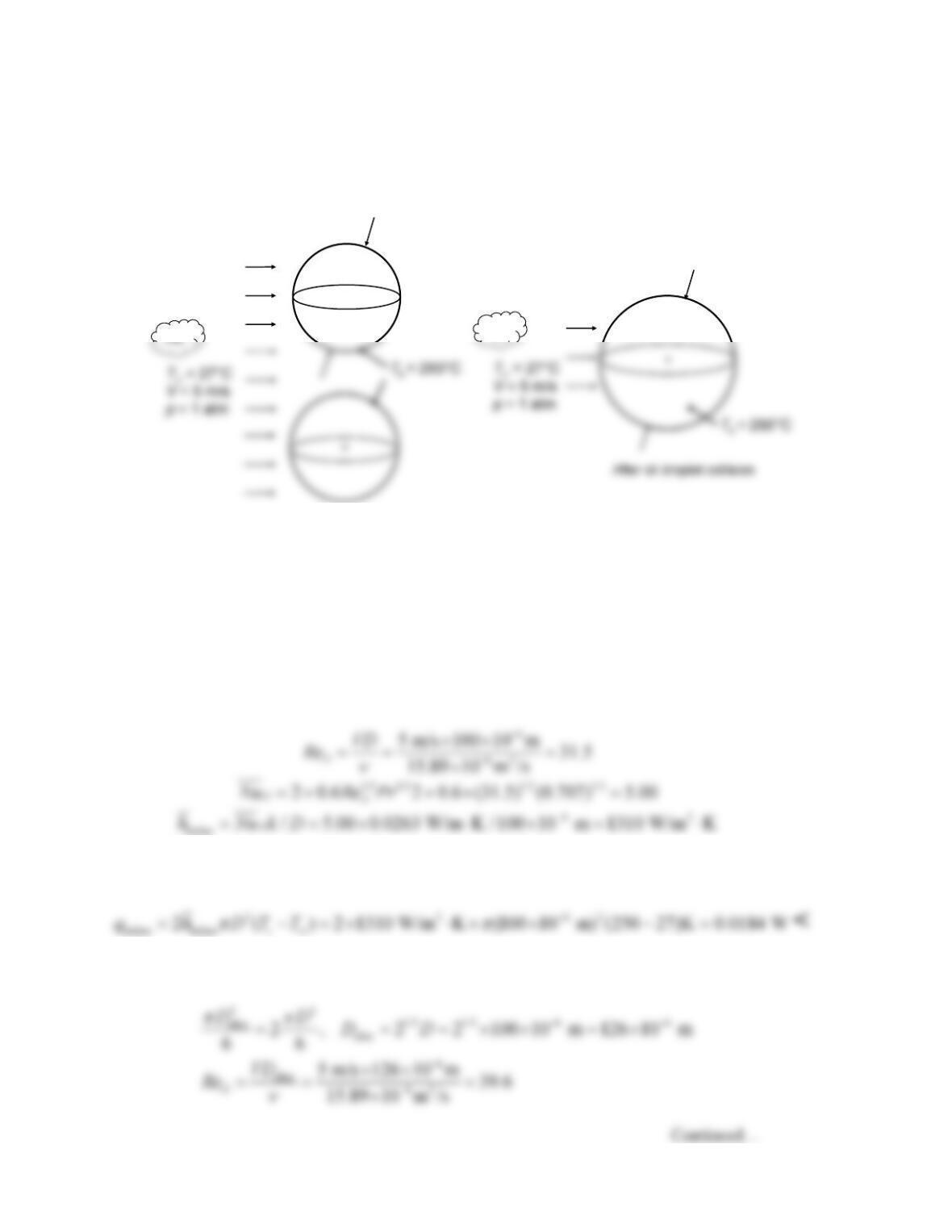
PROBLEM 7.57
KNOWN: Temperature, diameter, and velocity of oil droplets in air. Air temperature.
FIND: Heat transfer rate from oil to air for two droplets before and after coalescence.
SCHEMATIC:
Air
D2
+
D1= 100 μm
Before oil droplet collision
ASSUMPTIONS: (1) Steady–state incompressible flow conditions, (2) Constant properties, (3)
Negligible radiation effects, (4) Oil droplets are freely falling.
PROPERTIES: Table A-4, Air, (T = 300 K):
µ
= 184.6 × 10⁻⁷ N⋅s/m2,
ν
= 15.89 × 10⁻⁶ m2/s, k = 0.0263
W/m⋅K, Pr = 0.707.
ANALYSIS: The Ranz and Marshall correlation, Equation 7.57, can be used for freely falling drops.
Before coalescence, evaluating properties at the freestream temperature as indicated in Table 7.7,
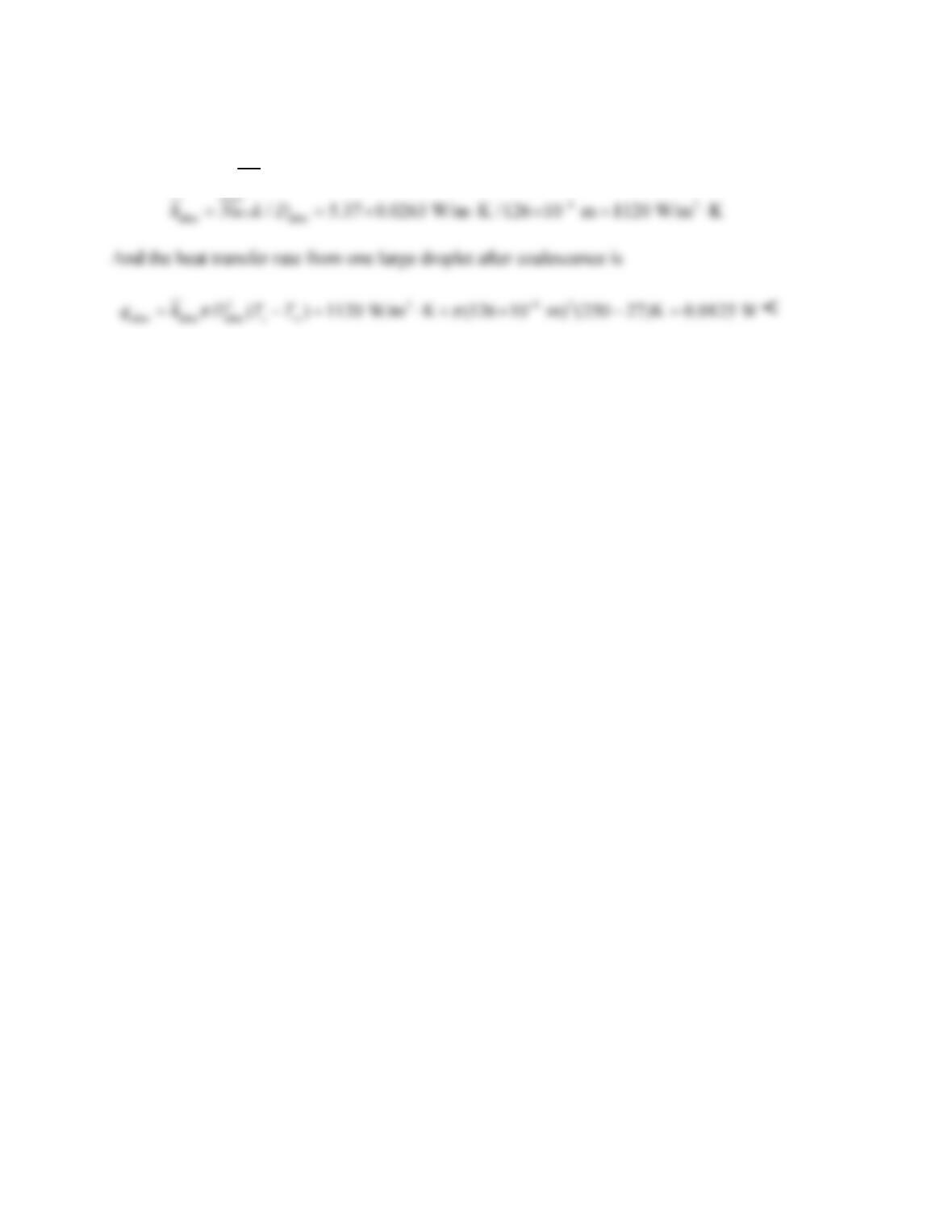
And the heat transfer rate from two droplets before coalescence is
After coalescence the new diameter and Reynolds number can be found:
PROBLEM 7.57 (Cont.)
Then,
1/ 2 1/ 3 1/ 2 1/ 3
2 0.6 2 0.6 (39.6) (0.707) 5.37
DD
Nu Re Pr=+ +× =
COMMENTS: (1) The larger droplet has a 32% lower heat transfer rate than two smaller droplets, due to
both a lower heat transfer coefficient and a lower surface area. (2) The radiation heat transfer rate can be
estimated by assuming that the surroundings are at 27°C and the emissivity is unity. The result is
approximately 0.0002 W in both cases, which is negligible compared to the convection heat loss rate.
PROBLEM 7.58
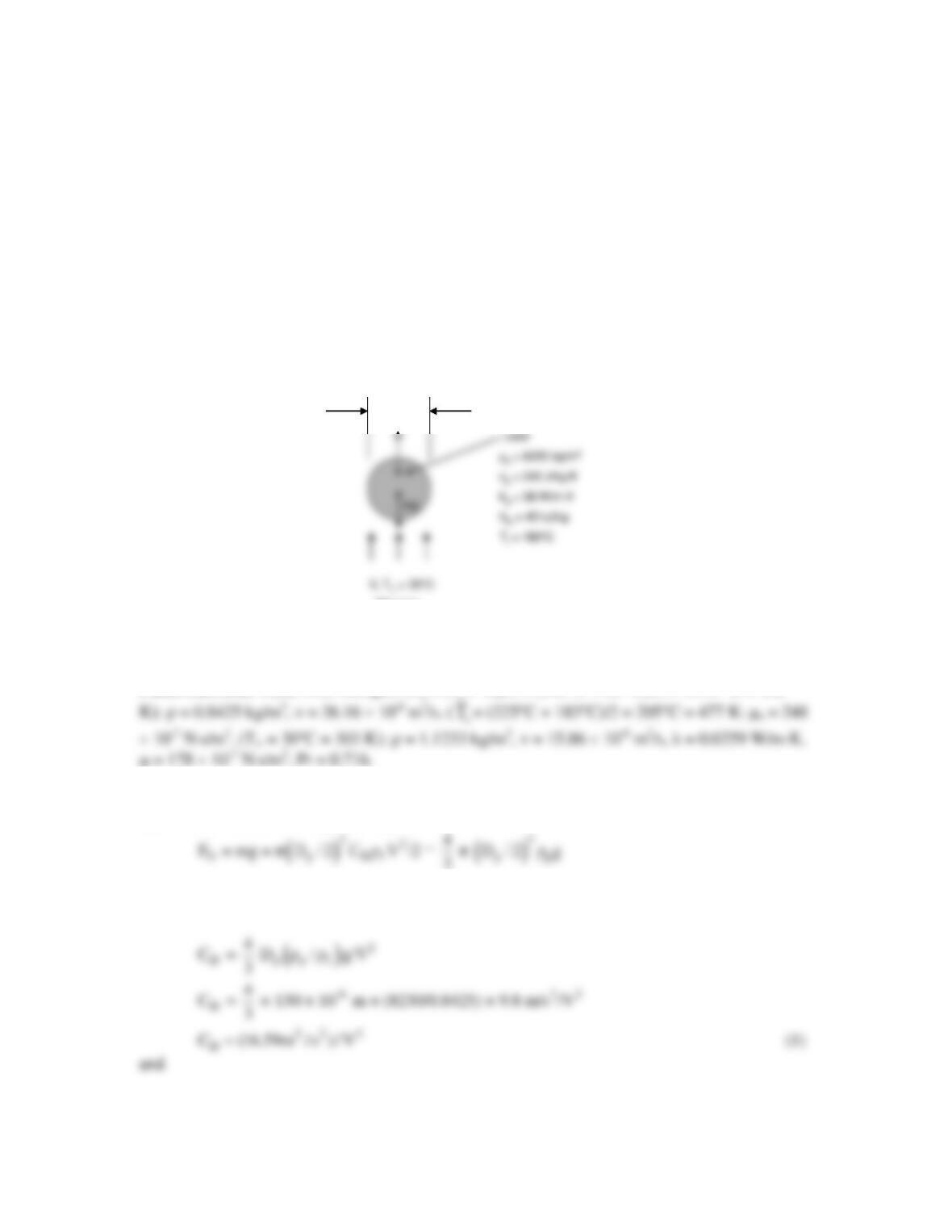
KNOWN: Method to manufacture small diameter lead solder balls. Properties of D = 130 µm
diameter particles ejected into nitrogen gas at V = 2 m/s. Nitrogen temperature and pressure,
initial particle temperature. Piezoelectric device oscillation frequency.
FIND: (a) Terminal velocity of the droplets and distance traveled when a droplet completely
solidifies, (b) Separation distance between droplets and pot size needed to produce solder balls
continuously for one week.
SCHEMATIC:
D
p
= 130 µm
F
D
Nitrogen
D
p
= 130 µm
F
D
Nitrogen
ASSUMPTIONS: (1) Negligible radiation heat transfer, (2) lumped capacitance thermal
response.
PROPERTIES: Table A.4, Nitrogen: (Tf ≈ (Ti + T∞)/2 = (225°C + 30 °C)/2 = 127.5 °C ≈ 400
ANALYSIS:
(a) A force balance on the particle yields
3
Which may be rearranged to yield
Continued…
PROBLEM 7.58 (Cont.)
p-6 -6 2
D
VD
Re = = V × 130 × 10 m/26.16 × 10 m /s
ν
ReD = (4.97s/m)×V (2)
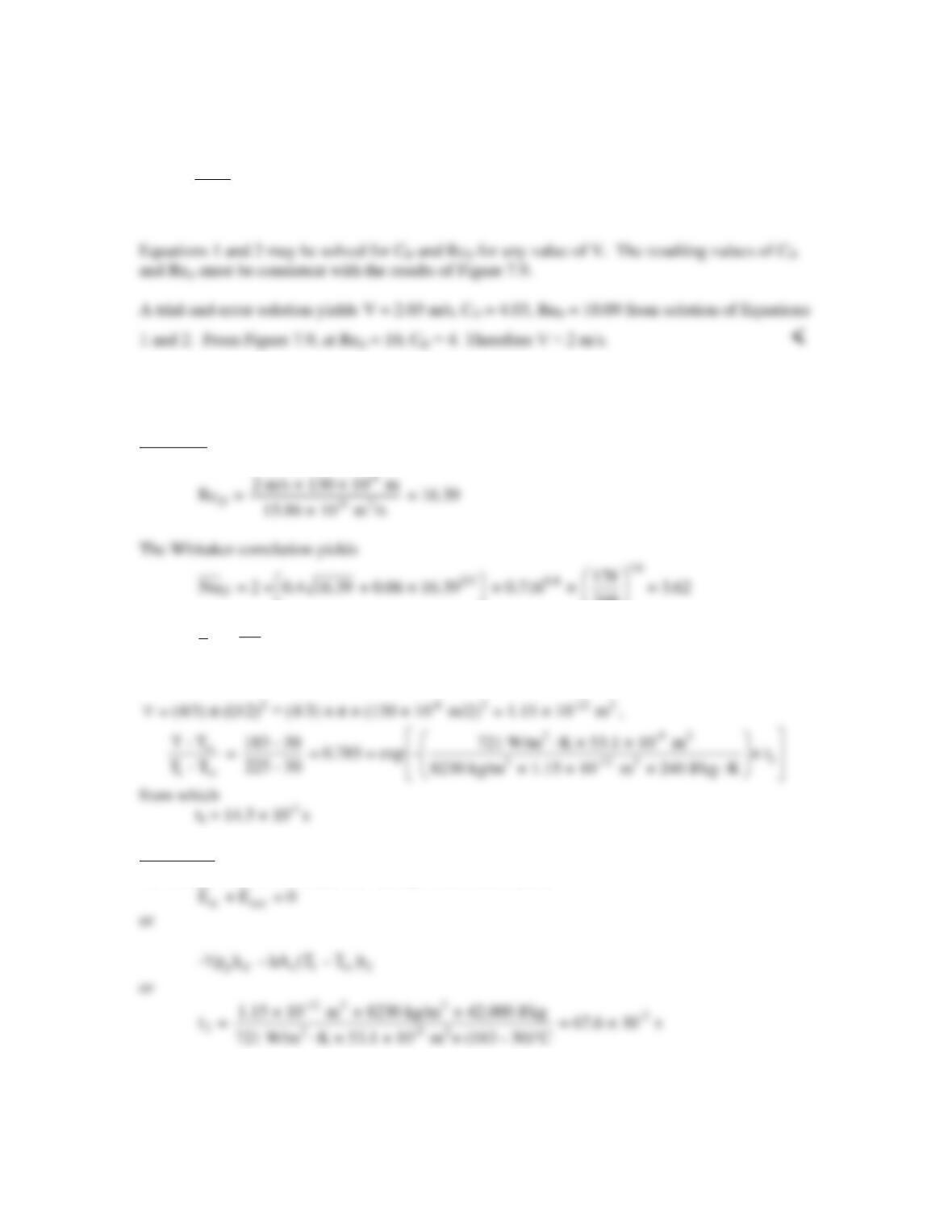
We note that the terminal velocity is identical to the injection velocity. Hence, the particles travel
at constant velocity. The particle cooling process occurs in two steps.
Step One: Particle cooling to Tf = 183°C.
With nitrogen properties evaluated at T∞ = 30°C, the Reynolds number is
248
Therefore
-6 2
D
Dp
h = Nu k/D = 3.62 × 0.0259 W/m K/130 × 10 m = 721 W/m K⋅⋅
Using Equation 5.6 with
2 -6 2 -9 2
s
A = 4π(D/2) = 4 × π × (130 × 10 m/2) = 53.1 × 10 m ,
Step Two: Particle solidification at Tf = 183°C.
An energy balance on the particle during solidification yields
Continued…
PROBLEM 7.58 (Cont.)
Therefore, the time to completely solidify is
T = t1 + t2 = 14.3 × 10⁻³ s + 67.6 × 10⁻³ s = 82 × 10-3 s
COMMENTS: (1) The Biot number associated with the cooling of the particle is Bi = h(Dp/6)/kp
= 721 W/m2⋅K × (130 × 10-6 m/s)/(38 W/m⋅K) = 0.0004 << 0.1. Therefore, the lumped
capacitance assumption is valid. (2) The maximum possible radiation heat transfer coefficient is
PROBLEM 7.59
KNOWN: A spherical workpiece of pure copper with a diameter of 15 mm and emissivity of 0.5 is
suspended in a large furnace with walls at a uniform temperature of 600°C. The air flow over the
workpiece has a temperature of 900°C with a velocity of 7.5 m/s.
FIND: (a) The steady–state temperature of the workpiece; (b) Estimate the time required for the
SCHEMATIC:
Sphere, T
s
T
s
, ε
E = 0
st
.
q
rad
T
sur o
= 600 C
ASSUMPTIONS: (1) Flow over a smooth sphere, (2) Sphere behaves as spacewise isothermal object;
lumped capacitance method is valid, (3) Sphere is small object in large, isothermal surroundings, and
(4) Constant properties.
PROPERTIES: Table A-4, Air (T∞ = 1173 K, 1 atm): µ = 4.665 × 10⁻⁵ N⋅s/m2, ν = 0.0001572 m2/s,
k = 0.075 W/m⋅K, Pr = 0.728; Air (Ts = 1010 K, 1 atm): µs = 4.268 × 10⁻⁵ N⋅s/m2.
ANALYSIS: (a) The steady–state temperature is determined from the energy balance on the sphere as
represented in the schematic above.
where As = pD2/4. The convection coefficient can be estimated using the Whitaker correlation, Eq.
7.56, where all properties except µs are evaluated at T∞. Assume Ts = 737°C = 1010 K to evaluate µs.
(b) The time required for the sphere initially at Ti = 25°C to reach within 5°C of the steady–
state temperature can be determined from the energy balance for the transient condition.
Continued …
PROBLEM 7.59 (Cont.)
in out gen st
EE E E−+ =
Recognize that
D
h is not constant, but depends upon Ts(t). Using IHT to perform the integration,
evaluate
D
h
,
and provide pure copper properties ρ and c as a function of Ts, the time to for T(to) =
(737 – 5)°C = 732°C is
Part V ReD
D
Nu
D
h Ts
(m/s) (W/m2⋅K) (°C)
a 7.5 715.6 15.96 79.8 737
b 15 1431 22.42 112.1 760
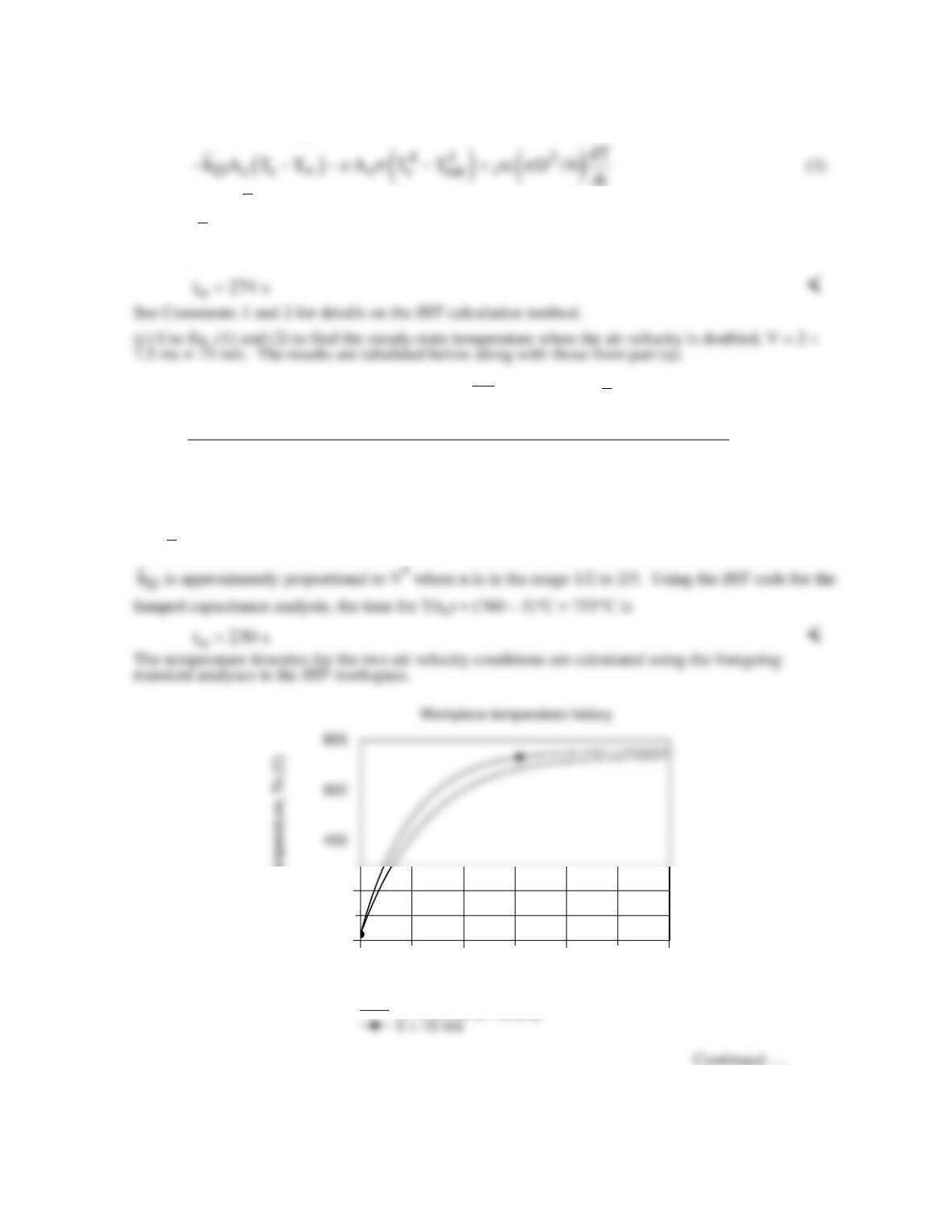
As expected, increasing the air velocity will cause the sphere temperature to increase toward T∞. Note
that
D
h
increases by a factor of 1.4 as the air velocity is doubled. From correlation Eq. (2) note that
D
h
0100 200 300
Elapsed time, t (s)
0
200
Sphere temperature, Ts (C)
V = 7.5 m/s, air velocity

PROBLEM 7.59 (Cont.)
COMMENTS: (1) The portion of the IHT code for performing the energy balance and evaluating the
convection correlation function using the properties function follows.
// Convection correlation, sphere
NuDbar = NuL_bar_EF_SP(ReD,Pr,mu,mus) // Eq 7.56
// Energy balance, steady–state temperature
–hbar * As * (Ts – Tinf) – eps * sigma * (Ts^4 – Tsur^4) * As = 0
As = pi * D^2
sigma = 5.67e-8
// Air property functions : From Table A.4
// Input variables
D = 0.015
eps = 0.5
V = 7.5
Tinf = 900 + 273
Tsur = 600 + 273
(2) Two modifications can be made to the code above to perform the lumped capacitance method for
the transient analysis: (a) include the storage term in the energy balance and (b) provide the properties
function for copper. The initial condition, Ti = 288 K, is entered as the initial condition when the
solver performs the integration.
// Energy balance, steady–state; equilibrium temperature
–hbar * As * (Ts – Tinf) – eps * sigma * (Ts^4 – Tfur^4) * As = M * ccu * der(Ts,t)
(3) Show that the lumped capacitance method is valid for this application.
PROBLEM 7.60
KNOWN: Diameter and initial and final temperatures of copper spheres quenched in a water bath.
FIND: (a) Terminal velocity in the bath, (b) Tank height.
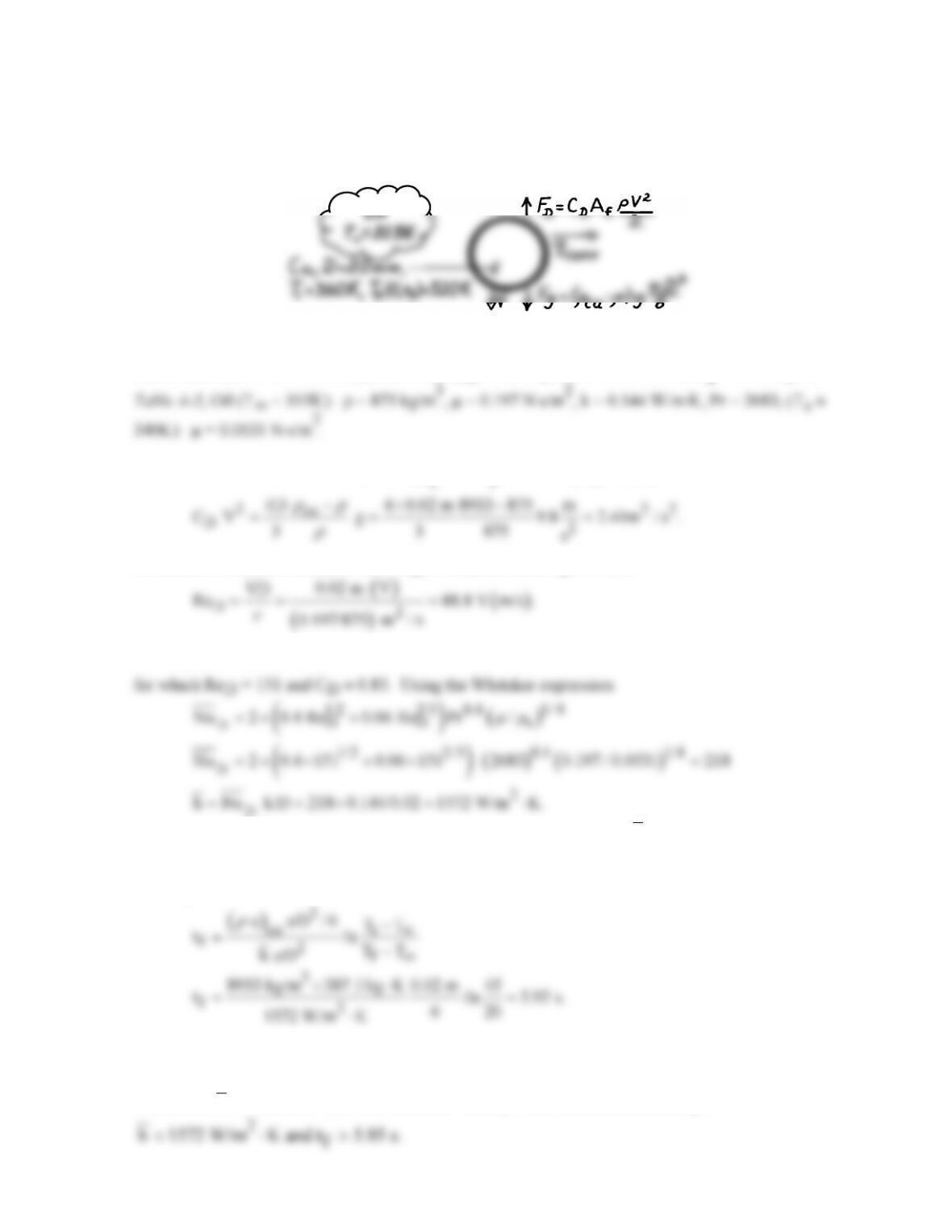
SCHEMATIC:
ASSUMPTIONS: (1) Sphere descends at terminal velocity, (2) Uniform, but time varying surface,
temperature.
PROPERTIES: Table A-1, Copper (350K): ρ = 8933 kg/m3, k = 398 W/m⋅K, cp = 387 J/kg⋅K;
ANALYSIS: A force balance gives
( )
22 3
D cu
C D /4 V /2 g D /6,
p ρ ρ ρp
= −
for which ReD = 29,580 and CD ≈ 0.46. Using the Whitaker expression
()
( ) ( )
D
0.4 1/ 4
1/ 2 2/3
Nu 2 0.4 29,850 0.06 29,850 10.26 1422 / 420 439=+× +× =
D
2
h Nu k/D 439 0.582 W/m K/0.02 m 12,775 W/m K.= =× ⋅= ⋅
To determine applicability of lumped capacitance method, find
( )
o cu
Bi h r / 3 / k 12,775= =
Required tank height is
f
H t V 0.76 s 2.1 m/s 1.6 m.=⋅= × =
<
COMMENTS: Note that the terminal velocity is not reached immediately. Reduced V implies
reduced
h
and increased tf. The Fourier number, Fo, is greater than 0.2. Hence, use of Eq. 5.53c is
justified.
PROBLEM 7.61
KNOWN: Diameter and initial and final temperatures of copper spheres quenched in an oil bath.
FIND: (a) Terminal velocity in bath, (b) Bath height.
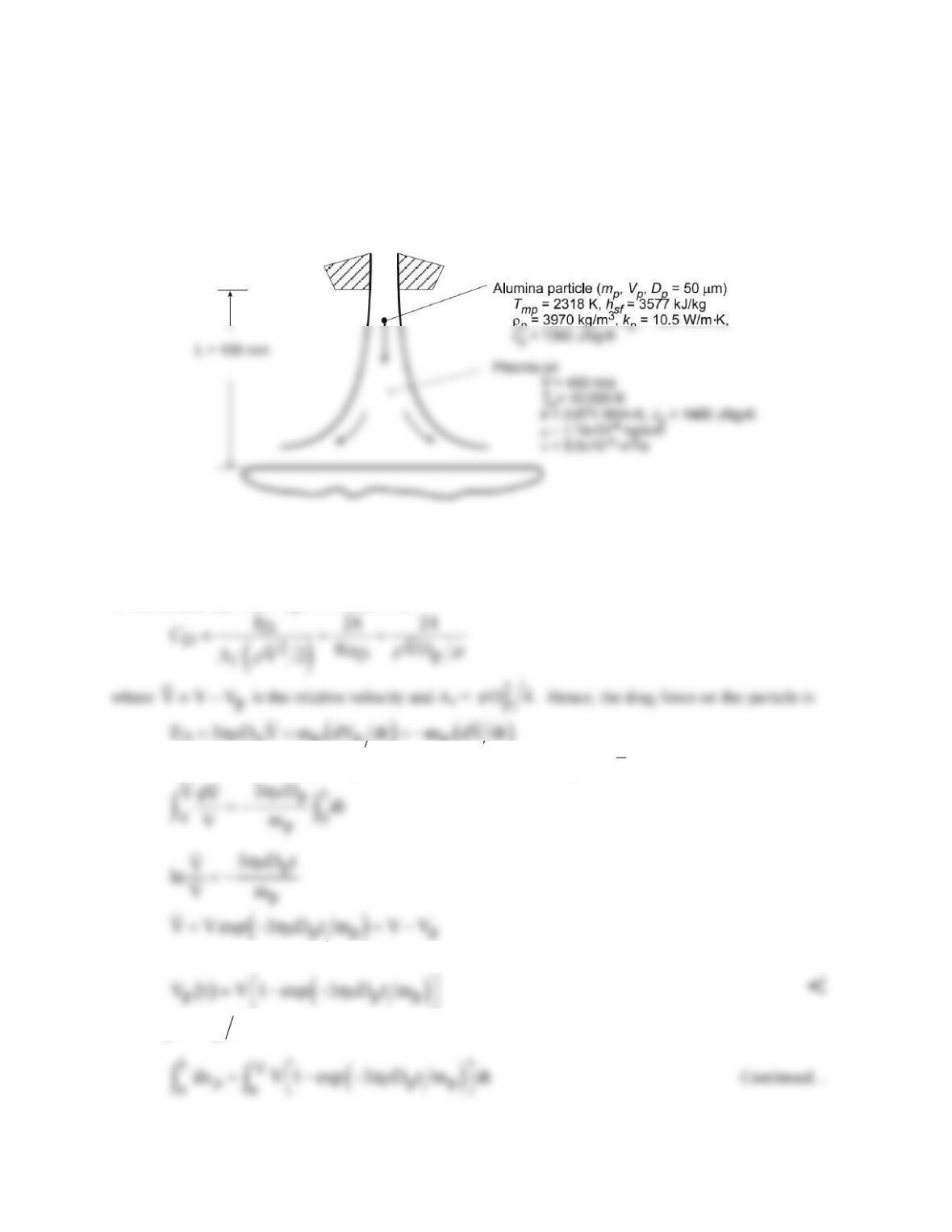
SCHEMATIC:
ASSUMPTIONS: (1) Sphere descends at terminal velocity, (2) Uniform, but time varying, surface
temperature.
PROPERTIES: Table A-1, Copper (350K): ρcu =8933 kg/m3, k = 398 W/m⋅K, cp = 387 J/kg⋅K;
ANALYSIS: (a) Force balance gives
()
( )
22 3
D cu
C D /4 V /2 g D /6,
p ρ ρ ρp
= −
An iterative solution is needed, where CD is obtained from Fig. 7.9 with
Convergence is achieved for
V 1.7 m/s≈
<
To determine applicability of the lumped capacitance method, find
( )
o cu
Bi h r / 3 / k= =
( )
2
1572 W/m K 0.01 m/3 / 398 W/m K 0.013.⋅ ⋅=
Hence lumped capacitance method can be used;
from Eq. 5.5,
Required tank height is H = tf ⋅ V = 5.95 s × 1.7 m/s = 10.1 m. <
COMMENTS: (1) Whitaker correlation has been used well beyond its limits (Pr >> 380). Hence
estimate of
h
is uncertain. (2) Since terminal velocity is not reached immediately,
PROBLEM 7.62
KNOWN: Velocity of plasma jet and initial particle velocity in a plasma spray coating process.
Distance from particle injection to impact.
FIND: (a) Particle velocity and distance of travel as a function of time. Time–in–flight and particle
impact velocity, (b) Convection heat transfer coefficient and time required to heat particle to melting
point and to subsequently melt it.
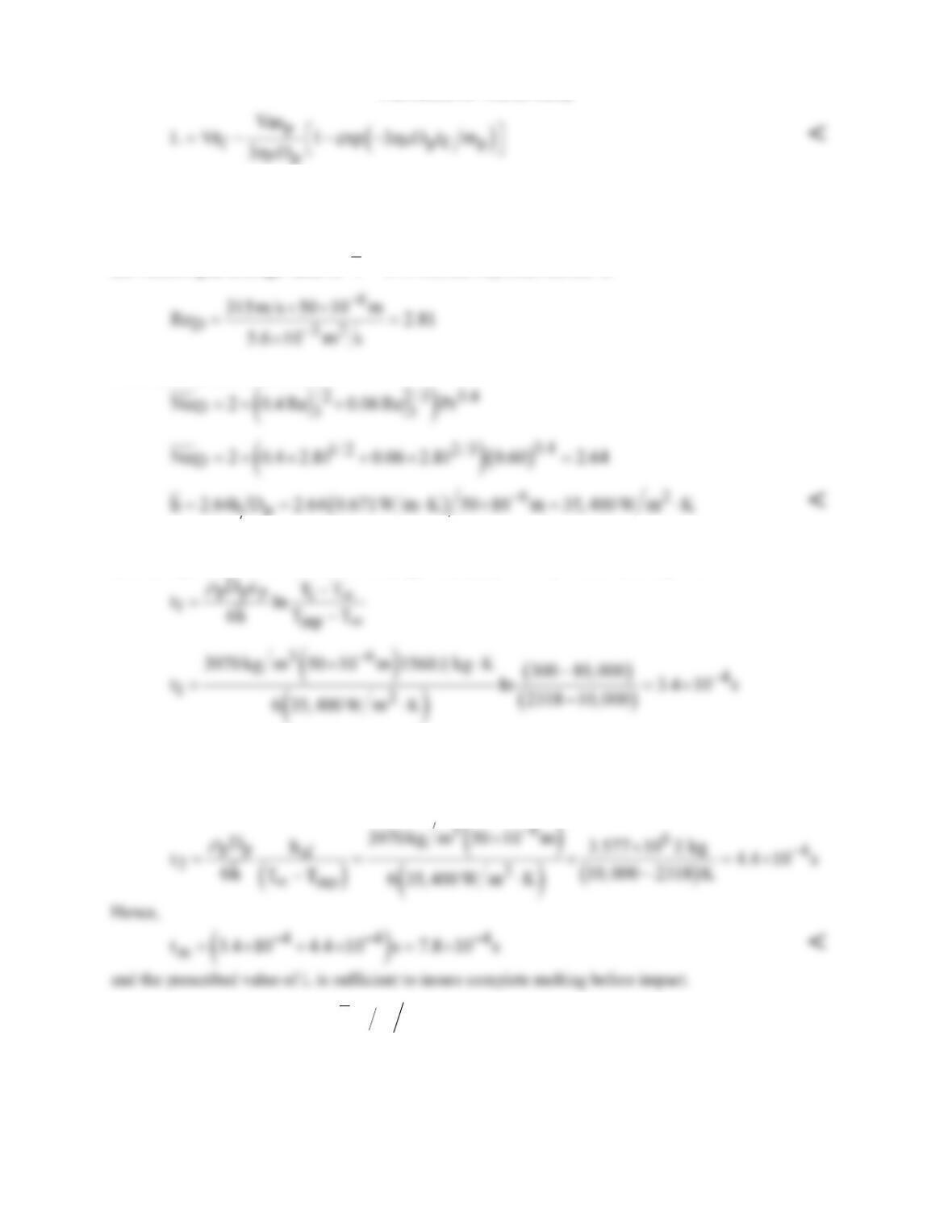
SCHEMATIC:
ASSUMPTIONS: (1) Applicability of Stokes’ law, (2) Constant particle and plasma properties, (3)
Negligible influence of viscosity ratio in Whitaker correlation, (4) Negligible radiation effects, (5)
Validity of lumped capacitance approximation.
ANALYSIS: (a) From Eqs. 7.50 and 7.55,
( )
( )
D p pp p
Separating variables and integrating from the nozzle exit, where Vp = 0,
VV=
and t = 0,
Hence,
With
pp
V dx dt=
, it follows that
PROBLEM 7.62 (Cont.)
Substituting the prescribed values of Dp, L, V and the material properties, the foregoing equations yield
pf
V 166.7 m / s t 0.001l s= =
<
(b) Assuming an average value of
V
= 315 m/s, the Reynolds number is
From the Whitaker correlation,
The two–step melting process involves (i) the time t1 to heat the particle to its melting point and (ii) the
time t2 required to achieve complete melting. Hence, tm = t1 + t2, where from Eq. 5.5,
Performing an energy balance for the second step, we obtain
m
1
t
conv st p sf
t
q dt E h
ρ
=∆=∀
∫
Hence,
COMMENTS: (1) Since Bi =
( )
pp
h r 3 k 0.03≈
, use of the lumped capacitance approach is
appropriate. (2) With ReD = 2.81, conditions are slightly outside the ranges associated with Stokes’ law.
(3) The Whitaker correlation is used outside of the Reynolds and Prandtl number ranges for which it was
developed. Since the Nusselt number is close to the limiting value of 2.0, it is probably reasonably
accurate.
PROBLEM 7.63
KNOWN: Diameter, velocity, initial temperature and melting point of molten aluminum droplets.
Temperature of helium atmosphere.
FIND: Maximum allowable separation between droplet injector and substrate.
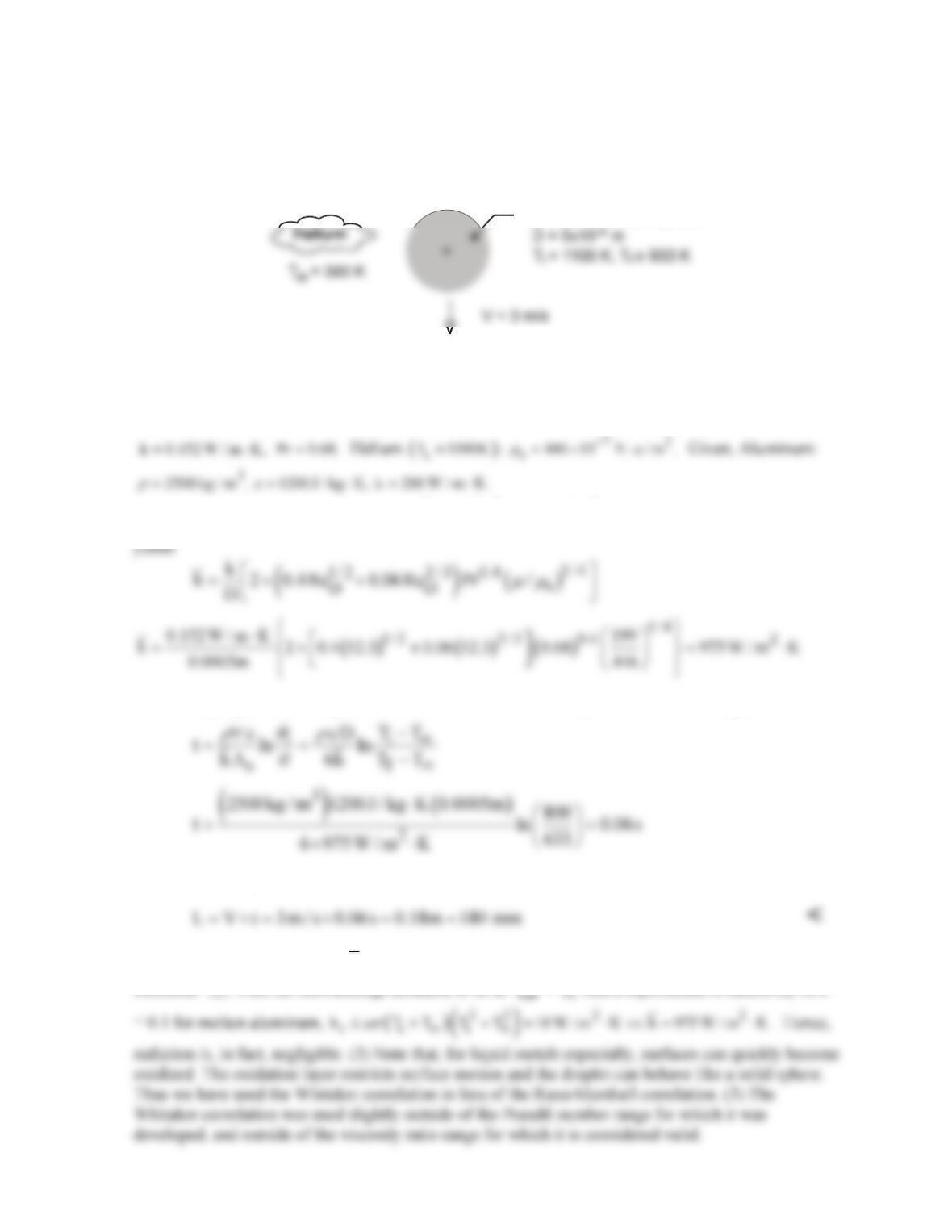
SCHEMATIC:
Molten aluminum sphere
ASSUMPTIONS: (1) Lumped capacitance approximation is valid, (2) Constant properties, (3)
Negligible radiation.
PROPERTIES: Table A-4, Helium
( )
62
T 300K : 122 10 m / s,
ν
−
∞= = ×
72
199 10 N s / m ,
µ
−
=×⋅
ANALYSIS: With
( )
4 62
D
Re VD / 3 m / s 5 10 m /122 10 m / s 12.3,
ν
−−
==× ×=
the Whitaker correlation
The time-of-flight for the droplet to cool from 1100K to 933K may be obtained from Eq. 5.5.
The maximum separation is therefore
COMMENTS: (1) With
( )
4
Bi h D / 6 / k 4 10 ,
−
= = ×
the lumped capacitance approximation is
excellent. (2) With the surroundings assumed to be at
TT
=
and a representative emissivity of ε
PROBLEM 7.64
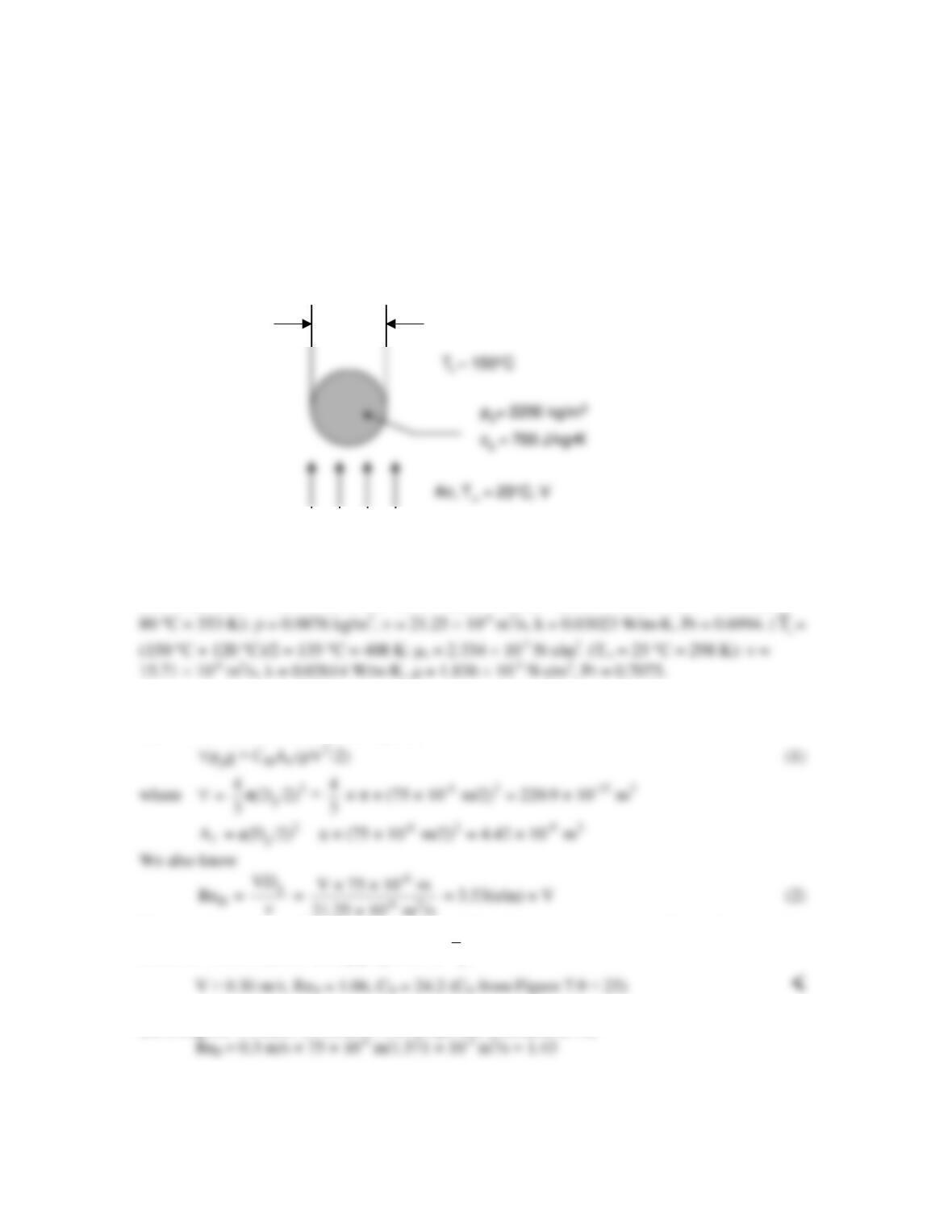
KNOWN: Method to manufacture small diameter droplets. Properties of D = 75 µm diameter
particles ejected into air. Air temperature and pressure, initial particle temperature. Desired
temperature of drop upon impact of a substrate.
FIND: (a) Terminal velocity of the droplets, (b) Separation distance between droplet injection
location and substrate so that the droplets impact the substrate at T2 = 120 °C.
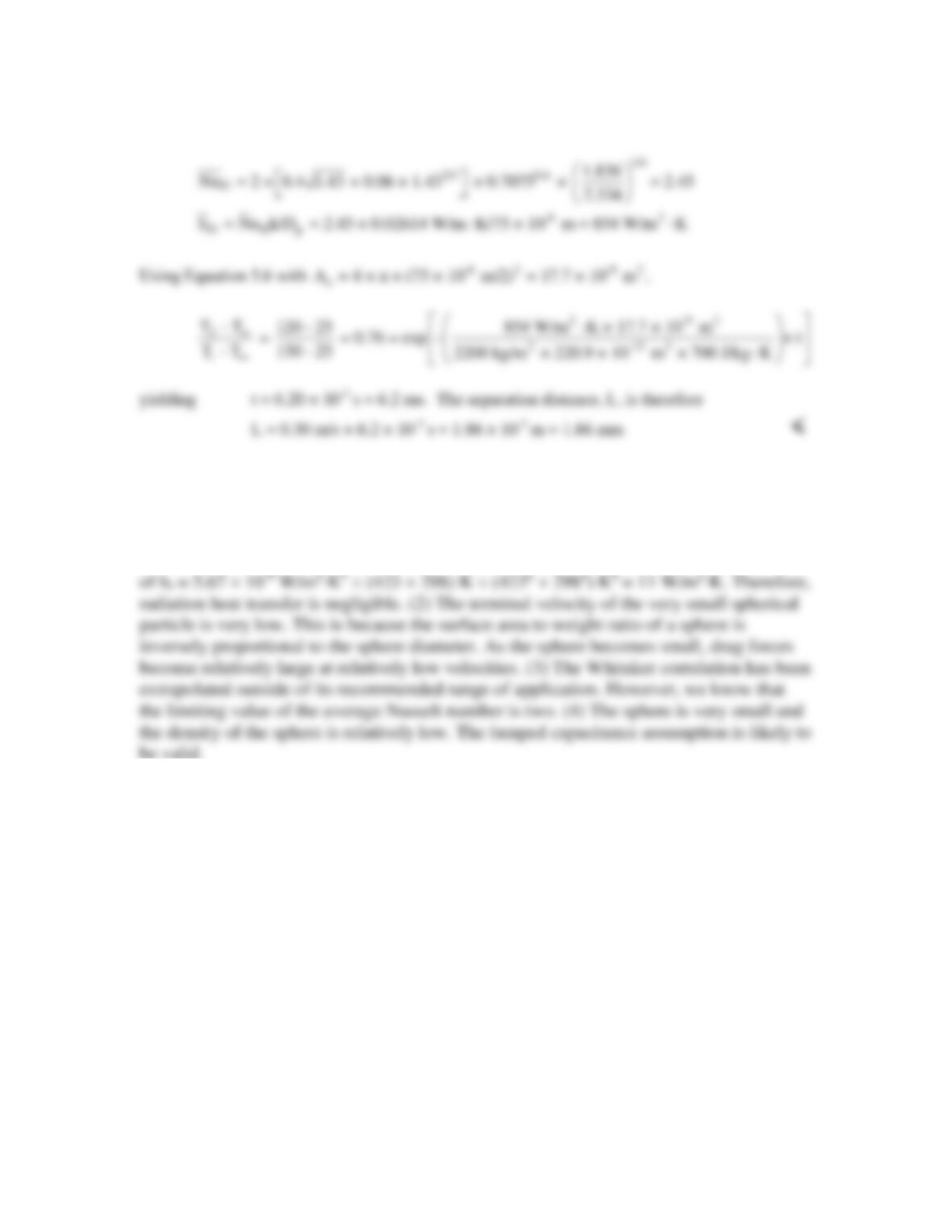
SCHEMATIC:
ASSUMPTIONS: (1) Negligible radiation heat transfer, (2) lumped capacitance thermal
response, (3) Negligible microscale heat transfer effects.
PROPERTIES: Table A.4, air: (Tf ≈ [(Ti + T2)/2 + T∞]/2) = [(150 °C + 120 °C)/2 + 25 °C]/2 =
ANALYSIS:
(a) A force balance on the particle yields
The correct velocity will yield values of CD and ReD that are consistent with Figure 7.9. A trial–
and-error solution yields (using properties at
f
T
)
(b) Using the Whitaker correlation with properties evaluated at T∞,
Therefore,
Continued…
D
p
= 75 µm
D
p
= 75 µm
D
p
= 75 µm
PROBLEM 7.64 (Cont.)
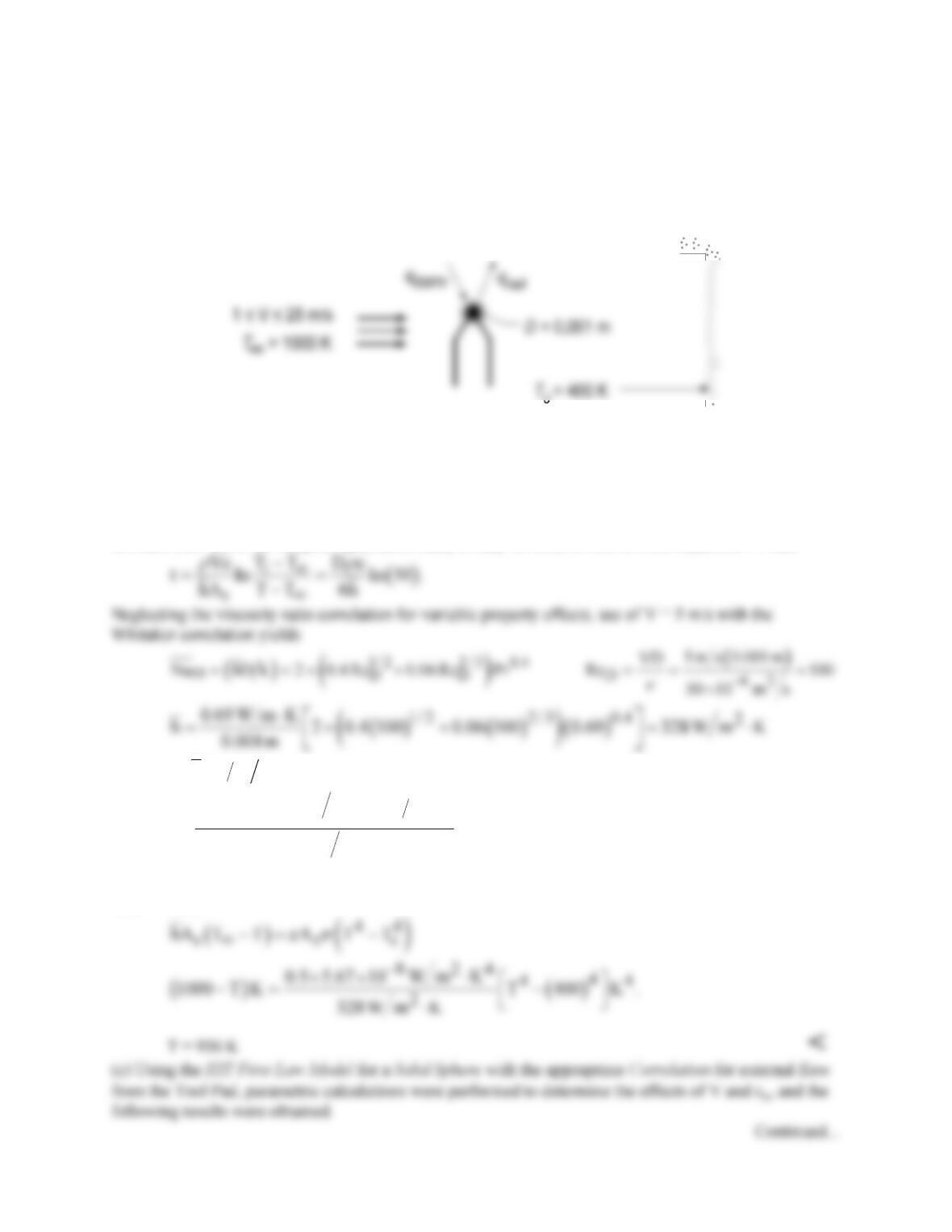
COMMENTS: (1) The maximum possible radiation heat transfer coefficient is
associated with the initial particle temperature and an emissivity of unity. Assuming a
surroundings temperature of 25 °C = 298 K, we find a radiation heat transfer coefficient
PROBLEM 7.65
KNOWN: Velocity and temperature of combustion gases. Diameter and emissivity of thermocouple
junction. Combustor temperature.
FIND: (a) Time to achieve 98% of maximum thermocouple temperature rise, (b) Steady–state
thermocouple temperature, (c) Effect of gas velocity and thermocouple emissivity on measurement error.
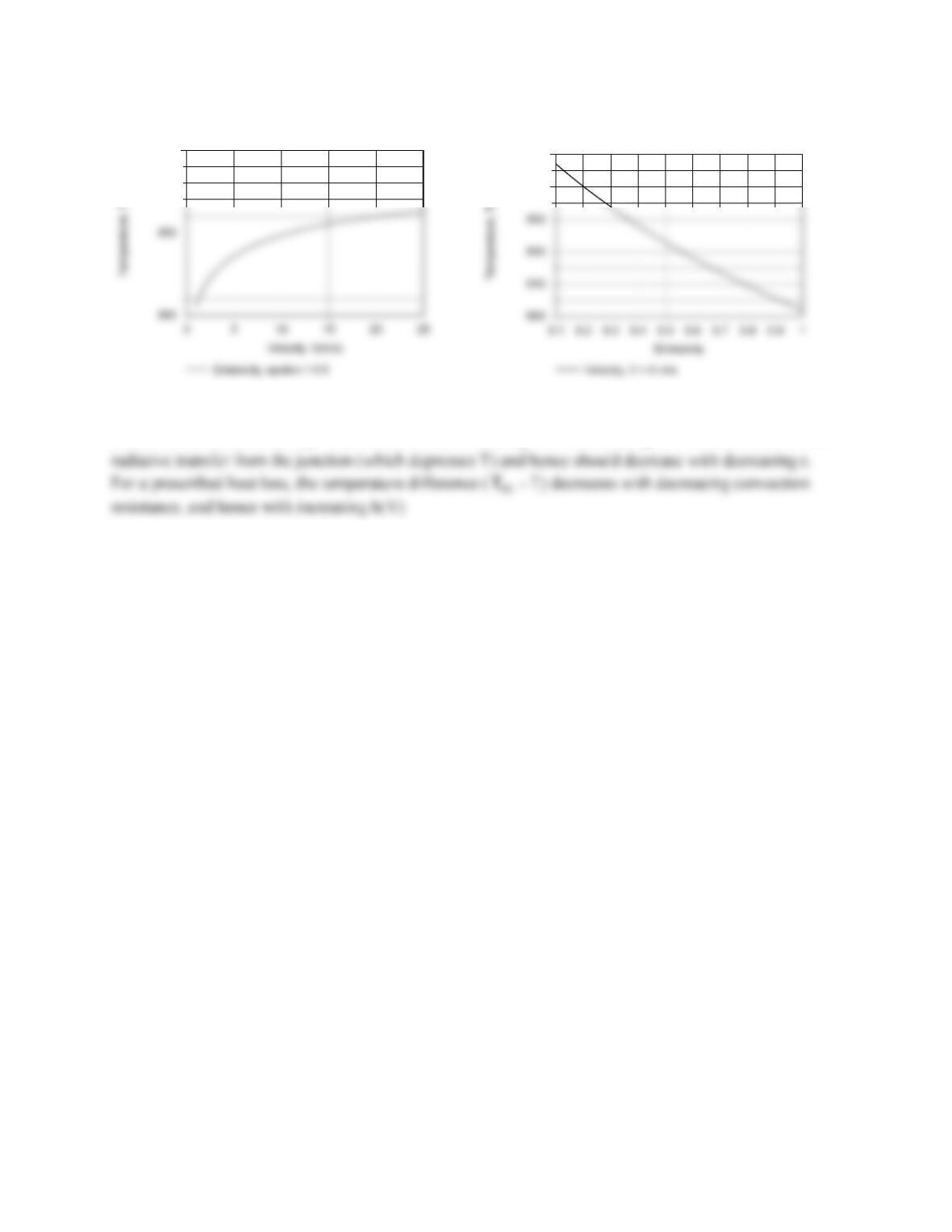
SCHEMATIC:
ASSUMPTIONS: (1) Validity of lumped capacitance analysis, (2) Constant properties, (3) Negligible
conduction through lead wires, (4) Radiation exchange between small surface and a large enclosure
(parts b and c).
PROPERTIES: Thermocouple (given): 0.1 ≤ ε ≤ 1.0, k = 100 W/m⋅K, c = 385 J/kg⋅K, ρ = 8920 kg/m3;
Gases (given): k = 0.05 W/m⋅K, ν = 50 × 10-6 m2/s, Pr = 0.69.
ANALYSIS: (a) If the lumped capacitance analysis may be used, it follows from Equation 5.5 that
Since Bi =
( )
o
hr 3 k
= 5.5 × 10⁻⁴, the lumped capacitance method may be used. Hence,
()
( )
3
2
0.001m 8920 kg m 385 J kg K
t ln 50 6.83s
6 328 W m K
⋅
= =
×⋅
<
(b) Performing an energy balance on the junction and evaluating radiation exchange, qconv = qrad. Hence,
with ε = 0.5,
PROBLEM 7.65 (Cont.)
1000
970
990
Since the temperature recorded by the thermocouple junction increases with increasing V and decreasing
ε, the measurement error,
T
∞
– T, decreases with increasing V and decreasing ε. The error is due to net
COMMENTS: (1) To infer the actual gas temperature (1000 K) from the measured result (936 K),
correction would have to be made for radiation exchange with the cold surroundings. (2) The Whitaker
correlation was used slightly outside of the Prandtl number range for which it was developed.
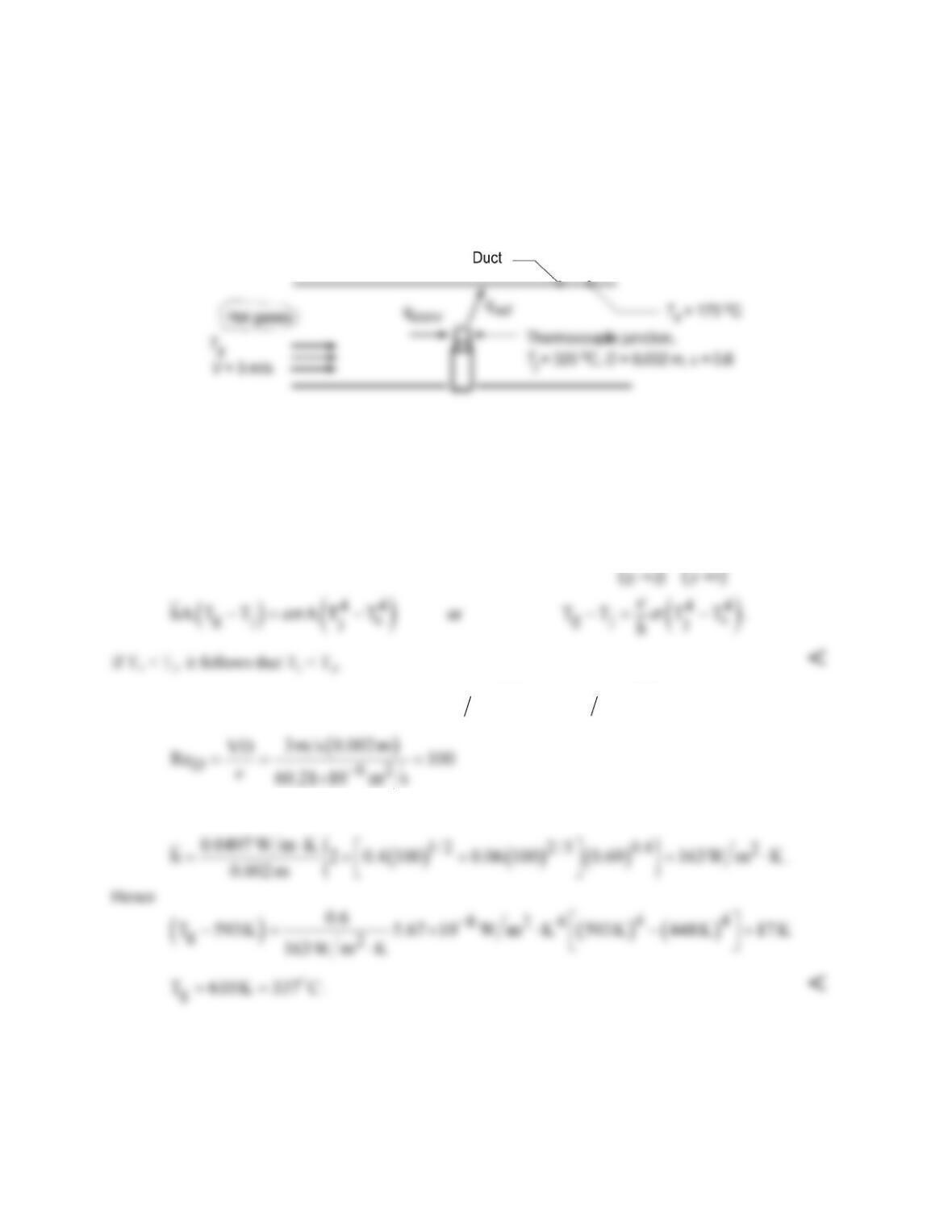
PROBLEM 7.66
KNOWN: Diameter, emissivity and temperature of a thermocouple junction exposed to hot gases
flowing through a duct of prescribed surface temperature.
FIND: (a) Relative magnitudes of gas and thermocouple temperatures if the duct surface temperature is
less than the gas temperature, (b) Gas temperature for prescribed conditions, (c) Effect of Velocity and
emissivity on measurement error.
SCHEMATIC:
ASSUMPTIONS: (1) Steady-state conditions, (2) Junction is diffuse-gray, (3) Duct forms a large
enclosure about the junction, (4) Negligible heat transfer by conduction through the thermocouple leads,
(5) Gas properties are those of atmospheric air.
PROPERTIES: Table A-4, Air (Tg ≈ 650 K, 1 atm): ν = 60.21 × 10⁻⁶ m2/s, k = 0.0497 W/m⋅K, Pr =
0.690, µ = 322.5 × 10⁻⁷ N⋅s/m2; Air (Tj = 593 K, 1 atm): µ = 304 × 10-7 N⋅s/m2.
ANALYSIS: (a) From an energy balance on the thermocouple junction,
conv rad
qq
=
. Hence,
(b) Neglecting the variable property correction,
( ) ( )
1/ 4 1/ 4
s322.5 304
µµ
=
= 1.01 ≈ 1.00, and using
the Whitaker correlation for a sphere gives
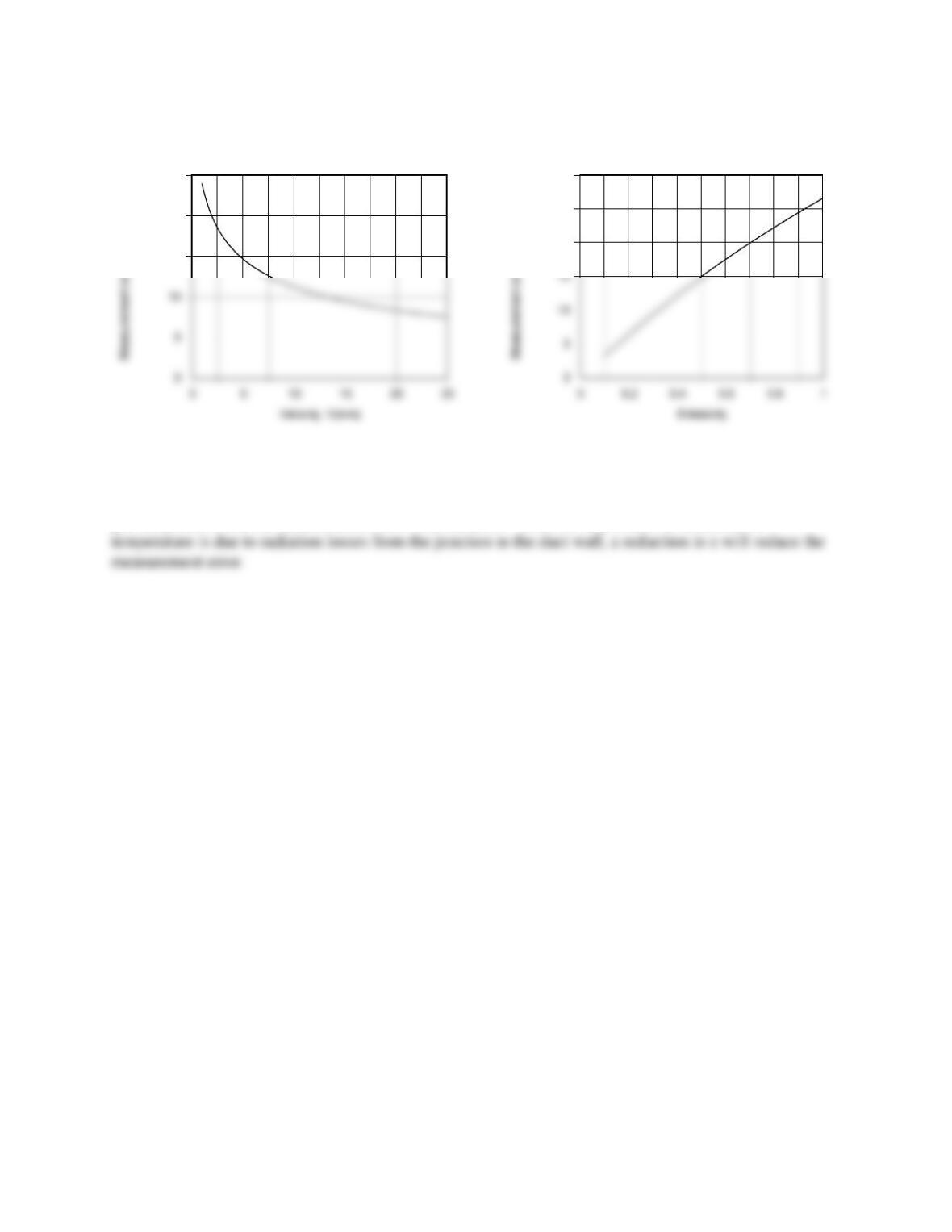
(c) With Tg fixed at 610 K, the IHT First Law Model was used with the Correlations and Properties
Tool Pads to compute the measurement error as a function of V and ε.
Continued…
PROBLEM 7.66 (Cont.)
15
20
25
20
25
30
Since the convection resistance decreases with increasing V, the junction temperature will approach the
gas temperature and the measurement error will decrease. Since the depression in the junction
COMMENTS: (1) In part (b), calculations could be improved by evaluating properties at 610 K
(instead of 650 K). (2) The Whitaker correlation was used slightly outside of the Prandtl number range
for which it was developed.
PROBLEM 7.67
KNOWN: Diameter and emissivity of a thermocouple junction exposed to hot gases of prescribed
velocity and temperature flowing through a duct of prescribed surface temperature.
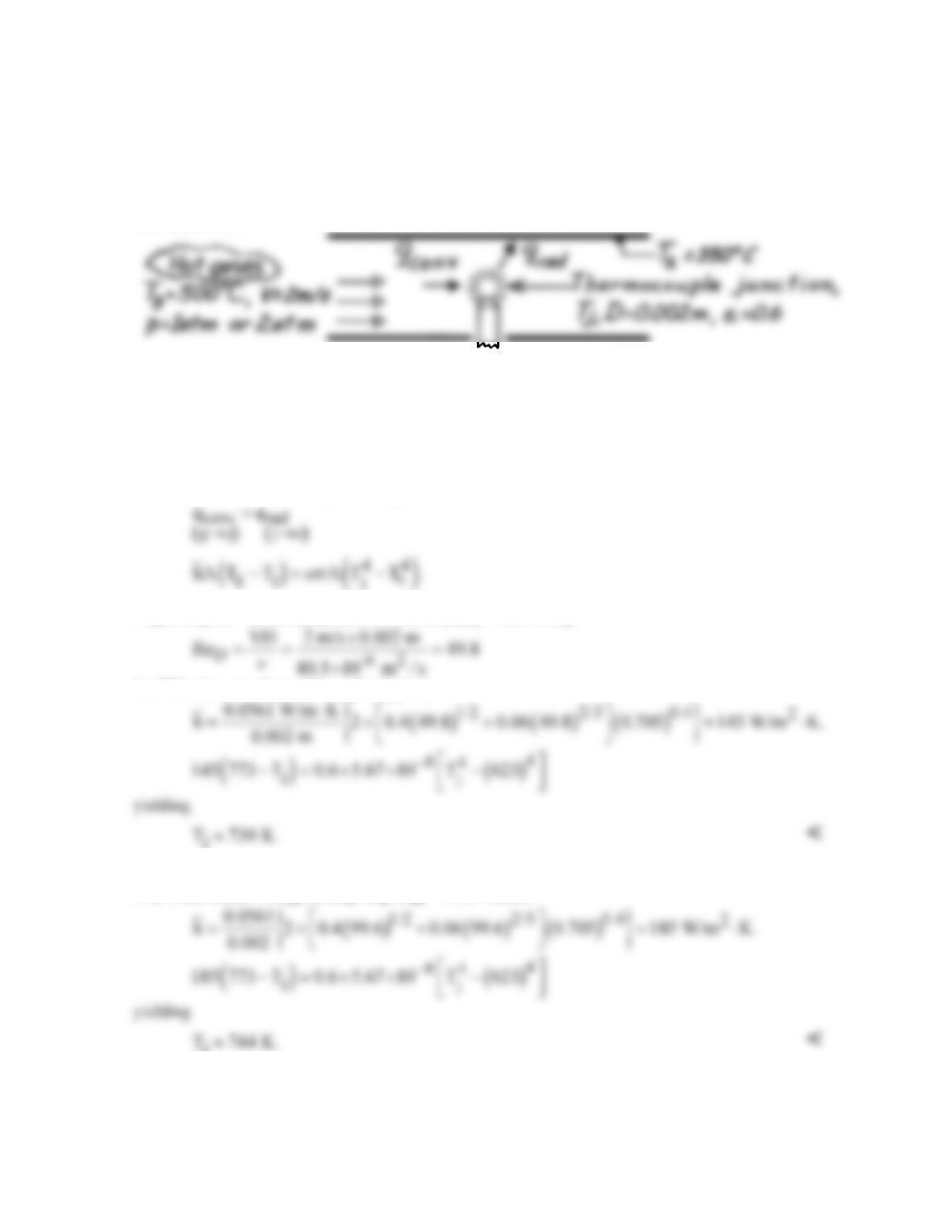
FIND: (a) Thermocouple reading for gas at atmospheric pressure, (b) Thermocouple reading when
gas pressure is doubled.
SCHEMATIC:
ASSUMPTIONS: (1) Steady-state conditions, (2) Junction is diffuse-gray, (3) Duct forms a large
enclosure about junction, (4) Negligible heat loss by conduction through thermocouple leads, (5) Gas
properties are those of air, (6) Perfect gas behavior.
PROPERTIES: Table A-4, Air (Tg = 773 K, 1 atm): ν = 80.5 × 10⁻⁶ m2/s, k = 0.0561 W/m⋅K, Pr =
0.705.
ANALYSIS: (a) Performing an energy balance on the junction
Neglecting the variable property correction, (µ/µs)1/4, and using
the Whitaker correlation for a sphere gives,
j
(b) Assuming all properties other than ν to remain constant with a change in pressure, ↑ p by 2 will ↓
ν by 2 and hence ↑ ReD by 2, giving ReD = 99.6. Hence
j
COMMENTS: The thermocouple error will ↓ with ↑ h, which ↑ with ↑p.