Problem 7.34
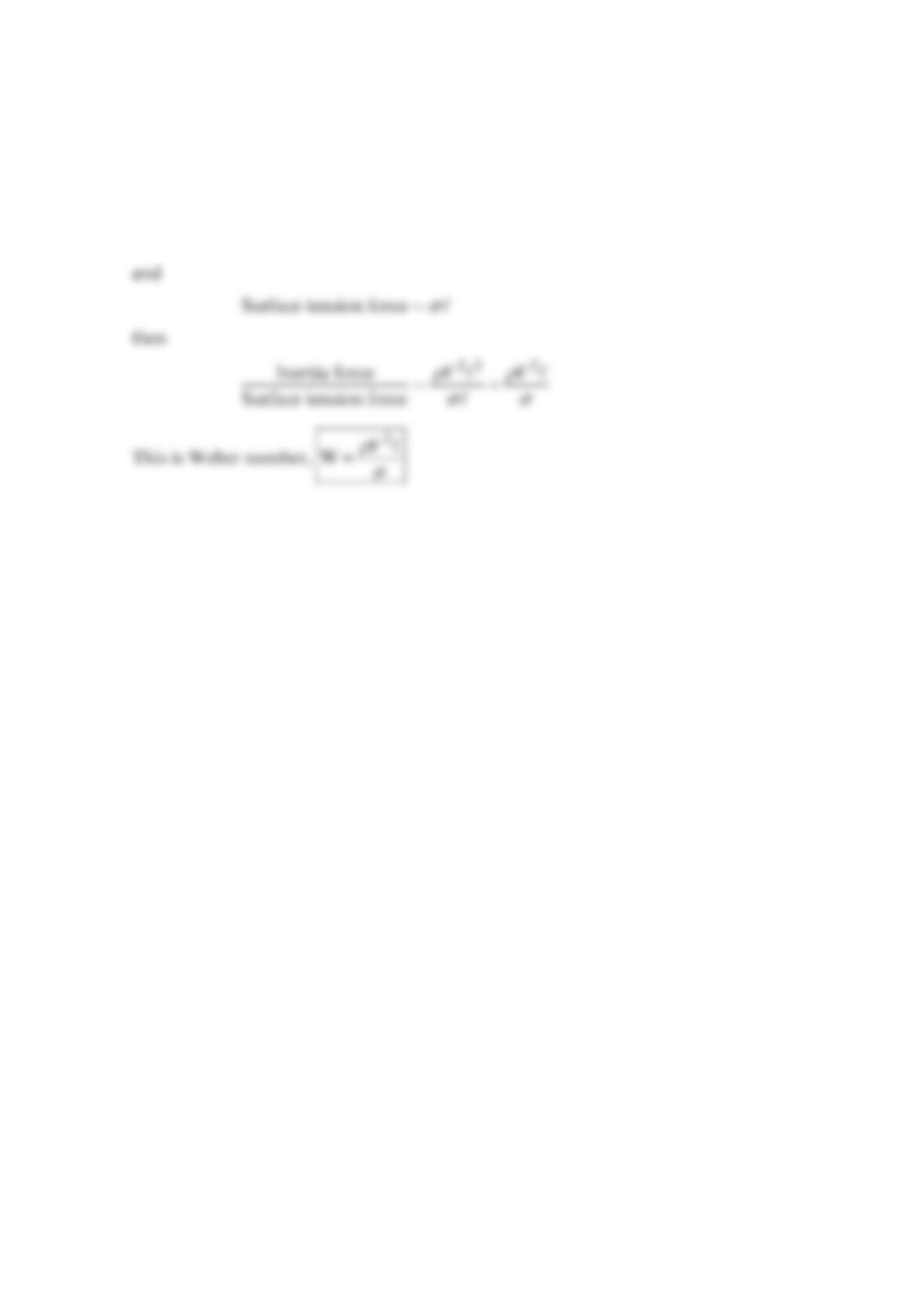
Develop the Weber number by starting with estimates for the inertia and surface tension
forces.
Solution 7.34
Inertia force
ρ
22
V
Problem 7.35
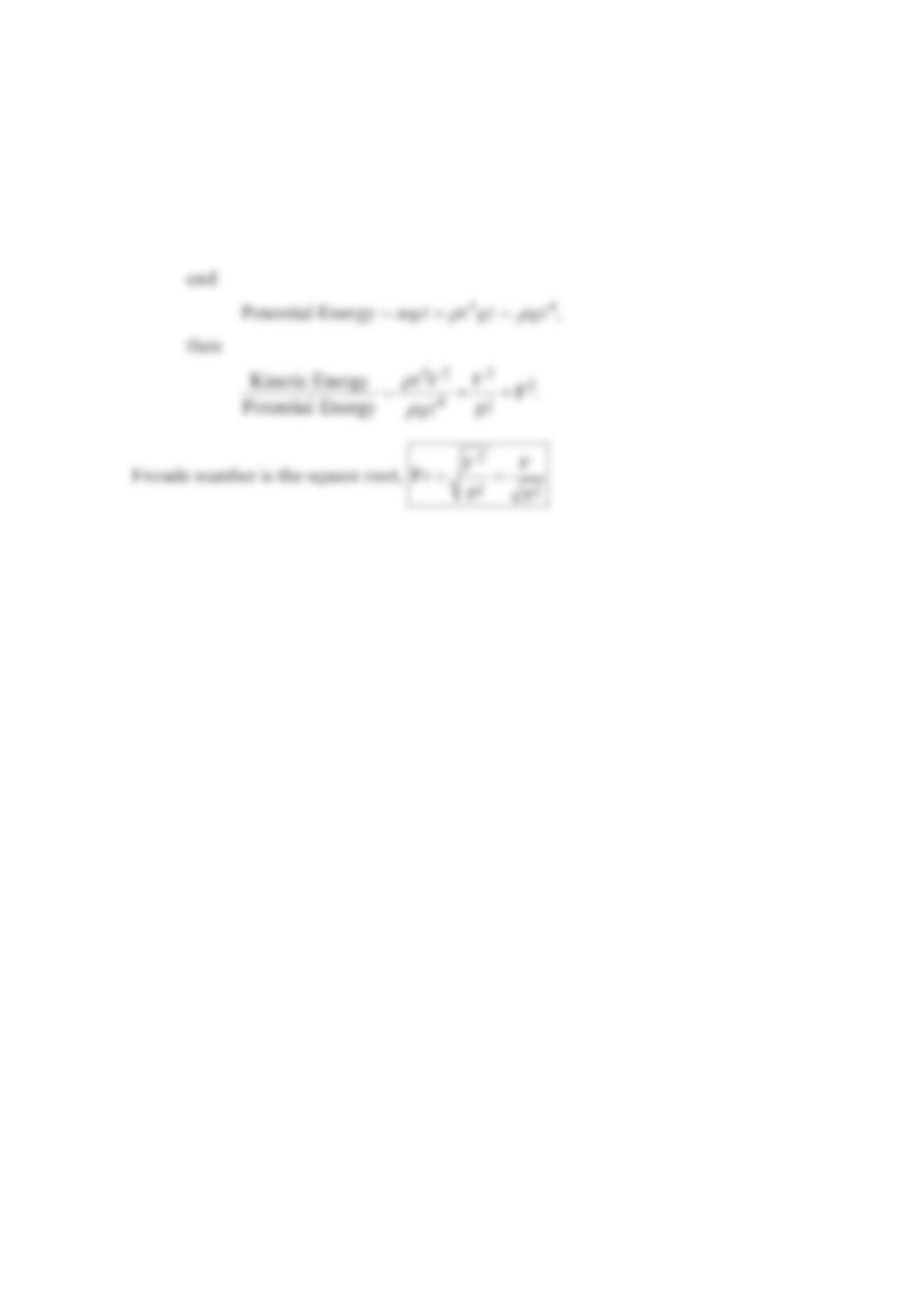
Develop the Froude number by starting with estimates of the fluid kinetic energy and fluid
potential energy.
Solution 7.35
Kinetic Energy
ρ
=
232
mV V
( =
typical length)
Problem 7.36
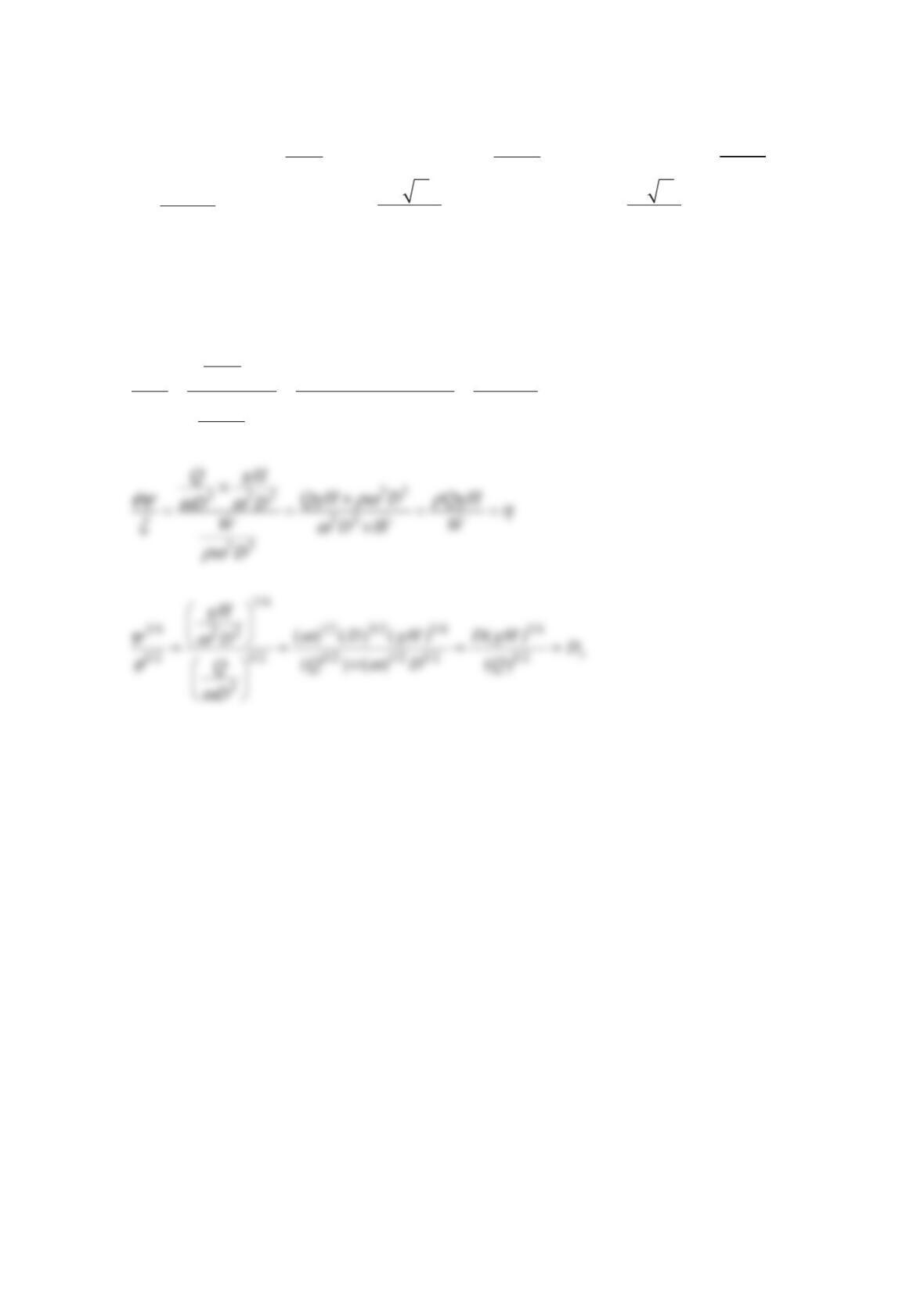
The following dimensionless groups are often used to present data on centrifugal pumps:
flow coefficient
φ
ω
=3
Q
D, head coefficient
ψ
ω
=22
gH
D, power coefficient
ξ
ω
=35
W
D
, efficiency
ρ
η
=gQH
W
, specific speed
ω
=
s3/4
()
Q
NgH , specific diameter
ω
=
s1/4
()
Q
D
gh . Show that the last
three groups can be formed from combinations of the first three groups.
Solution 7.36
φωω
ω
ψ
ω
ω
×
== ==
1/2
1/2 1/2 6/4 6/4 1/2
3
3/4 3/4 1/2 3/2 3/4 3/4
22
()() ()
() () ( ) ( ) s
Q
QDQ
DN
DgH gH
gH
D
ψ
Problem 7.37
The dimensional parameters used to describe the operation of a ship or airplane propeller
(sometimes called a screw propeller) are rotational speed,
ω
; diameter,
D
; fluid density,
ρ
;
speed of the propeller relative to the fluid,
V
; and thrust developed, T. The common
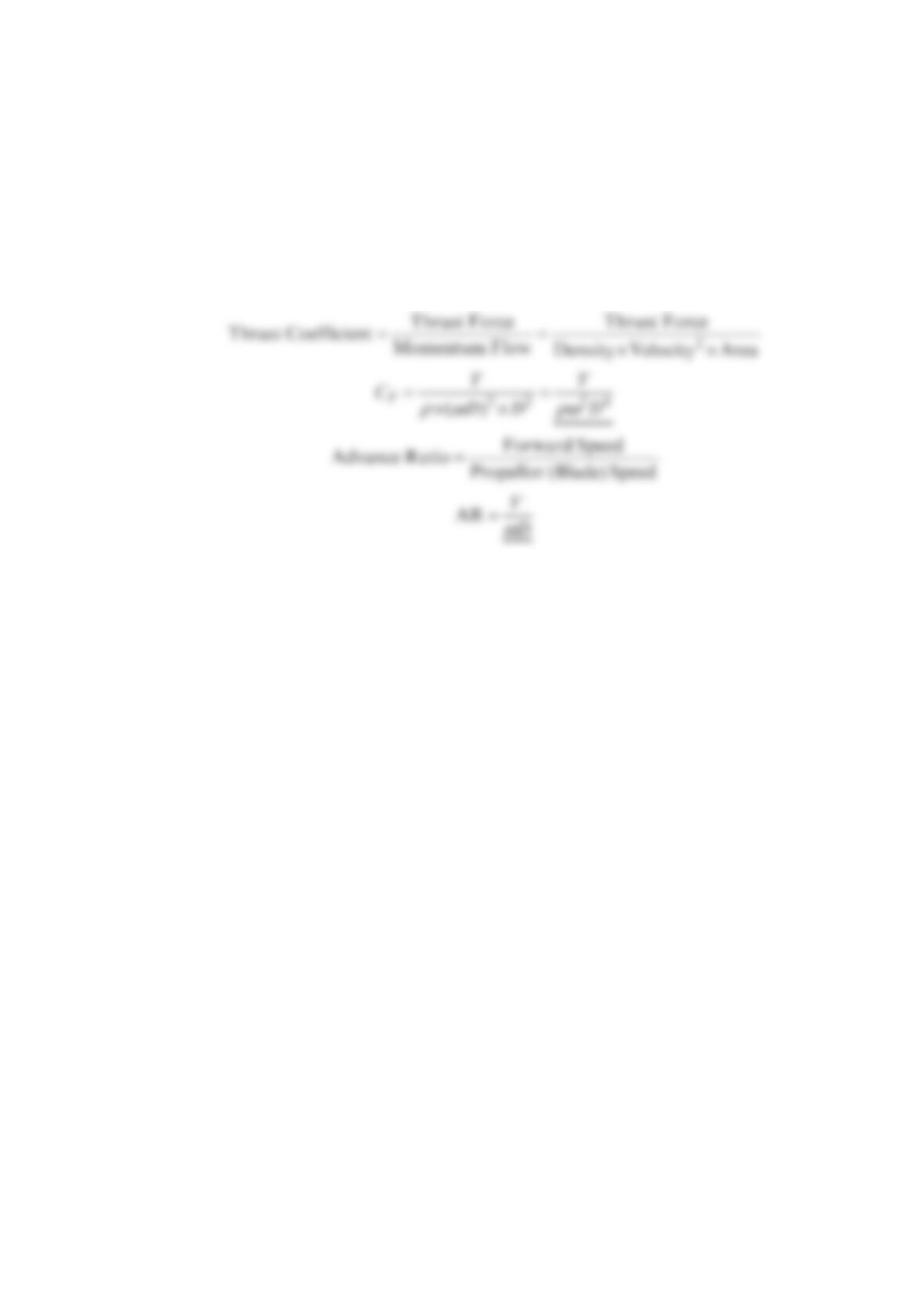
dimensionless groups are called the thrust coefficient and the advance ratio. Propose
appropriate definitions for these groups.
Solution 7.37
A number of different definitions could be proposed. The most common are:
Problem 7.38
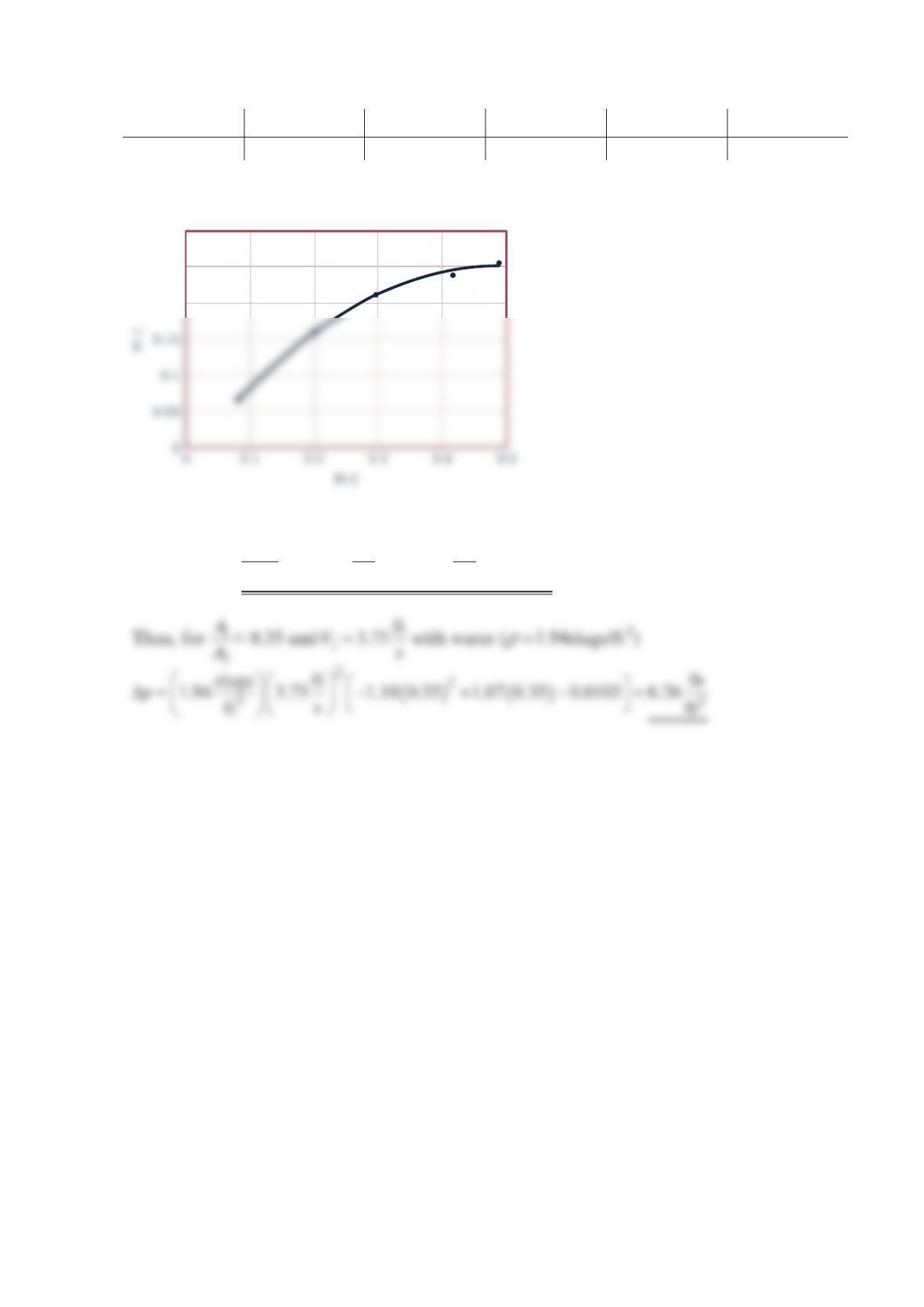
The pressure rise,
Δ
=−
21
p
pp
, across the abrupt expansion of the figure below through
which a liquid is flowing can be expressed as
()
ρ
Δ
=12 1
,,,pfAA V
where 1
A
and 2
A
are the upstream and downstream cross-sectional areas, respectively,
ρ
is
the fluid density, and 1
V is the upstream velocity. Some experimental data obtained with
=
2
21.25ft
A
, =
15.00 ft/sV, and using water with
ρ
=3
1.94 slugs/ft are given in the following
table:
2
1(ft )
A
0.10 0.25 0.37 0.52 0.61
Δ
2
(lb/ft )p 3.25 7.85 10.3 11.6 12.3
Plot the results of these tests using suitable dimensionless parameters. With the aid of a
standard curve fitting program determine a general equation for
Δ
p
and use this equation to
predict
Δ
p
for water flowing through an abrupt expansion with an area ratio 1
2
A
A = 0.35 at a
velocity =
13.75ft/sV.
Solution 7.38
−
Δ
=2
pFL
=2
1
A
L
=2
2
A
L
ρ
−
=42
FL T
−
=1
1
VLT
From the pi theorem, −=53 2 pi terms required.
Area =
A
1
Area =
A
2
p
1
p
2
V
1
Π
Δ
p
Π
Π
A
A
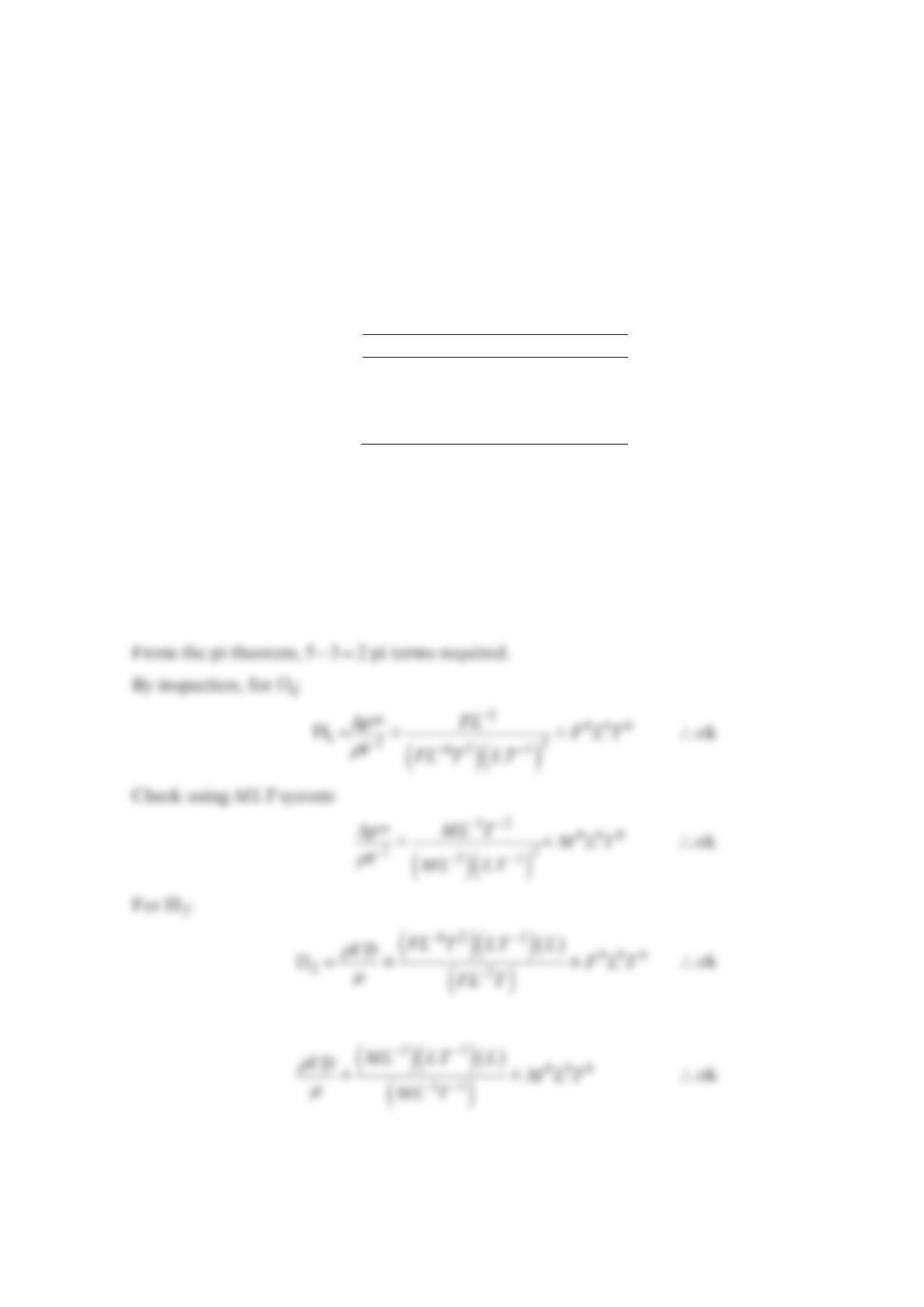
Using the data given, it follows that:
ρ
Δ
2
1
/
p
V 0.067 0.162 0.212 0.239 0.254
12
/
A
A 0.080 0.200 0.296 0.416 0.488
A plot of these data is shown below:
The curve drawn on the graph is a 2-nd order polynomial giving the equation
ρ
Δ=− + −
2
11
222
1
=1.10 1.07 0.0103
AA
p
AA
V
0.2
0.25
0.3
Problem 7.39
The pressure drop,
Δ
p
, over a certain length of horizontal pipe is assumed to be a function
of the velocity,
V
, of the fluid in the pipe, the pipe diameter,
D
, and the fluid density and
viscosity,
ρ
and
µ
. (a) Show that this flow can be described in dimensionless form as a
“pressure coefficient, ”
ρ
=Δ 2
p/(1/2 )
C
pV
that depends on the Reynolds number,
ρµ
=Re /VD . (b) The following data were obtained in an experiment involving a fluid with
ρ
= 2 slugs/ft3,
µ
= 2 × 10⁻³ lb
⋅
s/ft2, and =
D
0.1 ft. Plot a dimensionless graph and use a
power law equation to determine the functional relationship between the pressure
coefficient and the Reynolds number. (c) What are the limitations on the applicability of
your equation obtained in part (b)?
V (ft/s)
Δ
p
(lb/ft2)
3 192
11 704
17 1088
20 1280
Solution 7.39
(a)
()
ρµ
Δ
=,,,pfVD
−
Δ
=2
pFL
−
=1
VLT
=
D
L
ρ
−
=42
FL T
µ
−
=2
FL T
Check using
M
LT system:
Π
Π
F
Π
Thus,
Thus,
()
φ
=Re
p
C
where p
C
is the pressure coefficient and Re the Reynolds number.
(b) Using the data given,
Tabulated values for p
C
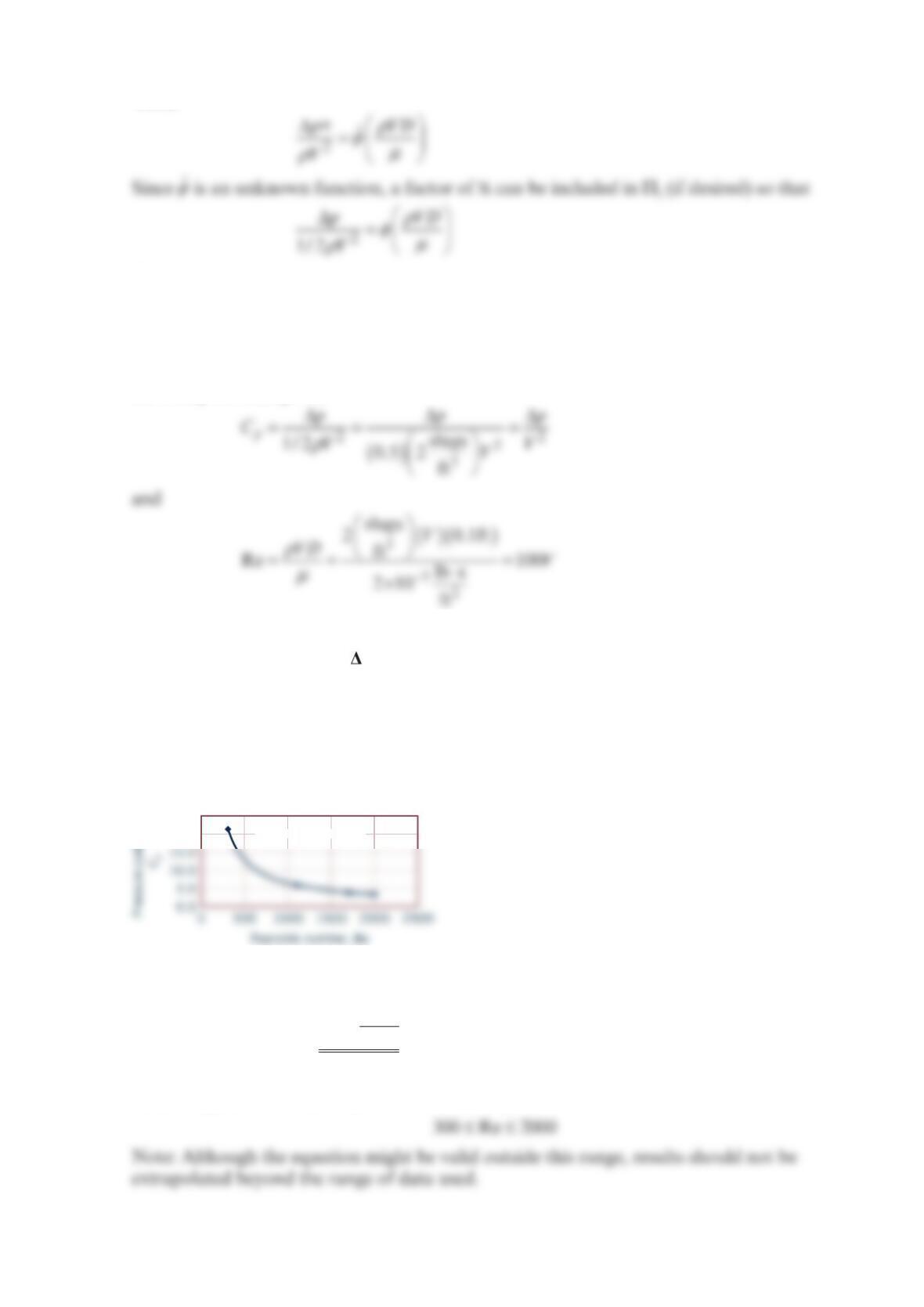
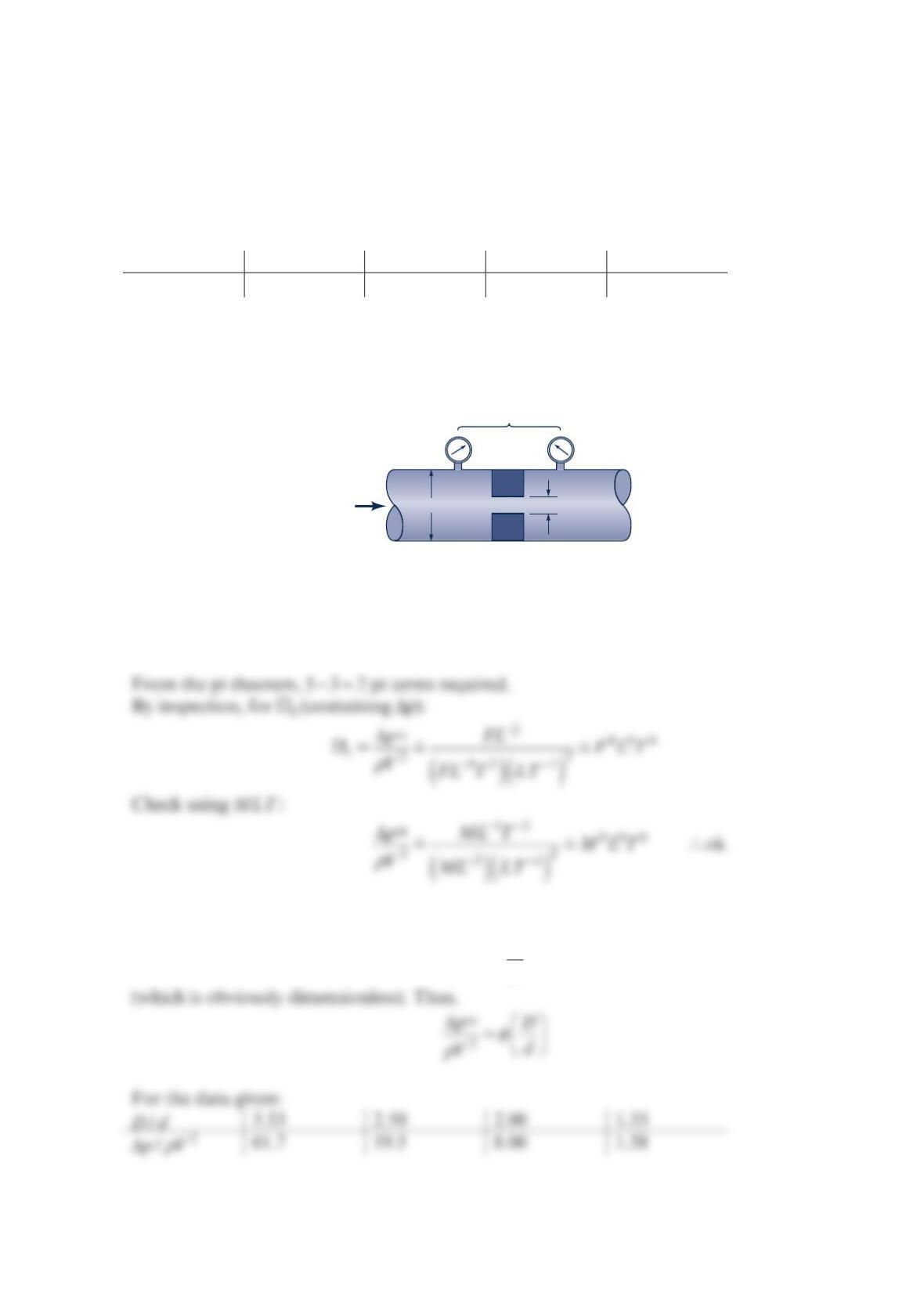
and Re and a plot of the data are shown below.
V (ft/s) p (psf) Re Cp
3192 300 21.3
11 704 1100 5.82
17 1090 1700 3.77
20 1280 2000 3.20
The power law relationship is
=6387
Re
p
C
(1)
(c) Based on the variable used and the given data, the empirical relationship, Eq. (1), would
only be applicable in the Reynolds number range
20.0
25.0
C
p
= 6387 Re
–1.00
Problem 7.40
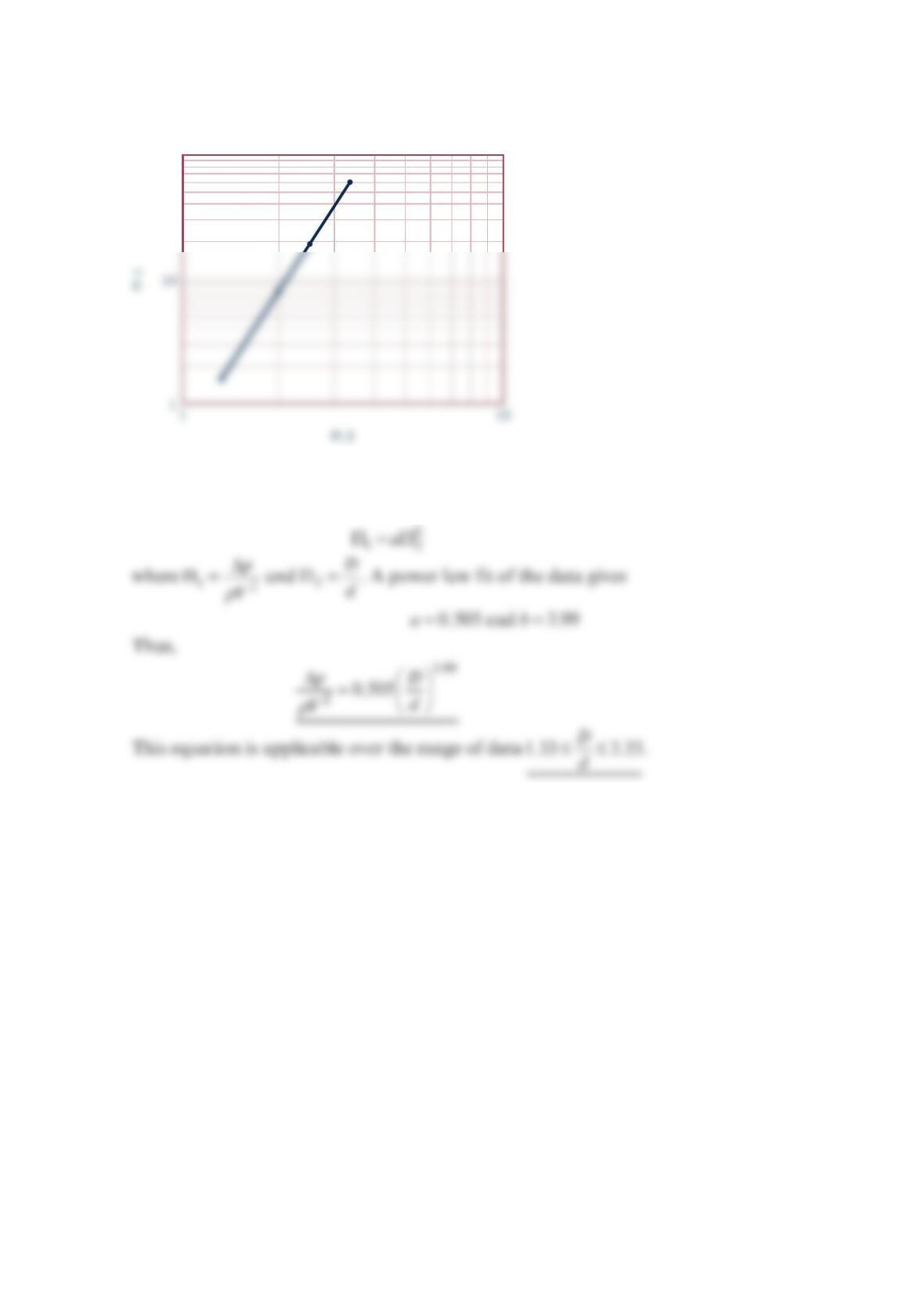
The pressure drop across a short hollowed plug placed in a circular tube through which a
liquid is flowing (see the figure below) can be expressed as
ρ
Δ
=(,, ,)
p
fVDd
where
ρ
is the fluid density, and
V
is the mean velocity in the tube. Some experimental data
obtained with =
D
0.2 ft,
ρ
=3
2slugs/ft , and =2ft/s
V
are given in the following table:
(ft)
d
0.06 0.08 0.10 0.15
Δ
2
(lb/ft )p 493.8 156.2 64.0 12.6
Plot the results of these tests, using suitable dimensionless parameters, on a log–log scale.
Use a standard curve-fitting technique to determine a general equation for
Δ
p
. What are the
limits of applicability of the equation?
Solution 7.40
−
Δ
=2
pFL
ρ
−
=42
FL T
−
=1
VLT
=
D
L
=
d
L
For
Π
2 (containing
D
and
d
):
Π
=
2
D
d
D
D
V
d
Δp
Π
Π
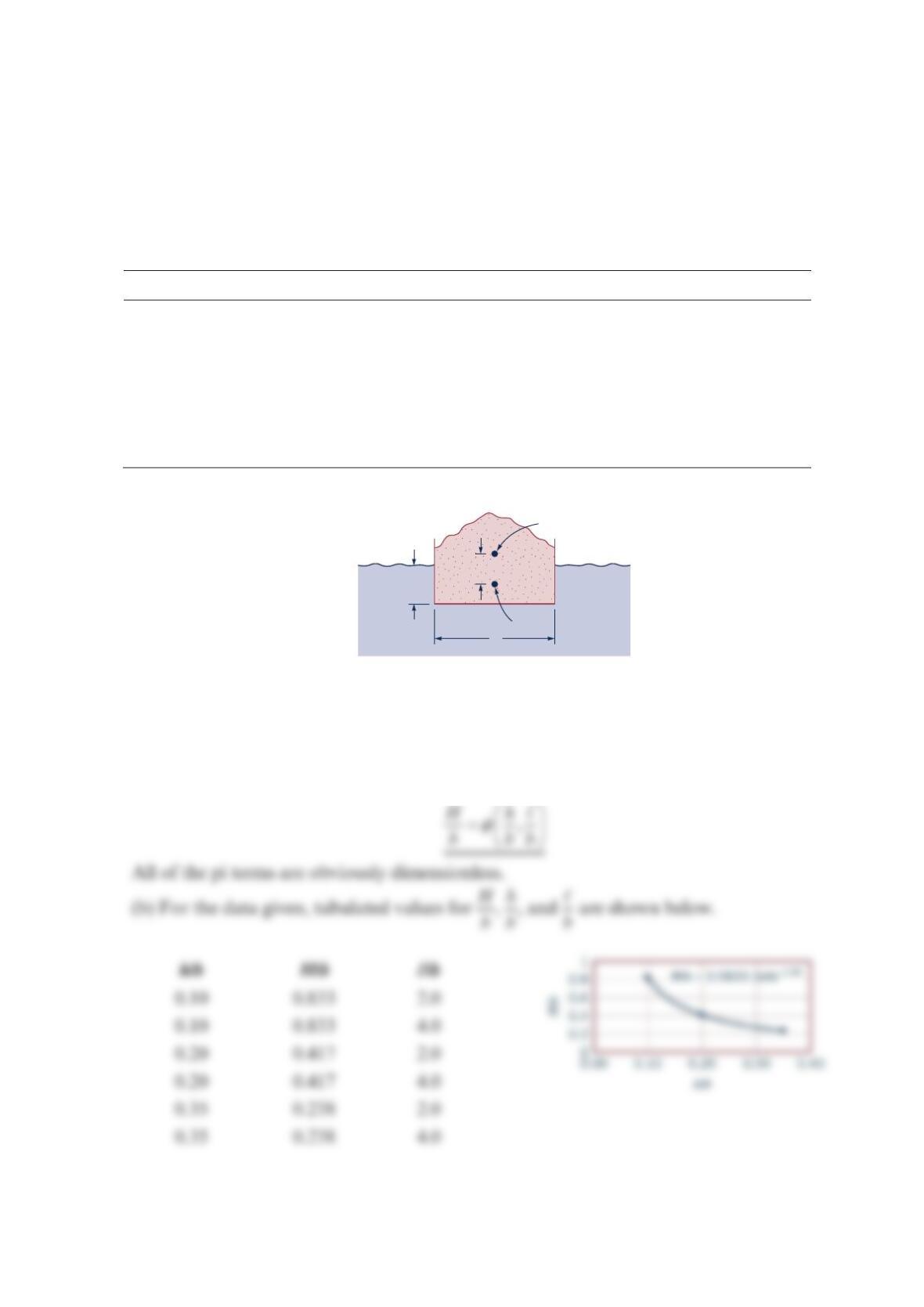
A log–log plot of these data is shown below.
Since the data plot as a straight line on a log–log plot, the equation for the data is of the
form
100
Problem 7.41
As shown in the figure below, a rectangular barge floats in a stable configuration provided
the distance between the center of gravity,
CG
, of the object (boat and load) and the center
of buoyancy, C, is less than a certain amount, H. If this distance is greater than H, the boat
will tip over. Assume H is a function of the boat’s width,
b
, length,
, and draft,
h
. (a) Put
this relationship into dimensionless form. (b) The results of a set of experiments with a
model barge with a width of
1
.0
m
are shown in the table. Plot these data in dimensionless
form and determine a power–law equation relating the dimensionless parameters.
ℓ (m) h (m) H (m)
2.0 0.10 0.833
4.0 0.10 0.833
2.0 0.20 0.417
4.0 0.20 0.417
2.0 0.35 0.238
4.0 0.35 0.238
Solution 7.41
(a)
()
=,,Hfbh
From the pi theorem, −=413 pi terms required.
By inspection:
CG
C
b
H
h
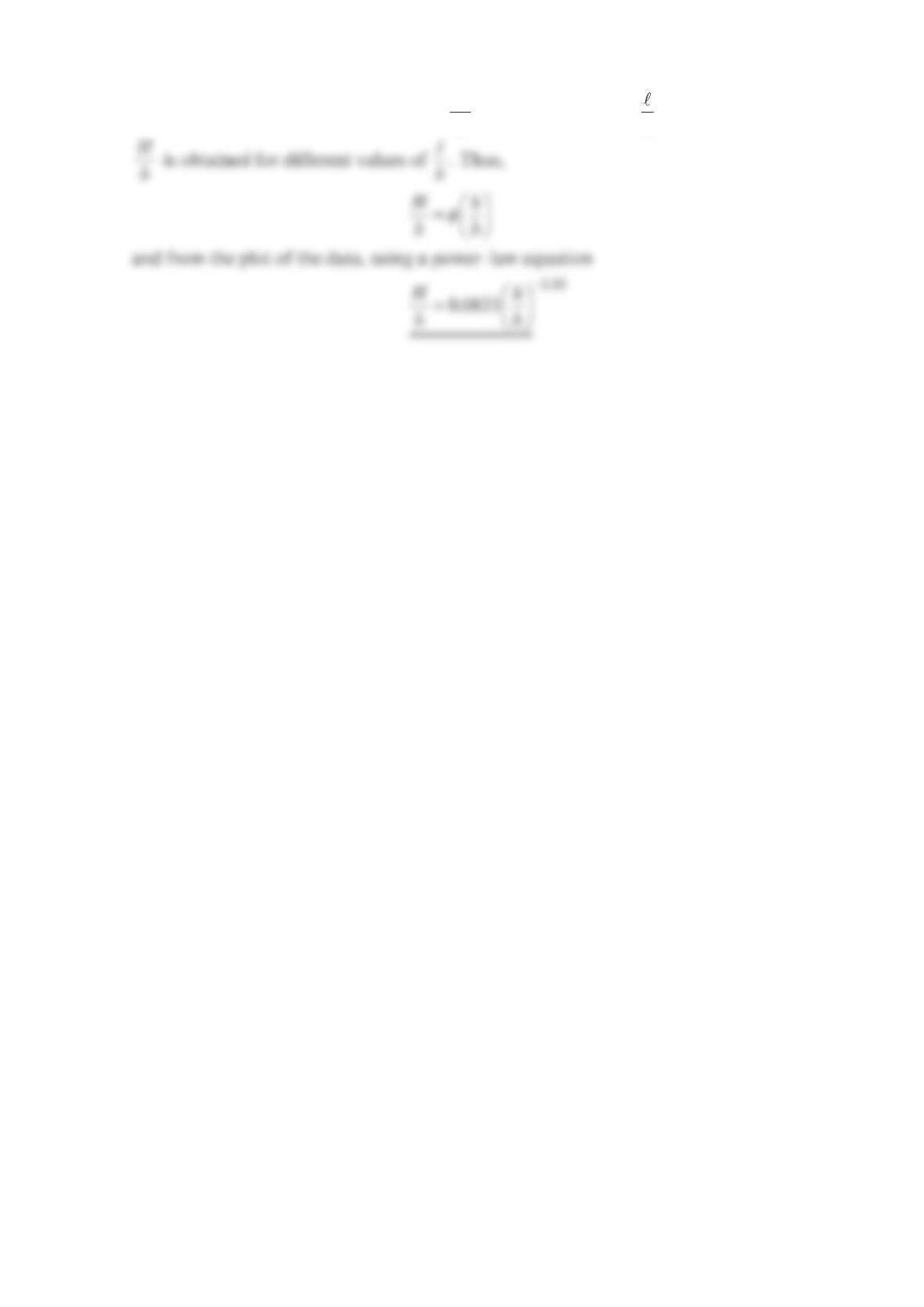
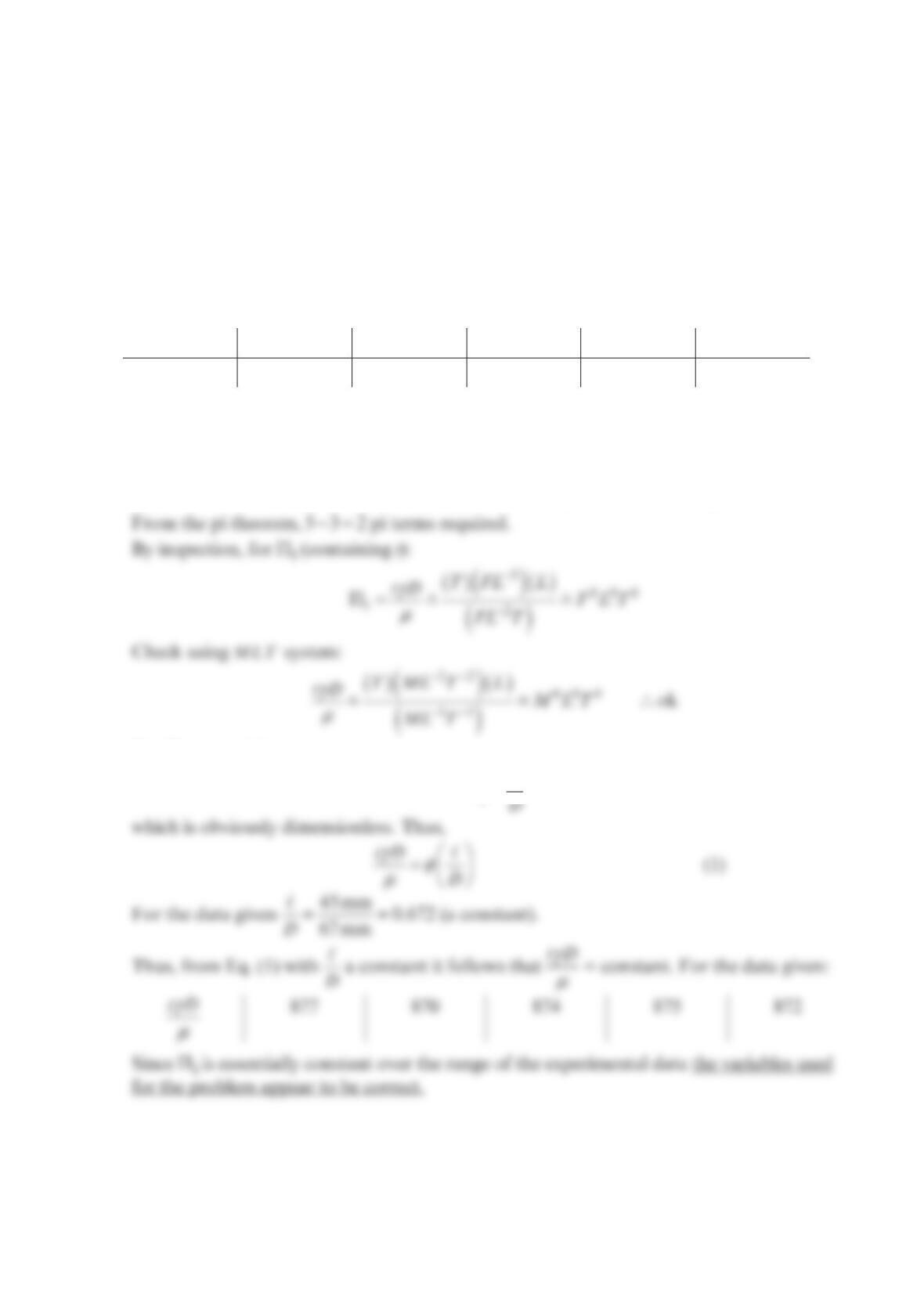
An inspection of these data reveals that H
b does not depend on ,
b i.e., the same value of
Problem 7.42
The time,
t
, it takes to pour a certain volume of liquid from a cylindrical container depends
on several factors, including the viscosity of the liquid. Assume that for very viscous liquids
the time it takes to pour out two-thirds of the initial volume depends on the initial liquid
depth,
, the cylinder diameter,
D
, the liquid viscosity,
µ
, and the liquid specific weight,
γ
.
The data shown in the following table were obtained in the laboratory. For these tests,
=45 mm,
=67 mm,
D
and
γ
=3
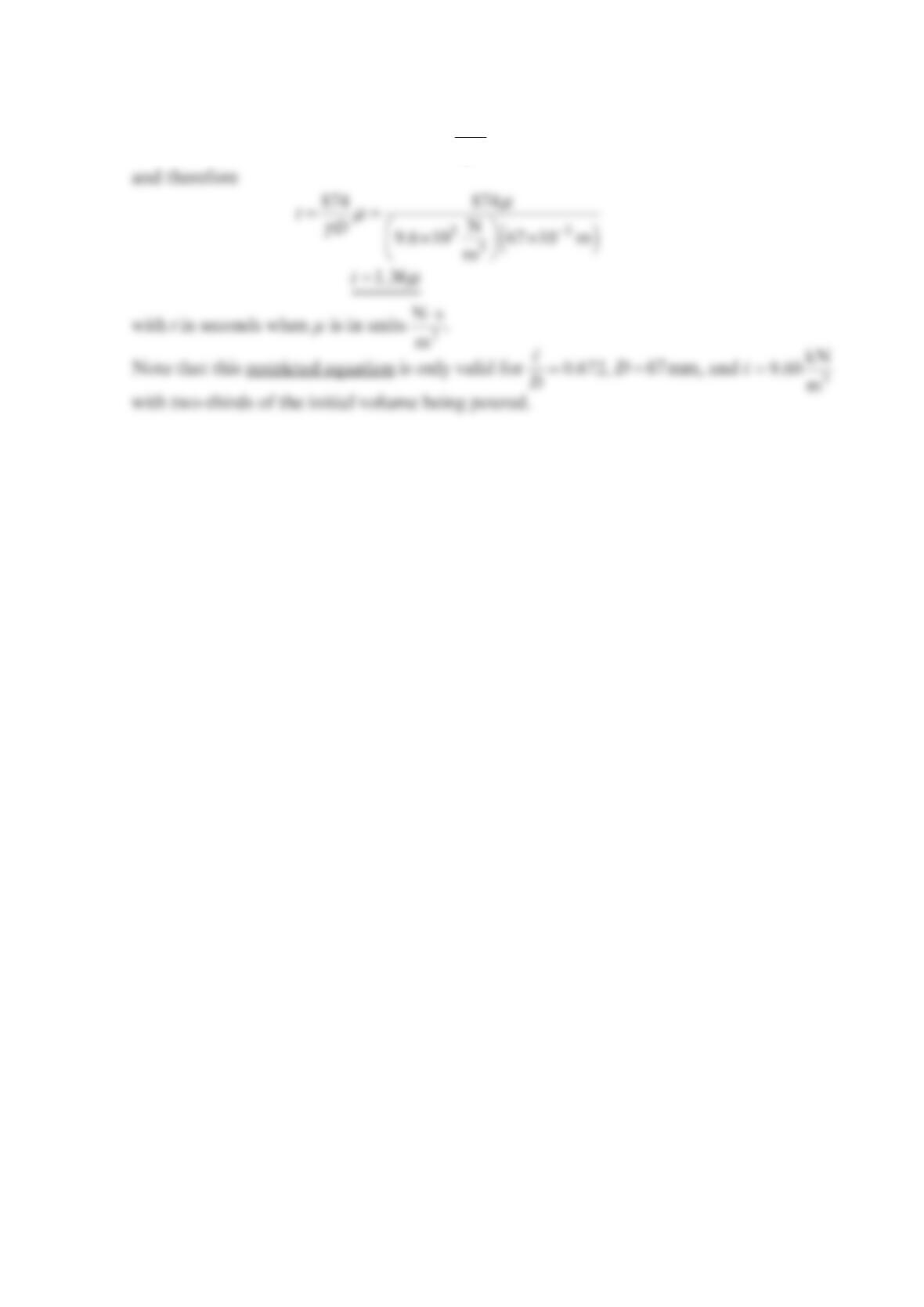
9.60 kN/m . (a) Perform a dimensional analysis, and based
on the data given, determine if variables used for this problem appear to be correct. Explain
how you arrived at your answer. (b) If possible, determine an equation relating the pouring
time and viscosity for the cylinder and liquids used in these tests. If it is not possible,
indicate what additional information is needed.
μ (N · s/m2)11 17 39 61 107
t(s) 15 23 53 83 145
Solution 7.42
()
µγ
=,,,tf D
=t
T
=L
=
D
L
µ
−
=2
FL T
γ
−
=3
FL
For
Π
2 (containing
):
Π
=
2D
Π
Π
t
Π
F
M
(b) The average value for
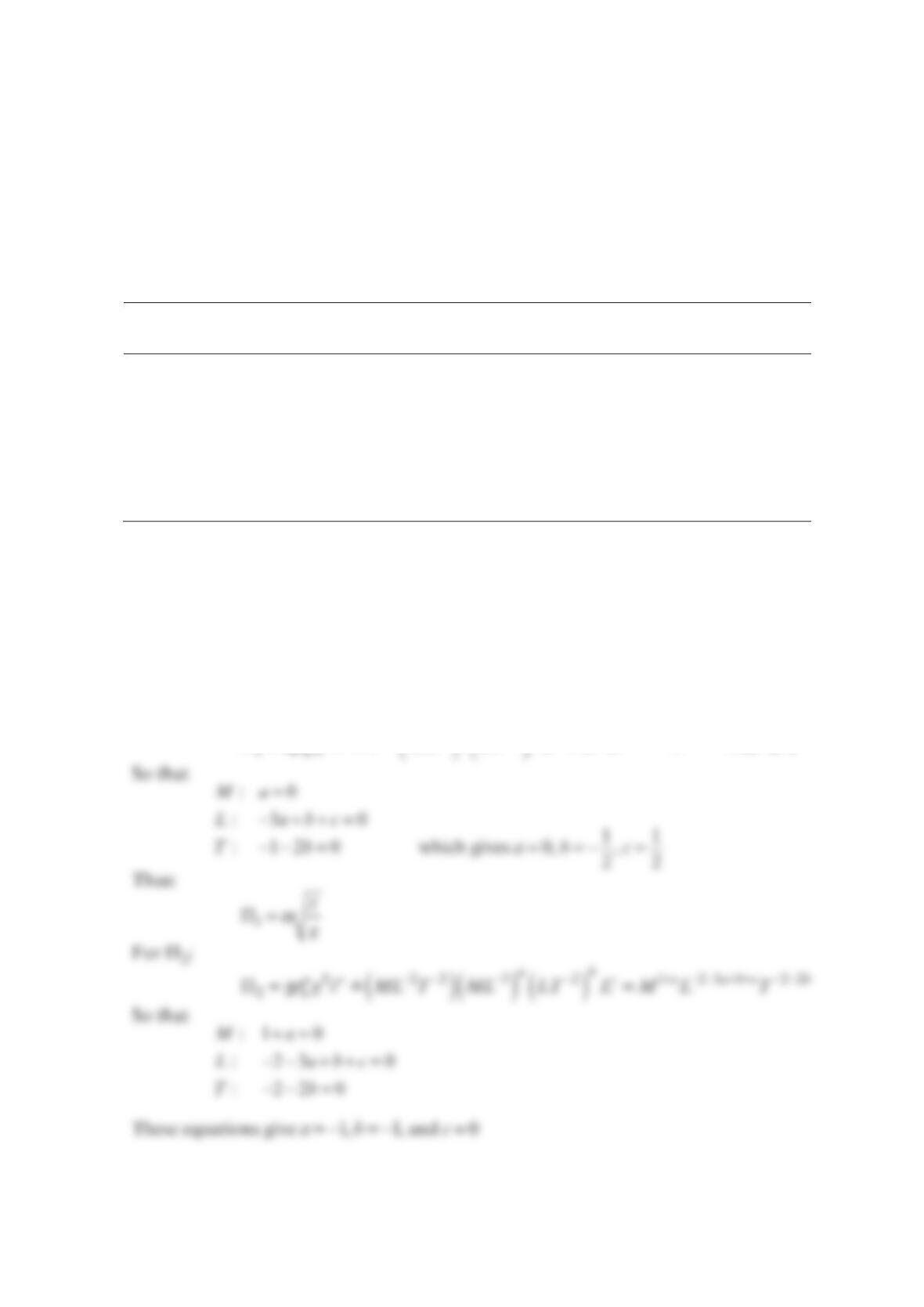
Π
1
is 874 so that
γ
µ
=874
tD
Problem 7.43
In order to maintain uniform flight, smaller birds must beat their wings faster than larger
birds. It is suggested that the relationship between the wingbeat frequency,
ω
, beats per
second, and the bird’s wingspan,
, is given by a power law relationship,
ω
n
. (a) Use
dimensional analysis with the assumption that the wingbeat frequency is a function of the
wingspan, the specific weight of the bird,
γ
, the acceleration of gravity, g, and the density of
the air,
ρ
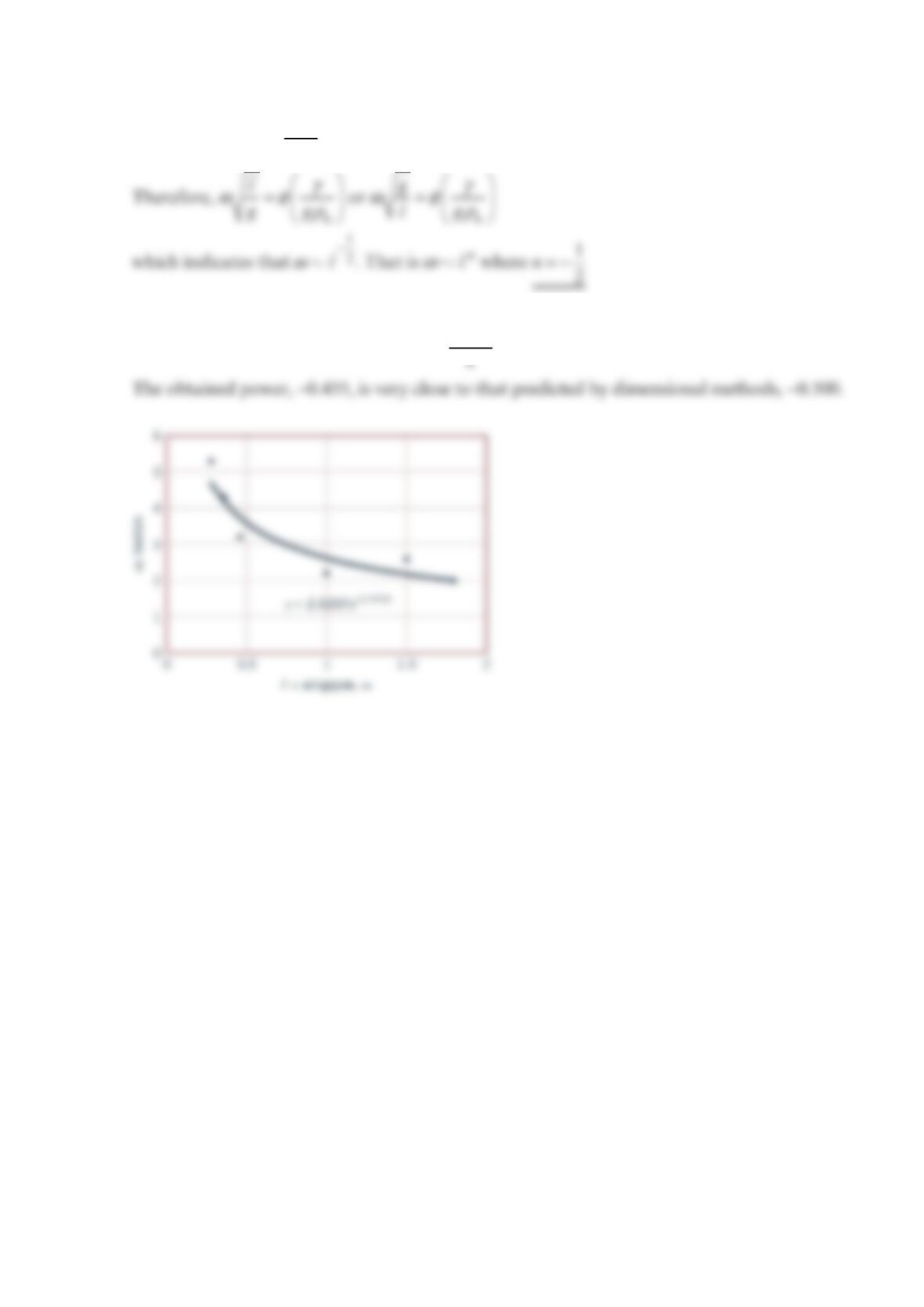
a, to determine the value of the exponent .
n
(b) Some typical data for various birds
are given in the following table. Do these data support your result obtained in part (a)?
Provide appropriate analysis to show how you arrived at your conclusion.
Bird
Wingspan (m)
Wingbeat frequency
(beats/s)
Purple martin 0.28 5.3
Robin 0.36 4.3
Mourning dove 0.46 3.2
Crow 1.00 2.2
Canada goose 1.50 2.6
Great blue heron 1.80 2.0
Solution 7.43
(a) Given
()
ωγρ
=a
,,,fg so that −=−=53
2
k
r or
()
φ
Π
=Π
12
ω
−
=1
T
=L
γ
−−
=22
ML T
−
=2
gLT
ρ
−
=3
aML
Thus, consider
ωρ
−− − −++−−
Π
== =
13 2 3 12
ab
abc c a abc b
gTMLLTLML T
=
00 0
MLT
Π
Thus,
γ
ρ
Π
=
2
a
g
(b) The given data are plotted below and a power law curve fit is applied, with the results
ω
−
=0.45
5
2.62, where
ω
beats
when m
.
ω
Problem 7.44
A
2
50-m-long ship has a wetted area of 2
8
000 m . A 1
100-scale model is tested in a towing
tank with the prototype fluid, and the results are:
Model velocity (m/s) 0.57 1.02 1.40
Model drag (N) 0.50 1.02 1.65.
Calculate the prototype drag at
7
.5 m /s and
1
2.0 m /s.
Solution 7.44
The dimensionless relationship for drag of surface vessels is
()
=Fr,Re
D
C
f.
where m
A
is the wetted area, and
()
==
2
22
m
18000 m 0.80 m
100
A
,
The test data give
)
V 0.57 1.02 1.40
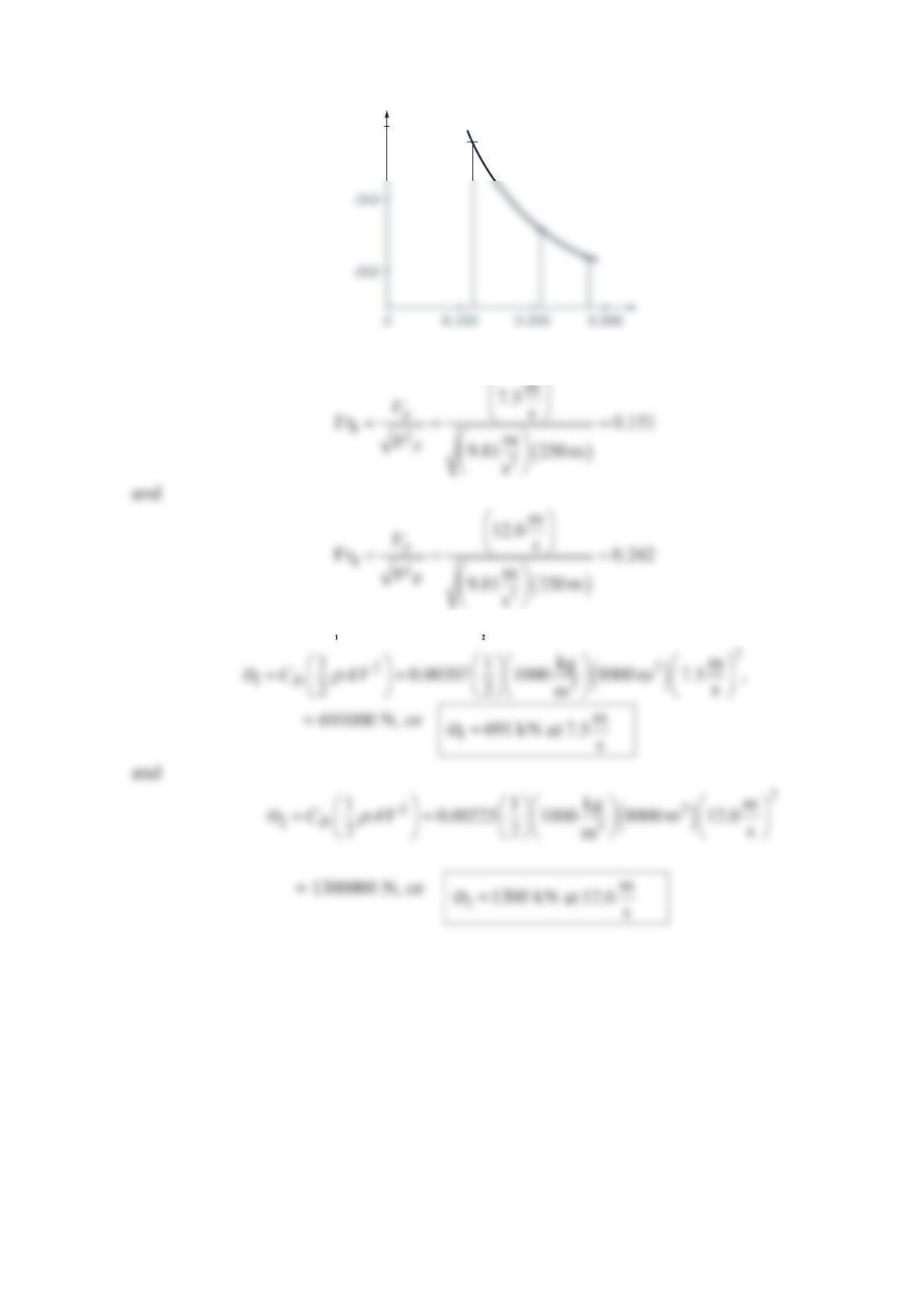
Plotting this data gives
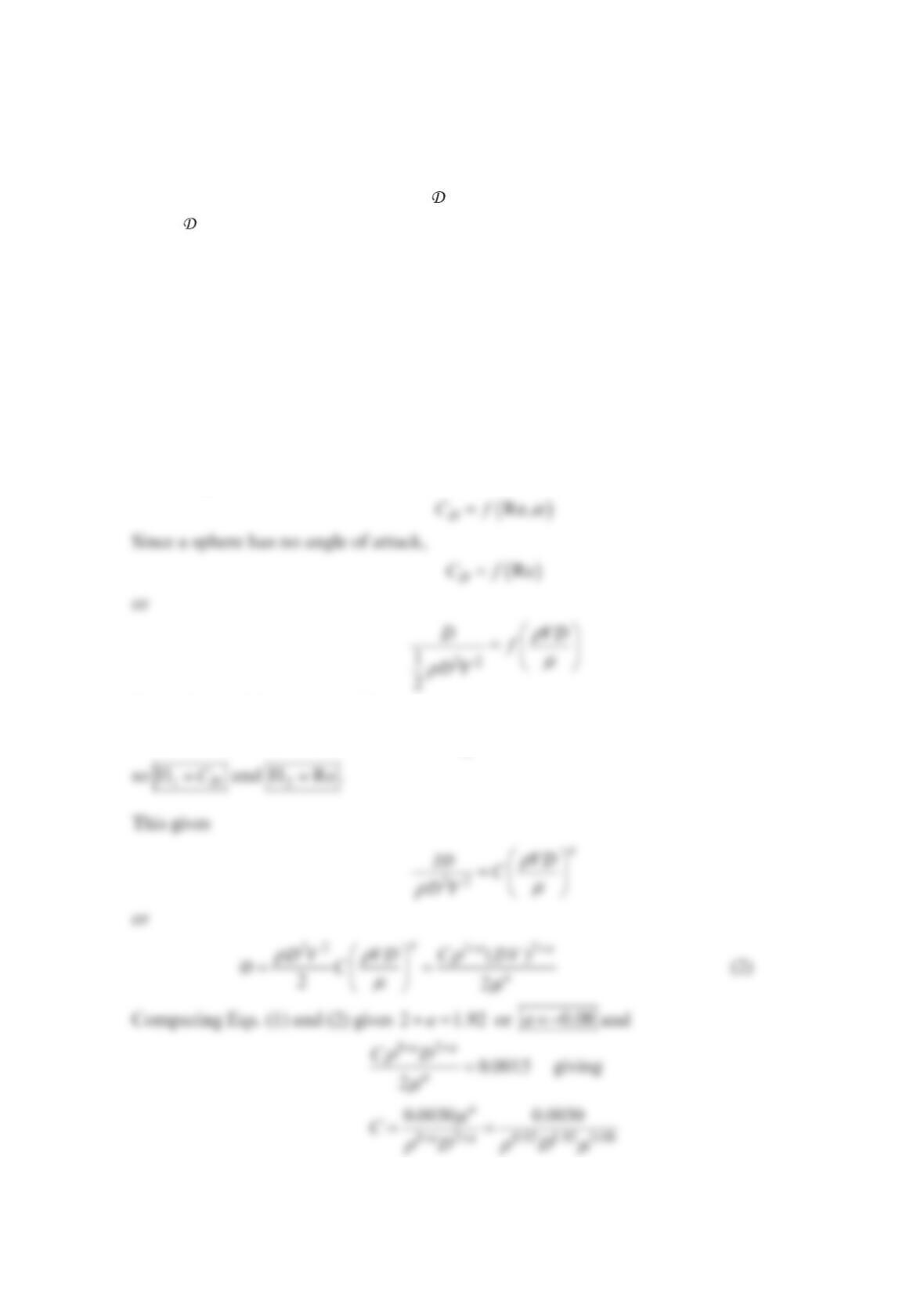
The required prototype velocities give
The above figure gives =0.00307
D
C
and =0.00225
D
C
. Then
.004
Problem 7.45
A student is interested in the aerodynamic drag on spheres. She conducts a series of wind
tunnel tests on a
1
0-cm-diameter sphere. The air in the wind tunnel is at 50 C
and
1
01.3kPa
.
She presents the results of her tests in the form of a correlation,
=1.92
0.0015V,
where is the drag force in Newton and
V
is the velocity in
m
/s. Another student realizes
that the results would have been more effectively presented in terms of dimensionless
parameters, say,
()
Π
=Π=Π
122
a
f
C,
where
Π
1
and
Π
2 are dimensionless parameters and
C
and
a
are constants. What are the
most appropriate dimensionless parameters (
Π
1
and
Π
2) and the corresponding values of
C
and
a
? What would be the drag on a
2
-cm-diameter sphere placed in a
1
-m/s,
2
0C
water
stream?
Solution 7.45
Assuming Weber and Froude number effects are not relevant,
for a sphere of diameter D. The data suggest
=Rea
D
CC
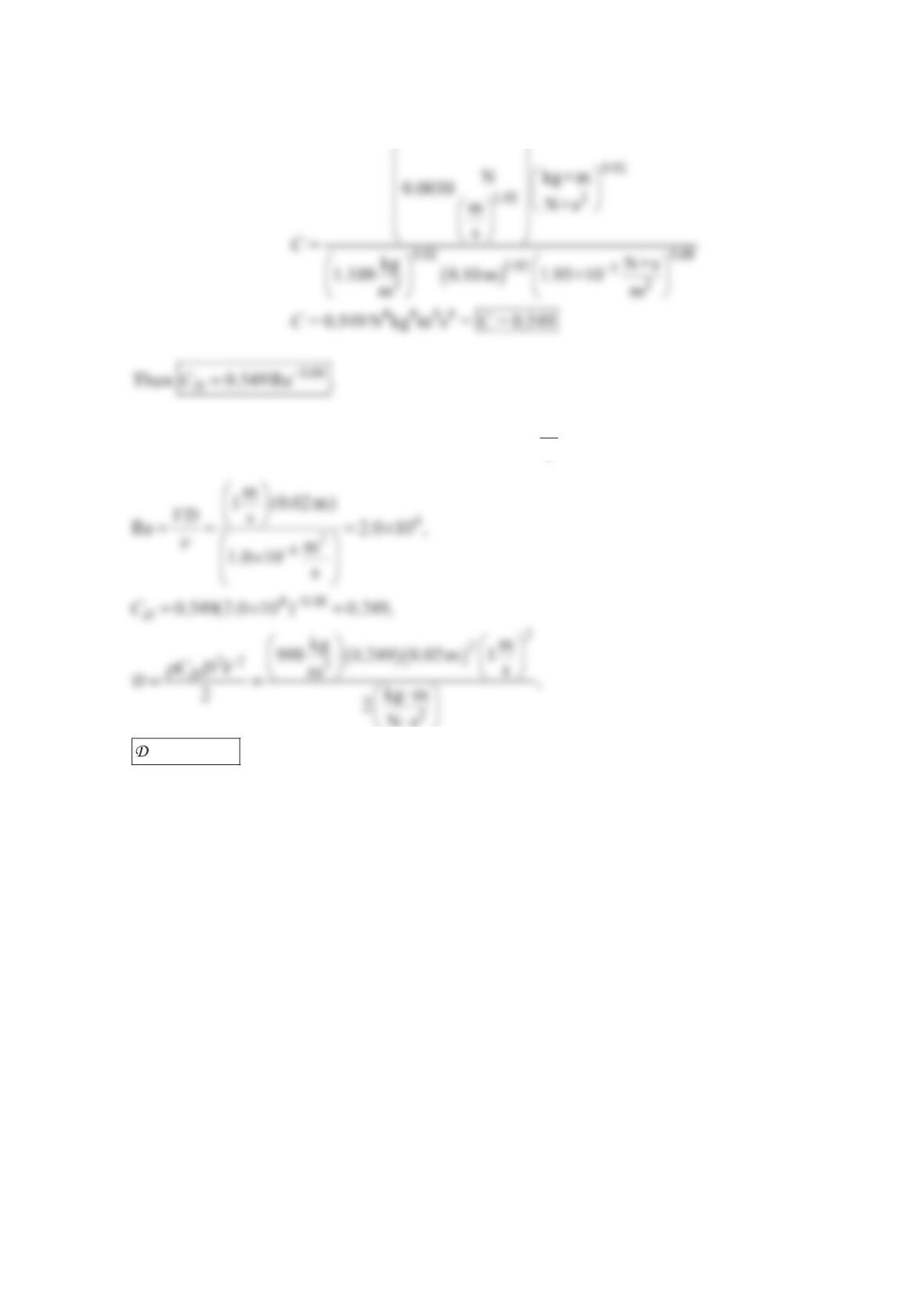
Using data for 50 °C air,
For the =0.02 m
D
sphere in
2
0C
water with =m
V
1s
⋅
=
0.0497 N