Chapter 7
Invoices, Trade and Cash Discounts
Student Performance Objectives:
Section I The Invoice
7-2 Extending and Totaling an Invoice
Section II Trade Discounts – Single
7-3 Calculating the Amount of a Single Trade Discount
Section III Trade Discounts – Series
7-6 Calculating Net Price and Trade Discount Amount By Using a Series of Trade Discounts
7-7 Calculating the Net Price of a Series of Trade Discounts By Using the Net Price Factor,
Section IV Cash Discounts and Terms of Sale
7-9 Calculating Cash Discounts and Net Amount Due
Chapter Notes, Teaching Tips and Lecture Launchers
• Lecture Launcher: Students should recognize that in business, merchandise is “bought” and
“sold” several times as it passes from the manufacturer through wholesalers and retailers to the
final consumer. In this chapter, students will learn about:
• Invoices, the business documents used to keep track of these sales and purchases,
• Trade discounts, how merchandise is priced at various stages of this merchandise
• Remind students that a recap list of all formulas used in the chapter appears in the Chapter
Summary and the end of the chapter.
• Spotlight: The Business Decision, “The Busy Executive,” at the end of the chapter will provide
students with some first-hand experience in applying all of the concepts they learned in this
chapter. It is a good “wrap–up” and review homework assignment.
Section I The Invoice
• Point out that invoices are usually sent out after the merchandise order is shipped. A packing
list, a form which lists the quantity and stock numbers of merchandise sent – but not prices –
usually accompanies the order.
• Have students keep in mind that invoices may vary in style and format from company to
company, but most contain essentially the same information.
• Spotlight:
• Use Exhibit 7-2, Invoice Terminology to enhance your discussion of invoices.
• Lecture Launcher: Describe how inter-modal shipping containers can be taken by truck, train or
ship.
• Draw the West Coast of the United States and a country in the Pacific Rim, such as
Japan, on the board. If a shipment of goods is being sent from a seller in Denver to
Seattle by truck, then by ship to the buyer in Tokyo, what do the terms F.O.B. Seattle
mean, in terms of freight and insurance?
• Spotlight: Classroom Learning Activities
• Have students discuss and answer Try-It Exercise 1 in groups of two’s.
Section II Trade Discounts – Single
• Spotlight: Point out that trade discounts are covered in the chapter before cash discounts because
that is the order in which they occur in sales transactions. The trade discount has to do with the
price, whereas the cash discount relates to when the bill is paid.
• Emphasize that list price is the suggested retail selling price of an item.
• It is the price from which trade discounts are taken.
• Emphasize also that no trade discounts are taken on freight charges or returned items.
• Freight services are supplied by a third party. While the seller may give the buyer a discount,
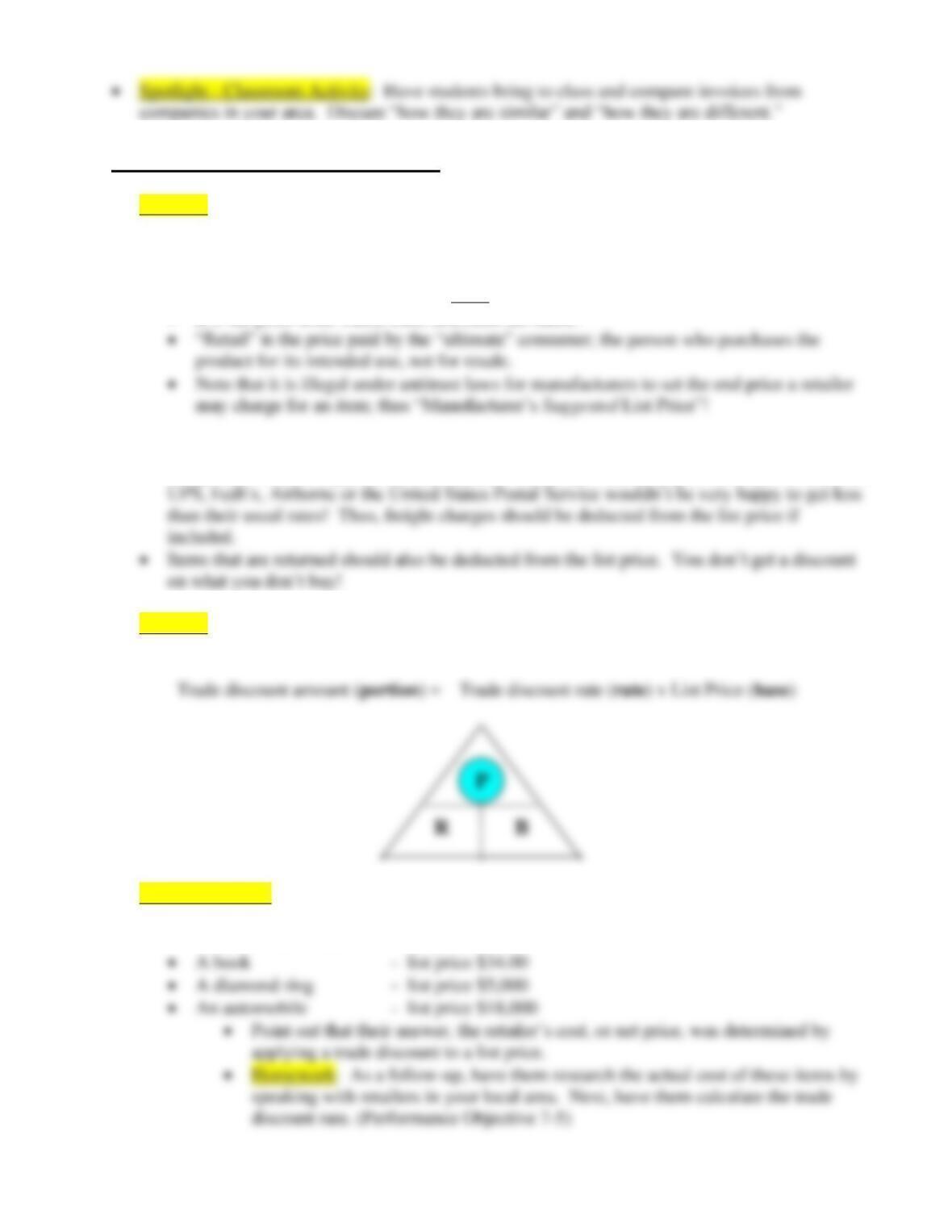
• Spotlight: Call attention to the fact that calculating the amount of a trade discount is an
application of the percentage formula, Portion = Rate x Base, learned in Chapter 6.
• Lecture Launcher: Ask students to “estimate” the retailer’s cost (net price) for the following
items:
• A can of shave cream – list price $1.99.
• Remind students that trade discounts are given to businesses in a particular channel of
distribution.
• These businesses are said to be “in the trade.”
• Collaborative Learning Activity: In groups of two’s or three’s, have students discuss
and create a channel of distribution for the following items:
• Be sure students understand that once the trade discount amount has been calculated, the net
price (actual amount paid) can be found by subtracting the trade discount from the list price.
Net price = List price – Trade discount amount
• Demonstrate to students that an alternate method for finding the net price is to use the
“complement method.” This short cut bypasses the trade discount amount calculation.
• Explain that complements are two numbers whose sum represents 100%.
• Collaborative Learning Activity: This activity will illustrate the importance of choosing the right
vendor. Have students work the following exercise in groups of two.
• Spotlight: You are the buyer for The Carpenter’s Corner, a nationwide chain of builders’
supplies stores. A number of vendors carry similar lines of merchandise. On claw
hammers, for example, Toolmakers, Inc. offers a list price of $9.00 each with a trade
discount of 30%. Johnson Supply Company offers a similar hammer for a list price of
$9.25 less a 40% trade discount. Which vendor is offering the lower net price?
a. If your company sells 20,000 hammers each year, how much money will be saved using
the lower-priced vendor?
Section III Trade Discounts – Series
• Spotlight: Emphasize to students that a “series” or “chain” of trade discounts is very common in
business. These multiple discounts are given for many reasons, including:
• The company’s position or level in the channel of distribution
• Spotlight: A common student error is to simply add the series discounts.
• Point out that this won’t work, since each discount must be applied to a successively
• Remind students that a series of discounts can be taken in any order, although they are usually
listed and taken in descending order.
• Have students work Try-It Exercise 6 in class (individually or in two’s).
• Point out that Performance Objective 7-7, Calculating the Net Price of a Series of Trade
Discounts By Using the Net Price Factor, Complement Method, is a short cut, just as
Performance Objective 7-4 in Section II was for single trade discounts.
• Spotlight – Classroom Activity: Be sure students do not round the net price factor!
• To illustrate how rounding can change the final result, have students solve the following
• Students should recognize that the single equivalent discount is a single trade discount that
equates to all the discounts in a series or chain. It is the complement of the net price factor in
decimal form.
Single equivalent discount = 1 – Net price factor
Section IV Cash Discounts and Terms of Sale
• Spotlight: Students mistakenly think that a cash discount is given for paying in “cash.”
• Describe how suppliers will frequently give a business credit by not requiring immediate
payment for goods, thus allowing the business to start selling the goods to the consumer
• Remind students that no cash discounts are taken on returned items or freight charges, as noted
above.
• Point out that to take advantage of a 2/10, n/30 cash discount, for example, the bill only has to be
paid 20 days earlier than the net date. (30 – 10 = 20)
• Spotlight: Students commonly believe that cash discounts don’t amount to much of a
savings. Demonstrate that a 2% savings in 20 days equates to a theoretical 36.5%
savings annually – Quite significant!
• Classroom Activity – Have students work Try-It Exercise 10 in class (individually or in two’s).
• Students should also recognize that penalty charges or late fees may be imposed on companies
that allow their accounts payable to go 20 to 30 days beyond the due date.
• Spotlight: College students should know how many days are in each month!
• As a shortcut, if they can remember that September, April, June and November have 30
• Have students keep in mind when determining due dates that the last day is counted, but not the
first.
• For example, if the invoice date is June 3rd, counting begins with June 4th.
• Spotlight: Remind students that in EOM dating, if an invoice is dated the 26th of the month or
• Collaborative Learning Activity: Typically, students get confused with the concept of “dating
methods.” Have them work Try-It Exercises 12-15 in groups of two’s or three’s.
• Wrap up the chapter by setting out the four basic steps for determining the final payment
amount:
• Step 1: Subtract freight and returned items from list price, if included.
Questions Students Always Ask
“Why does the buyer pay for freight if the seller has already paid for it?”
• Ask the students how many of them have ever ordered an item online or through a
“If I use the days–in-a-year calendar, aren’t I counting the first day?”
• Show how subtracting the number for the first day from the number for the last day in a
“Do I have to use the complement of a trade discount rate?”
• Can’t I just figure out the trade discount amount and subtract it from the list price?” Yes,
“Why can’t I just multiply the partial payment by the cash discount rate?”
• Impress upon the students that, with partial payments, it’s as if a greater amount was
owed, and the cash discount rate is multiplied by that greater amount to find the actual
“Do businesses actually use payment terms like EOM and ROG?”
• Yes, they do. Using your favorite search engine, do a search on the Internet for various