99
C H A P T E R 7
CORPORATE STRATEGY AND DIVERSIFICATION
Illustration 7.1
Baking change into the community
How Greystons diversification transforms a depressed community
1. What were the motivation(s) for Greyston bakerys diversifications?
Initially Greystone diversified away from its bakery to provide permanent housing for
homeless people and then a child day-care centre, followed by health services, community-
aspects of employee lives for both individuals and businesses.
2. Referring to the Ansoff matrix, how would you classify these diversifications?
The interesting aspect of this case is that it depends on how one defines the market. In a
Illustration 7.2
Zodiac deflates: from boats to aerospace
Zodiac illustrates a succession of related diversifications, which can lead a company quite far
from its traditional activity. In the end, these diversification moves stretched the business so far
that it was obliged to divest some of its original core business.
Johnson, Whittington, Scholes, Angwin and Regnér, Exploring Strategy, 10th edition,
Instructors Manual on the Web
100
1. Explain the ways in which relatedness informed Zodiacs diversification strategy over time.
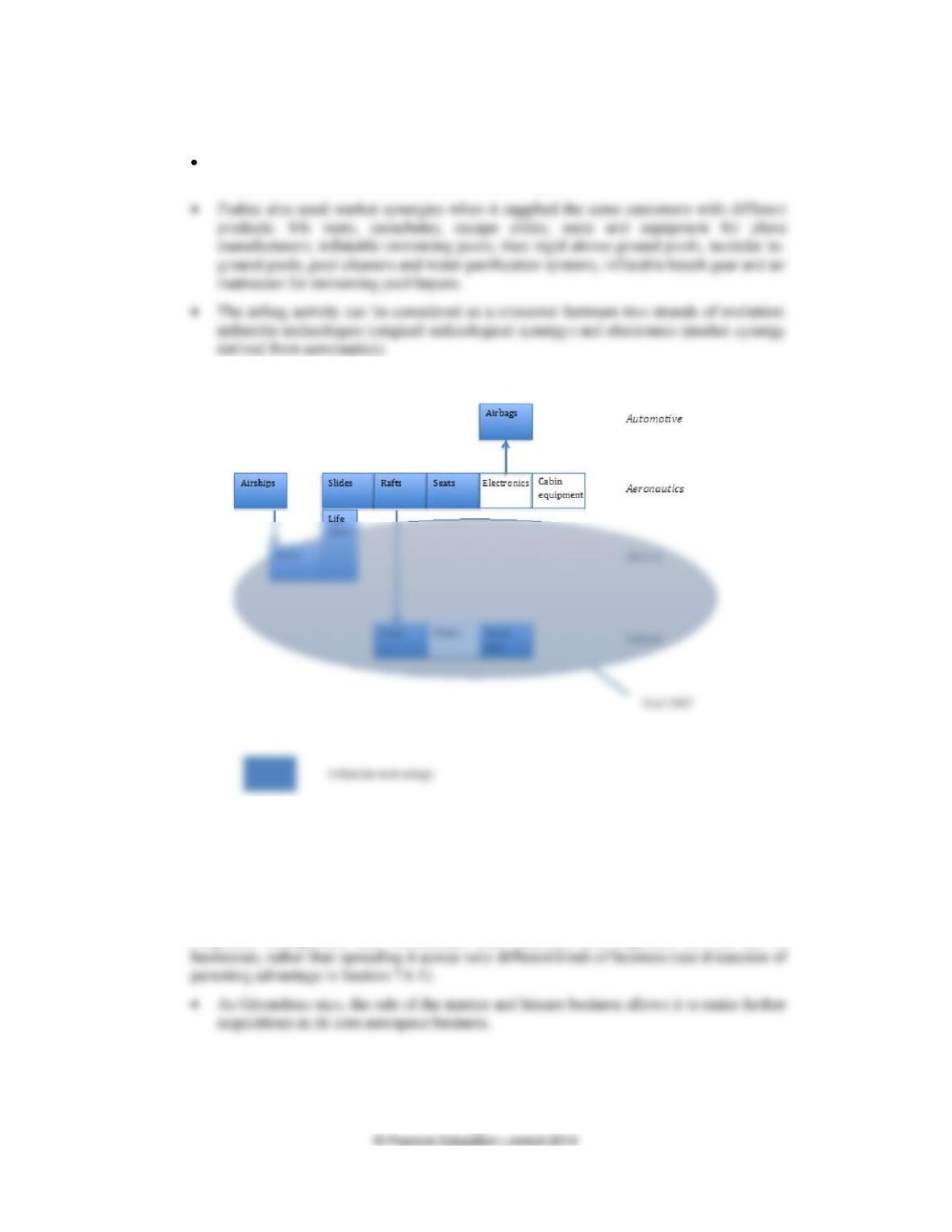
Zodiac repeatedly used the inflatable products technology as synergy: from airships to
boats, life vests, escape slides, rafts and swimming pools.
Overall, it is possible to illustrate the evolution of Zodiac:
Building from this portfolio, students might propose other related diversifications, either
using a technological synergy, such as inflatable technology or using a market synergy or
using both: for instance a new generation of airships and so on.
2. What are the advantages and potential dangers of its decision to focus on the aircraft
products market?
Corporate management can concentrate their attention and expertise on one set of
Johnson, Whittington, Scholes, Angwin and Regnér, Exploring Strategy, 10th edition,
Instructors Manual on the Web
101
Financial analysts tend to prefer pure plays rather than diversified companies, given
that shareholders can diversify their portfolios for themselves.
Illustration 7.3
Out of sight out of mind? Outsourcing at Royal Bank of Scotland
1. In terms of transaction and capability costs, why might outsourcing be attractive to
companies?
In general terms, outsourcing offers companies the opportunity to reduce their overall costs
by procuring the same, similar or better service or product more cheaply than they can
provide it for themselves. In the RBS case, there was reason to believe that outsourcing
2. What might be the risks of insourcing?
Insourcing, or bringing an activity back inside the parent company can appear to be a
positive move as it overcomes potential opportunism from suppliers and also cultural and
102
Illustration 7.4
Eating its own cooking: Berkshire Hathaways parenting
1. In what ways does Berkshire Hathaway fit the archetypal portfolio manager (see Section
7.6.2)?
Berkshire Hathaway exhibits a good many, but not all of the characteristics of a portfolio
manager. Buffet describes the company as a conduit rather than an agent and seems rather
less concerned with institutional investors than with smaller shareholdings. But nonetheless
2. With $20bn to invest, suggest industries and businesses Warren Buffett is likely never to
invest in.
Buffet is unlikely to invest in industries that are new, high-technology, highly competitive,
hypercompetitive or prone to oligopolistic competition (Section 2.3.1). Buffet prefers
Illustration 7.5
ITCs diverse portfolio: smelling sweeter
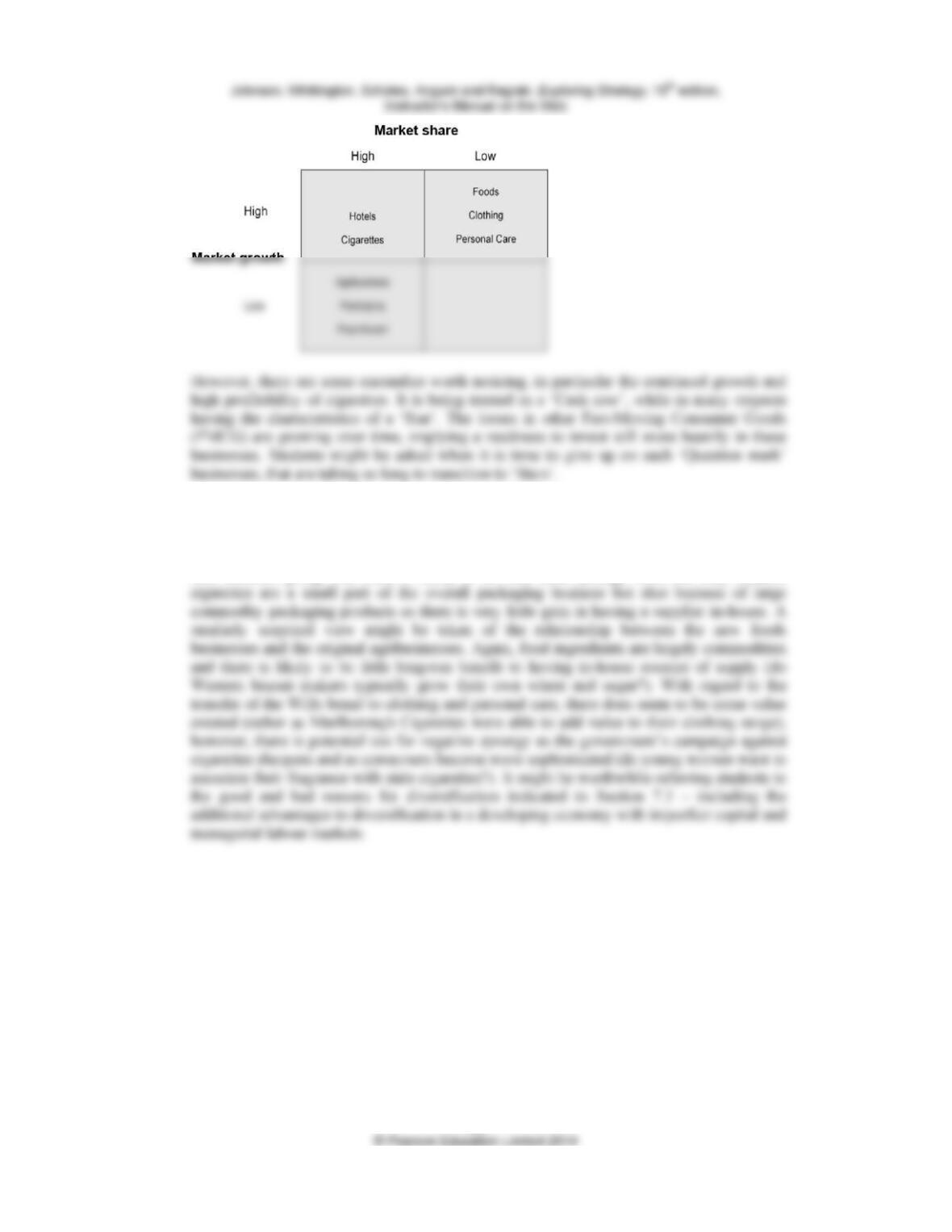
1. How well does ITCs portfolio fit in terms of the BCG matrix?
ITCs portfolio of businesses can clearly be seen in BCG terms, especially if relative rates
103
2. Identify and evaluate the various synergies in ITCs business.
It is worthwhile injecting some scepticism about internal synergies. Historically, there was
considerable synergy between packaging and cigarettes, the second being required to get the
first business going. But there is likely to be very little synergy now, not only because
Key Debate
Why have corporate-level strategies anyway?
Students should consider what knowledge a diversified multinational needs, which of this is
more or less transferable between its subsidiaries and how.
For Virgin
Product technologies: presumably pretty readily transferred and capable of being patented
or protected. So maybe they could be sub-contracted, outsourced or licensed.
There are of course counter arguments that can be made. For example, the rise of process
providers such as SAP or PwC might reduce the in-house advantage, as conceivably could
higher levels of management education, creating a population of managers sharing similar skills,
know-how and concepts. However, key to Virgin is a particular esprit de corp, an ethos and
attitude that is a distinctive characteristic of the group and hard to imitate. The importance of
this is not likely to reduce.
In Question 2, the argument against diversification in the developed world is that a sophisticated
set of institutions allows efficient transfer of resources and protects property rights. Efficient
Video assignment
South Western Ambulance Service Trust (SWAST)
This video case is focused on issues of corporate level strategy but the South Western
Ambulance Service Trust was formed from a merger between the Dorset ambulance service and
the West Country ambulance service so some issues relating to mergers (Chapter10) are also
1. It is worth starting with a review of Ansoffs product/market growth matrix (see Figure 7.2)
and discussing the different directions of growth. Most of SWASFTs activities are focused
on quadrant A developing and improving the existing services provided for existing needs
(markets). However, Ken Wenman refers to the newer urgent care out-of-hours service
2. There are a number of threats faced by SWASFT that Ken Wenman refers to. Not least is
the threat of competition only the emergency 999 service is not open to competition. The
other services provided by the ambulance service (such as patient transport services) are
open to competition private sector firms can submit tenders to the NHS to run these
Assignment 7.1
Ansoff matrix
Students can apply a similar procedure here to what was suggested for the discussion of
Illustration 7.2, Zodiac deflates. See the relevant case notes later in this Manual for discussions
of CRH, Marks & Spencer and SABMiller.
Assignment 7.2
Related or unrelated diversification and the dominant logic
This assignment will raise practical issues around the degree to which companies are related or
106
The following three cases proposed in the question are particularly interesting:
1. Google has been diversifying very rapidly out of pure search (as far as instant travel
comparison sites). Going to the Google website, and then clicking through to More, then
2. The highly diversified Indian Tata Group (from steel to consulting services) provides an
interesting case of diversification apparently working in a developing country context, as
argued for in Section 7.3.
Assignment 7.3
Corporate parenting
Generally, unrelated businesses are best managed by portfolio management styles or parental
development styles (e.g. both Siemens and Google can offer from the centre technological
Assignment 7.4
Portfolio matrix
This assignment is liable to be quite difficult, but can be revealing.
A great deal will rely on choice of company. Reliable market share data are not available for all
markets. However, consumer markets often have better information than others (e.g. search
engines, newspapers and mobile phones); so too do major industrial markets (e.g. aircraft and
As always, it is important to draw managerial implications from the analysis. Which businesses
should receive more investment, be milked, divested or whatever? Students should be asked to
be alert to when the logic of the matrix seems to contradict the real-world needs of the business.
Integrative assignment 7.5
Shareholders reactions to mergers and acquisitions
Mergers and acquisitions are a key method of diversification and are discussed in Chapter 10.
The behaviours of the share prices of the bidding and target companies in any deal need to be
evaluated against the following background.
As mentioned particularly in the key debate in Chapter 10, the finance literature has generally
found that acquiring firms stock prices typically fall by a small margin in the period
Against this background, students should expect the bidding firms share price to fall around the
bid announcement date. In cases where this does not happen, they should look for exceptional
Case Example
Strategic development at Virgin 2013
Students will probably have different views on the corporate rationale of the Virgin Group as
this is a private limited company and Branson uses the media very carefully to enhance his
business. He appears to have two images: the carefree adventurer and the astute entrepreneur.
108
The Virgin brand has benefited from its image in constantly attracting people who have new
business ideas. The organisation has developed into a very effective parental developer together
with the ability to enhance business ideas or reject them quickly if they do not meet Virgins
criteria.
All opinions about this group, because of its size and complexity, will have elements of
conjecture. How clear, for instance, was it when Branson bought the group back from public
ownership that he wanted to be rid of simply earning profits for shareholders, the constraints of
the City and the need for quick profits rather than the steady build up of businesses which he
considers have long-term potential? The other side to this decision may have been that, from the
entrepreneur mindset, he was able to buy the company back at a very competitive price and he
wanted to operate without the public eye minutely viewing how he ran his various companies.
1. What directions of strategic development have been followed by Virgin over the period of
the case (use Figure 7.2 as a guide)?
Virgins moves exemplify a wide range of Ansoff strategies. The addition of Our Price to
the existing Virgin stores was a case of market penetration (in terms of Figure 7.2, box A).
2. What is the corporate rationale for Virgin as a group of companies?
Students will probably have different views on the corporate rationale of the Virgin Group
as this is a private limited company and Branson uses the media very carefully to enhance
109
3. How does the Virgin Group as a corporate parent add value to its businesses? To what
extent are these parenting skills relevant to the various businesses in the group?
The provision of a ready-made brand, which should not be underestimated, is a key way in
which business have value-added by the parent. The brand has a high level of visibility and
Tata in India selected Virgin as a partner, even though it may have linked with a major
player such as Vodafone.
4. What should the future corporate strategy be?
Although many founders of organisations find it difficult to leave their creation any future
corporate strategy should take into account the possibility of Branson retiring.
This a very large organisation which has been in the public arena for decades so most of the
students will have views on this organisation and its founder prior to considering the case.
They should be encouraged to try and find a reasoned view looking at the case material and
any further research they may undertake and not just stick to their initial opinions. In
particular they should ground their arguments in a strategy perspective, such as the
Resource-based View or a Positioning approach.