Section 7.6
7.5.45 If a6= 0, then there are two distinct eigenvalues, 1 ±√a, so that the matrix is diagonalizable. If a= 0, then
1 1
a1=1 1
0 1 fails to be diagonalizable.
7.5.47 If a6= 0, then there are three distinct eigenvalues, 0,±√a, so that the matrix is diagonalizable. If a= 0,
0 0 0
0 0 0
7.5.49 The eigenvalues are 0,1, a −1. If ais neither 1 nor 2, then there are three distinct eigenvalues, so that the
matrix is diagonalizable. Conversely, if a= 1 or a= 2, then the matrix fails to be diagonalizable, since all the
eigenspaces will be one-dimensional (verify this!).
7.5.51 Yes, Qis a field. Check the axioms on page 368.
7.5.53 Yes, check the axioms on page 368. (additive identity 0 0
0 0 , multiplicative identity 1 0
0 1 ).
Section 7.6
7.6.1λ1= 0.9, λ2= 0.8, so, by Theorem 7.6.2, ~
0 is a stable equilibrium.
Chapter 7
7.6.2λ1=−1.1, λ2= 0.9, so by Theorem 7.6.2, ~
0 is not a stable equilibrium. (|λ1|>1)
7.6.5λ1= 0.8, λ2= 1.1 so ~
0 is not a stable equilibrium.
7.6.8λ1= 0.9, λ2= 0.8 so ~
0 is a stable equilibrium.
7.6.9λ1,2= 0.8±(0.6)i, λ3= 0.7, so |λ1|=|λ2|= 1 and ~
0 is not a stable equilibrium.
7.6.13 Since λ1= 0.7, λ2=−0.9,~
0 is a stable equilibrium regardless of the value of k.
7.6.14 λ1= 0, λ2= 2kso ~
0 is a stable equilibrium if |2k|<1 or |k|<1
2.
7.6.15 λ1,2= 1 ±1
10 √k
7.6.17 λ1,2= 0.6±(0.8)i= 1(cos θ±isin θ), where
θ= arctan 0.8
0.6= arctan 0.8
0.6= arctan 4
3≈0.927.
Eλ1= ker −0.8i−0.8
0.8−0.8i= span −1
iso ~w =0
1, ~v =−1
0.
366
Section 7.6
θ= arctan 4
3≈0.927.
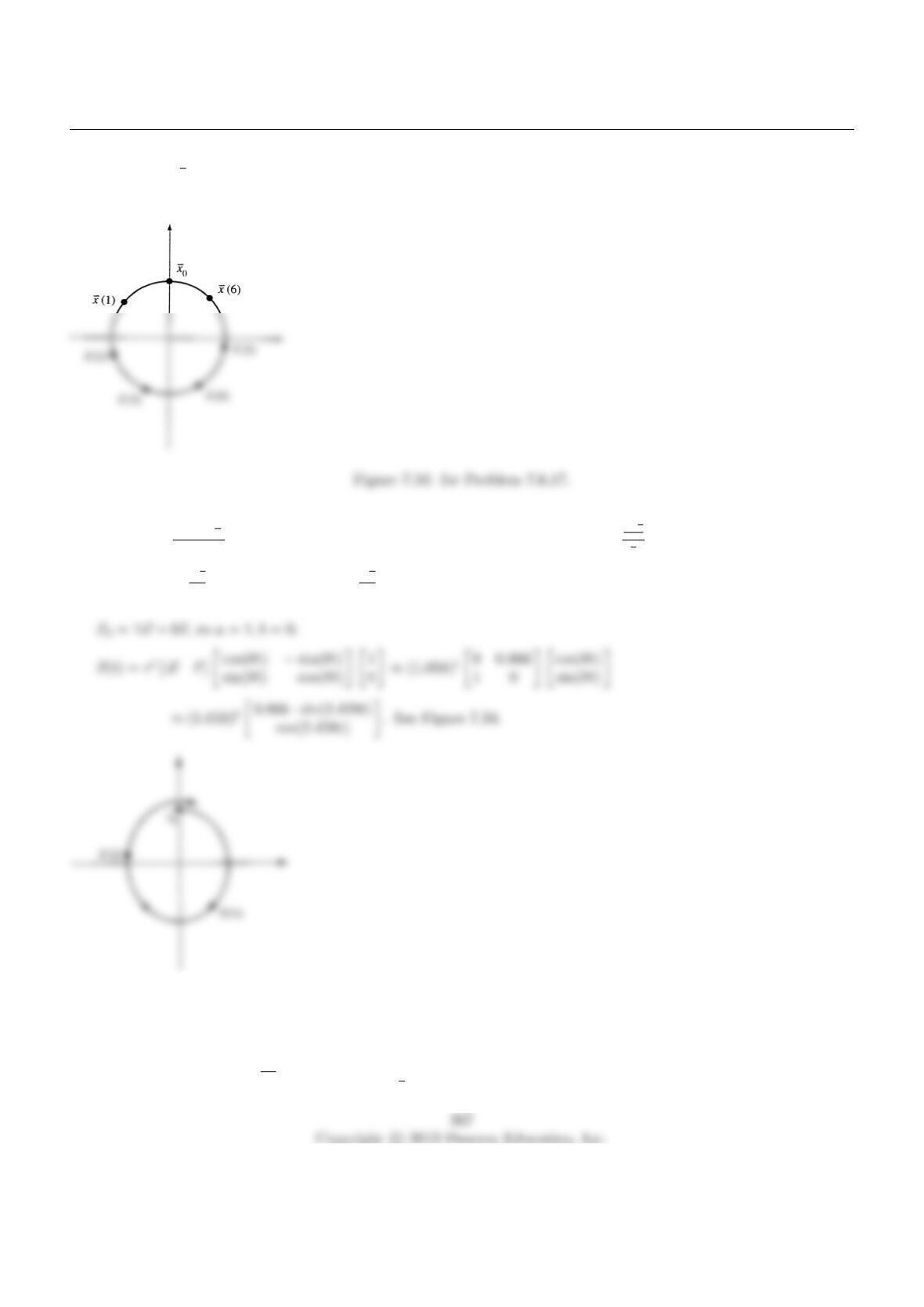
The trajectory is the circle shown in Figure 7.33.
7.6.18 λ1,2=−4±2√3i
5=r(cos θ±isin θ), where r≈1.058 and θ=π−arctan 2√3
5
4
5≈2.428 (second quadrant).
Eλ1= span √3
2
i, so ~w =0
1, ~v =√3
2
0.
Figure 7.34: for Problem 7.6.18.
Spirals slowly outwards (plot the first few points).
7.6.19 λ1,2= 2 ±3i,r=√13, and θ= arctan 3
2≈0.98, so
Chapter 7
7.6.20 λ1,2= 4 ±3i, r = 5, θ = arctan 3
4≈0.64, so λ1≈5(cos(0.64) + isin(0.64)),[~w ~v] = 0 1
1 0 ,a
b=1
0
and ~x(t)≈5tsin(0.64t)
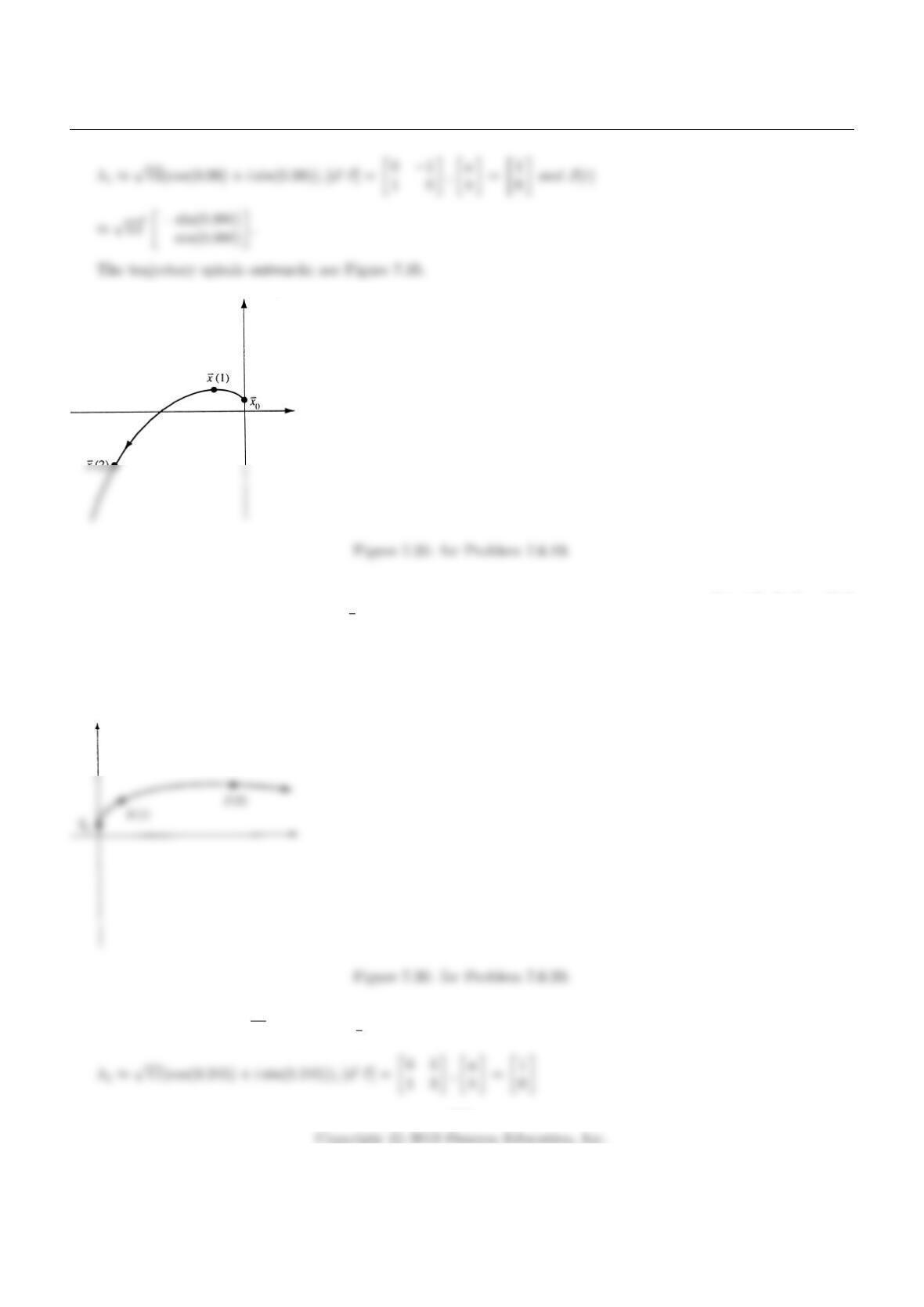
cos(0.64t). See Figure 7.36.
Spirals outwards (rotation-dilation).
7.6.21 λ1,2= 4 ±i, r =√17, θ = arctan 1
4≈0.245 so
368
Section 7.6
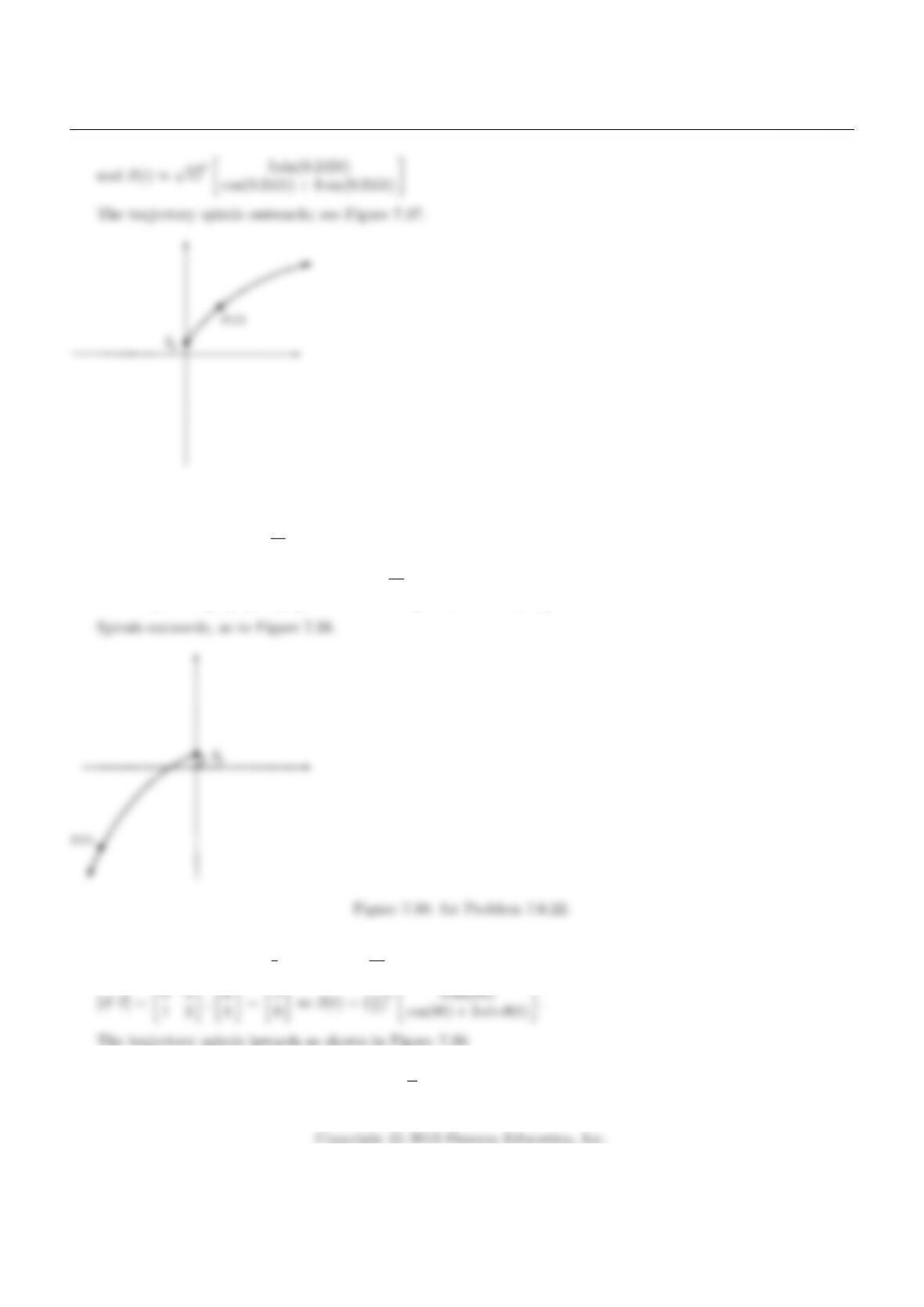
Figure 7.37: for Problem 7.6.21.
7.6.22 λ1,2=−2±3i, r =√13, θ ≈2.16 (in second quadrant)
[~w ~v] = 0−5
1−3,a
b=1
0so ~x(t) = √13t−5 sin(θt)
cos(θt)−3 sin(θt), where θ≈2.16.
7.6.23 λ1,2= 0.4±0.3i, r =1
2, θ = arctan 0.3
0.4≈0.643
7.6.24 λ1,2=−0.8±0.6i, r = 1, θ =π−arctan .6
.8≈2.5 (second quadrant)
369
Chapter 7
[~w ~v] = 0−5
1−3,a
b=1
0so ~x(t) = −5 sin(θt)
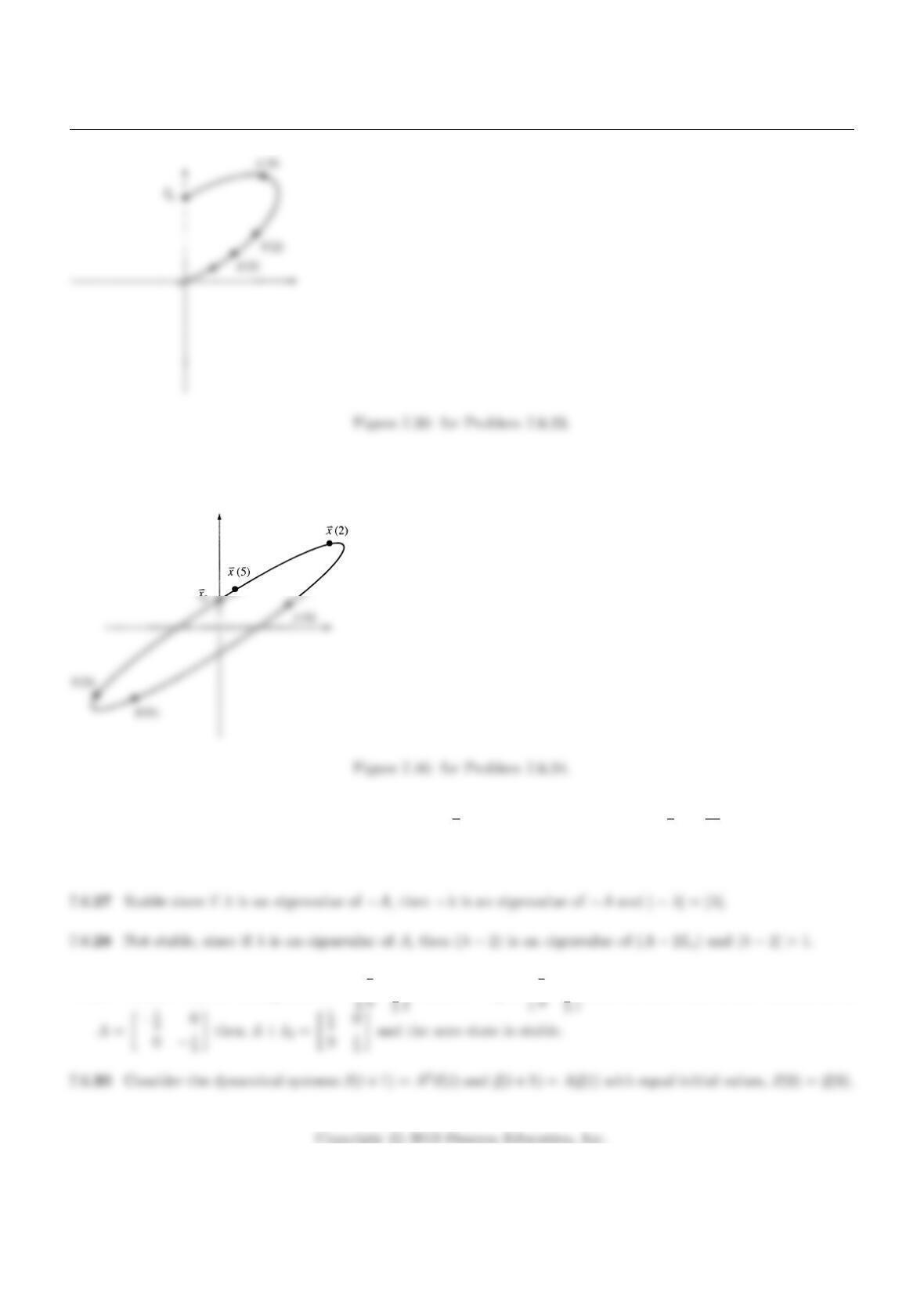
cos(θt)−3 sin(θt), an ellipse, as shown in Figure 7.40.
7.6.25 Not stable since if λis an eigenvalue of A, then 1
λis an eigenvalue of A−1and 1
λ=1
|λ|>1.
7.6.26 Stable since Aand AThave the same eigenvalues.
7.6.29 Cannot tell; for example, if A=1
20
20
370
Section 7.6
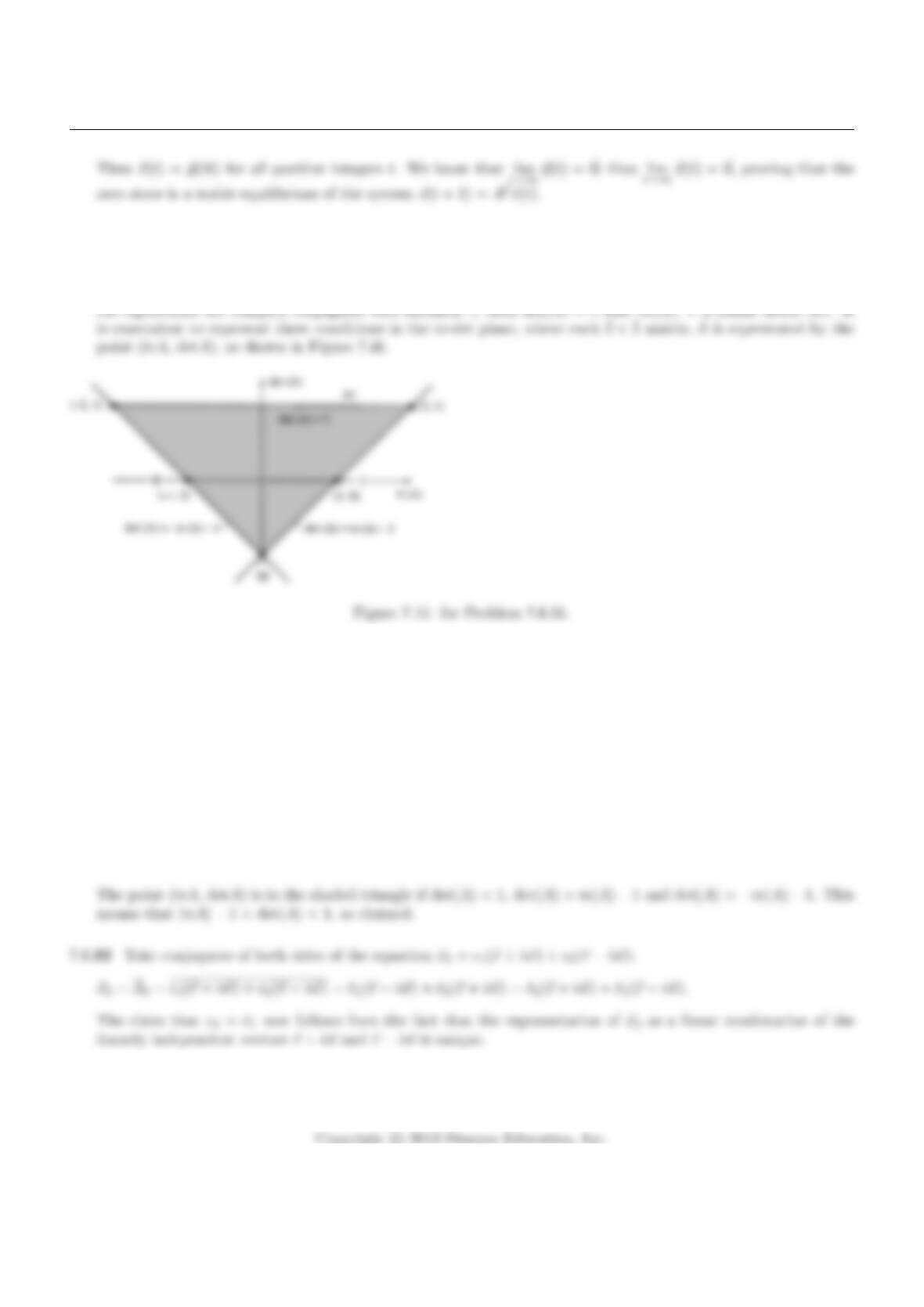
7.6.31 We need to determine for which values of det(A) and tr(A) the modulus of both eigenvalues is less than 1.
We will first think about the border line case and examine when one of the moduli is exactly 1: If one of the
eigenvalues is 1 and the other is λ, then tr(A) = λ+ 1 and det(A) = λ, so that det(A) = tr(A)−1. If one of
the eigenvalues is −1 and the other is λ, then tr(A) = λ−1 and det(A) = −λ, so that det(A) = −tr(A)−1. If
If tr(A) = det(A) = 0, then both eigenvalues of Aare zero. We can conclude that throughout the shaded triangle
in Figure 7.41 the modulus of both eigenvalues will be less than 1, since the modulus of the eigenvalues changes
continuously with tr(A) and det(A) (consider the quadratic formula!). Conversely, we can choose sample points
to show that in all the other four regions in Figure 7.41 the modulus of at least one of the eigenvalues exceeds 1;
consider
the matrices 2 0
0 0 ,−2 0
0 0 ,2 0
0−2,and 0−2
2 0 .
↑ ↑ ↑ ↑
in (I) in (II) in (III) in (IV)
It follows that throughout these four regions, (I), (II), (III), and (IV), at least one of the eigenvalues will have a
modulus exceeding one.
7.6.33 Take conjugates of both sides of the equation ~x0=c1(~v +i ~w) + c2(~v −i ~w):
371
Chapter 7
7.6.34 a If |det A|=|λ1λ2···λn|=|λ1λ2|···|λn|>1 then at least one eigenvalue is greater than one in modulus
and the zero state fails to be stable.
7.6.35 a Let ~v1, . . . , ~vnbe an eigenbasis for A. Then ~x(t) =
n
X
i=1
ciλt
i~viand
7.6.36 If the zero state is stable, then lim
t→∞(ith column of At) = lim
t→∞(At~ei) = ~
0, so that all columns and therefore
all entries of Atapproach 0.
Conversely, if lim
t→∞ At= 0, then lim
t→∞(At~x0) = lim
t→∞ At~x0=~
0 for all ~x0(check the details).
7.6.37 a Write Y(t+ 1) = Y(t) = Y, C(t+ 1) = C(t) = C, I(t+ 1) = I(t) = I.
by(t) = Y(t)−G0
1−γ, c(t) = C(t)−γG0
1−γ, i(t) = I(t)
Substitute to verify the equations.
372
Section 7.6
Use Exercise 31; stable if det(A) = αγ < 1 and trA−1 = αγ +γ−1< αγ.
The second condition is satisfied since γ < 1.
Stable if γ < 1
α
eigenvalues are real if γ≥4α
(1+α)2
7.6.38 aT(~v) = A~v +~
b=~v if ~v −A~v =~
bor (In−A)~v =~
b.
In−Ais invertible since 1 is not an eigenvalue of A. Therefore, ~v = (In−A)−1~
bis the only solution.
7.6.39 Use Exercise 38: ~v = (I2−A)−1~
b=0.9−0.2
−0.4 0.7−11
2=2
4.
7.6.40 aATA=BTCT
−C B B−CT
C BT= (p2+q2+r2+s2)I4
b By part a, A−1=1
p2+q2+r2+s2ATif A6= 0.
c (det A)2= (p2+q2+r2+s2)4, by part a, so that det A=±(p2+q2+r2+s2)2.
Chapter 7
e By part a we can write A=pp2+q2+r2+s2 1
pp2+q2+r2+s2A!
|{z }
S
, where Sis orthogonal.
Therefore, kA~xk=kpp2+q2+r2+s2(S~x)k=pp2+q2+r2+s2k~xk.
7.6.41 Find the 2 ×2 matrix Athat transforms 8
6into −3
4and −3
4into −8
−6:
A8−3
6 4 =−3−8
4−6and A=−3−8
4−68−3
6 4 −1
=1
50 36 −73
52 −36 .
There are many other correct answers.
True or False
Ch 7.TF.1T, by Summary 7.1.5.
True or False
Ch 7.TF.2T, by Theorem 7.2.4
Ch 7.TF.6T, by Theorem 7.1.3.
Ch 7.TF.7T; A=AIn=A[~e1. . . ~en] = [λ1~e1. . . λn~en] is diagonal.
Ch 7.TF.8T; If A~v =λ~v, then A3~v =λ3~v.
Ch 7.TF.9T; Consider a diagonal 5 ×5 matrix with only two distinct diagonal entries.
Ch 7.TF.13 T, by Example 6 of Section 7.5.
Ch 7.TF.14 T; The geometric multiplicity of eigenvalue 0 is dim(kerA) = n−rank(A).
Ch 7.TF.15 T; If S−1AS =B, then STAT(ST)−1=B.
Ch 7.TF.19 T; If A~v = 3~v, then A2~v = 9~v.
Ch 7.TF.20 T; Construct an eigenbasis by concatenating a basis of Vwith a basis of V⊥.
Ch 7.TF.21 F; Consider the zero matrix.
Chapter 7
Ch 7.TF.22 T; If A~v =α~v and B~v =β~v, then (A+B)~v =A~v +B~v =α~v +β~v = (α+β)~v.
Ch 7.TF.23 F; Consider A=0 1
0 0 , with A2=0 0
0 0 .
Ch 7.TF.27 T; If S−1AS =B, then S−1A−1S=B−1is diagonal.
Ch 7.TF.28 F; the equation det(A) = det(AT) holds for all square matrices, by Theorem 6.2.1.
Ch 7.TF.32 T; An eigenbasis for Ais an eigenbasis for A+ 4I4as well.
Ch 7.TF.33 F; Consider the identity matrix.
Ch 7.TF.34 T; Both Aand Bare similar to
1 0 0
0 2 0
0 0 3
, by Theorem 7.1.3.
Ch 7.TF.38 T; A nonzero vector on Land a nonzero vector on L⊥form an eigenbasis.
Ch 7.TF.39 T; The eigenvalues are 3 and −2.
376
True or False
Ch 7.TF.41 F; Consider a rotation through π/2.
Ch 7.TF.42 T; Suppose A A
0A~v
~w =A(~v +~w)
A ~w =λ~v
λ ~w for a nonzero vector ~v
~w . If ~w is nonzero, then it
is an eigenvector of Awith eigenvalue λ; otherwise ~v is such an eigenvector.
Ch 7.TF.43 F; Consider 1 0
0 1 and 1 1
0 1 .
Ch 7.TF.46 T; If A~v =α~v and B~v =β~v, then AB~v =αβ~v.
Ch 7.TF.47 T, by Theorem 7.3.5a.
Ch 7.TF.50 F; Consider 0 1
0 0 .
Ch 7.TF.51 T; If A~v =λ~v for a nonzero ~v, then A4~v =λ4~v =~
0, so that λ4= 0 and λ= 0.
Ch 7.TF.54 T; either there are two distinct real eigenvalues, or the matrix is of the form kI2.
Chapter 7
Ch 7.TF.57 T; Suppose A~vi=αi~viand B~vi=βi~vi, and let S= [~v1. . . ~vn].
Then ABS =BAS = [α1β1~v1. . . αnβn~vn], so that AB =BA.
Ch 7.TF.58 T; Note that a nonzero vector ~v =p
qis an eigenvector of A=a b
c d if (and only if) A~v =ap +bq
cp +dq