Chap. 7 Spread Footings: Geotechnical Ultimate Limit States
7.1 List the three types of bearing capacity failures and explain the differences between them.
Solution
General shear failure – It occurs in soils that are relatively incompressible and reasonably strong,
in rock, and in saturated, normally consolidated clays that are loaded rapidly enough that the
Chap. 7 Spread Footings: Geotechnical Ultimate Limit States
7.2 A 1.2-m square, 0.4-m deep spread footing is underlain by a soil with the following properties: γ
= 19.2 kN/m3, cʹ= 5 kPa,
φ
ʹ= 30°. The groundwater table is at a great depth.
(a) Compute the nominal unit bearing capacity using Terzaghi’s method.
(b) Compute the nominal unit bearing capacity using Vesić’s method.
Solution
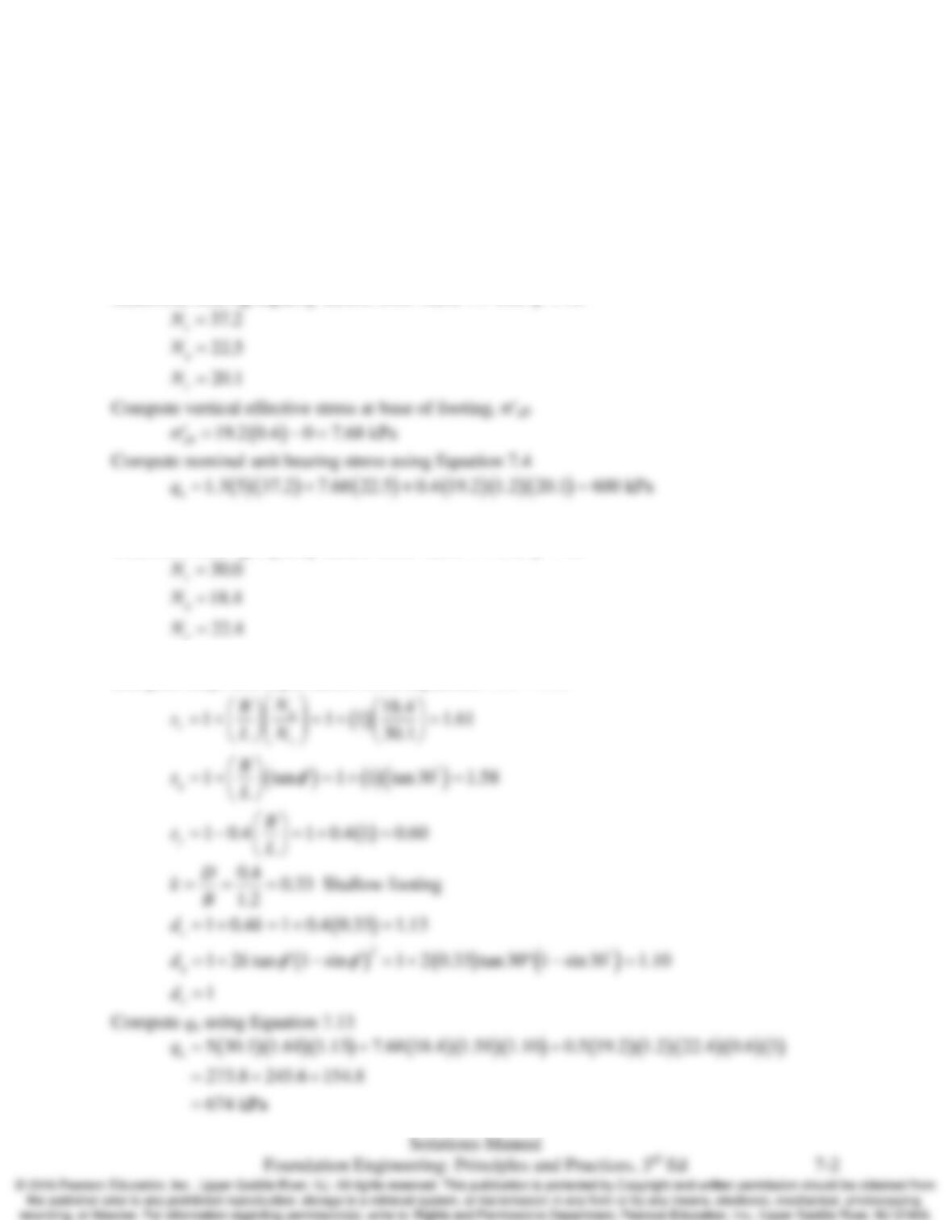
Terzaghi’s method
Determine bearing capacity factors from Table 7.1 with
φ
ʹ = 30º
Vesić’s method
Determine bearing capacity factors from Table 7.1 with
φ
ʹ = 30º
No change in σʹzD = 7.68 kPa
Compute shape and depth factors from Equations 7.14 – 7.19
7.3 A 5 ft wide, 8 ft long, 2 ft deep spread footing is underlain by a soil with the following properties:
γ= 120 lb/ft3, cʹ=100 lb/ft2,
φ
ʹ= 28°. The groundwater table is at a great depth. Using Vesić’s
method, compute the column load required to cause a bearing capacity failure.
Solution
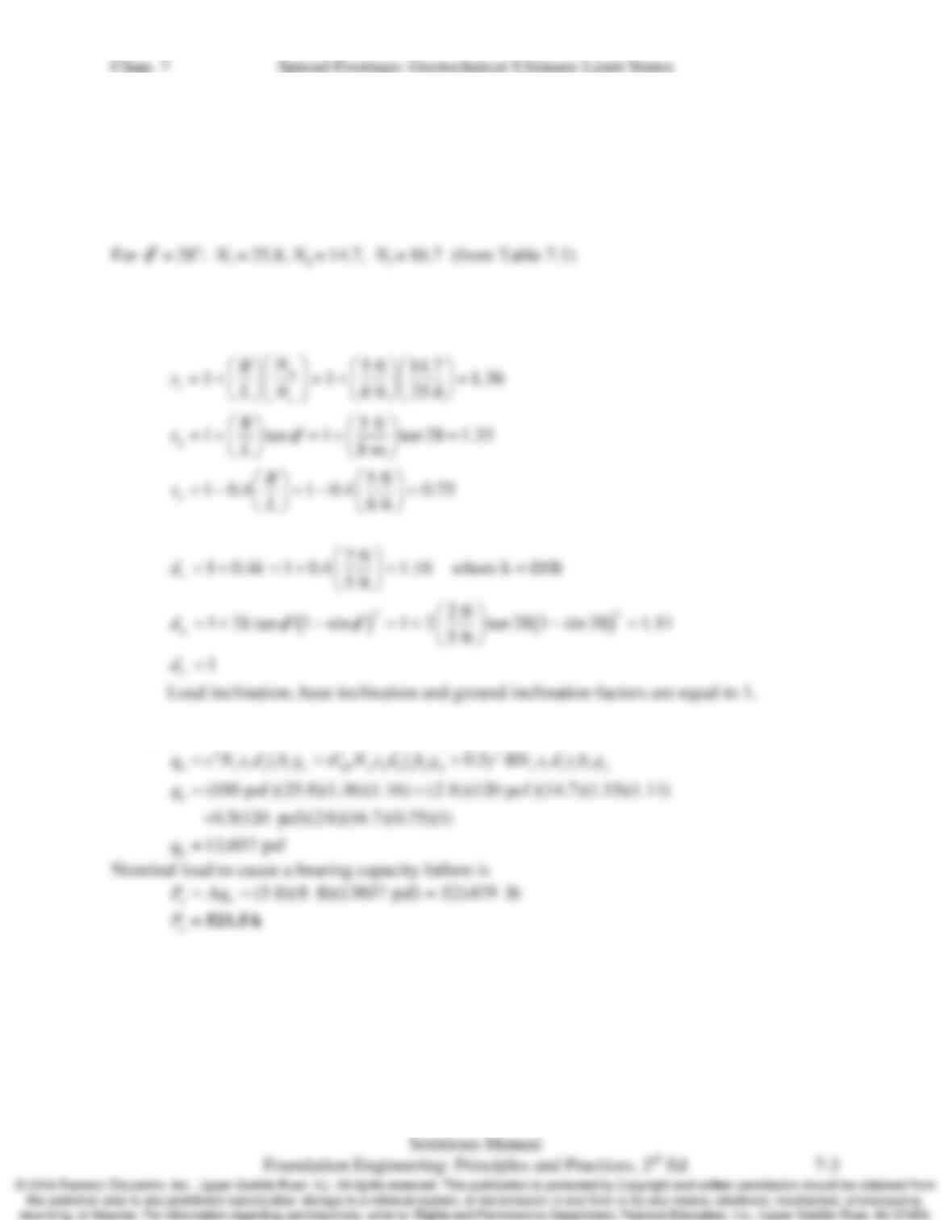
Determine shape and depth factors for Equation 7.13
Compute nominal unit bearing capacity using equation 7.13
Chap. 7 Spread Footings: Geotechnical Ultimate Limit States
7.4 A column carrying a vertical downward unfactored load of 270 k is to be supported on a 3-ft
deep square spread footing. The soil beneath this footing is an undrained clay with su= 3000
lb/ft2 and γ = 117 lb/ft3. The groundwater table is below the bottom of the footing. Using the
ASD method, compute the width B required to obtain a factor of safety of 3 against a bearing
capacity failure.
Solution
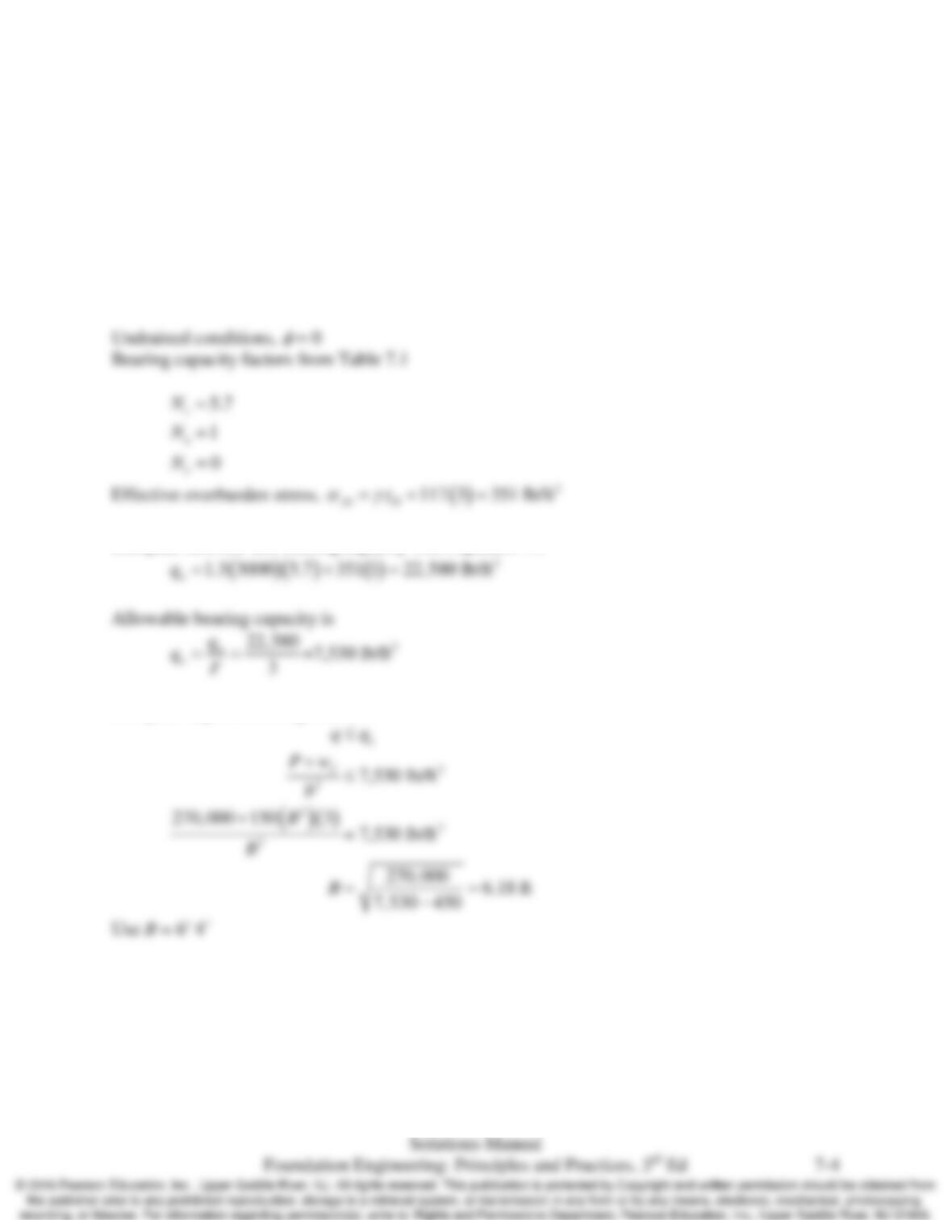
Use Terzaghi’s method
Compute nominal unit bearing capacity with Equation 7.4
Compute required footing width, B
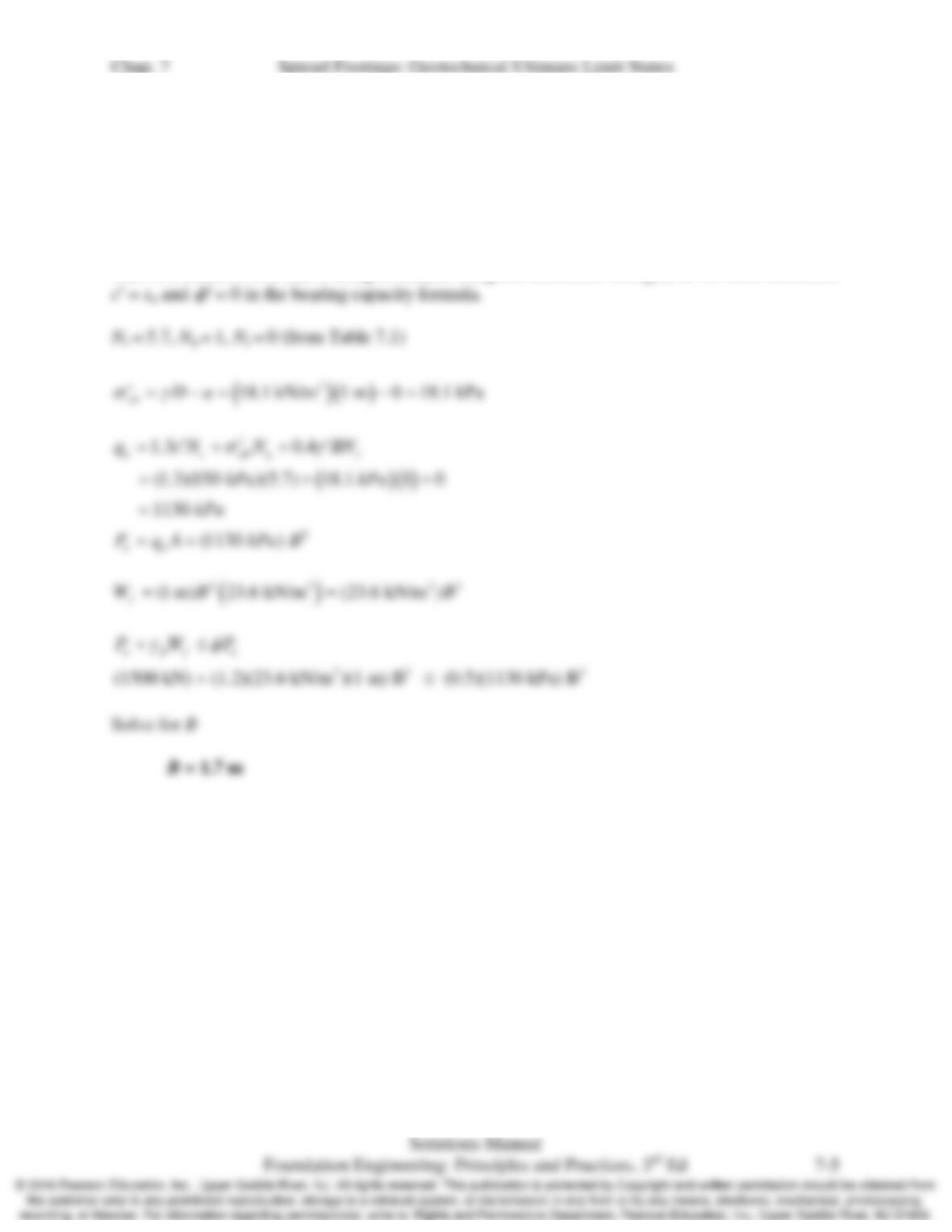
7.5 A column carrying a vertical downward ultimate factored load of 1500 kN is to be supported on
a 1m deep square spread footing. The soil beneath this footing is an undrained clay with su= 150
kPa and γ = 18.1 kN/m3. The groundwater table is below the bottom of the footing. Using the
LRFD method, compute the required width B. Assume the geotechnical resistance factor is 0.5.
Solution
This is a cohesive soil that is being evaluated using the undrained strength, so we must substitute
Chap. 7 Spread Footings: Geotechnical Ultimate Limit States
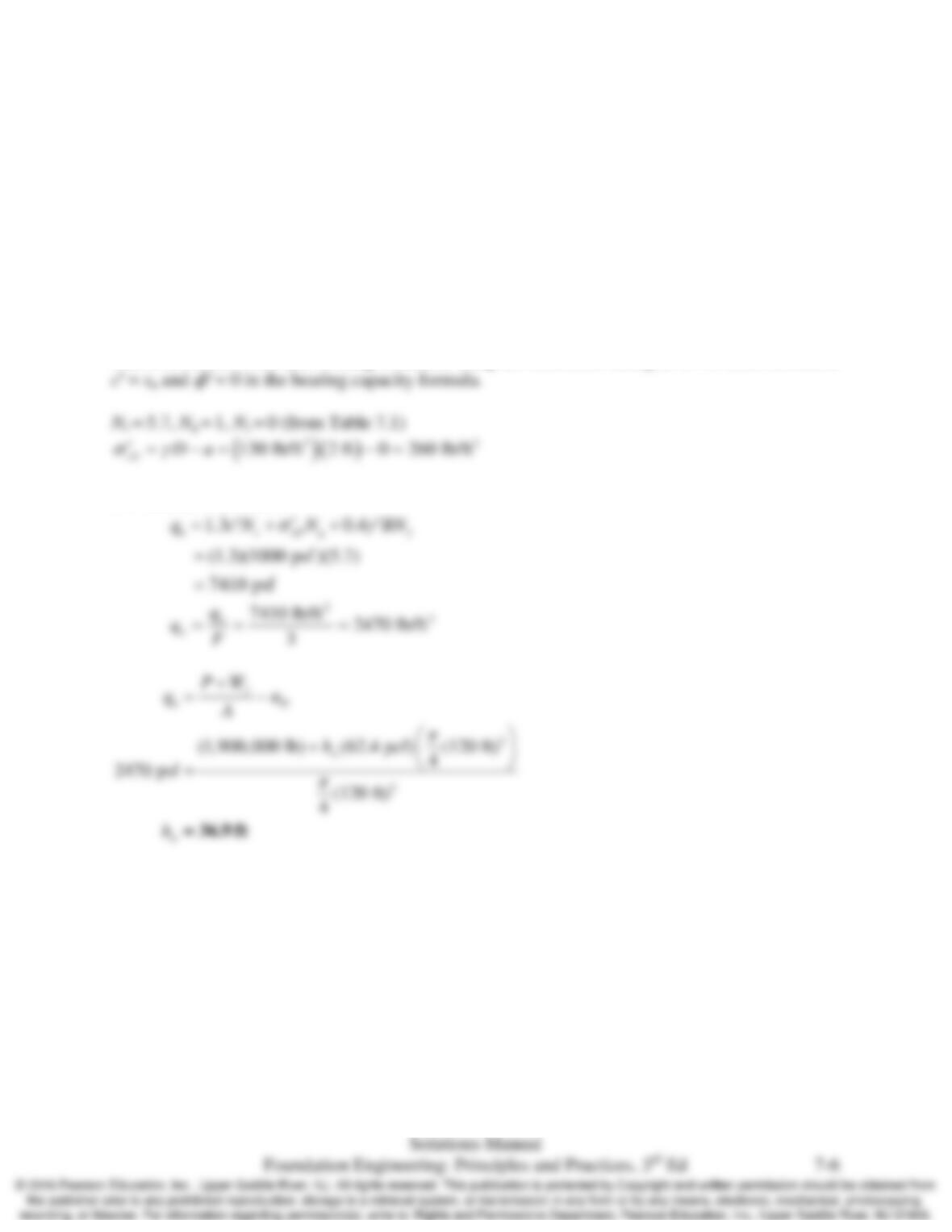
7.6 A 120-ft diameter cylindrical tank with an empty weight of 1,900,000 lb is to be built on top on a
2-ft thick compacted gravel fill with a unit weight of 130 lb/ft3. The fill will be roughly the same
diameter as the tank. This tank is to be filled with water. The underlying soil is an undrained
clay with su=1000 lb/ft2 and γ = 118 lb/ft3, and the groundwater table is at a depth of 5 ft. Using
Terzaghi’s equations, compute the maximum allowable depth of the water in the tank that will
maintain a factor of safety of 3.0 against a bearing capacity failure. Include the weight of the
gravel fill in your computations and assume the weight of the water and tank is spread uniformly
across the bottom of the tank.
Solution
This is a cohesive soil that is being evaluated using the undrained strength, so we must substitute
For circular foundation
Chap. 7 Spread Footings: Geotechnical Ultimate Limit States
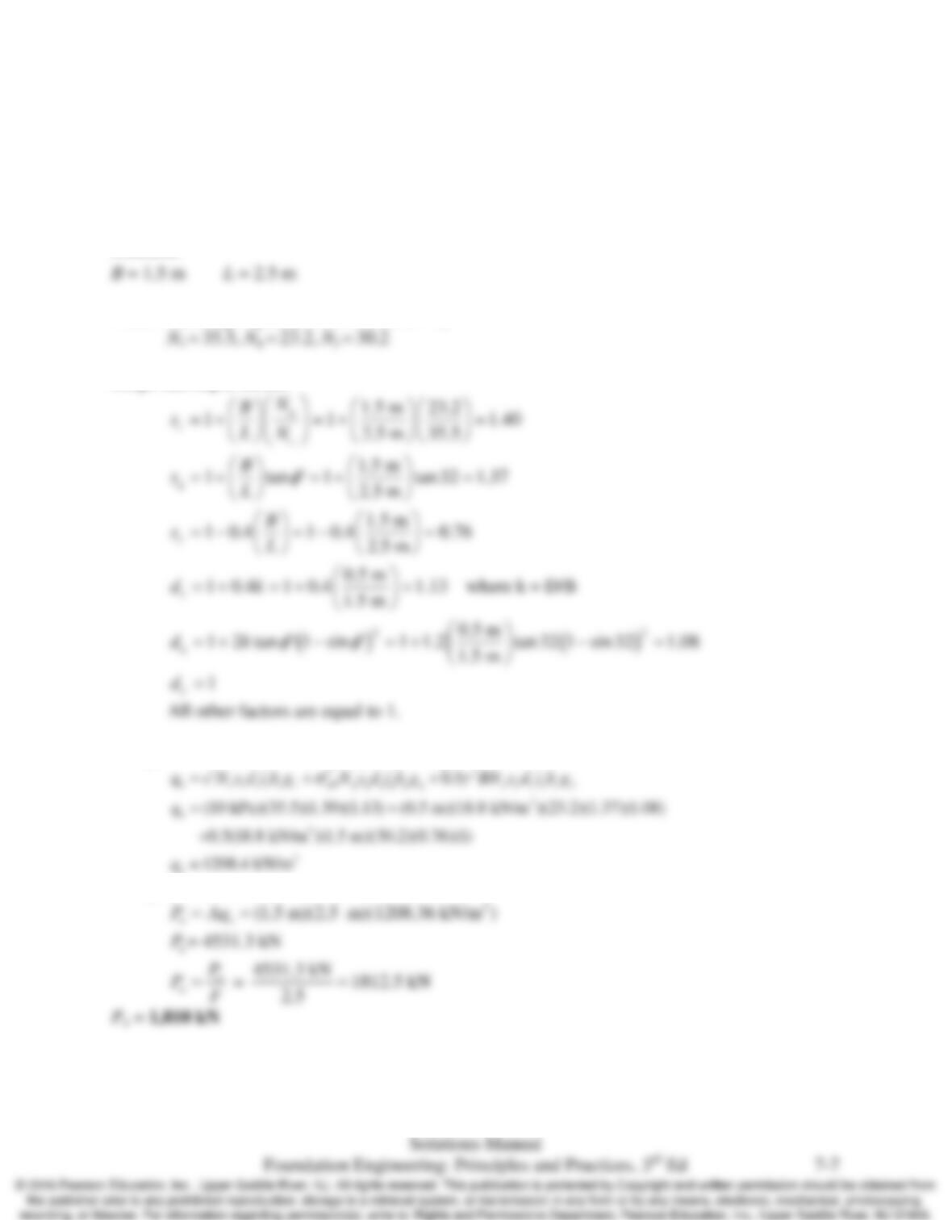
7.7 A 1.5-m wide, 2.5-m long, 0.5-m deep spread footing is underlain by a soil with cʹ = 10 kPa,
φ
ʹ = 32°, γ = 18.8 kN/m3. The groundwater table is at a great depth. Using ASD compute the
maximum unfactored load this footing can support while maintaining a factor of safety of 2.5
against a bearing capacity failure.
Solution
Vesić’s Bearing Capacity Factors (Table 7.1)
Shape and depth factors
Compute nominal unit bearing capacity using Equation 7.13
n
Compute allowable column load
Chap. 7 Spread Footings: Geotechnical Ultimate Limit States
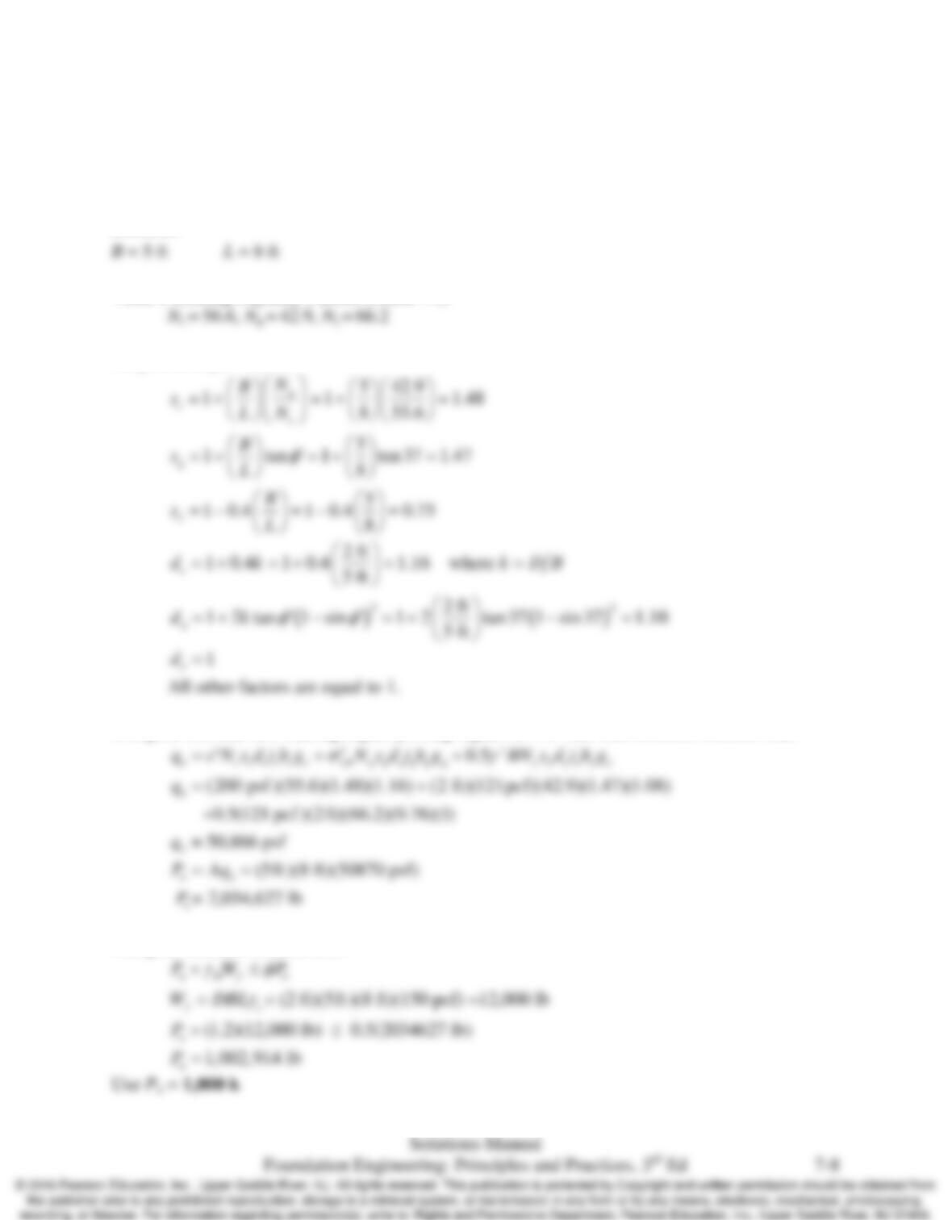
7.8 A 5–ft wide, 8-ft long, 2-ft deep spread footing is underlain by a soil with cʹ = 200 lb/ft2,
φ
ʹ = 37°,
γ = 121 lb/ft3. The groundwater table is at a great depth. Using LRFD with a resistance factor of
0.5 determine the ultimate factored load this footing can carry.
Solution
Vesić’s Bearing Capacity Factors (Table 7.1)
Shape and depth factors
Compute nominal unit bearing capacity using Equation 7.13 and then nominal column load.
Compute ultimate column load
Chap. 7 Spread Footings: Geotechnical Ultimate Limit States
7.9 A bearing wall carries a total unfactored load 220 kN/m. It is to be supported on a 400-mm deep
continuous footing. The underlying soils are medium sands with cʹ = 0,
φ
ʹ = 37°, γ = 19.2 kN/m3.
The groundwater table is at a great depth. Using ASD, compute the minimum footing width
required to maintain a factor of safety of at least 2 against a bearing capacity failure. Express
your answer to the nearest 100 mm.
Solution
Use Terzaghi’s method
Bearing capacity factors from Table 7.1
Compute nominal unit bearing capacity with Equation 7.5
Allowable bearing capacity is
Compute required footing width, B
Chap. 7 Spread Footings: Geotechnical Ultimate Limit States
7.10 A bearing wall carries a factored ultimate vertical load of 67 k/ft. After the footing in Problem
7.9 was built, the groundwater table rose to a depth of 0.5 m below the ground surface. Compute
the new factor of safety against a bearing capacity failure. Compare it with the original design
value of 2 and explain why it is different.
Solution
Bearing capacity factors and overburden stress do not change
Compute
γ
′
for ground water Case 2 conditions using Equation 7.34
Compute the nominal unit bearing capacity using γʹ and weight of the footing
Compute current factor of safety
Chap. 7 Spread Footings: Geotechnical Ultimate Limit States
7.11 A bearing wall carries a factored ultimate vertical load of 67 k/ft. It is to be supported on a 18-in
deep continuous footing. The underlying soils are medium sands with cʹ = 0,
φ
ʹ = 37°, γ = 124
lb/ft3. The groundwater table is at a great depth. Using LRFD, with a resistance factor 0.45,
compute the minimum footing width required. Express your answer to the nearest 4 inches.
Solution
Compute nominal bearing capacity using Terzaghi’s theory (Equation 7.5)
Compute required footing width
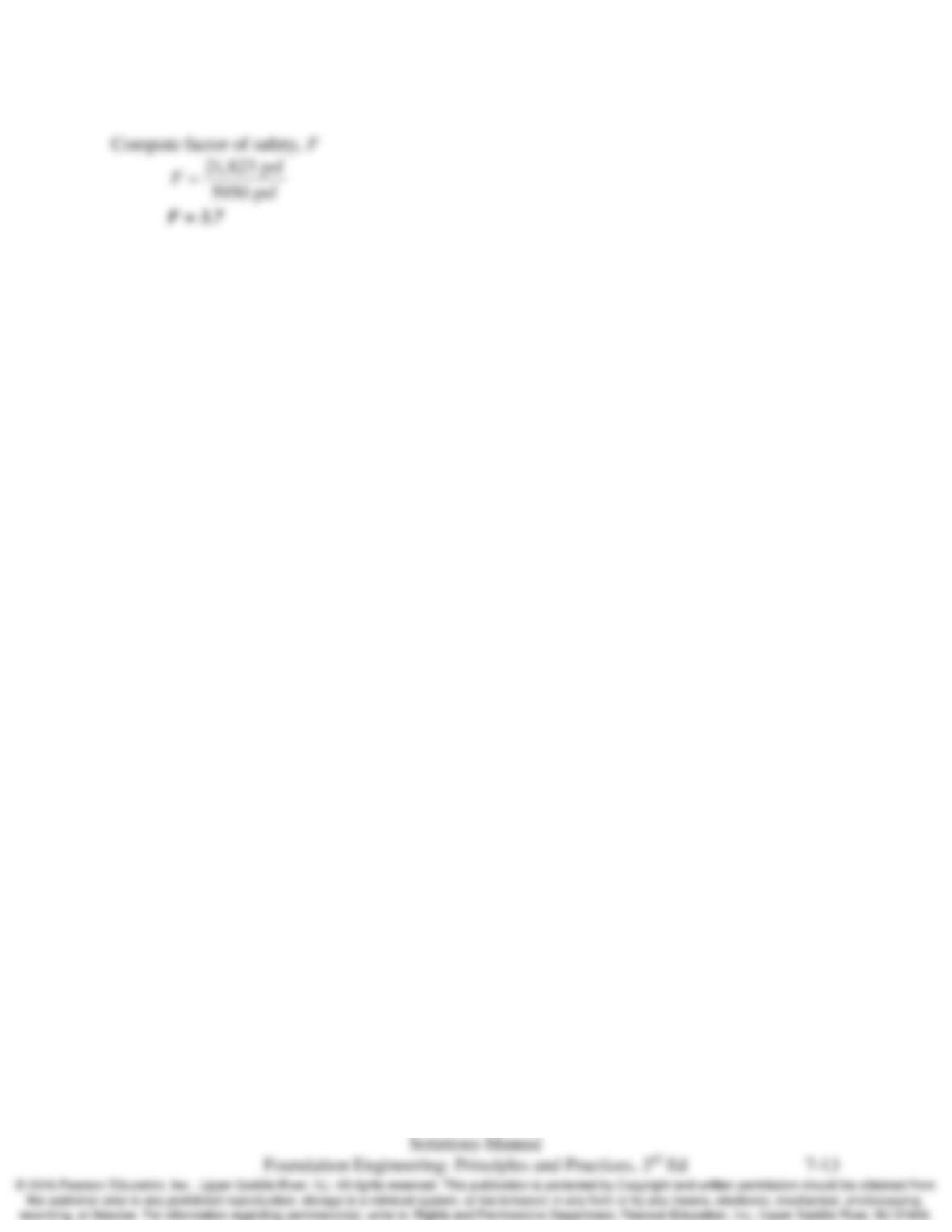
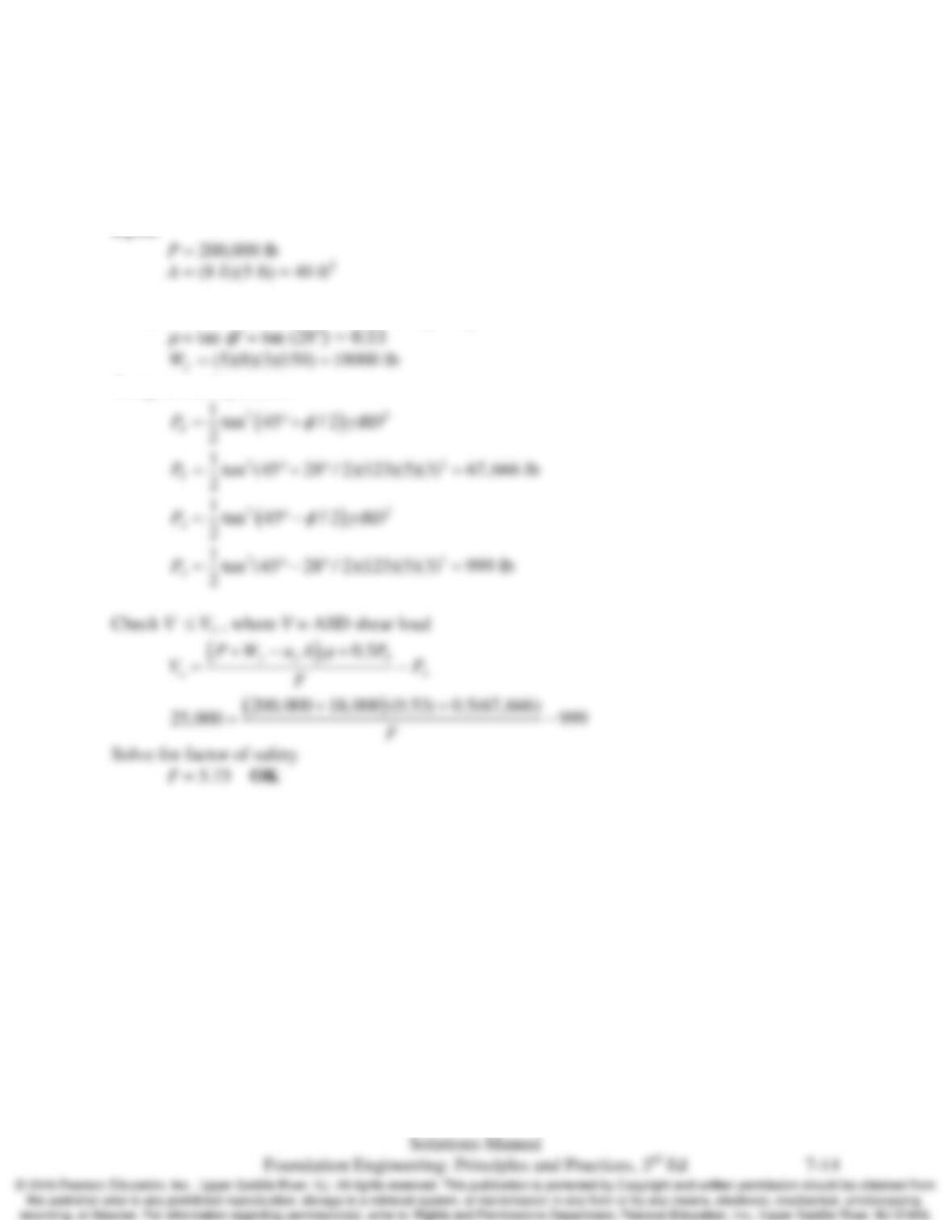
7.12 A 5–ft wide, 8-ft long, 3-ft deep footing supports a downward load of 200 k and a horizontal
shear load of 25 k. The shear load acts parallel to the 8–ft dimension. The underlying soils have
cʹ = 220 lb/ft2,
φ
ʹ = 28°, γ = 123 lb/ft3. Using a total stress analysis, compute the factor of safety
against a bearing capacity failure.
Solution
Because footing is rectangular, must use Vesić’s method.
Shape factors
Depth factors
Compute nominal bearing capacity with Equation 7.13
Chap. 7 Spread Footings: Geotechnical Ultimate Limit States
Chap. 7 Spread Footings: Geotechnical Ultimate Limit States
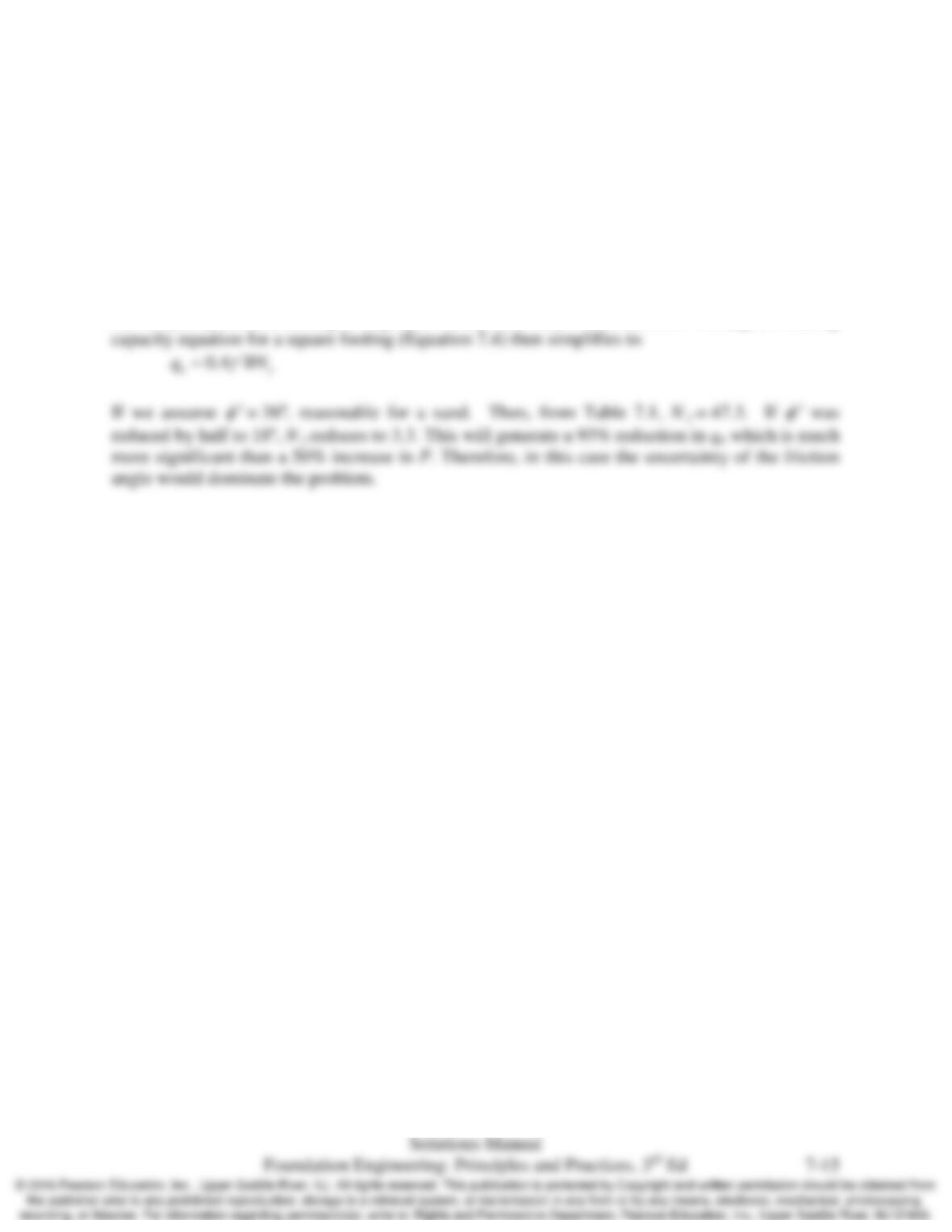
7.13 For the footing describe in Problem 7.12, determine the factor of safety against sliding. Is the
factor of safety adequate?
Solution
Inputs
Compute coefficient of friction and footing weight
Compute earth pressures
Chap. 7 Spread Footings: Geotechnical Ultimate Limit States
7.14 A spread footing supported on a sandy soil has been designed using ASD to support a certain
column load with a factor of safety of 2.5 against a bearing capacity failure. However, there is
some uncertainty in both the column load, P, and the friction angle,
φ
. Which would have the
greatest impact on the actual factor of safety: An actual P that is twice the design value, or
actual
φ
that is half the design value? Use bearing capacity computations with reasonable
assumed values to demonstrate the reason for your response.
Solution
For simplicity assume footing is at ground surface and sand is cohesionless. Terzaghi’s bearing