Chapter 7
7.1 a 0, 1, 2, …
b Yes, we can identify the first value (0), the second (1), and so on.
7.2 a any value between 0 and several hundred miles
b No, because we cannot identify the second value or any other value larger than 0.
7.3 a The values in cents are 0 ,1 ,2, …
b Yes, because we can identify the first ,second, etc.
7.4 a 0, 1, 2, …, 100
b Yes.
7.5 a No the sum of probabilities is not equal to 1.
7.6 P(x) = 1/6 for x = 1, 2, 3, 4, 5, and 6
7.7 a x P(x)
0 1218/101,501 = .012
1 32,379/101,501 = .319
2 37,961/101,501 = .374
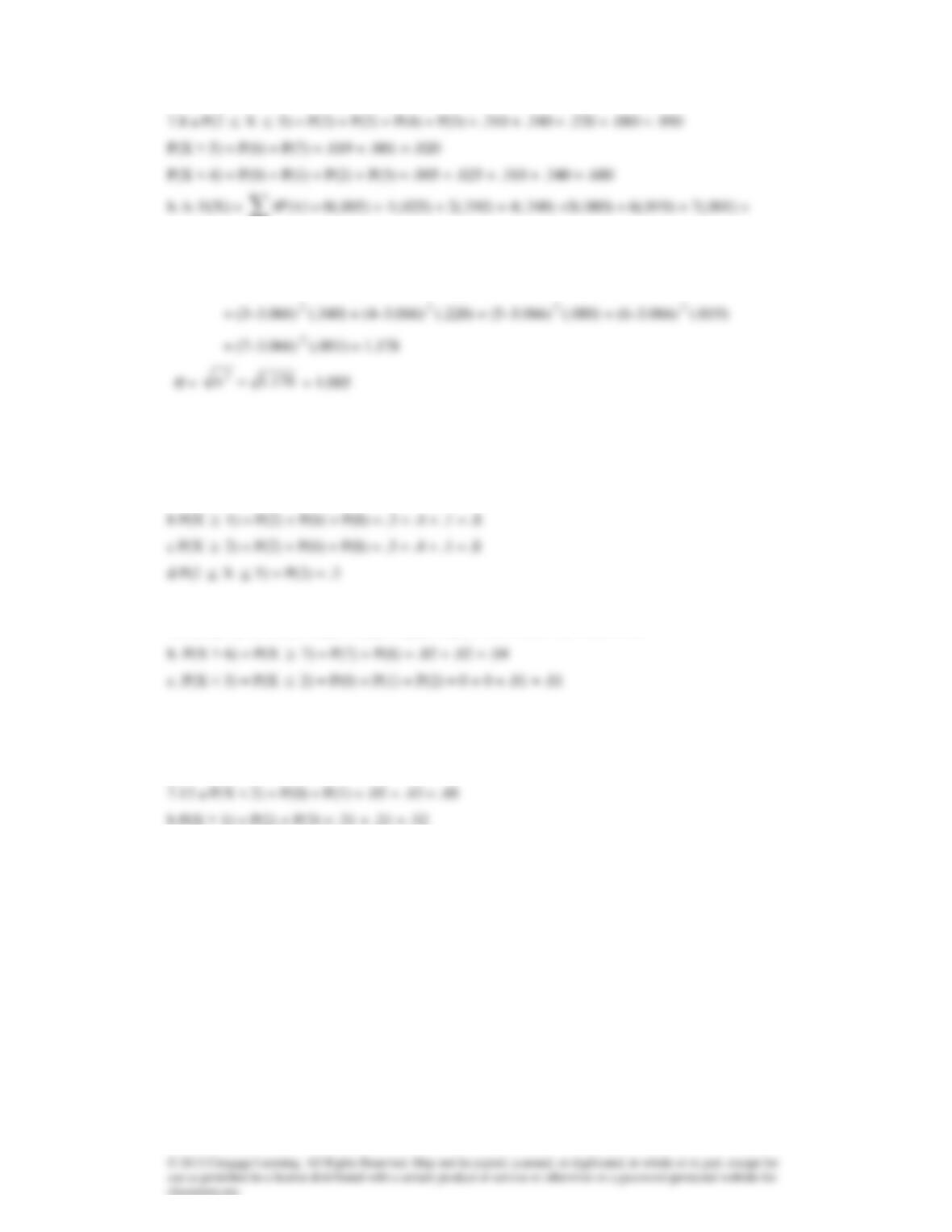
3.066
c.
2
= V(X) =
− )x(P)x( 2
= (0–3.066)
2
(.005) + (1–3.066)
2
(.025) + (2–3.066)
2
(.310)
2
2
2
7.9 P(0) = P(1) = P(2) = . . . = P(10) = 1/11 = .091
7.10 a P(X > 0) = P(2) + P(6) + P(8) = .3 + .4 + .1 = .8
7.11a P(3
X
6) = P(3) + P(4) + P(5) + P(6) = .04 + .28+ .42 + .21 = .95
7.12 P(Losing 6 in a row) =
6
5.
= .0156
7.14
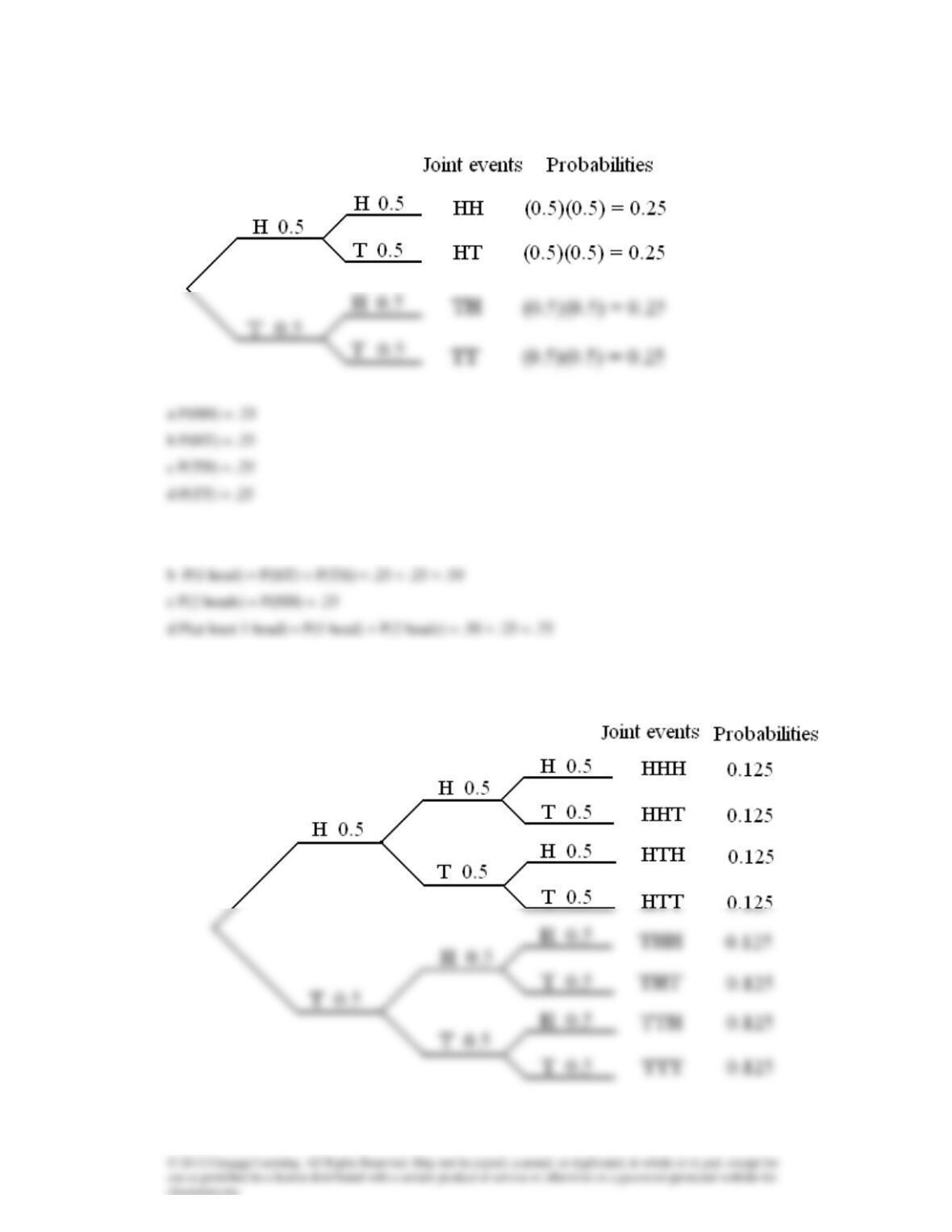
7.15 a P(0 heads) = P(TT) = .25
7.16
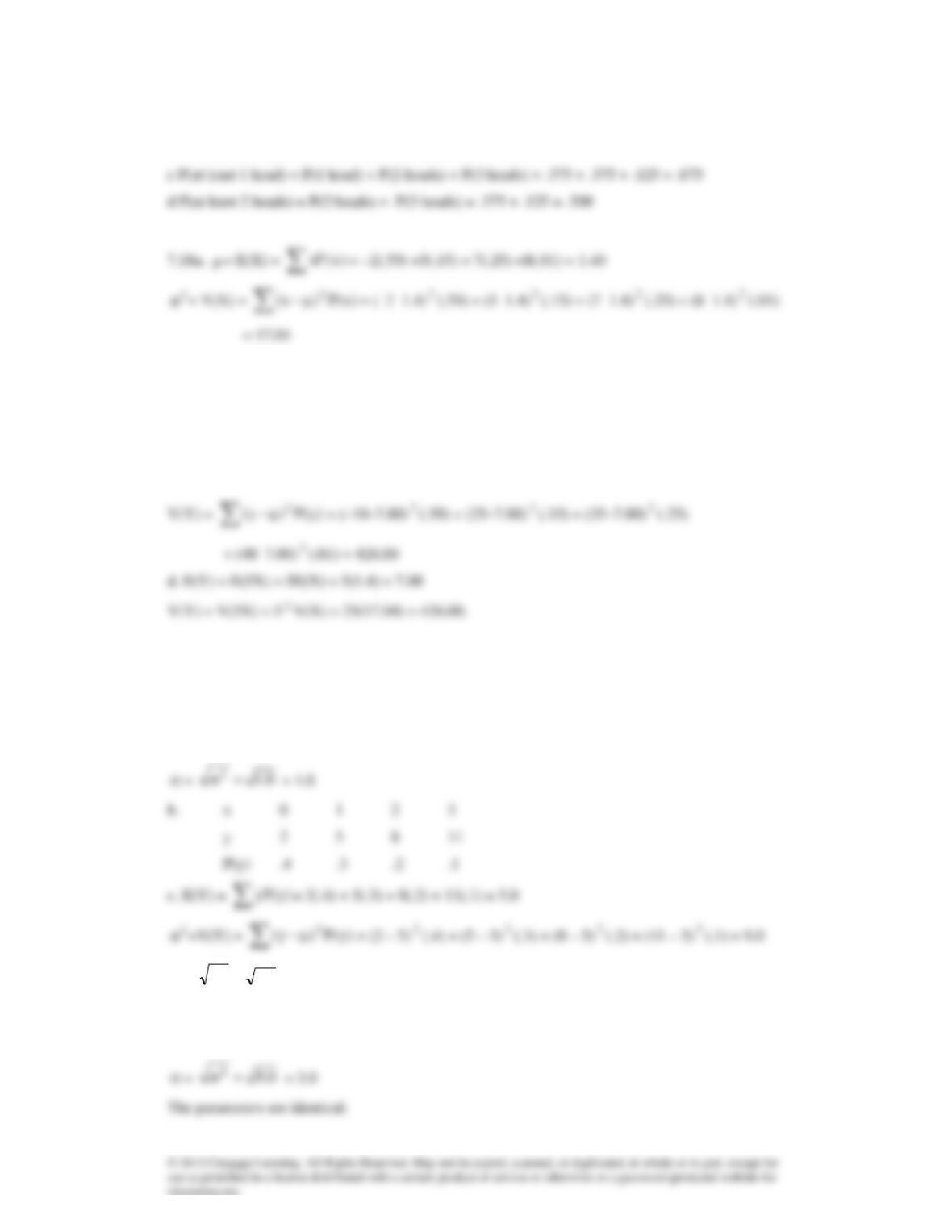
7.17 a P(2 heads) = P(HHT) + P(HTH) + P(THH) = .125 + .125 + .125 = .375
b P(1 heads) = P(HTT) + P(THT) = P(TTH) = .125 + .125 + .125 = .375
2
2
2
2
2
b. x –2 5 7 8
y –10 25 35 40
P(y) .59 .15 .25 .01
c. E(Y) =
)y(yP
= –10(.59) + 25(.15) + 35(.25) + 40(.01) = 7.00
2
2
2
2
2
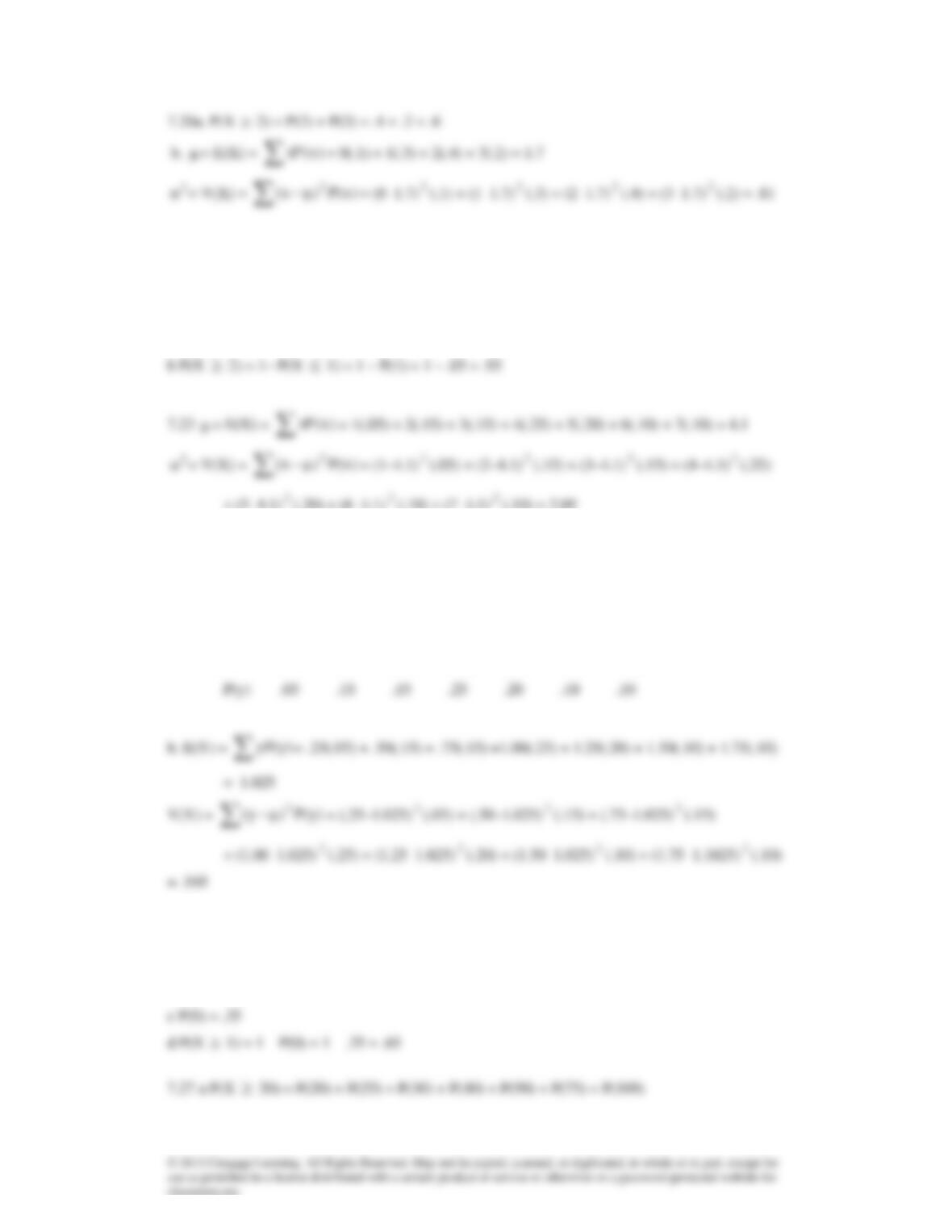
7.19a
= E(X) =
)x(xP
= 0(.4) + 1(.3) + 2(.2) + 3(.1) = 1.0
2
= V(X) =
− )x(P)x( 2
= (0–1.0)
2
(.4) + (1–1.0)
2
(.3) + (2–1.0)
2
(.2) + (3–1.0)
2
(.1)
= 1.0
)y(yP
2
2
2
2
2
=
0.9
2=
= 3.0
d. E(Y) = E(3X + 2) = 3E(X) + 2 = 3(1) + 2 = 5.0
2
= V(Y) = V(3X + 2) = V(3X) = 3
2
V(X) = 9(1) = 9.0.
2
2
2
7.21 E(Profit) = E(5X) = 3E(X) = 3(1.7) = 5.1
V(Profit) = V(3X) = 3
2
V(X) = 9(.81) = 7.29
7.22 a P(X > 4) = P(5) + P(6) + P(7) = .20 + .10 + .10 = .40
2
2
2
2
7.24 Y = .25X; E(Y) = .25E(X) = .25(4.1) = 1.025
V(Y) = V(.25X) = (.25)
2
(2.69) = .168
7.25 a. x 1 2 3 4 5 6 7
y .25 .50 .75 1.00 1.25 1.50 1.75
2
2
2
2
2
c. The answers are identical.
7.26 a P(4) = .06
b P(8) = 0
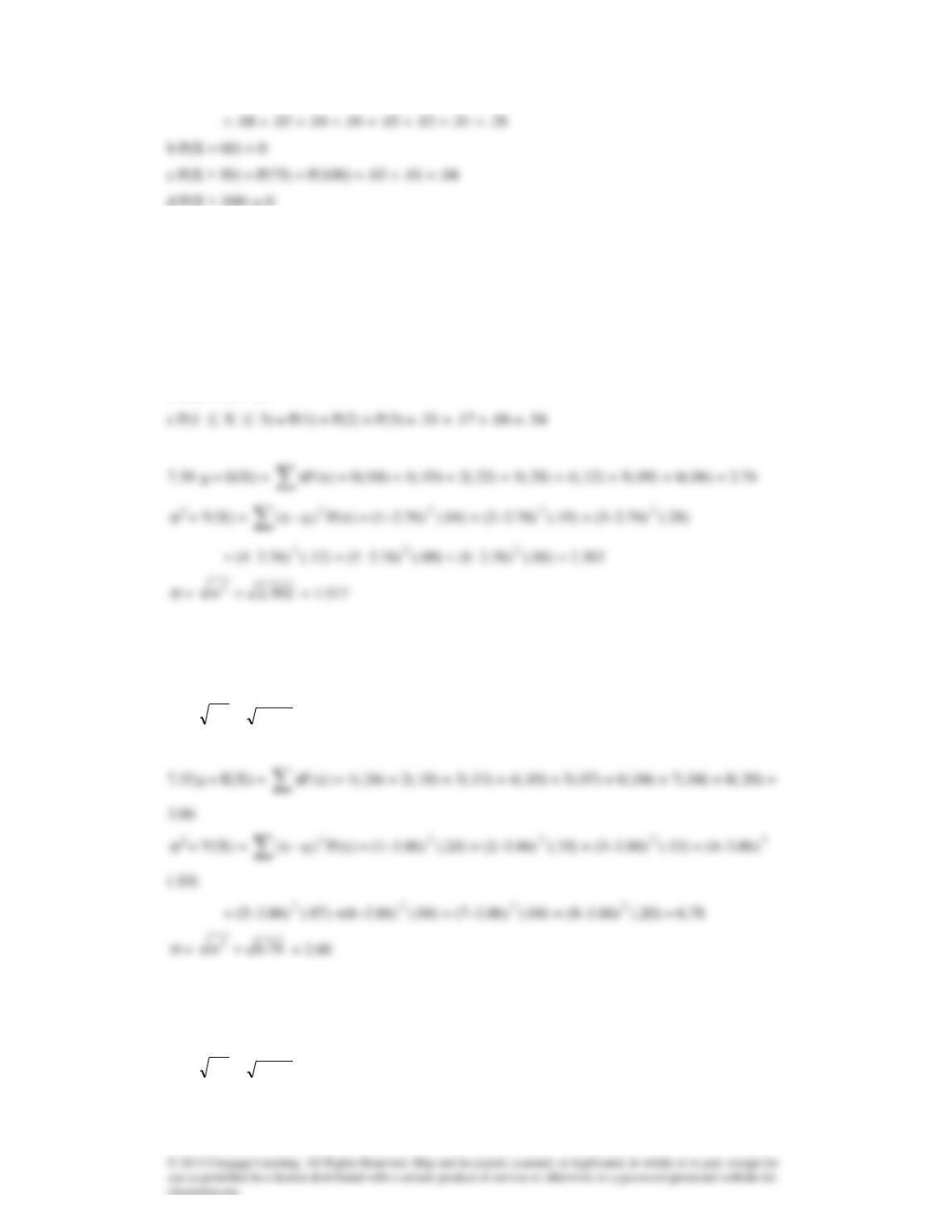
7.28 a P(X = 3) = P(3) = .21
b P(X
5) = P(5) + P(6) + P(7) + P(8) = .12 + .08 + .06 + .05 = .31
c P(5
X
7) = P(5) + P(6) + P(7) = .12 + .08 + .06 = .26
7.29 a P(X > 1) = P(2) + P(3) + P(4) = .17 + .06 + .01 = .24
b P(X = 0) = .45
2
2=
7.31 Y = 10X; E(Y) = E(10X) = 10E(X) = 10(2.76) = 27.6
V(Y) = V(10X) = 10
2
V(X) =100(2.302) = 230.2
=
2.230
2=
= 15.17
2
7.33 Revenue = 2.50X; E(Revenue) = E(2.50X) = 2.50E(X) = 2.50(3.86) = 9.65
V(Revenue) = V(2.50X) = 2.50
2
(V(X) = 6.25(6.78) = 42.38
=
38.42
2=
= 6.51
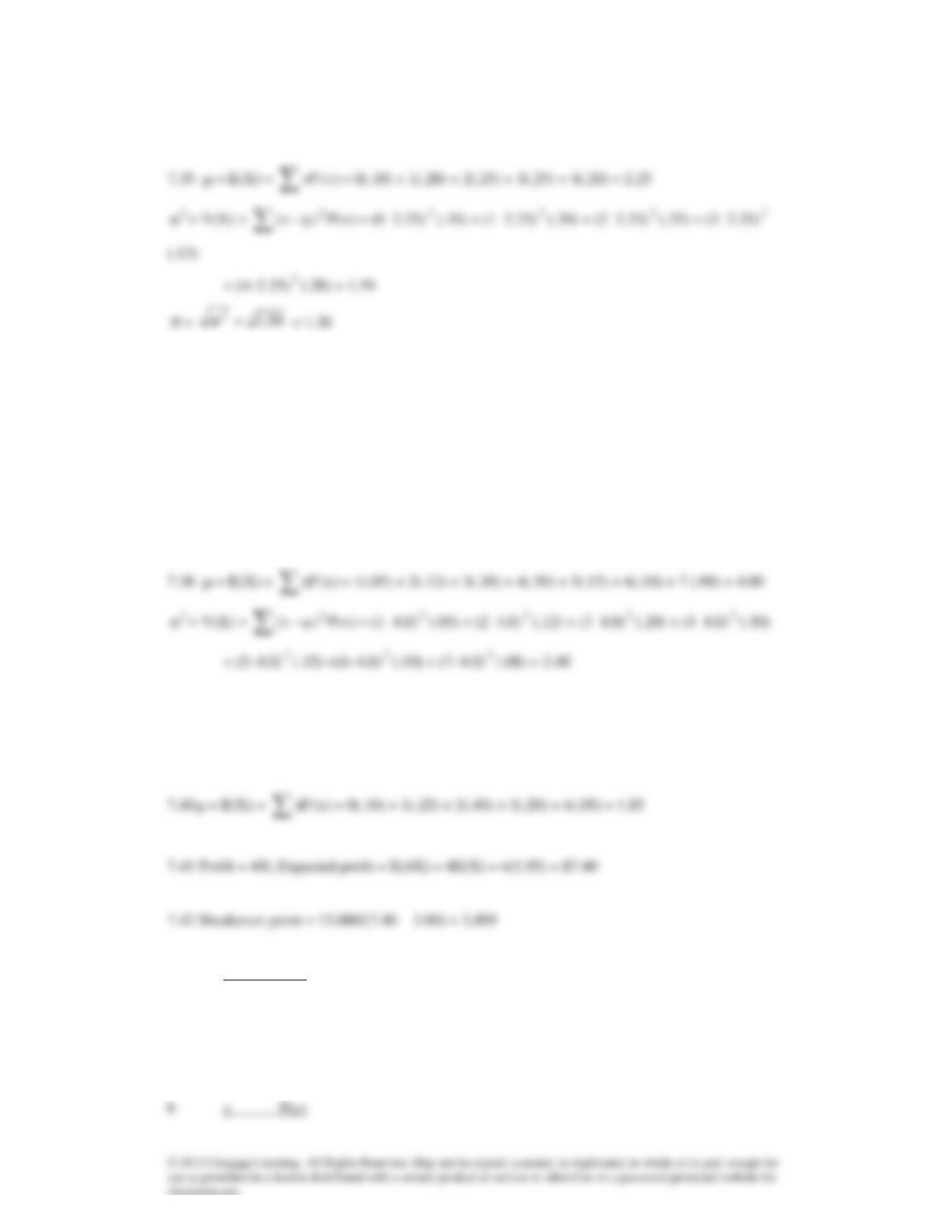
7.34 E(Value of coin) = 400(.40) + 900(.30) + 100(.30) = 460. Take the $500.
)x(xP
2
2
2
2
7.36 E(damage costs) = .01(400) + .02(200) + .10(100) + .87(0) = 18. The owner should pay up to
$18 for the device.
7.37 E(X) =
)x(xP
= 1,000,000(1/10,000,000) + 200,000(1/1,000,000) + 50,000(1/500,000)
+ 10,000(1/50,000) + 1,000(1/10,000) = .1 + .2 + .1 + .2 + .1 = .7
Expected payoff = 70 cents.
)x(xP
2
2
2
2
7.39 Y = .25X; E(Y) = E(.25X) = .25E(X) = .25(4.0) = 1.0
V(Y) = V(.25X) = (.25)
2
V(X) =.0625(2.40) = .15
7.43 a x P(x)
1 .6
2 .4
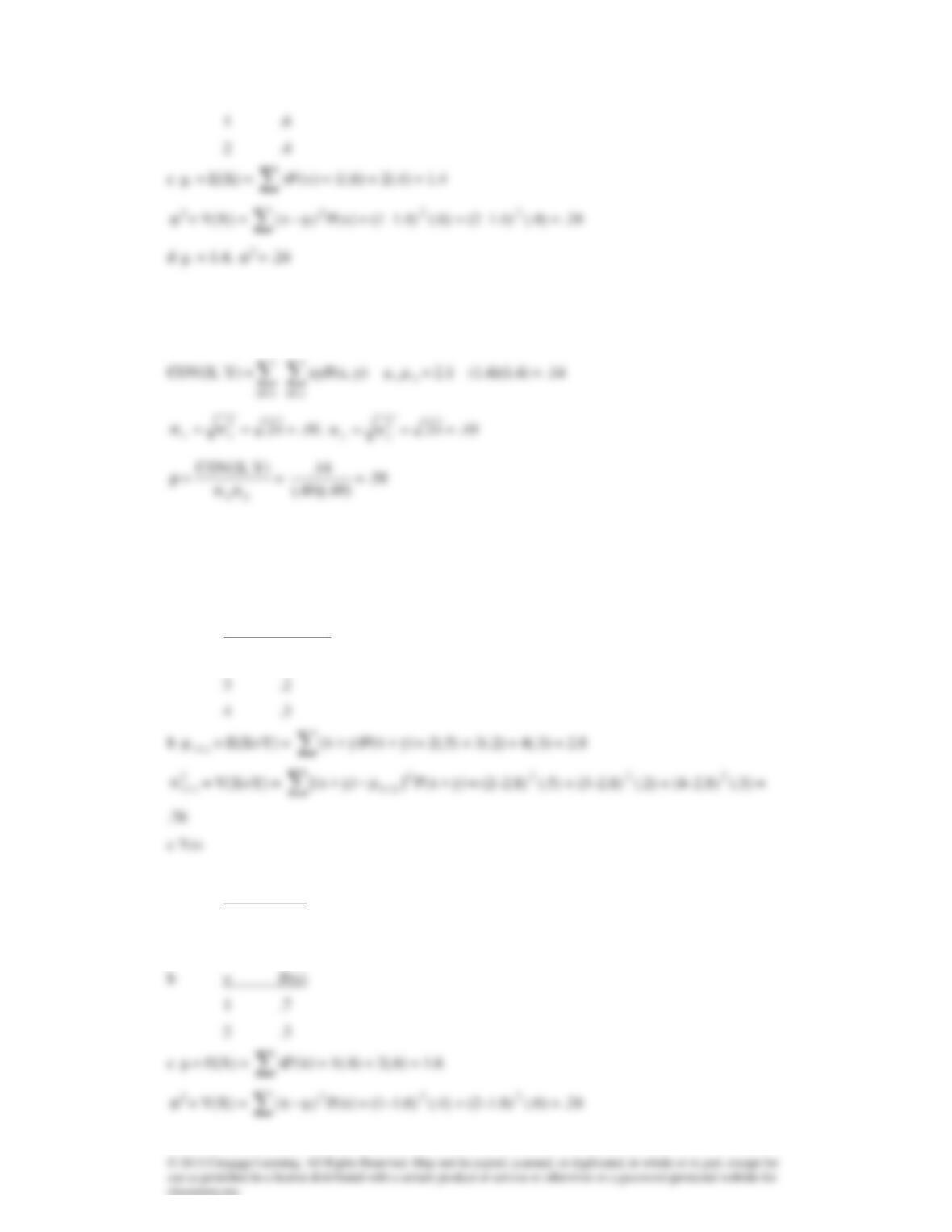
7.44 a
yallxall
)y,x(xyP
= (1)(1)(.5) + (1)(2)(.1) + (2)(1)(.1) + (2)(2)(.3) = 2.1
7.45 E(X + Y) = E(X) + E(Y) = 1.4 + 1.4 = 2.8
V(X + Y) = V(X) + V(Y) + 2COV(X, Y) = .24 + .24 + 2(.14) = .76
7.46 a x + y P(x + y)
2 .5
7.47 a x P(x)
1 .4
2 .6
d
= E(Y) =
)y(yP
= 1(.7) + 2(.3) = 1.3
2
= V(Y) =
− )y(P)y( 2
= (1–1.3)
2
(.7) + (2–1.3)
2
(.3) = .21
24.
2
xx ==
= .49,
21.
2
yy ==
= .46
yx
)Y,X(COV
=
=
)46)(.49(.
0
= 0
7.49 E(X + Y) = E(X) + E(Y) = 1.6 + 1.3 = 2.9
V(X + Y) = V(X) + V(Y) + 2COV(X, Y) = .24 + .21 + 2(0) = .45
2
2
2
7.51 a x P(x) y P(y)
1 .7 1 .6
2 .2 2 .4
2
2
2
2
2
− )y(P)y( 2
2
2
yallxall
)y,x(xyP
= (1)(1)(.42) + (1)(2)(.28) + (2)(1)(.12) + (2)(2)(.08) + (3)(1)(.06) +
(3)(2)(.04) = 1.96
c x + y P(x + y)
2 .42
7.52 x
y 0 1 2
7.53 x
y 0 1
1 .04 .16
7.54 a Refrigerators, x P(x)
0 .22
1 .49
2 .29
b Stoves, y P(y)
0 .34
d
y
= E(Y) =
)y(yP
= 0(.34) + 1(.39) + 2(.27) = .93
2
= V(Y) =
− )y(P)y( 2
= (0–.93)
2
(.34) + (1–.93)
2
(.39) + (2–.93)
2
(.27) = .605
505.
2
xx ==
7.55 a Bottles, x P(x)
0 .72
1 .28
b Cartons, y P(y)
0 .81
1 .19
c
x
= E(X) =
)x(xP
= 0(.72) + 1(.28) = .28
2
2
2
y
)y(yP
2
2
2
COV(X, Y) =
y_allx_all
)y,x(xyP
–
yx
= .100 – (.28)(.19) = .0468
202.
2
xx ==
= .449,
154.
2
yy ==
= .392
7.57
( )
=)X(EXE ii
= 18 + 12 + 27 + 8 = 65
( )
=)X(VXV ii
= 8 + 5 + 6 + 2 = 21
( )
=)X(VXV ii
( )
=)X(EXE ii
7.61 The expected value does not change. The standard deviation decreases.
7.62 E(Rp) = w1E(R1) + w2E(R2) = (.30)(.12) + (.70)(.25) = .2110
a. V(Rp) =
2
1
w
2
1
+
2
2
w
2
2
+ 2
1
w
2
w
1
2
=
)15)(.02)(.5)(.70)(.30(.2)15(.)70(.)02(.)30(. 2222 ++
= .0117
0117.
p
R=
= .1081
2
1
w
2
2
w
0113.
p
R=
2
1
w
2
2
w
1
2
0111.
p
R=
= .1052
7.63 a She should choose stock 2 because its expected value is higher.
b. She should choose stock 1 because its standard deviation is smaller.
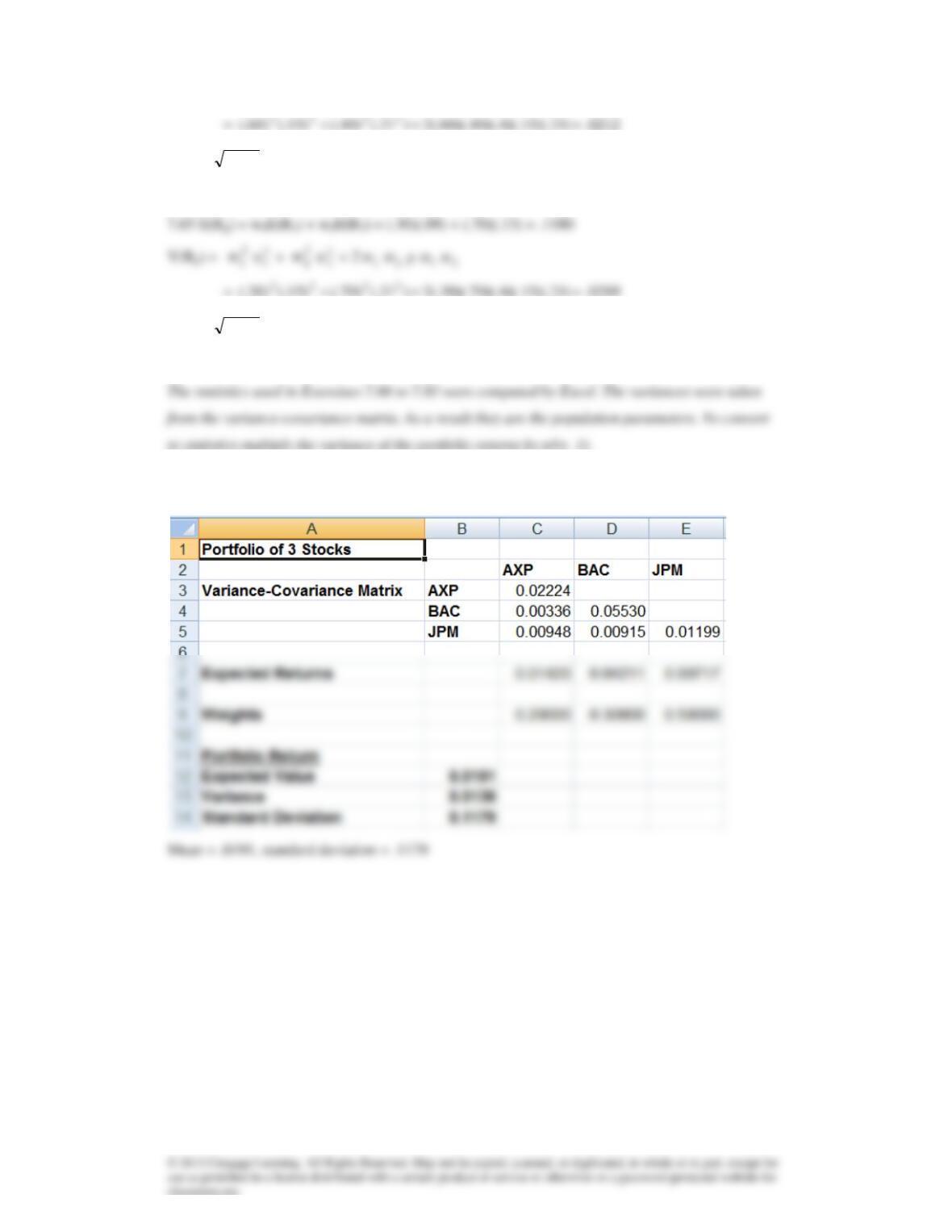
0212.
p
R=
= .1456
0289.
p
R=
= .1700
7.66a
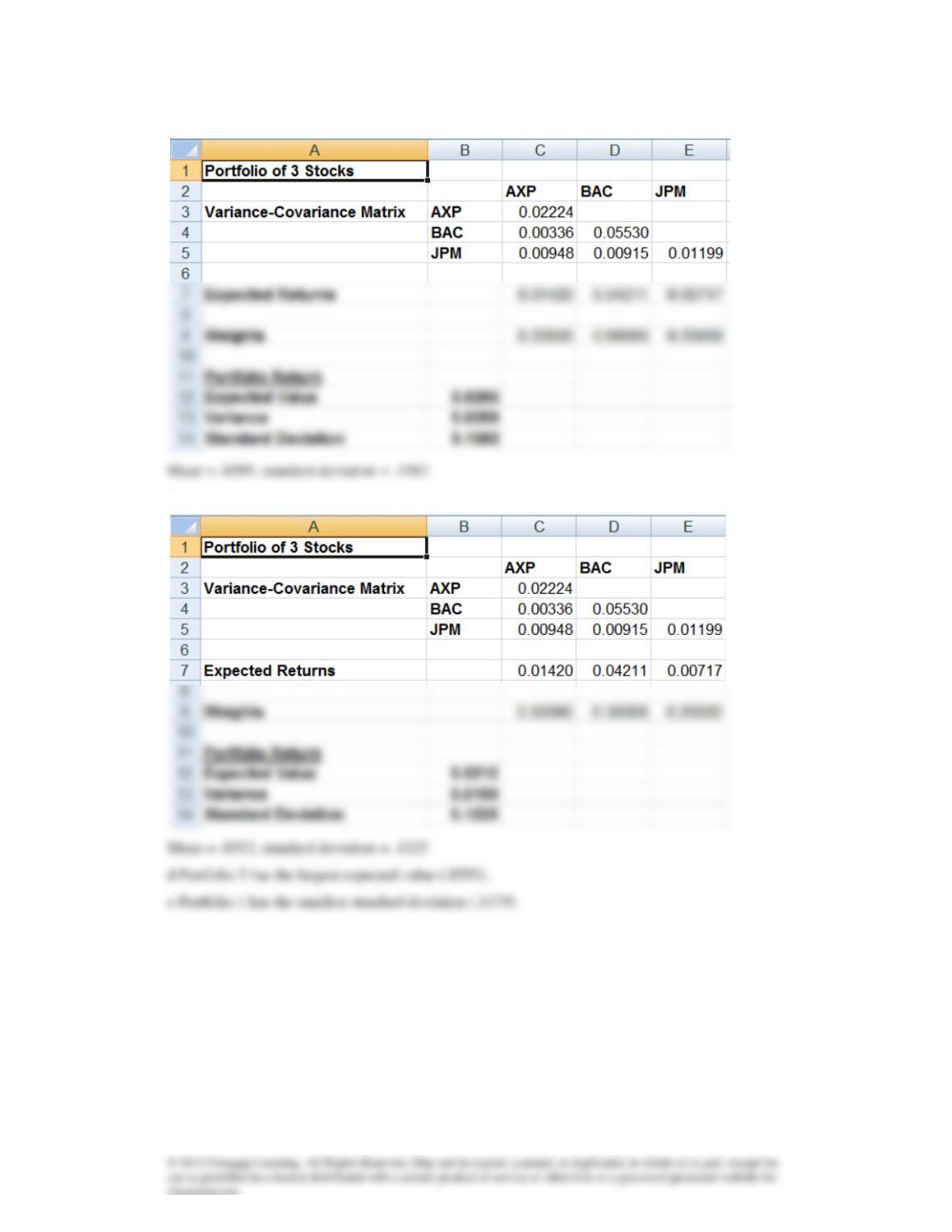
b
c
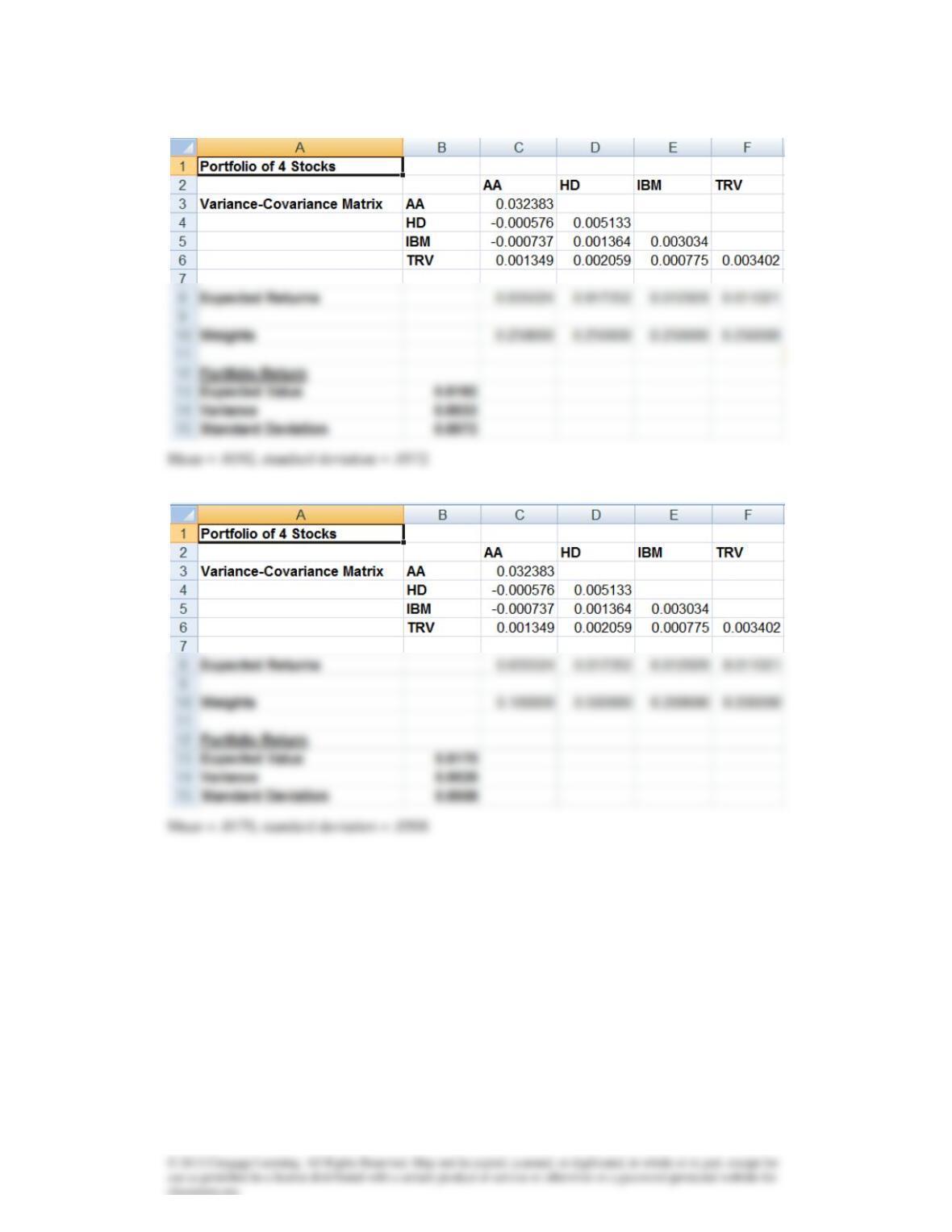
7.67a
b
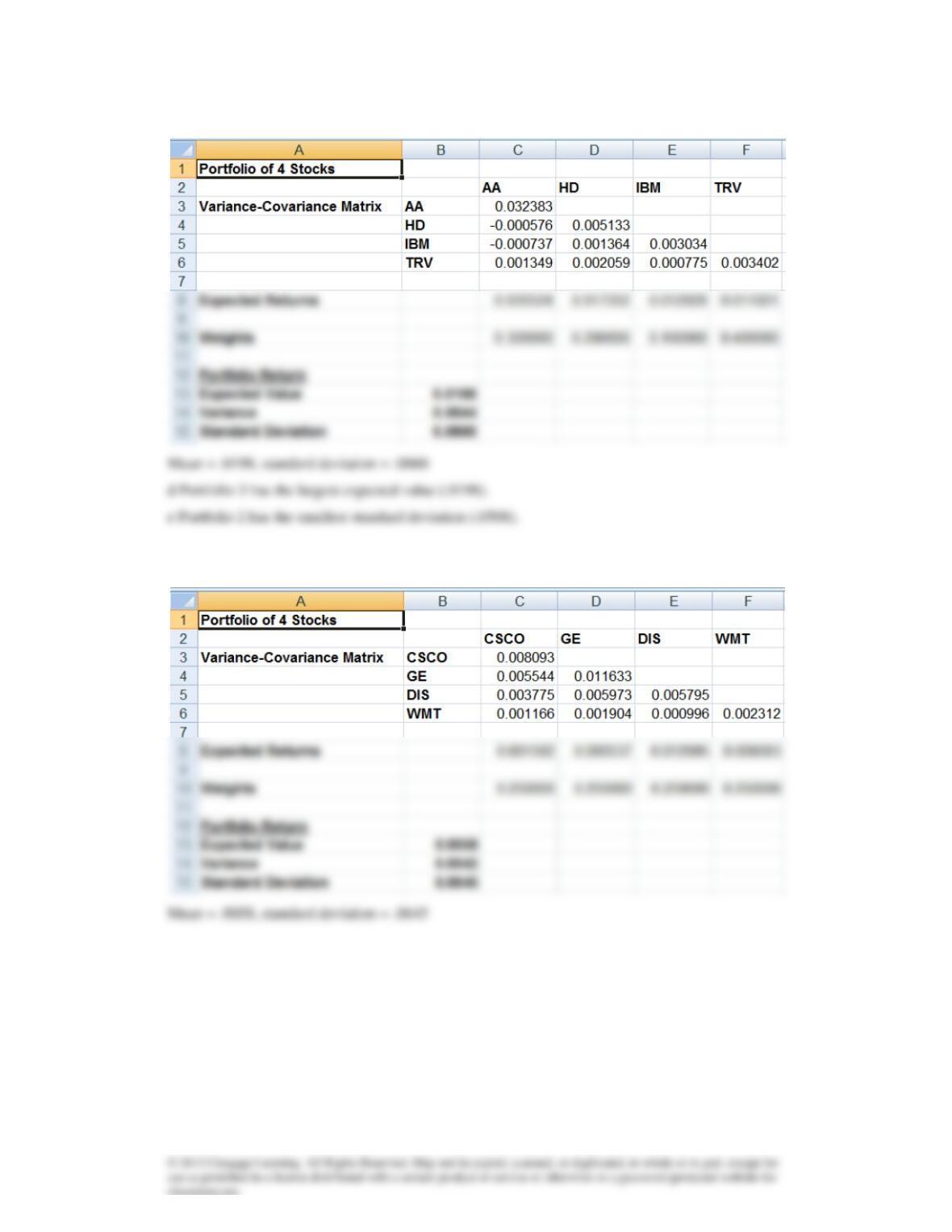
c
7.68a
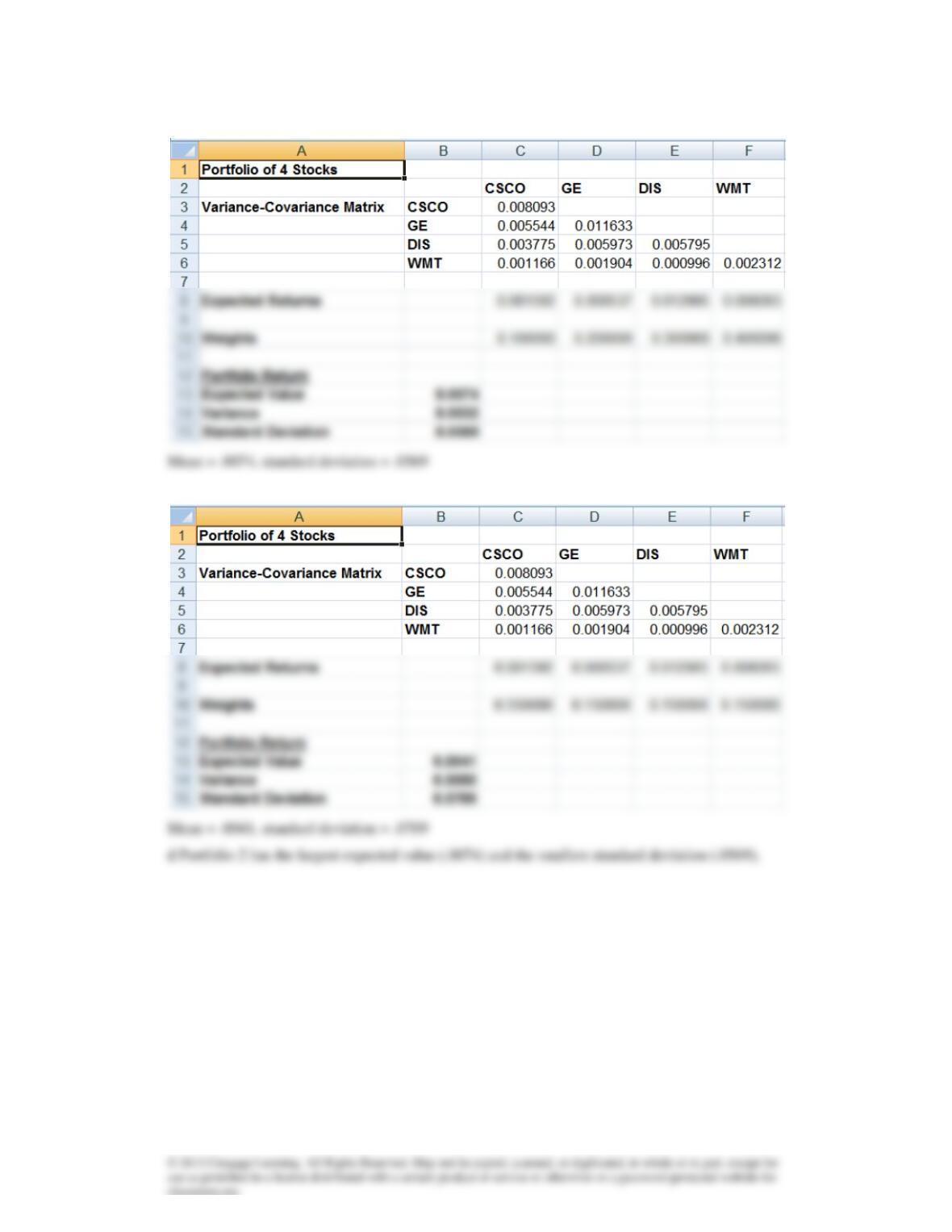
b
c
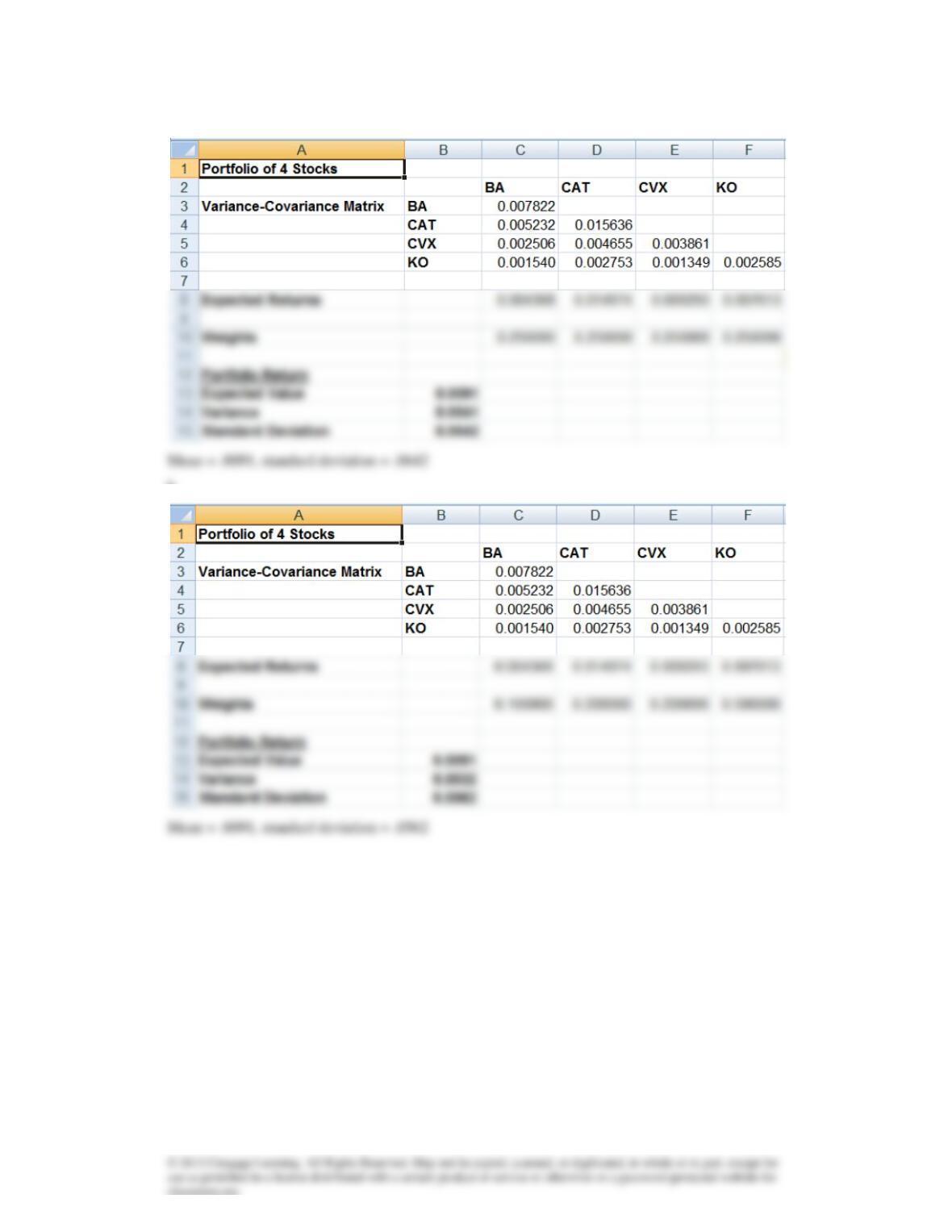
7.69a
b
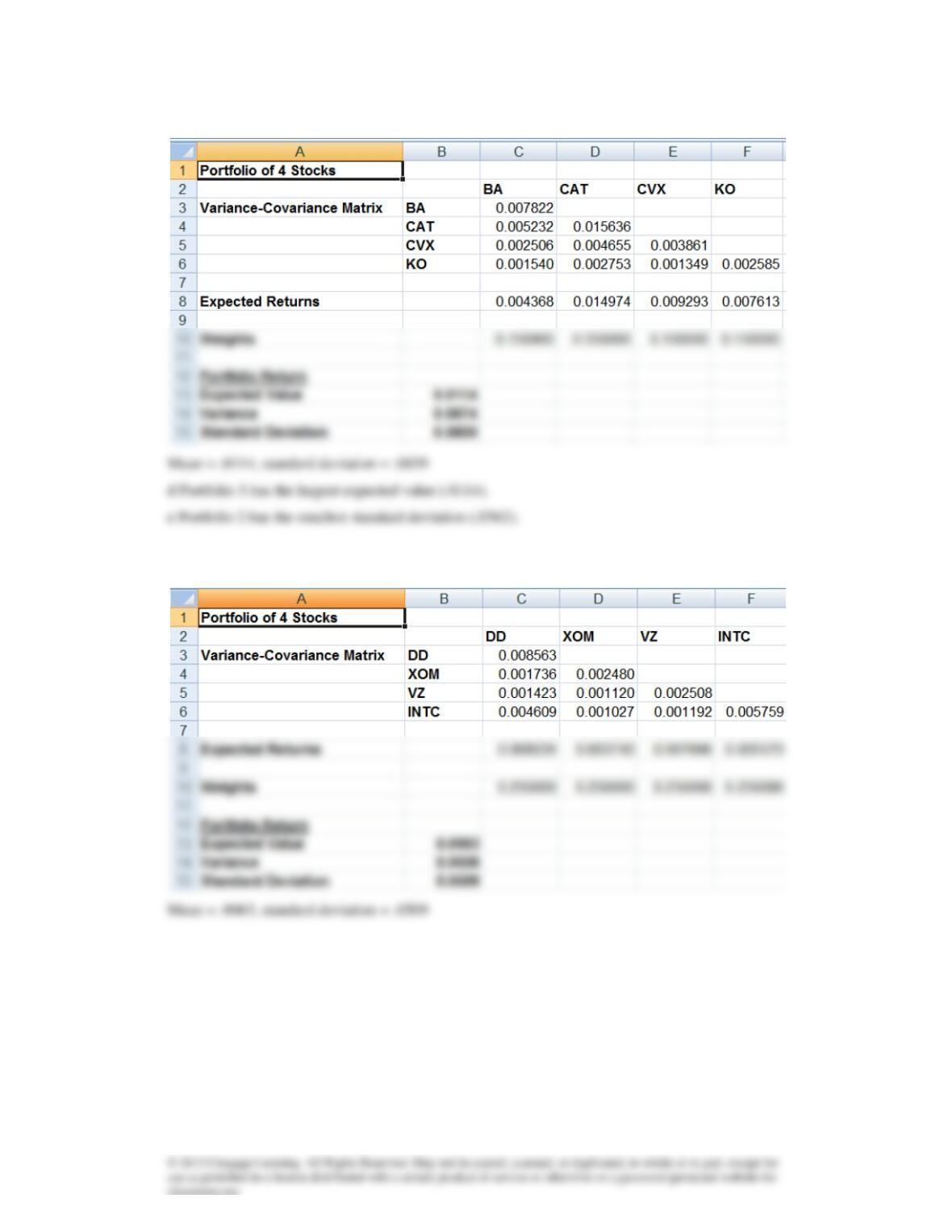
c
7.70a
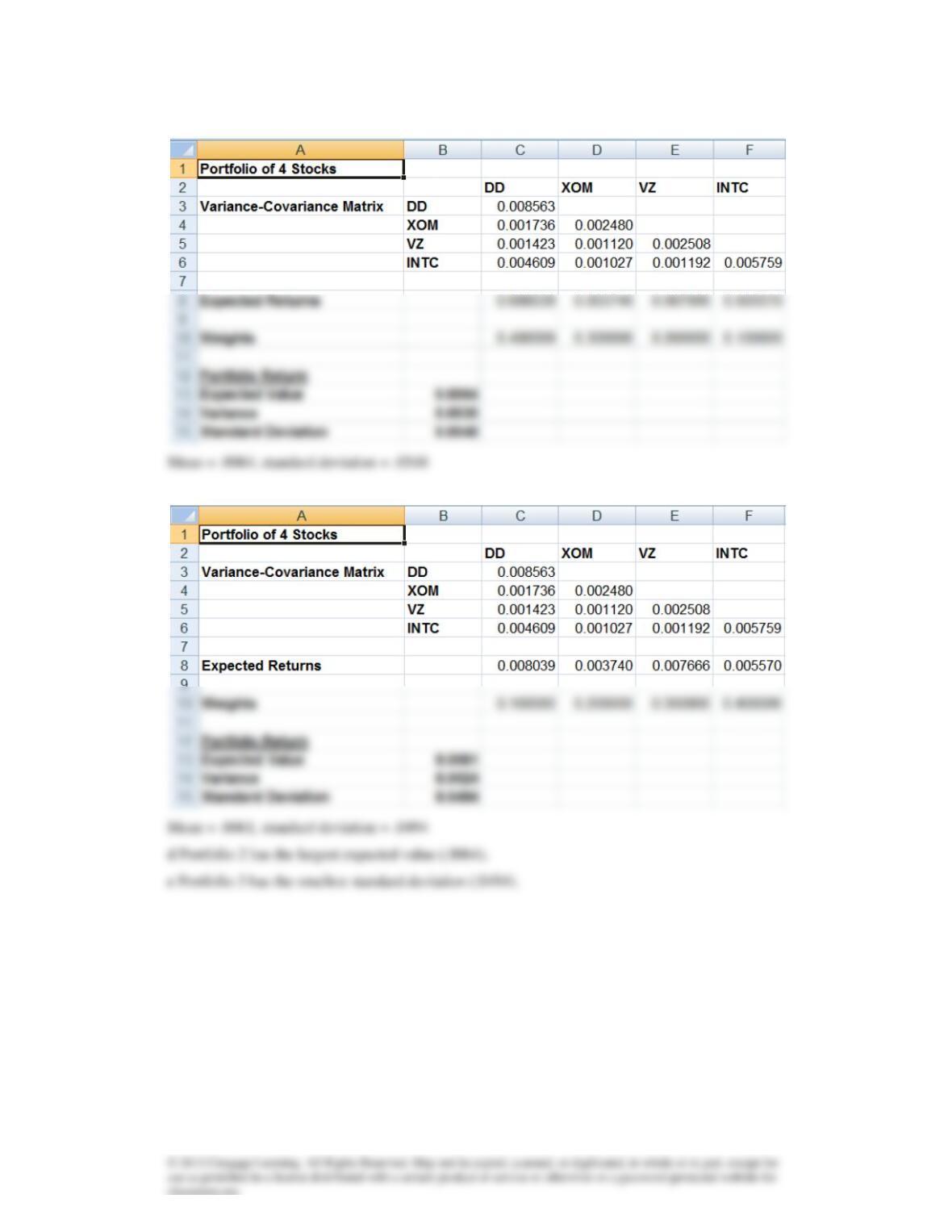
b
c