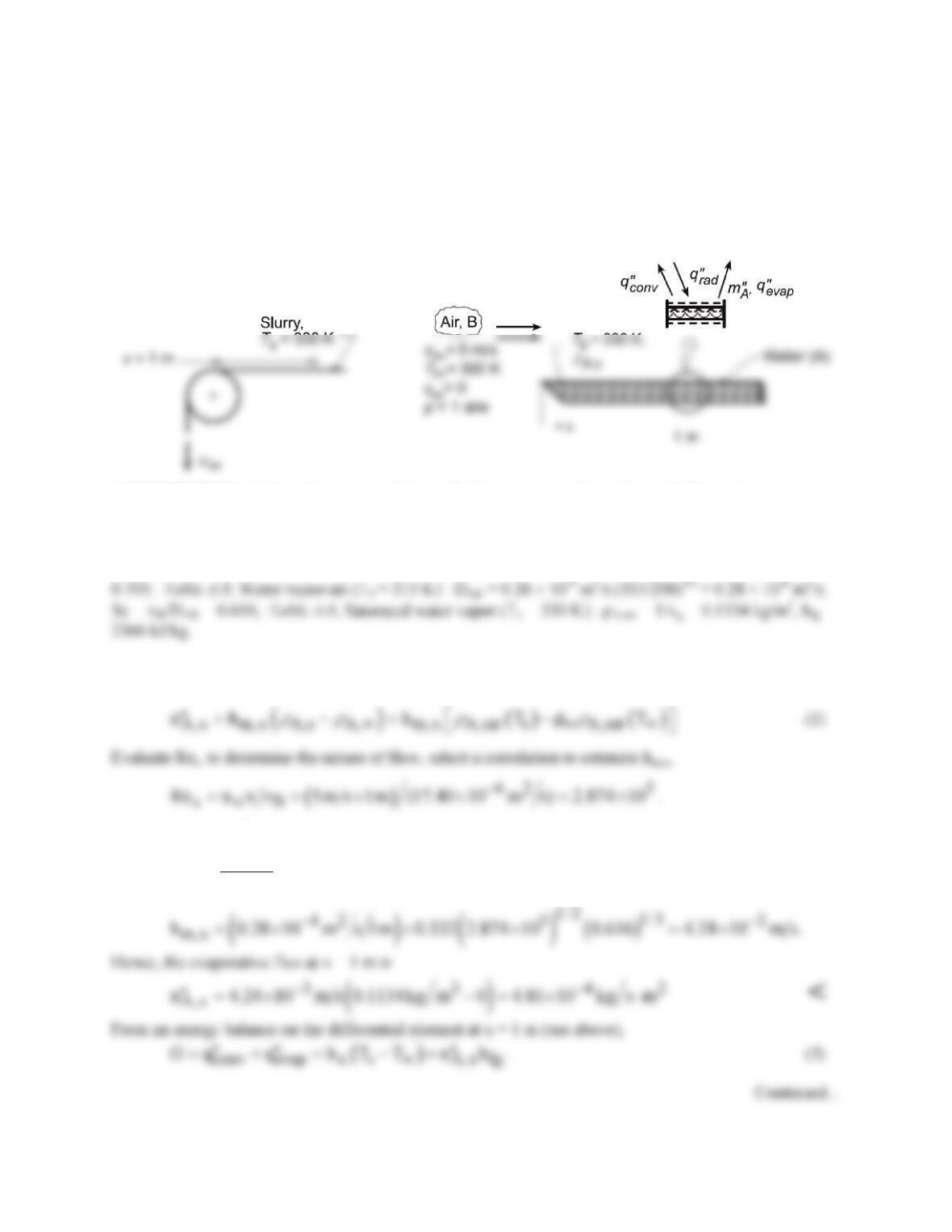
PROBLEM 7.102
KNOWN: Paper mill process using radiant heat for drying.
FIND: (a) Evaporative flux at a distance 1 m from roll edge; corresponding irradiation, G (W/m2),
required to maintain surface at Ts = 300 K, and (b) Compute and plot variations of hm,x (x),
A
N′′
(x), and
G(x) for the range 0 ≤ x ≤ 1 m when the velocity and temperature are increased to 10 m/s and 340 K,
respectively.
SCHEMATIC:
ASSUMPTIONS: (1) Steady-state conditions, (2) Heat-mass transfer analogy, (3) Paper slurry (water–
fiber mixture) has water properties, (4) Water vapor behaves as perfect gas, (5) All irradiation absorbed
by slurry, (6) Negligible emission from the slurry, (7) Rex,c = 5 × 10⁵.
PROPERTIES: Table A.4, Air (Tf = 315 K, 1 atm): ν = 17.40 × 10⁻⁶ m2/s, k = 0.0274 W/m⋅K, Pr =
ANALYSIS: (a) Recognize that the drying process can be modeled as flow over a flat plate with heat
and mass transfer. For a unit area at x = 1 m,
Since Rex < 5 × 10⁵, the flow is laminar. Invoking the heat-mass analogy,
m,x 1/ 2 1/3
xx
AB
hx
Sh 0.332 Re Sc
D
= =
(2)
PROBLEM 7.102 (Cont.)
To estimate hx, invoke the heat-mass transfer analogy using the correlation of Eq. (2),
Hence, from Eq. (3), the radiant power required to maintain the slurry at Ts = 330 K is
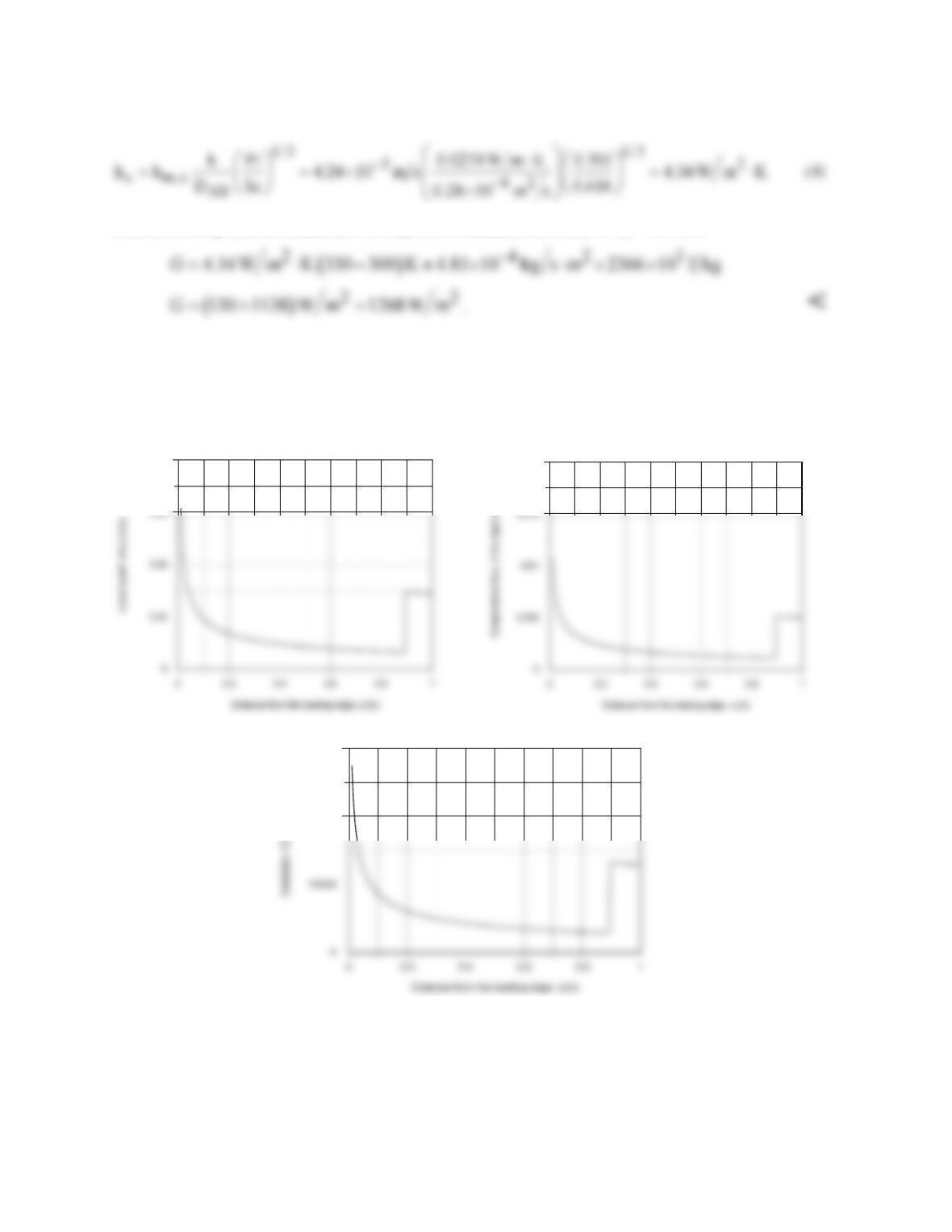
(b) Equations (1), (3) and (4) were entered into the IHT Workspace. The Correlations Tool, External
Flow, Local coefficients for Laminar or Turbulent Flow was used to estimate the heat transfer convection
coefficient. The results for hm,x (x),
A,x
n′′
(x) and G(x) were evaluated, and are plotted below for Ts =
340 K and
u∞
= 10 m/s.
0.08
0.02
20000
30000
COMMENTS: (1) The abrupt change in the parameter plots occurs at the transition, xc = 0.9 m.
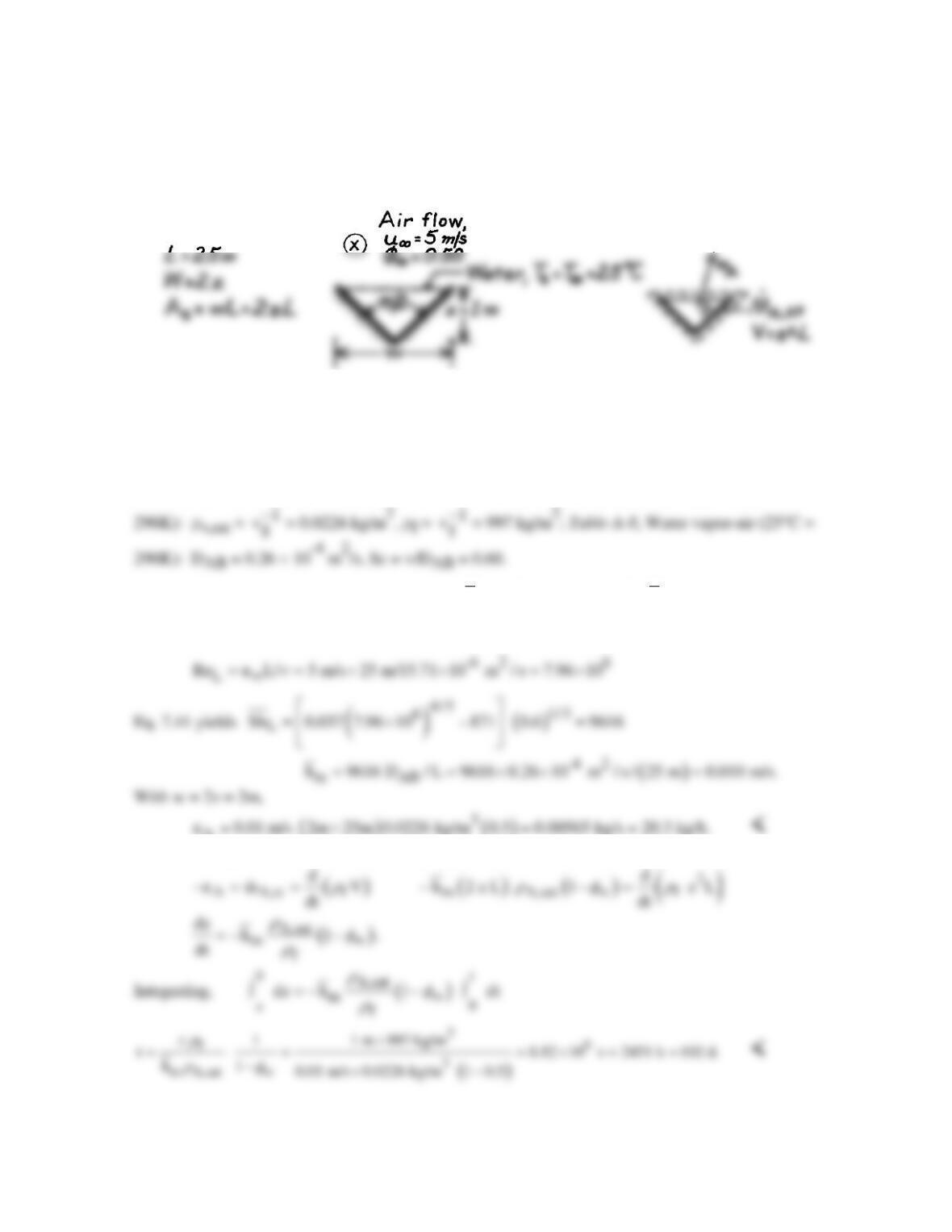
PROBLEM 7.103
KNOWN: Geometry and air flow conditions for a water storage channel.
FIND: (a) Evaporation rate, (b) Expression for rate of change of water layer depth and time required
for complete evaporation.
SCHEMATIC:
ASSUMPTIONS: (1) Steady-state conditions, (2) Smooth water surface and negligible free stream
turbulence, (3) Heat and mass transfer analogy is applicable, (4) Rex,c = 5 × 10⁵, (5) Perfect gas
behavior for water vapor.
PROPERTIES: Table A-4 Air (25°C = 298K): ν = 15.71 × 10⁻⁶ m2/s; Table A-6, Water (25°C =
ANALYSIS: (a) The evaporation rate is
( )
( )
A m s A,sat A, m A,sat
n h A h w L
rr r
∞
= −=×
( )
1
f
∞
−
. With
A
(b) Performing a mass balance on a control volume about the water,
COMMENTS: Although the evaporation rate decreases with increasing time due to decreasing As,
dz/dt remains constant and the water depth decreases linearly.
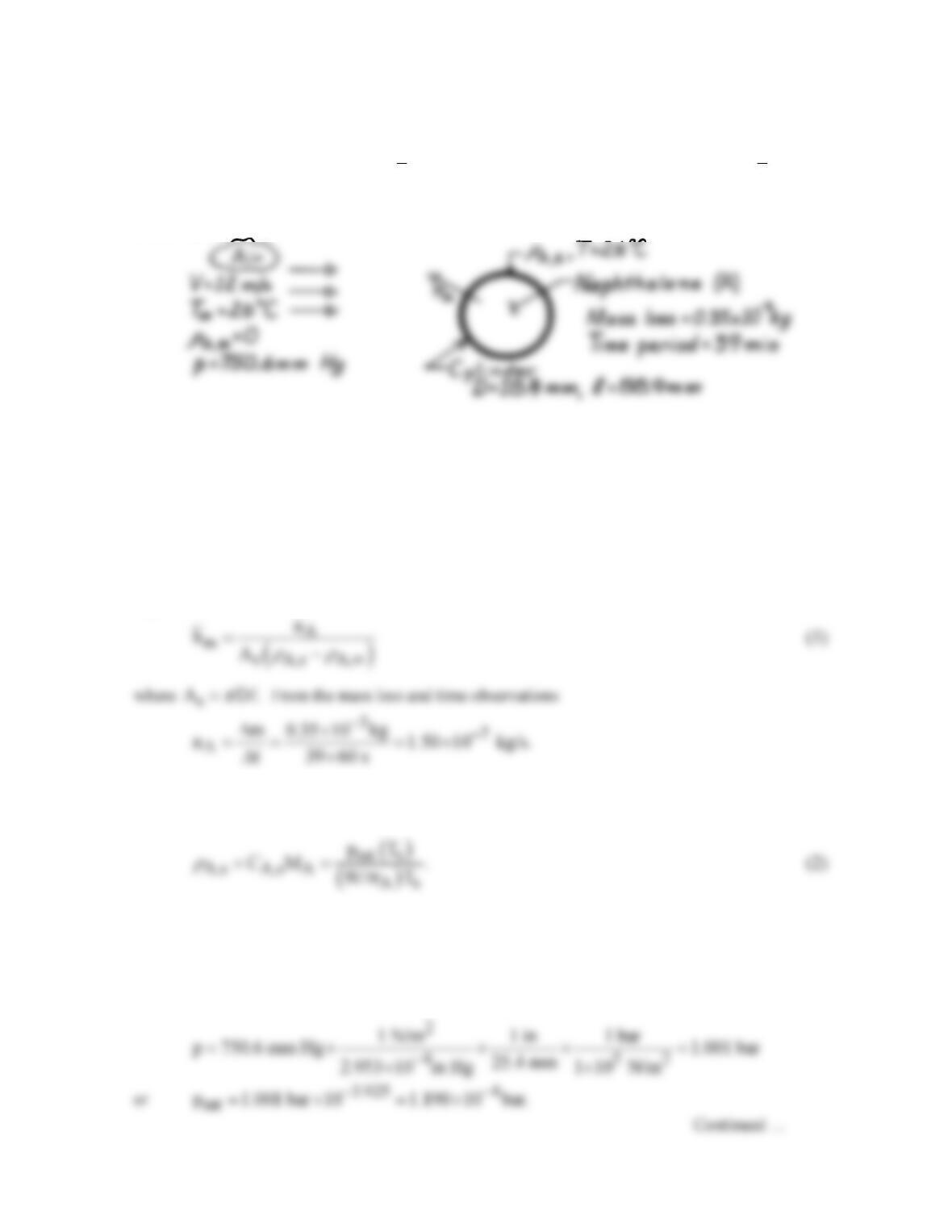
PROBLEM 7.104
KNOWN: Mass change for a given time period of a solid naphthalene cylinder subjected to cross
flow of air for prescribed conditions.
FIND: (a) Mass transfer coefficient,
m
h,
based upon experimental observations and (b)
m
h
based
upon appropriate correlation.
SCHEMATIC:
ASSUMPTIONS: (1) Steady-state conditions, (2) Negligible naphthalene vapor in free stream, (3)
Heat–mass transfer analogy applies.
PROPERTIES: Table A-4, Air (299K, 1 atm): ν = 15.80 × 10⁻⁶ m2/s; Table A-6, Naphthalene
vapor-air (298K, 1 atm): DAB = 0.62 × 10⁻⁵ m2/s; Naphthalene (given): M = 128.16 kg/kmol, psat =
p × 10E where E = 8.67 – (3766/T) with p[bar] and T[K].
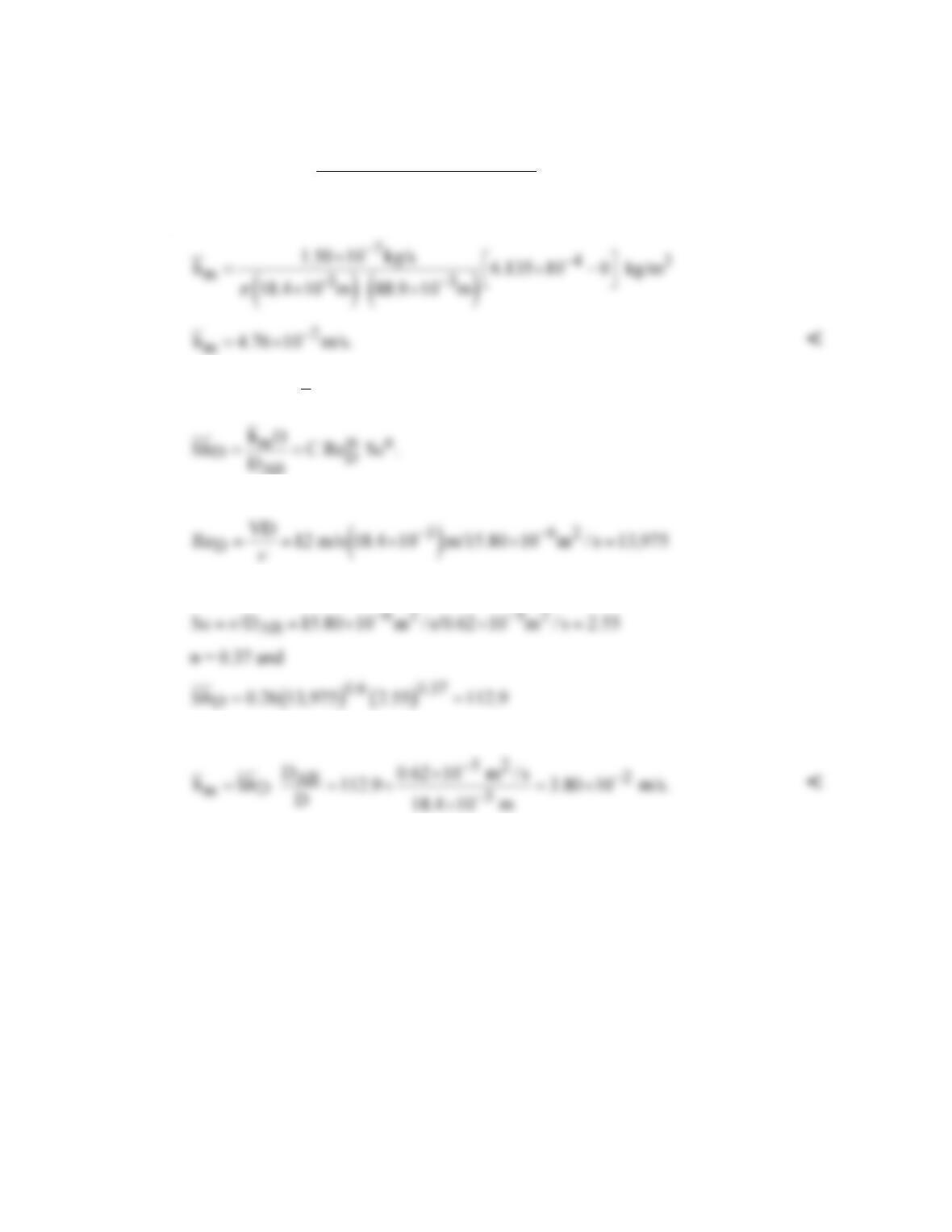
ANALYSIS: (a) The rate equation for the sublimation of naphthalene vapor from the solid
naphthalene can be written in terms of the mass transfer coefficient.
The saturation density of the vapor at the solid surface, rA,s, can be determined from the perfect gas
relation,
The saturation pressure, psat, is given by
E
sat
p p 10= ×
(3)
where
( ) ( )
E 8.67 3766/T 8.67 3766 / 299K 3.925=−=− =−
PROBLEM 7.104 (Cont.)
Substituting into Eq. (2),
-2 3
4 43
A,s
8.314 10 m bar/kmol K
1.190 10 bar/ 299K 6.135 10 kg/m .
128.16 kg/kmol
r
−−
×⋅ ⋅
=× ×=×
Using the parameters required for Eq. (1), the mass transfer coefficient is
(b) Invoking the heat-mass transfer analogy and assuming a Prandtl number ratio of unity, Eq. 7.53
can be used to estimate
h
m
,
With
it follows from Table 7.4 that C = 0.26 and m = 0.6. With
and
COMMENTS: The result from the correlation is 20% less than the experimental result. This may be
considered reasonable in view of the uncertainties associated with the observations and the
approximate nature of the correlation.
PROBLEM 7.105
KNOWN: Flow of dry air over a cylindrical medium saturated with water.
FIND: (a) Mass rate of water vapor evaporated per unit length
A
n′
, when water-air is at 300 K, (b)
Briefly explain change in mass rate if temperatures are at 325 K.
SCHEMATIC:
ASSUMPTIONS: (1) Steady-state conditions, (2) Heat-mass transfer analogy.
PROPERTIES: Table A.4, Air (300 K, 1 atm): ν = 15.89 × 10⁻⁶ m2/s, Pr = 0.707; Air (325 K, 1 atm): ν
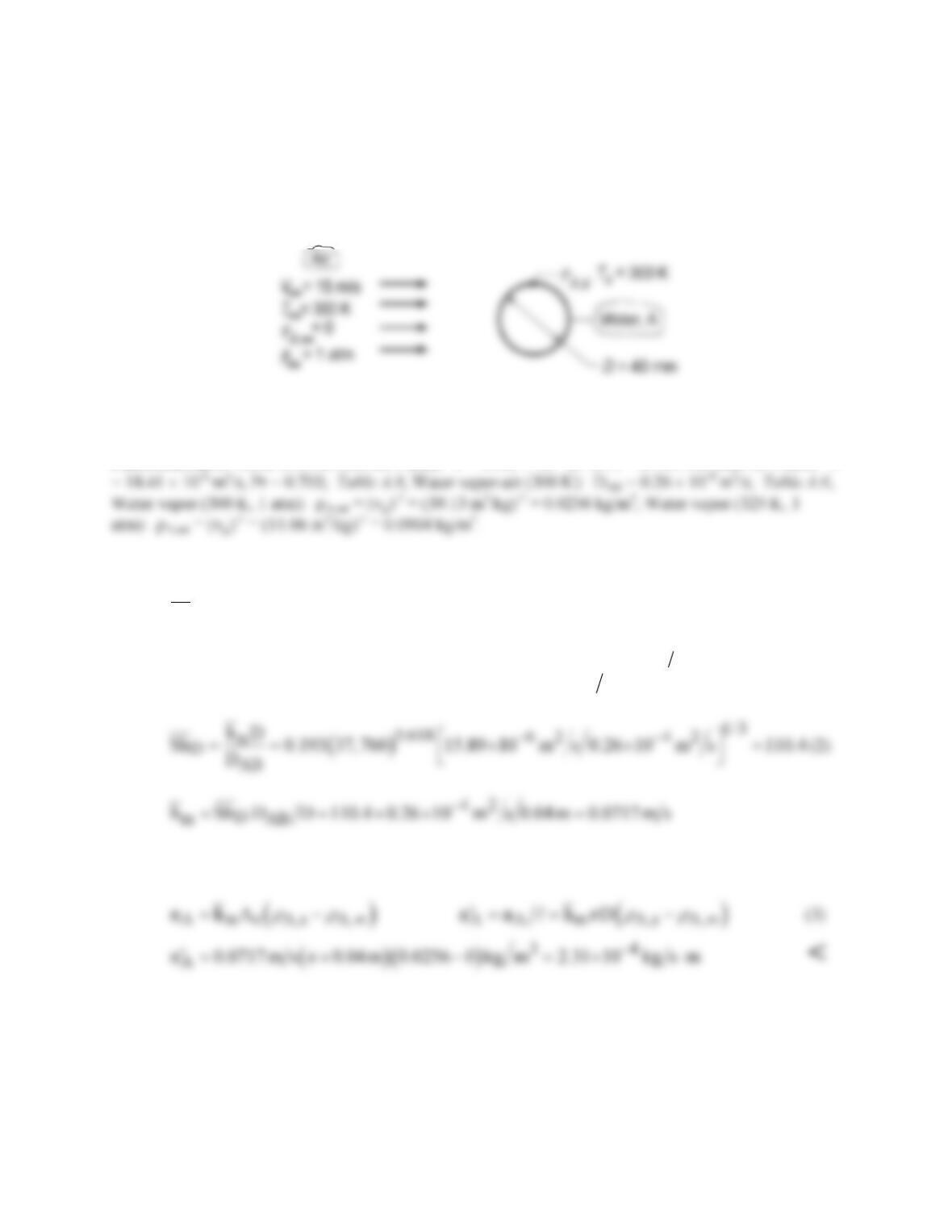
ANALYSIS: (a) For cross–flow over a cylinder, Eq. 7.52,
m 1/3
D
Sh C Re Sc=
(1)
where m,n are taken from Table 7.2. Calculate the Reynolds number, ReD =
VD ν
= 15 m/s × 0.04
m/15.89 × 10-6 m2/s = 37,760. With C = 0.193, m = 0.618, and Sc ≡
AB
D
ν
,
The evaporation rate, with
s
AD
π
= ⋅
, is
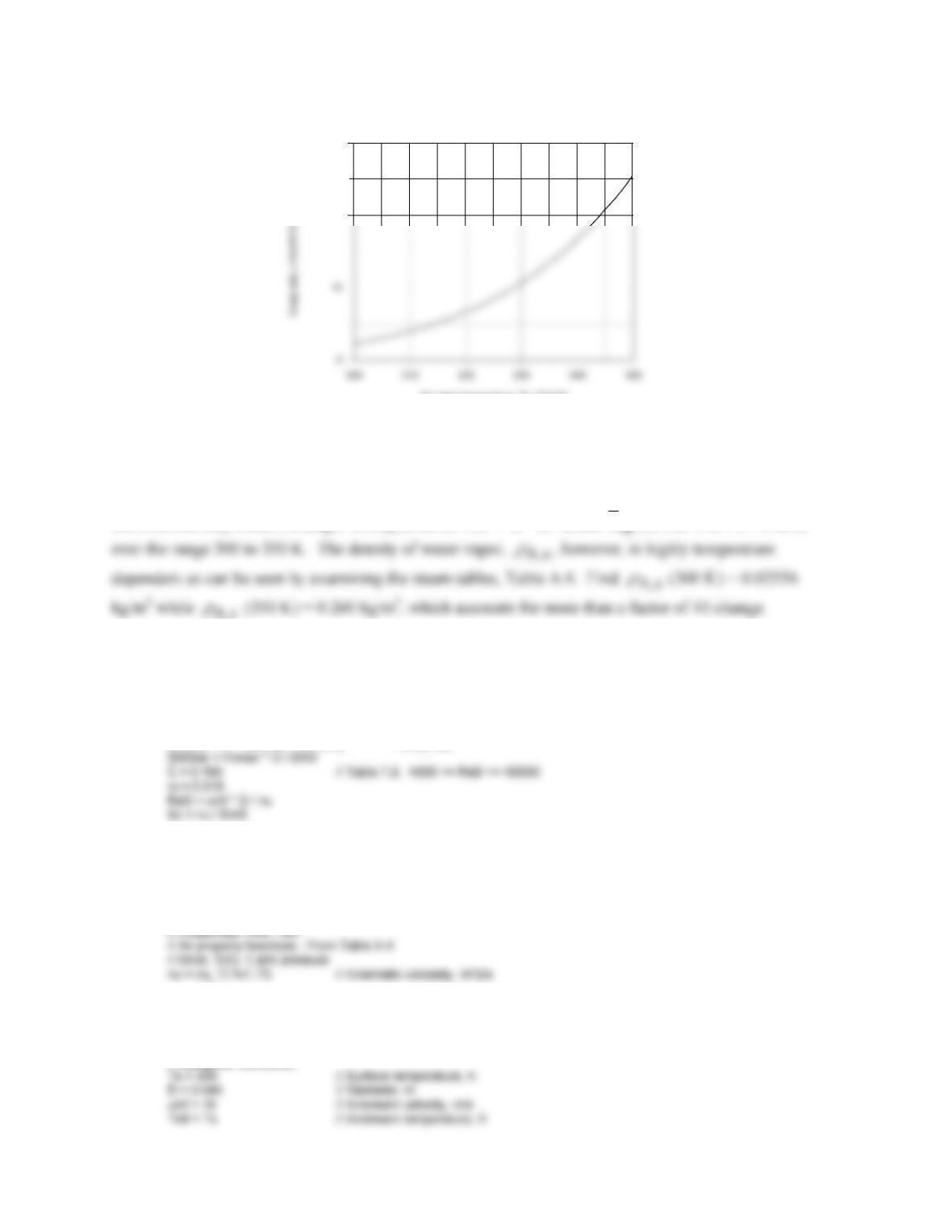
(b) The foregoing equations were entered into the IHT Workspace, and using the Properties Tools for air
and water vapor thermophysical properties, the evaporation rate
A
n′
was calculated as a function of air–
water temperatures (Ts = Tinf).
Continued…
PROBLEM 7.105 (Cont.)
Air-water temperature, Ts, Tinf (K)
20
30
As expected, the evaporation rate increased with increasing temperature markedly. For a 50 K increase,
the evaporation rate increased by a factor of approximately 12.
COMMENTS: (1) What parameters cause this high sensitivity of
A
n′
to Ts? From the IHT analysis,
we observed only modest changes in DAB (0.26 to 0.33 × 10⁻⁴ m2/s) and
m
h
(0.07273 to 0.0779 m/s)
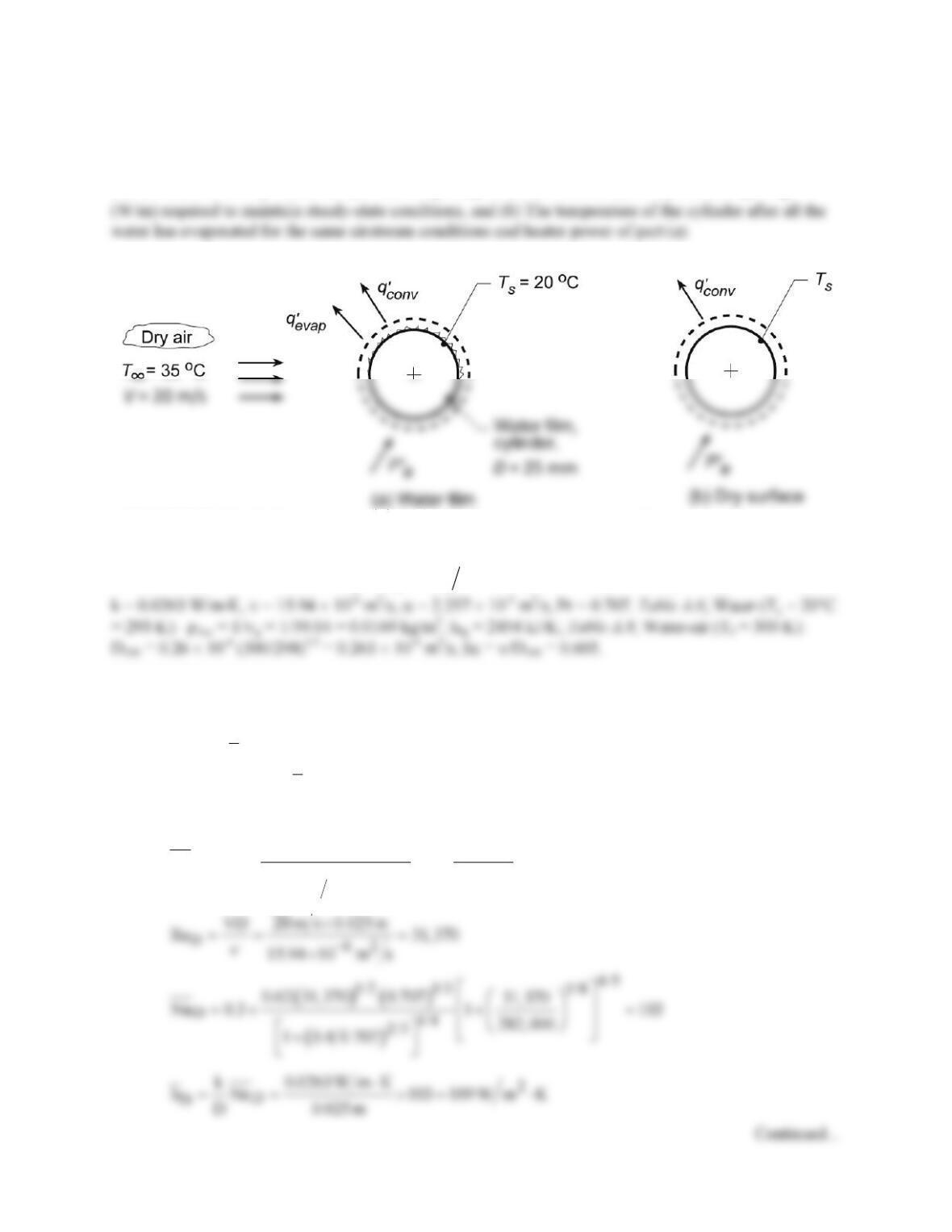
(2) A copy of the IHT Workspace used to perform the analysis is shown below.
// The Mass Transfer Rate Equation:
n’A = hmbar * pi * D * (rhoAs – 0 ) // Eq (3)
n’A_plot = 1e4 * n’A // Scale change for plotting
// Mass Transfer Coefficient Correlation:
ShDbar = C * ReD^m * Sc^(1/3) // Eq (1,2)
// Properties Tool – Water Vapor:
// Water property functions :T dependence, From Table A.6
// Units: T(K), p(bars);
xs = 1 // Quality (0=sat liquid or 1=sat vapor)
rhoAs = rho_Tx(“Water”,Ts,xs) // Density, kg/m^3
// Properties, Table A.8, Water Vapor – Air:
DAB = 0.26e–4 * ( Tf / 298 )^1.5 // Table A.8
Tf = (Ts + Tinf ) / 2
// Assigned Variables:
PROBLEM 7.106
KNOWN: Dry air at prescribed temperature and velocity flowing over a long, wetted cylinder of
diameter 25 mm. Embedded electrical heater maintains the surface at Ts = 20°C.
FIND: (a) Water evaporation rate per unit length (kg/h⋅m) and electrical power per unit length
e
P′
SCHEMATIC:
ASSUMPTIONS: (1) Steady-state conditions, (2) Constant properties and (3) Heat-mass transfer
analogy is applicable.
PROPERTIES: Table A.4, Air (
( )
fs
T TT 2
∞
= +
= 300 K, 1 atm): r = 1.16 kg/m3, cp = 1007 J/kg⋅K,
ANALYSIS: (a) Perform an energy balance on the cylinder,
in out
EE 0−=
e conv evap
Pq q 0
′′ ′
−−=
(1)
where the convection and evaporation rate equations are,
( )
conv D s
q h DT T
π
∞
′= −
(2)
( )
evap A fg m A,s A, fg
q nh h D h
πr r
∞
= = −
(3)
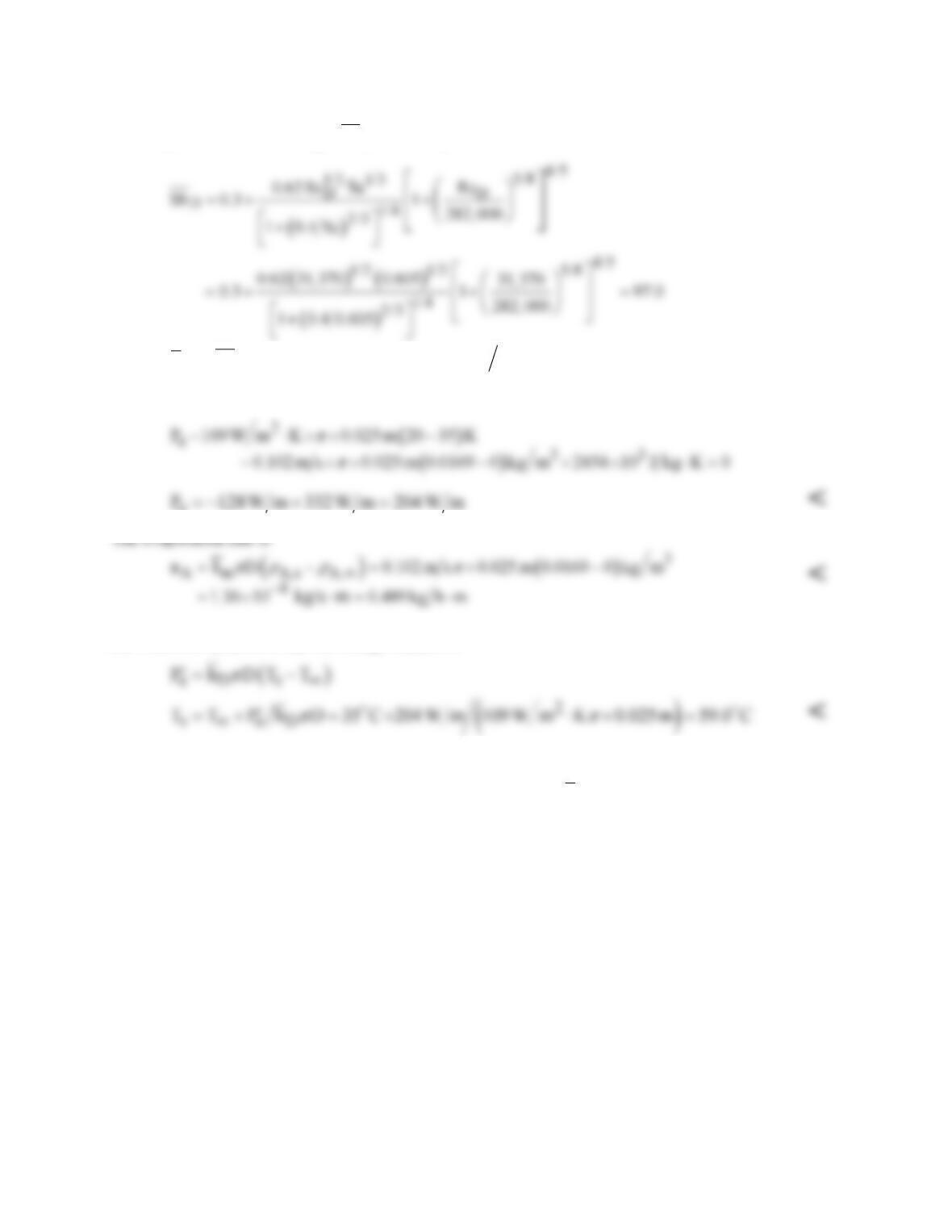
The convection coefficient can be estimated from the Churchill-Bernstein correlation, Eq. 7.54,
( )
4/5
5/8
1/2 1/3
DD
D1/4
2/3
0.62 Re Pr Re
Nu 0.3 1 282,000
1 0.4 Pr
=++
+
PROBLEM 7.106 (Cont.)
Invoking the heat-mass analogy,
D
Sh
can be expressed as
42
DAB
97.0 0.263 10 0.025 m 0.102 m / s
ms
m
h Sh D / D /
−
=×× =
=
Substituting numerical values, the energy balance, Eq. (1),
e
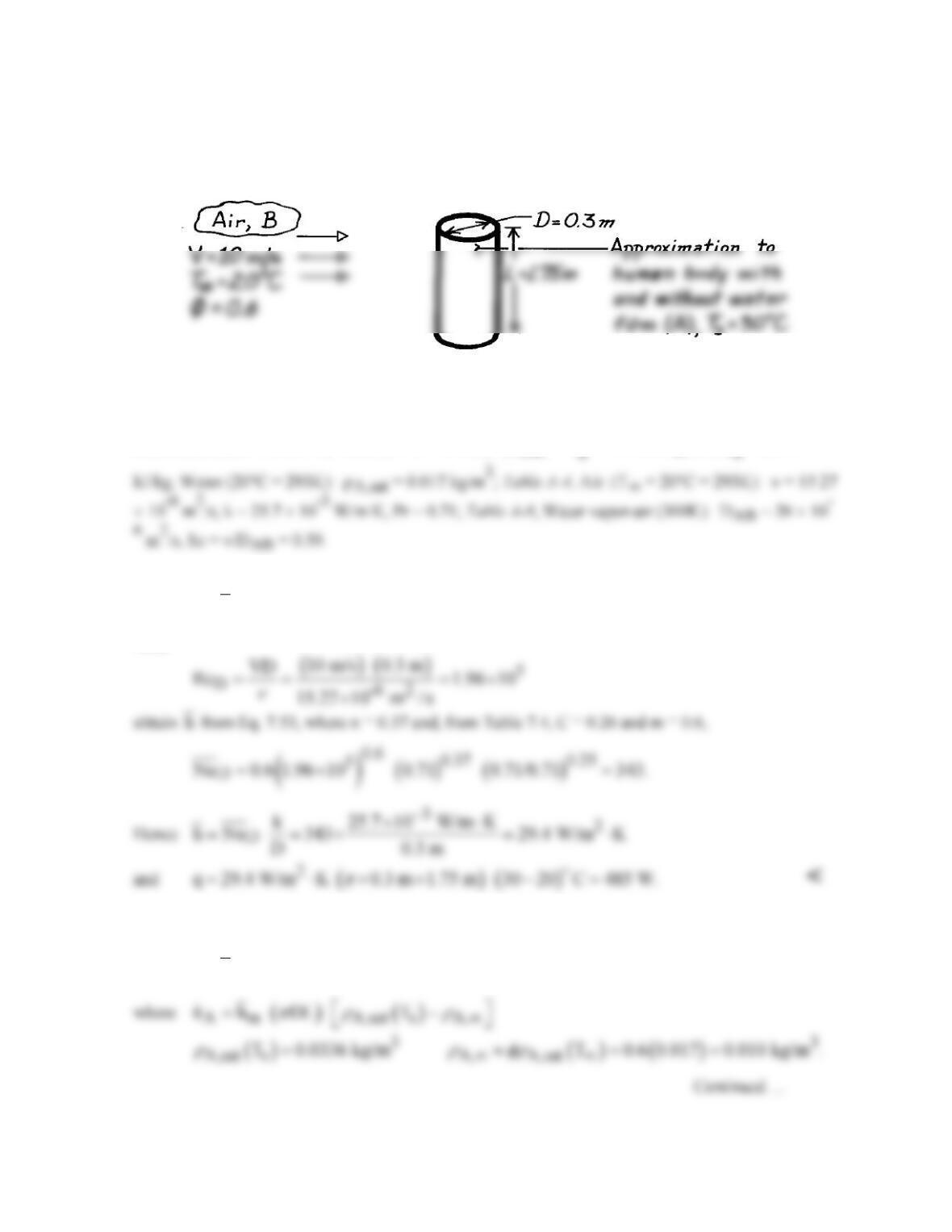
(b) When the cylinder is dry, the energy balance is
COMMENTS: Using IHT Correlations Tool, External Flow, Cylinder, the calculation of part (b) was
performed using the proper film temperature, Tf = 320 K, to find
D
h
= 107 W/m2⋅K and Ts = 59.3°C.
PROBLEM 7.107
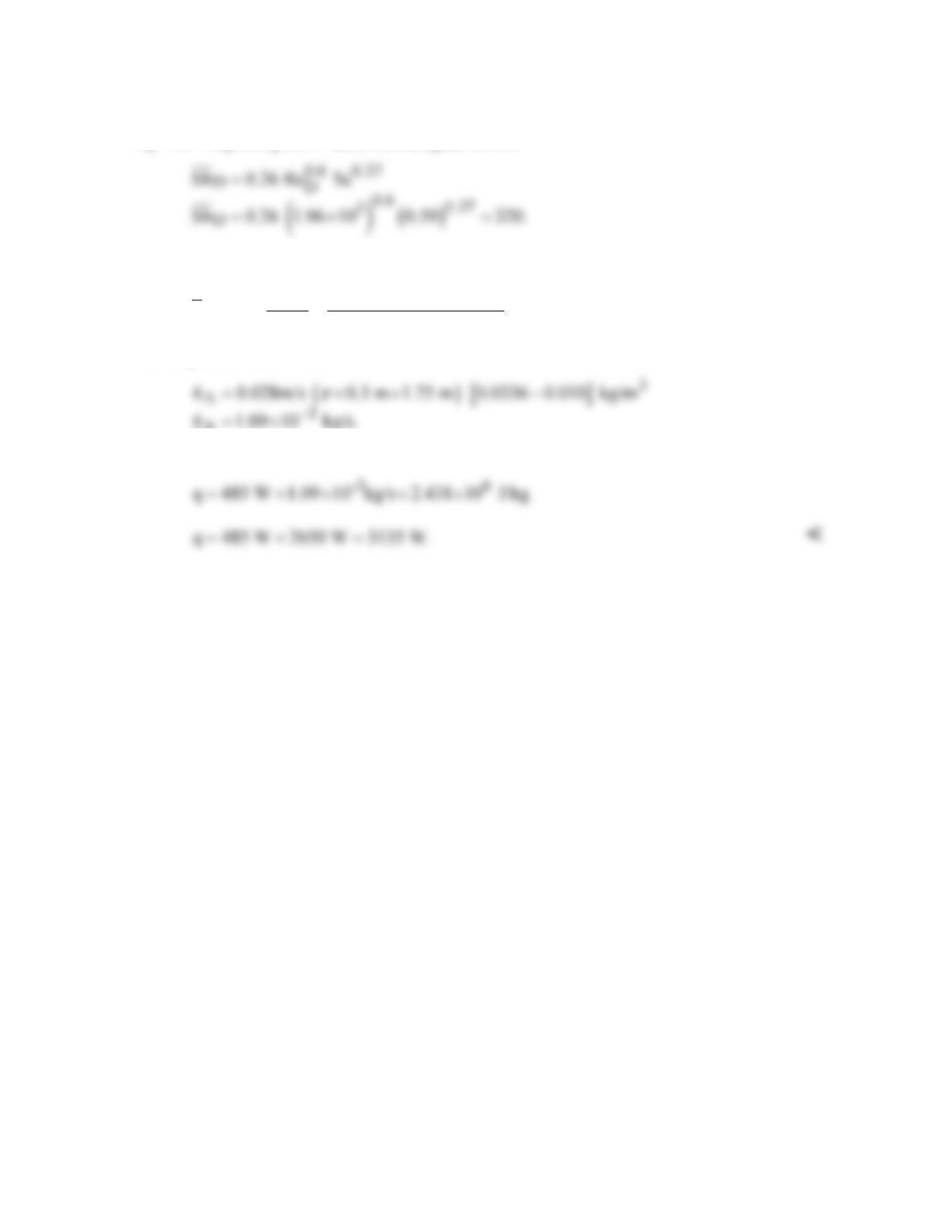
KNOWN: The dimensions of a cylinder which approximates the human body.
FIND: (a) Rate of heat loss by forced convection to ambient air, (b) Total rate of heat loss when a
water film covers the surface.
SCHEMATIC:
ASSUMPTIONS: (1) Direct contact between skin and air (no clothing), (2) Negligible radiation
effects, (3) Heat and mass transfer analogy is applicable, (4) Water vapor is an ideal gas.
PROPERTIES: Table A-6, Water (30°C = 303 K): rA,sat =
1
g
v
−
= 0.0336 kg/m3, hfg = 2431
ANALYSIS: (a) The heat rate is
( ) ( )
s
q h DL T T .
π
∞
= −
With
(b) The total rate of heat loss with the water film includes latent, as well as sensible, contributions and
may be expressed as
( ) ( )
s A fg
q h DL T T n h
π
∞
= −+
PROBLEM 7.107 (Cont.)
The convection mass transfer coefficient may be obtained by expressing the mass transfer analog of
Eq. 7.53. Neglecting the Pr ratio, the analogous form is
Hence
42
AB
m
D 320 0.26 10 m / s
h 320 0.028 m/s.
D 0.3 m
−
××
= = =
The evaporation rate is then
A
Hence,
COMMENTS: The evaporative (latent) heat loss dominates over the sensible heat loss. Its effect is
often felt when stepping out of a swimming pool or other body of water.
PROBLEM 7.108
KNOWN: Horizontal tube exposed to transverse stream of dry air.
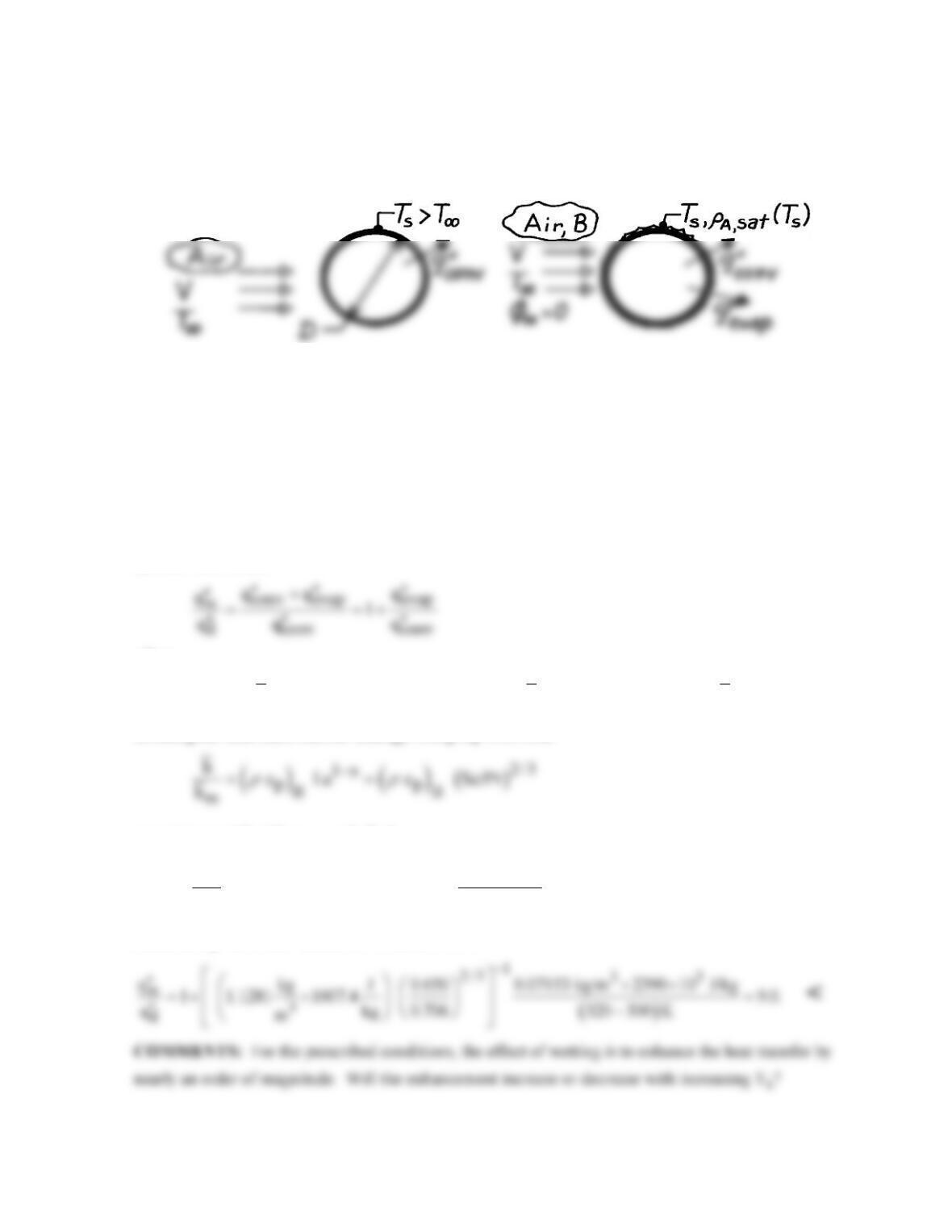
FIND: Equation to determine heat transfer enhancement due to wetting. Evaluate enhancement for
prescribed conditions.
SCHEMATIC:
ASSUMPTIONS: (1) Steady-state conditions, (2) Heat-mass transfer analogy applicable, (3) Water
vapor behaves as perfect gas.
PROPERTIES: Table A-4, Air (310K, 1 atm): r = 1.1281 kg/m3, cp = 1007.4 J/kg, ν = 16.90 ×
10-6 m2/s, Pr = 0.706; Table A-8, Air-water vapor mixture (310K): DAB ≈ 0.26 × 10⁻⁴ m2/s, Sc =
νB/DAB = 0.650; Table A-6, Saturated water vapor (320K): rA,sat = 1/vg = 0.07153 kg/m3, hfg =
2390 kJ/kg.
ANALYSIS: The enhancement due to wetting can be expressed as the ratio of the wet–to–dry
cylinder heat fluxes.
where
( )
( )
conv s evap A fg m A,s fg m A,sat fg
q hT T q mh h A, h h h.
rr r
∞
′′ ′′ ′′
= − = = −∞ =
Invoking the heat-mass transfer analogy, using Eq. 6.60, find
assuming n = 1/3 with rA,∞ = 0, find
( )
( ) ( )
1A,sat fg
2/3
wpB
ds
h
q1 c Sc/Pr .
q TT
r
r
−
∞
′′
= +
′′
−
<
Substituting numerical values, the enhancement is
PROBLEM 7.109
KNOWN: Dry-and wet-bulb temperatures associated with a moist airflow through a large diameter
duct of prescribed surface temperature.
FIND: Temperature and relative humidity of airflow.
SCHEMATIC:
ASSUMPTIONS: (1) Steady-state conditions, (2) Conduction along the thermometers is negligible,
(3) Duct wall forms a large enclosure about the thermometers.
PROPERTIES: Table A-4, Air (318K, 1 atm): ν = 17.7 × 10⁻⁶ m2/s, k = 0.0276 W/m⋅K, Pr = 0.70;
ANALYSIS: Dry-bulb Thermometer: Since Tdb > Ts, there is net radiation transfer from the surface
of the dry-bulb thermometer to the duct wall. Hence to maintain steady-state conditions, the
thermometer temperature must be less than that of the air (Tdb < T∞) to allow for convection heat
transfer from the air. Hence, from application of a surface energy balance to the thermometer, qconv
= qrad, or,
Wet-bulb Temperature: The relative humidity may be obtained by performing an energy balance on
the wet–bulb thermometer. In this case convection heat transfer to the wick is balanced by
evaporative and radiative heat losses from the wick,