!
2
!
Wal-Mart in Africa
TEACHING NOTE
SUMMARY
This case is about Wal–Mart’s entry into the African continent and the challenges it faced. The
case also highlights the challenges that Wal–Mart could encounter in establishing itself in the
African retail market. Wal–Mart started to put more emphasis on the international markets to fuel
its growth as the opportunities available in the domestic market dwindled since the financial crisis
Wal–Mart made a preliminary offer to buy South African retailer Massmart in September 2010.
Massmart was the second biggest retailer in South Africa and had operations spread across many
African countries. The offer was accepted by the shareholders of Massmart and South Africa’s
Competition Tribunal in June 2011. Later, Wal–Mart ran into trouble when some trade unions and
government departments alleged that its entry would lead to huge job losses and damage the
domestic manufacturing sector of South Africa. Wal–Mart countered the allegations by saying that
its entry would, in fact, create 15,000 new jobs within three years of the takeover. Wal–Mart’s past
record of being a low–wage, low–benefit employer and one that discouraged unionizing by its
TARGET AUDIENCE
This case is intended for use in undergraduate and post–graduate–level management programs as
part of the International Management, International Marketing and International Business courses.
It can also be used as part of the Business Strategy course as mentioned here:
!Wal–Mart in Africa
!
3
Program
Course
Section of the Syllabus
International Management;
International Marketing;
• Global Expansion Strategies
of a Firm
RESEARCH METHOD FOR PREPARATION OF THE CASE
This case was prepared through research on library sources. Thorough research was done on Wal–
Mart, using articles, reports, and corporate biographies published in various newspapers,
magazines, and websites. Several textbooks on international marketing, international business, and
business strategy were also consulted for writing the case.
TEACHING OBJECTIVES AND TARGET AUDIENCE
This case is designed to enable students to:
• Understand the issues and challenges faced by multinational companies like Wal–Mart when
entering new markets.
• Appreciate the importance of MNCs understanding the local market conditions when entering
new markets.
SUGGESTIONS FOR TEACHING THE CASE
The case should be distributed to the students a few days before it comes up for classroom
discussion. Students should be asked to prepare the key and basic issues of the case before coming
in for the discussion. They should form small groups and prepare a presentation on the case for the
class, preferably using presentation software. During the scheduled classroom discussion session,
!Wal–Mart in Africa
!
4
TEACHING PLAN
1. Introduction of the case (5 min)
2. Class discussion to identify the immediate and basic issues of the case (10 min)
7. Summary (10 min)
Note: Distribution of case and discussion questions 2–5 days before class.
LINKAGE OF THE CASE TO RELEVANT THEORIES
The basic issues in this case pertain to the following:
• International strategy.
Some of the issues are detailed here.
1. International Strategy
Many business organizations take their operations beyond their home markets in the course of
their expansion. They enter international markets due to several reasons. The most common
reason for entering foreign markets is to increase their revenues or to expand their business
operations when the domestic markets get saturated. But there are several other reasons for
organizations expanding into foreign markets.
• Businesses may start to expand in the global markets as globalization of the markets lead
to more competition in the domestic markets.
!Wal–Mart in Africa
!
2. Modes of Expanding into International Markets
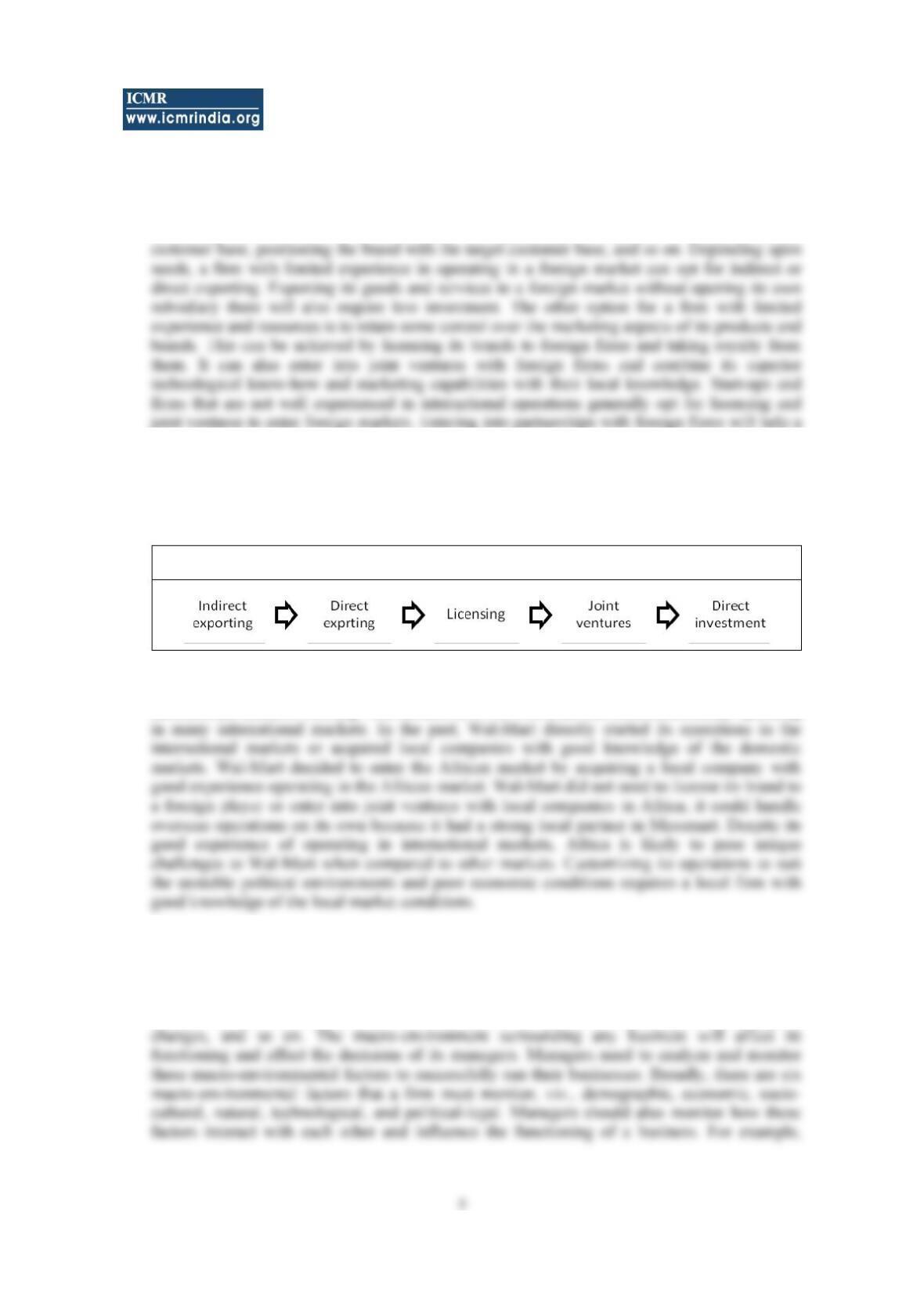
A firm can expand into international markets through different modes, depending upon several
factors like the needs of the firm, its capabilities, and its past experience. Any organization that
wants to expand to other countries needs to decide on a number of issues that range from the
marketing mix for the overseas subsidiary to segmenting the market, selecting the target
firm in dealing with local governments and customizing its products and services to suit local
tastes and preferences. Bigger organizations with good experience and the resources to operate in
foreign markets can opt for direct investment and set up their own subsidiaries in the foreign
markets.
Figure I
Different Entry Modes
Wal–Mart decided to expand into the emerging markets like Africa because the developed
markets were becoming increasingly saturated. It has good experience operating in
international markets. Starting with Mexico in 1991, Wal–Mart has been successfully operating
3. Analyzing the Global Macro-Environment
Macro–environment refers to the conditions that exist in the whole economy rather than in a
particular region. Many factors in the macro–environment affect a business. Examples of the
factors that constitute the macro–environment include changes in inflation, gross domestic
product (GDP), cultural beliefs, fiscal and monetary policies, employment, technological
!Wal–Mart in Africa
!
6
Analyzing the macro–environmental factors is more important for multinational companies
because their operations are spread out across many countries. They need to monitor the
macro–environmental factors prevailing in different countries in which they operate because
they keep differing from one country to the other. Apart from monitoring the macro–
environmental factors of individual countries in which they operate or that they plan to enter,
into the African market for fear of losing jobs. Nevertheless, Wal–Mart made use of the strong
judicial system of South Africa to allay the fears of the opposing parties and gain entry into the
market. Similarly, it needs to properly understand the local cultural preferences of the
consumers in the African continent before it expands further in the continent. A proper
understanding of the cultural environment will help Wal–Mart avoid the mistakes it made in
SUGGESTED ASSIGNMENT QUESTIONS
1.What were reasons for Wal–Mart shifting its focus to Africa? Do you think Africa offers
good growth prospects for Wal–Mart in future?
2. Why did Wal-Mart face opposition from trade unions and other government departments
over its acquisition of Massmart? Do you think the opposition coalition had a valid point in
opposing the deal? Justify your answer.
ANALYSIS
Answer 1
As its home market got increasingly saturated, Wal–Mart started to focus more on international
markets. Growth opportunities in the domestic U.S. market had dwindled as Wal–Mart faced
heightened competition from the more upscale retailers such as Target and online retailers such as
!Wal–Mart in Africa
!
7
The growth opportunities in other developed countries where Wal–Mart had its presence too were
getting saturated and some of the countries were embroiled in financial crisis. This prompted Wal–
Mart to look for new international market to grow further. Since it already had a presence in big
markets like China, it was trying to enter the Indian retail market for some time, due to the
tremendous untapped retail market in that country. However, Wal–Mart had to limit its presence to
some wholesale operations in India because the retail sector still had some severe restrictions for
foreign players.
The unstable political environment and poor economic conditions used to be the main hindrances
for multinational companies entering Africa, but some African countries with elected governments
and rule of law offered good prospects for foreign companies. Many multinational companies had
started focusing on Africa. Some African countries also had big modern retailers that could be
acquired to gain an immediate foothold in the market. This led Wal–Mart to select Africa for its
future expansion.
Answer 2
Wal–Mart’s entry into the African market was opposed by some trade unions and government
departments. In the countries that it operates in, Wal–Mart follows the policy of offering cheaper
prices than its competitors to its consumers. It follows several strategies to keep its prices cheaper
than that of its competitors. One way to achieve lower prices is to source its goods from countries
!Wal–Mart in Africa
!
8
The opposition’s fears regarding the entry of Wal–Mart into the South African retail market are not
totally warranted. The terms of the deal make it difficult for Wal–Mart to make any major changes
in its relations with its employees for some years after the acquisition was completed. Wal–Mart
was barred from removing any employees for two years and required to honor labor bargaining
rights for three years after the acquisition. Wal–Mart promised to create 15,000 new jobs after the
acquisition was completed. Wal–Mart also agreed upon a supplier development program where it
would train its suppliers in supplying goods that meet the standards set by Wal–Mart and other big
organized retailers. The opposition coalition did not have a valid point regarding the low wages
being paid to employees as the wage levels are traditionally lower in Africa than in the developed
countries where Wal–Mart operates. To counter any further opposition to its entry into Africa,
Wal–Mart should make appropriate changes to its policies related to various issues like labor
relations and procurement of merchandise.
Answer 3:
From the case. we see that Wal–Mart’s purchasing scale, low–cost mentality, and low cost
overheads provide it with a huge competitive advantage in the United States. In addition to this,
the retail giant’s merchandising skills, IT and management skills, human resource policies and
practices, locations in rural settings, and logistics are other sources of its competitive advantage.
Merchandising skills Retail being a very local activity, it is not clear whether Wal–Mart would be
able to transfer this advantage to Africa. Many retailers have failed in international markets
because they were not able to reconcile this difference. Wal–Mart itself had bad experience in
some countries, but overall it had shown that it was able to adapt.
IT and management skills These are undoubtedly the most transferable skills. The retail giant can
leverage its skills in this area and have a significant advantage.
!Wal–Mart in Africa
!
9
Logistics This is the least transferable of all the advantages. Most of Africa had poor
infrastructure. Even the best of places in Africa will be found wanting when compared to the
infrastructure in North America. This is a major issue for Wal–Mart because the company gained
huge efficiency advantages in its home market in logistics.
Wal–Mart can succeed in Africa if it can make some changes in its business model to meet the
unique challenges that it may face in the African countries that have a high incidence of poverty
and low income levels. The unique business model of providing everyday low prices that is
followed by Wal-Mart will be very successful in the African market, but apart from just focusing
on low prices, Wal–Mart might also need to make some changes in other areas like packaging and
merchandising. The low income levels of consumers in Africa force them to make their purchases
in limited quantities. Giant supermarket chains like Wal–Mart generally sell their products in bulk
quantities at a discount. Wal–Mart can, however, reduce the size of the packaging for the goods
Wal–Mart also needs to invest in building a good supply chain for its products sold in Africa. Due
to the lack of proper infrastructure, a significant chunk of the farm produce in developing countries
spoils before it reaches the market, leading to supply bottlenecks and higher prices. Wal–Mart can
sell its produce at a cheaper price by building a proper supply chain for its operations in Africa.
People in countries with low income levels generally make their shopping trips on a weekly or
!Wal–Mart in Africa
Suggested Readings and References
Books
1. Charles W. L. Hill, International Business: Competing in the Global Marketplace, 4th
edition.
2. Gerry Johnson, Kevan Scholes, and Richard Whittington, Exploring Corporate Strategy:
Text and Cases, 7th edition.
3. Philip Kotler, Kevin Lane Keller, Abraham Koshy, and Mithileshwar Jha, Marketing
Management, 13th edition.
4. Sak Onkvisit and John J. Shaw, International Marketing: Analysis and Strategy, 3rd
edition.
Other Sources:
8. Max Clarke, “Walmart Enters Africa despite Union Opposition,”
http://www.freshbusinessthinking.com, June 1, 2011.
9. Allison Martell and Jessica Wohl, “Target to Test Wal–Mart’s Mettle in Canada,”
http://www.reuters.com, April 11, 2011.
10. Stephanie Clifford, “Wal–Mart Bids for Massmart to Expand into Africa,”
http://www.nytimes.com, September 27, 2010.
!Wal–Mart in Africa
!
11
17. “Wal–Mart: Struggling in Germany,” http://www.businessweek.com, April 11, 2005.
18. “Mexican Retailers Unite against Wal–Mart,” http://www.expresstextile.com, July 29,
2004.
19. “About Us,” http://www.walmartstores.com/AboutUs/.
20. “History Timeline,” http://www.walmartstores.com.