Exercise 7B-2 (continued)
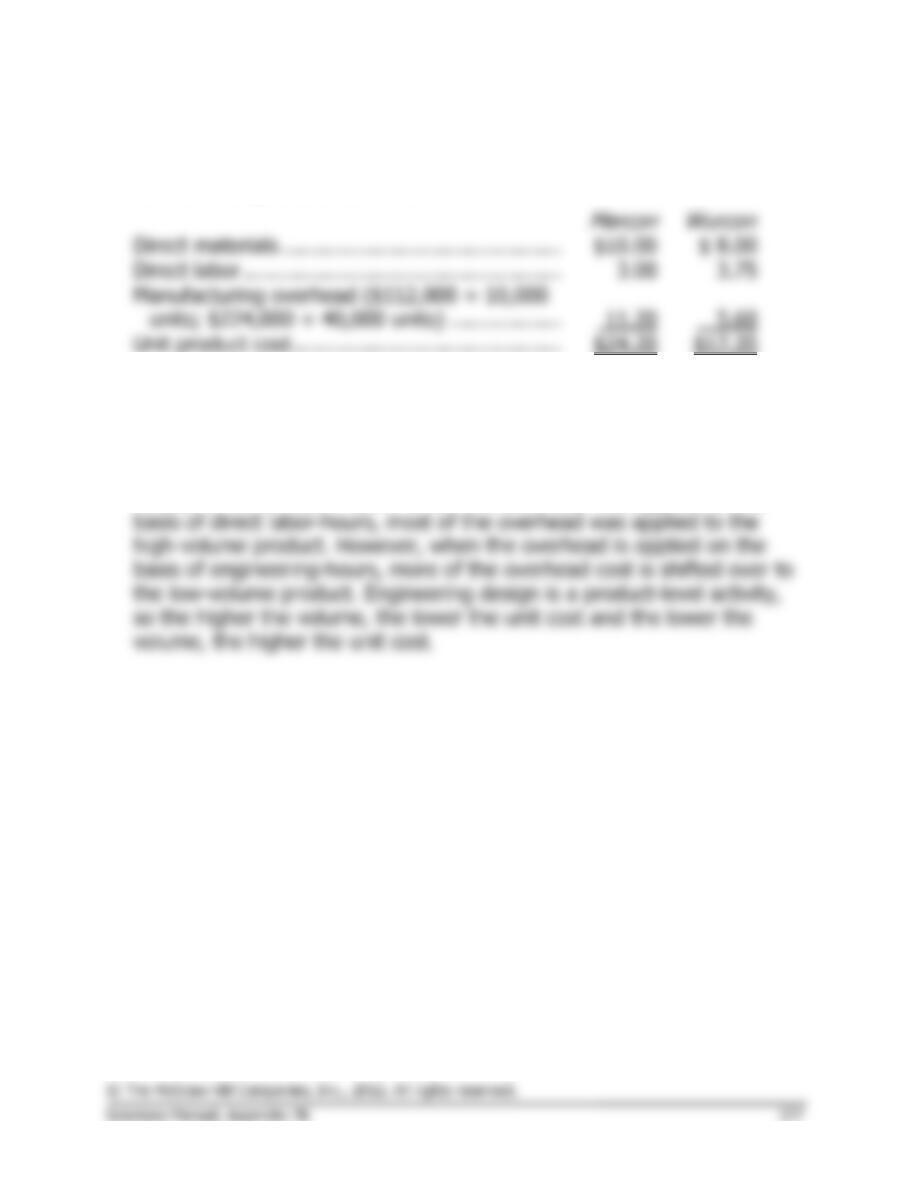
The unit product costs combine direct materials, direct labor, and
manufacturing overhead costs:
3. The unit product cost of the high-volume product, Wurcon, declines
under the activity-based costing system, whereas the unit product cost
of the low-volume product, Mercon, increases. This occurs because half
of the overhead is applied on the basis of engineering design hours
instead of direct labor-hours. When the overhead was applied on the
Problem 7B-3 (60 minutes)
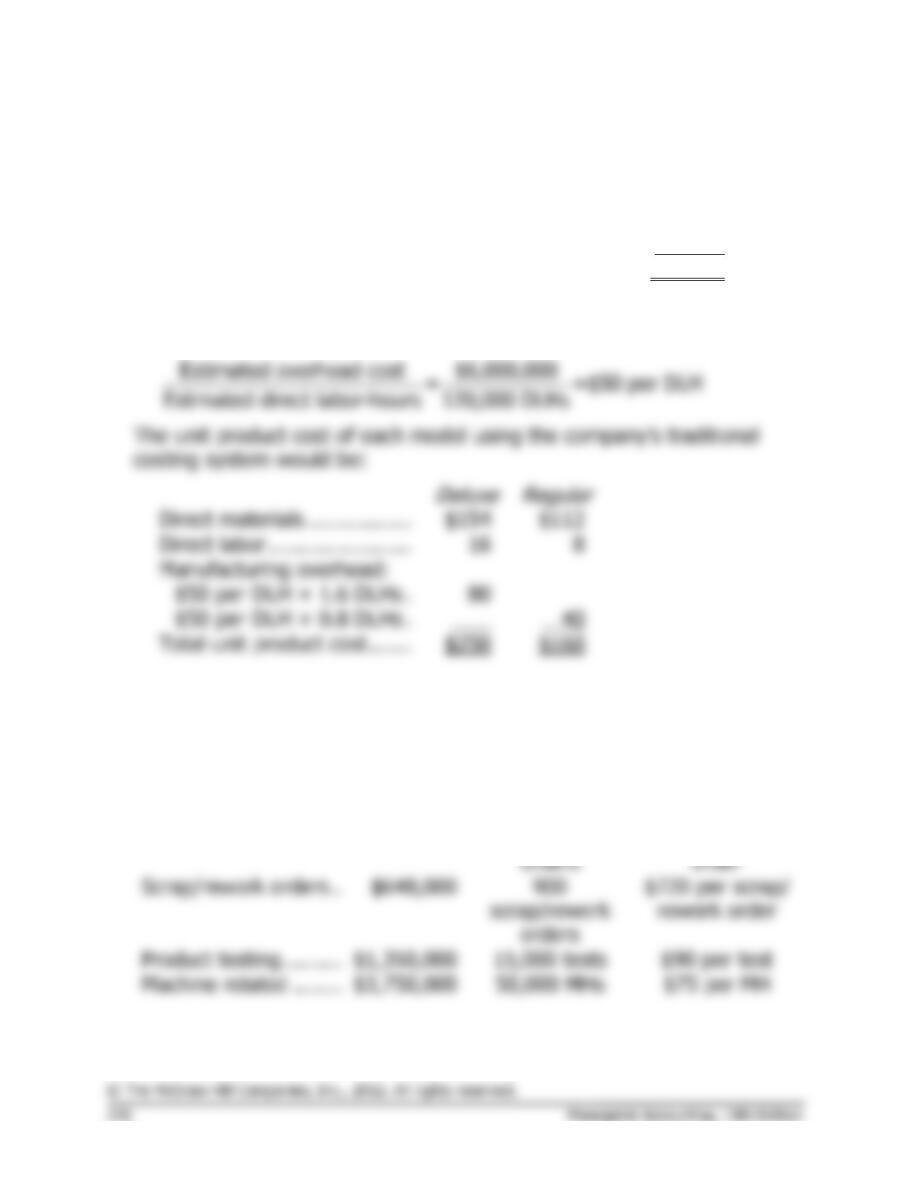
1. The company’s estimated direct labor-hours (DLHs) can be computed as
follows:
Deluxe model: 15,000 units × 1.6 DLH per unit ….
24,000
Regular model: 120,000 units × 0.8 DLH per unit .
96,000
Total direct labor-hours …………………………………
120,000
Using direct labor-hours as the base, the predetermined overhead rate
would be:
Direct materials ……………..
Direct labor …………………..
Manufacturing overhead:
Total unit product cost …….
2. Predetermined overhead rates are computed below:
Activity Cost Pool
(a)
Estimated
Overhead
Cost
(b)
Expected
Activity
(a) ÷ (b)
Predetermined
Overhead Rate
Purchase orders ……..
$252,000
Product testing ……….
Machine related ……..
50,000 MHs
$75 per MH
1,200 purchase
$210 per purchase
Problem 7B-3 (continued)
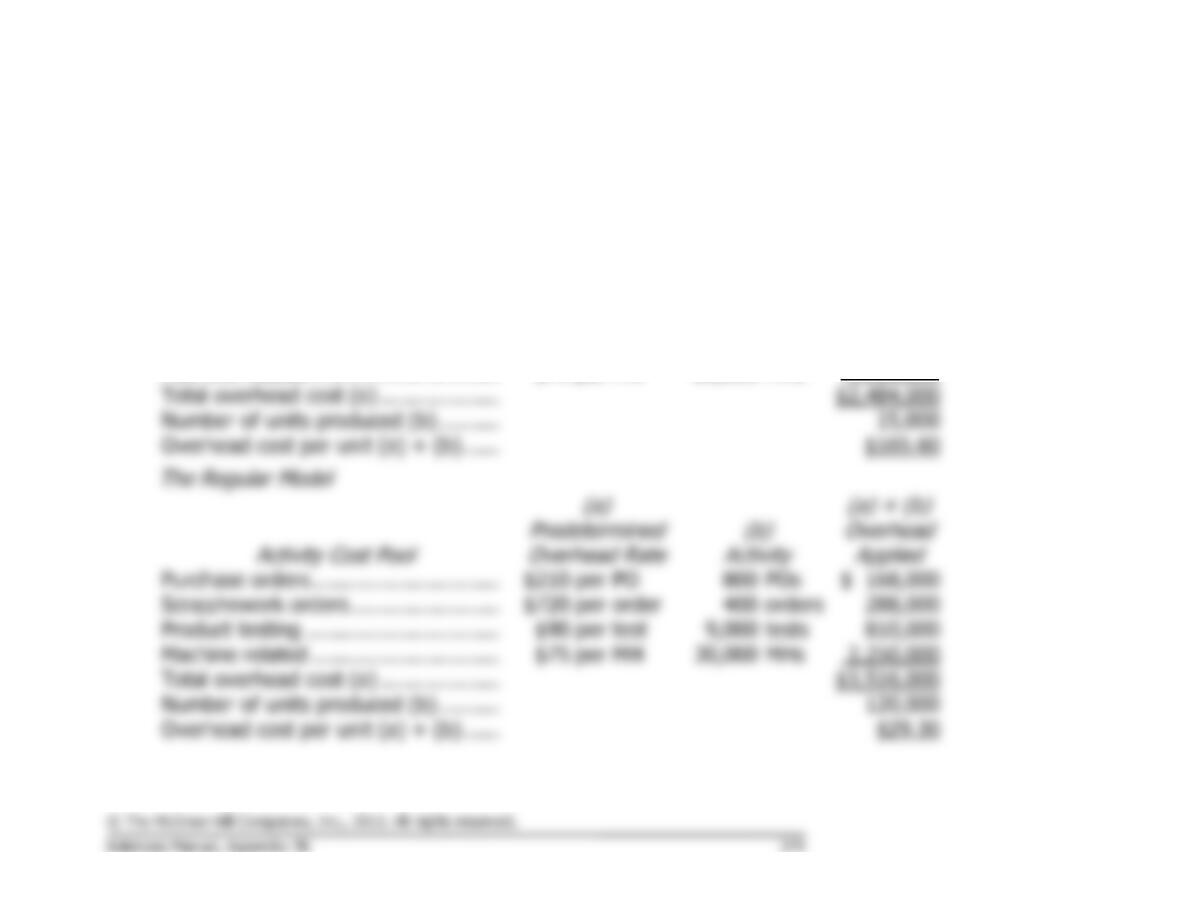
3. a. The overhead applied to each product can be determined as follows:
The Deluxe Model
Activity Cost Pool
(a)
Predetermined
Overhead Rate
(b)
Activity
(a) × (b)
Overhead
Applied
Purchase orders …………………………
$210
per PO
400
POs
$ 84,000
Scrap/rework orders ……………………
$720
per order
500
orders
360,000
Product testing ………………………….
$90
per test
6,000
tests
540,000
Machine related …………………………
$75
per MH
20,000
MHs
1,500,000
Total overhead cost (a) ……………….
Number of units produced (b) ……….
Overhead cost per unit (a) ÷ (b) ……
$165.60
Activity Cost Pool
(a)
(a) × (b)
Purchase orders …………………………
$210
per PO
800
POs
Scrap/rework orders ……………………
$720
per order
400
orders
288,000
Product testing ………………………….
$90
per test
9,000
tests
810,000
Machine related …………………………
$75
per MH
30,000
MHs
2,250,000
Total overhead cost (a) ……………….
Number of units produced (b) ……….
Overhead cost per unit (a) ÷ (b) ……
Problem 7B-3 (continued)
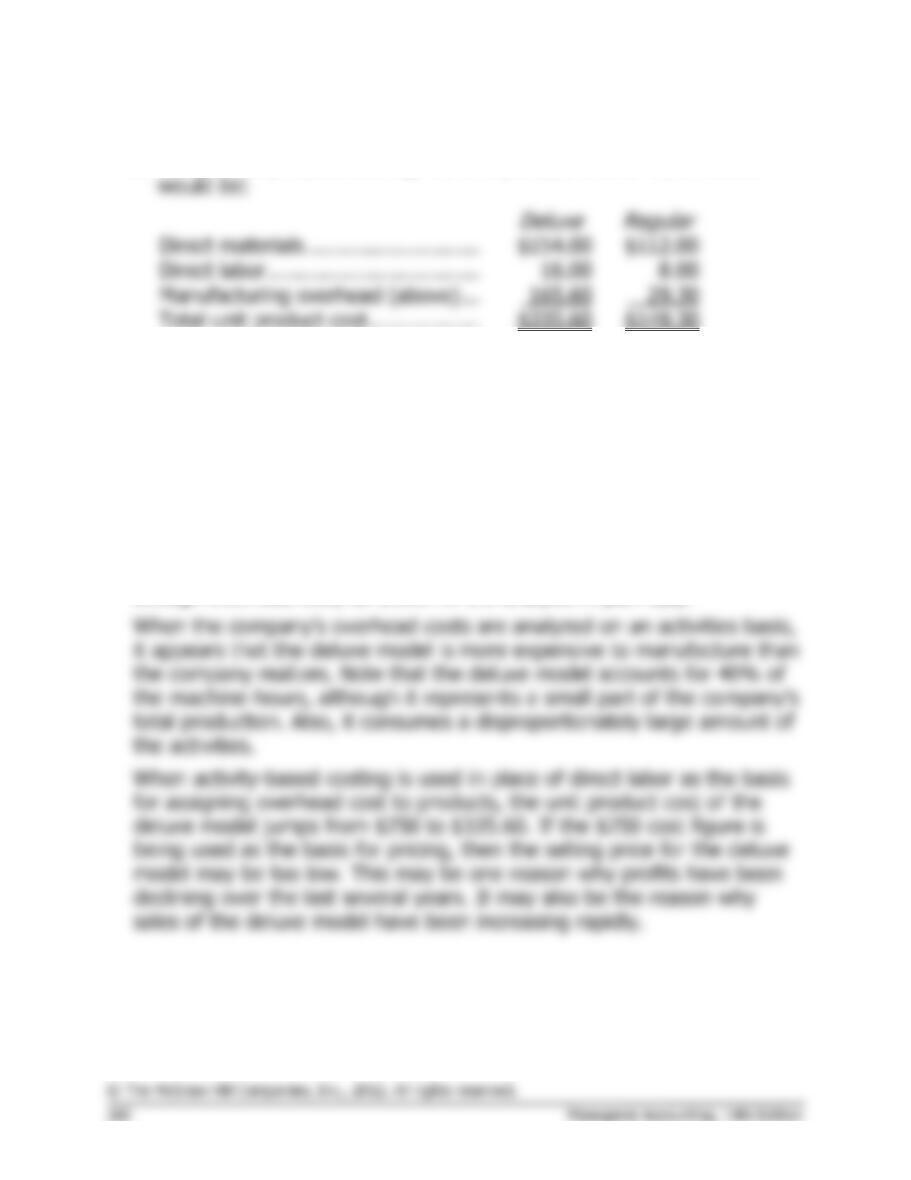
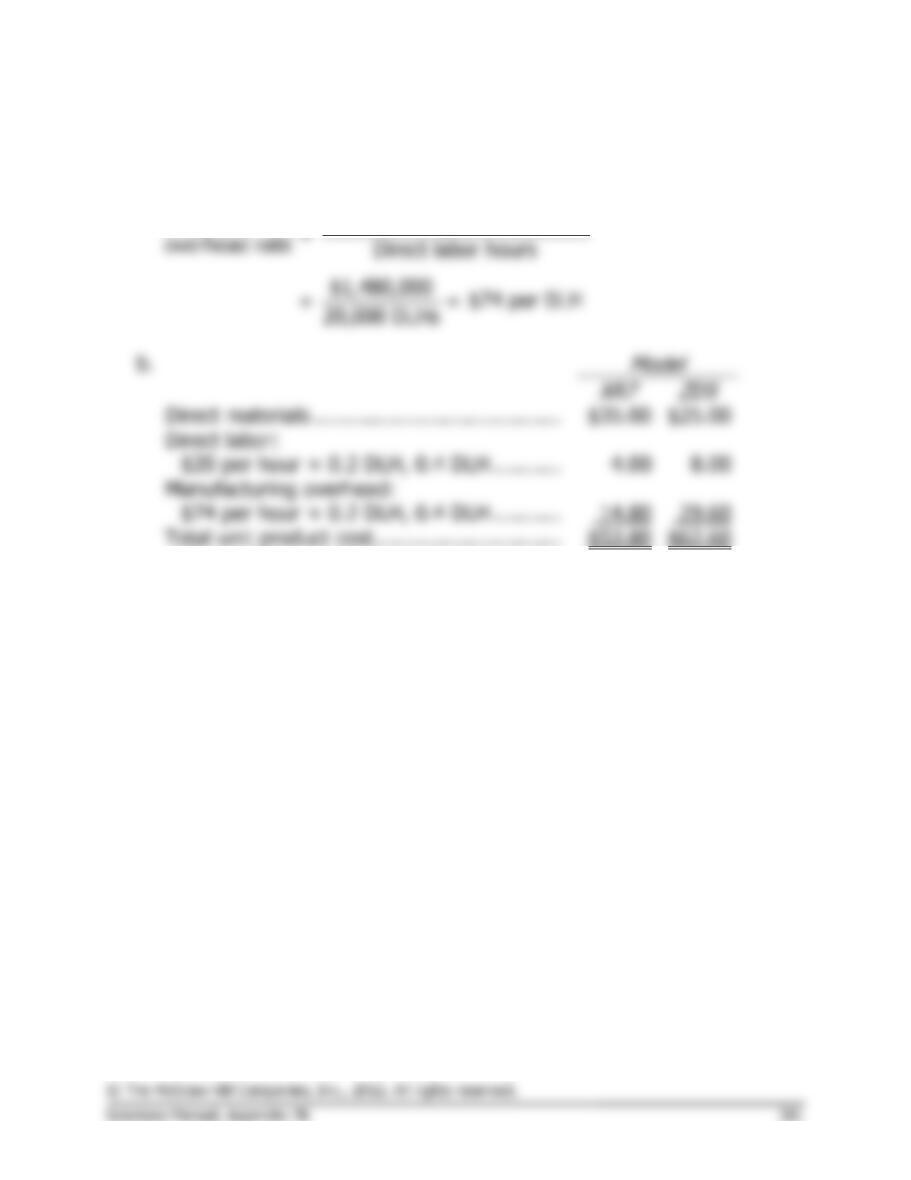
b. Using activity-based costing, the unit product cost of each model
4. It is risky to draw any definite conclusions based on the above analysis.
The activity-based costing system used in this company is not
completely suitable for making decisions. Product costs probably include
the costs of idle capacity and organization-sustaining costs. They also
exclude nonmanufacturing costs that may be caused by the products.
Nevertheless, the above analysis is suggestive. Unit costs appear to be
distorted as a result of using direct labor-hours as the base for assigning
overhead cost to products. Although the deluxe model requires twice as
much labor time as the regular model, it still is not being assigned
enough overhead cost, as shown in the analysis in part 3(a).
Problem 7B-4 (60 minutes)
1. a. When direct labor-hours are used to apply overhead cost to products,
the company’s predetermined overhead rate would be:
Direct materials ………………………………….
Total unit product cost …………………………
Manufacturing overhead cost
Predetermined
2. a. Predetermined overhead rates for the activity cost pools:
Activity Cost Pool
(a)
Estimated
Total Cost
(b)
Estimated
Total Activity
(a) ÷ (b)
Activity Rate
Machine setups ….
$180,000
250
setups
$720
per setup
Special milling ……
$300,000
1,000
MHs
$300
per MH
General factory ….
$1,000,000
20,000
DLHs
$50
per DLH
Problem 7B-4 (continued)
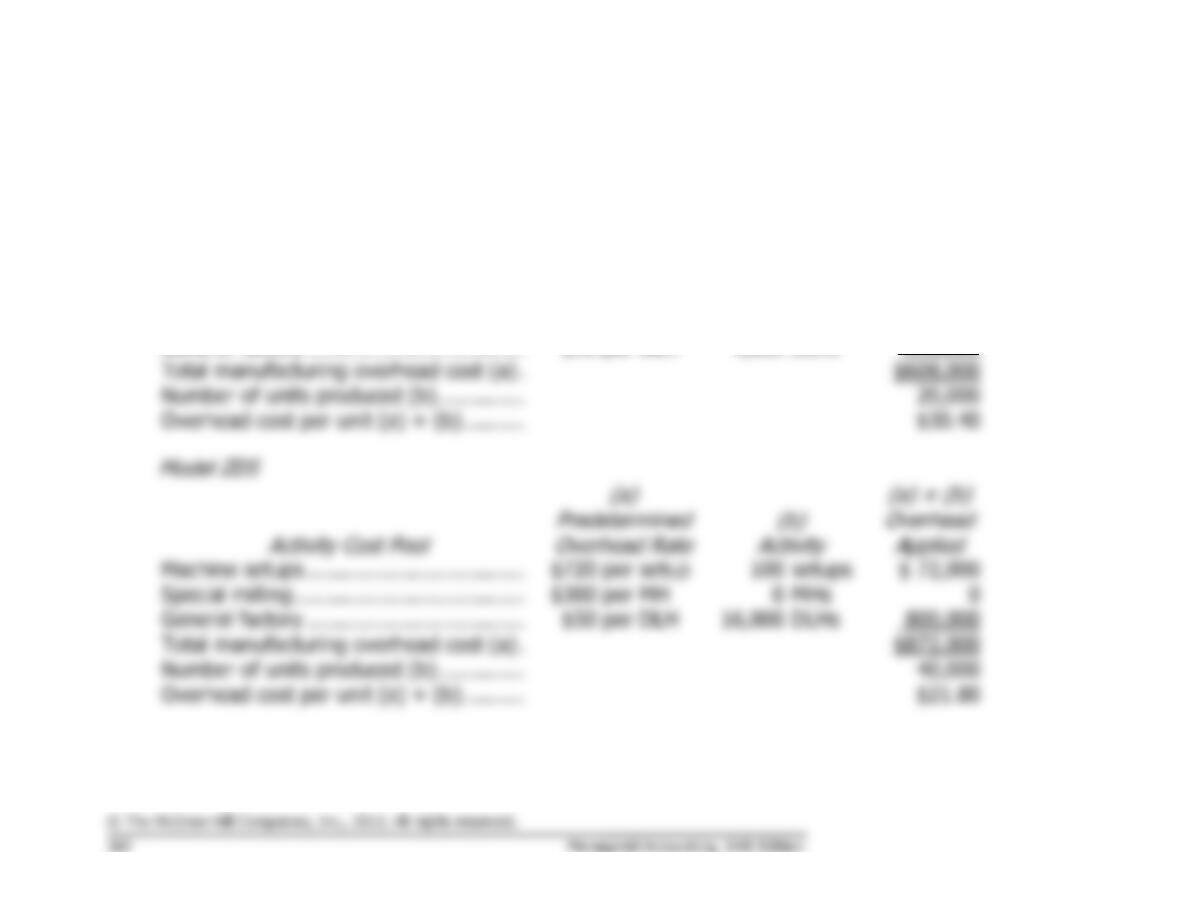
The overhead applied to each product can be determined as follows:
Model XR7
Activity Cost Pool
(a)
Predetermined
Overhead Rate
(b)
Activity
(a) × (b)
Overhead
Applied
Machine setups ……………………………..
$720
per setup
150
setups
$108,000
Special milling …………………………..…..
$300
per MH
1,000
MHs
300,000
General factory …………………………..…
$50
per DLH
4,000
DLHs
200,000
Total manufacturing overhead cost (a) .
$608,000
Number of units produced (b) …………..
Overhead cost per unit (a) ÷ (b) ……….
Activity Cost Pool
(b)
Machine setups ……………………………..
$720
per setup
100
setups
Special milling …………………………..…..
$300
per MH
MHs
General factory …………………………..…
per DLH
DLHs
Total manufacturing overhead cost (a) .
Number of units produced (b) …………..
Overhead cost per unit (a) ÷ (b) ……….
Problem 7B-4 (continued)
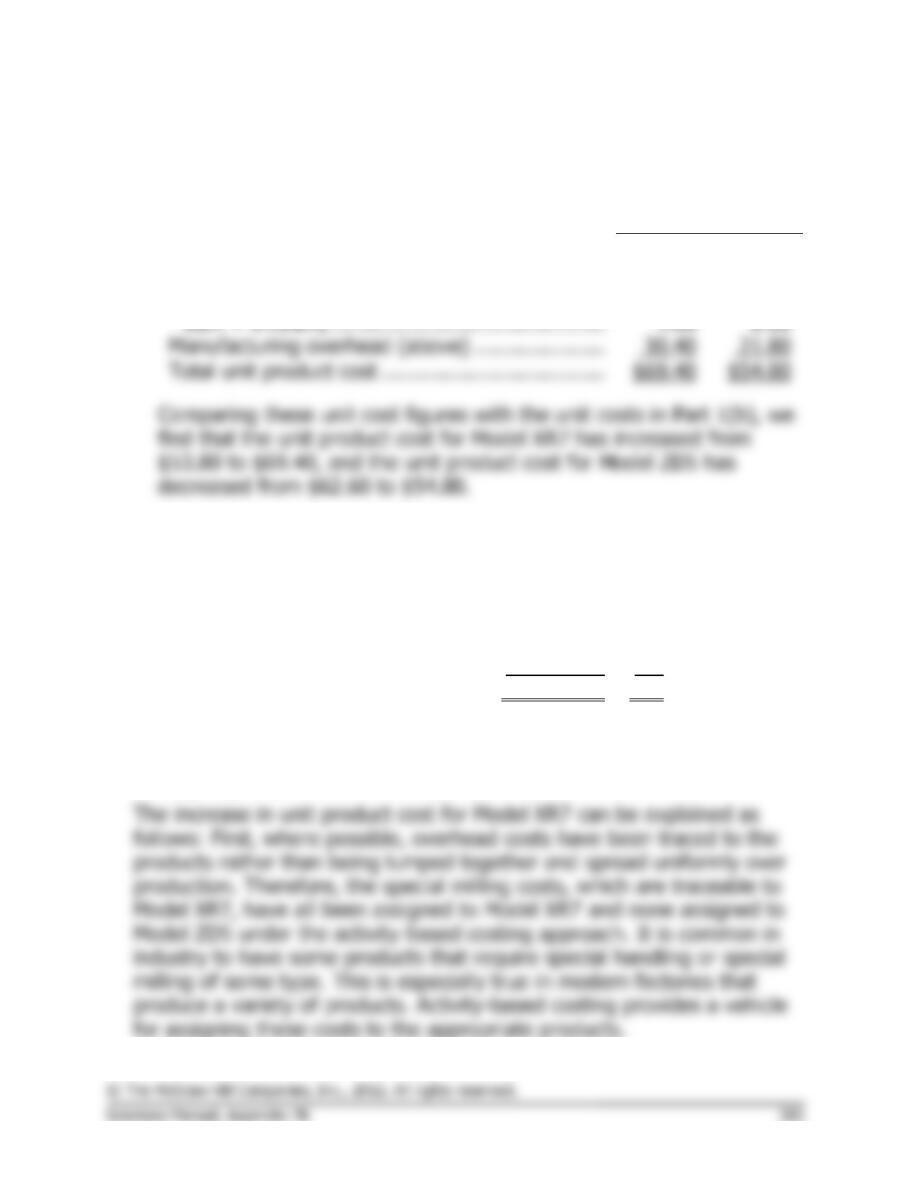
b. The unit product cost of each model under activity-based costing
would be computed as follows:
Model
XR7
ZD5
Direct materials ……………………………………….
$35.00
$25.00
4.00
Manufacturing overhead (above) …………………
Total unit product cost ………………………………
$69.40
$54.80
Direct labor ($20 per DLH × 0.2 DLH; $20 per
3. It is especially important to note that, even under activity-based costing,
68% of the company’s overhead costs continue to be applied to
products on the basis of direct labor-hours:
Machine setups (number of setups) …
$ 180,000
12
%
Special milling (machine-hours) ………
300,000
20
General factory (direct labor-hours) …
1,000,000
68
Total overhead cost ……………………..
$1,480,000
100
%
Thus, the shift in overhead cost from the high-volume product (Model
ZD5) to the low-volume product (Model XR7) occurred as a result of
reassigning only 32% of the company’s overhead costs.
Problem 7B-4 (continued)
Second, the costs associated with the batch-level activity (machine
setups) have also been assigned to the specific products to which they
relate. These costs have been assigned according to the number of
setups completed for each product. However, because a batch-level
Model XR7:
Cost to complete one setup [see 2(a)] ………
$720
(a)
Number of units processed per setup
(20,000 units ÷ 150 setups) …………………
133.33
(b)
Setup cost per unit (a) ÷ (b) …………………..
$5.40
Model ZD5:
Cost to complete one setup (above) …………
$720
(a)
Number of units processed per setup
(40,000 units ÷ 100 setups) …………………
400
(b)
Setup cost per unit (a) ÷ (b) …………………..
$1.80
Case 7B-5 (90 minutes)
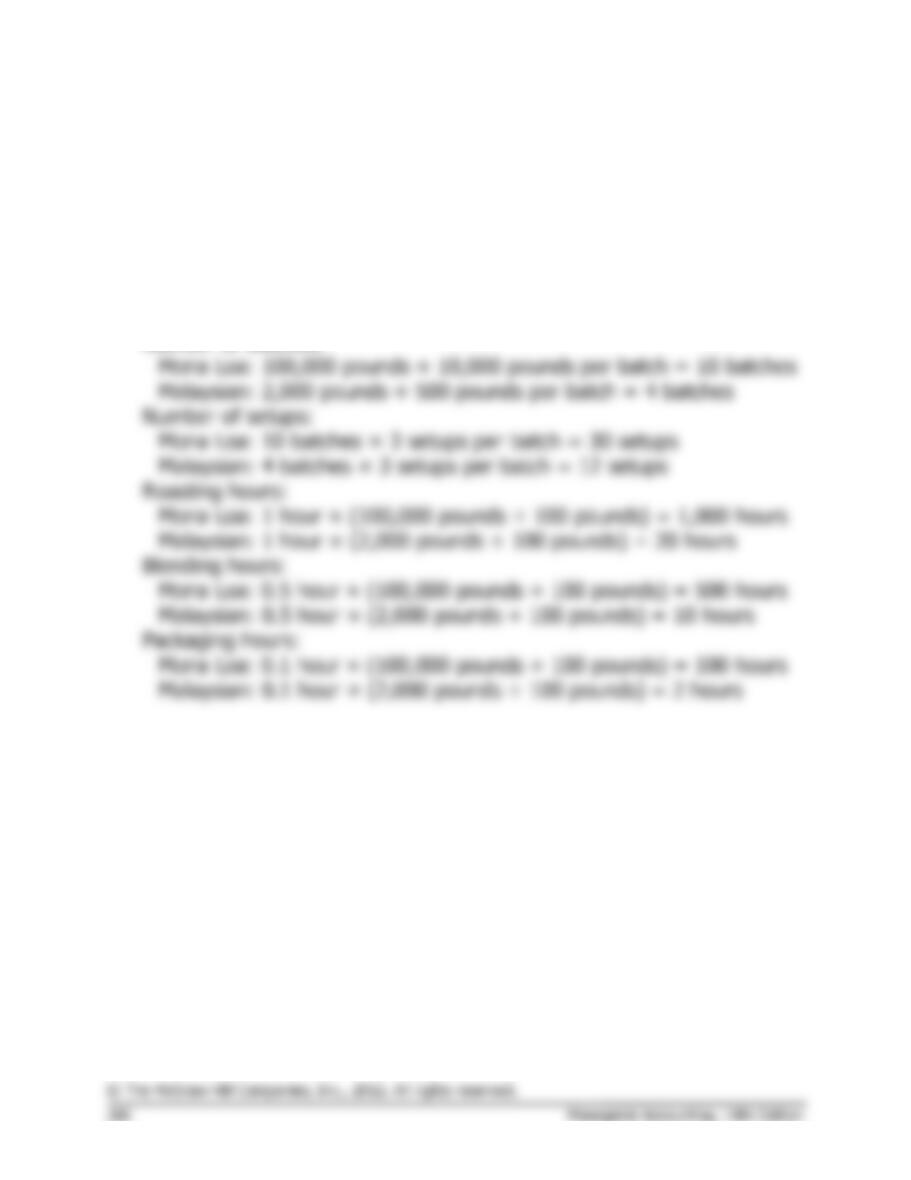
1. a. The predetermined overhead rate would be computed as follows:
Expected manufacturing overhead cost $3,000,000
=
Estimated direct labor-hours 50,000 DLHs
=$60 per DLH
Total unit product cost ………….
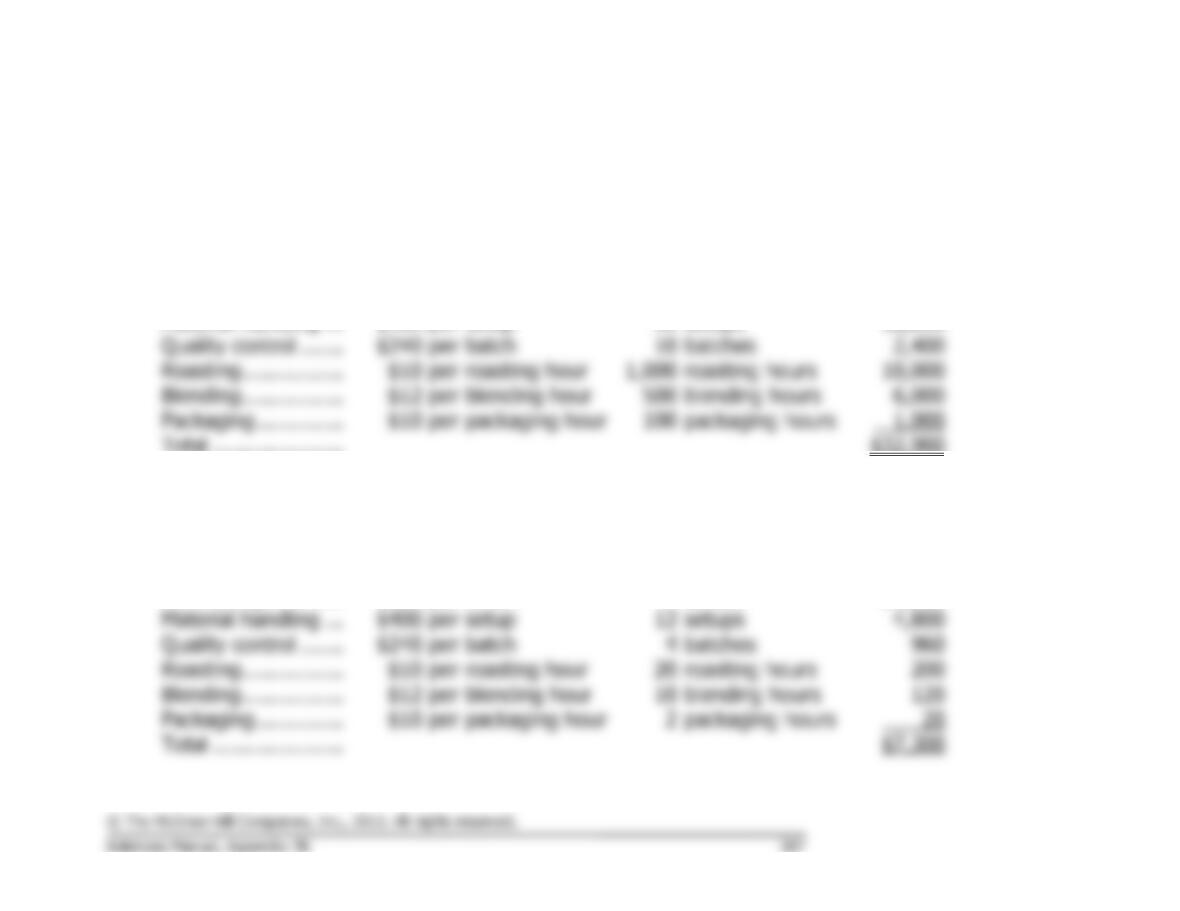
2. a. Overhead rates by activity center:
Activity Center
(a)
Estimated
Overhead
Costs
(b)
Expected
Activity
(a) ÷ (b)
Predetermined
Overhead Rate
Purchasing ………..
$513,000
1,710 orders
$300 per order
Material handling ..
$720,000
1,800 setups
$400 per setup
Quality control ……
$144,000
$240 per batch
Packaging ………….
$260,000
Case 7B-5 (continued)
Before we can determine the amount of overhead cost to assign to
the products we must first determine the activity for each of the
products in the six activity centers. The necessary computations
follow:
Number of purchase orders:
Mona Loa: 100,000 pounds ÷ 20,000 pounds per order = 5 orders
Malaysian: 2,000 pounds ÷ 500 pounds per order = 4 orders
Number of batches:
Mona Loa: 100,000 pounds ÷ 10,000 pounds per batch = 10 batches
Malaysian: 2,000 pounds ÷ 500 pounds per batch = 4 batches
Number of setups:
Mona Loa: 10 batches × 3 setups per batch = 30 setups
Malaysian: 4 batches × 3 setups per batch = 12 setups
Roasting hours:
Mona Loa: 1 hour × (100,000 pounds ÷ 100 pounds) = 1,000 hours
Malaysian: 1 hour × (2,000 pounds ÷ 100 pounds) = 20 hours
Blending hours:
Mona Loa: 0.5 hour × (100,000 pounds ÷ 100 pounds) = 500 hours
Packaging hours:
Mona Loa: 0.1 hour × (100,000 pounds ÷ 100 pounds) = 100 hours
Malaysian: 0.1 hour × (2,000 pounds ÷ 100 pounds) = 2 hours
Case 7B-5 (continued)
The overhead applied to each product can be determined as follows:
Mona Loa
Activity Cost Pool
(a)
Predetermined
Overhead Rate
(b)
Activity
(a) × (b)
Overhead
Applied
Purchasing ………….
$300
per order
5
orders
$ 1,500
Material handling …
$400
per setup
30
setups
12,000
Quality control …….
$240
per batch
10
batches
2,400
Roasting …………….
per roasting hour
roasting hours
Blending …………….
per blending hour
blending hours
6,000
Packaging …………..
per packaging hour
packaging hours
Total …………………
$32,900
Malaysian
Activity Cost Pool
(a)
Predetermined
Overhead Rate
(b)
Activity
(a) × (b)
Overhead
Applied
Purchasing ………….
$300
per order
4
orders
$1,200
Material handling …
$400
per setup
setups
4,800
Quality control …….
$240
per batch
4
batches
Roasting …………….
per roasting hour
20
roasting hours
Blending …………….
per blending hour
blending hours
Packaging …………..
per packaging hour
2
packaging hours
Total …………………
Case 7B-5 (continued)
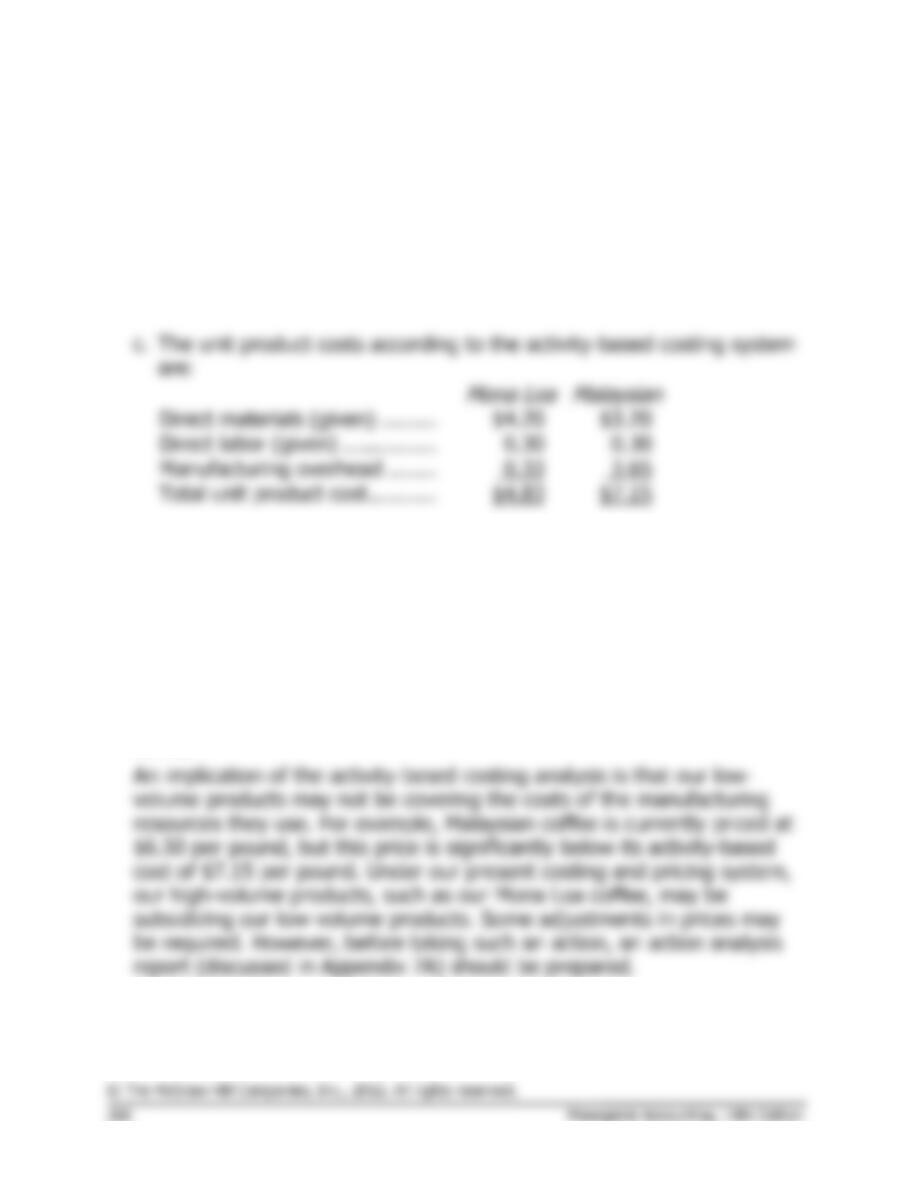
b. According to the activity-based costing system, the manufacturing
overhead cost per pound is:
Mona Loa
Malaysian
Total overhead cost assigned (above) (a) …
$32,900
$7,300
Number of pounds manufactured (b) ……….
100,000
2,000
Cost per pound (a) ÷ (b) ………………………
$0.33
$3.65
Direct materials (given) ………
Direct labor (given) ……………
Manufacturing overhead ……..
Total unit product cost ………..
3. MEMO TO THE PRESIDENT: Analysis of CBI’s data shows that several
activities other than direct labor drive the company’s manufacturing
overhead costs. These activities include purchase orders issued, number
of setups for material processing, and number of batches processed.
The company’s present costing system, which relies on direct labor time
as the sole basis for assigning overhead cost to products, significantly
undercosts low-volume products, such as the Malaysian coffee, and
significantly overcosts high-volume products, such as our Mona Loa
coffee.
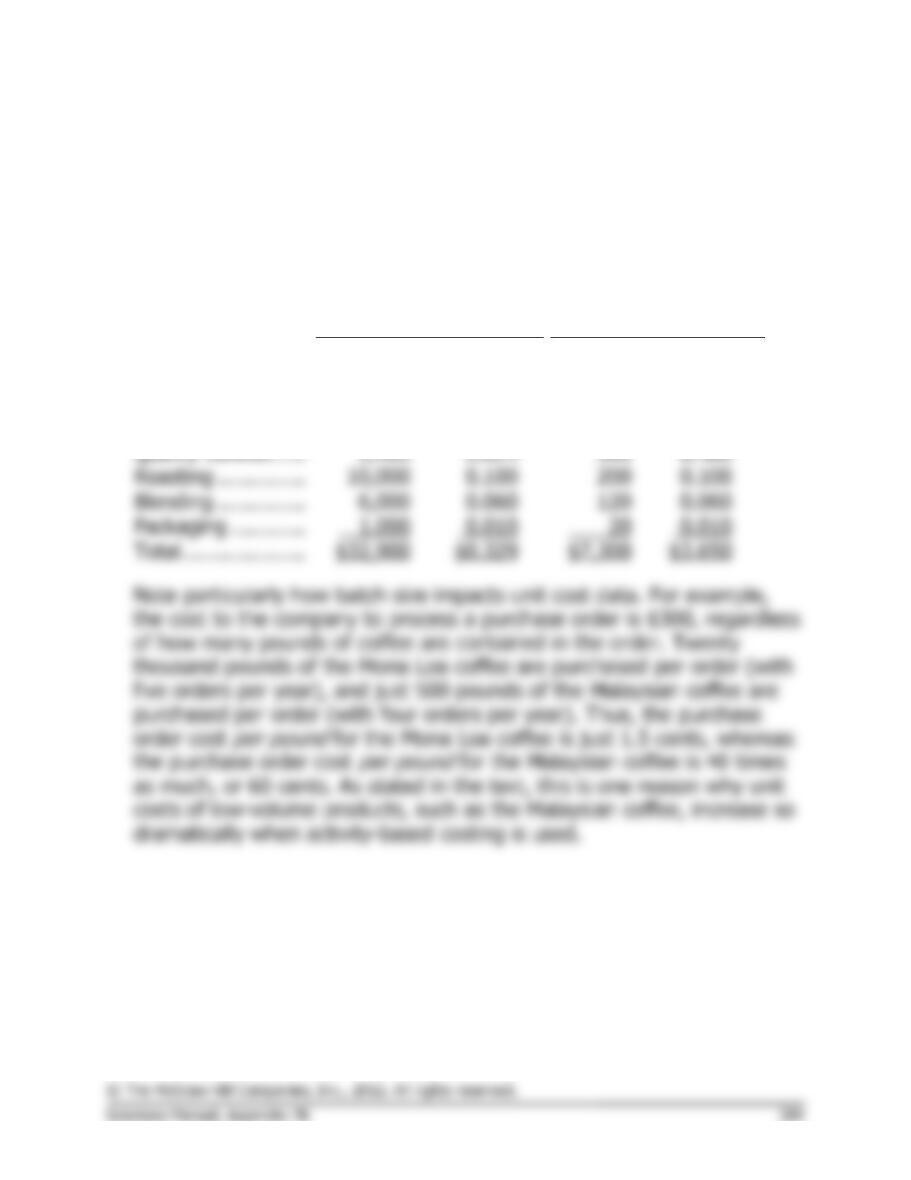
Case 7B-5 (continued)
ALTERNATIVE SOLUTION:
Many students will compute the manufacturing overhead cost per pound
of the two coffees as shown above. However, the cost per pound can
also be computed as shown below.
This alternative approach provides
additional insight into the data and facilitates emphasis of some points
made in the chapter.
Mona Loa
Malaysian
Total
Per Pound
(÷ 100,000)
Total
Per Pound
(÷ 2,000)
Purchasing ………..
$ 1,500
$0.015
$1,200
$0.600
Material handling ..
12,000
0.120
4,800
2.400
Blending …………..
6,000
0.060
0.060
Packaging …………
0.010
Total ………………..
$0.329
$7,300
$3.650