CHAPTER 6 – 1
CHAPTER 7
EQUITY MARKETS AND STOCK
VALUATION
Answers to Concepts Review and Critical Thinking Questions
1. The value of any investment depends on its cash flows; i.e., what investors will actually receive. The
cash flows from a share of stock are the dividends.
4. The general method for valuing a share of stock is to find the present value of all expected future
dividends. The dividend growth model presented in the text is only valid (i) if dividends are expected
to occur forever; that is, the stock provides dividends in perpetuity, and (ii) if a constant growth rate
of dividends occurs forever. A violation of the first assumption might be a company that is expected
to cease operations and dissolve itself some finite number of years from now. The stock of such a
company would be valued by the methods of this chapter by applying the general method of valuation.
A violation of the second assumption might be a start–up firm that isn’t currently paying any dividends,
but is expected to eventually start making dividend payments some number of years from now. This
stock would also be valued by the general dividend valuation method of this chapter.
CHAPTER 6 – 2
8. For a particular year, this can (and often does) happen. Going back to the cash flow identity, the
dividend payments depend on operating cash flow, capital spending, the change in net working capital,
and the cash flow to creditors. The firm could have positive operating cash flow with negative
9. It wouldn’t seem to be. Investors who don’t like the voting features of a particular class of stock are
under no obligation to buy it.
10. Investors buy such stock because they want it, recognizing that the shares have no voting power.
Presumably, investors pay less for such shares than they would otherwise.
13. In a declassified board, every board seat is up for election every year. This structure allows investors
to vote out a director (and even the entire board) much more quickly if investors are dissatisfied.
However, this structure also makes it more difficult to fight off a hostile takeover bid. In contrast, a
classified board can more effectively negotiate on behalf of stockholders, perhaps securing better terms
in a deal. Classified boards are also important for institutional memory. If an entire board were voted
out in a single year, there would be no board members available to evaluate the company’s direction
with regards to previous decisions.
CHAPTER 6 – 3
Solutions to Questions and Problems
NOTE: All end-of–chapter problems were solved using a spreadsheet. Many problems require multiple
steps. Due to space and readability constraints, when these intermediate steps are included in this solutions
manual, rounding may appear to have occurred. However, the final answer for each problem is found
without rounding during any step in the problem.
Basic
1. The constant dividend growth model is:
Pt = Dt × (1 + g) / (R – g)
The dividend at Year 4 is the dividend today times the FVIF for the growth rate in dividends and four
years, so:
P3 = D3 (1 + g) / (R – g)
P3 = D0 (1 + g)4 / (R – g)
P3 = $2.35(1.041)4 / (.104 – .041)
P3 = $43.81
There is another feature of the constant dividend growth model: The stock price grows at the dividend
growth rate. So, if we know the stock price today, we can find the future value for any time in the
future we want to calculate the stock price. In this problem, we want to know the stock price in three
years, and we have already calculated the stock price today. The stock price in three years will be:
P3 = P0(1 + g)3
P3 = $38.83(1 + .041)3
P3 = $43.81
CHAPTER 6 – 4
2. We need to find the required return of the stock. Using the constant growth model, we can solve the
equation for R. Doing so, we find:
R = (D1 / P0) + g
R = ($2.48 / $39.85) + .045
R = .1072, or 10.72%
4. Using the constant growth model, we find the price of the stock today is:
P0 = D1 / (R – g)
P0 = $3.65 / (.11 – .051)
P0 = $61.86
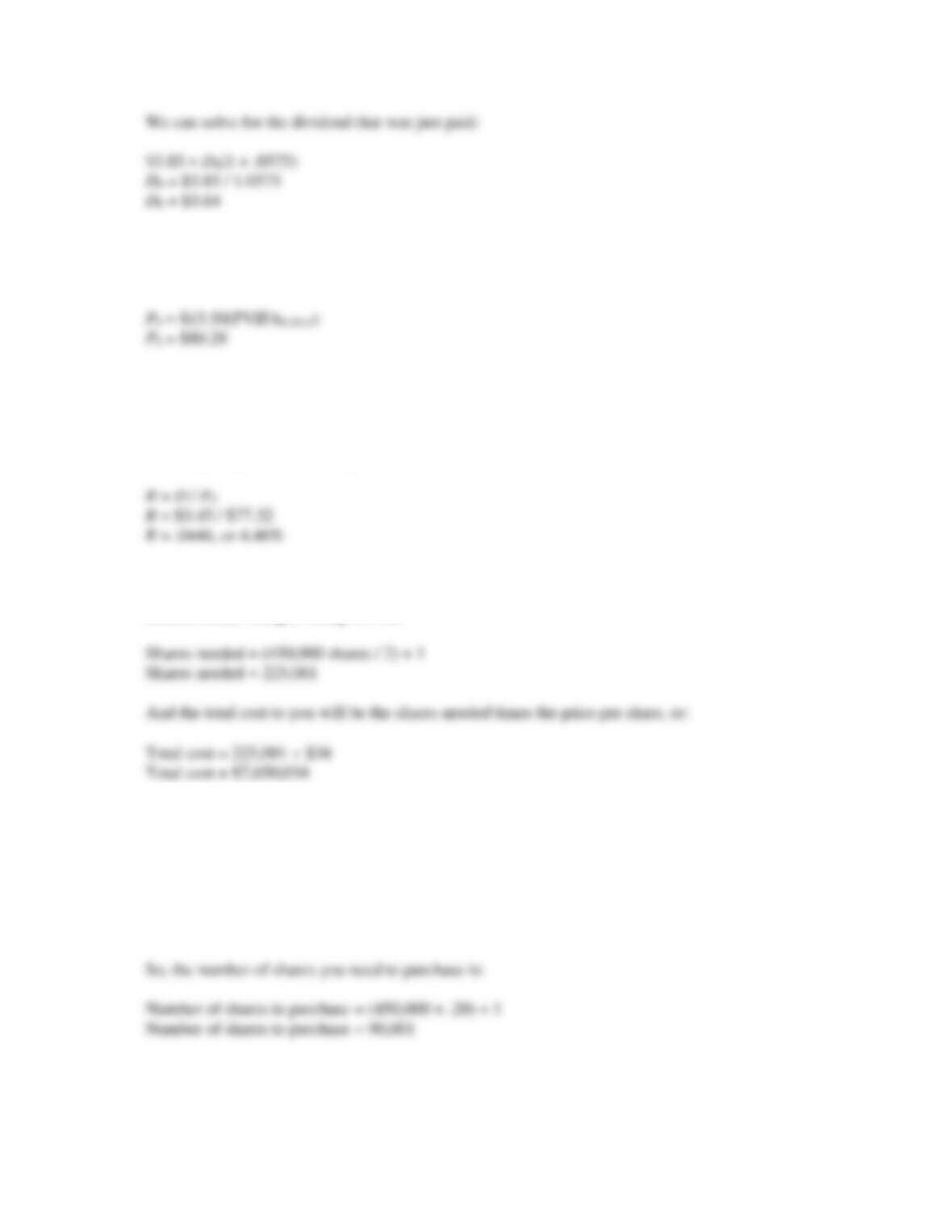
6. We know the stock has a required return of 11.5 percent, and the dividend and capital gains yields are
equal, so:
Dividend yield = 1/2(.115)
Dividend yield = .0575 = Capital gains yield
Now we know both the dividend yield and capital gains yield. The dividend is simply the stock price
times the dividend yield, so:
CHAPTER 6 – 5
7. The price of any financial instrument is the present value of the future cash flows. The future dividends
of this stock are an annuity for 9 years, so the price of the stock is the present value of an annuity,
which will be:
8. The price of a share of preferred stock is the dividend divided by the required return. This is the same
equation as the constant growth model, with a dividend growth rate of zero percent. Remember, most
preferred stock pays a fixed dividend, so the growth rate is zero. This is a special case of the dividend
growth model where the growth rate is zero, or the level perpetuity equation. Using this equation, we
find the price per share of the preferred stock is:
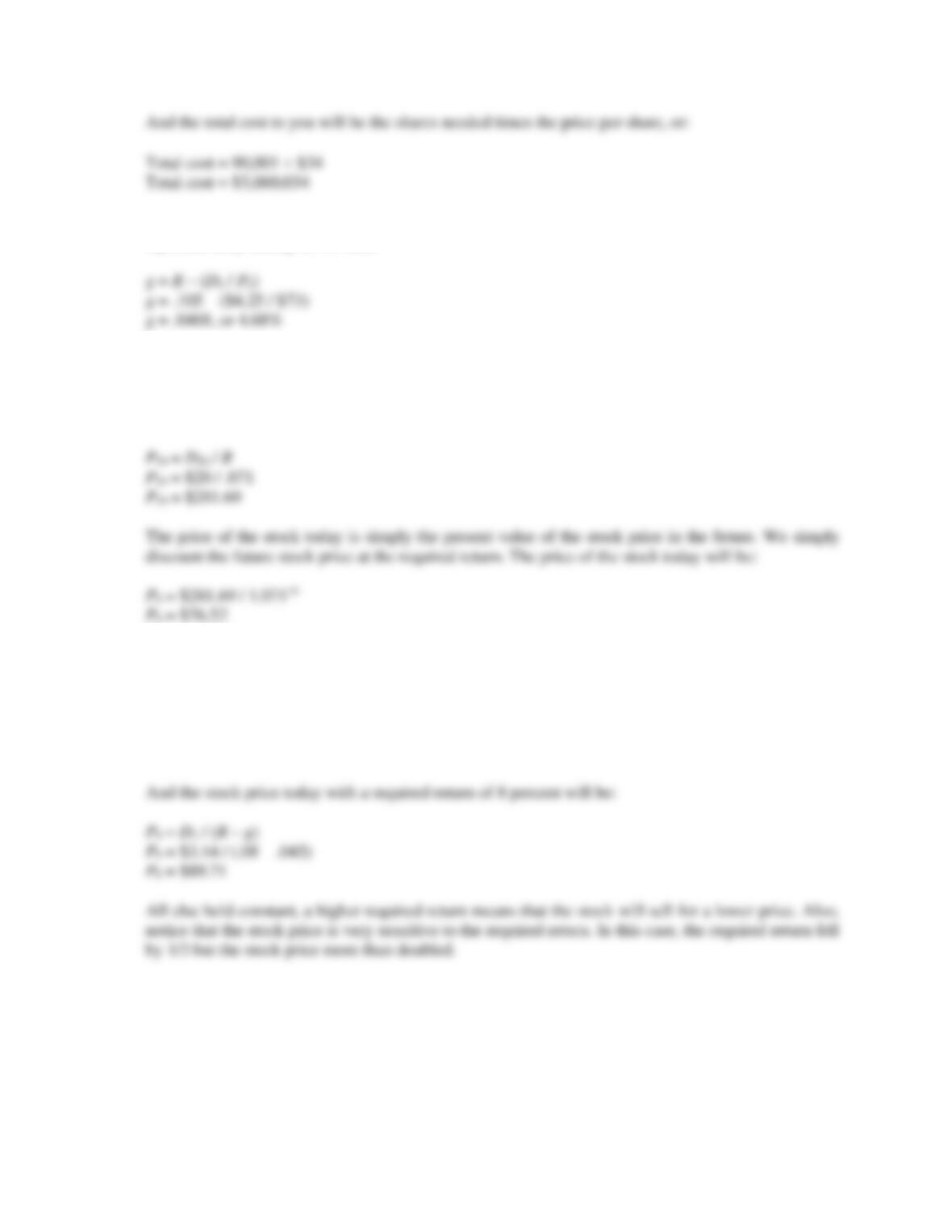
9. If the company uses straight voting, you will need to own one-half of the shares, plus one share, in
order to guarantee enough votes to win the election. So, the number of shares needed to guarantee
election under straight voting will be:
If the company uses cumulative voting, you will need 1/(N + 1) percent of the stock (plus one share)
to guarantee election, where N is the number of seats up for election. So, the percentage of the
company’s stock you need will be:
Percent of stock needed = 1 / (N + 1)
Percent of stock needed = 1 / (4 + 1)
Percent of stock needed = .20, or 20%
CHAPTER 6 – 6
10. We need to find the growth rate of dividends. Using the constant growth model, we can solve the
equation for g. Doing so, we find:
11. Here, we have a stock that pays no dividends for 20 years. Once the stock begins paying dividends, it
will have the same dividends forever, a preferred stock. We value the stock at that point, using the
preferred stock equation. It is important to remember that the price we find will be the price one year
before the first dividend, so:
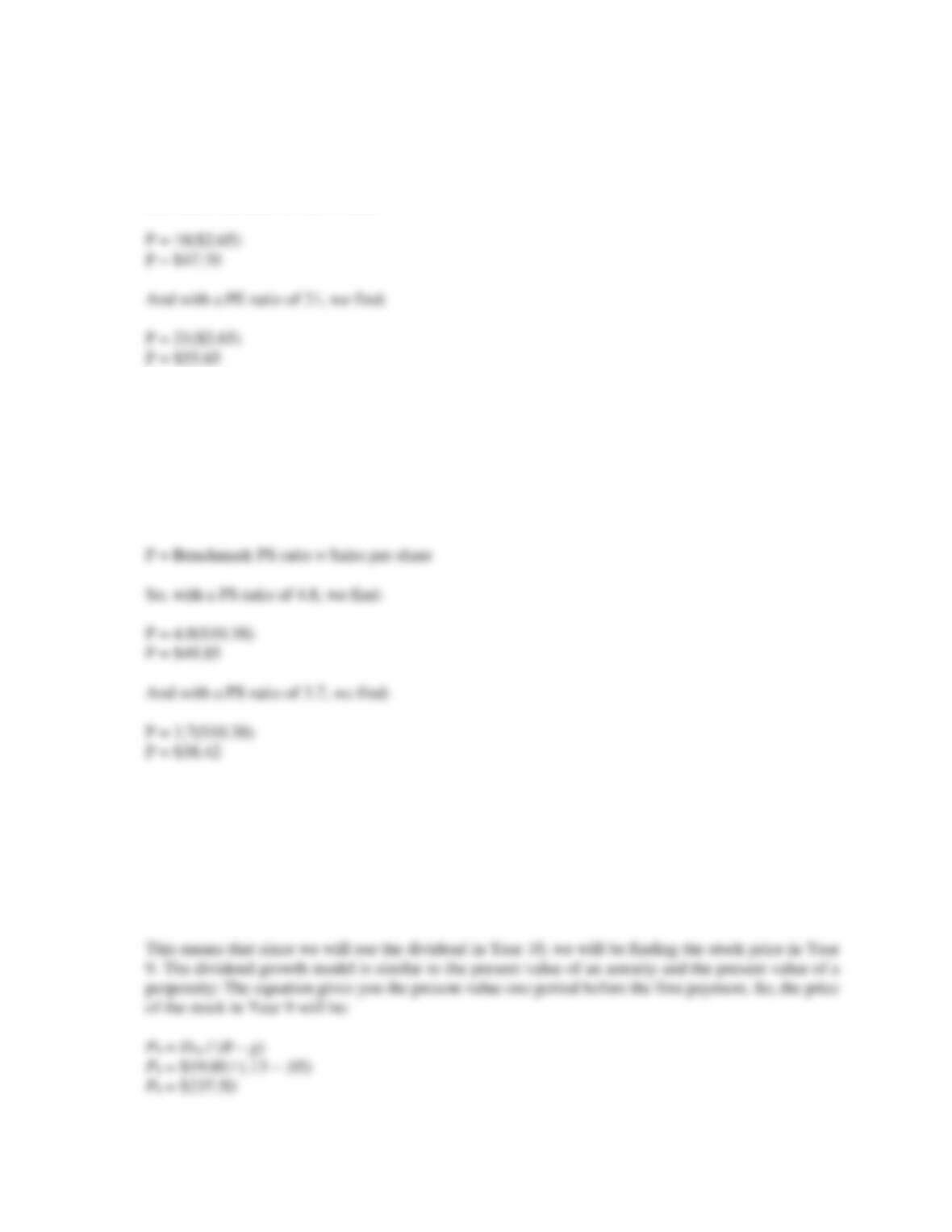
12. Here, we need to value a stock with two different required returns. Using the constant growth model
and a required return of 12 percent, the stock price today is:
P0 = D1 / (R – g)
P0 = $3.14 / (.12 – .045)
P0 = $41.87
CHAPTER 6 – 7
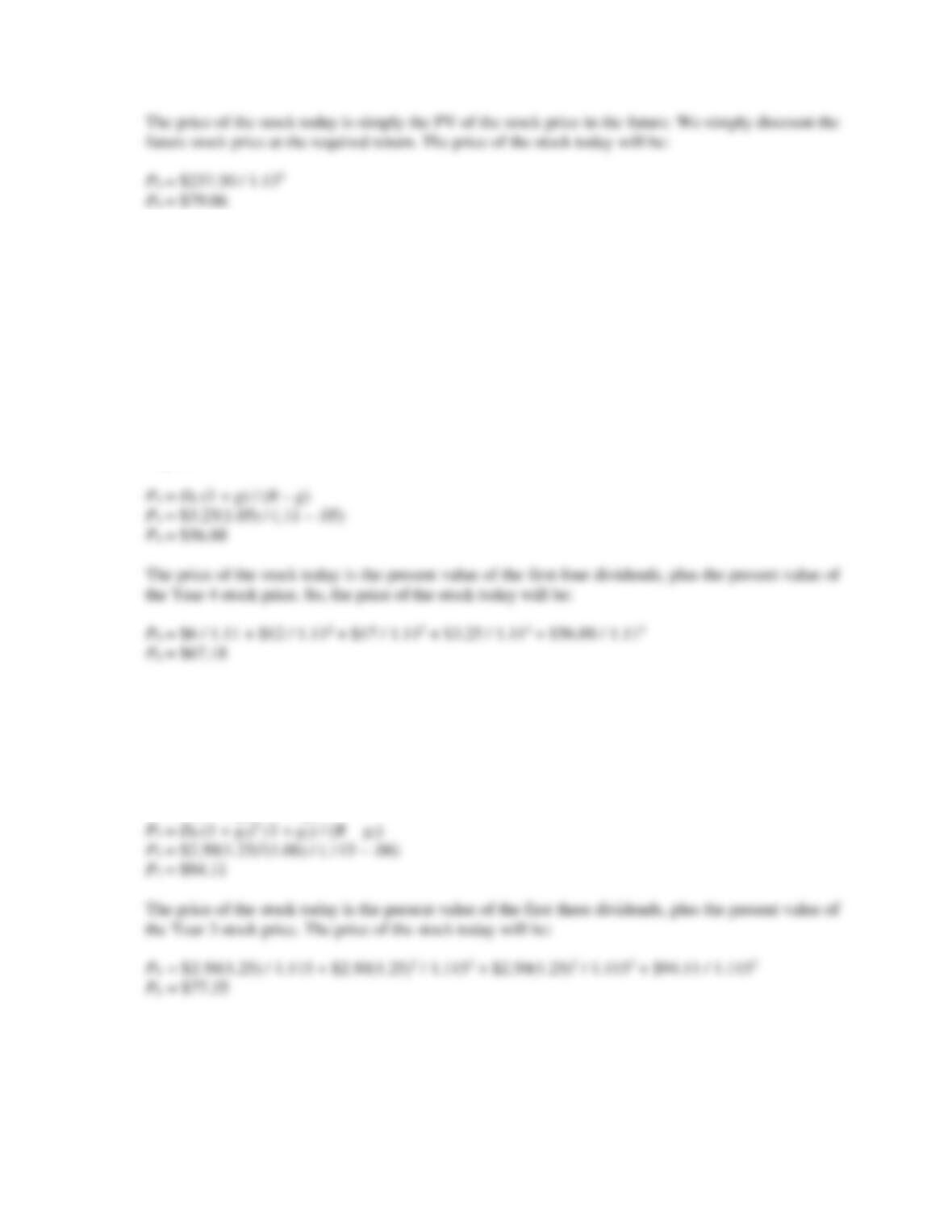
13. Using the equation to calculate the price of a share of stock with the PE ratio:
P = Benchmark PE ratio × EPS
So, with a PE ratio of 18, we find:
14. First, we need to find the sales per share, which is:
Sales per share = Sales / Shares outstanding
Sales per share = $1,350,000 / 130,000
Sales per share = $10.38
Using the equation to calculate the price of a share of stock with the PS ratio:
Intermediate
15. Here, we have a stock that pays no dividends for nine years. Once the stock begins paying dividends,
it will have a constant growth rate of dividends. We can use the constant growth model at that point.
It is important to remember that the general constant dividend growth formula is:
Pt = [Dt × (1 + g)] / (R – g)
CHAPTER 6 – 8
16. The price of a stock is the PV of the future dividends. This stock is paying four dividends, so the price
of the stock is the PV of these dividends discounted at the required return. So, the price of the stock
is:
P0 = $8 / 1.104 + $13 / 1.1042 + $18 / 1.1043 + $23 / 1.1044
P0 = $46.77
17. With nonconstant dividends, we find the price of the stock when the dividends level off at a constant
growth rate, and then find the present value of the future stock price, plus the present value of all
dividends during the nonconstant growth period. The stock begins constant growth after the fourth
dividend is paid, so we can find the price of the stock at Year 4, when the constant dividend growth
begins, as:
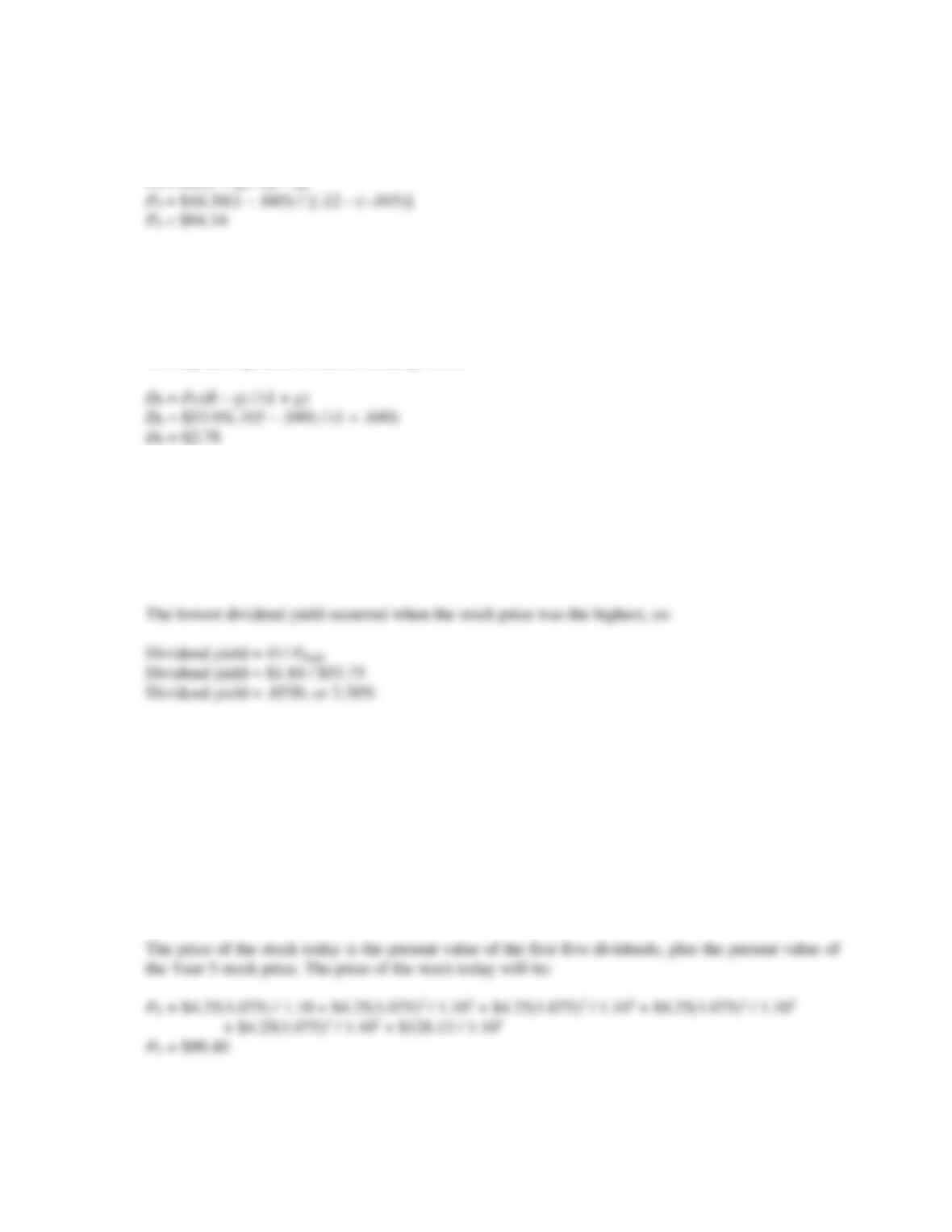
18. With nonconstant dividends, we find the price of the stock when the dividends level off at a constant
growth rate, and then find the present value of the future stock price, plus the present value of all
dividends during the nonconstant growth period. The stock begins constant growth after the third
dividend is paid, so we can find the price of the stock in Year 3, when the constant dividend growth
begins as:
P3 = D3 (1 + g2) / (R – g2)
CHAPTER 6 – 9
19. The constant growth model can be applied even if the dividends are declining by a constant percentage
just make sure to recognize the negative growth. So, the price of the stock today will be:
P0 = D0 (1 + g) / (R – g)
20. We are given the stock price, the dividend growth rate, and the required return, and are asked to find
the dividend. Using the constant dividend growth model, we get:
P0 = D0 (1 + g) / (R – g)
Solving this equation for the dividend gives us:
21. The highest dividend yield will occur when the stock price is the lowest. So, using the 52-week low
stock price, the highest dividend yield was:
Dividend yield = D / PLow
Dividend yield = $1.84 / $44.75
Dividend yield = .0411, or 4.11%
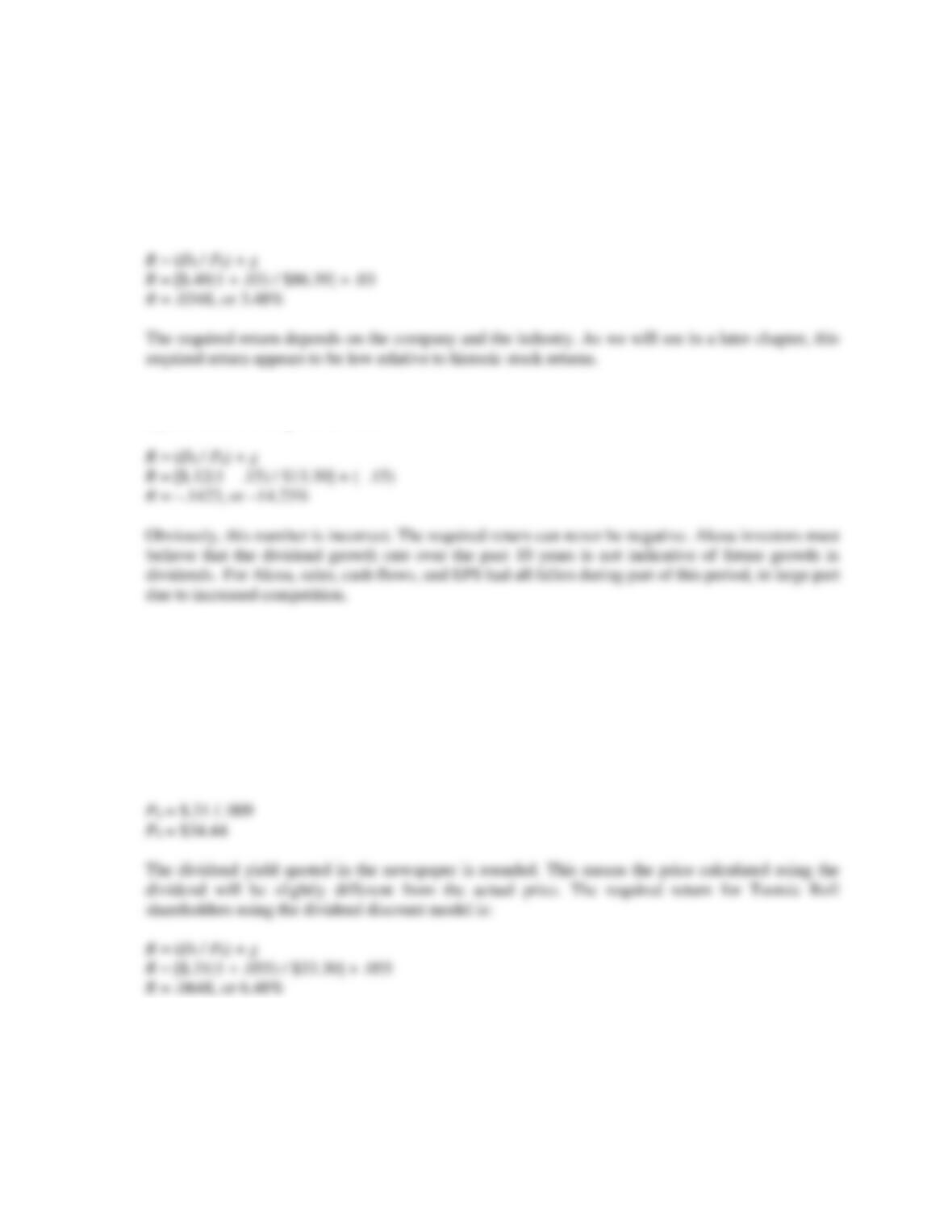
22. With nonconstant dividends, we find the price of the stock when the dividends level off at a constant
growth rate, and then find the present value of the future stock price, plus the present value of all
dividends during the nonconstant growth period. Since the first dividend with constant growth is in
Year 6, we can find the price of the stock in Year 5, one year before the constant dividend growth
begins as:
P5 = D6 / (R – g)
P5 = D0 (1 + g1)5 (1 + g2) / (R – g)
P5 = $4.25(1.075)5(1.05) / (.10 – .05)
P5 = $128.13
CHAPTER 6 – 10
According to the constant growth model, the stock seems to be overvalued. The factors that would
affect the stock price are both the nonconstant growth rate and the long-term growth rate, the length
of the nonconstant growth, and the required return.
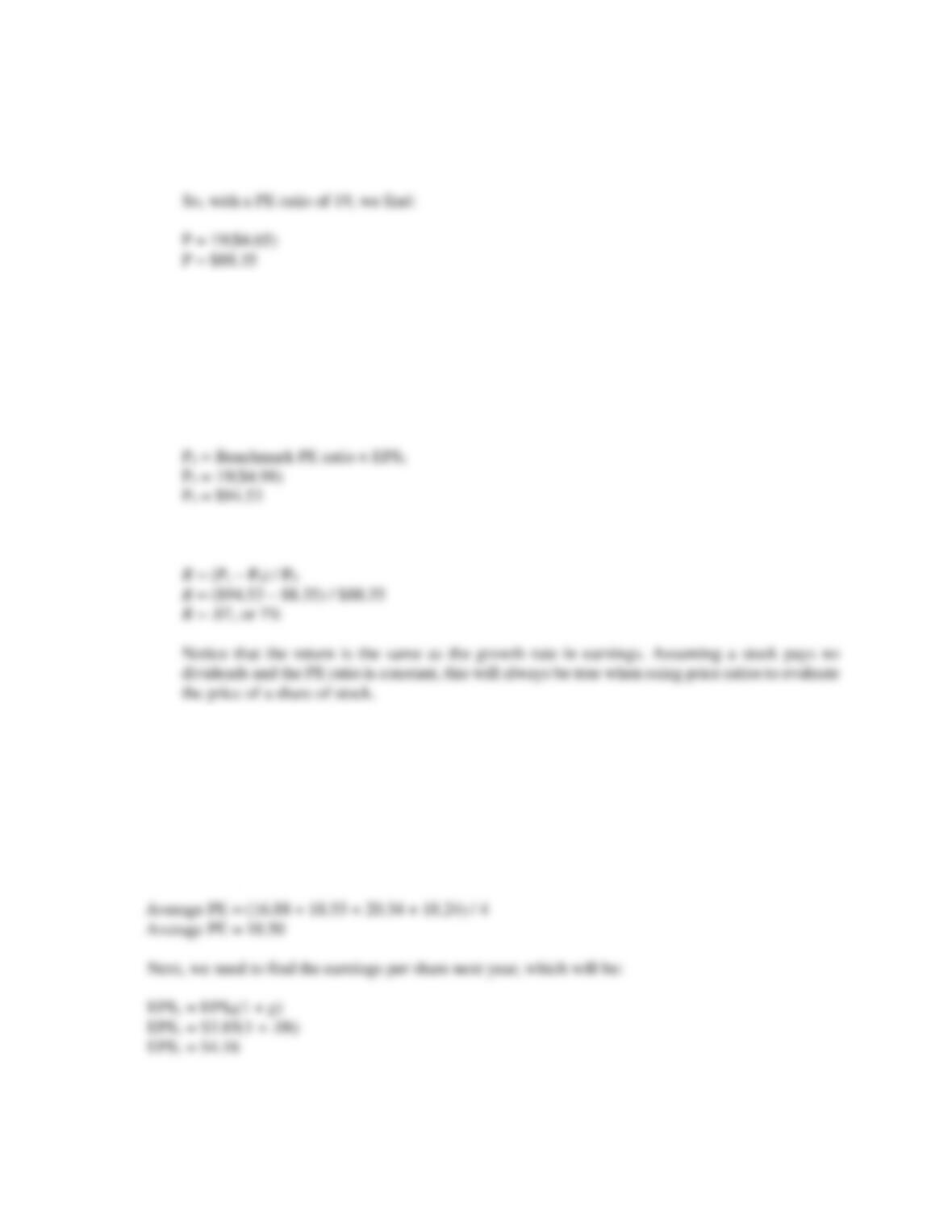
23. We need to find the required return of the stock. Using the constant growth model, we can solve the
equation for R. Doing so, we find:
24. We need to find the required return of the stock. Using the constant growth model, we can solve the
equation for R. Doing so, we find:
25. The annual dividend paid to stockholders is $.31, and the dividend yield is .90 percent. Using the
equation for the dividend yield:
Dividend yield = Dividend / Stock price
We can plug the numbers in and solve for the stock price:
.009 = $.31 / P0
As we will see in a later, this required return appears to be low relative to historic stock returns.
CHAPTER 6 – 11
26. a. Using the equation to calculate the price of a share of stock with the PE ratio:
P = Benchmark PE ratio × EPS
b. First, we need to find the earnings per share next year, which will be:
EPS1 = EPS0(1 + g)
EPS1 = $4.65(1 + .07)
EPS1 = $4.98
Using the equation to calculate the price of a share of stock with the PE ratio:
c. To find the implied return over the next year, we calculate the return as:
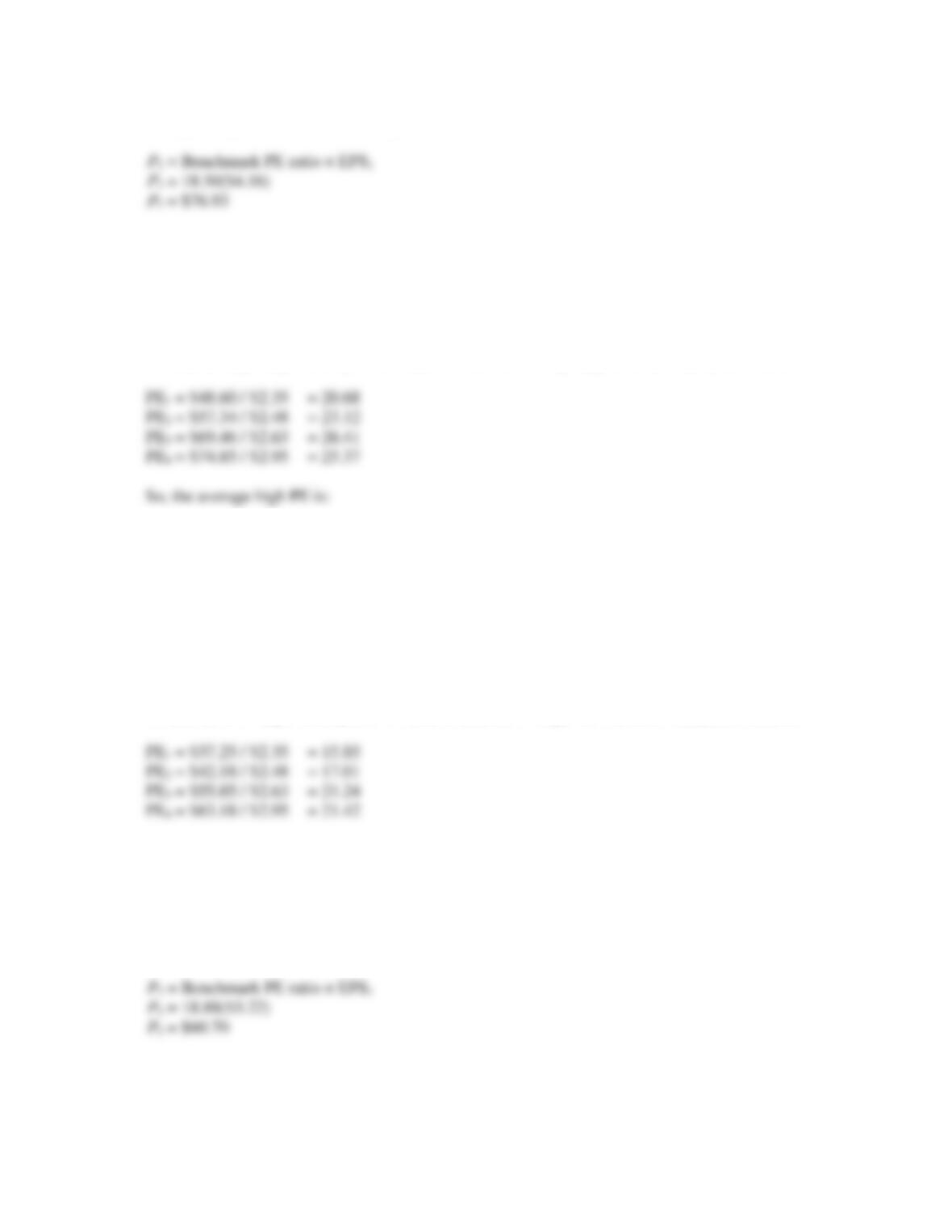
27. We need to find the PE ratio each year, which is:
PE1 = $53.18 / $3.15 = 16.88
PE2 = $62.14 / $3.35 = 18.55
PE3 = $73.21 / $3.60 = 20.34
PE4 = $70.21 / $3.85 = 18.24
So, the average PE is:
CHAPTER 6 – 12
Using the equation to calculate the price of a share of stock with the PE ratio:
28. First, we need to find the earnings per share next year, which will be:
EPS1 = EPS0(1 + g)
EPS1 = $2.95(1 + .09)
EPS1 = $3.22
To find the high target stock price, we need to find the average high PE ratio each year, which is:
Average high PE = (20.68 + 23.12 + 26.41 + 25.37) / 4
Average high PE = 23.90
Using the equation to calculate the price of a share of stock with the PE ratio, the high target price is:
P1 = Benchmark PE ratio × EPS1
P1 = 23.90($3.22)
P1 = $76.84
To find the low target stock price, we need to find the average low PE ratio each year, which is:
So, the average low PE is:
Average low PE = (15.85 + 17.01 + 21.24 + 21.42) / 4
Average low PE = 18.88
Using the equation to calculate the price of a share of stock with the PE ratio, the low target price is:
CHAPTER 6 – 13
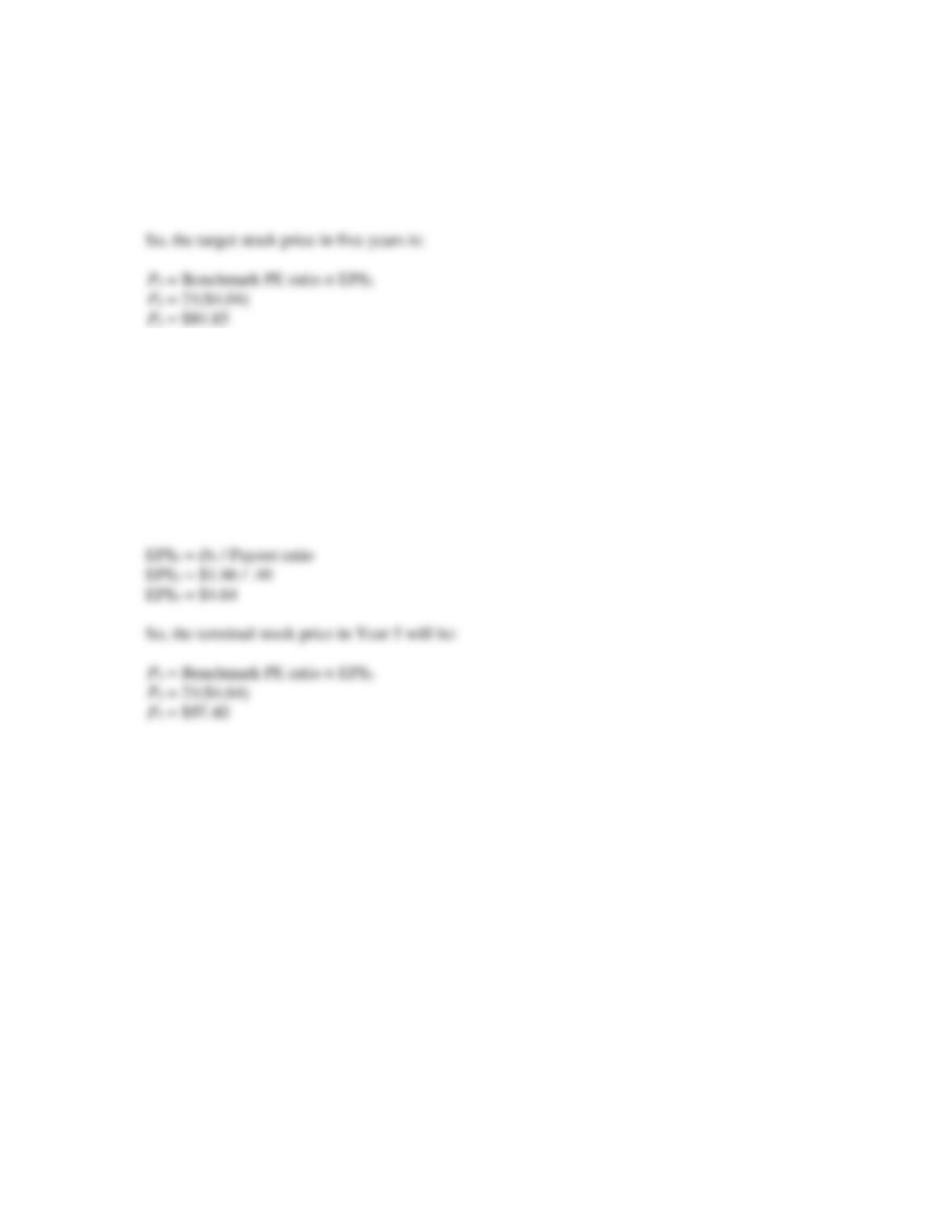
29. To find the target price in five years, we first need to find the EPS in five years, which will be:
EPS5 = EPS0(1 + g)5
EPS5 = $2.75(1 + .08)5
EPS5 = $4.04
30. We need to begin by finding the dividend for each year over the next five years, so:
D1 = $1.15(1 + .10) = $1.27
D2 = $1.15(1 + .10)2 = $1.39
D3 = $1.15(1 + .10)3 = $1.53
D4 = $1.15(1 + .10)4 = $1.69
D5 = $1.15(1 + .10)5 = $1.86
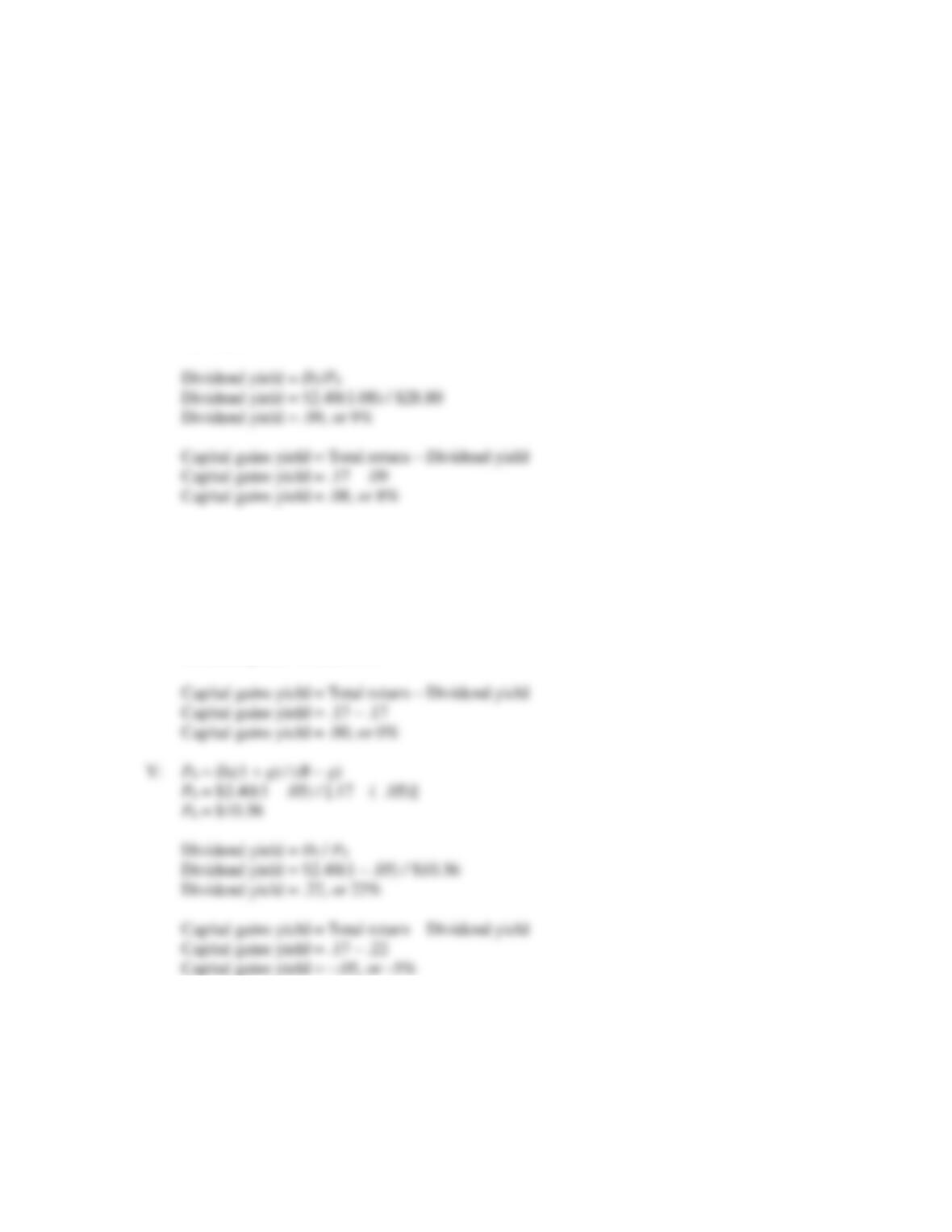
To find the EPS in Year 5, we can use the dividends and payout ratio, which gives us:
The stock price today is the present value of the dividends for the next five years, plus the present
value of the terminal stock price, discounted at the required return, or:
P0 = $1.27 / 1.11 + $1.39 / 1.112 + $1.53 / 1.113 + $1.69 / 1.114 + ($1.86 + 97.40) / 1.115
P0 = $63.41
CHAPTER 6 – 14
Challenge
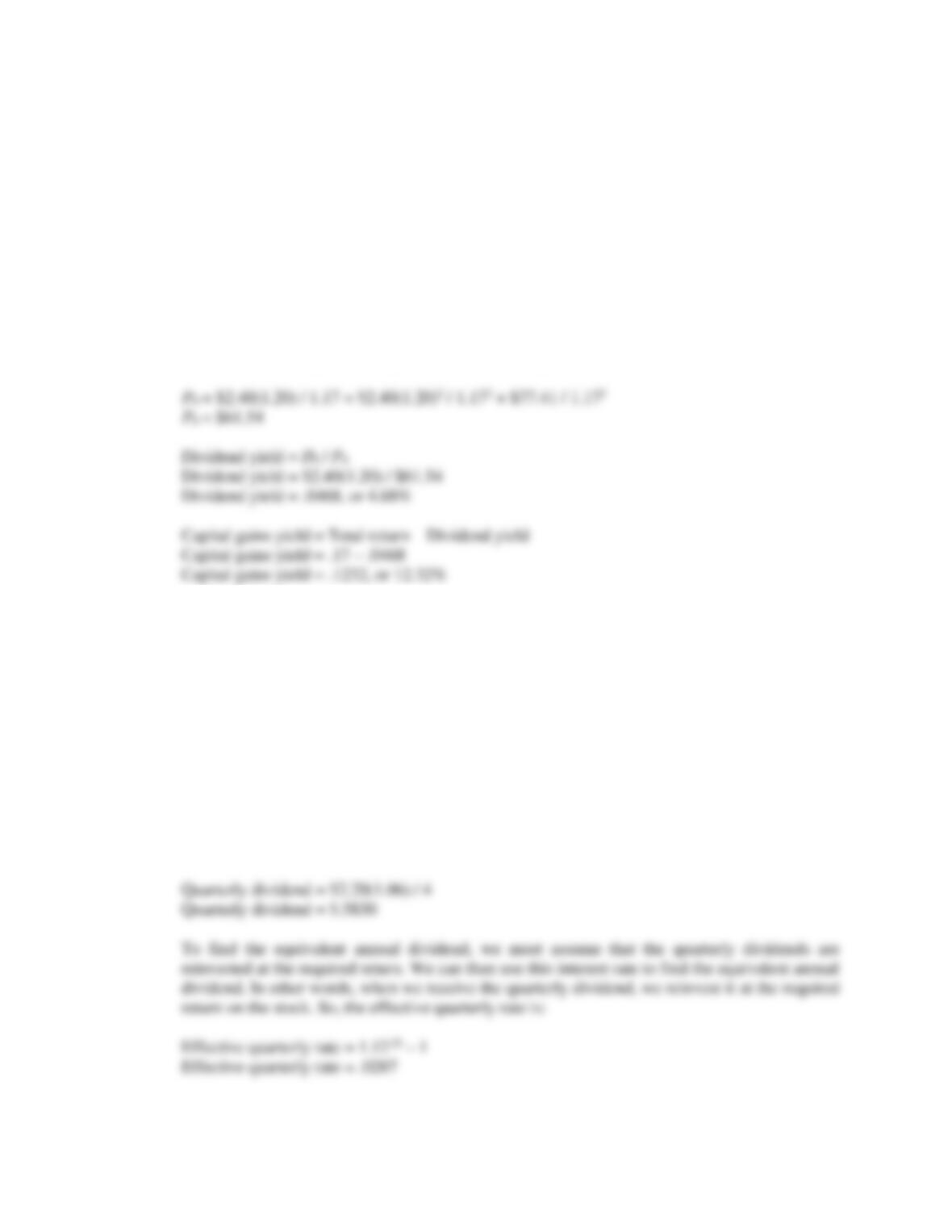
31. We are asked to find the dividend yield and capital gains yield for each of the stocks. All of the stocks
have a required return of 17 percent, which is the sum of the dividend yield and the capital gains yield.
To find the components of the total return, we need to find the stock price for each stock. Using this
stock price and the dividend, we can calculate the dividend yield. The capital gains yield for each stock
will be the total return (required return) minus the dividend yield.
W: P0 = D0(1 + g) / (R – g)
P0 = $2.40(1.08) / (.17 – .08)
P0 = $28.80
X: P0 = D0(1 + g) / (R – g)
P0 = $2.40 / (.17 – .00)
P0 = $14.12
Dividend yield = D1 / P0
Dividend yield = $2.40 / $14.12
Dividend yield = .17, or 17%
CHAPTER 6 – 15
Z: To find the price of Stock Z, we find the price of the stock when the dividends level off at a
constant growth rate, and then find the present value of the future stock price, plus the present
value of all dividends during the nonconstant growth period. The stock begins constant growth
in Year 3, so we can find the price of the stock in Year 2, one year before the constant dividend
growth begins, as:
P2 = D2 (1 + g2) / (R – g2)
P2 = D0 (1 + g1)2 (1 + g2) / (R – g2)
P2 = $2.40(1.20)2(1.12) / (.17 – .12)
P2 = $77.41
The price of the stock today is the present value of the first three dividends, plus the present value
of the Year 3 stock price. The price of the stock today will be:
In all cases, the required return is 17 percent, but the return is distributed differently between current
income and capital gains. High-growth stocks have an appreciable capital gains component but a
relatively small current income yield; conversely, mature, negative-growth stocks provide a high
current income but also price depreciation over time.
32. a. Using the constant growth model, the price of the stock paying annual dividends will be:
P0 = D0(1 + g) / (R – g)
P0 = $2.20(1.06) / (.12 – .06)
P0 = $38.87
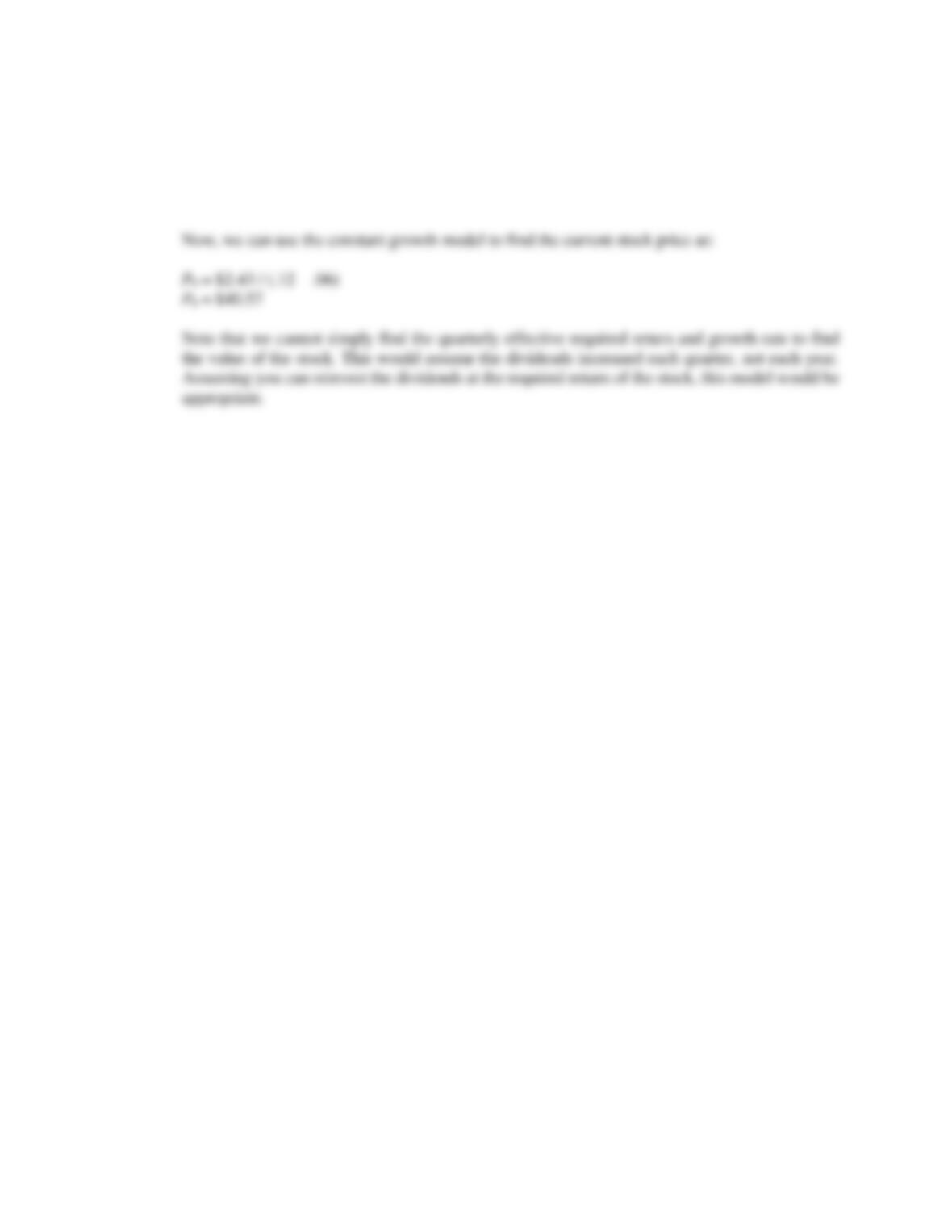
b. If the company pays quarterly dividends instead of annual dividends, the quarterly dividend will
be one-fourth of annual dividend, or:
CHAPTER 6 – 16
The effective annual dividend will be the FVA of the quarterly dividend payments at the effective
quarterly required return. In this case, the effective annual dividend will be:
Effective D1 = $.5830(FVIFA2.87%,4)
Effective D1 = $2.43