(guess)
τ1.1:=
The actual final temperature is now found from Eq. (6.91) combined with E
q
(4.7), written:
The actual enthalpy change from Eq. (7.17):
∆H’ 1158.8 J
mol
=
∆H’ ∆Hig RT
c
⋅HRB TrPr
,ω,
()
HRB Tr0 Pr0
,ω,
()
−
()
⋅+:=
∆Hig 1.298 103
×J
mol
=
∆Hig R ICPH T0T,1.702,9.081 10 3−
⋅, 2.164−10 6−
⋅, 0.0,
()
⋅:=
The enthalpy change for the final T is given by Eq. (6.91), with HRB for
this T:
∆SRAlnτ
()
⋅BT
0
⋅CT
02
⋅τ1+
2
⎛
⎜
⎝
⎞
⎠
⋅+
⎡
⎢
⎣
⎤
⎥
⎦τ1−
()
⋅+ ln P
P0
⎛
⎜
⎝
⎞
⎠
−
SRB τT0
⋅
Tc
Pr
,ω,
⎛
⎜
⎝
⎞
⎠SRB Tr0 Pr0
,ω,
()
−+
…
⎡
⎢
⎢
⎢
⎢
⎣
⎤
⎥
⎥
⎥
⎥
⎦
⋅=
Given
(guess)
τ1.1:=
The entropy change is given by Eq. (6.92) combined with Eq. (5.15) with D = 0:
Use generalized second-virial correlation:
253
∆H 5288.2 J
mol
=
∆S R ICPS T1T2
,1.702,9.081 10 3−
⋅, 2.164−10 6−
⋅, 0.0,
()
ln P2
P1
⎛
⎜
⎝
⎞
⎠
−
⎛
⎜
⎝
⎞
⎠
⋅:=
Given
∆HRAT
0
⋅τ1−
()
⋅B
2T02
⋅τ
21−
()
⋅+ C
3T03
⋅τ
31−
()
⋅+
…
⎡
⎢
⎤
⎥
⋅=
7.39 From the data and results of Example 7.9,
T1293.15 K⋅:= T2428.65 K⋅:= P1140 kPa⋅:= P2560 kPa⋅:=
Work 5288.3 J
mol
⋅:= Tσ293.15 K⋅:=
∆H R ICPH T1T2
,1.702,9.081 10 3−
⋅, 2.164−10 6−
⋅, 0.0,
()
⋅:=
254

T’2 T2 T1−()η⋅ T1+
⎡
⎣
⎤
⎦
:=
T’2 415.4 K=Eq. (7.18) written for a single stage is:
T’2 T1 P2
P1
⎛
⎜
⎝
⎞
⎠
R1
NCp⋅
⋅=Put in logarithmic form and solve for N:
(b) Calculate r for 4 stages: N4:= rP2
P1
⎛
⎜
⎝
⎞
⎠
1
N
:= r 2.659=
Power requirement per stage follows from Eq. (7.22). In kW/stage:
7.42 P1 1atm:= T1 35 273.15+()K:= T1 308.15 K=
P2 50atm:= T2 200 273.15+()K:= T2 473.15 K=
η0.65:= Vdot 0.5 m3
sec
:= Cp 3.5 R⋅:=
VRT1⋅
P1
:= ndot Vdot
V
:= ndot 19.775 mol
sec
=
With compression from the same initial conditions (P1,T1) to the same
final conditions (P2,T2) in each stage, the same efficiency in each stage,
and the same power delivered to each stage, the applicable equations are:
(where r is the pressure ratio in each stage and N is
the number of stages.)
rP2
P1
⎛
⎜
⎝
⎞
⎠
1
N
=
Eq. (7.23) may be solved for T2prime:
255
⎜
⎜
(7.22)
∆HSCp T1⋅P2
P1
⎛
⎜
⎝
⎞
⎠
R
Cp
1−
⎡
⎢
⎢
⎣
⎤
⎥
⎥
⎦
⋅
⎡
⎢
⎢
⎣
⎤
⎥
⎥
⎦
→
⎯
⎯⎯⎯⎯⎯⎯⎯⎯
⎯
:=
Ideal gases with constant heat capacities
∆HCpT2T1−()⋅[]
→
⎯
⎯⎯⎯⎯
⎯
:=
3.5
2.5
⎛
⎜
⎞
6
5
⎛
⎜
⎞
464
547
⎛
⎜
⎞
⎜
⎜
2.0
1.1
1.5
⎛
⎜
⎜
⎝
⎞
⎟
⎠
300
300
305
⎛
⎜
⎜
⎝
⎞
⎟
⎠
7.44
With data for saturated liquid water from the steam tables:
(d) Energy balance on each interchanger (subscript w denotes water):
(c) Because the gas (ideal) leaving the intercooler and the gas entering
the compressor are at the same temperature (308.15 K), there is no
enthalpy change for the compressor/interchanger system, and the first law
yields:
256

∆H
∆HS
η
→
⎯
⎯
:=∆HSVP
2P1
−
()
⋅
⎡
⎣
⎤
⎦
→
⎯
⎯⎯⎯⎯
:=
By Eq. (7.24)
CP
4.15
4.20
4.20
4.185
4.20
⎛
⎜
⎜
⎜
⎜
⎜
⎝
⎞
⎟
⎟
⎟
⎠
kJ
kg K⋅
⋅:=V
1.003
1.036
1.017
1.002
1.038
⎛
⎜
⎜
⎜
⎜
⎜
⎝
⎞
⎟
⎟
⎟
⎠
cm3
gm
⋅:=
From the steam tables for sat.liq. water at the initial temperature (heat
capacity calculated from enthalpy values):
β
257.2
696.2
523.1
217.3
714.3
⎛
⎜
⎜
⎜
⎜
⎜
⎝
⎞
⎟
⎟
⎟
⎠
10 6−
K
⋅:=η
0.75
0.70
0.75
0.70
0.75
⎛
⎜
⎜
⎜
⎜
⎜
⎝
⎞
⎟
⎟
⎟
⎠
:=
P2
2000 kPa⋅
5000 kPa⋅
5000 kPa⋅
20 atm⋅
1500 psi⋅
⎛
⎜
⎜
⎜
⎜
⎜
⎝
⎞
⎟
⎟
⎟
⎠
:=
mdot
20 kg⋅
30 kg⋅
15 kg⋅
50 lb⋅
80 lb⋅
⎛
⎜
⎜
⎜
⎜
⎜
⎝
⎞
⎟
⎟
⎟
⎠
1
sec
⋅:=P1
100 kPa⋅
200 kPa⋅
20 kPa⋅
1 atm⋅
15 psi⋅
⎛
⎜
⎜
⎜
⎜
⎜
⎝
⎞
⎟
⎟
⎟
⎠
:=
T1
298.15
363.15
333.15
294.26
366.48
⎛
⎜
⎜
⎜
⎜
⎜
⎝
⎞
⎟
⎟
⎟
⎠
K⋅:=
The following vectors contain values for Parts (a) through (e). Intake
conditions first:
7.47
257
⎜
⎯
⎯
⎜
298.338
367.986
⎛
⎜
⎝
⎞
⎠
0.188
1.506
⎛
⎜
⎞
2.541
14.17
⎛
⎜
⎝
⎞
⎠
1.906
10.628
⎛
⎜
⎝
⎞
⎠
258

P25bar:=
T3200 273.15+()K:= P35bar:=
Cpv 105 J
mol K⋅
:= ∆Hlv 30.72 kJ
mol
:= η 0.7:=
Estimate the specific molar volume of liquid benzene using the Rackett
equation (3.72).
From Table B.1 for benzene: Tc562.2K:= Zc0.271:= Vc259 cm3
mol
:=
From Table B.2 for benzene: Tn80.0 273.15+()K:= Trn
Tn
Tc
:=
Assume Vliq = Vsat:VV
cZc
1T
rn
−
()
2
7
⋅:= Eq. (3.72) V 96.802 cm3
mol
=
Calculate pump power
7.48 Results from Example 7.10:
∆H 11.57 kJ
kg
⋅:= W 11.57 kJ
kg
⋅:= ∆S 0.0090 kJ
kg K⋅
⋅:=
Tσ300 K⋅:= Wideal ∆HT
σ∆S⋅−:= ηt
Wideal
W
:=
7.53 T125 273.15+()K:= P11.2bar:=
259
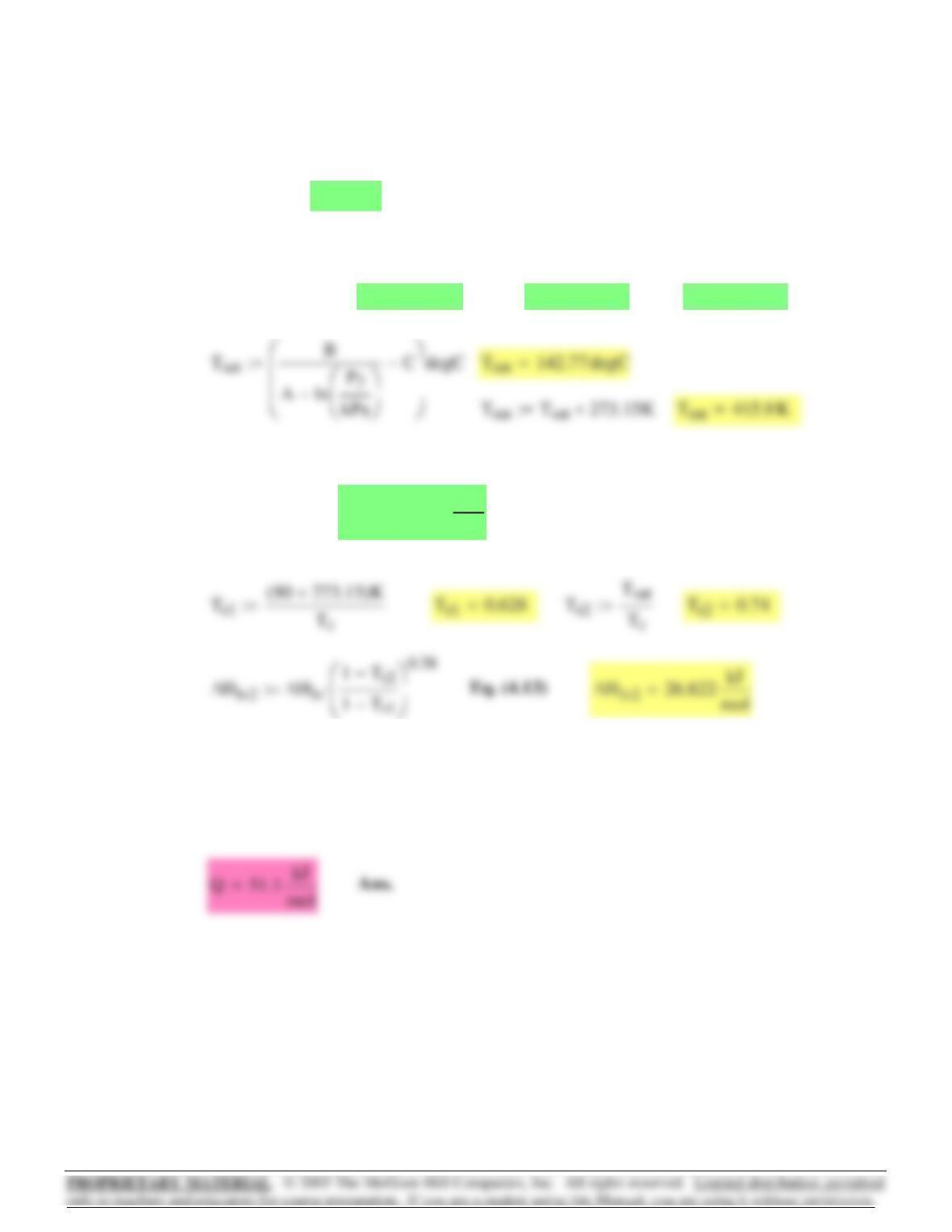
Q R ICPH T2Tsat
,0.747−, 67.96 10 3−
⋅, 37.78−10 6−
⋅, 0,
()
⋅
∆Hlv2 Cpv T3Tsat
−
()
⋅++
…:=
Calculate the heat exchanger heat duty.
∆Hlv 30.72 kJ
mol
:=
From Table B.2
At 80 C:
Estimate the heat of vaporization at Tsat using Watson’s method
C 217.572:=B 2726.81:=A 13.7819:=
For benzene from
Table B.2:
Estimate the saturation temperature at P = 5 bar using the Antoine
Equation and values from Table B.2
T2T1
:=
Therefore:
Assume that no temperature change occurs during the liquid compression.
260
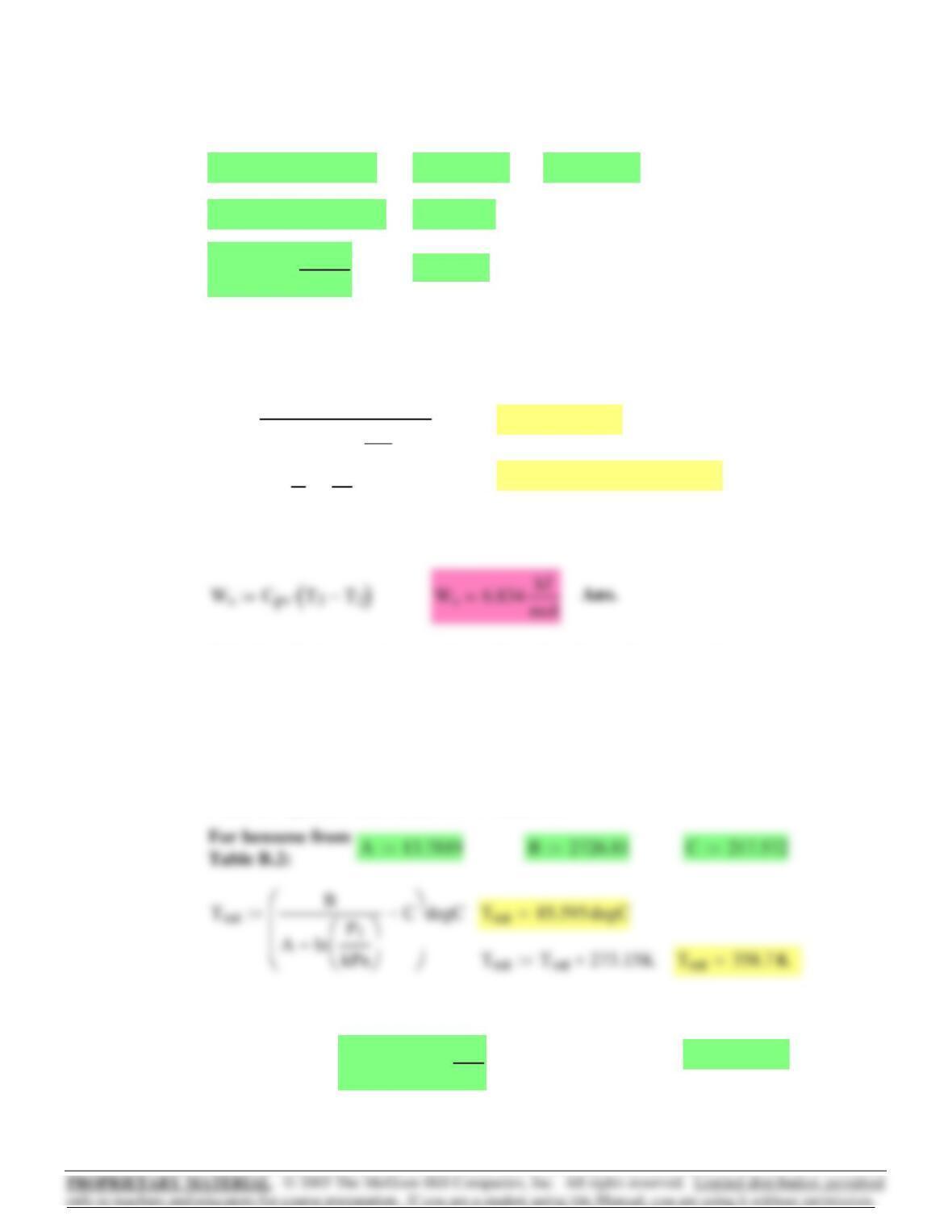
Calculate the heat exchanger duty. Note that the exchanger outlet
temperature, T2, is equal to the compressor inlet temperature. The
benzene enters the exchanger as a subcooled liquid. In the exchanger the
liquid is first heated to the saturation temperature at P1, vaporized and
finally the vapor is superheated to temperature T2.
Estimate the saturation temperature at P = 1.2 bar using the
Antoine Equation and values from Table B.2
⎜
Estimate the heat of vaporization at Tsat using Watson’s method
From Table B.2
At 25 C:
From Table B.1
for benzene:
Tc562.2K:=
∆Hlv 30.72 kJ
mol
:=
7.54 T125 273.15+()K:= P11.2bar:= P21.2bar:=
T3200 273.15+()K:= P35bar:=
Cpv 105 J
mol K⋅
:= η 0.75:=
Calculate the compressor inlet temperature.
Combining equations (7.17), (7.21) and (7.22) yields:
T2
T3
11
η
P3
P2
⎛
⎜
⎝
⎞
⎠
R
Cpv
1−
⎡
⎢
⎢
⎢
⎣
⎤
⎥
⎥
⎥
⎦
⋅+
:= T2408.06 K=
T2273.15K−134.91 degC=
Calculate the compressor power
261
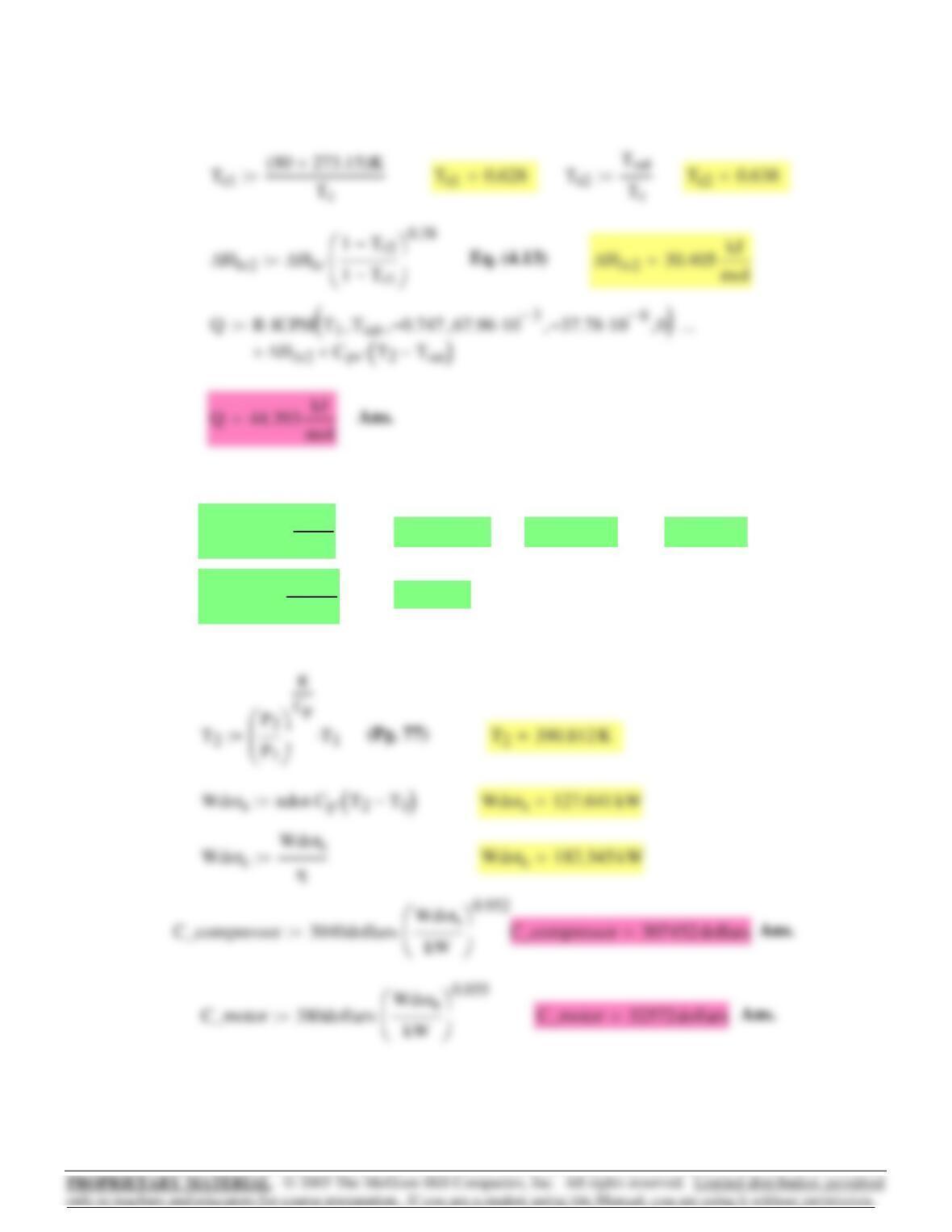
Assume the compressor is adaiabatic.
η0.70:=
7.57 ndot 100 kmol
hr
:= P11.2bar:= T1300K:= P26bar:=
Cp50.6 J
mol K⋅
:=
262
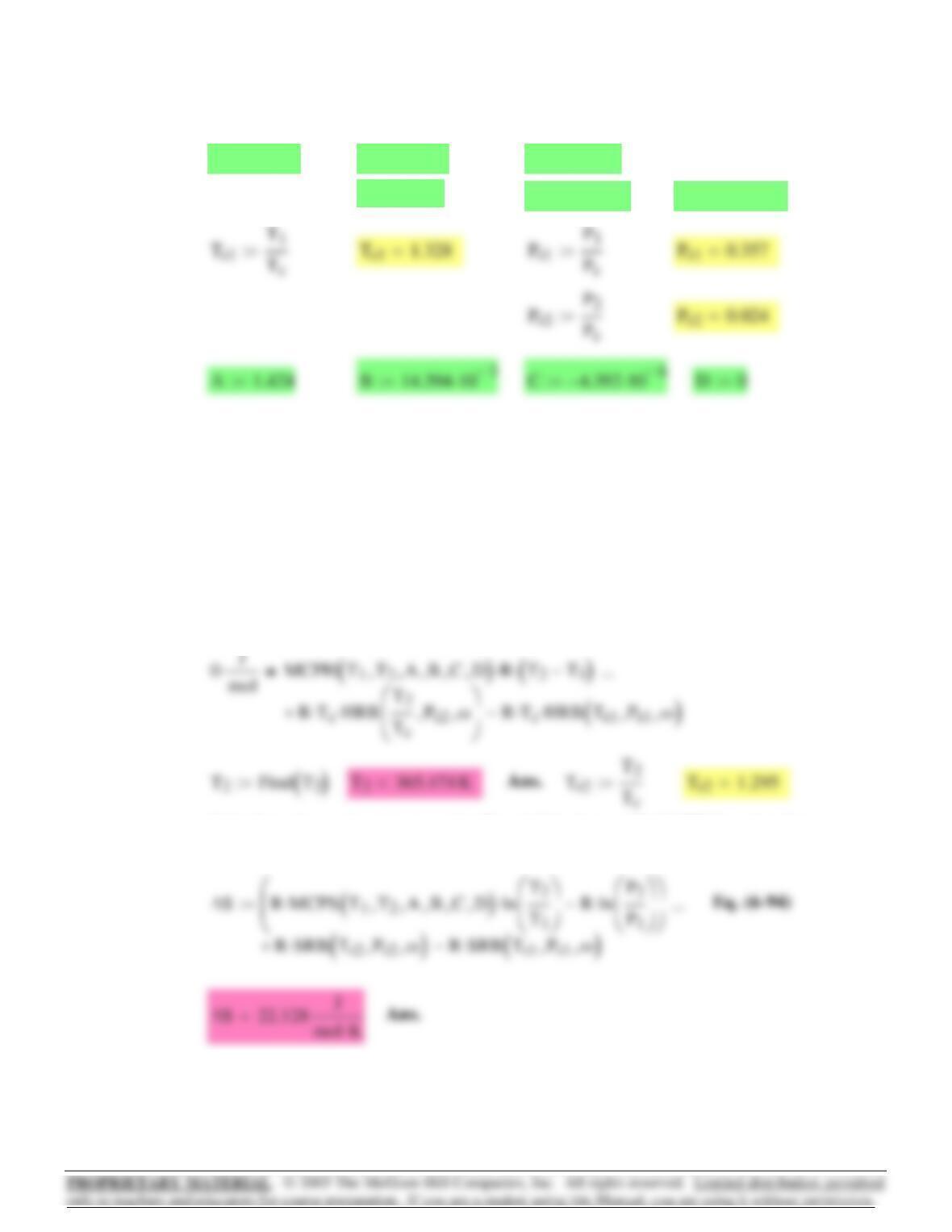
For throttling process, assume the process is adiabatic. Find T2 such that
∆H = 0.
∆HC
pmig T2T1
−
()
⋅HR2
+HR1
−=Eq. (6-93)
Use the MCPH function to calculate the mean heat capacity and the HRB
function for the residual enthalpy.
Guess: T2T1
:=
Given
Calculate change in entropy using Eq. (6-94) along with MCPS function for
the mean heat capacity and SRB function for the residual entropy.
7.59 T1375K:= P118bar:= P21.2bar:=
For ethylene: ω0.087:= Tc282.3K:= Pc50.40bar:=
a)
263
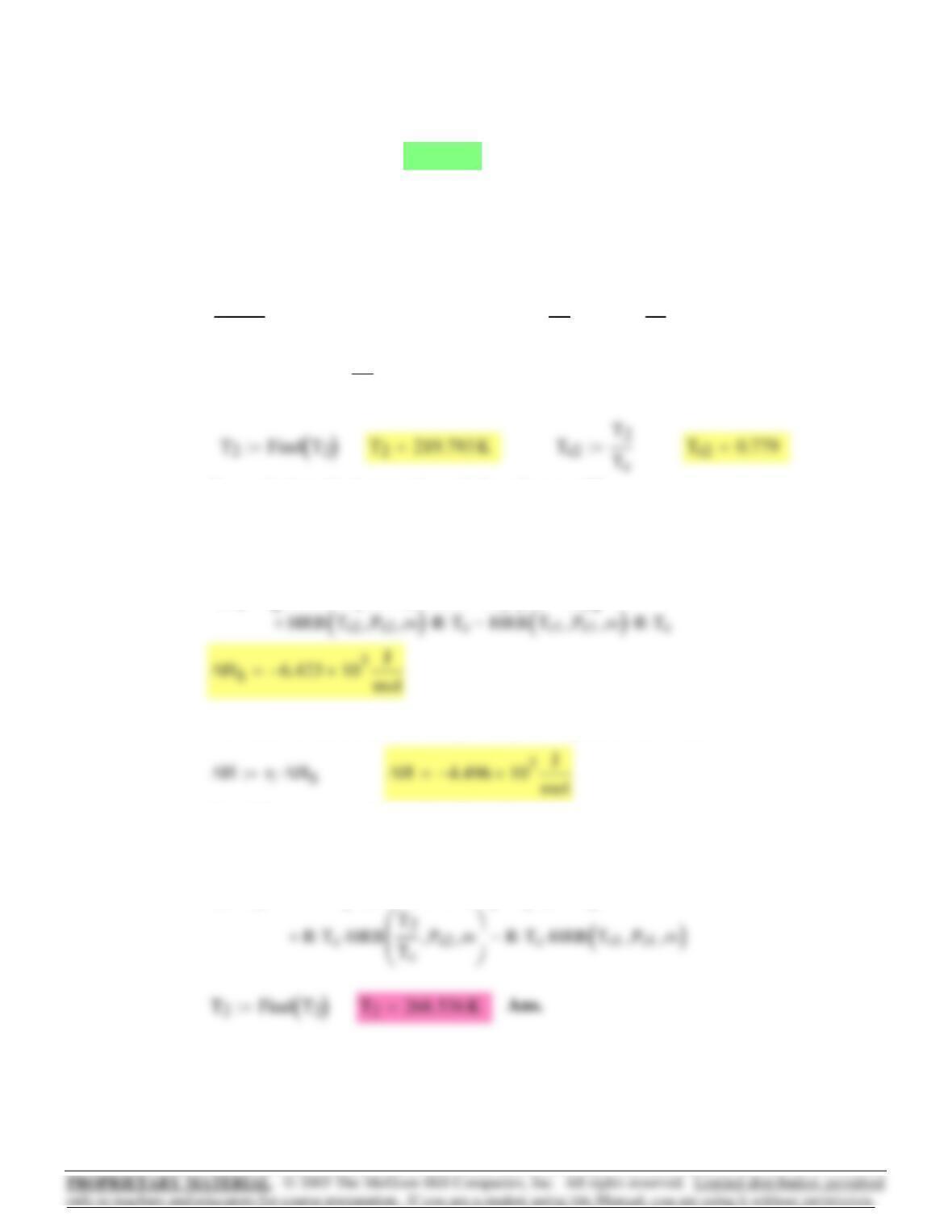
η∆HS
⋅MCPH T1T2
,A,B,C,D,
()
R⋅T2T1
−
()
⋅
…=
Given
Find T2 such that ∆H matches the value above.
Calculate actual enthalpy change using the expander efficiency.
∆HSR MCPH T1T2
,A,B,C,D,
()
⋅T2T1
−
()
⋅
⎡
⎣
⎤
⎦
…:=
HR2HRB Tr2 Pr2
,ω,
()
R⋅Tc
⋅:=
Now calculate the isentropic enthalpy change, ∆HS.
Eq. (6-94)
0J
mol K⋅R MCPS T1T2
,A,B,C,D,
()
⋅ln T2
T1
⎛
⎜
⎝
⎞
⎠
⋅Rln P2
P1
⎛
⎜
⎝
⎞
⎠
⋅−
SRB T2
Tc
Pr2
,ω,
⎛
⎜
⎝
⎞
⎠R⋅SRB Tr1 Pr1
,ω,
()
R⋅−+
…=
Given
T2T1
:=
Guess:
First find T2 for isentropic expansion. Solve Eq. (6-94) with ∆S = 0.
η70%:=
For expansion process. b)
264
⎜
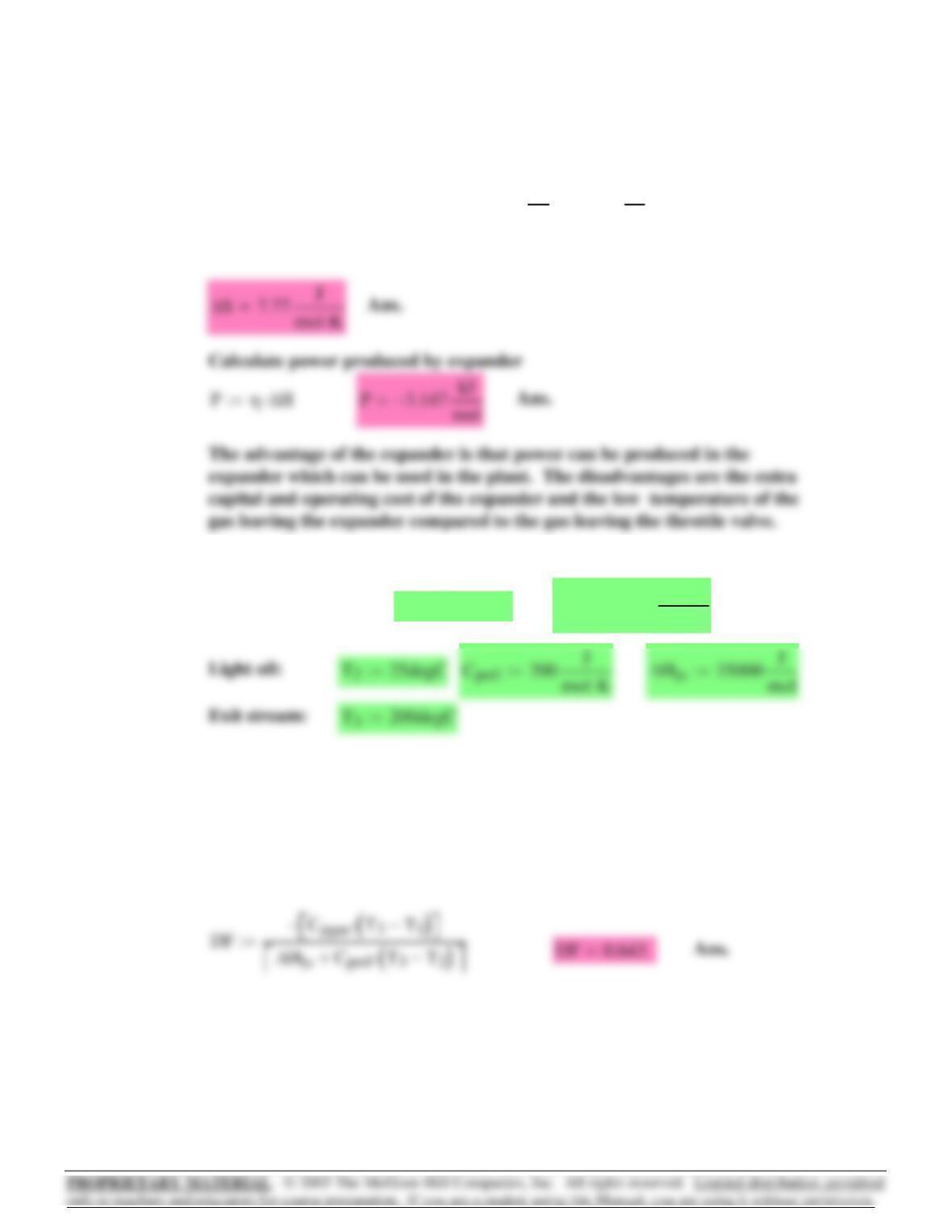
Using liquid oil to quench the gas stream requires a smaller oil flow rate.
This is because a significant portion of the energy lost by the gas is used
to vaporize the oil.
c)
Solving for D/F gives:
FC
pgas
⋅T3T1
−
()
⋅D∆Hlv Coilp T3T2
−
()
⋅+
⎡
⎣
⎤
⎦
⋅+ 0=
Assume that the oil vaporizes at 25 C. For an adiabatic column, the overall
energy balance is as follows.
b)
Cpgas 150 J
mol K⋅
:=T1500degC:=
Hydrocarbon gas:7.60
Eq. (6-94)
∆S R MCPS T1T2
,A,B,C,D,
()
⋅ln T2
T1
⎛
⎜
⎝
⎞
⎠
⋅Rln P2
P1
⎛
⎜
⎝
⎞
⎠
⋅−
⎛
⎜
⎝
⎞
⎠
R SRB Tr2 Pr2
,ω,
()
⋅R SRB Tr1 Pr1
,ω,
()
⋅−+
…:=
Now recalculate ∆S at calculated T2
265
⎡
⎣
⎤
⎦