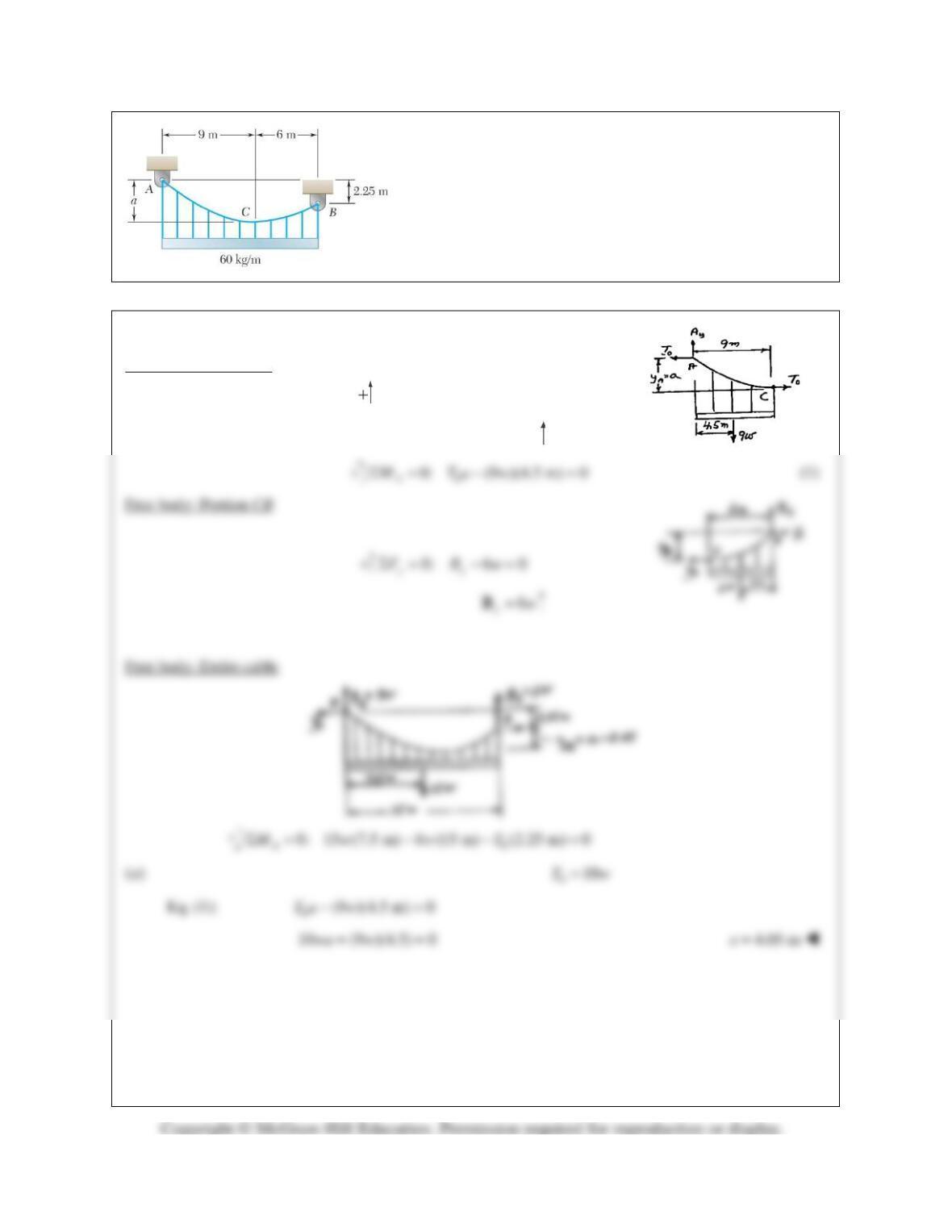
PROBLEM 7.116
Cable ACB supports a load uniformly distributed along the
horizontal as shown. The lowest Point C is located 9 m to the
right of A. Determine (a) the vertical distance a, (b) the length
of the cable, (c) the components of the reaction at A.
SOLUTION
Free body: Portion AC
0: 9 0
yy
F AwΣ= − =
9
y
w=A
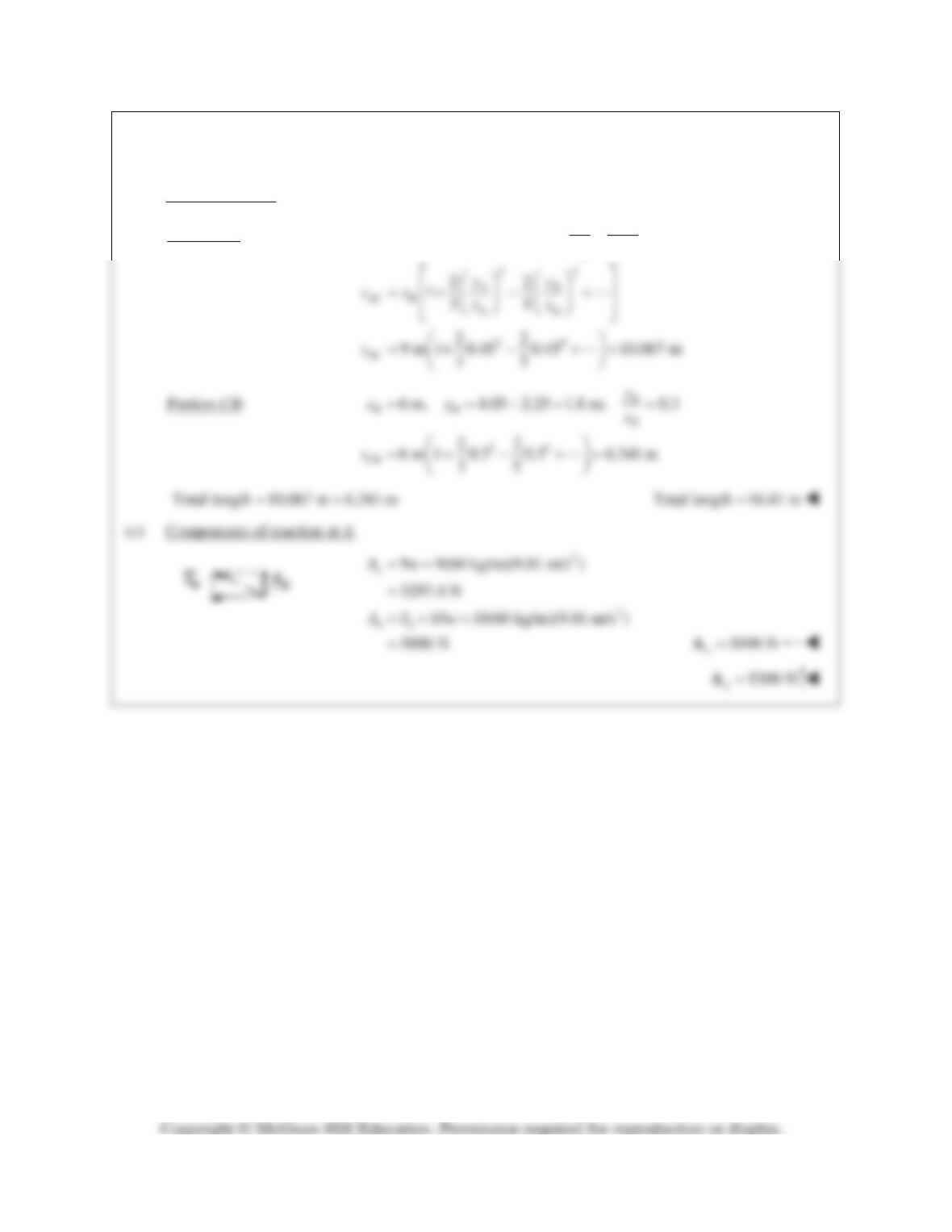
PROBLEM 7.116 (Continued)
(b) Length =AC+CB
Portion AC:
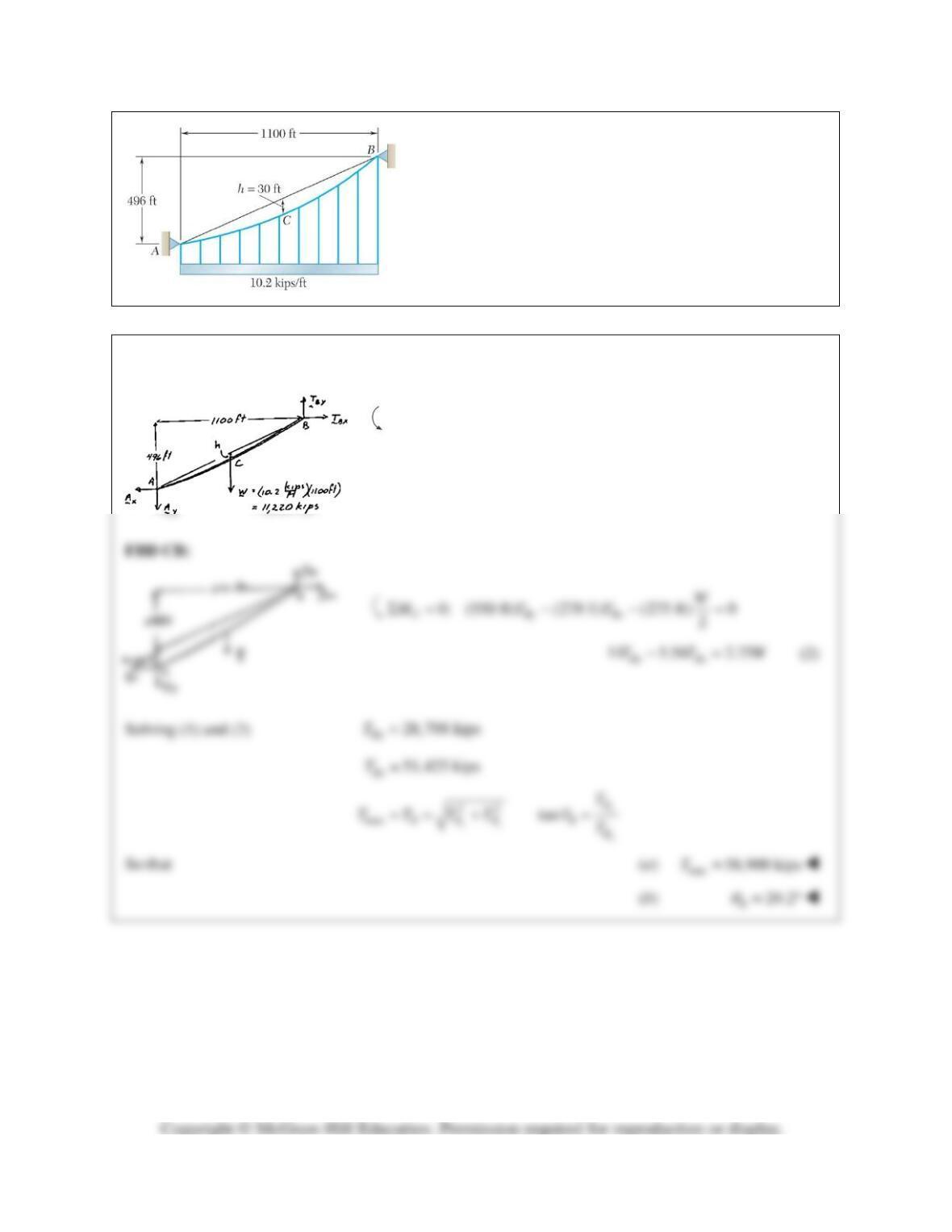
PROBLEM 7.117
Each cable of the side spans of the Golden Gate Bridge
supports a load w= 10.2 kips/ft along the horizontal.
Knowing that for the side spans the maximum vertical
distance h from each cable to the chord AB is 30 ft and
occurs at midspan, determine (a) the maximum tension in
each cable, (b) the slope at B.
SOLUTION
FBD AB:
0: (1100 ft) (496 ft) (550 ft) 0
A By Bx
M TTWΣ= − − =
11 4.96 5.5
By Bx
T TW−=
(1)
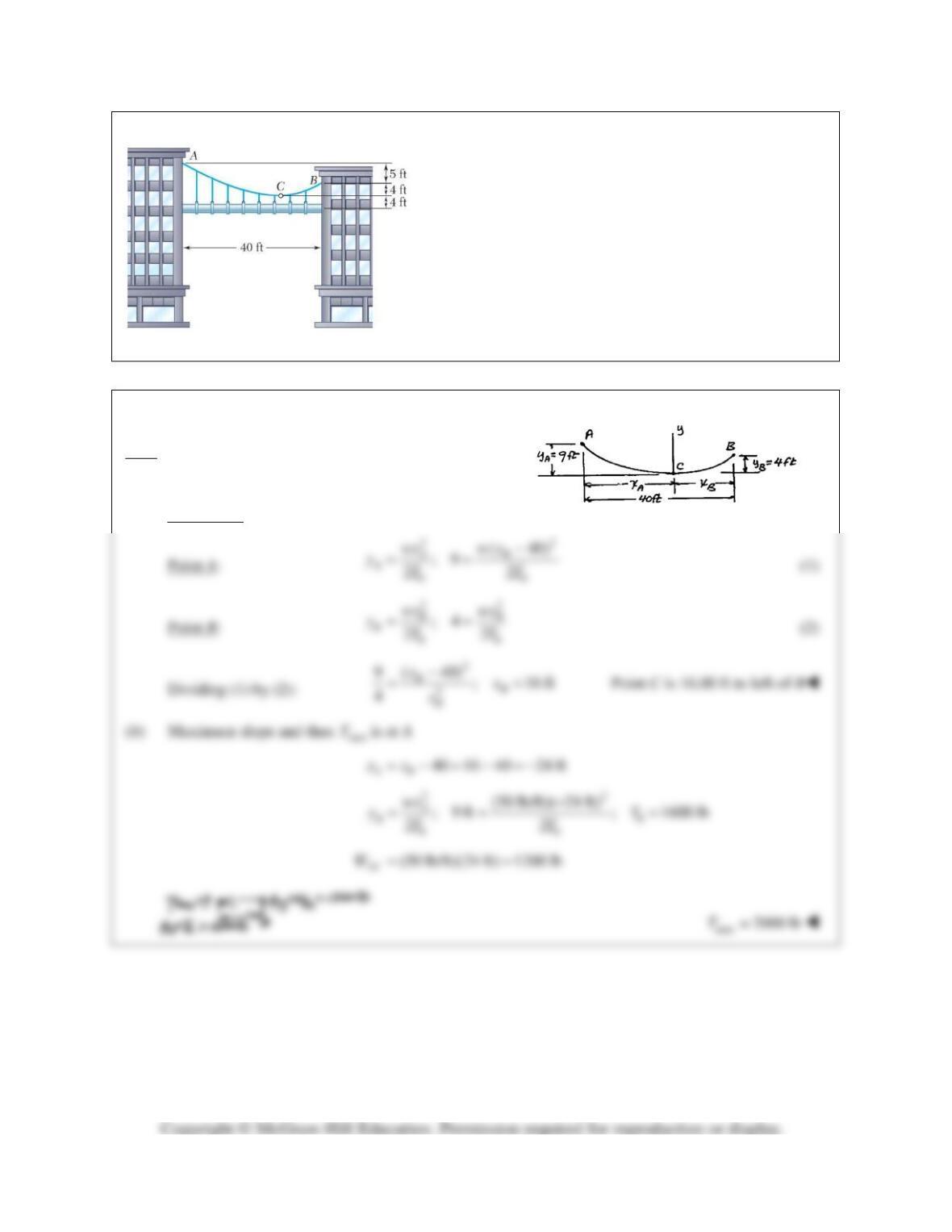
PROBLEM 7.118
A steam pipe weighting 45 lb/ft that passes between two
buildings 40 ft apart is supported by a system of cables as
shown. Assuming that the weight of the cable system is
equivalent to a uniformly distributed loading of 5 lb/ft,
determine (a) the location of the lowest Point C of the
cable, (b) the maximum tension in the cable.
SOLUTION
Note:
40 ft
BA
xx−=
or
40 ft
AB
xx= −
(a) Use Eq. 7.8
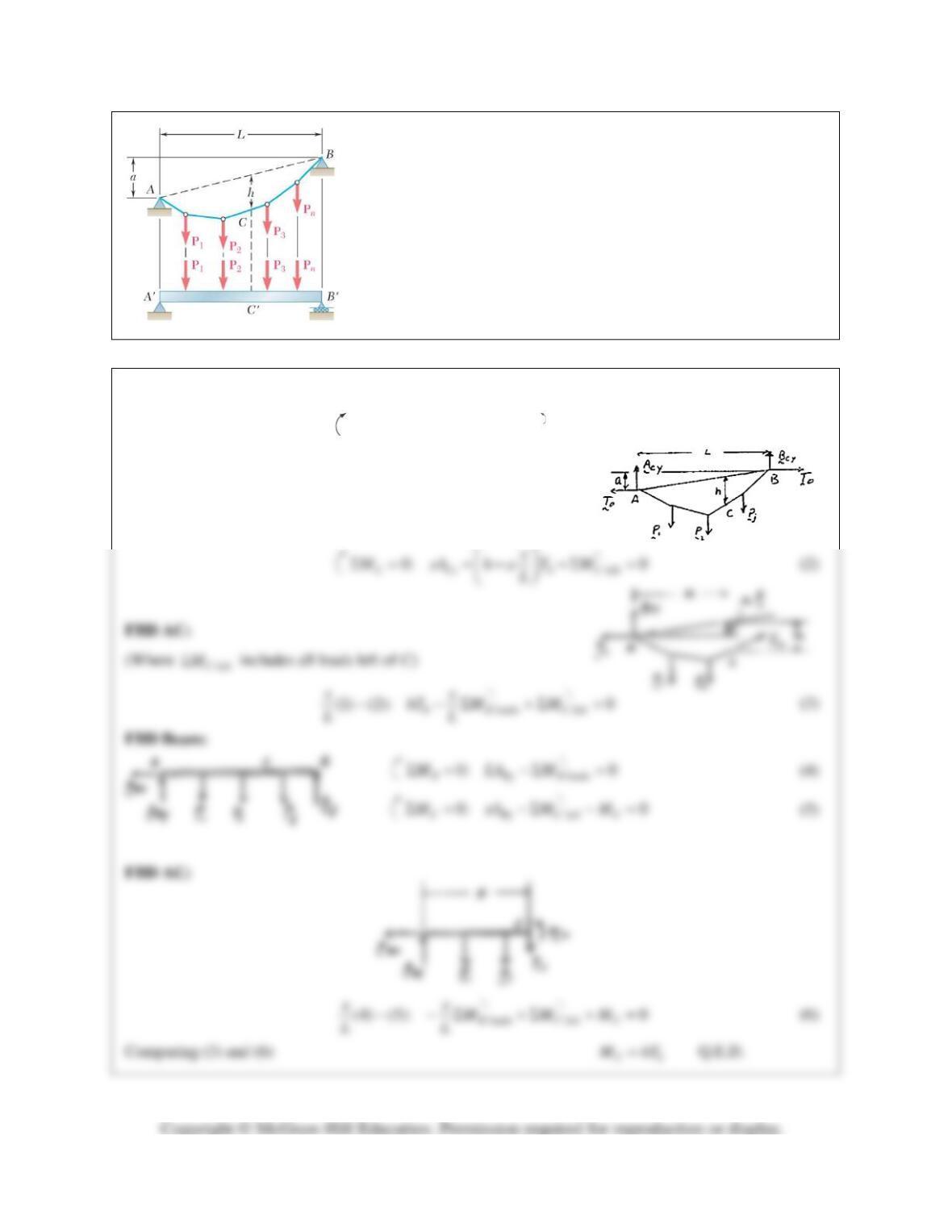
PROBLEM 7.119*
A cable AB of span L and a simple beam A′B′of the same span are
subjected to identical vertical loadings as shown. Show that the
magnitude of the bending moment at a point C′ in the beam is equal
to the product T0h, where T0 is the magnitude of the horizontal
component of the tension force in the cable and h is the vertical
distance between Point C and the chord joining the points of support
A and B.
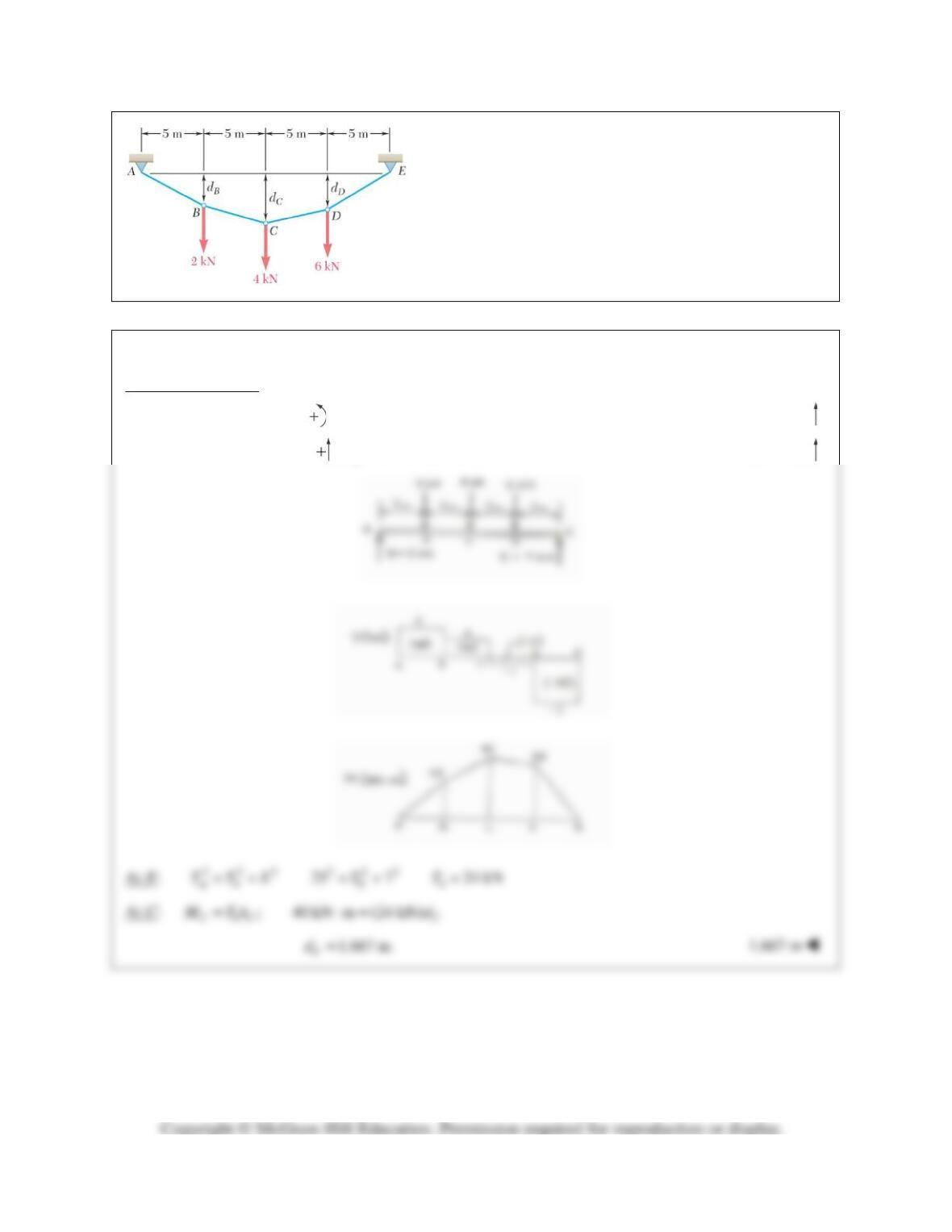
SOLUTION
0 loads
0: 0
B Cy B
M LA aT MΣ = + −Σ =
(1)
FBD Cable:
(Where
loadsB
MΣ
includes all applied loads)
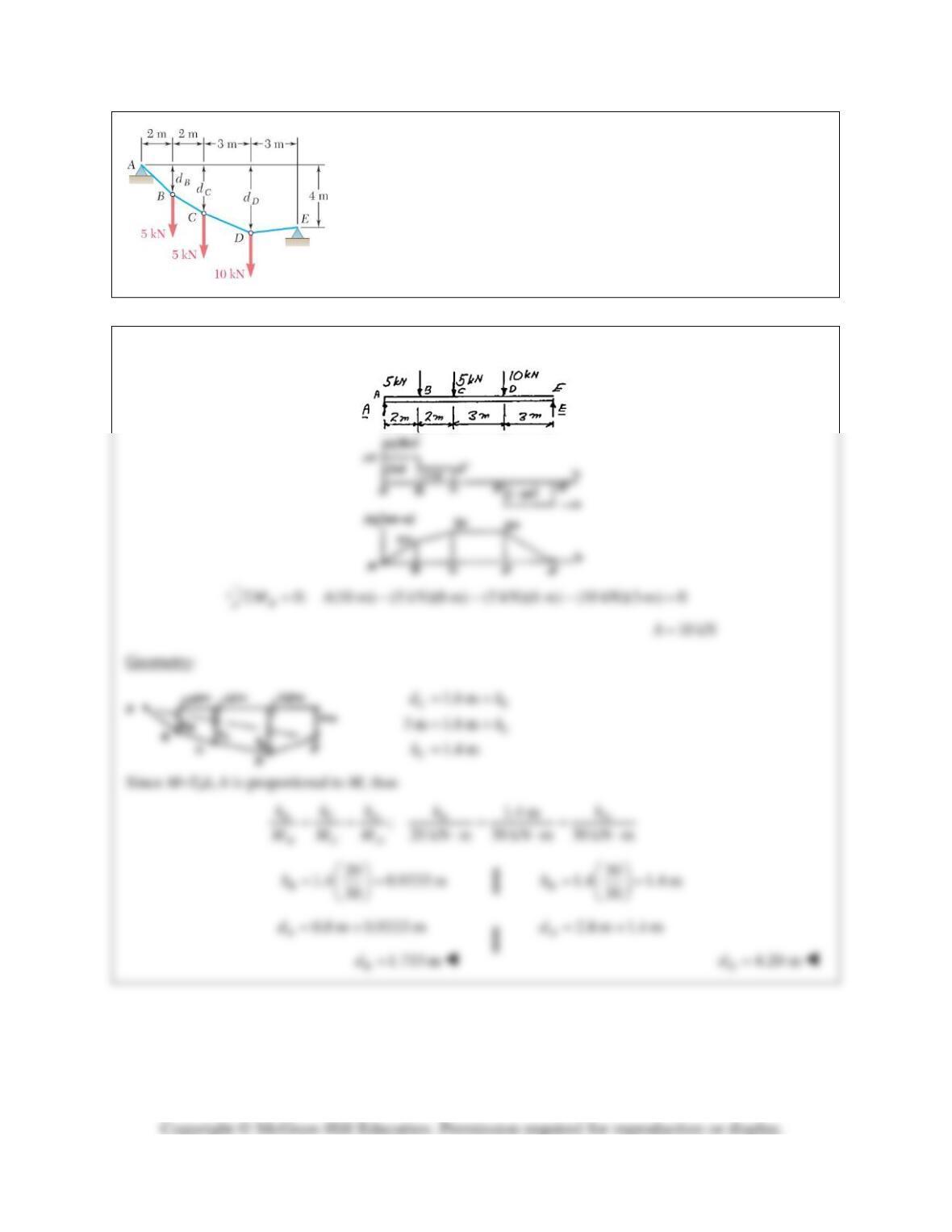
PROBLEM 7.120
Making use of the property established in Problem 7.119,
solve the problem indicated by first solving the
corresponding beam problem.
PROBLEM 7.94 Knowing that the maximum tension in
cable ABCDE is 25 kN, determine the distance dC.
SOLUTION
Free body: beam AE
0: (20) 2(15) 4(10) 6(5) 0
E
MAΣ= − + + + =
5 kN=A
0:5246 0
y
FEΣ = −−−+ =
7 kN=E
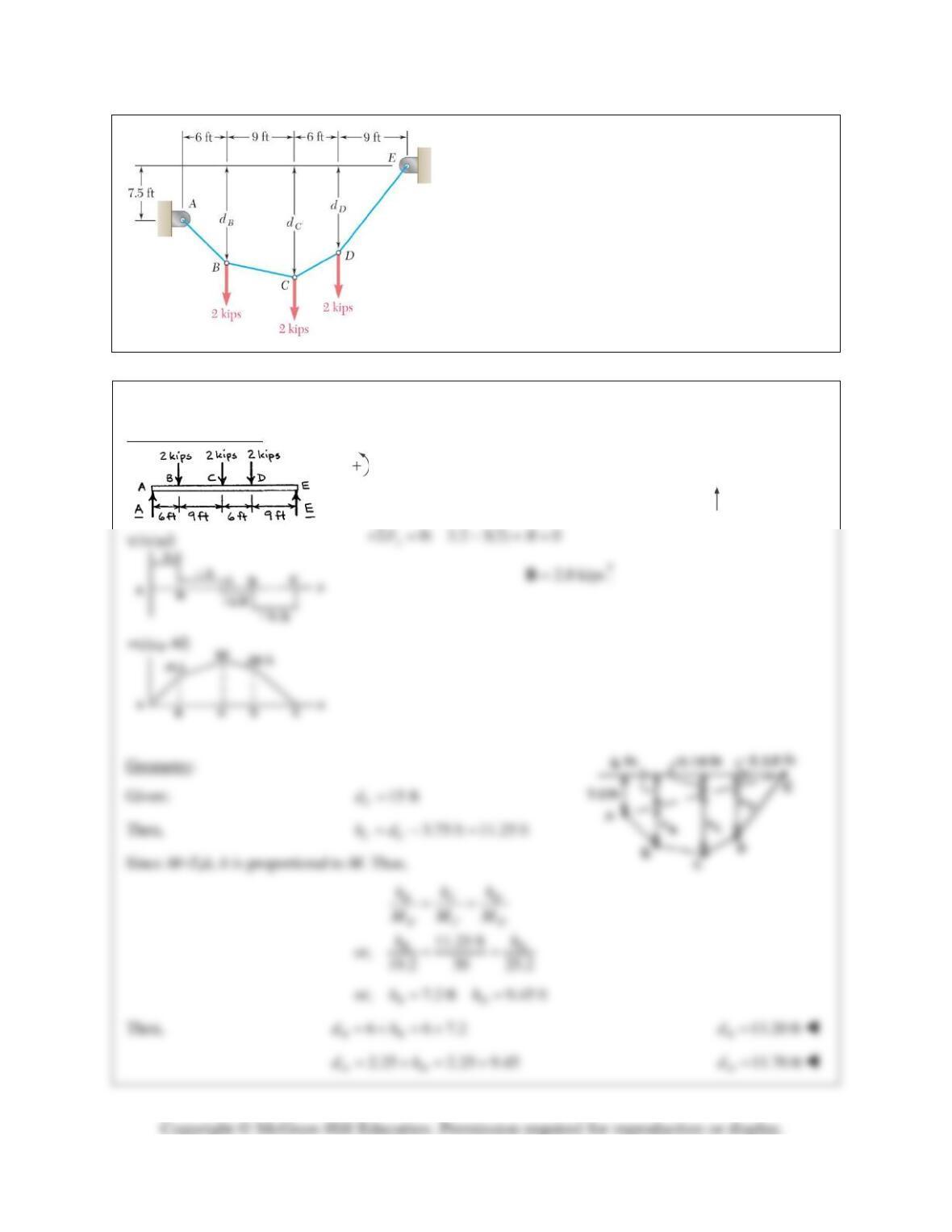
PROBLEM 7.121
Making use of the property established in Problem 7.119, solve the
problem indicated by first solving the corresponding beam problem.
PROBLEM 7.97 (a) Knowing that
3 m,
C
d=
determine the distances
dBand
D
d
.
SOLUTION
PROBLEM 7.122
Making use of the property established in Problem
7.119, solve the problem indicated by first solving the
corresponding beam problem.
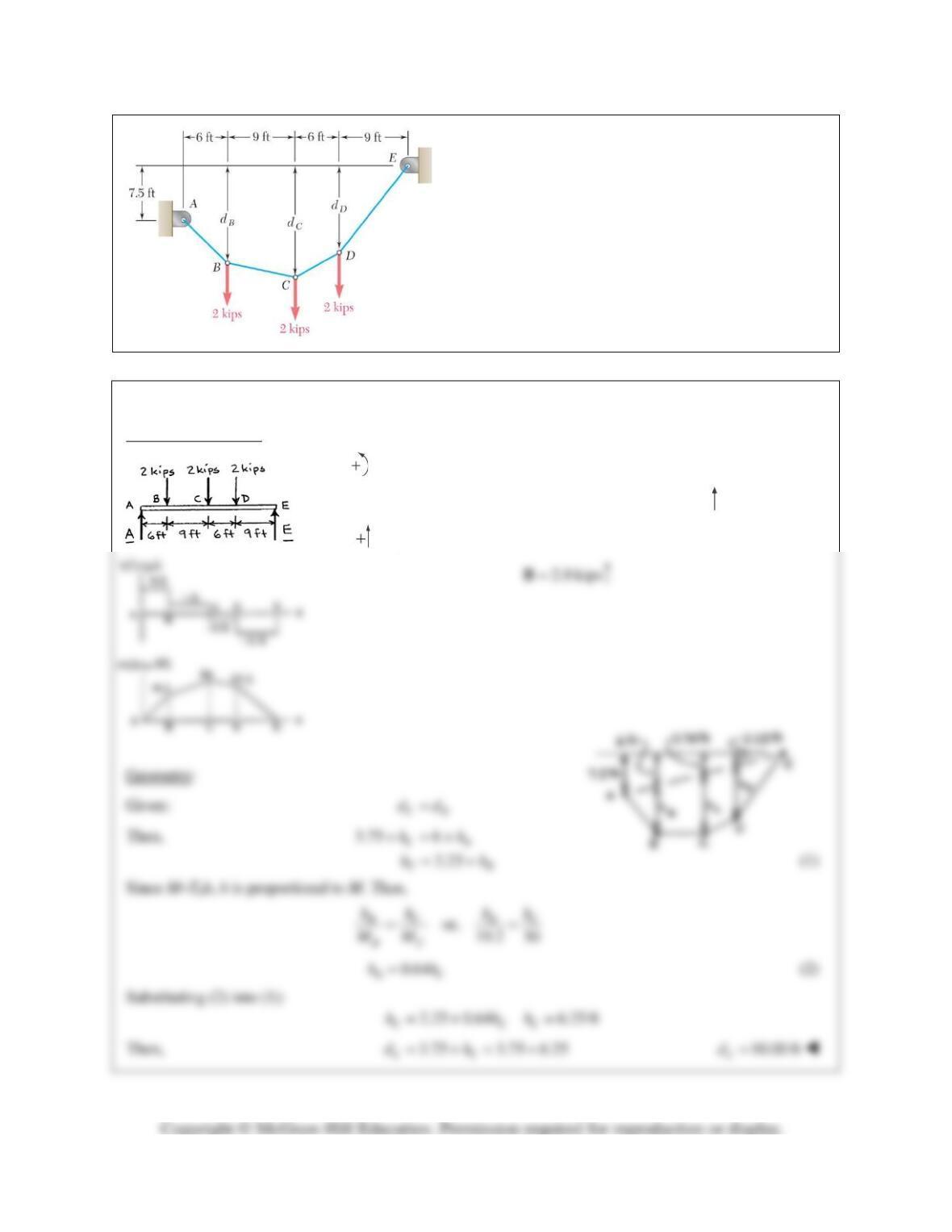
PROBLEM 7.99 (a) If dC= 15 ft, determine the
distances dB and dD.
SOLUTION
Free body: Beam AE
0: (30) 2(24) 2(15) 2(9) 0
E
MAΣ= − + + + =
3.2 kips=A
PROBLEM 7.123
Making use of the property established in Problem
7.119, solve the problem indicated by first solving the
corresponding beam problem.
PROBLEM 7.100 (a) Determine the distance dC for
which portion BC of the cable is horizontal.
SOLUTION
Free body: Beam AE
0: (30) 2(24) 2(15) 2(9) 0
E
MAΣ= − + + + =
3.2 kips=A
0: 3.2 3(2) 0
y
FBΣ = − +=
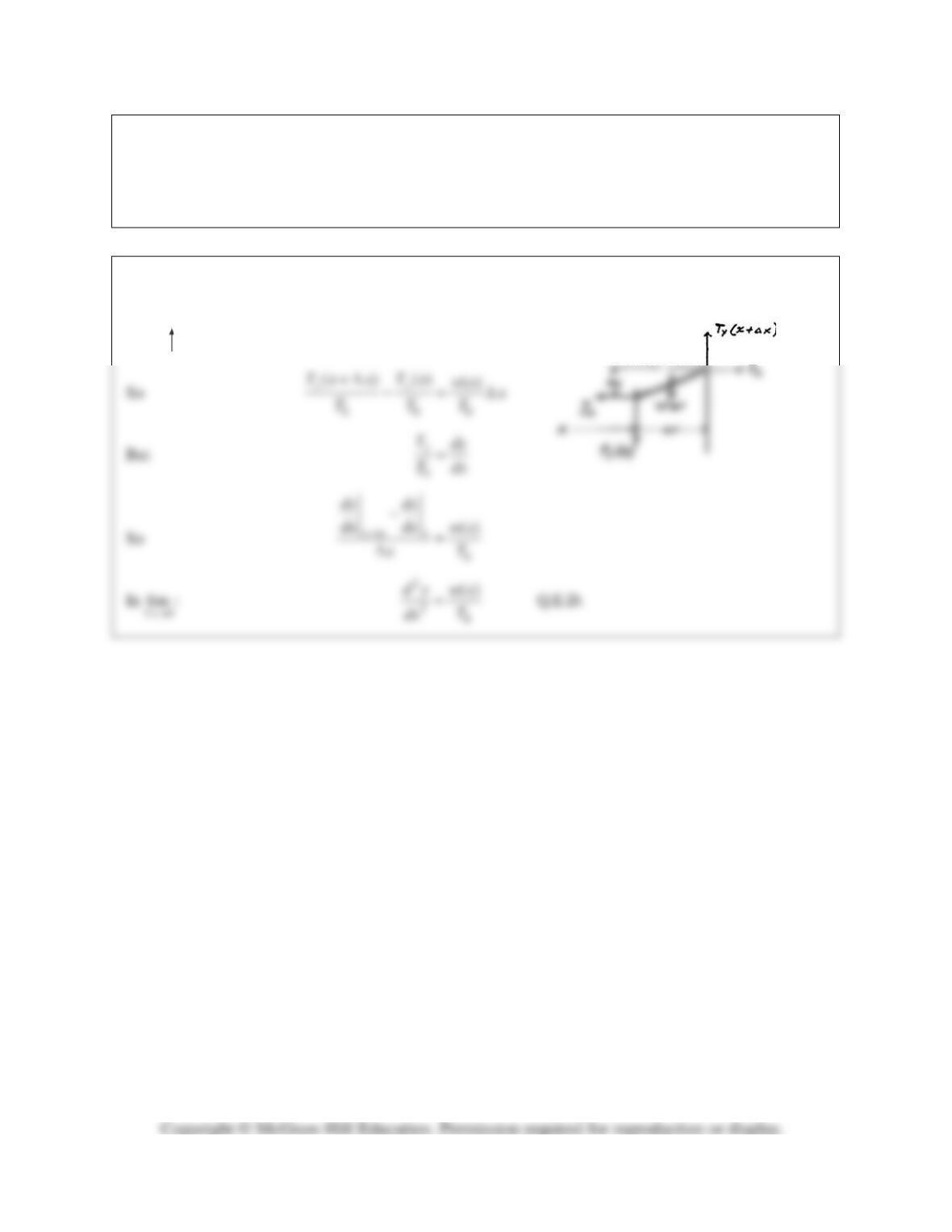
PROBLEM 7.124*
Show that the curve assumed by a cable that carries a distributed load w(x) is defined by the differential
equation d2y/dx2=w(x)/T0, where T0is the tension at the lowest point.
SOLUTION
FBD Elemental segment:
0: ( ) () () 0
yy y
F Tx x Tx wx xΣ = +∆ − − ∆ =
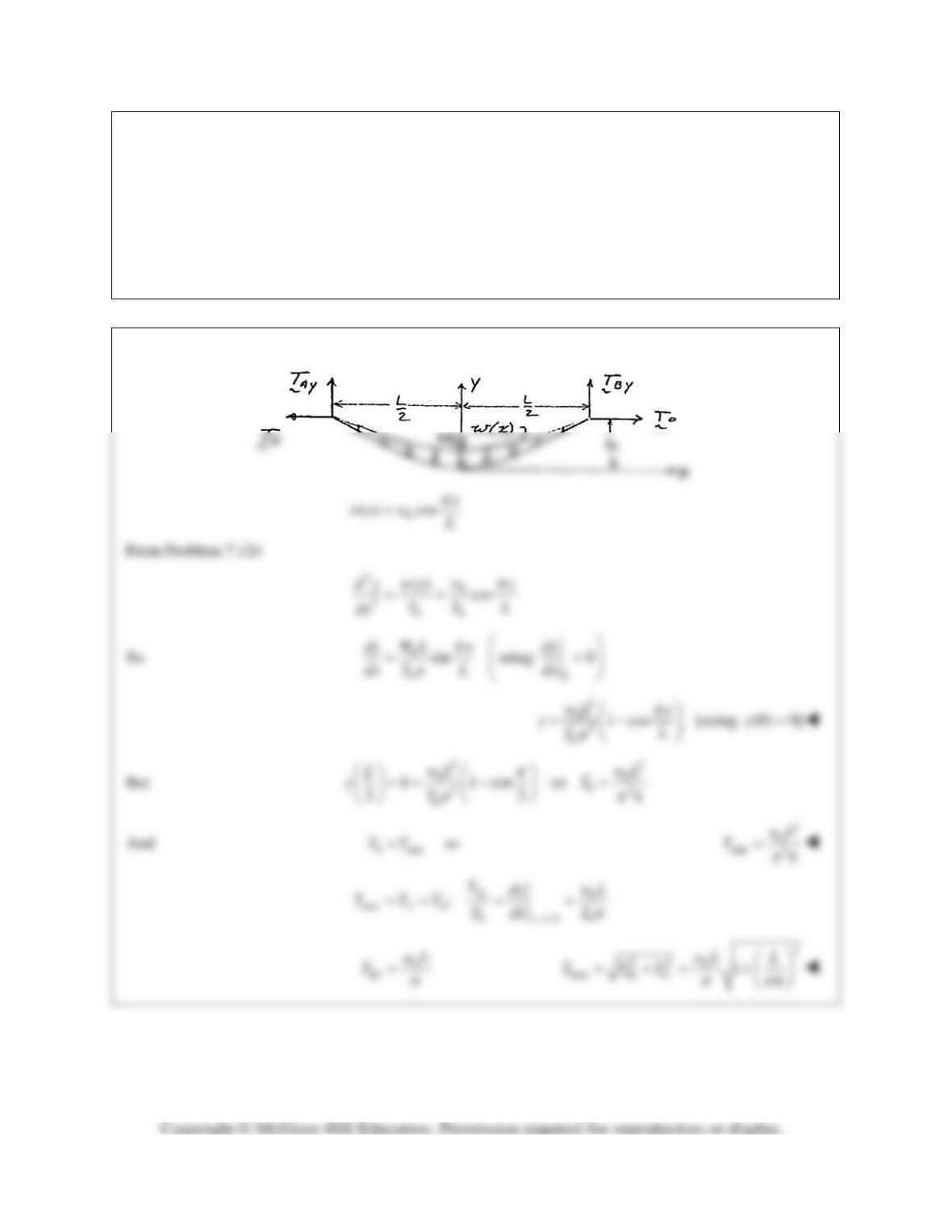
PROBLEM 7.125*
Using the property indicated in Problem 7.124, determine the curve assumed by a cable of span L and sag
h carrying a distributed load w=w0 cos (
π
x/L), where x is measured from mid–span. Also determine the
maximum and minimum values of the tension in the cable.
PROBLEM 7.124 Show that the curve assumed by a cable that carries a distributed load w(x) is defined
by the differential equation d2y/dx2=w(x)/T0, where T0is the tension at the lowest point.
SOLUTION
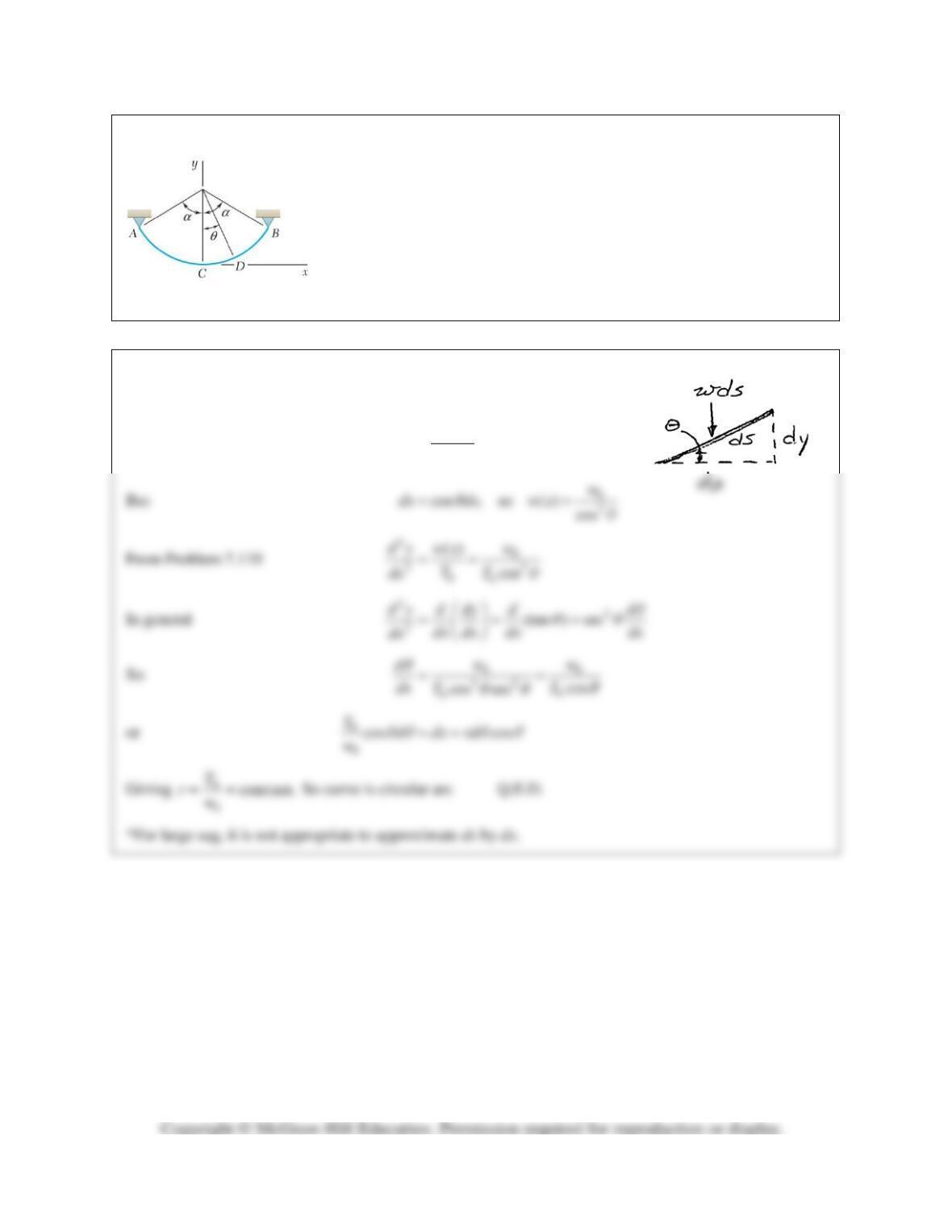
PROBLEM 7.126*
If the weight per unit length of the cable AB is w0/cos2
θ
, prove that the
curve formed by the cable is a circular arc. (Hint: Use the property
indicated in Problem 7.124.)
PROBLEM 7.124 Show that the curve assumed by a cable that carries a
distributed load w(x
) is defined by the differential equation
d2y/dx2=w(x)/T0, where T0is the tension at the lowest point.
SOLUTION
Elemental Segment:
Load on segment*
0
2
() cos
w
w x dx ds
θ
=
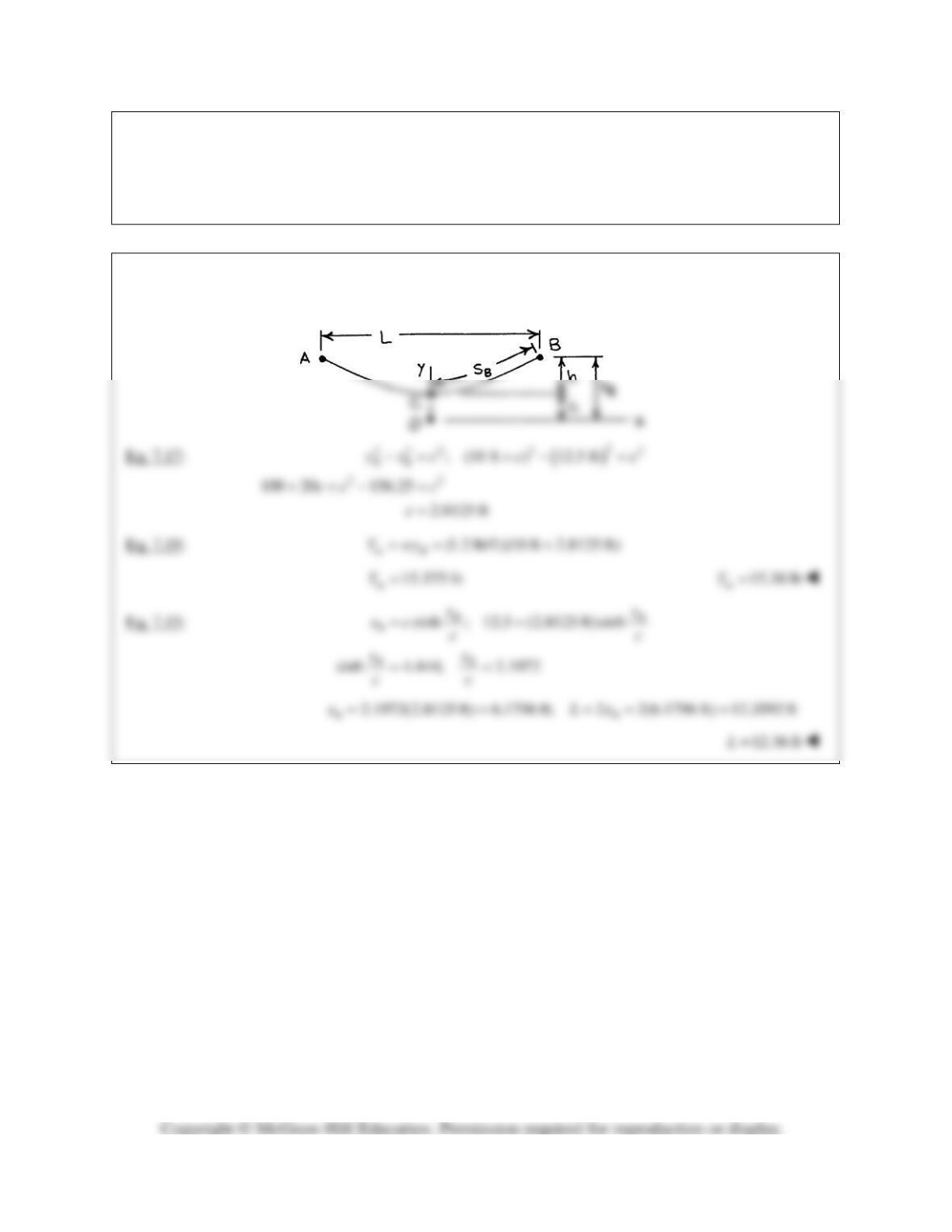
PROBLEM 7.127
A 25–ft chain with a weight of 30 lb is suspended between two points at the same elevation. Knowing that
the sag is 10 ft, determine (a) the distance between the supports, (b) the maximum tension in the chain.
SOLUTION
(30 lb)/(25 ft) 1.2 lb/ftw= =
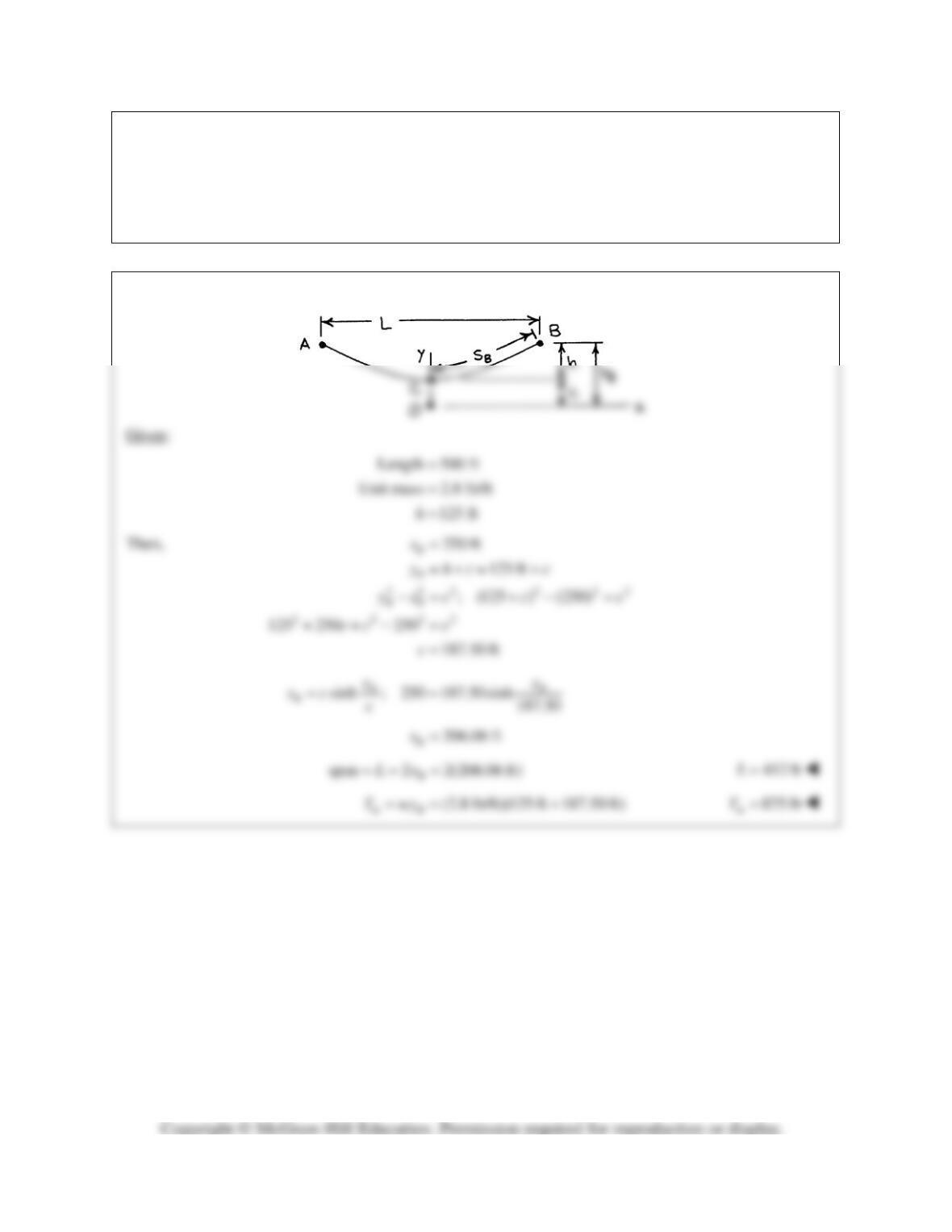
PROBLEM 7.128
A 500–ft–long aerial tramway cable having a weight per unit length of 2.8 lb/ft is suspended between two
points at the same elevation. Knowing that the sag is 125 ft, find (a) the horizontal distance between the
supports, (b) the maximum tension in the cable.
SOLUTION
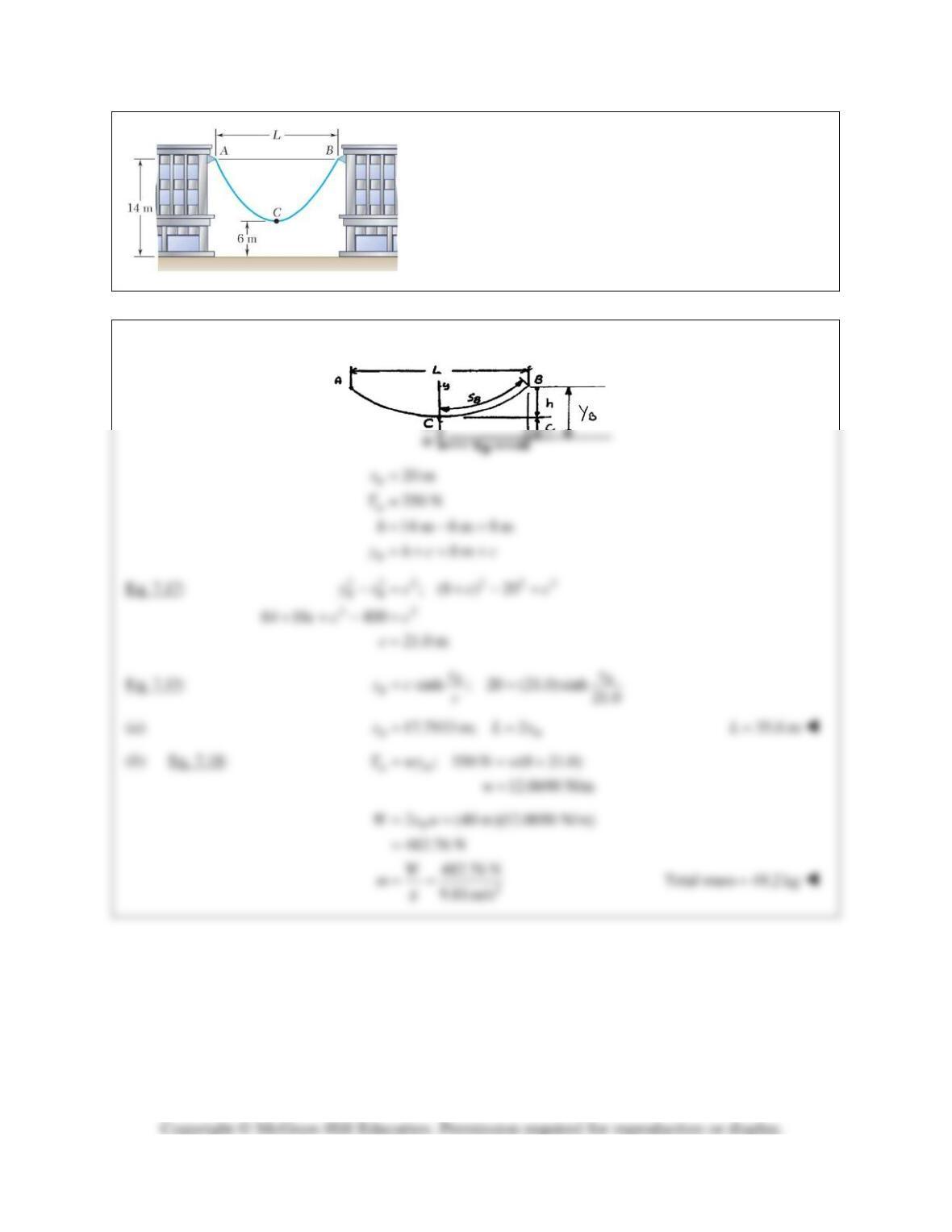
PROBLEM 7.129
A 40-m cable is strung as shown between two buildings. The
maximum tension is found to be 350 N, and the lowest point
of the cable is observed to be 6 m above the ground.
Determine (a) the horizontal distance between the buildings,
(b) the total mass of the cable.
SOLUTION
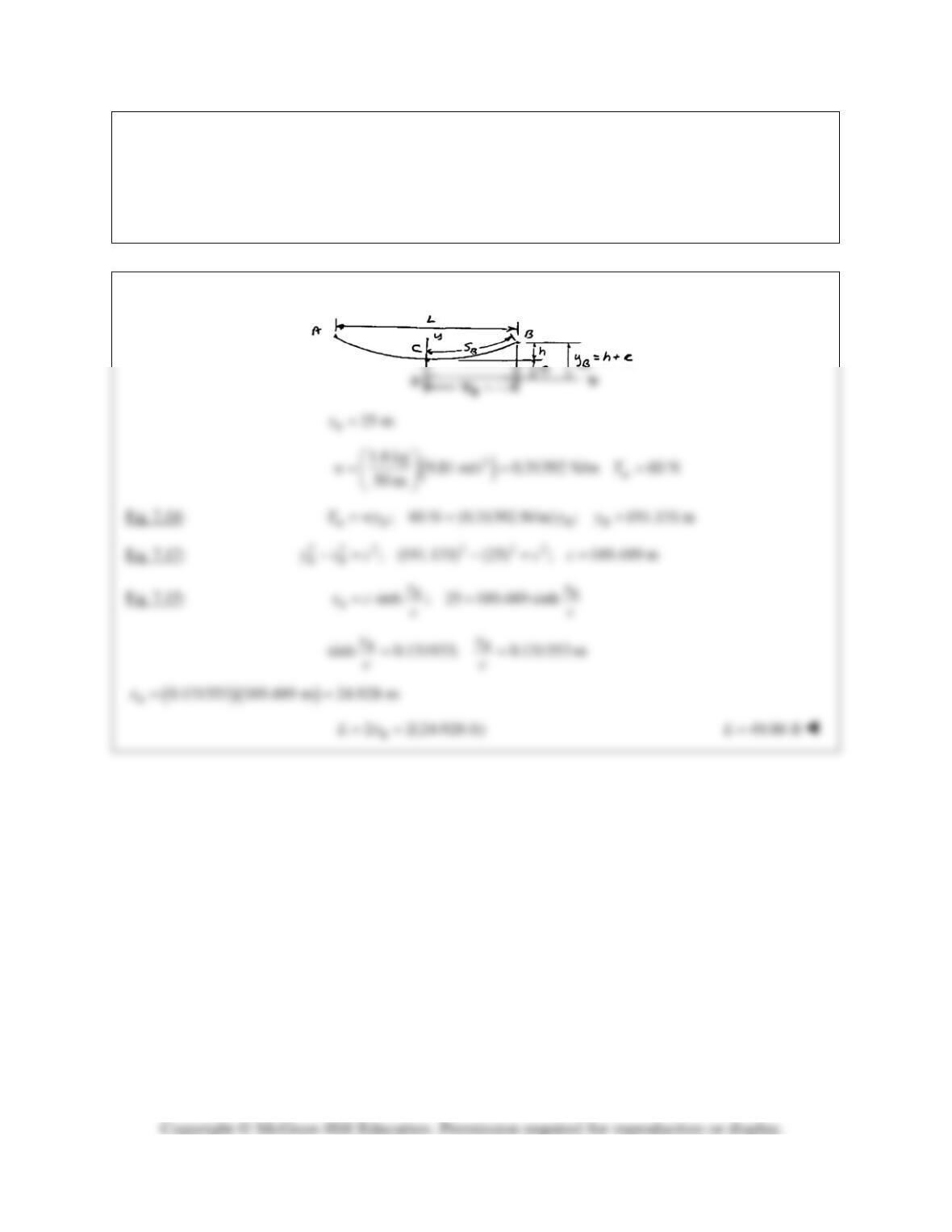
PROBLEM 7.130
A 50-m steel surveying tape has a mass of 1.6 kg. If the tape is stretched between two points at the same
elevation and pulled until the tension at each end is 60 N, determine the horizontal distance between the
ends of the tape. Neglect the elongation of the tape due to the tension.
SOLUTION
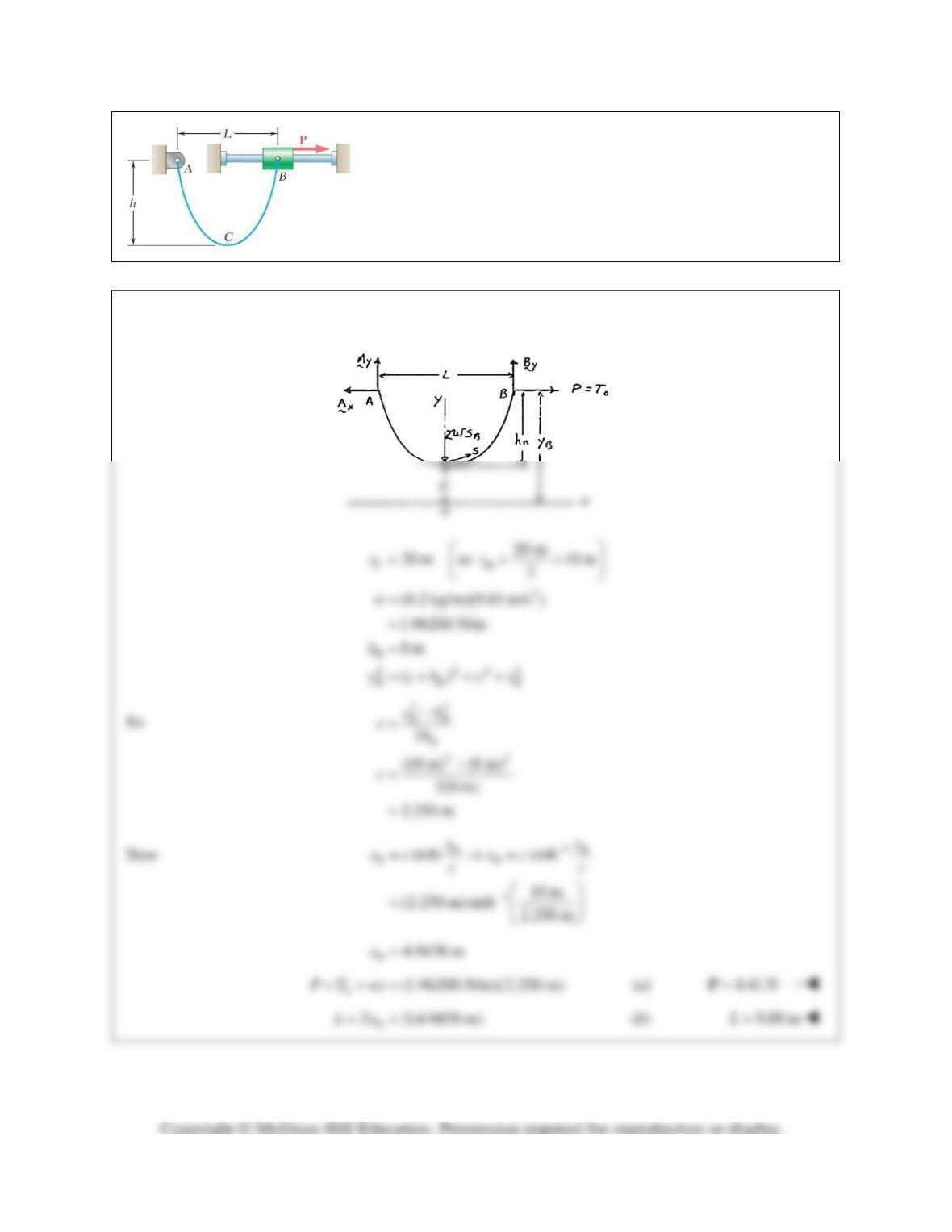
PROBLEM 7.131
A 20-m length of wire having a mass per unit length of 0.2 kg/m is
attached to a fixed support at A and to a collar at B. Neglecting the
effect of friction, determine (a) the force P for which h= 8 m, (b) the
corresponding span L.
SOLUTION
FBD Cable:
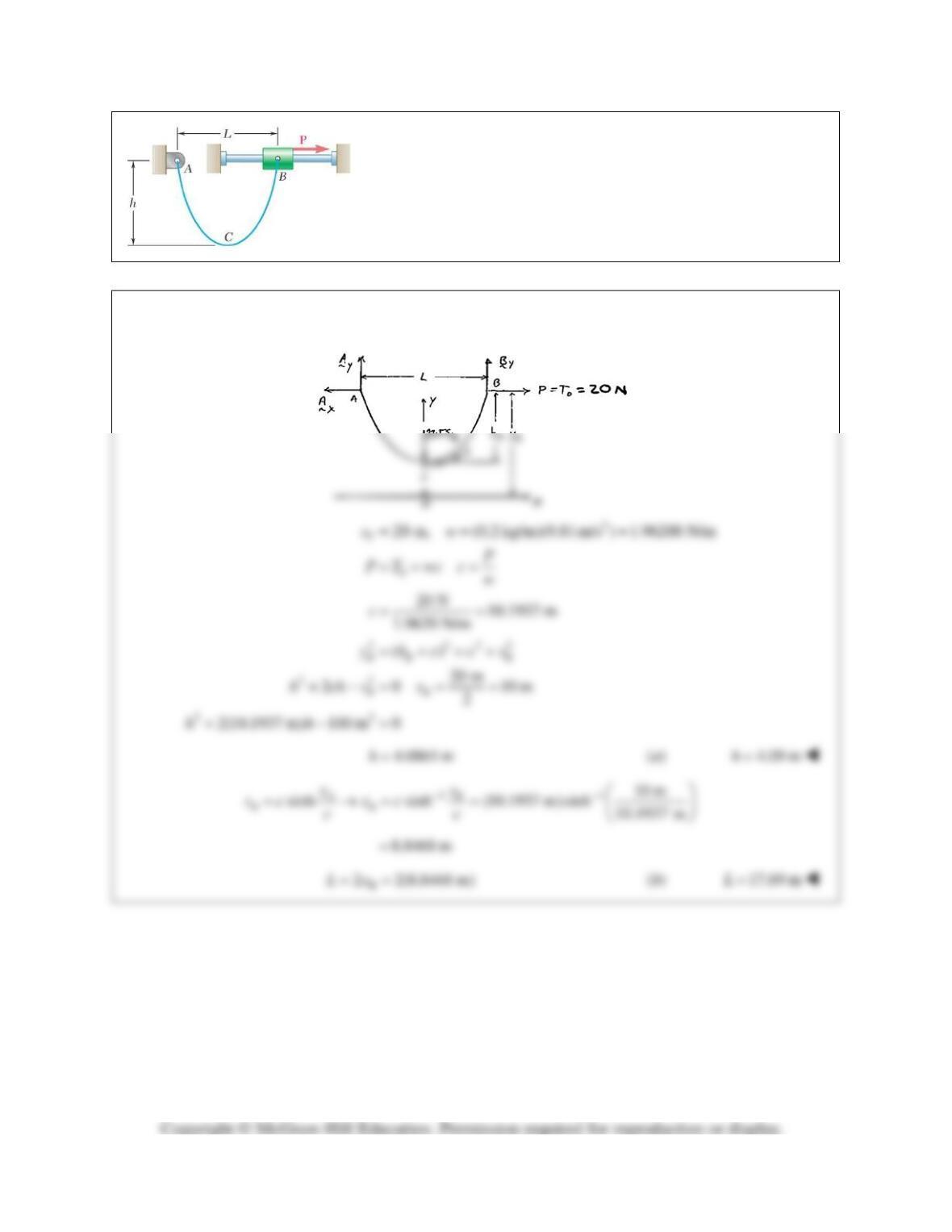
PROBLEM 7.132
A 20-m length of wire having a mass per unit length of 0.2 kg/m is
attached to a fixed support at A and to a collar at B. Knowing that
the magnitude of the horizontal force applied to the collar is
P = 20 N, determine (a) the sag h, (b) the span L.
SOLUTION
FBD Cable:
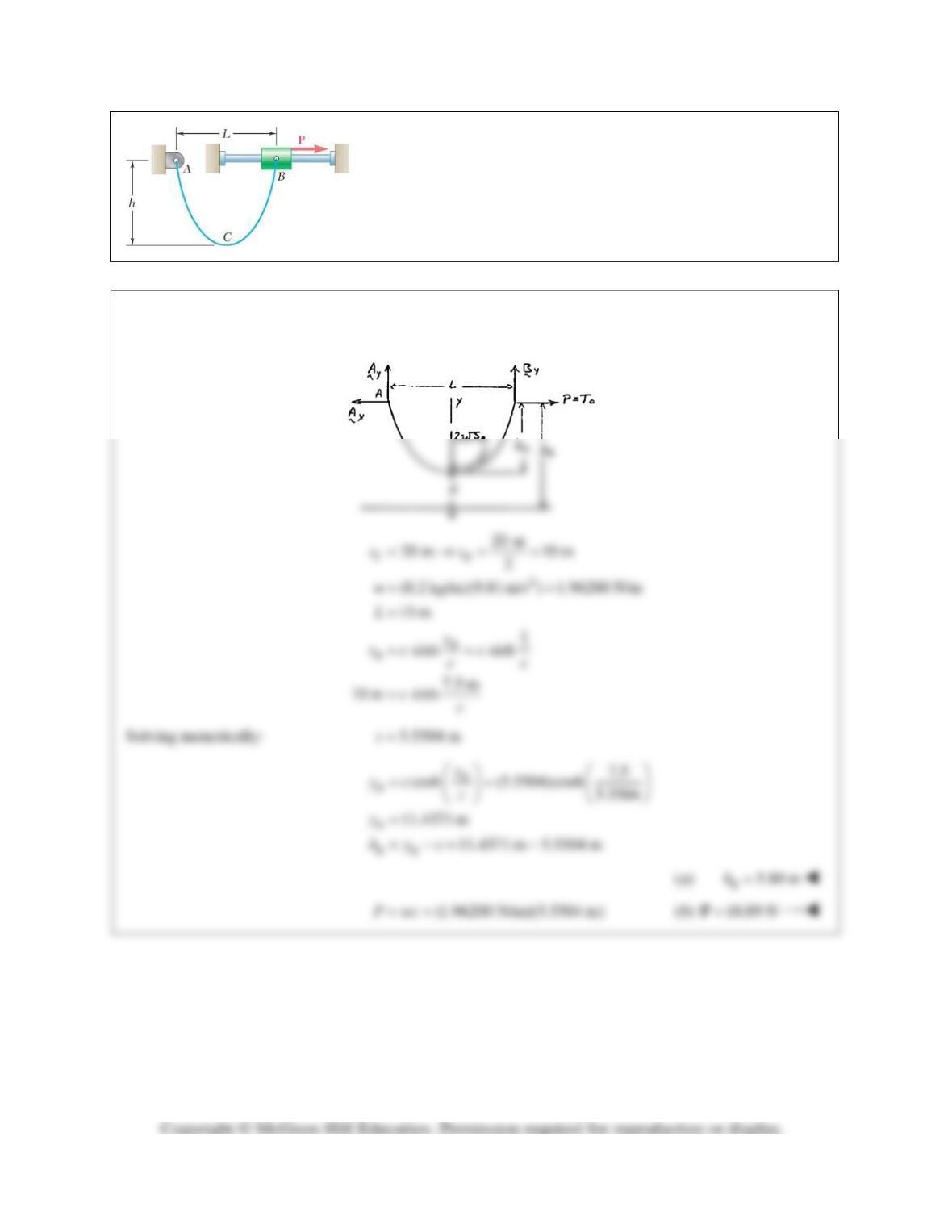
PROBLEM 7.133
A 20-m length of wire having a mass per unit length of 0.2 kg/m is
attached to a fixed support at A and to a collar at B. Neglecting the
effect of friction, determine (a) the sag h for which L= 15 m, (b) the
corresponding force P.
SOLUTION
FBD Cable:
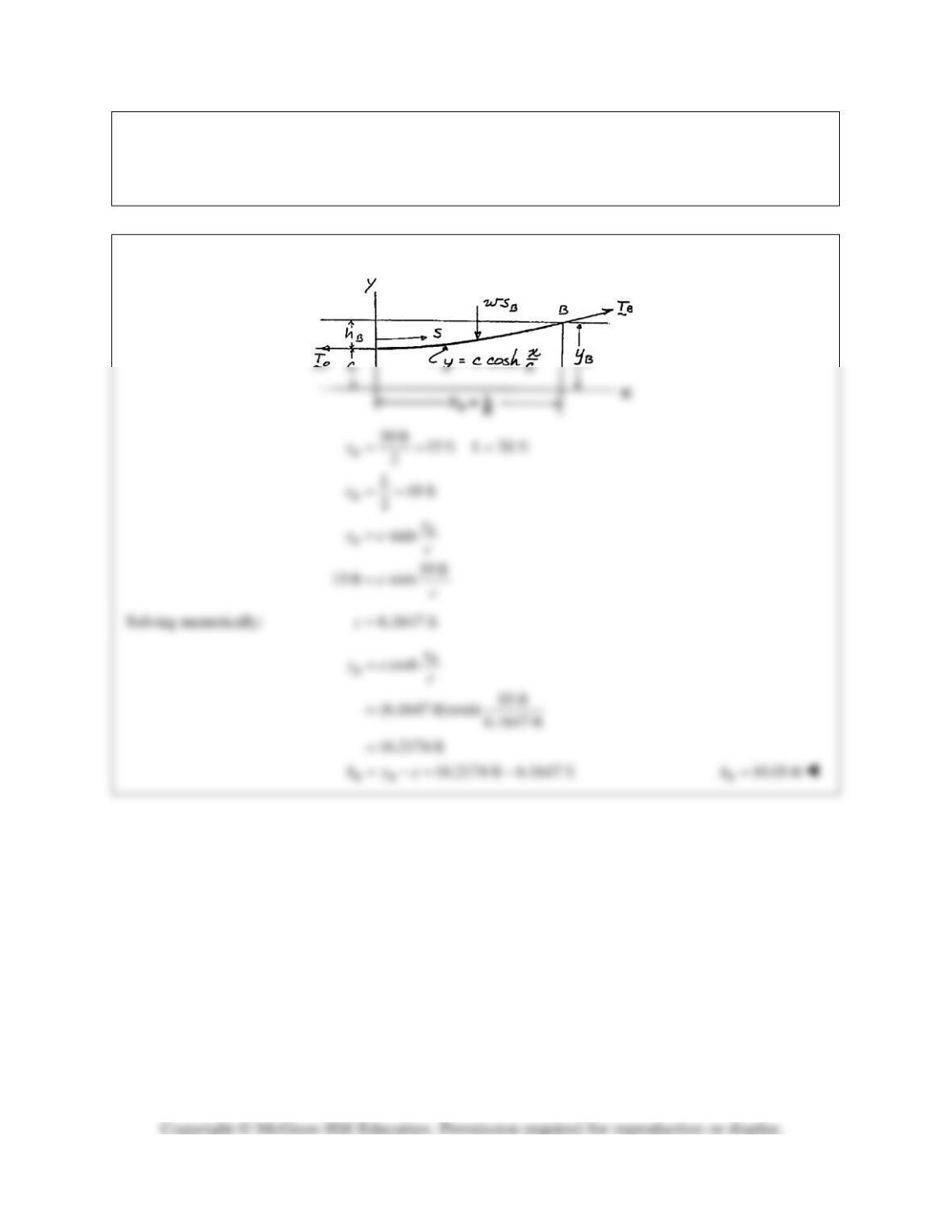
PROBLEM 7.134
Determine the sag of a 30–ft chain that is attached to two points at the same elevation that are 20 ft apart.
SOLUTION