23
VII. CHAPTER SEVEN: PREDICATE LOGIC SYMBOLIZATION
A. General theory:
1. Which of the following are sentences?
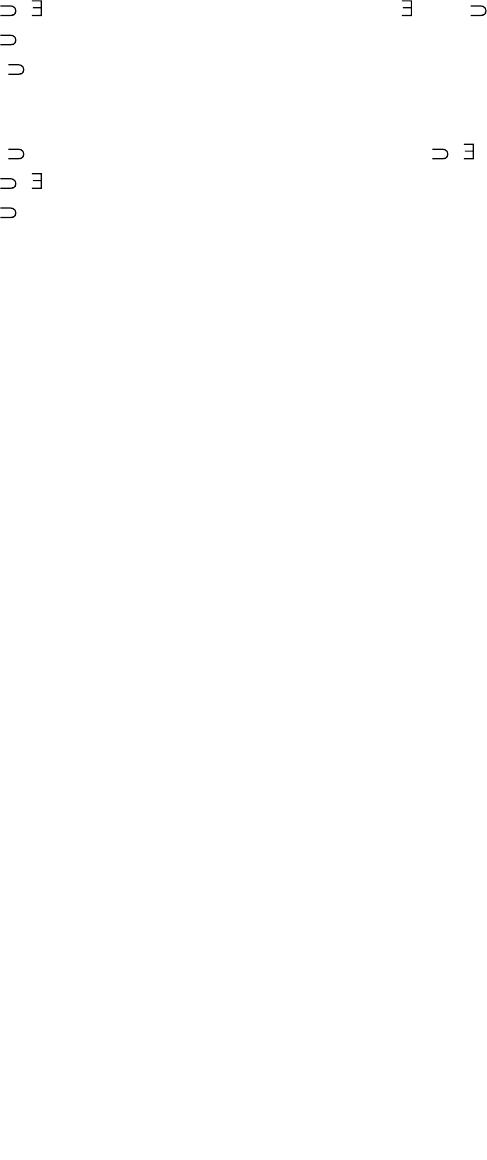
a. (x)Fx ( y)Gxy d. ~ ( y) Fy (x)Gx
b. (x)Fx Ga e. None of these
c. (x)(Fx Ga)
2. Which of the following are sentences?
a. (x)(Fx Gx) d. (x)Fy ( y)Gx
b. (x)Fx ( x)Gx e. None of these
c. (x)Fx Gx
3. Symbolize “Some mammals are not four-legged” a) when the domain is mammals
and b) when the domain is unrestricted (using obvious abbreviations).
4. Symbolize “No whales are fish” a) when the domain is whales, and b) when the
domain is unrestricted (using obvious abbreviations).
5. What sentence contradicts “No just acts are acts that cause pain”?
a. All just acts are acts that cause pain.
b. Some just acts are acts that cause pain.
c. Some just acts are acts that do not cause pain.
d. No acts that cause pain are just acts.
e. None of these.
24
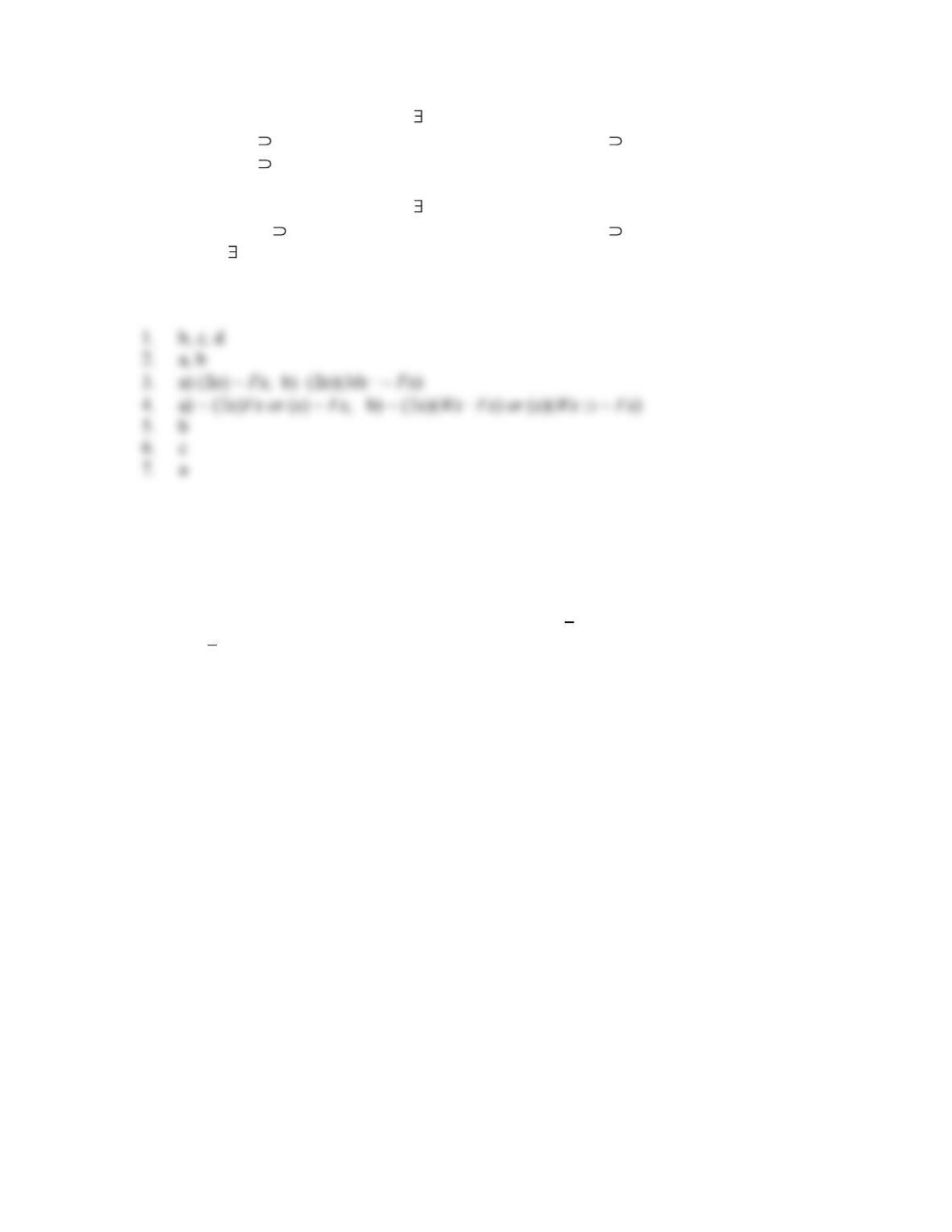
6. Which sentence is equivalent to ( x)(Ax · ~ Bx)?
a. (x)(Ax ~Bx) c. ~ (x)(Ax Bx)
b. (x)(Ax Bx) d. None of these
7. Which sentence is equivalent to ( x)(Ax ·Bx)?
a. ~ (x)(Ax ~Bx) c. ~ (x)(Ax Bx)
b. ~ ( x)(Ax · ~ Bx) d. None of these
A. Answers
B. Symbolize, using the indicated letters:
1. No mathematician philosophers are scientists. (Mx =“x is a mathematician”; Px =
“x is a philosopher”; Sx =“x is a scientist”.)
2. All mathematicians and philosophers are either non philosophers or
non scientists.
3. Some mathematicians and (some) philosophers are scientists.
4. No one is a scientist unless he also is a mathematician and philosopher.
5. Only mathematicians are scientists, and none but philosophers are
mathematicians.
6. No arguments that are either invalid or unsound are convincing. (Ax =“x is an
argument”, Vx =“x is valid”; Sx =“x is sound”; Cx =“x is convincing”.)
7. A student caught cheating will be expelled. (Sx =“x is a student”; Cx =“x is
caught cheating”; Ex =“x will be expelled”.)
8. A student who was caught cheating was not expelled.
9. If all students are good logicians, then they all will pass. (Sx =“x is a student”; Gx
=“x is a good logician”; Px =“x will pass”.)
10. If a student is a good logician, then he or she will pass.
25
11. If not all students will pass, then some students are not good logicians.
12. If any students pass, then they studied hard. (Hx =“x studied hard”.)
13. If all students pass, then at least some of them are good logicians.
14. Some students are good logicians, but are such that they won’t pass unless they
study hard.
15. Some students are neither good logicians nor good writers, but some students are
both. (Wx = “xis a good writer”.)
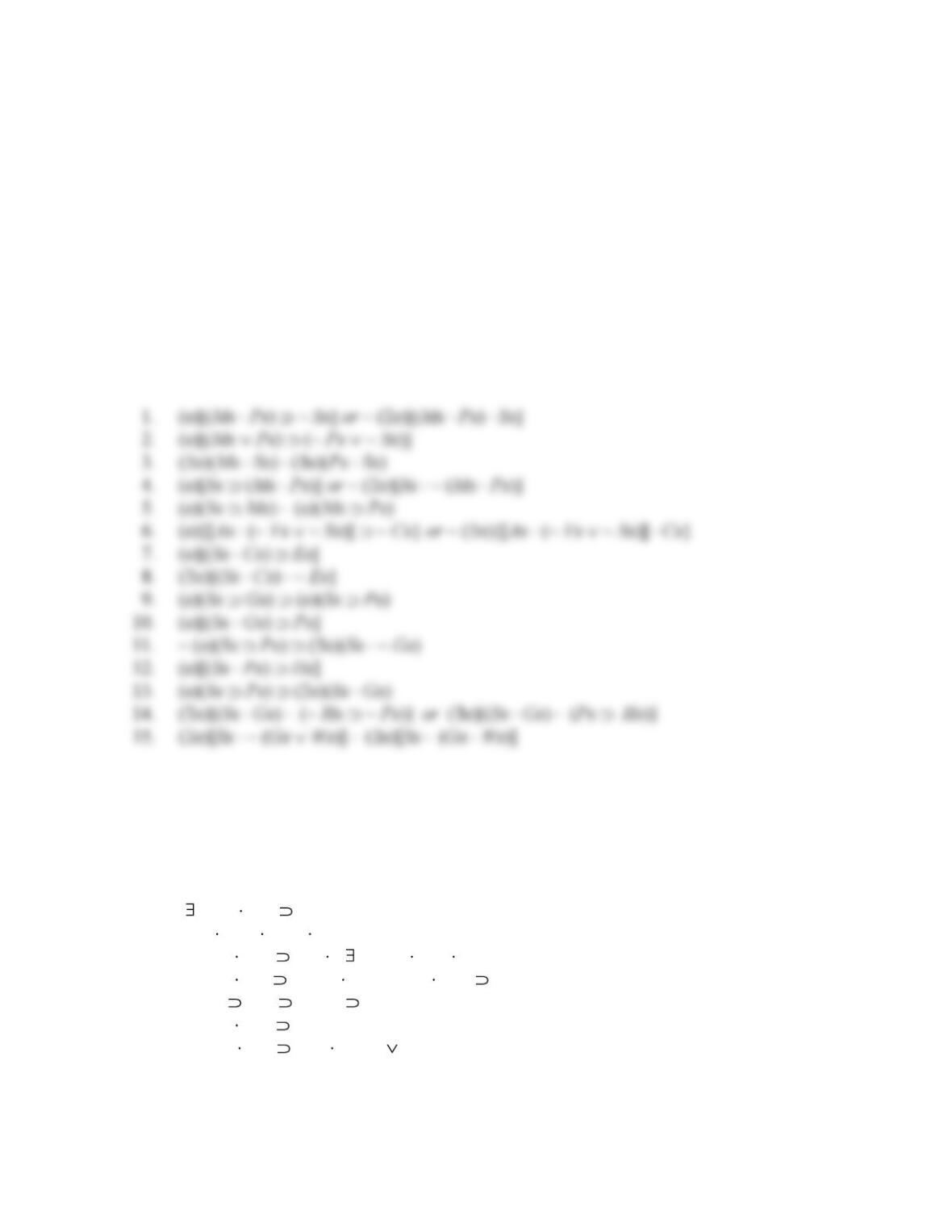
B. Answers
C. Translations. Translate the following into English, being a colloquial as possible. Use
same symbols as above, i.e., let Sx =“x is a student”; Cx =“x is caught cheating”;
Ex =“x will be expelled”; Gx =“x is a good logician”; Px =“x will pass”; Hx =
“x studied hard”; Wx = “xis a good writer”; and let Ax = “x is angry”; Yx = “x is
happy”; a= Alice; b= Burt.
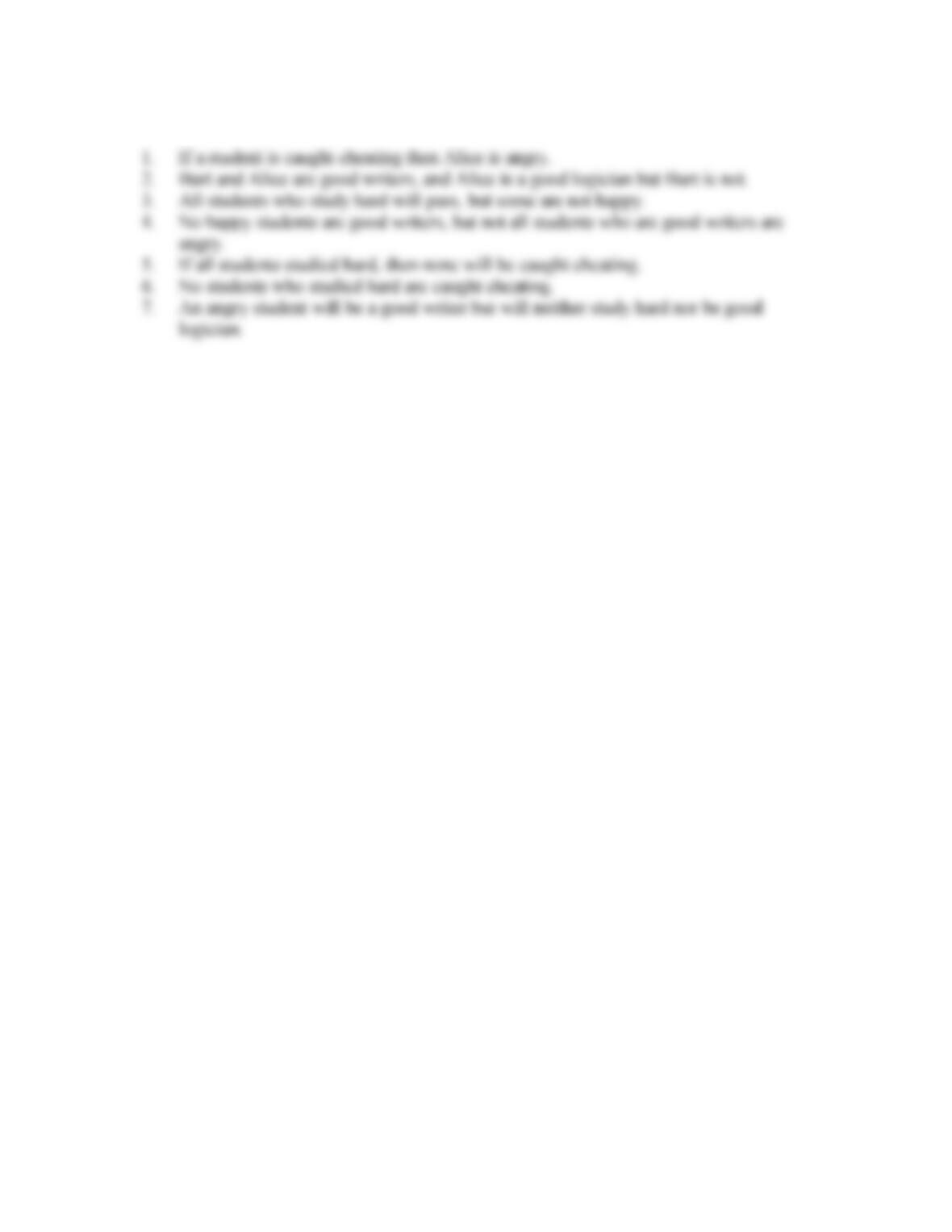
1. ( x)(Sx Cx)Aa
2. (Wb Wa) (Ga ~Gb)
3. (x)[(Sx Hx)Px] ( x) [(Sx Hx) ~ Yx]
4. (x)[(Sx Yx) ~ Wx] ~ (x)[ [(Sx Wx)Ax]
5. (x)(Sx Hx) (x)(Sx ~Cx)
6. (x)[(Sx Hx) ~ Cx]
7. (x){(Sx Ax) [Wx ~ (Hx Gx)]}
26
C. Suggested Answers