Chapter 7
Activity-Based Costing: A Tool to Aid
Decision Making
Solutions to Questions
7-1 Activity-based costing differs from
traditional costing systems in a number of ways.
In activity-based costing, nonmanufacturing as
well as manufacturing costs may be assigned to
7-2 When direct labor is used as an allocation
base for overhead, it is implicitly assumed that
overhead cost is directly proportional to direct
labor. When cost systems were originally
developed in the 1800s, this assumption may
7-3 Top managers provide leadership that is
needed to properly motivate all employees to
embrace the need to implement ABC. Top
managers also have the authority to link ABC data
to the employee evaluation and reward system.
Cross-functional employees are also important
because they possess intimate knowledge of
operations that is needed to design an effective
ABC system. Tapping the knowledge of cross–
functional employees also lessens their resistance
to ABC because they feel included in the
implementation process.
what products or services they buy. Organization-
sustaining activities are carried out regardless of
the company’s precise product mix or mix of
customers.
ask employees how they spend their time. It is
also possible to ask people to keep records of
how they spend their time or observe them as
they perform their tasks, but both of these
alternatives are costly and it is not obvious that
the data would be any better. People who know
they are being observed may change how they
behave.
7-8 In traditional cost systems, product-level
costs are indiscriminately spread across all
products using direct labor-hours or some other
allocation base related to volume. As a
consequence, high-volume products are assigned
7-9 Activity rates tell managers the average
cost of resources consumed to carry out a
particular activity such as processing purchase
orders. An activity whose average cost is high
may be a good candidate for process
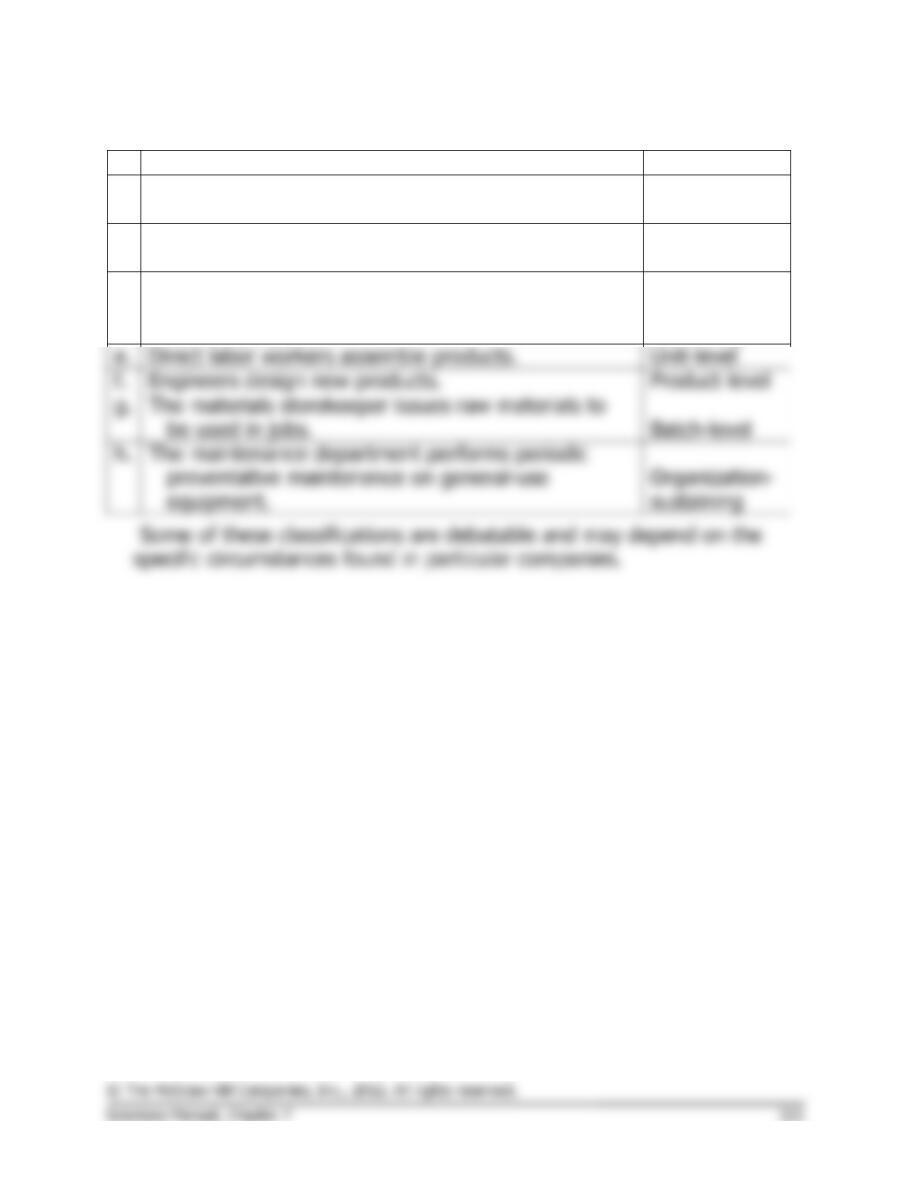
Exercise 7-1 (10 minutes)
a.
Various individuals manage the parts inventories.
Product-level
b.
A clerk in the factory issues purchase orders for a
job.
Batch-level
c.
The personnel department trains new production
workers.
Organization-
sustaining
d.
The factory’s general manager meets with other
department heads, such as marketing, to
coordinate plans.
Organization-
sustaining
Engineers design new products.
Product-level
g.
The materials storekeeper issues raw materials to
be used in jobs.
Batch-level
preventative maintenance on general-use
equipment.
Organization-
sustaining
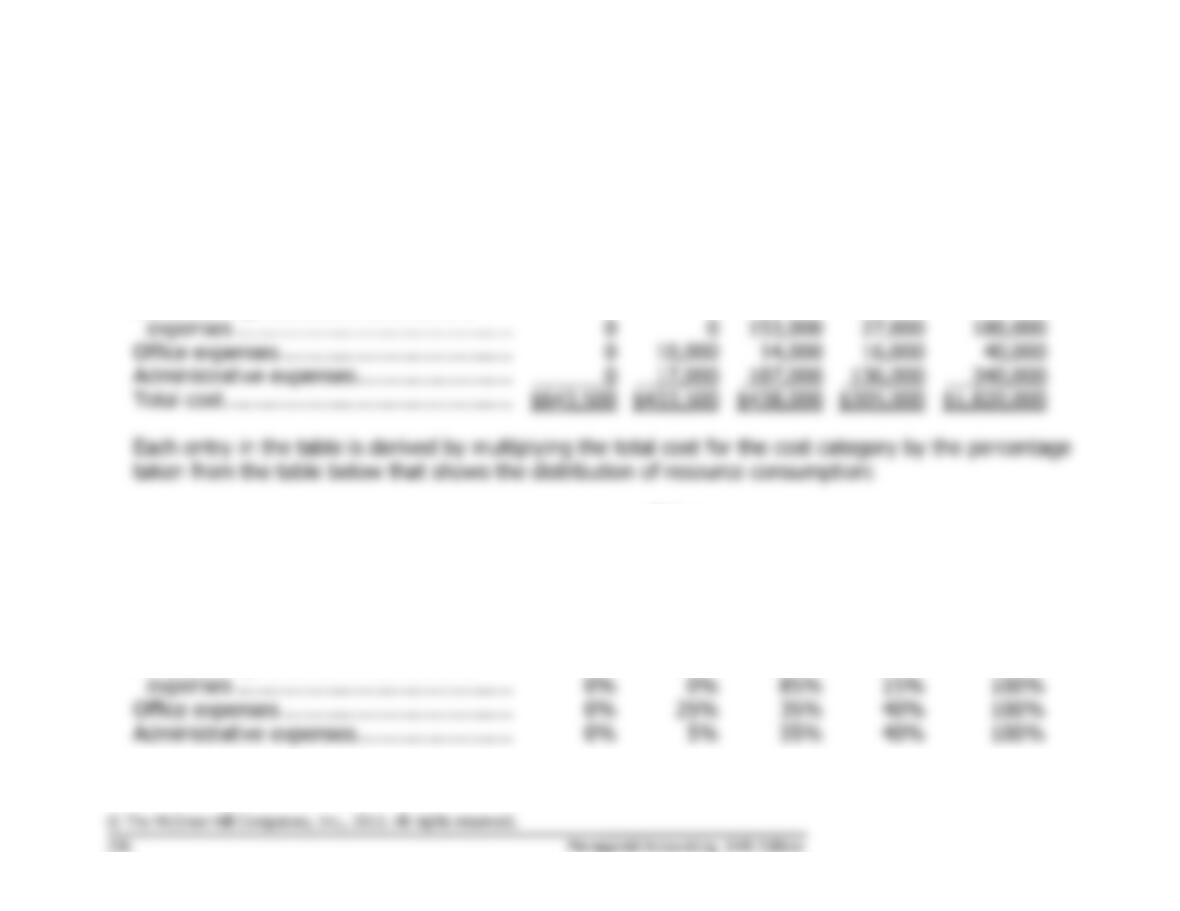
Exercise 7-2 (15 minutes)
Travel
Pickup
and
Delivery
Customer
Service
Other
Totals
Driver and guard wages …………………….
$336,000
$378,000
$ 84,000
$ 42,000
$ 840,000
Vehicle operating expense ………………….
202,500
13,500
0
54,000
270,000
Vehicle depreciation ………………………….
105,000
15,000
0
30,000
150,000
27,000
180,000
Office expenses ……………………………….
Administrative expenses …………………….
187,000
136,000
340,000
Total cost …………………………..…………..
$643,500
$433,500
$305,000
Customer representative salaries and
Travel
Pickup
and
Delivery
Customer
Service
Other
Totals
Driver and guard wages …………………….
40%
45%
10%
5%
100%
Vehicle operating expense ………………….
75%
5%
0%
20%
100%
Vehicle depreciation ………………………….
70%
10%
0%
20%
100%
0%
0%
85%
15%
100%
Office expenses ……………………………….
25%
40%
100%
Administrative expenses …………………….
0%
5%
55%
40%
100%
Customer representative salaries and
Exercise 7-3 (10 minutes)
Activity Cost Pool
Estimated
Overhead
Cost
Expected Activity
Activity Rate
Caring for lawn
$77,400
180,000
square feet of lawn
$0.43
per square foot of lawn
Caring for garden beds–
low maintenance
$30,000
24,000
square feet of low
maintenance beds
$1.25
per square foot of low
maintenance beds
Customer billing and service
customers
per customer
Caring for garden beds–
$57,600
18,000
square feet of high
$3.20
per square foot of high
Exercise 7-4 (10 minutes)
J78
Activity Cost Pool
Activity Rate
Activity
ABC Cost
Supporting direct labor ………
$7
per direct labor-hour
1,000
direct labor-hours
$ 7,000
Machine processing …………..
$3
per machine-hour
3,200
machine-hours
9,600
Machine setups ………………..
$40
per setup
5
setups
200
Production orders ……………..
$160
per order
5
order
800
Shipments ……………………….
$120
per shipment
10
shipment
1,200
Product sustaining …………….
$800
per product
1
product
Total overhead cost …………..
W52
Supporting direct labor ………
$7
per direct labor-hour
40
direct labor-hours
Machine setups ………………..
per setup
setups
Production orders ……………..
$160
per order
1
orders
160
Shipments ……………………….
$120
per shipment
1
shipments
120
Product sustaining …………….
per product
product
Total overhead cost …………..
Exercise 7-5 (15 minutes)
Sales ($1,650 per standard model glider × 10
standard model gliders + $2,300 per custom
designed glider × 2 custom designed gliders) ……..
$21,100
Costs:
Direct materials ($462 per standard model glider ×
10 standard model gliders + $576 per custom
designed glider × 2 custom designed gliders) …..
$5,772
Custom designing ($261 per custom design × 2
Customer service ($426 per customer ×
Customer margin …………………………………………….
Direct labor ($19 per direct labor-hour × 28.5 direct
labor-hours per standard model glider × 10
Exercise 7-6 (10 minutes)
Activity Cost Pool
(a)
Activity Rate
(b)
Activity
(a) × (b)
ABC Cost
Order size ………..
R 17.60
per direct labor-hour
150
direct labor-hours
R 2,640
Customer orders ..
R 360.00
per customer order
1
customer order
360
Product testing ….
R 79.00
per product testing hour
product testing hours
Selling ……………..
per sales call
3
sales calls
4,482
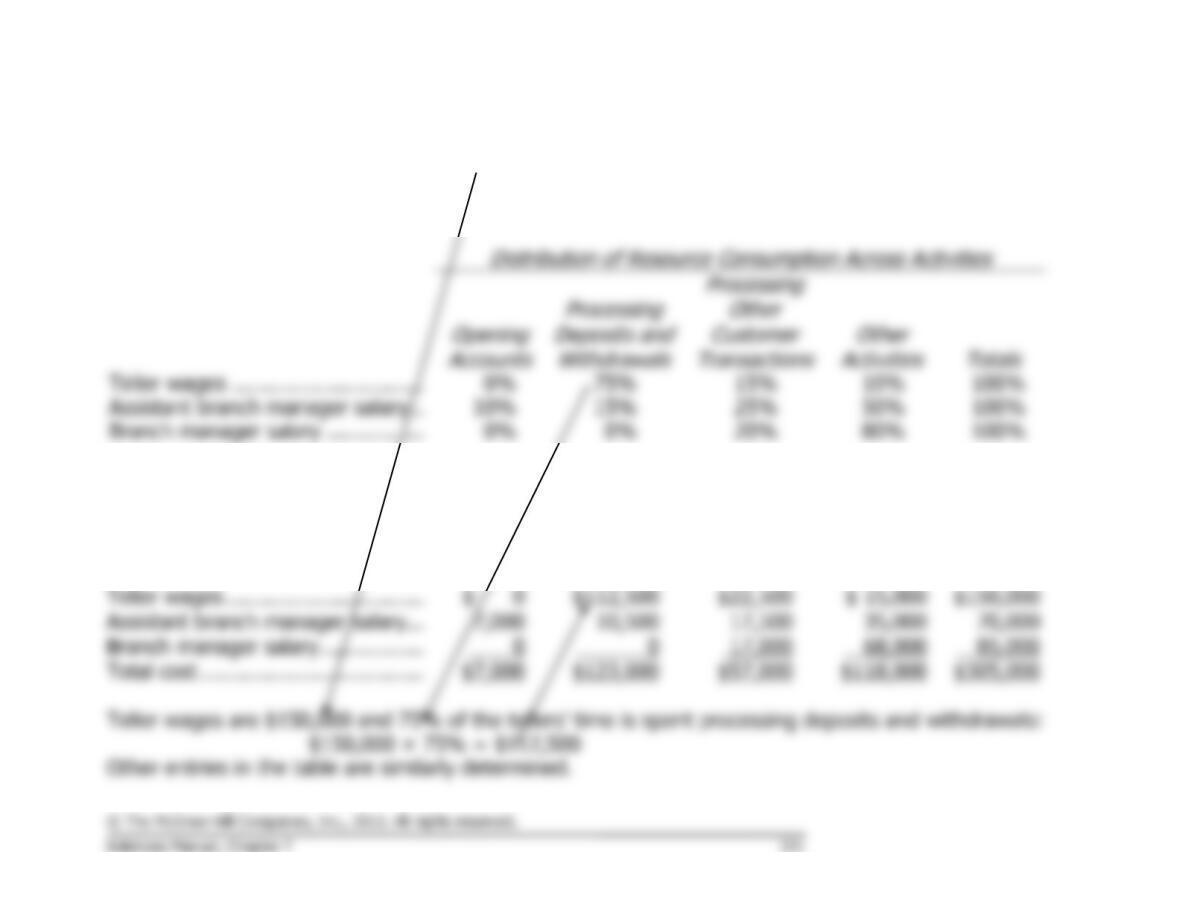
Exercise 7-7 (10 minutes)
Teller wages ………………………….
$150,000
Assistant branch manager salary ..
$70,000
Branch manager salary …………….
$85,000
Teller wages ………………………….
Assistant branch manager salary ..
Branch manager salary …………….
Opening
Accounts
Processing
Deposits and
Withdrawals
Processing
Other
Customer
Transactions
Other
Activities
Totals
Teller wages …………………………..
0
0
Exercise 7-8 (20 minutes)
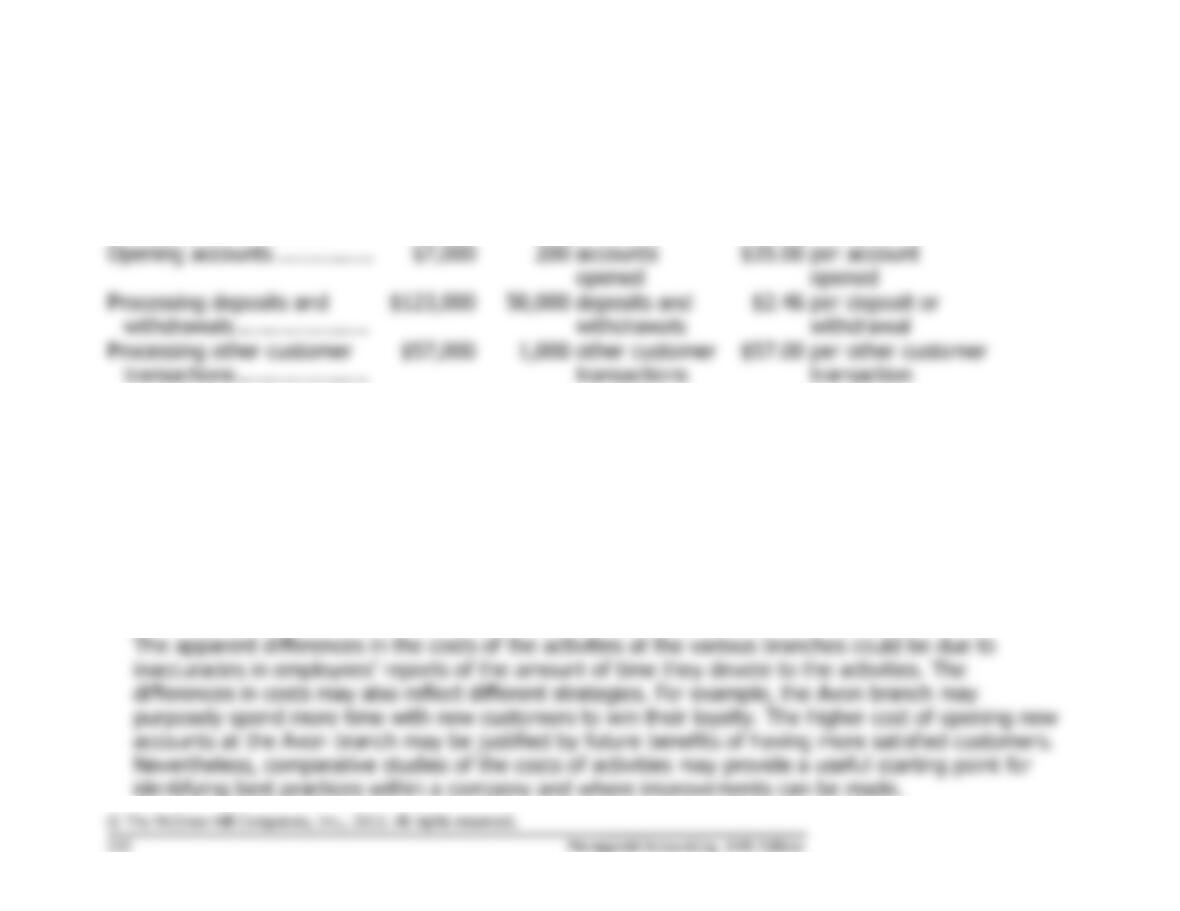
1. Computation of activity rates:
Activity Cost Pools
(a)
Total Cost
(b)
Total Activity
(a) ÷ (b)
Activity Rate
2. The cost of opening an account at the Avon branch is much higher than at the lowest cost branch
($35.00 versus $24.35). On the other hand, the cost of processing deposits and withdrawals is lower
than at the lowest cost branch ($2.46 versus $2.72). And the cost of processing other customer
transactions is somewhat higher at the Avon branch ($57.00 versus $48.90). The other branches may
have something to learn from Avon concerning processing deposits and withdrawals and Avon may
benefit from learning about how some of the other branches open accounts and process other
transactions. It may be particularly instructive to compare the details of the activity rates. For
example, is the cost of opening accounts at Avon apparently high because of the involvement of the
assistant branch manager in this activity? Perhaps tellers open new accounts at other branches.
Exercise 7-9 (30 minutes)
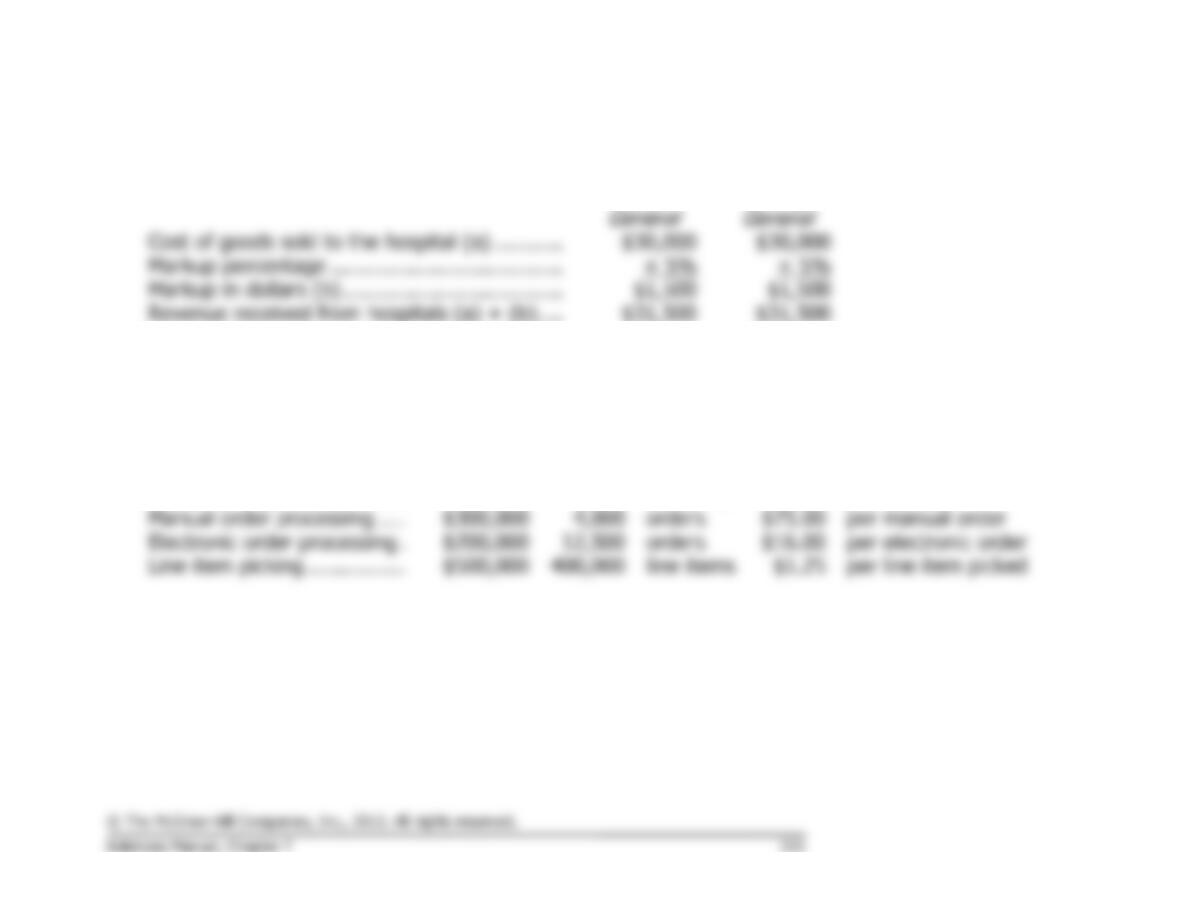
1. Total revenue received:
Cost of goods sold to the hospital (a) ………..
Markup percentage ……………………………….
Revenue received from hospitals (a) + (b) ….
City
County
2. Activity Rates:
Activity Cost Pool
(a)
Estimated
Overhead
Cost
(b)
Expected Activity
(a) ÷ (b)
Activity rate
Customer deliveries …………
$400,000
5,000
deliveries
$80.00
per delivery
Electronic order processing .
$200,000
12,500
orders
$16.00
per electronic order
Line item picking …………….
$500,000
400,000
line items
per line item picked
Exercise 7-9 (continued)
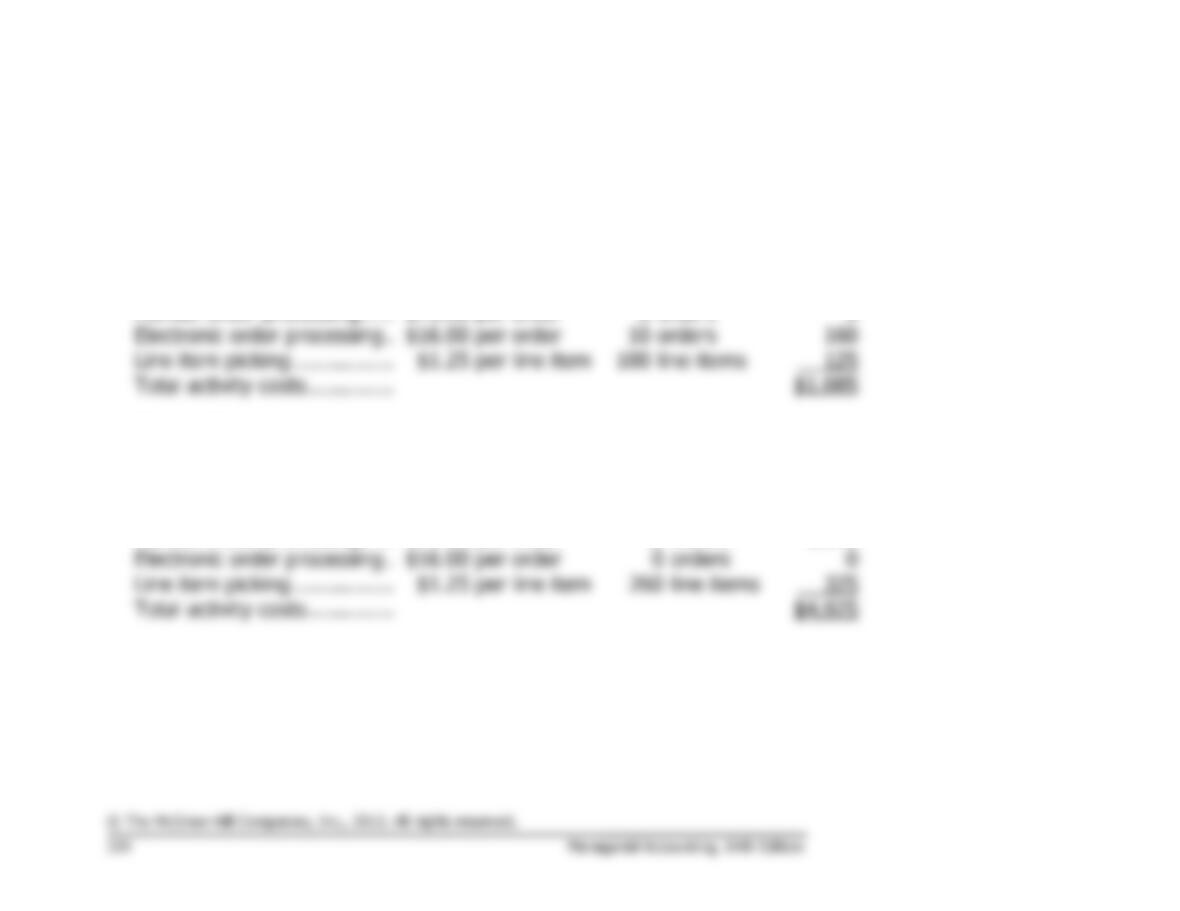
3. Activity costs are assigned to the two hospitals as follows:
City General:
Activity Cost Pool
(a)
Activity Rate
(b)
Activity
(a) × (b)
ABC Cost
Customer deliveries …………
$80.00
per delivery
10
deliveries
$ 800
Manual order processing …..
$75.00
per order
0
orders
0
Electronic order processing .
$16.00
per order
10
orders
Line item picking …………….
per line item
line items
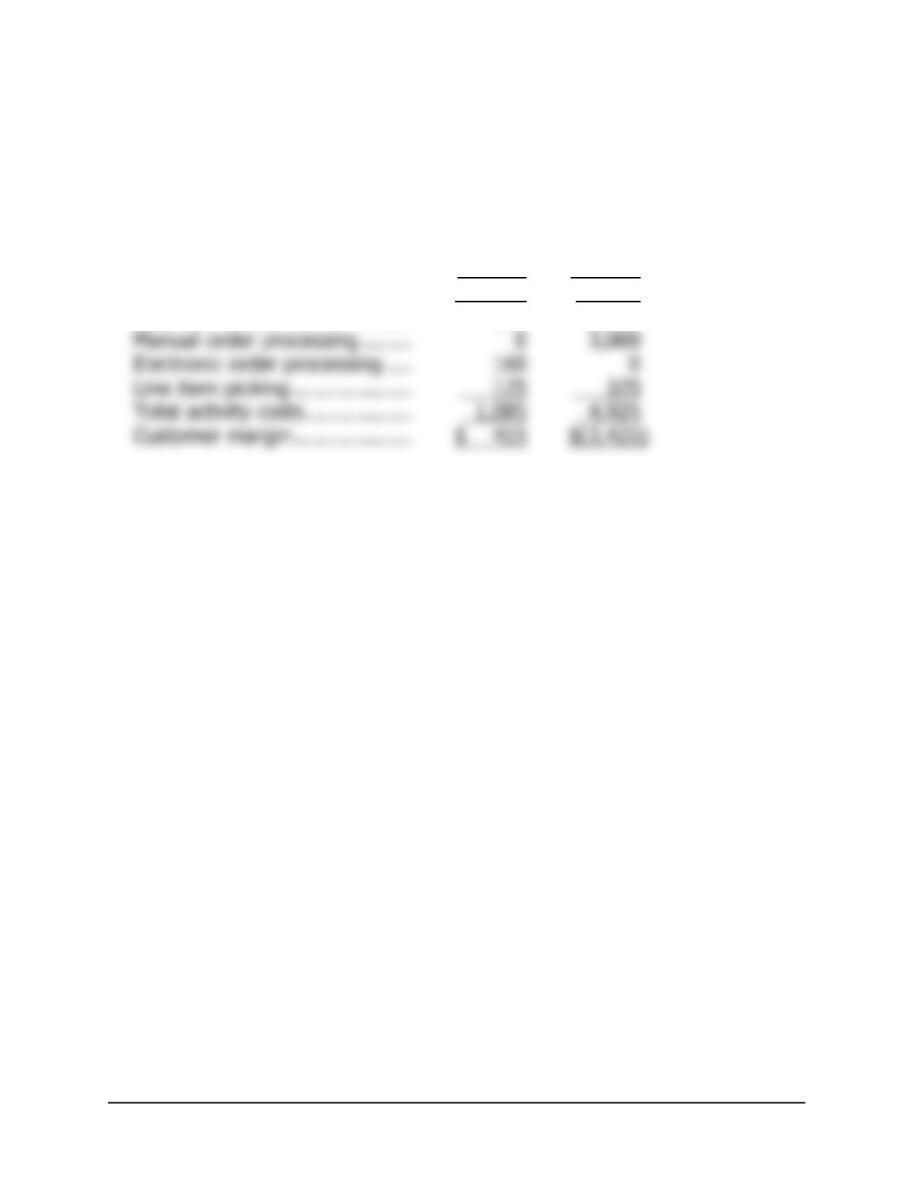
Total activity costs …………..
County General:
Activity Cost Pool
(a)
Activity Rate
(b)
Activity
(a) × (b)
ABC Cost
Customer deliveries …………
$80.00
per delivery
20
deliveries
$1,600
Manual order processing …..
$75.00
per order
40
orders
3,000
Electronic order processing .
$16.00
per order
orders
0
Line item picking …………….
per line item
line items
Total activity costs …………..
© The McGraw-Hill Companies, Inc., 2012. All rights reserved.
Solutions Manual, Chapter 7 335
Exercise 7-9 (continued)
4. Customer margins for the two hospitals:
City
General
County
General
Sales ………………………………
$31,500
$31,500
Cost of goods sold ……………..
30,000
30,000
Gross margin …………………….
1,500
1,500
Customer deliveries ……………
800
1,600
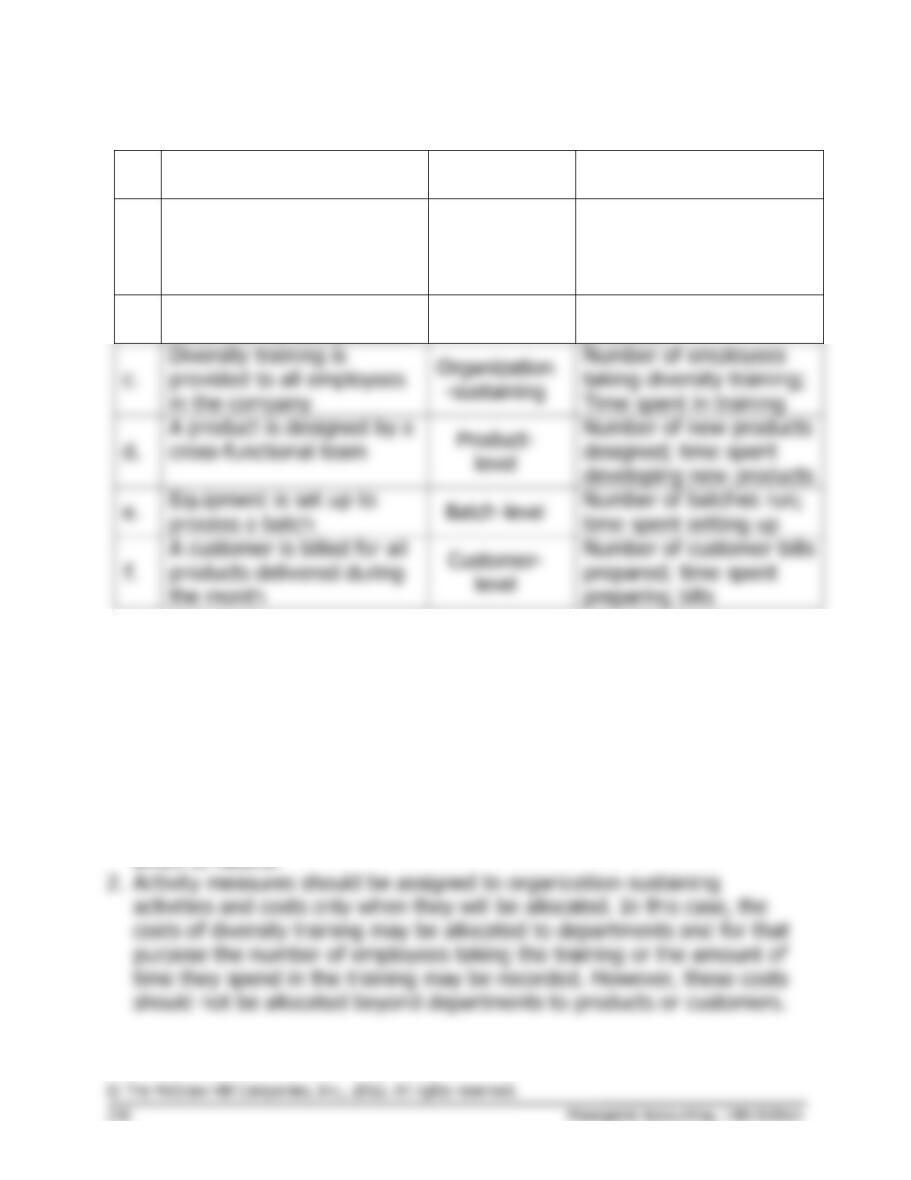
5. Hospitals that require frequent deliveries, place a high volume of manual
orders, and order many line items are likely to be unprofitable.
Manual order processing ……..
3,000
Line item picking ……………….
Total activity costs ……………..
Customer margin ……………….
Exercise 7-10 (10 minutes)
Activity
Activity
Classification
Examples of Activity
Measures
a.
Materials are moved from
the receiving dock to the
assembly area by a
material-handling crew
Batch-level
Number of materials
moves; time spent
moving materials
b.
Direct labor workers
assemble various products
Unit-level
Time spent assembling
products
Equipment is set up to
process a batch
Number of batches run;
time spent setting up
Notes:
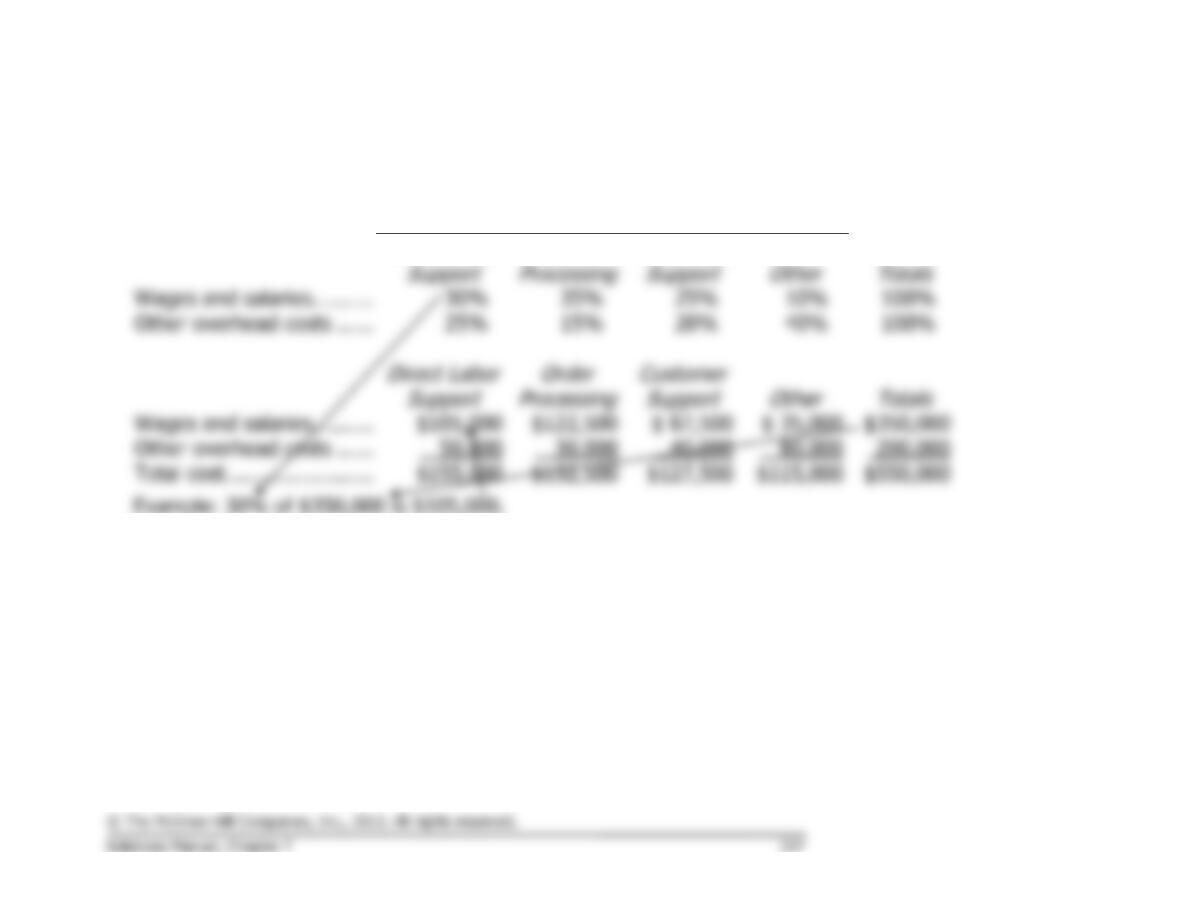
1. In all cases except for direct labor in part (b), two activity measures are
listed. The first is a “transaction driver” and the second is a “duration
driver.” Transaction drivers are simple counts of the number of times an
activity occurs, such as the number of times materials are moved.
Duration drivers are measures of the amount of time required to
perform an activity, such as the time spent moving materials. In
general, duration drivers are more accurate measures of the
consumption of resources than transaction drivers, but they take more
Exercise 7-11 (30 minutes)
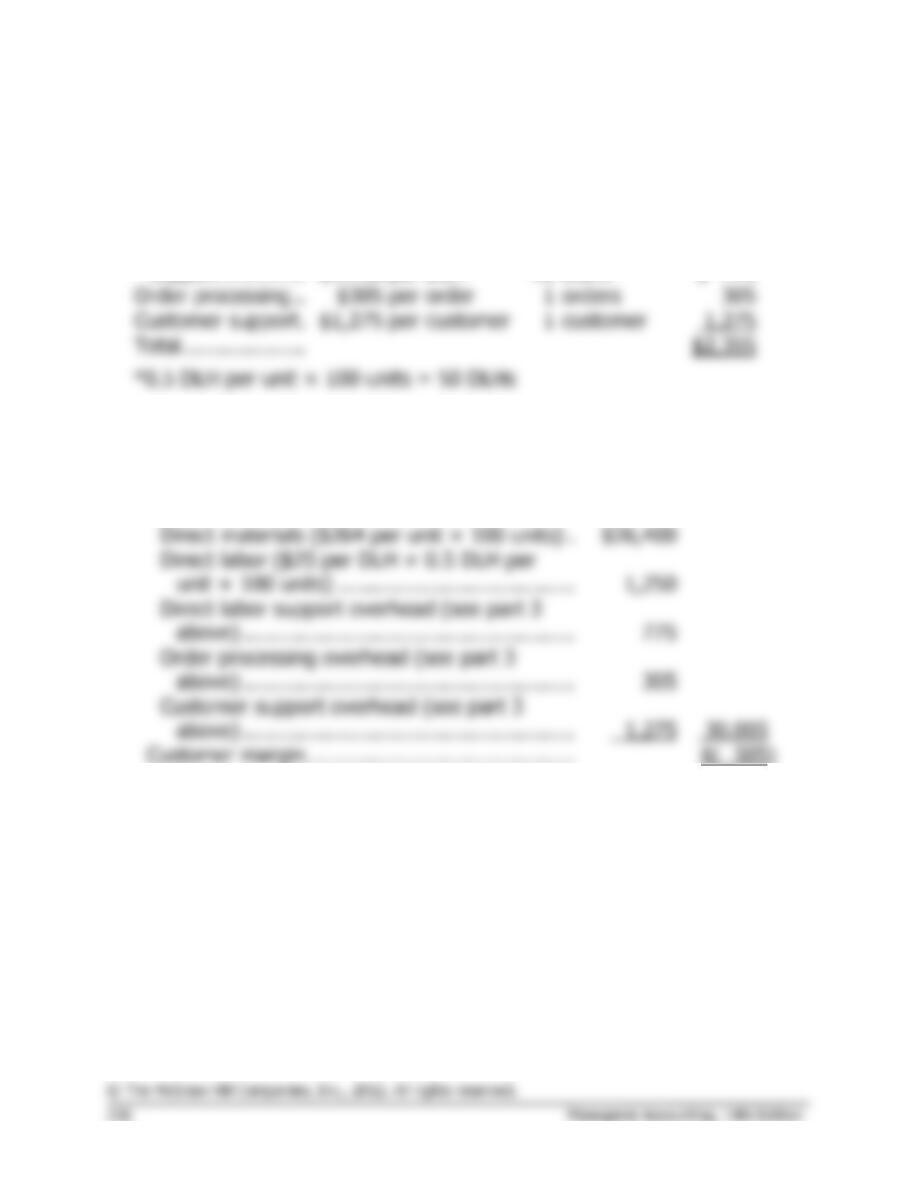
1. First-stage allocations of overhead costs to the activity cost pools:
Distribution of Resource Consumption
Across Activity Cost Pools
Support
Wages and salaries ……….
Other overhead costs ……
Wages and salaries ……….
$ 35,000
Other overhead costs ……
Direct Labor
Order
Customer
2. Computation of activity rates:
Activity Cost Pools
(a)
Total Cost
(b)
Total Activity
(a) ÷ (b)
Activity Rate
Direct labor support ……..
$155,000
10,000
DLHs
$15.50
per DLH
Order processing …………
$152,500
500
orders
$305
per order
Customer support ………..
$127,500
100
customers
$1,275
per customer
Exercise 7-11 (continued)
3. Computation of the overhead costs for the Indus Telecom order:
Activity Cost Pool
(a)
Activity Rate
(b)
Activity
(a) × (b)
ABC Cost
Direct labor
support ………….
$15.50
per DLH
50
DLHs*
$ 775
Customer support .
$1,275
per customer
customer
4. The customer margin for Indus Telecom is computed as follows:
Customer Margin—ABC Analysis
Sales (100 units × $295 per unit) ……………..
$29,500
Costs:
Customer margin …………………………………….
Exercise 7-12 (30 minutes)
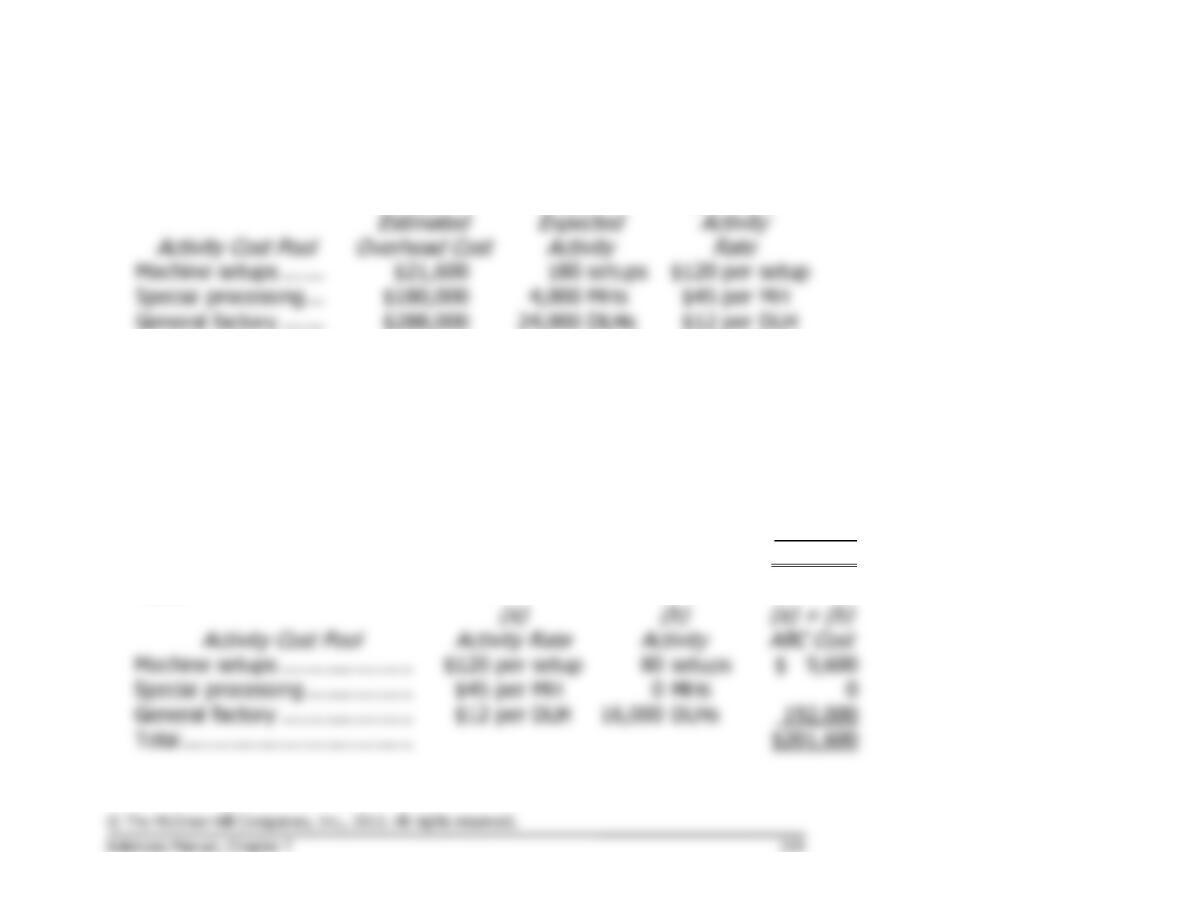
1. Activity rates are computed as follows:
Machine setups …….
setups
Special processing …
MHs
General factory …….
DLHs
(a)
(b)
(a) ÷ (b)
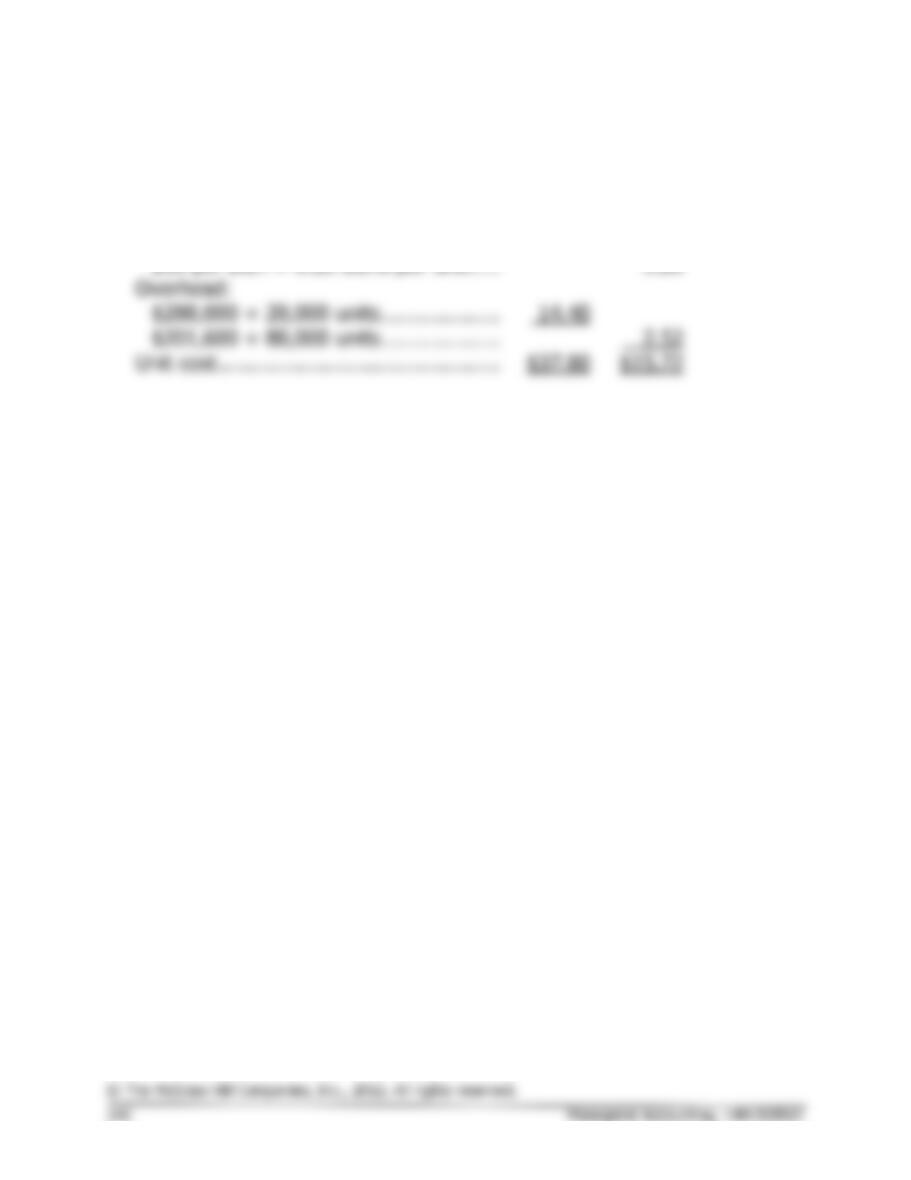
2. Overhead is assigned to the two products as follows:
Rims:
Activity Cost Pool
(a)
Activity Rate
(b)
Activity
(a) × (b)
ABC Cost
Machine setups …………………
$120
per setup
100
setups
$ 12,000
Special processing ……………..
$45
per MH
4,000
MHs
180,000
General factory …………………
$12
per DLH
8,000
DLHs
96,000
Total ……………………………….
$288,000
Posts:
Activity Cost Pool
(a)
(b)
(a) × (b)
Special processing ……………..
$45
per MH
MHs
General factory …………………
$12
per DLH
DLHs
Total ……………………………….
Exercise 7-12 (continued)
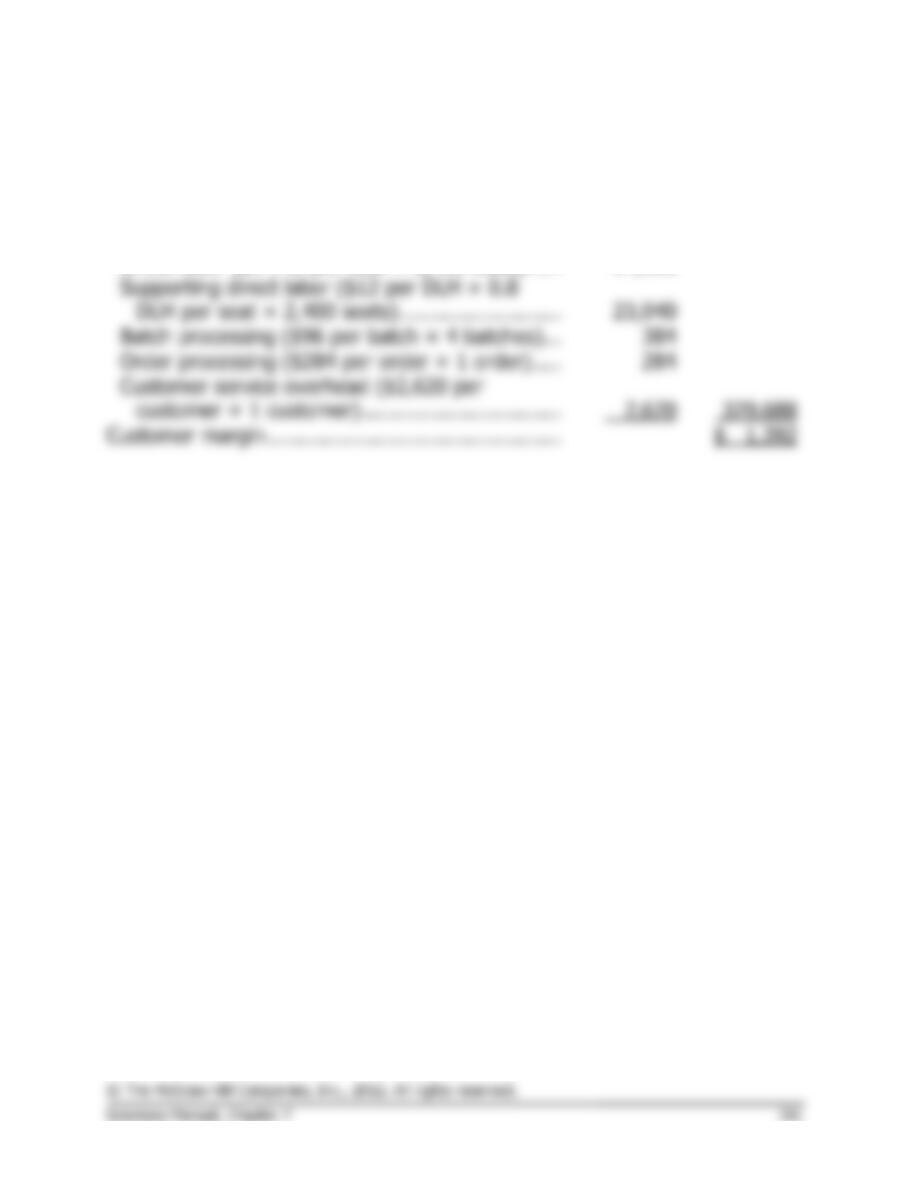
Rims
Posts
Direct materials ……………………………..
$17.00
$10.00
Direct labor:
$16 per DLH × 0.40 DLHs per unit…..
6.40
$16 per DLH × 0.20 DLHs per unit…..
3.20
Overhead:
$288,000 ÷ 20,000 units ……………….
$201,600 ÷ 80,000 units ……………….
Exercise 7-13 (15 minutes)
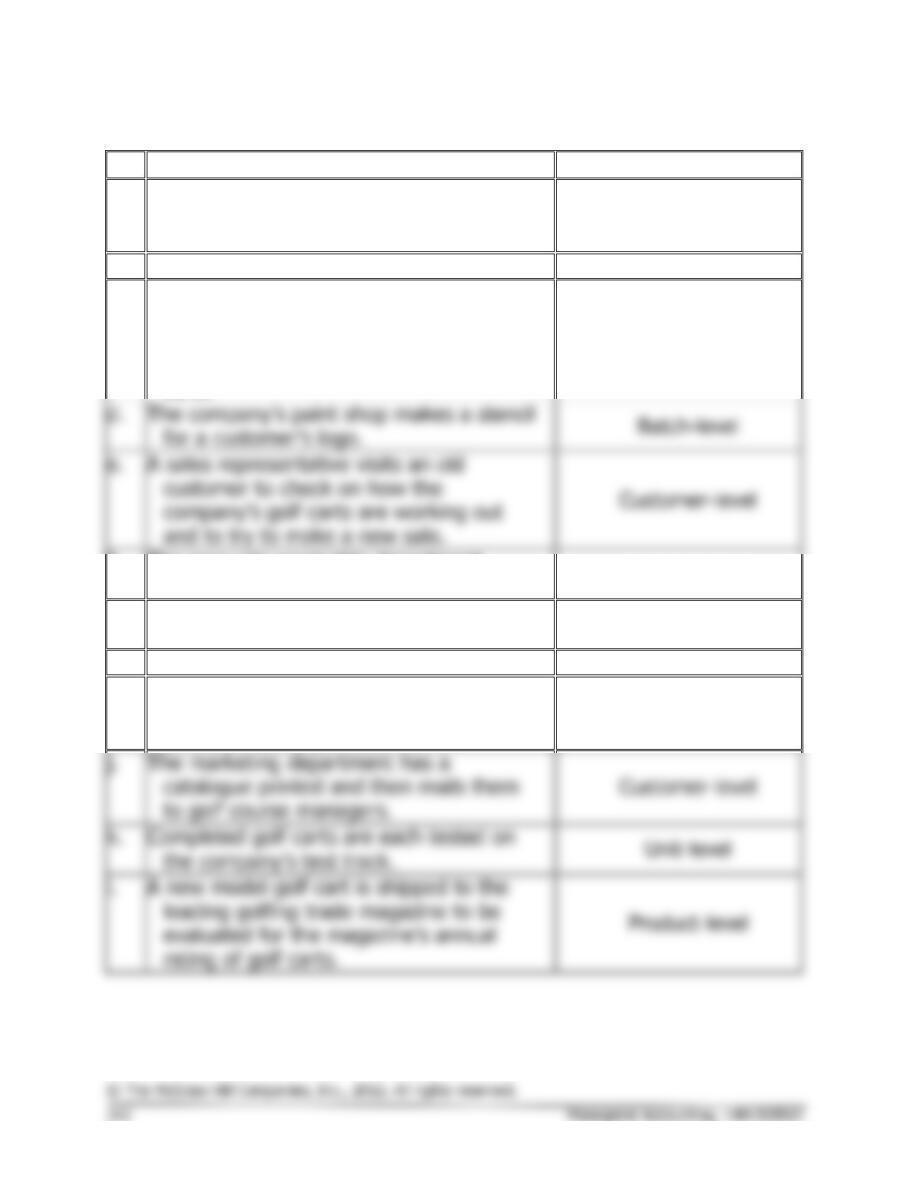
Customer Margin—ABC Analysis
Sales (2,400 seats × $137.95 per seat) ………….
$331,080
Costs:
Direct materials ($112 per seat × 2,400 seats) ..
$268,800
Direct labor ($14.40 per seat × 2,400 seats) …..
34,560
23,040
Batch processing ($96 per batch × 4 batches) …
Order processing ($284 per order × 1 order)…..
Exercise 7-14 (10 minutes)
Activity
Level
a.
The purchasing department orders the
specific color of paint specified by the
customer from the company’s supplier.
Batch-level
b.
A steering wheel is installed in a golf cart.
Unit-level
c.
An outside attorney draws up a new
generic sales contract for the company
limiting Green Glider’s liability in the
case of accidents that involve its golf
carts.
Organization-sustaining
Batch-level
f.
The accounts receivable department
prepares the bill for a completed order.
Batch-level
g.
Electricity is used to heat and light the
factory and the administrative offices.
Organization-sustaining
h.
A golf cart is painted.
Unit-level
i.
The company’s engineer modifies the
design of a model to eliminate a
potential safety problem.
Product-level
The marketing department has a
rating of golf carts.