83
CASE 7
SUGGESTED ANSWERS TO DISCUSSION QUESTIONS
(1)
A company profit-sharing arrangement is a matter of auditor concern because it
(2)
This case describes the payroll system used by the Lakeside Company. Tests of
controls are designed by the auditor to verify that specific control features
identified as possible strengths are operating effectively. A sample of such tests
would include the following:
a. Compare the payroll records produced by Sarah Sweet to time tickets
completed by hourly employees noting agreement as to hours
worked;
84
(3)
Existence or Occurrence – For payroll expense, the auditor would want to
determine that all employees do, indeed, work for the company. If 48 employees
are paid each period, the auditor needs to ensure that 48 individuals are working
for Lakeside. The auditor should be concerned that one or more employees are
Completeness – Completeness is not usually a major problem in the area of
payroll expense, where misstatements most often result from having extra
expense recorded (because of theft) rather than from having transactions
Rights and Obligations – For payroll expense, the auditor would want to ascertain
that work did occur during the period for which the company does have a legal
Valuation or Allocation – Since an expense rather than an asset is involved, the
auditor is more interested in allocation than valuation. Verification should be
85
made that the proper expense is being allocated to the current year. Hence, the
auditor should recompute the cutoff made of the payroll calculation at both the
beginning and ending of the fiscal year. Determination needs to be made that
the figure being reported is for 2009 only.
Presentation and Disclosure – The auditor wants to make certain that the
(4)
Types of evidence-gathering procedures that are used by an auditor during an
examination would include the following. (One method for approaching this
question is to ask the students to identify the accounts that could be tested
through each procedure.)
a) Observation of activities and conditions – usually a test of controls to
provide evidence of operating efficiency.
b) Physical examination and count – used to prove that an item physically
exists and agrees with the ledger balance.
f) Retracing transactions from origination to final reporting – ensures that
accounting system is functioning properly so that balances will be correctly
reported.
g) Scanning accounting records – an analytical procedure designed to highlight
significant or unusual differences.
86
h) Inquiry (including discussion, questioning, etc.) – helps auditors to learn
design of accounting systems and internal control and to evaluate efficiency
of operations.
This question also asks about the competence (significance and reliability) of these
procedures. Each test is potentially quite important and produces reliable evidence,
but only if used in the appropriate circumstances. For example, confirmation is one of
the most important steps in auditing cash bank balances but is rarely used in
connection with an account such as land. Physical examination is essential in
auditing marketable securities where ownership and value can often be ascertained
visually. This same procedure is much less of a factor in examining equipment. An
audit procedure must match an account and the type of evidence needed.
(5)
Maintaining a separate payroll bank account is a common control procedure
encountered by auditors. Having a separate payroll account:
Allows for easier application of control procedures, such as limit tests, item
counts, and validity checks;
87
(6)
Some of the more critical potential problems involving payroll include:
A. Checks are issued to fictitious employees or to former employees who have
left Lakeside, with the checks being diverted and fraudulently cashed.
Substantive tests that may disclose this problem:
Observe distribution of payroll checks.
Review personnel files for a sample of employees to verify current
status is maintained.
B. Payroll deductions are recorded or computed incorrectly, through error or
as part of a defalcation scheme.
Substantive tests that may disclose this problem:
Review W-4 forms, voluntary deduction forms, and employee
contracts for completeness.
Compare payroll register to W-4 forms recomputing appropriate
deductions.
Mathematically verify payroll deductions (foot and cross-foot) and
88
C. Year-end accrual may be ignored or incorrectly computed.
Substantive tests that may disclose this problem:
Review last payroll for the year to verify that recording was made in
SUGGESTED ANSWERS TO EXERCISES
(1)
This problem extends the students’ introduction to working paper construction by
placing them in the role of supervisor. A number of errors exist in the example
presented in Exhibit 7-1, and the students should be able to identify most of
them.
The working paper is not properly dated so that a reviewing auditor cannot
be certain that this testing applies to 2012.
The columns are not labeled. No method exists for identifying the
information that has been gathered.
89
Comment A is vague and does not indicate any reason for the exception
(2)
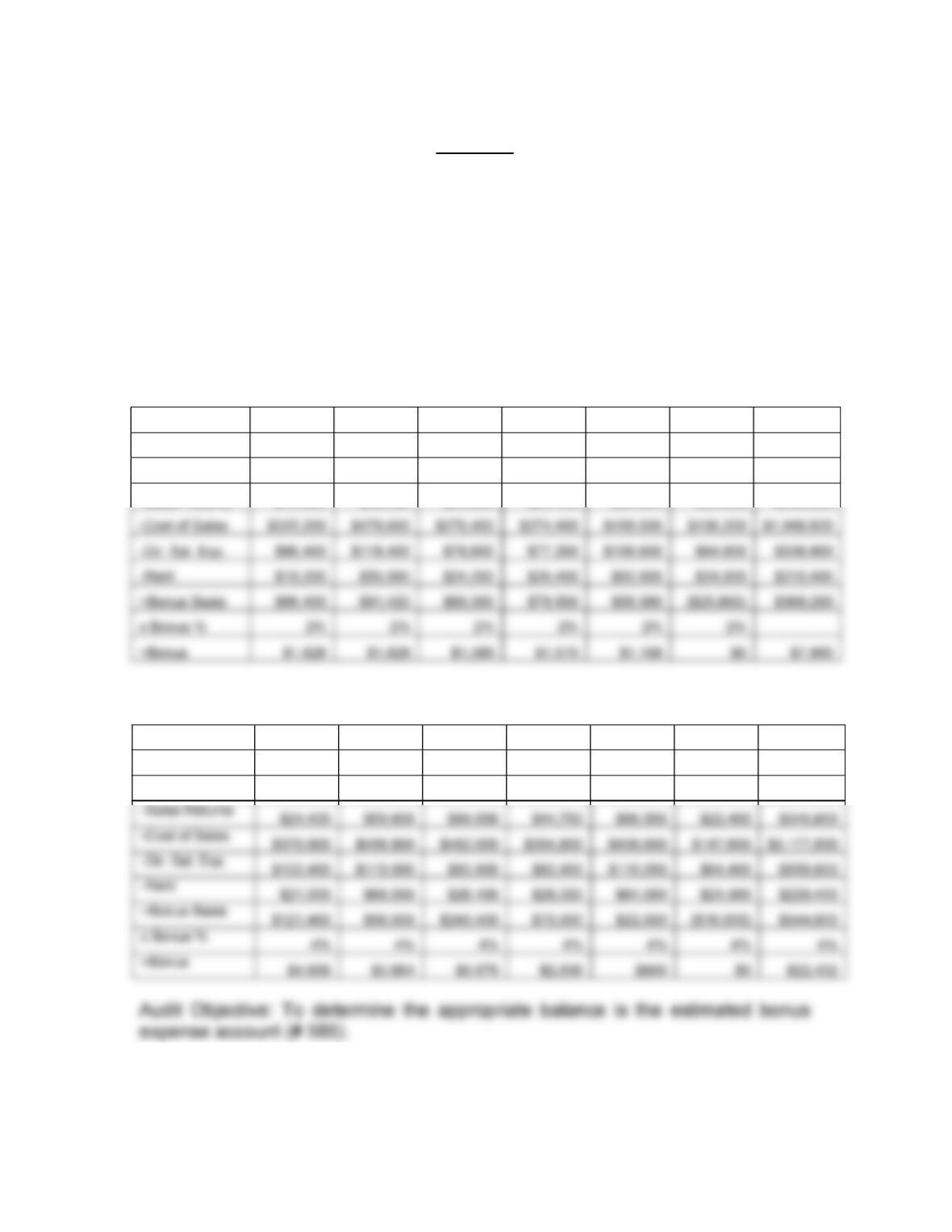
a. A completed Exhibit 7 worksheet is shown on the following page.
90
Exhibit 7
Lakeside Company
Account 585, Estimated Bonus Expense, for Nine Months ended
September 30, 2011 and 2012
Doc. No.
Prepared by
Reviewed by
2011 Bonus Plan
STORE STORE STORE STORE STORE STORE TOTAL
No.1 No.2 No.3 No.4 No.5 No.6 STORES
Sales $547,000
$795,600
$472,200
$484,600
$746,000
$221,600
$3,267,000
-Sales Returns $15,800
$50,380
$23,900
$28,100
$60,020
$22,600
$200,800
2012 Bonus Plan
STORE STORE STORE STORE STORE STORE TOTAL
No.1 No.2 No.3 No.4 No.5 No.6 STORES
Sales
$639,800
$
797,800
$917,600
$530,800
$729,200
$242,400
$3,857,600
$24,400
$59,800
$99,000
$44,700
$96,500
$22,400
$346,800
$102,400
$118,600
$80,800
$82,400
$110,200
$64,400
$558,800
$21,000
$66,000
$26,400
$28,000
$64,000
$24,000
$229,400
56
$3,864
$9,976
$2,836
$900
$0
$22,432
Scope: The bonus calculations for all six stores.
91
Audit Procedures:
Agreed all sales, cost of sales, and salary expense amounts to the
Comments: Client makes an “imputed rent” charge to Store No. 6 for the purpose
Audit Conclusion:
The 2011 bonus expense account is overstated (actual balance = $12,000 v.
SUGGESTED ANSWERS TO SARBANES-OXLEY QUESTIONS
During the audit of the internal control system (Sect 404), the CPAs can conclude
that the management report on their evaluation and audit of the system is fairly
stated and that the system works as it was designed and the design is effective.
Management will state its responsibility for maintaining
adequate internal control over financial reporting and give its assessment of
92
whether or not internal control over financial reporting is effective. According to
the rules, management cannot state that internal control over financial reporting
is effective if even one material weakness exists at year-end.
The independent auditor will evaluate and report on the
Documenting a significant deficiency could appear as in this example:
A material weakness is a control deficiency, or combination of control
deficiencies, that results in more than a remote likelihood that a material
misstatement of the annual or interim financial statements will not be prevented
or detected. The following material weakness has been identified and included in
no effective human resource