141
B. The differences between ABC and traditional
product costs
1. The traditional cost system overcosts the
SureStarts and consequently reports an
artificially low product margin for this
product.
ii. There are three reasons why the reported
product margins for the two costing systems
differ from one another.
47
142
activity to products because these costs
are caused by customers, not specific
2. The traditional cost system allocates all
manufacturing overhead costs using a
volume-related allocation base (machine-
a. The traditional cost system allocates
60% of all manufacturing overhead to
SureStarts and 40% to LongLifes.
b. The ABC system assigns 40% and
60% of customer orders activity cost
3. The traditional cost system disregards
selling and administrative expenses
because they are assumed to be period
49
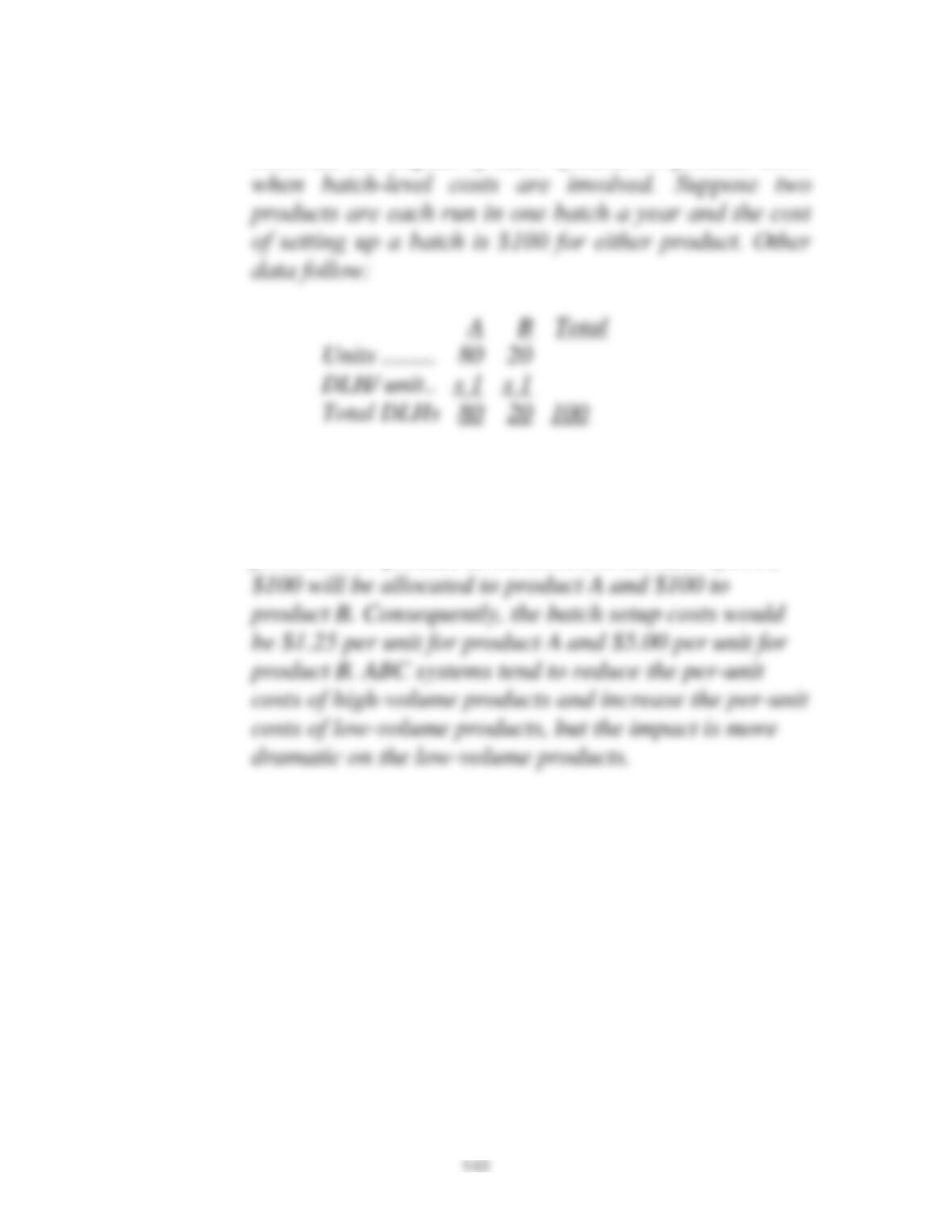
Helpful Hint: A simple example can be used to
illustrate the impact of ABC systems on product costs
The two batches a year cost a total of $200 to set up. If
DLHs are used to allocate the setup costs, the overhead
rate would be $2 per DLH or $2 per unit for either
product A or product B. However, in an ABC system,
144
V. Targeting process improvements
A. Key definitions/concepts
ii. While the theory of constraints approach
discussed in Chapter 1 is a powerful tool for
targeting process improvement efforts, the
VI. Activity-based costing and external reports
A. There are four reasons why most companies do not
use ABC for external reporting purposes.
51
145
errors tend to cancel each other out when the
product costs are added together.
iii. An ABC system, such as the one described in
the chapter, does not conform to generally
accepted accounting principles (GAAP).
iv. Auditors are likely to be uncomfortable with
cost allocations that are based on interviews
with the company’s personnel. This type of
subjective data can be easily manipulated by
management.
VII. The limitations of activity-based costing
A. There are five limitations of ABC
146
ii. ABC systems produce numbers, such as
product margins, that are at odds with the
numbers produced by traditional cost systems.
iii. In practice, most managers insist on fully
allocating all costs to products. The ABC
system described in the main portion of this
chapter does not conform to this preference.
v. Most organizations use ABC as a supplement
to rather than a replacement for their
existing cost system. Maintaining two cost
systems is costlier than maintaining just one
system and it may cause confusion about which
set of numbers is to be relied on.
147
VIII. Appendix 7A: ABC action analysis (slide 54 is a title
slide)
A. Key definitions/concepts
i. A conventional ABC analysis does not identify
potentially relevant costs. An action analysis
report can help in this regard because it shows
what costs have been assigned to a cost object
and it indicates how difficult it would be to
adjust those costs in response to changes in the
level of activity.
B. Baxter Battery – revisited
i. The first-stage allocation process
57
56
55
148
1. In the Baxter Battery illustration, there are,
for example, six activity cost assignments
from the customer orders activity to the
2. As another example, there are six
assignments from the design changes
activity to the LongLife batteries. These six
assignments total $3,040,000 as in the
conventional ABC analysis.
iii. Labeling costs using an ease of adjustment
code
1. Key definitions
a. Green costs adjust more or less
automatically to changes in activity
level without any action by managers.
149
require management action to realize
the change in cost.
(1). For example, direct and indirect
c. Red costs can be adjusted to changes
in activity level only with a great deal
of difficulty and with management
intervention.
2. Calculating Baxter Battery’s green, yellow,
and red margins.
a. The green, yellow, and red margins for
the LongLife batteries would be
$11,700,000, $478,000, and
62
61
150
IX. Appendix 7B: using a modified form of activity-based
costing to determine product costs for external reports
(slide 63 is the title slide)
A. Key definitions/concepts
i. A modified form of activity-based costing can
be used to develop product costs for external
financial reports. With this approach, ABC:
B. Simmons Industries – a traditional approach
i. Assume the following information for the
company as a whole and for its only two
products—deluxe and standard hedge
trimmers.
66
151
iii. Simmons’ traditional cost system would report
unit product costs as shown. Notice:
C. Simmons Industries – an ABC approach
i. Assume that Simmons assigned its $1,800,000
of manufacturing overhead costs to three
activities with expected activity levels as
shown.
70
1. All manufacturing overhead has been
assigned to products ($1,130,000 +
$670,000 = $1,800,000).
69
71
152
D. Simmons Industries – comparing the two approaches
1. The ABC system contains two non-volume-
related cost pools—“setting up machines”
which is a batch-level activity and “parts
administration” which is a product-level
activity.
74