
These are sufficiently close, and we conclude that:
xS
6.7093 Sl−
Sv Sl−
:=xH
Hv 801.7−.75 Hl⋅−
.75 Hv Hl−()⋅
:=
The two equations for x are:
If the exhaust steam (Point 2, Fig. 7.4) is “dry,” i.e., saturated vapor, then
isentropicexpansion to the same pressure (Point 2′, Fig. 7.4) must produce
“wet” steam, withentropy:
S2 = S1 = 6.7093 = (x)(Svap) + (1-x)(Sliq) [x is quality]
A second relation follows from Eq. (7.16), written:
∆H = Hvap – 3207.1 = (η)(∆HS) = (0.75)[ (x)(Hvap) + (1-x)(Hliq) – 3207.1]
Each of these equations may be solved for x. Given a final temperature
and the corresponding vapor pressure, values for Svap, Sliq, Hvap, and
Hliq are found from the table for saturated steam, and substitution into the
equations for x produces two values. The required pressure is the one for
which the two values of x agree. This is clearly a trial process. For a final
trial temperature of 120 degC, the following values of H and S for
saturated liquid and saturated vapor are found in the steam table:
S1 6.7093:=H1 3207.1:=
Properties of superheated steam at 4500 kPa and 400 C from Table F.2,
p. 742.
7.27
240

i15..:=η
0.80
0.75
0.78
0.85
0.80
⎛
⎜
⎜
⎜
⎜
⎜
⎝
⎞
⎟
⎟
⎟
⎠
:=
ndot
200
150
175
100
0.5 453.59⋅
⎛
⎜
⎜
⎜
⎜
⎜
⎝
⎞
⎟
⎟
⎟
⎠
mol
sec
⋅:=
∆S0J
mol K⋅
⋅:=
P
1 bar⋅
1 bar⋅
1 bar⋅
2 bar⋅
15 psi⋅
⎛
⎜
⎜
⎜
⎜
⎜
⎝
⎞
⎟
⎟
⎟
⎠
:=
P0
6 bar⋅
5 bar⋅
7 bar⋅
8 bar⋅
95 psi⋅
⎛
⎜
⎜
⎜
⎜
⎜
⎝
⎞
⎟
⎟
⎟
⎠
:=
T0
753.15
673.15
773.15
723.15
755.37
⎛
⎜
⎜
⎜
⎜
⎜
⎝
⎞
⎟
⎟
⎟
⎠
K⋅:=
Assume nitrogen an ideal gas. First find the temperature after isentropic
expansion from a combination of Eqs. (5.14) & (5.15) with C = 0. Then
find the work (enthalpy change) of isentropic expansion by a combination
of Eqs. (4.2) and (4.7) with C = 0. The actual work (enthalpy change) is
found from Eq. (7.20). From this value, the actual temperature is found by
a second application of the preceding equation, this time solving it for the
temperature. The following vectors contain values for Parts (a) through
(e):
7.30
∆HηV⋅P2 P1−()⋅:=
Eqs. (7.16) and (7.24) combine to give:
Cp 4.190 kJ
kg degC⋅
⋅:=V 1001 cm3
kg
⋅:=
Data in Table F.1 for saturated liquid water at 15 degC give:
η0.55:=T1 15 degC⋅:=P2 1 atm⋅:=P1 5 atm⋅:=
7.29
241
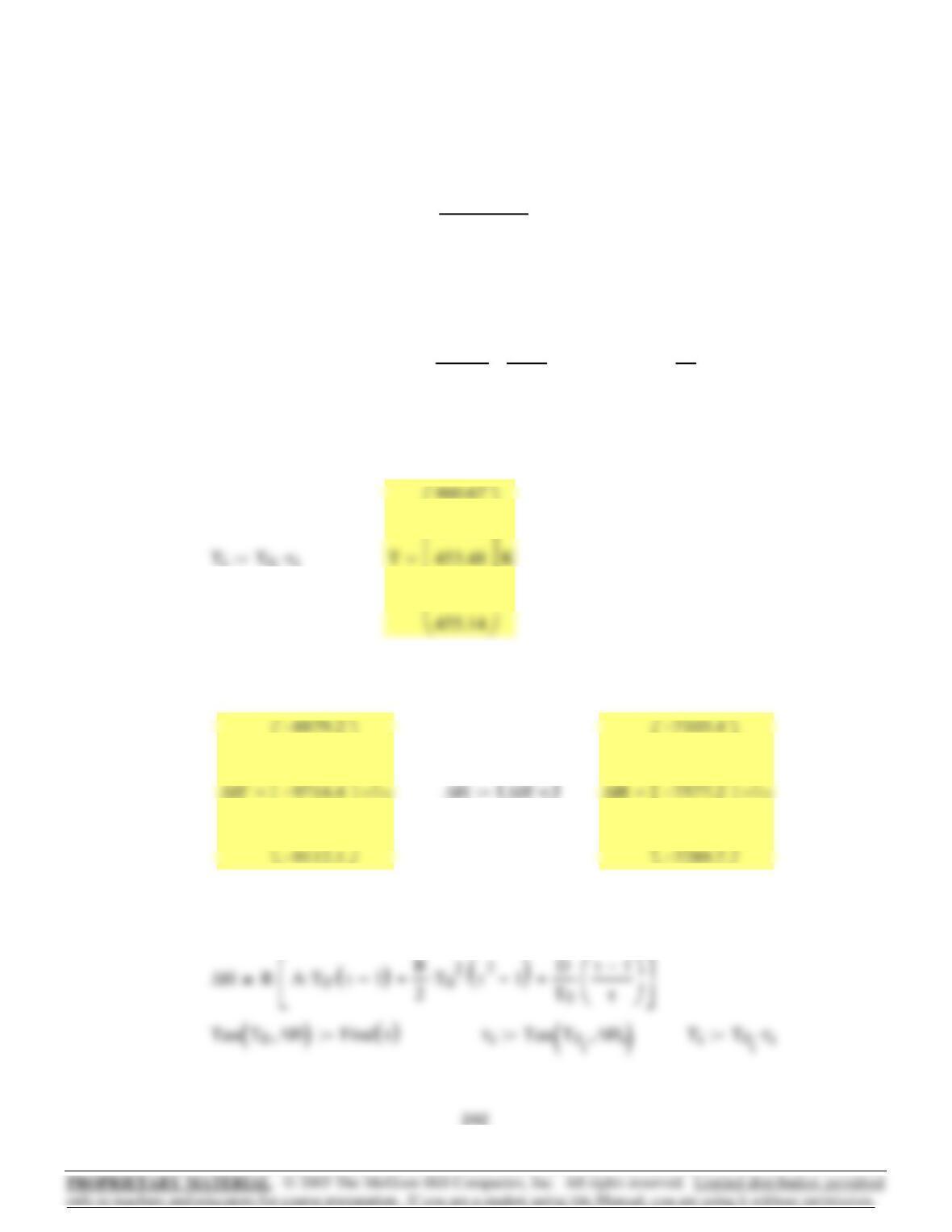
Given
(guess)
τ0.5:=
5459.8−
5900.5−
⎛
⎜
⎜
⎜
⎜
⎜
⎝
⎞
⎟
⎟
⎟
⎠
mol
→
⎯
⎯
⎯
7279.8−
6941.7−
⎛
⎜
⎜
⎜
⎜
⎜
⎝
⎞
⎟
⎟
⎟
⎠
mol
∆H’iR ICPH T0iTi
,3.280,0.593 10 3−
⋅, 0.0,0.040 105
⋅,
⎛
⎝
⎞
⎠
⋅:=
431.36
494.54
⎛
⎜
⎜
⎜
⎞
⎟
τiTau T0iP0i
,Pi
,
()
:=Tau T0P0
,P,
()
Find τ
()
:=
∆SRAlnτ
()
⋅BT
0
⋅D
T02τ2
⋅
τ1+
2
⎛
⎜
⎝
⎞
⎠
⋅+
⎡
⎢
⎣
⎤
⎥
⎦
τ1−
()
⋅+ ln P
P0
⎛
⎜
⎝
⎞
⎠
−
⎡
⎢
⎣
⎤
⎥
⎦
⋅=
Given
(guess)
τ0.5:=
D 0.040 105
⋅K2
⋅:=B0.593 10 3−
⋅
K
:=A 3.280:=
For the heat capacity of nitrogen:
⎜

7.32 For sat. vapor steam at 1200 kPa, Table F.2:
H22782.7 kJ
kg
⋅:= S26.5194 kJ
kg K⋅
⋅:=
The saturation temperature is 187.96 degC.
The exit temperature of the exhaust gas is therefore 197.96 degC, and
the temperature CHANGE of the exhaust gas is -202.04 K.
For the water at 20 degC from Table F.1,
H183.86 kJ
kg
⋅:= S10.2963 kJ
kg K⋅
⋅:=
7.31 Property values and data from Example 7.6:
H13391.6 kJ
kg
⋅:= S16.6858 kJ
kg K⋅
⋅:= mdot 59.02 kg
sec
⋅:=
H22436.0 kJ
kg
⋅:= S27.6846 kJ
kg K⋅
⋅:= Wdot 56400−kW⋅:=
Tσ300 K⋅:= By Eq. (5.26)
Wdotideal mdot H2H1
−TσS2S1
−
()
⋅−
⎡
⎣
⎤
⎦
⋅:= Wdotideal 74084−kW=
243

∆Sgas R MCPS T1T2
,3.34,1.12 10 3−
⋅, 0.0,0.0,
()
⋅ln T2
T1
⎛
⎜
⎝
⎞
⎠
⋅:=
∆Hgas R MCPH T1T2
,3.34,1.12 10 3−
⋅, 0.0,0.0,
()
⋅T2T1
−
()
⋅:=
molwt 18 gm
mol
:=
T2471.11 K=T1673.15 K=
T2273.15 197.96+()K⋅:=T1273.15 400+()K⋅:=
ndot 125 mol
sec
⋅:=
For the exhaust gases:
x30.883=S37.023 kJ
kg K⋅
=
S3Sliq x3Slv
⋅+:=x3
H3Hliq
−
Hlv
:=
H32.345 103
×kJ
kg
=∆H23 437.996−kJ
kg
=
H3H2∆H23
+:=∆H23 ηH’3H2
−
()
⋅:=
H’32.174 103
×kJ
kg
=x’30.811=
S’36.519 kJ
kg K⋅
=
H’3Hliq x’3Hlv
⋅+:=x’3
S’3Sliq
−
Slv
:=S’3S2
:=
For isentropic expansion of steam in the turbine:
η0.72:=Slv 6.9391 kJ
kg K⋅
⋅:=Sliq 0.8932 kJ
kg K⋅
⋅:=
Hlv 2346.3 kJ
kg
⋅:=Hliq 272.0 kJ
kg
⋅:=
The turbine exhaust will be wet vapor steam.
For sat. liquid and sat. vapor at the turbine exhaust pressure of 25 kPa, the
best property values are found from Table F.1 by interpolation between 64
and 65 degC:
244
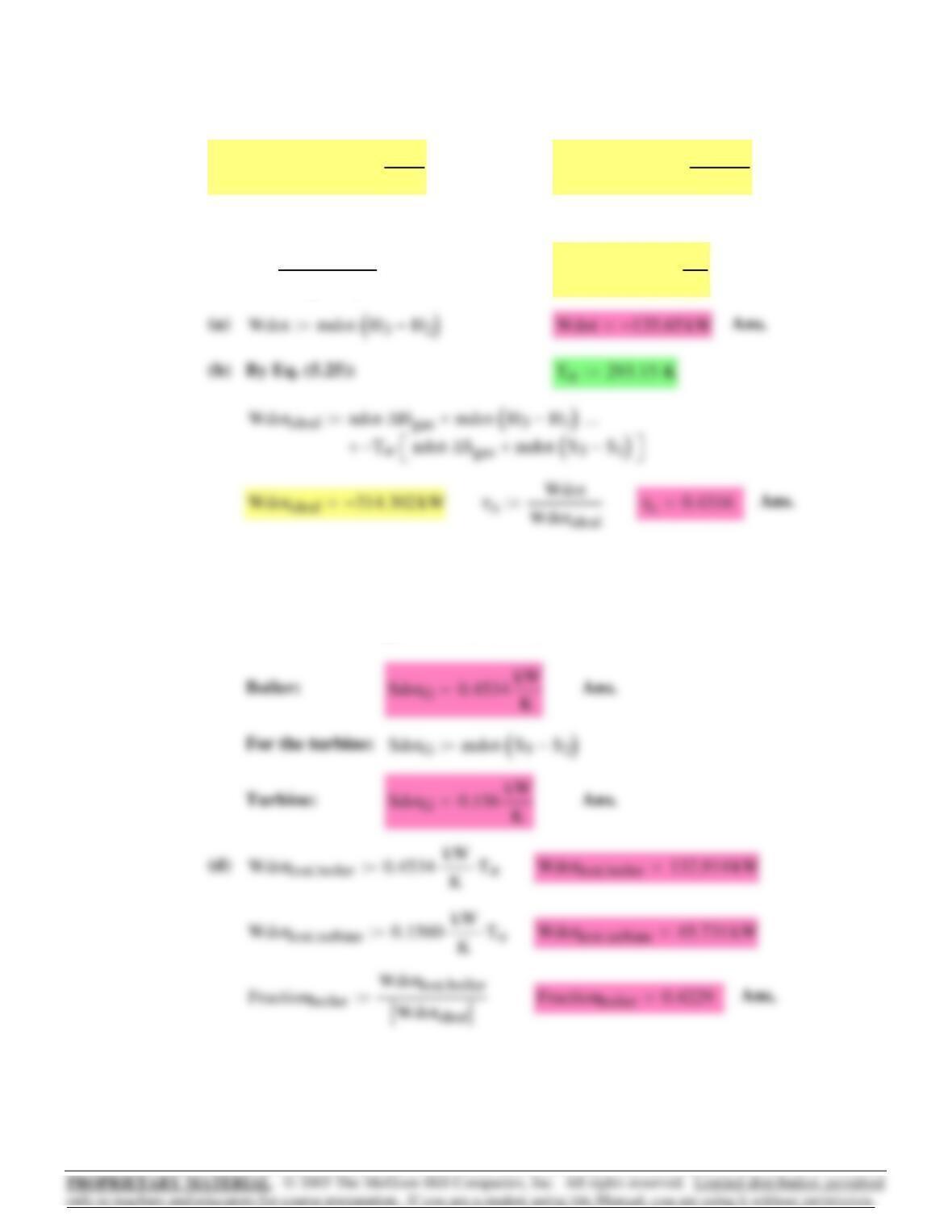
For both the boiler and the turbine, Eq. (5.33) applies with Q = 0.
For the boiler:
SdotGndot ∆Sgas
⋅mdot S2S1
−
()
⋅+:=
∆Hgas 6.687−103
×kJ
kmol
= ∆Sgas 11.791−kJ
kmol K⋅
=
Energy balance on boiler:
mdot
ndot−∆Hgas
⋅
H2H1
−
:= mdot 0.30971 kg
sec
=
(c)
245
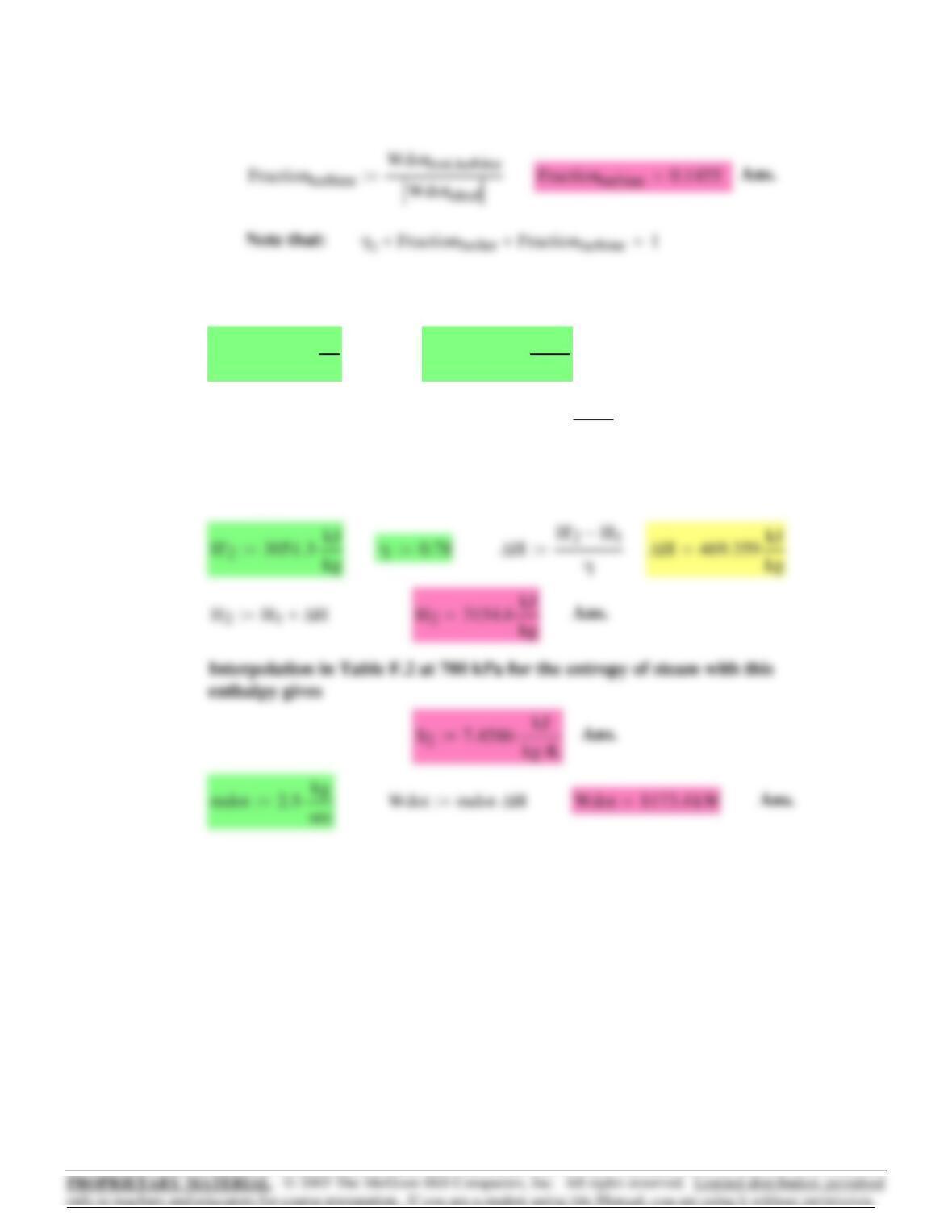
Interpolation in Table F.2 at 700 kPa for the enthalpy of steam with this
entropy gives
S’2S1
=7.2847 kJ
kg K⋅
⋅=
For isentropic expansion,
S17.2847 kJ
kg K⋅
⋅:=H12685.2 kJ
kg
⋅:=
From Table F.2 for sat. vap. at 125 kPa:7.34
246

τiTau T0iP0i
,Pi
,
()
:=Tau T0P0
,P,
()
Find τ
()
:=
∆SRAlnτ
()
⋅BT
0
⋅D
T02τ2
⋅
τ1+
2
⎛
⎜
⎝
⎞
⎠
⋅+
⎡
⎢
⎣
⎤
⎥
⎦
τ1−
()
⋅+ ln P
P0
⎛
⎜
⎝
⎞
⎠
−
⎡
⎢
⎣
⎤
⎥
⎦
⋅=
Given
(guess)
τ0.5:=
D 0.016−105
⋅K2
⋅:=B0.575 10 3−
⋅
K
:=A 3.355:=
For the heat capacity of air:
i16..:=
η
0.75
0.70
0.80
0.75
0.75
0.70
⎛
⎜
⎜
⎜
⎜
⎜
⎜
⎜
⎝
⎞
⎟
⎟
⎟
⎟
⎟
⎠
:=
ndot
100
100
150
50
0.5 453.59⋅
0.5 453.59⋅
⎛
⎜
⎜
⎜
⎜
⎜
⎜
⎜
⎝
⎞
⎟
⎟
⎟
⎟
⎟
⎠
mol
sec
⋅:=
∆S0J
mol K⋅
⋅:=
P
375 kPa⋅
1000 kPa⋅
500 kPa⋅
1300 kPa⋅
55 psi⋅
135 psi⋅
⎛
⎜
⎜
⎜
⎜
⎜
⎜
⎜
⎝
⎞
⎟
⎟
⎟
⎟
⎟
⎠
:=
P0
101.33 kPa⋅
375 kPa⋅
100 kPa⋅
500 kPa⋅
14.7 psi⋅
55 psi⋅
⎛
⎜
⎜
⎜
⎜
⎜
⎜
⎜
⎝
⎞
⎟
⎟
⎟
⎟
⎟
⎠
:=
T0
298.15
353.15
303.15
373.15
299.82
338.71
⎛
⎜
⎜
⎜
⎜
⎜
⎜
⎜
⎝
⎞
⎟
⎟
⎟
⎟
⎟
⎠
K⋅:=
Assume air an ideal gas. First find the temperature after isentropic
compression from a combination of Eqs. (5.14) & (5.15) with C = 0. Then
find the work (enthalpy change) of isentropic compression by a
combination of Eqs. (4.2) and (4.7) with C = 0. The actual work (enthalpy
change) is found from Eq. (7.20). From this value, the actual temperature
is found by a second application of the preceding equation, this time
solving it for the temperature. The following vectors contain values for
Parts (a) through (f):
7.35
247
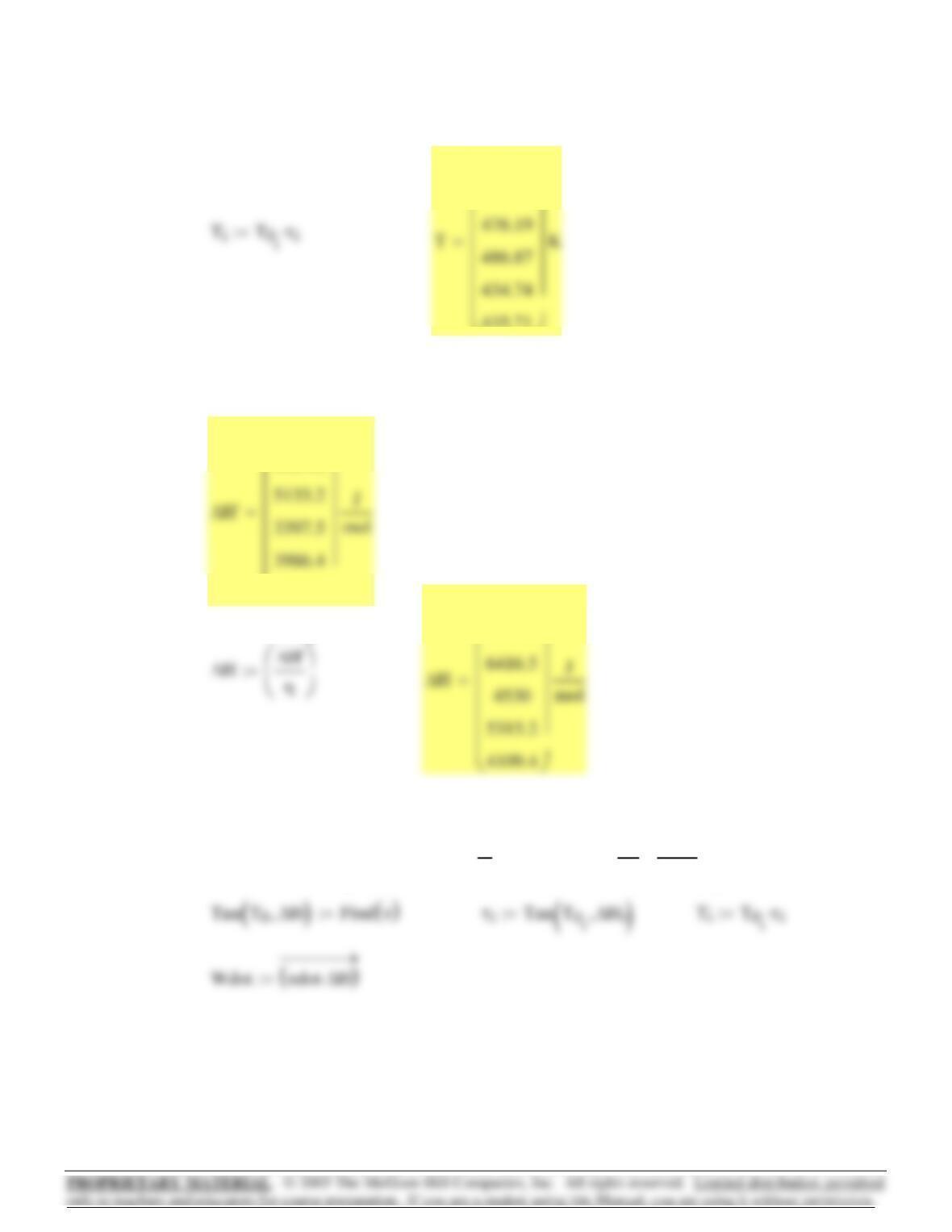
431.06
464.5
435.71
⎛
⎜
⎜
⎝
⎞
⎟
⎠
∆H’iR ICPH T0iTi
,3.355,0.575 10 3−
⋅, 0.0,0.016−105
⋅,
⎛
⎝
⎞
⎠
⋅:=
3925.2
3314.6
2876.6
⎛
⎜
⎜
⎝
⎞
⎠
⎜
⎜
→
⎯
⎯
5233.6
4735.1
⎛
⎜
⎞
τ1.5:= (guess)
Given ∆HRAT
0
⋅τ1−
()
⋅B
2T02
⋅τ
21−
()
⋅+ D
T0
τ1−
τ
⎛
⎜
⎝
⎞
⎠
⋅+
⎡
⎢
⎣
⎤
⎥
⎦
⋅=
⎯
⎯
248
⎜
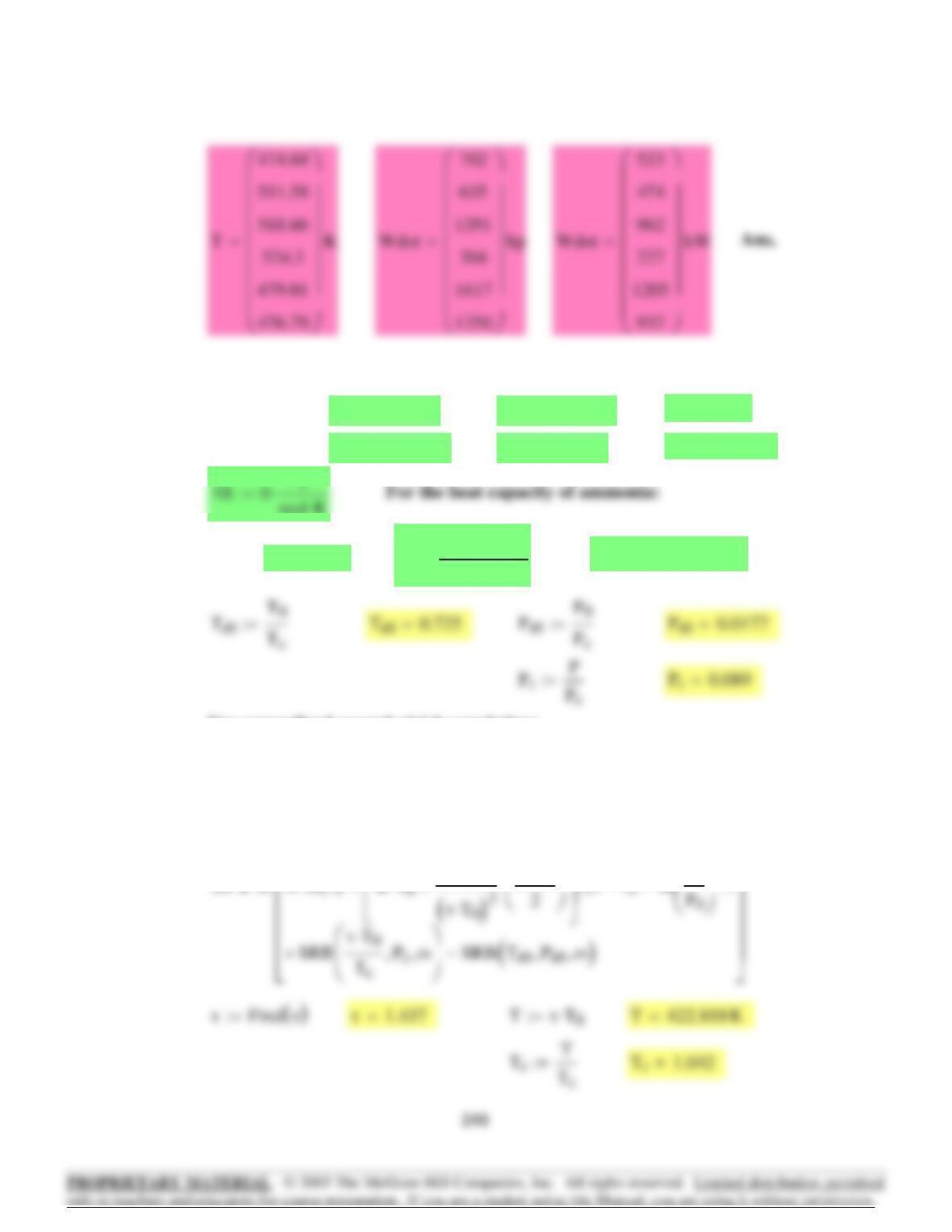
Use generalized second-virial correlation:
The entropy change is given by Eq. (6.92) combined with Eq. (5.15); C = 0:
τ1.4:= (guess)
Given
()
τ1+
⎛
⎞
⎡
⎤
()
⎛
⎞
⎡
⎤
7.36 Ammonia: Tc405.7 K⋅:= Pc112.8 bar⋅:= ω 0.253:=
T0294.15 K⋅:= P0200 kPa⋅:= P 1000 kPa⋅:=
A 3.578:= B3.020 10 3−
⋅
K
:= D 0.186−105
⋅K2
⋅:=
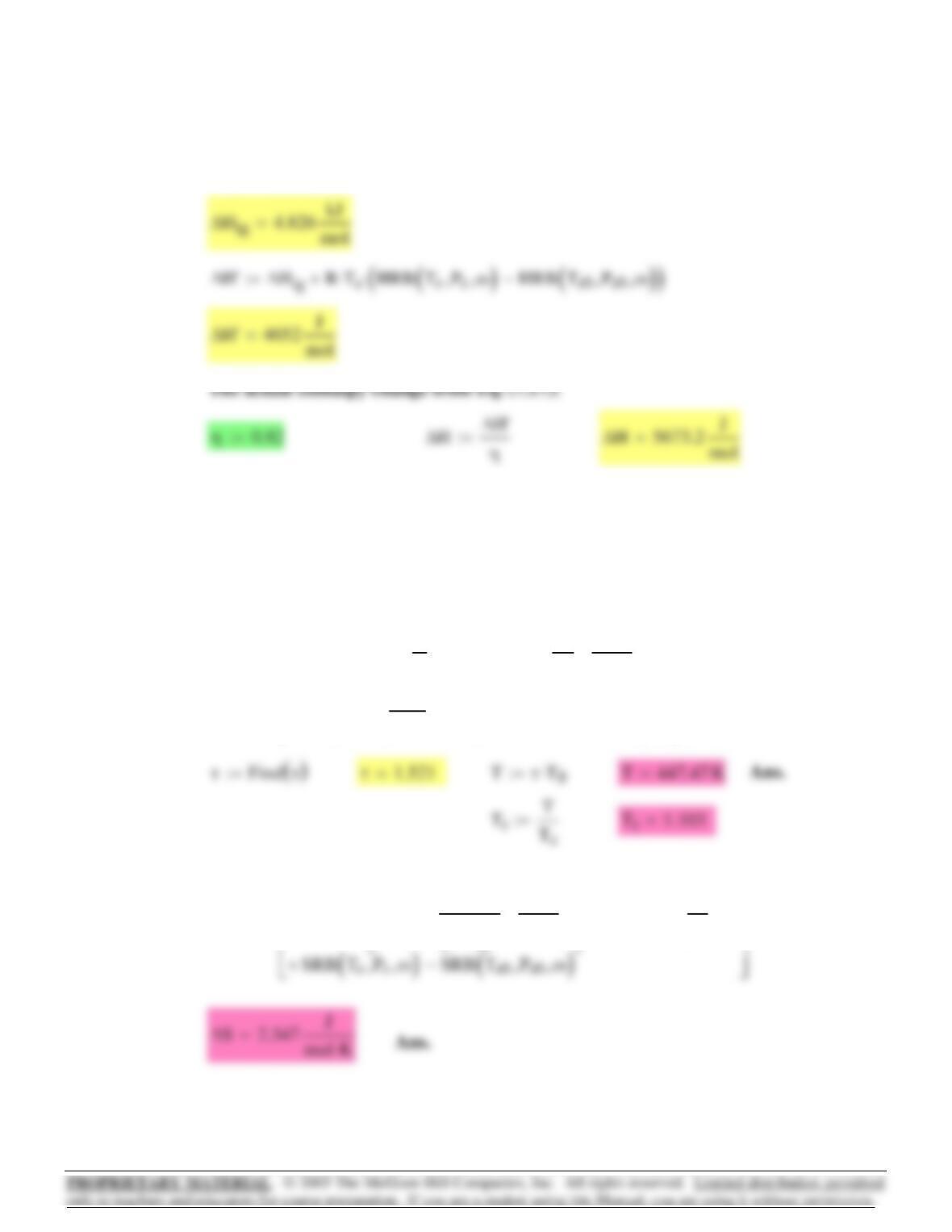
∆SRAlnτ
()
⋅BT
0
⋅D
τT0
⋅
()
2
τ1+
2
⎛
⎜
⎝
⎞
⎠
⋅+
⎡
⎢
⎤
⎥
τ1−
()
⋅+ ln P
P0
⎛
⎜
⎝
⎞
⎠
−
…
⎡
⎢
⎢
⎤
⎥
⎥
⋅:=
∆HRAT
0
⋅τ1−
()
⋅B
2T02
⋅τ
21−
()
⋅+ D
T0
τ1−
τ
⎛
⎜
⎝
⎞
⎠
⋅+
TcHRB τT0
⋅
Tc
Pr
,ω,
⎛
⎜
⎝
⎞
⎠HRB Tr0 Pr0
,ω,
()
−
⎛
⎜
⎝
⎞
⎠
⋅+
…
⎡
⎢
⎢
⎢
⎢
⎣
⎤
⎥
⎥
⎥
⎥
⎦
⋅=
Given
(guess)
τ1.4:=
The actual final temperature is now found from Eq. (6.91) combined with E
q
(4.7), written:
∆Hig R ICPH T0T,3.578,3.020 10 3−
⋅, 0.0,0.186−105
⋅,
()
⋅:=
250
⎢
⎥
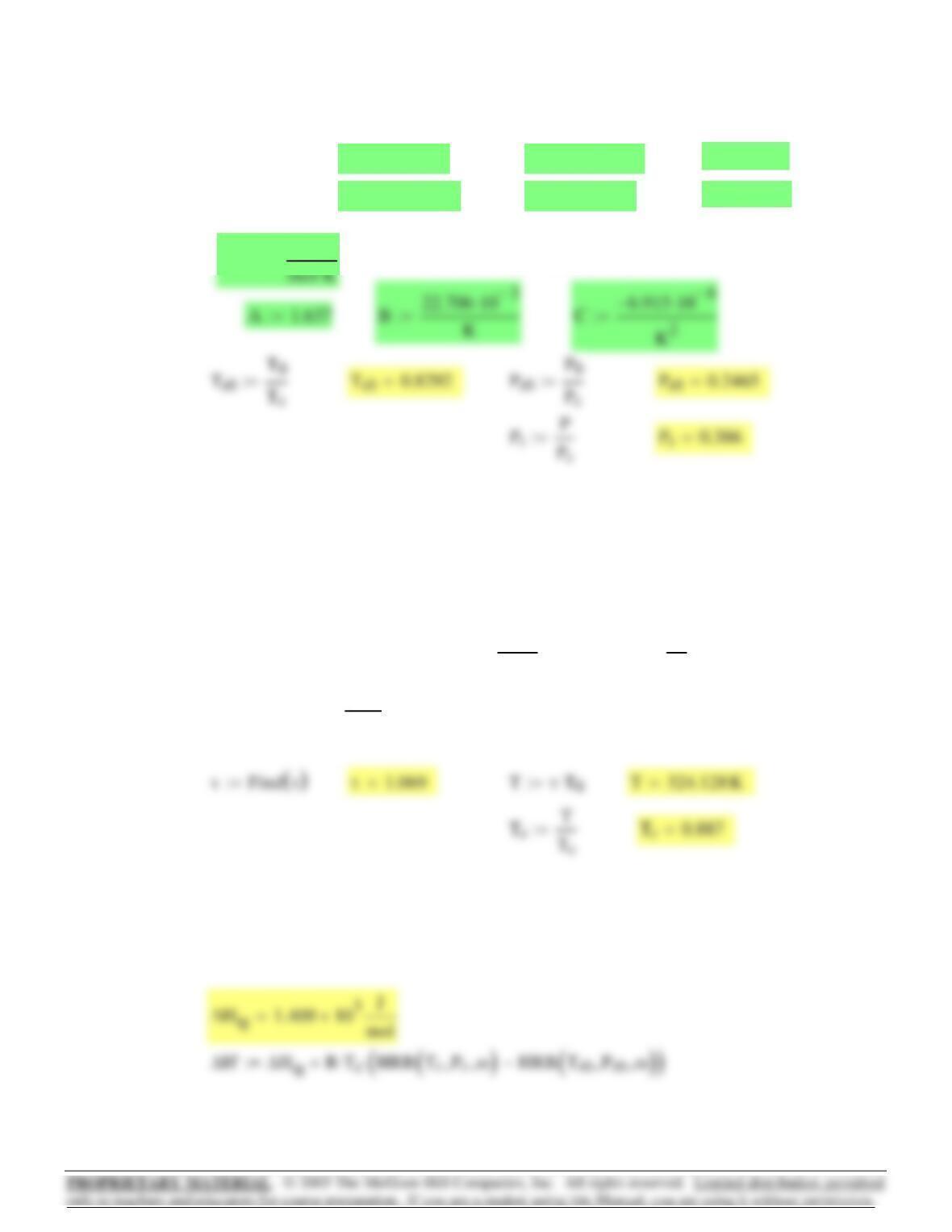
Use generalized second-virial correlation:
The entropy change is given by Eq. (6.92) combined with Eq. (5.15) with D = 0:
τ1.1:= (guess)
Given
∆SRAlnτ
()
⋅BT
0
⋅CT
02
⋅τ1+
2
⎛
⎜
⎝
⎞
⎠
⋅+
⎡
⎢
⎣
⎤
⎥
⎦τ1−
()
⋅+ ln P
P0
⎛
⎜
⎝
⎞
⎠
−
SRB τT0
⋅
Tc
Pr
,ω,
⎛
⎜
⎝
⎞
⎠SRB Tr0 Pr0
,ω,
()
−+
…
⎡
⎢
⎢
⎢
⎢
⎣
⎤
⎥
⎥
⎥
⎥
⎦
⋅=
The enthalpy change for the final T is given by Eq. (6.91), with HRB for
this T:
∆Hig R ICPH T0T,1.637,22.706 10 3−
⋅, 6.915−10 6−
⋅, 0.0,
()
⋅:=
7.37 Propylene: Tc365.6 K⋅:= Pc46.65 bar⋅:= ω 0.140:=
T0303.15 K⋅:= P011.5 bar⋅:= P 18 bar⋅:=
∆S0J
⋅:= For the heat capacity of propylene:
251
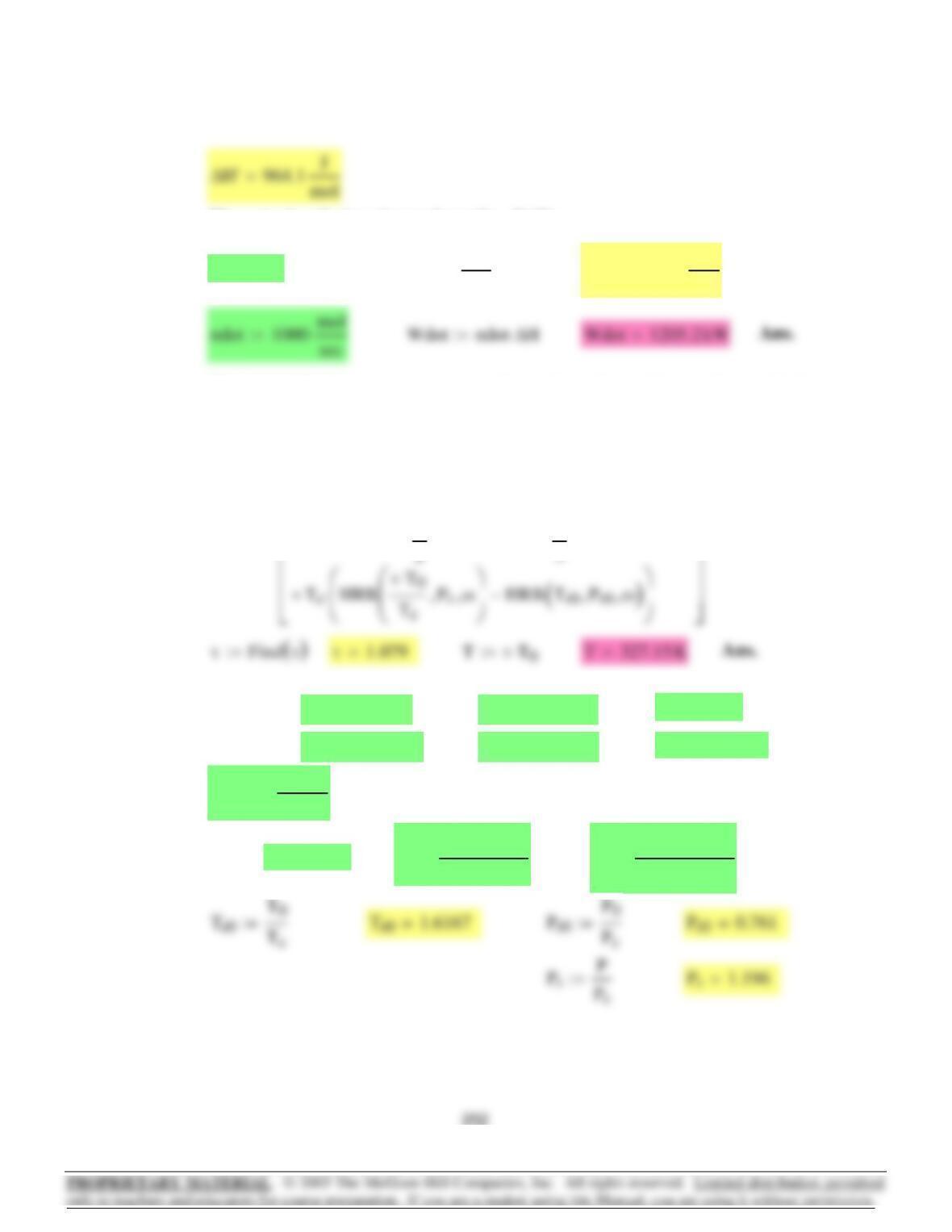
7.38 Methane: Tc190.6 K⋅:= Pc45.99 bar⋅:= ω 0.012:=
T0308.15 K⋅:= P03500 kPa⋅:= P 5500 kPa⋅:=
∆S0J
mol K⋅
⋅:= For the heat capacity of methane:
A 1.702:= B9.081 10 3−
⋅
K
:= C2.164−10 6−
⋅
K2
:=
The actual enthalpy change from Eq. (7.17):
η0.80:= ∆H∆H’
η
:= ∆H 1205.2 J
mol
=
The actual final temperature is now found from Eq. (6.91) combined with E
q
(4.7), written:
τ1.1:= (guess)
Given
∆HRAT
0
⋅τ1−
()
⋅B
⋅τ
21−
()
⋅+ C
⋅τ
31−
()
⋅+
…
⎡
⎢
⎤
⎥
⋅=