4
5
y
Chapter 7
Graphs, Functions, and Applications
Exercise Set 7.1
4. No; a member of the domain (6) is matched to more than
10. This correspondence is a function, since each person in a
14. a) g(0) = 0 −6=−6
c) g(13) = 13 −6=7
16. a) f(6) = −4·6=−24
c) f(0) = −4·0=0
d) f(−1) = −4(−1) = 4
18. a) h(4) = 19
b) h(−6) = 19
c) h(12) = 19
20. a) f(0) = 3 ·02−2·0+1=1
b) f(1) = 3 ·12−2·1+1=3−2+1=2
c) f(−1) = 3(−1)2−2(−1)+1=3+2+1=6
22. a) g(4) = |4−1|=|3|=3
24. a) f(1) = 14−3=1−3=−2
e) f(−2) = (−2)4−3=16−3=13
26. In 1980, h= 1980 −1945 = 35.
28. T(5) = 10 ·5+20=50+20=70
◦C
30. C(62) = 5
9(62 −32) = 5
9·30 = 50
3=16
2
3
◦C
9(23 −32) = 5
9(−9) = −5◦C
32. x g(x)
5
y
5
y
4
5
y
y
y
5
y
4
5
y
174 Chapter 7: Graphs, Functions, and Applications
34. x g(x)
36.
38.
40. x f(x)
−3−1
42.
44. x f(x)
46. x y
−5 0
48.
50. x f(x)
−2−10
54. Yes; it passes the vertical line test.
64. 6x−31=11+6(x−7)
Exercise Set 7.2 175
66. x2+2x−80=0
74. x+ 5 = 3 when x=−2.
h(−2+5)=h(3) = (−2)2−4=4−4=0
Exercise Set 7.2
RC2. 5−x= 0 for x= 5, so the domain is
2. a) f(1) = 1
{−1,0,1,2,3}.
4. a) f(1) = −2
d) The set of all y-values in the graph is
{y|−3≤y≤3}.
6. a) f(1) = −1
bers.
8. a) f(1) = 3
10. f(x)= 7
5−x
12. f(x)=4−5x
We can calculate 4 −5xfor any value of x, so the domain
is the set of all real numbers.
14. f(x)=x2−2x+3
x=−4
3
20. f(x)= 4
|2x−3|
22. g(x)= −11
4+x
Solve: 4 + x=0
24. g(x)=8−x2
28. g(x)= 2x−3
30. g(x)=|x|+1
32. g(x)= x2+2x
|10x−20|
34. {x|xis an integer}
36. 10y2+10y−20
38. t−4
t+7 t2+3t−28
40. Graph each function on a graphing calculator, and deter-
42. We must have 2 −x≥0, or 2 ≥x. Thus, the domain is
Chapter 7 Mid-Chapter Review
3. True; for a function f(x)=c, where cis a constant, all
6. The y-value that is paired with the input 0 is 1.
The y-value that is paired with the x-value 4 is −5.
7. The y-value that is paired with the x-value −2is0.
The y-value that is paired with the x-value 2 is −4.
We see above that the y-value −4 is paired with the x-value
2. In addition, we see from the graph that the y-value −4
through 3, so the domain is {x|−3≤x≤3}.
The set of all y-values on the graph extends from −2
f(0)=0−7=−7
16. f(t)=1
2t+3
2(−6)+3=−3+3=0
17. No vertical line will intersect the graph more than once.
Thus, the graph is the graph of a function.
18. It is possible for a vertical line to intersect the graph more
3
y x 2
x
f(x) x 1
20. g(x)= 3
12 −3x
21. f(x)=x2−10x+3
22. h(x)=x−2
x+2
24. y=−2
3x−2
We find some ordered pairs that are solutions.
3·3−2=−2−2=−4.
x y
−3 0
25. f(x)=x−1
f(4)=4−1=3.
−2−31
2
it h(x)=2x+1
2.
27. g(x)=|x|−3
g(2) = |2|−3=2−3=−1
g(x)
|
x
|
3
y
y
178 Chapter 7: Graphs, Functions, and Applications
0−3
28. y=1+x2
We find some ordered pairs that are solutions.
When x=−2, y=1+(−2)2=1+4=5.
When x=0,y=1+0
2=1+0=1.
x y
−2 5
2 5
29. f(x)=−1
4x
f(4) = −1
4·4=−1
31. When x<0, then y<0 and the graph contains points
y>0 and the graph contains points in quadrant I. Thus,
the graph passes through three quadrants.
32. The output −3 corresponds to the input 2. The number
33. The domain of a function is the set of all inputs, and the
Exercise Set 7.3
RC6. m=1−(−2)
2. Slope is −5; y-intercept is (0,10).
8. Slope is −3.1; y-intercept is (0,5).
10. −8x−7y=24
12. 9y+36−4x=0
y
(⫺3, 0)
y
14. 5x=2
3y−10
15
2x+15 = y
16. 3y−2x=5+9y−2x
18. We can use any two points on the line, such as (−3,−4)
20. We can use any two points on the line, such as (2,4) and
=0−4
4−2=−4
2=−2
22. Slope = −1−7
34. We can use the coordinates of any two points on the line.
We’ll use (0,100) and (9,40).
36. Rate of change = 41 −33
2012 −2002 =8
10 =0.8
38. 9{2x−3[5x+2(−3x+y0−2)]}
=9{2x−3[5x+2(−3x−1)]}
40. 54÷625 ÷52·57÷53
42. 8−125x3=(2−5x)(4+10x+25x2)
Exercise Set 7.4
2.
4.
5
y
5
y
2
4
3
5
y
5
y
(0, 4)
2
1
y
(2.1, 0)
4
5
y
3x 4y 10
⫺
4
⫺
224
⫺
2
2
⫺
5
⫺
3
⫺
1135
⫺
1
1
x
y Wx 4
⫺4⫺224
⫺2
⫺5⫺3⫺1135
⫺1
x
180 Chapter 7: Graphs, Functions, and Applications
6.
8.
10.
12.
14.
16.
18. y=2
5x−4
5;y-intercept: (0,3)
Starting at (0,3), find another point by moving 2 units up
and 5 units to the right to (5,5).
22. x−3y=6
x
5
y
2
4
3
2x 6y 12
y
5
y
4
5
y
x 4
⫺4
⫺2
⫺3
y
5
y
5
y
Exercise Set 7.4 181
24. 2x+6y=12
6y=−2x+12
26. g(x)=−0.25x+2
and 4 units to the left to (−4,3). Starting at (0,2) again,
move 1 unit down and 4 units to the right to (4,1).
28. 3·f(x)=4x+6
30.
32.
34.
36.
⫺4⫺224
⫺2
4
⫺5⫺3⫺1135
⫺1
5
x
4 g(x) 3x 12 3x
⫺2
4
3
3 f(x) 2
182 Chapter 7: Graphs, Functions, and Applications
38. 4·g(x)+3x= 12+3x
4·g(x)=12
The slope is 0.
40. 3−f(x)=2
1=f(x)
42. Write both equations in slope-intercept form.
y=2x−7(m=2)
44. Write both equations in slope-intercept form.
46. Write both equations in slope-intercept form.
y=−7x−9(m=−7)
48. The graph of 5y=−2, or y=−2
50. Write both equations in slope-intercept form.
perpendicular.
52. y=−x+7 (m=−1)
54. y=x(m=1)
56. Since the graphs of −5y= 10, or y=−2, and y=−4
is small, so the exponent is negative.
0.000047 = 4.7×10⁻⁵
60. Move the decimal point 7 places to the left. The number
62. The exponent is positive, so the number is large. Move the
64. The exponent is negative, so the number is small. Move
68. 64x−128y+ 256 = 64(x−2y+4)
70.
72. x+7y=70
of the slopes must be −1.
k=7
74. The x-coordinate must be −4, and the y-coordinate must
Exercise Set 7.5 183
78. 2y=−7x+3b
Exercise Set 7.5
RC2. y=−5 is a horizontal line, so its slope is 0.
RC4. y=−5
6x+4
3
RC6. 10x+5y=14
2. y=5x−3
4. y=−9.1x+2
10. Using the point-slope equation:
y−y1=m(x−x1)
y=mx +b
12. Using the point-slope equation:
Using the slope-intercept equation:
14. Using the point-slope equation:
Using the slope-intercept equation:
y=mx +b
y=3x+4
16. Using the point-slope equation:
y=−3x−6
y=−3x−6
18. Using the point-slope equation:
Using the slope-intercept equation:
y=mx +b
20. Using the point-slope equation:
y−3=−4
5x+8
5
3=−4
184 Chapter 7: Graphs, Functions, and Applications
22. m=7−5
4−2=2
2=1
y=x+3
Using the slope-intercept equation:
y=mx +b
24. m=9−(−1)
9−(−1) =10
10 =1
Using the slope-intercept equation:
y=mx +b
9=1·9+b
26. m=0−(−5)
3−0=5
3
28. m=−1−(−7)
Using the slope-intercept equation:
y=mx +b
30. m=7−0
−4−0=−7
4
Using the point-slope equation:
4x
Using the slope-intercept equation:
y=mx +b
32. m=
5
6−3
2
=
−4
6
=2
y−5
6=2
11(x−(−3))
34. 2x−y= 7 Given line
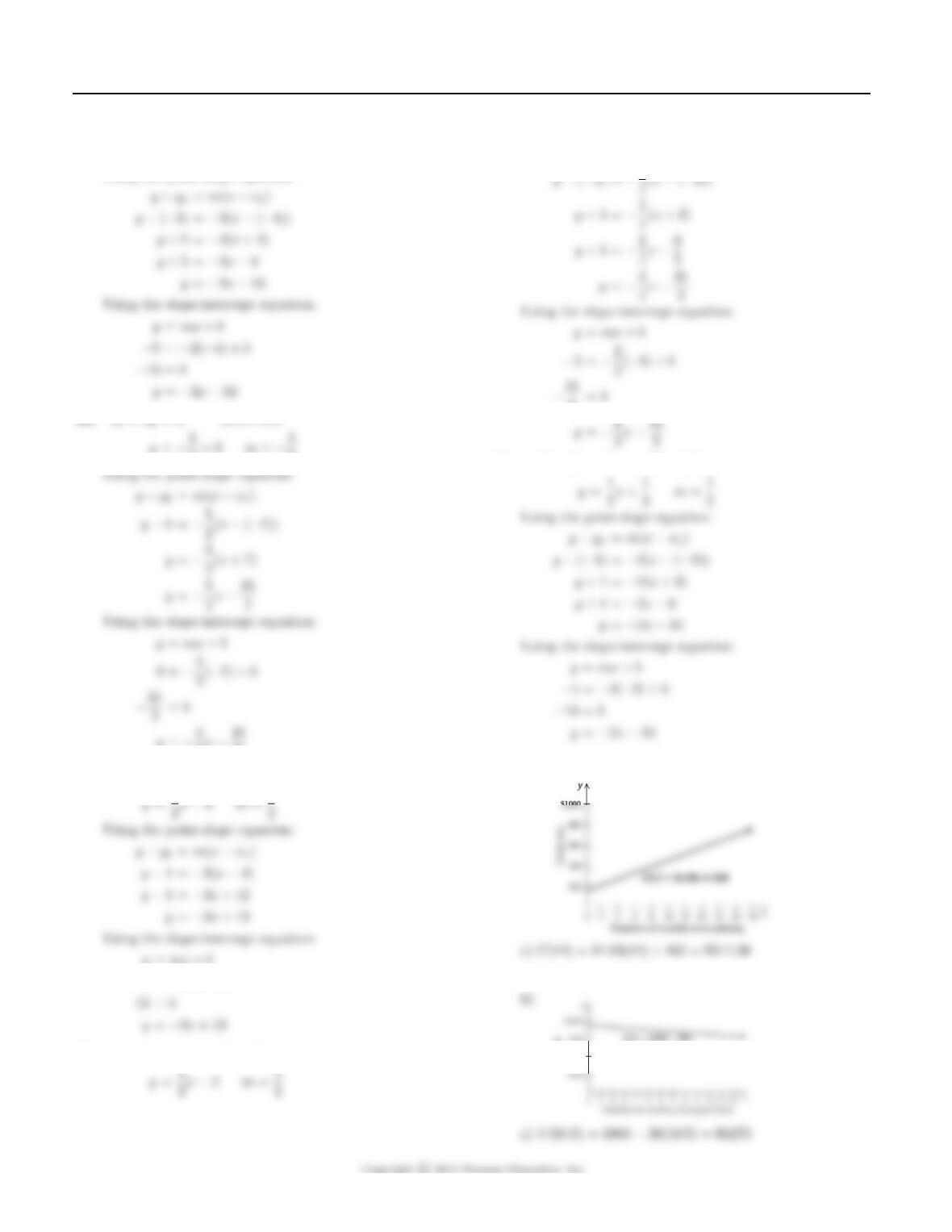
Value
2000
Exercise Set 7.5 185
36. 2x+y=−3 Given line
y=−2x−3m=−2
Using the point-slope equation:
38. 5x+2y= 6 Given line
2+3 m=−5
2
y=−5
2x−35
2
40. x−3y= 9 Given line
1=−3·4+b
42. 5x−2y= 4 Given line
Using the point-slope equation:
y−y1=m(x−x1)
5=b
44. −3x+6y= 2 Given line
46. a) C(t)=24.95t+ 165
b)
48. a) V(t) = 3800 −50t
50. a) The data points are (0,174) and (5,245).
D(x)=14.2x+ 174, where xis the number of years
52. a) The data points are (0,46.8) and (40,43.8).
function R(x)=−0.075x+46.8.
m=89.73 −79.27
8−0=10.46
8≈1.308
58. 4y+32
y2−y−72 =4(y+8✦)
(y−9)(y+8✦)
y=−2x+2
3
64. First find the slope of the line through (−1,3) and (2,9).
2.
Now we find the equation of the line with slope −1
Chapter 7 Vocabulary Reinforcement
4. The slope of a line containing points (x1,y
1) and (x2,y
2)
Chapter 7 Concept Reinforcement
Chapter 7 Study Guide
(⫺5, ⫺5)
y
y
x
2. g(x)=1
2x−2
3. y=2
5x−3
We find some ordered pairs that are solutions, plot them,
5. The set of all x-values on the graph extends from −4
through 5, so the domain is {x|−4≤x≤5}.
6. Since x−3
3x+9 cannot be calculated when 3x+ 9 is 0, we
solve 3x+9=0.
7. m=−8−2
2−(−3) =−10
5=−2
9. 3y−3=x
To find the y-intercept, let x= 0 and solve for y.
The y-intercept is (0,1).
10. y=1
by moving 1 unit up and 4 units to the right. We get to
the point (4,−2). We can also think of the slope as −1
−4.
We plot the points and draw the graph.
11. y=3
y
188 Chapter 7: Graphs, Functions, and Applications
12. x=−5
2
13. We first solve for yand determine the slope of each line.
y=3
8x−1
14. We first solve for yand determine the slope of each line.
The slope of 5x−2y=−8 is 5
15. y=mx +bSlope-intercept equation
y=−8x+0.3
16. Using the point-slope equation:
Using the slope intercept equation:
17. We first find the slope:
18. First we find the slope of the given line:
−5=8
19. From Exercise 18 above we know that the slope of the
Chapter 7 Review Exercises