7-73
FINANCIAL STATEMENT ANALYSIS CASE 2
Part 1
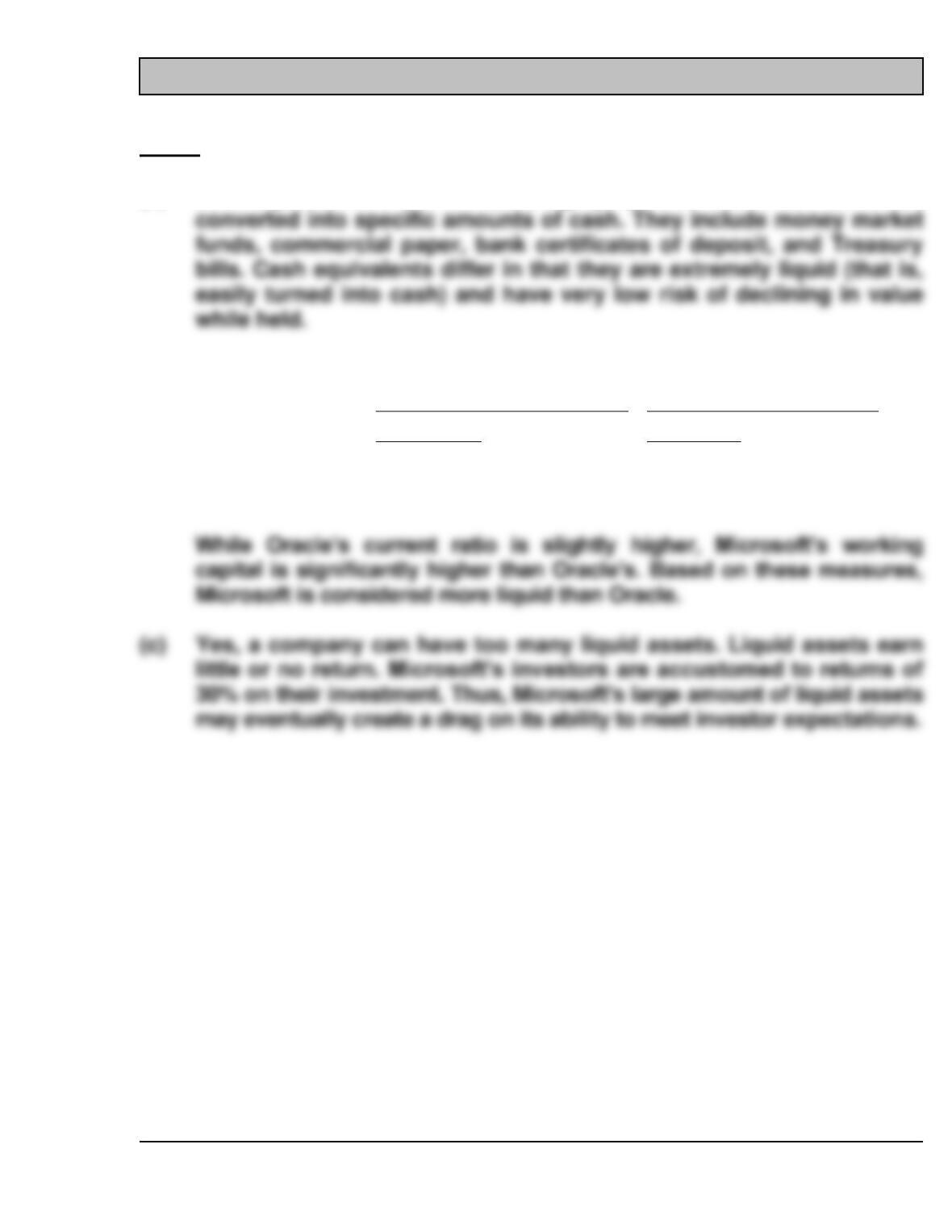
(a) Cash equivalents are short-term, highly liquid investments that can be
(b)
(in millions)
Microsoft
Oracle
(1) Current ratio
$49,280
= 1.82
$18,581
= 2.03
$27,034
$9,149
(2) Working capital
$49,280 – $27,034 = $22,246
$18,581 – $9,149 = $9,432
7-74
FINANCIAL STATEMENT ANALYSIS CASE 2 (Continued)
Part 2
2009
(a)
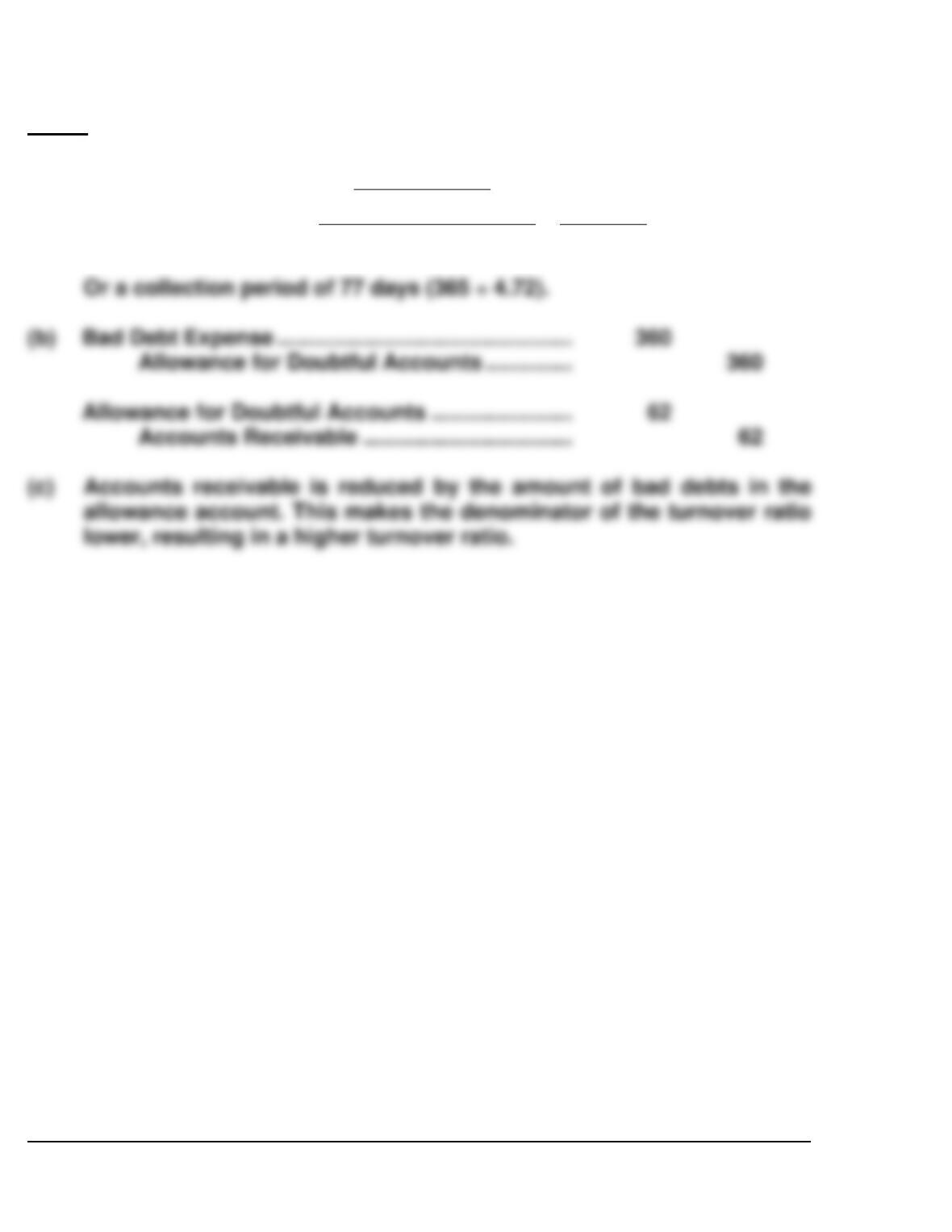
Receivables Turnover
$58,437
=
$58,437
= 4.72 times
($11,192 + $13,589)/2
$12,390
7-75
ACCOUNTING, ANALYSIS, AND PRINCIPLES
ACCOUNTING
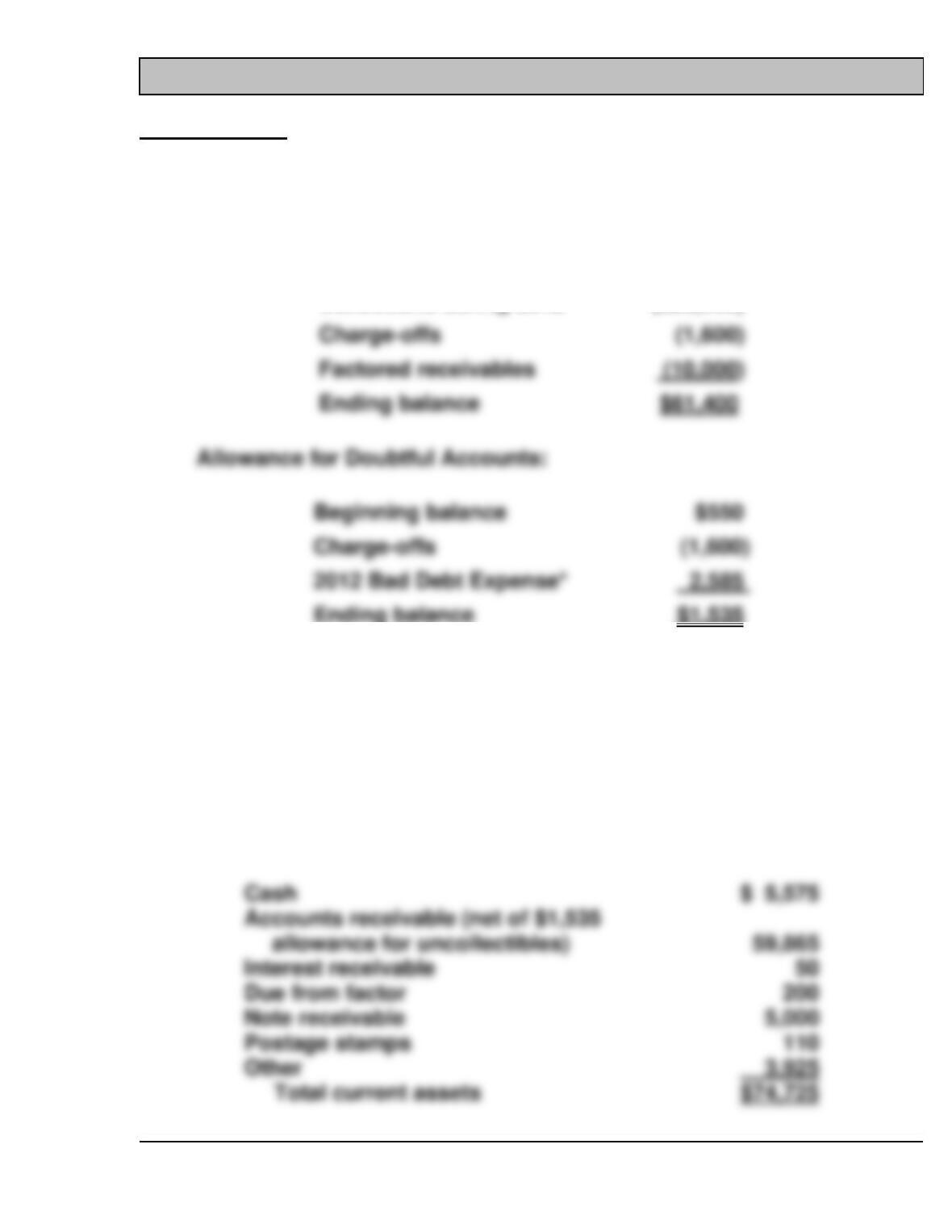
(a) Accounts Receivable:
Beginning balance
$46,000
Credit sales during 2012
255,000
Collections during 2012
(228,000)
*2012 Bad Debt Expense is the amount needed to make the ending
balance in the Allowance for Doubtful Accounts equal to $1,535
($61,400 X 2.5%). In other words, $550 – $1,600 + Bad Debt Expense =
$1,535. Therefore, Bad Debt Expense = $1,535 + $1,600 – $550 =
$2,585.
(b) Current assets section of December 31, 2012 Flatiron Pub balance
sheet:
Cash
Interest receivable
Due from factor
Note receivable
Postage stamps
Charge-offs
Factored receivables
Ending balance
$61,400
Beginning balance
Charge-offs
2012 Bad Debt Expense*
Ending balance
7-76
ACCOUNTING, ANALYSIS, AND PRINCIPLES (continued)
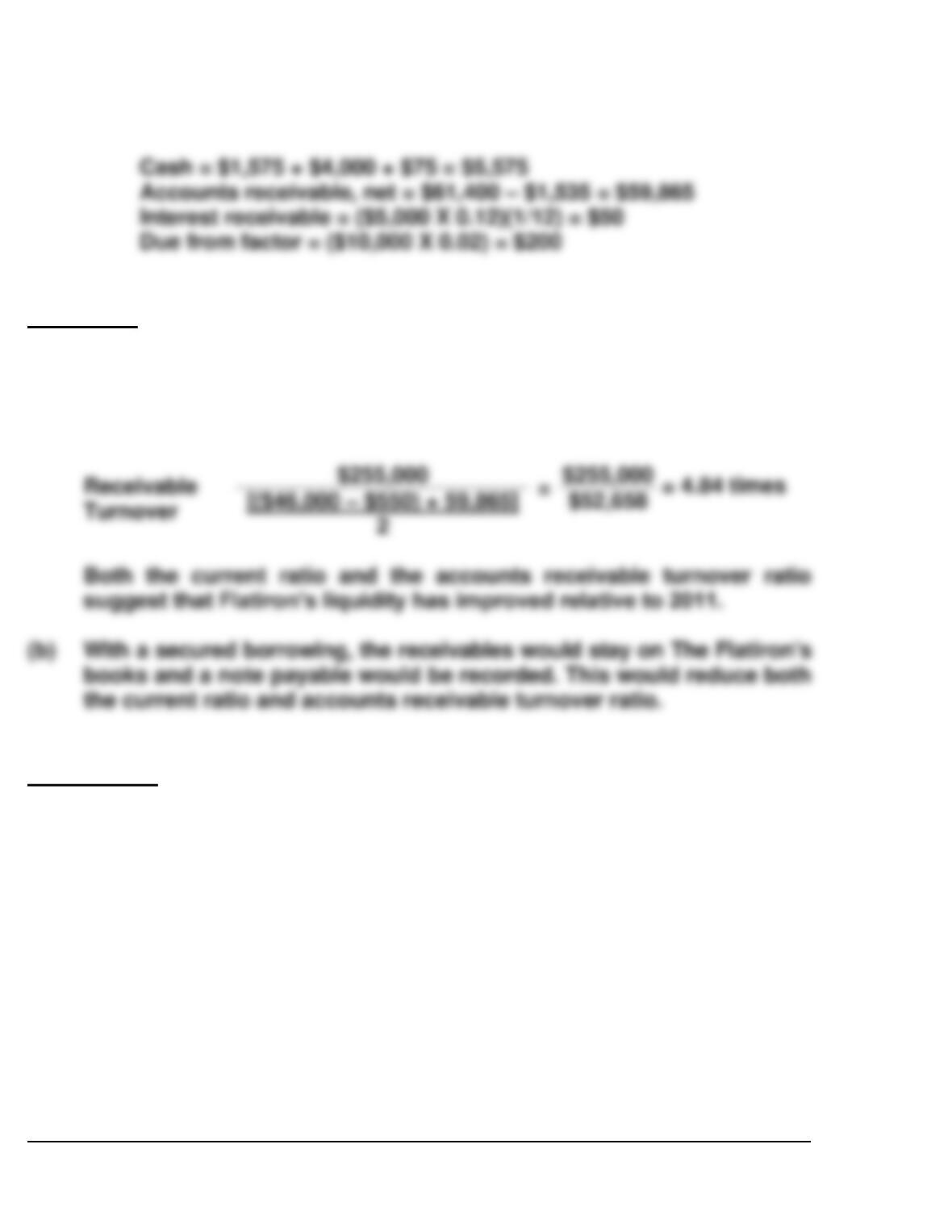
Calculations:
ANALYSIS
(a) 2011 current ratio = ($2,000 + $46,000 – $550 + $8,500) ÷ $37,000 = 1.51
2012 current ratio = $74,725 ÷ ($44,600 + $400) = 1.66
PRINCIPLES
The expense recognition principle requires that bad debt expense be
recorded in the period of the sale. Otherwise, income will be overstated by
the amount of bad debt expense. In addition, reporting the receivables net
of the allowance provides a more representationally faithful reporting (at
net realizable value) of this asset.
7-77
PROFESSIONAL RESEARCH: FASB CODIFICATION
(a) Transfer of receivables is addressed in FASB ASC 860-10: Codification
String: Broad Transactions > 860 Transfers and Servicing > 10 Overall >
05 Background >
(b) The objectives associated with transfers: (FASB ASC 860-10–10)
10–1 An objective in accounting for transfers of financial assets is for
each entity that is a party to the transaction to recognize only
assets it controls and liabilities it has incurred, to derecognize
assets only when control has been surrendered, and to
7-78
PROFESSIONAL RESEARCH: FASB CODIFICATION (Continued)
(c) Definitions: (Codification String: Broad Transaction > 860 Transfers
and Servicing > 10 Overall > 20 Glossary)
Transfer
The conveyance of a noncash financial asset by and to someone other
than the issuer of that financial asset.
Recourse
The right of a transferee of receivables to receive payment from the
transferor of those receivables for any of the following:
a. Failure of debtors to pay when due
b. The effects of prepayments
c. Adjustments resulting from defects in the eligibility of the
transferred receivables.
7-79
PROFESSIONAL RESEARCH: FASB CODIFICATION (Continued)
(d) Other examples (besides recourse and collateral) that qualify as
continuing involvement:
05–4 The following are examples of continuing involvement discussed
in this Topic: (Codification String: Broad Transactions > 860
Transfers and Servicing > 10 Overall > 05 Background)
a. Recourse
7-80
PROFESSIONAL SIMULATION
Measurement
Trade Accounts Receivable
Allowance for Doubtful Accounts
Beginning balance
$ 40,000
Beginning balance
$ 5,500
Financial Statements
Current assets
Cash* …………………………………………………………..
$ 12,900
Trade accounts receivable …………………………...
$40,000
Allowance for doubtful accounts ……………….
(7,600)
32,400
Customer receivable (post-dated checks) ………
Interest receivable** ……………………………………..
Due from factor*** ………………………………………..
Notes receivable …………………………………………..
Inventories …………………………………………………..
Prepaid postage …………………………………………..
Total current assets ………………………………….
$183,012
*($15,000 – $2,000 – $100)
**($50,000 X 11% X 1/2)
***($47,700 X 6%)
Analysis
2011
2012
Current ratio = ($139,500* ÷ $80,000)
= 1.74
($183,012 ÷ $86,000)
= 2.13
Receivables turnover = 10.37 times
$550,000
= 16.4 times
($34,500 + $32,400)/2
Credit sales during 2012
Charge-offs
Collections during 2012
2012 provision
Change-offs
Factored receivables
Ending balance
Ending balance

7-81
PROFESSIONAL SIMULATION (Continued)
Explanation
7-82
IFRS INSIGHTS
IFRS CONCEPTS AND APPLICATION
IFRS7-1
A receivable is considered impaired when a loss event indicates a negative
impact on the estimated future cash flows to be received from the
customer. The IASB requires that the impairment assessment should be
performed as follows.
1. Receivables that are individually significant are considered for impair-
2. Any receivable individually assessed that is not considered impaired
3. Any receivables not individually assessed are collectively assessed
for impairment
IFRS7-2
Both the IASB and the FASB have indicated that they believe that financial
statements would be more transparent and understandable if companies
7-83
IFRS7-3
(a)
Note Amortization Schedule
(Before Impairment)
Date
Cash
Received
(0%)
Interest
Revenue
(10%)
Increase in
Carrying
Amount
Carrying
Amount of
Note
12/31/12
$62,092
12/31/13
$0
$6,209
$6,209
68,301
12/31/14
0
6,830
6,830
75,131
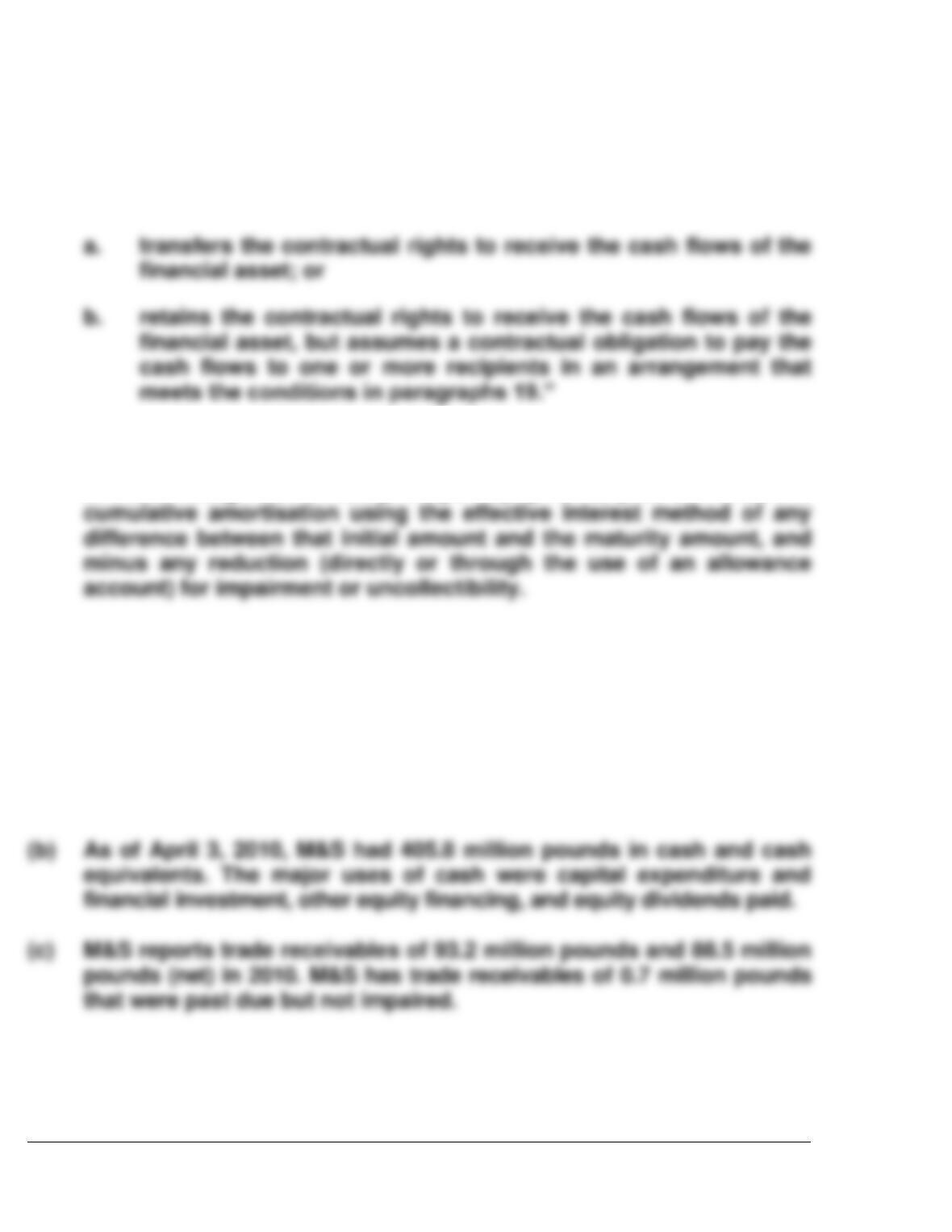
(a)
December 31, 2014
Bad Debt Expense …………………………………………….
18,782
Allowance for Doubtful Accounts ………………
18,782
(b)
Allowance for Doubtful Accounts ………………………
18,782
Bad Debt Expense …………………………..
7-84
IFRS7-4
(a) IAS 39, paragraphs 18-28 addresses derecognition of financial assets.
(b) According to paragraph 19, “An entity transfers a financial asset if, and
only if, it either:
(c) The amortised cost of a financial asset or financial liability is the
amount at which the financial asset or financial liability is measured
at initial recognition minus principal repayments, plus or minus the
IFRS7-5
(a) M&S’s cash and cash equivalents include short-term deposits with
banks and other financial institutions, with an initial maturity of three
months or less and credit card debtors receivable within 48 hours.
The carrying amount of these assets approximates their fair value.