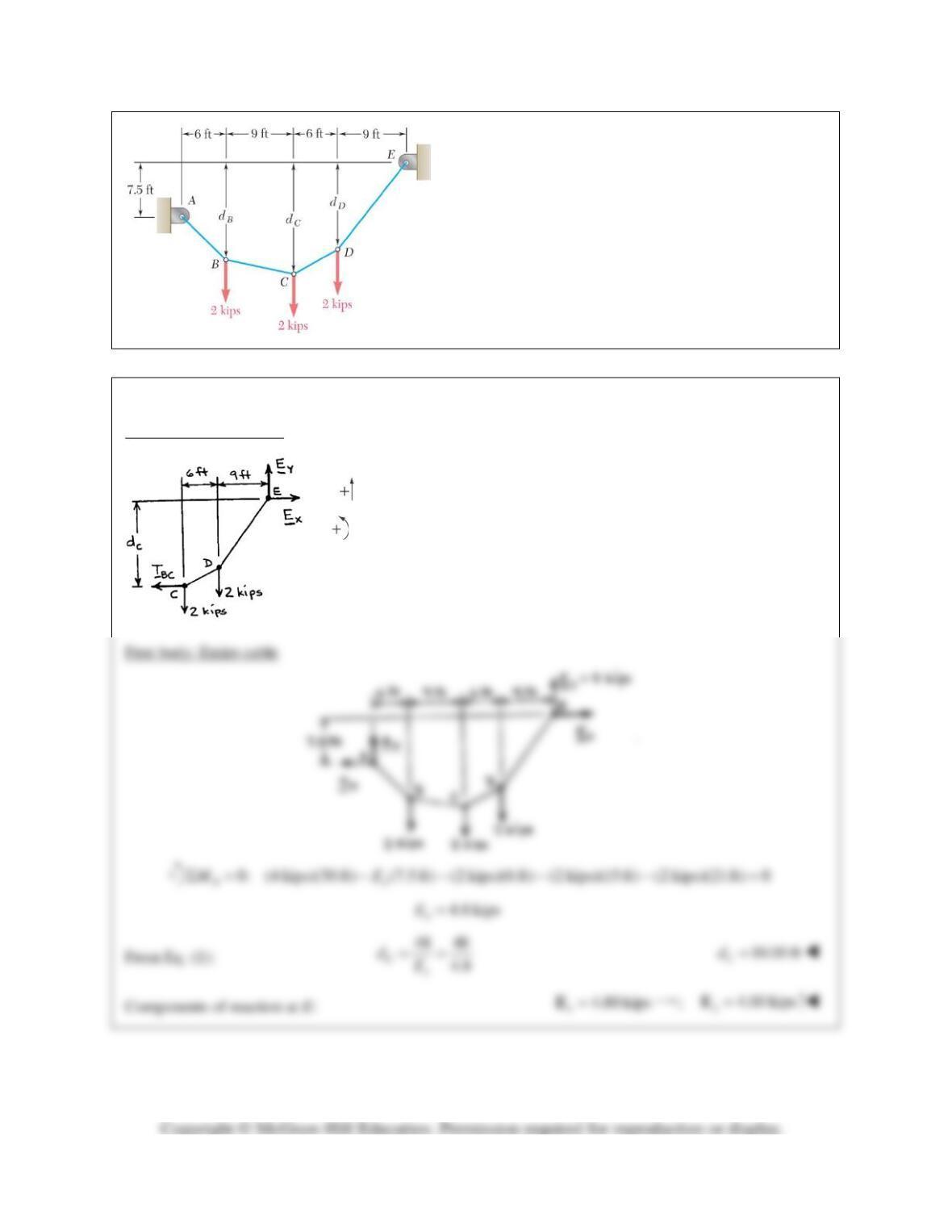
PROBLEM 7.100
Determine (a) the distance dC for which portion BC of
the cable is horizontal, (b) the corresponding
components of the reaction at E.
SOLUTION
Free body: Portion CDE
0: 2(2 kips) 0 4 kips
yy y
FE EΣ= − = =
0: (4 kips)(15 ft) (2 kips)(6 ft) 0
C xC
M EdΣ= − − =
48 kip ft
xC
Ed = ⋅
(1)
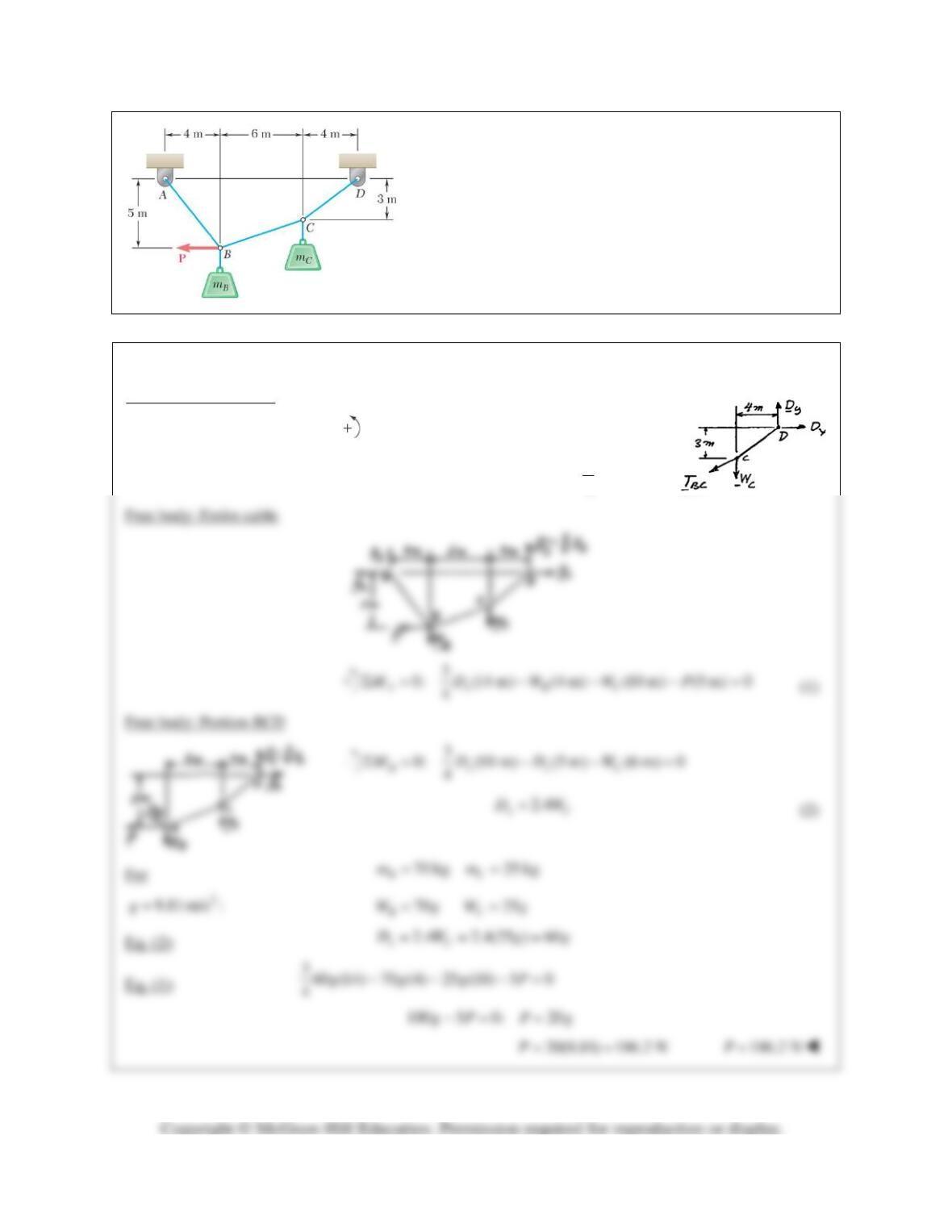
PROBLEM 7.101
Knowing that mB= 70 kg and mC= 25 kg, determine the
magnitude of the force P required to maintain equilibrium.
SOLUTION
Free body: Portion CD
0: (4 m) (3 m) 0
Cy x
MD DΣ= − =
3
4
yx
DD=
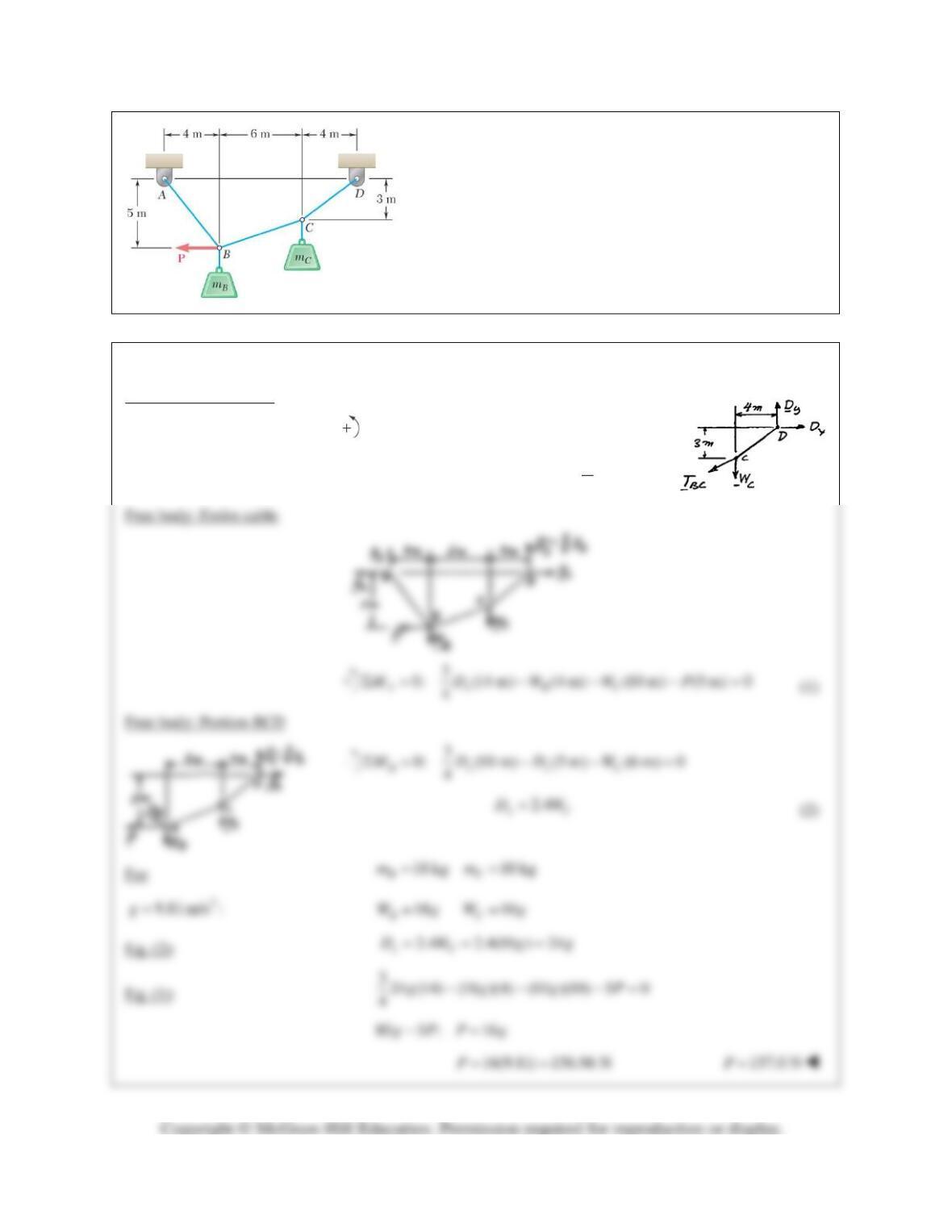
PROBLEM 7.102
Knowing that mB= 18 kg and mC= 10 kg, determine the
magnitude of the force P required to maintain equilibrium.
SOLUTION
Free body: Portion CD
0: (4 m) (3 m) 0
Cy x
MD DΣ= − =
3
4
yx
DD=
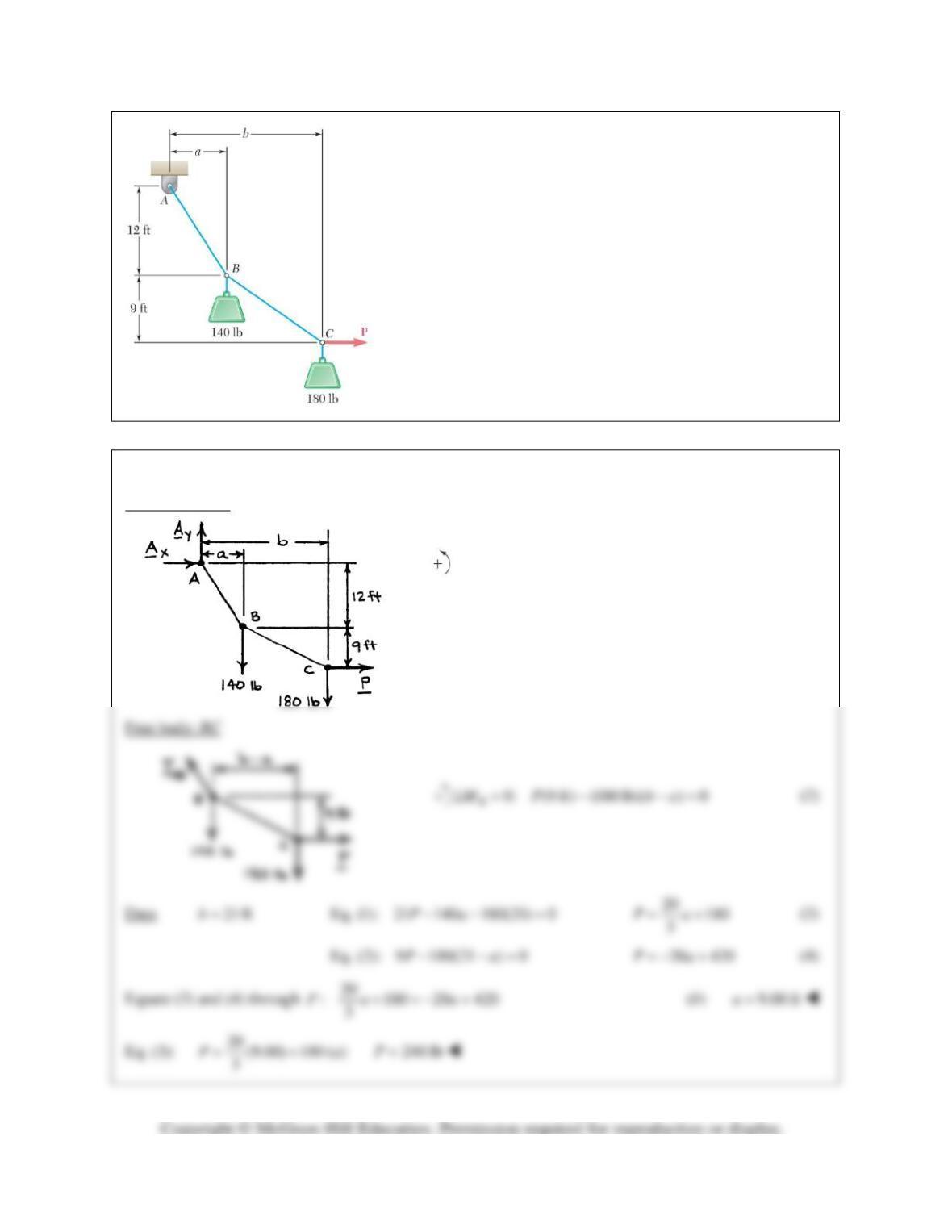
PROBLEM 7.103
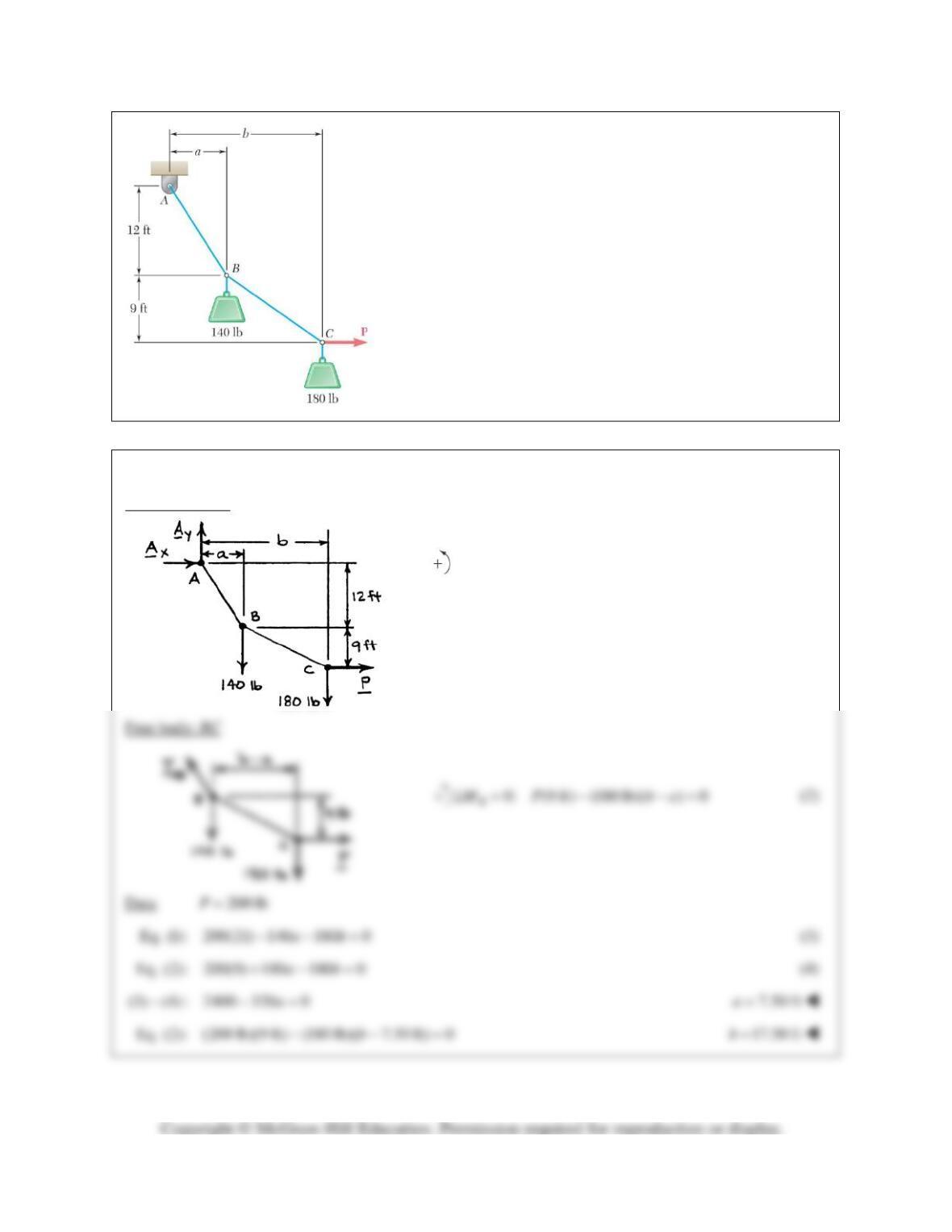
Cable ABC supports two loads as shown. Knowing that b= 21 ft,
determine (a) the required magnitude of the horizontal force P,
(b) the corresponding distance a.
SOLUTION
Free body: ABC
0: (12 ft) (140 lb) (180 lb) 0
A
MP a bΣ= − − =
(1)
PROBLEM 7.104
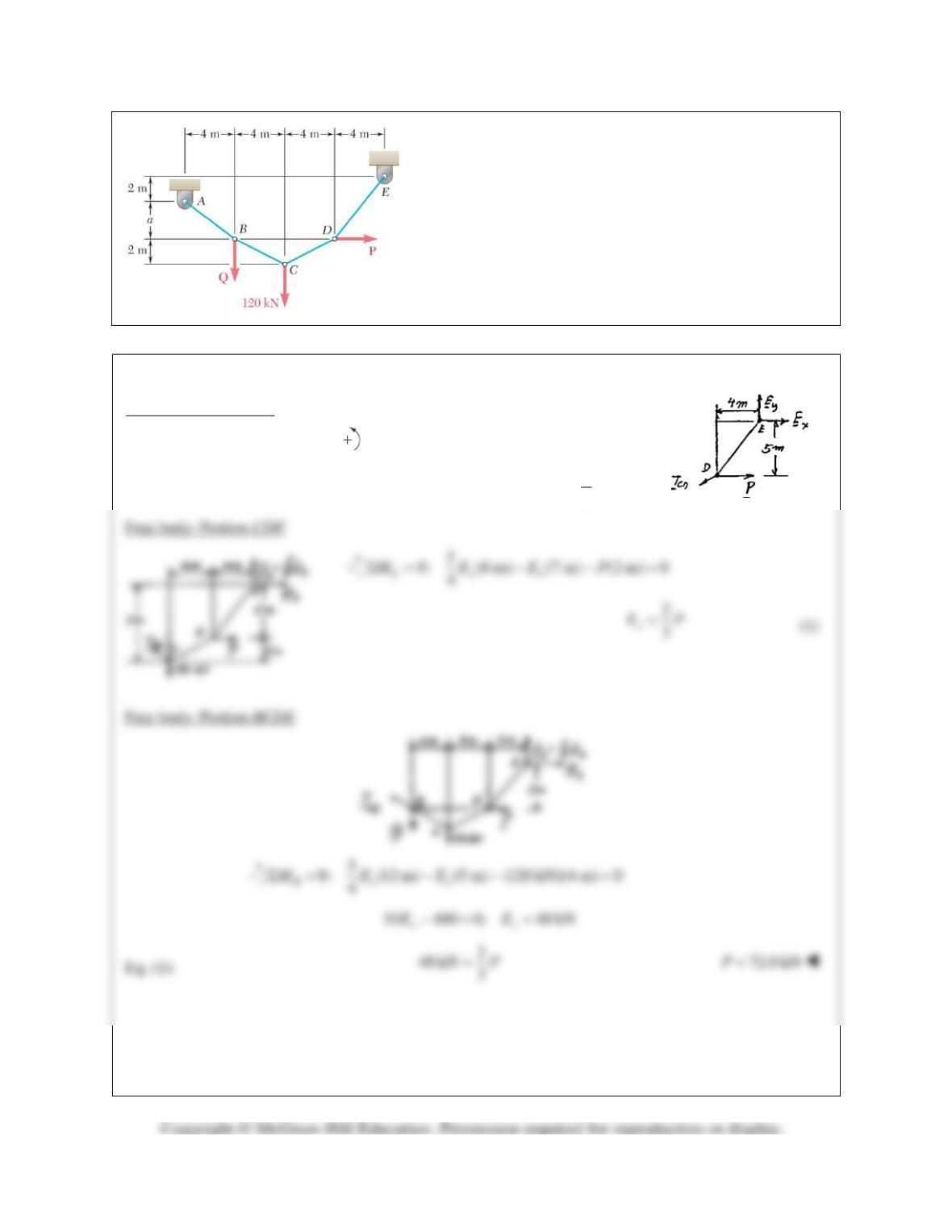
Cable ABC supports two loads as shown. Determine the
distances a and b when a horizontal force P of magnitude 200 lb
is applied at A.
SOLUTION
Free body: ABC
0: (12 ft) (140 lb) (180 lb) 0
A
MP a bΣ= − − =
(1)
PROBLEM 7.105
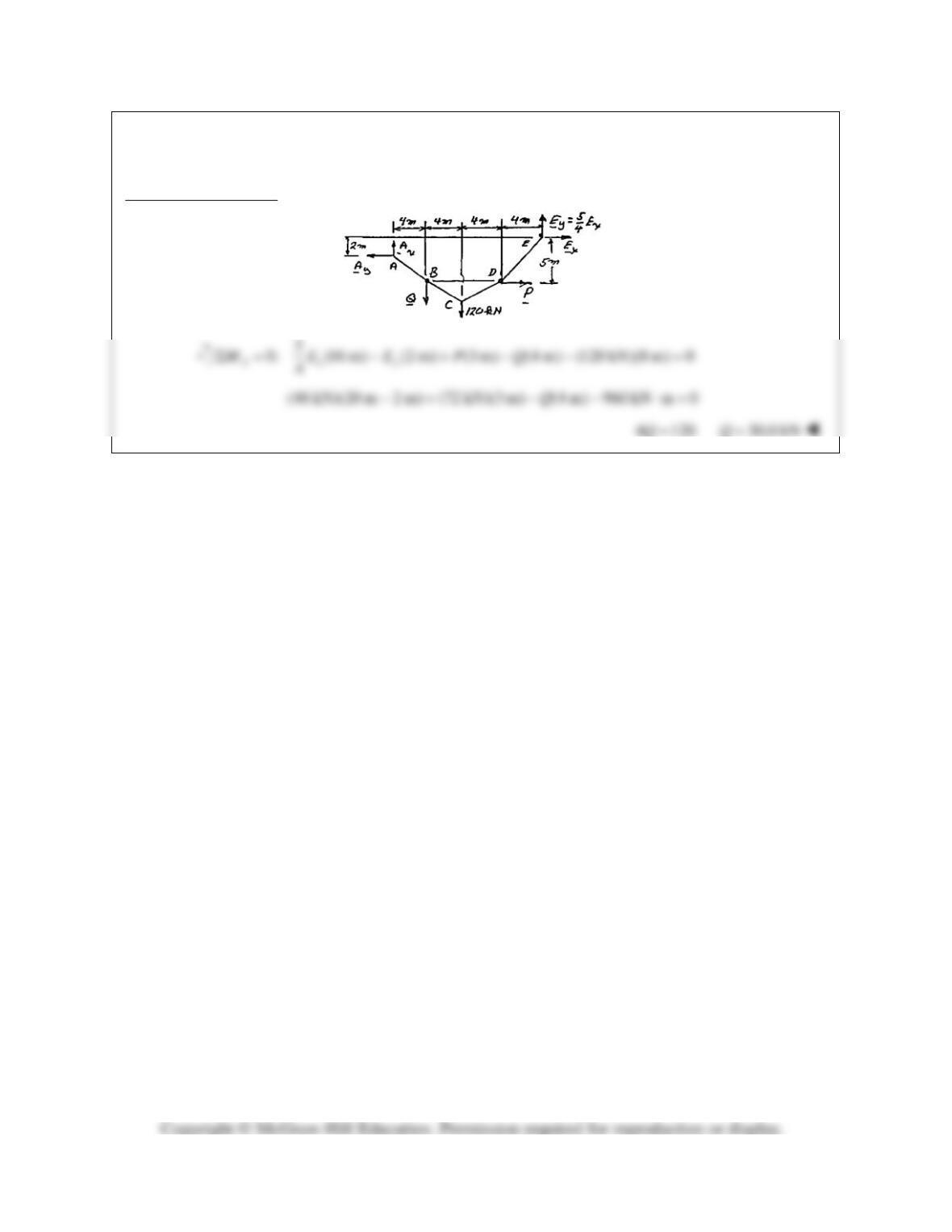
If a= 3 m, determine the magnitudes of P and Q required to
maintain the cable in the shape shown.
SOLUTION
Free body: Portion DE
0: (4 m) (5 m) 0
Dy x
ME EΣ= − =
5
4
yx
EE=
PROBLEM 7.105 (Continued)
Free body: Entire cable
PROBLEM 7.106
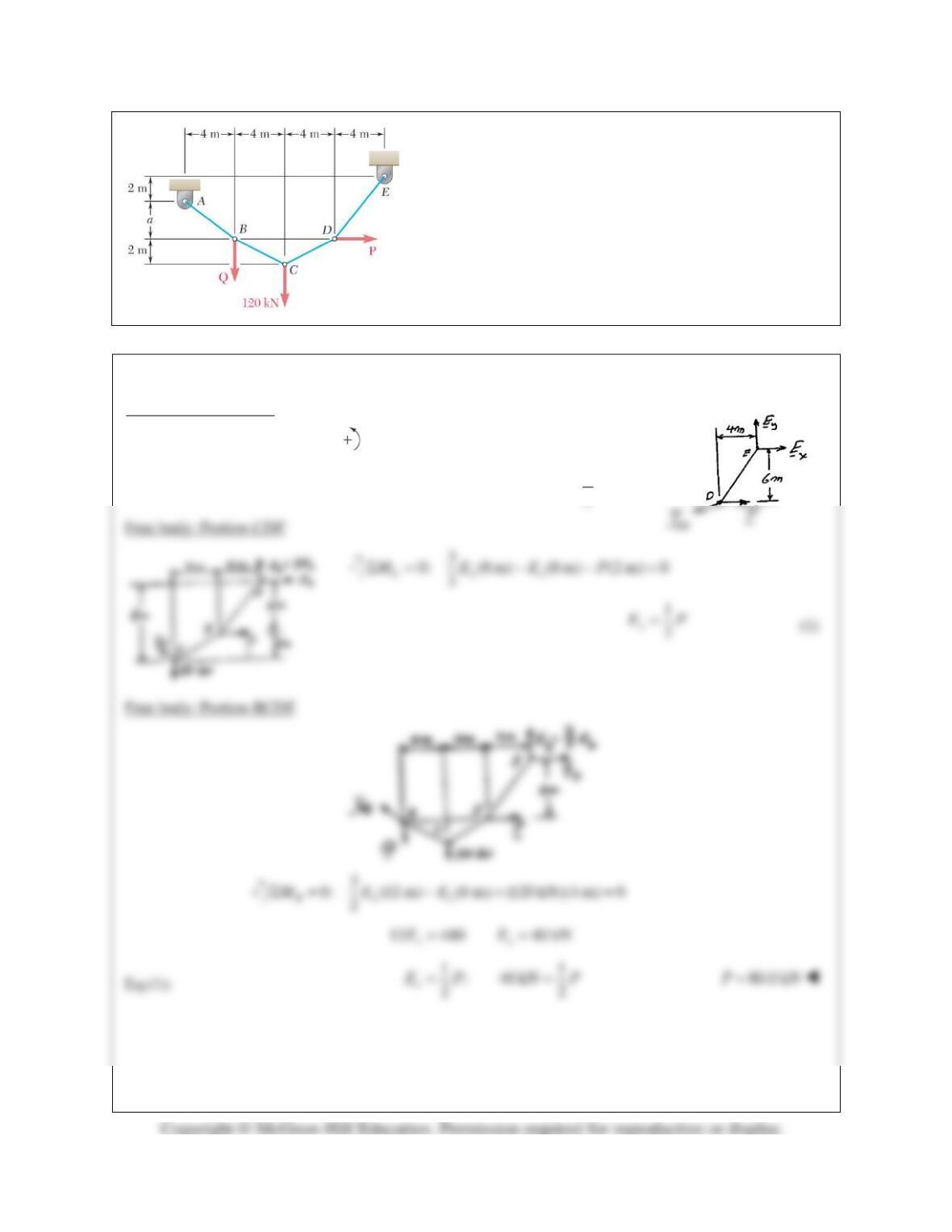
If a = 4 m, determine the magnitudes of P and Q required to
maintain the cable in the shape shown.
SOLUTION
Free body: Portion DE
0: (4 m) (6 m) 0
Dy x
ME EΣ= − =
3
2
yx
EE=
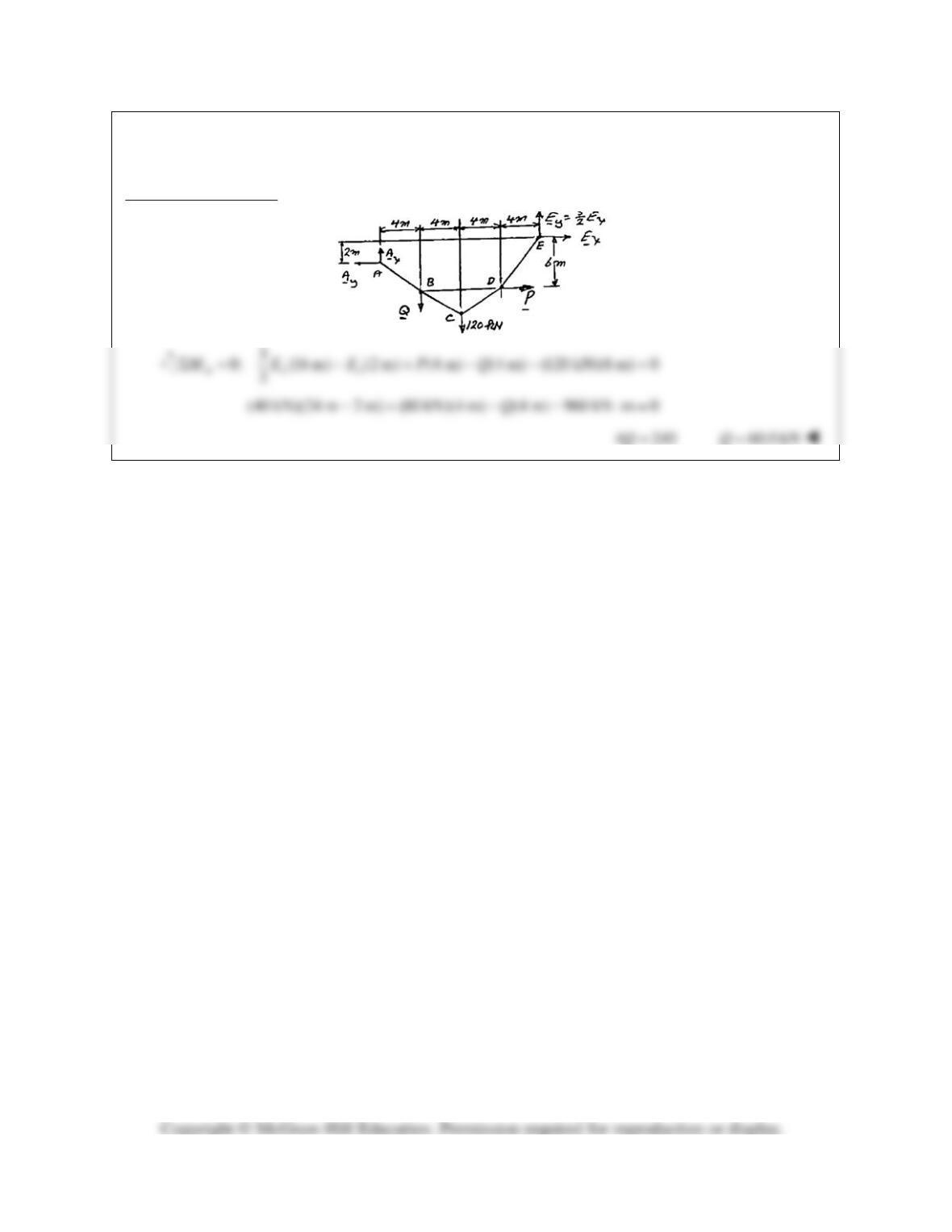
PROBLEM 7.106 (Continued)
Free body: Entire cable
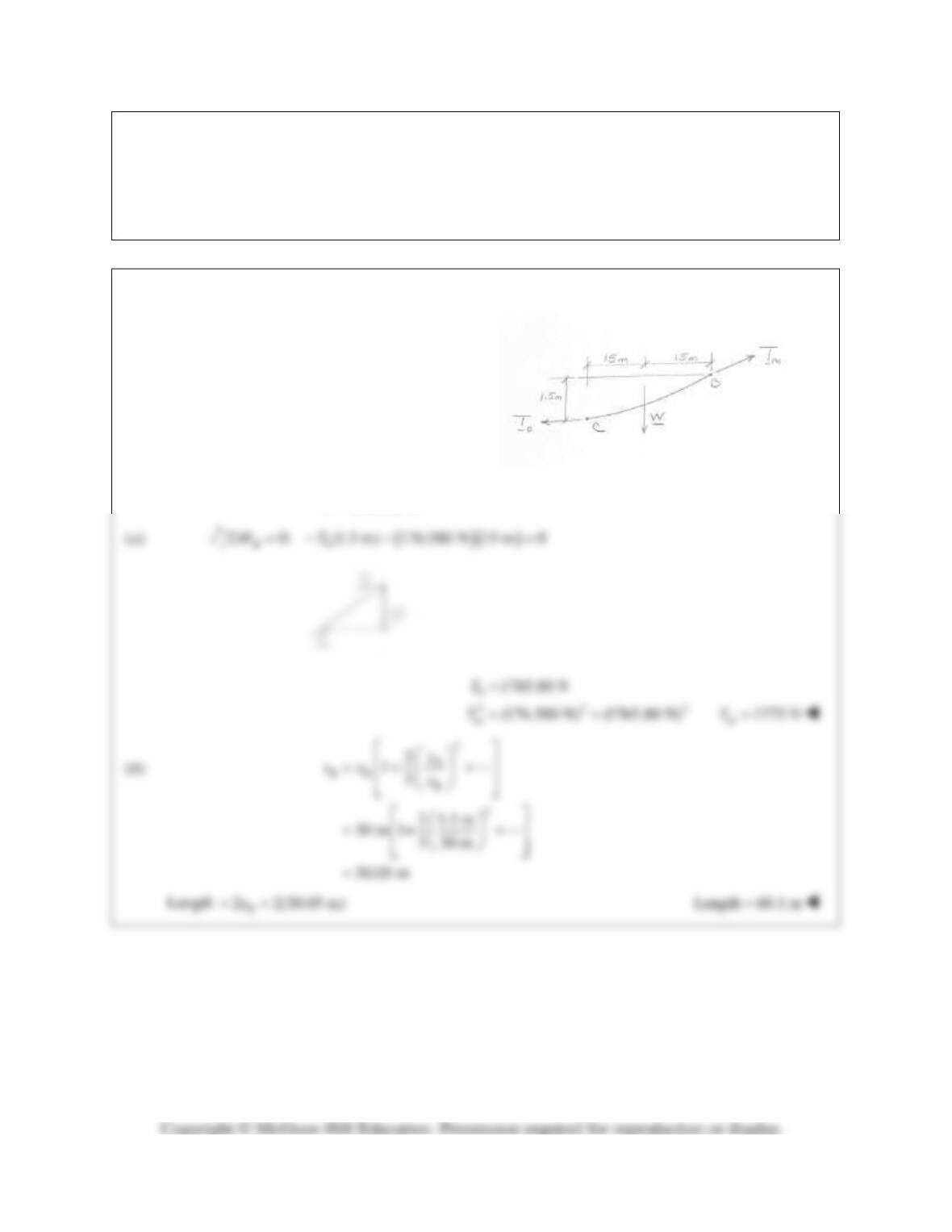
PROBLEM 7.107
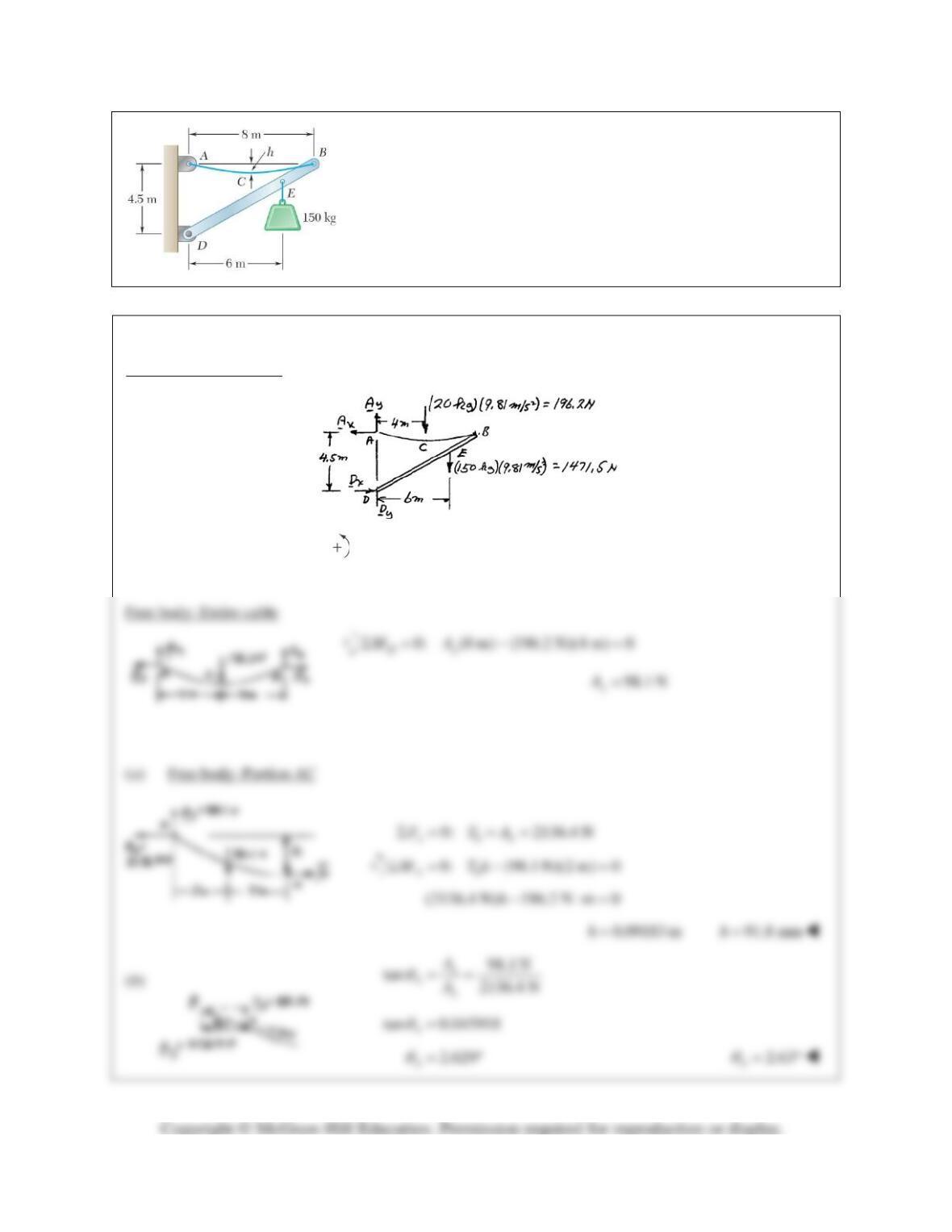
An electric wire having a mass per unit length of 0.6 kg/m is strung between two insulators at the same
elevation that are 60 m apart. Knowing that the sag of the cable is 1.5 m, determine (a) the maximum
tension in the wire, (b) the length of the wire.
SOLUTION
2
(0.6 kg/m)(9.81 m/s )
5.886 N/m
(5.886 N/m)(30 m)
176.580 N
w
W
W
=
=
=
=
PROBLEM 7.108
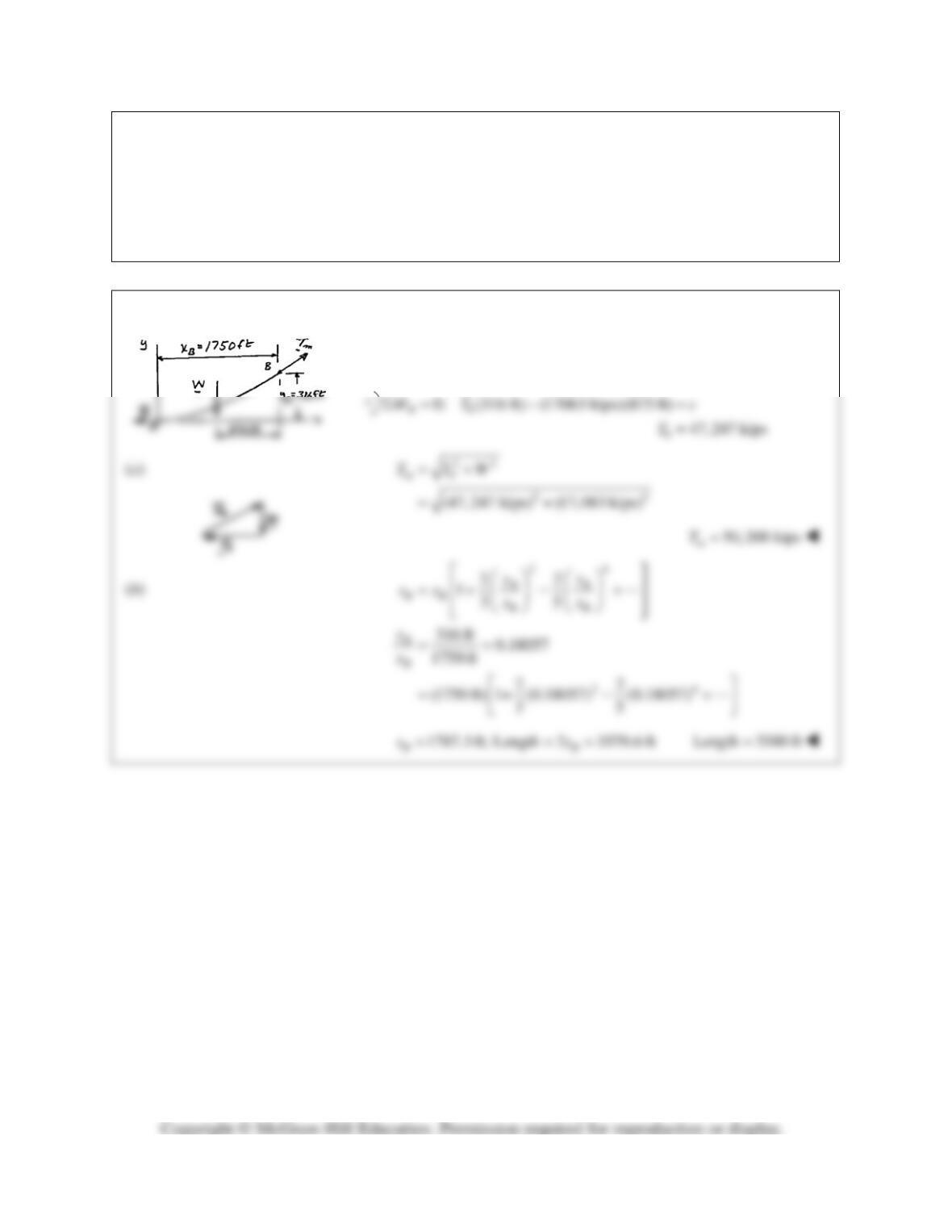
The total mass of cable ACB is 20 kg. Assuming that the mass of the
cable is distributed uniformly along the horizontal, determine (a) the
sag h, (b) the slope of the cable at A.
SOLUTION
Free body: Entire frame
0: (4.5 m) (196.2 N)(4 m) (1471.5 N)(6 m) 0
Dx
MAΣ= − − =
2136.4 N
x
A=
PROBLEM 7.109
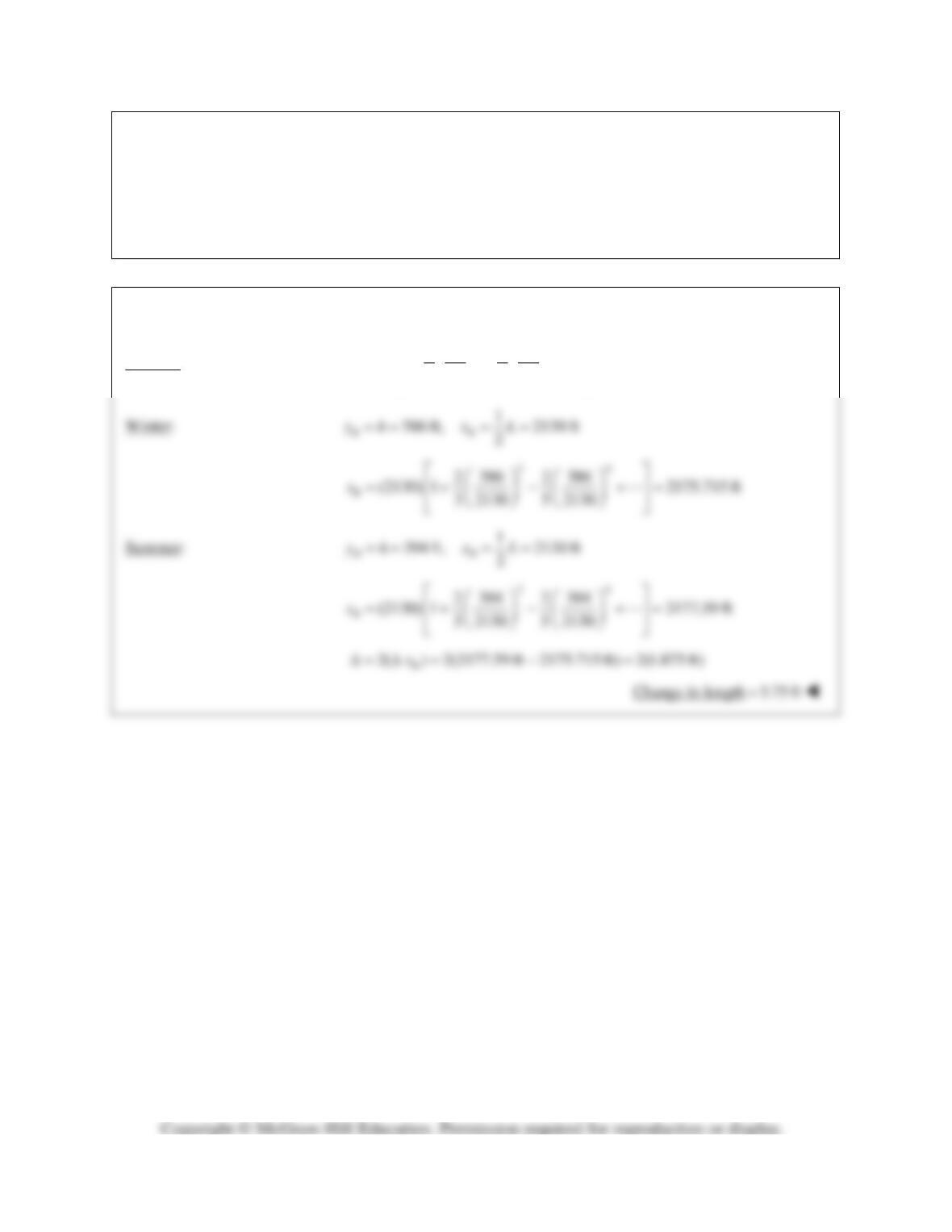
The center span of the George Washington Bridge, as originally constructed, consisted of a uniform
roadway suspended from four cables. The uniform load supported by each cable was
9.75 kips/ftw=
along the horizontal. Knowing that the span L is 3500 ft and that the sag h is 316 ft, determine for the
original configuration (a) the maximum tension in each cable, (b) the length of each cable.
SOLUTION
(9.75 kips/ft) (1750 ft)
17,063 kips
= =
=
B
W wx
W
PROBLEM 7.110
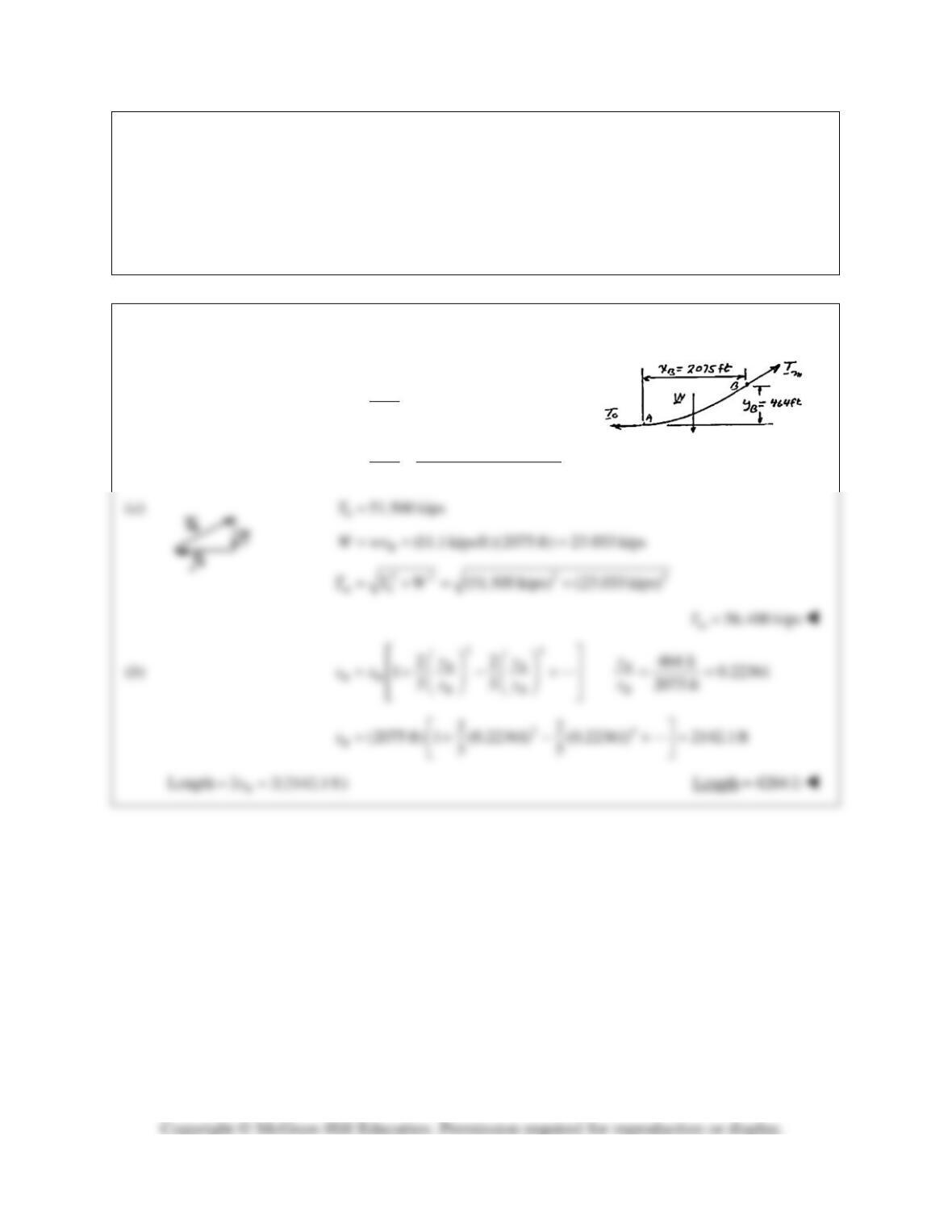
The center span of the Verrazano–Narrows Bridge consists of two uniform roadways suspended from four
cables. The design of the bridge allows for the effect of extreme temperature changes that cause the sag of
the center span to vary from hw= 386 ft in winter to
394 ft
s
h=
in summer. Knowing that the span is
L = 4260 ft, determine the change in length of the cables due to extreme temperature changes.
SOLUTION
Eq. 7.10:
24
22
135
BB
BB
BB
yy
sx xx
=+−+
PROBLEM 7.111
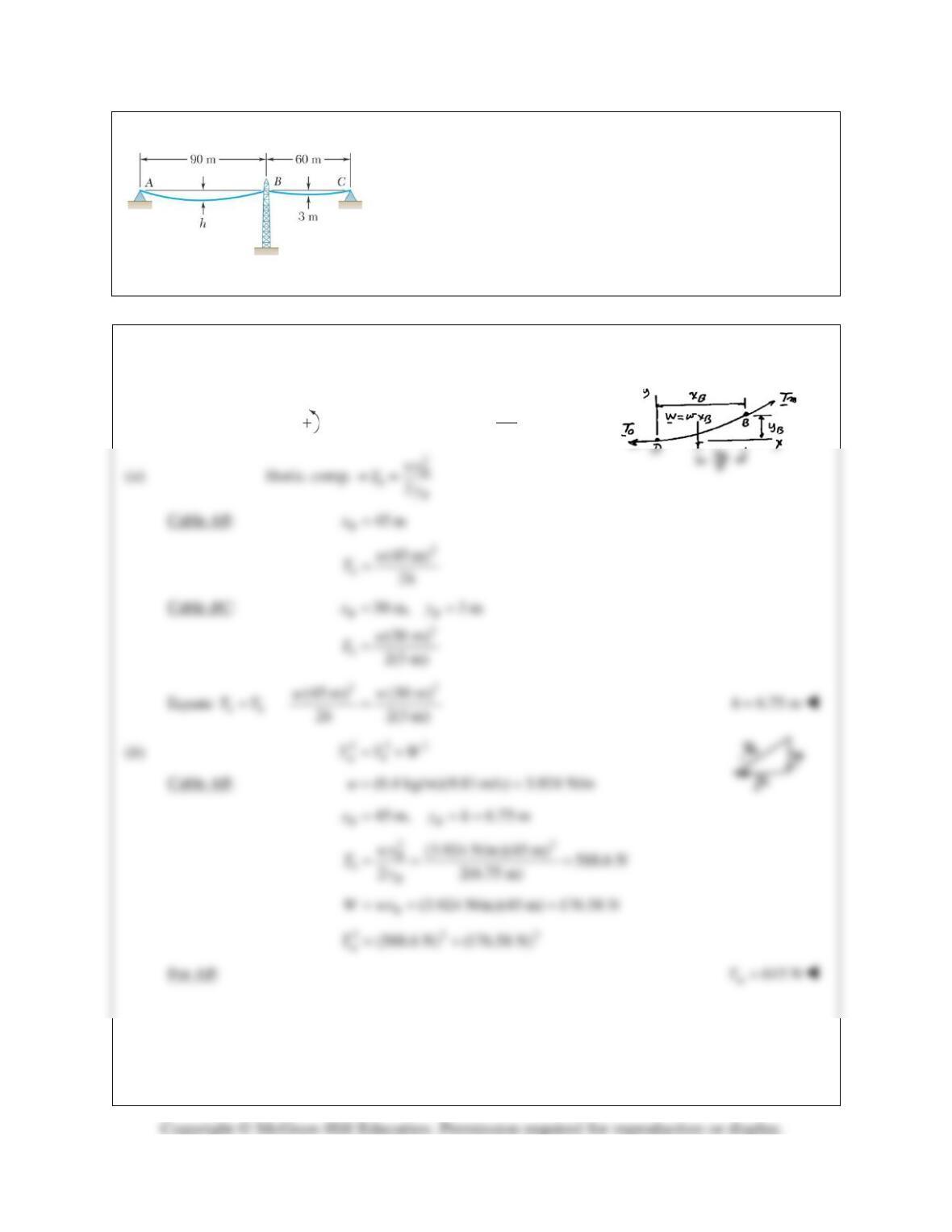
Each cable of the Golden Gate Bridge supports a load w= 11.1 kips/ft along the horizontal. Knowing that
the span L is 4150 ft and that the sag h is 464 ft, determine (a) the maximum tension in each cable, (b) the
length of each cable.
SOLUTION
Eq. (7.8) Page 386:
At B:
2
0
2
B
B
wx
yT
=
22
0
(11.1 kip/ft)(2075 ft)
2 2(464 ft)
B
B
wx
Ty
= =
PROBLEM 7.112
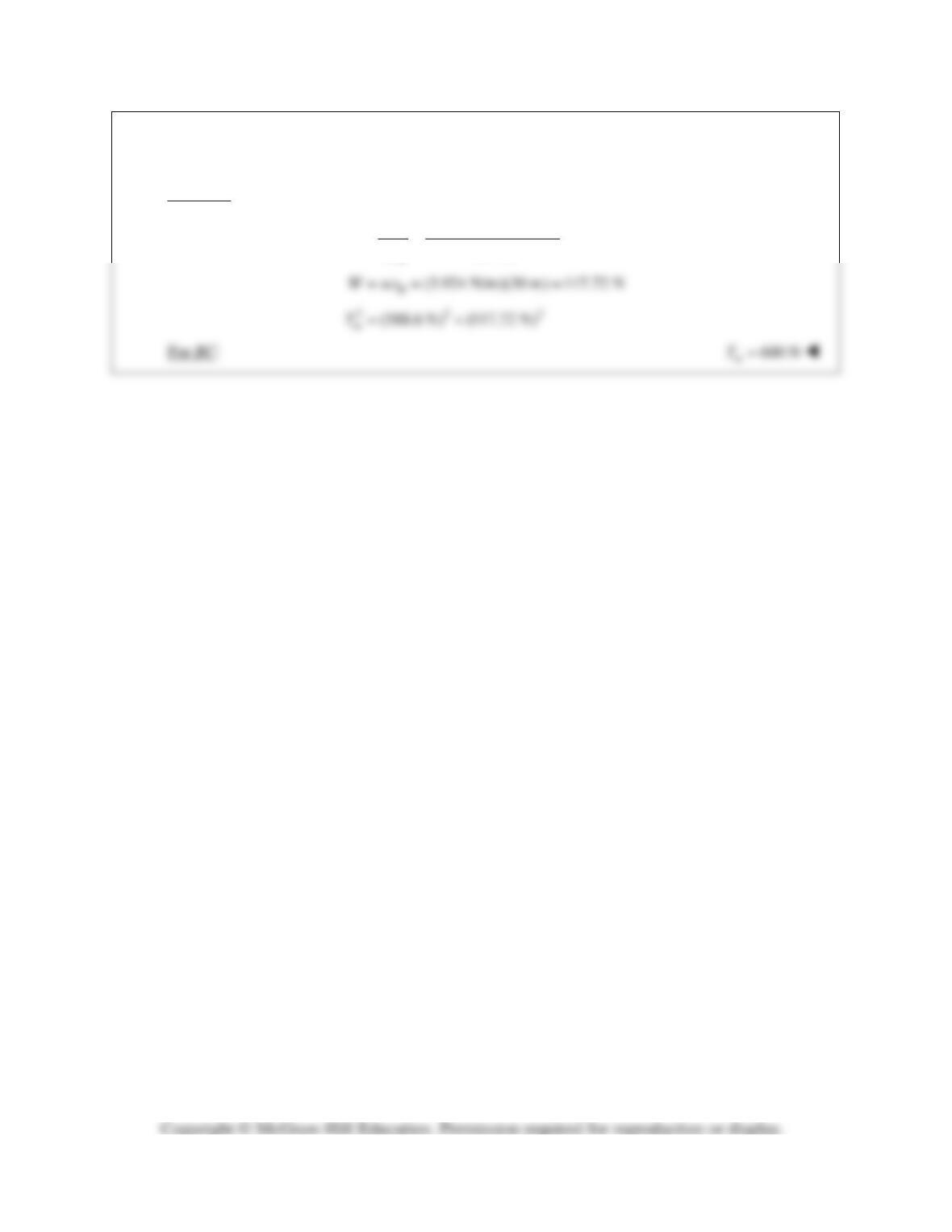
Two cables of the same gauge are attached to a transmission tower
at B. Since the tower is slender, the horizontal component of the
resultant of the forces exerted by the cables at B is to be zero.
Knowing that the mass per unit length of the cables is 0.4 kg/m,
determine (a) the required sag h, (b) the maximum tension in each
cable.
SOLUTION
B
W wx=
0
0: ( ) 0
2
B
B BB
y
M T y wxΣ= − =
PROBLEM 7.112 (Continued)
Cable BC:
30 m, 3 m
BB
xy= =
22
0
(3.924 N/m)(30 m) 588.6 N (Checks)
2 2(3 m)
B
B
wx
Ty
= = =
PROBLEM 7.113
A 76-m length of wire having a mass per unit length of 2.2 kg/m is used to span a horizontal distance of
75 m. Determine (a) the approximate sag of the wire, (b) the maximum tension in the wire. [Hint: Use
only the first two terms of Eq. (7.10).]
SOLUTION
First two terms of Eq. 7.10
(a)

PROBLEM 7.113 (Continued)
+
0: 820.12 N 0 820.12 N
yy y
FB BΣ= − = =
22 2 2
(2861.6 N) (820.12 N)
m xy
T BB= += +
2980 N
m
T=
PROBLEM 7.114
A cable of length L + ∆ is suspended between two points that are at the same elevation and a distance L
apart. (a) Assuming that ∆ is small compared to L and that the cable is parabolic, determine the
approximate sag in terms of L and ∆. (b) If L = 100 ft and ∆= 4 ft, determine the approximate sag. [Hint:
Use only the first two terms of Eq. (7.10).
SOLUTION
Eq. 7.10 (First two terms)
(a)
2
2
13
B
BB
B
y
sx x
= +
PROBLEM 7.115
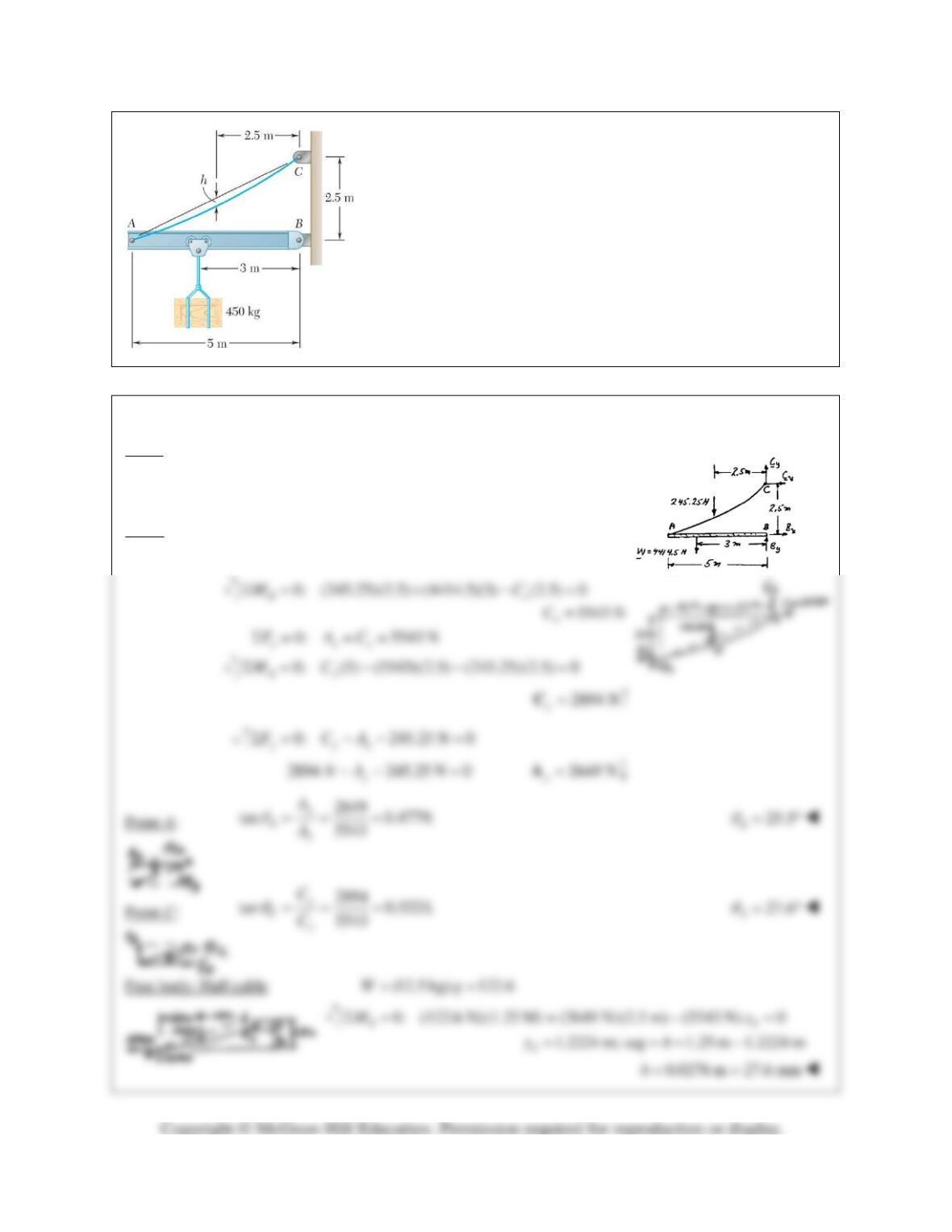
The total mass of cable AC is 25 kg. Assuming that the mass of the
cable is distributed uniformly along the horizontal, determine the
sag h and the slope of the cable at A and C.
SOLUTION
Cable:
25 kg
25 (9.81)
245.25 N
m
W
=
=
=
Block:
450 kg
4414.5 N
m
W
=
=