1
Chapter 7: Whites/Caucasians
Chapter 7
Whites/Caucasians
Table of Contents
Content
Page No. in the IM
Chapter Outline
1
Chapter Objectives
1
Lecture Notes and Teaching Suggestions
2
Key Facts (and Selected Questions)
3
Consideration as Discussion Points
Questions to Consider (End of Chapter)
11
Actions and Exercises
14
Suggested Readings
17
Suggested Videos
17
Suggested Test Questions
18
Chapter Outline
2. History of Whites in the United States
4. Population
6. Research on Whites and Diversity
8. Recommendations for Individuals
10. Summary
12. Questions to Consider
13. Actions and Exercises
Chapter Objectives
After completing this chapter, readers should have a greater understanding of
2
Chapter 7: Whites/Caucasians
Whites/Caucasians and their role in organizational diversity. Specifically, they should be
able to:
• discuss some of the history of White ethnic groups in the United States.
• describe differences in income by education levels between Whites and other racial
and ethnic groups.
• explain the similarities and differences between employment experiences of White
Lecture Notes and Teaching Suggestions
This chapter focuses on Whites/Caucasians as a particular racial group relevant to
diversity in organizations. Instructors should emphasize to students that Whites are
sometimes overlooked in the study of diversity but they are very important to the study
and to make changes in organizational diversity. Students are often surprised to learn that
Title VII covers White men as well as women and people of color. Some cases are
included in the chapter that provide examples of when a White individual was purposely
discriminated against because of his or her race and/or sex. Instructors should emphasize
to students that although “reverse discrimination” is often associated with affirmative
action and is often feared by White men, it is highly unlikely. If it does occur, however,
Title VII is applicable. In many of the EEOC cases, Whites were treated unfairly when
they stood up against discrimination against other groups.
By examining the history of Whites in the U.S., this chapter allows readers to observe the
similarities and differences in the experiences of White ethnic group members with each
other and also with Blacks in the U.S. While White ethnics originally experienced
discrimination and differential treatment, intermarriage and the general invisibility of
their ethnic background reduced the opportunity for any discrimination against them. The
internment of Italians in the U.S. during the 1900s is a little known fact about the
3
Chapter 7: Whites/Caucasians
discrimination practiced against members of Italian ethnic groups in the U.S. White
religious minorities (e.g., Irish Catholics, Jews) also experienced, and still continue to
experience, discrimination in the U.S.
During the 1900s, lower status White ethnic groups encouraged and capitalized on the
fear and antipathy of high-status Whites toward Blacks, using them to “become insiders,
or Americans, by claiming their membership as Whites” and designating Blacks as the
“other.” This differential treatment against Blacks and others of color remains stronger
These unearned advantages do not make one racist, but they do not make one meritorious
to receive the advantages either. Despite being members of the non-dominant class group,
and dealing with class-based inequality, lower SES Whites often experience White
privilege and advantages denied to minorities at the same or higher class levels.
The chapter provides comparisons of the experiences of White men and White women in
organizations, emphasizing women’s experiences with the glass ceiling and walls, sex-
based discrimination, sexual harassment, and other barriers to diversity. Although White
women are the least disadvantaged among women of all races/ethnicities, they earn less
than White men and receive lower returns than White men on their educational
investment.
Key Facts (and Selected Questions)
Questions following each “Key Fact” are helpful in stimulating class discussion.
(Selected key facts include discussion points in this Instructors’ Manual. Instructors may
choose to emphasize different ones depending on the needs/interests of students and
4
Chapter 7: Whites/Caucasians
racial and ethnic groups.
Question: Why is the growth declining for non-Hispanic Whites?
• Although women of all races and minorities of both sexes now comprise a greater
share of the labor force, White men and White women continue to hold a
disproportionate share of managerial jobs.
Questions: Why do these differences still exist?
Similarity effect, greater social networks of Whites compared with people of color,
• As the great majority of CEOs, executives, and senior level managers, White men
play key roles in organizational diversity.
Questions: What kind of roles do Whites play in organizational diversity?
Whites play distinctive roles in organizational diversity. As members of the
dominant racial group, Whites have more power to make changes than do people of
color. As members of the dominant group, they may also erroneously view
5
Chapter 7: Whites/Caucasians
• Whites are less likely to be laid off than minorities in the same organization, even
when taking into account their education, skills, performance, and tenure.
Question: Why do you think Whites are less likely to be laid off?
Students’ answers will vary. Often the people making the decisions about layoffs
may be Whites and may choose to keep people who are more similar to themselves.
• White women have higher workforce participation rates than Asian and Hispanic
women but lower participation than Black women.
Question: What factors contribute to these differences in women’s participation
rates?
Students’ answers will vary. Some of them may mention that this is a complex
issue, as the participation rates for women are generally affected by age and
• Even Whites who do not personally practice discrimination and exclusion, or who
are recent immigrants, are advantaged by systemic discrimination and exclusion
that disadvantage people of color.
Question: In what ways do Whites continue to benefit from slavery and
discrimination in the U.S.?
The combination of slavery in the past and continued discrimination disadvantage
6
Chapter 7: Whites/Caucasians
Blacks and therefore advantage Whites. When competition for education, jobs,
Selected Items for Instructors’ Consideration as Discussion
Points
1. Individual Feature 7.1: Albert Einstein, Genius and Antiracist
This feature discusses Albert Einstein as an anti-racist and civil rights activist, which is a
little known aspect of Einstein’s work. Readers are often surprised to know about this.
Questions to Consider:
1. Prior to reading this section, were you aware of Albert Einstein’s strong antiracist
stance?
2. Some have suggested that because Einstein was Jewish and also experienced
discrimination, he was more antiracist than he otherwise might have been. Is this a
likely cause of Einstein’s perspective? Explain.
Students’ answers will vary. Einstein may have been able to empathize more with
2. Feature 7.1: The Internment of Italians and Germans in World War II
Questions to Consider:
1. Prior to reading this selection, were you aware that Italians and Germans had been
evacuated and relocated as enemy aliens during World War II?
2. Aside from differences in the numbers of people affected, why do you think that the
Italian and German relocation experience has received such little attention when
compared with that of the Japanese?
3. Why might Caucasians have been perceived as more loyal than the Japanese?
3. Research Summary 7.1: “White Privilege” and the “Myth of Meritocracy”
This research summary considers the research of Dr. Peggy McIntosh, associate director
of the Wellesley College Center for Research on Women, and a book on the Meritocracy
Myth by Stephen McNamee and Robert Miller. McIntosh’s list of “white privileges” is
often used in diversity training programs, and it provides examples of numerous
8
Chapter 7: Whites/Caucasians
Questions to Consider:
1. What other White privileges can you think of that have specific relevance to
diversity in organizations?
2. If you are a member of a non-dominant racial or ethnic group, how many of the
privileges listed resonate with you? Which ones?
3. If you are White, how many of the privileges listed had you recognized prior to
reading this selection? Which ones are most sobering or surprising to you?
4. Belief in meritocracy and that people can “pull themselves up by their bootstraps”
is common in the United States. Had you considered “the myth of meritocracy”
prior to reading this selection? What do you think of the possibility that by
discriminating against minorities, society and organizations provide advantages for
Whites? In what ways does failure to acknowledge the consequences of
discrimination contribute to Whites’ feelings of their own individual qualifications
and “merit” and to beliefs that others just need to work harder?
Students’ answers will vary. Some of them may mention that Whites receive
employment advantages and preferences based on similarity to key decision
5. The term qualified minorities is sometimes used in selection searches. How much is
the term qualified Whites used? (Qualified women? Qualified men?)
6. What things might be on a list of “male” privileges—unearned advantages that men
experience—relative to diversity in organizations?
7. Recall from Chapter 4 that most wealth is inherited. What things might be on a list
of privileges provided by wealth?
4. Table 7.1: Unemployment Level by Educational Attainment by Race (2013)
(Percent of Population 25 and Over)
5. Table 7.2: Mean Total Money Earnings of Workers 18 Years and Over, by
Educational Attainment, Race, Hispanic Origin, and Sex: 2012
This table depicts the male and female wage gap for Whites, Blacks, Asians, and
10
Chapter 7: Whites/Caucasians
Hispanics by their education level. This table also shows that Asians females sometimes
have higher earnings than their White counterparts (e.g., Asian females with an advanced
6. Individual Feature 7.3: Frank McCloskey, Vice-President of Diversity, 2000–
2010, Georgia Power
Questions to Consider:
1. McCloskey believes that corporations must “take the lead to close the educational
and poverty gap across racial and ethnic lines” to build a future talent pipeline and
sustain corporate business models. Do you agree that the racial and ethnic
disparities in educational attainment discussed in this book may negatively affect
corporations? If so, in what specific ways might corporations get involved with
alleviating such disparities? Why might individual investors support corporations’
involvement in such efforts?
Students’ answers will vary. Some of them might agree that racial and ethnic
disparities in educational attainment will negatively affect corporations.
2. What is the relationship between a country’s success and the ability of all its
citizens to be free from injustice, educated, and participating in and benefiting from
wealth creation?
3. McCloskey believes that change must first begin in one’s immediate circle of
influence—the family—and recommends adults be careful not to unintentionally
teach children subtle forms of bias and prejudice. To what kinds of unintentional
forms of bias and prejudice are children introduced by well-meaning adults who
believe themselves to be unprejudiced?
Students’ answers will vary. Students might suggest that most adults may
Questions to Consider (End of Chapter)
1. Many Whites argue that their resistance to affirmative action and diversity
programs is due in part to their families’ history of not owning slaves or their not
having practiced discrimination. What are some ways in which Whites who have
not done these things nonetheless benefitted from and been advantaged by slavery
and discrimination?
By restricting opportunities for Blacks (former slaves) and other people of color,
employers, banking institutions, educational institutions, and other institutions have
2. How does the visibility (identifiability) of groups such as Blacks and Asians
contrast with the invisibility of White ethnics in shaping their organizational
experiences?
12
Chapter 7: Whites/Caucasians
3. Recall from Chapter 4 that many of the Whites who participated in Blacks’ struggle
for civil rights were Jewish. How were the organizational experiences of Jews and
Blacks in the United States similar and dissimilar?
4. Is the transition of Jews and Irish from non-White to White category surprising to
you? Brodkin also discusses the transformations of Mexicans to White then back
again. Were you aware of these changes? In addition to those listed in this chapter,
what other changes in race occurred within the U.S. census categorizations?
5. Recall the study by Castilla that found similar starting salaries but differential
salary growth for women and minorities compared to White men even when
performance ratings were the same. What are some possible negative consequences
for the organization if these salary differences become widely known? What
specific steps would you recommend to avoid “performance–reward”
discrimination?
If the performance-reward discrimination were widely known, the negative
13
Chapter 7: Whites/Caucasians
6a. If you are not White, do you know someone well who is White? In what capacity
do you know this person (e.g., personal friend, manager, classmate, neighbor)? Do
you know this person’s ethnic origin (e.g., Italian, Irish, German)? How much time
have you spent with him or her? Have you thought about this person as having a
race or ethnicity? Have you discussed race, ethnicity, or other diversity issues with
him or her? Explain.
6b. If you are White, do you know your ethnic origin? How much of a role does your
ethnic origin play in your everyday life, experiences, and opportunities? Can
outside observers discern your ethnic origin by looking at you?
Students’ answers will vary. Students who are white might belong to one ethnic
6c. How does the ethnicity of Whites differ from visible ethnic differences in its effect
on a person’s experiences and opportunities?
7. Individual Whites may report experiences with reverse discrimination, despite little
research evidence to support it. How do such experiences affect support of or
resistance toward diversity efforts? What might help such individuals to be
supportive of diversity efforts, despite believing they had experienced
14
Chapter 7: Whites/Caucasians
discrimination?
Students’ answers will vary. Whites’ experiences with reverse discrimination are
likely to fuel animosity toward diversity efforts. Some people in the dominant
Actions and Exercises
1. Search the EEOC Web site (http://www.eeoc.gov) for the most recent three or six
months for cases of discrimination charges and settlements against Whites. In any
month that you find a case involving discrimination against Whites, document the
events surrounding this case. What proportion of cases involved race-based
discrimination against Whites?
2. Although “quotas” are generally illegal in the United States, many people believe
they are legal and common. Prepare an argument to dispel the idea of reverse
discrimination basing it on education and earnings and representation in senior and
executive management of White men, White women, Black men, and Black
women.
Students’ answers will vary. Students might base their argument on fact that
3a. Conduct an informal census of employees in several places: a fast food restaurant, a
sit-down restaurant, a discount store, department store, government office, bank, or
other locations in which many employees are visible. Document the number of

15
Chapter 7: Whites/Caucasians
employees overall and the number of White employees visible. What is the race
and sex of the store manager? Estimate the proportion of the employees who are
White in each place. How many managers and assistant managers are White? How
many are White and male?
Students’ answers will vary.
3b. Choose two nights to watch television for thirty minutes to one hour each night.
Document the program, type of commercial, and the numbers of White characters
in the programs and commercials. In what roles are they portrayed?
Students’ answers will vary.
3c. What similarities and differences are apparent between the people in parts a and b?
4. From your data in Exercises 3a and 3b, speculate on the ethnicity of the White
employees (3a) or characters (3b). What factors did you use in your speculation?
Compare the difficulty in speculating on the ethnicity of the Whites with
identifying them by race and sex.
Students’ answers will vary.
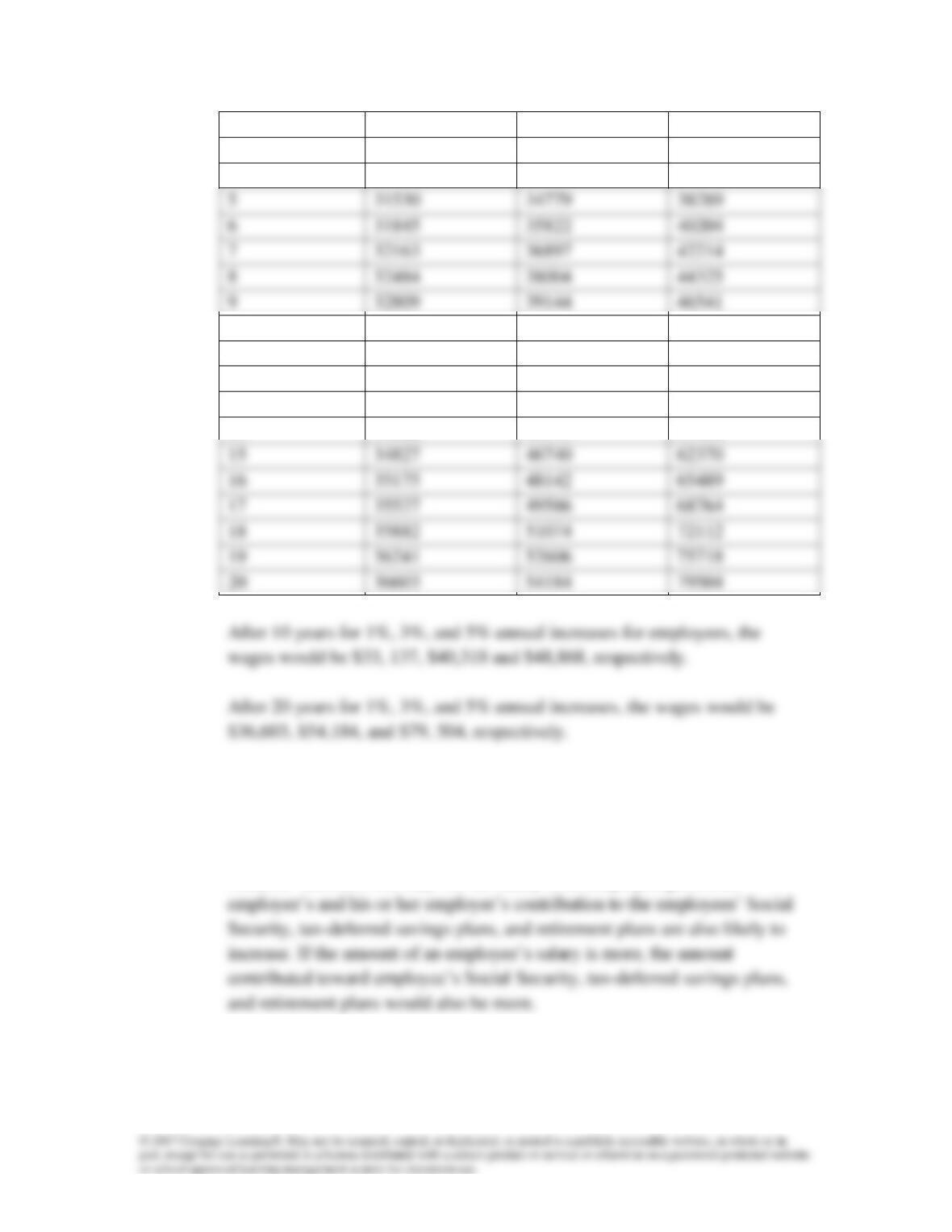
5. Use a calculator to make a chart projecting the effects of performance-reward
disparities (Castilla’s study, discussed in the chapter) in salary growth for White
men, White women, and people of color.
a. Make columns for starting salaries of $30,000 for the new employees. Use
different annual salary increase estimates (e.g., 1%, 3%, 5% or other
estimates) for each demographic group. What are the salary differences after
10 years? After 20 years?
1% Annual
Increase
3% Annual
Increase
5% Annual
Increase
Year
30000
30000
30000
1
30300
30900
31500
16
Chapter 7: Whites/Caucasians
2
30603
31827
33075
3
30909
32782
34729
4
31218
33766
36466
5
31530
34779
38289
6
31845
35822
40204
7
32163
36897
42214
8
32484
38004
44325
9
32809
39144
46541
10
33137
40318
48868
11
33468
41528
51311
12
33803
42774
53877
13
34141
44057
56571
14
34482
45379
59400
15
34827
46740
62370
16
35175
48142
65489
17
35527
49586
68764
18
35882
51074
72112
19
36241
52606
75718
20
36603
54184
79504
b. What effects would such disparities in salary growth have on each
employee’s and the employer’s contributions to the employees’ Social
Security, tax-deferred savings plans, and retirement plans?
Students’ answers will vary. As the salary of an employee grows, an
c. What effects would such disparities have on other outcomes for these groups
(e.g., housing opportunities, investments, children’s education)?
17
Chapter 7: Whites/Caucasians
Suggested Readings
Instructors should preview the following books for appropriateness of content for specific
levels, classes, and students.
Bonilla-Silva, E. (2003). Racism without Racists: Color-Blind Racism and the
Persistence of Racial Inequality in the United States. Lanham, MD: Rowman &
Littlefield Publishers, Inc.
Jerome, F., & Taylor, R. (2005). Einstein on race and racism. Piscataway, NJ: Rutgers
University Press, p. 91.
McNamee, S. J., & Miller, R. K., Jr. (2004). The Meritocracy Myth. Lanham, MD:
Rowman & Littlefield Publishing Group, p. 17.
Wijeyesinghe, C. L., & Jackson, B. W., III, (Eds). (2001) New Perspectives on Racial
Identity Development: A Theoretical and Practical Analogy. New York, NY: New
York University Press.
Suggested Videos
An ABC News video titled “The Fairer Sex” features a young White woman and young
White man who act as testers to try to negotiate for a car, apply for jobs, secure a round
of golf, and purchase dry cleaning. During the hiring situation, the young man was
approached about an assistant manager position, while the young woman was given a
typing test. The young woman noted that “if things had played out to their logical
conclusion, she would have been working for the young man.” The disparate treatment
against the young woman and her surprise are good sources of class discussion. How
much more would each have earned in the male vs. female jobs?
18
Chapter 7: Whites/Caucasians
that the agency has trouble with people because “they are too lazy to work.” One
apartment manager tells the young White man, “It’s a nice neighborhood, but they’re
moving in.” Students may comment on the (low-level) appearance of the woman making
that comment. The manager also claims, “We’re not prejudiced—we got Blacks, we got
Mexicans, we got Jews.” The woman also comments that the complex managers are not
Suggested Test Questions
1. How have Whites who have not owned slaves nor practiced discrimination in
employment nonetheless benefitted from and been advantaged by slavery and
discrimination?
2. What are some White privileges that are job-related and how do such privileges
advantage Whites?
3. Discuss earnings differences between White men and women.
5. Discuss the managerial representation of White males compared to White women
and people of color.
6. What can White men, who are most likely to be managers and executives in
organizations, do to foster diversity in organizations? Why would they want to do
so?