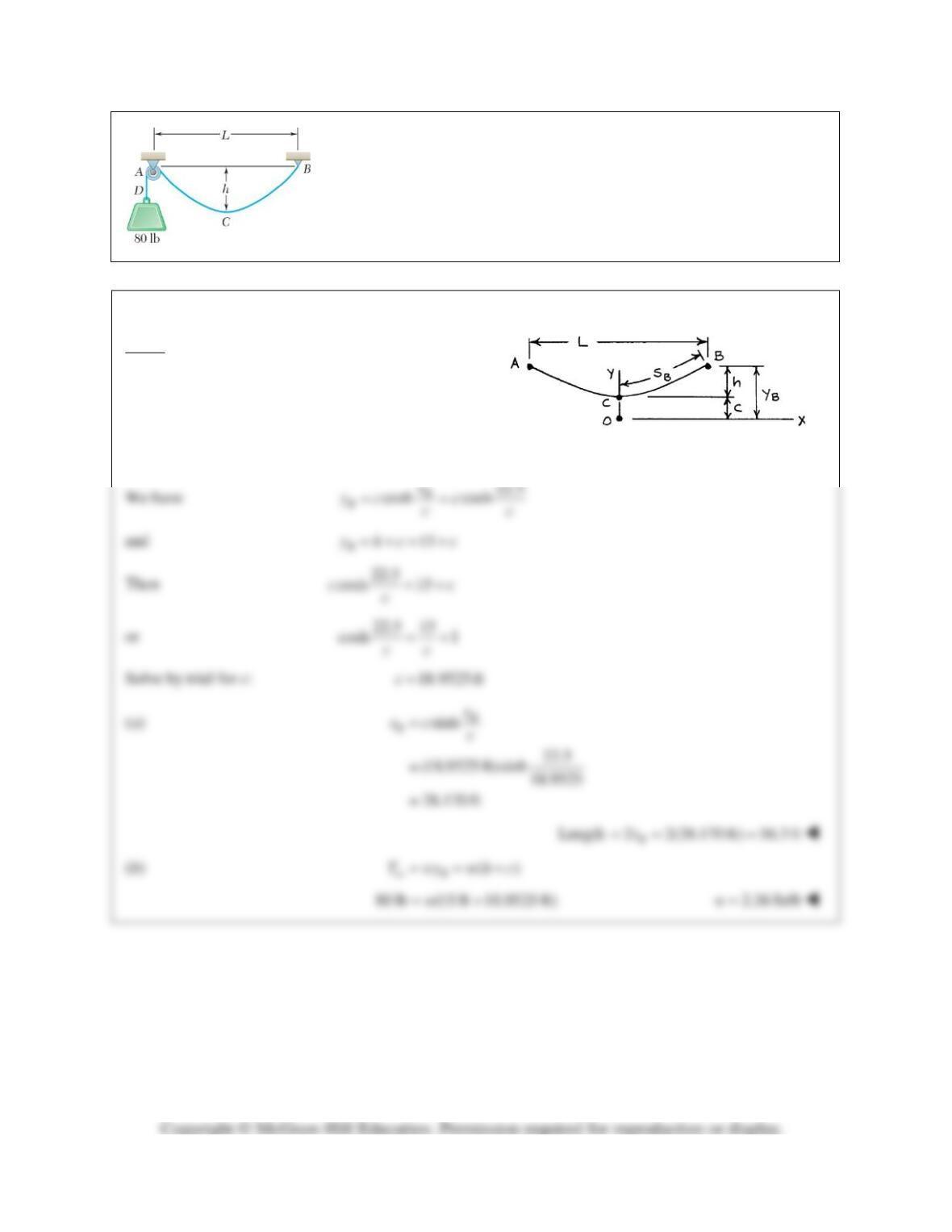
PROBLEM 7.135
A counterweight D is attached to a cable that passes over a small pulley at
A and is attached to a support at B. Knowing that L= 45 ft and h= 15 ft,
determine (a) the length of the cable from A to B, (b) the weight per unit
length of the cable. Neglect the weight of the cable from A to D.
SOLUTION
Given:
45 ft
15 ft
80 lb
22.5 ft
A
B
L
h
T
x
=
=
=
=
By symmetry:
80 lb
B Am
TTT= = =
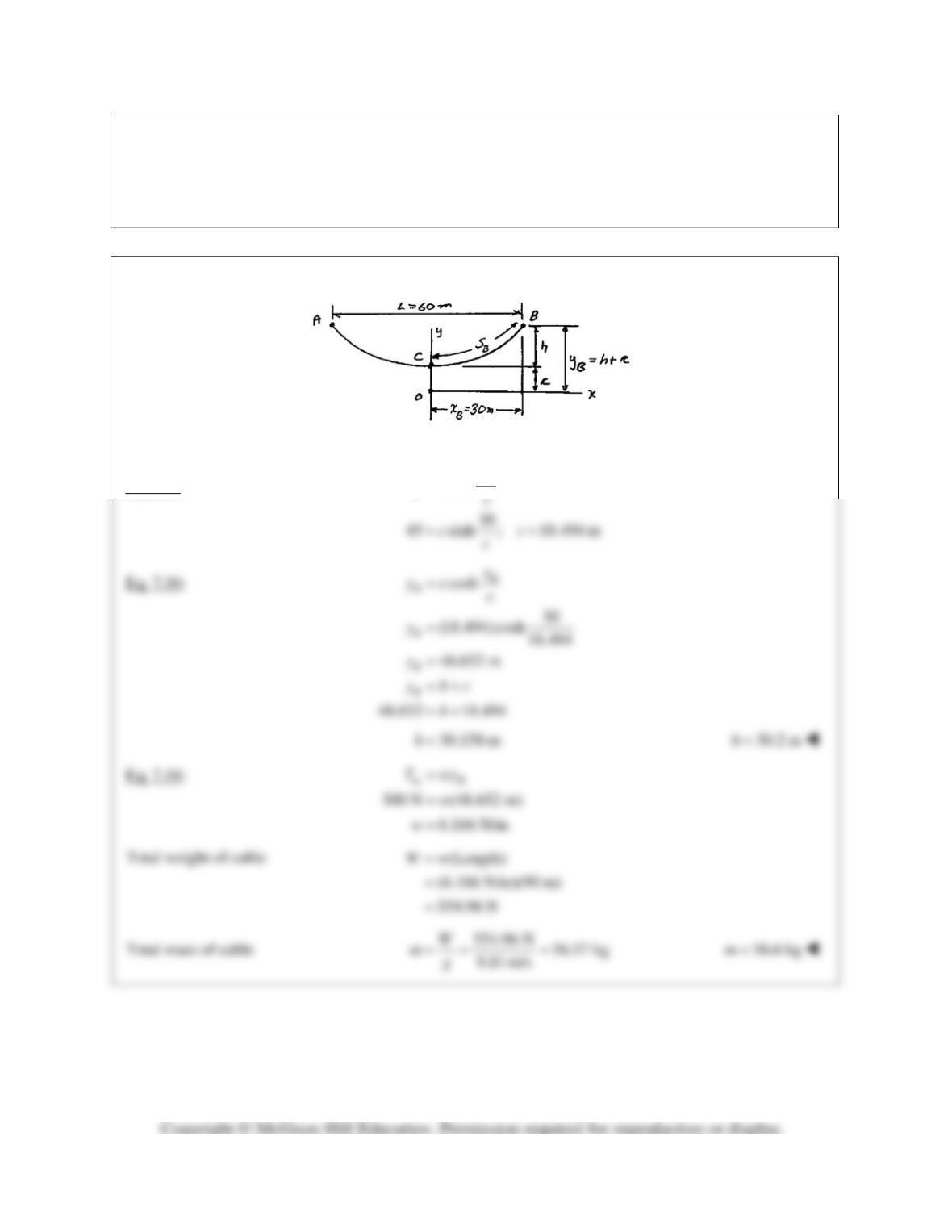
PROBLEM 7.136
A 90-m wire is suspended between two points at the same elevation that are 60 m apart. Knowing that the
maximum tension is 300 N, determine (a) the sag of the wire, (b) the total mass of the wire.
SOLUTION
45 m
B
s=
Eq. 7.17:
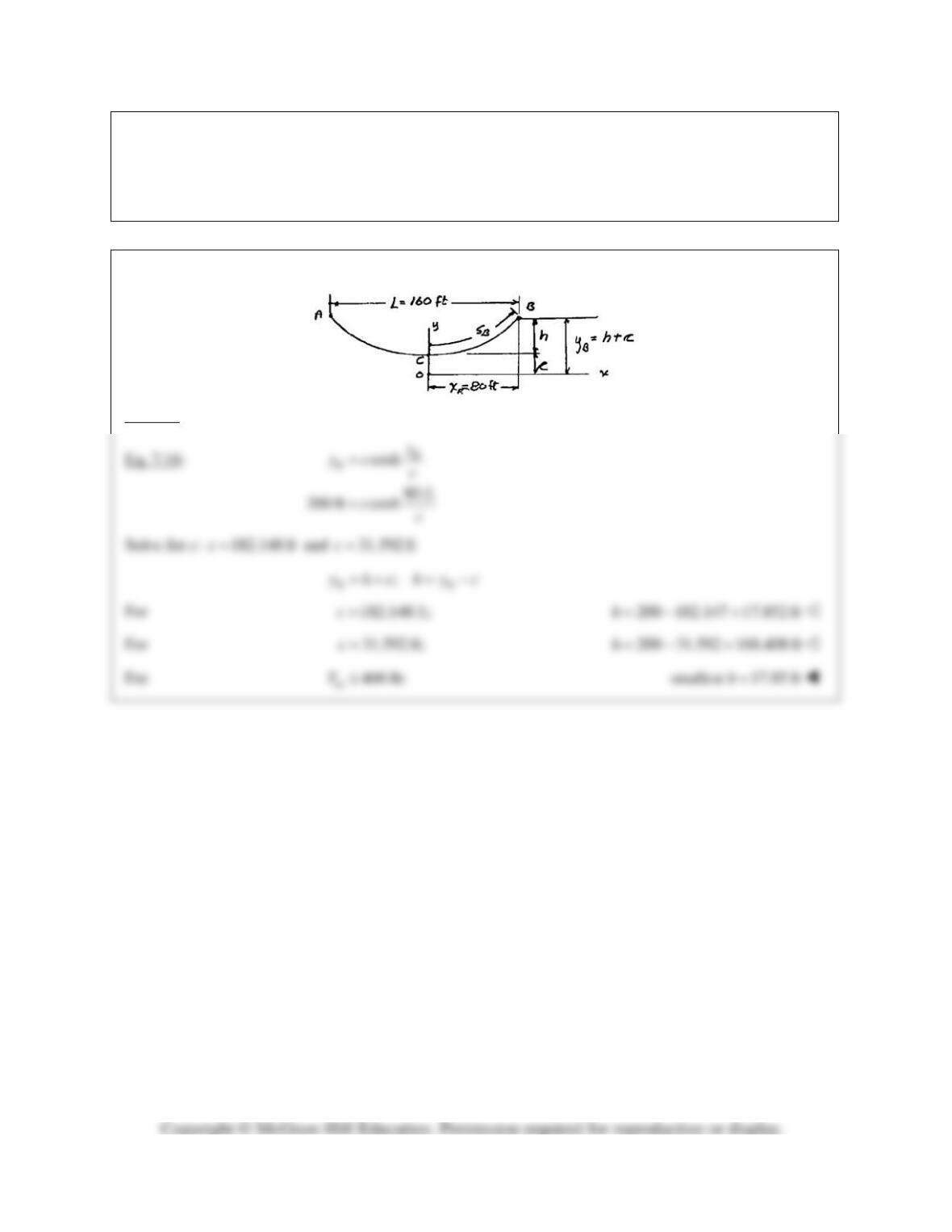
PROBLEM 7.137
A cable weighing 2 lb/ft is suspended between two points at the same elevation that are 160 ft apart.
Determine the smallest allowable sag of the cable if the maximum tension is not to exceed 400 lb.
SOLUTION
Eq. 7.18:
; 400 lb (2 lb/ft) ; 200 ft
m B BB
T wy y y= = =
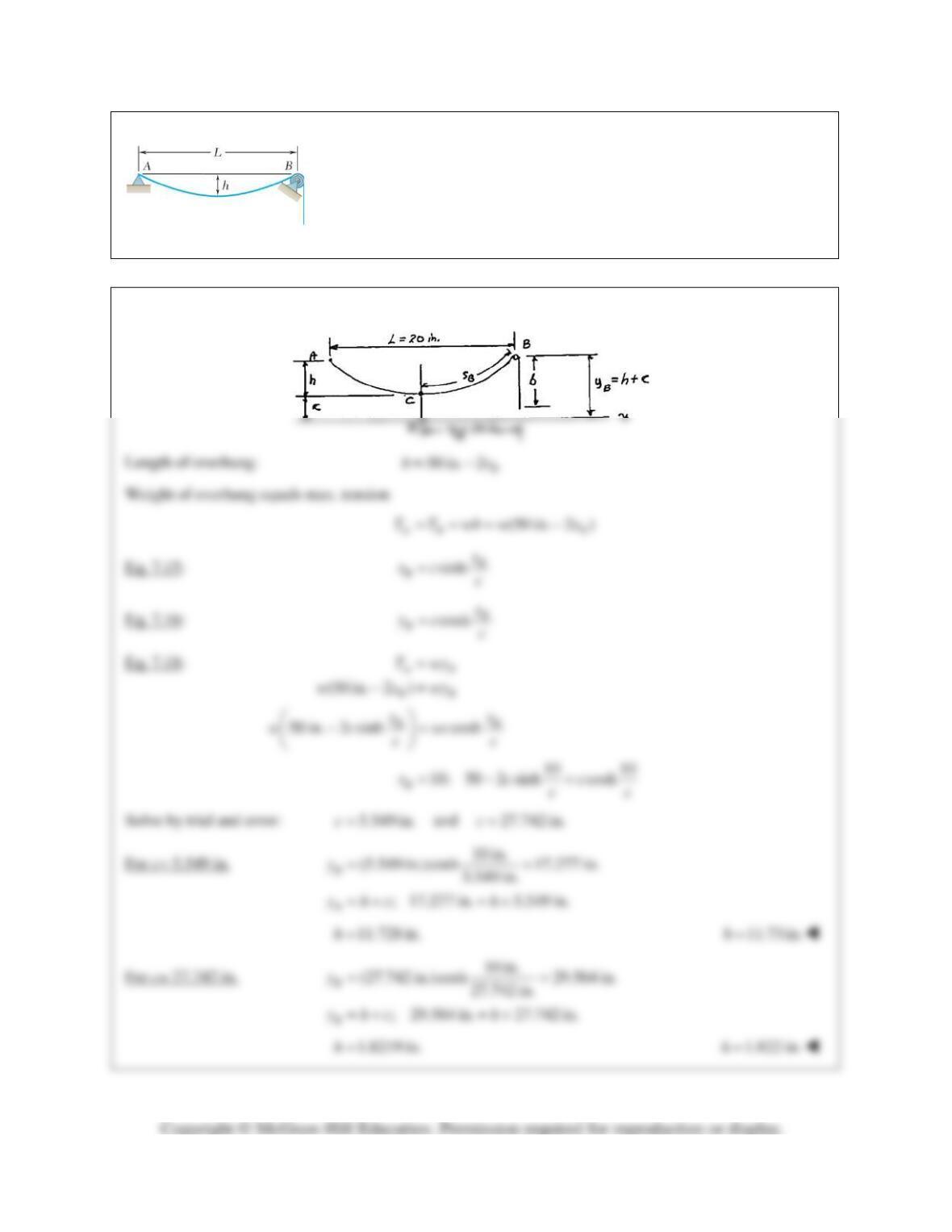
PROBLEM 7.138
A uniform cord 50 in. long passes over a pulley at B and is attached to a
pin support at A. Knowing that L= 20 in. and neglecting the effect of
friction, determine the smaller of the two values of h for which the cord is
in equilibrium.
SOLUTION
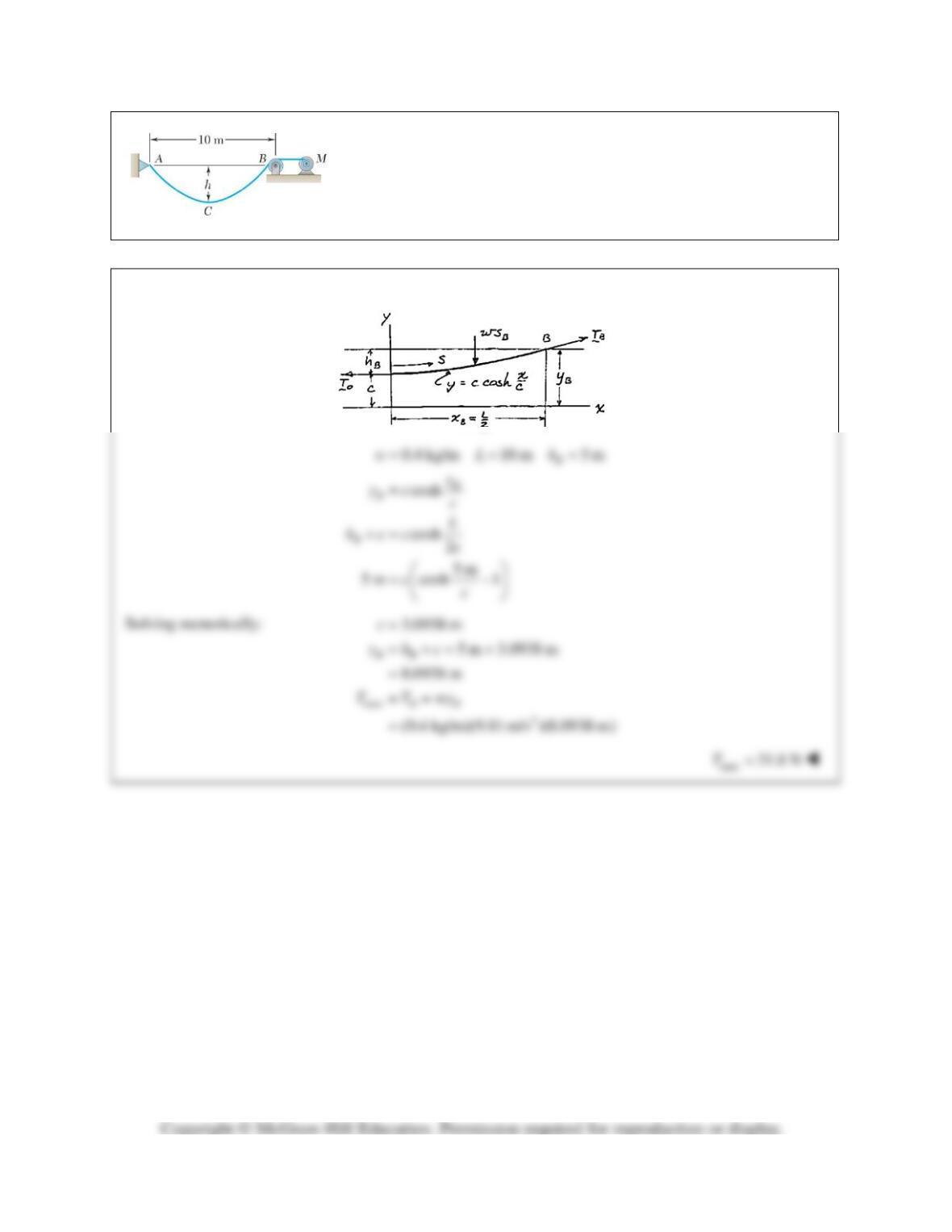
PROBLEM 7.139
A motor M is used to slowly reel in the cable shown. Knowing that the
mass per unit length of the cable is 0.4 kg/m, determine the maximum
tension in the cable when h= 5 m.
SOLUTION
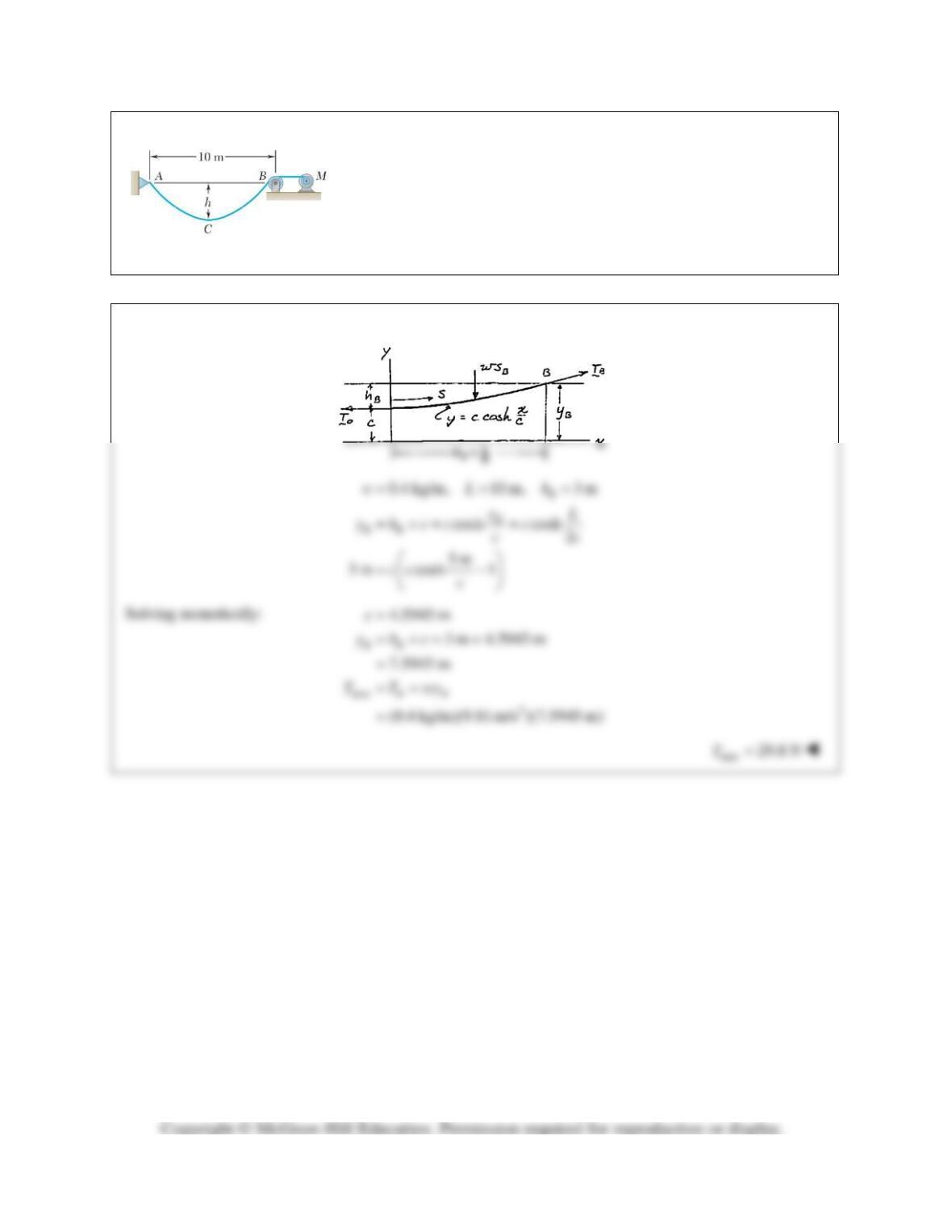
PROBLEM 7.140
A motor M is used to slowly reel in the cable shown. Knowing that the
mass per unit length of the cable is 0.4 kg/m, determine the maximum
tension in the cable when h= 3 m.
SOLUTION
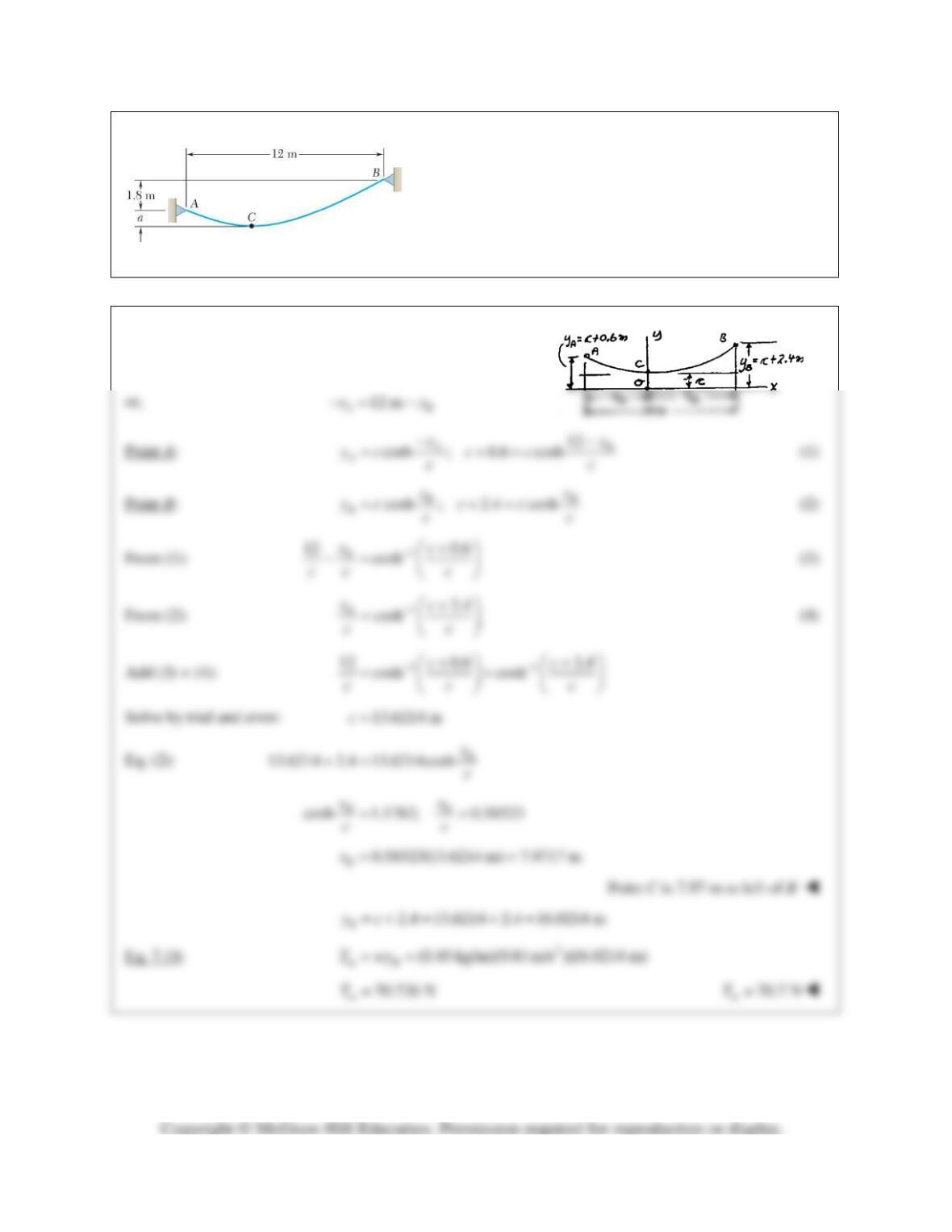
PROBLEM 7.141
The cable ACB has a mass per unit length of 0.45 kg/m.
Knowing that the lowest point of the cable is located at a
distance a= 0.6 m below the support A, determine (a) the
location of the lowest Point C, (b) the maximum tension in
the cable.
SOLUTION
Note:
12 m
BA
xx−=
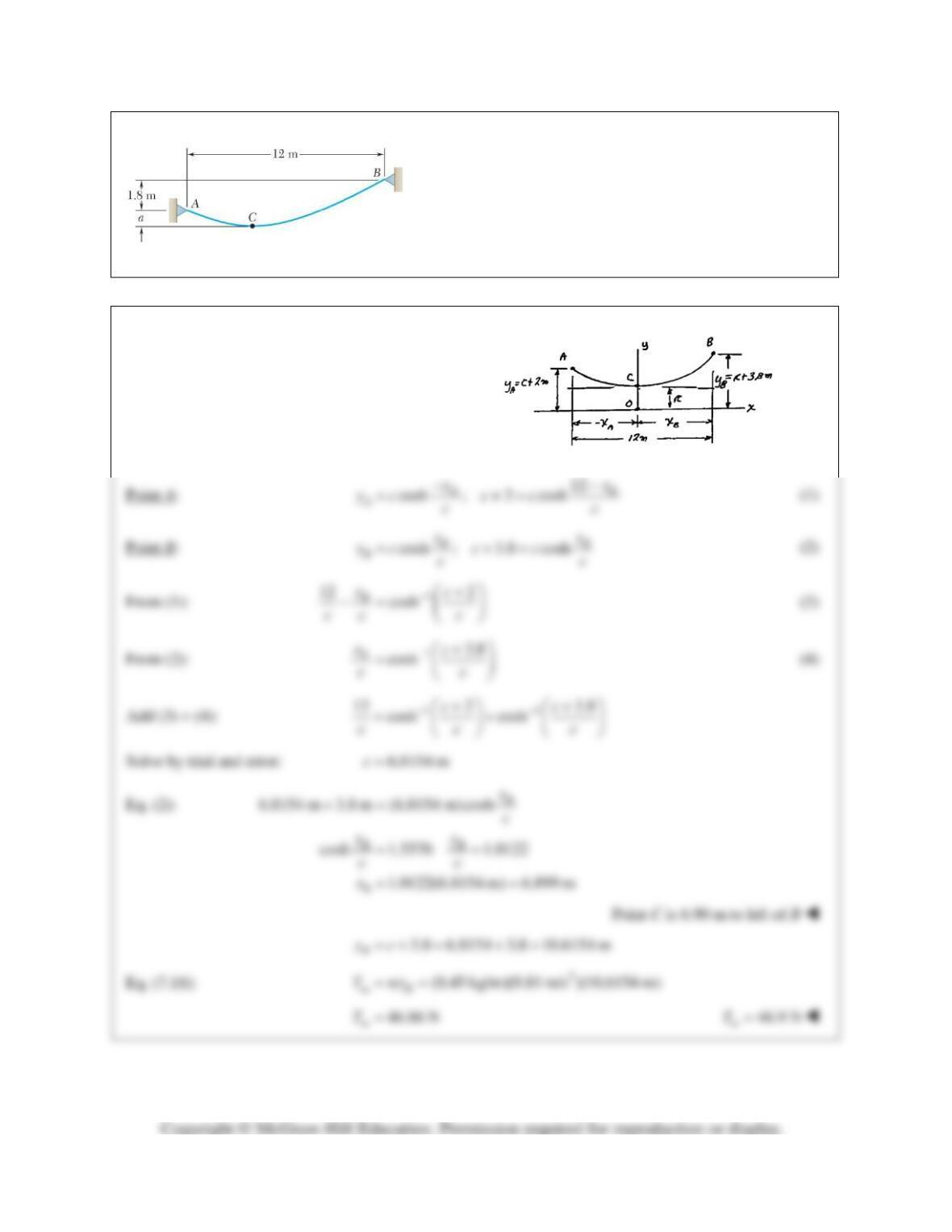
PROBLEM 7.142
The cable ACB has a mass per unit length of 0.45 kg/m.
Knowing that the lowest point of the cable is located at a
distance a= 2 m below the support A, determine (a) the
location of the lowest Point C, (b) the maximum tension in
the cable.
SOLUTION
Note:
12 m
BA
xx−=
or
12 m
AB
xx−= −
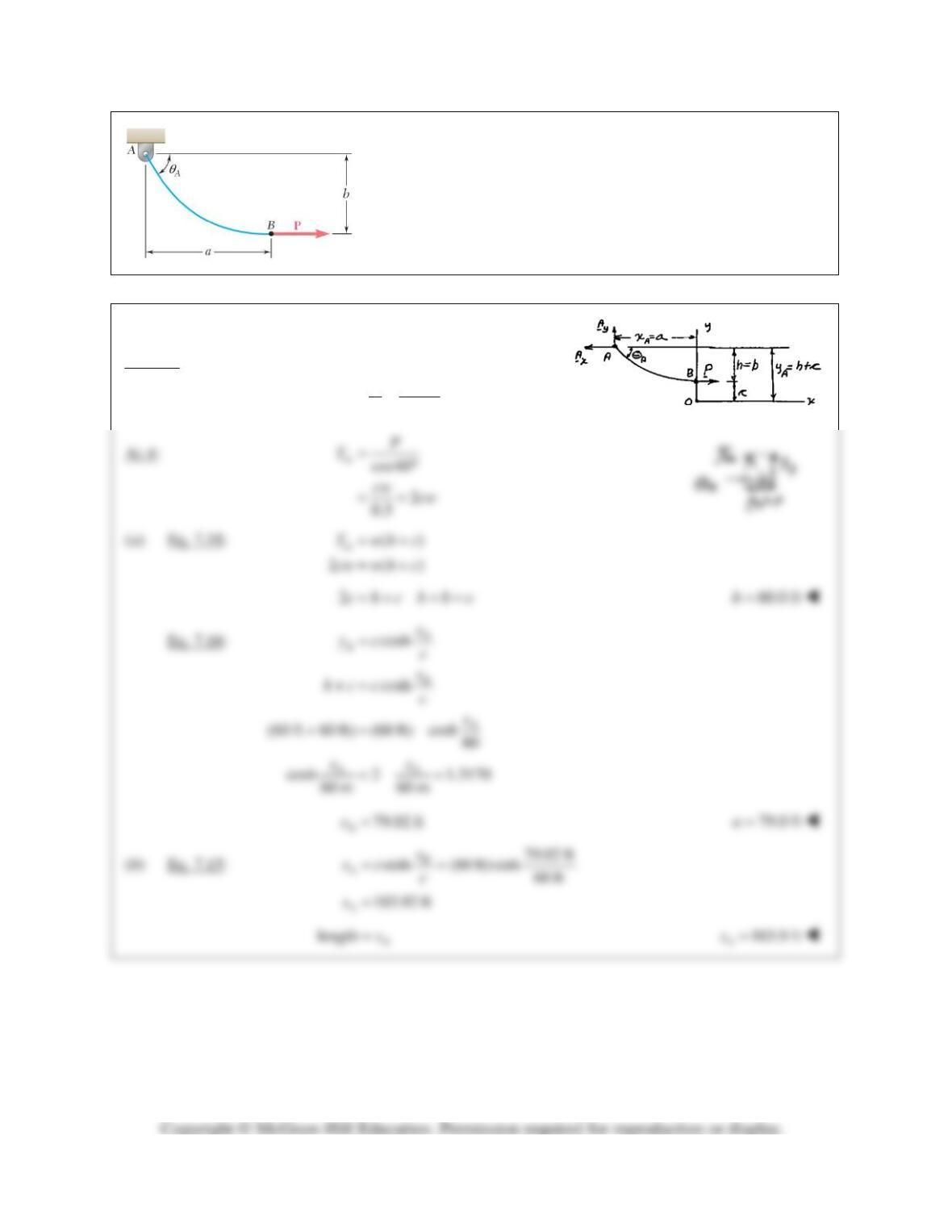
PROBLEM 7.143
A uniform cable weighing 3 lb/ft is held in the position shown by a
horizontal force P applied at B. Knowing that P=180lband
θ
A =60°,
determine (a) the location of Point B, (b) the length of the cable.
SOLUTION
Eq. 7.18:
0
180 lb 60 ft
3 lb/ft
T P cw
P
cc
w
= =
= = =
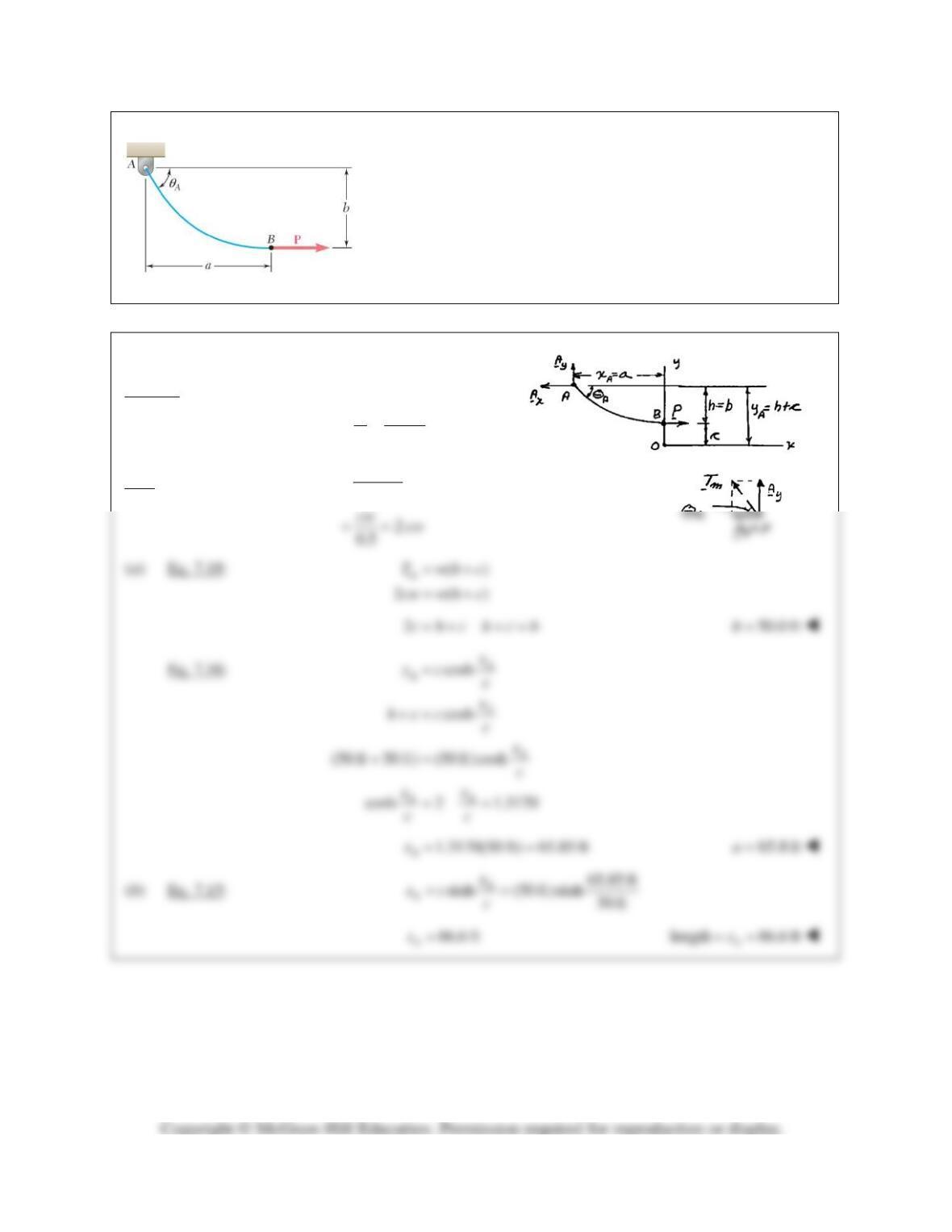
PROBLEM 7.144
A uniform cable weighing 3 lb/ft is held in the position shown by a
horizontal force P applied at B. Knowing that P =150lband
θ
A=60°,
determine (a) the location of Point B, (b) the length of the cable.
SOLUTION
Eq. 7.18:
0
150 lb 50 ft
3 lb/ft
T P cw
P
cw
= =
= = =
At A:
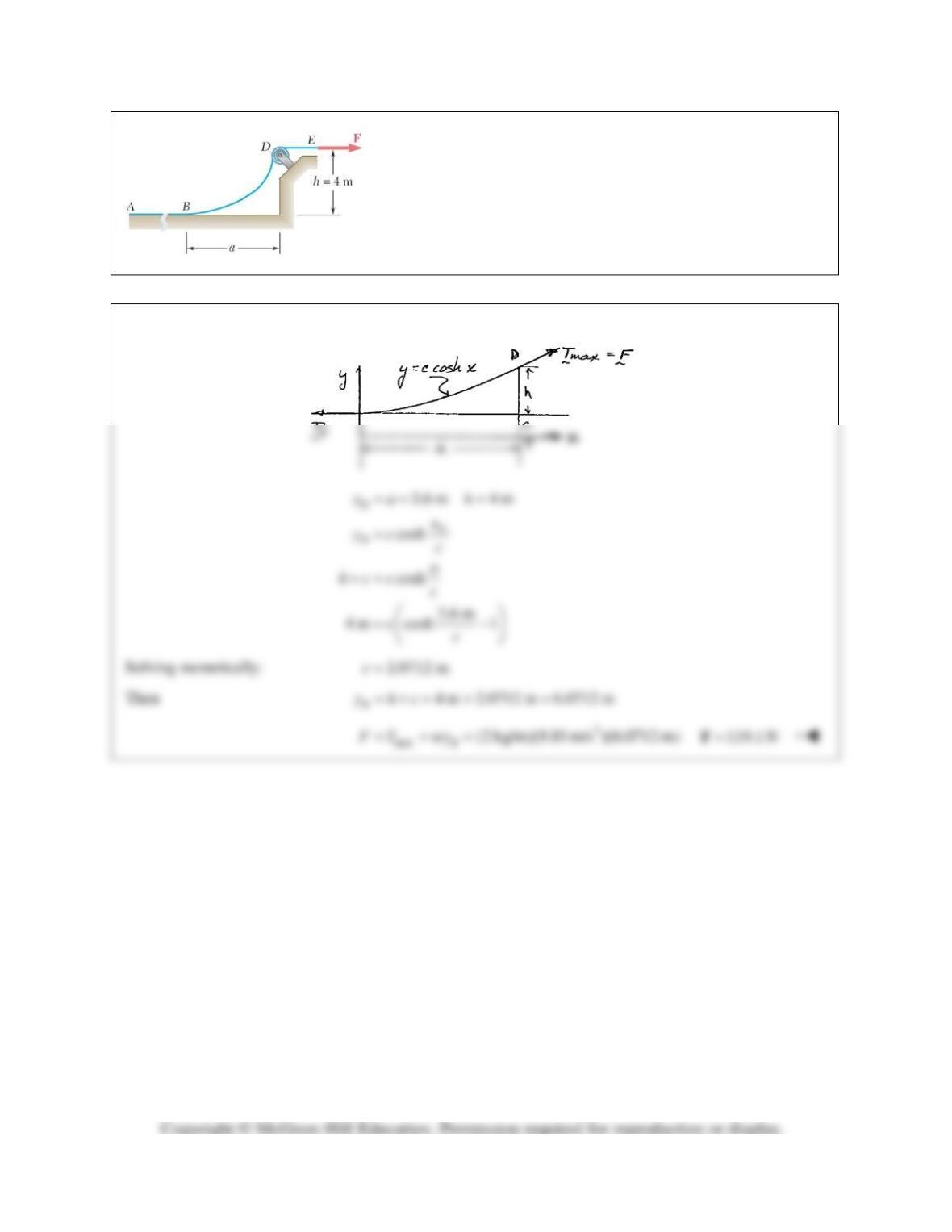
PROBLEM 7.145
To the left of Point B the long cable ABDE rests on the rough
horizontal surface shown. Knowing that the mass per unit length
of the cable is 2 kg/m, determine the force F when a= 3.6 m.
SOLUTION
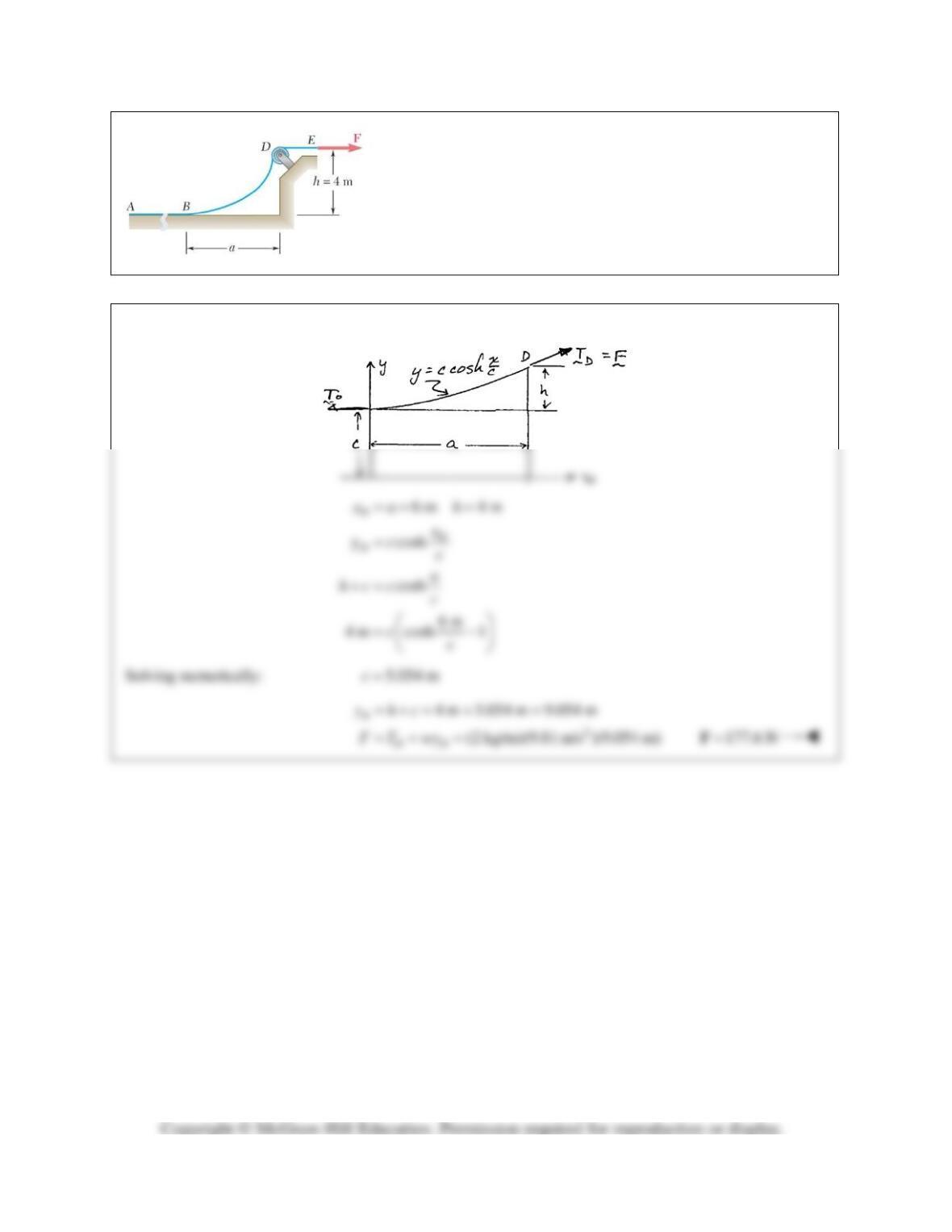
PROBLEM 7.146
To the left of Point B the long cable ABDE rests on the rough
horizontal surface shown. Knowing that the mass per unit length
of the cable is 2 kg/m, determine the force F when a= 6 m.
SOLUTION
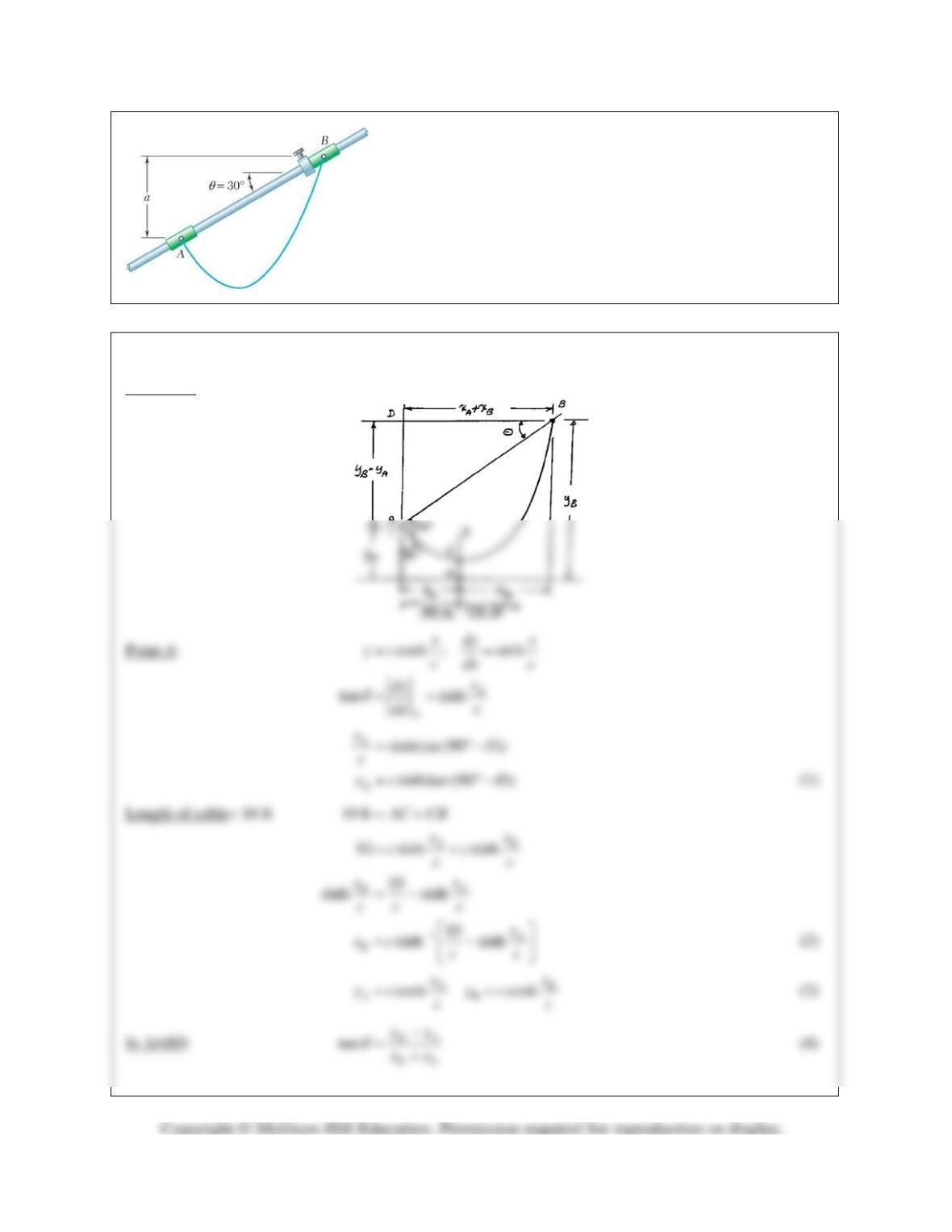
PROBLEM 7.147*
The 10–ft cable AB is attached to two collars as shown. The
collar at A can slide freely along the rod; a stop attached to the
rod prevents the collar at B from moving on the rod. Neglecting
the effect of friction and the weight of the collars, determine the
distance a.
SOLUTION
Collar at A: Since
0,
µ
=
cable ‘ rod
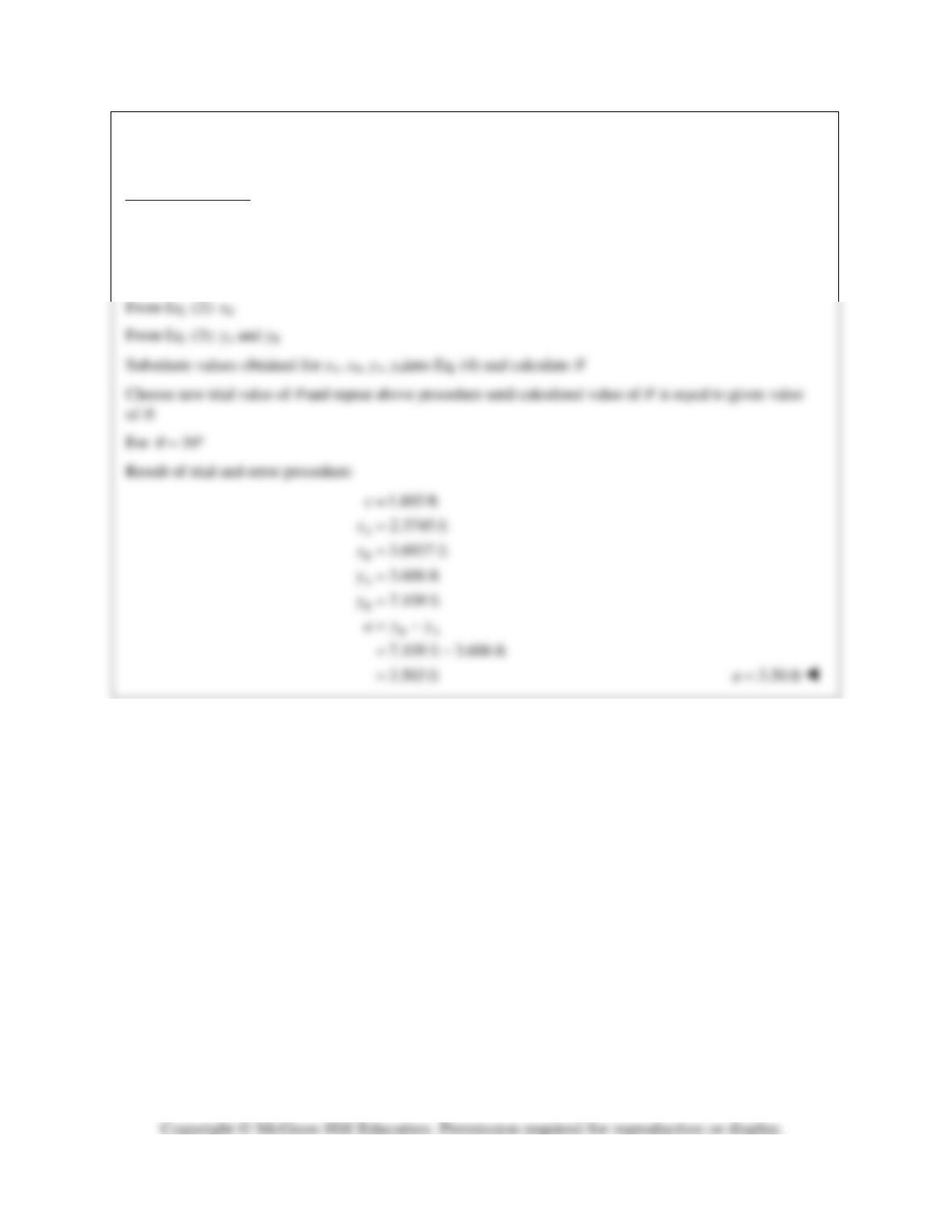
PROBLEM 7.147* (Continued)
Method of solution:
For given value of
θ
, choose trial value of c and calculate:
From Eq. (1): xA
Using value of xA and c, calculate:
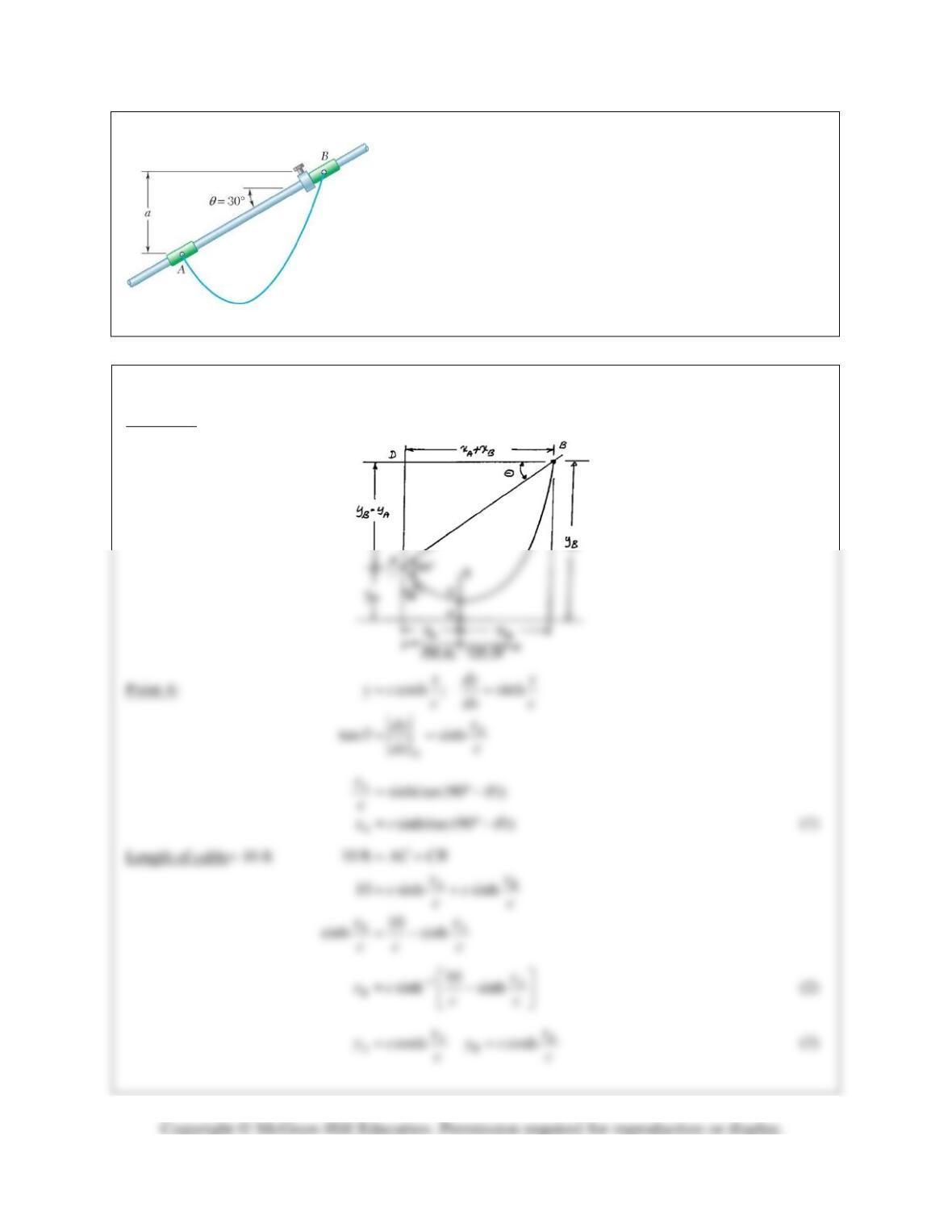
PROBLEM 7.148*
Solve Problem 7.147 assuming that the angle
θ
formed by the
rod and the horizontal is 45°.
PROBLEM 7.147 The 10-ft cable AB is attached to two collars
as shown. The collar at A can slide freely along the rod; a stop
attached to the rod prevents the collar at B from moving on the
rod. Neglecting the effect of friction and the weight of the
collars, determine the distance a.
SOLUTION
Collar at A: Since
0,
µ
=
cable ‘ rod
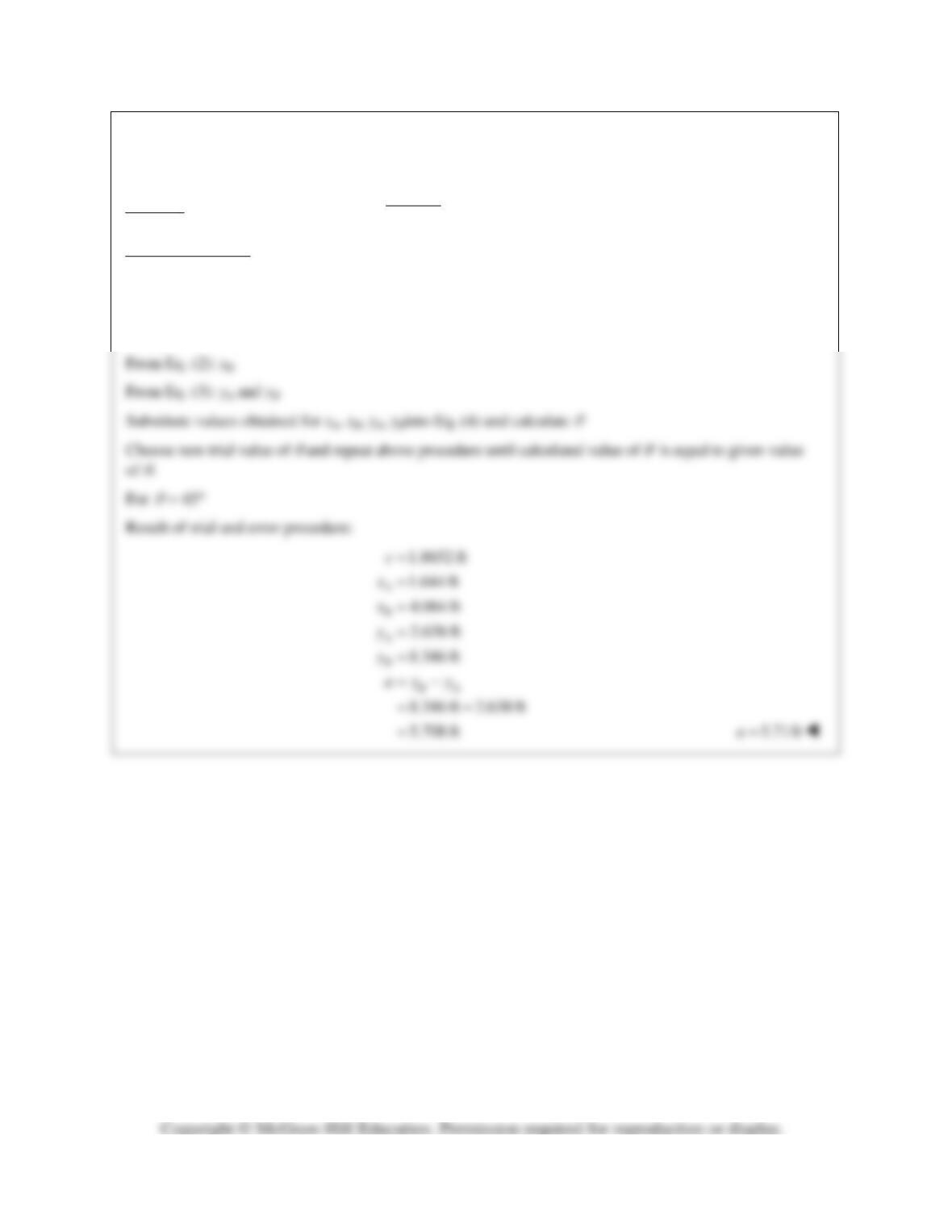
PROBLEM 7.148* (Continued)
In ∆ABD:
tan BA
BA
yy
xx
θ
−
=+
(4)
Method of solution:
For given value of
θ
, choose trial value of c and calculate:
From Eq. (1): xA
Using value of xA and c, calculate:
PROBLEM 7.149
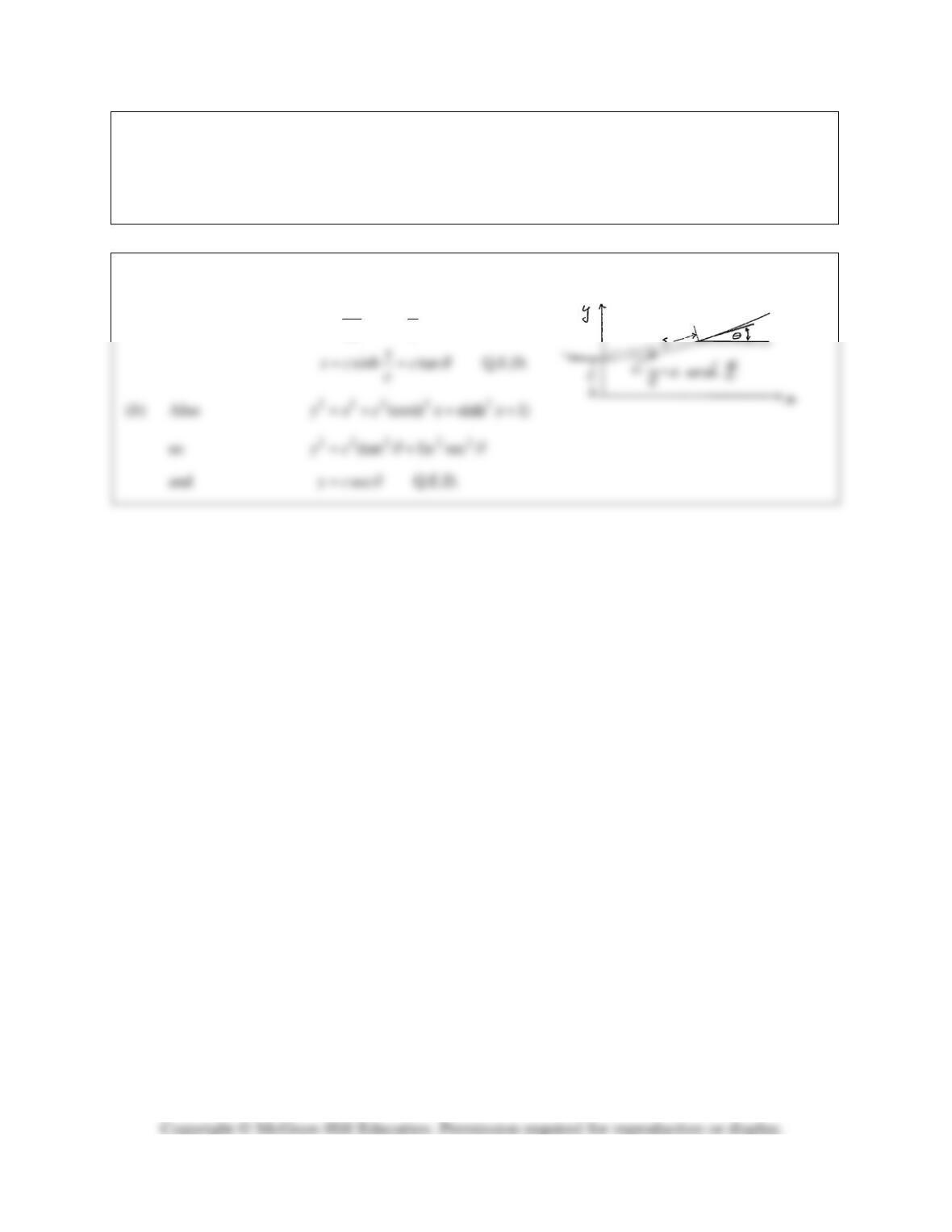
Denoting by
θ
the angle formed by a uniform cable and the horizontal, show that at any point (a) s = ctan
θ
, (b) y=c sec
θ
.
SOLUTION
(a)
PROBLEM 7.150*
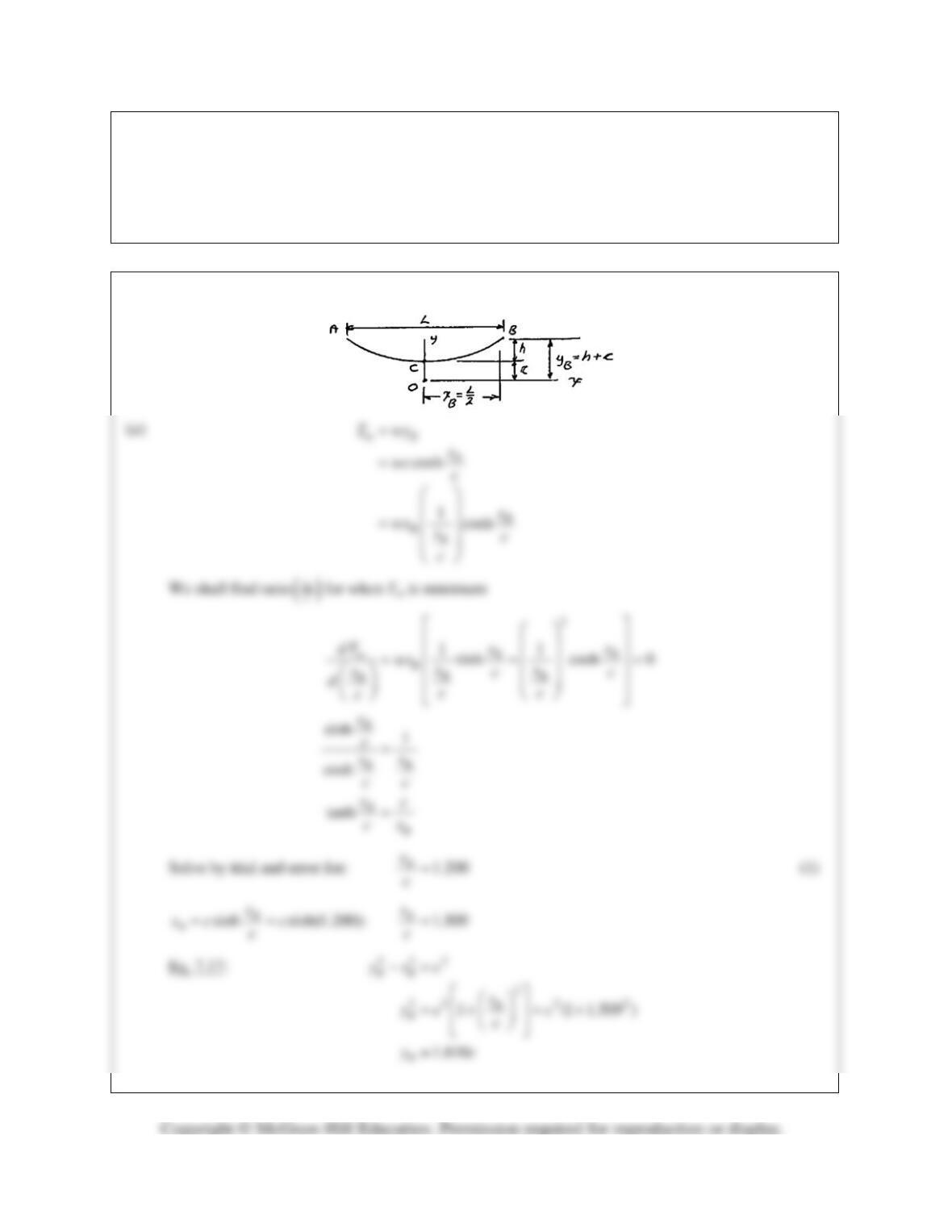
(a) Determine the maximum allowable horizontal span for a uniform cable of weight per unit length w if
the tension in the cable is not to exceed a given value Tm. (b) Using the result of part a, determine the
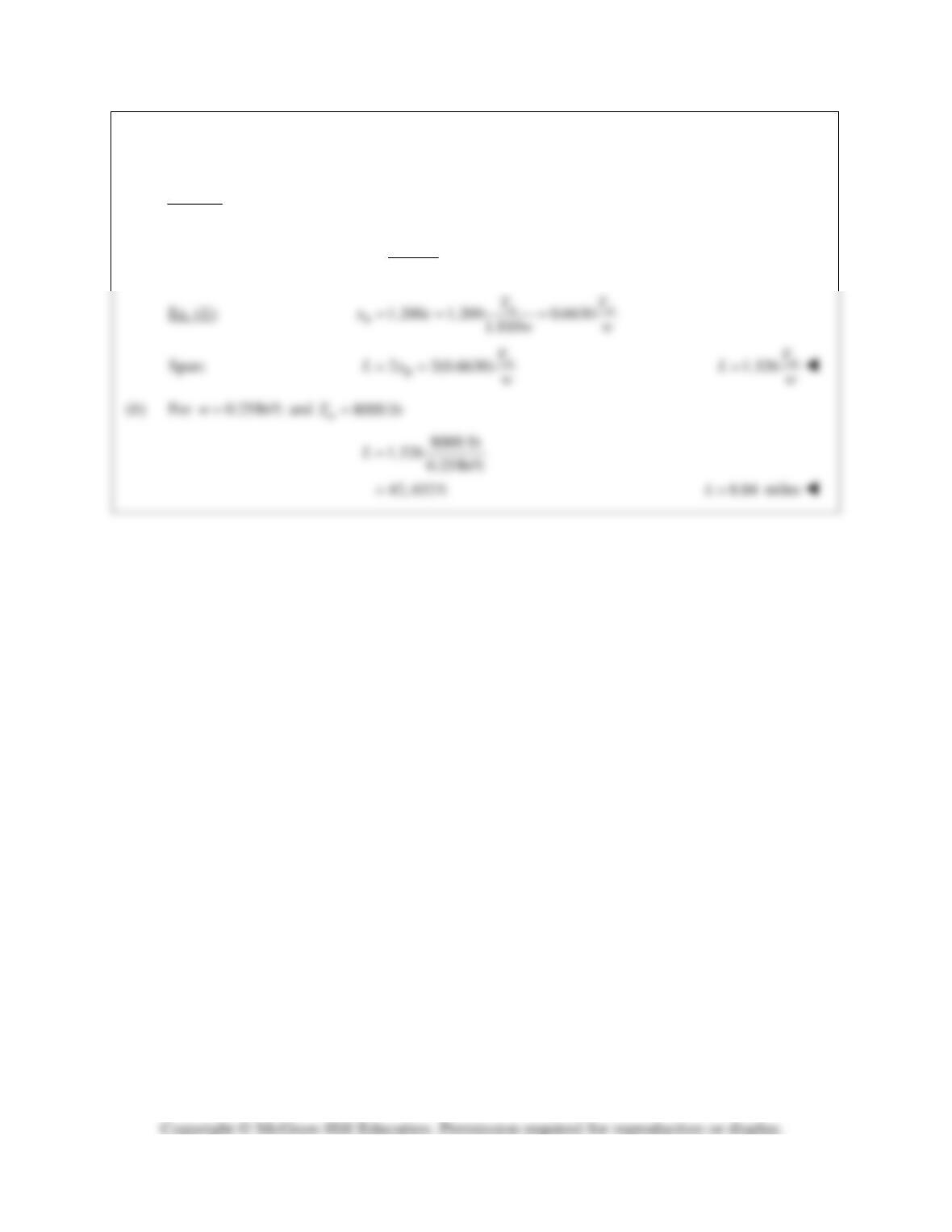
maximum span of a steel wire for which w= 0.25 lb/ft and Tm= 8000 lb.
SOLUTION
PROBLEM 7.150* (Continued)
Eq. 7.18:
1.810
1.810
mB
m
T wy
wc
T
cw
=
=
=